The Source of the Lune
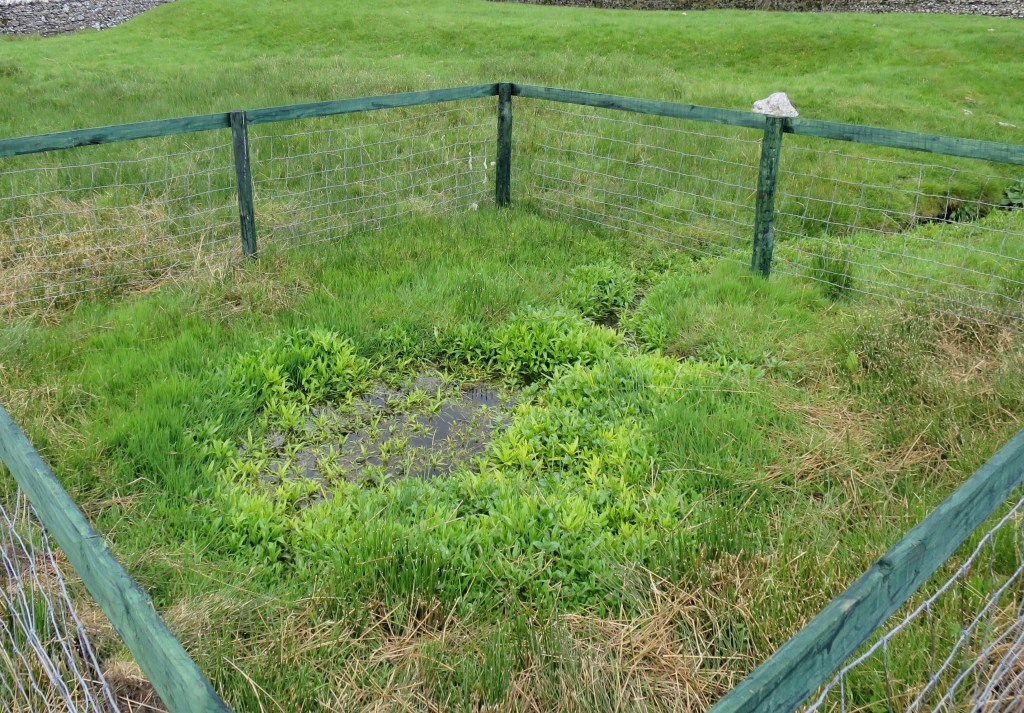
“She just jumped in, disappeared – it’s deep, no one knows how deep, dangerous, that’s why we’ve fenced it off now. Then popped up, her head and face covered in bright green weed, and set off swimming – well, paddling actually – towards Glasson Dock.”
He’s squatting outside his greenhouse, cutting a circle of green plastic an inch bigger than the metal disc lying on it. I’m intrigued, want to see what he’s making. But he’s happy to stop while he talks, resume when I’ve gone. He’s talking about the woman who swam the length of the Lune. “For charity, I suppose. She got a good send-off.”
The Lune’s source (source is French for spring) is a resurgence (another word from the French), a stream that disappears into the limestone rock and emerges elsewhere as a spring. The nymph Arethusa, fleeing from the predator Alpheus, leaped into a stream in Greece, and emerged in a spring in Sicily. And this, poetically, is a resurgence. Geologically, it is a stream that disappears in one place and reappears in another.
I think of the résurgence at the foot of the Cathar stronghold of Montségur, where the priestess hid the sacred head from the besieging French army. And of the fathomless Fontaine de Vaucluse, where Petrarch wrote his sonnets to Laura. Springs have mystical and spiritual significance. In France I used to confuse sourcier, water diviner, with sorcier, magician. Why all this French? I am still finding my bearings, having connected Lune with lune.
And springs were access-points to the other-world – gifts, inscriptions, broken weapons were dropped in as dedications, falling to who knows what depth. For Christians they were places of transformation, healing, purification – each church has a font, which means spring.
When Claire de Lune, as I’ve taken to calling her, leaped into St Helen’s spring, as she descended, what whisper, deep down, did she hear of its origin, of where it came from … before she emerged, weed-covered, silent, and set off towards the sea …?
This spring became St Helen’s Well, with a chapel, long gone, dedicated to the mother of Constantine, who brought Christianity to the Empire, discovered the True Cross under a temple to Venus she’d demolished, and built there the Church of the Holy Sepulchre. The source of the Lune is a source named for the source of Christianity in the West.
There is a stream flowing from the spring, small but well incised. But the heroic woman must have walked a long way before the river was deep enough to swim in.
Far more water feeds the Lune from the streams flowing from the Howgill Fells to the south. And if the longest was included, it would lengthen the river. But this is the true source of the Lune.
I make my dedication, and set off, towards Glasson Dock.
Walking the Lune through Lunesdale.
From the spring the Lune once flowed unimpeded through Newbiggin-on-Lune. Now it is culverted four times before it escapes under an old stone bridge, weed streaming like Ophelia’s hair. Heading west, it picks its way across the wide lumpy valley, through the till of clay and stones left by the last glacier. In the six miles to Tebay it grows from a two-feet wide stream to a twenty-feet river, fed by a dozen tributaries from the Howgills to the south. It is wide and shallow, flowing between white shingle; but with banks, reinforced after Storm Desmond, bulwarked with Cyclopean stones.
It is a bright spring day, my first day following the river from its source. The last of the cherry blossom – in a breath of wind it falls like confetti at a wedding – the first of the scented hawthorn. There are bluebells and cowslips, primrose and orchids.
A heron heaves up from the stream, then a pair of whirring synchronised mallard. A hare! Tall, alert, and then gone.
There are sheep and lambs everywhere, heads up, stock still as I pass, lambs’ propeller ears twitching. I am quickly in Pre-Raphaelite allegories. This lamb, in the midst of sheep, commanding beyond its age, is Christ among the Doctors. That one, alone and blindingly white, is an image of the Transfiguration. There are lambs with tiny horns, like the satyrs in Botticelli’s ‘Venus and Mars’.
A large brown horse with large shaggy hooves, as if it is wearing lamp shades. Two lapwing fly across, black, white.
The path leads into a farmyard. The young farmer is holding the skinned body of a lamb, thin as a rabbit, guts hanging out, as he tussles to wrap the skin around a larger, wriggling lamb, tying it on. He smears the thin body, blood and guts, onto the tied-on skin. Released, the lamb bounds away. ‘Lost it this morning. Messy job, but it’s got to be done.’ I’ve read about it many times, how to get a sheep to adopt an orphaned lamb, never seen it. Fell farming. I walk on.
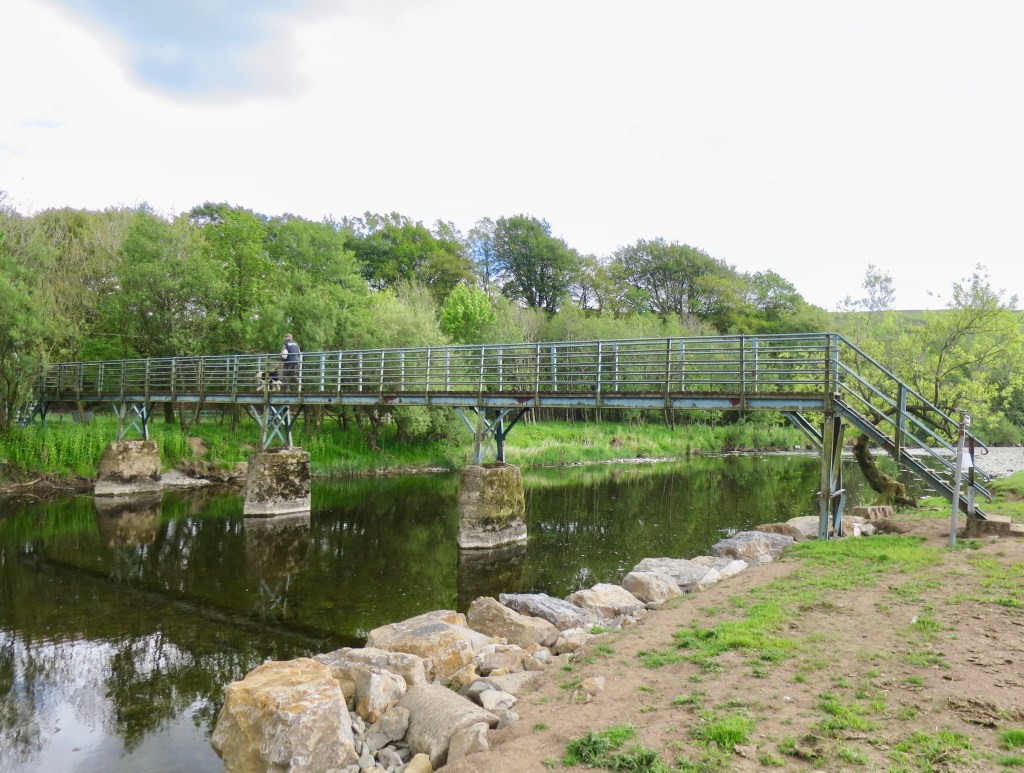
This fifteen-foot high pedestrian bridge was submerged in Storm Desmond, the old farmer tells me. One tooth, dog glued to his calf, he worked fifteen years on the railway to buy his farm, hated every minute. Now he’s up at four, bed at ten, his own man, knows every inch, every animal. Proud of the otters that are back, even of the ducks, allows no shooting on his land, hates the fishing for salmon, ‘jerking them about – they’re pregnant!’ For the first time, hasn’t seen a single dead salmon (they spawn and then die) this year.
In Tebay, a man carries an armful of mannequin body parts out of the church. ‘I’ll not ask.’ ‘Best not.’ ‘More inside?’ ‘Plenty’, as he stacks them in the van.
Hitting the hard rock of the Westmorland Supergroup (definitely the name of my next band) (Ordovician, 450 million years old) of the Lake District massif at Tebay, the river is turned sharp south, along the fault line of the Lune Gorge.
The river, the Roman road, A685, West Coast railway, M6 are all crammed into this narrow pass between Lake District and Yorkshire Dales. But what might be visual overload is eased by the long relaxed flank of the Howgills to the east, relief to the weary eyes of train and motorway passengers, its rounded rock softened by velvet grass, the shadows of passing clouds like smoothing hands.
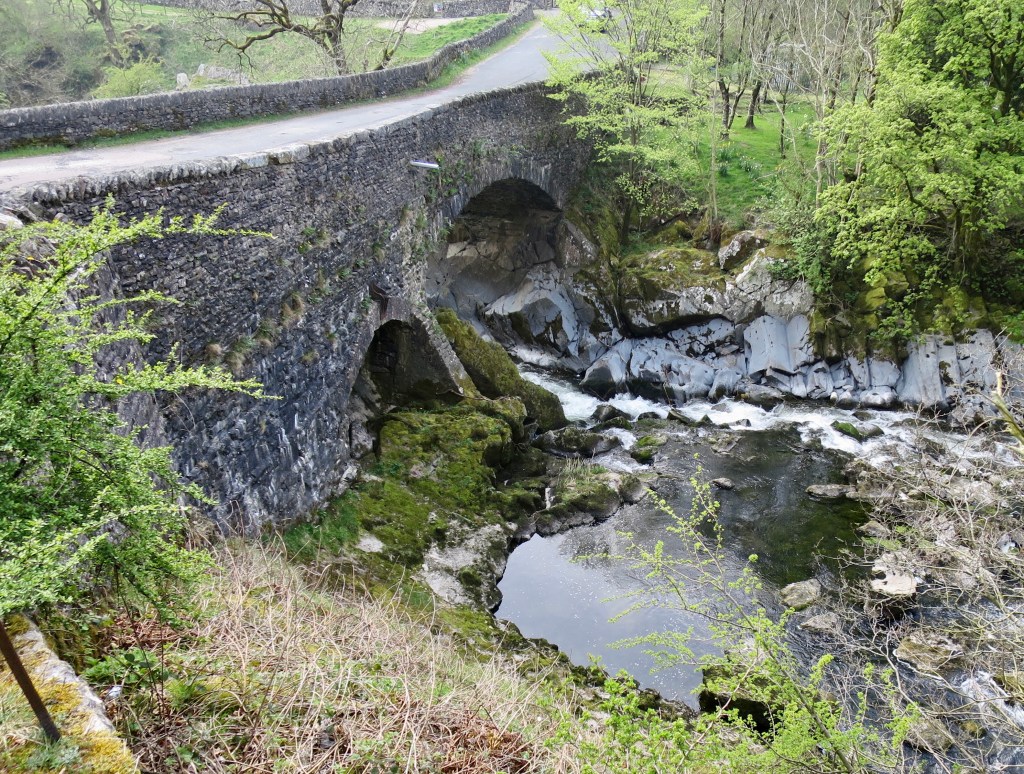
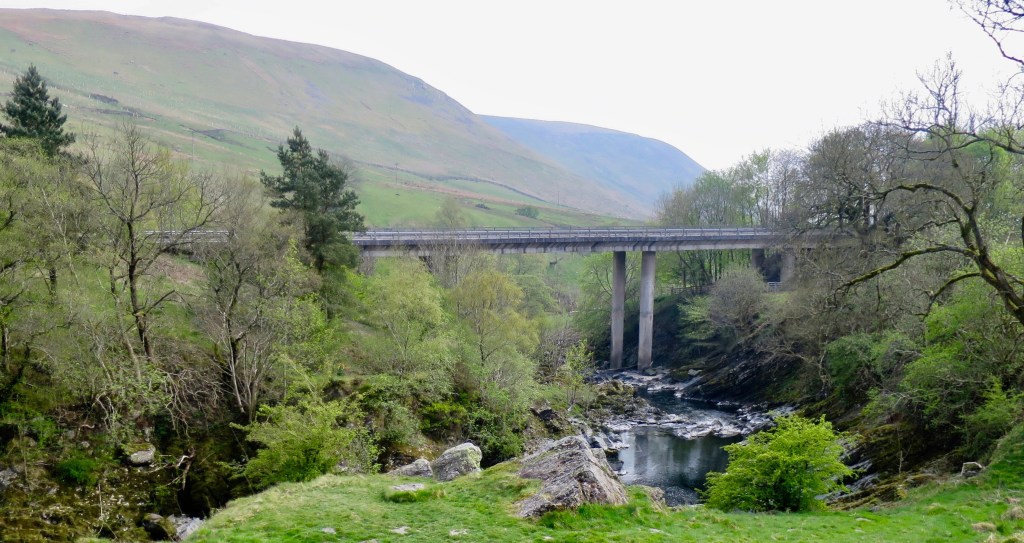
Two bridges together.
The old bridge is of stone, with abutments growing out of the rock, forces contained and transferred down into the rock, arches curving up to meet like the tips of steeple fingers.
The new bridge is concrete and steel, horizontals and verticals, forces defied and neutralised by contraries.
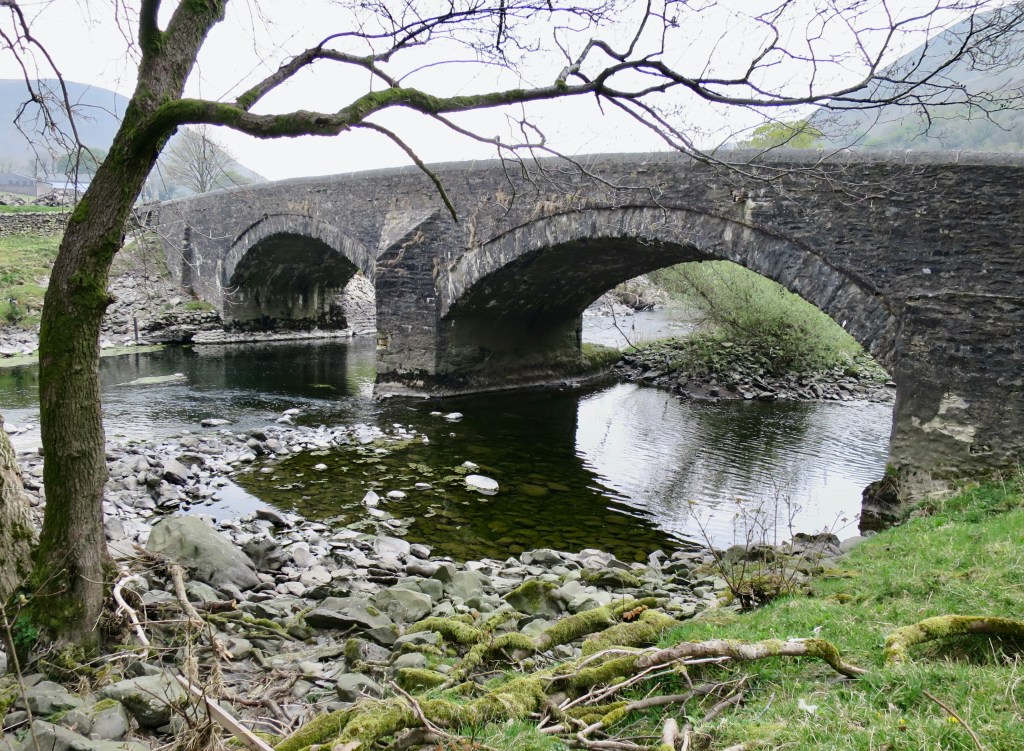
After wide open, bare grass Lunesdale, the Gorge is a narrow linear wood of variety and dappling shade, trees that grow on either side and over a river carved into rock, its nature ever changing. Here a deep pool, transparent as amber, with a shadowy trout deep down. Here it ripples, rattles, dazzles over and between white stones, creating miniature rapids – I imagine miniature people in miniature boats running them. Here a long stretch of dark water, with long jagged submerged rocks like prehistoric megacrocodiles. Terns, heron, a mewing buzzard, wagtails. A sudden spark of emerald/sapphire flashes bullet-like upstream. There are narrow stone bridges that cars creep across, wing mirrors pulled in. This one has two arches like stern eyebrows.
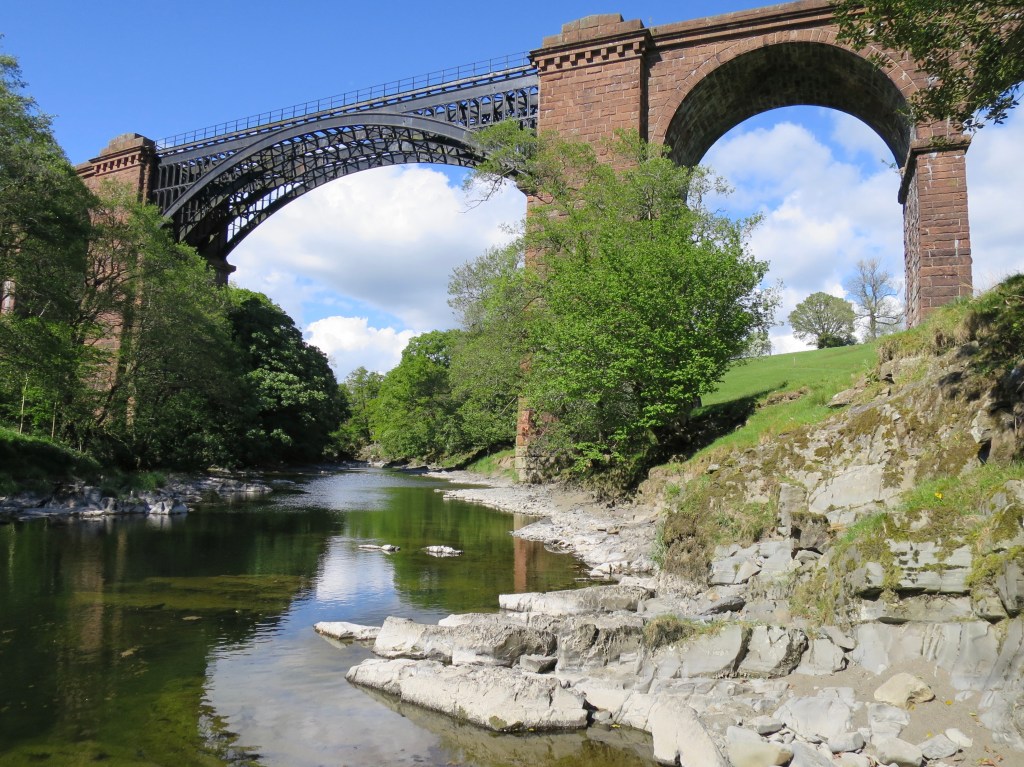
And then:
It is huge, and unexpected, the Waterside Viaduct. 570 feet long, 100 feet high, stepping across the valley, three arches on each side of the river, built of alien Penrith sandstone red as brick, linked by a metal central arch. Hard to believe that this was built to carry a minor railway line, from Ingleton to Lowgill near Tebay. Such was the railway mania of the 1850s. I resolve to map all the lost lines, and imagine them today as cycle paths.
Now the valley opens out into Lonsdale.
The Lune through Lonsdale
At some time in the Ice Age, the Lune emerged from the Gorge, into a wide-spreading landscape, and onto the relict mile-wide bed of a great river that had flowed two million years before. Across which today it curves and meanders. It is like the track of a post-apocalypse tribe wandering on the lost highway of a great civilisation. On the geological map it is a blue line wiggling across a yellow stripe.
The Romans, with their thread of road and beads of camps and milestones – still there – followed the valley as their route north. As did the Normans, with their motte and bailey castles – also still there. But at some time the main road migrated west, to what became the A6, through Kendal and Penrith, leaving Lonsdale – the name for the lower Lune valley – to pastoral farmers. And to wealthy incomers: dukes, bankers, industrialists, who amassed large estates and built big houses.
So this landowner can regulate passage along a seven-mile stretch of the river – ‘permission to paddle’ only from November to March, groups only, no individual paddlers, ‘no access or egress is permitted to the river bank’, ‘Paddlers must not stop or play on the river’.
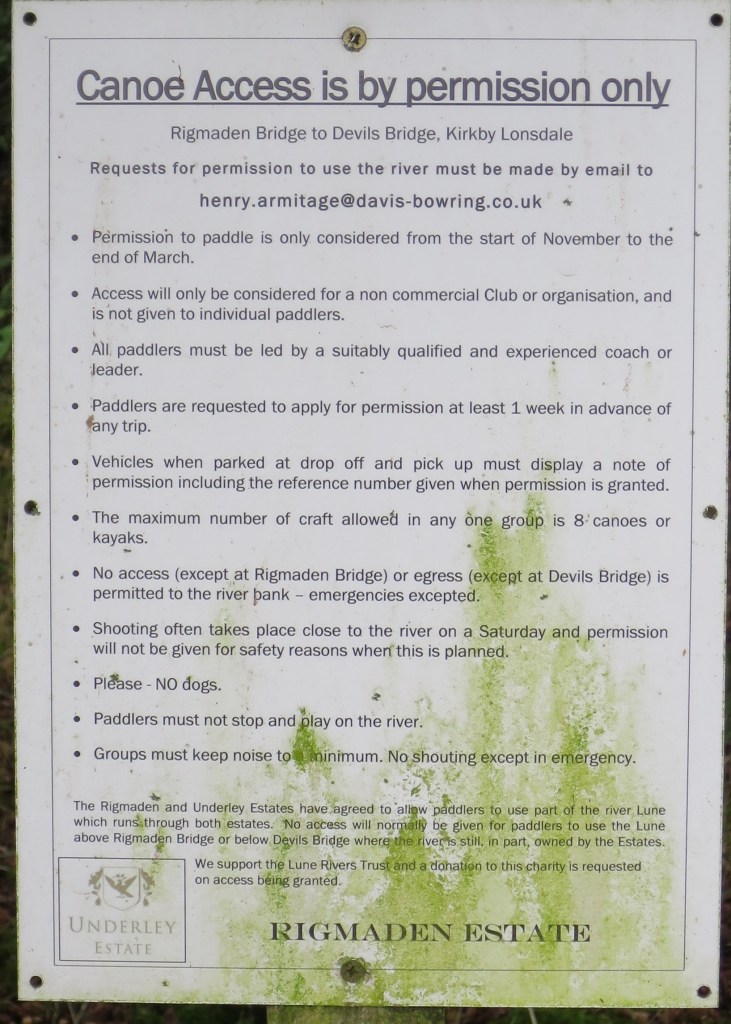
And this bridge, the most elaborate on the whole river, was built to connect the Hall to the estate fields, nothing else. While half a mile upstream farmers and villagers had to wade through water on the ford.

Since my cycling days here, the farming villages, like pearls along the thread of the Roman road, have been substantially gentrified, with many houses, even the smallest cottages, done up, and shops and pubs either closed or delicatessened and gastro-ised … But this is so everywhere.
And at some time in the eighteenth century the Lune emerged from the Gorge into consciousness. Or, rather, into our consciousness of ‘Landscape’, as an object to be viewed, and consumed aesthetically; to be located within the shorthand of the Picturesque, the Beautiful and the Sublime. “Examine the face of the country by the rules of picturesque beauty,” William Gilpin commanded in 1768.
In 1769, Thomas Gray, as we’ll come to.
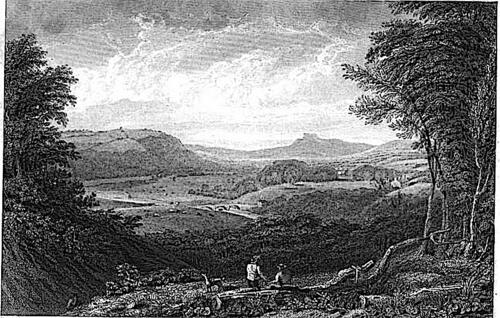
In 1831, ‘L.E.L’, (Letitia Elizabeth Landon), the foremost popular poet of the day, wrote a celebration to accompany this engraving, ‘Vale of Lonsdale’:
“I could not dwell here, it is all too fair,
Too sunny, too luxuriant; those green fields,
With the rich shadows of their old oak trees,
Or the more graceful sweep of the light ash;
Fields where the skylark builds amid the grass,
Trees where the thrush’s nest is on the boughs;
Those human dwellings, looking peace at least,
In gardens, with their growth of cultured flowers;
The quiet winding of that tideless stream,
Whose very movement is repose, whose waves
Are rarely stirred save by the falling rain,
Which comes when sunshine asks relief from showers;
I could not dwell here, it is far too fair,
For my heart feels the contrast all too much,
Between the placid scene, and its unrest.”
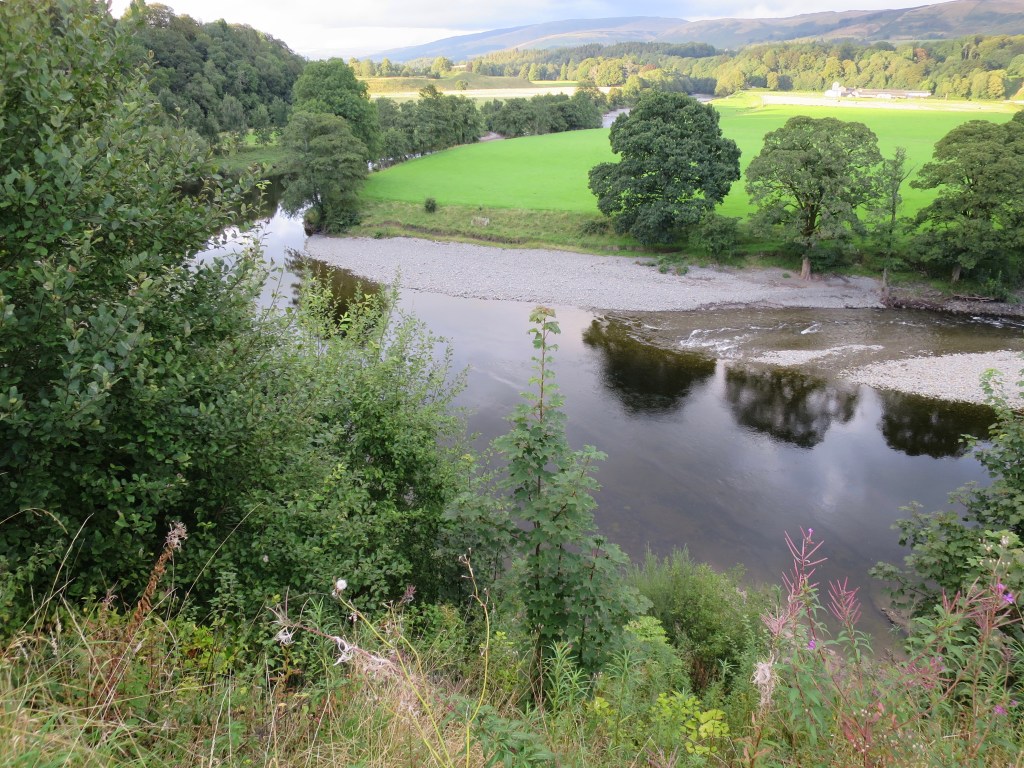
In 1875, Ruskin wrote: “The valley of the Lune at Kirkby Lonsdale is one of the loveliest scenes in England – therefore, in the world. Whatever moorland hill and sweet river can be, at their best, is gathered here; and chiefly seen from the steep bank which falls to the stream side from the upper part of the town itself. … I do not know in all my own country, still less in France or Italy, a place more naturally divine, or a more priceless possession of true ‘Holy Land.’”
But disengaged, from theorising and Views, and from my unease at ownership, possession and access, it is glorious walking downstream towards Crook o’ Lune, moving through the landscape. Here, the river winds in wide shining sweeps of freehand curves that I cannot resist, in haptic echoes, inscribing in the air. Here, the river glitters over shingle as if alive with feeding fish. Here, the river passes dark and slow under me, as I scramble through the hanging woods, ancient woodland fragments from lost times, stilled with slowed time, and yet alive with the after-vibration of outlaw rides, a place for adventures.
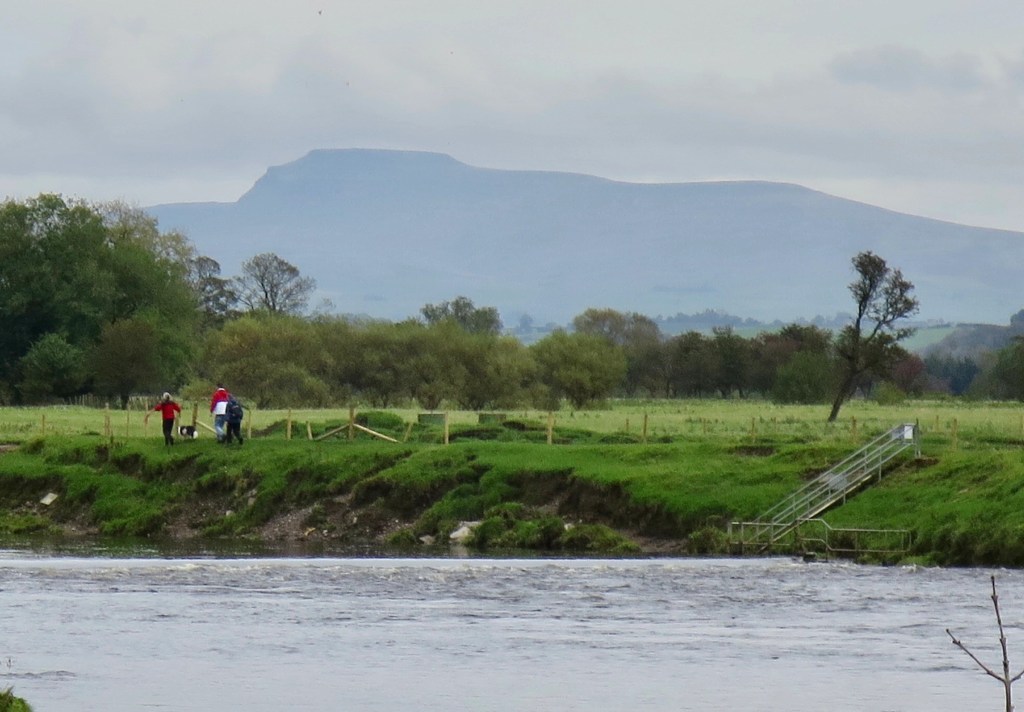
And all the time, seen or unseen, but always there, Ingleborough.
As distinctive as Mont-St-Victoire or Mount Fuji. I can imagine painting it. Walking towards it, I see a Cézanne accumulating image after image of it in every nuanced condition of weather and light. A Hokusai depicting it unchanging in picture after picture from different points of view. And, in privileged moments, I see it as it is, Ingleborough.
Note: The Ruskin quote is from ‘Fors Clavigera: Vol 5, Letter 52, April 1875′.
Gray’s Seat, Crook o’ Lune, a View
It is a stiff scramble, up from the river to the road, then another climb towards my destination. But this second climb has shape, form. It is a progress, the path curving intriguingly up through woods, between on one side an old drystone wall thickly-velveted with bright green moss, on the other a palisade of upright flagstones, slender menhirs. The path heads up, towards a blank wall – then curves surprisingly left, enters a small arena, a viewing area, carefully made. At its centre is a semi-circular seat, constructed from quartered tree trunks and upright planks. It faces, looks out over, presents to the eye – not Gray’s famous View, but, trees. This is the oft-repeated 1769 quote:
“Ingleborough, behind a variety of lesser mountains, makes a back-ground of the prospect: on each hand of the middle distance, rise two sloping hills; the left clothed in thick woods, the right with variegated rock and herbage: between them, in the most fertile of valleys, the Lune serpentizes for many a mile, and comes forth ample and clear, through a well-wooded and richly-pastured fore-ground.”
Whereas in my fore-ground, there is a barrier of dark trees. I climbed up here in the magic hour before sunset, for the view. What I see is dark foliage. While through it in haloed fragments, and around and above it, the air is expansive, the light golden. In my mind’s eye I see the hill to the right, vivid emerald, the hill to the left, shadowed viridian. I see Ingleborough gold, becoming pink, then mauve, then blue, as the river alchemises from gold to silver, as day fades into night … Chop down the trees! Restore the view!
I argued above against the fetishising of the view as static, framed, fixed, and for the view come upon in one’s motion through the landscape, and thereby taken into the self within that motion. The artists of the Views would not just fix, frame and enclose it in the eye; they would bring Claude glasses and, sitting with back to the view, they would draw or paint the image that was reflected in a mirror. How Ruskin hated them!
But of course we all like a View, including Ruskin, as I’ve seen. It says, ‘I was there.’
For the mass market visitor to the View, after photography, there was that ready-made, the postcard.
And with the coming of mass-market cameras, each could take their view that, when it was returned days later from the chemist, would displace the fading memory, and become the view.
With the digital camera, the image could be viewed immediately – but was quickly buried under the deluge of promiscuous clicking.
Perhaps the Polaroid was the one copy that enabled the symbiosis, the feedback relationship, between view and image, that could enrich both. But the Polaroid was always expensive, niche.
With the smart phone and the selfie, the image-maker again stands back to the view. But now the view is not the subject but a backdrop. Like one of the painted backdrops in Victorian photographic studios that represented aspiration, the hoped-for destination.
In the selfie, as in the Victorian studio portrait, the person is the subject: but now the view represents arrival. I was there.
As for Gray’s view – please, chop down the trees.
ps. Gray was an advocate for and populariser of the Claude glass. “on one sightseeing trip was so intent on the glass that he fell backwards into a ‘dirty lane’ and broke his knuckles.” Prefiguring the jokes (and in some cases the reality) of selfie-takers walking backwards off cliffs.

