She was small and dark and silent. She would appear by the side of an old woman crocheting, a fisherman absorbed in splicing a rope or mending a net, her eyes following the complex practised movements of gnarled knotted fingers. When asked if she wanted to try, she would shake her head slowly, eyes intent on the moving hands. It was as if her hands – ‘like birds!’ a fisherman at the pub said suddenly – were not to be occupied, were always to be free: to dance in the air; to trace the form of a flower without touching; to read with their skin the surfaces of polished mahogany, carved stone, of sand running through; to be a place for a butterfly to settle, for a bird to land, its feet vibrating on a white finger.
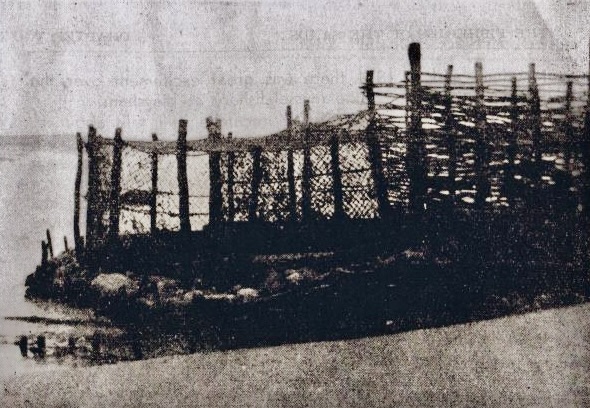
She lived in a village of fishermen without boats, who stretched their nets between poles so that the fish the tide swept in were caught when it swept out. As soon as she could walk she would be found by the nets, crying, trying to release the fish caught by their gills, comforting them. She had to be forbidden, dissuaded, diverted – her father was churchwarden, there was latitude granted her – but she never forgot the high rectilinear grid of net against the sky, and the gasping, flapping fish.
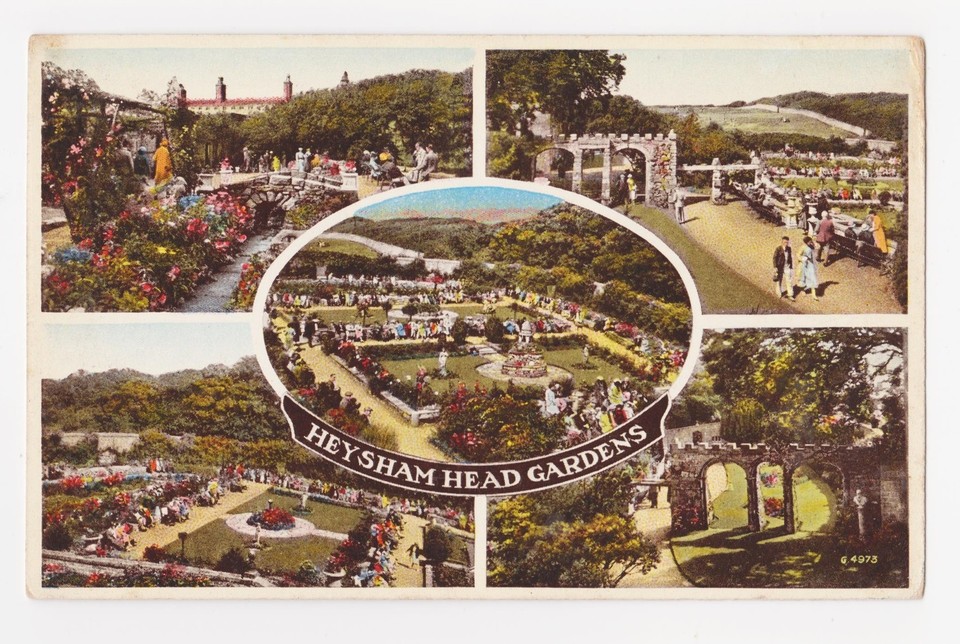
She was taken age five to the Pleasure Gardens on the other side of the Head. She became disturbed as soon as they entered the sunny park busy with holidaymakers. She shrank, hands over ears, from the rumbustious squealing children in the playground. Watched fist to mouth in pained horror at Punch’s violence and the howling crowd. Burst into tears at the parrots chained to their perches. But she refused to leave, walked grimly on.
Silent at the time, she told him, the boy, later, as they roamed through the derelict site they had broken into one moonlit night, past empty cages, to the concrete pit: ‘I wanted to experience just once the horror of the lived world. How did I know, at five? I’d always known; at five I could articulate it. The violence of children and their screeching hysteria. The puppets playing out murderous desires, and the howling audience given licence to join in. The ugliness of beautifully plumed birds that once dipped and glided through jungles uttering their wild cries, now chained on bare perches and provoked to make a sound meaningless to them that brought forth gape-mouthed cacklings from the humans. The rabbit they gave me to stroke quivered as if its heart would explode. Past cages of listless monkeys, and the endlessly pacing jaguar. Deeper into the horror. Until there, where I’d been heading. Here,’ pointing down at the bare, stained concrete.
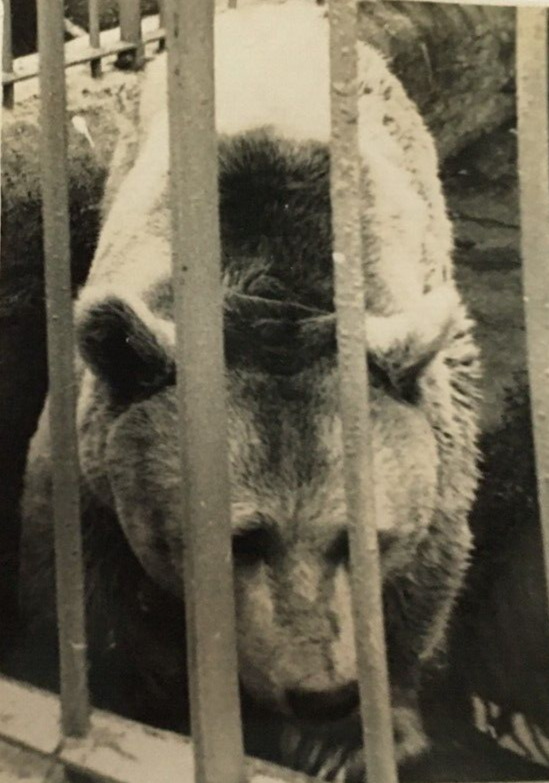
‘The bear pit. The bear, dirty, smelly, patches bare of fur, behind iron bars, its eyes fathomlessly sad. Eyes that did not look at me, but that I fell tumbling into. Down, through years of barren captivity, on permanent, scarifying show. Back, to the moment it was dragged from the lifeless mother, beaten, boxed, transported. Back further, to a sunlit open slope by a cave in the forest, play-fighting with siblings, lounging in the warmth, buried deep in the familiar feel and smell of mother’s fur, drifting milk-fed into contented sleep. And then returning, through layers of time, to the bear, in the concrete pit. I think I passed out. I was in bed for days. When I recovered, still silent, they realised they couldn’t send me to school.’
Her home education was supervised by an aunt. Childless, her husband had died unexpectedly, leaving her enough to live on, enough to enable her to style herself an “independent scholar”.
The aunt had done a degree, and been a schoolteacher. But she had always felt, in a way she could never articulate, that her education, and the way she was instructed to teach, missed some fundamental and vital point. Now, her activities, her studies were each a line, a plane, a vector in a multidimensional geometry (the only way she could describe it) that could, together, by enclosing, locate that point. ‘There may be nothing there. I rather hope there isn’t,’ she said. ‘That it is contentless, null, a nothing defined by everything that is. But in locating it, the lines, planes vectors of – “learning” – will resonate in a new way.’
Fortunately for the child this purpose lay deep and largely unreferenced in a mind and personality that were omnivorous and non-judgemental. She imposed no curriculum on the child, proceeding from her interests, what interested her. To experience, to describe, to explain, to wonder. ‘If an explanation does not evoke wonder, it is, however “correct”, an inadequate explanation,’ she said. ‘I require only interest, application, and verve.’
And she had that precious attribute of the good teacher – to know when an interest is simply an interest, an experience to engage with, in and of itself, and then let go. And when an interest, an experience is the starting point for learning. Beginning from the girl’s here and now, experience, followed by inquiry – ‘but why?’ Answering her question, or giving her the tools, or reminding her of the tools, to answer it. And learning how to check the answer.
At seven, watching the tide go out for the hundredth time the girl suddenly saying, ‘where does the water go?’ ‘Around the world, for the world is a globe.’ ‘What!?’ Observe with her from the cliff top the curve of the horizon, a circle. Watch the Isle of Man ferry at the horizon appear to sink into the sea. Demonstrate a globe with beach ball and toy boat. And by comparison with sun and full moon: ‘the earth like them is a globe.’ (the phases of the moon for a different time.) ‘Why does the tide go out?’ Observe the coincidence of full moon and high tide. A fortnight later – ‘but there is a high tide with the new moon.’ Because of the sun. Set up a demonstration, with different size balls and lights, requiring trust in metaphor and the abstract. Patterns of repeated behaviour – “laws”, we call them – taken, for the time being as given, short cuts to understanding other phenomena. From, ‘this is what happens’, to ‘why does it happen?’, to ‘this is why it happens’, to ‘this is what happens’, – with a new sense of wonder.
It would have been easy, with a child of her capabilities, and a teacher so focussed, attentive and knowledgable, to produce a brilliant oddball, who would shrivel on contact with the societal world. But the aunt’s focus was on preparing her to enter school at eleven, with the equivalent knowledge and skills, however differently acquired. She was introduced to children homoeopathically, so that, while not really understanding them, she could get on with them.
On her first day at school, new uniform, new bag, small, dark and silent, knowing no one, she was unprepared for the clamour, the ricocheting energy, its superfluity and waste, the chaos. But centring herself she was able to observe. How carelessly the girls merged, submerged themselves, their selves, into collectivities, gave themselves away so cheaply in return for acceptance. How the boys fought, but posturingly, each settling quickly into set roles in their coteries, comfortably defined and confined by their agreed positions.
New and alone, making no attempt to join, this lack of need to join was challenged by the top girl. She took her aside, and, after words unheard by anyone else, she was troubled no more, was protected. The boys she handled by ignoring them, or with biting words. She settled into schoolwork, not understanding why she was there, but managing each subject and teacher competently, so that each teacher was sure that they were her favourite. While she remained deliberately veiled, an alien masking superpowers, Reserving her real effort for out of school.
She continued like this for two years, having acquaintances not friends. Until the boy arrived at the school. It was instant. For the next five years they were inseparable. They dressed alike, wore their hair long together, cut it short together, wore makeup together, went clean-faced together. A place was laid at every meal for the other in both their houses. Their parents watched astonished. At school they maintained their cloaked selves, still bright enough to be near the top. Alone together, they revealed themselves.
The pleasure of tossing up an image, that the other caught without thinking, twisted once, like a Rubik’s cube, and sent it back enhanced. The delight of launching, like a hot air balloon, an idea that as it rose the other shot into a dozen fluttering, dazzling butterflies.
That was their academic work. Their real relish was in exploring together. The aunt, having stepped back, watched. So this was what had come to inhabit the null place at the centre. For five years these collaborative artists of the mind discovered, invented, created. The village was their subject, raw material, medium, canvas, their work. Their Gesamtkunstwerk.
Their inventions were public, private, secret. Mostly secret. Intelligence and artistic energy focussed, irradiating the place they were part of. There are many tales, but for another time, to be told in other stories. For this story, they were way-stations towards the hogback stone.
It is massive, a block of sandstone six feet long, a foot thick, and two feet deep at its highest convexity. It is engraved all over: the top with stylised roof tiles, the ends enclosed by great carved beasts, each long face covered in human and animal figures. It is in the dark church. It has been there all her life.
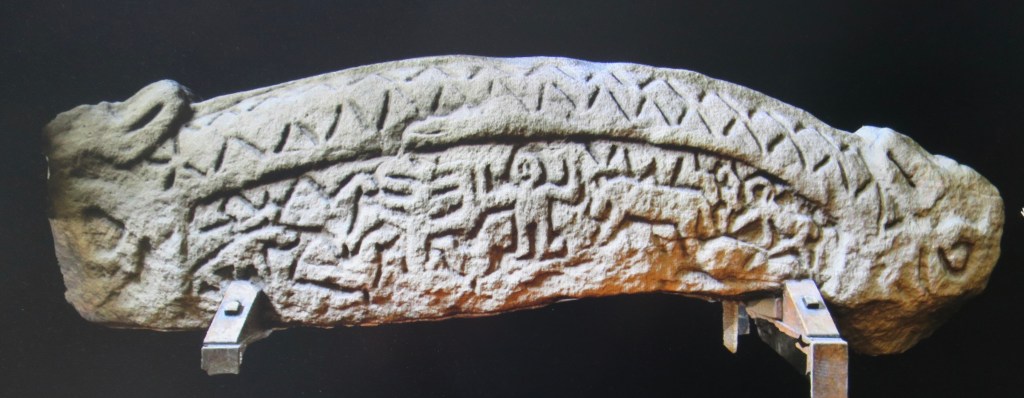
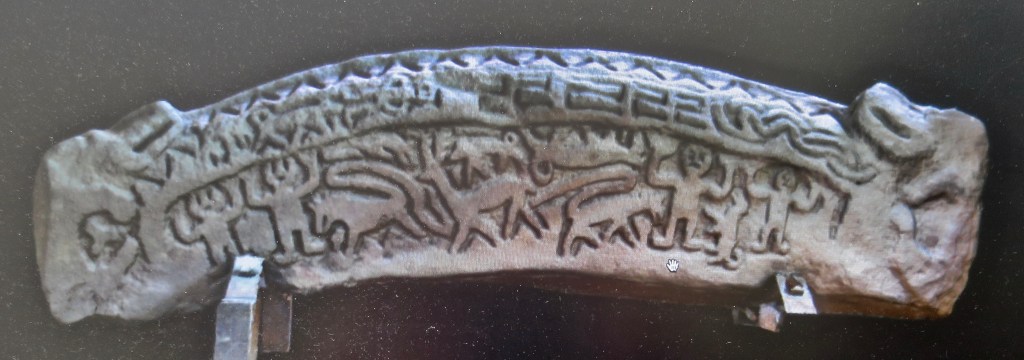
During services she watched the figures flicker into brief movement as the light changed. While her mother polished the pews with Mansion polish, or changed the flowers (the smell of overripe water), she sat astride her bow-backed animal. Holding the end beasts close to her, one day dinosaur-jawed, the next rabbit-eared. Outlining the figures with her fingers. Whispering her stories to them. And hearing, her ear close to the stone, their stories in return.
Gradually she allowed the boy in. On sunny days they would sit in the parti-coloured light of the church, cross-legged, side by side, poring over the surface, shouting out what they saw, the stories that came to them, being shushed by tutting ladies and suppressing their laughter. At night, entering with her father’s key, experiencing it anew in the clarity and mystery of moonlight. Or with closed eyes tracing its surface with fingertips, their hands touching, parting, touching again. It became their lodestone. And, as they learned, the central enigma.
From study emerged meanings for this Viking trader’s grave marker. The whole was a house, to shelter him. The end beasts were protectors. The iconography – he, the boy, was getting into this – was, he said, intriguingly enigmatic and ambiguous. ‘This figure, standing by the tree, with ox, monkey, bear, peacocks around, is Adam in the Garden, naming the animals. Except, here, in his raised hand – see it? so faint – a sword with which he pierces the almost-invisible serpent that coils around the stone, that’s Sigurd slaying Fafnir – the “ox” is actually his horse, Grani, carrying the treasure – see? ‘Unless it is Christ standing by Yggdrasil, the world tree, in the new world after Ragnarok. And on the other face, up there, is Sigmundr as the wolf approaches; the four figures are his brothers waiting to be eaten. Although possibly they’re the Aesir holding up the world. As for the hart with the creature on its back …’
She turned away mid-sentence, ‘but …?’, he said, as she walked quickly out of the church, the graveyard, up to the cliff top, into the wide air, gulping for breath, walked and walked. What was he doing? Where was their story, that they, and their subject, brought reciprocally together, to what would become ‘the piece’? Didn’t he sense the flicker of life, hear the whisper of voices in the stone? Didn’t he feel in the creatures on the stone the lives of the animals in the zoo, hear their cries? Why was he bent on flattening into a single narrative the overlapping stories, the dissonances and sudden rhymings that they must live with, as they allowed ‘their piece’ to emerge? Why wasn’t he opening himself, to what the stone carried and brought into the now – the past time when gods were everywhere and everything had a voice? Why wasn’t he, as they always did, seeking images and words to join them to the plants and animals, and beyond, to the sea and the stars, and ask what the wave says? For, from that place, through their work, would emerge the new something, that they had midwifed into being. Why was he making so much noise, drowning what was there? Why was he trying to explain? What had happened to him?
Dark when she got back to their cliff top above the village, the old chapel silhouetted, a blue and silver night with many stars, Venus bright, and a horned moon. She wanted to lie in silence, listen to the sea, look at the sky, hear the whisper of stars.
Instead, from the beach below, the thump of music, harsh adolescent voices, and the crackling gash in the darkness of the lurid orange and red of a driftwood fire, their schoolfellows having a party, their dancing shadows thrown grotesquely by the leaping flames. A single rolled rock would silence them all. He is there. With a girl. Edging out of the light, with her, into the shadows, gone.
Next afternoon she invited him up to their cliff top. They lay side by side, near the edge, on their backs, as they often did. ‘Lie on me.’ ‘What?’ ‘Lie on me.’ Awkwardly he lay on her, face to face, holding his hips away from hers until she clamped her arms around his waist, pulled him down onto her, groin to groin, held him there, began to move, began to speak, looking into his eyes. ‘Who were you with? Did she let you fondle her soft titties?’ putting his hand on her breast. ‘Did you touch her down there?’ Moving his hand down while pressing herself against him, feeling him thicken and harden, watching his eyes grow vague. ‘Did she ooh… and aah… in the right places when you touched her? Make you think it was you?’, holding him hard as he breathed faster. ‘Did you have sex with her?’ On ‘sex’ he came, with a groan. ‘Well, now you’ve had sex with me,’ pushing him off, watching the stain seep out through his jeans as he lay, eyes closed, his breath slowly slowing. ‘See you at dinner,’ she said, as she scrambled to her feet and walked off.
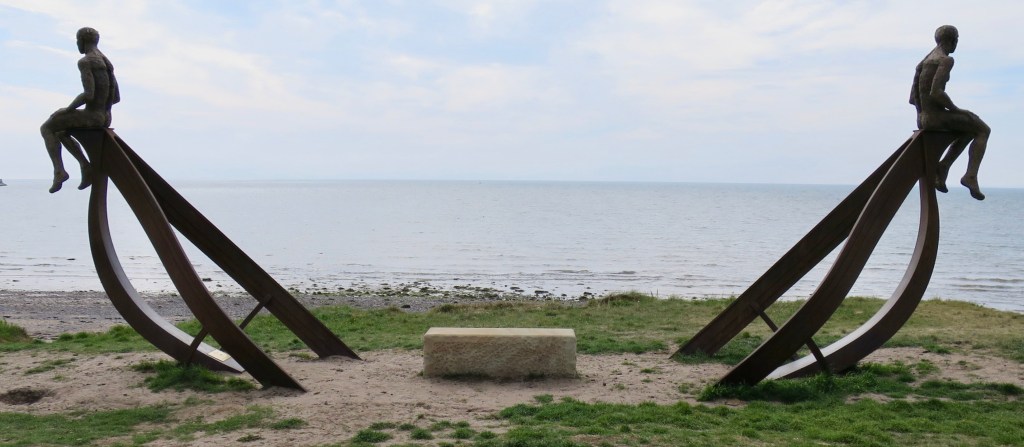
Next day she sought out the new thing on the shore. An art work, called Ship. The steel skeleton of a hull, a figure sat high at each end, cupping sea and sky. Its emptiness shocked her.
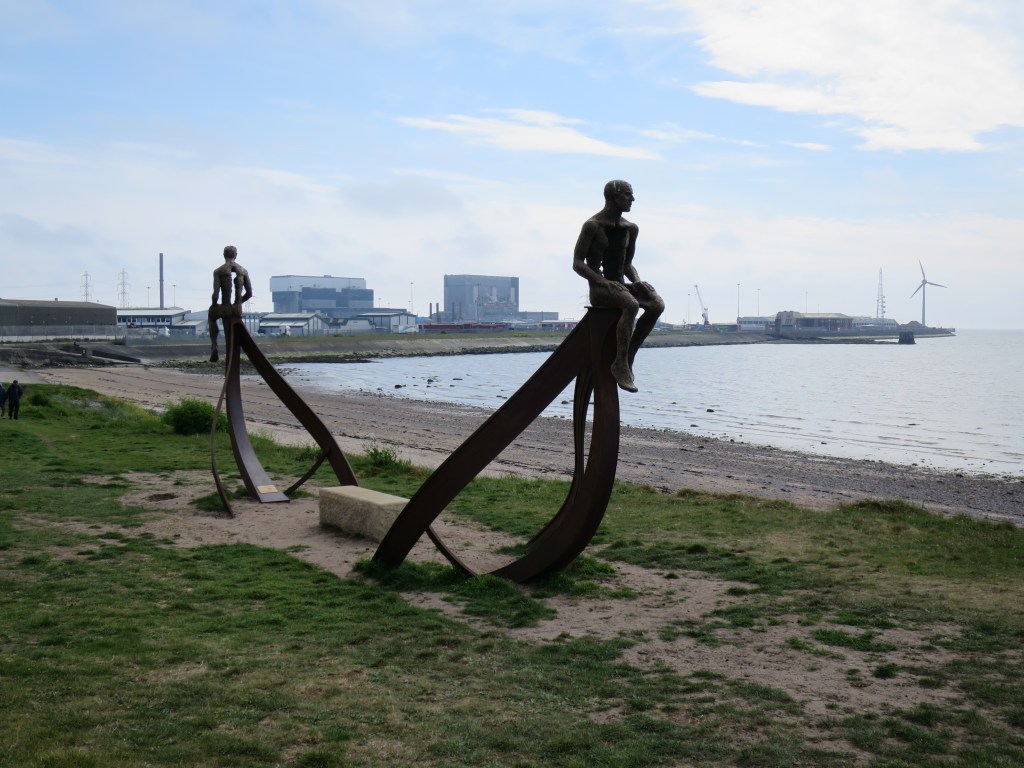
When she moved to one side, it framed in its concavity the nuclear power station and the concrete harbour walls, a ship leaving. The perched figures were back to back, each facing out, to a different future.
She felt him behind her, at a new distance. He said, quoting: ‘“When the modern era began, the exterior world, hitherto teeming with gods, muses, fairies and ghouls, became an empty space.”’ ‘No!’ ‘“While the interior world became rich and deep beyond measure. Language changed, from poetic to descriptive, men and women no longer spoke to the world, but about it, replaced connection with control, named all things but did not sing them.”’ ‘NO!’ ‘It’s called progress.’ ‘No.’
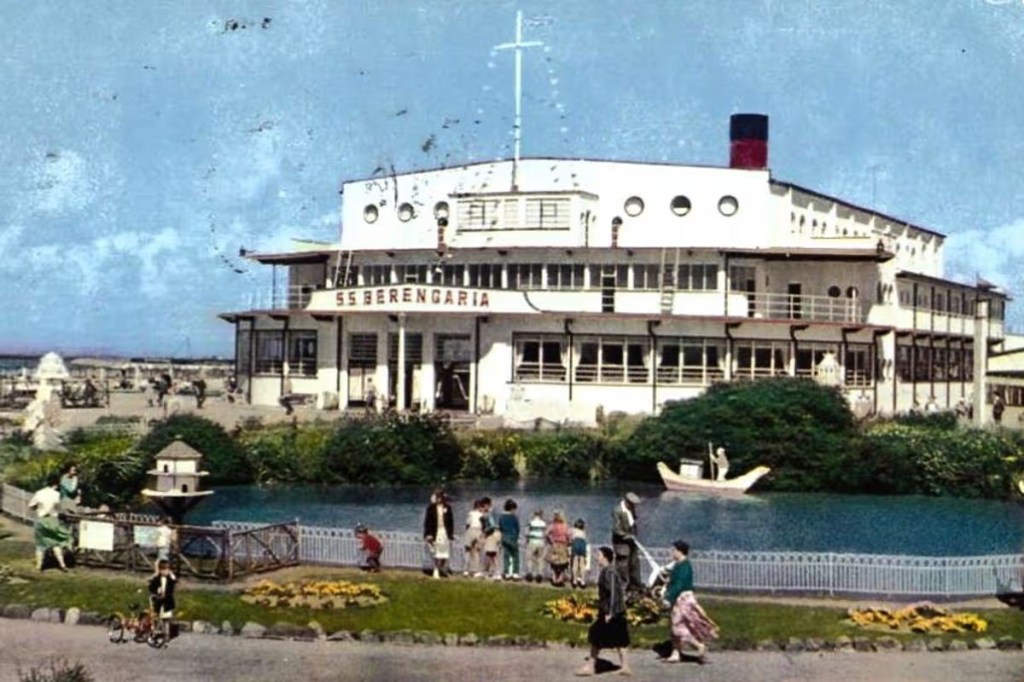
Next week were A Levels. She didn’t turn up. He did well, got a place at his chosen university. He worked for the summer at the Holiday Camp, whose main building was the reclaimed superstructure of an ocean liner, complete with funnel. He gave up his virginity with gratitude to a chalet maid ten years his senior. He missed her when the season ended. He left for university.
She knew he would go far, naming and doing great things. And that she would stay, come again and again to experience the sea and sky cupped in the steel hull, and listen for what the wave says.
The aunt died, left her the house and enough to live on. For a while she was content to live within the dark cottage, reading through her aunt’s library of arcane texts, catching unexpected glimpses of herself in ormolu-framed mirrors, brushing against hanging fabrics. Then working the intensely-planted garden, more botanical than cottage.
With spring she went out. The village was big and rich and various; she turned on the spot then walked down the cobbled street between the cottages to the shore. The nets long gone, but she remembered the mesh against the sky, the gasping fish. The boy had said: ‘knowledge acquisition is trawling with nets of appropriate mesh-shape and size. The nets changed fundamentally in the seventeenth century. After collection is classification, a mesh of boxes.’ ‘But what if something doesn’t fit into a box?’ ‘Discard it, an error in the net. And there are always edge cases, the liminal, portal to a different dimension – to be avoided.’ ‘But nothing is an edge case to itself! Everything is the centre of its own world!’ ‘But that individualism,’ he said, ‘leads to solipsism.’ ‘Damn!’ She said, walked hard up to the top of the Head, threw herself panting onto the moss-soft turf, heart thumping against the ground.
Pressed herself onto it. She was he, the ground was her, as she’d been when she had held him groin to groin. With him struggling to be free. While wanting, she was sure, to be in her, driving into her hard, deep, have her. She laughed, felt sad. ‘Damn!’, flipped onto her back.
White clouds, blue sky. “By what hands is the incense of the sea built up into domes of marble?” she remembered. And yet softer than wool, gossamer, not even existing. That one, size of a hand, then a thumb, fading, like a snowflake melting, gone, but where? ‘Cumulus,’ he’d said absently, she’d slapped him. Damn.
Onto her front, chin in cupped hands, looking outward. The bay a vast sunlit tawny pelt, smooth as chamois, soothing; her fingertips trace its surface, read the cuneiform of bird footprints. Above it the fractal shifts of starling murmurations. The tide runs in fast, but the water seems to appear from within, suddenly there, like now, wash of yellow ochre become sea of fretted blue. The mountains beyond are still the lumpy back of the blue dragon from her childhood. Long low neck to its head, fire-breathing now with nuclear weapons. Offshore, its breath, a mist of flickering wind turbines, a neat completion. Sits up.
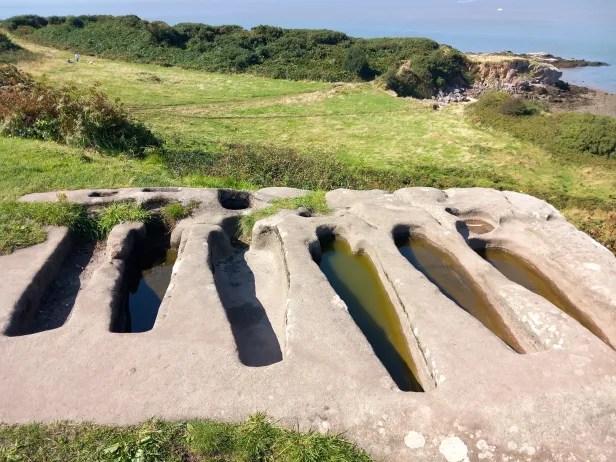
The chapel to mark St Patrick’s shipwreck. Midnight, full moon in a round arch, madonna’s face – had she spoken? Auspicious for burial, eighty-four bodies. And the rock-cut graves. Small, she had tried to lie in, couldn’t fit. ‘That’s because they’d chop your head off, put it in the hole at the top.’ Scare story.
Not a grave, an ossuary, with a socket hole for a cross. Had the hogback stone once covered one of them? Shipwrecked sailors, burial paid for by the gold earring. She felt shipwrecked, and without a gold ring.
Small and dark and silent, by the side of the old woman crocheting, her eyes following the complex practised movements of gnarled knotted fingers. Hook, loop, pull, hook. ‘Shame you never knew the Fairy Bridge.’ Hook, loop, pull, hook, speaking slowly, with long gaps. ‘Or the Fairy Chapel. In Half Moon Bay, they were. Half Moon Bay. I’ve always liked that name. Like a song. Or out of South Pacific. Rossano Brazzi.
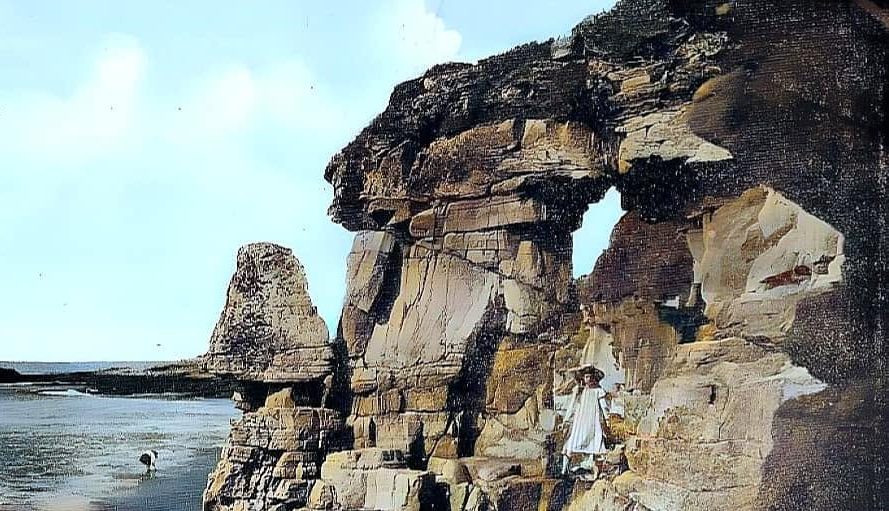
‘The Bridge was an arch of rock, out from the cliff, onto the beach. Boys used it for a football goal. When they’d gone it was ours. Just girls, you know, that age. The world looked different, looking through that arch. We’d imagine different worlds, through it. We’d walk through, arm in arm, and be, I don’t know, ladies, going to tea. Very posh. Or circus performers, turning cartwheels, “And now we present …!” Sometimes we’d imagine walking through into a different life – dancers, showgirls, the London Palladium! Paris! ‘Then one of us came up with the idea that if we walked through, at a certain moment on a certain day, saying the right words, you actually would walk into a different world.’ ‘A portal.’ ‘Is that what they’d call it? We tried May Day, Midsummer, midnight, sunrise. Nothing. Gail said we didn’t say the right words. Liz that they’d beggared up the calendar hundreds of years ago, so now you could never get it right. Closed forever. It was a fancy. We liked fancies. I’d only ever walk through it one way. Superstition, I suppose.’ Hook, loop, pull, hook.
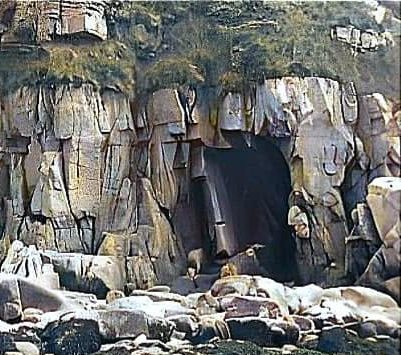
‘The Fairy Chapel was a sea cave that flooded every tide. Dark, echoey, slippery. Smelled of salt, seaweed and fish. We’d sit at the back, cool on the hottest day, and look out at the dazzling, churning sea framed in the jagged black rock, more vivid, more alive, being framed. We’d sit there as the tide came in, the roar of each surge amplified by the cave, daring each other to stay. Then scramble out past the rising water, shrieking, getting our feet wet, for the thrill. If we’d slipped … Things you did … Just a place.
‘And then. I’ll never forget. Family night at the pub, music, songs. This girl, young woman, hair pulled back, big glasses, very serious, started singing. Well, serious was usually repaid with raucous. And this was a long, unaccompanied ballad. But gradually everyone went quiet. Even the bar staff stopped moving. Like a spell. When she finished, silence. Before we’d come back to life, she was gone.
‘It was about this “being”, who’s a seal at sea, but comes out of the sea a man, and – has – this girl. There were seals in the zoo back then, sad creatures, and I imagined freeing them and them swimming away and one day one of them returning, a seal, and swimming into the cave, and rising out of the water a man and – having me. In our chapel. And he’d dive in a man and become a seal, and I’d dive in a girl and become a seal, and we’d swim away together. Something about the song.’ Hook, loop, pull, hook. ‘A librarian, someone said. Visiting. Never seen again. I imagined her leaving the pub and walking down to the beach, throwing off her clothes, and diving in. And sitting on a rock somewhere, singing.
‘The Fairy Bridge and the Fairy Chapel they were called. You could buy postcards of them in the shop.’ Silence. A sigh. ‘But – what happened to them?’ ‘Oh I don’t know. I went working away. When I came back, they were gone. Someone said they’d been washed away in a storm. Others said they’d been quarried for stone. Just gone. Hardly remembered. But I remember. I feel them gone. Like my uncle felt the pain of his lost leg. An ache.’
The boy gone. The Fairy Bridge gone. No girl from the sea. Her unconscious life over. Was there some ‘thing’, some ‘there’: a fixed point, a void, a navel, a null place to find? Around which she could begin to live again, make a conscious life …?
She walked, looked, sat, waited. She read. Had her aunt left her nothing? But that had been her education: ‘contentless, null, a nothing defined by everything that is. But in locating it, the lines, planes vectors of – “learning” – will resonate in a new way …’
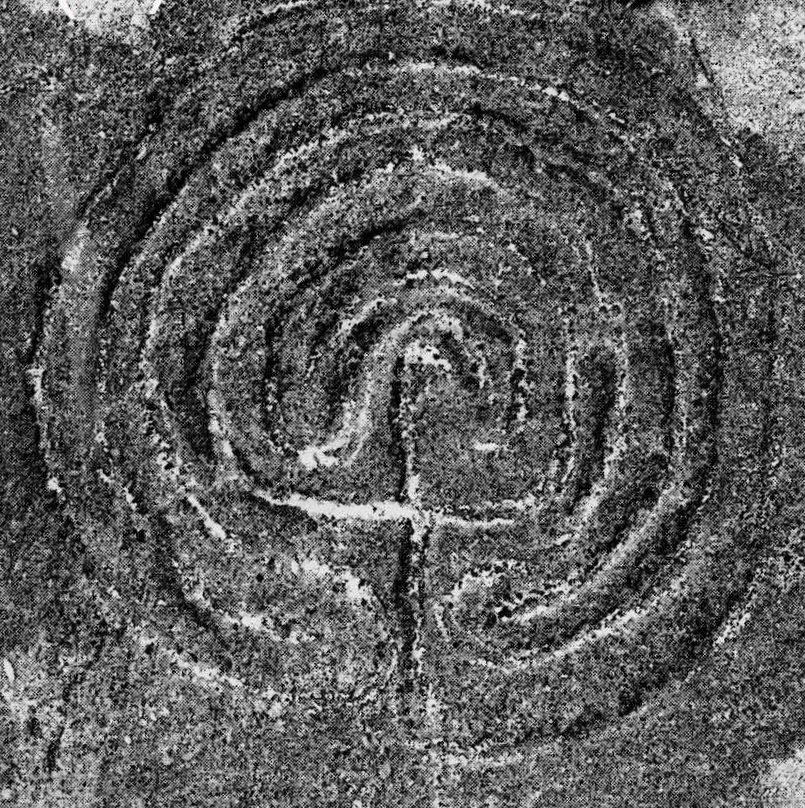
Putting back yet another book on the crammed shelves, a cutting fluttering down. A report in the local paper decades ago, about a “mysterious rock carving” found on the shore, with a photograph of it, a perfect Cretan labyrinth. “Excited historians have been scrambling for their reference books following the discovery of a mysterious carving on the beach by the village”, read the cutting. One expert thought it prehistoric. Another said it was Victorian graffiti. “The journey through the labyrinth is the path to the self, and the gateway to the beyond,” pronounced a New Age adept.
Hardly remembered, no one knows now where it is she discovered, asking around. Eight inches across, faint, it is there, in the acres of sandstone pavement below the cliff overlooking the sea, the possible clew that might fill the null point. Or maybe it is gone.
There is a place she sits, on the sandstone flats below the cliff, to watch the setting sun lay its fretted path to her. One way she can see the old chapel. The other, beyond Half Moon Bay, she can see Ship. It is a comfortable place.
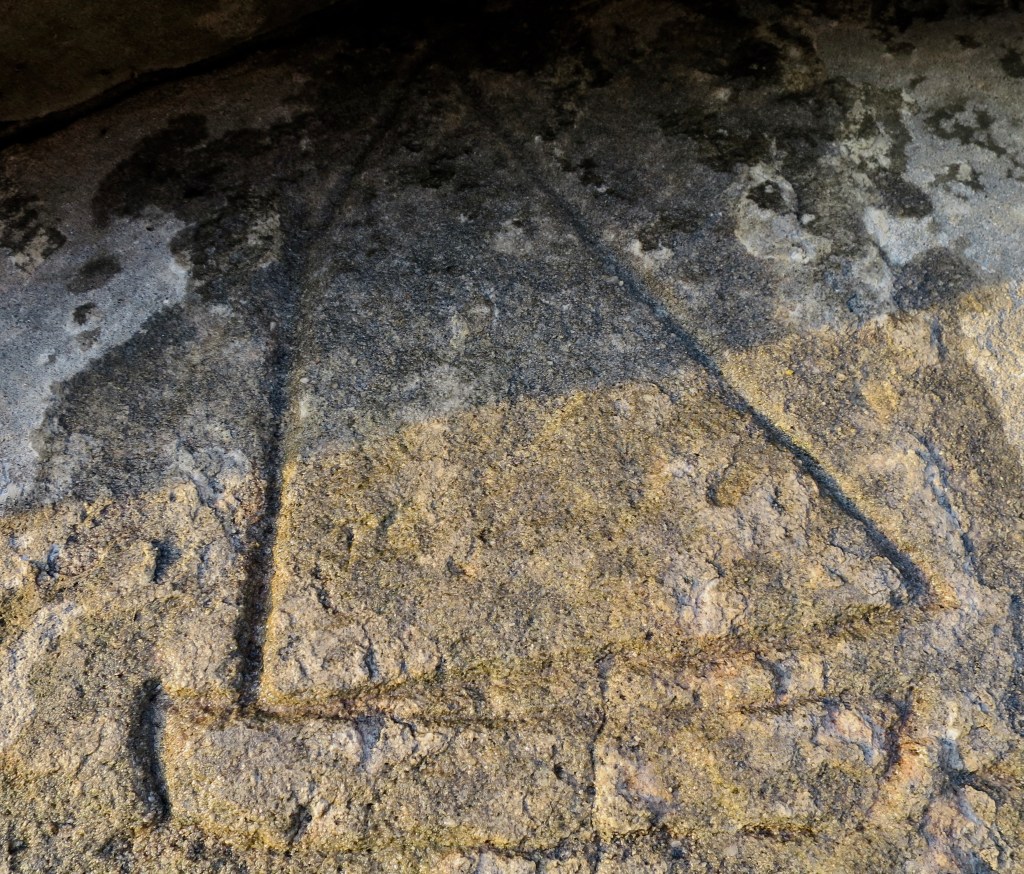
One evening she looks up at the ochre sandstone cliff beside her and sees, made visible by the angle of the sun, a carved boat, sail set. In her fancy, the sea rising lifts the boat off the wall, it sails away, with her in it. Except she knows she will never leave.
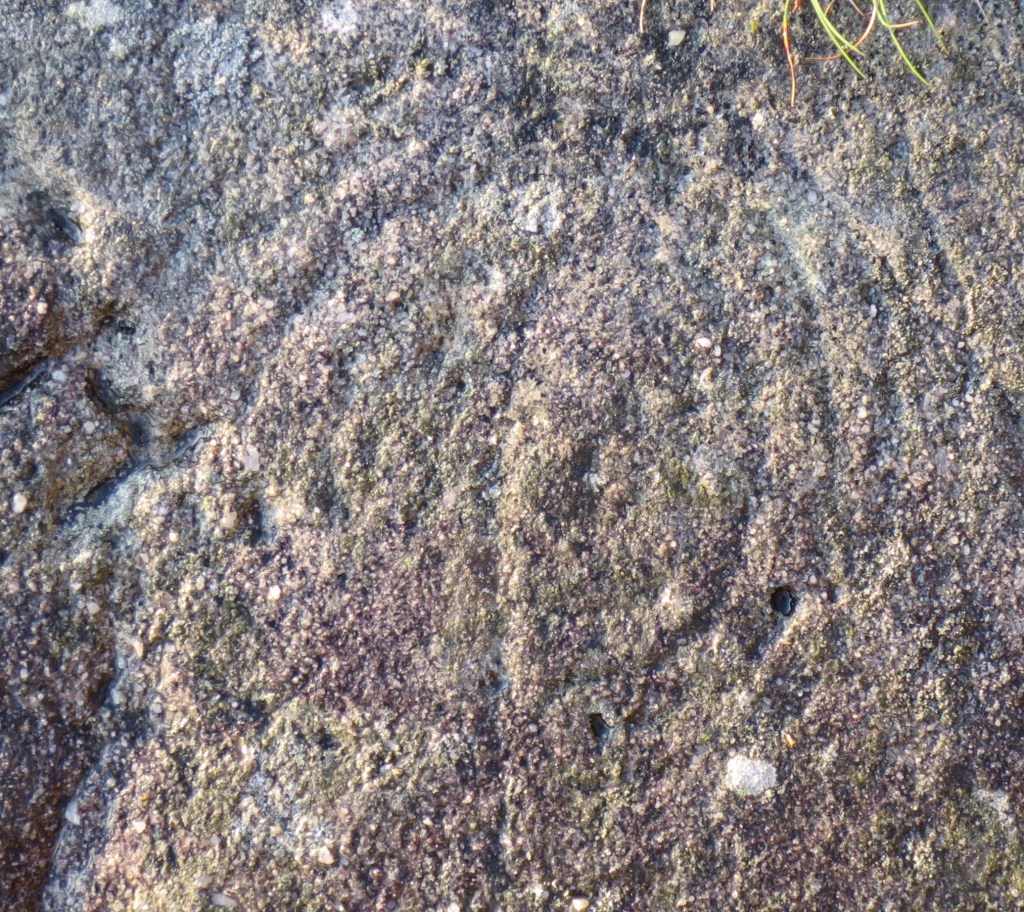
Another evening, by the carved ship, her finger idly tracing the pavement beside her, she feels a curve. And another curve. Revealed by the low sun is the labyrinth. Much faded in the time since the photograph. Hardly there.
She studies it in minutest detail, every curve. But eyes distance, touch connects. She touches it, tastes the sandstone, tastes the salt. She follows the curves with her fingertips, the involutions and evolutions, in towards the centre, out almost to the edge, the complexities of the labyrinth.
There is only one path through a labyrinth, but many journeys. Sometimes to the root, reflecting on her animal nature (remembering the zoo and the hogback stone), and the primary senses of touch, taste and smell. Sometimes to the heart, the golden spinning radiance of love and compassion – and, yes, remembering the boy, and missing him. Sometimes to the third eye, of imagination and clairvoyance, and the stories she told. And always arriving at the centre, the gateway to the beyond, and knowing that if she stepped through she would leave this world behind, and the work she still had to do, here. Tempted, but never succumbing. It is the centre of her world. Eyes closed, her fingertips read the story, like Braille. So many stories. Eyes closed, the walls of the groove rise on either side and she is the needle on a record playing its song. So many songs.
On sunny days at low tide she sits beside the labyrinth and inscribes words, makes patterns, writes stories on the vellum of the bay. On moonless nights at high tide she stands over it as the dark waters lap at the ledge. She is aware of the limitless ocean, is drawn to enter it, and lose herself in it; instead she draws the ocean into herself, encompasses it. One day the water will rise above the ledge. She imagines lying on the ledge, being lifted, floating away.
The labyrinth weathers, fades. Her finger continues to follow it. One day it is quite gone. She places her hand on the place, like a hand on a cave wall, connecting through. Her finger resumes, continues to follow it unerringly. While she lives, the labyrinth exists. And while the labyrinth exists, the mystery of this place exists, in her, the girl, small, dark and silent.
Note: the nets, pleasure gardens, zoo, hogback stone, Saxon chapel, rock-cut graves, Ship, nuclear power station, harbour, holiday camp, Fairy Bridge, Fairy Chapel, labyrinth, all exist, or existed, in the village.

