1 Mar, 1995. Hill Town
Wrapped in a shroud of melancholy. Nothing deep, but a wafting tissue that makes everything a little sad.
With Stella to a concert of Tallis and Byrd. Begins with ‘Third Mode Melody’, the theme Vaughan Williams used in his ‘Fantasia’. Stella is bright, full of energy, unconstrained after her days with Harald. To the pub.
I know I’m tired, but there’s such sadness, too. I’d come up with this phrase, this formulation (I don’t use it), that Stella and I know so much about each other, know each other’s type, so well. And it’s this: she lies, I deceive. And I don’t know what I, we, should do with the knowledge. It hangs between us, unspoken. I tell myself that what I want is peace. But maybe what I need is Stella’s brightness, her refusal to be extinguished.
Letter to Helen.
‘Why not? Enormous charcoals, fierce and quickly done, expressing the structure of the land, and the limbs and fingers of trees; soft pastels, nuances of pure colour catching the evening light; detailed oils patiently recording the permanent behind the ephemeral; the painstaking topographic accuracy of pen and ink; the changing moods caught in swashes of watercolour … you can do all these. Monet had a dozen paintings of each view, and would work on whichever fitted the weather and his mood.
‘Yes I do believe in a daily discipline, to anchor one’s life. And a creative discipline adds a dimension. Because in practising it you’re changing both the thing you’re working on, and yourself. Creativity is a continuous life and death struggle in which things are constantly being brought to life then destroyed, in your head, on the paper. You are the god of an evolutionary process, creativity the means of asserting ourselves against entropy.
‘Our education consigned ‘thought’ to our heads, from where instructions, sieved to a thin code, are sent to generate action through the body. Creativity puts ‘thought’ back where it was for the Ancients, in the body, where intellect, emotion, imagination, vision live in promiscuous hugger mugger, where Gods (or Graces, or Muses, or Inspiration) can visit us freely (not locked out of the cranial vault). Art is both the process and end of creativity. It may be, as the Magic Theatre sign in Steppenwolf says, “Not for Everyone”. But why not for you?’
2 Mar, 2000. Hill Town
To mum’s. She disconsolate, unhappy at home, having been unhappy in hospital. She sees only pain and incapacity ahead. Which is, unfortunately, true. What to say, do? Has she simply run out of energy? Or interest. The physio says, try to sit up, she says, it’s uncomfortable. I say, why not try sitting at the table, playing Patience. She can’t be bothered, slumps in her chair. I cook fish, potatoes, mange tout peas. She eats well. I try to work her towards accepting now as the given. She wants only before, or after.
A strange conversation with Vicky. (two hours!) (I’d rung her.) She says, there’s a Fay Weldon play, do you want to come with me? I say I really don’t see us doing something like that again, after last time. We go through it, the ‘misunderstanding’(!). That she had still been in the zone of us ‘getting it together’, while I was out of it, into being friends, – saying how lovers face each other, close the circle, friends go arm in arm, face the world. I say I’d done everything ‘right’ as a friend, saying look at the stars, talking her down, saying come round tomorrow, but she’d still been in the realm of ‘us’, ‘together’, asking should she get a heart-shaped diamond ring? Me saying, as long as you put rubies in it, we’ve spilled enough blood. And, going through all this, saying it, saying that I’d moved, moved out of that zone in December, accepted it as, ‘never will be’ at New Year, into a place where I wanted us to do together what we do well, and let go of what we can’t do. Which means letting go of sex, and of us being the ‘significant other’ in our lives.
And saying it out loud, and having said it, instead of thinking, as I expected to, ‘oh my god, what if there was still a chance …?’ as I’d thought so often, I felt strangely calm, and strangely certain, and strangely accepting of it. Has my heart turned to stone? I don’t think so. Do I have a sense of closing a book? No. Just a sense that certain possibilities are no longer ahead of me, will never happen. Not a willed sense, not a ‘and I’ll make sure they never will,’ but the sense that the circumstances when these things happen will never arise. And not even the – I used to cry because I miss you, now I cry because I no longer miss you, not even that. I don’t feel good, I don’t feel bad. Just that certain things have cleared out of the way, are no longer in front of me. And with it, the stone of resentment, of feeling I’ve been abused as a companion, that too fades away. Because, at our last meeting, she had been in a different place, on a different tack, in a different realm of possibilities. Just keep things moving.
3 Mar, 1999. Hill Town
Rain, large wet drops, the sky bright, mocking. How often have I waited like this?!! Her car was there this morning, and no phone call. Oh why is no one else sufficient, why is Vicky the only one with substance for my life?
It’s getting very close. Once again (yet again, again, how many times??) I’m amazed she hasn’t got in touch. This is the moment the end approaches. And yet, not. I’m still available, still prepared for the commitment, for us both to say, ‘yes’ and start building something that works. But I’m also prepared for the final parting. Whatever, it needs to take the future out of it, to be now. I feel giddy. Terrified. And yet light. There is a brightness around the edges. But that’s just the thrill of the prospect of going out through the door. And I’ve done that often enough to know that, beyond the glow of unknown promise, there’s little to be said for it, in itself. Accepting. Accepting of whichever. Weird! Bizarre! Like accepting with equanimity the throw of a dice. Oedipus at the crossroads.
She’s bolted, and without a touch of good manners. But that’s what you do, Sheen says, ‘as an alcoholic, you try to drive your loved ones to abandon you, to confirm your unworthiness.’ And beyond the sting of being slighted, I feel a curious equanimity, that I’m strong enough to carry what’s necessary. An increasing certainty that it’s right, that it is time, that we must begin with the pledge (the marriage, as it were), and that given the pledge – ‘the business of love is cruelty which, by our wills we transform to live together,’ William Carlos Williams – we would find ways to make it work, techniques of getting on. Because there is a melancholy, a heaviness, a darkness, a descending figure that would always be with me if I were to live without her. And a heartfulness I feel about her, with her. And a belief that if the heart is right – the heart being the only part one can’t will or manipulate – you can sort out the rest, with intention, effort and will.
It can happen. Why am I so steadfast in my purpose? Because I feel I’m, at last, beginning to come into myself, a being developing from within, not imposed from the outside. And if I can be strong in myself, I can be strong for her. Oh such happiness! How I love being in love with her!! My heart, my heart, my heart. It’s all in there. That’s what she gives, what no one else has.
4 Mar, 1968. Textile City
To Liverpool for the match, then on to the party. A girl looks twice and we exchange a few words, ‘A’ levels, Wakefield, pre-dip next year, and that’s it. Out for a drink with Ben and the others. A feeling of inevitability – feeling as I did with Noreen and Jill – in the pub I become precise, compact, bright and lively but cool, a sharp knife rather than a blazing fire. What is it, that cool, intense passion? When I’m master of the situation, confident and strong, yet gentle and thoughtful, with passion and sensitivity linked. And I’m determined not to get drunk.
Back to the party, she’s waiting, metaphorically, still available, a nice smile, recognising what’s happening. A superb evening of physical compatibility, we’re exactly on the same wavelength, it is a long, passionate, controlled, sensitive interaction (we’re so together) a sort of falling in love, two people who see the inevitability of their coming together, go with it, and experience with delight as they draw closer the naturalness of what is happening. She is young, fresh, keen, sensitive. I never met such girls when I was eighteen. Maybe they’re only like that when I’m twenty-two. Dancing together, creating the relationship as it unfolds as it must – she doesn’t know Otis Blue, oh, youth! – slowly drawing closer, cutting out the world, making our own world. I act beautifully, she responds beautifully, poise not pose, she blossoms, she blooms, I sensitise, subtilise.
And, after the dancing, our lovemaking (no sex, she’s too young, and what a relief not to be in will we / won’t we wondering territory; it’s like our sixth-form parties when we acknowledged and respected our self-imposed limits) is gently passionate. No words, few looks, a restless touching and response to touching (she is deliciously sensuous), our endless ranging, our delicious exploring of limitless bodies – how astonishing her open female body, how amazing my awakened male body – roaming over landscapes, of touchings and scents, of textures and tastes. We are endless. And the shock and then delight of recognition when suddenly we look into each other’s eyes, see perfect reflections and fathomless deeps.
And then, as the party winds down, and people leave, we, high but not drunk, unroll our sleeping bags and lie, at first my arm around her, her head on my chest, and then as sleep approaches side by side after a sweet goodnight kiss. In brief awakenings we are reassured by each other’s presence, our touching bodies. And in the morning, only us awake in a room of sleepers, bright shaft of light through a gap in the curtains, that marvellous feeling of leaning over a girl, half asleep, hair straggled across her face, her body soft under her nightdress, a first morning kiss, and then a last embrace, her breast delicious in my hand as she leans on her elbow, our silent mutual thanks, and quietly I’m gone, out into the brilliant early morning.
I stride out, energised, through empty Sunday morning streets, a deserted echoing city of slashed diagonals, blinding light and deep shadow carving up this solid and yet, this morning, this provisional city, in which I am the first man.
The train to Chester is a local service. I sit behind the driver, like on a bus, he waves to men on the track and staff at the little stations; the line is dead straight and we are heading east, the bridges are in perspective, nested inside each other, and the dazzling sun rests on the track.
It is good to see Alison. But we soon realise that we are no longer in the same world, which we had so intensely shared that summer, three long years ago. That having each been taken to the heights and then cast down at around the same time; while I, Bellerephon-broken, landed in a weird new world, she seems to have parachuted back into her familiar realm of family and career. She is looking forward to graduating and beginning teaching. Disappointed, but accepting, I set myself to getting some pleasure from the river, and listening to her friends.
In the evening I walk alone along the Walls, there is a gently-glowing sunset behind the cathedral, a vibrant evening stillness, last urgent bird song, and gentle strollers nestling into each other. To the station, and back to Textile City.
5 Mar, 1979. Milton Gate
Tom was upset last night, but I got stoned in that violent, cutting-myself-off way. I felt very guilty this morning. But the smoke cleared my head.
Chère Louise, a 1972 Philippe de Broca film, with Jeanne Moreau. Louise (Moreau), a spinsterish divorcée teacher, leaves Dieppe when her mother dies. She goes to Annecy with her two dogs. The train journey. Crossing Paris on the metro. She has a flat in Annecy, a pretty town, and teaches art at the school. A pair of vagrant Italians, the older finds the younger, Luigi, a job, then abandons him. Luigi crashes the road roller on the job, and flees. Begs in the street. Louise’s dogs are poisoned. She takes them into the hills to bury them. Luigi follows her, helps her, takes her back to town on his (stolen) bike. She feeds him, he showers and sleeps on the sofa. Then it’s the story of their relationship. Deftly told. Louise refuses the advances of an older man. Also refuses to accept the life of her PE teacher friend, Fréderique, a frustrated lesbian who dreams of being an opera singer in Paris, as she sings with the local dramatic society. Louise finds Luigi a job at the local cycle shop, and he lives at the flat. Occasionally they make love. She encourages him to have younger friends, but when he brings a girl home she deliberately shows him up. At the same time she’s educating him. It’s an impossible situation, because now she loves him, and can’t be what she’d wanted to be, his teacher and mentor, the midwife to his development. He asks her to marry him, she refuses. She pretends to be his mother when he brings home an American who he wants to marry to get to America, and of whom she disapproves. The American catches them kissing. Luigi loses his job after stealing money to buy Louise a hat. He decides he’s a nobody and runs away. Meanwhile Louise sells her late father’s collection of watches to buy him a motor cycle. Luigi never returns. She faces, once more, her aloneness. At one in this with Fréderique, but without her dream.
It’s the deftness that’s so beguiling, the light touch of a scene, of the dialogue. The vignettes of provincial life – Fréderique’s ambition to get to Paris, which Louise crossed without noticing it. The two outsiders. The letter Luigi writes proposing marriage. The hat. The scene where Fréderique, on Louise’s orders, tries to seduce Luigi.
And of course it reminds us both – probably in different ways – of France. Of provincial town life – just the life, cafés, and dipping bread into bowls of coffee, the vivacity that, apparently effortlessly, is France. And the teacher Louise, who believes she is free, and leaving Luigi free, when she is getting hopelessly involved. The failure, in real life, of the Cartesian method.
My first rejection slip. Strangely it strengthens my resolve – at least as a rejected writer I am part of the world of writing. I’m torn between writing what I want to write, and writing to sell.
The problem now is finding a voice. I’ve got a more than passing relationship with many branches of literature, and need now to work on style. Find models and use them.
The French story should be Science Fiction, ie rapid, broad-brush, but with vignettes, nuggets of the real stuff. Heinlein, and possibly Bradbury, as models. Don’t try to create literature – try to produce stylish writing that is literate. I must come up from underground sometime, stop being anonymous, be counted.
6 Mar, 2000. Hill Town
Suddenly the pressure comes off. Like a gale-force wind dropping to nothing. I’m standing, fists clenched, resolved, firm on my feet, ready for anything and – nothing. I stand, swaying slightly from lack of resistance. I’ve weathered it. It has passed. I have come through. And for a moment there is peace.
What a difference between the poetic mind and the prose. Already I feel the change. The poetic is a waiting, a making oneself available.How odd that before I started writing poetry (while with Jane, before I met Vicky, who is the muse of my poetry), I wrote this, about ‘strange creatures’:
‘There is a particular creature men fish for, whose unique quality is that it has no settled form. When caught and brought to the surface it may be one of a million startlingly different shapes, no two identical but all having a resemblance. It is very strange.
‘The creature lives at great depths, in total darkness, and it seems that at that depth, in the dark, its shape is ever-changing. But the moment it is touched, by anything external, be it hook, light, finger or vibration, it fixes in that shape. It is a most tantalising creature.
‘Some fish for it constantly, hoping that each one they catch, when they see it in its newly-fixed form, will be the one they have always been looking for. Others fish in order to build collections, some in as great a variety as possible, others in certain shapes. Another group, more subtle, let down their hookless lines and when the creature is touched, try to divine its form, without bringing it to the surface; many and bizarre are the shapes these fishermen visualise.
‘And there are those, heroic, foolish, or mad, who plunge into the depths, the directionless blackness, to embrace these creatures directly. No one knows what they experience, as none ever returns.
‘If you have any sense, you will ignore these creatures.
‘But if you must fish for them, do this. Instead of bait, sensing devices, or cameras, let down, on a long line, your imagination. Lie back, in a boat pitching in a storm’s ferocity, or undulating softly, as on a sea of soft glass, with above you the clouds moving slowly, stars shining, a typhoon spinning, with the line tied to your big toe, Huckleberry Finn fashion, and let your imagination explore. Be still; move fast as light; be active as an electron; be passive as plankton; follow with senses sharp every nuanced subtlety of your imagination’s exploring. Take all the time in the world. When you haul in your line you will have no idea of these creatures’ shapes. But you will know all that is important to know about these singular denizens of the deep.
‘But, a last piece of advice: do not tell others what you have experienced; they will not understand.’
Poetry is about making oneself available, creating a space, an emptiness one guards, in which words, a poem, may come into being. It is about an intensified moment, in which words appear slowly like a photograph in developing fluid, clarify. The importance of waiting; because when it appears, it is fixed (although, like an outline carving, a first clay model, it requires much work thereafter), and all alternatives are excluded, and it can either be developed, or must be discarded. It involves a determined absence, a suspension of oneself in time. It can be very painful.
7th Mar, 1967. Textile City.
Melanie and I are finished forever. How often and how definitely I’ve said that; and how little I mean it.
It’s now three weeks since she finished – I still don’t know why, and still hope (expect?) it to be revived. And yet to some extent I’m reconciled to it.
At first I was numb. Then there was a terrifying period when I was shattered, hardly able to function. I went to a dance, cracked completely, stood outside The Cobourg until long after closing-time, hoping to see her leave, not daring to go in, not sure if she still worked there, not knowing she was in hospital. I wrote,
‘I am in love. Suddenly all the pop records are relevant, ‘yes, that’s me!’ I say, about all the broken hearts. (Remembering listening to my brother’s fifties’ records in a darkened room, simulating a broken heart, practising, as it were – as I’d galloped home from the cinema as if on a horse, tossed off shots of pop as if they were whisky. That was fantasy, imagination – this is real.) Because I know now that if I lost Melanie I would be broken-hearted. Perhaps I have lost her.
‘I saw her in hospital, just her eyes, lying on her side, those eyes, so completely and utterly desolate. The psychiatrist had said she had to stay in. Then her mother came back and said she can come out, suddenly her eyes all shining, alive.
‘I treated her so badly. Could I treat her better if we were together again? The problem is our work at college – it’s so hard, but we’re doing such good things, we’re so near a breakthrough. Work’s always meant, means such a lot to me, but it makes me so bad with her.
‘I must see her. I’m sure I can help her. I’ve written to her.
‘I tried to work this evening, alone in the house. So little enthusiasm.’
But at the next dance I realised I felt different, independent, self-sufficient. As I’d felt at Oxbridge. I’d readjusted to a lower level of intensity, emotions damped down, intellect taken over, no longer with people, ‘us’, but ‘me’ and ‘them’. I had rebuilt the wall around myself, so painfully knocked down during that frantic period.
Without doubt it was the supreme period of my life. I was living on a higher plane, emotions were heightened, the world was more real. As I’d always hoped, wanted, desired. Now it’s gone. And with it has gone certainty.
And yet I still believe we were coming through when it ended. That’s the crucifying part – still I imagine it, still I can see it happening now. Still Melanie dominates my thoughts. I build a protective wall around thoughts of her, sure I’m okay, then – bang! – I see her in the refectory and I collapse, she’s straight through, right down, deep down.
I can’t feel deep emotions, can’t go in galleries, look at beautiful landscapes without feeling as though there’s a knife deep in my heart that makes me want to weep uncontrollably. Which I’ve done several times. The first time since I was seven.
It wouldn’t be so bad if she was dead. Then I would have to look away, in different directions. But she’s here, so near, and there seems to be nothing keeping us apart. Why did she finish…?
This is the only thing I have of hers, of her. Written a week before she left. And she was so happy …
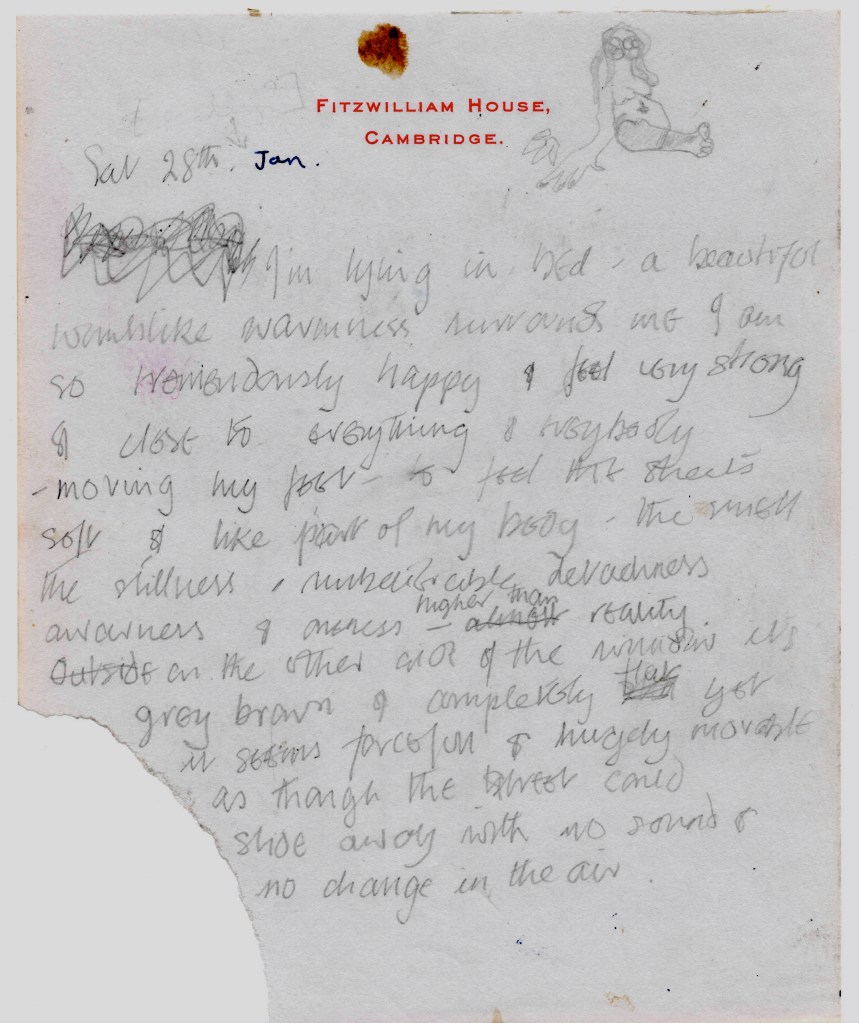
8 Mar, 1983. Milton Gate.
To the party, all couples, our age, children around. Drinking in the kitchen, then furniture pushed back and the dancing begins. Fleshy blond, Lynn, homes in on me, bosomy and perfumed and provocative, dancing close, soft flesh, ‘oh, I love this song!’ When I say Jane and Tom are going away tomorrow, says, ‘you must get in touch.’ ‘What about your husband?’ ‘We have – an understanding.’ Gives me her phone number and is gone, to dance with her husband, give herself to him. Afire with visions of sex with her, of suburban affairs – their houses are so decorated, so neat, like showrooms, in which they are on display, examples (samples) of lives, not lives lived. While imagining transgressive acts (spreadeagled across this moquette sofa, pressed against that picture window) in these show homes. What they need, these fantasising women, is real life!
As soon as Jane and Tom leave I’m on the phone. Call after call, eventually her daughter answers, hands over the phone. ‘When can I see you?’ ‘What, come round here?’ ‘I thought maybe a drink.’ ‘Oh I don’t think I could get involved like that.’ A pause, then, ‘Have they gone, then?’ ‘Yes.’ ‘Well, you’ll just have to throw yourself into your work.’ The technicolor picture shatters to shards of glass. Of course, the swapping, the affairs are as much fantasy to them, to be mildly explored at parties, and to check she still ‘has it’, but otherwise safely lodged in tv programmes and cheap novels. Whereas for me it’s a fantasy I want to risk making real. Such heightened imaginings. And then the banal flatness of actuality.
To Jane – words unspoken.
We just want different things from life, to live such different lives. Hence all the conflicts, over roles, jobs, Tom, television, solitude, friends, etc, etc. So we’re always at cross-purposes. Maybe we each just want our own way. Like spoiled kids. (From Startite Kids to selfish horrors.) It seems the only place we can still make contact is in bed. And that less and less so.
The problem is that in spite of the obvious impracticality of two such incompatible people living together, I know in my heart that I will never love anyone like I love you; nor will I ever be loved like you love me. Sometimes it seems worth bearing the pain, unpleasantness, boredom, the feeling of everything not fitting, to retain the situation in which that love bloomed. But a lot of the time it doesn’t. And these times are more frequent. I feel let down, because I thought you were the one person in the world who understood me. But now I feel as much a stranger to you as to everyone else.
I know I’m odd. But I feel now you refuse to acknowledge my oddness. Oh no, you say, you only think you’re odd. Everyone feels odd in their own way. It’s normal. And of course that deprives me of my specialness, as you try to normalise me out of existence.
9 Mar, 1990. Hill Town
‘Dear Jane
‘I don’t really know how to reply to your letter. Although I was shocked when I read, ‘I saw it being different when Tom grew up, we’d be able to sort out our relationship’. Whereas for several years I’ve known I would leave the same day he left for university. I was determined not to die in this relationship, as your father died literally and mine figuratively, in theirs. I would rather have taken to the road penniless than that.
‘You say you love me. And yet when you say it, I feel nothing coming from you. And your actions have no loving in them. You don’t want to love, but to possess. I’ve been deprived of love for too long.
‘And you only want me on your terms. All your actions show this. This time you assumed I would respond as I always have, that I’d come back into line, be whipped in. You wanted not relationship but domination. In fact, if you’d wanted to drive me away, you would have acted as you have for the last six months. Maybe that is what you wanted, and this your opportunity to bear no responsibility, and put the blame on someone else. Citing Vicky for ‘adultery’ – in this day and age! We from the liberated Sixties! Rather than having the guts to acknowledge being part of ‘irrevocable breakdown’.
‘And, whisper it, if you were set on ‘sorting out our relationship’ in eight years’ time, if you had turned a blind eye now to an affair, it might well have burnt hot then burnt out. I realise that while I am envious of what others have, you are jealous for what you’ve got. You aimed to come out of this smelling of roses, when you stink of hypocrisy.
‘Yes, the marriage of 16 September is over. I’m not even sure I was there; a suit, a shirt, a tie and a smile, all of which I’ve never worn again. The marriage of 22 April will never end. I will never marry again. I offer you friendship and shared parenting. Four months ago I offered more and you turned it down. Six months ago you could have had all of me. You weren’t interested. You will probably reject this.
‘I don’t deny your existence, but I’ve withdrawn from it. Does your existence depend on me acknowledging it? If so, it’s not your existence, but mine. Until we can converse without aiming for a particular outcome, we can’t converse.
‘In order to survive I have to deny so much in relation to you. We were bound together. Until you do not want me, you cannot have me. I’ve walked away from repetition. I’m too fragile for repeats. Your beatings were too severe, your barbs too deep. ‘You still treat this house like its your home!’, you rage. The house that I built. And treat this child as mine? You are too hard, too unyielding, to relentless for me. I gave myself for you to enjoy, and all you wanted was to possess. You have my name, my son, my brother, my mother, my house, my home. And you always want more, and wanted more. You read my diaries, burned my letters. You even phoned my therapist! Just to hear his voice, to know something about him. You listened to his voice on the answering machine, and left no message. These actions. Why do you want, need, have to know? Have you never known blissful ignorance, the peace that comes with turning a blind eye, saying, it’s none of my business?’
The letter unsent. What’s the point of more bile? I copy out the words of ‘Girl, I’m gonna miss you’, make a tape, write, ‘this song is a dialogue – identify with whichever you want to’. But that’s a call for dialogue, and dialogue isn’t what she wants. If she’d unpicked things, something might have survived. Using a knife, nothing has.
10 Mar, 1990. Hill Town.
‘The Summer of the nine-Year Flower
(Enabled by Vicky, with memories of last summer.)
‘It was a summer that comes rarely in a life on this strange world I have lived on since my birth. The sun (I use that word to remind me of the similarity; often it serves only to sharpen the poignancy of the difference) began to shine in late spring and shone continuously to early autumn. There was no rain. Clouds, red in the morning, white at midday, gold in the evening, were an aspect of the sky, picturesque. Each day began afresh, each sunrise over the lip of the world the first, each day subtly different from every other, complete in itself. The hot sun did not burn, it warmed. I would find myself time and gain putting my face to the sun, eyelids closed, feeling its warmth, turning with its movement like a sunflower.
‘And as I warmed, I felt stir in me a new adventurousness, and the beginnings of the memory of an old adventurousness. It was a summer of transformation, when an unusual nakedness is possible, when unusual flowers bloom. It was the summer of the nine-year flower. It was the summer I met the Nereid. It was the summer the Revolution (Ah! the Revolution!) resumed. It was the summer I found my father, the summer I lost my son. It was the summer I began to remember, the summer I will never forget.
‘Fine words! From a hunted man. Not even that (visions of scouring troops, my foxy cleverness). Even that is rhetoric. A haunted man. A man suffering from the city’s – indifference. A revolutionary – ignored! A fate worse than death. I must pause. In this tiny room, within this thick wall, I must gather, collect, reflect, connect. Everything is here. I must make the connection. I must make it. I must!’
And fifty more pages. And more needed …
Up here in this attic room, with its wooden ceiling that feels like an upturned boat, with the rain rattling on the skylight, I have to justify the nuclear fission – no, not justify, nothing justifies, “they walk like ghosts, dressed in black, doom-laden, life-lorn, mute accusing faces say – you did this.” I have to make happen what I intended to make happen, when I stepped off the railway track of my career, that I realised could never happen with Jane. Otherwise this is self-indulgence.
11 Mar, 1966. Oxbridge.
I’ve just been out on the bike. Thoughts are pouring, surging through my brain, too rapid to put into words never mind to recall and then write down now. For a few miles I see nothing outside me, not even the front wheel I’m focussed on. Everything is within me, my self, only I exist. Everything exists because I think it into existence. My novel passes before me, unfurling clear and complete. As my thesis did at times last summer. But it will be hard, as hard in the actual writing as my thesis. But worth it, because it will be more meaningful than my thesis, more me. And then the feeling is gone, and my consciousness shrinks to being part of a greater consciousness, in which individual ‘me’ is a part of life, of mankind.
But by so doing I cease to be unique, I become a cog, with no potential for greatness. As a cog, in my place in society, I write what society wants, in society’s terms – as with my thesis. In any job I do, I will be performing a role, for society, in society’s terms. Whether I agree with them or not. And the higher the level of job I do, as a town planner, for example – as against a labourer digging a ditch – the more of ‘me’ will be coopted. But what if I believe in what I’m being required to do? The best lack all conviction; the worst are full of passionate intensity”.
But what has this to do with ‘me’, the exploration and development of my essential self, the self I experienced so vividly at Mont-St-Victoire? And what of Colin Wilson’s peak experiences, adventures, insights? I’ve just read ‘Existentialism is a Humanism’, in which Sartre says we must start with the individual. Man, a man, knows he exists because he thinks, cogito ergo sum. His existence is all he knows. There is no god, there are no rules or prior assumptions. He is free. As he thinks, he develops the essence, ie character, general laws, rules into which he chooses to fit. Because existence precedes essence, everyone is completely free, and can’t blame anyone or anything for anything. He is “condemned to freedom”. And he must use this freedom. He must be committed to living, committed (because he’s ‘stuck’ with it) to freedom. But nb this freedom embeds us in the community, because everything we do affects other people. I can see the influence on Wilson, the immense responsibility of creating a life and world. But whereas Sartre is a rationalist, Wilson is a romantic, a transcendentalist in his belief that there are laws to be discovered (not invented), a higher reality, a cosmic harmony which we must aspire to connect with. Echoing Tillich’s “the present is real because eternity breaks into time and gives it a real present”.
Yesterday, for the first time in years, I did some meaningful drawings. Not meaningful in themselves, but because through doing them I saw a little of the way of art. I am an Expressionist, of that there is no doubt. The problem is exactly that of expression, of transferring, translating thoughts and feelings into material paintings. Partly a matter of technique. Partly of insight. Through painting one can touch, or at least gain insight into, the laws of the universe, the beyond – the spiritual harmony, in Kandinsky’s phrase. I must read him. But first I must paint and draw, handle the materials.
I saw Repulsion, a horrifying, brilliant film about a girl going mad. Incidents – her horror of being soiled, and then looking with longing at the white-clad nuns playing ball. A film in which, to use another line from the poem, “the ceremony of innocence is drowned”. I felt I could go mad in the same way – normal feelings, but magnified, and the mind becoming further and further detached from reality. And the man applying ‘normal’ criteria to the situation, and therefore failing completely to recognise or understand her abnormality. And the others too. And they were all wrong.
12 Mar, 2002. Hill Town.
To mum’s. When I leave four hours later, I’m shaking. Not with anger, but in frustration. The memories of my childhood crowding in, what I lived with for so long, the humming, numbing, muffling atmosphere that dissolved into me, impregnated me, stained me, filling up what should have been my own emptiness with their stuff, my perimeter breached and that world filling me up and me crying helplessly, ‘I want my self back!’ Time alone, out of the house, walking, my lifeline, so much walking, my ‘walks’, routes for every mood, and each one unfolding an alternative narrative, with real and imagined places and people – such intense passions for them! – and all in relation to the real me, my essential self, unrecognised, unacknowledged by anyone else. Ah, such blissful worlds! Then returning to that suffocating place. Seen through the window, and standing outside the door, taking a deep breath, entering, and however much imagined life I brought in with me, and however hard I resisted, being absorbed back into it.
And time alone so much more valuable than time with others, even sympathetic others. So I never learned how to develop a social self – with more than one or at most two – it was too complex, there were too many moving parts. Then I would either fall silent, intensely into myself, or ‘perform’.
Mum is changing. As if the fall, her illness are stripping veils from her, revealing more of her essential self. A growing luminosity, of which she is entirely unconscious. How different, mum and dad, their approaching ends! He, as he ceded control, faded, emptied, a blank cliff, a lifeless rocky desert. His a willed life, with little to it, beyond what he willed. Whereas for mum, the control she’s losing is not her control but the control of others over her. As these veils of control (of obligation, siblings, husband, children, all the people and events she has felt responsible for, whether in her control or not), are stripped away, revealed is something closer to the original person. I see large, seeing eyes, clarity of vision. Luminosity. She is newly lovely. It is good to be with her.
Dear Helen
I started going to the Frome poetry café. At first on my own, now there are four of us from Shaftesbury. At the next meeting I am the ‘Featured Poet’, my name in lights, and a half-hour spot.
I’ve had three poems accepted by a magazine. And one of my manuscripts read by a London agent. With the usual, ‘you write very well, but then you go off and do your own thing, not commercial’ etc etc. I suddenly thought, heavens, yes I could probably write something publishable. But it wouldn’t be what I want to write. I just want to write what I want to write. If it’s not my personal, pure vision, it’s not worth me writing it. It might as well have been written by someone else. The whole area – of agents, editors, publishers, marketing, critics, etc etc, – depresses me.
13 Mar, 1977. London
Foggy brain, mucho dope. Back to Vanbrugh Hill days. And five large marijuana plants drying in the airing cupboard. I get stoned taking out a shirt.
What to do about France, La Balme, Gabrielle? I want to see her, to finish it properly. Jane just wants it over, says I couldn’t stand it if you slept with her again. Why can’t she turn a blind eye, let me do it my way, ask just one question when I come back – Is it over? but she has to know, be in on it, Lady bloody Macbeth.
And the practicalities of getting the car on the road, having been at La Balme over the winter, insurance etc.
But if I don’t go, bring stuff back, I’ll have no summer clothes. How clear I was that I (Jane and I) would go back this summer. But it’s dead for Jane. And I know I have to stay with her, to get anything out of these years. I was between sea and land when I met her, I chose land, walked to Moscow, settled there. Now I have to dig down, into the white hot magma, to be reborn, not in heaven but in earth, salamander, phoenix, through the womb.
An acceptance letter for the carpentry course bucked me up. I copy up this, that I wrote, Miller ‘free association’ style:
‘The nibbling leather trousers of the unbridled guilty seek to prevent all possible delusions being meted out upon the heads of those who say I do. Because in the end there is no futurity except the single continued line of the present time and of gloom which doomfully implies that all is well – yay all is well in the well of the world. Was it really for this that the fascinating tendrils of outrageous design were thrown forward, brought back; and in the midst of salutations presented with formal freedom that only a fool would refuse? I don’t know. But nevertheless the sound of passionate embraces is a feeling we all forbear from time to time. Telling me this he laid his horny hand upon my shoulder, and shrugging back a tear or two, said, this is the end of the road, old buddy, from now on, you’re on your own – which struck me as pretty loathsome in the eventuality of the current situation. Allons y nous, he added, and smiled enigmatically. I smiled back, my small uncomprehending smile, and said, ‘sure thing, sir. In the annals of history this will be a Biggy.’ I pronounced it with a capital letter (sorry). War wounds take centuries to heal, though poppies push up their bloody heads in no time, and the ripping plough turns over bones and grinning skulls, and the occasional iron cross for the delectation of all who love to possess the trophies of others’ victories. A sort of vicariousness, I would have thought, that would put to shame the most flinty-hearted collector. However, be that as it may, and up that as it’s down, I wonder whether words are sufficient to point the lineaments of this fabulous castle which rises in clouds like an illusion on a hot and dreamy day as the west wind piles up cumulonimbus. And me on my bike, between fields white with chalky rock, and dipping between dark hedgerows and then up onto the ridges and spreading around me the desert dips and slopes of Cambridgeshire. Swooping through silent village streets and returning via the long flat road from the Fison’s Research Centre and so to my room and a wank.’
14 Mar, 2012. Hill Town
Okay drive to Vicky’s in Camford. Check I haven’t forgotten too much. (Torch. And wish I’d brought the recorder.) Okay meal.
Check coaches to London … they don’t run between midnight and 04:30am! How often has she said, isn’t it great, they run 24 hours …? How do I get to St Pancras for Eurostar at 7am? I want her to say, I’m sorry, I should have checked, I’ll drive you to the first tube station. Instead she says, how awful, what a surprise. Sounds of hand-washing.
There’s a 4am train to Paddington, but I’ve no idea how to get from there to St Pancras, all the info conflicts. And the fare will double my Eurostar fare.
An hour’s sleep, and Vicky drives me through empty, dew-soaked Camford to the station for 03:45. The station’s closed. There are a couple of scruffy lasses sprawled on the steps, used to sprawling. A white sports car speeds in, tall blonde stumbles out, driver can’t wait to get away, speeds off, not looking back, short tight skirt, she wobbles on six-inch heels up the steps. Door opens at 03:50, board says first train is to Ealing Broadway, Vicky prepares to drive me to Hillingdon (sorry, I withdraw the above), PA says Paddington. Ticket office closed, machines, scruffs say they never buy a ticket, I decide I’ll pay on the train. Scruffs get off at the first stop. The blonde is cleaning off her make-up using her reflection in the window (women no longer carry compacts with mirrors in the flip-up lid), a sad wise – you’re getting too old for this – look, but head back and rapid heels and defiant when she gets off at Didcot. No passengers, no ticket collector, an empty train.
The tube is running, so tube to St Pancras, but I can’t tap out on my Oyster. Because I didn’t tap in, a woman also trapped, collector says there are machines on the platform. But we didn’t know! we chorus, he lets us through. So, no fares at all.
After the fraught trip so far, I’ve arrived in a temple of calm. High newly-cleaned glass roof, freshly painted iron work with complex mouldings picked out, dark wood floor, new features discrete, everything well signed, and just a few passengers for Brussels and Paris. Quickly through security and passport, treated like a business traveller. Coffee and croissant. Boarding begins at 06:50, train leaves at 07:01.
A party of young Americans with big bags shuffles through the carriage, lost but acting cool, used to being shepherded. ‘Do we have to get on a boat?’ ‘We go under the water, in a tunnel.’ ‘Are you kidding, or not?’ ‘Why didn’t Mario tell us where our seats are?’ Gradually they subside into seats, and are progressively ousted by those who’ve booked those seats, and then like placid but bemused young cattle they amble off into another carriage, are never seen again.
No sense of speed, but we pass cars that look stationary and I realise they are driving fast on the motorway.
Twenty minutes in the tunnel. The first sign in France is on a warehouse, ‘franglaisvins.com.’
It’s grey and flat, just like England. But the fields are bigger and more carefully cultivated. And the pylons are different of course, like giant catapults. I remember the first time off the boat, surprised I wasn’t in a world of Mediterranean colour, or at least Paris vivaciousness. Still surprised that Pas de Calais is as dull as Kent.
As the countryside zips past, I start to plan. As well as Amber’s recitals, I’m here to recce my walk across Paris, following the Arago Medallions. In 1994 135 12mm bronze medallions were set into the ground marking the Paris Meridian through the city, the 5.7 miles from péripherique to péripherique. My idea is to plot the line, and then research every thing and event and person of interest along the line. A biographical slice through, a cross-section of Paris. From the flea market at St-Ouen, through the world of Céline’s Journey to the End of Night, Montmartre (already beguiled by the brief affair between Suzanne Valadon and Erik Satie that left him ‘with nothing but an icy loneliness that fills my head with emptiness and my heart with sadness’. How I identified, Melanie my Suzanne! she was buried at St-Ouen, he at Arceuil at the south end of the Paris Meridian), past where Vincent lived with Théo, the flat Gabrielle and I stayed in, through the Arcades, and Benjamin’s amazing Project, past where Isidore Ducasse lived and died, across the bridge of locks, past Christo’s barrels and Debord’s graffito, over the Catacombs, past Miller’s Villa Seurat, Soutine’s studio, Nadja’s mental hospital. Up to the Parc Montsouris, where the Dreyfus conspirators met by the petite ceinture railway. Already.
And now wonderfully extended across France by the millennial Meridienne Verte project, to plant thousands of trees along the Meridian across France, a linear forest from Dunkirk to beyond Perpignan, which I intend to cycle – past Gabrielle’s flat south of Paris, our house in the Aveyron, Perpignan twinned with River Town, and so much more – for my seventieth birthday in 2015.
15 Mar, 1994. Hill Town.
Saturday, to the Two Brewers with Stella. A jazz band, excellent New Orleans, complex, clear, rhythmic. But no dancing. How we, she and I, need to dance! Strange how all our attempts to dance have come to nought, how significant music coming through the body would be, especially for us. We climbed up to town, walked along Pine Walk then up past the cemetery yew tree and out onto Castle Park. A clear night, no moon, Orion vivid, Sirius clear, one can map the heavens up here, while looking over the vale, (like that LA view), the star street lights of the villages and town, the sweeping beams of car lights, and beyond the ridge the distant glow. We saunter, embrace, chatter and kiss, feeling seventeen, all the fifties’ songs, but okay that we’re not seventeen. On the way to my place a hilarious tale of collecting Martin’s lawnmower and it rolling out of the back of the car, trundling down the road, cars swerving round it. We drink wine, kiss on the sofa – odd, this adolescent ‘necking’, feeling nicely subversive – to bed, nice lovemaking, she leaves at 12.
Mother’s Day. Mum phones, are you sure, the wind’s awful? I say, no problem. But on the bike, panniers full with the dinner I always cook, and presents, cycling into a gale, at times at a standstill, at times almost blown off. Although I felt strong all the way, it was hard.
After dinner we talk. For the first time ever she asks me about writing. I tell her what’s happening, what it means to me. I talk entirely freely. Then, watching the clock, needing to leave soon, I say, there’s something I wanted to talk to you about, but I don’t want to upset you, I want the time to be right. I’m already in tears. Sat next to each other on the sofa, her hand on mine, not looking at each other, she says, well I can’t imagine there being a better time than now. I talk about my last visit, how good it was, then back in Hill Town, going for a walk and saying, ‘I’m adopted’, and feeling different. Well, she says, you aren’t adopted. I had you, and hard work it was. Your father’s your father, and your brother’s your brother. There are no skeletons.
And then we can talk, because I’ve asked the key question, the unlocking question, the Grail question. She says, I could never understand how I’d had such an intelligent child (I remember her saying – we never knew where you came from.) I wasn’t that bright, nor your father (although I’d always seen him as having great intelligence, but unnurtured). So that when you went to the grammar school, and then university …
I talk about feeling separate. She talks of dad and his silences (he’d go for days without speaking), how she worried they’d affect us, wished she could protect us. And I realise my orphanness is not biological but psychological.
At some point I separated myself, put a wall around me to protect myself, and thereby orphaned myself. My family is my family and I have to work with that. And it felt good.
She talked about her lack of feeling, being unable to be loving, worried that there was something wrong with her that she couldn’t feel. (She was an abused child, an abused wife.) I say she is a good soul, an open soul, the problem lies in her upbringing not in her, that Malcolm and I both have good, open souls, that come from her.
I leave, knowing I can talk about anything to her, and can make progress with the woman/mother thing. The main effort now has to go into the man/father thing.
A clear sky, the wind behind, a sliver of moon above the sun, it’s soon dark, lights on. I have a slow puncture, and keep having to pump up the rear tyre. Two hours to get back. I eat pasta, rice pudding, finish the wine, bed by 10.
16 Mar, 1967. Textile City.
Melanie came today. She was so beautiful. It was like old times. But without that sudden rush into me. I wanted her so much. We talked. But as usual we couldn’t get through to each other. Her note explains why she left. I tried so hard to get through to her (to make her love me, horrible, but that’s what it was) but couldn’t. And her basic point, that I was selfish and self-centred, was demonstrated by her getting to within a week of a nervous breakdown without me doing anything, not even noticing.
I rode to town on the bus with her, not wanting to let go of her. The world looked different, the university buildings light and mobile. The parting was awful. I took her arm as we crossed the street, held her hand guiding her to the bus, put my arm around her walking down the hill. Nothing. Her love is dead. For her it was years ago, for me the threads knitted instantly. She said she’d suddenly realised that what she was waiting for had already happened. That she would never get through to me.
Walking home feeling strangely at peace. I remembered the quote from Adolphe that she’d pointed out to me so early, “woe to the man who in the first moment of a love affair does not believe that it will last forever.”
My pleasure, my happiness, I realised hadn’t been the result of a union of equals, but of me feeding off her, draining her and giving nothing in return. Hilary was right, I was selfish, with no ability to love, to give, loving her only in the selfish sense of wanting and possessing the benefits she bestowed, without return. Selfish, in refusing to listen to Paul when he wanted to talk, in being angry at Melanie because she was happy. And my thoughts of going back to university are an escapist wish to flee the real world, to avoid responsibility and growing up, to hide in childhood.
What to do? Whatever I do, the selfishness comes out. If I’m home alone, writing, I’m selfish. With people, I’m selfish. And always on the look out for someone (a girl) who’ll put up with my selfishness, and give me more than I give them. What to do? This is Melanie’s letter.
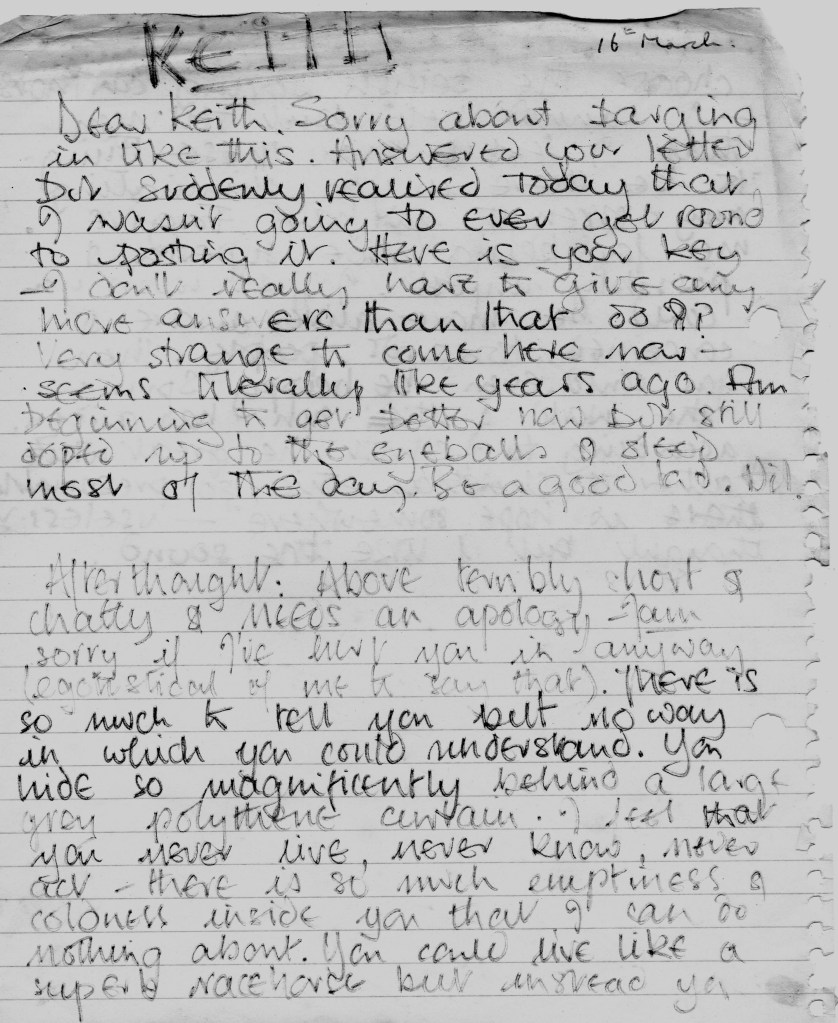
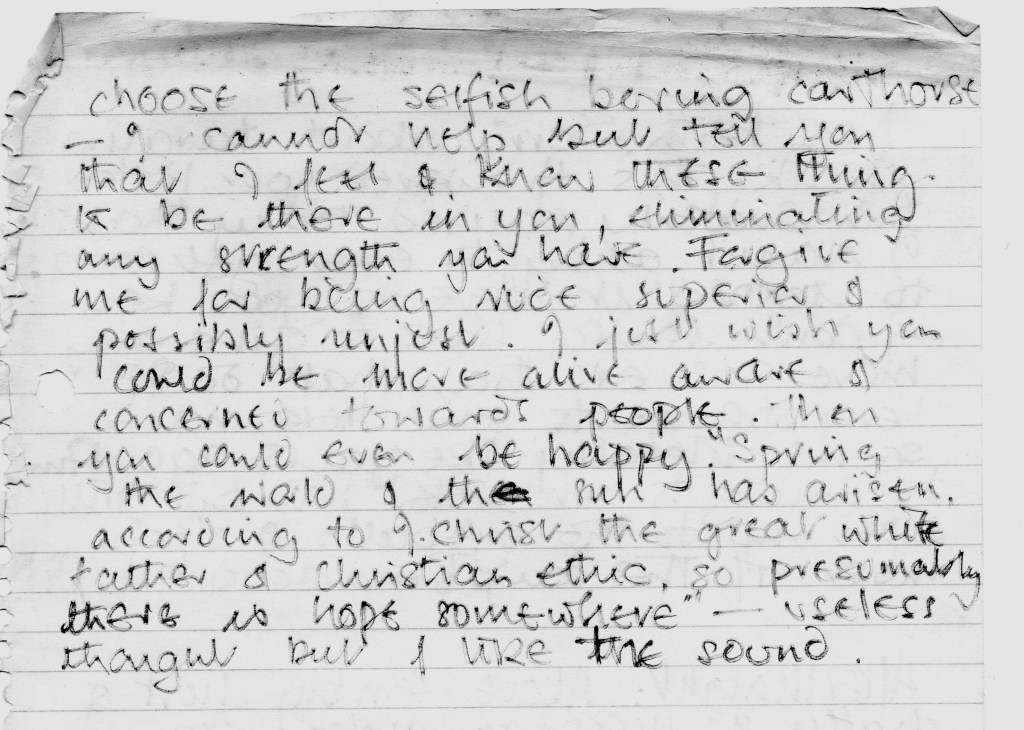
17 Mar, 2006. Hill Town.
Odd. Yesterday I was writing, ‘three weeks since the book launch and I’ve had absolutely no feedback. A resounding silence. Nothing.’
Today, Robert arrives with a nice review of the evening from David, Paul called – he hadn’t expected me – as did Stephen. Jack stopped me in the street to say he’s a third of the way through, and how evocative it is of the region. (All I want is for his wife to read it.) I call Stephen, he was very enthusiastic, and detailed and perceptive in his reading of it. Then a very positive letter from Kay, a writer whose judgements I respect, much beyond her usual encouragement.
But for each person who hasn’t responded, I invent a scenario of them hating it and not mentioning when we meet, the elephant in the room. And I realise that if I sold a thousand, a hundred thousand copies, for every silent reader I would pile up the unspoken criticism, already done in my head, too much this, too little that, does this person really believe he can write …? and the silent faces of condemnation. Or worse, dismissal.
To Kay: ‘I was struck by your last comment, that it was a book you’d like to leave on the Underground. That’s exactly my plan, to leave copies around – on café tables, park benches etc – with a message to respond if they’d like, or just to pass it on. Literary white bicycles. I’d rather give copies away than send dozens of review copies that end up on the reviewing slush pile. One writer I know had the idea to travel the country leaving a copy at every library. But it’s difficult these days even to give copies to libraries. I’ll leave copies in Youth Hostels I visit, on the free-book shelves of pubs and cafés etc. I don’t want it to sell, I want it to circulate. Going further, one could make an ‘art event’ of it – how many ways to get a book circulating? Slip copies onto bookshop shelves, in ‘W’ (not shoplifting but shop shelving), onto charity shop shelves with a price written in, etc. It could become a thing – a meme, is it? Odd, to pour so much knowledge and work into a cuboid of paper, hoping that it will, like a Japanese paper flower dropped into the water of other people’s lives, magically bloom. Astonishing things, books.’
A programme, The Falling Man, about those who jumped – over 200 – from the World Trade Center, after the planes hit. As always I’m knocked out by the images, the aesthetics of the drama, and all of it observed and recorded – the phone messages, the visceral shock and beauty of the second plane canting over and dissolving into the south tower in a slow fireball, the firemen futilely – there was nothing they could do and they knew it – climbing the stairs as death came down towards them, those on the top floors, unable to go down, faced with decisions – climb up with the film-inspired hope (happy ending) of being rescued from the roof by helicopter? Make peace, curl up and wait to succumb to smoke and heat? (1hour 45 minutes from strike to collapse). Break a window and wave table-cloths? Or … A man says of his wife, “she was out in the air, breathing pure air after the heat and smoke. It was her way of taking control. It must have been like flying.” His final image of his wife, flying.
18 Mar, 2004 Hill Town
Last night to Timmy’s concert, his orchestra of local amateurs. Two months since their daughter, who played cello in the orchestra before going to the conservatoire, hanged herself. from a beam in the garden shed, so Inga would be the one to find her. Inga, a life steelily devoted to her husband’s career, a mother to everyone, except her daughter.
First verse of a poem I wrote:
Wrestling with demons
her hand on a writhing neck
knees gripping
body curved around a bomb
she dares to explode
A hug from Kate. I might be pursuing her now. But probably with the usual result, ‘Keith, we’re friends. I need friends. Not the messy business.’ How I love the messy business!
And Mary is there with Jonathan. She’s schoolgirl-giddy about Vicky and I being together (again, again), at my marriage proposal, ‘When did you realise you were in love?’ Large and soft, matronly and schoolgirly at the same time, irresistibly buxom, and how she ‘likes’ me, sees me as a ‘good sort’. Kate slender as a willow, who would wrap herself around me in snake-like convolutions and me around her, her unreadable snake eyes always watching, embracing her slithery nature. Mary I would lose myself in, buried and blissfully lost.
Today to Wales for Helen’s sixtieth, a big do in the middle of nowhere, a social weekend, oh dear. I stop at Hay, and realise I no longer love books, that I’m jaundiced about people’s love of books, of their talismanic nature, and repetitions of what I’ve passed beyond as I search through second-hand bookshops. Just at the time when Robert and I are about to found Brimstone Press. The rain clears, the setting sun shines on the wet bare rock faces of slate quarries.
A warm greeting from Helen, no one else is here yet, I’ll collect Vicky in Worcester tomorrow. Strange, we embrace bodily, walk hand in hand, or with her holding my arm, her breast (lovely breast) pressed disconcertingly against me. With, apparently in her, no sense of its sexiness. She ring-fences sex from physicality, sensuality. Whereas for me all physical contact is a gateway to ‘possible sex’. We first slept together at college, a night (two nights) which I recall in delighted anatomical detail, and she doesn’t remember. Then twenty years of our marriages. And after I left Jane, seven years of letter writing, an epistolary relationship into which I poured everything, she circumspectly examining life beyond marriage, and began to develop herself as a patron of the arts, enjoying proximity to art and artists without plunging into their world. (She’s not a plunger.) I guess I’ve been for her a ‘work in progress’ all this time. Her promise to pay for the printing of my poems is why we’ve started Brimstone Press. After her divorce (at an expensive restaurant, ‘a very expensive restaurant’, on her fiftieth birthday, she told her astounded husband she was leaving him) and her move to Wales, a couple of years of occasional meetings. Then one night, holding our goodnight embrace a moment longer than usual, we woke the next morning together, with her saying, ‘I wondered when that would ever happen.’ Since then, sex from time to time, depending on my relationship situation, never when I was with someone, and the continuing epistolary relationship. And this, the last time I saw her, after I had committed to Vicky but Helen not knowing, she saying casually, out of nowhere, ‘I’m available, whenever’. And wouldn’t that have been the perfect situation? Except no, I must (time and time again …) plunge into Vicky, that there, with her, in her, is not just my writing life (of which she is the enabler, the muse), but my essential life, the beating heart of my life … If we could but – realise it.
19 Mar, 1986. Hill Town.
Men’s group last night. I felt okay with my glassy smile of acceptance, until John talked of Dora’s affair, and suddenly I was unable to handle it, except by feeling hard towards him and his self-regard of acceptance and forgiveness. I dreamed about Dora in the night. We were alone together in a house, laying out our sleeping bags to go to bed, when inevitably we kissed, although we both knew that it would only be kissing because we were alone together and there was a conditioned necessity not to go further. Her breath was bitter. As I’m sure was mine. We drew apart and both smiled, in triumph that we had followed what had to be which had led to the inevitable end, but without all the messy stuff between: A to Z, without the letters between, end of.
My mood of smiling acceptance is concealing a build up of bitterness, loneliness and isolation. I hope I can express it in writing, work it through there. Because I am so used to expressing my emotions with and through Jane, including my sexual feelings, I’m not sure I could ever relearn how to express them alone or with another. And that’s a sad and frightening situation.
Jane is in a very dark mood, casting a dark shadow around herself, so that if I’m in it I feel numb and desperate.
ps. I shaved off my beard on Saturday, and I still don’t recognise myself in the mirror. Something strange has been happening, has happened, behind the beard, unseen. A loss of definition, character, my chin now too small and ill-defined, my mouth characterless and weak. How strange. A story, in which a man shaves off his beard and finds he’s a different person. But no one remembers how he looked before he grew the beard, so only he sees the change – to those around him, he’s just someone they know who’s removed a beard – and wonders where that person has gone. And misses him.
I’ve reached the crux of Geoffrey’s story, where the aesthetic becomes the spiritual. No, where the aesthetic is replaced by the spiritual. The aesthetic charge had gone with the girl, leaving the place, once so animatedly beautiful, an empty shell. When Geoffrey experiences the spiritual, then he can move the place forward, on the new path. But Geoffrey’s story is too prosaic, too much like a life I could plausibly live, to be of much interest to me. I’m just keeping the reader interested, involved, able to admire, envy, feel sorry for him, to get them – and me – to Rolf. In whose life they will experience in horrified fascination the power and energy and absolutism of the monomaniac, who achieves, goes through so much, driven by a fire that can lead to only one possible end. I hope I’m up to writing it.
20 Mar, 2000. Hill Town.
A persistent belief that if one proceeds long enough and hard enough, relentlessly, implacably, unrestingly, unceasingly, then something will come of it. And no idea where that belief comes from.
Theo returns all my poems, says they would have got into the magazine last year, but they weren’t written (submitted) last year. But I decide to return to poetry, to keep going with it, the one on-going, it’s what I have.
(Later)
Curious, this feeling of ampleness, and that out of this ampleness something will come, from this work something will come, that from all this writing something will separate itself, as carefully as an avocado stone from the fruit, amoeba from amoeba, baby from mother, sculpture from rock, ease itself away, complete in itself, however unfinished: at first wet and shivery and unestablished, slowly firming to something having form, and eventually a twitching a stirring into life; at first an inner life, contemplating its livingness, feeling its central flame, gradually sensing the outside, the outside of its own being, feeling the movement and touch of fingers, observing itself, and then relating to the world outside itself, with a clear eye. At first it makes no sense, but gradually it makes sense, and then having a voice, communicating and commanding, a hand imperious, a stride decisive, and gradually taking the whole world under its command, and absorbing the whole world into itself. When it freezes, locks, a fossilised world. The weather beats against it, the lightning strikes, but nothing happens for eons. Until something inside begins the long process towards separating itself. And then something will come.
A ring of fluorescence around the full moon. It must be near the equinox.
A new display in the American-Indian shop, ‘Baltic Amber’, and the quick memory of buying a necklace for a woman, the delight in buying presents for someone who is always in one’s thoughts, and especially necklaces, the drape of silver around white skin, the column of neck and the twist of skin as the head is turned, the touch of fingertips, of lips on neck, by an earlobe. And a determination to find a ‘significant other’, of whatever degree of involvement.
21 Mar, 1981. Milton Gate.
At last the mornings are lighter and I can live and grow. It’s not about warmth but light. I’m an onion, I need to strip off layer after layer so each may be struck by light, until …
I’ve been reading through old stories, trying to work out where to begin. There’s a lot I need to work through, locate, digest, discard.
But the finished stories, the F.light Tale, the Journey story, will remain personal, unresonant, without a market, until they have a public life.
And already France is as far behind as Textile City was when I lived in London …
Art is about being alone with the world. An inner aloneness, an inner one-to-oneness, an opening of the self, so the That inside may touch the That outside. And alone all around, isolation. Accepting the irremediable loneliness as a given.
Artists are torches, ignited of their own free choice. The story is of two men. One builds his house, in all styles and with all technologies, makes of it a Centre where he brings gifts to people. The other builds out of his life, out of the things of his life, a bonfire, climbs into it and spontaneously combusts. The watchers hear the roar of silence, are struck dumb. The crystal at the centre of the first man’s house shatters, the house and his work. The story of the burning man travels by word of mouth, spreading like rings on water, transforming, enduring.
Tom was disturbed last night, and we spent a lousy evening and an uneasy night. I smoked, and listened to side two of Slow Train Coming, and a long sliver of my life became perfectly clear – growing away from parents, attachment to school, belief in somewhere else, onto the narrow track, knocked off it (woken up) by the girl, Melanie, scrabbling around, and then finding True Love and everything thereafter revolving around her. So clear when stoned, so ordinary when straight.
On the Journey, he (I) is now in the forest, the mountain lost to sight, only remembered, the broad highway, on which he might be travelling with ease, glimpsed from time to time. If I’d stayed in the Planning Office I would now be preparing for thirty years of regret, sweating with comfort, having neither lived my life one-hundred per-cent, nor done the things I wanted to do. Expand the Planning Office story into a half-hour radio play?
Ridiculous, these notes. What for?
22 Mar, 1994. Hill Town.
A waking dream – I dream, put on the light, write it down, switch off the light, turn over, the dream resumes, light on, etc. Then at 03:55 I’m instructed to get up and work. When I look, so little written, and imperfectly recalled. But it feels important.
An unknown woman, ‘before we begin, can I ask you something? Do you wish you hadn’t written? / been a writer?’
I ponder, have difficulty wording my reply. ‘I suppose I couldn’t not have been. All that was, and is important, is to write the right way. Not too far, not too short (not going too far out, not stopping too soon …?) all I can do is try to get it exactly right.’
The woman has become Alex, but Alex without the hang-ups, as she might have been.
We’ve only just begun. (Is this her speaking, or me thinking?)
The image of a reclining female, as in c17th painting (Is it Melanie?) against a background of writing, with PEAU outlined and expanded from the text.
Finally I say, ‘I can take it away at the weekend, and it can blow away.’
So imperfect, and yet it says something fundamental. And when I get up I find myself clear, at last, about going away this weekend with Stella, and am sure it will be fine.
Stella on the phone last night, hardly able to contain her excitement about my birthday present. But all day the Vicky thing was a dull ache – then a sudden pain when I went past her house, saw her car. I simply have to let it go. I’ll go away with Stella, as I used to go away with Vicky. Another, ‘as I used to …’. After Stella and I have gone to the pub together, had sex together, slept together. Another step on.
As I do with others the things I used to do with Vicky, the area Vicky occupies in my life shrinks. It’s like a wound healing from the edges. But it remains as raw and painful in the centre. I sat in my chair after lunch, gasping, unable to move, as if there was a spear through my heart into the chair.
And weird to realise that this uniquely painful experience is experienced universally, and as intensely. Uniquely painful, but so commonplace as to be banal. And the realisation that as I occupy ever more of my life with others, with ever less space for Vicky, the realisation that when I succeed, so that Vicky occupies no space, then I will have to give up the last refuge, hope. At the end of hope is despair. At the end of despair is acceptance. And then everything Is. Or so I’ve read. But, a life without hope of Vicky … Really? And yet I must live as if she doesn’t exist. (Easier if she were in Australia. Or dead – at least then I could occupy myself in mourning. But, living in the next street …?)
I must live with her entirely out of my life. And not waver from that. What she did was unforgivable, it’s important to remember that.
I write out ‘Anthem’ for Helen, write, ‘Heaven knows what I’m doing, up at 4am, copying out a Leonard Cohen song, and writing this to you. Just that, I guess. It has been, is such a gift to have Bob Dylan and Leonard Cohen with me the whole of my adult life, and for them still to be there, still saying important things.
“Ring the bells that still can ring.
Forget your perfect offering.
There is a crack in everything.
It’s where the light gets in.”
“Every heart to love will come, but like a refugee …”’
On with the story!
Ponder the dream.’
23 Mar, 1970. Textile City.
Dave G, ‘More and more I’m seeing the need for the right to be miserable and depressed’. The problem of the social self. And of marriage sealing one into the realm of the consistent self. John, finger on the pulse, go with the flow, adapt to be one of the group, part of, take the oath; and yet his reserved centre. But what if one wants to live that reserved centre?
Standing in a bus of housewives. Did they dream before they wed?
My education was a booster rocket into alien space. When it fell away, I was left with who I am.
“I believe that Gauguin thought that an artist should seek the symbol, the myth, enlarge the things of life and raise them to the stature of myth. While Van Gogh believed that myth should be deduced from the most earthly things of life. And I think he was damned right.” Artaud, Anthology. p143.
Dear Cathy
Why did I step back? I’ve been trying to put it into words. A sense I was falling apart, the centre not holding. A fear of involvement, especially after last time. Sorry to bring it up again. But I just can’t allow myself to get involved as I did last time. And an ongoing sense of you as la belle dame sans merci, combining enchantment and detachment. I suddenly knew how the knight felt. Sorry. But how amazing to see you, and how marvellous. And how little time seemed to have passed, in spite of everything.’
Dear Astrid
Herewith your earrings [pinned through painted ears] – keep the ears, my first painting for a while. I respect and envy your desire to devote yourself to your work. It’s a devotion I should have, am trying to work towards.
Dear Mary Mo-snow
What a delight you are! I’m far too rough-hewn for you, it would not go well. I hope you meet one of matching delicacy and sensitivity. He will be a lucky man.
(Bridie) Small, birdlike, tough sparrow, koala bear, field mouse, at a party, then away two weeks. Working on my head, parties, Boot Grange, early morning runs, drinking, to Holland, smoking, Eleanor, Helen, Nora, the spiritual, the barmaid. Above all, aware.
My train slowing into Textile City station, returning from work. Standing at the carriage door gazing vacantly at the passing cityscape, red terraces, sooty brick factories, public buildings, collecting myself with mild regret, ready, having changed out of my office clothes, for the evening. A train slides suddenly sideways towards mine, now very close, on the adjacent line, travelling slightly quicker, the carriage door approaching, window open, a girl standing at it, looking, do I flee, look away, I must look, her eyes lock into mine, place an unexploded bomb in my heart, she smiles, encouragingly, sadly as her train, its job done, lurches sideways, to disappear into a distant platform. I descend, go to the buffet to eat, as I often do, I’m finishing the last of my apple pie when the bomb explodes, I rush around the station and out, is that her disappearing around a corner? she is gone.
24 Mar, 2003. Hill Town.
Mum and dad’s things, in less than half a cubic yard of cardboard box. Nothing distinctive, much less distinguished. Style, heirlooms and expressions of their taste winnowed out as they hurried (fled?) from house to caravan to council bungalow.
A few audio tapes, light classical, popular modern, nothing genre. Mum’s photographs documenting her trips abroad, each one an ‘up yours’ to him, each photo characterless, cutting a patch out of what’s seen, as if she didn’t presume to express an opinion, even in the taking of a photograph. He never had a camera, after the amazing photographs he took in service pre-war in Singapore, native life photographed and captioned with sensitivity, carefully collected in an elaborate album. What happened?
In manilla envelopes the substantial record of what mum did in the village, after he was no longer there to thwart her. Senior Citizens, the Church, Ramblers.
The chapel was full for her funeral.
Family only – and a thin family – at his. (When they asked what they should do with his ashes, she said, put them on the crematorium flower beds, they’ll help the flowers grow. Discarded. We’d wanted to take them to the Lake District.) Six years a private in the army, seven years in the war, two years in a TB sanatorium, twenty-five years a greenkeeper with a local firm.
In the Sanatorium, no Sillitoe, Simpson & Galton, Bruce Lacey translation into creativity. Maybe then, there, having been thwarted of his ‘real’ life (whatever that might have been) first by the war then by TB, he began his secret imagined life. Twenty-five years a groundsman, in charge of his own world, sure he was cleverer than anyone in the company office, among whom he’d have been, without his illness. How he pulled down others’ worlds! He encouraged his kids, bathing in their reflected glory while we were successful – my brother an excellent carpenter who was being groomed to take over the building firm; my school and university success. And yet both of us dropped out. As if undermined by his envy, and his disparagement of the lives of others. What was there to aspire to in lives we might live, when he had so comprehensively pulled apart all possible lives? He had the habit of the envious, of looking always for weaknesses, probing for the cracks into which he could insert doubt, like water in rock that freezes and prises apart. Dissatisfied until he found cracks, and could then relax back into the world he ruled. And I’m sure he was so with us – sure that he would have made a better job of it, whatever we were doing, if he’d been doing it, if he’d had the opportunity. And crucial lessons in how to get on never learned. How could they be, when his life was so much fantasy? And maybe our dropping out was revenge on him – to deny him the reflected glory of our success …?
And yet four times he transformed himself. From back-street kid into a successful soldier, then sufficiently transformed in the army to get an office job. When told that, with TB he must get outdoor work, he turned himself, from groundsman labourer, with concentrated study, into an excellent green keeper. With a lung and four ribs missing, he took up golf, and won the Green Keepers National Championship. Deciding we should cycle, and having little money, by buying and selling and doing up bikes we soon each had a fine machine, and were integral to the local cycling club, until we left home and he gave it up (his fine bike rusting in the shed for years, refusing to let me have it, sure he would ‘one day’ cycle again. Or just being selfish). As if none of these activities touched his centre. If he had a centre. There was always the sense of an emptiness at his centre, a void where the essence should be. As if there was no face behind the mask. “The King of Asini a void under the mask.” As if at heart he didn’t believe in himself. So how could we?
And in this box of remains, the absence of the one thing I wanted to find – the story he wrote about the python, rising up from the sea by his boat, looking at him then, long and smooth, diving back down. His one piece of authenticity. And in the hardback notebook I’d read it in, long ago, nothing, just the edges of torn-out pages. Had he torn it out and destroyed it, or she?
25 Mar, 1997. Hill Town.
Now this, the question: do I carry on with this writing, of descent into another world, another time, place, a place where time only passes when I am actively engaging, am actually making progress there, a place where everything is an immense effort? Or do I live exactly in the now, and write of what I see and think now; then leave the moment behind, with what I’ve written a marker, an epigraph, an epitaph …? I want to create worlds. Maybe I have time only for snapshots of this world.
I seek out the comet (Hale-Bopp) each evening. It’s the first thing I look for in the morning. It is a reassuring presence, the large fuzzy head (size of ten stars), the long stream of tail that seems to depict speed but is motionless in the sky. It is a visitor from a world so much bigger than ours, returning every two thousand years, entering our small world. With no message. It visits to be seen. And yet a group in California, thirty-seven people, killed themselves, so they could board the spaceship that they believed is shadowing the comet. (Drunvalo Melchizedek spoke of the second presence, the shadowing spaceship, in his packed talk at Glastonbury.) Their curious literalness. Their given, that the self can shed the body and still be.
Ursula was soloist at Timmy’s concert, playing Schumann’s cello concerto. She played with great passion and brio, but explosively self-contained, as if too nervous or inhibited to let out the full feeling, even the full sound. Constrained. Imagine her letting go.
I realise how much effect depends on opening the self, in order to let out what one has, that being confident makes confidence, allows the audience to relax. You’re doing the work so they don’t have to, can just enjoy. Remember this at readings, in conversation.
Suddenly, yesterday a.m., I had finished the chapter. I’m not sure what to do with it, how much revision it needs, but at least it’s concluded. And suddenly I remember how to be chirpy.
Auden says that the novelist’s is the highest art. It’s true. And if I give up, it will be out of weakness. Poetry is brilliance and skill and self-laceration and exposure. Fiction is quiet dedication, the long haul, the long term identification, the purification of self in order to see ever more clearly the imagined characters in the imagined world, and making of it a created world. It is a heroic endeavour. The poet is acrobat and magician. The novelist is explorer and adventurer.
26 Mar, 2000. Hill Town.
Jess is at her door when I deliver the post. Jess who now and forever I associate with that morning in the sunshine, with the words that crystallised the impossibility, and my sadness at it. Now she is excited at being in the community play, and saying if only they’d put in the connection with Glastonbury. As I’m leaving she says, Vicky really does love you, she’s just afraid of commitment. And returning past Vicky’s house, seeing her car, all the longing and loss is there.
But, too, the hardened heart, the calcined connections, the thickening of blood that once flowed so vital and energetic.
And how she managed in so many ways – always a new way, always finding a new way – to screw up.
But thereby I excuse myself from responsibility, for my agenda of wanting her to be a certain person, wanting her to become independent, self-responsible, resistant to the voices that were forever getting her to exchange individuality for community, groups that she was forever joining then breaking from. Breaking from because there was too much present in her life, too much now, to stay for long. And in that presentness was her perpetual self-renewal and reborn innocence, her attraction, she who at fifty can look – can be – seventeen.
Yesterday I enlarged her photograph. Curious that, enlarging the photograph, I was no longer outside. I could step into, as if I was climbing into a cinema screen. Larger than life brings to life.
Later she stopped by as I was washing the Post Office vans, seeking TLC she said, an awkward hug and mutual accounts, she looking old and worn and a little lost, and me isolated in the centre of my ‘live without her’ mode.
Reading Seferis. And I’m immediately back in Greece. The hard, rocky Greece of the absented, gone gods, of the disappeared, failed heroes, of the lost, and the scratching searching of those disconsolate ones, inconsolable at the silence; and the palpable sense of absence. The idols and objects that can no longer be drawn up from the well, while “touching the grooves on the well’s lip reminds us of our past happiness”; the marble head, too heavy in the hands; the search of one, at one with the blade of the plough and the ship’s keel, for the first seeds, so the age-old drama could begin again. A land without springs or wells, only cisterns. But also I’m back in quiet rooms, and the silence of solitary contemplation, of sitting by a fire rather than a television, of that special silence, when reading a book, that the crackle of the fire, the taps of raindrops against the window brings one out of the book, into the revery, brings to one the sense of what is outside, and what is inside. And of loss. And of the imagined. Oh! That poem, about working in my room. That life. And the sense of loss because the person has gone, and if only the person were there, it would, the life, be able to continue.
But how to live with the sense of loss when the life has gone but the person is still there …?
‘If I chose to remain alone, what I longed for
was solitude, not this kind of waiting,
my soul shattered on the horizon,
these lines, these colours, this silence.’
And this:
‘And a soul
to know itself
must look
into a soul.’
And this, of Melanie :
‘I regret having let a broad river slip through my fingers
without drinking a single drop.’
27 Mar, 1996. Hill Town.
A disturbed night. But I did go out and see comet Hyakutake. I woke suddenly at 12:30am, saw the sky was clear in places, dressed and went out. It was very cold. Stars above clear, the moon a bit hazy, and near the Pole star a hazy patch. I was saying, as I walked along Bell Street, I do hope that haze clears from near the Pole star by the time I get to Castle Walk. When I got there, with a clear view, I realised that the hazy patch – like a fingerprint on glass over a light – was the comet. The stars were sharp and bright, this patch diffused, half the size of the moon, a smudged star. Not clear. But a presence. A fingerprint on the clearness of the night sky. I realised why people regard comets as portents of disaster: it smudged the heavens. Then gradually I accepted its arrival, its presence, its passage. And actually (just visibly) moving. And yet, like a partial eclipse, an imperfection. With the added sense of intrusion – I don’t want this wandering alien, a smudge without a tail. But it’s there. Accept it. And now I’ve seen a comet, visible for only three nights, and this the last, and soon covered by cloud. Frozen I limped home, was up for work at 04:30.
As my life ‘normalises’, as I rest and begin to feel, however faintly, the pulse, the vibration of life within me, I become more convinced that what stopped me writing wasn’t a failure of nerve or energy to work, but an artistic impasse. It wasn’t that I didn’t I know how to get to where I was going; I didn’t know where I was going. This is significant, and helpful. So my alternative strategy is artistically sensible, as it prepares the ground for what I want to say, inside the fictional world.
Helen came for the weekend. I was very nervous – the first time since 1968, in Textile City, when after a party we slept together. Twice.
She arrived at 5:30, we did the tour of the town, then dinner at her hotel. On Sunday, Lulworth, Durdle Door, Maiden Castle, Cerne Abbas. I told her my idea of planting, opposite the giant, a hillside of daffodils in the shape of Marilyn Monroe, to flower each spring. Maiden Castle was dark, but there was a fine sense of the massive certainty of a people so sure of their place and power that they created this enormous earthwork, feature, place, that both embodied their strength, and strengthened the landscape that comprised their world.
On the way back she said she’d checked out of the hotel, could go to friends in Exeter, or a B&B on the Levels. I said do please stay at my place. She had a bath, we ate Chinese, she slept in Tom’s room, breakfast was on the table when I got back from first delivery. Delightfully domestic. The sun was shining as she left.
Could we have? Should we have? She fills my thoughts. Not because of a physical passion, but because of her intelligence, her presence, her organisation. I am (at present) very drawn to sharing a life. Compared, Vicky seems (how ungracious) slight, provincial. Helen has real power. The woman to sort me out? Not quite. But almost. Something like that.
Energised, I began typing up old stories, looking at old files, thinking about getting sorted. I said to Helen, it feels like an angel is holding open a book, saying these are the pages you should be looking at. I wrote this:
“At fifty the end
Came into view
Life ceased
To go on forever
I began to aim
My life towards
The end
My life became
Death filled.”
Death acknowledged, for the first time, at last. And with it, a wonderful serenity.
28 Mar, 1966. River Town.
It’s strange, I return to River Town after a term away, and the streets, the shops are the same, but the people are all different. As if the whole population has been changed while I was away. I guess because I’ve had so little to do with the town, since I went up the hill to the grammar school, it’s just been a backdrop to my life, with little need to interact with it.
At first when I get back (I’m always the first, as our terms are shortest) I feel utterly alone. And entirely free. I might walk into that pub and become a regular, into the newspaper office and become a columnist, into a redundant warehouse on the Quay – climb through dusty echoes – and begin to plan (as Alison and I used to) our new Arts Centre. Start my life from scratch at this moment. Except I don’t. The town is just a set on which imagined stories are acted out.
At first walking all over, everywhere, fiercely alone, needing to touch (with feet, eyes), reconnect – with places of memory (under canal bridges, remembered moments from childhood, happy and desolate, – and how often past Alison’s house!), and settings for newly-discovered aspects of myself – this is where this is supposed to happen, locations for my ‘Werther’ story, etc. But also feeling intensely unmoored, lonely, untouched, untouchable – Oh for a familiar touch!
Gradually seeing people (I’m recognised on my second visit to the library), meeting them, some back from college, others maybe met at parties, who speak tentatively to me, me to them, who I realise will be part of this vacations’s social world. And – the big decision – which girl to pursue. In Oxbridge all girls are fantasy. Here all girls are in the market. Always several in my head. But first, alone, the dream lover. This time it’s Joan. After her visit in term, on one of my long walks, in the fierce wind, up past the Park, I remembered her in my room in Oxbridge, then imagined. Her large soft breasts firmed by a bra, her smooth sensuous hips in stretched nylon. Half sitting, half lying in front of the gas fire, bra removed, her naked breast and nipple silhouetted against the flickering light. Then I was drawing her to me, kissing her lips, neck, breast, loins. I felt the sensation of inserting my penis, her gasp of pleasure, ‘oh, it’s lovely, yes!’ As I pushed in and moved slightly. I almost came in my pants. Back home I wanked over the picture I’d drawn of her that afternoon, but it wasn’t the same.
And still sex hasn’t happened. It’s never been – right. Either the girl doesn’t fancy me enough, in which case she doesn’t want to, or too much, in which case I would feel exploitative and, weird word, a cad. Or, as with Alison, postponed until, too late, we were no longer going out with each other.
And then last night it – life here – came together – as it always does, each vacation, after the emptiness and desolation. The right gang meeting at the pub – always better when Rigby’s there – then to Thunderball. And the warmth, even love, of friendship, in the talk and being together and catching up (which one of us has suddenly found ‘the one’, etc). Not the carnal desires of sex, boys and girls together, but the pleasantness of friendship and gentle lovemaking, within our accepted rules of how far to go. And in the end Rigby and Rick and I walking down through town, having taken Gill home, under the great bell dome of the sky and the mighty rolling clouds, an occasional still star – stop, look – singing ‘Chimes of Freedom’, walking faster, into the hard wind, then running, down hill, arms out, about to take off, helter skelter, right through the song and on the final “chimes of freedom flashing!” we collapsed on the town hall steps, laughing.
And now the time is right, to be in a couple, to be sharing secrets. Crystallised by this, from a book review of The Flight from Woman by Karl Stern, which contrasts two modes of knowledge, the rational/scientific, and the intuitive/poetic, and writes of the flight of striving, lonely men (from Goethe to Sartre, and today’s ‘strivers’) from the tenderness of women that they need so much:
“If, for whatever reason, the child has never experienced that irrational, total acceptance which a tender mother will normally extend to him, both faith and love will tend to be replaced by a distorted rationality which is ultimately sterile.”
“A truly complementary, reciprocal relation between a man and a woman can only be maintained when each is able to feel the dignity and indeed the splendour of being created male and female.”
So, I want Cathy.
29 Mar, 2006. Side, Turkey.
After the disappointment of the 1999 eclipse in Normandy, missing this eclipse in Turkey, with a high chance of clear skies, on my birthday, the first anniversary of my retirement from the post office, would have been perverse. So here I am, on a sunny day, by the sea, among fine Greek ruins, surrounded by tripods of telescopes and cameras angled skyward, pointing at the same spot, waiting for first contact.
And after my education’s long process of subtracting wonder in order to to leave solid bricks of facts, the matter-of-fact, that can be used to build edifices of knowledge, I am here to re-wonder. That the sun and moon are the same size in the sky is a wonder. That each place on earth (this place) experiences a total eclipse only once every three or four centuries is a wonder. That the earth (here) is spinning at 725mph, and the moon is travelling at 2288mph, and that it is the passage of the moon between sun and earth, its shadow a negative torch beam, a beam of black 150 miles across that will exclude sunlight from where I stand for 3 minutes and 10 seconds and then be gone for several centuries, is a wonder.
At first contact the glasses go on, and we are Alien Nation, seeing the world as one, through our glasses. With half an hour to go the sun is half covered, a crescent of light, in shape a crescent moon but quite different. A boat heads out to sea. The waves are soft and repetitive. A water skier passes – will he ski through the eclipse? And a plane. In 1973 eclipse-chasers experienced totality for 74 minutes in Concorde.
And then a change: from the experience of a crescent of light, to the sense of an immense object moving slowly across, being manoeuvred, a vast spaceship, of great size and weight, of something docking, moving on a preordained path, by gravity, effortlessly. It cools. The sea is choppier and noisier. The air is fresher. Venus appears. And then this thought: that the perfect world is black, and the sliver of sun is the last imperfection. And as the final piece of black slides into place, closes the last window, we take off our glasses and see directly, and together, acolytes of the true dark world.
The light is suddenly very odd, not making sense. Dark – like a storm approaching? The sky, as if purple with clouds, but with the black sun in the centre. Grasping for familiarity. There is none. The thinnest of crescents, then the diamond ring, then nothing. And light is sucked out, as if the sun has been sucked out of the universe and all light with it. Try again. Darkness descends, like a blanket. Yet everything is visible. For 3 minutes and 10 seconds it is a different world, which I and those around me are living in. Above, it is as dark as night, deep blue, a purple blackness, stars are visible. But all around, the horizon is like the sky after a vivid sunset, orange and red. Over us is an immensity blocking out of light (Independence Day), the shadow of an enormous presence; while all around is both the memory and the prospect of the ‘normal’ world. Lights are on in the village. Dusk all around that will turn into dawn all around. Bizarre. And frightening. And yet we’re happy, chattering back and forth, happily in thrall to this new darkness, this new sensation. Because we know it will end? Of course. But imagine it extending for some chosen time. People would visit this place to experience its difference. Cheers for the diamond ring, then for 3 minutes and 10 seconds, nothing will change. Absurdly, a minute in, a man drives up, sinks his spinning wheels into the sand, is stuck. And we merely register his absurdity. For we are in the middle of something immense. Look at the sun. Or rather the absence of sun, the black disc with the white flaring corona. In the middle of a dark blue night sky, dark overhead, the horizon all around held in a beautiful after-sunset moment, that time of revery as the light fades and night gathers and the world settles into night.
Instead, another diamond ring, and then, like a dimmer-switch being turned up, light floods back. The spotlight of darkness, of black, flies away, accelerates off – where has it gone? What happened? Did it happen? A sense not of it moving on but of it moving upwards, ending its visit, disappearing into space. We shake ourselves awake. Within five minutes it is fully light, quickly brightening to a familiar sunny day. A dreamy, reflective hour follows – what happened, did it happen? The only evidence, as I saunter back to the village, of what has happened is in the crescent suns on the ground under trees. An eclipse has passed through me. It will always be in me.
30 Mar, 1978. Milton Gate.
A dream. It’s like a story, a literary creation, but it’s actually happening. I’m in that green and grey valley place, rough stone, dilapidated, French-feeling. I’m with Helen. She is with a man, but he’s more a keeper than a companion. She is there to see me. We go to bed together. I remember the touches and affection before, the excited anticipation. Then it is dawn, and I wake to see her curly hair on the pillow beside me, and realise that we haven’t made love, not even been physically involved. I feel a great sense of regret, while accepting that I’d known that it wouldn’t happen. But I’m still about to make advances, maybe …? when the man knocks, puts his head around the door, ‘Helen, it’s time to go’. Not peremptory or with authority but urgently, he’s looking behind, they have to go. She turns sleepily to me, we smile and shrug, are filled with sadness, but accept that we knew it wouldn’t happen.
31 Mar, 2008. Cwmystwyth.
Sunny morning, standing at the picture window, overlooking the valley, steel blue river winding between yellow-green fields, brown-green deciduous trees – trunks moss green, range of browns at the twig tips – solid dark coniferous up the slopes and over the rounded tops, white dots of sheep, long blue shadows from the low sun. Electricity poles, a wire to every house, cluster of buildings below, grey, white, and on the converted chapel a bright red door.
I see it as an ink sketch, with different marks for different textures, a code, and I imagine sketching it like that. Then I see myself patiently working across a picture as big as the window, at first sketching in pencil, then working in the detail, ever more until there is as much detail in the picture as in the landscape; but not the same, each detail equivalent, a representation in an exact simulacrum, each coded mark represented in the picture’s legend, as on a map. I imagine taking down the picture, and seeing the landscape in front of me in a new way. And beginning a new picture.
A visual world, hard to describe in words because there is too much detail for words, needing a texture finer than ‘the word’.
Sometimes, like last night, I have an image here of ‘Nature’ as an an entity, massing outside, confronting directly, up against the window, pressing, solid, no gaps, nothing that can be got through. Then the power of the wind is a giant fist, the rain is stones hurled relentlessly. But then, listening, sensing texture within the solidity, bleating lambs, enduring sheep, somewhere life ebbing away as a weak creature dies slowly. Implacable. The few house lights and occasional headlight are puny, about to be snuffed out. Big forces. And a bony landscape, of bones and hard muscles under rippling velvet turf, ready to flex, stir. A landscape ready to move, maybe moving now, slowly, a snuffle, a sigh. Kites swirl overhead, streams are ever noisy.
Standing here, I know why Helen lives here, has this picture window, why she draws and paints.

