I walk through Roman ruins at Side, along a colonnaded way, past the Apollo temple. Many are sat in there. What will they see? Will they watch on screens? Further on there are sand dunes, low cliffs, excellent sea views, plenty of room – this place will work.
I am in Turkey, on my birthday, to witness a total eclipse of the sun. A year since I retired from Royal Mail, the year I gave myself to live without plans or constraint. The beginning of the new year, when I must decide what to do, what not to do, what to focus my life on, a new way to live intently, the rest of my life.
What do I know? I know the track of the eclipse, about a hundred miles wide, that sweeps across the earth at about a thousand miles an hour, giving, at each point, a period of totality of 3-4 minutes.
I know that the moon eclipses the sun, covers it exactly, because although it is one four-hundredth the diameter of the sun, it is 400 times closer to us.
I know the eclipse has started in Brazil at dawn, is crossing Africa, Turkey, Kazakhstan, Mongolia, and will end at sunset there.
I know totality starts here at 13.54.24, the maximum is at 13.56, it will end at 13.57.34. But the moon begins to cover the sun at 12.37.33, clears it at 15.12.47.
The moon moves across the sky anticlockwise (from west to east). Question: if it’s the moon going around the earth, why isn’t there an eclipse every month? Because the moon’s orbit is at an angle to the earth’s orbit of the sun – in summer, the moon passes ‘above’ the sun; in winter below.
A minimum of twice a year (maximum 5 times), the tracks cross, and there’s an eclipse, most often partial. Just 66 times a century (on average), there is a total eclipse from some point on the earth’s surface. But any point on the earth’s surface can expect one total eclipse only every 3 or 4 centuries. This will be one of the longer totalities, almost 4 minutes.
22 minutes to first contact. To the dunes. Lots of people around, lots of cameras and telescopes pointed at the same place, where the sun will be in 2 hours – dedicated, single-minded, pointing up like beasts at their appointed season. Like worshippers called not to prayer but to attention. To bear witness. There is only one possibility in their world at this time, they can only do one thing. They point upwards, all at the same angle, unmoving. Like creatures brought by biological and environmental imperatives. Like acolytes of a Cargo cult, steadfastly waiting. Except for them, and for us, the certainty is that it will happen, the event. That’s why we love science, revere and worship it. They wait with infinite patience, total certainty. Or they are simply machines for whom time doesn’t yet exist, for they are, at this time, switched off.
Beside them move or wait their minders, those whose role is simply to bring them to this place and time, to point them at a particular point in the sky, empty at present, but the one place in the sky that (here) it will happen, to select from the infinite number of points in the firmament that one point which, at the allotted moment, there will intersect the trajectories of the earth, the moon and the sun. All are waiting. Their minders are mindless; they have done their one job, located the one point.
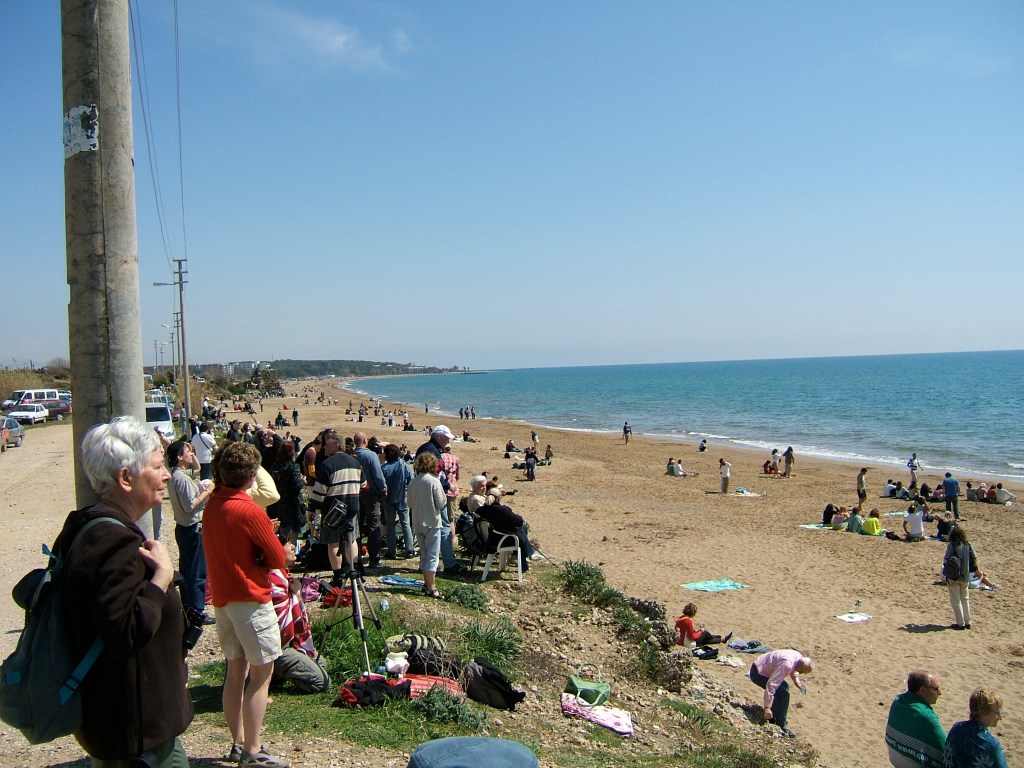
Around them, between these one-pointed individuals, wander the happy-to-be-here’s, those who’ve arrived here as a result of various accumulations of incident and intention, not acolytes, but tourists. Or birthday holiday-makers. Us.
12.37, first contact, the eclipse glasses go on – and we’re in They Live, seeing the world differently, but as one, through our spectacles. All around are goggle-eyed faces, like the clay figures with their pencil-hole eyes that Anthony Gormley made. We’re all staring up together, our eyes sightless, silver or empty black. Sometimes blazing with light, as if radiating inner light, the revelation of a new truth, we know, we believe, this is happening, we are here. Sometimes black as empty space.
13.25, half an hour to go. The sun is half covered, it’s a crescent of light when observed through glasses. Like a crescent moon, but entirely different.
I’ve found my place, on a low cliff above the beach, with a clear view in the direction the moon’s shadow will come across the sea. This is where it will happen, for me.
A boat, moving slowly, full of worshippers, heading out to sea. The sea, soft and repetitive.
The German lady next to me says she’s seen a sunspot; I try through her binoculars but can’t claim to have seen anything.
13.30 (t – 24’) – is the light diminished? Is there a new clarity? A water-skier passes. Will he waterski through the eclipse? I check the exposure setting on my camera – it’s now 1/450 at f5.6. The brightness has gone from the light, there’s no need for sunglasses.
I look through my eclipse glasses. Now I have the sense of an immense object moving slowly across the sun (or, rather, across the one visible thing in the sky), being manoeuvred across, a vast spaceship – a sudden sense of size, and weight, like something docking, being manoeuvred carefully. Except it’s sliding across in a pre-ordained way, as if on rails, in grooves, with gravity (that force that holds all things together, and apart, in three dimensions) as both lubricant and guiding principle, enabling it to move, be moved effortlessly into place, that’s making all this happen. More paradox. But, will it fit?
And that whole coincidence, not only of their similar apparent sizes, but that from time to time their orbits intersect in such a way that one gets exactly between the other two. The similarity and the difference of the lunar and solar eclipses, the entirely different feel – lunar is a shadow, the moon is still visible – this is real. And much more serious: the sun is disappearing.
Or, how about this? We inhabit a black universe (as it is through our glasses), which temporarily is incomplete; this, sliding into place, is the final piece of black, to close off all light. The sun as the final window. Or the final imperfection. The world a prison. Or a world perfect in its uniformity, its oneness. We observe the blackness together, through our spectacles, we worshippers, and we will share, when the final piece is across, the dark. And then we’ll be able to take off our glasses together and, for the first time, see – directly, and together. The weirdness of the eclipse is unhinging normality.
An aeroplane appears, a small one, busy and buzzing.
13.37 (-17’) A wind comes up. It’s a bit cooler. Things are happening, there are effects down here – not effects of the vast forces of gravity, but of the moon’s shadow as it impedes the ‘natural’ flow of sun rays, sun heat, interrupts the sunlight.
13.44 (-10’) definitely darker, but clearer. Cool, especially in the risen wind. The sea seems choppier, noisier. It’s fresher, there’s clarity to everything. Someone spots Venus. We all look – where? Can’t see it. There! Yes, I can see. 1/350 at f2.8.
13.47 (-7’) – nervous tension rising.
13.50 (-4’) 1/50 at f2.8. It’s as if the light is filtered, its colour changed slightly – a bit bluer, a bit more orange? Definitely clearer, more intense. As if it’s floodlit – a bright light shining on a dull day, so that figures are picked out, somehow. The light suddenly very odd, doesn’t make sense. A storm coming? Like when most of the sky is purple with rain clouds but the sun’s still shining? Grasping for familiarity, but there is none – this is seriously weird. Because it is unique.
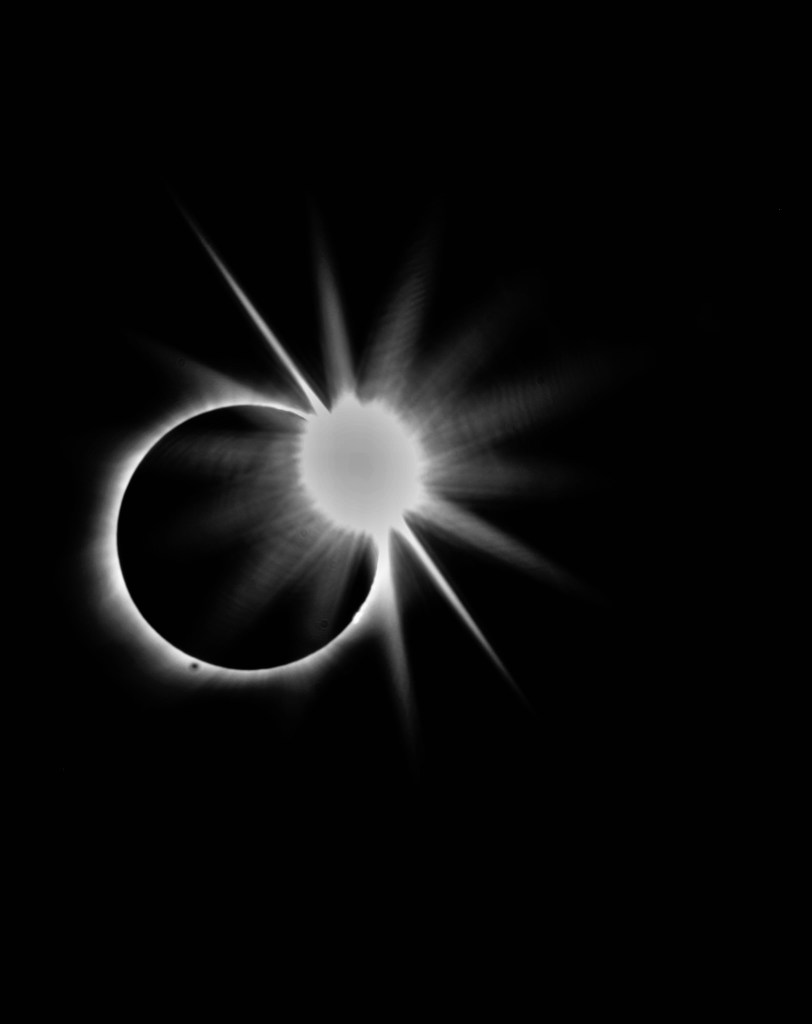
I look at sun, the thinnest of crescents. Suddenly – gone.
The diamond ring – and – the light is being sucked out, as if the sun has ceased to exist, is simply no longer there, has been sucked out of the universe and all the light with it. And darkness falls. It descends. Like a blanket.
Except that everything is still visible.
What, then? Like a dimmer switch being turned suddenly down. I looked hard out to sea, but saw no sign of the shadow moving towards us. Darkness simply descended.
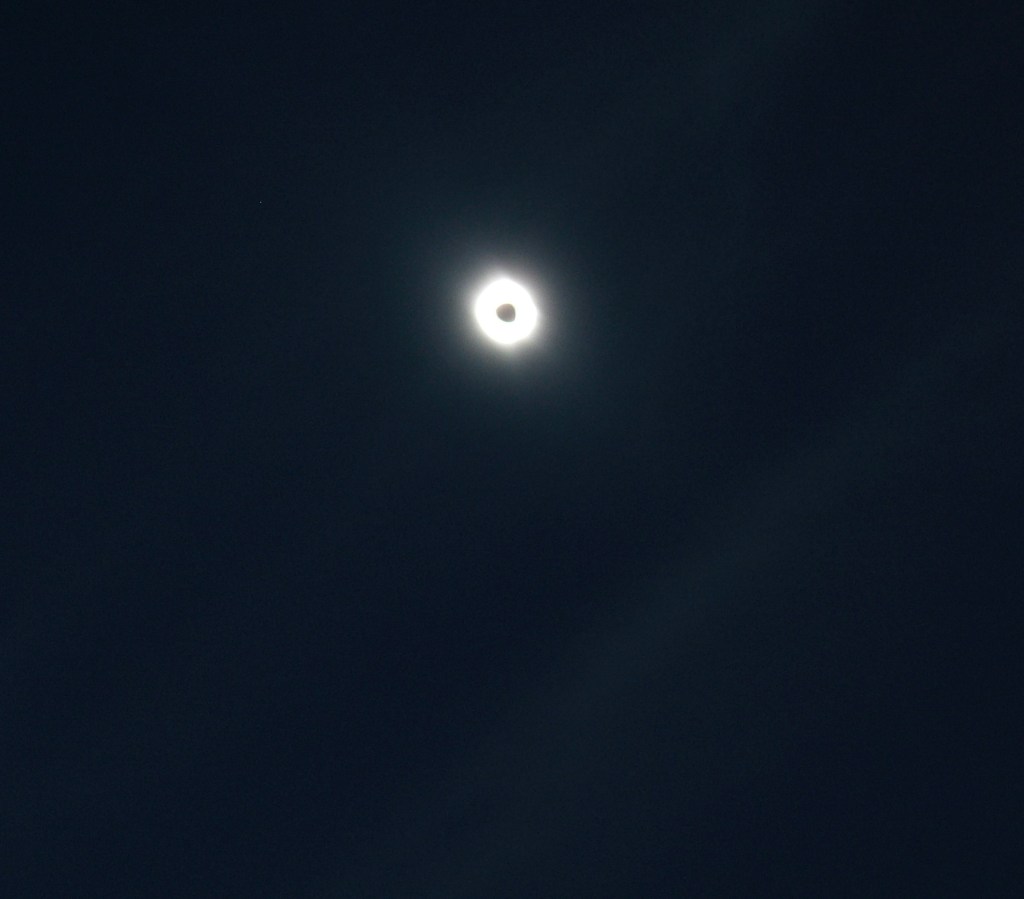
And then there are over 3, nearly 4 minutes of a different state, a different world. I know it’s coming, I’m prepared, I know it will last for a short, a finite time, 3 minutes and 40 seconds. And it’s nothing like I expect. All I can do is hoover up as much as possible of what I experience, into my memory. Here goes.
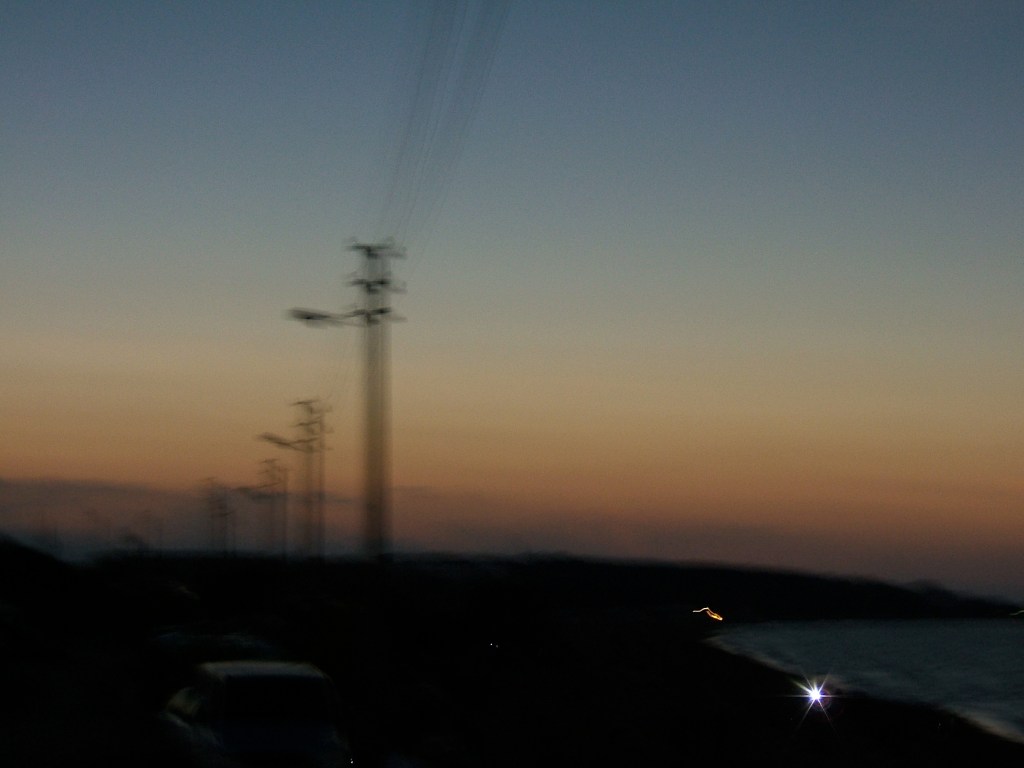
They say it’s as dark as a full moon night. But the light is entirely different. In fact the opposite. Above, it is dark as night (although, oddly, I registered no stars – too busy looking at other things?) a deep blue, a purple blackness. But all around the horizon, in every direction, it’s like the sky half an hour after a vivid sunset, red and orange. Over us is this immensity blocking out the light (like the spaceship in Independence Day), a shadow falling, of some immense presence. But all around there is both the memory, and the prospect, of a ‘normal’ world, of a day ending normally, or beginning normally. Dusk, all around. Dawn, all around. Bizarre, and frightening.
And yet I, we are happy, happy to be in thrall to this new darkness. Because I/we know it will end? Of course. And for all of us it’s too brief. We know the end will come, soon. And we don’t want it to, then. Given the choice, what period would people put on the duration they’d like? An hour? A day? A week? A year? This, a state, a place, that people would visit for a while, to feel its difference. A Ray Bradbury novel. For this time we are not in the world, but in the cosmos. It is cosmic.
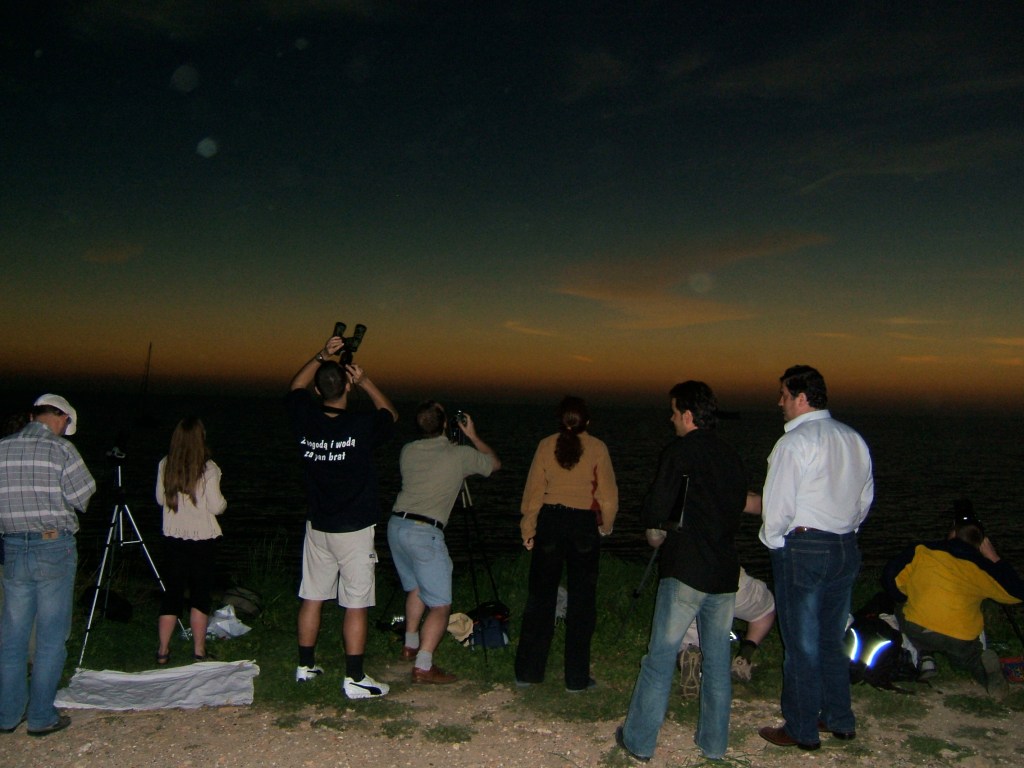
We’re here, together, in this place. For 3’40” nothing changes. People cheer when they see the diamond ring, when darkness falls, they look around, they photograph each other, they chatter, they say ‘this is awesome’, they commentate on the phone. The tension of preparation, of waiting, is at last released. No, not released, for this is the culmination, the 3’40” we’ve come for, been waiting for. Focussed. Everyone, in their way, is trying to focus on this 3’40” of this state, that we may well never experience again.
I look around. I take a few snaps. I register the light, the cold. Bizarrely someone comes driving up the sandy slope during totality, gets his car jammed, revs and revs, the smell of scorched rubber and burning clutch. Engine cuts. Silence. And we can ignore him; this absurd action shrinks into nothing in the immensity of what’s happening.
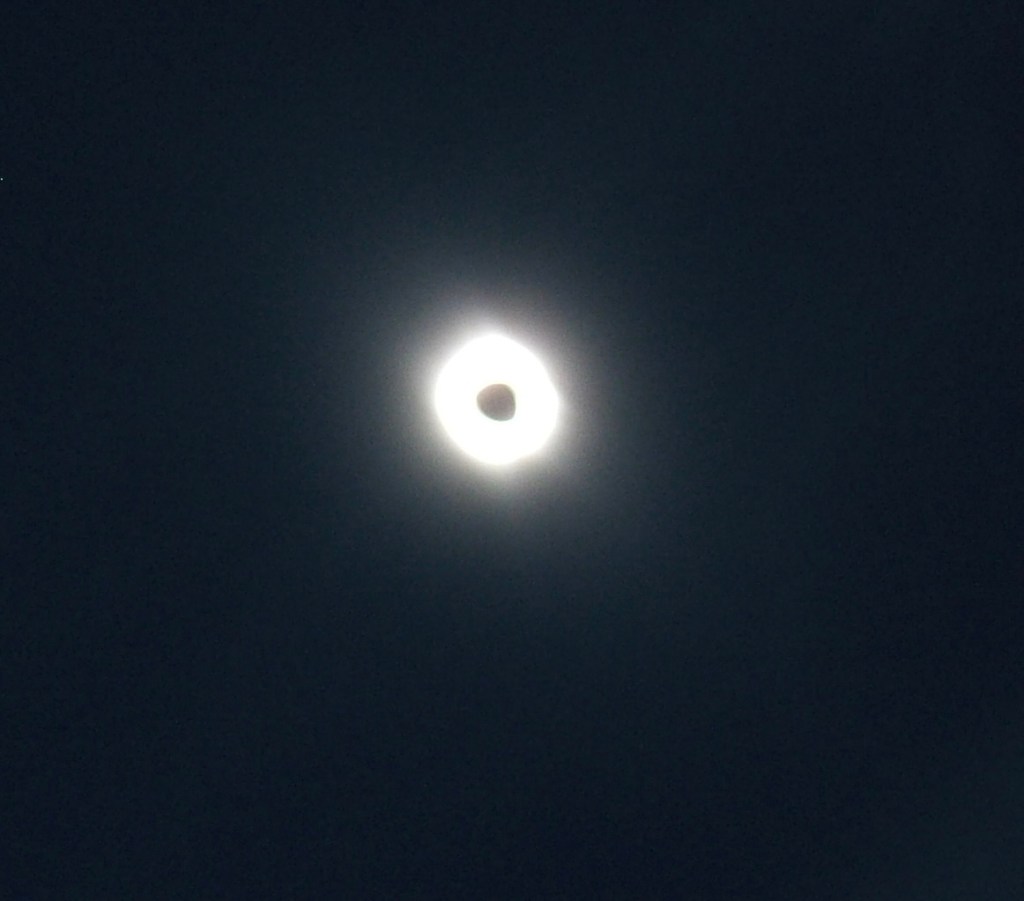
But wait – look at the sun. Or rather the absence of sun. The flare of the corona, a perfect black disc with a white flare all around it. Trying to make sense of a black disc surrounded by white light in a dark blue sky. Everything’s topsy turvy, reversed. Look across at the village, there are lights, like seaside illuminations as darkness falls. One is like an illuminated ferris wheel at night. And in every direction I’m looking at a beautiful after-sunset moment, that time of revery before the light finally fades and night gathers and the sky turns starry and the world down here turns starry with our own lights. I notice that I think of it as sunset, not sunrise; it’s that feeling.
But, instead of the gathering darkness, the onset of night, suddenly (after another diamond ring) the dimmer switch is turned back up, light floods back. That which was, as a terrifying demonstration of what they could do, blocking the sun suddenly, whisks away, accelerates off. Where has it gone? What happened? Did it happen? There is no sense of it moving on – it’s as if it flies off upwards, into space, is gone.
As we shake ourselves awake, by 14.02 (+5’) it’s full light, although, again, that sharp, hyper-clear light, which quickly brightens to an overall sunny day. A sense of release, of too-loud conversations, of ‘yes, it was great’ phone calls.
The old lady next to me who will never see another one. Will I? Many Germans, many English (especially among the eclipse-chasers). The moment of eclipse when the light suddenly disappears, exactly as if a dimmer switch had been turned down – the light level goes down to an hour after sunset but, as I say, the sunset is all around, instead of it darkening to black in one direction. The sense of something sitting over the earth, a giant space ship, blocking out all sunlight to the earth, settling over the sun. A violent upsetting of the natural order, a lesson to mankind that shakes you, a sense of vastly greater forces reminding us of their powers. The diamond ring. No Baily’s beads. Light diminishing, getting cooler, more rapid drop than at sunset, as if there’s no heat in the atmosphere, it all comes from the sun. That dependence on the sun.
Nb with primitives, it would be very close to the actual eclipse before they would be aware of what was going on – it would be frighteningly sudden.
Afterwards, notice how long it takes to warm up again, as if I’ve been shaken up, made more observant by the experience – not sharing the general ‘it’s over’. But much of it is in the anticipation. As soon as it reappears, it’s all over. Slow, tense build-up, rapid release. Nb no sense (I looked hard) of the shadow sweeping towards us.
Afterwards, I wished I’d stayed with my original idea of going up to the top of the rock here, because there’s still a desire to experience that sensation. But then one rapidly turns into an eclipse chaser, who’s always after the ‘perfect event’, whose life is variations on the perfect event, a dancing around, it never happening. Becomes the drug, cf Dylan concerts. The twitchers, a category worth looking at.
14.05 (+7’) still cool. Anti-climax – what to do with rest of my life?
It moves away, hugely imperturbable. Something being lifted. Check speed – how to calculate? I can’t quite work out why it should be covered for any other than a brief time. The mechanism. It’s the moon moving across the sun.
Very soon after, everyone acts as if it’s all over. An instant release of tension. Even with the sun still three-quarters covered, it’s all over.
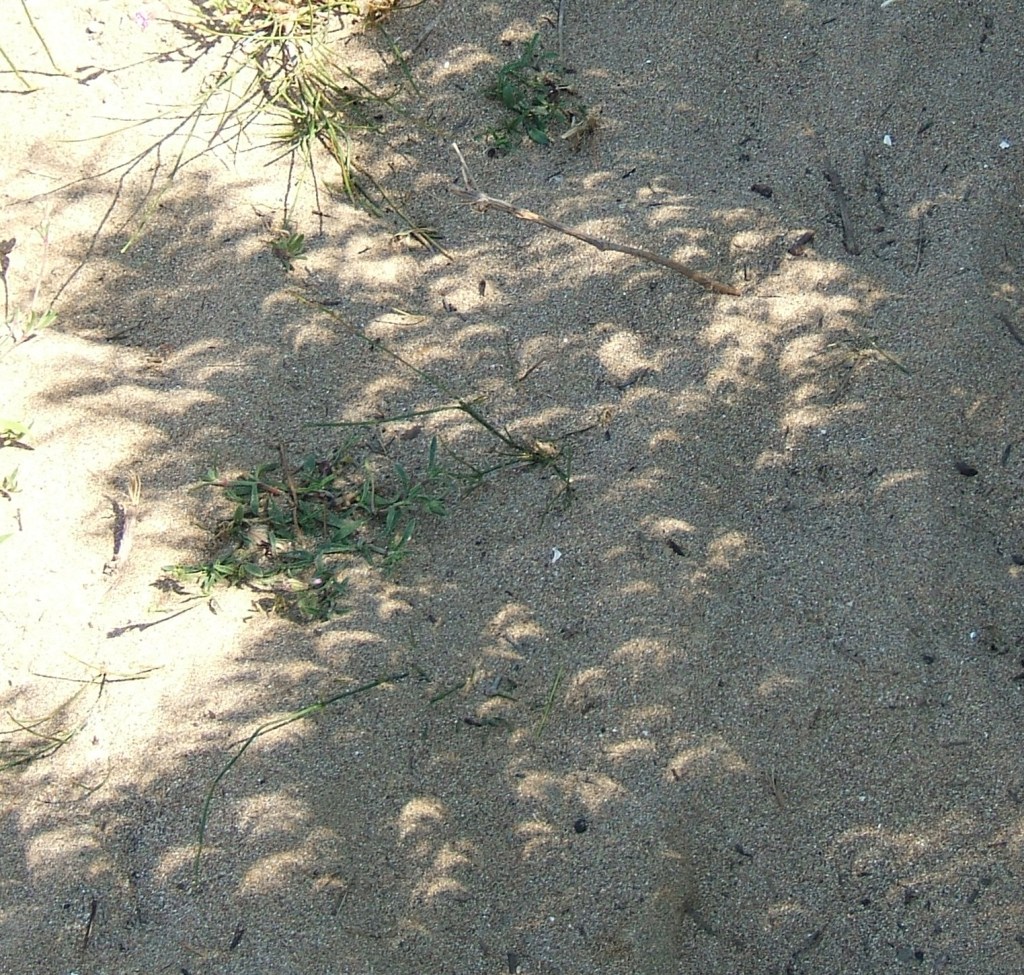
Nb while the sun is a crescent, I see the crescents through tree shadows, the pinhole camera effect of the sun through tiny holes – each pinhole enables a separate image to be projected onto the ground. Dozens of crescent suns
People wander around, having telephone conversations – not the urgent ones at the time, this is happening, now, but the, oh it was great, awesome. The techies quickly dismantle their equipment. I realise now their pride at being able to set up their kit in exactly the right direction hours before; amateur version of the guys who work it all out years in advance. No, not quickly, but with the measured speed of professionals who’ve done their work carefully, conscientiously. The images have been swallowed into their computers, or they exist invisible on film that will reveal itself in the developing fluid. Everything breaks up.
Gone is the focusedness, the sense of being all together. We’re back to being individuals, absorbing and digesting in our own ways, making it personal, personalising it, wandering off alone. Each of us is now in the all-important process of becoming the hero of their own story. Each begins with their own experience. It would be easy to say – okay, alright, but no big deal, where’s the drama, the heroics? Only then I must begin to justify my experience, indeed my life by turning it into a narrative, a heroic tale. The need to tell one’s story in order to make it real.
Although, nb, afterwards, most seem happy to keep their story to themselves, a private story held close to the chest. Why? Because it’s not ‘big’ enough, the story? Or maybe really it is an event that’s personal, vast inside oneself, that doesn’t need telling to be awe-inspiring. It’s filled each of us with a sense of hugeness. It was an event full of implications.
And my memory, the personal story that doesn’t need to be told? The darkness above, the light all around. The black sky with the black disc with the light all around it. The topsy-turvyness of it all, an incomprehensible world where nothing makes sense.
But, afterwards, with the return to ‘normality’, the sense of a world shaken up, that one understands so little of, that no longer comforts because so many assumptions have been subverted. Maybe.
I walk through Side, to where the tv cameras are, lots of interviews. The vendors beginning to pack up – at least the tee shirt sellers can expect some trade. But not the eclipse-glasses sellers. The next total eclipse in Turkey will be 2060.
Walking back across the dunes, birds fly this way and that out of the bushes, it’s the first I’ve heard of them, they’re mightily confused and discomforted. I photograph the crescents on the ground.
I walk back through the Roman city, all the carved stones lying around. Why have they not been looted? Is there really so much better stuff lying around elsewhere? Pretty stuff, lying as if it was carved there, the carver has just left, domestic, ordinary, in the nicest way, as it’s well carved. The stone looks both soft and fine-grained, amenable to the carver’s chisel while keeping sharp edges.
To the bus station. I find the Manavgat dolmus eventually. It leaves full, gets fuller, a (apparently) self-appointed conductor at the back piling bewildered-looking tourists aboard at each stop. Ticket money is handed down the bus to the driver, who keeps it very carefully – notes in a box, high value coins under a cloth, small change on top of the cloth – as if to reassure us as to how carefully he will drive. A Scot next to me, entirely silent, except to say, of the bodies pressed together – the dolmus is the nearest thing I’ve seen to sex without taking your clothes off. Not lustful, or ironic, just deadpan observation. In Manavgat, I get off by the river. A beautiful river, wide and green, with trees on either side.
I go to bed early, get up early, to a cloudy sky, a wild sea, cloud blowing in from the south. Yesterday, waking to a cloudless sky, and no prospect of anything but clear sun, the enthusiasts out early, business-like, self-important, this is our day. Today is an ordinary day.
We drive through the mountains, between snow fields, across an empty brown plain, 260km, to Konya, and the mausoleum of the poet Rumi. Another story.

