I am cycling from Vallon-Pont-D’Arc, the village at the head of the Ardèche Gorge, remembering the Ardèche trout I ate last night, accompanied by a pichet of too much/just the right amount of white wine, outdoors, in the excellent company of a cosmopolitan Austrian couple, retired, who come here each year, towards the village of Barjac. It is a beautiful June day. Yesterday I visited Chauvet 2, the copy of the Chauvet Cave, where were discovered in 1994 the oldest, finest figurative cave paintings in Europe. I wrote about it in my post of 4 July, ‘The Chauvet Cave : Into Prehistory’.
Today I am cycling towards La Ribaute, where Anselm Kiefer created his Gesamtkunstwerk of towers, tunnels and exhibition spaces I have wanted to visit since 2011 when I saw Sophie Fiennes’ film of the site, Over Your Cities Grass Will Grow. Recently the Eschaton Foundation, to which Kiefer donated the site, has made available a few tickets each year to visit the site, and I have one.
Kiefer was first in this area age 18, on his prize-winning journey, following Van Gogh from the Netherlands to Arles, which I wrote about in the fifth of my ‘Vincent and I’ essays, ‘My Life with Van Gogh : Anselm Kiefer’, much of which is about Kiefer and his work, and useful in relation to this Post – see the dropdown menu above.
Anselm Kiefer was born on 8 March, 1945, on the day an Allied bomb blew up the house next door, depositing the neighbours’ Singer sewing machine onto a pile of rubble in the middle of the street. Heaps of waste, and incongruous juxtapositions, are integral to his practise – having grown up amid bomb damage. (When the road was dug up outside his current studio, the vast former repository of the Samaritaine department store, he bought the rubble and had it brought into his studio). He spent much of his childhood building a child’s world with bomb-damage bricks – wishing only for mortar so he could ‘realise’ his buildings.
Unlike many German artists of his generation (for example Wim Wenders the film maker, confronting the post-war world, the division and then reunification of Germany and the American influence, or Gerhard Richter’s 1988 paintings of the photographs of the suicided corpses of Meinhof, Baader and Enslin of the Red Army Faction), his references are backward, to German history, Jewish mysticism, and to alchemy. And yet full of relevance today.
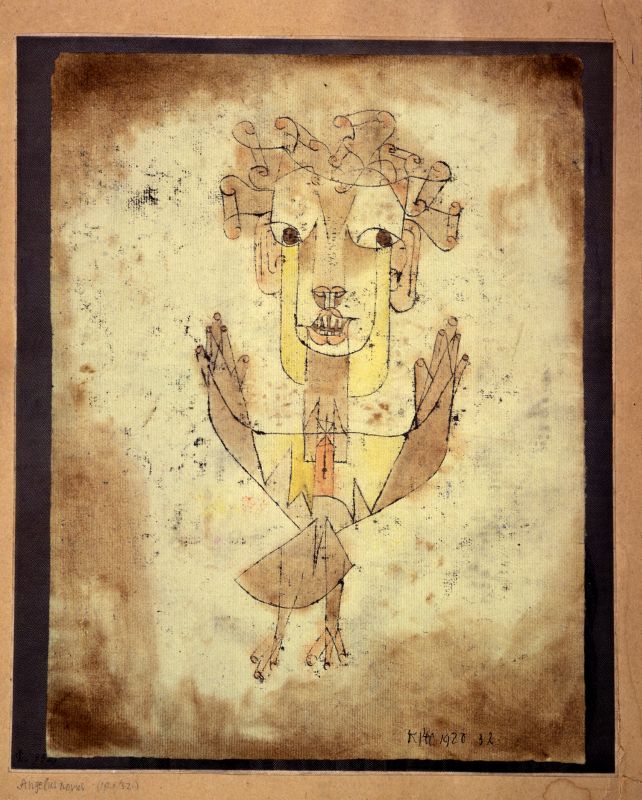
So backward-looking, as though he has his back to the present and future, Kiefer has been likened to Walter Benjamin’s interpretation of Paul Klee’s Angelus Novus as ‘the angel of history’:
‘His face is turned towards the past. Where we perceive a chain of events, he sees one single catastrophe, which keeps piling wreckage upon wreckage and hurls it in front of his feet. The angel would like to stay, awaken the dead, and make whole what has been smashed. But a storm is blowing from Paradise; it has got caught in his wings with such violence that the angel can no longer close them. This storm irresistibly propels him into the future to which his back is turned, while the pile of debris before him grows skyward. This storm is what we call progress.’ (Walter Benjamin, ‘Ninth Thesis on the Philosophy of History.’)
Kiefer says, ‘History is malleable. It is a resource, to be reconfigured.’ And
‘Art is not an object. It is a way of receiving. It is full of archaeological potential.’
‘I fundamentally believe that through my work I can fill an empty room created in my childhood. A room devoid of things from outside. The room has not been filled yet.’
‘I want to build a palace of my memory, because my memory is my only homeland’.
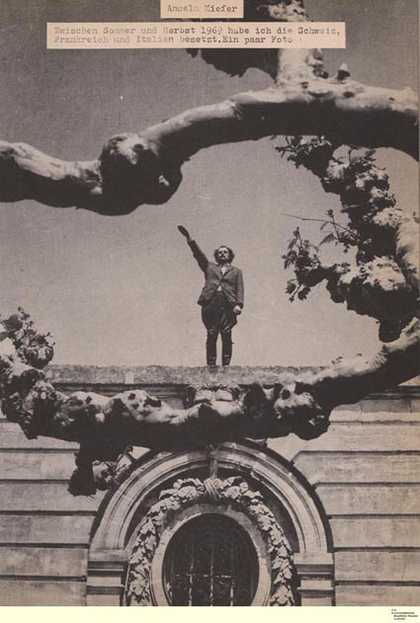
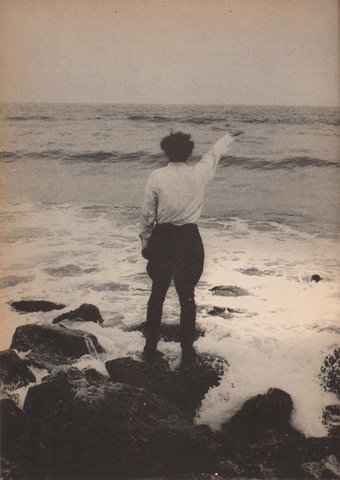
Kiefer was next in Arles in 1969, as part of a ‘tour’ of significant sites in Europe, where he had himself photographed, wearing his father’s Wehrmacht uniform, performing the sieg heil salute (illegal in Germany since 1949) as part of his graduation presentation, ‘Occupations’. It was his way of protesting at the way the Nazi past was put out of mind and discourse (including education), especially after ‘denazification’ was abandoned under Adenauer, with the economy, academia, the civil service and even the military run by men who had been active under the Nazis. Only one of his tutors backed him, and enabled him to graduate.
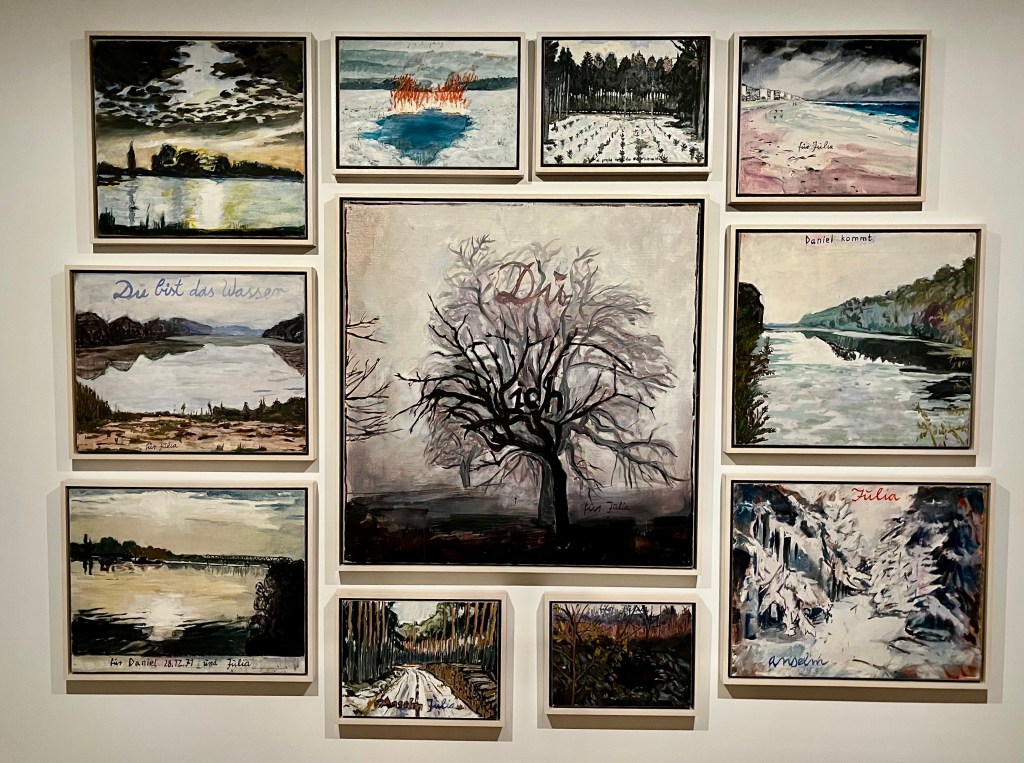
Several of the photographs – published in a book, Heroic Symbols – reference, in their images of lone figures facing into the unknown, German Romantic images, especially those of Caspar David Friedrich. The influence of German Romanticism and Expressionism is clear in his early, more figurative and descriptive work, examples shown here.
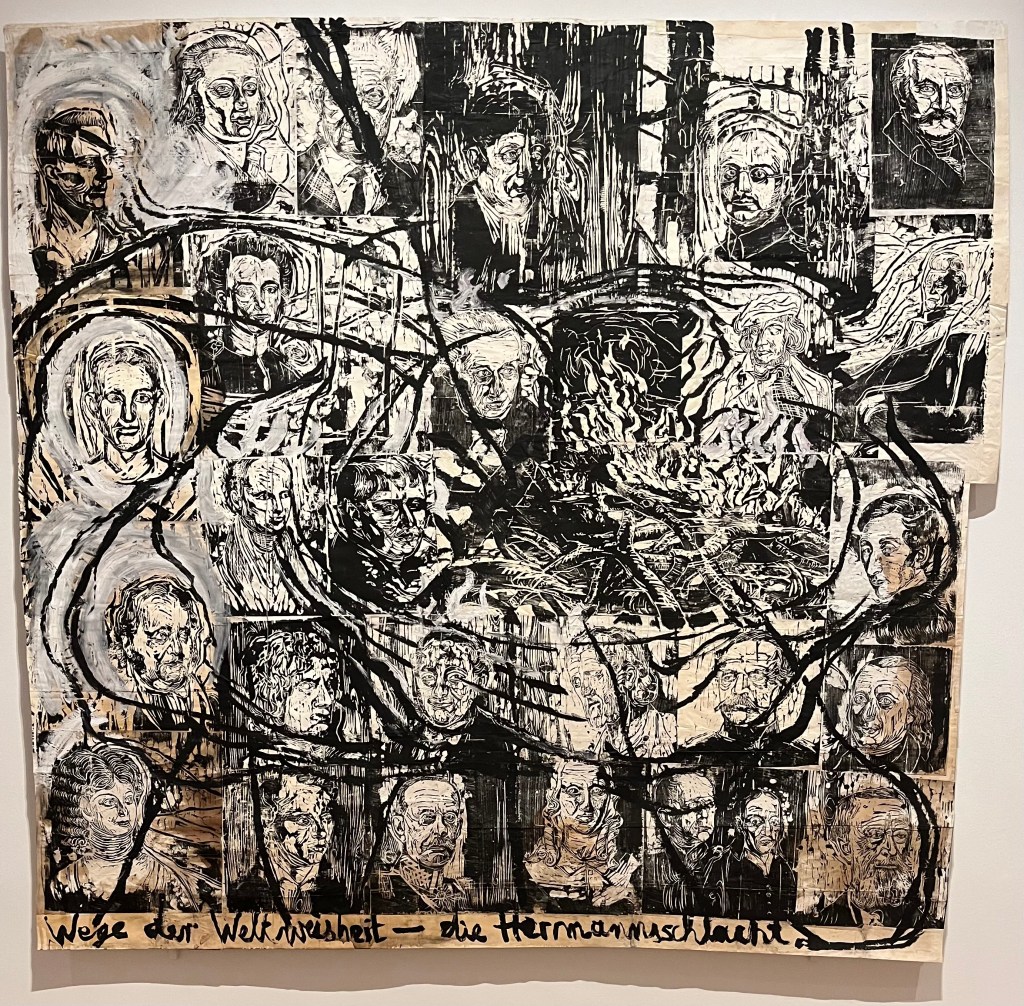
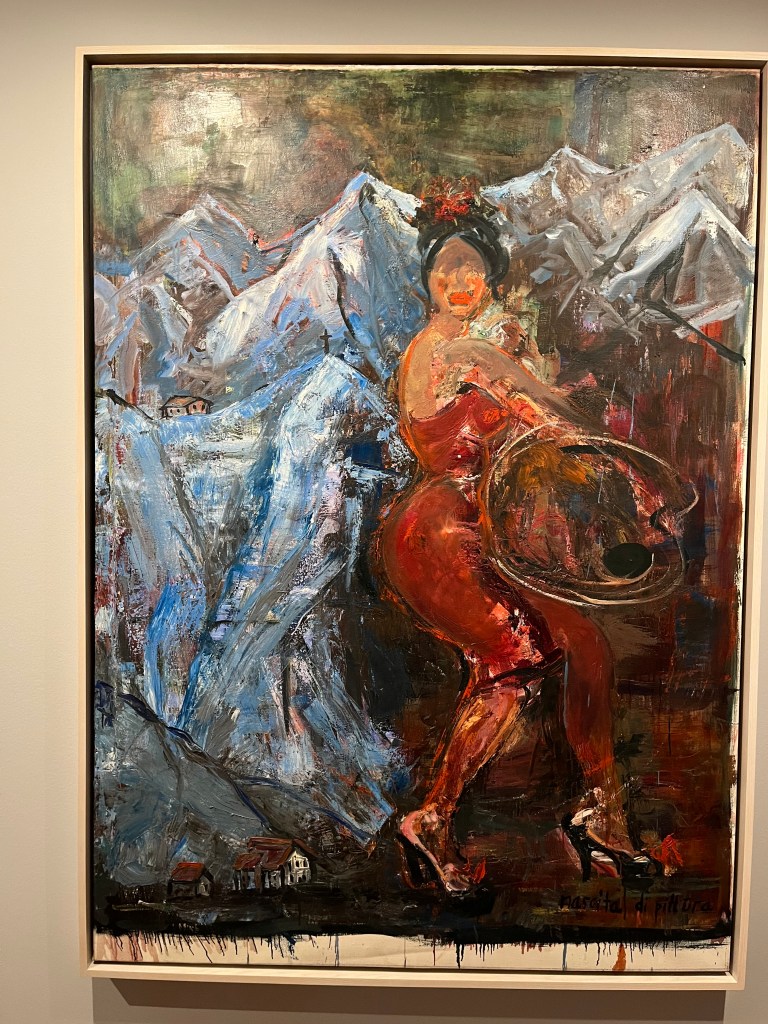
The dancer picture includes an artist’s palette, an early use of Kiefer’s symbol for the artist.
The road to La Ribaute turns off at a roundabout, short of Barjac. On the climb up into the hills, I ponder yesterday’s visit to Chauvet 2.
Although excellently done – the fidelity to the ‘real’ cave surface, the quality of the copies, the adjustment of temperature, the atmospheric lighting etc – in the compressed space the group is sent from ‘set’ to ‘set’, and then listens to a presentation in earphones. The experience is not comparable to the immediacy of the images in Werner Herzog’s film, Cave of Forgotten Dreams, especially seen in 3D. This is an exhibition; in the film it is an experience. None of the questions that I pondered on my way there, as written about in my ‘Chauvet Cave’ post (4 July, 2026), come up in my visit to Chauvet 2. Why?
Perhaps it is simply an example of what Walter Benjamin called ‘aura’, the authenticity, the ‘cult value’ of the original. Of course to Benjamin a film lacks aura. But what of a documentary, in 3D? Clearly Chauvet 2 lacks the ‘aura’ of the original. But, the film? In Benjamin’s terms, it enables the original to ‘meet the beholder halfway’, for the cave ‘to leave its locale’ and enter that of the watcher. It is interesting that the ‘quality’ I saw in the images on the film made as nothing the achievements of ‘modern industrial society’. I experienced them, at the moment the film ended (and the cave withdrew, back into itself), as ’gimcrack, inconsequential, superficial’.
And surely there will be ‘aura’ here, in the presence of Kiefer’s work, as there was in Amsterdam and Oxford, especially here, where many of the works were created.
I arrive at the entrance to La Ribaute. There is a small toilet block, and seats, and beyond it a locked gate into the property.
Kiefer came here in 1992, having been shown many possible sites for him to work by French Culture Minister, Jack Lang. Kiefer’s work had become popular in the art world, especially in USA through the 1980s, selling enough to enable him to move to successively bigger studios – from the attic of a schoolroom to an old brickworks. Although well-known in Germany, he isolated himself from other artists, and by 1990, after an extended period of travel, he was ready to move abroad.
The 40 ha Barjac site is centred on a silk-spinning mill, abandoned in 1950s. The growing of mulberry trees, and the raising of the moths on the leaves, was introduced into the Ardèche from sixteenth century, to supply silk thread for the growing silk-weaving centre of Lyons. It thrived for many years, but disease, and the rise of artificial fibres in late-nineteenth century, led to its decline, and it faded away in the twentieth century. (Coincidentally my father worked for thirty years at a factory producing one of the rival ‘artificial silks’, rayon.) La Ribaute was one of many silk spinning establishments in the area.
As I sit in the shade, I ponder my ambivalence towards Eschaton, a foundation established to control and run the site. When he moved from La Ribaute to Paris in 2007, and having got the permission of the French government, he attempted to give the site to the Guggenheim gallery. When that failed, the Eschaton (meaning ‘end times’) Foundation was set up ‘to advance the artistic legacy of its founder, Anselm Kiefer, by maintaining and cataloguing his archive and by preserving La Ribaute, his former studio-estate in Barjac, France, for future generations.’
Kiefer’s original hope was that visitors could walk the grounds unaccompanied, encountering by surprise the pieces he had placed around the grounds. Instead Eschaton has taken a bureaucratic approach, creating artificial scarcity by limiting visits to accompanied groups a few times a week – tickets sell out within hours of going on sale. And by not permitting photography. Citing ‘copyright’ issues, when everyone visiting his gallery exhibitions freely photographs his work.
In his Notebooks, vol 1: 1998-1999, p21 Kiefer writes of photographs as his ‘holy helpers’ (after a group of less-significant saints who were credited with interceding against common maladies). Photographs, for him, would ‘help find paths into … set something in motion, unleash something.’ And today, with phone-photography, one is not trying to produce ‘portraits’, totemic images. Rather, there is a back-and-forth between photographer (‘snapper’) and photographs, an ongoing dialogue in which the photographs inform the catcher of the image (rather than ‘The Photographer’) about what he has photographed. Not being able to photograph is like not being able to take notes.
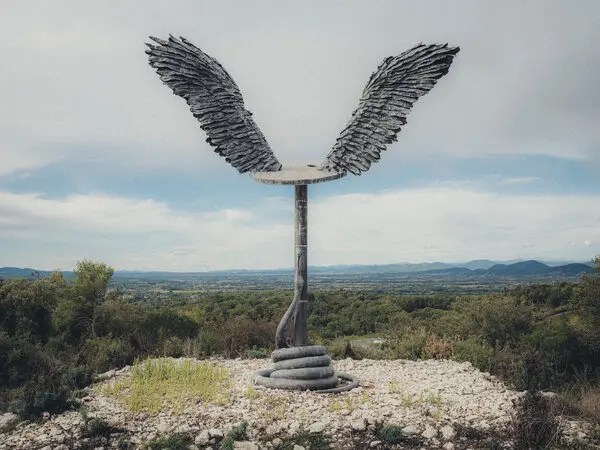
As the group of twenty gradually assembles, I notice on a hill, just visible above the trees, a palette with wings atop a pole. I know the piece, and that it has a serpent coiled around the base. The palette with wings is his image of artistic aspiration, both the overweening ambition of Icarus, and the more measured craftsmanship of Daedalus. Jean C Cooper devotes three pages of her comprehensive ‘An Illustrated Encyclopaedia of Traditional Symbols’ to the complex imagery of the serpent, from instigator of humankind’s fall from direct access to the divine, to the source of earth magic because it is in touch with the earth along its length.
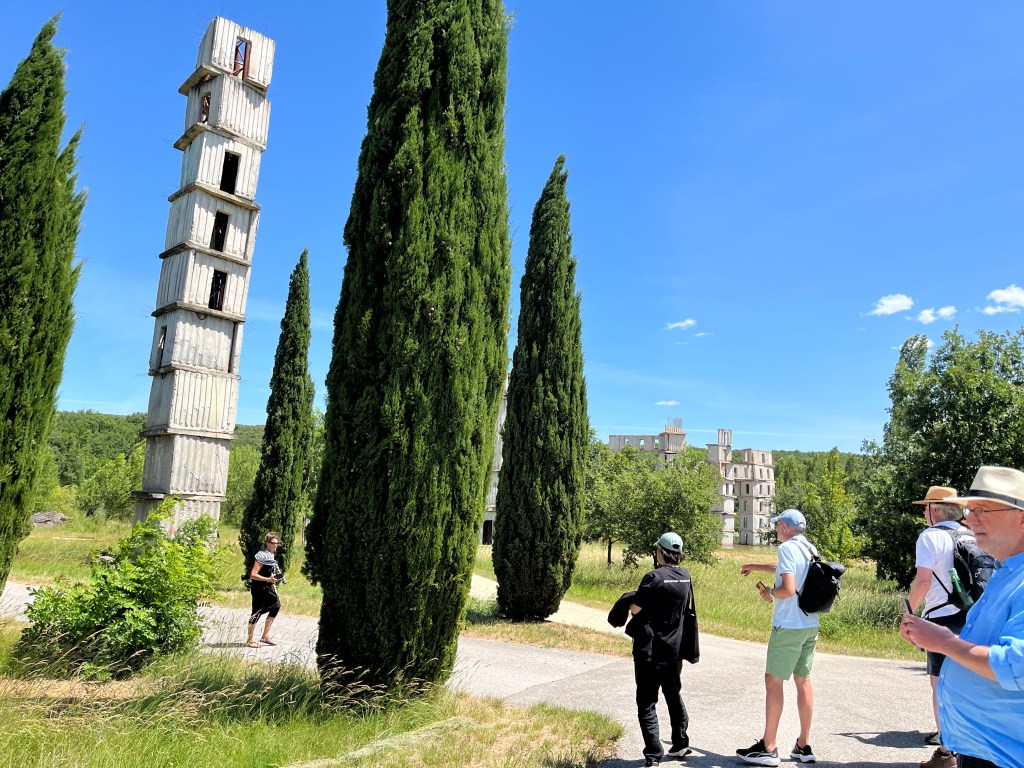
We troop off down the path to our first stop, overlooking the ‘estate’ of concrete towers he has built. Here we are allowed to take our first and last photographs.
At first glance they might be an estate of 1960s tower blocks set in parkland.
But seeing them, leaning and windowless, they bring to mind a bombed Ukrainian city.
Kiefer associates his towers with Jewish mysticism and ‘The Book of Palaces’, which narrates the symbolic path of spiritual initiation. But also the war destruction he grew up with, 50% of German buildings destroyed or damaged, and the work of the Trümmerfrauen, the rubble women who, for a few pfennigs and a meal voucher cleared the rubble and cleaned the bricks to be reused – like the bricks from the neighbour’s house that Kiefer built his imagined worlds with. But, with their construction in concrete, poured between the forms of shipping containers – the modular unit of global trade – he used here a material he for a time lived within, on a youthful retreat at the Corbusier-designed La Tourette monastery (Corbusier’s final building), and developed an affinity with. (As Kris says, in my novel Diggers and Dreamers p68, concrete is the only stone that can be poured, and poured cold. Which gives it the sense of an alchemical quality.)
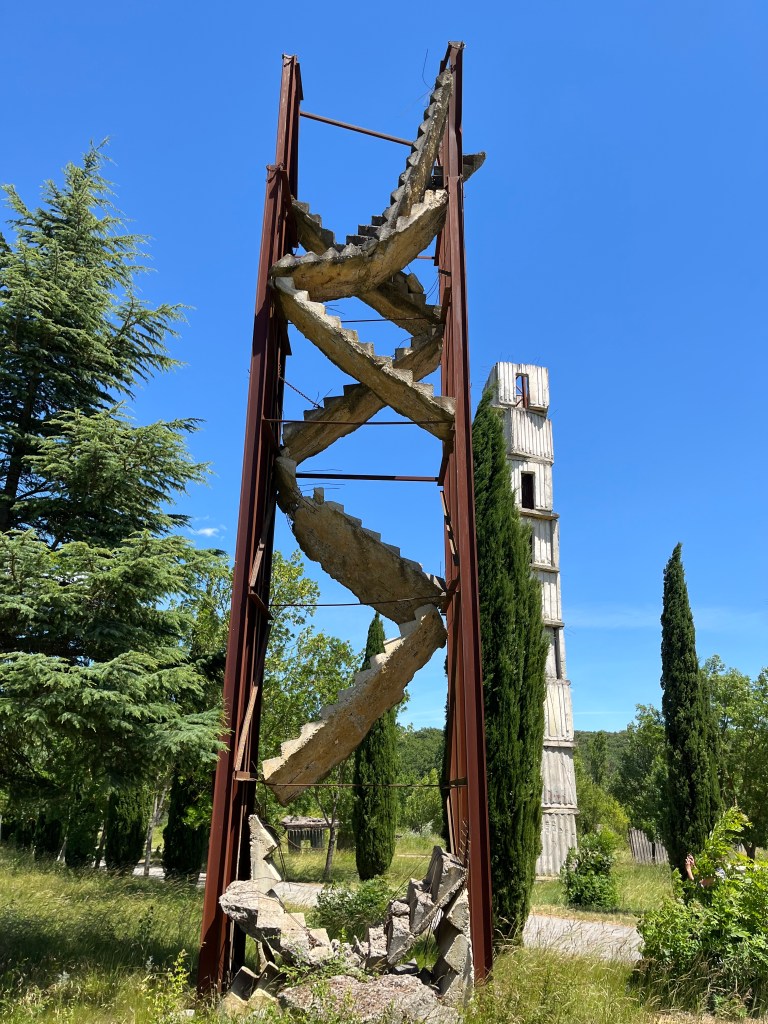
And this construction, representing Jacob’s Ladder, the original Stairway to Heaven on which Jacob dreamed he saw the angels of God ascending and descending. (Later we pass a heap of concrete stairways, discarded, as if representing failed connections from earth to heaven.)
Phones put away, we proceed.
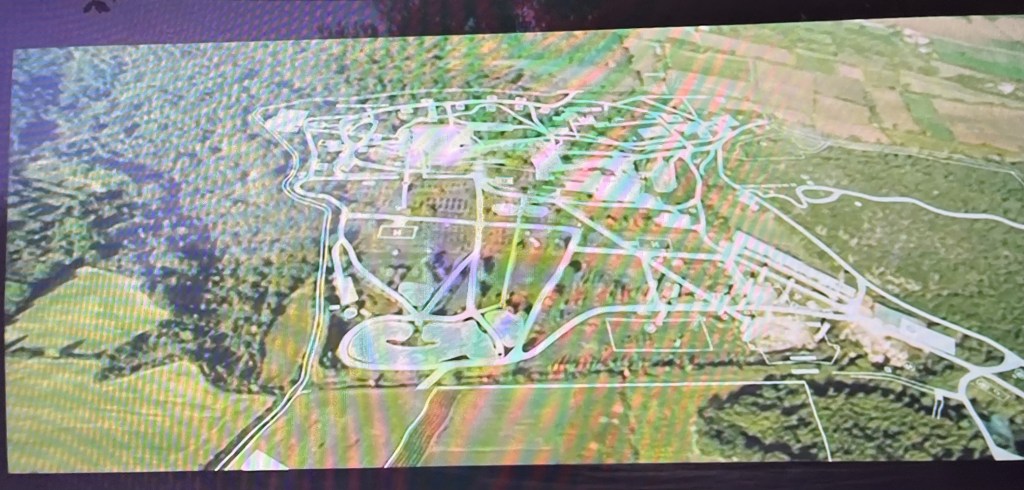
When he moved to Ribaute, Kiefer employed a bulldozer, which he walked in front of with a flag, ‘like the guides in the Louvre’, creating new roads across the site. This a screen shot from Anselm, Wim Wenders’ excellent documentary, showing the new roads. Whereas the Louvre guides walk their followers through the accumulated art of millennia, Kiefer was creating the empty ground plan of future art. With an invisible parallel network of tunnels. He has since built 40 pavilions and galleries to display his work, which are linked by the tunnels.
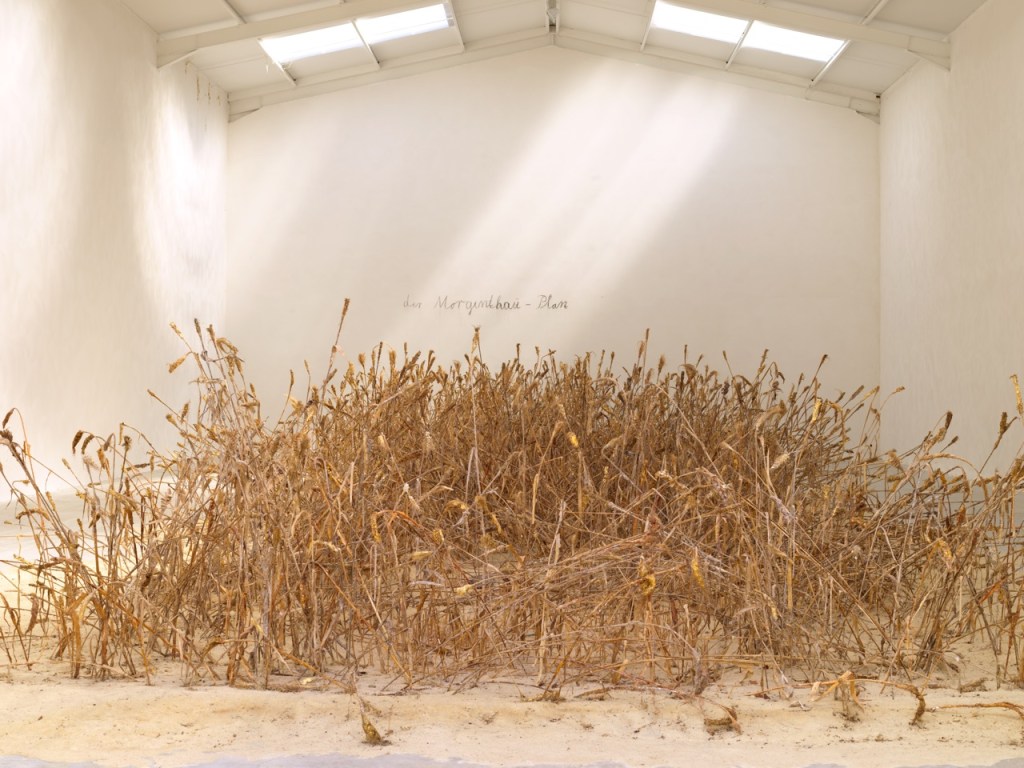
To a pavilion in which wheat grows, the installation called The Morgenthau Plan. This was a 1944 plan, at first supported by Roosevelt and Churchill, to destroy German industry and make the country ‘primarily agricultural and pastoral in its character’. Only when it was realised that this would require the population to be reduced by 40% – by starvation? By moving them to …? – and (probably more significantly) that the rest of Europe could not be revived without German resources and industrial power, was it dropped. Meanwhile Goebbels’ publicising of the plan strengthened German resistance, and extended the war.
Straw is a material he returns to, sticking it to paintings, and often setting fire to it. He associates it with Margarethe, the ‘golden haired’ mistress of the camp guard in Paul Celan’s Death Fugue, contrasted in the poem with ‘ashen-haired Shulamith’, the Jewess who will die, shot with ‘a bullet made of lead’. Written around the time of Kiefer’s birth, the poem has become well-known as a ‘masterful description of horror and death in a concentration camp’.
One reason for Kiefer’s detailed study of Jewish mystical writing, in Quabala and Merkaba literature, especially the writings of Gershom Scholem and Isaac Luria, is his belief that by the Holocaust German culture lost its connection to its important Jewish component. (Just as his engagement with Germany’s Teutonic past, so privileged by the Nazis, is his attempt to recover it from its Nazi connections.)
But also the attraction of certain ideas – Lilith we’ll meet later. The idea that God had to withdraw a little from his creation, no longer filling it, to allow space, light, and life to come into being. That there is a letter missing from the Hebrew alphabet, and only when that is revealed will there be the possibility of full understanding. He has an interest in ‘closed’ systems, worlds in which ‘everything’ exists ‘within’, for example the work of the hermetic philosopher, Robert Fludd. Especially taken with his idea that for every flower there is a star, an example of the congruence of microcosm and macrocosm, ‘as above, so below’. But he also makes paintings with each of the stars designated with its unique NASA identifier.
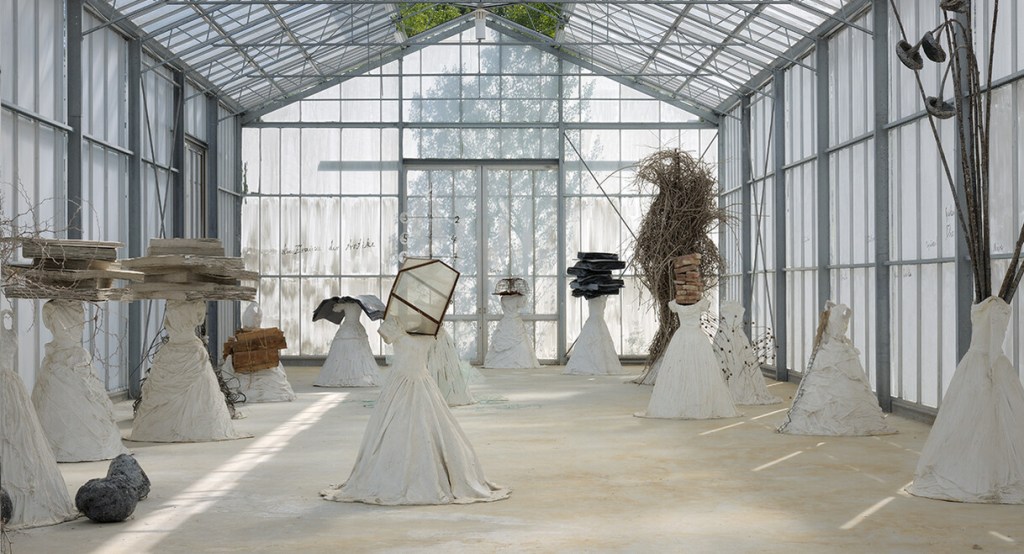
Next door is a whitewashed greenhouse with several ‘Women of Antiquity’, women ignored or persecuted. Each is represented by a wedding dress, solidified in plaster. These headless, armless ‘figures’ are further encumbered, this one weighed down by lead books, this by a ‘crown’ of razor wire, this with shards of glass penetrating the figure, this with weights around the hem. Surrounded by them – and especially remembering the whispering voices in Anselm – one can only, as a man, feel guilt. But, again, I have to imagine the intensity of coming upon one of the several who are located in the landscape, alone, the dialogue that might follow.
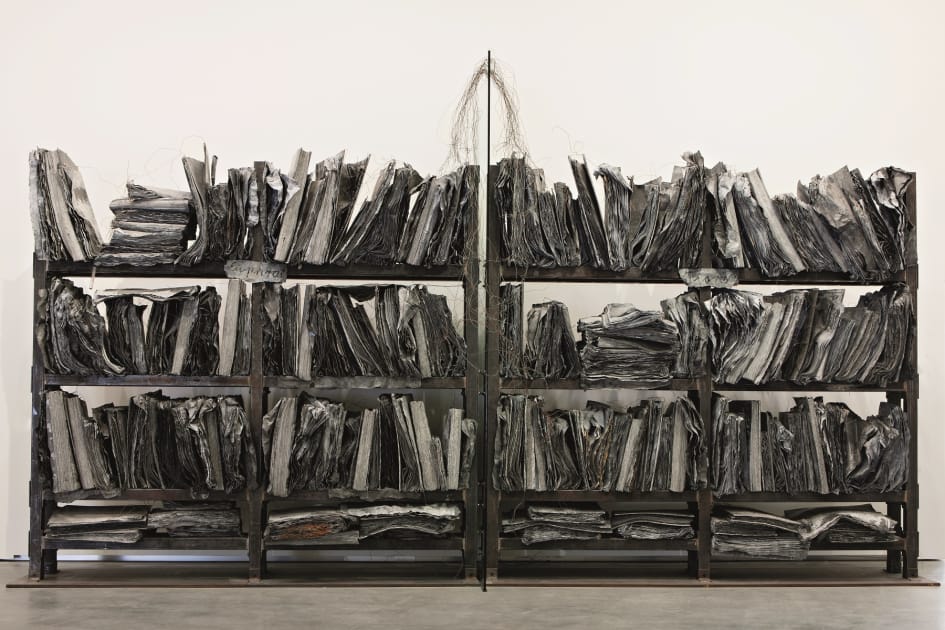
Into a library of Kiefer’s lead books. Which I wrote about long ago :
The lead library
books too heavy to lift
and you must wear gloves
when you turn the pages
to protect yourself
from contamination.
One printed with photographs of the earth’ surface, taken by him from an aeroplane. One can imagine him, given a sphere large enough – perhaps the size of the earth …? – printing the whole earth’s surface onto it.
Lead a material often used by Kiefer, from the time he bought the roof of Cologne cathedral, intrigued to see how the lead, over the centuries, had flowed, so the ’tiles’ were thicker at the bottom than the top. In alchemy, lead is the ‘base’ metal from which the alchemist derives gold – it has gold within it. He has used it for books, beds – as seen in a subsequent room – and, molten, poured it onto paintings. Associated with Saturn and melancholy, in the Renaissance it was the planet, and the mood, of creativity.
A room of his books, oversized volumes he has bound and then fills with pictures and writing. And, in 20 Years of Solitude, semen, having masturbated onto each page. Perhaps a reference to another favourite figure, Lilith. In Jewish mystical writing she is the first wife of Adam, born like him from the earth, who refused to serve him, lie under him, and left Eden, where God then created Eve from Adam’s rib. She wanders the earth, a witch-like figure who robs men of their semen.
And then we go underground. From summer brightness to darkness hardly lit by light wells and an occasional bulb. There is a maze of tunnels, which Kiefer envisaged visitors wandering, perhaps creating patterns of ways between the studios and pavilions, perhaps randomly following them and emerging who knows where. The maze gives options.
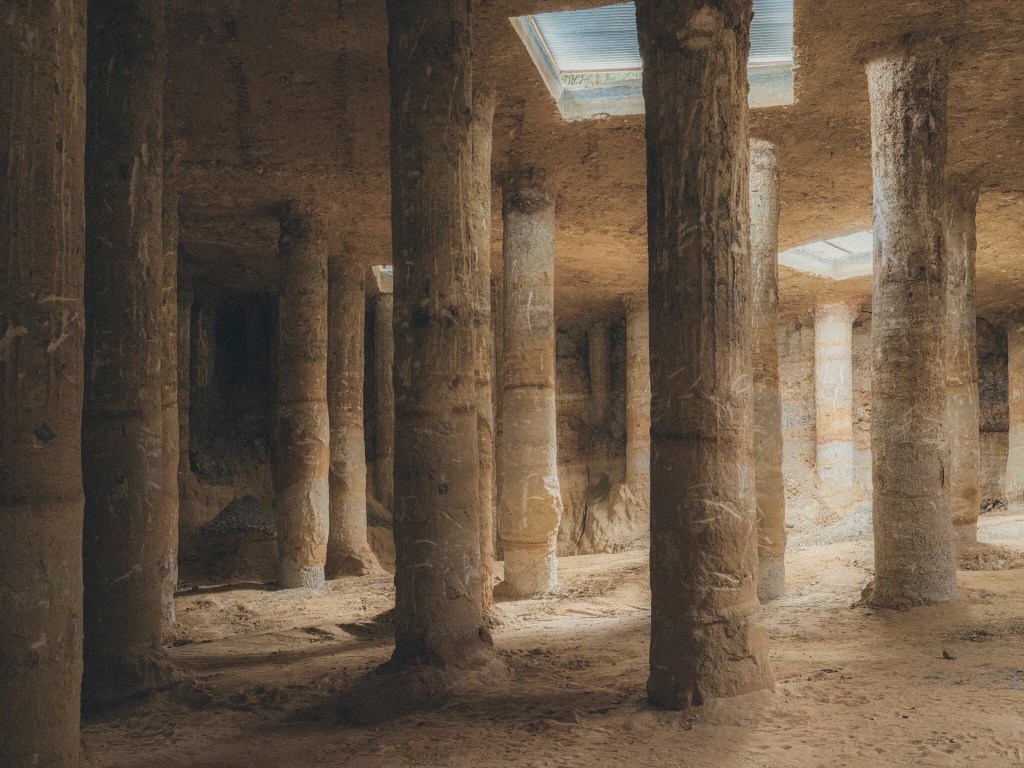
But first we visit the crypt. The making of this was recorded in Over Your Cities Grass Will Grow. He drilled down (the earth was soft), poured concrete in, creating these pillars, and had the earth excavated from around them. It is a spine-tingling place to be in, both frightening and exuberant. Like the cellar we dug out of the empty building – an abandoned plumber’s workshop – behind the house we lived in as children. This Crypt is a place to dwell. But rather than being given options, we must keep moving.
And climb up and emerge into the pavilion of The Women of the Revolution.
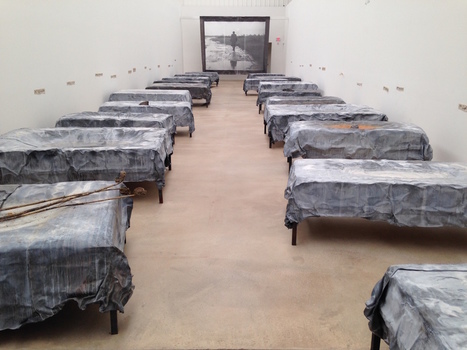
The title is from a book by Michelet about the women of the French Revolution. On the wall by each bed, with its ‘sheet’ of lead, is a woman’s name. In the middle of each bed is a hollow filled with water. Dead water, because poisoned by the lead. At the end of the room, the ‘dormitory’, the cell, is an image, printed on lead, of a photograph from Heroic Symbols, of Kiefer in army uniform, walking away. it is a sombre, chilling creation.
Two large paintings from subjects from Greek mythology. Heracles cutting off the heads of the hydra – and remembering that for each one cut off, two grow, endlessly, until he employed his squire to cauterise each neck. And Zeus visiting (and impregnating) the imprisoned Danae as a shower of gold, and thereby fathering Perseus. (A story I expand on in Dionysos’ Island p 222 et seq.)
The picture is covered in gold leaf. Gold the end product of the alchemical process of refining lead, and something he often adds to his paintings. Not for ‘value’, but as a material. He writes, ‘I choose materials that have something to say to me: ash, sand, lead, gold, etc. For me, these are selected things that have a spirit in them, which I bring out, make visible.’
And the way he journeys through mythologies, finding stories that stimulate him to create art. ‘Art and mythology are different forms of recognition. Myth provides answers to the questions of where we come from, what we are doing, where we are going, what we are. you are dust and to dust you shall return. Over your cities grass will grow.’ And the greatest myth is the human race, made with an unsurmountable design flaw.
He writes of the importance of ideas – for years he hesitated between being a writer or an artist. And in his Notebooks Vol 1, 1998-1999, p210, writing about butterflies, ‘If I can’t connect the butterfly’s flight to something else, if I can’t offer some idea about it … what is there to say? It has been the same with painting for many years. If I have nothing to say about them, nothing to write, they stay in the containers. So many paintings begun that remain without ideas.’ On the process of creativity, ‘one doesn’t create anything oneself, but brings together ideas from elsewhere together in one’s head’. p204.
And then to the amphitheatre. A vast, upturned ziggurat, created from shipping containers and concrete. One imagines events here, everything from fashion shows to theatre pieces, using the levels as metaphors as well as physical spaces. But when we leave, this place will return to silence and inactivity – except for the pigeons that flap here and there.
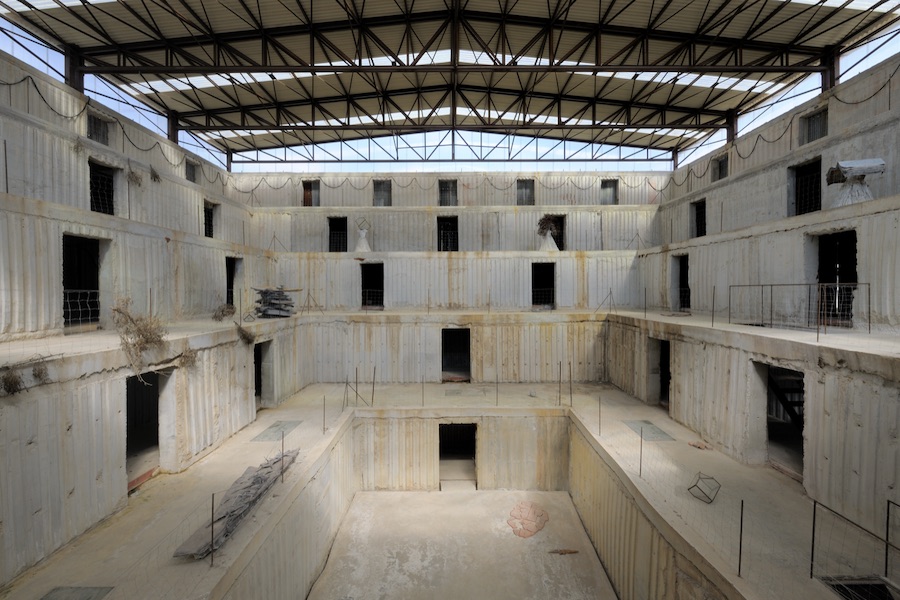
He has created his gesamtkunstwerk – but to what end? Has he ‘filled the empty room created in my childhood. A room devoid of things from outside’? Has he built ‘a palace of memory, because my memory is my only homeland’?
In 2007 Kiefer left Barjac, moved to Paris to live, and moved his studio – hundreds of lorry trips, carrying his containers and shelves of unfinished work, his archives, and his collection of materials and ‘stuff’ – to a vast warehouse outside Paris. He constantly accumulates more than he uses. Is this his ‘palace of memory’? Or evidence that the ’empty room created in my childhood’ can never be filled, and that at least he can continue to make ‘art’ to sell, and prepare exhibitions that are in themselves ‘experiences’, rather than collections of ‘art’. Has he escaped from his gesamtkunstwerk, because he found it impossible to live in?
There is a telling scene towards the end of Anselm, when the camera follows Kiefer, wearing a long coat, around Barjac (after he has moved to Paris). He reminds me of the long-coated angel Damiel in Wenders’ Wings of Desire, envying the lived, sensuous life of the Berliners he observes.
Barjac the place feels to me like a set, a setting, that needs people to inhabit, interact with it, not the Eschaton elitist vision of an ‘artwork’ to be experienced by a select few. Kiefer is happy that his pictures age, bits fall off them (curators earnestly collect the bits that fall off his paintings during exhibitions and give them to him, to his amusement that they so deny his works their life). They are robust enough to survive less as objects than as settings and stimuli.
In a subsequent piece I will consider Chauvet and Barjac, and their creators, and return to the concept of ‘aura’.


2 responses to “Anselm Kiefer at La Ribaute, Barjac”
A fine piece, many thanks.a lot of history and personages I had no idea about. How far do you cycle each day. What type of bike are you riding? I’d love to try that some day while the joints are still working!
Peter.
LikeLike
Thanks for reading the piece, and for your comments, much appreciated. I rented an electric bike in Avignon, for independence, especially with uncertain local bus services up in the Ardeche. My last serious cycling (pre-electric!) was across France in 2005, when I was 70 – I wrote about it in my book In Search of France’s Green Meridian, which is on the website. I like cycling in France, lots of rural roads, and considerate motorists, and I recommend it. Most tourist towns have rental options – easy to check and reserve on line. But it was already too hot in mid-June for comfortable cycling for me. Climate change. Max day was 65 miles, but that was a ‘get from A to B’ day – France a country in which to ‘make haste slowly’. Best wishes
Keith
LikeLike