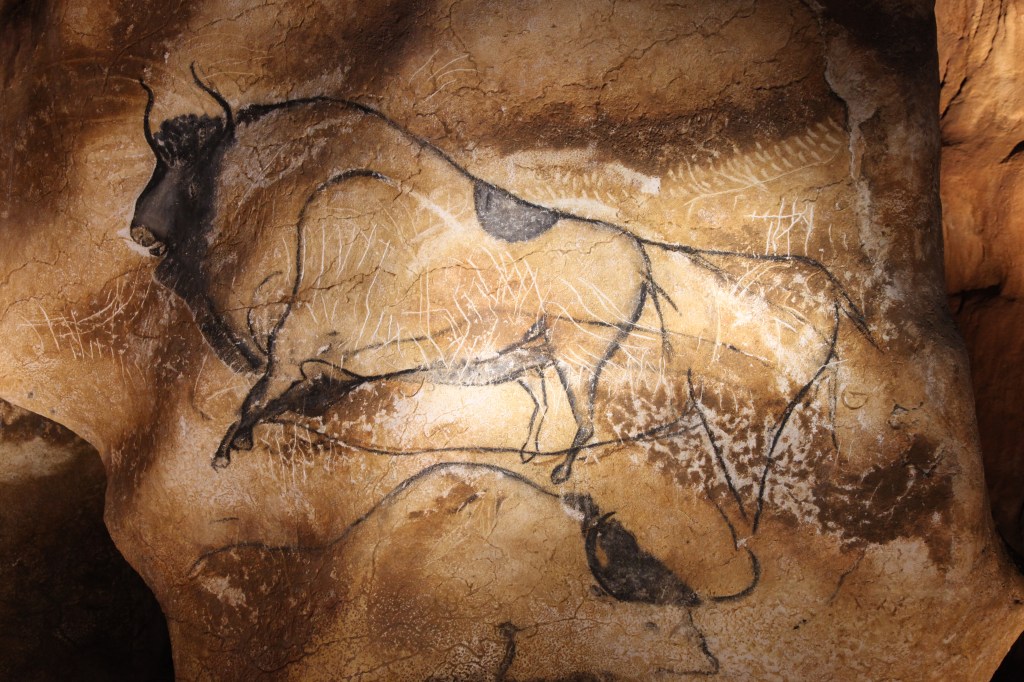
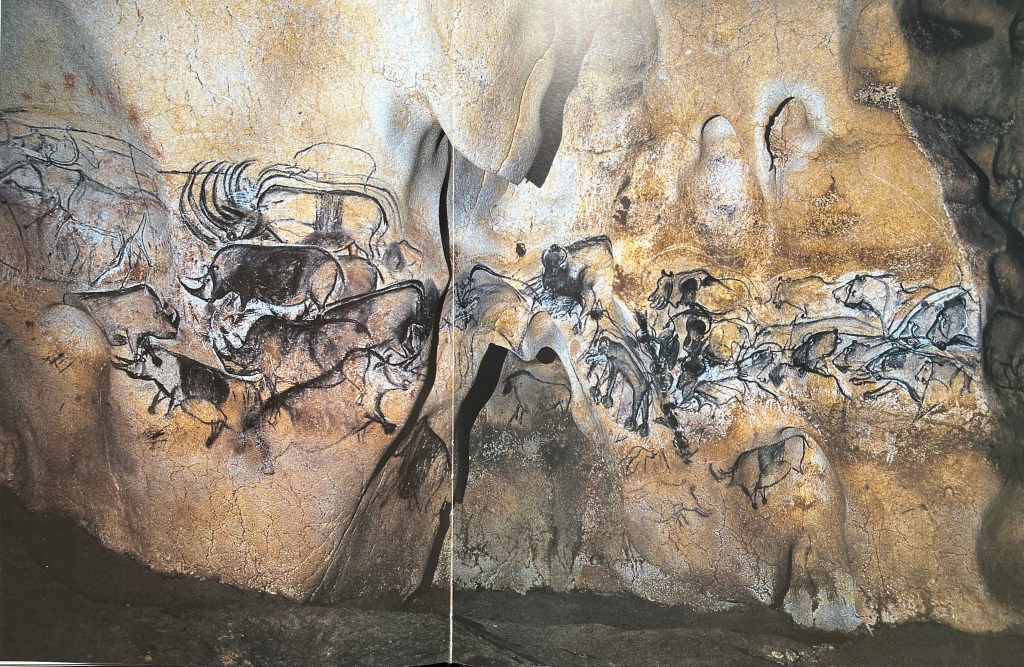
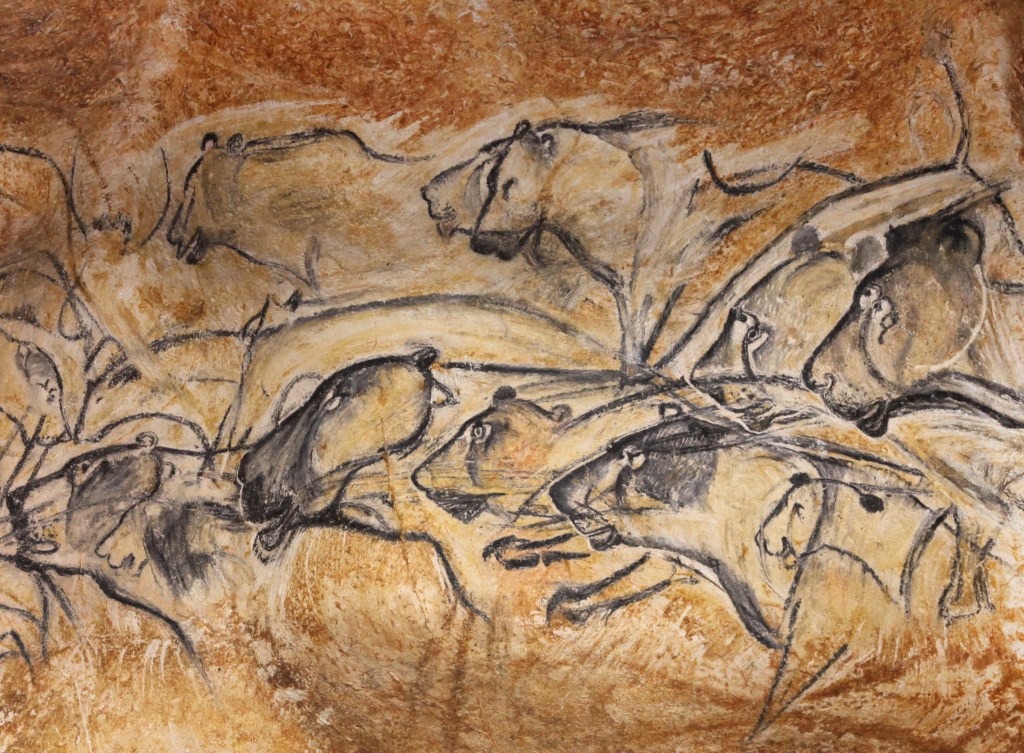
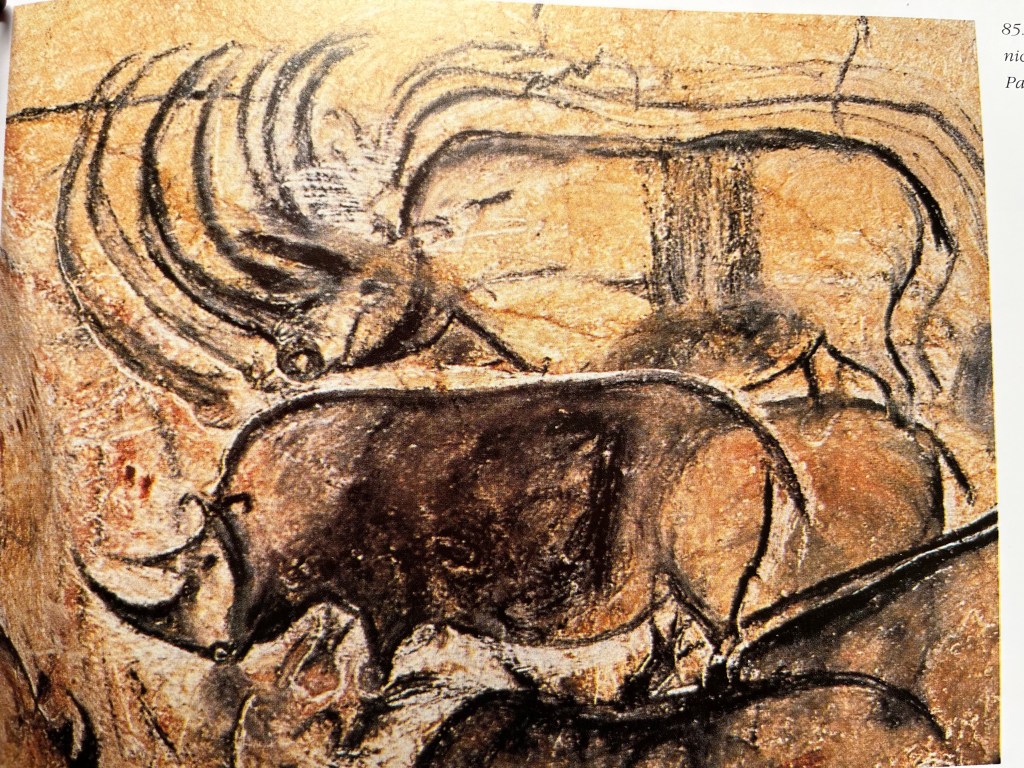
Cycling up the tree-clad Ardeche valley, as the motor-cyclists speed past around the many curves (this is a tourist road, opened in 1960), canted over, hanging their lives out over hundred-metre drops, depending on the adhesion of a few square inches of rubber, I am imagining the painters of the Chauvet Cave watching the passing herds of horses, woolly rhinoceroses, mammoths, and storing up the sun-lit images to take down into the permanent dark of the cave, there to reproduce them, in flickering lamp light, with remarkable accuracy and vitality onto the cave walls.
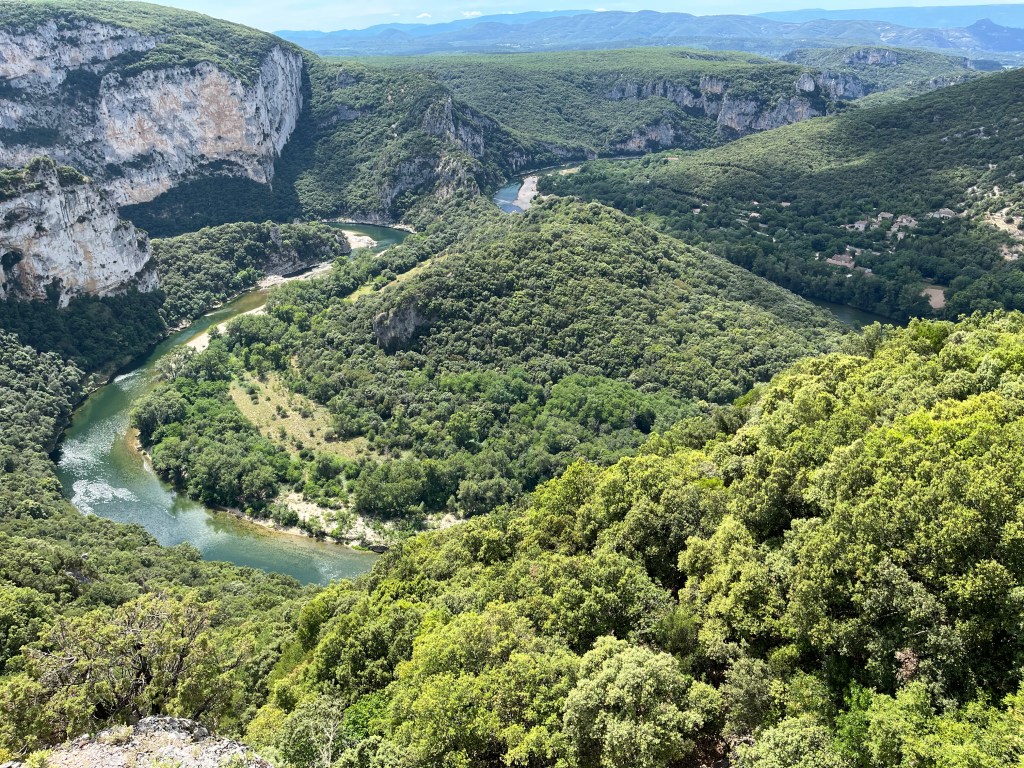
As I climb up to another of the belvederes that give views of the valley deeply incised into the limestone, and over the tree-covered plateau, I recall what I wrote in Diggers and Dreamers – published in 2006 but set in 1976, and written in the early 1990s – about the ‘Palaeolithic Cathedral’ that Pieter, the deracinated South African dreamed he found, and ever after searched for. He says, ‘In 1969, as the world was collapsing around me, when they set foot on the moon, and I thought, that’s it, the ultimate blasphemy.’ In the dream he was walking towards a hill, golden in the sunlight, began to climb, walking confidently, then stepped into nothingness, fell into blackness. ‘I had three matches. I lit one. The flickering flame revealed a cave, its walls covered with the most astonishing pictures of animals. I lit the matches one after another, lighting up as much of these paintings, of incomparable vitality and holiness, as I could.’ He sat in the dark, then felt himself floating up, and awoke in his bed. He continues to look for the cave, in vain. (Diggers and Dreamers p143.)
I was writing the book in 1994, at the time the Chauvet Cave was discovered. In 1995 a book of photographs of the cave was published, The Chauvet Cave : The Discovery of the World’s Oldest Paintings, which I bought but never opened, waiting for the right moment. It came in April 2011, after I had seen Werner Herzog’s 3D documentary, Cave of Forgotten Dreams, in Bristol. It begins with an impossible tracking shot (using a drone?) parallel to the narrow path to the cave, over low bushes. And I’m there, here, in France, in the limestone country, bushes with small leaves, a dark green river, a limestone arch, the rock that smoothness that it might be constructed, the whole thing effortlessly beautiful, as if a compact had been made at earliest times always to create the beautiful. And then into the cave.
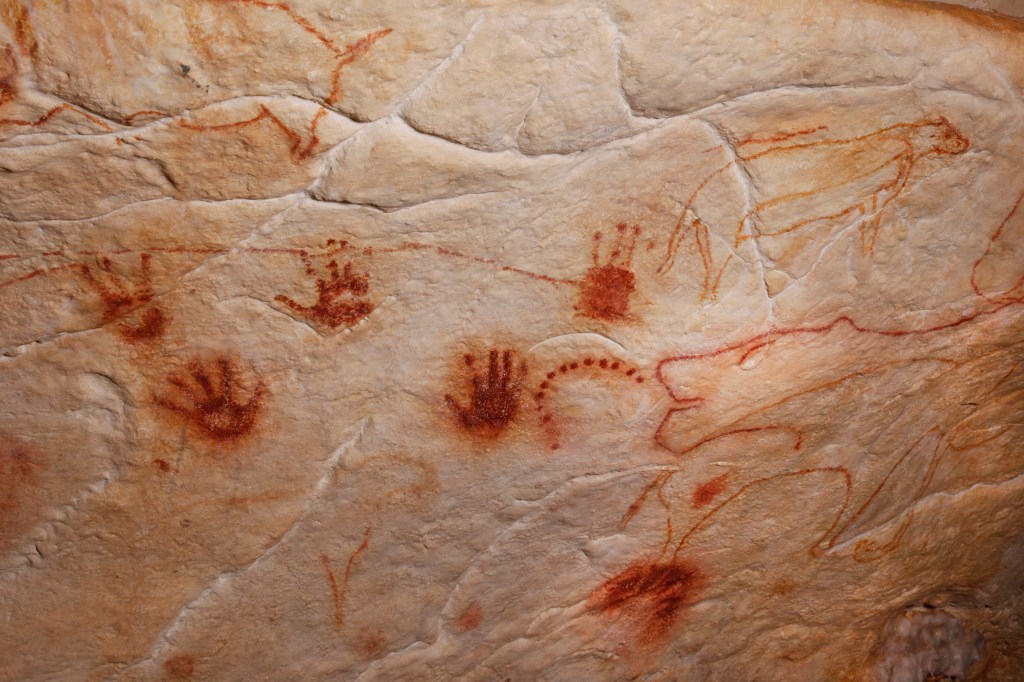
I drove home from Bristol, rehearsing all this, trying to leave nothing out. The hanging pillar tantalisingly inaccessible, with the lower half of a woman, the top half (or covered by the head of) a bull. A wall scratched by a cave bear, drawn over, scratched again. The wall of palm prints made by a six foot man. The shapes coming and going with the walls. The fresh look. The bear skull on a square rock facing the entrance. Hand prints and hand outlines.
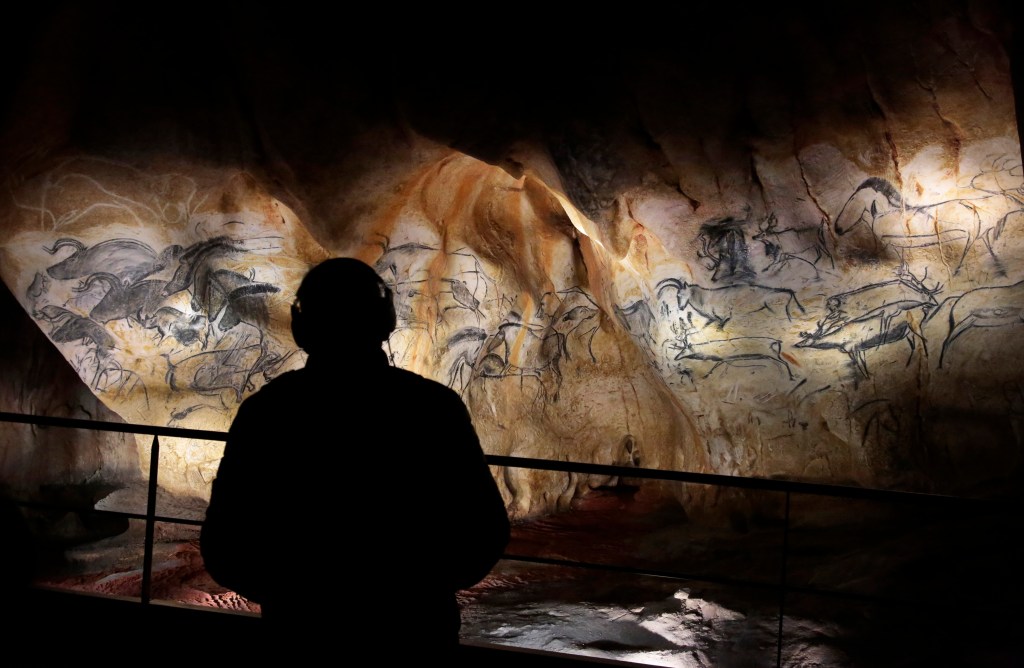
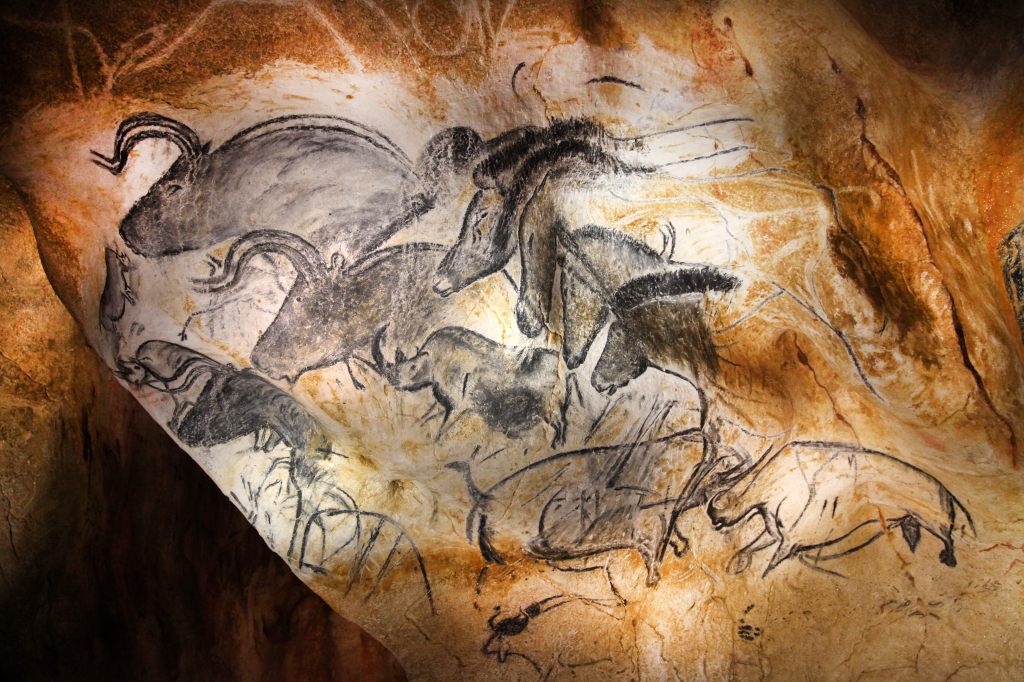
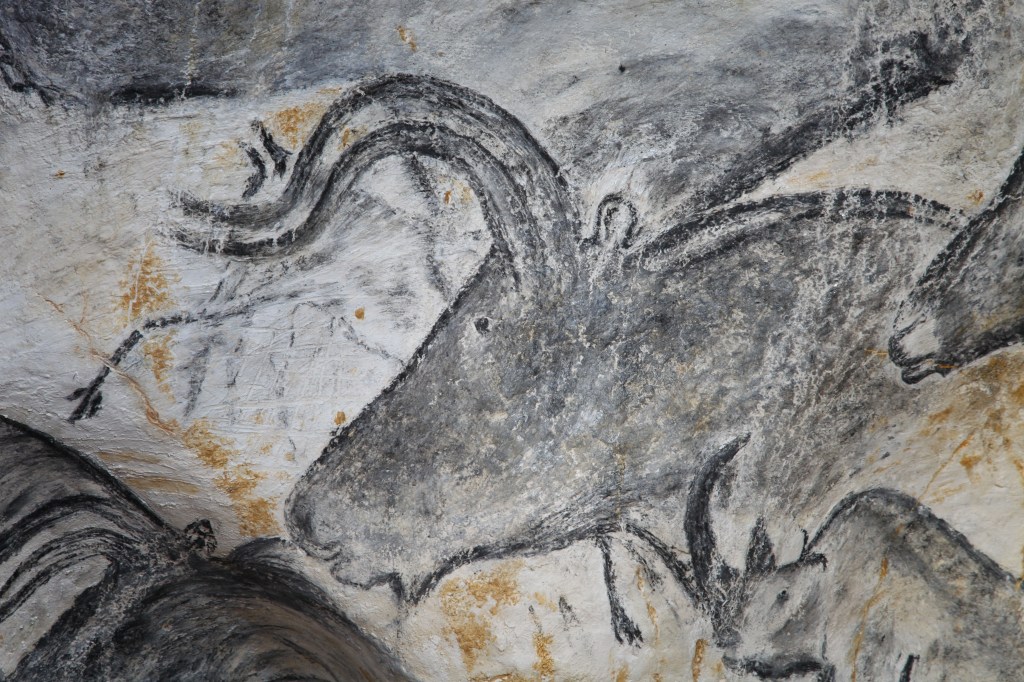
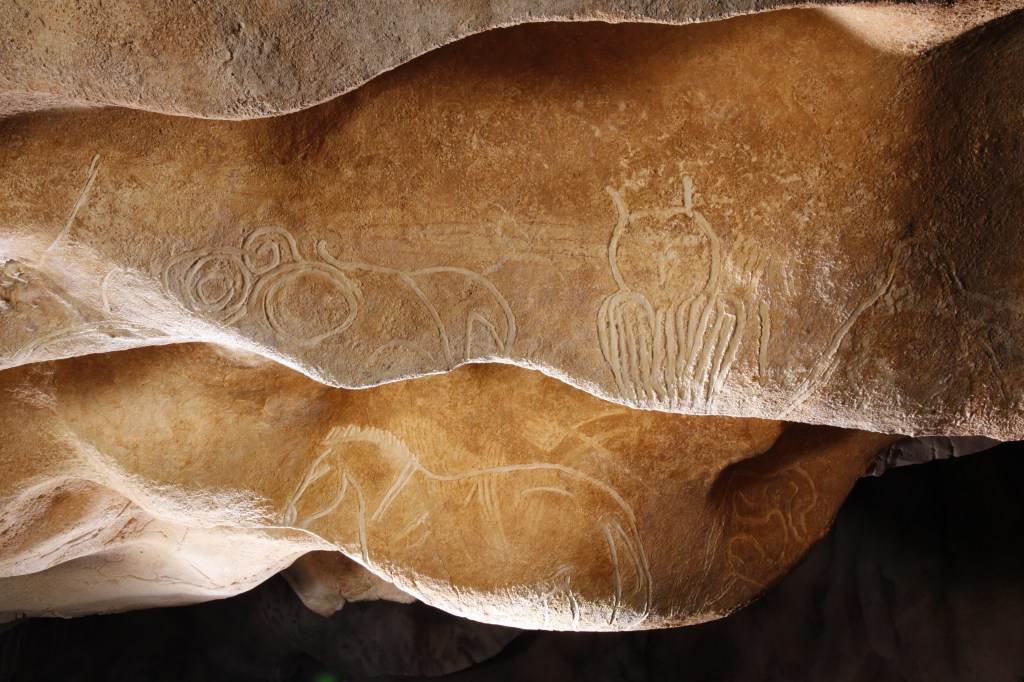
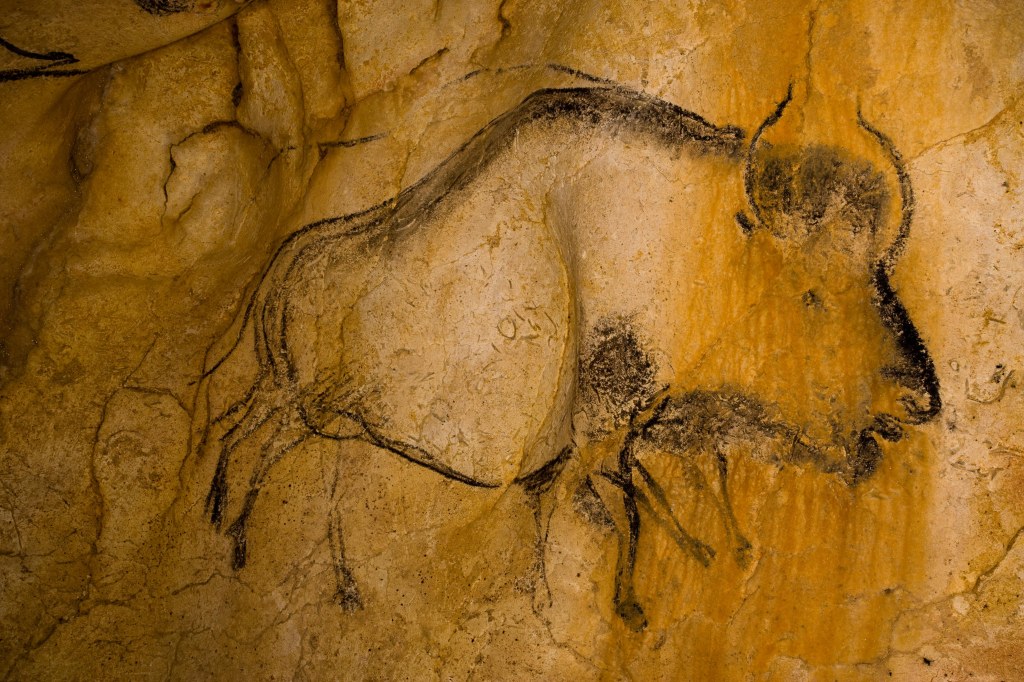
Something about the freshness of the drawing, the cleanness of line, the sheer beauty, is emotion-inducing. Horses (exactly like Franz Marc, the Expressionist) with bristly manes. Rhinoceroses with long curved horns. A bizarre thin elephant with big boots on. Bears, aurochs, bison, maybe bird or butterfly shapes, an owl!, lions. Drawn with an almost cartoonish accuracy, capturing the essence – the bulk of bison, the speed of horses, the sweeping lines of rhinoceros horns and bodies, the almost human thoughtfulness of the lions.
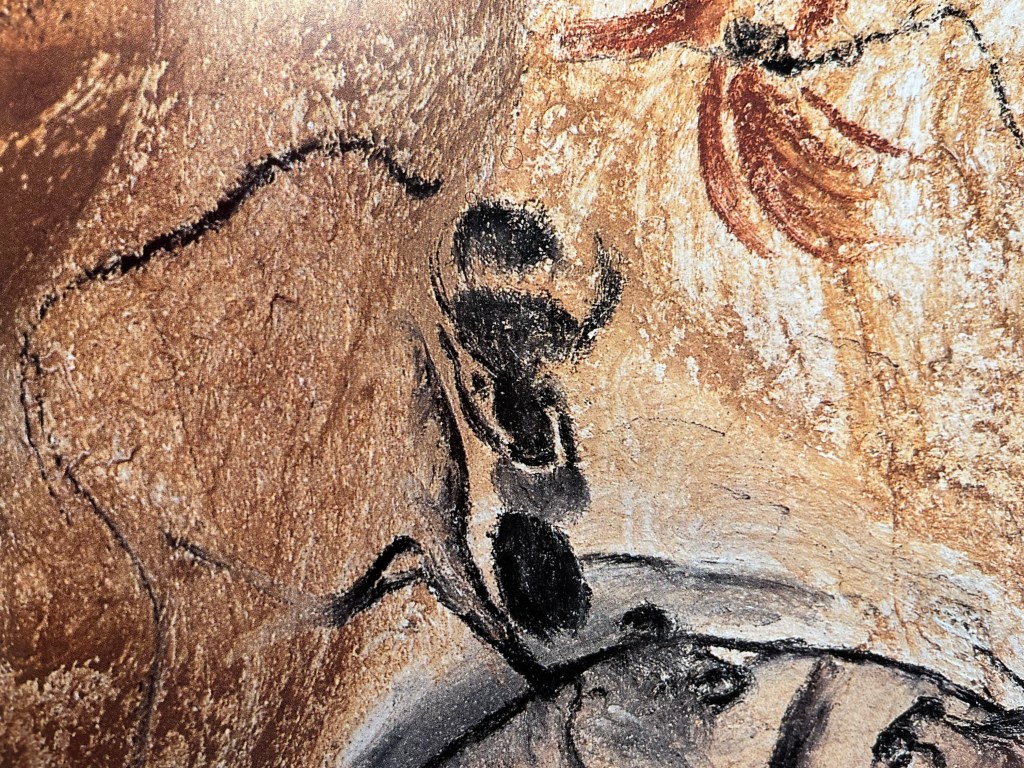
And then a moment, the camera panning along a wall (the 3D is very effective) follows a concavity in which the body of a bison is viewed obliquely and then as it pans on, and the wall curves out, towards us, facing, the head of the bison, head on, face à face. That says, simply – don’t go out of the cave. You have everything here. If you leave the cave, you’ll spend the next 35,000 years doing the daftest and most awful things; because you’ll have a sense of loss but you won’t know what it is you’ve lost. Here, you have everything, here and in the world above, the company of the animals, a world in which you belong, all the religion, ritual, art, mythology, story you’ll ever need. Every few thousand years, if you fancy, you can change this, add that drawing, as you are moved to do. Acting when moved to act.
I’d wondered why, in the later part when in the film Herzog had lost the talking heads (watching them tramp serious-faced away from their brief research, jaws set to write up their reports resolutely, finding ways to fit this into their preconceived notions) and the camera is passing over the shapes, lingering at the hectic scene in which rhinoceros fight, horses run, multiple bison thunder, I’d wanted it not to stop. Simply because, when it stops, I have to leave. I wanted more, to see each part more and more, to sink deeper in, to become more and more part of, to feel it at last all around me. Odd, the lights coming on in the cinema, how gimcrack it all looked, felt, even the technology, even, outside, the great harbour works, how inconsequential, superficial as a wisp of fabric, the easy, smiling, chatting, expensively-spectacled faces, the noisy girls talking giddily to the quiet man they’d sat beside about a trip down the Dordogne, were. Bristol has at best a pleased with itself, consumer self – everyone kept afloat by a surrounding of culture; or maybe, more, insulated from the real world by a culture that they wear and consume rather than interact with. Glib. (Intermixed with people who simply don’t know how to cope.) Everything insubstantial and inconsequential.
My usual fancifulness. But chiming exactly with gut feelings I have about ‘progress’. Something about the Palaeolithic, following and responding to the tides and currents of the earth, experiencing the world fresh and immediate : but also on occasion descending into the earth, the darkness, carrying the vividly-alive upper world down with them. For ceremony, ritual, initiation. And to connect to the other, bigger world. (Through the arch. Through the walls.) Having everything. And yet in their new humanness, deepening their experiencing, enriching their inner world, their profound selves.
Prehistorians talk of the ‘sapient paradox’ : why did fully-human homo sapiens take 70,000 years to start the Neolithic Revolution? The answer is simple. They did not want to. It was a trap they resisted all that time. And then fell into. The result is there, in the Bible : man and woman expelled to a life of labour; Cain, the farmer, the first murderer.
Lost, that fresh experiencing, in homo sapiens in the Neolithic, with its vain attempts to control those currents with their henges and stone circles. Controlling society with their authoritarian systems. The health of humans deteriorated markedly when they changed from hunter-gatherer to settled agriculture.
Ever more lost to us as we’ve packed more and more of our lives into our heads, experience ever more mediated … And of course the great irony that I try to engage with this ever more in my head, becoming more and more just a brain! But here I am, on a bike, heading for ‘direct experience’ in the reproduced cave, at ‘Chauvet 2’.
I am here, now, because of another film I saw, also in April, 2011. Sophie Fiennes’ film Over Your Cities Grass Will Grow, about Anselm Kiefer’s ‘work’ at Barjac, where he transformed the grounds of an abandoned silkworm farm and spinning mill, with roads, tunnels, buildings and galleries, into a remarkable Gesamtkunstwerk. Ever since it was opened to the public in 2022, I have wanted to visit. This year I managed to book one of the limited tickets. I didn’t know where Barjac was, except ‘near Avignon’. I find it on the map. In fact 50 miles from Avignon. But, more interestingly, 12 miles from the Chauvet cave, and from the replica, Chauvet 2. I am here because of Kiefer and Barjac; which I will visit the day after Chauvet 2. Serendipity has brought me, at last, to Chauvet.
As I cycle upwards, I try to collect my thoughts.
First, the age of the paintings. Most were created 37,000 to 33,500 years ago. More than twice the age of Lascaux.
Second, that ‘art’ (depiction) of the highest quality was made from the beginning. Gone the nineteenth-century evolutionary idea of a development through ‘youth’, to a brief ‘maturity’, followed by the decline into ‘old age’, or academicism; as presumed by an ‘expert’ in the art of Lascaux, writing : ‘the development of Palaeolithic cave art may be summed up as 15,000 years of apprenticeship, followed by 8,000 years of academicism. At the turning point in this evolution stands Lascaux.’ Lascaux, The Final Photographs. Lascaux is fine; Chauvet, fifteen millennia older, is as fine.
Then, ‘37,000 to 33,500 years ago’. This is a longer period, 3500 years, than from the present back to Pharaonic Egyptian times. What is the relationship between figures drawn at different times during this period? There is evidence of figures added to existing figures, even inserting a new figure behind an older figure. And the relationship between the peoples who created and, presumably revered, this work? Was it, for some later peoples, a ‘given’, a place they found ‘ready-made’, visited, and also revered?
It was created during a period when average temperatures were 10° lower than today. Not glacial, but steppe-like conditions of sparse tree cover and grassland. Hence the high representation of woolly rhinoceros (72 are depicted). A harsh environment in which population density was very low. But in which people would group in favourable areas, especially river valleys along which herds would migrate. Would one stable group have occupied this area for millennia? Or would different groups pass through, even intermix. How, in a group of 20, to avoid inbreeding, with its negative genetic consequences? Were there gathering places and times, when brides (and grooms?) were exchanged?
The cave was also occupied by cave bears, formidable creatures long extinct. The cave bears would have hibernated in the cave in the winter. Did they use the cave at periods when the bears weren’t using the cave? Or did the cave artists enter and work in spring and summer, after the bears had left? Did they have a relationship with the bears?
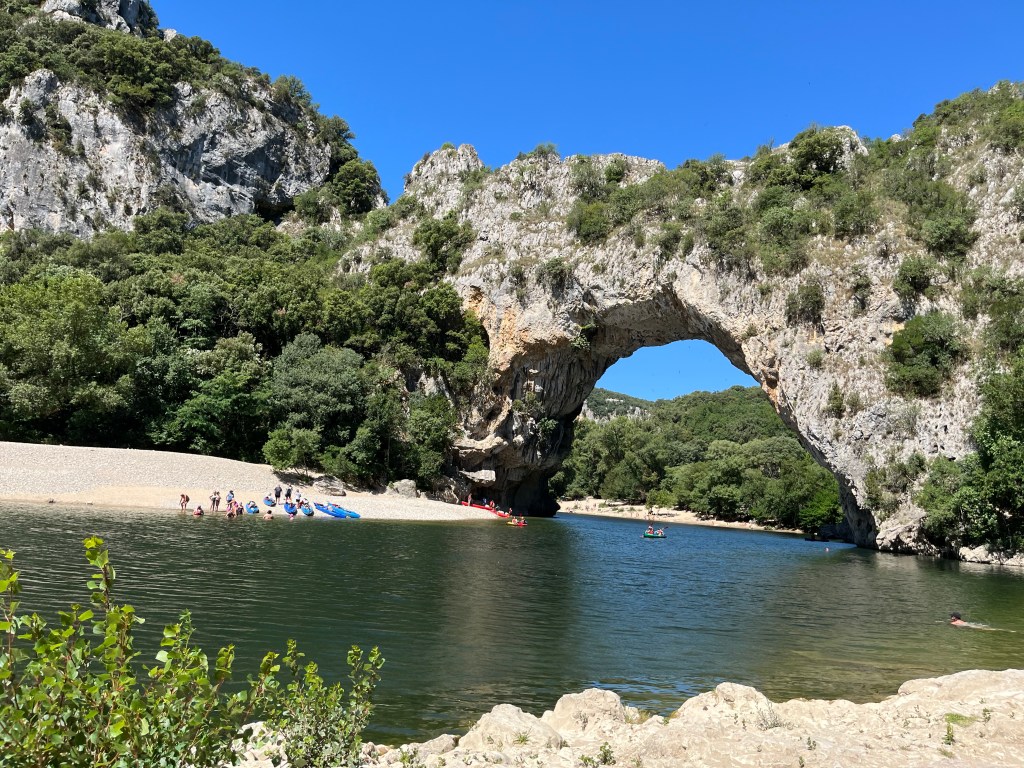
So many unknowns. I want the Pont d’Arc, at the foot of the cliff in which Chauvet is located (and the only such river-made arch in Europe), to be a portal through which the artists would have passed, to the cave.
I want the handprints, both positive and negative (some made by placing an ochre-covered hand on the rock, some by spitting ochre onto the hand and then removing it) to be a Palaeolithic way of connecting through the rock, to a spiritual realm beyond.
But most of all I want to revisit the cave with the same fresh eyes as when I sat in the cinema, watching The Cave of Forgotten Dreams, with its perfect, memorable title.
So I will end this piece with photographs of the cave walls, paintings made by the first homo sapiens, remembering Picasso’s response to Lascaux, ‘we have invented nothing. We have learned nothing in 12,000 years.’ Extend that to 37,000 years.