Claude Levi-Strauss and approaching the Red Centre
I
“Exploration is not so much a covering of surface distance as a study in depth: a fleeting episode, a fragment of landscape, or a remark overheard may provide the only means of understanding and interpreting areas which would otherwise remain barren of meaning.” Levi-Strauss, Tristes Tropiques, p56
In the museum in Sydney is an account of the arrival of the first settlers in 1772, the dozen ships of convicts from the hulks and marines to guard them.
In the beginning there are almost endearing accounts of the delicacy of interaction as Aborigines and military each tried to make sense of the other, and were tentatively invited into each other’s worlds; of uniformed officers squatting at camp fires, and chiefs’ wives taking tea at the governor’s residence. Although the incomers was always astonished by the nakedness and material poverty of the Aboriginal life, while the Aborigines were appalled at the white man’s brutality, especially flogging. But these were contacts of enlightenment gentlemen and native leaders. Within a short time, 80% of the indigenous peoples were dead of smallpox. And soon after came the conflicts over land, with the Europeans seeing, as empty, land that was an active, intricate and integral part of the hunter-gatherer ecosystem. As useless for labour as the Caribs Columbus encountered, and insufficiently numerous or warlike to present, like the North American natives, a threat, the Aborigines were pushed aside, a dark shadow, a stain, hardly existing, a nuisance, a problem to be solved, often (give them alcohol, steal their children) in the most casually terrible way. There seems to have been little attempt to understand; the only question was whether they were sufficiently human to be educable, in other words turned into black white men.
Levi-Strauss says this, about mutually-uncomprehending societies meeting:
“The less human societies were able to communicate with each other and therefore corrupt each other through contact, the less their respective emissaries were able to perceive the wealth and significance of their diversity. In short,” he continues, of his arrival as an anthropologist in Brazil, “I have only two possibilities: either I can be like some traveller of the olden days, who was faced with a stupendous spectacle, all, or almost all of which eluded him, or, worse still, filled him with scorn or disgust; or I can be a modern traveller, chasing after the vestiges of a vanished reality. I lose on both counts, and more seriously than may at first appear, for, while I complain of being able to glimpse no more than the shadow of the past, I may be insensitive to reality as it is taking shape at this very moment, since I have not reached the stage of development at which I would be capable of perceiving it. A few hundred years hence, in the same place, another traveller, as despairing as myself, will mourn the disappearance of what I might have seen, but failed to see.” Tristes Tropiques p51.
We are only aware of what is lost, after it is lost. But the lost is not just irrecoverable, it’s unimaginable, except as imagined in the now, therefore made up, true to the now, untrue to the lost.
At Cairns, 1500 miles north of Sydney, where I’ve trekked through sub-tropical forest, and swum on the Barrier Reef, I walk the length of the esplanade. There is a promenade and cycle path, through green grass, beside white sand and blue sea, in a setting of purple mountains. It is brilliantly sunny and clear, the temperature in the thirties and a strong and refreshing wind blowing in from the sea – the Coral Sea! – bending and rattling the palm trees, while lugubrious pelicans fish, and Noisy Miner birds fiercely stake out their territories, and there is activity everywhere, white people running, cycling, walking, games-playing, barbecuing, Sunday afternoon busyness: with, asleep under a tree, two Aborigine women, massive and ancient, on a different time scale, as if dreaming slow dreams of a lost world, or waiting, tortoise-like, in their slow patience, for that world to reappear.
Flying from Cairns to Darwin, north again, over the outback of Northern Territory, an uninhabited tawny desert, without large-scale features but everywhere marked, it is hard not to see the scratches and squiggles of small landforms and dry watercourses as being signs of message and symbol, the skin of the earth marked as meaningfully as primitive peoples mark their skins, with illustrations and narrative. In Bruce Chatwin’s The Songlines I had read of “the labyrinth of invisible pathways which meander all over Australia and are known to Europeans as ‘Dreaming-tracks’ or ‘Songlines’; to the Aboriginals as ‘The Footprints of the Ancestors’ or ‘The Way of the Law’” (p2) that record the journeys of the legendary beings who wandered over the continent in the Dreamtime, singing out the name of everything that crossed their path and so singing the world into existence. This process is repeated in the Aboriginal walkabout, when the story of the landscape is told as it is walked, each landmark having its place in the narrative, and each journey is a retelling. Man’s place in creation is not to change the world, but to preserve it at its moment of created perfection. Just as meditation, being in the moment, renews the moment, so, telling the story and performing the ritual, each time in order and perfectly, renews the nature, the quality of the place, physical, animal, spiritual (these intertwined, inseparable), in the here and now. A world in which men live in the eternal present, in which each place is as it should be, and each moment is perfectly new and infinitely old.
No wonder, then, the mutual incomprehension when Aboriginal met European, for whom time is a stream flowing, the present a momentary passing point between past and future, and what exists is to be changed, in response to the past, or in striving towards some imagined future!
Levi-Strauss characterises the two societies as ‘hot’ and ‘cold’.
Cold societies seek to remain static. He likens them to mechanical machines, like clocks, which begin with a certain amount of energy and employ that energy as long as possible, seeking to conserve it (although ‘rewinding’ repeatedly), until friction wears them down and some readjustment is necessary. They tend to be egalitarian, regulated by unanimity, producing little order but also little entropy.
Hot societies are dedicated to rapid change and innovation. They are like steam and other thermodynamic machines, which can do more work, but quickly use up their energy which must be constantly resupplied. Always changing, they have a clear and visible history. They draw their energy from differences in potential, employing differences in status and wealth, such as slavery, serfdom, class distinction to maximise the work done, producing much order but also much entropy, in terms of social conflict and political struggle. (And, one might add, resource depletion and waste production.)
There is something beguiling, to my complicated world of mind and imagination, product of a hot society, in this belief that man’s purpose is not to develop himself, or change the world, but to preserve and renew the given at its moment of creation. Animals are part of this process automatically. But humans, with the extra degree of consciousness, self-consciousness, have (apparently, for there is always the possibility that self-consciousness is in fact simply the capacity for self-delusion) choice.
But, for Levi-Strauss, true self-consciousness can only be achieved through contrast with the ‘otherness’ of another culture. Otherness holds up a mirror to a society, in which it can recognise and study this image of itself. And the only ‘other’ are the ‘cold’ societies. Which have been “crushed by the development of Western civilisation, that monstrous and incomprehensible cataclysm which overwhelmed such a large and innocent portion of mankind.” (Tristes Tropiques p375.) Thus we are deprived of the space in which to gain perspectives on our own values and beliefs. The path to legitimate self-knowledge is closed forever. For the European, “the adventure into the heart of the New World signifies first that this was not our world, and that we bear the responsibility for the crime of its destruction; and further that there will never be another New World.” (Tristes Tropiques p454.)
But Levi-Strauss was arriving in a world that had experienced over 400 years of European interference. And where the indigenous societies had already adopted agriculture. Was Australia, where white impact in the centre was negligible until the 1920s, and where the indigenous societies were ‘Palaeolithic’ in type, “another New World”?
For the Greeks, and fundamental to European societies since, there were two contrasting views of human history.
For Hesiod, man is a fallen creature, living a benighted life in an age of iron in which “men never rest from labour and sorrow, by day, and from perishing by night; and the gods lay sore trouble on them.” (Work & Days, lines 175-178.) While he remembers, with longing, the age of gold, when men “lived like gods without sorrow of heart, remote and free from toil and grief: miserable age rested not on them; but with legs and arms never failing they made merry with feasting beyond the reach of all evils.” (Work & Days, lines 112-115.)
Whereas for Aeschylus, in Prometheus Bound, Prometheus’ action, in tricking Zeus, had liberated man from the oppressive control of the gods, and enabled him, with the Titan’s gifts of intelligence and understanding, speech and number, fire, the domestication of horses, and the conquest of the sea in ships, to progressively advance himself.
Christian theology has its fall. But also, a gift of God, power over the natural world, where he is instructed to “be fruitful and increase, fill the earth and subdue it, rule over every living creature.” (Genesis I v28.)
A given power, and a gathering sense of independence from god that, through the specific forms of intelligence and technology developed through the revolutions of science in the seventeenth century, ideas in the Enlightenment of the eighteenth century, and the Faustian pact of industry, capitalism and the presumption of ‘progress’ in the nineteenth century. By which time god was generally judged to be unnecessary.
So that in 40,000 years man had developed, in Europe, from Palaeolithic hunter-gatherer and cave painter, through Neolithic farmer and marker of his presence with great stone monuments, through bronze and iron ages, ‘evolving’, ‘developing’, ‘progressing’, in the intellectual and material spheres, to the present nature-conqueror, and creator of and dweller in his own made environment, in which nature is subset not context.
While, in 40,000 years in Australia … not change, evolution, development, but repetition, living in nature, preserving and renewing, generation after generation, sixteen hundred generations and counting. Until the Europeans arrived.
In my mid-twenties, I worked at the Ecology Bookshop. My education had been dominated by, even predicated on the ‘Whig view of history’, of an ever-upward trend of evolution, development, progress, of wealth, knowledge, understanding. At the bookshop I learned about steady-state equilibrium in ecosystems, in which, in circumstances of a relatively stable external environment, a system can achieve, through various feedback loops (negotiations), a long-term stability that takes it outside the realm of time-as-change, is effectively timeless. The version in nature of Levi-Strauss’ ‘cold’ society.
It appealed because I was in the doldrums that some enter after an intense and forceful education, as they cross the shadow-line into adulthood. I likened my aimlessness to drifting in space after a capsule’s rockets had fallen away, or floating directionless on a vast lake after prolonged descent through rock-filled rapids. The thought of converting this stasis, stagnation to an active steady-state was attractive.
I meditated. I imagined myself a contemplative, ‘dwelling in the face of God’, or one of the choirs of angels whose existence is in adoring god and thereby sustaining him. But, lacking belief, the ecological steady-state equilibrium was attractive.
I made a version of it, living on a ‘self-sufficient’ smallholding in rural France, which minimised interactions outside the system, and change within. But because one is part of that larger system, which is forever changing and ‘evolving’, one must, unless fixing your way of life – as the Amish have done – at a particular date, evolve along with it, adopt new technologies, lagging but still changing. It may be more comfortable for those who dislike change, but it is only a paler version of the prevailing ‘hot’ economy of perpetual change and ‘forward’ motion.
But in that remote part of France I became aware of Palaeolithic cave art, and the places of ceremonial within which it was created. (One of the most remarkable such places, the Chauvet cave was discovered close to where I lived.) An art clearly in no way inferior to any subsequent art. (As Herzog, the director of The Cave of Forgotten Dreams says, the art ‘bursts onto the scene fully accomplished, and when you look through the faces of cultural history, art history, it hasn’t gotten any better.’) Indeed with such freshness that made so much subsequent art appears mannered, laboured, muffled by history. Here was an art of immediacy – where two horses painted 20,000 years apart can’t be told apart, an art of perpetual renewal and refreshment. And if the art – perhaps the life? Seeing The Cave of Forgotten Dreams, and afterwards experiencing the cinema, the city, the car I drove home in, as having less substance than the life hinted at in the film …
Levi-Strauss, again, has useful insights on art in ‘primitive’ and ‘civilised’ societies, seeing three differences between them. First, that in ‘civilised’ societies, art is made for an elite, and only they share the language of artists and fully understand their symbolic representations; in the ‘primitive’, the language of art is shared by all. Second, in ‘primitive’ societies, the art object has a meaning beyond its physical presence, as the nexus of social, religious and magical forces; whereas in the ‘civilised’, the focus is on the object, on destroying what he calls its “superabundance”, and turning it into an artefact the individual can possess. Third, there is in ‘civilised’ societies a self-conscious academicism, in which artists endeavour to place themselves in a tradition of “great masters”, who make “priceless” objects; which of course strengthens one and two.
I had already read how that origin symbol of human progress, the Neolithic revolution, that kickstarted the modern world with settled agriculture, had shortened lives, reduced health, curtailed freedom, and introduced a new monotony, and agreed with Jared Diamond, “the agricultural revolution was the worst mistake in the history of the human race.” And if the agricultural, why not the industrial, the technological? In which our well-being depends on hideous mistreatment of animals, physical and human resource exploitation, and ecological despoliation. In which our extended lives are at the cost of the primitive’s belief that his life is but a brief (and probably the least interesting) time in a much longer, perhaps eternal life. No wonder we protect ourselves from death, grab at every extra year, when, for the first time in the story of man, we face extinction! (Even that defiant pronouncer of God’s death, Nietzsche, had to stave off the prospect of annihilation by positing eternal recurrence.)
So that, far from seeing intellectual and technological innovation as a series of methodical steps and sudden spurts of change, increasing complexity and sophistication, in which man ‘ascended’ a stable pyramid, I was used to the image of the modern world as an unstable inverted pyramid, with technology as a series of damage-limitation fixes to ecological instability that man’s actions had created. In this model, the ‘original sin’, for which we are forever paying, is settled agriculture.
Perhaps this makes no sense. But as I move away from ‘civilisation’ – I’m already about to land in Northern Territory, where 30% of the population is Aboriginal (nationally it’s 3%), and large areas have been returned to them – I’m glad that there are peoples whose purpose is to preserve the ‘world as given’, rather than developing the ‘world as made’. And, as I approach nearer the red centre of the continent, perhaps I will find whether the thoughts I’ve brought with me are book-learning, wishful thinking, or that they have some measure of reality that will enable me to experience more vibrantly.
However, as the plane lands in Darwin, I remember Levi-Strauss’ words on the delusion of travel accounts; that they “produce the illusion of what no longer exists, but what must exist if we are to avoid the overwhelming evidence that 20,000 years of history have been gambled away … Mankind has established itself in a monoculture; it is preparing to produce civilisation en masse, as if it were sugar beet. Its meals henceforth consist of only this one dish.” (Tristes Tropiques p38-9.)
II
In his review of Jared Diamond’s The World Until Yesterday, anthropologist Wade Davis questions the author’s presumption that Australian Aborigines had ‘failed’ to develop their material culture, and that this is an indicator of their essential ‘primitiveness’. This presumption, says Davis, is a hangover of the nineteenth century Eurocentric idea of a linear evolution of cultures, culminating in – ours. Whereas “cultures do not exist in an absolute sense; each is but a model of reality, the consequence of one particular set of intellectual and spiritual choices made many generations ago.” And “the visionary realm of the Aborigines represents one of the great experiments in human thought. In place of technological wizardry, they invented a matrix of connectivity, an intricate web of social relations based on more than 100 named kin relationships. If they failed to embrace European notions of of progress, it was not because they were savages, as the settlers assumed, but rather in their intellectual universe, distilled in the devotional philosophy known as the Dreaming, there was no notion of linear progression whatsoever, no idealisation of the possibility or promise of change.”
For Levi-Strauss too, “the savage mind is logical in the same sense and the same fashion as ours.” Thus he rejects the ethnocentrism that sees ‘primitive’ thinking as: relic of our evolutionary past; analogous to the thought of the child; or to the insane; a pre-logical, mystical ‘participation’ with the experience.
But clearly the primitive and the modern think differently. “The difference [he writes] lies not in the quality of the intellectual process, but in the nature of the things to which it is applied.” ‘Primitive’ and ‘modern’ thinking are equally rigorous, but they are applied to different orders of experience. They have different grand strategies for approaching experience.
Compare the witch doctor and the scientist. Both operate according to the principle of causation. But the scientist has a very limited notion of causality. Most phenomena are treated as chance: why a particular moon is in a certain orbit, how a new variation appears in a species; as simply the beginning of a chain of causal connections. Whereas the magician tries to explain everything. Every illness, every defeat is the result of magical forces operating. “Magical thought is distinguished from science by a more imperious and intransigent demand for determinism.”
But why should this be? Magical thought deals directly with the immediate phenomena of experience, of perceptible qualities such as colour and taste; it is a “science of the concrete.” Whereas science is somewhat removed from experiential reality, is exterior to events, and organised in terms of abstract concepts.
To clarify this, he uses, as metaphor, the contrast between the bricoleur, or handyman, and the engineer. The bricoleur has a limited set of tools and materials, which he adapts to each problem. It is a closed system. Faced with a problem, he will examine his tools, and his experience, and solve it from within that set. Whereas the engineer will analyse the situation, and come up with a specific, perhaps novel solution, involving designing a new set of tools. (Example, moving coal: primitive thought will modify packs, try other animals; scientific thought will invent the railway.)
Primitive thinking doesn’t get you to the moon. But if your intellectual universe is focussed on maintaining the world precisely as it was at the moment of creation, it works.
III
My experiences of Aborigines are limited and observational, anecdotal and superficial. They are these.
In Cairns, two Aborigine women asleep under a tree, massive and ancient, and on a different time-scale, tortoise-like in their slow patience, as if waiting for a different world to arrive, or dreaming of a lost one.
In Darwin, Aborigines under the trees in the park, away from white people. Easy to romanticise but to me faces of craggy timelessness, carved like landscape features, with deep-set eyes, watchful but bright. No sense of engagement, defensive, reactive, they wait. Perhaps it’s just the look of people disempowered by the incomprehensible, disinherited in their own land, deracinated from their own traditions, used to be treated as a ‘problem’, waiting for the next ‘solution’ to be tried on them by the usurpers of power. They seem not to mix, but just to wander around, sit or lie, a still, living reproach. (This based, of course, on little evidence.)
In Katherine, groups of dark figures, sitting in the shade, or walking unevenly around. They look lost, even bewildered, seeming not to see, and yet seeing. What is it? It’s as if they experiencing simultaneously this place as it was, for 40,000 years, and as it is now, a century’s accretion of concrete buildings, tarmac roads full of cars, lawns, street lights. All of this solid, and yet experienced at the same time as a shimmering mirage. Which is real?
When the bus stops, the whites rush into the shop, to buy stuff from the fridge, and soak in the air con. The Aborigines clamber slowly down and squat close to the bus, patient, waiting.
They seem to be treated well, but condescendingly, like children. The driver says, the truant officers ban Aborigine children who don’t go to school from the swimming pools, the games, even from buying sweets. ‘It’s tough, but they have to learn. It’s the only way they’ll survive.’ Which is true. But they won’t any longer be Aborigines, they’ll have lost their difference, their uniqueness. And we’ll have lost that all-important mirror.
In Alice Springs, a mixed group of Aborigines, rowdy, reeling, drunk, talking argumentatively in an incomprehensible language. A native language? An Aboriginal pidgin? Bewilderment, confusion, the escape into alcohol, the boiling up of anger, conflicts with law and order.
An Aboriginal woman labours onto the bus, one asks her, she says, ‘he’s in the cells. Police got him. Bernie’s been locked up.’ She’s off searching for him at one in the morning.
I’m sure – is this true? – that at each stage of integration, Aborigine faces become less craggy, less timeless, more like ours, they progressively lose their differentiation.
(Driving through the outback, mile after mile.) This is a place without buildings. The Aborigines built nothing that couldn’t be removed by the weather as easily and completely as a sandcastle by the tide. There are no ruins, there’s no record, no memory, no time.
The impact of the whites appears to be minimal – a building here, a fence there, a road cut through a low ridge. But utterly disruptive of ‘the footprints of the ancestors’. As if Aborigines cut through a telegraph wire and then knotted it – it wouldn’t look that different, but it wouldn’t work. Or they established an occasional path across a factory production line, maybe dabbed paint on circuit boards passing on the line, not that disruptive, but producing chaos. A complete dissonance between two attitudes to landscape.
The tarmacing of roads in the 1960s revived ranching in the outback by making possible the live cattle trade, carried in the road trains, trucks and trailers fifty yards long. The cattle are at very low densities, but their presence, however few, frightens away native fauna. And whereas the Aboriginal seasonal burns were small scale, a quarter of the land, so that each of the four quarters was at a different stage, the white farmers burn off large areas. Cattle are rounded up by aeroplane or helicopter. One spread near Uluru, of a million acres (the size of Belgium), is so big, the only way to round up the cattle is progressively to turn off the water supply, to drive them to the farmstead. Eleven people live there.
Uluru / Ayers Rock
(The name, successively, Uluru, Ayers Rock (after a politician), Ayers Rock/Uluru, Uluru/Ayers Rock.)
The area was of little interest to white men because it was too dry. The first white men to have an impact on the Aborigines around Uluru were dingo hunters in the 1920s – the Australian government put a bounty on dingo scalps, to put money into the rural economy. The hunters paid the Aborigines for them in tinned food. The diet changed, obesity and diabetes resulted. Alcohol came in, and the law, which Aborigines were often on the wrong side of. Films at the Information Centre tell of their bewilderment, their incomprehension of the “white fellas’” ways. Adventurers came in, and, in the 1950s, the aeroplane, and tourism. Climbing Ayers Rock, which had been a sacred activity, became a tourist must-do, made easier by the chain local whites fixed on it in the 1950s. And the government ‘civilisers’, with a complete lack of acceptance of any validity to the ‘child-like’ ways of these ‘primitive’ peoples, their duty, to them – that might well fail, because they are so ‘undeveloped’ as to be unteachable, but their responsibility, as ‘civilised’ and ‘civilising’ people – to try. Including taking their children from them, putting them in orphanages, or having them adopted, to protect them from their parents. In 1958 a large area was made an aboriginal reserve, protected. But then came tourism, so the area around the rock was made a National Park, the airport, the chain, hotels came. In 1985 the National Park was handed back to the Reserve, on condition it was then leased back to the government. The promise to stop the climbing was broken.
So, the Information and Cultural Centre gives the Aborigine story, they are being given control of their story. It sells Aboriginal paintings and artefacts. But, the story is told in European terms, by European methods, by Aborigines who have had ‘European’ educations. And the art is treated as art is in the European culture – as objects in themselves, possessed by the one who’s bought them, giving a flavour of their origin in Aboriginal culture, but little connection to it. The myths are told in Aboriginal terms – but in versions for white people, that both conceal the Aboriginal essence, and have been adapted to a European tradition of story-telling.
In 1938, A P Elkin wrote this, in The Australian Aborigines, of Aborigines living with white men:
“What then is the secret life of the Aborigines? It is the life apart – a life of ritual and mythology, of sacred rites and objects. It is the life in which man really finds his place in society and in nature, and in which he is brought in touch with the invisible things of the world of the past, present and future. Every now and then we find the tribe, or groups of more than one tribe, going apart from the workaday world. A special camp is arranged where the women remain unless some of them are called upon to play a subsidiary part in the ceremony. Then the men go for a mile or so to a secret site or sites where they spend hours or maybe days and weeks and even months, singing and performing rites, and in some cases even eating and sleeping there. When they return later to the world of secular affairs they are refreshed in mind and spirit. They now face the vicissitudes of everyday life with a new courage and strength gained from the common participation in the rites, with a fresh appreciation of their social and moral ideals and patterns of life, and an assurance that having performed the rites well and truly, all will be well with themselves and with that part of nature with which their lives are so intimately linked.”
Back in Sydney, on the Quays, where buskers entertain the crowds, there is a white man playing a didgeridoo to an amplified electronic beat. And an Aborigine, in loin cloth and body paint, who dances, and brandishes his stick in menacing poses, for the tourists to photograph. What was once ritual is now entertainment, done not to be done but to be seen, and with him not experiencing himself being, but seeing himself being seen.
Talking to an Australian teacher, she says that with each city, each community strung out along the coast, isolated, they tend to be concerned with their own problems, and face outward, rather than connecting with each other. (This is, of course, a Commonwealth, not a unitary state.) And I have a sudden vision of Australia from space at night, as a string of lights around a dark centre, like a necklace around a neck, or a diadem on a head. And that the empty centre, the red centre, has somehow to be drawn into the conversation, incorporated into the Australian story, in a way that isn’t just conquest, ‘educating’ the ‘primitive’, and tourism.
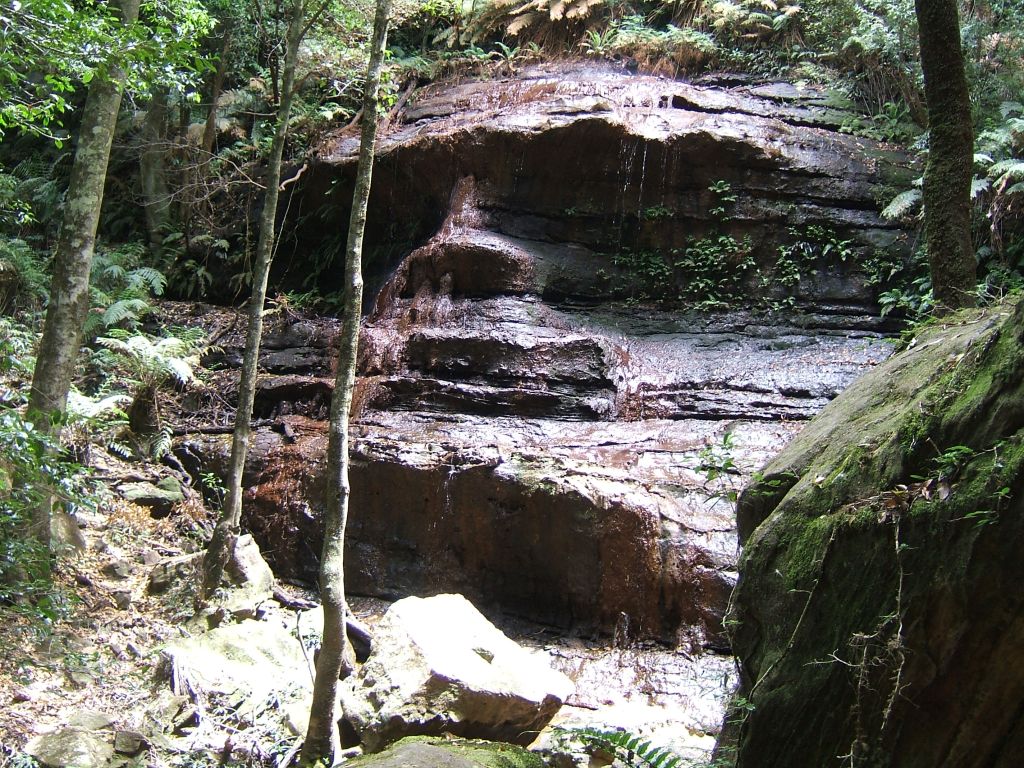
The Blue Mountains, west of Sydney, for 40 years found to be impassable, were finally crossed by following the ridges rather than the (deep, forested) valleys. Climbing out of one of these valleys, on my last day in Australia, far from the red centre, I came upon this stone face. It is a natural feature, not mentioned in tourist guides. This unremarked face, just fifty miles from central Sydney, is for me one more symbol of the indigenous peoples, the pre-European past, and the need for Europeans to both recognise and be reconciled with them, and it.
4th Jan, 2015
Levi-Strauss in South America
‘And yet, just as the sad liquidation of these last vestiges of a dying culture was about to be completed, I was to be given a surprise. It happened in the early hours of darkness, at a time when everyone was taking advantage of the last flickerings of the camp fire to settle down for the night. Chief Taperahi was already stretched out in his hammock; he began to sing in a halting, faraway voice, which hardly seemed to belong to him. Immediately two men (Walera and Kamini) came and crouched at his feet, while a thrill of excitement ran through the tiny group. Walera uttered a few calls; the chief’s song became clearer, his voice stronger. And suddenly I realised what it was we were hearing: Taperahi was performing a play, or to be more accurate, an operetta in which arias alternated with recitative. All by himself, he was impersonating a dozen or so characters, each one distinguished by a special tone of voice – shrill, falsetto, guttural or droning – as well as by a musical theme tantamount to a leitmotif. The melodies sounded extraordinarily like a Gregorian chant. The Nambikwara flutes had reminded me of the Sacre; I now felt I was listening to an exotic version of Noces.
With the help of Abaitara – who was so interested in the performance that it was difficult to extract any remarks from him – I was able to get some vague idea of the subject. The play was a farce, and its hero the japin bird (an oriole with black and yellow plumage whose modulated song can be mistaken for that of a human voice); among other characters were animals: tortoise, jaguar, falcon, anteater, tapir, lizard etc; objects: a stick, a pestle and a bow; and lastly spirits, such as the phantom Maira. Each of these expressed in a style so suited to its nature that I was soon able to identify them myself without help. The plot centred round the adventures of the japin which, after being at first threatened by the other animals, tricked them in a variety of ways and eventually got the better of them. The performance, which was repeated (or continued?) for two consecutive nights, lasted about four hours on each occasion. At times, Taperahi seemed to be inspired; words and songs cam pouring out of him, causing bursts of laughter on all sides. At other times, he appeared exhausted, his voice would grow weak, and he would try various themes without being able to settle for any one of them. Then one of the narrators, or both together, would come to his aid, either by repeating their calls so as to allow the chief actor a breathing space, or by suggesting some musical theme to him, or again by temporarily taking over one of the roles, so that for a little while, the performance became a genuine dialogue. After thus being allowed to recover his energy Taperahi would embark on a new phase of the story.
As the night wore on, it became clear that poetic creation was accompanied by a loss of consciousness and that the performer was being subordinated to his characters. His different voices became foreign to him; each acquired such a distinctive nature that it was hard to believe they were all coming from the same person. At the end of the second session, Taperahi, while still singing, suddenly got out of his hammock and started to stagger wildly about, demanding cahouin [alcohol]; he had been ‘seized by the spirit’; suddenly he snatched up a knife and rushed at Kunhatsin, his chief wife, who only just managed to escape from him by running off into the forest, while the other men forcibly held him back and obliged him to return to his hammock, where he immediately fell asleep. By morning everything had returned to normal.’
Tristes Tropiques p 471-2
 my writing