Day 7: St-Ouen to Fleury-Mérogis, 53 miles.
The flea market. Reuniting two lovers. Suzanne’s grave. A hectic ride across Paris. Satie’s flat. The undertaker. Erik’s grave. Cultural tourism. Gabrielle. The bell not pressed. Depression in a metal cell.
I eat breakfast in the bar. Bright sun outside, washed streets, deep shadows, few people. A bar waking up, stretching, preparing for the long day. It is run this morning by a red-haired girl, competently in charge. This man is tolerated, served quickly with his too-early glass of wine. This man, a valued customer, is greeted with extravagant air kisses. An old man shuffles heavily in, disappears at the back. She rushes after him with coffee, more coffee, and then a plate of food. He is to be kept sweet, he’s the chef, and it will be a busy Saturday. I could sit here all day, watching from my invisibility a day in the life of a Paris bar, making notes that by closing time would be a book, as Georges Perec did near Saint-Sulpice. But I have to get on.
I had suddenly realised in the night, recovering from the physical strain of the day, and my loss of nerve, that the best way to cross Paris early on a Saturday morning is by bike. It is, after all, hardly 6 miles from Périphèrique to Périphèrique. Without the weekday deliveries and commuter traffic, and knowing the streets along the Meridian well, having walked them several times, it should be straightforward. There are even cycle paths in places! So now I can do what I intended to do: connect two lovers, once joined in Paris, long separated.
I cycle to Saint-Ouen cemetery. It is vast, ordered, municipal, the graves are in tight, symmetrical rows, with gravestones like stone coffins. How Suzanne Valadon, the “mistress of Montmartre”, would have hated it! Here is her grave. Her funeral in 1938 was attended by Picasso, Braque, Derain, and her troubled son, Maurice Utrillo.
She was born illegitimate in 1865, and from nothing she worked her way, from laundress, to trapeze artist, to the model and mistress of artists, to acceptance by them as an artist. A woman who lived in her own uncompromising way in a man’s world, and in her female nudes showed a new way not just of representing, but of seeing the naked woman.
One of her many lovers, and for a very short time, was Erik Satie, the composer and musician, a gentle, otherworldly soul who was drawn like a moth to the flame (how appropriate the cliché!): illuminated by the light, and heated, just once in his life, by the fire of this life-filled woman. He embraced it, pressed it to his neglected heart. But when he was left holding emptiness (how quickly she moved on!), and he had “nothing but an icy loneliness that fills my head with emptiness and my heart with sadness”, his angel’s gossamer wings vaporised, and he fell. Hard. Now wingless, he crawled away from the exuberance, vitality and vivacity of Montmartre, to the grey anonymity of the suburb of Arcueil, south of Paris, to remake his life.
And of course, for me Suzanne was Melanie, the romanticised femme fatale of my youth, and Satie a tragic hero I could identify with. And wouldn’t I, like Satie, with “nothing but icy loneliness …” etc., limp away, live secretly, change unseen, become who she had seen I could be (how clearly she had seen! How we need that!), and would say, ‘is this you? You did it!’ Of course I never saw her again. But she changed me, and I changed my life.
The flea market at Saint-Ouen, the biggest in the world, was once a place of quirky characters, both sellers and buyers, who had the knack of making the discarded the desired, of creating a theatre of imagination. It was a favourite place of the Surrealists. I came here with Gabrielle. We bought a birdcage and a well-thumbed copy of Jacques Prévert’s Paroles, carried the cage, with the book inside, back to the top-floor flat she’d borrowed in Rue Quincampoix, made aeroplanes of each of the poems and flew them across to the wide space in front of the Pompidou Centre, watched people pick them up and read them. Each of the poems except ‘Pour faire le portrait d’un oiseau’ (‘To Paint the Portrait of a Bird’), which we folded up and slipped into a gap in a door frame.
Now the flea market is an enormous commercial enterprise.
Except at the edges where, a sign of the times, it has reverted to what it was when it began, the market of the chiffoniers, the rag-pickers, who on the glacis (the open area in front of Paris’ defensive wall), La Zone, built squatters’ shacks and gathered and sorted and sold Paris’ waste. This was before M Poubelle, with his dustbins and municipal dumps, put them out of business from the 1880s. The city wall, having proved useless against the Prussians in 1870, was demolished in the 1920s, and the Périphérique ring road built on the line of it in the 1960s.
Now, gathered in the dank gloom under the Périphérique is a sorry collection of desperate-looking people, with pathetic objects, worn cases, broken toys, old clothes, rags, anything to sell. The rag-pickers are back, the squatters’ shacks – visible from the Périphérique – are back. The brief era of reducing inequality is past, and the poor are once more powerless.
I cycle under the Périphérique. In wealthy areas, the ring road has been put underground. In poor zones it passes on stilts at bedroom height. It is 35km long. The record time for completing the circuit is 9 minutes 57 seconds, on a motorbike.

And I am in Paris.
Bronze medallions were set into the pavement along the 9.2km length of the Meridian through Paris in 1994. I have walked it several times, recording buildings, places, people, associations along the way. The first time I tried to cycle in Paris, I hardly survived the crazed 1960s traffic. Now there are vélibs, bike lanes, and a new regard for the cyclist. And it is a sunny Saturday morning, early, there are few cars, the bright sun is flickering through the plane trees as I rush along, and water is gushing from the gutters across the fan-shaped patterns of pavés.
Across the boulevard and into where stood the mean tenements Céline wrote about so vividly in Journey to the End of Night, now replaced with council flats. Then the familiar world of Paris quartiers, seven-storey walk-up Haussmann apartment blocks, in the streets are bars, local shops, and life revolving around small, oddly-shaped squares, with trees, benches, a play area, green iron newspaper kiosk, and maybe a metro station, and here, a street market setting up.
Climbing up to Montmartre, with its windmills and vineyards that thrived because it was outside Paris, subversive and cheap, where the Commune began, the heart of art for a generation, the dream of art ever since. Suzanne and Erik lived on this street, Toulouse-Lautrec’s studio is … too late, past. An obelisk marks the Meridian, invisible in a private garden.
I drop down, past where Vincent van Gogh lived with Theo, on the hill up which M Citroën tested his cars, past le Chat Noir where Satie played, ‘Passant, soi-moderne’ over the door.
Across the crossroads where Nerval saw the star that lead him to the river. An extra horse was hitched here, to get the omnibuses up to Montmartre.
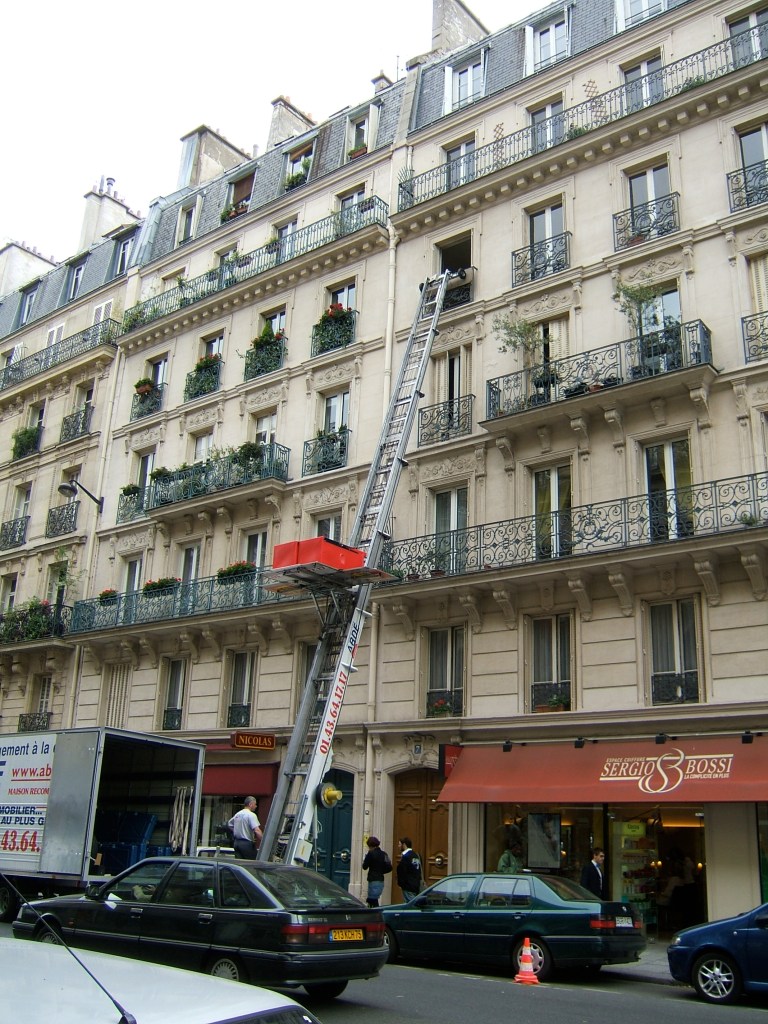
Across Bouvevard Haussmann past Proust’s cork-lined apartment.
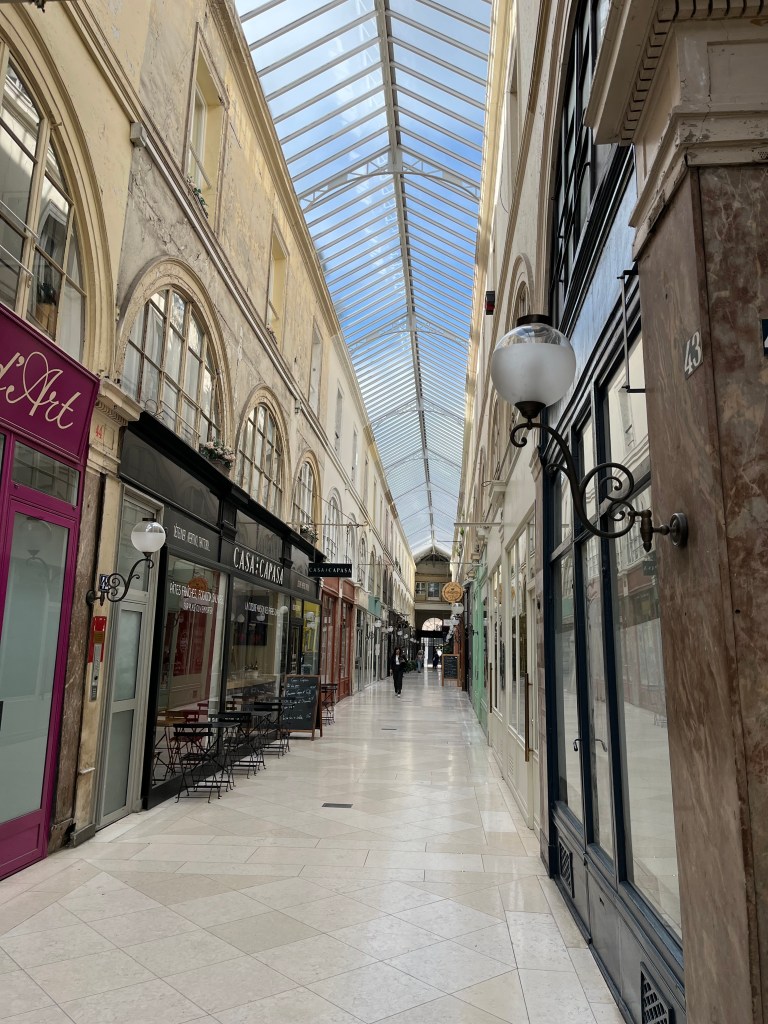
Through the Passage des Panoramas, one of the iron-and-glass arcades that so fascinated Aragon, and later Walter Benjamin, starting him on his ‘Arcades Project’.
I shouldn’t cycle, but can’t resist a Bande à Part moment as the astonished shopkeepers preparing their displays shout after me as I skid across the washed tiles.
Into the heart of the State, past the Stock Exchange and National Library. But, too, where Isidore Ducasse, having written his incendiary Maldoror – unread before being rediscovered by Aragon (a battered copy of the Belgian edition, found in Saint-Ouen flea market? Why not?) – died in a cheap hotel, starved to death in the 1870 siege.
Past the Palais Royal, where Nerval in his youth walked his pet lobster.
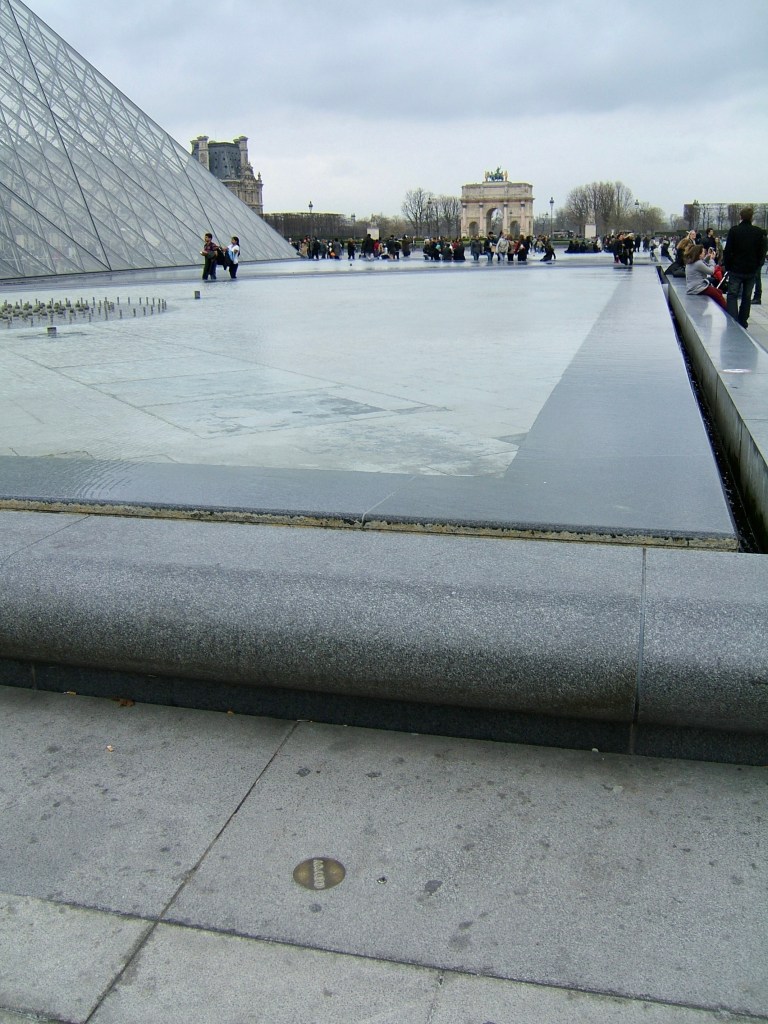
Through the Louvre – more shouts as I scatter earnest Americans following Dan Brown’s Rose Line, past several Meridian markers – and out to where, staring up at his star, Nerval hanged himself. And I’m at the Seine.
After the hectic rush and the closed-in buildings it all opens out, and I can relax and allow the vast expanse of sky to materialise in front of me, the broad, bright, softly-flowing river, the dreamy world of the quais at the water’s edge to appear, and I can take it into myself.
I stop, to allow myself to catch up. I’ve been like Limpy in Songlines, trying to sing the song of walking the landscape while travelling in a jeep. I’ve passed so many people, places, memories. In thirty-six minutes.
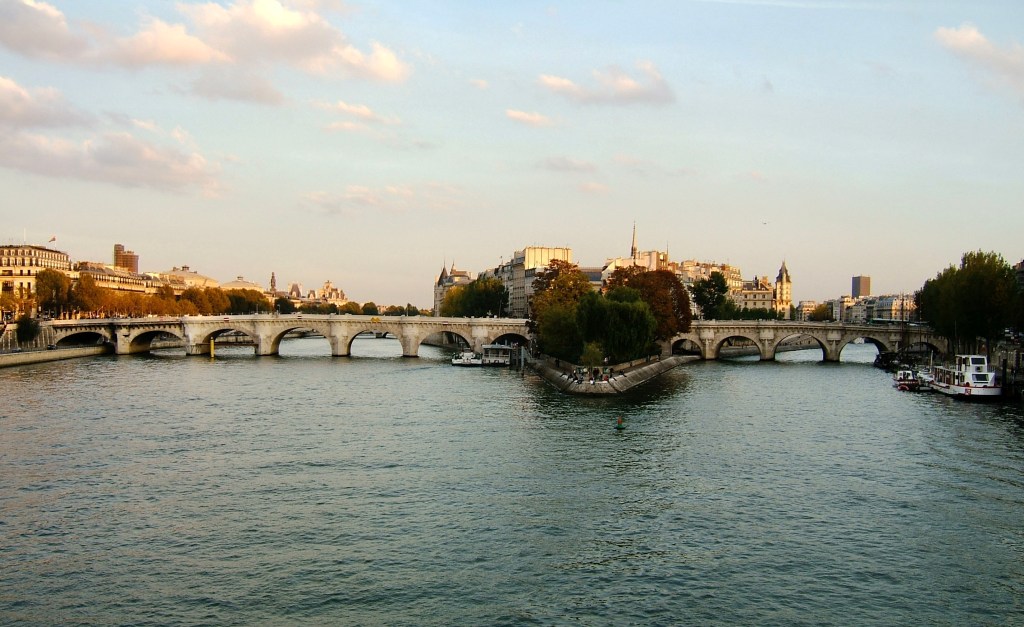
Upstream, the river glitters around the Île, Notre Dame, the Pont Neuf. It is the view that haunted Lantier in Zola’s The Masterpiece, the view so many, hand in hand, have fallen in love to, perfect Paris. Christo once wrapped the Pont Neuf in gold. Imagine.
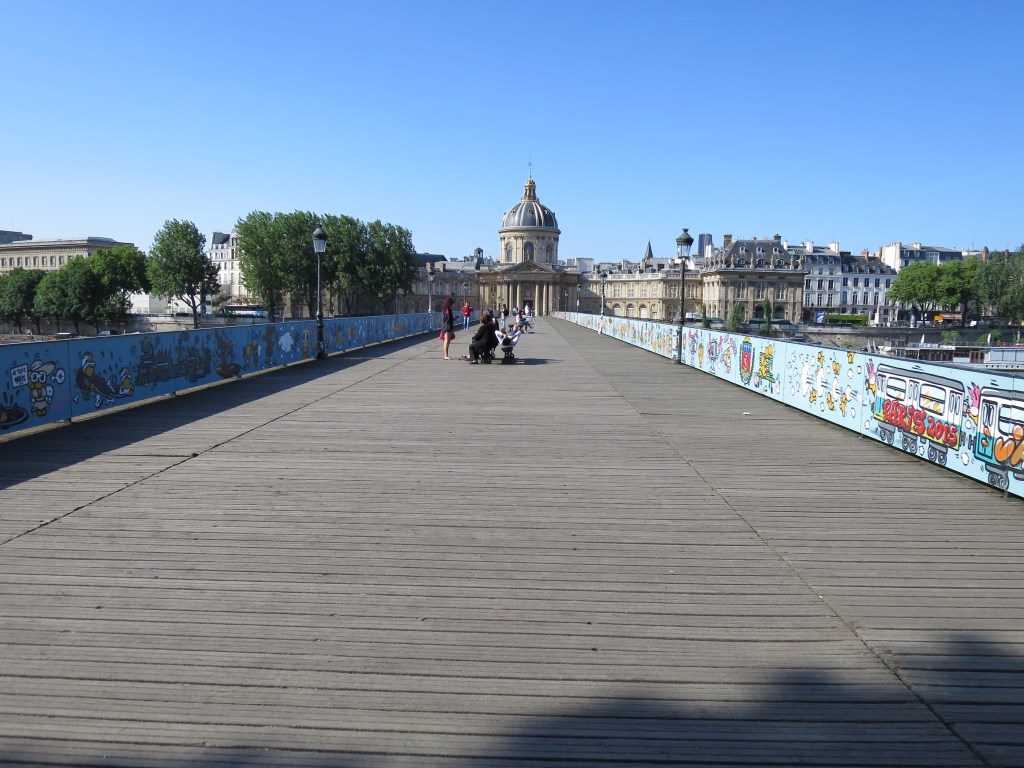
I push my bike across the Pont des Arts. It is eerily empty. It is a pedestrian bridge, wooden-decked, and until recently had wire mesh at the sides, the river glittering through the mesh, the mesh heavy and shining with lovers’ locks. Now they’re gone, replaced by solid panels painted with a wire mesh pattern, and ‘love is the key!’ in English.
I have never understood the association of love and locks, but, with their spontaneous felt-tipped initials and hearts, their memories of moments, they humanised, democratised and brightened up the bridge. So, they’ve been removed, and the view of the softly moving water has been sealed off.
Over the river.
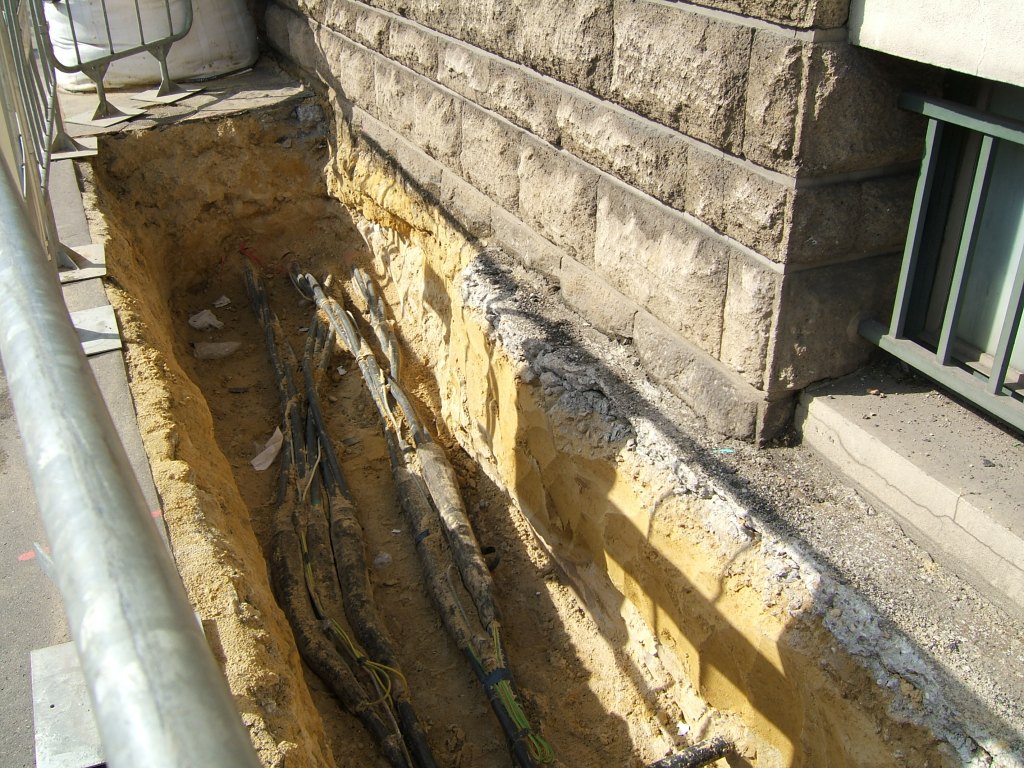
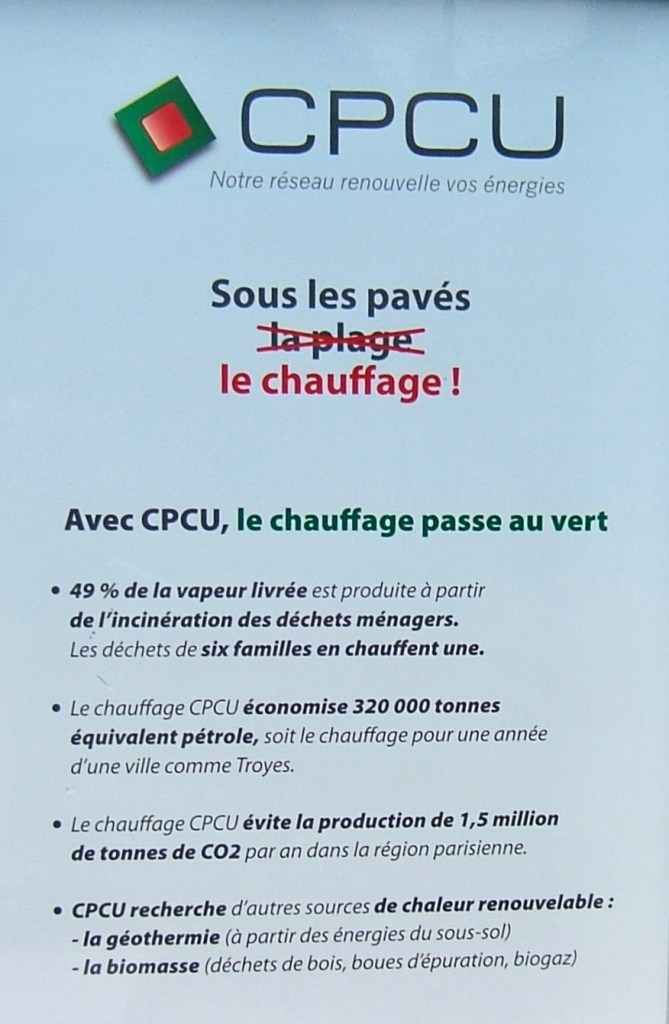
Past a hole dug for cable repairs – sand! “Sous les pavés la plage“! Except next to it, this sign, advertising district heating, an appropriation of idealism by technology.
North of the river the streets zigzag across the Meridian. South, the Left Bank, they follow the line more directly.
Past the street of Christo’s first ‘intervention’ (he blocked it with barrels).
And the site of Debord’s famous graffito. In 1954 Guy Debord, founding situationist, wrote on a wall in the rue du Seine, ‘Ne travaillez jamais!’. ‘Never work’. This was photographed and sold as a postcard by a commercial printer. In 1963 Debord reprinted the postcard in his magazine. The seller of the postcard demanded a reproduction fee from Debord, for reprinting the image of his own graffito. Who owns what? Copyright such a slippery slope into individualism. But how the shopkeepers must wish they had not cleaned it off, preserved it rather, under Perspex, a tourist site!
Through the once-Bohemian Left Bank, now smart galleries rather than radical bookshops.
Into St-Germain, past Café Flore and Deux Magots. The cobbles, used in 1968 to build barricades, beneath which is the dreamed-of beach, are now sealed under two inches of tarmac.
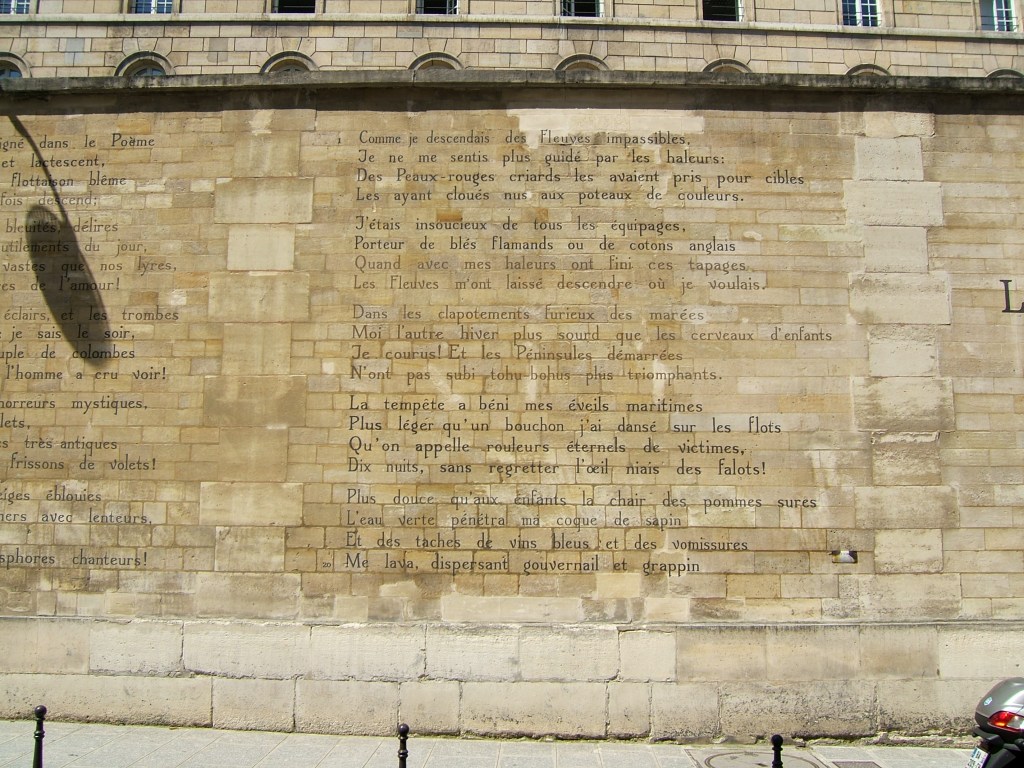
Past the bar where the seventeen-year-old Arthur Rimbaud electrified literary Paris with his reading of Le Bateau ivre. And past the wall on which the text of the poem, vastly enlarged, has now mysteriously appeared, “Comme je descendais des Fleuves impassables, Je ne me sentis plus guidé par les haleurs …“no longer guided …
Past the church of Saint-Sulpice, key to The Da Vinci Code, and past the café where Perec wrote his “attempt at exhausting a place in Paris.”
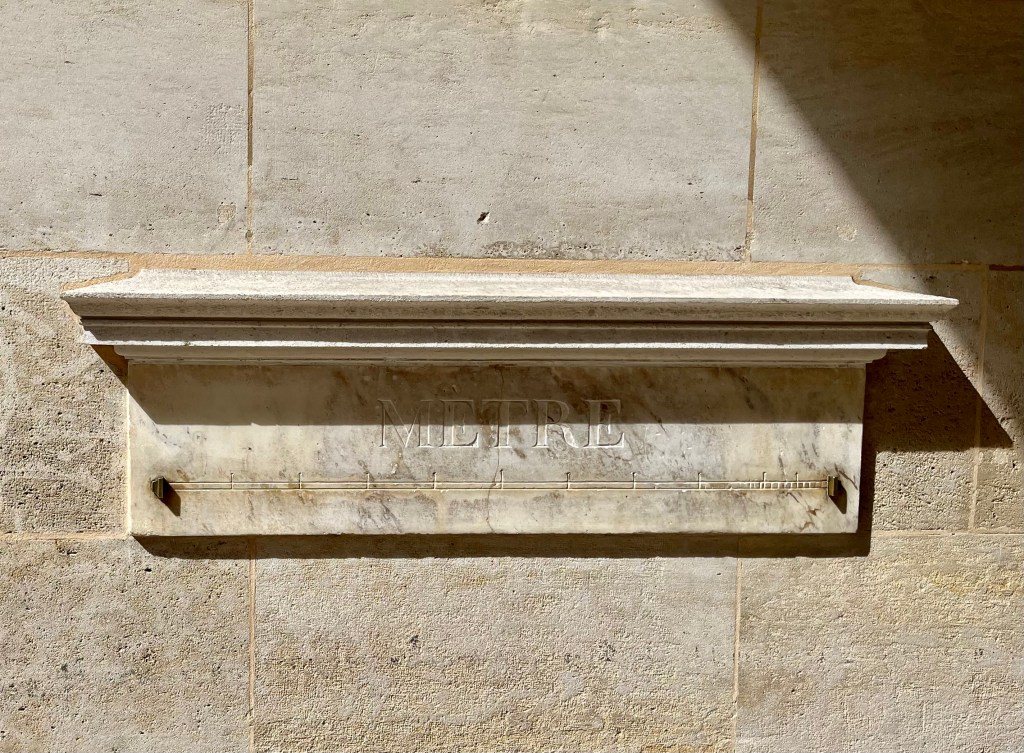
On rue de Vaugirard is the last Metre Étalon in its original location. After the metre was adopted in 1796 as the standard measure, these were installed around the city to familiarise the citizens with the new measure, and as a standard against which measures could be checked.Through the Luxembourg Gardens – ‘no cycling!’ – past a circle of three empty chairs, the air still vibrating from the just-ended conversation.
On past the Observatory, the point of origin of the Meridian.
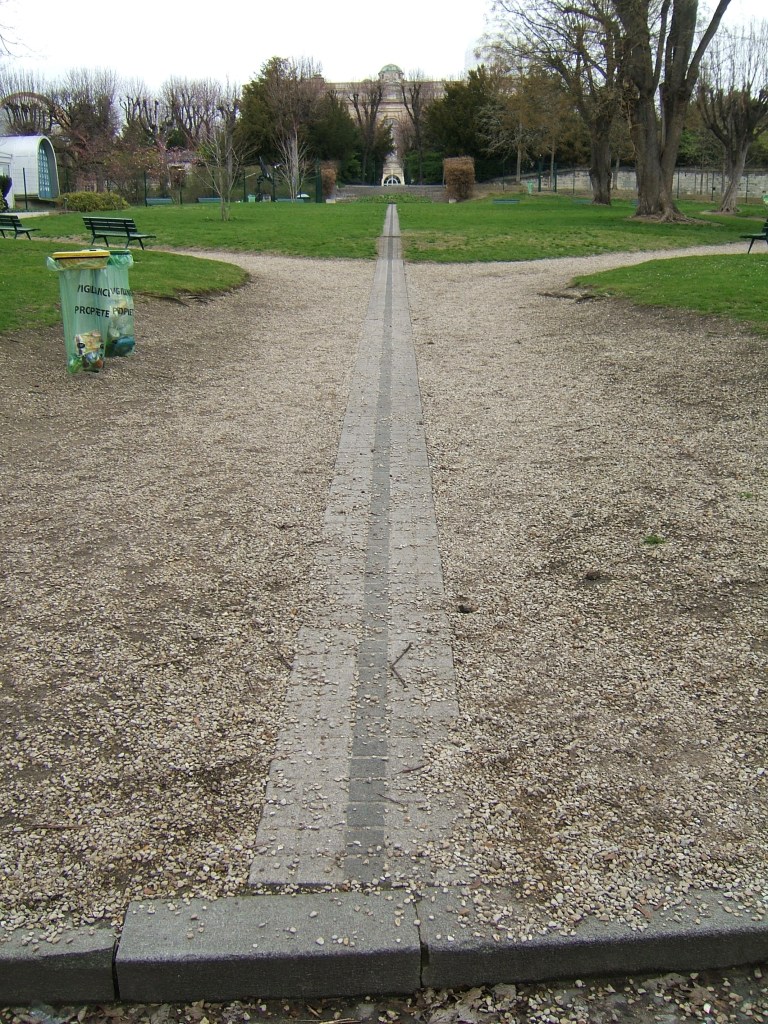
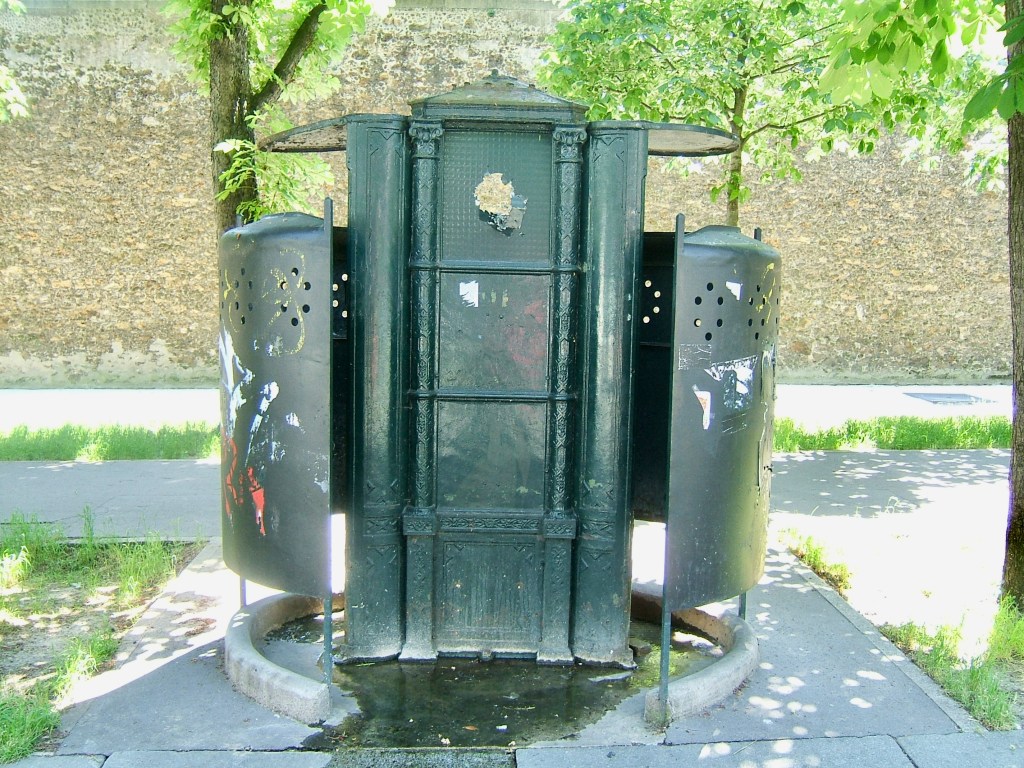
Here is the brass strip embedded in the pavement, north-south, and there the plinth on which stood a statue of Arago, surveyor of the Meridian, and director of the Observatory, until melted down by the Germans in 1940. Past the last vespasienne (pissoir) in Paris, very smelly.
Over the Catacombs, the underground quarries from which the stone that built Paris was dug, now full of bones. Through the Montparnasse of Picasso and Modigliani, another heart of art, long lost in modern developments. Past Beckett’s flat –
To the Villa Seurat. Where Henry Miller wrote Tropic of Cancer – I pause, touch the door. A well-dressed young man comes out, I say ‘do you not realise …?’, but of course he does not. On.
Now I’m exactly on the Meridian. On one side was Soutine’s studio, the neighbours complaining of the smell from the rotting carcasses he painted. On the other the vast mental hospital of Sainte Anne, where Breton’s tragic Nadja was detained. Up to the Parc Montsouris where the Dreyfus conspirators met, to the 1806 obelisk that marks the Meridian.
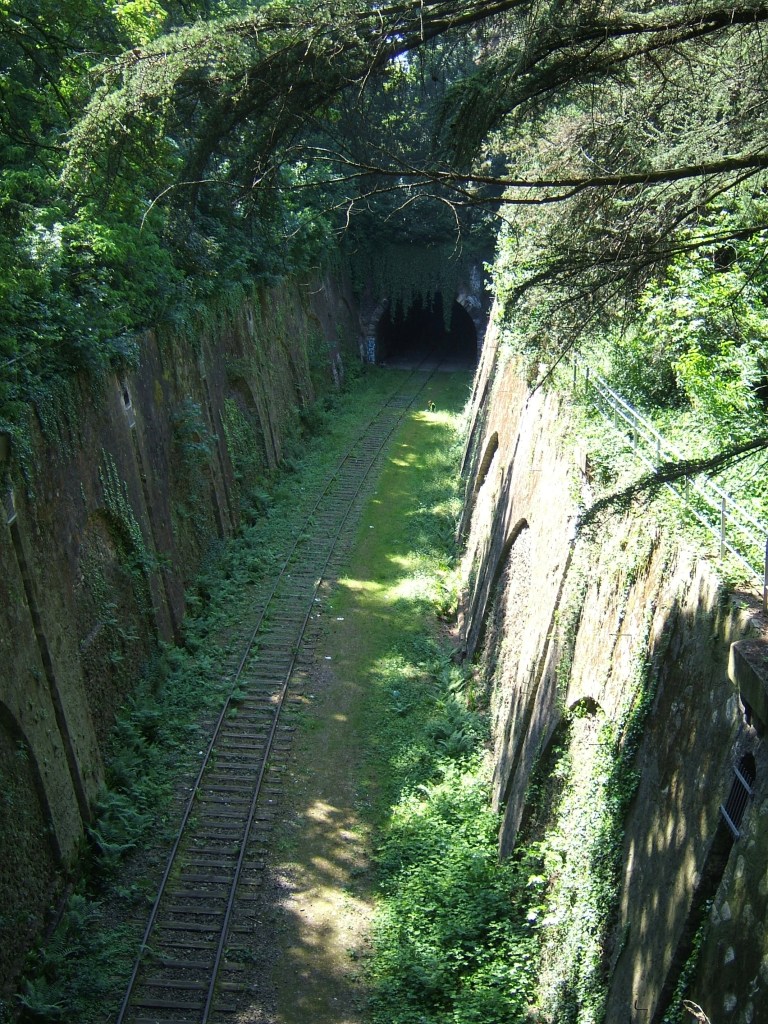
Look down into the tunnel of the ceinture railway that circled Paris inside the old wall.
A last look back across the panorama of Paris, down to the Seine, up to Montmartre, wide, bright and open. I have crossed Paris in an hour. And each place I passed I might have marked with another name, a different event. I cross the Périphérique, and I’m in the ‘red ring’ of old Communist suburbs.
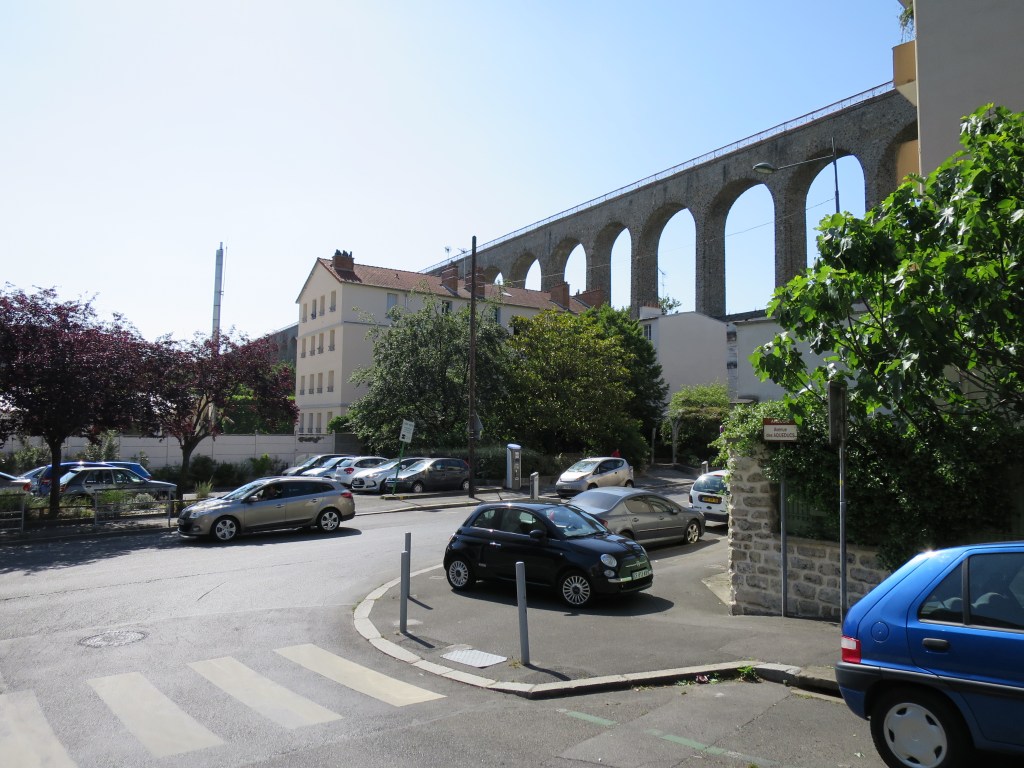
Arcueil was one of the red suburbs, left-wing strongholds. Familiar from the immensely tall aqueduct, with its slender pillars and round arches (reminds me of de Chirico), bringing water to Paris. I’m looking for Erik Satie’s apartment.
I pass a block that looks familiar from photographs, but there’s no plaque, so I press on. Eventually, after less-than clear instructions from a librarian, in a ‘mediathèque’, (no sign of books), I arrive back at it: it is the block, recently done up, with new windows and security doors, and repainted.
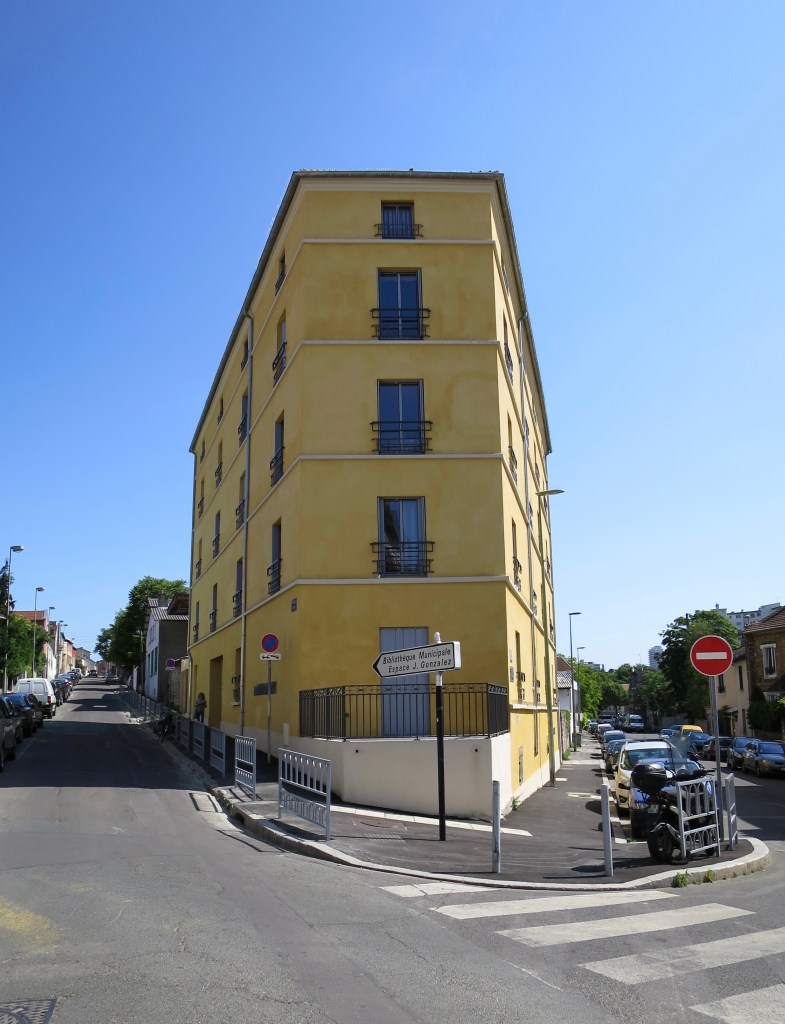
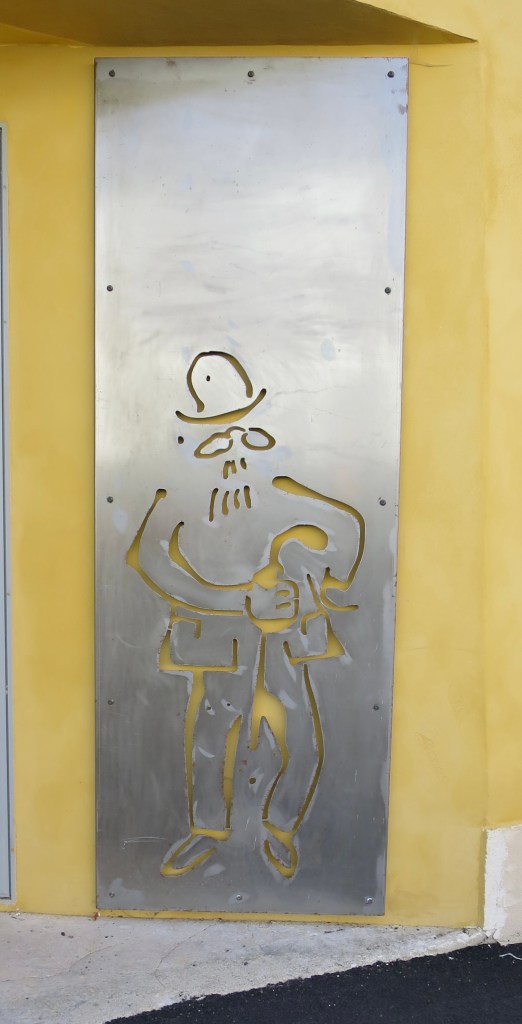
The simple plaque has been replaced with a stainless-steel cut-out of Satie as a Chaplinesque tramp, and this, by his friend Cocteau, ‘Satie est un ange (bien déguisé), un ange d’Arcueil se cachant’. (‘Satie is an angel, well-disguised, an angel of Arcueil in hiding.’ Or, ‘hiding in Arcueil’.)
His apartment was a squalid chaos. As he lay dying in 1925, lacing his medicine with opium and champagne, he reproached his opinionated friends, “why attack God? He may be as unhappy as we are.”
The apartment will now be tastefully chic, perhaps with artful references to the two grand pianos, one on top of the other, the seven identical grey suits, the collection of umbrellas.
In fact, Satie moved here not because of a broken heart, but because it was cheaper, and away from the temptations of Montmartre. How easily I used to fall for romanticised bourgeois tales of poets and artists ‘maudits’! In Arcueil Satie was a respected citizen, who walked each day to Montmartre to play the piano in night clubs, and meet his avant-garde friends, stopping on the way (at rather too many bars) to telephone them to make appointments. He was championed successively by Debussy, Ravel and Cocteau, worked with Picasso, was one of the original ‘Les Six’ …
I cycle around, up and down, looking for the cemetery where he is buried. At last I see a funeral parlour. They’ll know. Hot and sweaty, I burst in.
One of those moments. Inside, a hushed solemnity. The dark scents of funeral flowers and coffin wood, gentle music. A woman behind the desk, professionally compassionate. A small man, with a sad face and drooping moustache, cap literally in hand, sits in front of her, making himself small. Bewildered, his wife of fifty years gone, poor, and faced with pressure to make this a good funeral – does he not owe it to her? It will be the only time he travels in so big a car. But, the prices … I burst in. He looks shocked. She looks pained. ‘Pardon,’ I stutter, ‘Desolé,’ I stammer ‘… la cimetière?’ Coolly she looks at me. Coolly she looks past me, with the faintest of head movements. Across the road, twenty yards away, where his wife of fifty years will be buried in two days’ time – he looks and droops a little more – is the cemetery. I back out, apologising, cursing myself.
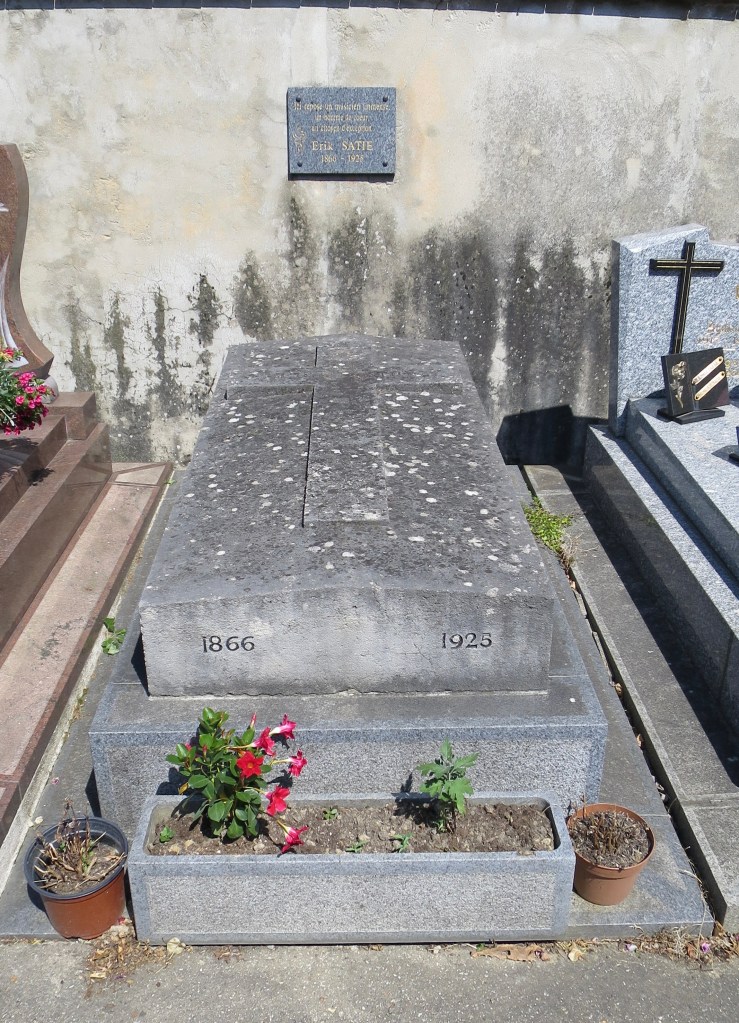
It is a simple grave, very similar to Suzanne’s. But his is in a small cemetery, and set against a wall, warmed by the sun. On the plaque, “Ici repose un musicien immense, un homme de coeur, un citoyen d’exception“. There was to be a monument, but they couldn’t raise the money. I place the flower I brought from Suzanne’s grave. The least she owes him. Then I water the other flowers.
What is it, this searching out of dead heroes? Why fifty years ago did I so want to look up at the window of the apartment in Montmartre where Vincent van Gogh lived with his brother? Why have I followed him from Zundert to The Hague, London, Ramsgate, the Borinage, Drenthe, Brussels, Arles, Auvers …?
So, cultural tourism. When I first went to Saint-Rémy, fifty years ago, there was no sign of Van Gogh. He was simply a former patient of the nuns who still ran the hospital there. Did one of the older nuns, in her eighties, maybe even remember him? Nobody asked, in those days. Now his room has been recreated as it was then, there is a gallery and shop. Around Saint-Rémy, reproductions of his paintings have been set up at the places he painted. In Arles, the hospital has been repainted in the colours his picture portrayed it, not as it actually was when he painted it. The bridge he painted, long knocked down, has been replaced with a similar one brought from elsewhere. It won’t be long before the Yellow House – destroyed in the War – is recreated, again as he painted it, not as it was. This is cultural tourism as theme park.
But there is, I believe, a deeper level of cultural tourism. Which has the elements of pilgrimage. There is the journey, which costs, in money and time, and often discomfort. There is the object, whether cathedral or house or painting. There is the preparation of the self, with knowledge, anticipation, and focussing. And there is the sense, presumption even, that the self will be changed by experiencing, in a heightened state, the revered object, the special place. I participate fully in this sort of cultural tourism. Crudely, art as religion, art objects as relics, art galleries as churches, art the locale of whatever spirituality we’ve left ourselves with.
But why our interest in where heroes were? H V Morton, the interwar travel writer, titled his books In Search of. Richard Holmes writes of travelling “in the footsteps of” his biographical subjects. This in order to make a connection with the subject, so one can exist in parallel to him (her), with the subject as imagined presence, as the biographer unfolds their life. For me, it’s about being in the presence of the hero. Across this threshold Satie stepped each morning, turned – left? right? – and walked along the Meridian, through a gate in the city wall, Montparnasse, across the Place d’Enfer, over the Seine, up to Montmartre, composing to the rhythm of his footsteps, the tapping of his umbrella.
And what may become clearer to me, on this journey that is fixed in its central, linear purpose, but where the choices of what to be interested in around that line are so great, is noting who and what registers, interests, engages me, and how much. I imagine finding the ‘me of me’ in a three-dimensional Venn diagram, with ‘location of interest’ on the plane, and ‘degree of interest’ in the height.
Edward Thomas wrote: “Stay, traveller, says the dark tower on the hill, and tread softly because your way is over men’s dreams; but not too long; and now descend to the west as fast as feet can carry you, and follow your own dream, and that also shall in course of time lie under men’s feet; for there is no going so sweet as upon the old dreams of men.” I descend to the south as fast as pedalling feet can carry me.
Towards Vigneux-sur-Seine, and Gabrielle’s flat. The traffic is heavy, cross-currents of shopping, visiting and heading for motorways to escape the city.
I get to the Seine, wide and green, and make my way upstream, to Vigneux.
At the end of my novel Diggers and Dreamers, set in 1976, Kris is leaving La Balme, the smallholding in the Aveyron where he has been working for two years towards self-sufficient sustainability. He faces a choice. He can go back to England, to his wife who left La Balme and will never return, and resume there the life that living in France had interrupted. Or he can go to Paris, to the French schoolteacher who believes in La Balme and has renewed his vision of the possible life there. Where he can teach in winter, and work for the rest of the year at La Balme. She will come for the holidays. Together they will make it work.
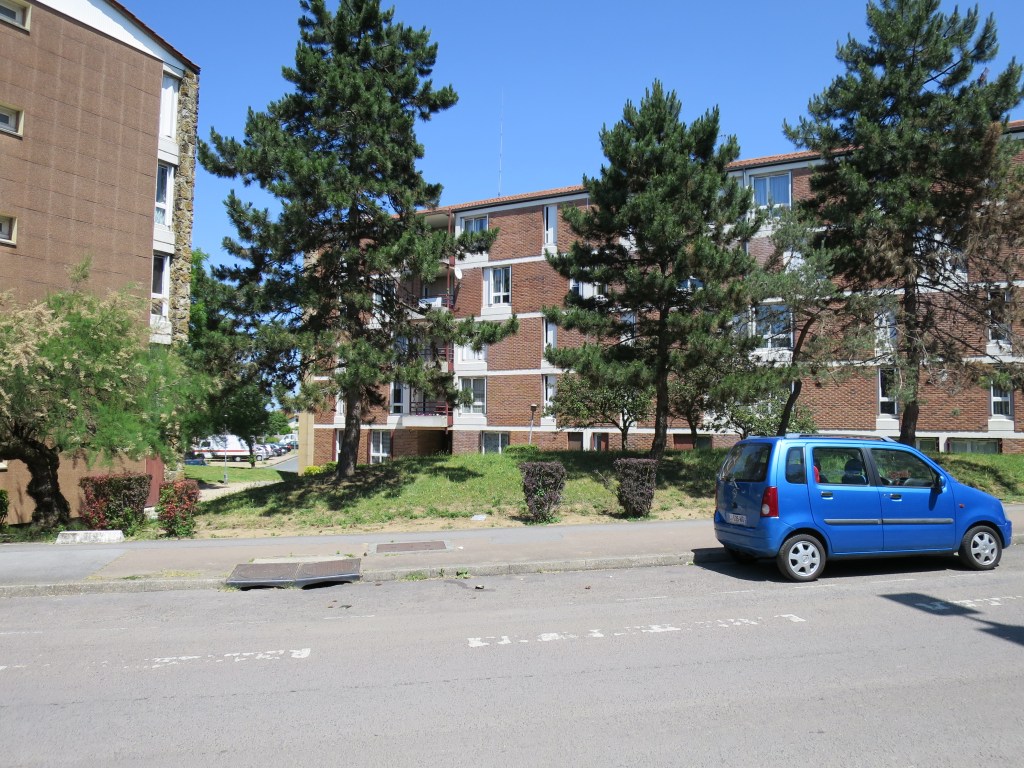
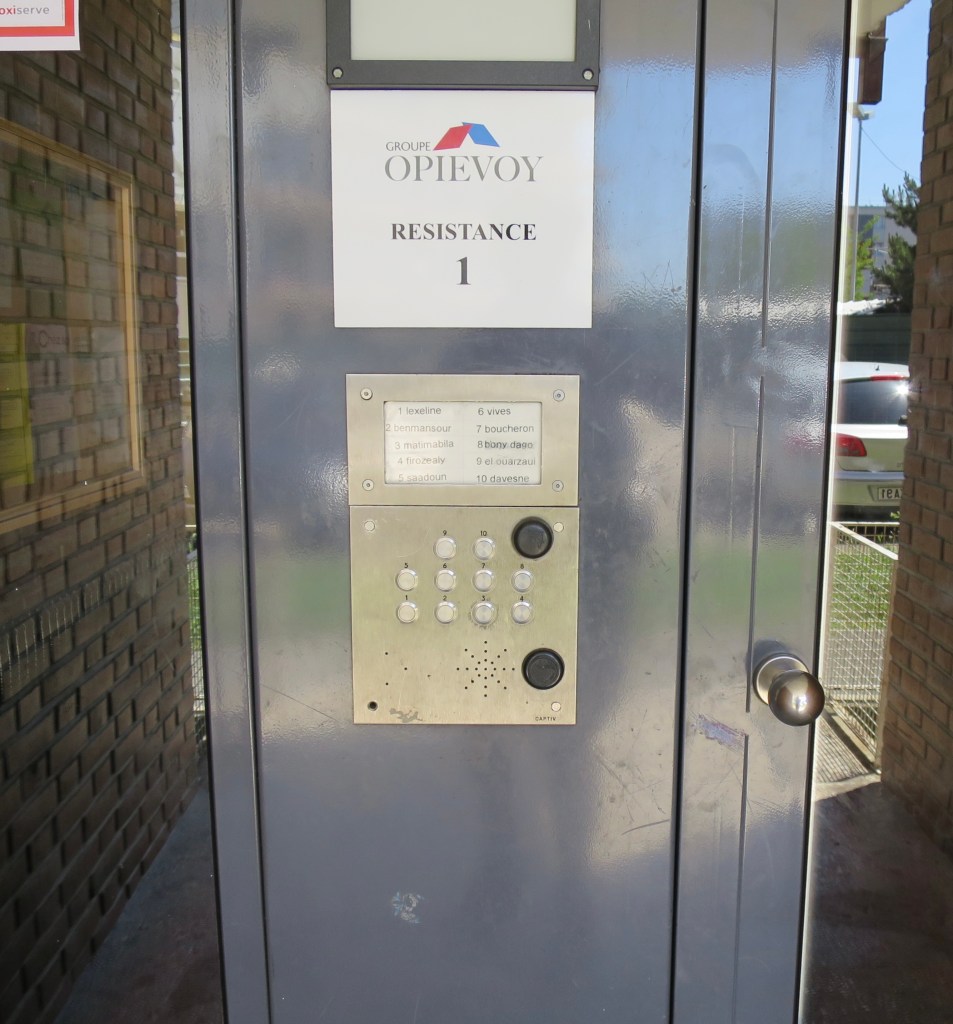
A choice I made. Gabrielle’s flat is still here. All the blocks around have been demolished and rebuilt. Only hers is still here. The same door. The same bell-push. Is she still here? Of course not. And even if …? My finger hovers. There is an electric charge between finger and bell-push. Of course not. My hand drops. The bell not rung, the door not passed through, the road not taken. For I had returned to England.
Why am I here? A few months ago, I thought I was about to begin a new phase of my life. But it hadn’t happened. My life settled back. Now I accept that, rather than discovering what might be, my life is making sense of what has been. I have taken my place.
And having decided to follow the Meridian down France, and having found that both Vigneux and La Balme are close to the Meridian, I realised that they are chakras of the spine of France, and that one of the ‘desire paths’ along the Meridian, the ‘serpents of eternity’ around the axis mundi, passes through them. I will follow my own dream, and make of it and them what I can. My finger hovers. There is an electric charge between my finger and bell-push. Of course not. My hand drops. I turn away and cycle on.
It is a complicated journey through the outer suburbs, including a cycle path alongside the N7, called ‘the Holiday Road’, ‘the Road of Death’, before the motorways were built, when I first cycled in France, cycled it down the Rhone valley.
To Decathlon, a sporting goods retail shed, where I buy a tent and a sleeping mat. I will be camping for most of the next fortnight.
In Fleury-Mérogis I pass a wedding party outside a church, all black, men in black suits, women and children in brilliant colours, an easy, festive air, and arrive at my second Première Classe hotel. The same stacked containers, this one has three storeys, the same heavy security doors, metal window shutters and prison-like skeleton of stairs and walkways. The biggest prison in Europe is in Fleury. Many visitors must stay here. And inside the room, the finish that resists imprint.
One has to bring a lot of resource into a room like this, this room, because there is nothing here. I hadn’t notice in the Première Classe at Dunkirk, because I was full of myself and the coming trip and I’d arrived on a following wind. Now, after a tough week, of too much wind, too much heat, bike problems, the first week of four, on a journey I’ve hardly begun, and with little sign of the Meridian, I’m not sure I have that resource.
First, where to eat? The hotel is on a wide access road to the motorway, lined with council blocks. The small shopping centre is closed. There is a fast-food takeaway, Quick. But every time I go there, even at 10pm, it is too busy for me to cope with. Cars are coming off the motorway, fuelling-up with fast food, rushing back on.
Is there more to Fleury than this cut-price version of architectural Modernism, Corbusier parodied (or his ideal achieved?) – the wide boulevard, the tall, slab blocks set in green, the specialised zones? I haven’t the energy to look.
I spend a long evening in my sensory-deprivation cell, with no food. Low blood sugar brings a mild depression.
It is the end of the first week. It is unnerving to look at the map of France and see how far north I still am. Am I waiting for something to happen? I had expected la Méridienne verte to happen, that it would have substance, a suggestive dynamic that I could relate to, gain energy from, by interacting with. But it’s not there. I’m following something that doesn’t exist. It existed once, as an idea, an event. And it might have come into being by now. It was intended to have come into being by now. As a line of trees, a spine, a hiking route, a stitching-together of the length of the midline of France. That it isn’t there is as significant. I had expected this journey to be an experiencing and recounting of the various ways the Meridian is being celebrated, with each place expressing both its own individuality, and its place in the larger frame of la belle France. As each pays has its food, its language, its culture, so it would have its own way of celebrating. As a metaphor for France.
But maybe I’ve got this wrong. The original surveying of the Meridian was a grand endeavour, a dangerous exploration in which men lost their lives, by which France was revealed to be a terra incognita, new places were discovered, science at last got the measure of France. (Louis XV complained, when the first survey revealed that France was smaller than thought, that Cassini had lost him more territory than any king had lost in war.)
It was the beginning of the modern state.
The scale of the endeavour was so great that it was celebrated with obelisks along the line. It was heroic, a source of national pride.
Perhaps, in contrast, la Méridienne verte is just an idea, something dreamed up by an architect, a PR stunt seized upon by a government desperate to find a way of celebrating and commemorating the Millennium; but that, because it is an artistic and bureaucratic invention, without substance, it has no resonance for the French, for la vraie France?
Or, more worrying, that in the contemporary atomised world, in which businesses are more powerful than states, and Facebook ‘friends’ more real than neighbours, in which Guy Debord’s Spectacle, the commodification of culture and the recuperation of dissent, is ever more apparent, there is no place for nationality, locality, anything beyond the isolated consumer? Maybe the Green Meridian is a metaphor for France today … My journey has become the story.
A worried face appears at my window. Mine is the only window with the shutter raised, where the resident is visible. He has locked himself out of his room, his key card is inside. Can I help? I try my card, which of course doesn’t work. We go down to reception, which closed an hour ago, and find an emergency number to call. He calls the number, and they tell him that help will arrive within five minutes. How can that be? I imagine someone driving from a central depot covering all the hotels in a region. But in a couple of minutes a faded woman emerges from the back of the hotel, climbs the stairs with him, opens his door, walks heavily down and disappears into the back. It’s not the receptionist, and I never see her again.
I drink tea, dream of food, and go to bed.
Notes:
In 1954 Guy Debord wrote on a wall in the rue du Seine, ‘Ne travaillez jamais!’. ‘Never work’. This was photographed and sold as a postcard by a commercial printer. In 1963 Debord reprinted the postcard in his magazine. The seller of the postcard demanded a reproduction fee from Debord, for reprinting the image of his own graffito. Who owns what? Copyright such a slippery slope into individualism.
‘Sous les pavés, la plage’ was a 1968 graffito. Another was ‘Soyez réalistes, demandez l’impossible’.

