Vincent arrives in Paris in March 1886, ten years to the month after he had left in ignominy – on his birthday, oh these anniversaries! – having been sacked by Goupil’s. His younger brother, Theo, is now manager of a Goupil’s Paris gallery. And he comes as an artist.
He arrives from Antwerp without telling Theo he is coming, asks him to meet him in the Salon Carré of the Louvre. This is where several masterpieces hang. And where today one or two of his would hang, if the Louvre displayed work painted after 1840. Theo had told him not to come, knowing the chaos that he would create. Vincent knew after the progress he had made in Nuenen that Paris, the centre of the art world, was where he needed to be.
Theo is living in an apartment in rue Chaptal (now Laval), the same street in which their uncle Cent van Gogh lived, in a grand mansion, when he was part owner of Goupil’s, and where Vincent was sacked.
[Back story: from age 16 to 23 Vincent was employed by Goupil’s, in the Hague, London and Paris, with the hope that he would take over from uncle Cent, who was childless. Unknown events in London – which I speculate upon in ‘When Vincent met Rimbaud’, on this website – precipitated disaffection, and dismissal. There followed five years of religious enthusiasm, bordering on mania, before at 28 he decided to be an artist.]
Theo’s flat is on the Paris side of bvd de Clichy, the boundary between Paris and Montmartre, a short walk to his gallery on one of Paris’ Grands Boulevards. Vincent persuades Theo to move to an apartment up the hill, in the heart of Montmartre.
Although Montmartre had been part of Paris since 1860, it had retained its bohemian edge, as a place of entertainment and centre of creativity.
Their new apartment is at 54 rue Lepic, a curving road up to the very top of Montmartre, which Napoleon had paved to provide good access to the semaphore signal station at the top, by the moulin de la Galette, by 1886 no longer a working mill, but a popular café and dance venue. In a dozen years Louis Renault will successfully test-drive his car up it, and found his car company. The history of Paris oozes out of the pavés! My next project on this website will recount my walk across the city, along the Paris meridian.
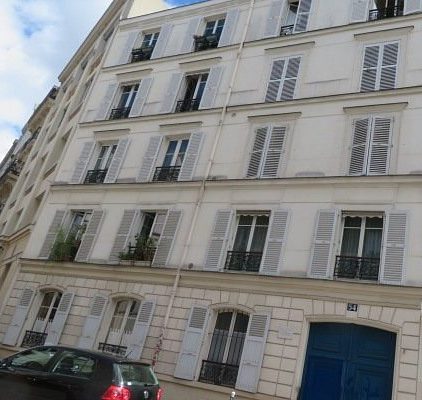
I remember looking up at the fourth-floor apartment. It was the first time I had so precisely connected a place and a person I was studying, gazing up like a lovelorn teen at a desired one’s room. Vincent looked out of that window. From the window in his back bedroom he painted the view of Paris several times. In the small studio he painted dozens of pictures I knew well. Each day Theo returned after a day’s work to the chaos that Vincent would have created.
From here I could, and did, follow Vincent. Down to the bvd de Clichy, where he attended Cormon’s academy, taking painting and drawing lessons, and at the Café Tambourin met Agostina Segatori, who modelled for him and with whom he had another of his chaotic liaisons, and where he showed his pictures. To the ave de Clichy, where he curated a group exhibition. To the studios of painters, Toulouse-Lautrec (very fine – he was a wealthy aristocrat), John Russell and Suzanne Valadon (now the Montmartre museum). The paths he followed to the places he painted – up the hill, beyond the new houses, which I climb to imagine the wild area and quarries that then surrounded the remaining windmills, beyond, down to the abandoned ramparts around the city (now the Boulevard Périphèrique). And on to Asnières on the Seine.
Vincent arrived in Paris with a backward-looking body of work. He left two years later prepared for and facing the future. Three things had happened.
1) For the first time he met contemporary painters. Although at first both amused and alarmed at his eccentric ways and manner of painting, by the time he left he was accepted among them as beginning to be a serious artist. And the artists he met would make up the new avant-garde, the next wave of the Impressionist revolution.
He met Toulouse-Lautrec, Anquetin and Bernard at Cormon’s academy. Signac, who would become Seurat’s most important follower, while sketching as Asnières. He met Gauguin through Bernard, at Père Tanguy’s paint shop, where he also met Pissarro, and saw Cézanne’s paintings. And Suzanne Valadon, model, painter, and the queen of Montmartre, at a Toulouse-Lautrec soirée.
He organised a large exhibition (100 pictures) of the new artists, those he jokingly called Artists of the Petits Boulevards, as against the Grands-Boulevardiers, Manet, Monet, Renoir, Degas, now selling well. It was less than successful, and ended with Vincent quarrelling with the patron of the café where it was held and taking the paintings home in a wheelbarrow. But it was the first time they had been shown, and Bernard sold his first painting.
Toulouse-Lautrec and Pissarro drew him, Signac visited him in Arles, he had a long correspondence with Bernard, and Gauguin lived with him in Arles.
Vincent was first noticed as an eccentric. In his time in Paris, he began to gain acceptance as a painter. While he was in Arles, his paintings were included in their Paris exhibitions.
It helped that his brother had charge of the entresol at Goupil’s, where lesser-known artists were exhibited. Although Theo said later that it was Vincent who connected him to them, rather than vice versa.
2) He engaged with japonaiserie. Japan was everywhere in Paris of the time. Vincent collected the brightly-coloured prints of Japanese life as avidly as he had the black and white social realist prints from The Graphic. He copied Japanese prints – copying was his way of learning – and used the prints as backgrounds in several pictures. It liberated him to experiment with large areas of unmixed colour (called cloisonnism by Bernard), which he did in his Monticelli-influenced flower studies. Their awkward (to Western eyes) perspectives intrigued him – especially as he always struggled with perspective, often using a home-made ‘perspective frame’. And it led him to engage with Impressionist paintings.
3) He came face to face with ‘Impressionism’. It had been around for a dozen years, but despite Theo’s encouragement, Vincent hadn’t seen any of their work. From Manet on, the Impressionists had been rebelling against the Salon’s prioritising of decorative values, traditional themes, and immaculate finish (and control of the art market), with their vivid impressions of life, contemporary subjects, and emphasis on the artist’s personal touch. They acknowledged a painting as both a window on the world, Zola’s ‘a corner of creation seen through a temperament’, and paint on canvas. Also the importance of painting from the motif, quickly, not finishing them in the studio, and lightening the palette.
So much of this fitted with where Vincent had arrived by the end of his time in Nuenen. But it was only in his second year in Paris that he fully engaged with Impressionism.
In the first year he concentrated on flower studies, in the colourful impasto of Monticelli (a neglected Marseilles artist), but with strong contrasts and complementaries, colours selected according to Blanc’s colour theory.
And a series of self-portraits. No longer the skull and cigarette of Antwerp but, with new teeth and better barbering and tailoring, in the image of the rising young artist. As if he needed to represent himself as a success before he could imagine being one. (Vincent always an extreme mix of head-down belief (his Aries boney forehead) and chronic self-doubt.)
When he did engage, it was, as ever, in his own terms. Whereas they painted the bars, bals and Seine boating parties of the new middle-class in their weekend liveliness, he painted them on Monday morning, empty or with an occasional figure. He was a painter of the working world. Even the tourist-spot windmills of Montmartre are painted as if they are working mills.
His main engagement with Impressionism was in facture, the application of paint to canvas.
Paint had been applied variously by the Impressionists (I use the term as Vincent used it, to include all post-Manet painters) in dabs and marks, visible but with little attention to their form, beyond their contribution to creating an overall effect. The Pointillists applied paint in disciplined dots of pure colour, mixing in the eye not on the palette. But the results were both pallid and static – even an acrobat on a circus horse had no animation. In a six-month period, Vincent copied every dab and dot used by them, in a series of derivative pictures. And arrived at the stroke – a decisive act, sometimes used to structure a picture, always to articulate and animate it, to create vivacity.
(In Cézanne’s paintings, each mark creates stillness; in Vincent’s, each creates animation. They are equally the greatest painters of their time.)
I gained a measure of the richness and complexity of Vincent’s mature paintings when, during lock-down I did a paint-by-numbers copy of ‘Starry Night’ – it used 25 colours and over 5000 colour cells, ie brush strokes.
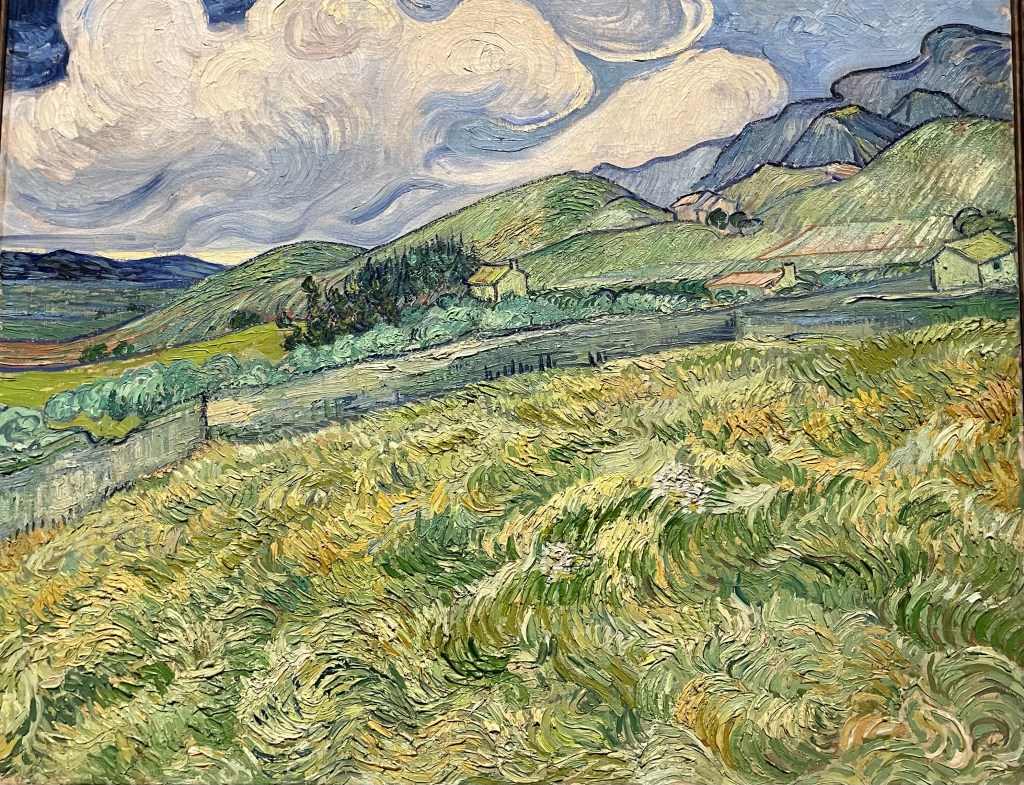
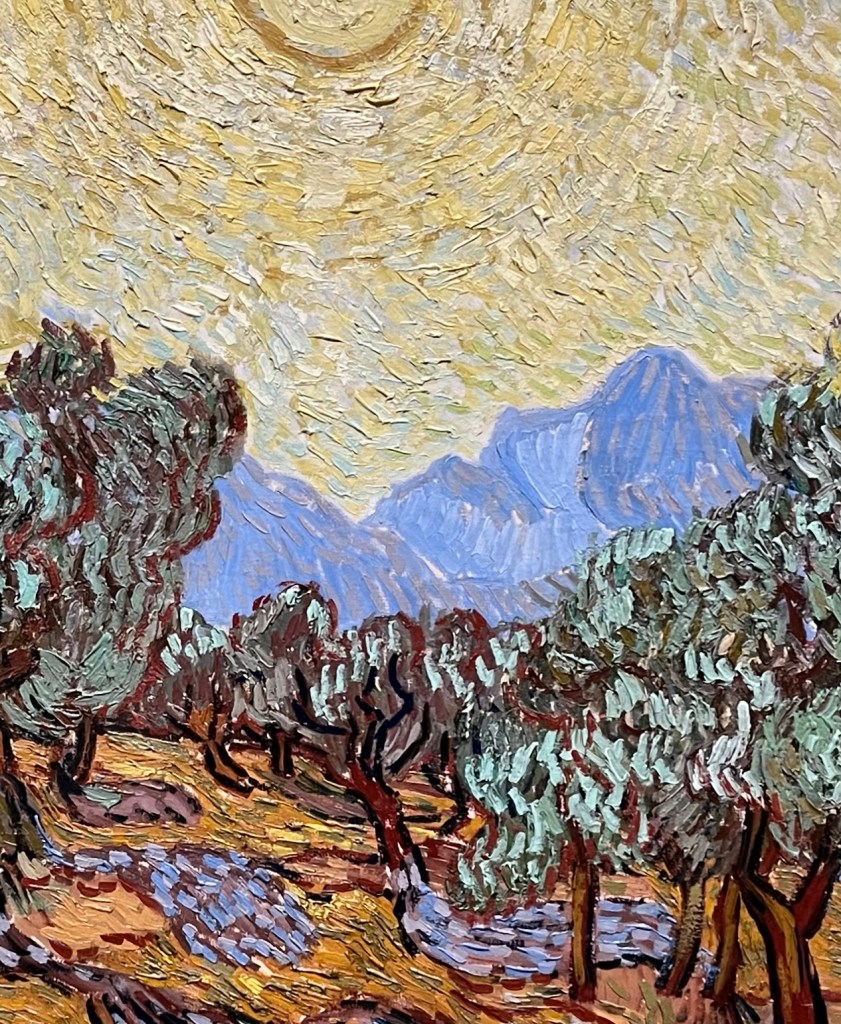
In the ‘Poets and Lovers’ exhibition at the National Gallery, I was able to see this close up. Here are some examples. (They are from Arles and Saint-Rémy, but the beginnings are there in Paris.)
Here he uses different strokes to depict the turbulent clouds, the still earth, and the wind-blown animation of the wheat.
In this, he uses complementary and contrasting colours, and paint strokes to articulate, as seen in this detail.
Here he uses the cloisonnism of dividing the picture into areas of dominant colour, then articulates within each to depict flowers, grass, bare earth.
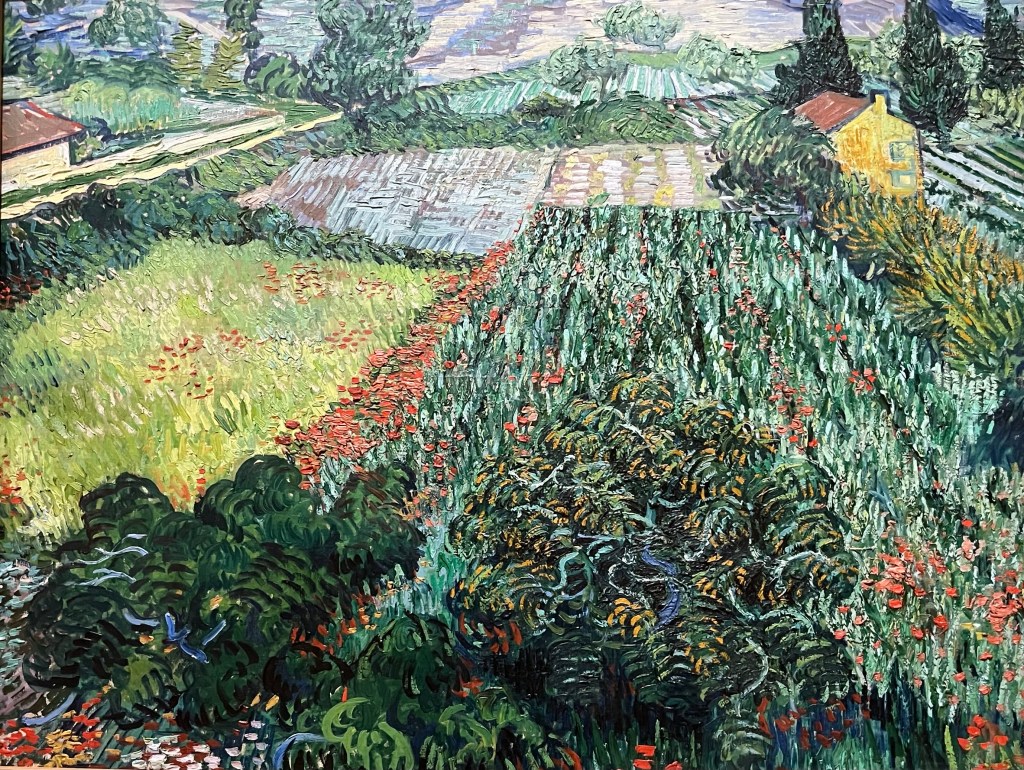
Vincent always paints what he sees. One can zoom in, to a few square inches of canvas, and still see richness, and purpose.

To return to the influence of Japan. Beyond the visual there was a fundamental quality he saw (although in fact he invented) in Japanese art – the idea of artists exchanging pictures, and working collectively, in a simpler world, almost monastic in its nature. (He even painted himself as a bonze, religious teacher.)
And the place this could happen was away from the darkness and complication of the city, in the clear air and among the bright colours of the South. He disappeared from Theo’s overnight, heading South.
 my writing
2 responses to “Vincent and I: Paris.”
Superb stuff Keith. Keep it flowing.
LikeLike
Thanks, Harry, your encouragement is greatly appreciated!
LikeLike