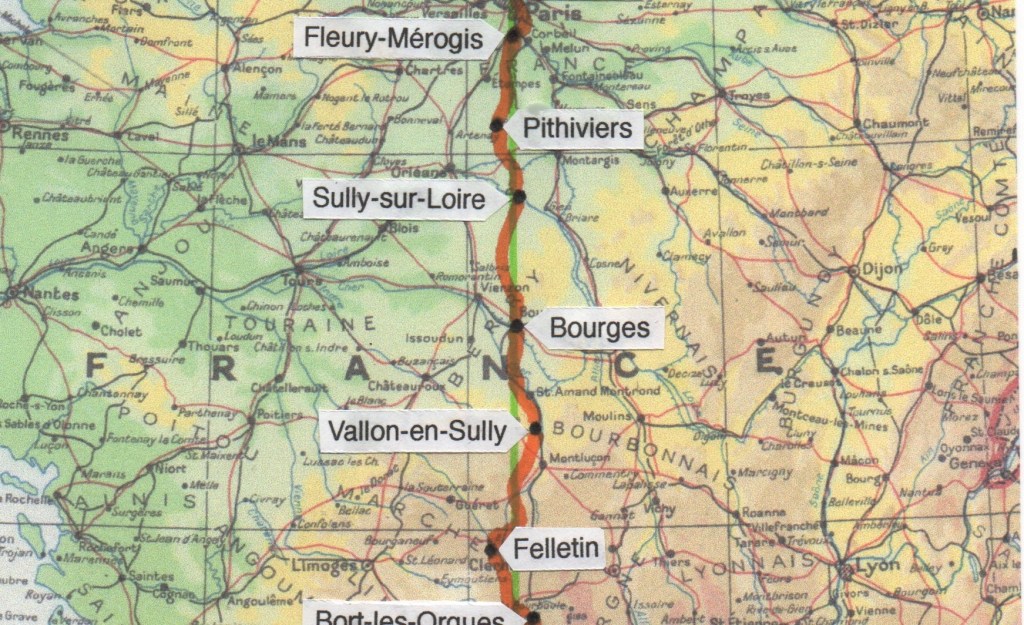
Day 9: Pithiviers to Sully-sur-Loire, 74 miles.
The deportation-camp. Irène Némirovsky. The hunting ground of the Forest of Orléans. The Count of Toulouse’ final surrender. ‘The Name of the Rose’. The end of the troubadours. Gribouille. Love’s arrows.
I fall asleep to the dream that I am in my own sweet corner of la France profonde, having slipped warmly into my sheet sleeping-bag (no down sleeping-bag – who needs a down bag in June?) in a pair of shorts as the last light fades from the sky, and roosting birds serenade me from the softly whispering trees.
I wake to the nightmare that I am lost in Siberia, frozen to the marrow, having pulled on every garment as the night has gone on, getting ever colder as an icy wind knifes through the tent wall, waiting to freeze to death.
My first night camping began with the late arrival of a family in a motorhome, which, on a large, empty campsite, the driver chose to park opposite my lone tent, backing in so his headlights blazed through the tent fabric into my face for an hour as they prepared and ate a multi-course banquet using dozens of metal pots.
Then, as darkness returned, there arose out of the silence the sounds of a cat-skinning abattoir, screechings, yowlings, blood-freezing screams that continued for most of the night.
Then the wind got up, and for the rest of the night the security lights, my tent the focus of several of them, switched blindingly on and off, triggered not by movement but by the Brownian motion of atmospheric particles. And it got colder, and colder.
The only gain from camping is the night sky. Which was spectacular when I crawled out for a pee. To be caught, as I stood up, pants down, in the cross-fire of the klieg-lights.
In the morning it takes half an hour walking up and down the lane to recover any semblance of bodily feeling, and the minimum of brain activity needed to decide what to do next. On the way I passed the cat abattoir, a rookery of birds smiling as they sleep, like drunks after a night out.

First, a cup of tea. Second, another cup of tea – no, no, pack up, go into town, find breakfast.
For some reason – I still believe I’ve entered a dream of France – I expect there to be breakfast in the town. That I will walk into the right bar, and speak in the right way, and boiled eggs, and croissants and tartine avec confiture will appear, and good coffee, the smiling moustachioed patron in his long white, if a little work-worn, apron, clucking as I tuck in, inquiring anxiously, ‘encore?’ I remember when it was routine in a bar at breakfast time to put a basket of croissants by your coffee. You’d be charged for those you ate, then it was passed to the next customer. Now sugar comes not in a wooden box of irregular cubes but in paper tubes. I remember …
I go into the first bar I find, and ask for a grand crème. The woman is thin, energetic. She is vigorously, violently washing the wine bottles they use as water carafes. I imagine that, in a good mood, in the evening with her familiar customers, she is a friendly patronne. At 8am on a Monday morning, with an oddly-garbed foreigner, she is not. Without looking at me, working with brittle energy but without grace, she says very quickly something incomprehensible that doesn’t sound promising. I decide to be Mister Reasonable, and say if it is too much trouble, that’s not a problem, I can go elsewhere. In the time it takes to me to stumble through this, she has made coffee, boiled milk, poured coffee and milk into a cup and plonked it down in front of me. It is an ordinary cup. I put down the money for a grand crème. She pushes a euro back to me and takes the rest and smiles the big, sincere smile, see I’ve really got a heart of gold. No, a heart of gold would have made a grand crème.
On this off-balance note I leave Pithiviers. It is an unsettling place, with its strangely-shaped iron church steeple, its vast, open, windswept hilltop square that even in June feels full of winter blizzards.
And it is a place full of the unspoken. It is Lago in High Plains Drifter. Are there people here who remember the deportation camp? There must be. And people who made money from it.
The camp had been built before the war for the expected German prisoners-of-war. The Vichy government of Pétain used it first for political dissidents and then, after the 14 May 1941 roundup of French Jews, as a transit camp. In 1942, 6,079 Jews were sent from here to Auschwitz. 115 survived. Among those who died was Irène Némirovsky, whose account of the German invasion and early days of occupation was discovered and published in 2004 as Suite Française, one of the few contemporary accounts of the ignoble chaos of 1940.
In 1957 a memorial was raised on the site of the camp, near the railway station. In 1994 a plaque was placed on the station. I freewheel down the hill away from it, and head for the Forest of Orleans, and the Loire.
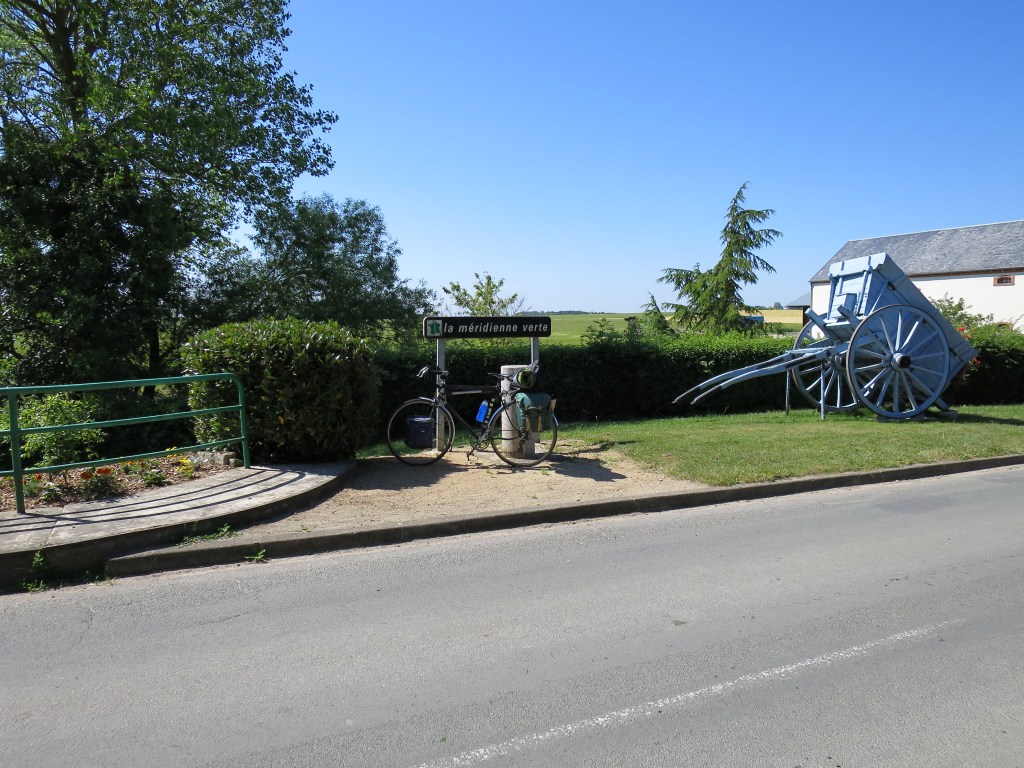
I look for Meridian markers. At Courcelles there is a small ash wood, a triangle with its apex pointing north. This seems to be the limit of the tree planting, small woods, like the patches of millennium planting in England. There are markers at Nancray and Nibelle.
But, really, what’s the point of simply visiting markers from the millennium, when nothing has happened since? I need to think about the Green Meridian. But not now. Now I turn west and plunge into the Forest of Orléans.
Although ‘plunge’ is hardly the word. I had high expectations for this. At 35,000 hectares it is the largest forest in France, and state-owned. I had expected an ancient woodland, with rides, coverts, and the feel of a place with memories from the time of the troubadours, of knights and ladies.
I find it divided into neat parcels of trees by arrow-straight rides, with crossroads of four, six, even eight radials.
These were laid out for hunting: the lateral rides are for the chase, the radials, created later, for the shooting. I imagine game driven across, enfiladed, mown down as they cross the road.
The woodland itself, oak (60%) in some areas, Scots pine (30%) in others, is given over to timber production. It has the stillness and emptiness of the monoculture. The only interest is the strong, resinous smell of sawn wood from the large lumber mills I pass.
I had expected something wilder, looser.
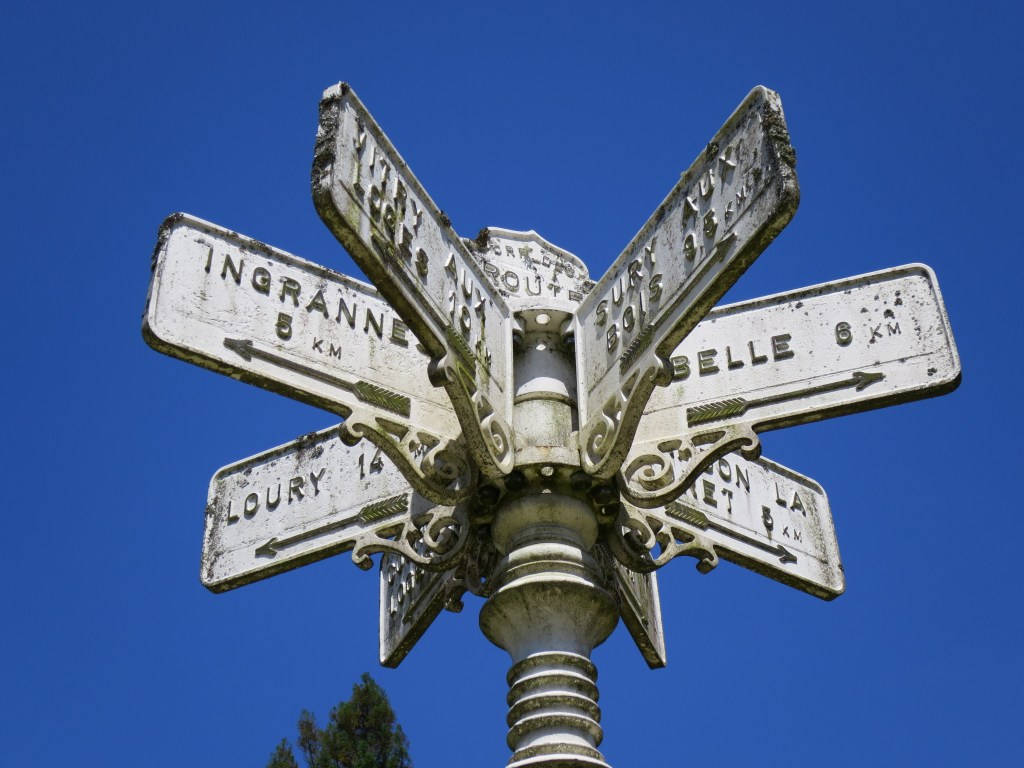
35,000 hectares is, after all, 135 square miles, big enough for rambling pathways and cycleways, mixtures of trees and lakes, habitat diversity. And yet here I am, at a crossroads, by a cast-iron signpost that points down eight straight roads, like points of the compass, next to a sign that says that walkers are likely to encounter stag-hunters on horseback on Wednesdays and Saturdays, and gun-toting hunters of wild boar and deer on the other days. Except Sunday.
After the Revolution these forests, previously the preserve of nobles and the church, were opened up to all. But in the 1820s, under the new king, restrictions were placed on hunting and wood-gathering. The forest is now divided into rectilinear plots of hunting rights.
Close by, within sight, is a national observatory, but the road to it is closed to the public.
Sorely disappointed I turn south from Engrannes, pass lakes used for fishing, and reach the canal d’Orléans.
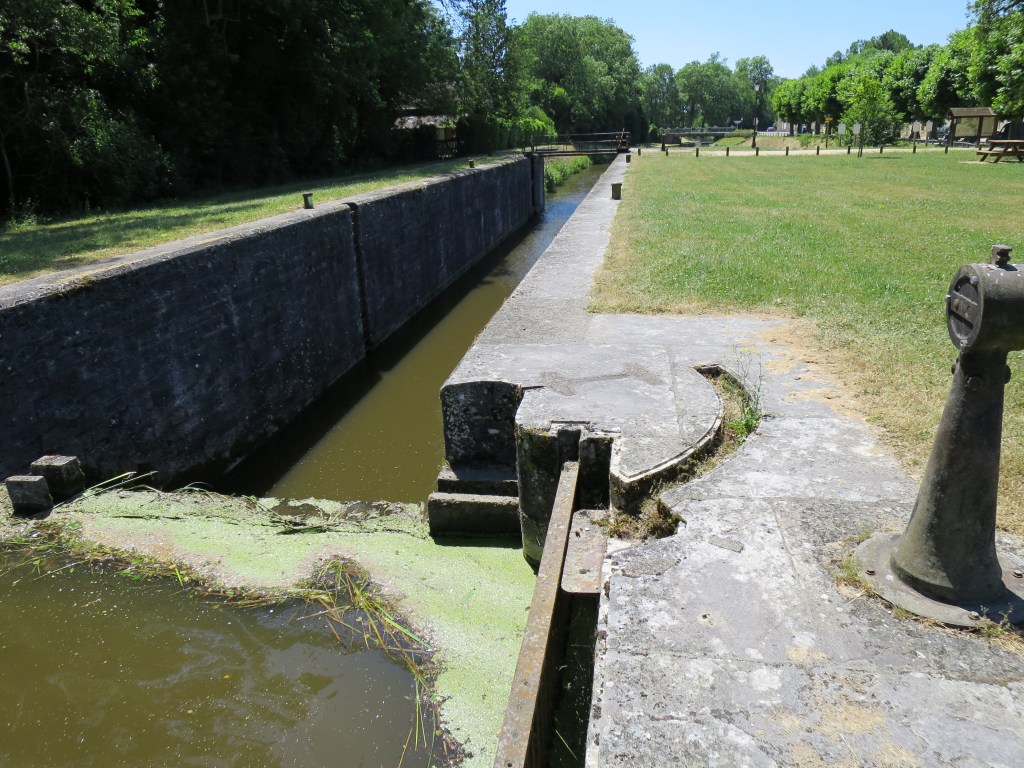
It was constructed in the 1690s by a businessman to transport timber and coal. Eventually it was part of a system that linked the Loire with the Seine. This was over sixty years before the first significant canal in England. Again, I ponder why France, the richest country in Europe, scientifically advanced, well-populated, was so late to industrialisation.
But the ruling class of the eighteenth century had no need of industrialisation: there were plenty of peasants to labour and tax; no middle-class to push them aside or demand the sort of products English industry was producing; and all the luxury goods they wanted were being made in Paris or traditional specialist centres.
And I ponder why this canal, closed in 1954, was simply abandoned, until the state decided to renovate it for leisure use. In England there would have been local volunteer groups campaigning, and working to open up each stretch.
There seems to be a lack in France of what we call ‘civic society’. There are no real equivalents of the National Trust, RSPB, Ramblers’ Association, Civic Trust, Woodland Trust etc. It is the State’s job to do this stuff, while the citizen focuses on self, family and friends.
It seems to go back at least to the Revolution which ‘proclaimed the rights of men and citizens as individuals, and emphatically rejected groups’ rights. There was nothing between free and equal individuals and the state.’ (Howarth & Varouxakis.) Which is perhaps why the French are prepared to pay a higher a proportion of their income in taxes. Maybe this is another reason for the lack of interest in the Meridian.
I cross back over the Meridian, to the village of Lorris, because of Guillaume de Lorris. Around 1230 he wrote the first 4,000 lines of The Romance of the Rose, a poem of courtly love, of which Huizinga writes, ‘Few books have exercised a more profound and enduring influence on the life of any period.’ And: ‘Just as scholasticism represents the grand effort of the medieval spirit to unite all philosophic thought in a single centre, so the theory of courtly love tends to embrace all that appertains to the noble life.’
If my education, in its scientific and intellectual attempt to understand and codify the world, was the modern equivalent of scholasticism, then romantic love was my way of embracing the noble life. I was one of those sucked out of the working class by that curious hoover the eleven-plus, to add to and energise the middle class in the one-off post-war doubling of the administrative class. Deracinated (Richard Hoggart writes of us being ‘uprooted and anxious’), and supposedly grateful for the opportunity to be grafted onto (into?) bourgeois society, I found it intellectually stimulating, ideologically suspect, and emotionally numbing. Through school, emotion was the sentimentality of pop songs. At university I added Romantic poetry and literature. And although I was forever seeking it with those at the racy edge of the middle class, especially art students, when love hit me, it knocked me for six, changed my life.
Lorris was an important hunting centre for the Capetian kings; it would be to entertain this court that Guillaume composed his Romance, which was much influenced by the love poetry and song of the troubadours of the South.
In 1242, Raymond VII, Count of Toulouse was summoned here by Louis IX finally to capitulate to the French crown, after 30 years’ resistance to the Albigensian crusade. It was the end of the independent South, of a Languedoc society, based on courtoisie, where the troubadours thrived.
Around 1270 in Paris, Jean de Meun added 17,000 lines to the Romance. In his continuation, the poem of love becomes a clotted intellectual allegory. The contrast between the two parts exemplifies the victory of Northern universities over Southern courts, the victory of the scholastic over the poetic.

Lorris is a sleepy, empty place. Two men lounge outside a bar. I buy orange squash in a general store, with little for sale, run by a woman who laughs a lot, but as if to stop herself crying, oddly tragic.
The church modulates between Romanesque and Gothic in a comfortable, non-ideological way, with a Romanesque porch, a Gothic window above, and topped by a sixteenth century brick clock tower, surprisingly harmonious.
I head south-west, on a straight road through the forest, heading for le Carrefour de la Resistance, the memorial to le maquis de Lorris.
The Loiret was an important centre of Resistance, with many deportations. In August 1944, 50 maquisards were slaughtered here. There are giant sequoias close by. But the road to the memorial is closed.
A dramatic arrival at the Loire, at Sully-sur-Loire. There is long bridge over the wide river, and the town is guarded by a fairy-tale castle of white stone, with round towers and conical slate roofs, rising up from a moat.
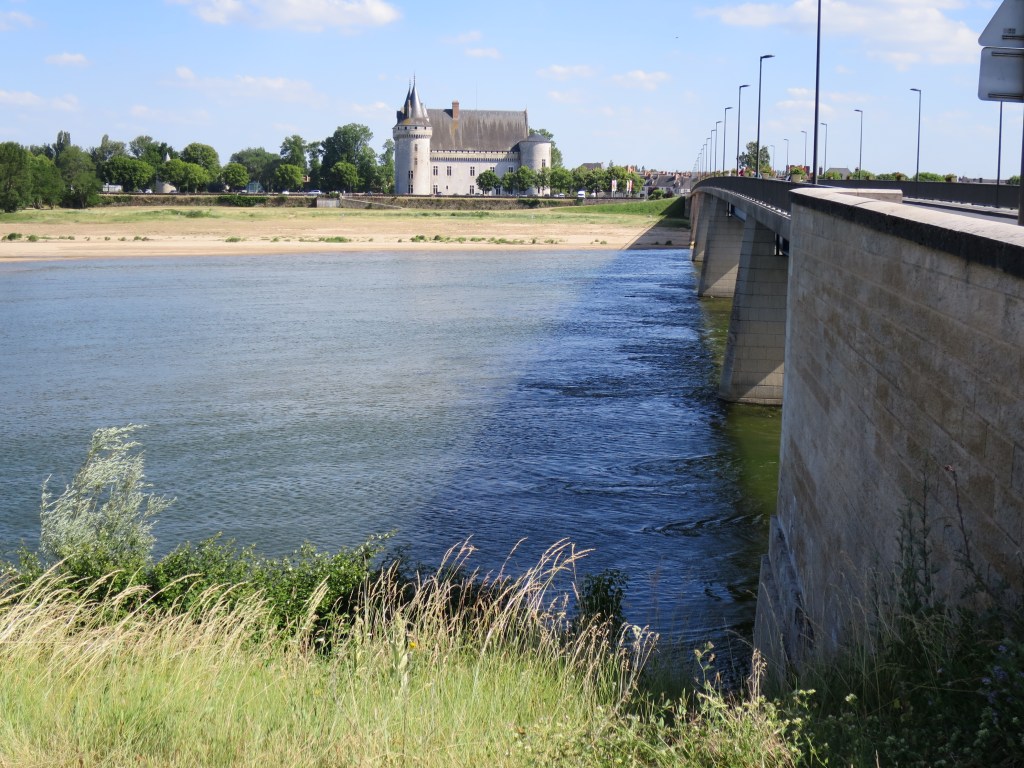
It was built to secure the river crossing, and added to by Henry IV’s minister the Duke of Sully from 1600. The five-arch bridge is recent, replacing the suspension bridge built in 1839, which was destroyed by the retreating French in June 1940, then again by Allied bombing in June 1944.
It reminds me of the phases of the war here: the German invasion sweeping south, the Allied invasion moving north. In the time between, France was a partitioned and occupied country. The suspension bridge was rebuilt six times, finally falling down in 1985, damaged by fierce frosts.
I go straight to the Office de Tourisme, where two young men eagerly demonstrate their English and their knowledge. Disappointed that all I want to know is the location of the campsite, one directs me there, adding hopefully, ‘and if there are no vacancies, please come back and I will telephone around.’
The campsite is by the river. It is a large, efficient site, mostly motorhomes, the few tents are, pleasantly, located on the river bank. The woman at reception is friendly, intrigued by the out of the ordinary. I book two nights. I’m having a break from daily packing up and moving on, a lateral day, along the placid continuity of this great river, its meandering flow west, under the given of gravity. A corrective to my headlong willed rush south.
I make tea, and sit by the river that murmurs softly past. The sun shines, glittering on the water.
There are ducks and water fowl on soft sand and among thick grass. The Loire must have been in Guillaume’s mind when his narrator writes: ‘I bent my steps towards a river which I heard murmuring close by … not quite so great as the Seine, but wider. Never before had I seen that stream, which was so beautifully situated, and I gazed on the delightful spot with pleasure and happiness. As I cooled and washed my face in the clear, shining water, I saw that the bed of the stream was all covered and paved in gravel. The fair broad meadow descended to the water’s edge.’
The narrator of The Romance of the Rose has a dream: on a perfect May morning he arrives at the Garden of Pleasure, a place of surpassing beauty and perpetual enjoyment. The garden is enclosed, access is granted only by Idleness.
Inside, gazing into the Spring of Narcissus, taking care not to look at his own reflection, he sees all the beauties of the garden reflected. Then, in the Spring he sees, beauty of beauties, the rose. As the narrator approaches the rose, Love shoots him with his arrows, infecting him with the divine madness of love.
I have been shot by the arrows, infected with the divine madness of love, three times, at intervals of decades, each time out of the blue.
The first time, I discovered pleasure, idleness, the spring of Narcissus, the beauty of beauties. It flew me high, cast me down, fused circuits of feeling, knocked me off the rails of my given life, at first into a wilderness but then led me at last to the making of art.
The second time was the recognition of the perfect opposite, the mutual attraction of magnets, the sudden coming-together energising and lighting each other up, while laying waste all round. And with sudden, destructive reversals that followed attraction with repulsion, love with hate. The beloved was the muse, bringing art of a new quality. But the repeated reversals eventually drained the magnetism. Time to eat.
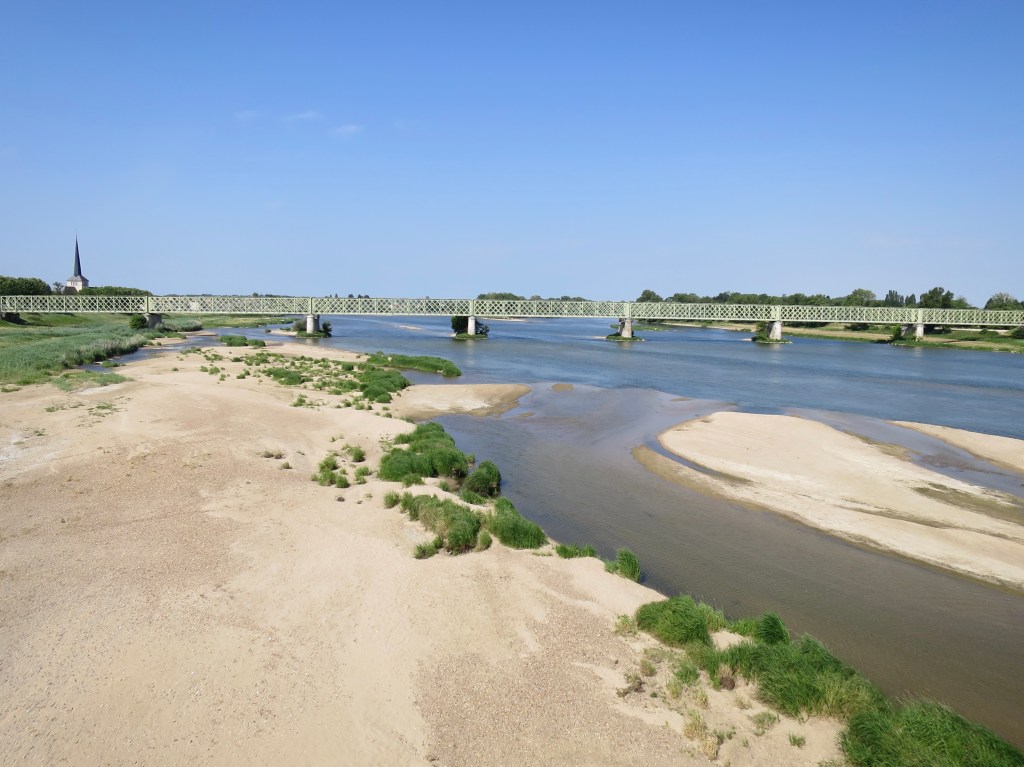
I walk along the river bank towards town. The river is wide, shallow and flat, with sandbars and islands. ‘Loire’ means ‘alluvium’. It seems odd, seeing this benign, slow-moving stream, that it is called ‘the wild river’. But this is because its shifting shoals, summer droughts and winter surges have always made navigation difficult. ‘One arch is sufficient for the passage of its waters when it flows at a depth of two or three metres only above its sandy bed; fifteen arches are not sufficient when it rages through them on a level with their keystones.’ (Ormsby.)
By the bridge is a marker for the water high-point; it is above the top of the bridge.
Although well used since earliest times, with quays all along it, navigation was quickly abandoned after the coming of the railways. Imagine the different history of France if this, the longest river, across the middle of the country, with timber and sheep, coal and iron in the uplands, rich agriculture along its length, had been easily navigable along its length, with a harbour at its mouth! In the Hundred Years’ War it was the boundary between English and French territory.
I walk into town. There are few places open, not even the kebab shop. In the bookshop window, ‘Le Bateau-Lavoir dionysien’, which promises tales of wild goings-on at Picasso’s studio in Montmartre. But is about a laundry-barge on the river at Saint-Denis-en-Val. (Inhabitants of towns called Saint-Denis are dionysiens, perpetuating Suger’s myth that Denis was Dionysius the Areopagite.)
There are many local books: on Clogs and Clog-making; Salt-smugglers at the time of the gabelle (salt tax); Miracles of the Loire; Gauguin in Orleans; Criminality in Berry in the eighteenth century; In the pays of Sologne … This interest in what has gone allows us to romanticise the past, to (at a safe distance) mourn its passing, and be silently grateful that ‘progress’ has moved us on from then.
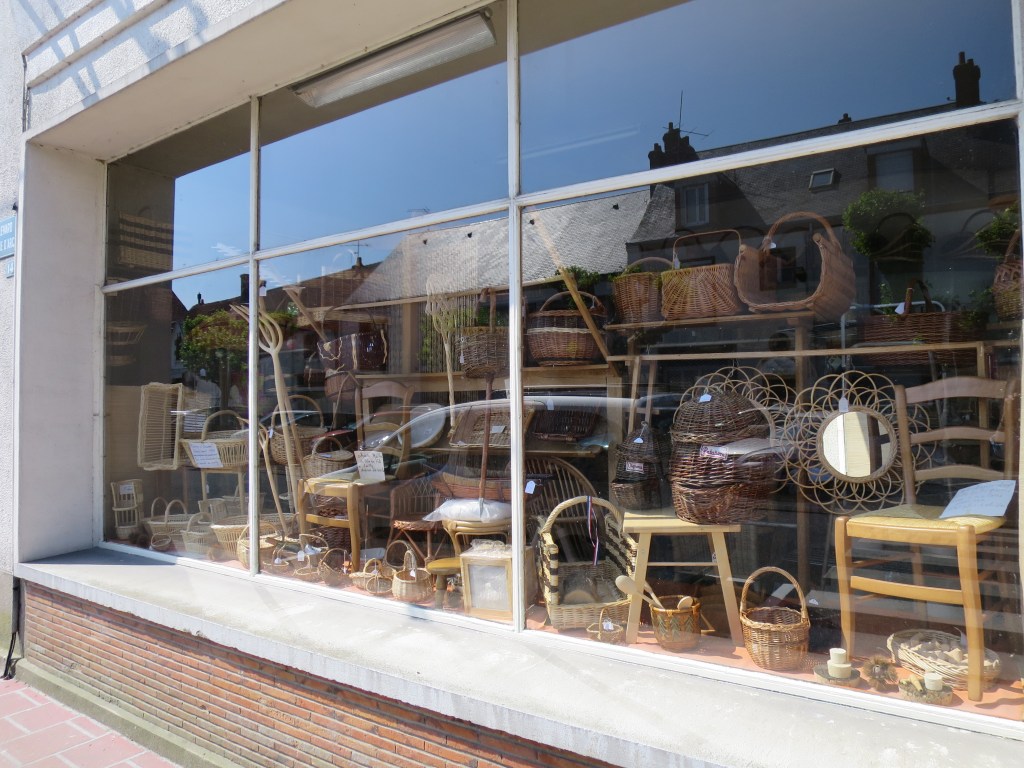
Next door is a shop filled entirely with products made of wood and straw: carpet-beaters, bellows, straw-seated chairs, shopping bags, baskets of all shapes, straw hats, hay forks, all immaculately made. And made for display.
Unlike the rough-and-ready but serviceable ones made by our neighbour in the Aveyron, and by me under his tuition – a basket made in an hour from hazel and willow, a rake re-handled in fifteen minutes at dawn with a freshly-cut ash bough. And I remember the basket-maker in the village, with knotted fingers and bowed back.
Curious, this world of craft revival, items for conspicuous display rather than practical use, often made by well-paid middle-class professionals, rather than the ill-paid artisans who made them when they were actually used.
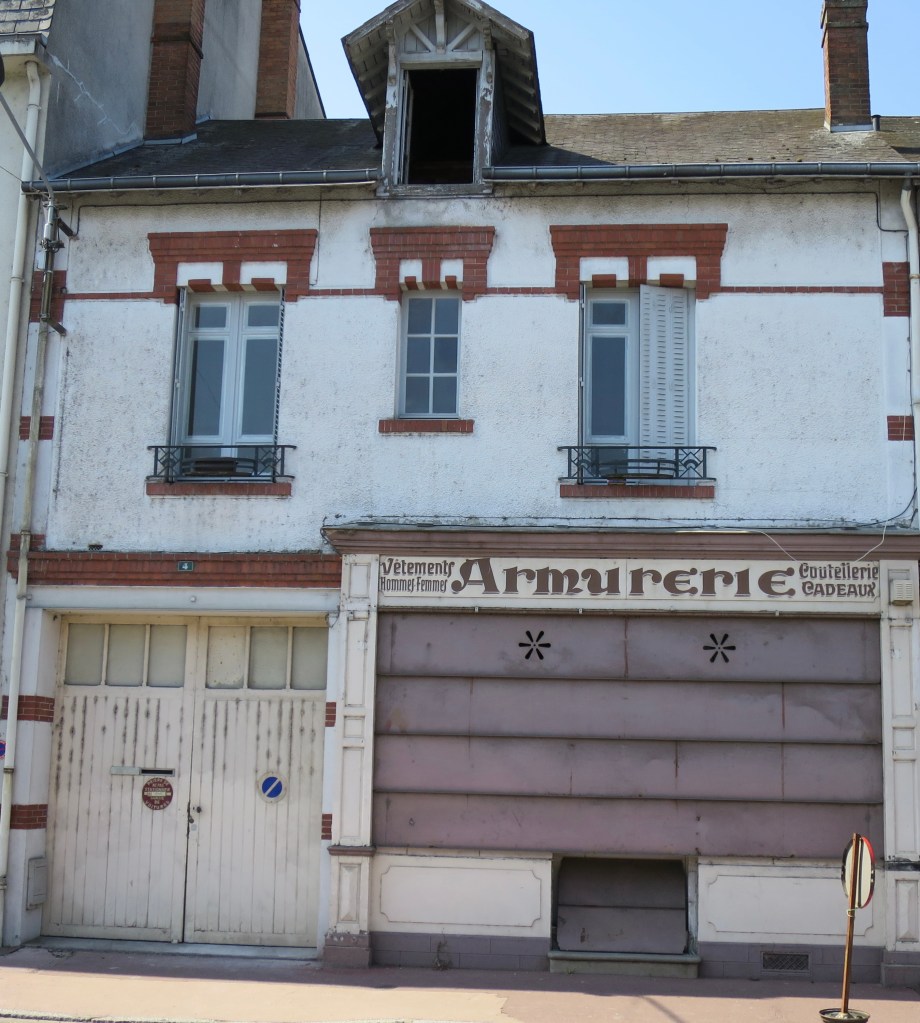
There is a shop, closed down and metal-shuttered, with, in that art-nouveau-influenced early-twentieth-century script of so many older French shops, in big letters, ‘Gunsmith’. Around it, in smaller letters: ‘Cutlery, Gifts, Men and Women’s Clothes.’ What a mix! Are they ‘lines’, brought by commercial travellers? Or an illustration of what could be sold in a small town, before cars and buses made larger centres accessible?
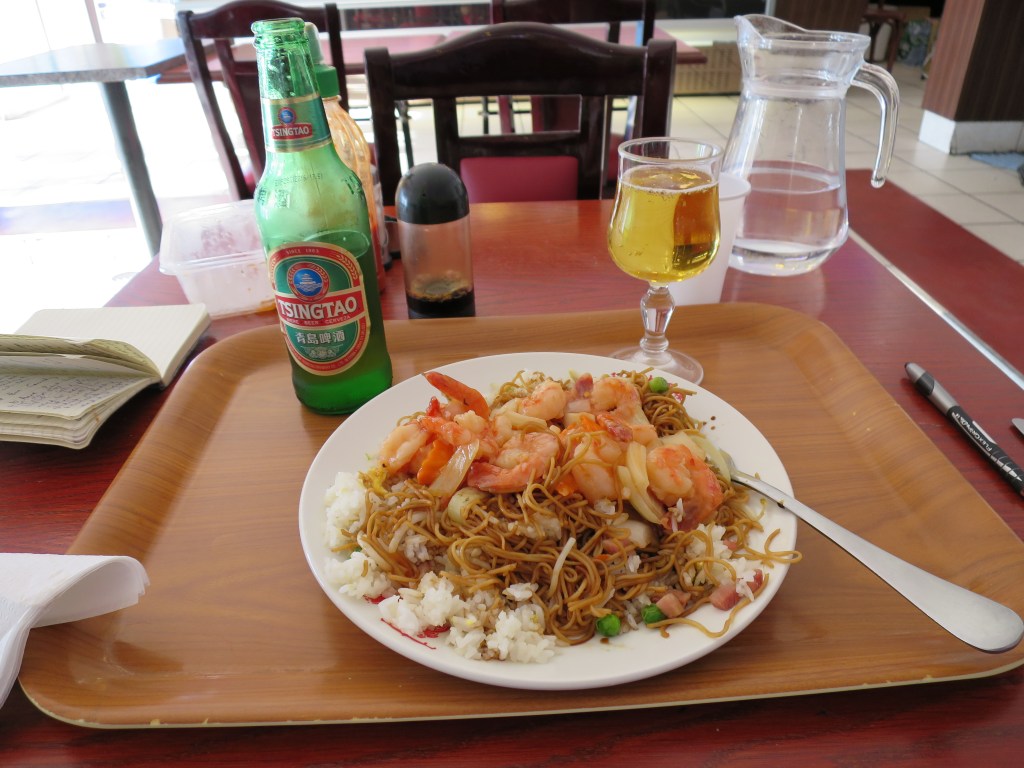
There is little choice of eating place, but fortunately my standby, the Chinese takeaway. I select my dishes at the glass-fronted counter. They are identical, the rices, the noodles, the meat dishes and salads, in identical plastic pots, to those in the place I ate in Paris. I imagine a factory in central France – perhaps next to the Norbert Dentressangle lorry park – where the dishes are prepared in great vats, decanted into identical polythene containers and shipped across the country to be displayed in identical takeaway counters. There would be the ‘Chinois’ line, and the ‘Libanais’. The ‘Indien’ line is coming soon. I select rice, noodles, and chicken with black mushrooms. They are microwaved and brought to my table on a china plate, with cutlery, serviette, a carafe of water, and a bottle of Chinese beer, and served with finesse. I eat with relish, writing in my notebook from time to time.
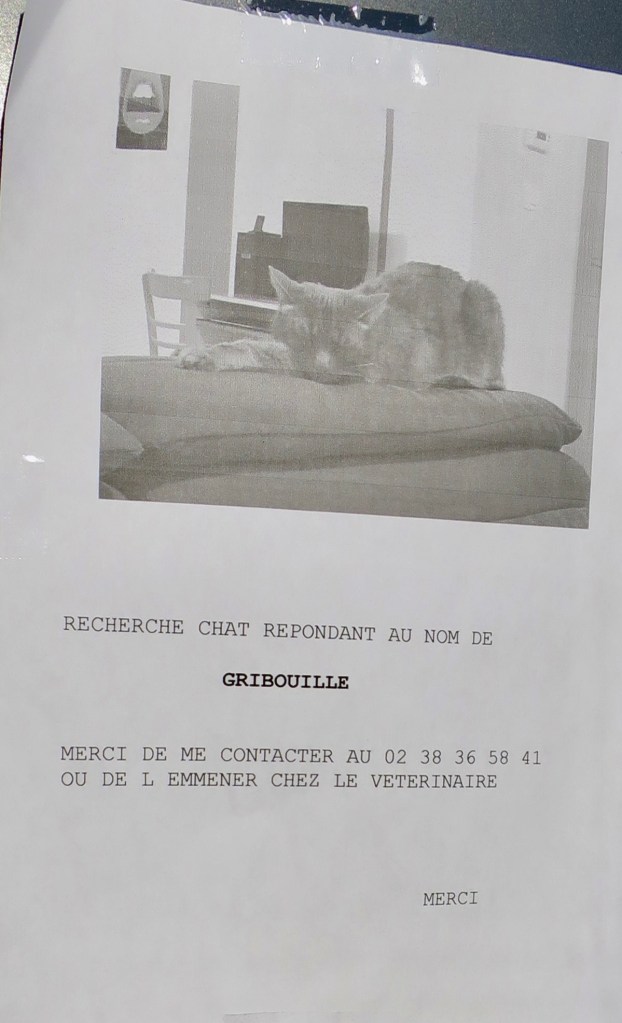
Walking back – how it reminds me, this small town, of my home town, on a summer evening after the shops closed, the streets filled with sunlight, a town I inhabited alone! – I pass a notice on a lamp post about a lost cat, ‘answers to the name Gribouille,’ and a phone number.
A rather lovely word, Gribouille. It means rashly naive, ‘someone who throws themselves into the river to get out of the rain’. It was also the name of a popular TV puppet who taught children to draw (gribouiller means to sketch). And of an intense, troubled French chanteuse of the sixties who died of drink and drugs at 26. I try to imagine who Gribouille’s mistress (I’ve decided it’s a woman) named her for. Is it to remind her of a loved TV character from her childhood? Does it describe the endearing scattiness of the cat? Or perhaps it reminds her of her own rash naiveties, good and bad, that have made her who she is. Maybe she’s a no-nonsense schoolteacher, settled in job and life, who plays, late at night, cat on lap, the songs that enchanted her student days, that take her back there, perhaps to when she had something of the troubled chanteuse about herself. I imagine stories about her and her cat, paths not taken. I always see a woman alone, in an upper room, like Rapunzel spinning, like the Lady of Shallot with her mirror, as I pass.
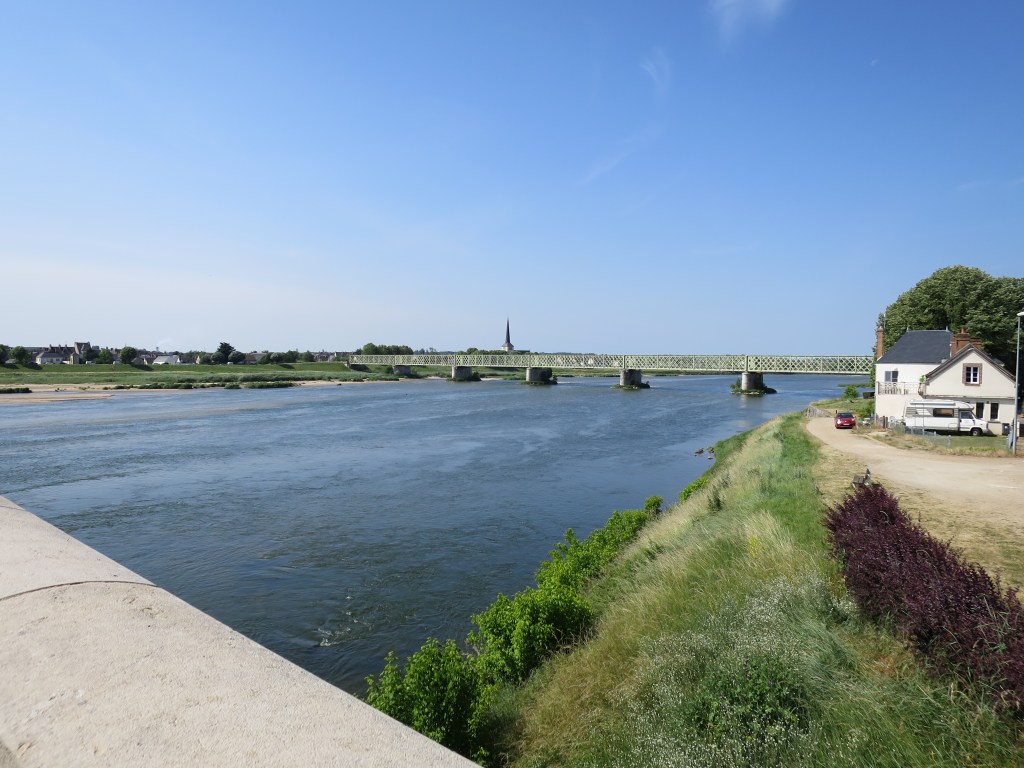
The walk back across the long bridge, looking downriver, west, stretches out the view horizontally, like a wide Flemish picture, pierced vertically by a single sharp silhouetted church spire. The wide river glitters with the low sun that shines between golden clouds. There are sandy shoals, grassy islands, small still stick figures of men fishing, evening-busy birds. The foundations of the old bridge below remind me of home, by the new bridge. The view recalls a shared walk on the Severn water meadows at Tewkesbury. For me, on the bridge, something has changed.
Is it the place? The turreted castle? Thoughts of courtly love? Or the sudden halt in my headlong rush south, the dissolving of the bubble of self-containment in which I have been travelling, inside which my life has simplified to practicalities, desires have progressively fallen away, until all that matters is the journey? I can understand, now, those who cycle on and on, around the world, and then around the world again, a life simplified to the setting and achieving of goals, in which there is no arrival, for there is nowhere to arrive. Whichever, it is not an evening to be comfortably alone.
But I am alone, midway across this long, wide, empty bridge. I reach for my notebook, and pen. No pen. And my reserve pen. Gone. Panic. I hurry to reception at the campsite.
The owner sits in her globe of light in the gathering gloom, attractive, reflective. I ask if she has any pens for sale. She looks at me, ponders, then says, in French, no, but I have something else. She reaches into a drawer and pulls out a pen that advertises the site. As she hands it to me, with a smile, she says, or I think she says – ‘then when you use it you will remember us, and write the light.’ I smile and thank her. Of course, on this special night she has seen that I am different, a writer, for the French notice and respect these things. She sits in her office and watches travellers come and go, and has stories for each of them, and scraps of their travels stay with her, and shreds of herself go with them. Maybe she is chained by circumstance to this place, condemned to be the eternal observer. Or perhaps this is the perfect place to dream of possible journeys and other lives.
Ah, the romantic French, ‘you will write the light.’
I make tea, and sit outside the tent to write in the last soft light, the trees on the far bank charcoal silhouettes. When I press the pen, a light comes on. As I write, the pen illuminates the page. She was telling me that the pen has a light in it.
Ah, the rational French, ‘you will write in the light.’
Day 10: Sully-sur-Loire to Sully-sur-Loire, 16 miles.
3am thoughts. The savage river dreams. Norse pirates. Theodulph’s oratory. The saint at the abbey. The Apocalypse. The first heretics burned at Orléans. Joan of Arc and visions. Max Jacob. The failure of la Méridienne verte, the success of letterboxes.
3 a.m. Writing, in the cold, unfamiliar light of my new, illuminating pen. The third time, recently, love struck me with the freshness and force, the spark of the first time we had set eyes on each other so many years before. Having lived our lives separately, differently in the years between, we arrived, just once, at the same time, the same place, the moment. Just once. Love struck.
And yet. How easy, at 3 a.m., alone in the shroud of my tent, with the faint whispering of the ever-flowing river, the occasional woodwind note of a night bird, a motorcycle accelerating across the bridge, the thrum as it crosses the end of the bridge onto the dead-straight road, heading north, or south, how easy for me to believe that I have got my life all wrong, that she, with investment in capital and family, with continuity and acceptance, had got it right, had chosen the responsible way. That I would be wrong to try (as I always try) to lead her away from the hearth, into the twilight world between fire and stars, between camp circle and forest. Rather, that I should forget myself and, amenable, slip into a place in that circle, fit in, warmed by the fire in front, with the firelight sparkling and enlivening the faces in the circle, the light and noise blanking out the solitude and silence behind …
And yet. We met after long and different lives, while living those different lives, drawn to each other eventually by their difference. Why this choice – either to join her circle, or to entice her out of it? Why not let be, so each can be themselves in their lives? Have faith in the compatibility of our unlikeness.
And remember my duty to the path I have chosen. ‘Breaking my staff’, ‘burying my book’, ‘abjuring rough magic’ etc., would be a betrayal of my life.
Perhaps, rather, it is time exactly to move forward, to deny myself all notions of ‘retirement’; to work more. The faith, once chosen, is an obligation.
I wake to a morning when I have no camp to break, no packing up to do, no destination to plan for. I have a day by the Loire. There are cycle paths the length of the river, over a hundred kilometres. Which way to go? Upstream, to the nineteenth-century technological marvel of the Briare aqueduct? Downstream, along the Loire of long history?
The thin man is leaving. I watched him arrive last night, leaning forward, looking neither left nor right, no eye contact, no word. All his movements are quick, impatient. Quickly, impatiently (how ‘things’ annoy him!) he rolls up his low dark tent, packs his few things into the coffin-like box on his bike. Quickly, impatiently he pushes his bike to the camp-site road, acknowledging no one. As if nothing, anywhere, is good enough, so he must move on. Or is there, just beyond that Concorde nose, that beard like the ram of a Greek trireme, that butting forehead, a destination, ever out of reach? He pushes off, cutting through like the bow of a ship, and the sea closes behind him, and he leaves no wake. An icebreaker, breaking a cold path through ice that freezes behind him. He’s gone.
I have become a mesh, through which some things pass, to which some things stick. Unsure any longer which is me. And not sure it matters.
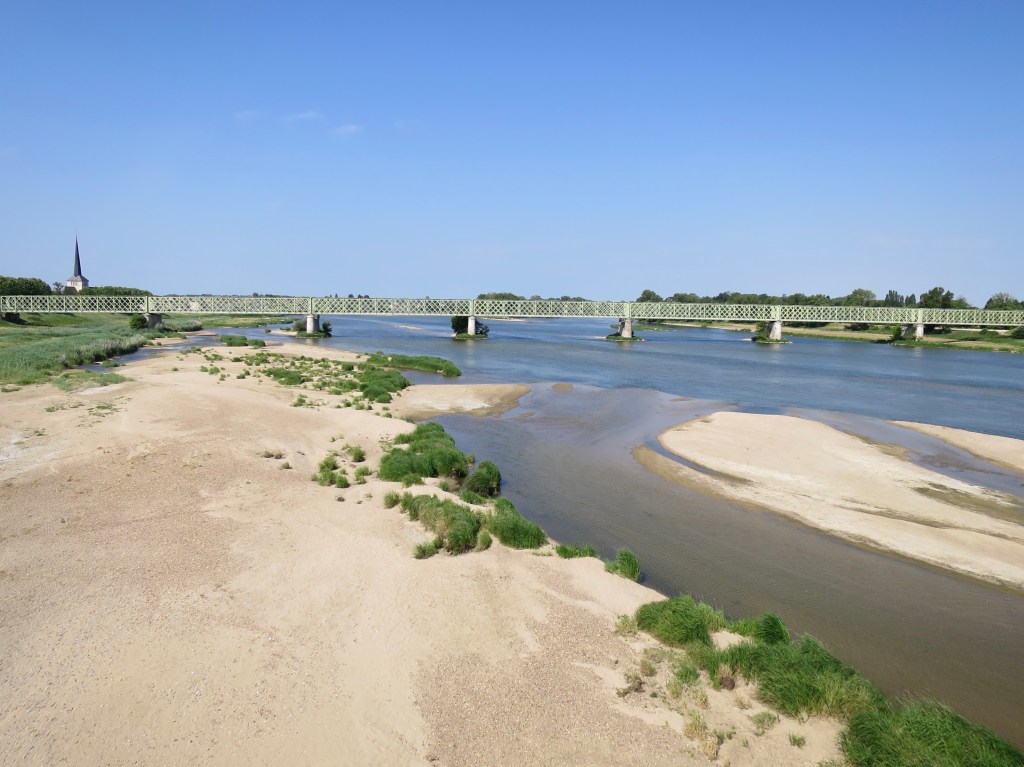
I find the cycle path and head west, downstream, the path weaving sometimes alongside and sometimes away from the river. It is a bright, hazy day, very calm. The river flows slowly, slowed by the friction of its alluvium bed. Or perhaps reluctantly, as if there is too much to explore among the sandbars and vegetation-covered islets, the coves and beaches, too much of interest to hurry. It is a curious river, a nosy river, nosing here, nosing there.
And a dreamy river, on this low-water June day, in the bright, hazy light of a big sky.
No wonder Guillaume de Lorris had his dream here, dwelt here in the garden of his imagination, wrote the four thousand lines of his dream “in which the whole art of love is contained”.
No wonder the French kings and nobles who built their châteaux along this river built them ever up and out, elaborating them, with complication and embellishment, endlessly, as if in a dream.
And yet so much French history happened here.
Châteauneuf-du-Loire has echoes, but only that, of the heyday of navigation, before the railways were built: a chain suspension bridge like the fallen one of Sully, high enough for the sails of boats, stone quaysides now tidy and deserted, fine traders’ riverfront houses, a museum of river navigation. I might cycle on to Orléans, where so much has happened. Instead I turn around and cycle back towards Sully: I have two destinations, which I want to visit, in order, travelling back upstream, first to Germigny-des-Prés.
The first fortifications on the river were built to resist the Norsemen, who rowed up in the ninth and tenth centuries, out of curiosity, and in a quest for booty. This was before they settled in Northern France and became the Normans. One of the places they destroyed, in 860, at Germigny-des-Prés was the grand palace of Theodulph, religious advisor to Charlemagne, and bishop of Orléans.
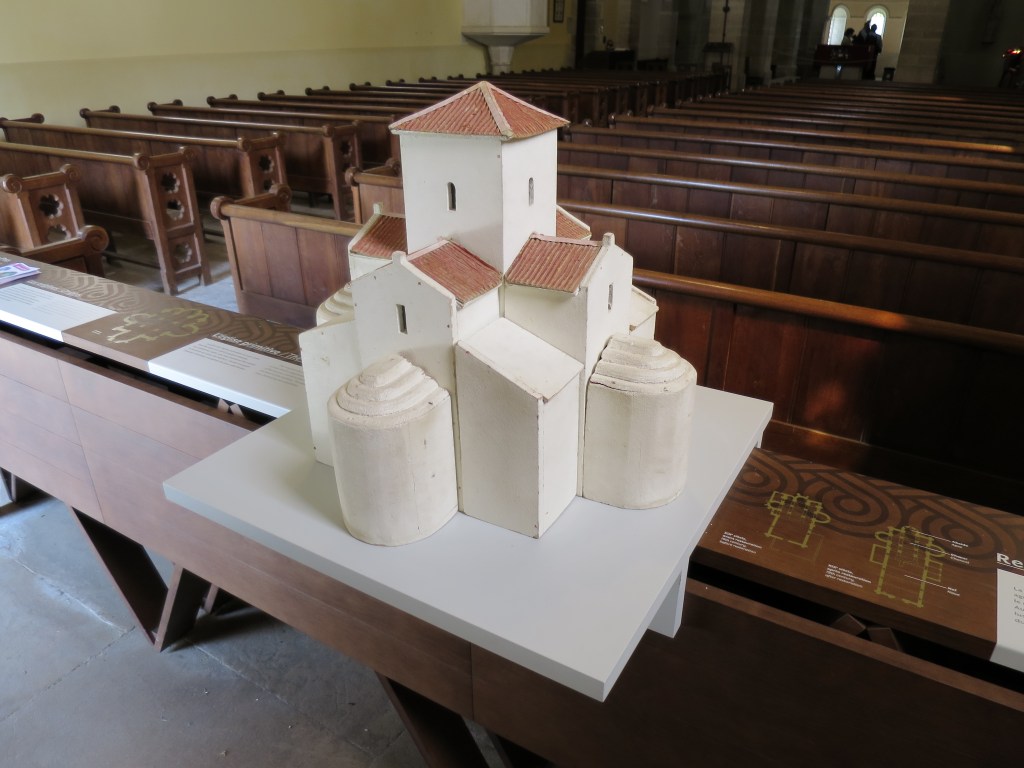
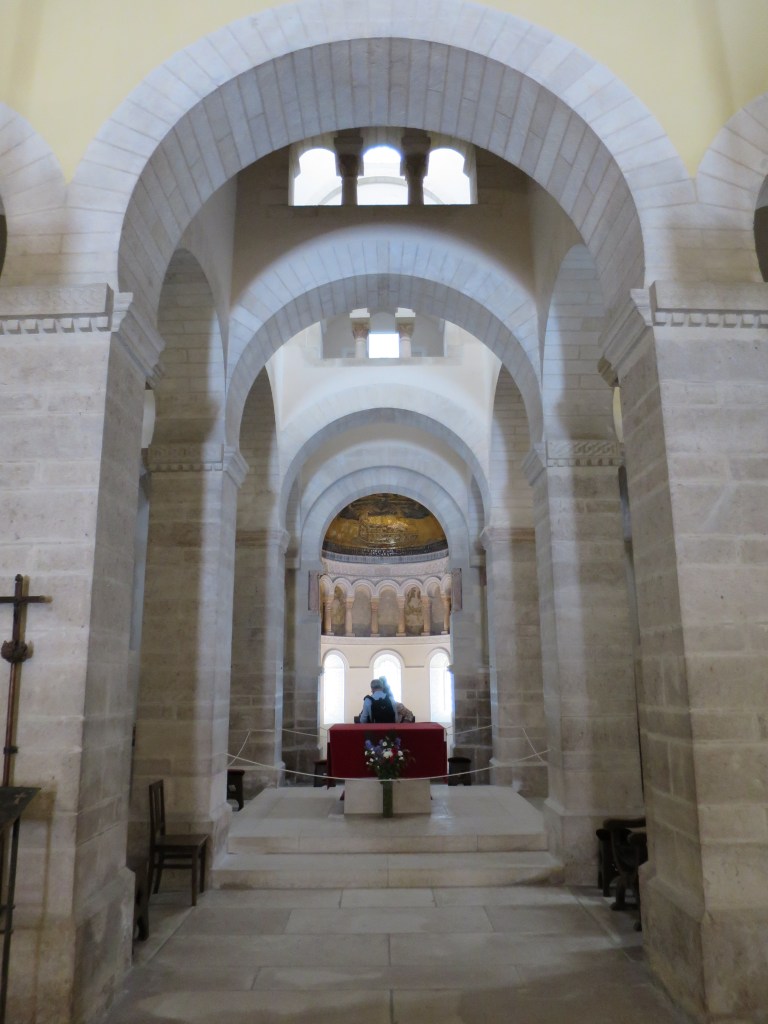
All that survives is Theodulph’s oratory, consecrated in 806. From the outside it is a modest building, square, with half-circle apses on each side, tiled pitched roofs, small windows, a central tower. It is domestic in scale. Or rather, private. It is unassuming, with no sense of making a statement.
Inside it is made up of the simplest forms, of square and circle, pillar and round arch. And yet it has a great sense of unity, integrity, and intensity. Why is this?
The square is divided, by four pillars, into nine squares. And it rises up through three levels. It is, without being obviously so, a cube of nine. This evokes the celestial city as described in the Book of Revelation.
And the arches aren’t quite semicircles, but horseshoe-shaped, a form brought by Theodulph from his native Spain. As are the apses. And that slight pinching in, and the pattern of different-sized arches and slender pillars, ever changing as one moves, create tension, dynamism, even expectancy.
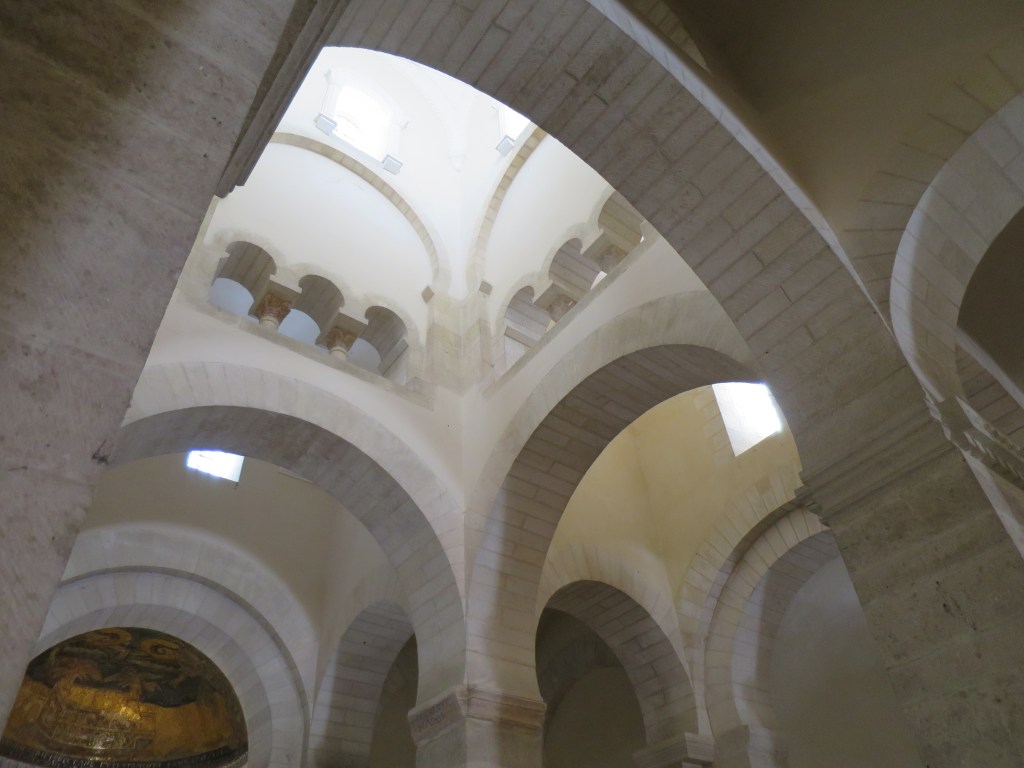
All the pattern and change swirls around an illuminated central stillness.
Under the tower is a simple, still, light-filled space, Turrell-like, where the white light is purified. This is the oratory, the private prayer space of the bishop.
His work, as spiritual head, depends on him intensifying the spirit within himself. This space is his spiritual accumulator. It is expressive of a vision of accumulation and intensification. Rather than, as I’ve met so often with the Gothic, of upreaching and aspiration. The light touches in benediction a bent head that is turned towards the inner light. Rather than shining in upraised eyes searching into the beyond.
From these forms, the Spanish and the Byzantine, influences from the south and east, developed what the French call Roman and we call Romanesque. It quickly became the standard church architecture, until the Gothic. And it expressed a different focus in Christianity.
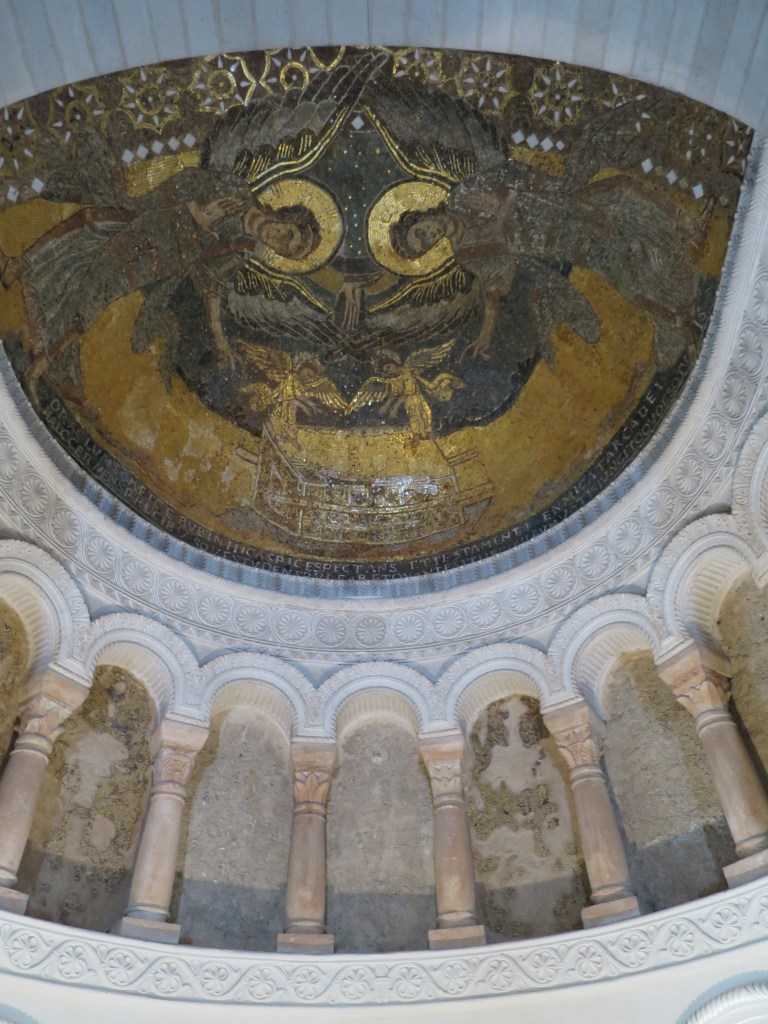
And so that he is not lost in abstraction, facing the bishop in his oratory, in the dome of the eastern apse, is a gold-rich mosaic. It is the only Byzantine mosaic in France.
Traditionally it would have been of the Virgin, with the Christ child on her knee. But the oratory was constructed during a period of Iconoclasm, when such images were prohibited. So it represents the Ark of the Covenant. The ark contains the manna, which was regarded as prefiguring the Virgin, flanked by two cherubim and two smaller angels. Not to be worshipped, as Theodulph makes clear in his writings, but as an aid to contemplation.
But, and this is weird, what I see, when I look at the mosaic from a distance, is first an ark and angels, but then the face of a horned and bearded devil, Satan. First one, haloed and winged cherubim and angels. Then the other, halos become horns, wings and angels a brutish snout. It is so clear, it must be obvious. Has no one else seen this? What is going on? I leave, scratching my head.
A little upstream, at St-Benoit-sur-Loire is the Abbey of Fleury. Theodulph was abbot here.
In 630, monks from Orléans founded at Fleury one of the first Benedictine abbeys in Gaul. Benedict’s abbey at Monte Cassino had been laid waste by Lombards in 580 and abandoned. In 672, intrepid monks from Fleury walked to Monte Cassino, found Benedict’s remains, and brought them to Fleury, which became the primary centre from which Benedictine principles spread. Both the Cistercians and Cluniacs adopted the Rule of St Benedict:
This abbey is the root from which the monasticism of the eleventh century grew and flowered.
Benedict’s bones were interred in the crypt, the foundation stone placed upon him, and with him at its centre the church was built up from him. All rests on him, all converges on him, all grows from him.
In 1020 Abbot Gauzlin built a monumental tower here, “to serve as an example to the whole of Gaul”: it was an evocation, in architecture, of the celestial city, the new Jerusalem, as described in Chapter 21 of the Book of Revelation.
It is time, at this church 2km from the Green Meridian that was intended to commemorate the second millennium, to go back to the first Millennium, the year 1000.
Michelet writes: “It was the universal belief in the Middle Ages that the world was to come to an end in the year One Thousand AD.” People waited for the end. And when it didn’t come, “by the coming of the third year after the year 1000, churches and buildings nearly everywhere were again being built, especially in Italy and Gaul … It was as if the very world was shaking itself free of its decrepitude and everywhere put on a white mantle of churches.”
This is an often-quoted passage from the eleventh-century Benedictine monk and scholar, Rudolfus Glaber. More careful research has shown both these statements to be exaggerated, and that those predicting, and believing in the imminent end of the world were a minority. Albeit a noisy one. Abbon, the abbot of Fleury before Gauzlin, tells of having heard a preacher in Paris talking thus in the 950s, and that such ideas were circulating in the 970s. They faded as 1000AD passed.
But it clearly bothered Gauzlin enough to build his tower in 1020 (another favoured date for the apocalypse was 1033) “as an example to the whole of Gaul” of what can come after. For what follows the Apocalypse, and the defeat of Satan is, as John writes, “a new heaven and a new earth … the holy city, new Jerusalem, coming down out of heaven from God.”
And what survived 1000AD was a newly-persistent idea: millenarianism. Cohn, in The Pursuit of the Millennium, describes it as “a group’s belief in a terrestrial, imminent, total and miraculous change that results in salvation for the members of the group.” It was a commonplace when I worked in Watkins esoteric bookshop in the 1970s, from the Age of Aquarius, to the Mayan ‘End of Time’ of 2013.
It vibrates north up the Meridian to Paris and beyond in Dan Brown’s The Da Vinci Code, south to the mystery of Rennes-le-Château and Pic de Bugarach.
It echoes in Utopianism, its post-religion, secular version.
It underlay my belief in ‘the new world’ that I would help to build as a socialistic town planner in the post-war welfare state consensus.
And when that fell apart, my embracing of a News from Nowhere ‘salvation’, that would come from a handwork-based life focussed on rural self-sufficiency.
Perhaps the Green Meridian was a last, faint echo.
Or maybe an example of revivalism that had no traction, that failed to ‘take’ …
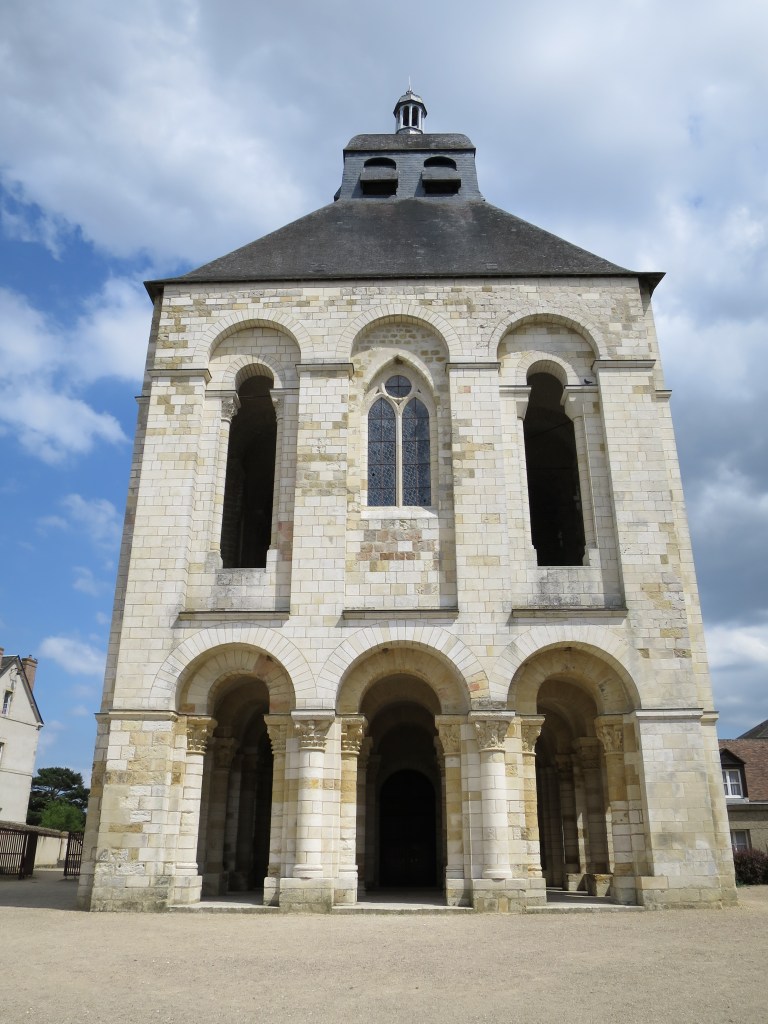
Abbot Gauzlin’s Porch-Tower is his contribution to the millennium, and is still standing in front of the abbey.
It is a remarkable and very attractive building. The four pillars at the centre divide the space into nine squares, referencing Theodulph’s Oratory, and evoking the celestial city, the new Jerusalem, which “forms a square, its length and breadth and height being equal. It has twelve doors, three to the east, three to the north, three to the south, and three to the west, and they are never closed since this place knows neither day nor night …”
The capitals illustrate the Book of Revelation, with Christ in glory, the book with seven seals, the four horsemen of the Apocalypse, and more.
Thus, at the turning of the millennium, he gave hope. It echoes Theodulph’s Oratory, also a cube of nine. And, too, I can’t shake from my mind the image, in the Oratory, of the mosaic in which I saw both angels with the Ark, and a horned Satan. Who, in Revelation 20, is “let loose from his dungeon … to seduce the nations in the four quarters of the earth” …
For what arose at the same time as millenarianism was heresy. Or rather the idea of heresy. Which was, of course, the work of Satan.
Books have been written about the extent, even the existence of heresy in the period from 1000. I will look at this when I reach the Cathar lands. Enough to say that in 1022, just two years after he began his tower of the New Jerusalem, Gauzlin convicted 14 canons of Orléans cathedral of heresy, and had them burned alive. They were the first executions of heretics since Roman times.
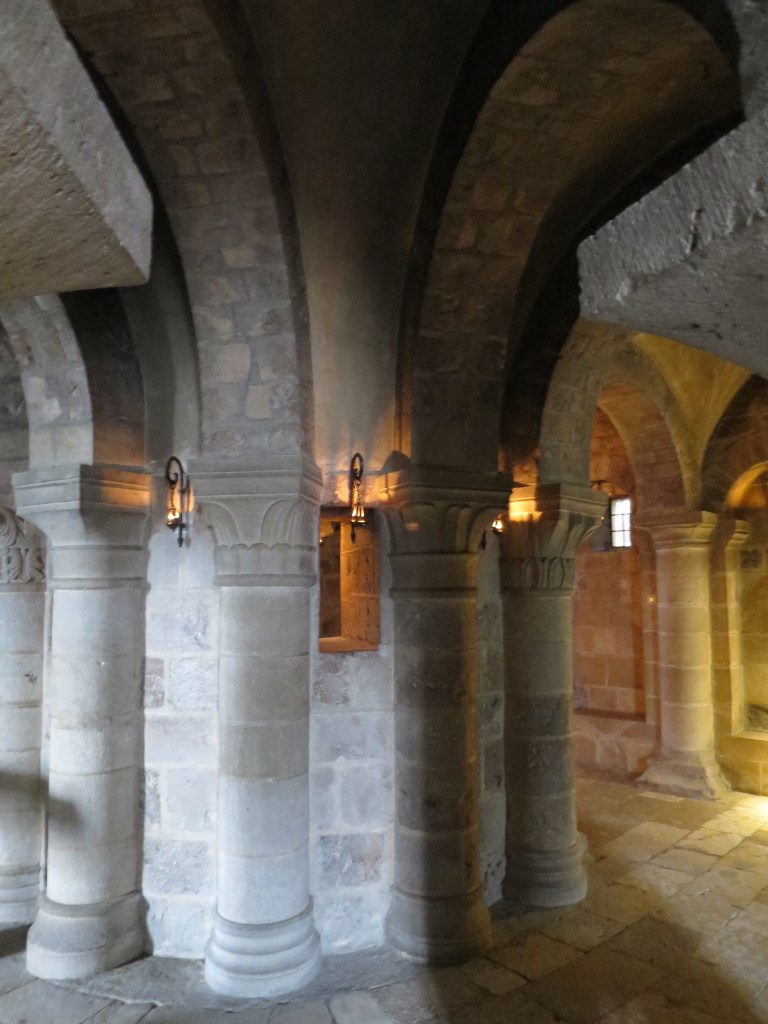
After which I enter the church. It is a fine church, and I can imagine the life spiritual growing up, like stems from a root, from Benedict. Pillars sprout and arch in sprays of masonry up from his bones in the crypt, the upgushing of a spiritual fountain. And the church (The Church) rests upon the foundation of his bones
It was much visited by churchmen, including the pope, the king, and Bernard of Clairvaux in 1130. After the abbey was closed down in 1790, the church was saved by becoming a parish church. The monastic tradition was maintained by having a priest who was secretly a Benedictine monk (shades of Dan Brown!). In 1865 a group of monks came to maintain the presence near the saint. Full monastic life was restored in 1944. The monks perform the offices six times a day.
In this quiet space, I notice two plaques on the wall.
One records a visit here by the dauphin with Joan of Arc in June 1429, when Charles, seeing how tired Joan was, suggested she rest. To which Joan, in tears, replied that she would not rest until Charles was anointed king at Reims.
The Loire was the front line in the Hundred Years’ War (1337–1453), with the English army pouring south. Following defeat after defeat, the last French bastion on the north bank was Orléans. Joan, an illiterate peasant girl of seventeen, after visions of saints told her to drive out the English, had made her way from her home in Burgundy (allies of the English) to the dauphin at Chinon, got into his presence, and persuaded him to let her take part in the relief of Orléans. The breaking of the siege coincided with Joan’s arrival in the field, and was hailed as her triumph. It was the turning point of the war. Within two months she was at the dauphin’s side at his coronation at Reims. Thereafter she helped at the siege of Paris, but was captured when attacking the Burgundians at Compiègne. They sold her to the English.
The English, in their stronghold of Rouen, arranged for compliant French clergy to try her for heresy, declaring the visions diabolical and condemning her. She saved herself by recanting. So, the church required a second conviction. It found her guilty of cross-dressing (when in she only wore men’s clothes in circumstances that the church allowed, for example to deter rape). The records of the trial show that she handled herself with remarkable self-possession and acuity. She was burnt at the stake by the English, aged nineteen, her bones reduced to ashes and dumped in the river – or rather, dissolved in the very water of France. It is one of those stories beyond the power of invention.
But, what are visions?
Rationalist science treats them – has to – as delusions created by neural misfirings within the individual’s brain, products of sickness or overwrought imagination.
Religions, believing in the supernatural, need ways of dealing with visions, especially of separating the true from the false, those that lead us towards God, and those that lead us away, usually towards Satan.
Julian Jaynes writes of a critical change in human history, recorded around the eighth century BC, from a time before, when the gods were ever present, humans conversed with them, and held them responsible for their actions, to a time after, when the gods had absented themselves, leaving humans to make their own decisions. He sees this as the moment of the development of self-consciousness.
But Jaynes, as a scientist, saw these gods not as existing, but as the internalising of the humans’ authority relationships. Whereas I, although a non-believer, want to see it as the moment when we gave up on the gods, on the idea of gods, eventually turning the remnants of the direct experiencing of them into a disease called schizophrenia. And as the moment the gods, if not exactly giving up on us, stepped back, as if unsure of, not safe with, what humans had become.
The problem is that, as Harari makes clear, the differentiating characteristic of Homo sapiens is “their ability to transmit information about things that do not exist at all. As far as we know, only Sapiens can talk about entire kinds of entities that they have never seen, touched or smelled.” That is, imagination. Once this has happened, a species – us – has no way of determining what is ‘real’.
From this follow most of our achievements. And most of our insecurities. The sense of living in a world that is fruitfully malleable, in which perhaps anything is possible; but that is never stable, always questionable.
And where are gods in this? I find myself telling a friend, ‘I don’t believe in gods. But I would not want to live in a world where no one believed in gods.’
And this, from Traherne, “God hath made you able to create worlds in your own mind which are more precious to him than those which he created.”
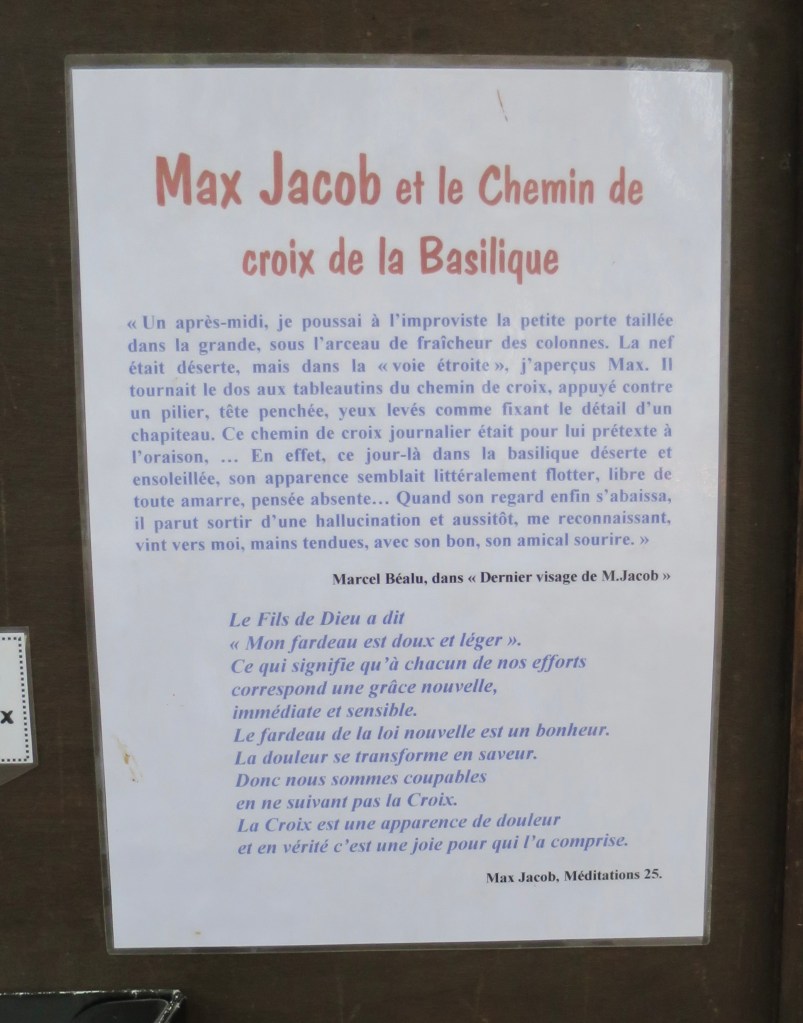
The other plaque is about Max Jacob. He was a writer who befriended Picasso when he first came to Paris, taught him French, introduced him to Apollinaire and Braque. A Jew, he had a vision of Christ in 1909, and converted to Catholicism. In Picasso’s ‘Three Musicians’ he is ‘the monk’. He spent much of the 1920s at St Benoit-sur-Loire, and lived here from 1936 until 1944. Marcel Béalu records entering the church and seeing Max, who was supposed to be studying the pictures of the Way of the Cross, “back turned to the pictures, leaning back against a pillar, head back, eyes looking up, as if fixed on the detail of a capital. His “study” was an excuse for prayer. He seemed literally to float, free of all moorings, without thought, absent … When at last he lowered his gaze, he seemed to come out of an hallucination, and immediately on seeing me, came towards me, hands held out, smiling his lovely, friendly smile.” In 1944 he was arrested here by the Germans, as a Jew, interned at Pithiviers. He died of pneumonia in Drancy before he could be transported to Auschwitz.

I come out of the monastery, out of history, into a light made luminous by the flowing waters of the river. The Loire is ‘Fleury’s golden valley’. Jacob wrote that here he was in the most beautiful countryside in the world, with the most perfect balance between three masses: of stone, of greenery, of water. For him, the Trinity. To which he added another mass – silence.

I meander east in the sunshine, between wide fields and shining river, past a meadow of brown goats, and find a marker for the Meridian, almost buried in midsummer vegetation. The banner talks of the trees planted along its length “establishing a strong relationship between new generations and the environment.” It leans, about to fall. And where are the trees? I’m by the river, at the point where the Meridian crosses the river. Invisibly.
How would different people mark the Meridian?
Grandville, who in 1844 represented the rings of Saturn as a “circular balcony on which the inhabitants of Saturn strolled in the evening to get a breath of fresh air” might have marked it with a carriage way of innumerable iron arches and cavalcades of coaches, north to south.
For 1960s architectural technical utopians, sons of Corbusier, it would be a linear city with a multi-lane motorway running along the top of the buildings.
Ecologists would have a green way, a protected corridor in which wildlife would live unhindered, and providing them with safe migration routes.
The technologically-inclined millennials would have fun with laser shows, waves of light and sound propelled along it.
Half a million people could link hands.
A shouted or a waved message would need just thirty people in each commune to take part, 10,000 in all.
Imagine a shouted or sung message sent along the Meridian.
Imagine a dance in each commune which at an agreed moment stops, and everyone joins hands and connects to the adjacent communes …
Or it could be an opportunity for each locality to find its own form of expression, to express its individuality, that it would share with other communities on Meridian Day, not exactly a competition, but an opportunity to show off …
And here, where the Meridian crosses the great central river of France, how I want an arc-en-ciel, a rainbow of connection across the water! But there’s nothing.
And yet, perhaps the days of such collective action are over. Even on demonstrations there is the sense of atomised individuals absorbed in recording and broadcasting their own experiencing. We are each, now, the star of our own show.
As if in illustration, 5km from here is the village of Saint-Martin-d’Abbat. In 1997 someone proposed that householders customise their letterboxes. (The French, like Americans, have letterboxes at the edge of their property.) Now there over 200 decorated boxes in the village. It was an idea that ‘took’. They variously depict a cow, a dancing couple, a tractor, a fire-hose reel, a guitar, a public telephone box, all sorts. Each is the expression of an individual nature and interest. Like the passerelles at Amiens. And like the passerelles, they are at the limes of the home, the place where the private pagus meets the public realm. Not nationality or locality, but individuality. Not la patrie or le pays, but la personne. “Since 1789, the entire nation, as a people, has unfolded in the purified individual.” (Hugo.) And, however much I may wish it different in others, it is how I have lived my life. Time for dinner.
I eat in my Chinese takeaway. As I begin to eat, prawns instead of chicken tonight, the young assistant approaches shyly and asks if I left a pen here last night, holding out to me my cheap bic. I am touched. I have two pens again. And each, now, resonant with generosity.
Notes:
Guillaume de Lorris wrote the first part of Le Roman de la Rose, which I write about on Day 9.
Day 11: Sully-sur-Loire to Bourges, 62 miles.
Hunting grounds of Sologne. Celtic nemetons. Meaulnes’ lost domain. Alain-Fournier’s birthplace. The closed museum. The first moped. A French ‘Passport to Pimlico’. ‘Êtes-vous pèlerin?’
A sunny day. As I cycle out of the campsite, I wave to the woman at the desk. She raises her hand and smiles. A different sign, signal to each person, an expression of what she has taken from each, an acknowledging smile, the world experienced from her desk.
Heading south, I am soon in the Sologne. What a change! From dreaming river, wide hazy fields, carefully-wrought stone crucibles of the soul, I am in a forest.
And such a forest!
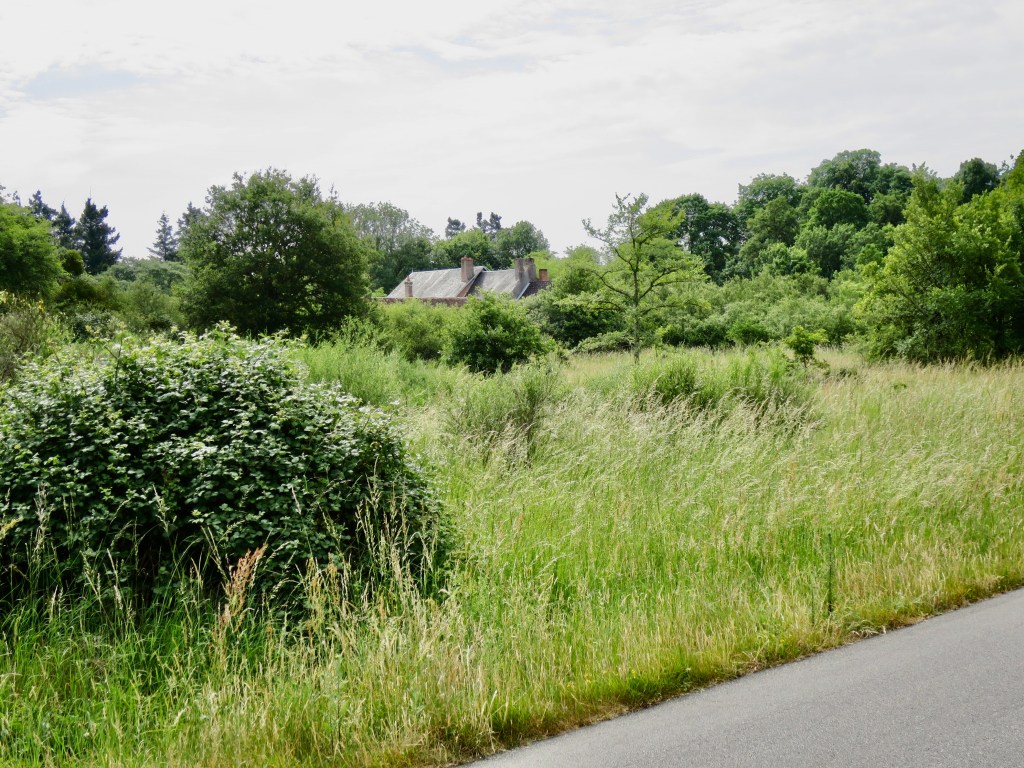
Of turbulent growth, rampant and multifarious greenery, unrestrained vegetable energy, a bursting up, bursting out, with dense trees swathed in vines and buried in thick undergrowth. And a place of wild animal energy, of snorting combative well-being, the grunting, headlong boar, the crashing bellowing stag. Nature let go, left free to its burgeoning, energetic competitiveness. A place not to tame but to fight; not to coerce but to do battle with: a place for man, his ancient blood up, to hunt.
In Celtic times this uncrossable forest marked the boundary between two of the great tribes, the Carnutes, whose capital was Orléans, and the Bituriges, centred on Bourges. It is reputed to be the location of one of the great Celtic nemetons, the sacred groves where druidic rituals were shared between the tribes.
The sort of place that Lucan titillatingly described thus. “No bird nested in the nemeton, nor did any animal lurk nearby; the leaves constantly shivered though no breeze stirred. Altars stood in its midst, and the images of the gods. Every tree was stained in sacrificial blood. The very earth groaned, dead yews revived; unconsumed trees were surrounded with flame, and huge serpents twined round the oaks. The people feared to approach the grove, and even the priest would not walk there at midday or midnight lest he should then meet the divine guardian. At a certain season the druids assemble in a consecrated place on the frontier of the territory of the Carnutes which is taken as the centre of all Gaul.”
And it is the heart of Robb’s Celtic wisdom, a wisdom buried first by the mechanistic Romans, and then by the Christianising Franks. The root of a Gaul that has lived on in the French paysan soul.
Developed as aristocratic hunting grounds in the fifteenth century, the Sologne became neglected, its impermeable soil making drainage difficult, so that by the nineteenth century it had become a “dreary, bare, lake-studded plateau … with its malarious, scrofulous, wretched inhabitants.” (Ormsby). A traveller records in 1863 “a desolate country, crossed by a difficult, sandy, deserted road; not a single château, farm or village in the distance, just a few lonely, wretched hovels.” Such a contrast to the château- and trade-rich Loire valley, the managed Forest of Orléans just to the north! I realise that crossing the Loire I have passed out of the direct influence of Paris (which is only 60 miles north of Orléans), and taken a step deeper into la France profonde.
The area was transformed by Emperor Louis-Napoleon from the 1860s, by drainage and afforestation. A personal interest because his mother’s family, the Beauharnais, lived here. Much of it was then bought up by the new belle époque wealthy for hunting estates.
Hunting, the great aristocratic privilege, had been opened to all at the Revolution, to great rejoicing. And the first day of the hunting season is still celebrated with expeditions and fusillades across the country. I remember being woken by the blaze of gunfire all around our cottage in rural Aveyron, and the neighbour’s son triumphantly returning with a rabbit slung over his shoulder. They shot songbirds and dropped them in the freezer one by one until they had enough for a meal. But by 1820s restrictions were being introduced, hunting was increasingly privatised, and these hunting estates are the result.
Which is how it is today. There are a few signs of agriculture. Here and there a field has been cleared of forest for a crop of hay. Here a bog, there a lake among the trees. There are occasional houses, but behind high walls, buried in trees. There are tracks leading into the forest, but everywhere the signs, ‘no fishing’, ‘no entry’, ‘private’, ‘keep out’.

I find a Meridian marker, and a road running south, on the Meridian.
I have just passed 500 miles on my milometer. I stand on the white line, photograph its recession to the vanishing point between the trees, imagine it across France to the Pyrenees.
By the road are rough platforms. I imagine them to be the platforms that the original surveyors built, where they took their readings and made their meticulous notes. But they are for the guns (the instrument becomes the man) to shoot from.
In my ride along empty lanes through the forest I come upon villages buried among the turbulent vegetation and hacked-out farm land. A house in this village has long ladders fixed diagonally across its walls as decoration. On a gate in this one is a handwritten sign, ‘Ste-Montaine in peril. No to the quarry.’ There are apple trees and pear trees and vines. A length of road has an avenue of large trees cut down, tree after tree. They lie like fallen idols, or gods, the resinous smell is of their ichor.
It is a place to explore, get lost in, to follow intriguing tracks leading off into the woodland. But every one has a sign, sign after sign, ‘no entry’, ‘private’, ‘keep out’. A privatised realm, enforced by the powerful.
But it is exactly in these unmade roads winding into the forest, the buildings glimpsed through the trees, the secret worlds at the ends of tracks, that my interest lies. For this is the world of the ‘lost domain’ of Le Grand Meaulnes. I am, at last, in Alain-Fournier’s Sologne.
Le Grand Meaulnes was Alain-Fournier’s only novel. He was killed, age 27, in the second month of the Great War. For the French the book represents the world lost in that cataclysm: not just the old world, but the young men, and the possible futures. It fixes the moment after which nothing was the same again. It is a school set-text.
For myself, and fellow discoverers, it is one of those books that, if it catches you at that right moment, when you are young enough to crave adventure, old enough to be romantic, it keeps hold of you. You find your hand straying to it late at night, and you reread it, alone in the night, in the light of a single reading-lamp, your home, wife, family, life all around you out there in the dark beyond the lamplight, and you shake your head and smile, and go deeper each time into its labyrinth of friendship, love, loss, yearning, acceptance, while gazing often out into the dark.
I turn south east, out of the Sologne, towards the birthplace of Alain-Fournier at La Chapelle-d’Angillon.
Looking at the map, I see that a few miles north (past La Surprise, yet another intriguing name on the map I won’t visit) is Aubigny-sur-Nère. A ‘Franco-Scottish’ festival is held on Bastille Day. The ‘Auld Alliance’ between France and Scotland is traced back to 882. It is an area where, according to Robb, Scottish veterans from the Hundred Years War were settled. I wonder if my bagpipe-playing friend is of the same clan. So many places passed, unvisited, on this trip, because of the discipline of the Meridian.
La Chapelle-d’Angillon in the midday sun, hot now, is deserted. Doors and shutters are closed, there is no sign of a shop. Just a bar, long closed, now a house that has kept the fading sign, ‘café A.Mercier, bar’.
Fournier’s father was the schoolteacher here until Henri (as Alain was christened) was five, when they were moved to Epineuil-le-Fleuriel, in the south of the département. His parents returned to teach here when Alain was eighteen, when he was at school in Paris. And they were still here in 1914, when he died.

The place of his birth, 35 Avenue Alain-Fournier, is a neat house that must have been new in the 1890s, a child’s picture of a house, with a pitched roof, two windows for eyes upstairs, and a door like a surprised exclamation. It even has an ivy nose.
But all the shutters are unpainted and rusted shut, and the garden is overgrown, with unpruned white roses and red camellia climbing the front. On the gate-post there is an enamel sign, ‘Member of the Federation of writers’ houses, and the literary heritage.’ Patrimoines littéraires meaning so much more in French, and to the French, expressing both national identity and uniqueness. French exceptionalism again.
I cycle past the locked mairie, along a street emptied of all life (not a cat, not a bird), sharp angles of light and shadow, to a mural covering the side of a house. It is a feature of French towns and villages, this painting of large, descriptive murals on the rendered end-walls of houses.
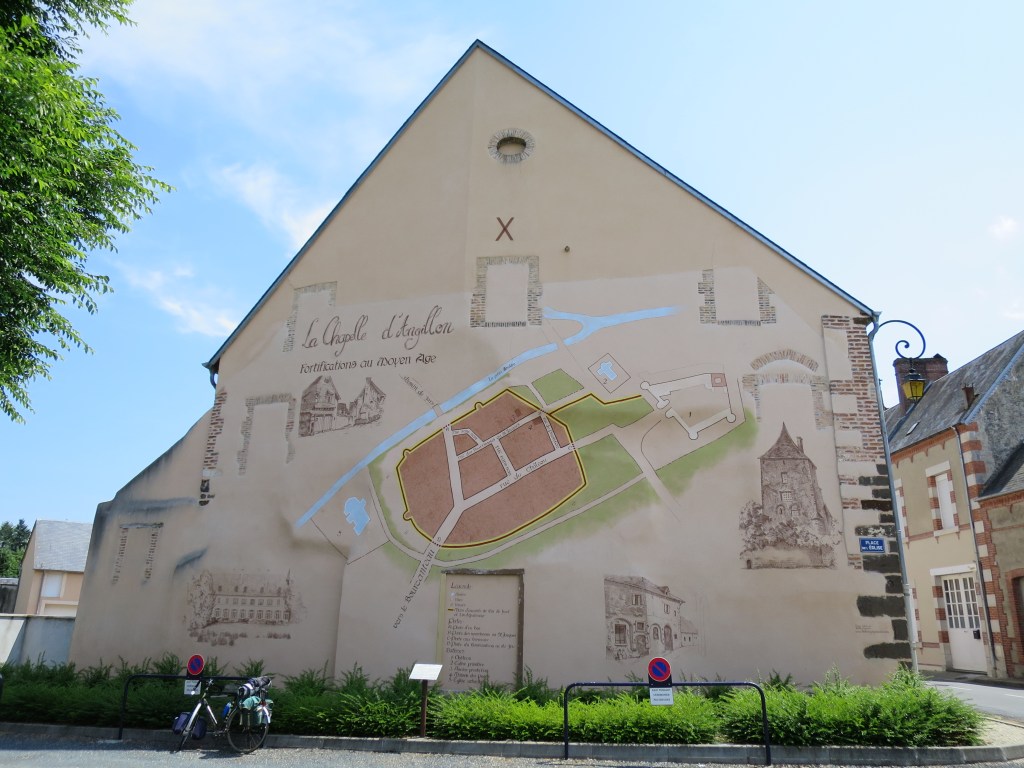
This one depicts ‘La Chapelle’s medieval fortifications’.
Next to it is a board telling of a Greek hermit who settled by the river here, among the beehives that belonged to Bourges abbey. After his death in 865, the faithful came to pray at his tomb, Monks from Bourges built a chapel for the pilgrims (for prayer, and to collect donations). La Chapelle passed to Gilon of Sully. He was a descendant of the Vikings who had rowed up the Loire in the ninth century and sacked Theodulph’s palace. In 1064 Gilon gave the monks the right to glean in the forests, fish in the streams, and cut enough wood to build a new priory. He also fortified the village, and built the château. The archbishop who built the great gothic cathedral of Bourges came from here.
But my priority is Alain-Fournier. There is a museum dedicated to him at the château. And I have questions to ask. While the geography of the book, the towns and villages mentioned and the area he gets lost in, ‘in the whole of the Sologne it would have been hard to find a more desolate spot’, clearly refer to this area, equally clearly the house, school, and the village he wrote about bear no resemblance to what is here. I’m hoping the museum will unpick the story. I head for the château.
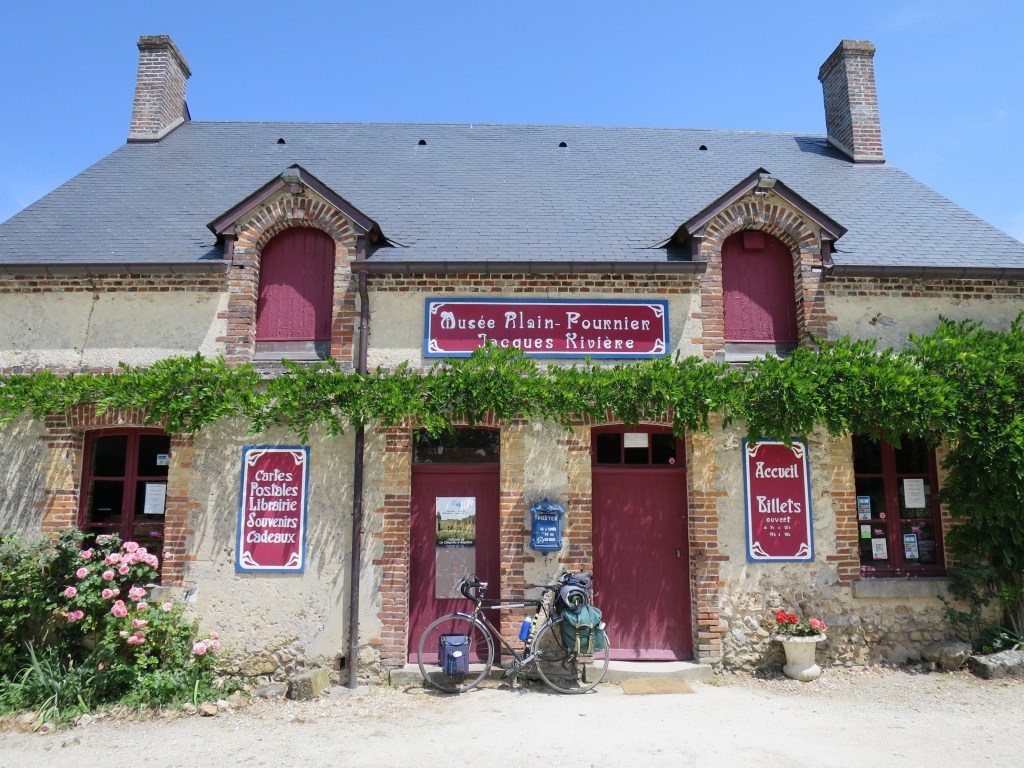
The museum is in a neat brick building, ‘Musée Alain-Fournier Jacques Rivière’ (Rivière was the close school friend who married his sister), in smart art-nouveau lettering. ‘Ouvert 14h à 18h’. It is 15h, and very fermé. It is as shuttered as his birthplace.
The château is a tall, four-square building, a keep, set in a deep moat. It has round towers with conical roofs either side of the front door. I cross the drawbridge. On the door, in French, ‘Welcome! To the ancient sovereign principality of Boisbelle. To visit please ring the bell.’
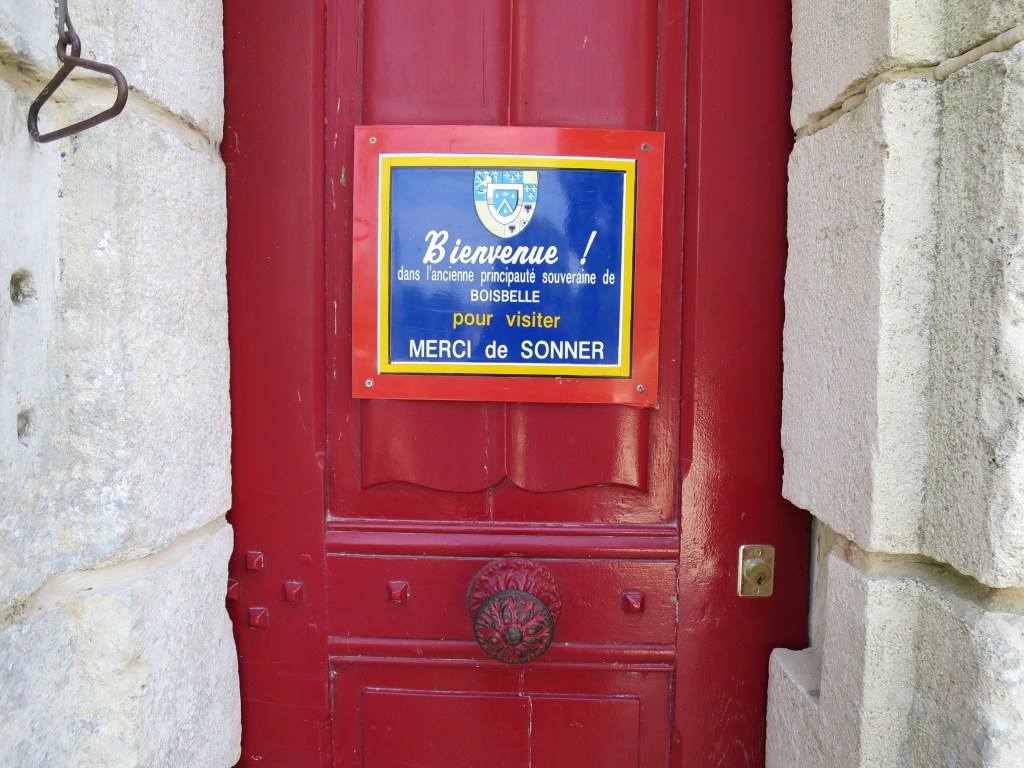
I yank the ancient bell pull. The bell clangs sonorously. I wait for slow steps on stone, the creaking of rusty hinges, the dusty retainer. Or even the ‘sovereign principal’ himself. But no one comes. Many of the windows are broken, and it all looks rather dilapidated.
But when I walk round the back, there is a large visitor car park, carefully laid out, with signs ‘do not drive on the grass’. Completely empty. The place has been arranged as a major tourist attraction, but is quite deserted. Perhaps a case of ‘build it and they will come’, but they came not? Or perhaps a place that only comes to life in the two months of French holidays.
Past the car park it opens out into a deer park, with a lake and a splendid giant cypress tree. At the back of the château, overlooking the moat and the park, and facing the sun, there are well-maintained brick buildings around an attractive courtyard, with flower beds, statues and several modern, expensive cars. Signs of a comfortable life. But no one.
I head out of the village, having seen no one, and found no answer to the mystery of Meaulnes’ ‘lost domain’. I head out on a minor road towards Bourges, to avoid the dead-straight D940.
Through the village of Ivoy-le-Pré. This is the birthplace of Felix Millet, who invented a rotary engine that in 1892 he attached to the back wheel of a bicycle, creating the first moped. It was the progenitor of France’s universal Solexes, eight million of which were made. The very image for adolescent us (still on push bikes) of young France. With a ‘cool’ quotient (especially when a slender girl with flying hair was bouncing along on it) the moped could never match.
A failure in the 1895 Bordeaux–Paris–Bordeaux motor race ended its commercial life. “By 1900 the Millet marque had disappeared.”
But the engine had a second life as an aircraft engine in the first World War, and many planes were powered by it.
How did a man from a village in the middle of nowhere, at a time when the bicycle was a novelty, and in the earliest days of internal combustion engines, come up with such an idea, build a prototype, and develop it on a commercial scale? I guess he was the equivalent, in his day, of today’s kids who develop killer apps in their bedrooms.
In Ivoy is yet another renovated washhouse. On it a sign: ‘Contes et légendes de nos lavoirs en pays Sancerre Sologne’, and the tale of a grumpy, plough-throwing, bachelor giant.
The Principality of Boisbelle, I discover, was a kingdom within the kingdom of France. An independent realm in which the Prince of Boisbelle had sovereign rights, to make laws, administer justice, and mint money, and where the inhabitants paid no taxes. They were exempt from the hated gabelle (salt tax) and the equally hated corvée (the duty to provide their labour for road upkeep), paying dues only to the church. And they were exempt from military service. This utopia was established by the descendants of Viking pirates, and the privileges were repeatedly renewed until 1766.
This curiosity was, curiously, bought in 1605 by Maximilien de Béthune, first Duke of Sully, Henry IV’s chief minister, when his main base was at Sully-sur-Loire. Curiously, because Sully’s main achievement was in unifying and centralising the French state.
But he was a devout Protestant. (As was Henry, but he had converted on becoming king, to stop the ruinous forty-year wars of religion.)
In 1609 Sully began to build, in the middle of Boisbelle, 10km from La Chapelle-d’Angillon, a new town, dedicated to Henry, called Henrichemont. He designed it as a square within a square, with geometrically radiating roads. It represented an ideal harmony. It had its own money, its own mint. What was his idea?
To provide a refuge, in this state within a state, for Protestants, who were still persecuted in spite of the Edict of Nantes of 1598? Was he, in this, secretly encouraged by Henry? It did indeed become a refuge for persecuted Protestants.
Or was it, rather, the blueprint, with its geometrical harmony, for a harmony between Catholics and Protestants? It was, after all, planned to have both Catholic and Protestant churches.
Was it to be the capital of this state within a state, where Sully could, in small, work out ideas that he might then apply to France as a whole?
Who knows what might have happened here, what example might have been set? But this is my imperturbable faith in utopian thinking. Whatever, in 1610, a year after Sully began building his new town, Henry was assassinated. Within months, Sully had fallen from power. In 1685, after the Revocation of the Edict of Nantes began the renewed active persecution of Protestants, the Protestants left the town.
The Henrichemont I cycle through is an ordinary small French town, its high concepts neglected, its ideal proportions blurred, obscured by time, practicality, and forgetting.
In 1766 Sully’s descendant gave up the Principality to the crown, and it lost all its privileges. Although you can still buy its coins in the collectors’ market.
What was a candidate for a French version of Passport to Pimlico had become a might-have-been.
Although that doesn’t stop me, as I cycle along the quiet roads under shading trees, writing the script. It would involve the eccentric but canny aristocrat of La Chapelle, his feisty daughter, the radical schoolteacher, the tax-avoiding, smuggler-peasants, the recently-arrived eco-activists, the at-first scandalised, but then gleefully complicit priest, in an unlikely alliance of utopians …
I pass the villages of Presly, Pigny and Fussy, who become, on a long slow climb (oh for Millet’s startling, rotating engine!), a trio of loveable, hairy dwarves forever playing tricks on grumpy, plough-throwing giants. Such japes!
At the top of the hill I have my first view of Bourges, its great cathedral almost celestial in the late afternoon light, a shimmering destination for devout pilgrims.
‘Êtes-vous pèlerin?’ The girl on reception at the youth hostel in Bourges asks casually. A pilgrim, me …?
‘Sorry?’
‘Are you on the Camino?’
Bourges is on one of the routes to Santiago de Compostela in north-west Spain. Do many pilgrims stop here? I ask. Yes, many, she says.
The relics of St James became a popular pilgrimage destination after the ‘discovery’ of his bones at Compostela in the ninth century. It is glib, but not without a germ of truth, to see our holidays as echoes of medieval holy days, and tourism our pilgrimage.
For don’t we holiday for ‘re-creation’, to recover our lost selves, to come face to face with our true selves?
Don’t we often return from our holidays determined to change our lives?
And with the growth of adventure holidays, extreme experiences, cultural tourism, aren’t holidays becoming more pilgrimage-like, our substitutes in an age of unbelief for the journey of spiritual significance?
There has been an enormous increase in recent years in pilgrims to Compostela, whether believers or not. Am I a pilgrim?
In his 1140 guide to the Camino, Pope Callixtus II writes: “The pilgrim route is a very good thing, but it is narrow. For the road which leads to life is narrow … it is the thwarting of the body, the increase of virtues, the road of righteousness, love of the saints … it makes gluttonous fatness vanish, constrains the appetites of the flesh … cleanses the spirit, leads us to contemplation.”
And my journey?
The road is narrow, certainly, but I allow myself a capricious latitude from it.
It is less a thwarting than an exercising of the body.
I have sought out the shrines of my saints; but are they saints in any meaningful way?
Gluttonous fatness is certainly vanishing, as are the appetites of the flesh; but I welcome their absence because it increases my sense of well-being, rather than experiencing it as penance.
My life has simplified, and I am thinking a lot. Is that a cleansed spirit and contemplation? Or just mental meandering?
Doesn’t the personally-determined nature of my journey damn it as self-indulgent, a self-selected piece of cultural tourism?
And isn’t that just a fancy name for a holiday with pretensions?
And am I not just wheeling over the surface of ‘le Spectacle’, that simulacrum of reality created by consumer capitalism? And less ‘experiencing’ it than recording it, with notebook, tablet, phone, camera? To what purpose?
‘Êtes-vous pèlerin?’
‘No,’ I reply. But, still, I’m not sure.
Day 12: Bourges to Vallon-en-Sully, 68 miles.
The ambassador. Wild music from the cathedral. The pizza-man. Jacques Coeur and alchemy. The gnomon. Saint Sulpice and the Rose Line. Zone of Occupation. The many centres of France. ‘The Martyrs of Vingré’. Dinner beside the canal. Evening thoughts.
Cycling out of Bourges, towards the Meridian, which passes 2km west of the cathedral, I come upon a poster that sums up my problem with the city. It says, ‘Like me, become an ambassador for Bourges.’
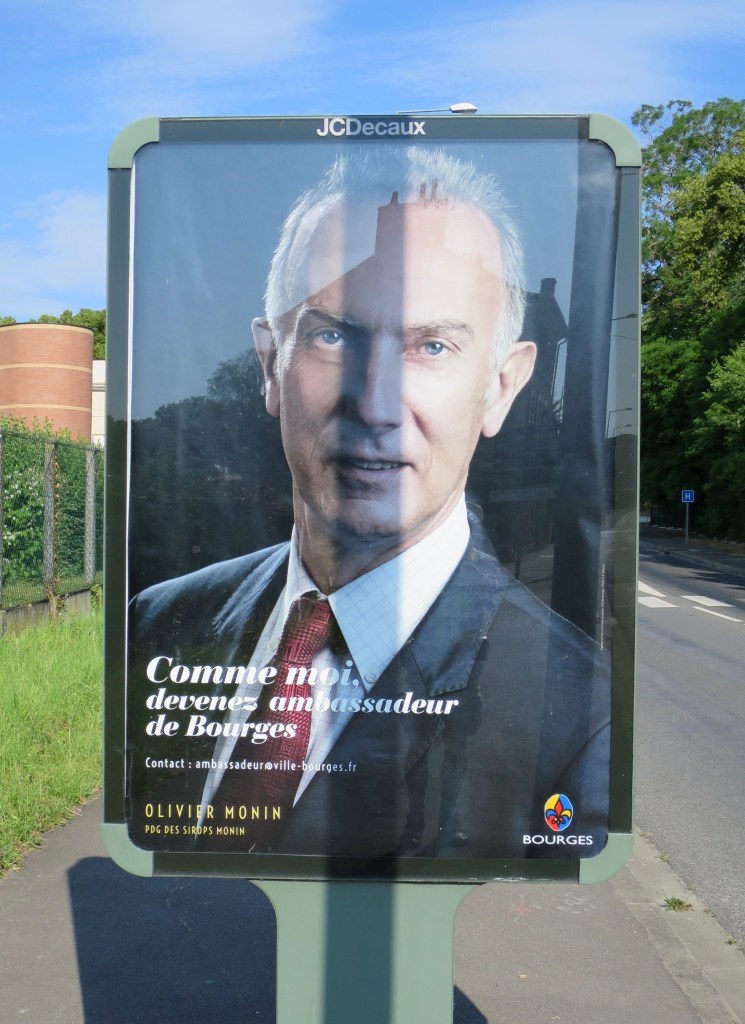
The photograph is of a man in his sixties. But the modern, slim, healthy, prime-of-life sixties, white hair cut en brosse (to express vigour), direct gaze of penetrating eyes that engage and yet are slightly elevated, as if he sees beyond. A serious face, but with a slight crinkling of the eyebrows to show that he hasn’t quite solved all life’s problems, he accepts that life can be a funny old thing, but that, whatever comes up, you can trust him to be on top of it. In a dark suit, a restrained silk tie, a formal shirt that yet has a fine check and button-down collar. It is a calculated photograph, carefully calibrated. It is a political photograph.
Seeing it, I am reminded of Roland Barthes’ essay ‘Electoral Photogeny’. In such a photograph, the man’s effigy both elevates and distances him, while at the same time establishing a complicity with the viewer – this is a man you can trust to act in your best interests (even if you haven’t realised they are your best interests), who will apply his best efforts (so much superior to yours) to ‘being an ambassador’, and by so doing, both relieve you, and strip you, of – engagement. All contradiction is resolved. ‘All this coexists peacefully in that thoughtful gaze, nobly fixed on the hidden interests of Order,’ concludes Barthes. The photograph mediates. And this is a city that feels so well-ordered, smilingly opaque, that it feels all mediated.
But perhaps, arriving late, and leaving early, I haven’t given it a chance, now that I’m leaving … To return to my arrival yesterday.

The atmosphere has been building all afternoon, and it is hot and heavy, close, when I arrive around 5pm. I cycle past a fine trompe l’oeil scene on the side of a house, depicting an idealised medieval town centre, looking so three-dimensional that I can imagine riding into its quirkiness.
But the city centre itself is anything but quirky. It is foursquare and steady, solidly prosperous, and without such jeux d’esprit, such off-centredness, oddly flat. Even a fine medieval carved-wood facade looks over-finished.

From the bruised gloom bursts a short, large-dropped shower that wets and adds to the humidity, without clearing the air.
They are smilingly pleasant in the tourist office. But I am finding this a hard place to like.
It is similar to Amiens in its layout, with citadel and cathedral on high ground at the centre, and river and marshes (now recuperated for recreation) to the north. But whereas Amiens felt open, lively, and rather ramshackle, Bourges feels prosperous but ponderous, smiling but stolid, solid but dull.
Perhaps it’s my mood, but the great cathedral also strikes me as ponderous and dull. It is the most southerly of the ring of Gothic cathedrals around Paris, and was modelled on Notre Dame. But, without transepts, with five aisles, and very little light from the apse, it is dark and uninspiring, a dark barn, a retail shed of religion.
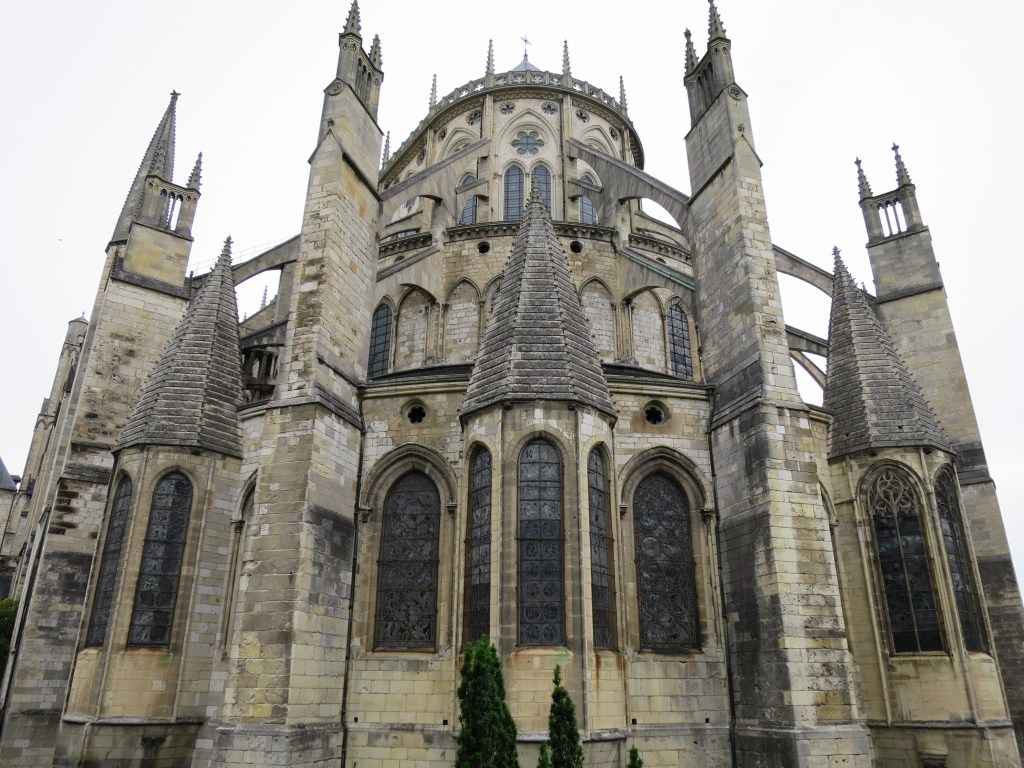

And outside, even the fine array of flying buttresses looks more like careful engineering than daring-made-stone. Is it simply the lack of the visual excitement created by Amiens’ water-spout gargoyles, the buttresses-upon-buttresses of Beauvais? Maybe here they were cleverer builders than at Beauvais? And they didn’t need Amiens’ waterspouts because it’s drier here? But they could have come up with something! This a place built within bounds, there is no risk, no inspiration, no aspiration. Light is excluded, and the stone weighs heavy. And heavy with symmetry and thudding symbolism – five aisles, five radiating chapels, five doors in the West front, to represent the five wounds of Christ. Even the highly-decorated West front looks fussy, grandiloquent rather than grand. Sorry, Bourges.
Disappointed, unsettled, I head for the youth hostel. Which is another disappointment. It is a grudging place, run more for their than the travellers’ benefit. The way to judge a youth hostel is by its breakfasts. I will see tomorrow.
I go out to find food. I walk past the West front of the cathedral in the evening light.
From inside, from behind the ‘frozen music’ of detailed carving, comes actual music: a thrilling, crazed combination of bagpipes and organ, the bagpipes piercing and keening, the organ thundering solid masses of spectacular chords.
What mad goings-on inside, the organist freed from liturgies in a clashing, harmonising battle with his virtuoso bagpipe-playing friend (perhaps Michael Aye himself)? Imagine the delight on their faces!
What must it be like inside, the cathedral unlit, a couple of candles creating strange, trembling shadows, the vast dark, the rumbling in the blood in each of them, the contrasting notes from the two instruments vibrating every surface …? I try the door. It is locked.
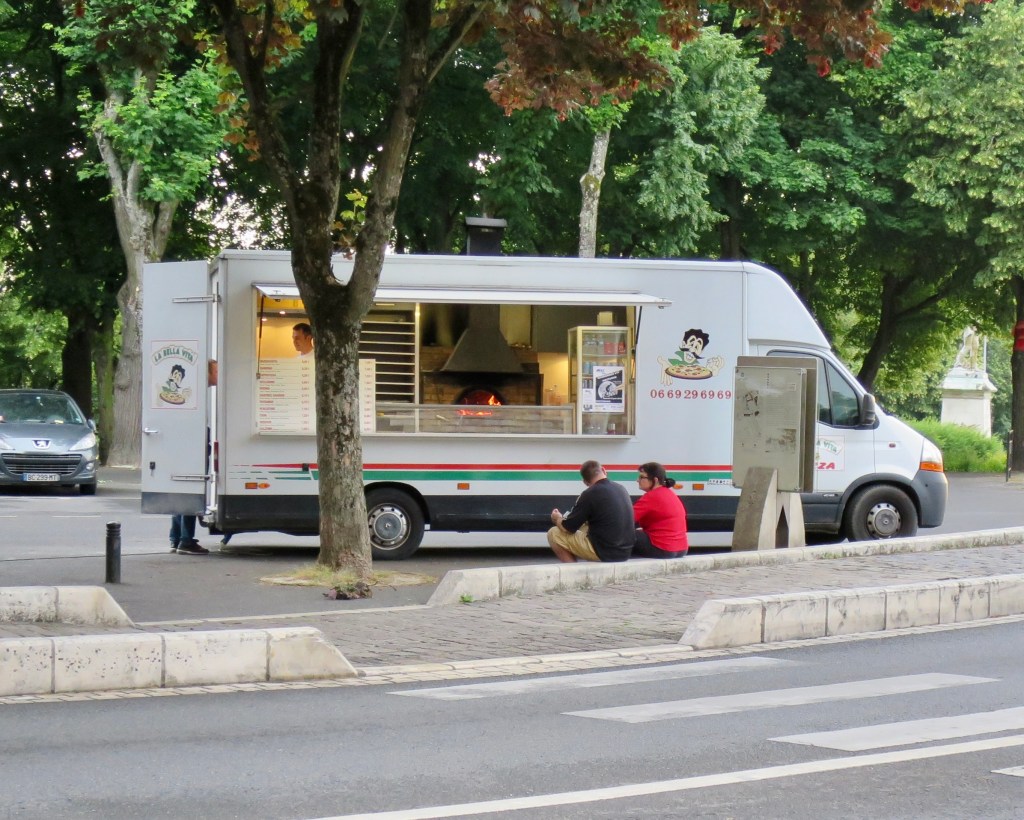
Walking back across a car park of fiercely-pollarded plane trees, a pizza van is open for business.
But no ordinary pizza van.
In the back, behind the serving hatch, is a large, open oven burning red with logs. The pizza man takes the order (from a list of twenty or more), and chatting the while to the customer, takes a piece of dough, passes it quickly first this way then that way through a mangle to produce a paper-thin base, then with rapid sweeps he coats it with tomato and grated cheese, and the pieces of chicken, tomato, pepperoni, prawns, mushrooms, whatever, to make up the ordered pizza. All this done with quick, precise movements while he engages with the customer.
He slides a flat wooden shovel under the pizza and pushes it into the furnace, to the edge of the burning logs. Surely it will burn?
No, with practised dexterity and skill – this man is an artist! – he manoeuvres it round four times with his paddle at exactly the right moment, so it cooks in from each edge. Then he pulls it out, places it in the box that he has in the meantime made up from a flat sheet of cardboard, labels it, passes it across, already turning to the next customer.
I open my box. The pizza is burnt at the edges, but a flavoursome burntness. And it is cooked through to the middle. It is a superb pizza. He is a master artisan, a practical genius. How I admire hand skills!
And he’s also a salesman. I note how he engages each person who comes to the van, to hold us no matter how busy he is, to get us in the queue, where we quickly become an intrigued audience. And the way he begins the next pizza while this one is in the oven, turning from his preparations just in time – quick! we want to shout, it’s about to burn! – to turn it deftly through another ninety degrees, a constant banter and by-play, perpetually working.
I sit on a wall, admiring a craftsman at work, and eat with relish, with a beer. A fine pizza, and crazy music – surely enough to beguile me? But I return to the empty, disappointing hostel, looking forward to leaving this disappointing city.
And yet in the night, these thoughts about Bourges.
It has been an important centre since Celtic times: it was the capital of the Bituriges, and it was the one Celtic city Vercingetorix could not bring himself to destroy in his scorched-earth policy in his war with the Romans.
It is almost at the centre of France. It is surrounded by rich farm land. It has, or had, my 1931 Geography tells me, ‘remarkable nodality’, with six main railway lines, and a dozen major roads radiating from it, as well as commanding important east-west and north-south routes.
And it is on or near several of the lines that divide France.
The line, from Biarritz to Strasbourg, that divides Highland France from Lowland France.
The language division that curves up from the mouth of the Gironde estuary to just south of Bourges separating oc south from oïl north.
The St-Malo–Genevaline, that has long been taken to mark the division between the ‘mature’ North, and the ‘undeveloped’ South, where the people were supposedly less literate, smaller, shorter-lived, more criminal, with a more backward agriculture, and in general less enterprising. (Amazing how a stereotype developed with the North’s victory in the Albigensian crusade, has been perpetuated for 800 years!)
It is at the southern edge of the reach of the scholastic Île-de-France.
And on the northern border of lively Aquitaine, home of the troubadours. It is on many lines of division. It could, thereby, be the great unifier. The place where difference meets, connects.
It should be the capital of France!
Indeed it was here that Louis VII, king of the Franks, unified North and South when he married Eleanor of Aquitaine in 1137. He was crowned in Bourges cathedral. But when he divorced her – against the advice of his wise counsellor, Abbot Suger – her subsequent marriage to Henry II of England precipitated 300 years of war.
No, France will always be centred on Paris. Bourges, for all its centrality, will always be peripheral.
Bourges’ most famous son is Jacques Coeur (1395–1456). At the time of Joan of Arc he founded a business empire, based on trade with the Levant, that made him within a few years the richest man in France. His money enabled Charles VII to push the English out of Normandy. He built a spectacular palace in Bourges. He was a confidant of the king, and reformed the mint for him. The Celtic ‘Bituriges’ means Kings of the World: Jacques Coeur was an early Master of the Universe.
But his wealth was his downfall. He had taken too much trade from other merchants, and lent money to too many nobles who didn’t want to repay him, and therefore had an interest in bringing him down. He was found guilty of trumped-up charges of treason, and his enormous wealth was distributed among the king’s allies. He never got to live in his new palace. The man on the poster, the Ambassador for Bourges, would approve Coeur’s entrepreneurship, but shake his head at his lack of understanding of tall poppy syndrome: one must get on, but be clubbable, Bourges-style.
Hardly of interest to me, the story of a man obsessed with building a financial empire. Even his opulent high-Gothic palace looks like overblown Gothic-revival.
Except that there was talk that he was an alchemist, literally ‘making money’. This was stated as fact in Fulcanelli’s seminal Mystery of the Cathedrals. And esoteric images have been found in the decorations of his palace. He was in Syria in 1432, and made his money trading with the Arab world. And ‘alchemy’ is an Arabic word. (From which chemistry developed. “But if you look at the history, modern chemistry only starts coming in to replace alchemy around the same time capitalism really gets going. Strange, eh? What do you make of that?” (Pynchon). A thought for another day.) But the true aim of alchemy is the transmutation of the self.
Meanwhile, there is the gnomon in the cathedral.
This is a narrow brass strip let, on a north-south line, into the nave floor. The sun shines, through a small hole made in a stained-glass window, onto this line every day at midday. Its position on the length of the gnomon tells which day of the year it is. It was used to determine Easter.
This reminds me of the gnomon in Saint-Sulpice in Paris, which Dan Brown, in his hectic holy-grail thriller The Da Vinci Code says is ‘built over the ruins of an ancient [Celtic?] temple to the Goddess Isis’. He says it is on the Rose Line. Okay, he conflates it with the Paris Meridian, which in fact is several hundred yards to the east. But parts of Bourges are on the Paris Meridian. And Saint Roselin’s (Rose line) day is 17 January. Saint Sulpice was bishop of Bourges and died here in 647. And his day is – 17 January. He was buried at a monastery near Bourges, and his tomb soon became a place of miracles. What if the monastery, and tomb are on the Meridian …?
The idea of making a hole in a stained-glass window to allow in a ray of light brings to mind Leonard Cohen’s ‘there’s a crack in everything; it’s how the light gets in.’ The idea that the ‘real’ light is too bright for us to endure, that material and conceptual reality exist to filter and ‘colour’ it, so we are able to live in a sensory world.
And how well that hole in the many-coloured narrative of the stained-glass window, letting in the pure light, illustrates it! Moments of sudden insight give us apprehensions of it, the light beyond light.
It is an idea that is basic to all esoteric and religious thinking. It was where I turned when I ‘lost my faith’ in the rational world-view of my education.
And something in me feels, however faintly, that there is a bigger world, that the rational/scientific is a man-made room, a Truman Show world, its firmament a painted ceiling, within a so-much bigger world.
The Meridian crosses the road at Pierrelay. There is no sign of it. But Saint Sulpice was buried in a monastery which lay “in a most lovely place between two rivers with pasture and wood and vineyards in great number, with fields and rivers flowing between huge plains so that there, the inhabitants may be seen to possess the image of paradise.” It could easily be here.
And buried in the crypt of Bourges cathedral is the Duke for whom the Très Riches Heures de duc de Berry (now in Chantilly) was made, a book that recorded the long agricultural prosperity of the fifteenth century, 70 years of good harvests, a sort of earthly paradise.
So, spinning around Bourges is one of the chakras I am visiting along this spine, reflecting my time at the esoteric bookshop. I am spiralling a new connection up the Meridian to Paris, and down the Meridian to Pic de Bugarach.
To return to this morning at the hostel. The breakfast had been as poor as I feared, hard bread, thin jam, weak coffee. A young Norwegian couple were stoically eating when I entered. I showed them how to eat French style, dunking jammy bread into a bowl of coffee. But the girl is so fastidious that she has managed to eat a breakfast of shrapnel-flying bread on a 7-inch square of napkin, which she then folds carefully with the crumbs inside, leaving the table clean.
They are inter-railing, heading now for Lyon, and then to Italy. I say, stay in the north, visit Florence, Venice. They’ve done France in four days, they’ll do Europe in a month. A greatest-hits tour.
But they are young, it is a scoping trip, finding places to revisit when they are older, still together in twenty years, with the kids. I say that the Norwegian currency is strong. He says it has fallen with the oil price drop. I say at least your country looked after their oil revenues, investing them in sovereign wealth funds, while we spent ours. He says, before the oil we had only fish. And after? I ask. Maybe something else will turn up, he says. The young.
From Pierrelay, and the imagined monastery, I cycle through the lanes, heading for the D73, the road south that runs closest to the Meridian. There are many cyclists out in groups. They flock together, French cyclists, and I exchange noisy greetings with them.
At Trouay the village shop and post office are newly reopened, by a North African couple. She is head-scarfed and calm, good with customers, he has the restless energy and work ethic of the ambitious. They speak French to the customers, Arabic (I presume, from the sound) to each other.
Leaving the village, I come, with a shock, to a marker for the Line of Occupation, established by the Armistice of 22 June 1940. I am about to cross from Occupied France into Free France. Yet another demarcation line close to Bourges!
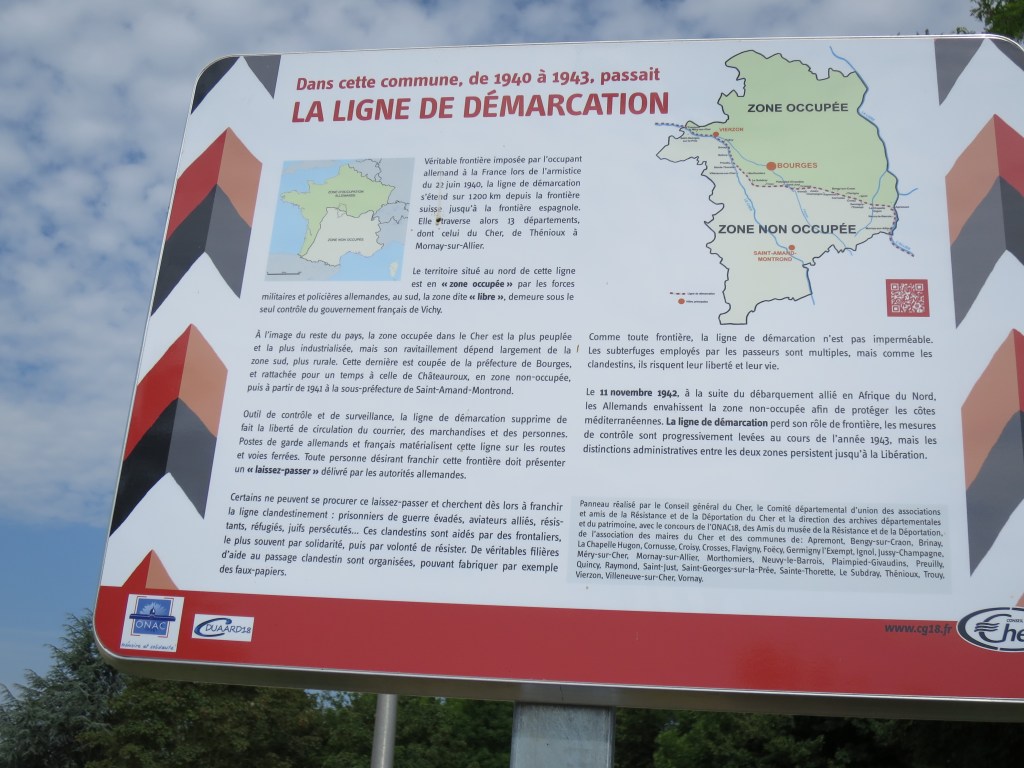
I’ve read about it, how in the North they chafed at the privations, the indignities, the shame of Occupation, where any reaction was treated harshly, and each had to make his existential decision to be collaborator, accepter, resister. While in the South many were happy to have got rid of the third republic and its ‘Jews and lefties’. Some were happy with Pétain’s fascistic leanings, seeing Britain as the enemy. Others thought, at first, that he was a cunning patriot, playing the long game, and planning to rise up, at the right moment, against Hitler. And I imagine the difficulty and the indignities involved in simply getting across to Bourges to shop, to trade.
It was expected, the French government’s Armistice with Germany in 1940, to be interim; a final settlement would be made when Britain saw sense and sued for peace. “The immense majority of the population welcomed the armistice with infinite relief, and the Republic disappeared on 10 July to general indifference.” (Gildea.)
The Armistice of 1940 deliberately mirrored, in reverse, that of 1918, which had in turn reversed that of 1870: Alsace and Lorraine to Germany, heavy reparations, a limit to the size of the army. It was signed at Compiègne, the same place, and in the same railway carriage as that of 1918. The Germans occupied all the Atlantic coast, the industrial and mining areas of Northern France, Paris, and the rich agricultural lands of Beauce and across the Loire to Bourges.
The Line was crossed by the Germans 11 Nov 1942, when the Allies landed in North Africa, and the whole country was occupied.
Némirovsky’s Suite Française gives a vivid account of the chaotic and self-serving flight south before the German advance, and of the difficulties and compromises faced when occupied by a powerful and ruthless enemy.
What to think? How simple for we British, isolated and bombed, but moated and ‘in the right’. How complicated for the French, to come to terms with capitulation, ‘Collaboration’, ‘Resistance’. And no wonder the speed with which France embraced a new European order after 1945, to end the cycle of wars. (It is an irony that, after two catastrophic defeats, in the post-war settlement Germany achieved both the Kaiser’s aim of a Franco-German customs union, and Hitler’s of a Europe united under German hegemony.)
And perhaps no wonder Britain’s uncertainty with that new post-war order, our ‘holding out’, giving a boost to our own brand of exceptionalism, the aloofness of the island race, the clinging to its memory of being the great imperial power, the illusory belief that Britain had won the war (when it was US and USSR). Easy to see the EEC as ‘provincial’, ‘continental’, the solution to a little local difficulty.
I head straight south. The wind is from the south-east, but it is light, and the sun is warm. There are shaved fields where the hay has been cut. The winter barley is well ripened, peach-coloured, ruffled by the wind as by a soothing hand. It is a wonderful cycling day. And there is little better than cycling in France on such a day.
At Bruère-Allichamps I come to ‘The Centre of France’.
There are many ‘Centres of France’; I will visit several today. This one is marked dramatically, at the southern end of a 35km dead-straight road from Bourges, by a Roman military marker, topped with a French flag, in the middle of the road. The marker was recovered from the cemetery, where it had been used as a gravestone for 1500 years, and set up on a small traffic island at the crossroads in the centre of the village. It was Adolphe Joanne, a nineteenth-century writer of popular travel guides (they became the Guides Bleu) who designated this as the Centre.

Once the busy RN144, now it’s the departmental D2144, bypassed by the A71 motorway, and it carries little traffic. The village snoozes quietly in the midday sun, in that French small-town way, with the shops closed, and low noises of dining and conversation coming from the bars and restaurants at the crossroads.
But it was once a Route Nationale. I remember these racetrack villages, smelling of diesel, coated in a film of tyre rubber and brake-pad asbestos, shaken by the vibration of noisy lorries. I can imagine a motorcyclist heading north, dipping out from behind a lorry at the beginning of the 35km straight, accelerating towards the open road, imagining the speed he will reach, and wrapping himself around the unexpected, flag-topped centre of France.
There is a worn ‘la fête du tour’ official Tour de France logo stencilled on the road. It passed through this centre of France in 2013. Roland Barthes writes this about the Tour, “I believe the Tour is the best example we have ever encountered of a total, hence an ambiguous myth; the Tour is at once myth of expression and myth of projection, realistic and utopian at the same time.” Realistic and utopian at the same time. Ah, la France!
Why are there so many Centres of France? It is as if, through this amorphous ‘middle’, far from the defined edges of the hexagon, the Spirit of France has wandered, is wandering, like some unhomed spirit, a lost Mercurius, looking for its home, for ‘the Centre’. Having failed to find its definitive centre, its heart, ever more definitions of the centre are thought up, and ever more communities claim to be the centre.
Even the language here, in this area of Centres of France, is neither oïl nor oc; this is the zone of the Crescent, le Croissant, where the dialect has elements of both. The zone of the croissant! France itself! Except that croissants in France are, these days, rarely crescent-shaped.
And perhaps this proliferation of centres is another sign of how France, uncertain of itself, is vehement in proclaiming itself.
A little further south, at the Centre de la France service station, is one of the simpler definitions – the halfway point between the northern and southern limits of France. I photograph my milometer, 565 miles, and email ‘halfway there!’ It’s very hot now, and I apply cream, and roll down my sleeves.
A few more miles, and another centre, St-Amand-Montrond. This is the midpoint between the most northerly, southerly, easterly and westerly points of mainland France. And, according to one source, the southern limit of langue d’oïl. There is a Mirage fighter on a traffic island, donated by a former mayor. Where did he get it?
Over the sweet Cher, and through Drevant, which has a one-finger clock on the twelfth-century church, put there in 1790. Perhaps to symbolise the unifying, simplifying spirit of the Revolution that would soon metricate everything, including the days of the week.
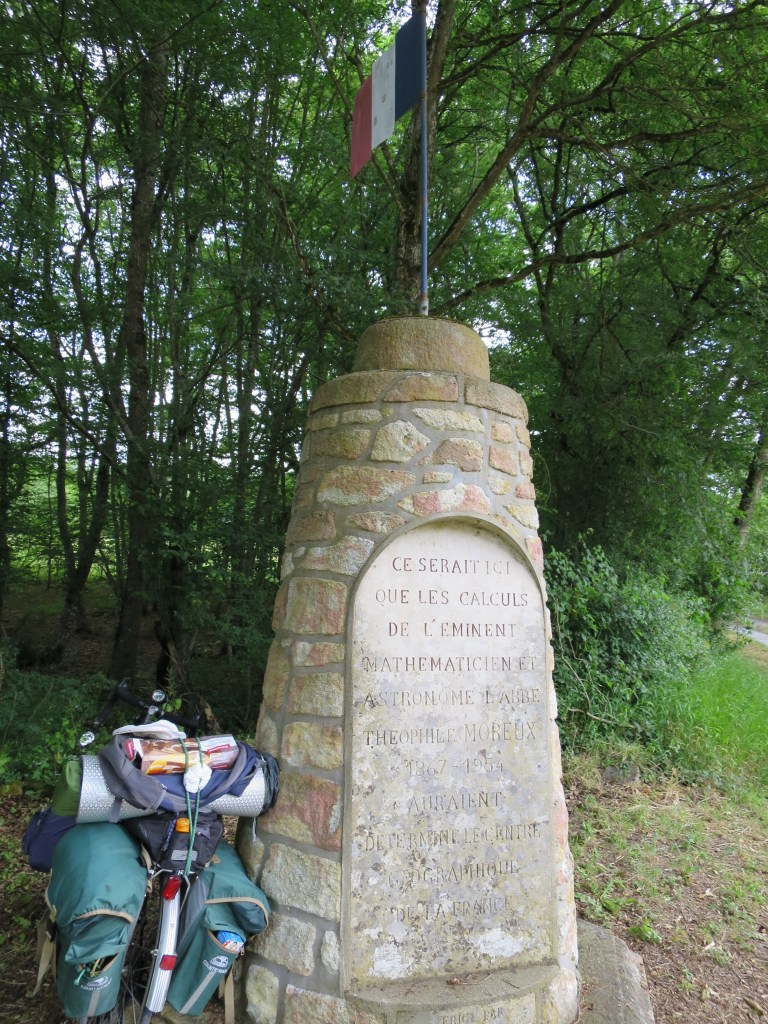
On to the next candidate, Saulzais-le-Potiers. A small pyramid, topped by the tricolore, erected by ‘The Friends of old Saulzais’. It is in a cul-de-sac, and inscribed: “It was here that the calculations of the eminent mathematician and astronomer l’abbé Théophile Moreux of Bourges 1867-1954 determined the geographical centre of France.”
Moreux was a writer of popular astronomy and science books, a teacher in Bourges, where he built an observatory. He was arrested in Paris in 1943, aged 76, for criticising Hitler, and transferred to prison in Bourges. The German commandant, an amateur astronomer, discretely freed him after six months. I can imagine the conversations they had, and the humanist commandant torn between freeing him for Moreux’s benefit, and keeping him for his own enlightenment. Saulzais proclaims itself ‘Capital of grès rose.’
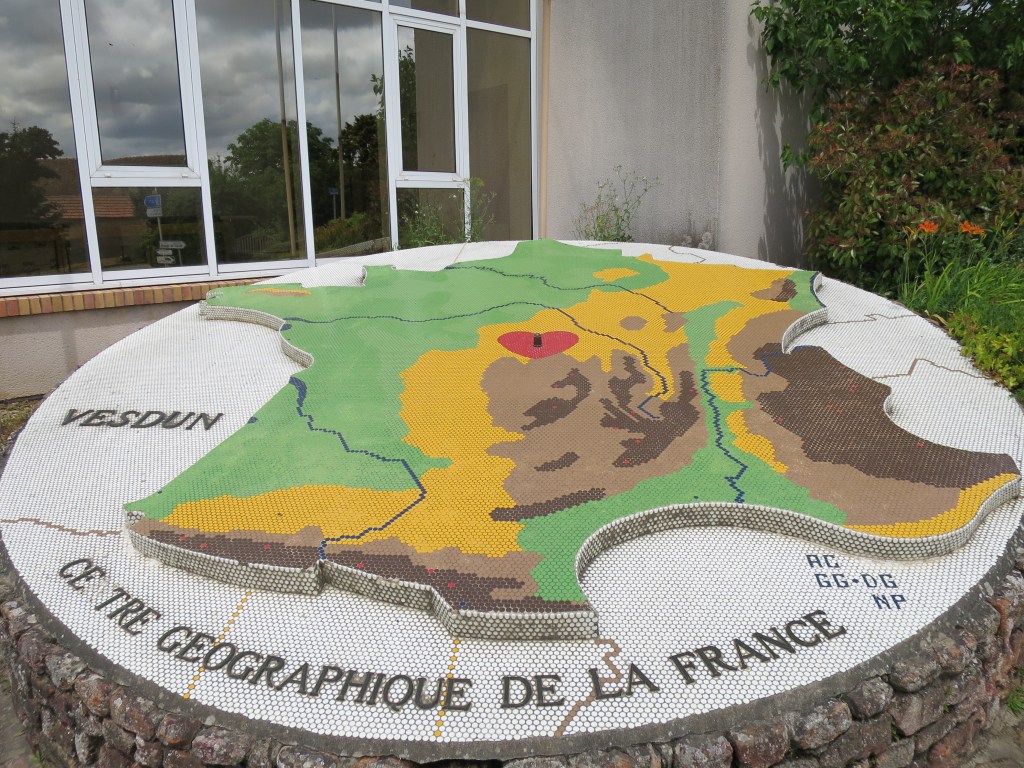
On to Vesdun, where there is a splendid five-metre diameter mosaic map made from 60,000 coloured discs, which puts the village ‘at the heart of France’ (represented by a red heart on the map). This is the centre of gravity of continental France, the point of balance of the 36,453 communes, as calculated by the National Geographical Institute (IGN) in 1984.
Next to it is a panel, with notes about differential and integral calculus, explaining how the calculation was made, and the number of hours taken to make the map (518). But both map and panel are disappearing under dirt and encroaching ivy. Perhaps, like la Méridienne verte, it illustrates a love of the grand gesture, but with a neglect of the detailed consequences.
It is very French, the many Centres of France. The logical French mind says: there is only one answer. The ingenious French mind says: yes – but there are many questions.
Vesdun is a beguiling village, with its ‘Forest of A Thousand Poets’, and its flower- and rush-edged duck pond with a sign, ‘No Fishing for over thirteen-year-olds’.
And it has an attractively simple church, built in the twelfth-century as a Benedictine chapel. In 1569 the village and its church were burned down by Protestants, so the chapel became the parish church, and still is. Its Romanesque carved capitals and frescoed barrel-vaulted ceiling (two frescoes survive) are a reminder of a faith of story and acceptance, rather than Gothic’s light and aspiration. There are frequent reminders in this area of the Wars of Religion that divided France from 1562 to 1595, with Protestant followers of Calvin, a Frenchman educated at Orléans, strong in the south, confronting the Catholics at the Loire.
Another dimension to the ‘Centre of France’ debate is represented by Châteaumeillant. It is on the same parallel as Vesdun, west of the Meridian. It is, according to Graham Robb’s Ancient Paths, the mid-point of Celtic Gaul, where its central Meridian and parallel cross. A couple of years before my trip, Robb had followed, also by bike, the Celtic Meridian, 10km west of the Paris Meridian, from Loon Plage, through Samarobriva, Mont César, Nanterre, Châteauneuf-sur-Loire, Châteaumeillant, to Axat in the Pyrenees.
I have one more centre of France to visit today, 10km east of Vesdun, at Nassigny, where the IGN calculation puts the centre of France when Corsica is included. Close by is le Grand Meaulnes air de repos on the A71. And Alain-Fournier is why I have strayed 20 km east of the Meridian, as I will find tomorrow.
This evening I cycle to Vallon-en-Sully, and find the camp site. It is a municipal camp site, on low-lying land between the river Cher and the Canal du Berry. It is on the Avenue of Sighs. It is very large, and very empty. Where to pitch? Thunder is rumbling around, rain seems imminent. Should I pitch under the trees, for shelter? Or would the trees draw lightning? I pick a place close to the toilet block, between a tree where I can lean my bike, and a table and bench where I can sort my things and write.
There is a man is working on the plumbing at the toilet block. I go over to borrow a hammer for the tent pegs. His dog, lying bored, muzzle on paws, springs up, all attention when he sees me approaching, a large wolf-like beast, energetic, curious, friendly. The man calls it Mignon, a curious address (‘sweet’, ‘cute’) for such a beast, endearing. He is that sort of man, a tradesman, secure in his abilities, tough when he needs to be, but with no interest in masculine posturing, gentle in his ways. He thinks there may be a storm. When I ask who I pay, he says someone will be around between 8 and 9 in the morning. I ask about the showers. Yes, they’re working.
Minutes after I’ve got the tent up, there is a deluge. I throw everything into the tent and shelter. It is over in minutes, and the storm rumbles away. Just like last night. Was I really in Bourges last night? It feels like yet another country, this unknown heart of France.
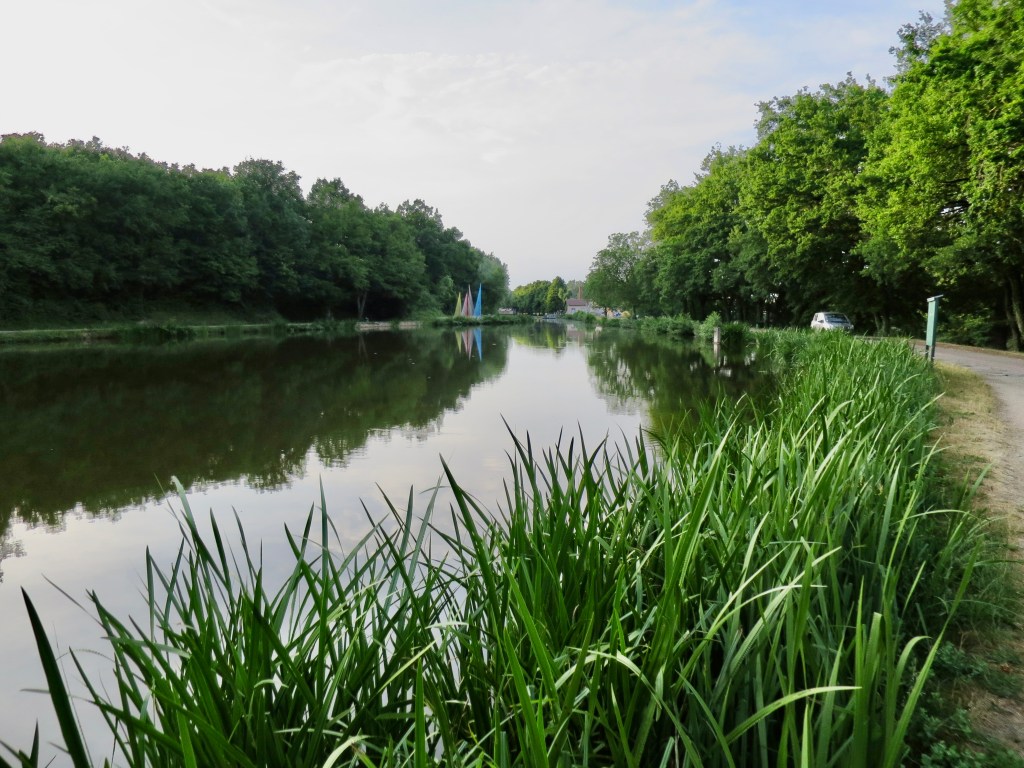
I shower, change, and head into Vallon, walking along the Canal de Berry.
It is broad and attractive, with lots of water fowl, and that greening, of rushes and shrubs, that comes with abandonment. The 26km canal was completed in 1841, to take coal north from Commentry to Berry and on to Paris, and to bring iron ore south to Montluçon. It was closed in 1950, and sold to the communes it passed through for one franc a kilometre. This ‘sausaging’, as the information board so nicely puts it, has made recuperation difficult. But there is now a 20km cycle path to Montluçon. This is tempting. But although taking me south, it would be away from the Meridian.
Montluçon is at the northern edge of langue d’oc. In le Grand Meaulnes, Alain-Fournier comments on its harsh ‘industrial’ accent. Nancy Wake, the colourful and deadly New Zealand Resistance fighter, led an attack on the Gestapo headquarters there, killing 38. In the forest across the river from Vallon was one of her centres of operation. There are colourful, sail-like sculptures by the canal. And a replica of one of the large coal barges, péniches, is being built, clearly job-creation projects. There are signs about fishing: ‘Black Bass, Carp, no kill absolu, ne pas tuer.’
Walking into town I cross the Cher, a wide, shallow river,and pass le musée maquettes animées (working models), closed, of course.
And into Vallon. Is this a large village or small town? It has 1500 inhabitants, the same for a century. There seems to be no real poverty, but neither is there a sense of much happening. It is a place marking time. It exists out of habit. There are houses for €35,000. There’s no one around, no bars open. But the emptiness feels less of desertion, than of the home-centredness that is everywhere. The bakery is called Le Boul’ Ange, heavenly bread. But the funeral directors’, with its memorial à ma Mamy, makes me think of rural Ireland.
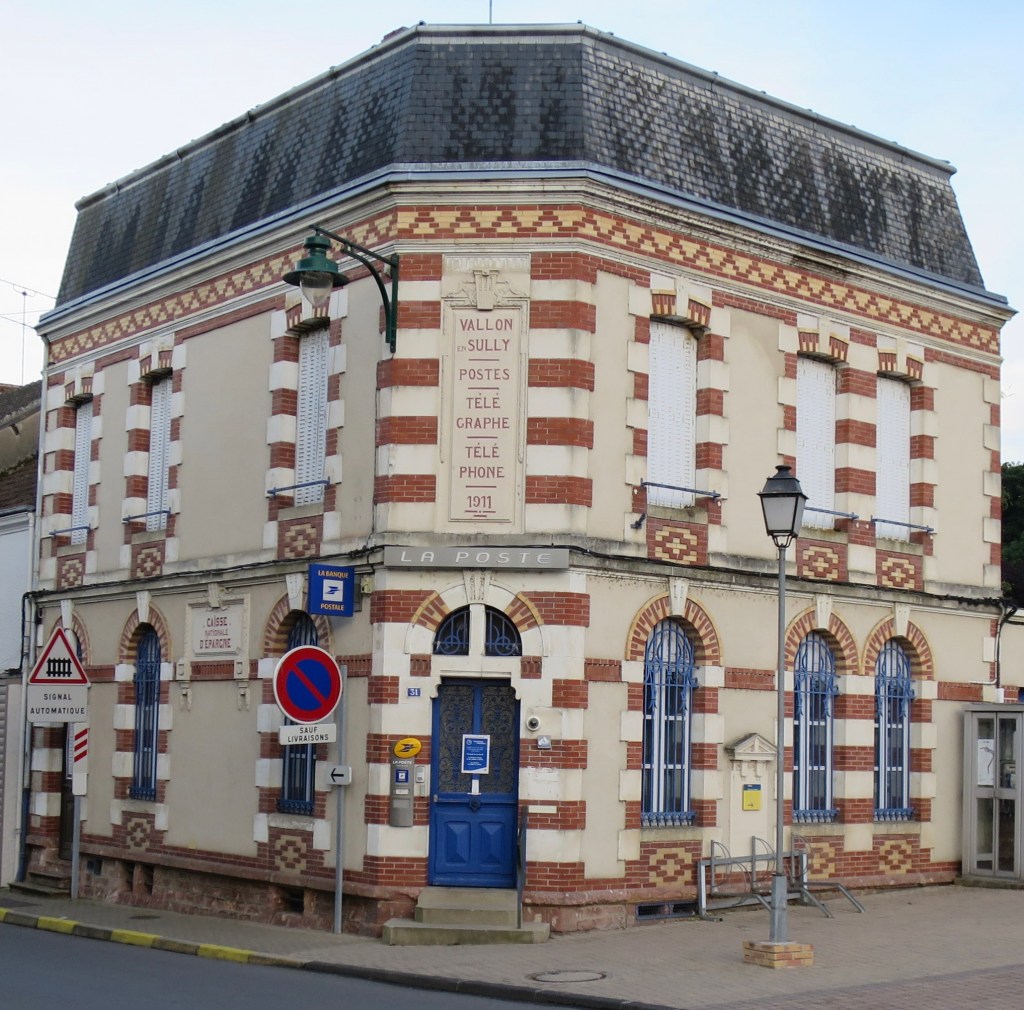
There is a fine belle époque post office. Built in 1911, it advertises, in stone, ‘post, telegraph, telephone, savings bank’. What was it like, this sudden arrival, together with the newly-affordable bicycle, of ‘the future’, represented by all these innovations?
And followed so soon by a catastrophic war in which millions of Frenchmen were forced to leave, for the first time in their lives, their familiar world, within the sound of their church bell, and, many of them, die?
And buried in Vallon is Jean Quinault, one of the ‘Martyrs of Vingré’, a victim of another element in ‘the future’.
In November 1914, the early days of the war, when the military high-command had no idea how their ragtag conscript army would hold up, following an engagement with the Germans, twenty-four French soldiers were accused of deserting the field. At their courts martial, they said the Lieutenant had ordered them to retreat. He denied this. Found guilty, six were selected to be shot, in accordance with an order from High Command for actions ‘to help combatants rediscover their taste for obedience.’
In a letter to his wife, Jean Quinault wrote, ‘Last letter from me, dying on grounds I don’t know the reason for. The officers get it wrong, and we have to pay. I never thought I’d end my days at Vingré, and especially being shot for so little and without being to blame.’
There is the palpable sense of unfairness, generally felt, expressive of the distance between the soldiers and an incompetent and callous officer-class. Céline expresses it vividly in Journey to the End of Night. There were several mutinies at the French front. I remember Pétain’s care for his men.
After the war, pressure led to an inquiry, which found that the lieutenant had lied at the court martial, had indeed ordered the retreat, and been the first to flee the line. The judgement against the men was annulled, and the withheld widows’ pensions paid. A case was brought against the lieutenant for perjury. He was acquitted, for ‘lack of evidence’. An attempt to prosecute the trial officers was ‘classé sans suite’, that is, buried in the files.
Having found nowhere to eat, I return to the camp site, and go to the bistro by the river, close to the canal.
There are two parties outside, one of young men, eating and drinking boisterously and good-heartedly, the other a large family group, with the usual comings and goings of adults and children of all ages. I order the dish of the day, souris d’agneau – lamb smile? Mouse of lamb? It’s a lamb shank, the meat falling tenderly off the bone, with chive mashed potato, and a vegetable-filled half tomato. (odd, this photographing of food – I guess because it’s so important on a cycling trip.)

I sit, under the trees, in the warm evening, eating a delicious meal, and drinking a beer, a second beer. A few late birds sing, and the river purls softly. I am on my own, while enjoying at one remove the activities of the groups close by. Who am I? Does it matter? Where do I belong?
It used to be that in a town like this, having walked around it alone, I would imagine myself living here, finding my place, that a me-shaped place was waiting for me. Or else I would assert my atomic individuality, my separateness, and in a bar like this, after a second beer, I would experience myself as the still point in the swirl of the surrounding and ever-changing. Or cast myself as the perpetual outsider who lives independent, the wanderer over the face of the earth paying, gladly, the price of his integrity. (‘I paid the price of solitude, but at least I’m out of debt’, etc.) Now? None of these. I inhabit a mental universe. I make it up as I go along. I live a life.
As the young men amiably settle their bills, notes passed back and forth, and the family party starts to break up, the young man I’ve seen moving attentively between tables comes over, asks how was the meal. He is the owner, this is his first week of business. A good start, I say, pointing to the number here. He has come from Calais to open this place. I say that’s where I’ve come from, by bike. He acknowledges this, but doesn’t follow it up. It is that French characteristic that might be a lack of interest in anyone else, or a respect for the privacy of the other; in either case an acknowledgement of the primacy of the individual.
On my slightly tipsy way back to my tent I come upon a sign telling campers what they should do in the event of an ‘Inondation Brutale’, illustrated with a twenty-foot wave overwhelming a tent. I had seen a sign of a man running next to water, with a large direction arrow, and thought he was heading enthusiastically to a designated bathing place. Now I realise it’s the direction I must flee for my life in case of said Inondation Brutale. (In small letters at the bottom, ‘to better understand risk and prevention, consult immediately the complete file at the mairie.’)
So I go to sleep, my small tent the only one in the middle of a large, empty campsite, with the wind moaning through the trees in the Avenue of Sighs, rain pattering then driving onto the tent fabric, with a rising river on one side and a filling canal on the other, trying to remember which way the cartoon man was running.
Day 13: Vallon-en-Sully to Chambon-sur-Voueize, 53 miles.
Alain-Fournier museum. Le Grand Meaulnes. M Fournier and the Republic. Grès rose. Treignat and ‘le Grand Pique-Nique’. An in-between place. Into the hills.
I wake to a cuckoo, calling ‘Bep-po, Bep-po’. Then ‘D’Ac-cord, D’Ac-cord’. The table and seat are dry enough for me to write my diary as I drink my mug of tea in the early sun.
By the time I’m ready to leave, no one has come to collect money. It is a good municipal site, well-equipped, with good showers, hot water, even a big block of soap for washing clothes, lights on at night. I calculate the charge from the price list, and drop it into the post box.
I cycle to Epineuil-le-Fleuriel. At the entrance to the village is a drum of enormous coloured pencils and a sign, ‘on the schoolchildren’s desks, the past comes to life … and Le Grand Meaulnes welcomes you to his Museum’. This is where Alain-Fournier spent his childhood years.
Here is the school and school house, exactly as in the novel! And an excellent museum. Both are open. What a contrast with La Chapelle.
The first thing I learn is that Fournier, christened Henri-Alban, changed his name because there was a famous racing driver called Henri Fournier. Le Grand Meaulnes was published in autumn 1913. Within a year the author had been killed at the Front. There is a photograph of him with ‘the men of his company’, men like ‘The Martyrs of Vingré’.
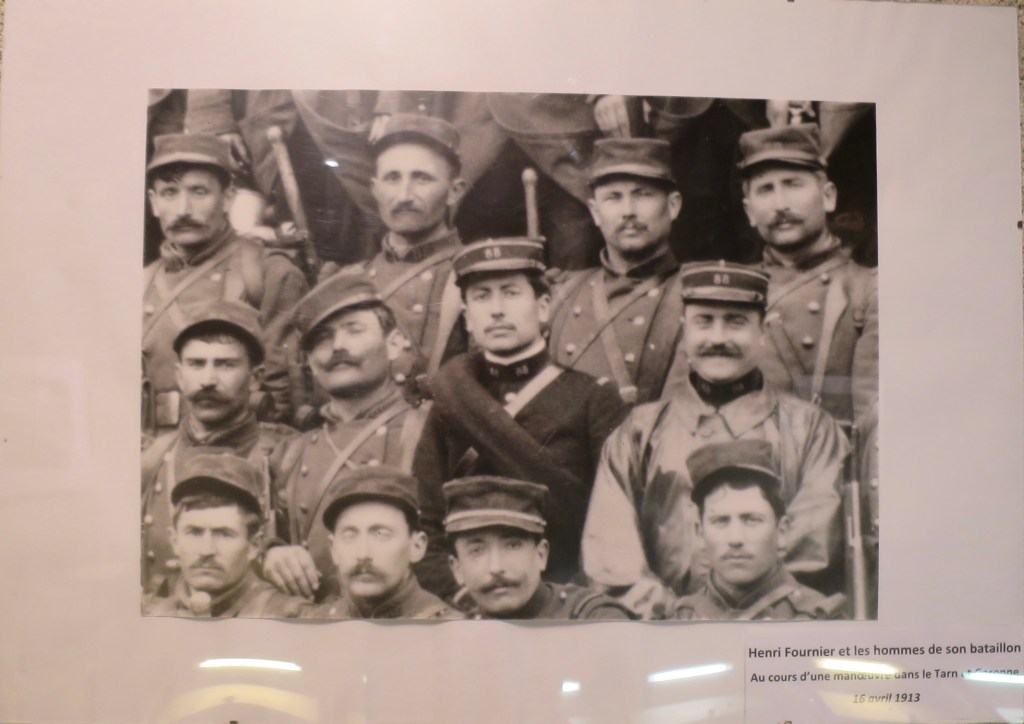
Henri lived here in Epineuil from five to twelve, with his teacher-parents. They then moved back to La Chapelle-d’Angillon when Henri was at school in Paris, where he met Jacques Rivière, who became his close friend and literary ally.
In 1905, aged nineteen, walking by the Seine, Henri met Yvonne de Quiévrecourt, was smitten, and arranged to meet her there a year later. As he later wrote to Rivière, “she did not come. And even if she had, she would not have been the same.” From four elements: the mysterious countryside of the Sologne near La Chapelle; the school and village of Epineuil; the chance encounter with and loss of the beautiful, enigmatic girl; the intense friendship of the soulmate, he wove the endlessly intriguing and beguiling story, “about a happiness as deep as it is fleeting, the pursuit of a dream that has hardly come into being, a first taste of adventure”, as a note in the museum puts it. Another writer calls it “a story of lost innocence, hidden paths and fantastic events’”, noting that more than one Resistance group adopted Meaulnes for their nom de guerre.
Le Grand Meaulnes begins when an adventurous sixteen-year-old, Augustin Meaulnes, comes to the school where François’ father teaches, and lodges with his family. He and François, a year younger, become fast friends. On a winter escapade in the mysterious Sologne countryside, Meaulnes comes upon a dilapidated estate, where a wedding party run by children is awaiting the arrival of the son of the house, Franz and his betrothed, Valentin. There Meaulnes briefly meets and falls in love with the daughter of the house, Yvonne de Galais. The party is suddenly stopped and Meaulnes, leaving with the others, loses track of where he has been. After months searching, and failing to find the ‘lost domain’, he follows a clue to Paris. François meanwhile finds the domain, meets Yvonne, and arranges a party where the couple will meet. There Meaulnes asks Yvonne to marry him. But soon after their wedding night, Meaulnes disappears. Yvonne gives birth to their daughter, and dies. François, now a teacher, lives at their house, looking after the child, and learns that Meaulnes had gone to Paris to find and reunite Franz and Valentin. Meaulnes returns with them, and reclaims his daughter. Francois finishes, “I felt that le grand Meaulnes had come back to deprive me of the only joy he had left me. And already I imagined him, one evening, wrapping his daughter in a cloak and setting out with her for some new adventure.”
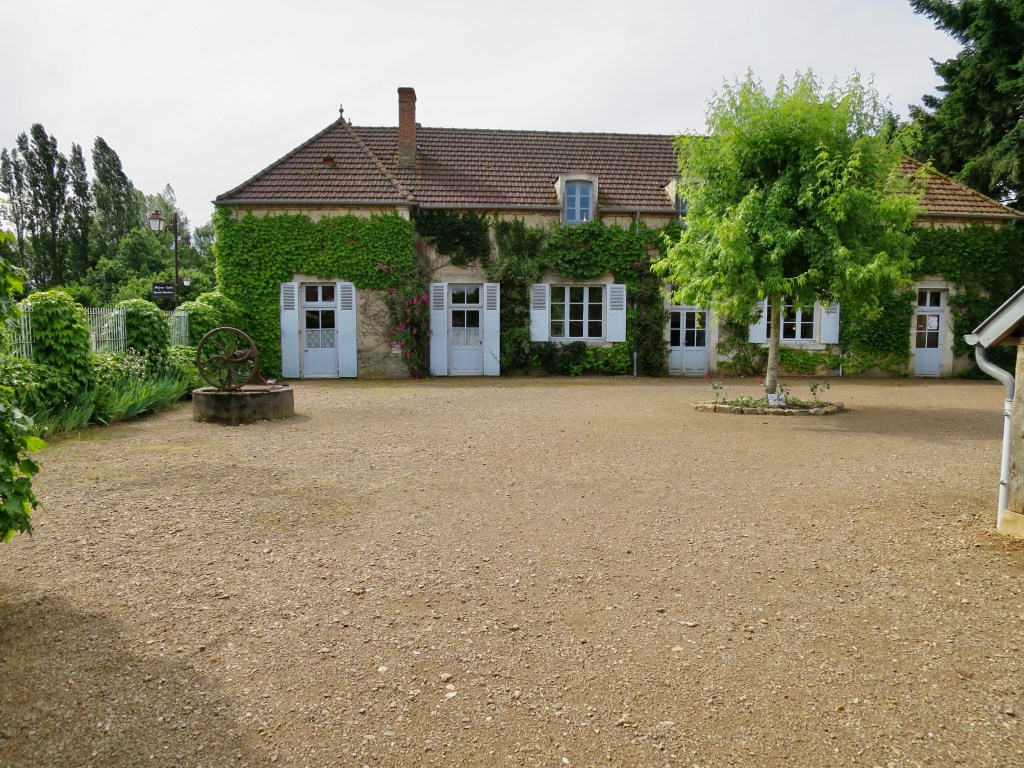
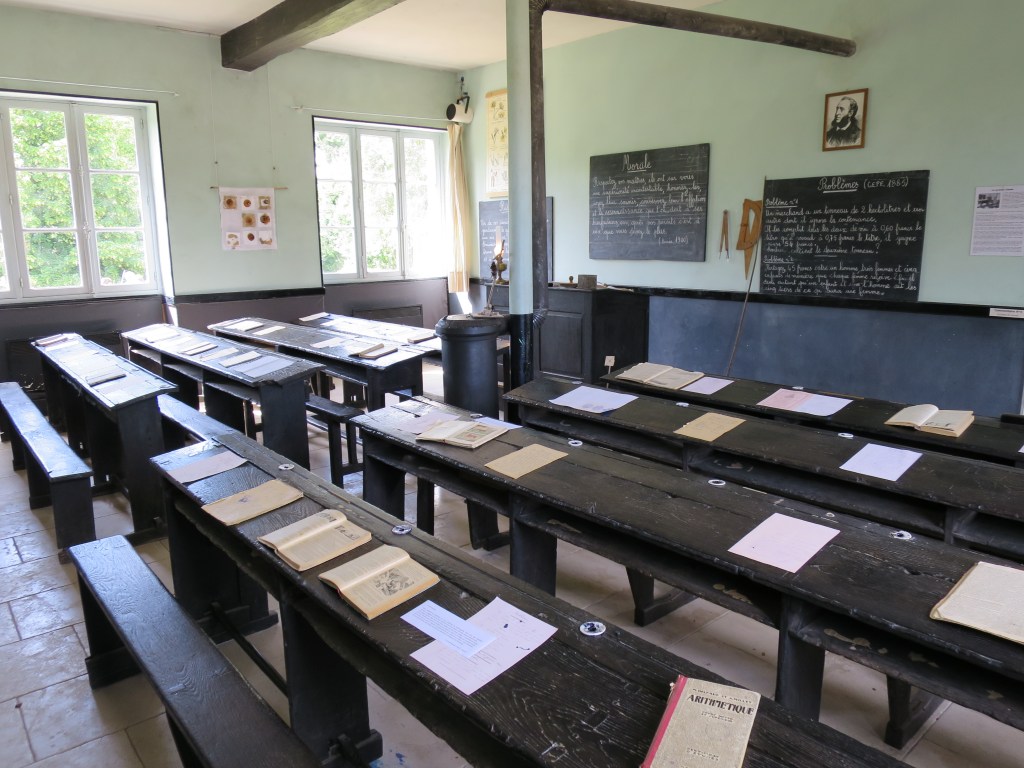
The school house has been preserved exactly as it was at the turn of the century. I visit it accompanied by an excellent audio guide. That shiver of recognition of the cultural tourist, ‘this is where …’ Every detail from the book is here – the school gate the gang shouted through, the yard where the boys played, the shelter where they hung their capes, the three window-doors, the classrooms, the stove around which the boys loitered, the Fourniers’ living room … Looking out at the back, there is even the farm from where Meaulnes took the pony and cart that began his adventure.
Then up to the attic rooms, which were store rooms and Henri’s bedroom, and – bang! that moment you hope for as a cultural tourist, the object or place that makes sense of something, that can only happen because you are here.
The moment of revelation is in the attic, where Henri slept alone, above his parents, with a stick so he could knock on the floor if he was afraid, where stores were kept that filled the air with their smells, among great timbers, and where his mother hung up sheets like sails to dry on wet days. The mature Henri has added into the memory of his lonely childhood an imaginary friend, strong, restless, adventurous, a leader, to live with him in the attic, with himself, ‘François’, as his chosen confidant, both faithful sidekick and sensible friend, helpmeet and problem-solver. I can see Meaulnes, dreamed of in Henri’s lonely childhood, and then coming to life in his mature imagination, when he made the young men the age he was when he was at school with Rivière. “Anyone who does not wish to be happy has only to go up into the attic and there, until nightfall, he can listen to the whistling and creaking of foundering ships;” he writes. But, empowered by storytelling, continues, “or else he can go outside on the road, and the wind will throw his scarf back against his mouth like a sudden, warm kiss that will bring tears to his eyes. But for anyone who loves happiness, there is the house of Les Sablonnières, beside a muddy road, where my friend Meaulnes came back with Yvonne de Galais, who had been his wife since noon.”
Why do I keep coming back to Le Grand Meaulnes? Because, for all its structural oddities and strange changes of tense, it is endlessly beguiling. It has the romantic form of boy meets girl, boy loses girl, boy gets girl. But with it, the suspense of resolutions heralded then not taking place, the sense, with happy accidents pushing the story along, that it is heading for a happy resolution, that doesn’t happen.
For it is a book of adolescence. When we so often have, and take for granted, experiences that are in fact unique; and when we casually let go what we spend the rest of our lives missing, even searching for. It reminds us of adolescents’ inability to take as real their present happiness. It foretells our life.
Then there is the ‘lost domain’, where there are no adults.
And the dream one has in adolescence of meeting the one, and imagining a union that transcends, and yet includes in an almost abstract sense, the physical.
And yet one is forever fleeing “the tight embrace of happiness”, because it threatens one’s fragile sense of self.
It is the time of practising to be an adult: “The time for childish make-believe is over”, we declare, while being full of romanticism: “Come back here, exactly a year from now, at the same time. You will find the girl that you love.”
The memory of the perfect time: a spring and summer “the like of which will never come again.”
And its ending: “Our youth was ended and happiness had passed us by.” The perfect love: “Yvonne de Galais, a woman so long sought and so much loved.” And François, the ideal good friend.
It is important to return, from time to time, to the world of adolescence, to refresh oneself. And Le Grand Meaulnes is one of the perfect ways to return.
I go to the café, to let the reality of the place soak into my memory of the book and to add to my experience of this place, the mystery of the Sologne I passed through just a couple of days ago. And the poignancy that Fournier’s future ended within a year, in a war that changed everything.
And I look forward, one lonely night, to my next reading of Le Grand Meaulnes.
Then I return, for a look at a French school in the 1890s.
First, this, to be copied as a writing exercise (in French): “Respect your masters, they are unquestionably superior to you, honour them, be their subject, retain their affections and recognise what you owe to these benefactors, because, after your parents it is to them that you owe the most.” A presumption that the Martyrs of Vingré would have questioned in 1914.
There is a map of the world, centred on the Paris Meridian.
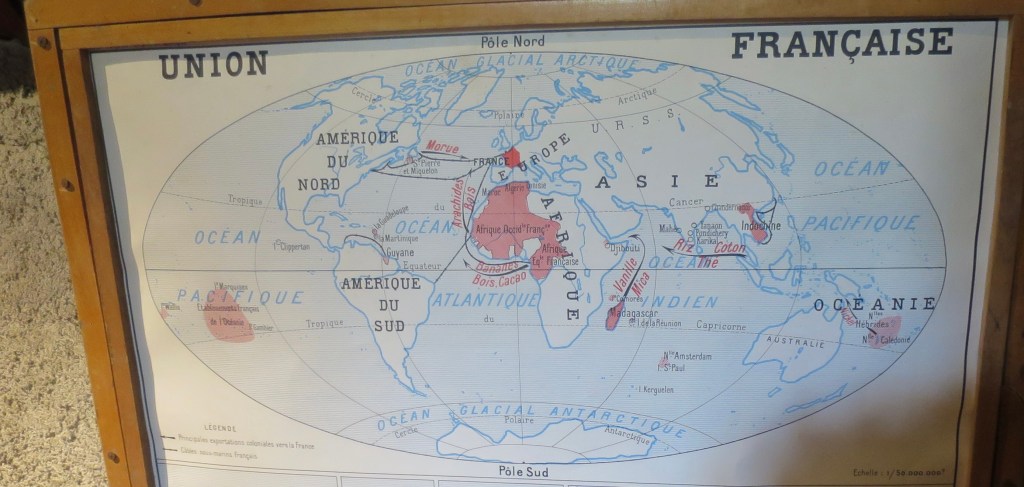
I learn that after Jules Ferry introduced compulsory, non-religious (laïque) education in 1882, schoolteachers were the front line against the church. Henri’s father had to keep his friendship with the curé a secret. Often the school and mairie shared the same building (once I’m alerted, I see this everywhere). As the agent of the state, the teacher would organise elections. It was at this time that the modern, republican, secular (and often socialist) state finally took root, after a century of dynastic rule.
It may be ‘The Alain-Fournier Experience’, but it’s been great.
I stock up at the village shop, run by a Chinese couple who also have a takeaway, with identical dishes in the glass-fronted display to those I enjoyed in Paris and Sully. Most important is drink: I’m already drinking 2 litres on the road, and it’s another hot day. I’ve taken to orange squash, it’s cheap, sugared, and goes down well. And then I head west, back towards the Meridian.
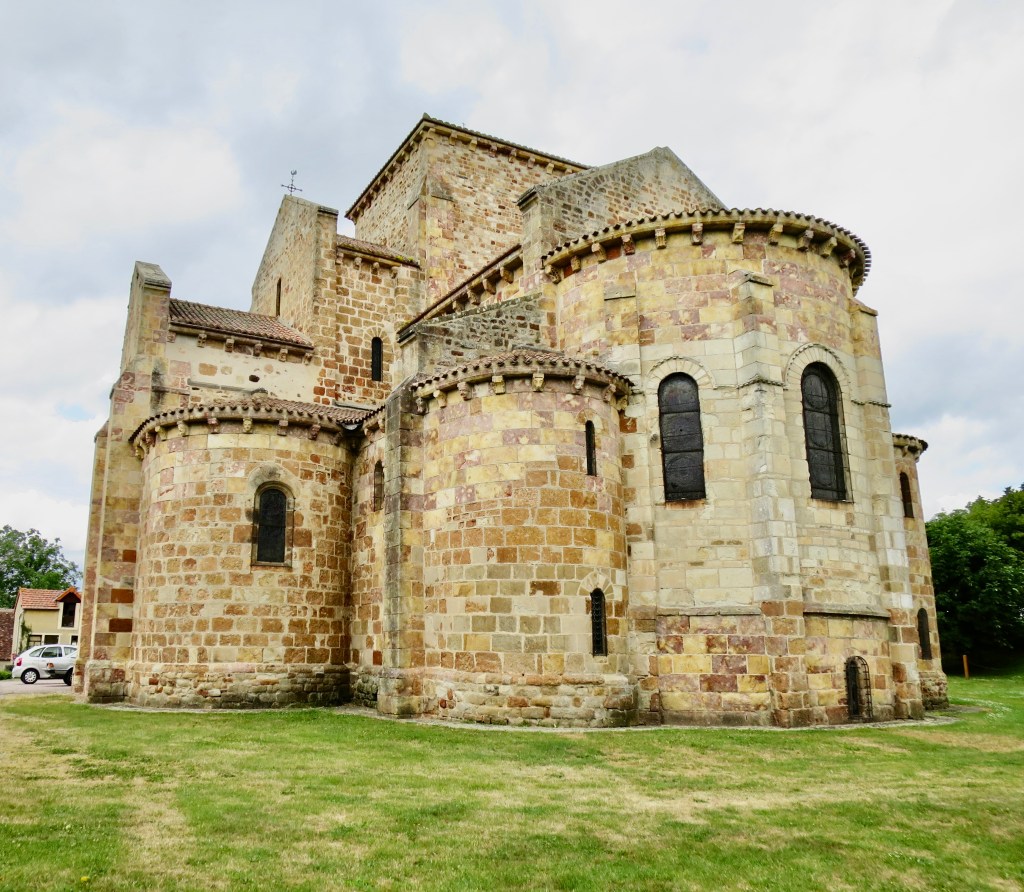
The fine church at Saint-Désiré is built of the ‘grès rose’ of which Saulzier is the capital. It’s a particularly attractive variegated sandstone, of many patterns and colours, from vivid pinks, through different ochres, to a bright yellow, giving a pleasing mosaic effect to a church that has that Romanesque sense of being heaped up, a man-made mountain, more tumulus than church, that focusses inwards, on chancel and crypt, a religious orgone accumulator to both contain and intensify the radiance of the saint at its heart. For a saint is buried here.
I eat by the church. I watch an old man walk slowly from among houses a hundred yards away, under the hot sun, carrying a small bag, drop it in the rubbish bin, walk slowly back. The bibliobus drives up and parks, the two women staffing it talk animatedly. No one visits it.
In 552 Désiré, bishop of Bourges, was passing though, on the ancient road from Clermont to Poitiers, returning from a conclave in Clermont, when he died. He was buried here, in a crypt, the choir was built over, and the church on top.
Inside I am again struck by the contrast with the Gothic; this church is heaped up, focussed inward: whereas the Gothic opens up both the space and the self to light, is concerned less with intensification than aspiration, opening the door for inquiry, explanation and, eventually, the modern world.
And while Gothic pillars are abstract geometries, soaring, as nakedly powerful and structural as cast-iron, the Romanesque columns are just uprights, supporting weight, as simply as the familiar posts in a house or barn.
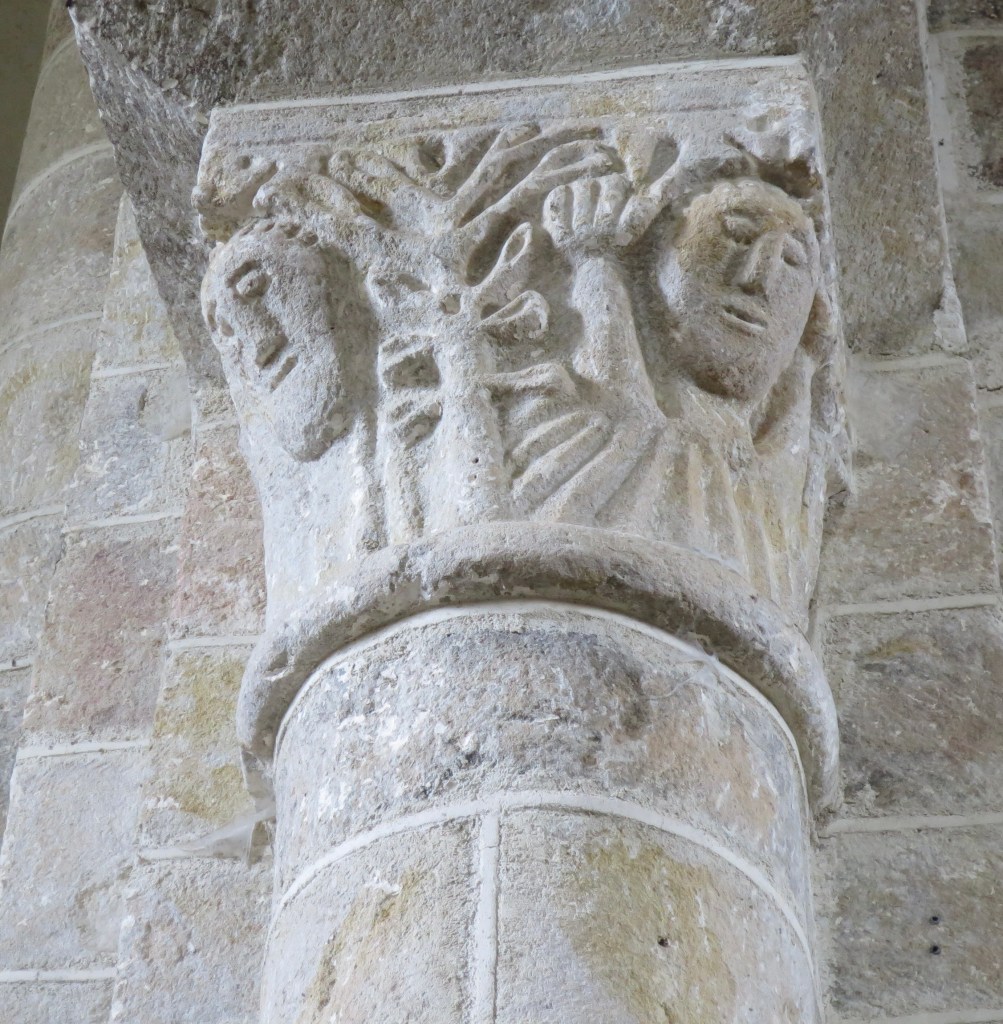
And on the capitals are figures, faces looking down, as if peering over, out of one world into another, ours. I can imagine worshippers seeing them each week, from childhood onward, figures and shapes inscrutable until, suddenly, a meaning comes, a zen moment of revelation, the figure speaks.
I walk up to the war memorial and look across where I’ve come from. I’ve already climbed quite a lot: Vallon was at 192m, Saint-Désiré is at 330m. I am now in the Auvergne, heading into the Massif Central, climbing all the time.
I head south, on the Meridian, to Saint-Sauvier, yet another candidate for ‘the centre of France’, this one calculated by Axel Chambily as the point furthest, in aggregate, from the edges of France, its frontiers and sea coasts.
I am soon at Treignat, a place of significance for la Méridienne verte. Approaching, I pass two Meridian signs, which is encouraging – are things looking up, coming to a climax?
For Treignat was the centre for ‘l’incroyable Pique-Nique’ on 14 July 2000, with ministers and mayors flown in, and where cyclists and runners and horse-riders heading south met those heading north. Surely Treignat’s moment of fame, when for one day, on the first Bastille Day of the new millennium, it was the centre of France, will be remembered, commemorated, annually celebrated?
There is a one-line mention on the information board in the town square.
Otherwise it talks not about Treignat’s centrality, but its in-betweenness – between the Gallic tribes of Bituriges and Lemovices, between the old provinces of Bourbonnais and Marche, between the languages of oc and oïl.
It is also, for good measure, on a geological fault line.
And now it is where the départements of Allier and Creuse, and the regions of Auvergne and Limousin meet. It is a celebration of not belonging. Which I guess is one definition of individuality. Pays exceptionalism, within patrie exceptionalism.

By the church is an 11th-century stone lion, worn smooth with age, as if sucked by time, turning it into a distant cousin of the lions of Delos. It was “certainly on guard at the entrance to the cemetery to guard against evil spirits,” asserts the information board. The church is locked. There is a museum of the mobylette, dedicated to the last half-century’s means of going between.
There is a sudden, wetting shower, and the temperature drops dramatically. I am still climbing, now at 450m.
I have passed, in a few hours, from hazy lowland heat, to upland coolness and cloud. For I’m now into the uplands, and it is reminding me already of the Aveyron, where I lived forty years ago.
A few miles back, in the lowlands (I think of it now as ‘the lowlands’, with this growing sense of entering the other world of the Massif), most villages had a neat bar, offering at least a set menu for €12. But this village I’m passing through is all shut up. It reached its maximum population in 1880, and has declined ever since, halving between 1910 and 1960, and halving again since then. Catastrophic. When a building loses its function, as a shop, or a garage, there is no new use for it, it closes, it’s left empty.
The garage closed long ago. You can date when they closed, these rural garages, by the version of the Peugeot sign they still display.
And this is a world not of replacement, but of make do and mend, where nothing is thrown away, but little is worth keeping, of the ubiquitous orange binder-twine, rather than shop-bought materials, of wonky, tied-together gates, and patched fences. Of bent old men and collapsed women. I see my first buzzard.
And after days of big, unfenced open fields of arable, it’s all small fields of pasture, and electric fences to keep in the cattle. They are mostly the white ones, either Charolais or Blonde d’Aquitaine. They are in family groups, rather than segregated into milkers, store cattle etc. As if to reflect a more tribal society up here. There are some brown ones, the Limousin, light, pleasant-looking beasts; and then among them a hulking bull, all bulging muscle and heavy slowness, like a gym obsessive. There is grass, and there are trees, and little corners where the cattle stand under trees, among tree roots, sheltering. And, already, there are blue distances. A few fields have been cut for hay.
I drop down 150m into the valley of Chambon-sur-Voueize, where there is a campsite.
I find the campsite easily. It is a municipal one, not very big, a circle of grass, with a ring of motorhomes. There is a vast toilet block, with places to wash clothes, something botheringly institutional about it, as if it was built for detainees.
I passed a supermarket on the way in. But, having put up my tent, when I go back to it at 7:20pm, I find it closed at 7, and won’t open till 9am. I’m still surprised how late in the morning shops open in France. Only the bakers open early.
I walk into town. It is a solid, stolid, dark-stone place, deep in its valley, all shut up, apart from an expensive hotel, and a pizza van in the square. The pizza is adequate, but lacking the skill and showmanship and the pizza-quality of the man in Bourges, who I miss. Curious how quickly nostalgia has set in for a place I couldn’t wait to get out of! It rains from 9pm to midnight. There are owls in the night.
Day 14: Chambon-sur-Voueize to Felletin, 46 miles.
The Massif Central. Hen harriers. Memories of Aveyron. A railway tunnel. The Fire of 1511. Coventry tapestry. Vide greniers. The English campsite. The bittersweet herb of self-discovery.
Climbing out of Chambon-sur-Voueize, I am soon at 500m, and into the upland world I will be crossing for the next seven days.
The Massif Central is 200 miles long, a third of the Meridian, averaging a thousand metres in height (a plateau as high as England’s highest mountain), a”much-dissected plateau of ancient crystalline rocks, surmounted here and there by masses of volcanic rocks … with a cincture of limestone,” says Ormsby. An ancient core that resisted and thrust aside the earth movements that threw up the Alps, and against which the ancient seas broke, their beaches and shells forming the sandstones and limestones of the surrounding lowlands. Ancient and stubborn.
And a barrier to movement – only since the opening of the Millau viaduct in 2004 has there been a north-south motorway. There is still no east-west motorway for 150 miles south of Clermont-Ferrand.
I will be crossing its western side, up and down the valleys that drain to the west, familiar names, département names, Creuse, Dordogne, Lot, Tarn. Old rocks, poor soils, high rainfall, forests and pasture, low and declining population, ancient and stubborn.
I am now on yet another of the lines that French geographers love to draw across their country: la diagonale du vide, a band of low population from the Marne in the north east, to the Landes in the south west.
In the last 150 years the population of the Massif has halved, while that of France as a whole has doubled. It is the result of emigration, mostly to Paris.
The Creuse masons sing of walking to Paris and building the great monuments of the capital.
Men of Aveyron ran most of the bars of Paris, and proudly proclaim there are more Aveyronnais in Paris than in their département.
The bougnats of Auvergne built rafts and transported coal and wine along the Allier river and the Briare canal to the Seine; in Paris they broke up the rafts and sold the wood as well as the coal. Some stayed, becoming water- and coal-carriers, and eventually metal workers, settling in the Rue de Lappe near the Bastille.
Often each group would settle in their own quartier, retaining their trade, patois, cuisine and ways, and their connection with their pays, hoping always to return home. I can remember even in the 1970s the ‘friendship with a view to marriage’ small-ads in newspapers in Paris often requested partners who originated in their own département or region. And Gabrielle’s parents, living in Paris, spent every holiday building a bungalow in their parents’ home village. The yearning for home.
They are more like international migrants. Like for example the Irish in London. Maybe, again, that deep Celtic connection to pays. And another indication that France is a mosaic of peoples, rather than a nation. “France exists thanks to the state alone.” (De Gaulle.)
The town names now give the alternative Occitan form. But mostly I am, simply, in the Massif Central.
For most of its length it will be a place to cross; only towards the southern edge, in Aveyron, will it be a place to visit. For I lived there for a couple of years forty years ago. I might have stayed. But I didn’t. And I have never been back.
I head west, back towards the Meridian. I am now on the Plateau of Millevaches – not, the guide books insist, a thousand cows, but a thousand lakes. This is impermeable granite. It reminds me of upland Wales. But although I’m much higher, the grassland doesn’t end and turn into moor and bog, but has fields to the tops. An undulating road, through pasture and woodland, brown Limousin cattle, small scale, few houses.
Through the village of Lupersat, on the Meridian. No marker, of course. A sign records the catastrophe of 1511 when lightning struck the steeple and burned down the church and most of the village. The population is a seventh of what it was in 1850. And yet it looks solid, prosperous, with an upmarket bar-restaurant.
I cycle on, through the increasingly familiar: small fields, pasture, brown cattle, cut hay, foxgloves, bracken, distant blue views, and then – hen harriers. One, two, four, six of them, high in the blue sky, supple, flexing, playing together, moving from east to west across the sky like energetic, absorbed children passing, playing along a town street, appearing, being, gone. And I am back.
Back forty years. Back to the Aveyron.
How clear the memories of a place I settled in, lived in so intensely, and yet so briefly! These memories.
A pair of hen harriers, gliding, swooping, playing, dancing with each other above the meadow I was scything, alone, having been left, close then far apart, stretching to the limit, and then rushing together, and weaving round each other, close, touching.
Driving to work at the abattoir early in the morning, and seeing foxgloves still quivering from the withdrawn rufous paw. And a hare, big as a dog, ‘cantering gracefully’ in Muir’s words, loping ahead of me down the road.
Driving home after a day’s work in the abattoir, brilliant evening sun on emerald grass, sheep vivid as in pre-Raphaelite paintings, I would stop at the high point, fill the back of the old 2CV with bracken for compost, the scent intoxicating as I drove the last miles into the blinding sun.
Pruning vines in grey, winter stillness, and the sudden irruption of a flock of tiny, chattering birds, each a vivid chip of life, and as quickly disappearing, leaving the air vibrating, as if about to shatter, then, slowly, so slowly solidifying and becoming once more still.
Harvesting potatoes like golden eggs.
Lying in the summer vines, beneath tendrils and leaves and the swelling fruit, under a mauve-pink sky, watching the yellow sun set and the white moon rise, at opposite ends of the dome of heaven, like orbs on a balance, and me, myself, I at the fulcrum …
But these had been experiences, speaking to our love and idealism, in a time of being that we shared after I had worked too hard, through school and university, at becoming what they had wanted me to be.
No, not too hard, necessarily, but too much against the grain of my self. I had been too impressionable (on the ‘softened surface of the soul’, to use Murray’s devastating phrase), too easily flattered about my cleverness, to know what that grain was. But aware, as I would later see it in a piece of wood I was planing, of something wrong.
So I had, for the five years after university, lived in the present, resolutely not ‘getting on’. (“Living for nothing, keeping some kind of record”, in Leonard Cohen’s words. Volumes of diaries, sheaves of notes, stories and poems …) Five years I wouldn’t trade for anything.
I had drifted into working in the Ecology section of Watkins esoteric bookshop.
The move to France, to the country, to be ‘self-sufficient’ had come from books, and was an attempt to leapfrog the five incremental years my contemporaries had put in, to a sustainable life. We had no skills. But I was good at experiences.
After a year my wife had gone back to London, back to a proper job. With Gabrielle, a chance meeting with an idealistic schoolteacher from a town south of Paris, a brief time together, I had imagined making it work. But I, too went back. In England I learned the skills that might have made it work in France. But by then we, my wife and I, were on a rack-and-pinion that has its own mechanics. And I had written and rewritten those experiences, falsifying them and making them truer in writing my novel, Diggers and Dreamers.
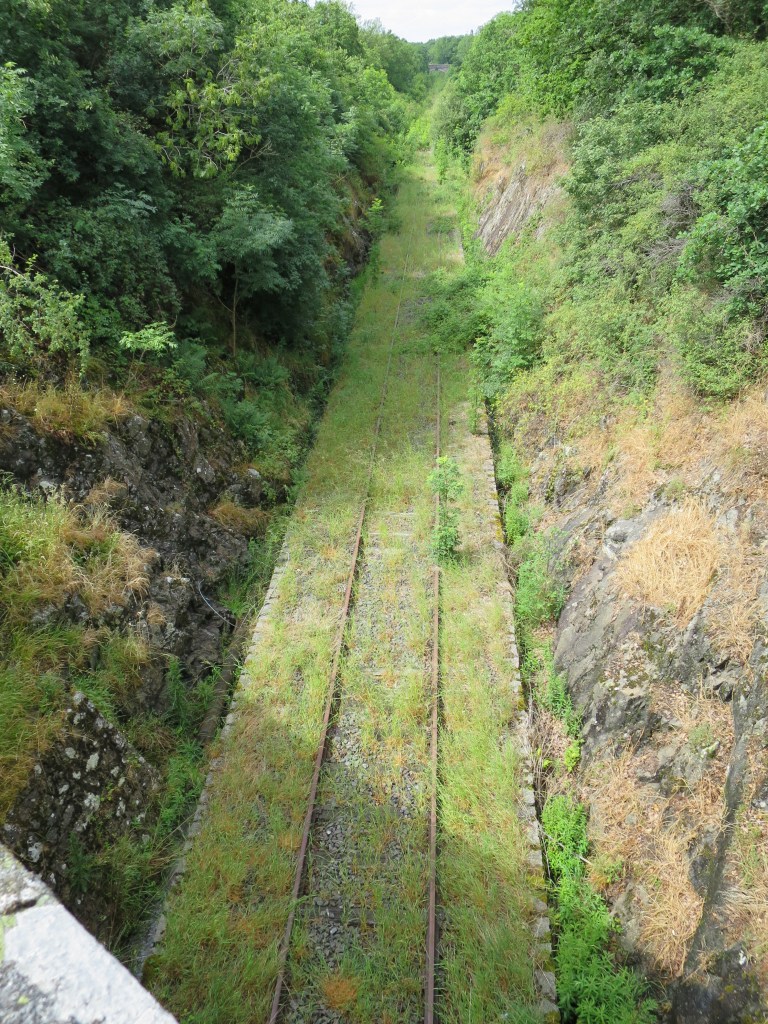
I cross, in the middle of nowhere, the carefully-carved cutting, straight sided and deep, through solid granite, of a railway, into a tunnel under the road. Green-walled, overgrown with flowering shrubs, rails in place, waiting, curiously dream-like. As if something magical might happen. Or is it an enchanted road to – somewhere? What if I descended, entered the tunnel? Where would I emerge? Would I emerge? Had it been built, but trains never ran, a grand project unfulfilled? Or had there once been a railway across this remote part of the Massif?
I arrive at Aubusson. For lack of cheap hotels, and even campsites on this section of my route, the seven days across the Massif, I am having to zigzag across the Meridian.

It is one of those small towns that, above shop-window height, has preserved its old-world, even medieval feel – steep roofs, frontages of brick and wood, of local stone, narrow, curved streets following the old building lines so the buildings almost meet overhead, creating intriguing geometries of sky between them.
This image of a pre-industrial world has been continued into the modern age of leisure on large murals that depict a whole range of modern, but, crucially, unmechanised activities – painting, tapestry-making, fishing, cycling – taking place in ‘unspoilt’ landscapes, with lots of water, and lots of green.
There is a tapestry in a window of a fragment from the ‘Lady and Unicorn’ tapestries that Rilke evokes so vividly in The Journals of Malte Laurids Brigge, and that I make a pilgrimage to the Cluny museum to stand before every time I am in Paris.
Tapestry-making was brought to Aubusson by Flemish weavers. The Unicorn tapestries weren’t made here, but for five hundred years it has been, with Beauvais and Gobelin, one of the centres of tapestry-weaving in France. I imagine that working in the industry was not the pleasant and leisured occupation it is for the amateur tapissière, making, with her tapestry kit, rabbits and flowers to frame.
But at street level there is the usual mixture of tourist shops, boutiques, chain stores and food outlets, discount stores. It could be anywhere. Only by looking up, at first and second-floor levels, does one see difference, individuality, regional style, local quirk, only then am I somewhere.
And there is one big difference from English towns, I notice as I wheel my bike down the pedestrian-friendly main street: there are no charity shops. The equivalent English street would be full of them. I have been passing signs everywhere for vide greniers, car-boot sales. Is it a sign that the peasant mentality, in which everything has a use and therefore a value, remains close to the surface even of town dwellers in France? Or is it an absence of the English reticence that shies from laying out their ‘things’, exposing them for all to see, and then, heaven forfend, bargaining the price?
Cyclists are arriving, in ones and twos, like swallows, and gathering chattering at the main hotel. They are on lightweight bikes, without panniers. An organised group, I imagine, who have their luggage transported by van from hotel to hotel.
I ask at the tourist office for a camp site, but there isn’t one. The nearest is at Felletin, five miles south. Felletin is also a tapestry centre, and where the Graham Sutherland tapestry in Coventry cathedral was made. They explain how to get there along a minor road. It looks, on the map, like a gentle meander along the banks of the Creuse.
In fact, it involves a very long climb back onto the plateau, and an equally long descent.
The camp site is signed at the edge of Felletin, and I follow it without shopping first. It’s a long way. It’s taken me halfway back to Aubusson, on a minor road that would have brought me there along the river. By now I’m too tired to care, and decide to make do with the food I have. I’ve only done 46 miles – is it the problem with the slipping gears, the accumulated effort so far? Or am I not eating well enough? Whatever, it’s worrying. I should be feeling better than this.
The camp site at Felletin is run by an English couple. After the anonymity of the municipal sites, I am disconcerted by the ‘home-from-home’ feel of this one. It is laid out attractively, almost in the picturesque landscape style, with trees and viewpoints, in contrast to the formal and functional French sites. Even the toilet block is more English, with less of the exposed and dubious plumbing of the French. In a brief conversation the woman tells how they fell in love with the place at first sight, and knew that they had to … etc. How we need our narratives!
There are several English motorhomes. An overweight man with a neat white beard passes at the slow pace of aldermanic self-importance, announcing to me as he passes without stopping that he is from Felixstowe, smiling at this white-haired man with his old bike and small Decathlon tent, for he has done well, he has his house and his motorhome. And I realise how much I don’t want to be part of anything that has the claustrophobia of England. Or rather the given of the English abroad.
I’m reminded, in my instant alienation from these English, how unalien it has felt, and I have felt, all this time in France. Without any sense of ‘belonging’ here. It reinforces that, for me, France is a place I can be. Without belonging. Or wanting to belong. I am comfortably a stranger here.
Perhaps it’s because of the famous French ‘neutrality’, of letting you be, of not intervening, not even being curious about your life. The other side of that is the essential self-centredness, even narcissism, that means they don’t give a bugger about you, they don’t even register you. That they would step over you as you lay destitute on the pavement – as I was shocked to see when I first came to France. Is that why there are no charity shops?
But I also have the sense that, if I have a problem in France, I will find a solution. It’s a place in which I can survive. And it’s a place where one grows up. It provides the environment, the circumstances in which one can grow up.
I remember how I needed to come here at twenty to begin to grow up. And Lawrence Durrell’s words in Clea, “Do you remember how Pursewarden used to say that artists, like sick cats, knew by instinct exactly which herb they needed to effect a cure: and that the bitter-sweet herb of their self-discovery only grew in one place, France?” And how I needed to live here, at thirty, to begin to find my way – in the same letter Clea writes of “stepping across the threshold of one’s imagination and taking possession of it, once and for all.” And now, at seventy …?
It is a fine evening, with “the ceremony of sunset in a tranquil, ensanguined, quietly travelling sky”, over the still, bright, tree-margined lake. But, after a hot day, there is thunder around, and a bruised, purple, perturbed look to the clouds.
Day 15: Felletin to Bort-les-Orgues, 54 miles.
Trésaguet’s roads. The Soviet in the military camp. Metal monsters. Executions of maquisards. Nancy Wake’s epic ride. Eleanor’s troubadour. Sunday lunch. From -at to -ac. The lakeside hotel and the disappointed patronne.
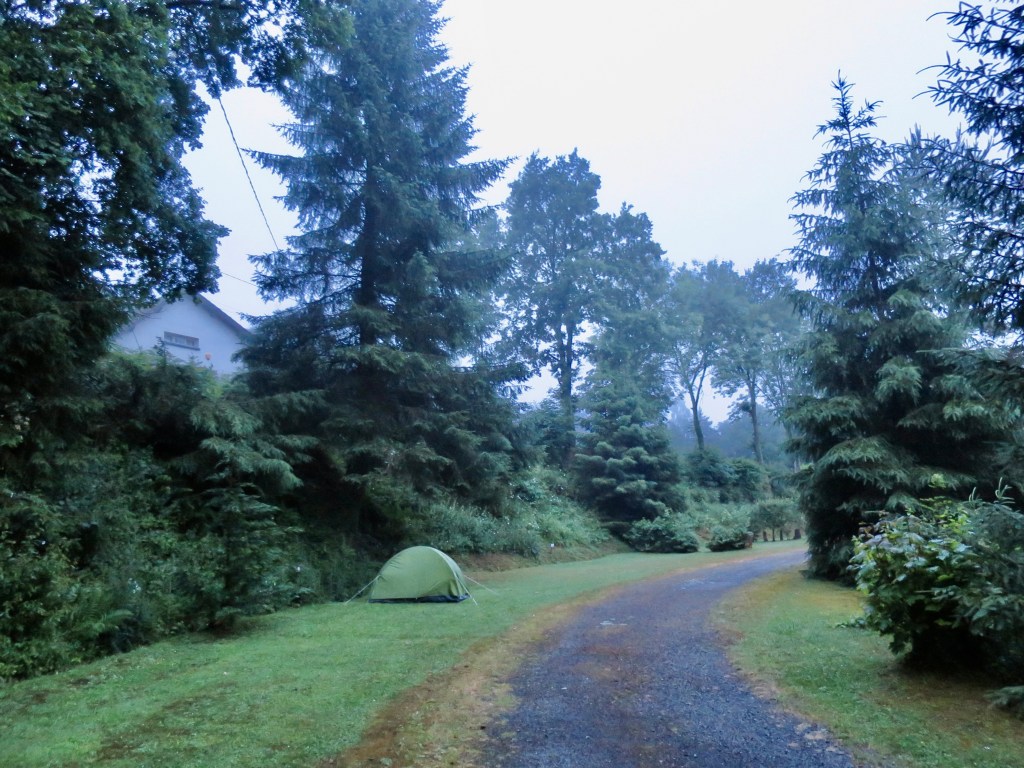
It rains a lot in the night. Mine is the only tent on the site, among curtained, blank-eyed motorhomes. After the man from Felixstowe, I see no one. There are individual bird songs from 5, by 5:30 a full, raucous, competitive cacophony. I get up to mist, greyness, and a forecast of rain.
The weather forecast for the next few days is poor, and my days are ill-planned. I intend just to get on, perhaps find some way of sorting out my gears, head for end of the Massif, Aveyron and my former home.
I set out at 07:45, without breakfast. As I’m leaving, the campsite lady points out my hat that I must have dropped last night. It’s sodden. She has told me that it’s a good road to Ussel. I usually avoid the main roads, but it is Sunday, so there will be little traffic until at least ten, and I just want to get on.
It is cloudy, with some rain. I make good time, even though the road soon rises to 800m. I remember with gratitude the work of the engineer Trésaguet in the 1780s, here in the Limousin.
Recognising that Trudaine’s straight roads, made in the 1730s, were fine on the flat, but less practical in the uplands, he introduced a gradient limit of 8%, or 1 in 12. Fine, as Robb writes, for a fully laden mule. And coincidentally for a cyclist on a decently-geared bike. So that the arrows of Trudaine across the lowlands are in the Massif replaced by Trésaguet’s sweeping curves. The inner conflict in the French between the direct straight line and the elegant curve, the rational and the aesthetic, is neatly combined in their roads, a resolution that is both a metaphor and a reality.
The rain sets in, and I stop at La Courtine for coffee. It is a village in the middle of nowhere, transformed in 1904 when an army camp for thousands of men was created around, indeed in, the village, and every peasant became an instant bar-owner. Russian soldiers were based here, and in 1917 when the Revolution happened, they dismissed their officers, formed a soviet, and ran the base for four months. The French army finally recaptured it after five days’ fighting. It was occupied by the Germans from 1942.
A group of soldiers in uniform stands by the garrison gate, bright-eyed, bursting with energy, boyish, heading out for the day. I buy a millefeuille at the baker’s, served by an elegant black girl.
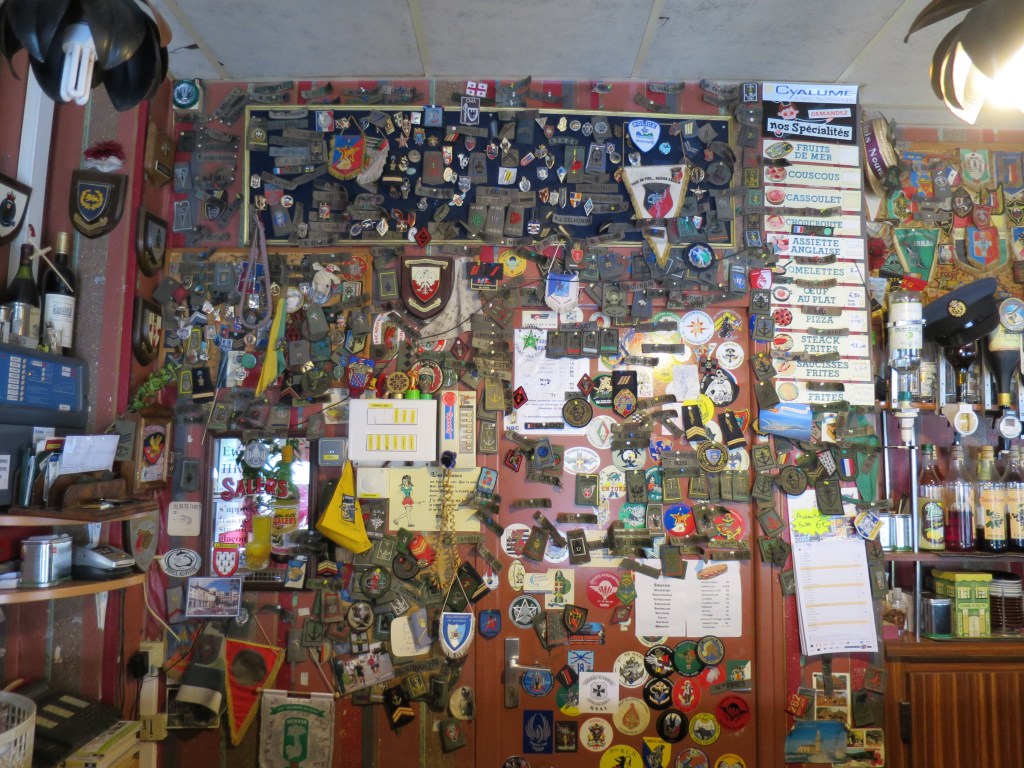
Into the one bar open, a military bar, with a mass of insignia, badges, even military caps pinned to the wall behind the bar, going back generations. An oldish woman, dark hair pulled back, smoker’s husk, recovering the bar from Saturday night, says, I probably haven’t got what you want – meaning, I guess, that the long list of food displayed isn’t yet available. I say, if you have coffee, milk, and a large cup, you have what I want.
As she prepares a grand crème, I imagine her life here. At first, as a young country girl, impressed by their swaggering, boastful virility, maybe falling for it. Over the years watching them grow younger, turn into noisy, insecure boys, sympathetic. While observing, with admiration, as I have in pubs near army camps in Dorset, the way, no matter how drunk, or carried away by the allure of girls the squaddies are, they look out for each other. Not just in fights, either, but in keeping each other safe, getting them home. What the Australians endearingly call ‘mateship’, a word whose very awkwardness is so working-class male.
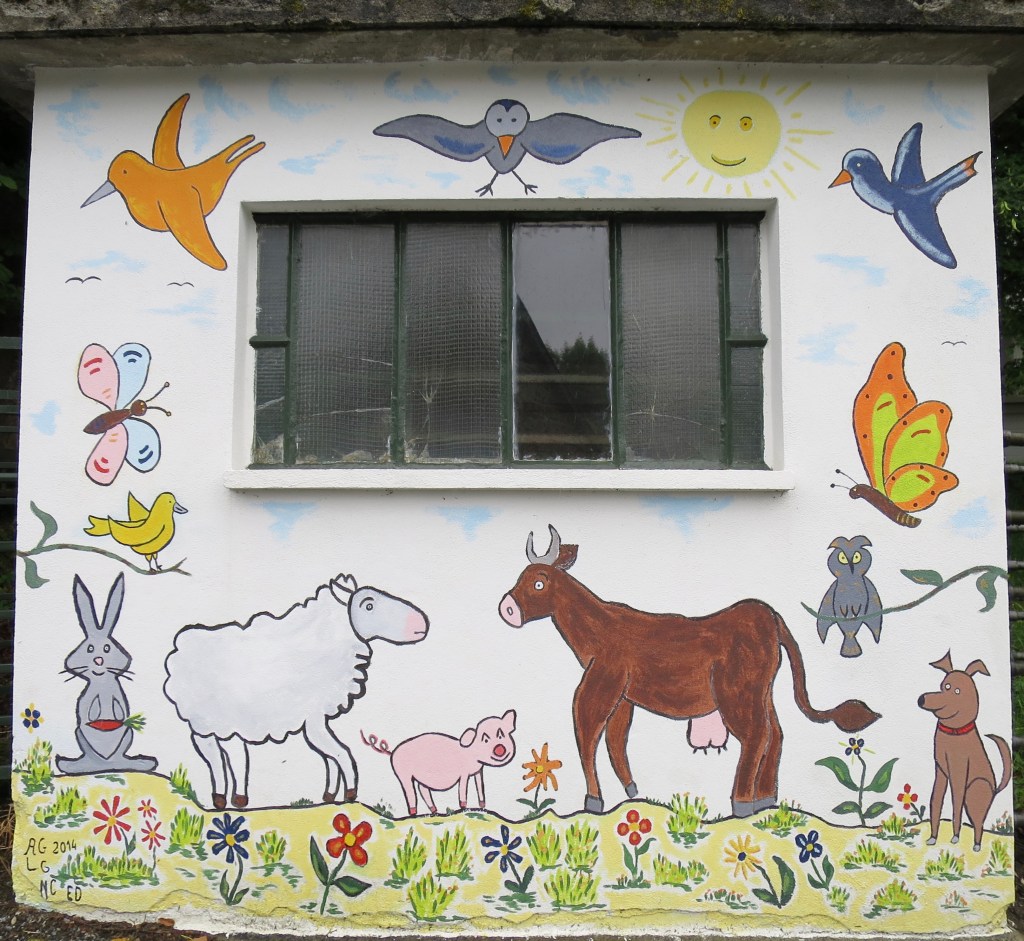
I pass a village bus shelter, decorated with a country scene: smiling animals, including an owl, emblem of Athena, and a cow with a crescent moon for horns, symbol of Isis, goddess of magic. I am close to the Meridian.
It’s raining, I’m cold and wet, and I haven’t eaten a decent meal for two days, so I stop in Ussel for a Sunday lunch. I still imagine I will find a traditional restaurant with family parties, motherly patronne, and just one dish, a huge pot of the slow-cooked ‘dish of the day’ on the menu.
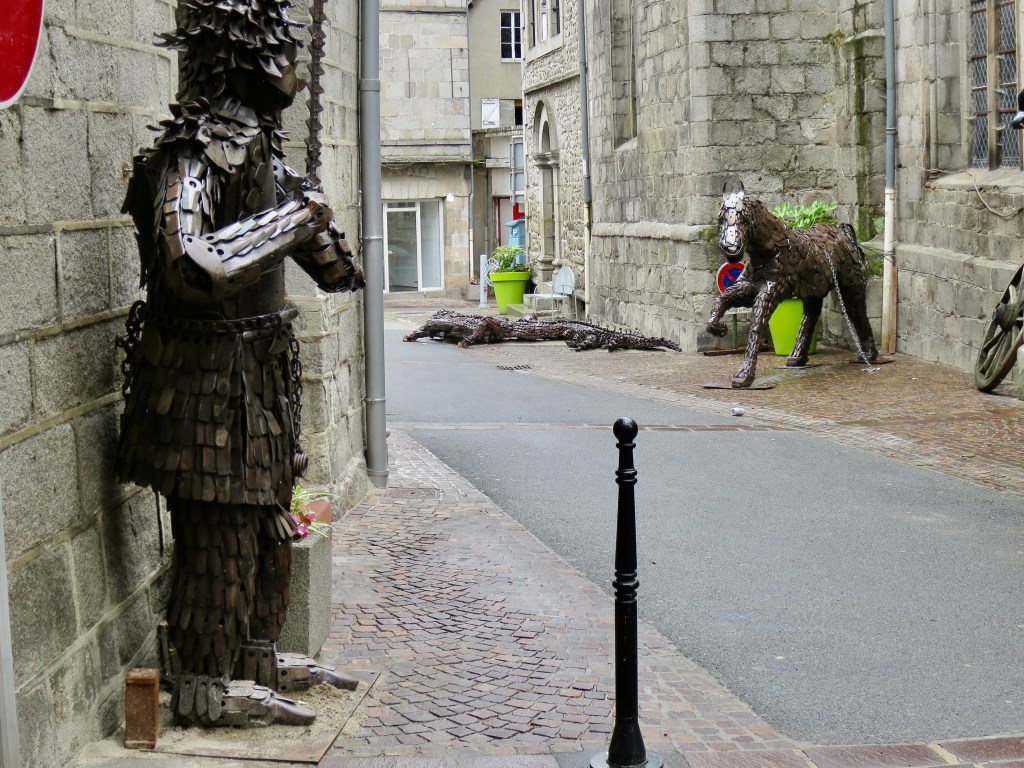
It is a grey town, on a grey day. I stop by the church. The congregation is just coming out, people stand around, as if waiting for something to happen. By the church are over-size sculptures made from small plates of dark welded bronze, mostly animals: two crocodiles, a horse, a bear; also a spiky-armoured samurai. Unsettling, menacing even, these plated, metal creatures, as if they are about to clank into life, more menacing in the confines of the tall, dark stone.
I just catch the small supermarket before it closes at midday.
There is a drinkers’ bar, not what I had in mind. It’s early for lunch, but still I can find nothing even promising in the centre, so reluctantly I head out on the road to Bort-les-Orgues. There are several cafés and restaurants on the long road out, but all are closed, except one, and that’s empty – is it even open? I go into the bar next door, part of the same establishment.
It is noisy, full, like the public bar of a popular working-class pub in England at Sunday lunchtime. There are no women. The patron is huge as a stevedore, in a vest, with tattoos on his massive, fleshy arms, dark as a fairground gypsy, only the earrings are missing. He pours a Ricard with care, picks up an ice cube with tongs, delicate as an egg, puts it gently into the clouding liquid, hands the glass to the customer with a moment’s pause, like a sacrament, then busies himself with the next customer. A shrunken man comes in, shakes hands all round, including with me, saying ‘bonjour’ to each. I struggle to the bar, ask the man if they are open for food, but of course, please, please, ushers me through into the empty dining room.
I take a seat in the window. I always do this, because I like to look out, and because I’m sure that people will come into a restaurant or café if they see someone inside, especially by the window. I always want to bring trade to the establishment, and interest for me.
The restaurant is decorated in florid bad taste. The individual elements are questionable – rag-rolled mustard walls, purple leatherette chairs, orange serviettes on green paper tablecloths. On the wall there are optically disturbing, curious elongated metal figures of ‘elegant’ ladies with small dogs, a revisiting of 1950s ‘contemporary’. The whole is a chaos.
The patronne, alerted by the patron, bustles in. She is large, dark, with long frizzed hair, all in black, wearing a loose gold belt, she narrows down from a voluminous loose top to big-hipped tights, to slender ankles, even a gold ankle-chain, and long, thin stiletto heels. This decor is proudly hers, style, in contrast to her husband’s ramshackle bar. I decide they are devoted to each other. I order what looks like it might be a mixed grill. I have a ravenous desire for meat.
As I sip my beer, I check on Ussel. A Gaulish foundation and a Gaulish name. I note that close by are Lignareix, Loudeix, Courteix. Perhaps the patron is Obelix, the patronne, Eponine. More Celtic connections.
In June 1944, as the various resistance groups became active after the D-day landings, 55 maquisards were executed in the square, among the granite buildings, where the metal menagerie is now. The town was also the scene of battles between the maquisards and the Brigade Jesser, a notorious outfit set up by the Germans to suppress the Resistance. The Massif Central was one of the most important centres of the Resistance in 1944, diverting thousands of Germans from defending against the Allied landings. Nancy Wake, the formidable New Zealander resistance fighter cycled through here on her epic 400km ride to the radio-operator at Chateauroux to call for help for the 2,000 defending le Reduit de la Truyère against 20,000 Germans. The arms-drop came two weeks too late, after they had been wiped out.
A glum-looking French family, drawn in by the €13 menu, not having seen ‘not on Sunday’ in tiny letters, are trying to find something affordable on the menu, requests from the children furtively put down, the quiet desperation of the unhappy family. An old couple have quietly taken their regular table, settled with a contented sigh for their customary weekly meal out, and are sharing, in sips, a small pichet of wine.
Then I note that the town was part of the fiefdom of the Viscount of Ventadour. Ventadour rings a bell. Of course! Bernat de Ventadour (Ventadorn in Occitan) was the leading troubadour of the 12th century. He was born, I learn, in the nearby castle of Ventadorn, son of a baker, learned to write and sing love poems dedicated to the count’s wife, Marguerite. But on making the mistake of falling in love with her (wrong artistically, for the troubadour song is dedicated to the unattainable, even to unattainability itself. But it turned out to be a good career move), as he had to flee to the court of Eleanor of Aquitaine. She had just married Henry II, and she took Bernat with her to the English court. His work influenced the (Northern) trouvère tradition, specifically Chrétien de Troyes, from whom we get the Arthurian romances. Dante was a great admirer, Occitan the only language other than Italian he used in his Commedia. When Eleanor fell from favour in England, Bernat returned to the South and the court of Raymond V of Toulouse, grandfather of Raymond VII, who submitted to the French king at Lorris.
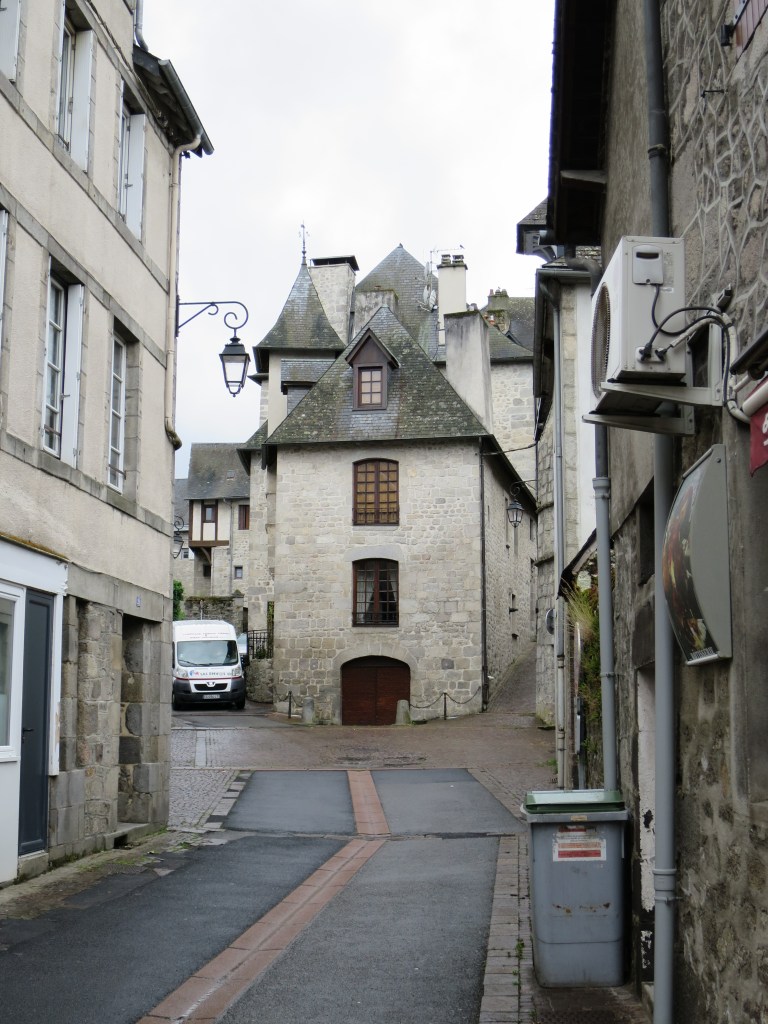
I can’t quite get my head round a court of love in this Massif gloom. But on this cold, wet Sunday, I am transported to the warm realm of love song, and to the sunny South.
While in the North, Suger of Saint-Denis and Bernard of Clairvaux were strengthening the papacy and the crown, and Suger was inventing the Gothic, in the South it was an age of less formal religion, and of courtly love. And I like to imagine that while Bernard was being heckled by the ‘heretics’ in Albi, Bernat was enjoying the court life of Toulouse.
I am beginning to get my head round the astonishing richness and complexity of the twelfth century – courtly love and scholastic debate, Gothic building and heretic burning – in the land we now call France. How intriguing it would be to visit the château of Ventadorn, just a few kilometres away … But no time on this trip.
Two women have come in. Middle-aged, lively. Are they a couple, having just discovered their true sexuality? Colleagues, friends, happily single, sharing a lunch? Lunching before heading for the bars, and fun?
As I tuck into lamb chop, thick bacon, two sorts of sausage, and chips, greasy but robust, eight bikers enter! Four couples, all in leathers. I’d seen them pass and then return to park opposite.
And suddenly, as I munch through my meaty meal, I’m in a movie, writing scenarios for the movie. This, around me, is the set-up: the dysfunctional family with the rebellious adolescent daughter and dissatisfied wife, the unreadable and yet oddly available women, the inseparable old couple, the eight bikers, have been introduced. It’s all ready. Now something will happen. Someone will burst in, to make a desperate hold-up. Or maybe they’re escaping from a failed heist, and the police, or betrayed associates, are in hot pursuit. A hostage-taking bomber or, in a period film, a fleeing partisan. (The rebellious daughter – or maybe the dissatisfied wife – will of course fall for him.) Each remembering, years later, (told in flashback?) what they did, and didn’t do. Decisions will be made, people will die, those who survive will be changed. At dawn the survivors will stagger out, blinking, into the grey light, the camera will pull back, THE END. I try different scenarios as I eat my fruit tart, continue as I drink my coffee. Around me the diners carry on, oblivious to the films they’ve been part of.
I pay the bill, and, stomach lined and filled, I leave.
I continue along the main road, south-east now, across the Meridian (nothing) heading for my night’s stop as directly as possible. I have booked into a hotel near Bort-les-Orgues. I struggled to find cheap hotels on-line in the Massif, hence the camping.
There is still little traffic, for the day is more like October than June. It rains, it eases, I think it will clear, and then it returns. But in the breaks in the rain there are clear views of Auvergne, the mountains of Auvergne, very clear, very blue, the blue mountains of the Auvergne.
But I continue to have problems with the gears slipping. My only solution is once more to lock the rear changer in one gear, using the front changer to give me two gears, far too limited for the ups and downs of the Massif. I will write of my gears and my bike here, and not again.
My bike is old, but I had thought it sound. It has taken me across Britain, Northern Europe, France, up Lake District passes and Mont Ventoux. The frame was hand-built for my father, and on my continental rides I’m taking the thought of him, as well as his bike, to places he never went. I don’t know what the problem is. I had thought of myself as Hilton’s ‘old-timer’ on his outdated bike. But on his bike “the transmission – chainset, chain and back sprocket, the heart of a bicycle – is expertly and beautifully maintained”. I have failed to maintain the heart of my old bike.
I ponder during the rest of the trip whether what I had thought of as a classic, that needs careful but routine maintenance, is in fact a vintage, requiring constant care. I email a friend, “it’s like driving across the US in a Morris 1000 with a dodgy clutch – adventurous certainly, admirable perhaps, even heroic, but not good sense.”
But that thought, and my other thought – that the bike is so heavy because I am carrying my father – I realise are inflated self-dramatisations. When I get back to England, I solve the problem. And a couple of weeks after, I meet a group of cyclists all riding bikes of my vintage, each one with the carefully-preserved accessories of the fifties and sixties, the golden age of English bikes and cycling.
The sad thing is that with the bike working properly, with the full range of gears, it would have been a much more interesting ride, I could have taken better advantage of Trésaguet’s careful roadbuilding.
As it is, I ride by using the tricks of “age and guile that beat youth and innocence” to quote a P J O’Rourke book my son gave me, putting aside possible solutions and, concentrating on survival, on getting there, learned over a lifetime of cycling. Of getting by. What the French in the War called système de débrouillage. The problems continue throughout the journey, but it would be tedious to mention them again.
When I get back to England, I try something counter-intuitive: cleaning off all the oil I’ve been lavishing on the gear mechanisms (lubrication the watchword on bicycles). And the changers, front and back, work perfectly. I struggle, and fail, to work out what lesson I might learn from this.
I travel on. I am passing through, I am living within myself, within the small (and yet limitless) compass of my self, oddly, contentedly, independently self-sufficient. That word again. Who am I? The locus, the centre of gravity, the null point of everything that happens around me and to me. Like a Gormley figure that is the person-shaped absence at the centre of rods pushed in from (or radiating out on?) every side.
Between Crépiat near La Courtine, and Sauliac near Bort-les-Orgues, the name endings change definitively from ‘at’ to ‘ac’.
The hotel is in a small village outside Bort-les-Orgues.
How strange, after camp sites and a youth hostel, tent and dormitory, to have my own room, four walls, a double bed to lay out my things on – to sleep in! – making a mattress of my clothes for a week. There are wardrobes and drawers in which to place my things, a bathroom. All mine! With a decor, however unexceptional (romanticised rural views) to respond to, to have an opinion on. Society. I hang up and spread out all my wet things. They will be dry by the morning. And I will be able to pack my four panniers with a renewed order. I have a long, hot shower.
The village is miles from anywhere, so I upgrade to demi-pension. I eat the set menu, chastely alone. Behind a screen a Dutch couple eat à la carte
I’m in the large empty bar, at my own small table, like a Peynet character on a desert island.
The patronne serves each course as if she is clockwork, absenting herself between, while insistently making her presence felt with each course by slapping noisily across the long, empty floor in her loose slippers.
A plate of cold meats. Pig hock, with mashed potato, mushrooms and beans. A plate of cheeses. Cherry tart.
She appears, as if on some ratcheted cue, some timed interlocking of gears, through the door from the kitchen, with the new dish, slaps across the long floor, removes the last plate, places the new dish, slaps back across the long floor, in silence. Once she appears too soon, while I’m still eating; she turns on her heel, a mannequin turned back to the kitchen on a short circuit, and disappears through the swinging door. She reappears, several minutes later, her timing recalibrated. She is polite but aloof.
Or, rather, resistant. She has prepared a good meal, making intelligent use of leftovers from the à la carte menu. But her mechanical presentation, and the insistent slap of her slippers, register as a silent reproach to her situation, that she is better than this, was meant for better, maybe even greater, things.
Was there once another man, the one who ‘got away’? Or is she a woman who needs to have disappointment in her heart to justify the failure of her life. Her husband is proud of his business, working hard to build it up, he’s affable, conversational. But he accepts, negotiates around, the reluctance of his helpmeet to have the same wholehearted enthusiasm. Perhaps he wonders where it might have gone, this business, to what heights they might have taken it, if she had had his enthusiasm. While she dreams of where she might have been, now. Society. The Dutch couple behind the flowers are animated, but struggle with French when talking to the patronne.
Warm, dry, well-fed, I go to bed.
Day 16: Bort-les-Orgues to Jussac, 56 miles.
Thurber and the dam. War memorial. Les Orgues and the Blue Mountains. Surveyors and mapmakers. The neighbours’ oxen. Motorhomes on campsites.
I sleep for nine hours. I wake to a noisy aluminium ladder being shifted. I look out, to see a man with a hand-rolled cigarette stuck to his lip (how long since I’ve seen that?), cleaning the gutter, shuffling the high ladder along without climbing down. It is Monday.
Breakfast is just adequate if well presented: yoghurt in a glass pot, juice, 3 small pastries, three pieces of biscotte, the rusks the French insist is food, black coffee, one spoon for yoghurt and coffee. I’d give anything for a full English, or even a bowl of porridge.
I cycle to Bort-les-Orgues. The road rises and falls, tracking the quiet reservoir whose edge follows the sinuous contour. I pass through a village of oddly-shaped eco-houses. Past a girl training a horse on a long leading rein. It circles, between nothingness and the flicking whip, searching for the intentions of the girl turning at the centre of its new world.
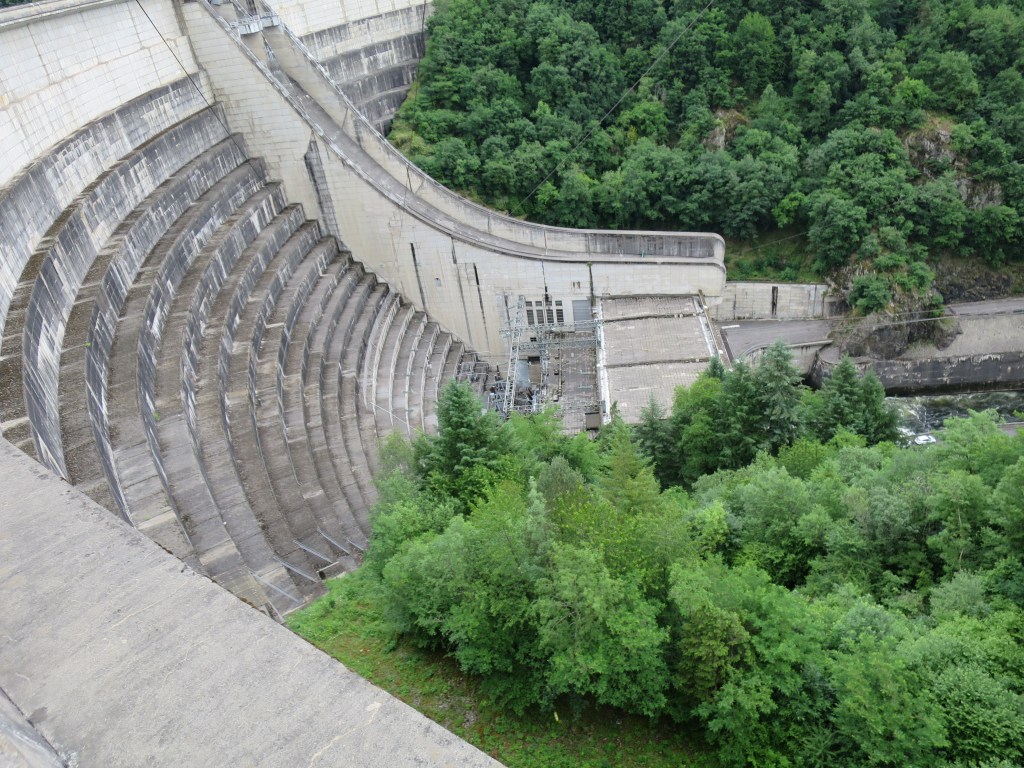
The dam at Bort-les-Orgues is 120m high. Above it, half a billion cubic metres of bland water bury and weigh down what was. Below it, the valley continues, busily various, the town going about its business. I descend. At the top, the dam is elegant. From below, the stepped mass (700,000 cubic metres of concrete) looks as authoritarian, even totalitarian, as the ziggurats and pyramids of the Middle East and Central America, or Hitler’s Atlantic Wall.
The dam is not visible from the town – how terrifying it would be if it were! – but in Bort there is a display of photographs of the dam being built.
It must have been strange, just after the war, after the Occupation, the Resistance, the harshness of reprisals – 99 young men strung up like crows by the Germans a few miles from here – hoping to return to its peacetime ways, a quiet rural area far from industry, to watch it being built, the scale of it, rising ever higher, blocking off the valley. And then, as the water rose, to watch the familiar slowly disappear, the fine texture and nuances of the land, the memories, of woods, pasture, roads, villages, disappear beneath the placid, blank, unreadable surface.
I remember the James Thurber story, ‘The Day the Dam Broke’, and wonder if a similar panic ever occurred. Or if there is a perpetual unease at that half a billion tonnes of water behind 1.75 million tonnes of concrete. Does the solid, falling water, creating the mysterious will o’ the wisp, electricity (I remember the Thurber character convinced that electricity leaked from light sockets if there was no bulb), the hum of the turbines, the crackle of the electricity, do they ripple, like low-level fracking, and subconsciously disturb, make strange dreams? A strange place to live.
I ask at the pharmacy for Nivea cream. Oh no, she says, with the ghost of a superior smile, we don’t sell Nivea cream, they sell that in supermarkets.
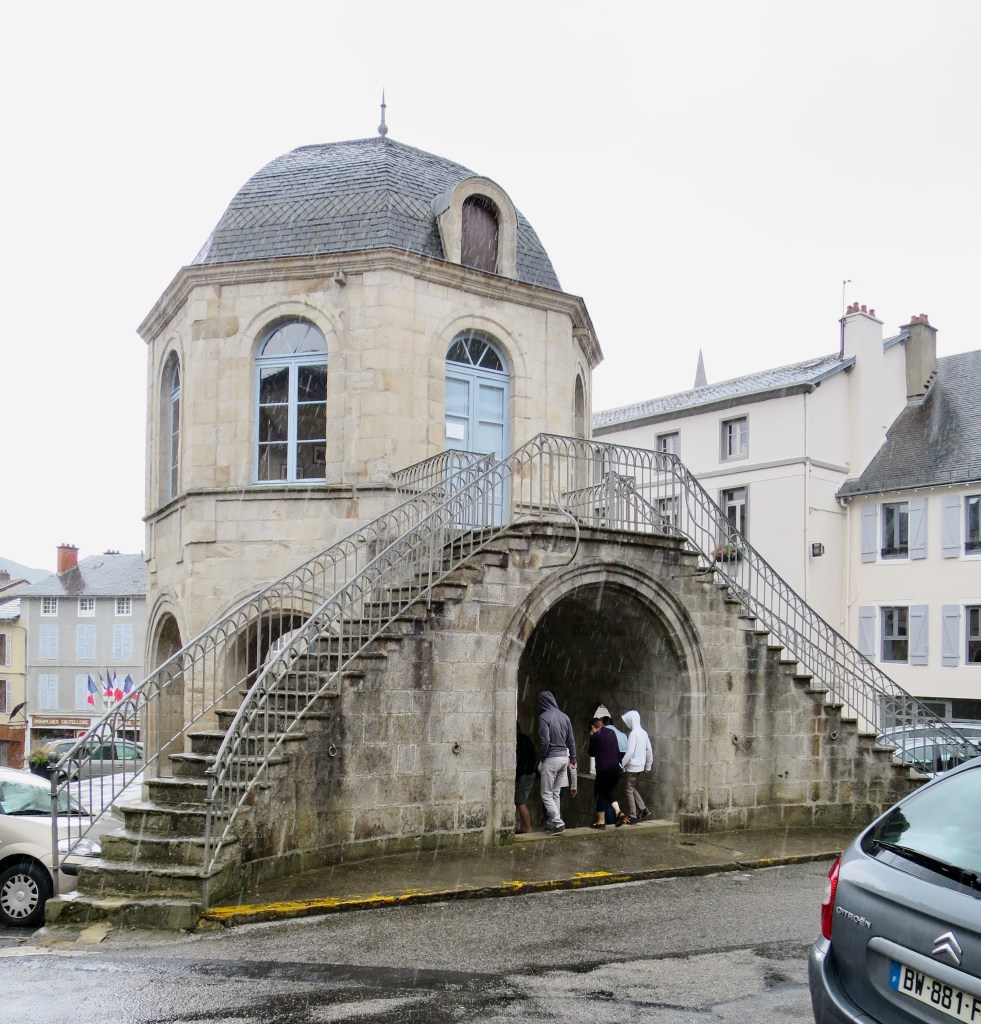
In the square is an unexpectedly elegant hexagonal, domed building, with an elaborate stone double staircase up to the door, the Grain Exchange. What sudden wealth paid for it?
But what draws my attention is the war memorial.
The population of Bort in 1910 was 3,800. The military-age population would have been about a sixth, perhaps 700 men. There are 152 names on the memorial. Almost a quarter of the men, speaking a different language, who had never been ten miles from their home, dying hundreds of miles away in an incomprehensible war in a strange land, and buried there, for – France. No wonder the country surrendered in 1940. There are 36 names from the second war.
Where, I ask at the tourist office, are les orgues? Up, she says, directing me to the road. Bort became Bort-les-Orgues in 1919, a response to the growing tourism industry, as the motor car brought the adventurous into the previously inaccessible. It now claims to be ‘at the heart of the Massif Central’, which is pushing it. But it is on the ancient road from Clermont to Limoges, and the Tour de France passed through in 1996.
It is a long climb, out of Bort, then up and up, from 330 to 850m. But the sun has come out, and it’s a clear day. There are steep-roofed houses slated with round-edged slates.
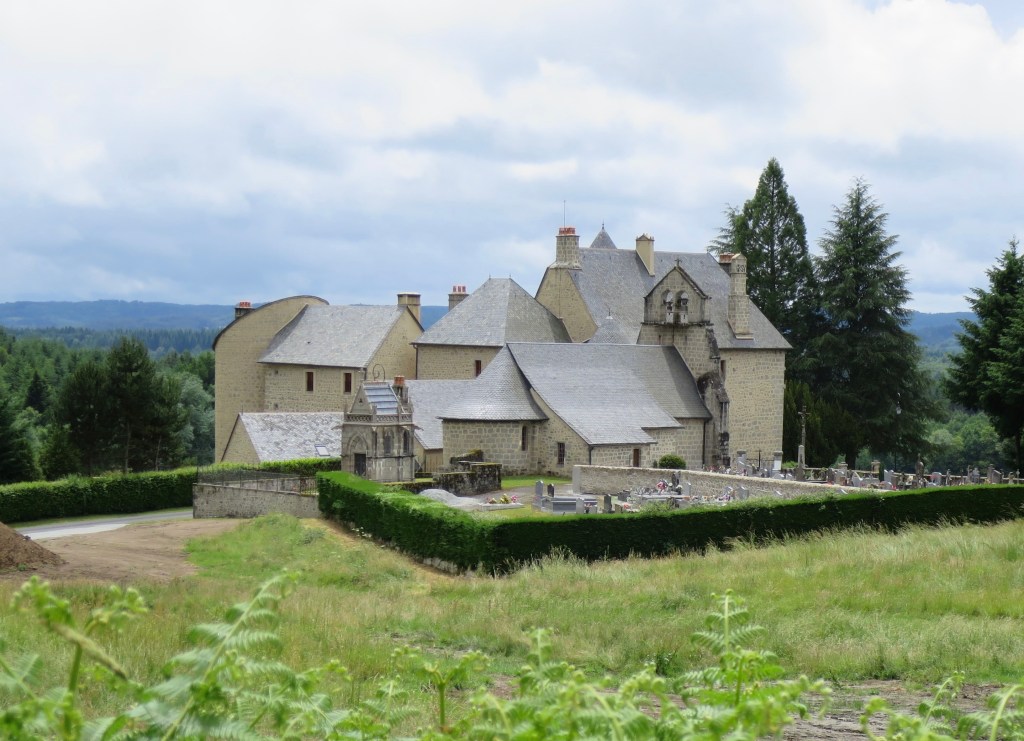
Some are the houses of the wealthy, seeking panoramas and views.
Some of incomers, marginaux, scratching a cheap living.
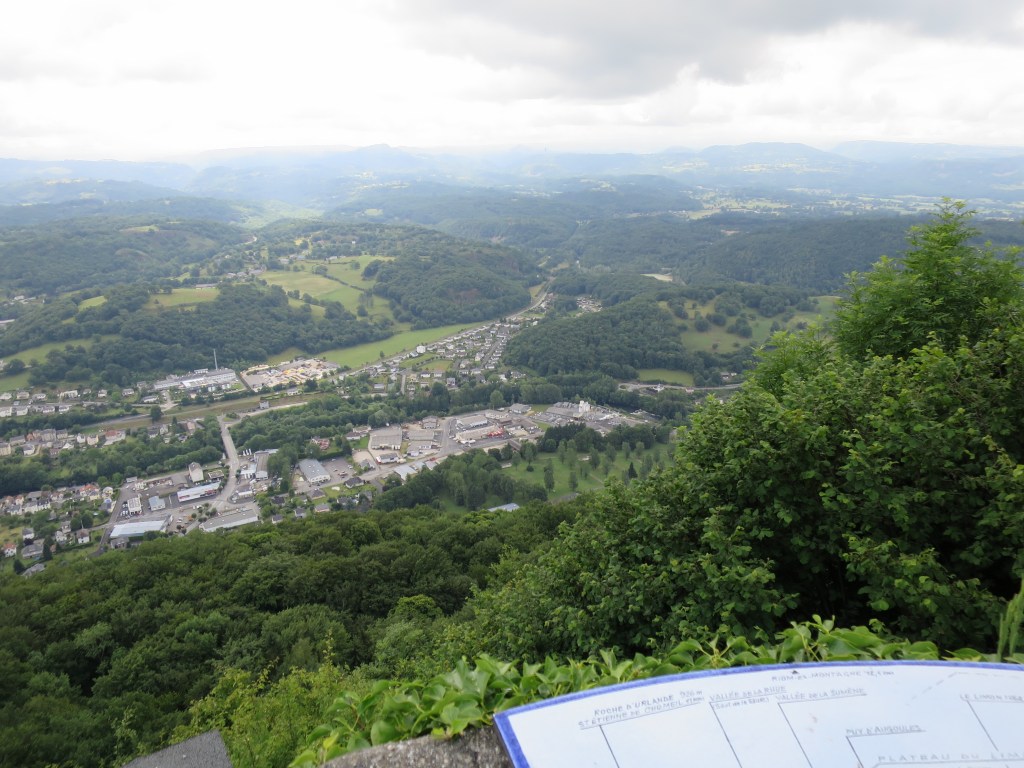
It is a long climb but – what a view! I park my bike and walk to the edge. And it is an edge, with a steep drop down. Looking east, the whole of the Massif is laid out in a vast panorama, limitless until softening and lost in blue distance. The blue mountains of the Auvergne. A woman walks to the edge, whispers ‘magnifique!’ ardently, thrusts herself out like the figurehead of a ship over the blue emptiness.
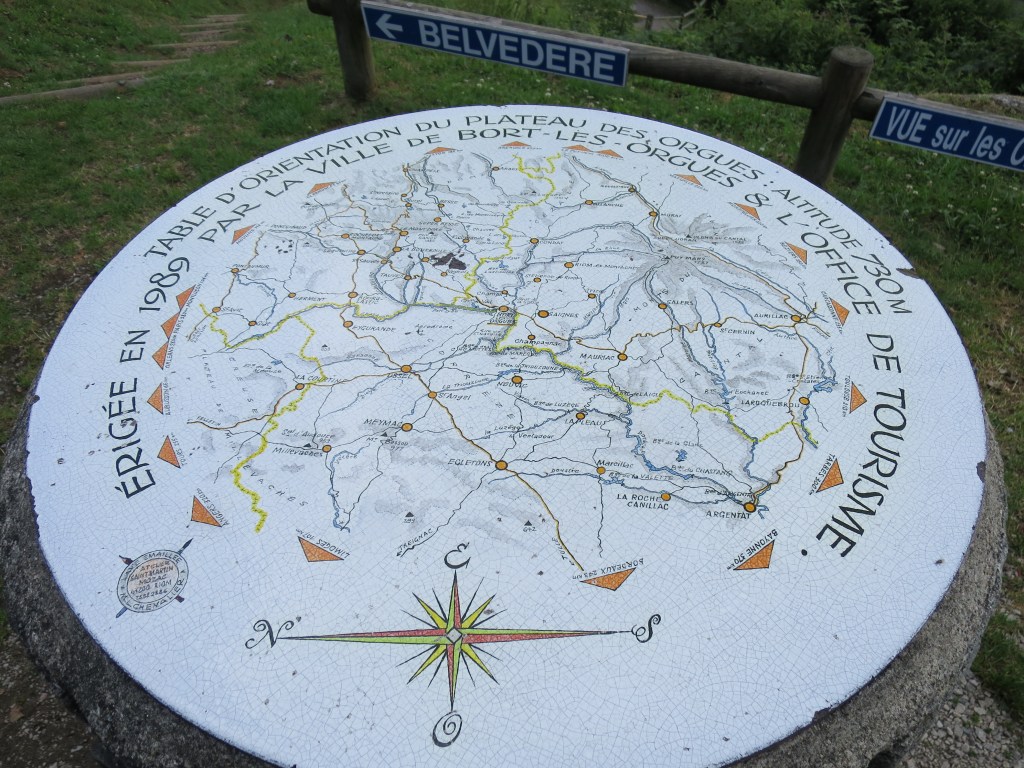
I imagine the first map-makers in the mid-eighteenth century, having triangulated their way from the Meridian 10km away, climbing up here, looking out at what they were going to have to enter and survey, a limitless terra incognita, and saying ‘what the f…!’ as they see laid out before them the scale of their task. A few miles east of here one of the surveyors was hacked to death by the suspicious locals. A few miles south, one was so badly beaten that he had to be retired on a pension. Another ‘went native’, married a local girl, and reappeared in Paris in his nineties with a new, improved theodolite he had invented. How well Robb evokes their heroic eighteenth-century journeys into lands of incomprehensible languages and strange ways, as alien as America, or even Africa! And they did it, not to make money, but to bring a new rationalism. They were making a geometric net with which to capture, definitively, the various land of France.
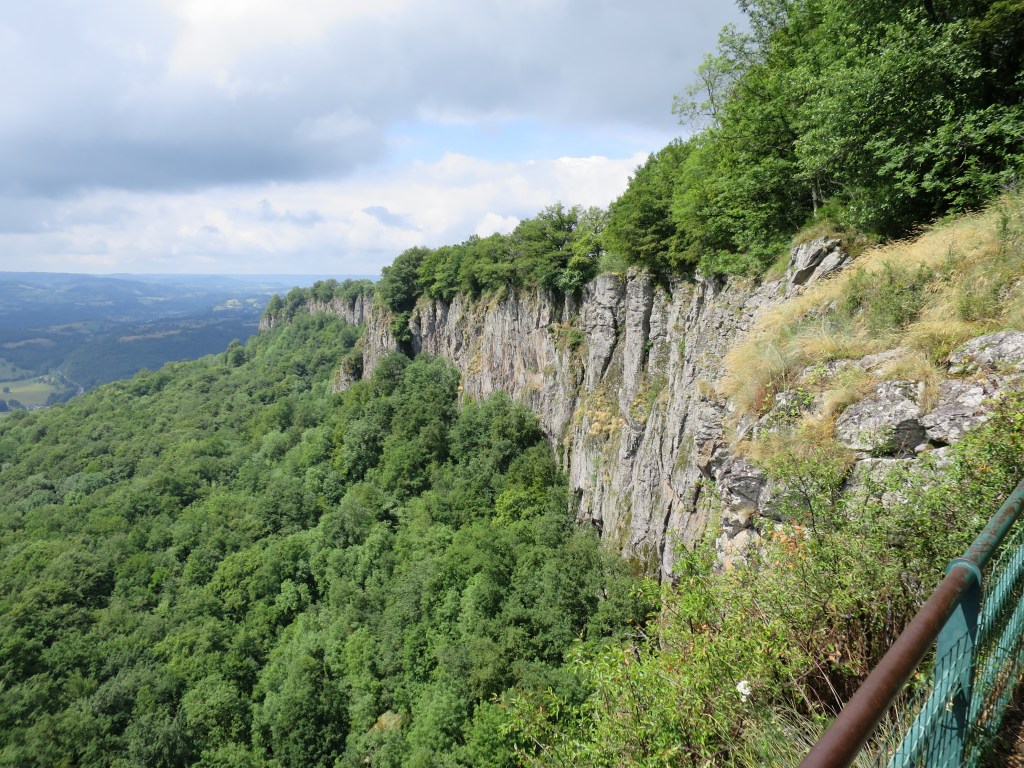
But up here, in this place, there is some place faraway that is nudging at the edge of my memory. And when I walk round to view Les Orgues, I remember. Les Orgues are phonolithic volcanic rocks, an 80m vertical face of ‘organ pipes’ that look like the basalt columns of the Giant’s Causeway, fancifully a giant’s xylophone, but are in fact the result of erosion. And I remember the view from Katoomba, in the Blue Mountains of New South Wales. How similar, the Three Sisters rock formation and the view across the endless blue plateau, where I spent a memorable day with my son six months ago. The Blue Mountains, uncrossable because every valley route ended in an impasse. Only when one explorer kept to the ridges did he succeed. As the French surveyors would keep to the heights, sighting from high point to high point. There is now a telecommunication mast up here, where the survey point is now lost in dense woodland.
There is a refreshments caravan. I wonder how he makes a living; even in the middle of June there are few tourists around. I have coffee and a chocolate bar. He asks where I’m heading, I tell him south, not sure where I’ll camp. He says he likes Entraygues, on the Lot. I take this as a sign, make a note as a place to camp tomorrow night. I say goodbye to the Blue Mountains, French and Australian, my son far away. I’ve spent far too long on this pilgrimage up to one of the surveyors’ high points. But it’s been worth it. Now I freewheel down the hill, and then up towards Mauriac; I want to get as far south, as near to Aurillac as I can today.
It’s a long day of hard cycling, the road snaking to ease the ups and downs, in classic Trésaguet road-building. Mostly over 700m, in places 800m, long sweeping roads tough even when the gears aren’t playing up, what with the weight of the bike and my lack of strength.
Even so, it’s a fascinating day, cycling through a curiously fairy-tale world of houses tall-roofed with scalloped slates, avenues of trees, woodland among the pasture, long green hills, distant blue mountains, paths off to who knows what mystery places, a sort of enchantment, even on a windy, cool, grey day. The cow bells, the first I’ve heard this time, add to the sense of enchantment. The Limousins have lustrous brown hides, small shapely heads, large dark eyes, delicate feet. The Charolais are sturdier, but of a startling whiteness that makes them other-worldly, descendants of the Zeus who carried off Europa. I have just passed La Vallée du Mars.
They are now popular beef animals across the world, and were both developed from the meaty breeds bred for oxen. It was because the French never turned to horses as draught animals, and because of the late industrialising of French agriculture, that they survived, and were available to be introduced into breeding programmes. Every farm in our part of Aveyron still had the sturdy wooden frame needed when the oxen were being shod; they can’t stand on three legs.
Our neighbours still had two oxen when we arrived. The neighbour’s brother-in-law, a live-in farm-hand, loved to take them out, to plough the more difficult areas inaccessible to the tractor, or to earth-up the potatoes, the rows of which the great beasts used to step between with an unlikely care and grace. I wrote this: “Gaston returns to the cowshed. I wait expectantly. The first ox emerges, then the second. They stand, unmoving, huge brown creatures with massive shoulders, but smooth and rounded, and somehow daintily proportioned. Eunuch cousins of great strength and placid disposition. They stand patiently as Gaston locks their heads together in the wooden yoke, tightens the strap across their brows, their long horns interlocked. He puts the light wooden plough over his shoulder and leads them away making chucking noises. They lean together, strange twins, Kleobis and Biton, balanced, separate but coordinated, their steps surprisingly delicate, but plodding nevertheless. He is going to earth-up the potatoes. He whistles as he goes.”
When we returned from a trip away, the oxen were gone. Where are they, Gaston? In the deep freeze, he said, a so-it-goes smile masking his grief. Another of the old ways gone. The neighbour had decided they were too expensive to feed, didn’t pay their way, the son wanted a new Lamborghini tractor, they had to go. But they weren’t going to waste them.
I make decent progress, on a snaking parallel to the Meridian close by. I note that many places here are twinned not with foreign towns, but with places in Brittany. It seems odd, but it’s a sign of the size and variety of France. In the Massif, the coast is another country, and it’s a chance for local children to be by the sea, and their children to experience the mountains.
I make it through Saint-Martin and Saint-Cernin, pressing on. I think I might even get to Aurillac. But when I reach Jussac and stop at the supermarket, I feel cold and put on a jersey. But now I’m shivering. I pass a camp site and then go back to it and get off my bike, shaking. I’m all in.
The bright woman with sharp eyes in the office says, I saw you pass, then come back. It is a private camp site. And €10! And always the local tax of 20c added. It’s always irritating. The commune demands its tax. The businesses refuse to include it. Provincial France at its most self-justifyingly pernickety.
Are there places to eat here, I ask? She talks vaguely of restaurants. And you can always get a pizza, she assures me, gesturing down the main street.
I pitch near the toilet block, which itself is beside a deep, running stream. As so often I am the only camper. There are a couple of motorhomes.
The motorhomes fascinate me. I arrive at each site to find them parked up. I see no sign of life. They are still there when I leave. The campsites aren’t cheap for motorhomes, and those in them make little use of the facilities. They are self-contained, self-sufficient. So why don’t they park by the roadside? Security, perhaps. I feel they are people who would fear the worst in any situation, in cities expect to be mugged, in the country to be attacked by local deviants or roaming maniacs. And, too, the comfort of drawing up among the similar. It is like a bungalow easing itself into a space in a cul-de-sac. The campsites are like suburban closes. Home from home. And of course there is the power point; I can’t imagine they ever miss their favourite TV shows. But it seems odd, leaving home without leaving it. I imagine the interiors are miniature versions of their houses, with every picture and knick-knack an analogue. And yet driving to a different place, and parking between different, if identical, motorhomes, makes a difference. Self-sufficiency, yes, but it feels like the petty bourgeois self-sufficiency of ‘neither a borrower nor a lender be’, a wall-in, wall-out world.
I go in search of food. The office is closed, the woman gone, so I wander around the village. There is one closed-down restaurant, and another closed on Mondays. The pizza place is open Wednesday to Sunday. Surely she knew all this? It’s curious, this lack of honesty. As if, once she’s gone, she’s ‘got away with it’ – after all, it’s not her fault that nowhere is open. I return to the campsite and eat what I have, sardines, bread, rice pudding.
It rains. I sleep.
Day 17: Jussac to Entraygues-sur-Truyère, 57 miles.
Latitude 45ºN. A land of faery. The Félibrige mansion. ‘The most remarkable man of the tenth century.’ Bienvenue en Aveyron. A headlong descent. Pointed arch and mandorla. A pavement café. The stranger at home in a strange land.
I should be pressing on south. Instead I go west, the few kilometres to the Meridian.
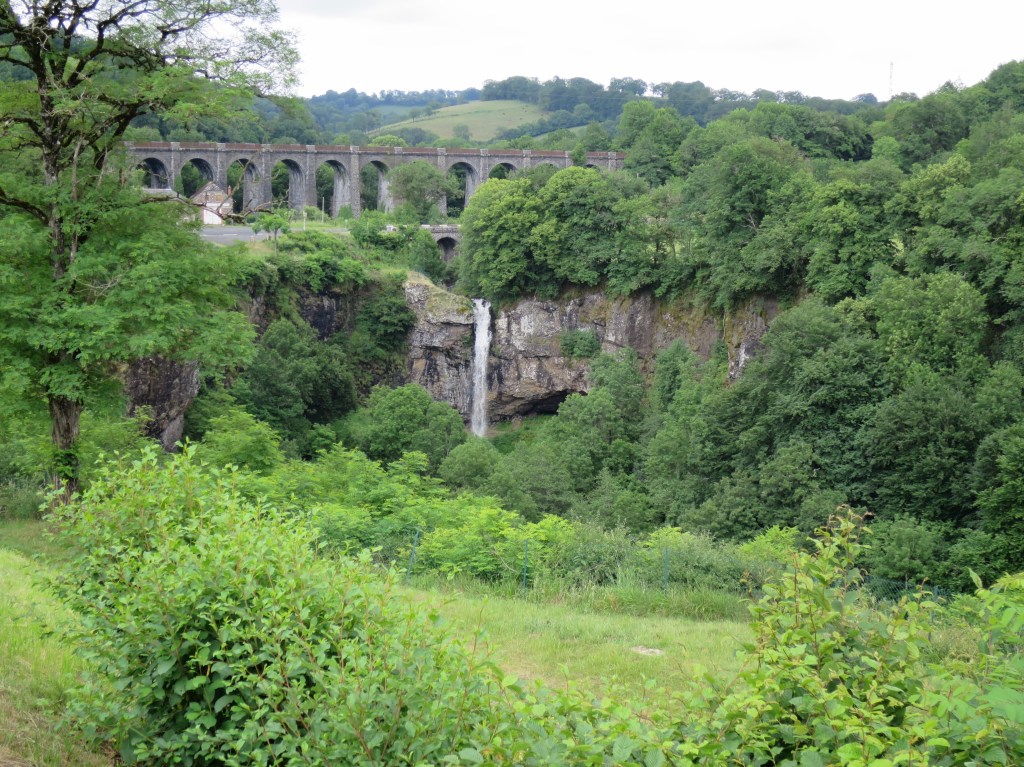
Away from the main road, it is strangely faery. There is a stillness that yet vibrates with a sense of something having happened, or about to happen, a suspense. It is a place of dells and woods, where transformations might take place, where creatures glimpsed from the corner of the eye are not there when you look … Were they ever? Where have they gone? I experience the tableau, of a secret river lost in vegetation, a waterfall, a railway viaduct of stepping brick arches disappearing into woods, with Palmer’s vision, de Chirico’s mystery, as a vibration left by the departed. The lane I’m on twists through a farmyard, I’m engulfed by animal warmth and the scent of hay, so beguiled I almost climb off and enter; and by it is an ordinary house. Yet it has a round tower with a conical roof of scalloped slates, a spiral staircase up to a room of solitary work – what was it once? What is it now? Who is there?
But my destination is pure science. I am on latitude 45º north. Which is not only half way between the North Pole and the Equator (the quarter of the earth’s globe from which the length of the metre was derived in 1799), but also the origin-point of the Bonne Projection used to map France. All map projections are distortions, as they map the spherical onto the plane; the origin-point is where the distortion is least. Four trees, I read, have been planted around this point, at the four cardinal points, near the village of Ayrens. I find the exact spot. A field of pasture. And no trees. Yet another absence in my search for the Green Meridian.
And close by is another absence. The Château of Clavières was built by the Duke of Rochemaure, ‘grand, megalomaniac lord of the manor, majoral of Félibrige, historian of the pope Gerbert, and of Cantal troubadours.’
It was built in the late nineteenth century, in the ‘Troubadour’ style. I’ve seen photographs. It was a fairy-tale castle, of turrets and steep roofs and pinnacles, filled with furniture, paintings, ceramics, tapestries, sculpture in every and any style, as long as it was ‘old’. The Troubadour style is what in England would be a mixture of Gothic Revival and William Morris medievalism. It brings to mind Walpole’s Strawberry Hill, Beckford’s Fonthill Abbey. A confection of revivalism. And yet, with its “magnificent park with a lake and stream, pavilions, gardens, troubadour statue, monumental gateway, and commons”, it must have been disconcerting and magnificent at the same time.
The duke would entertain on a grand scale, holding dinners for a hundred guests and more, the beau monde of the belle époque, until his death in 1915. There is a photograph of the duke and friends in a motor car, dressed in the highest style, like characters out of Proust.
The château burned down in 1936. The surrounding park and buildings remained accessible until it was recently bought. It is now fenced and gated. Again, imagine entering the “magnificent park with a lake …” etc. that surrounded, danced round, was inspired by, the now-absent centre. What would Meaulnes have made of it, on a winter’s night? And perhaps it explains the strange mood that came upon me as I entered this area.
Returning to the duke. Whereas English medievalism tends to evoke a romanticised Arthurian world, the French had the troubadours. And the troubadours were real, leaving real songs. And in an old language. And suppressed by the victory of the Northern barons in the Albigensian crusade. The majoral of Félibrige was the council of fifty of the Occitan revival movement, founded by Fréderic Mistral in 1854. But whereas Mistral’s Occitan was that of Provence, the duke championed the Auvergne Occitan. (Cantaloube’s ‘Songs of the Auvergne’ are in this language.) There was a group in Aurillac writing in Auvergne Occitan in the duke’s time. But when he started a magazine, he founded it in Paris.
The duke died in 1915, his widow in 1930. There was an eight-day sale of the contents, drawing buyers from all over Europe. Reminding me again of Beckford’s great sale in 1822. And then the empty house went on fire, on the day of Aurillac fair in 1936. The lakes had long been emptied, so there was no water for the firemen. All they could do was watch.
Another place I could stay, go deeper into (that winding staircase up to that tower room …). But, onward!
Except – wait: ‘historian of the pope Gerbert’. As I bypass Aurillac, a city of ‘unpretentious provinciality’, the département capital furthest from a motorway, a city besieged several times by the English and sacked in the Wars of Religion (reminding me again how ravaged was the middle of France from 13th to 16th centuries), the city of Auvergnat poets, I must celebrate ‘the most remarkable man of the tenth century’ (Wolff), Gerbert of Aurillac.
A poor Auvergnat, he was a monk at Aurillac monastery, of such quality that in 967 he was sent to study at the abbey of Vic in Catalonia. (It is due south, on the Meridian. It was a monk from Vic, visiting St Fleury monastery on the Loire to beg a fragment of St Benedict, who witnessed and wrote about the burning of the Orléans heretics in 1022. Ripples up and down the Meridian.) The libraries and learning of the monasteries in Catalonia were much superior to any in the North, as a result of their contact with the Islamic world. From Vic, Gerbert could visit the great Islamic scholars in Cordoba and Seville.
He returned to France, bringing Arabic numerals, with which, on an abacus of his own devising, he amazed scholars with the speed of calculation when compared with Roman numerals. He had learned arithmetic, geometry, astronomy, and music, the quadrivium,long neglected in the North, which he taught at Reims. (The North had focussed on the trivium, grammar, rhetoric and logic, the skills of the clerk, not of the intellectual explorer.) He reintroduced the armillary sphere, used to study the stars, adding sighting tubes for accurate observation. He wrote a treatise on the astrolabe. He built a water-powered organ, tuned to an accurate mathematical scale. Obsessed with learning, he wrote to a friend, “you know with what zeal I am everywhere collecting copies of books … I use large sums of money to pay copyists and to acquire copies of authors.” “I am diligently forming a library.” A humanist before the time of humanism, he read the classical authors, “the treasures of Greek and Roman wisdom” he called them. H had little interest in theology, or administration or politics. His two years as Pope Sylvester II were not a success, although he did help Otto III advance Christianity into Poland. But his practical approach to the ‘sciences’ – his method was used for over 200 years – and his knowledge and respect for Islamic learning was a thread of connection with the forgotten learning that would power the Renaissance. “I teach what I know, and what I do not know I learn.” This from a tenth-century pope.
But within a century, tales were circulating that Gerbert had derived his knowledge not from study but from a book of spells stolen from an Arab philosopher in Spain. Or from a pact with the devil. He was also said to have a brazen head (another detached head!) that would answer any question with ‘yes’, or ‘no’. (Sir Thomas Browne considered this to be a misunderstanding of the alchemical work of scholars.)
Perhaps, as with Jacques Coeur at Bourges, any exceptional talent is, in fearful (they would say respectful) times, ascribed to the devil. But alchemy, and ancient and mysterious knowledge, keep appearing along the Meridian.
After Aurillac, I head along the road towards Rodez, the département capital of Aveyron. I’ve never been there, and won’t be going there this time. I know it only as the place where Antonin Artaud was put in an asylum. His friends had taken him south, out of the Occupied Zone in 1940. To cure him of his habits of crafting magic spells and creating astrological charts, he was given electroconvulsive therapy. While there he wrote ‘Van Gogh, the Man Suicided by Society’. In his Theatre of Cruelty (closer to Nietzsche’s ‘Dionysian’ than cruelty as we use it, more a return to the origin of theatre in magic and ritual), performers and audience shared a ritual of extreme confrontation, in order to shatter false reality. His ‘spectacle’ – his name for the theatrical event – was intended to shatter what Debord coincidentally called le Spectacle, the world of mediated experience created by consumer capitalism.
I am heading for Entraygues for the night, simply because the man in the snack bar by the orgues at Bort and told me he liked the place.
Up and down, in long Trésaguet sweeps. And then, at the top, the département boundary, and ‘Bienvenue en Aveyron’. The first time since we came back briefly, my wife and I, with a baby, to sell the house. It was the day mains water arrived in our little hamlet, the day the old way ended, the old way I write about in Diggers and Dreamers.
It is so much more beautiful than I remember. How much my memory has been coloured by the troubles we had, that need not have been! The door that opened. That I did not walk through.
Laid out before me is a distant, airy panorama of blue hills with, nearer, the land swelling and dipping, my hand automatically following its line as I stand by the Aveyron sign. Dark woods of oak, for building-timber and feeding pigs; sweet chestnut, for furniture wood and the nuts that were once the staple food, so much more secure and nutritious than imported potato and expensive wheat; lighter ash, for tool-making and winter fodder. With, carved out from the woodland, the bright green pasture, the coloured patchwork of cut hay, potatoes, barley, wheat. And among them the gardens, and the houses and barns clustered in small hamlets, as ours was.
The cars drive faster, wilder, there are more beeps, more arms waving from car windows, more shouted encouragements. I am entering the South.
Why do I think this? I am still high in the Massif. But, it feels like the South.
It’s been a tough day, with lots of climbing, and I still have 10km to go. How will I manage?
But then, now, as if by magic, the road starts to go down. And keeps on going down. I hadn’t realised that I had been climbing ever since I left Aurillac, and that I am now descending, in a few miles, 600m, down to the Lot. Like the cars on a roller-coaster ratcheting slowly up to the highest point, I have been storing up potential energy. And now, released to gravity, I fall, leaning through the sweeping bends, in and out of dense woods, without turning handlebars or touching brakes, steering simply by shifting my weight, my centre of gravity. I swoop down like a bird, on the edge of control, fast, thrilling.
I pass a blur of warning signs telling of an emergency exit 6, 5, 4km ahead, with the graphic of a runaway lorry with speed streaks behind it pitching off a cliff onto a church steeple. It lacks only a screaming figure with fright hair leaning out of the cab.
I sweep through curves, the wind in my face streaming out my hair, I’m cutting through, with the air holding me back, and gravity letting me go. For these falling minutes I am released from my load, freed of responsibility, liberated.
I land at the bottom, soft as a bird, beside a mirror-smooth river, close to an elegant bridge. I have fallen into a different world.
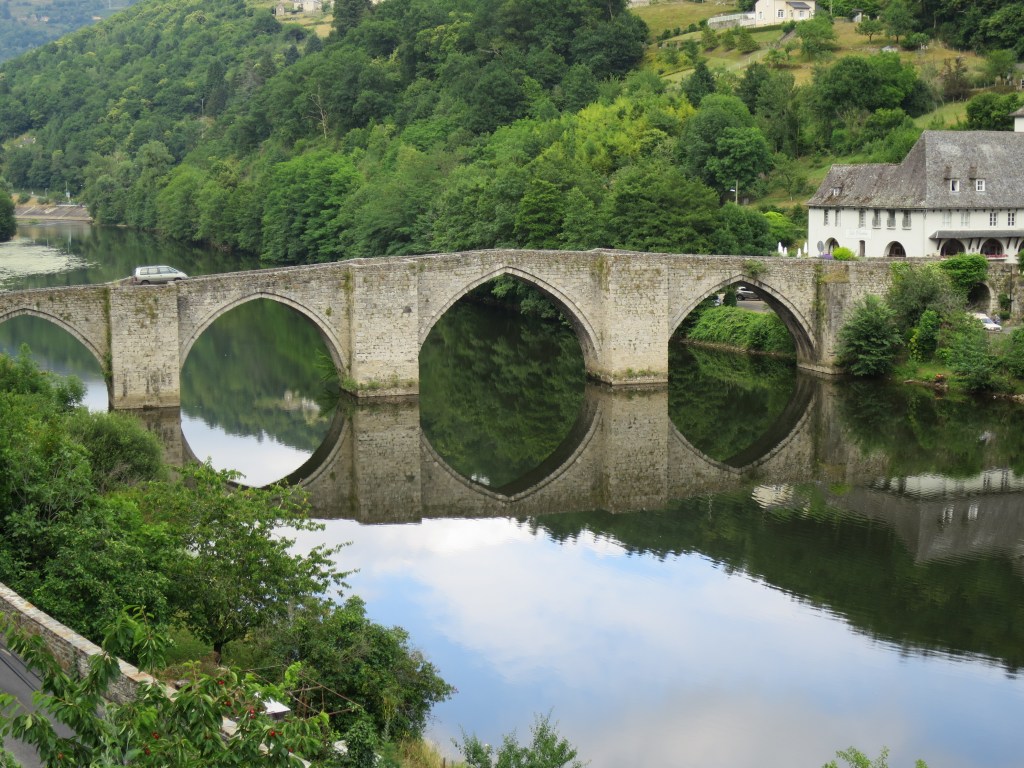
I cycle along the river bank, in the narrow cleft between high wooded hillsides studded with houses, towards the bridge.
Elegant is the wrong word for this bridge. It is leaner, more muscular than that. It is a bridge of pointed arches, built at the same time as the great Gothic cathedrals of the north were being built.
One accepted theory brings the pointed, the ‘Gothic’ arch, from the Moslem world, brought by Crusaders returning from the capture of Jerusalem in 1099. It echoes, this bridge, a 9th-century Byzantine bridge in Turkey, an Arabic bridge in Iraq. It has the panache of the necessary curve of Moslem architecture, worked out in such brilliant complexity in the Alhambra in Granada. Here, in a practical bridge, the curves rise up to meet at the thinnest, highest, weakest point, and thereby carry away the strain, with a satisfying grace. Perhaps the new bridges were built in the South on the Arabic model, seen there by returning nobles and clerics, and the idea carried north, taking fire in Suger and his church builders …?
And this. The pointed arch, together with its mirror image in the still water, creates the almond-shaped aureole, the vesica piscis or mandorla. Which, variously: depicts the sacred; frames the figure of ‘Christ in Majesty’ in early church art (revived in Graham Sutherland’s Felletin-woven tapestry); is the ichthys symbol of Christ; is the vulva, entrance to mysteries, the passage out of this world into new worlds. A whole restless realm of possibilities. Surging out of the Moslem, this river flowing through it, a gift to the Gothic. The long descent freed my head, deliciously, for fancy.
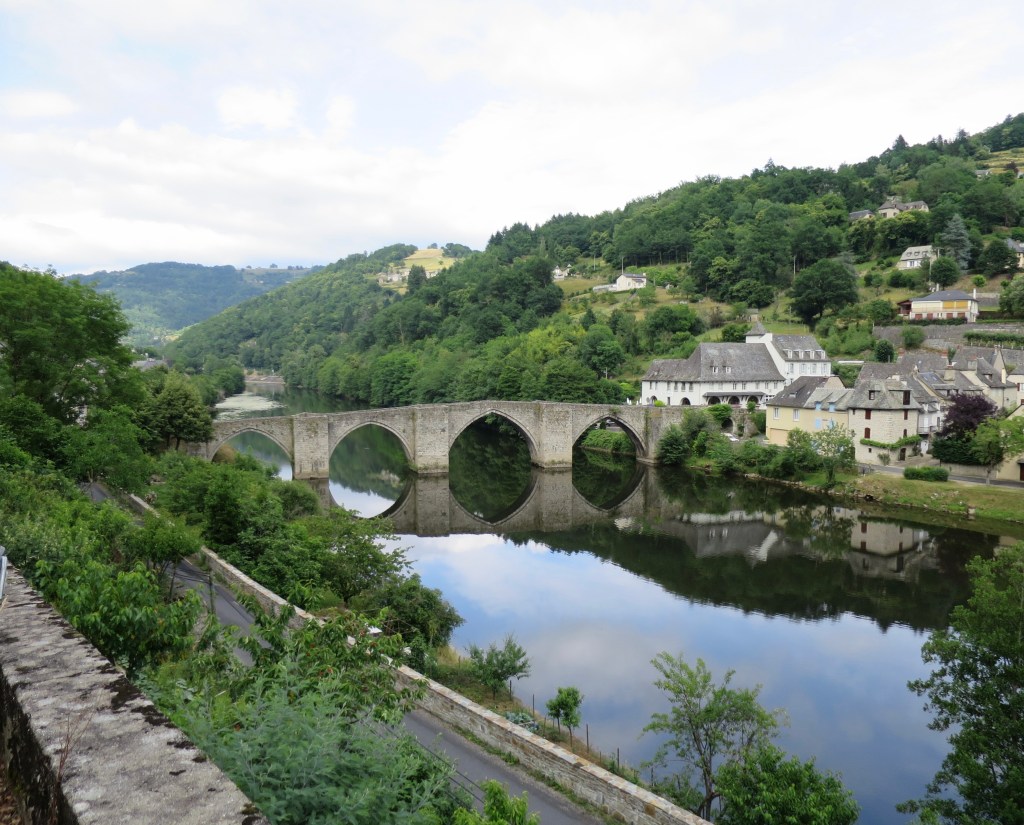
As I cross the bridge over the Truyère and turn into town, then follow the road out of town along the Lot (Entraygues means ‘between the rivers’ in Rouergat Occitan; the rivers join here), across the bridge over the Lot, and back to the campsite, I progressively re-inhabit my prosaic self.
It is a well-appointed, busy camp site, well shaded, and with tents and motorhomes, by the river. I am now in a real tourist area, moderately busy even in June. I had cycled a long way into and out of the village, but the loop has brought me back to the centre, and the village is just a short walk over a pedestrian bridge.

As soon as I have set camp, had tea, showered and changed, I head past the football pitch and cross the Lot. The Truyère is the bigger of the rivers, with several dams upstream, flowing wide and even. The Lot is shallow and turbulent. But the combined river is the Lot. It was navigable up to Entraygues, and of course bridgeable, therefore strategically important. There is a reconstruction of a river boat. It is more punt than boat, the size and shape of a Cambridge punt but solid, made with inch-thick planks and with many strengthening ribs.
Running the river, before the hydroelectric dams were built, must have been quite a trip. I suppose that, as on the Seine, when they reached their destination, they pulled the craft to pieces and sold the wood as good timber, returning on foot.
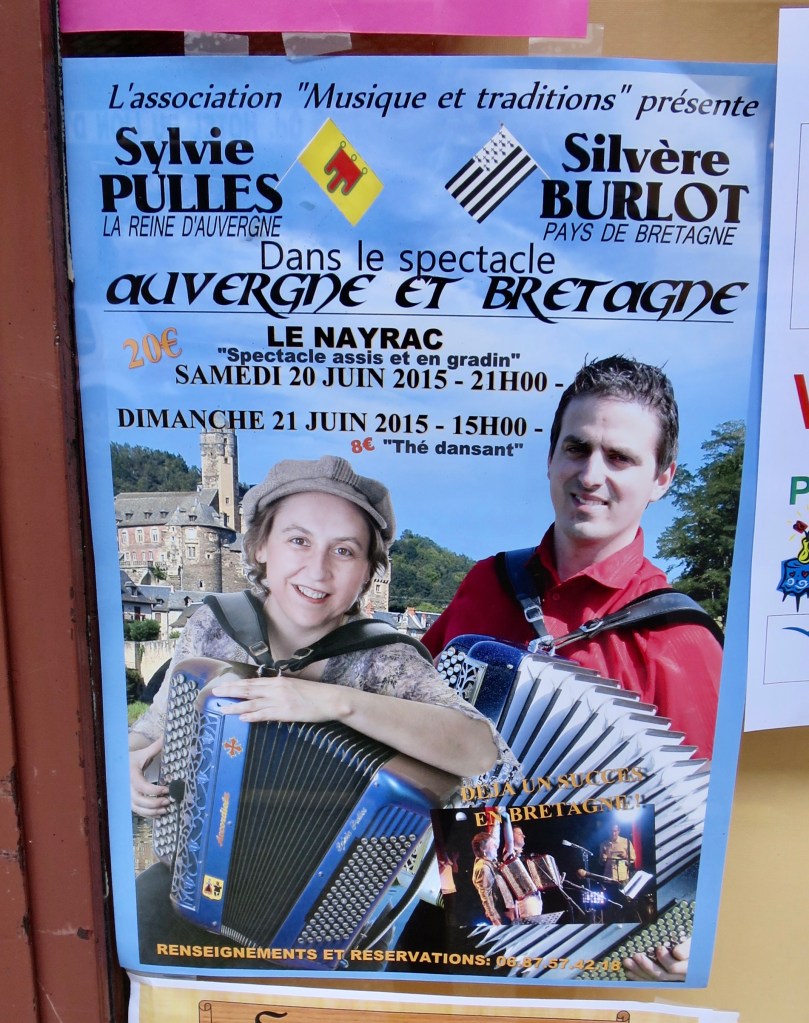
By the bridge is a poster for a concert of Breton and Auvergnat accordion music. It is promoted by the ‘Association of Music and Tradition’ and is a ‘Spectacle Auvergne et Bretagne’.
There is an open-air concert on Saturday evening, and a thé dansant on Sunday afternoon. The connection, which results in so many town-twinnings, is cultural as well as practical. For they are two regions, or provinces – in the best sense of ‘provincial’ – that have maintained their connections to the old ways, and are sharing and strengthening them in mutual support, against the metropolitan and the commercial.
Entraygues is a pleasant little town of solid, sixteenth-century houses, grey stone, tall, with steep slate roofs, the grey, vertical severity lightened by the scalloped slates, and an almost oriental curve up at the eaves that adds a fairy-tale element.
I find an unpretentious café-bar, sit outside, at a pavement table. It’s warm enough. It is noisy inside, the loudness, the flattened Aveyron vowels, the twang of Southern voices. It is louder, more rumbustious than the North, but there is an inner gentleness. Travelling south in France is like travelling north in England.
I order a canard burger (a burger with a slice of duck on top) and sip my wine, as the swifts scream and the swallows silently flash up and down the river in the violet evening light. The patron was so welcoming when I went in to ask about food, his wife so gentle in her service, it was the welcome for the stranger.
And now, listening to the vehement voices inside, and sitting in the flickering light of a single candle, between the bright lights inside and the gathering dusk outside, and smiling at the occasional strolling couple, I am, happily, a stranger in a strange land. But I’m also filled with a sense of having come back, come home even, to the place where I grew up; or rather, where I began to be grown up.
The view when I arrived at the top – had the Aveyron ever looked so beautiful? The sign, ‘Welcome to Aveyron’. How easily that becomes Avalon! The exhilarating ride down, and my landing at the river, the bridge, the reflection … they are with me, in me. And how easily I entered that view, enter once more a garden, a house, woods; yes, even an abattoir.
Could I have been a part of it? Should I have stayed? Had my wife’s role (she who loved being at home in France) been to bring me (I who loved being a stranger, however accepted, in France) here. To leave me here, and return to the mainstream of her life? Should I have let her go? Should I have stayed? Was it a mistake for both of us that I followed her back? Could I, with Gabrielle, in Paris and at La Balme, have made it work? I learned, here, how to work manually, after an education designed to take me away from my hands. I learned, in the abattoir, how to work among men whose way is actions not words, for whom words are as clear-cut as actions (how in my education I had learned to make words malleable, slippery, crafty!). Men who I could, would work among, with, for the rest of my life. (I spent the first twenty-five years of my life escaping from my brother’s world of manual trades, the second twenty-five getting back into it.)
And yet I returned, to a London I hated. Why? Because there was another way, that I had only begun to set out on.
For something else had happened, I learned something else, that summer on my own, something that Gabrielle’s arrival and presence, however explosive, had not disturbed. I experienced, and began, however intermittently at first, to learn how to access the deep, continuous, imperturbable stream that I can only call creativity.
I moved from the idea of writing, to writing. Not that I hadn’t ‘written’ before. But for the first time I brought together memory and invention in something I could claim to be – creation. It didn’t happen in the grand way I depicted it in Diggers and Dreamers, of a fully-realised prophetic work wrought in the solitude of a cloud-shrouded tower. But in two short, not very good pieces. And once that line, that you drop down hesitantly, arduously, touches, connects with that imperturbable stream, something changes, irrevocably.
I stop, fork halfway to my mouth, look around, be around. Alive in this moment. Because this moment is what the journey is about. I have returned home. But to a home I had to leave, and that I must now pass through. It had been an arrival, coming to the Aveyron, living here. But it had been an arrival at a beginning. What was important was, not what I had done here, but what I did when I came away from here. And having the experiences and the memories to call upon, when I doubted, as I often did, and acted badly, as I often did, but I carried on. I imagine returning here, becoming strong once more, becoming young once more. Coming back. Except, “you can come back, but you can’t come back on the way …”
Today I crossed my highest point in the Massif. Tomorrow I will leave on the level, along the river.
Day 18: Entraygues-sur-Truyère to Belcastel, 60 miles.
A ‘most beautiful’ river. The failing monastery and stolen bones. The hideous reliquary. Religious tourism. The burning mountain. The opera-singer’s escape. Sliding down. ‘It’s bloody Brigadoon!’ Sleeping by the Aveyron.
A powerful dream, like a drug trip, full of significance and meaning if I could only grasp it. I want to record it but it’s going too fast; and anyway, the person wanting to record it is the me inside the dream. Perhaps it’s the effect of sleeping by a river, and especially at the junction of two such different rivers.

I look out of my tent. The sky is blue, the sun just catching the tops of the hills, mist swirls around the church spire, and the castle in its high place. The mist is rising and thinning as the air warms.
I make coffee, pack up, and stopping only to eat pastries at the warm bakery while most of the town sleeps, I am soon on the road beside the river.
“The most beautiful stretch of the Lot valley is from Entraygues to Coursavy: deep, narrow and wild, with the river running full and strong, with scattered farms and houses high on the hillsides among long-abandoned terracing. The shady, tree-tunnelled road is level and not heavily used, making it ideal for cycling.” The Rough Guide is right, although on this balmy June day, and after the places I have been and the days I have had, ‘wild’ is a little excessive. The sun is behind me, illuminating the tree-clad valley ahead, glittering on the smoothly-flowing water.
I pass Le Fel, where I had booked a night in a stone cabin which I then cancelled. The cabin is by the road, quirkily interesting, but far enough from the food, quiet civility and the feeling of homecoming I had experienced at Entraygues to be glad I had cancelled.
It is for sale, as so many places are. Country living, especially in out-of-the-way places is, like buying a country pub, so often a dream with little connection to reality. But Le Fel has its own appellation wine: “once, Le Fel was renowned for its distinctive wines … without doubt Aveyron’s greatest wines.” Reduced, now, to just 20 hectares. And further on I pass an ambitious smallholding, with every sort of vegetable growing, and glasshouses as well, a productive result of huge hard work. Would I …? No, I lack that relentless energy.
But today I am spinning along, beside a beautiful river, and in my mind I’m back on the Rance or the Tarn near our house long ago, and imagining that I can turn off, here, to visit Dennis, who grows the best grass, there, Philippe, who conjures breathtaking pots from spinning lumps of clay as he talks amiably.
At Coursavy bridge I turn south. I stop on the bridge and look upstream: the sun like a Barnes Wallis bouncing bomb comes at me along the dazzling river and explodes in me. Shaking my head to clear it, I cycle towards Conques.
The road climbs and narrows, climbs and narrows. But there are big signs advertising the village along the tree-shaded road; this is a major tourist stop.
Conques, clustered around the church in a narrow defile, is all verticals, dark against the sun, with hardly space for gardens never mind agriculture.
I cycle past the car park, where all cars are stopped, and push my bike, with the familiar combination of the anticipation I feel entering a religiously-charged place, and the knowledge that I am entering a commercial tourist space, onto the polished cobbles of the narrow village street. At the first house an old man welcomes me, I thank him in French, he asks me in English if I am a pilgrim. I say I’m cycling across France, from Dunkirk to the Pyrenees. A sort of pilgrim, then, he smiles, wishes me good fortune, and goes back into his house.
That sense, in these places whose present life is linked to one past period, of suspended time, of ageing having been stopped, in order to preserve the physical world of the date selected. There are shops selling pilgrim staffs and scallop shells. And snow domes and boxes of biscuits. But, don’t romanticise the past: when they were places of pilgrimage, they sold stuff, made money. The economy of the monastery depended on pilgrim money.
The monastery was founded around 800, by monks fleeing the Moors. They soon found that the spiritual nourishment of the site was not matched by its physical sustenance. What they needed was a draw, to attract the increasing number of pilgrims travelling in search of physical or mental health, even salvation, their search limited to Europe after Jerusalem fell into Islamic hands in 637.
The second Council of Nicaea had in 787 established that through venerating the relic of a saint, the saint may be encouraged to intercede on behalf of the venerator, bringing cures and even miracles. A whole new business for churches and abbeys developed from this. What Conques needed was a relic.
So, in 856 a plot was hatched. A monk was sent, incognito, to join the monastery at Agen, which had grown wealthy from pilgrims to the bones of Sainte Foy (St Faith), an eleven-year-old martyred for refusing to worship the Roman gods. For ten years he was a faithful and devoted monk, rising slowly through the hierarchy and increasingly trusted. Until the night came when he was given the honour of guarding the saint’s bones. The ‘sleeper’ awoke, cast off the robes of Agen, picked up the bones, and ran, home to Conques, carrying the priceless money-maker. (Agen tried but failed to get the bones back. Its monastery is long forgotten, and the town has settled for being ‘the capital of the prune’.)
At the monastery at Conques a gold reliquary was built around the bones, and a church around the reliquary. The monastery did well as a regional centre of pilgrimage, and the present fine church was built in the eleventh century.
And then came a stroke of luck (or intercession by the saint?). Conques was conveniently placed on the pilgrim route from Le Puy to Compostela, and its plenary indulgence. The church was redesigned, to speed the flow of pilgrims around the apse to pass the reliquary of Sainte Foy. (I remember a cartoon satirising coach tours of the Continent which has the tail of a stream of figures running in at one door of a church, while the head runs out of the other door and back onto the coach. I remember a similar reliquary in an abbey on Majorca which we shuffled past, the faithful making dashes to touch or even kiss it, cut off as they were pushed on from behind. I remember the way, in a blockbuster art exhibition, the crush pushes you past each picture, giving you your moment in the presence but little else.)
The interest in pilgrimage, and relics, and monasticism faded, and with it, Conques’ glory. It owes its popularity today to a new interest in the old, begun with Prosper Mérimée’s appointment in 1834 as Inspector-General of Historic Monuments, and continued with Viollet-le-Duc’s Gothic revivalism. There developed an interest in preserving, visiting, even venerating the old. This revived interest in the religious and the old came exactly at a time of religious scepticism and rapid material change.
A small house of monks was re-established here, but only, it feels, as a legacy revival, like those Iron Age huts in archaeological theme parks that enthusiasts live in. Perhaps I’m being too harsh.
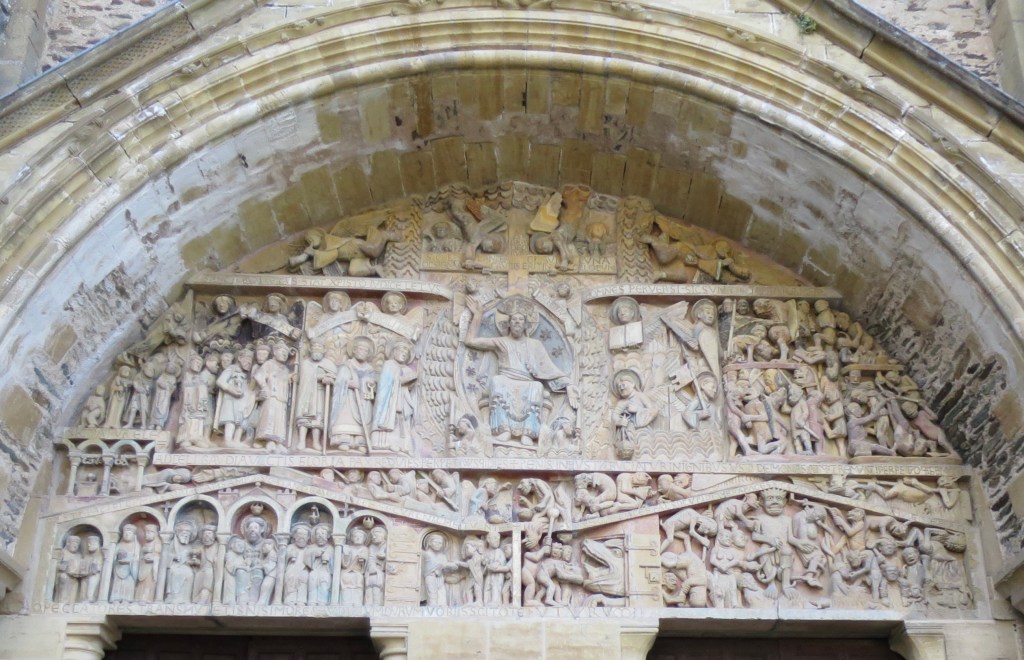
The church is a fine Romanesque building. The tympanum over the West door is well wrought, and may represent, rather than what look like the torments of hell, the pains of purgatory. It reads ‘Thus are all perverted ones sunk in Tartarus’. Tartarus is the waiting-room of Hades. It was, at the time it was made, a useful reminder of the value of the plenary indulgence. The idea of purgatory as a place, and the idea of the plenary indulgence (first declared in 1095, for the first Crusade) were taking hold at this time.
I wander round outside the church. Here the bulging back presses hard against the self-effacing house of monks. Over there is a long drop past a narrow garden to the bottom of the valley. In front of it is the swept-clean artificiality of the preserved authentic, furnished with overpriced ‘traditional’ cafés, and low-ceilinged shops filled with charmless merchandise. I have no reference for this place.
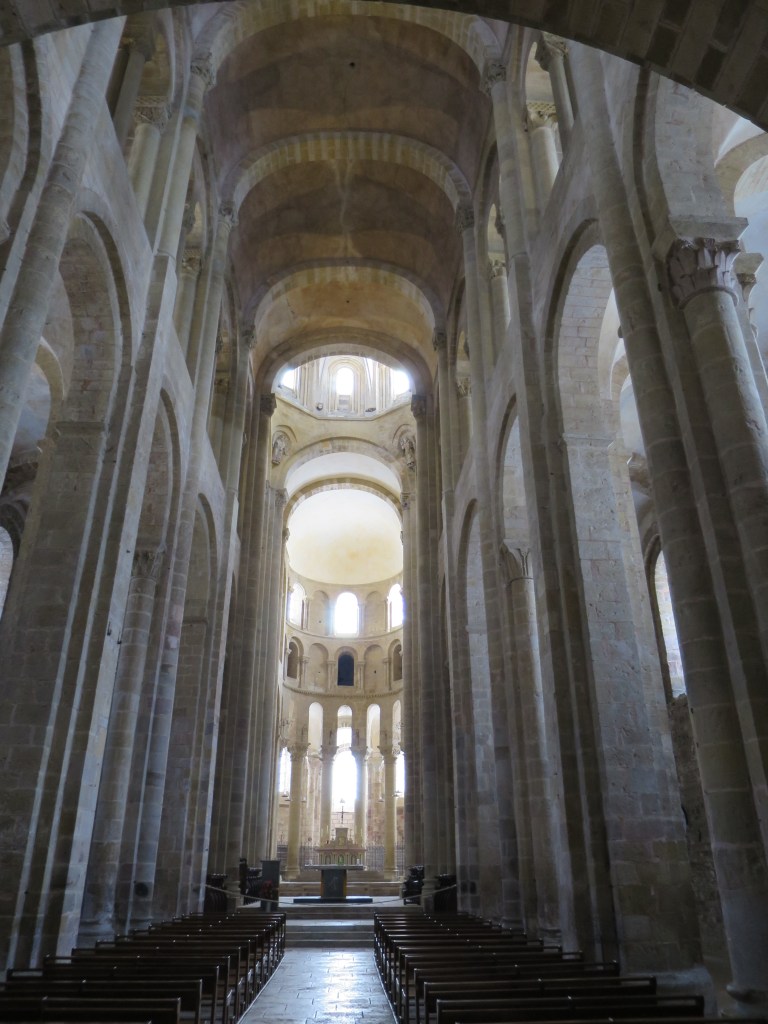
Inside it is surprisingly lofty for a Romanesque church, and striking. But it feels empty of purpose without monastic services, pilgrims and reliquary.
And what about the famous reliquary of Sainte Foy?
“The statue is hideous. It is as horrifying as a Senegalese fetish. And as potent. Beyond question that image has magical power.” (White, Three Rivers of France)
“The crowd of people prostrating themselves on the ground was so dense it was impossible to kneel down,” wrote Bernard d’Angers in 1010. “When they saw it for the first time, all in gold and sparkling with precious stones and looking like a human face, the majority thought that the statue was really looking at them and answering their prayers with her eyes.” He goes on, fearing that this is exactly the fetishism of the pagan world, “Brother, what do you think of this idol? Would Jupiter or Mars consider himself unworthy of such a statue?” Is it, he’s suggesting, any different to the statues the girl Faith died for refusing to bow down before?
It was made in the tenth century, formed around a wooden core (what was that? – a Celtic fetish …?), using the golden head from a fifth-century Roman statue (again, perhaps one of the gods Faith refused to kneel before). Gold crown, earrings, filigree work, cameos and jewels were added over the years. At some point she was placed, for her comfort in her long working day, upon a throne. In the fourteenth century crystal balls were added to the throne, and in the sixteenth she was given silver arms and hands, far too small for the enormous head. The eighteenth century added bronze shoes.
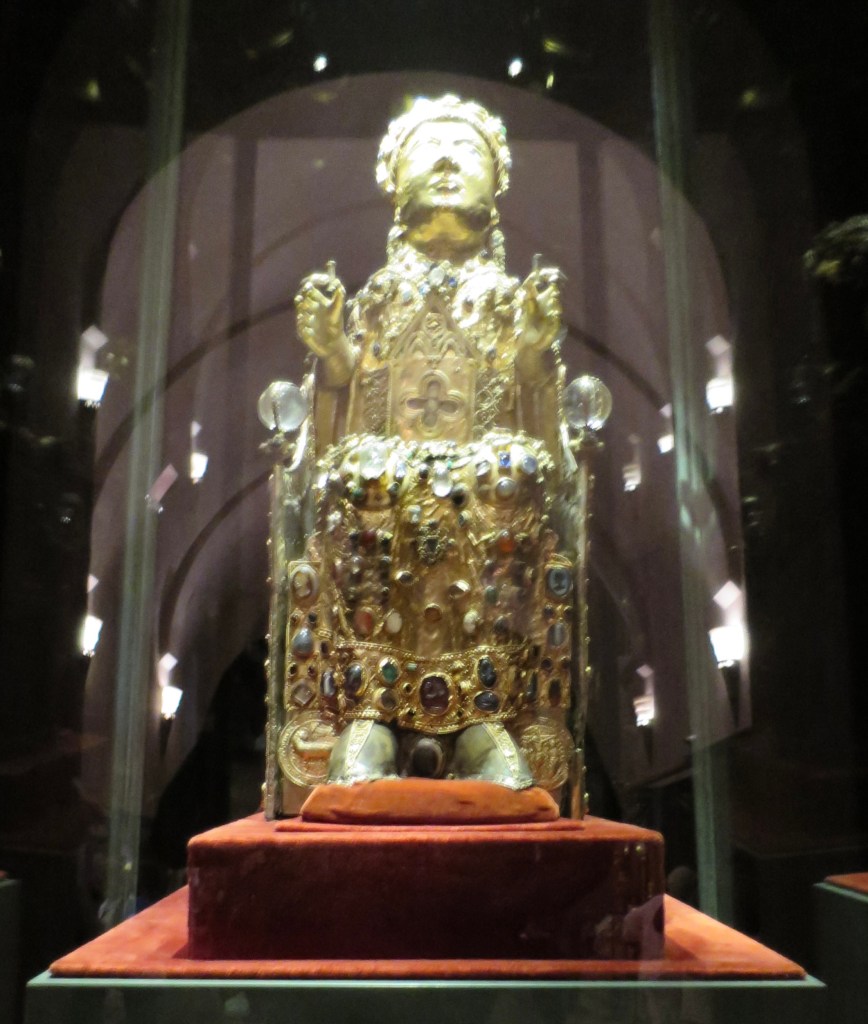
What of it now, safely neutralised behind glass in a museum of reliquaries? It is an over-decorated piece of flashy gaudiness. And yet. The blank haughtiness. Black eyes that look through you. Or, rather, large black pupils that draw you into their emptiness. I imagine it whirring, clanking to its brazen-shod feet coming forward, expressionless, embracing, crushing, absorbing. I imagine it turning mechanically when questioned. Perhaps it is Gerbert’s brazen head. A woman is about to photograph it when her husband whispers no photographs are allowed, and she looks guiltily at me. Usually I would signal her to take it, but I don’t move. When they’ve gone I take a surreptitious photograph, from waist height. Why this discomfort? Is it the dark, spotlighted place? Or some residual feeling that such fetishes might just, you never know, have a power?
But, in spite of the fine church, and the disturbing reliquary, this place doesn’t work for me. I flee Conques, from a place made up.
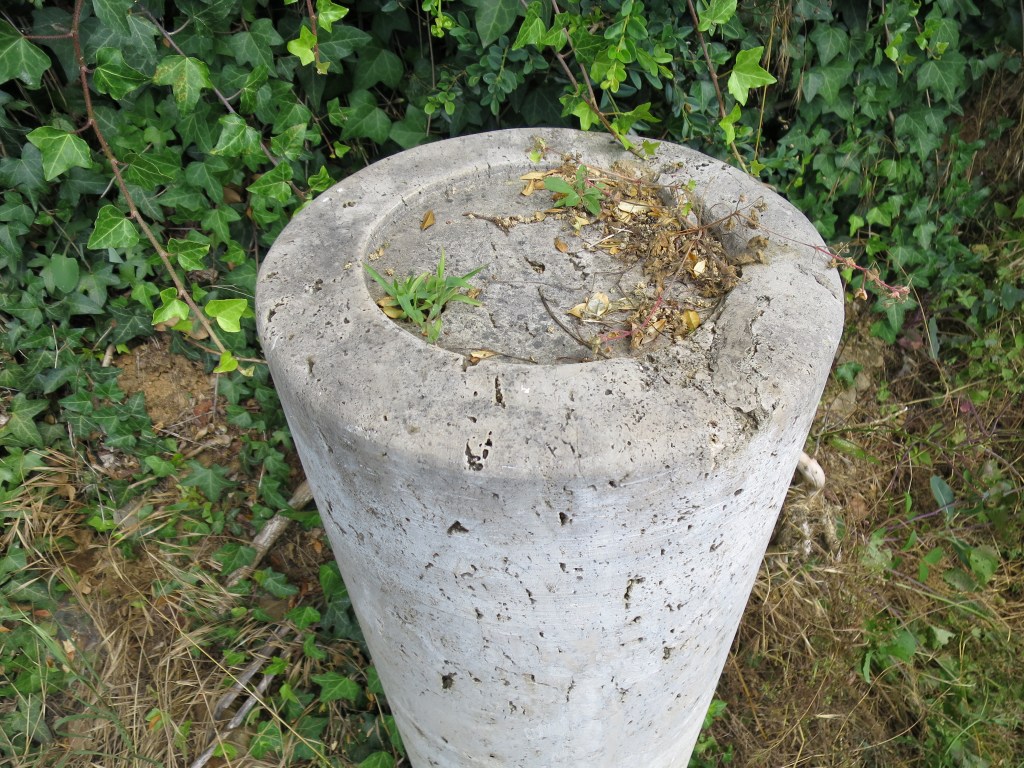
I freewheel back down to the river, beginning to breathe again, and continue west along the sunny, peacefully-flowing river. I’m soon at the Meridian. There is a plastic banner from 2000, faded but still readable, with a list of the communes la Méridienne verte passes through. I read down through my journey so far, each place a frame in a flickering film. I’m now three-quarters of the way down. The bronze disc has been stolen from top of the concrete column. Was there life, the electrical charge of the Meridian, in the bronze discs? More desperate grasping at magical thinking.
I follow the river for a few miles, and then then leave it to climb south, to Decazeville.
I have been fascinated by it since I read Robb’s vivid, perhaps hyperbolical description. In the chestnut forest of the Aveyron, there was “one of the natural wonders of southern France: the Burning Mountain of Fontaygnes. At night, a person peering down into one of the little craters that pocked the mountain would see the glow of a great fire. Coal deposits burned continuously, filling the cellars of the nearest hamlets with smoke … the abundance of coal meant the villagers could stay up after dark … telling tales of the English invaders who had set fire to the mountain many years before.” And this so close to the Meridian, not far from where we had lived in the Aveyron chestnut forest!
I knew about Carmaux, near Albi. And now I am becoming familiar with French industrialisation. How, even well into the nineteenth century, it was developed more like the pre-Industrial Revolution industries in the south of England, in isolated pockets, often by a single, frequently an aristocratic entrepreneur. Such enterprise built the French canals, the iron industry of Montluçon, the tyre business of Clermont-Ferrand. France lacked the entrepreneurial class (the Protestants having been driven out) that established the Industrial Revolution in Britain.
Louis XIV had a habit of handing out mining concessions to his mistresses, and in 1826 the duc Decazes inherited the Fontaygnes concessions. He started mining the coal, and smelting the local iron ore. He called the town Decazeville. During a strike in 1869, 17 miners were shot dead; in 1886 the Director was killed during a strike; in 1889, 49 died in a mining disaster. Decazeville had the largest open-cast pit in Europe. The last mine closed in 2002. Its most famous daughter is Emma Calvé, the greatest diva of the belle époque.
So, what do I expect? A black, sulphurous sink, as described by Lawrence in Nottinghamshire, depicted by Van Gogh in the Borinage, where environmental destruction, economic exploitation and moral degradation mirror and amplify each other? In Calvé, a Zola-esque, or Loretta Lynn tale of single-minded escape from mining poverty to glittering success? A place now emptied of purpose, streets filled with the haunted faces of those remembering?
I find a small, neat town, a third the size it once was, but surviving, perhaps even thriving, with a combination of small-scale industry, local services, and state aid. Emma Calvé, far from being a child of the mines, was the daughter of a wealthy engineer, educated in private schools, who went to Paris with her mother. And the last strike was an underground sit-in to keep the mine open. As with Nottinghamshire, the Borinage, it has been grassed over. And the modern equivalents of such ‘Hells’ of the past that we wax indignant about, are now off-shored to the ‘developing’ world.
The town has a statue of Decaze, imperially robed. And one of the ugliest churches I’ve ever seen (gift of Decaze, of course), a huge, looming, featureless dark oblong, made of stone that succeeds in looking like lifeless black concrete.
I have coffee in an empty café. Music plays, the television is on, the girl is engrossed in her phone. People walk past, shopping, or just passing the time. A swarm of schoolchildren flies past on their buzzing mobys, more busy bees than a threatening horde. Quiet lives. Not of desperation but of acceptance. Focussed on family, friends, and the local rugby team. Why not? Poujade, the champion of the ordinary, the given, came from near here.
The opencast pit, once stepped down in black terraces, like Dante’s circles of hell (more wilful romanticising by me!), has been smoothed and lawned to a vast green bowl of banality, with at its centre a dark pool. The Industrial Revolution passed through, leaving hardly a trace. What to do with the past? Conques and Decazeville provide two very different answers.
I cycle up, out of the town, heading south. I am near Espalion, which is called “the first smile of the South”. But, however much I yearn for it, the South is not yet smiling on me. And I face one last climb, back up to 750m, and one last night camping in the Massif.
I am determined not to camp at Belcastel. It is near the Meridian, but at the bottom of a steep and deep river valley, and I don’t want to have to claw my way up out of it tomorrow morning. Of course I end up there. I still don’t know how. Hurrying to get on, trying to get as close to Albi as I can, passing possible campsites, my final error is to fail to turn off to a village shop, with a camp site close by. Instead, I take the easy option of a road down, that twists and narrows and finally loses its surface.
I descend from sunlit open fields into shadowed woodland, I pass two chattering and laughing girls leading a large, mettlesome horse, and tumble down like an insect into the trumpet of a flower (nectar-filled? carnivorous?), to arrive at the bottom of the steep-sided valley, by the river, at the Belcastel camp site, too disheartened and with too little energy to contemplate climbing out and finding somewhere else.
What a curious place is Belcastel! It is one of the ‘Beautiful Villages of France’. There is a Gothic-arch bridge, similar to Entraygues but more rustic, less stylish. On the other side of the bridge over the Aveyron the village heaps up the steep slope, climbs up to the château. It is made of small pieces, tesserae: the bridge is paved with small cobbles, as are the streets; the buildings are made of small stones, like dun-coloured Lego bricks, with roofs of small slates. The roofs are steep, with triangular, hipped dormers. It is not unlike Entraygues, but somehow lifeless.
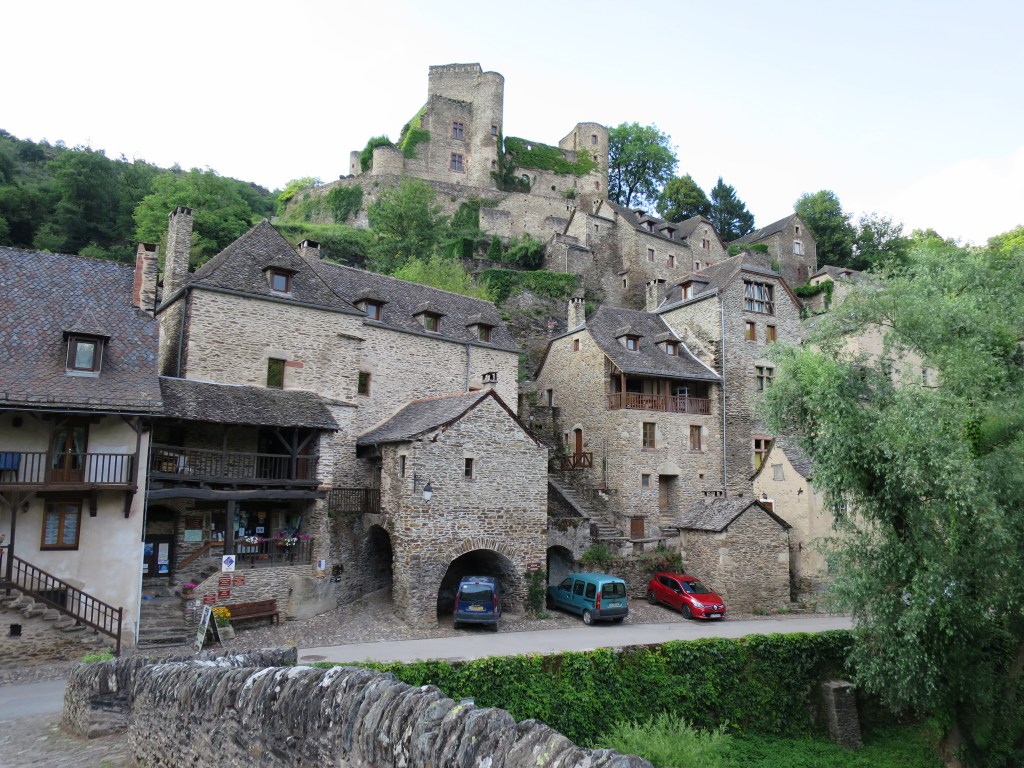
It has been renovated to picture-postcard perfection. Even the ruined part of the castle has on it a swag of manicured ivy. The village has been restored to a particular date in history and then sprayed, with the patina of age, and a time-suspending preservative. I am not surprised to learn that it was the project, in the 1980s, of one of ‘the great architect-builders of the post-war reconstruction’. It feels like the product of single-minded vision and ideological certainty. It is a pet project. Aesthetically it is lovely. It should be beguiling. But I find it charmless. And yet it has a past. The population of the village halved from 1906 to 1911. What happened in those five years?
I go to the shop by the bridge, and ask about camping. The man says, pitch where you like by the river, we’ll settle up in the morning. The shop is expensive, not from inflated prices but because it stocks no staples, just tourist products. At the restaurant there’s a sign saying today’s special is paella. The last time I had paella was at the Tarasque Festival at Tarascon, where it was served from six-foot pans. Here, I feel sure, it will come in microwavable portions. But, paella is good.
I make camp. I’m a few feet from the softly-flowing river, by a fine bridge, with in front of me a pretty view. An irritatingly pretty view. Stop being so grumpy! This is the river Aveyron! Accept the prettiness!
Across the river a farmer is cutting hay on a very steep slope. He reverses the tractor up the field, climbing up into the evening sunlight, the engine roaring and straining, then lets it descend jerkily, cutting a swathe of hay. Each time, as he reverses up, as it jerks down, I expect something to give, and for tractor and driver to plunge out of control into the river. Or into the wall of the film-set, as with Truman’s boat in The Truman Show. It’s that sort of place.
Thirty yards away from me is a motorhome. The oldish French couple sit outside, across the table from each other. They have eaten. The man talks. Nonstop. The woman sits in silence, looking at him. He is talking when I go to the toilet block. He is talking when I return, having showered and done my laundry. He is talking when I go for a walk around the village, and when I return. He talks in that raised-voice certainty, the complacent modulation of a man who has arranged his life safely around himself, never risking anything. Who controls what he can, and dismisses what he can’t. And he can control his wife, a submissive acceptor, whose job is to nod, and agree, and arrange her life around his. I imagine them one day at home. The police enter, alerted by the neighbours who have reported the sudden silence from next door. The couple are sitting across the table from each other. They have eaten. The woman is silent. The man is silent. There is a look of surprise on his face, and a carving knife in his chest. The woman is calm. When they ask her what happened, she says, ‘he wouldn’t stop talking,’ and smiles at the silence.
I walk around the village. The bonfire is ready for the feu St-Jean on Sunday. Most places moved their summer bonfires to 14 July after the division of state and church in the 1880s, but there has been a recent revival of the traditional date. There is a boutique hotel. There is a small restaurant, empty, but open, and advertising steak-frites, the French staple. Outside a house, on a patio like a stage, a man in a wheelchair is regaling a couple with a story. Otherwise the place is empty of life.
As I’m walking back over the bridge, a 2CV with British number plates draws up. I’ve seen hardly any 2CVs, in fact more Renault 4s. The young man takes from the boot a circle of blue material, like one of the hoops of paper that circus dogs leap through. He throws it down. While in the air the small circle becomes a bigger circle; when it hits the ground, it explodes, blooms, like a Japanese paper flower in water, into a domed tent. They are American.
I sort my things, and at 7:45 head into the village for food. The shop and restaurant are closed, the paella sign gone. Over the bridge, the steak-frites restaurant is closed. The old man has been wheeled back in, his door closed, no lights are on in his house. I’m in Disneyland after closing time, and all the staff, including the old man storyteller, have clocked off and gone back to the real world. I remember a line from Four Weddings and a Funeral, ‘It’s Brigadoon! It’s bloody Brigadoon!’
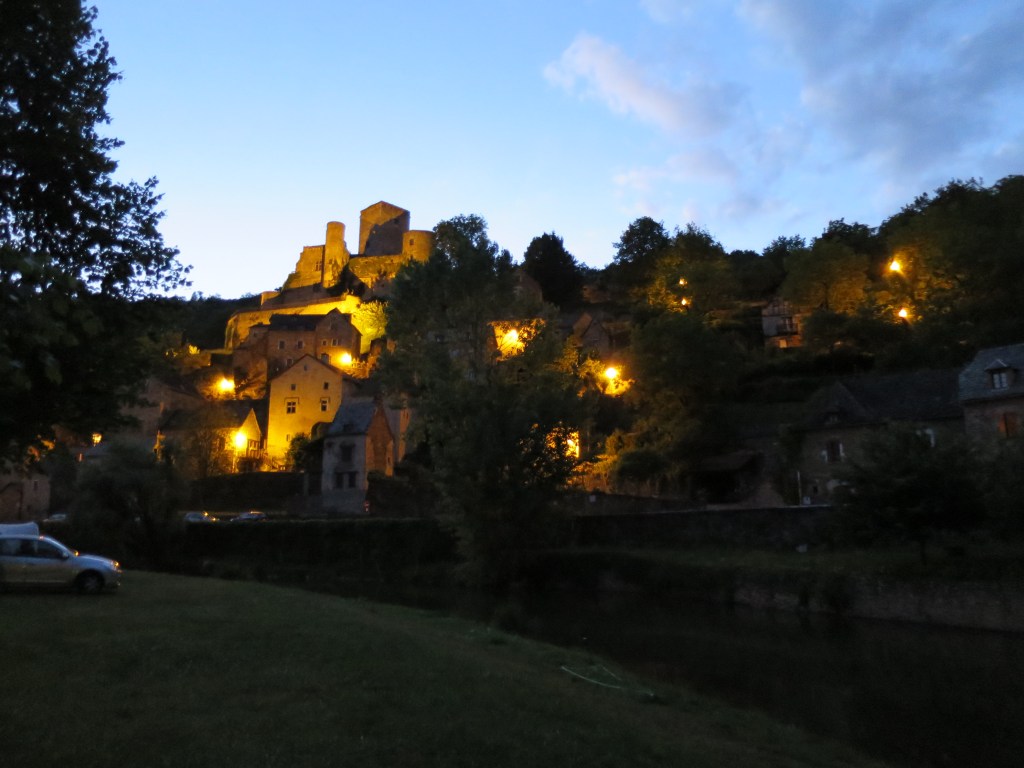
I return to my tent and cobble together a frugal meal. As darkness gathers down here, the sky still pinkly light high above, the street lights come on, orange-coloured and carefully placed to enhance the visual effect of the village reflecting in river. An irresistible photo-op. I take photographs.
I wake at 2am and look out. The lights are still on in the deserted – uninhabited? – village. I check: at least the river hasn’t been turned off, it still flows quietly. I go back to sleep in bloody Brigadoon.
 my writing