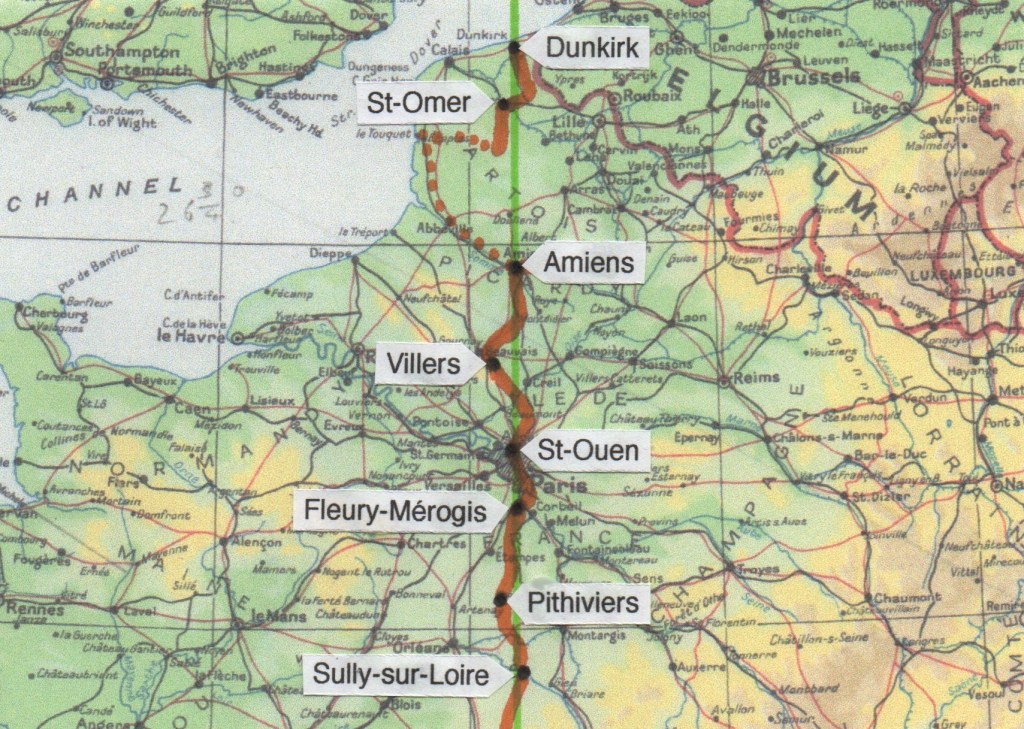
Day 1: Calais to Dunkirk, 38 miles.
A rainy Sunday. The old-timer. ‘The Jungle’. An Island Race. The Celtic Meridian. Barthes on plastic. De Tocqueville and French exceptionalism. The ‘Miracle of Dunkirk’. The first Méridienne verte marker. Grace at the Libanais take-away.
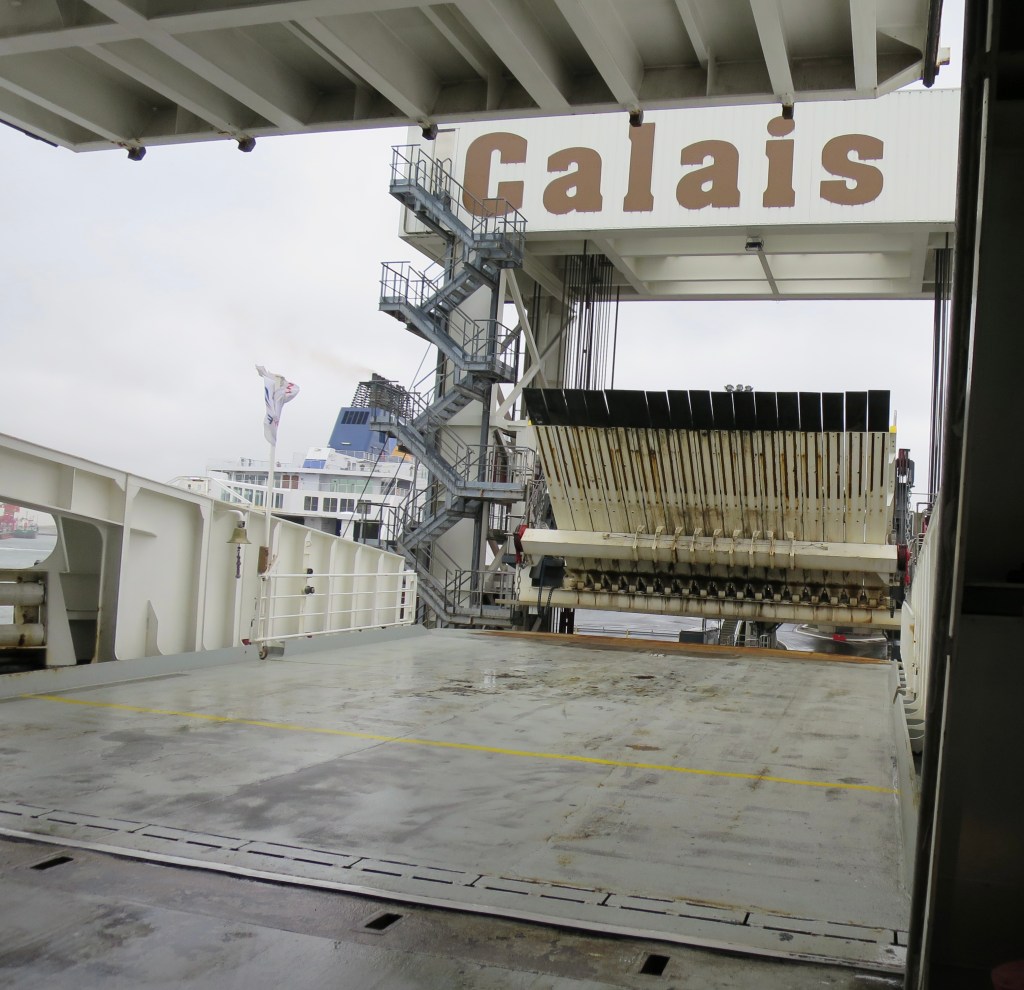
As the bow doors creak open, I prepare for the young man next me, who’s been revving the engine of his black Range Rover impatiently, to speed past me onto the ramp. Instead he looks across, smiles, and waves me on before him, with a courteous gesture. I acknowledge with a smile and a gesture I hope equally courteous – thank you, but do please go ahead. I follow him, freewheeling my heavily-laden bike down the steep, wet ramp, as the enormous lorries thunder past me.
It is a grey day in Calais, with rain sweeping across. There’s a strong southwester, and Dunkirk, tonight’s destination, where my journey begins, is to the north east. But first I’m heading to Sangatte, south, along the coast.
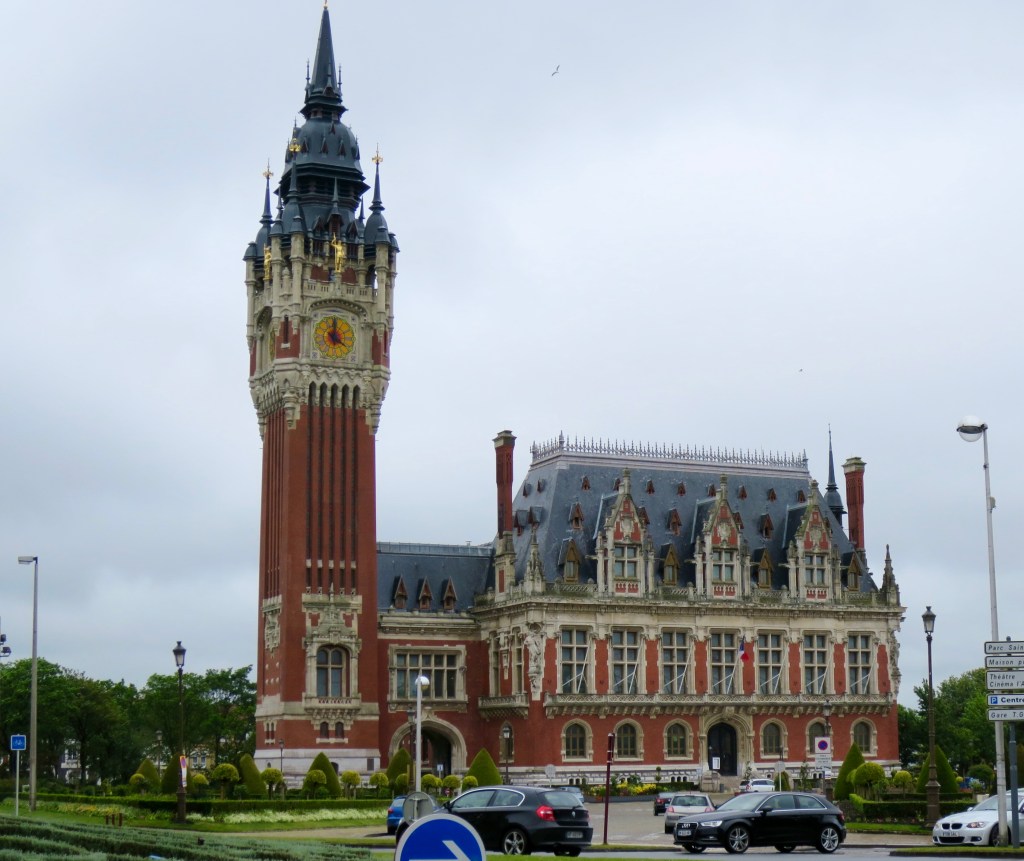
Through the centre of Calais, past the splendid Flemish-Renaissance-Revival town hall, across the Place d’Armes, the open market square, which today is a windswept, empty and bleak place, made more so by contemporary ‘art interventions’: fountains that wee weakly, and a grey sculpture of a grey couple huddled against wind and rain, altogether too literal.
It is Sunday afternoon, there are glass-fronted restaurants like aquaria all around the square, and in them the diners bob gently, in after-lunch repletion and vacancy, digesting.
I turn south, along the coast, into the wind, towards Sangatte, the Tunnel entrance. Past a water-tower decorated to commemorate Blériot’s flight across the Channel. Past the colourful bungalows of second-homers and retirees, safe behind grass-planted sand dunes, as old-fashioned as Newhaven. And then nothing but dunes. I had expected fences, and black and brown faces staring unblinkingly through. But of course the Sangatte camp was closed years ago.
So I turn around, and I’m flying back up the cycle path by the coast road, caped against the rain, when I see a cyclist bent over his bike. I stop, ask him in French what’s the problem. He replies in English. He’s Belgian. His problem is with the dynamo built into the front hub that charges his smart phone. I look at all the complication of disc brakes, of gears operated by brake levers (he has 27 gears, I have 10), of nine-sprocket cassettes (we called them blocks), and of cleated pedals (I still have toe clips and straps), and realise that this is all beyond me, incomprehensible technology. And that I am on a sixty-year-old frame, with nothing that wasn’t around seventy years ago. In my zip-up jacket, baggy cotton trousers, tweed cap, and voluminous rain cape, I am from a former era.
Tim Hilton, art critic and lifelong cyclist, writes, ‘Another cycling legend concerns the old-timer. In song and story he is not awheel but is encountered by the side of a road. He wears unfashionable clothes, carefully washed and stitched where necessary. He is not the sort of person who takes his rest in a haystack. He might be a ghost. The old-timer’s bike is ancient. Some of its accessories, in this story usually the mudguards, are held to the frame by twisted pieces of wire. But the transmission – chainset, chain and back sprocket, the heart of a bicycle – is expertly and beautifully maintained. The old-timer has climbed off to eat his sandwiches or to smoke a pipe. Other cyclists instinctively brake and stop to say a word in fellowship or homage. He replies only with the words, “it’s a grand life”. Just as no one has seen him ride, nobody knows where he comes from.’
I met him once, outside Chepstow, when I was young, before I’d read about him. Now I have become him. I have become the old-timer.
Back into Calais, and I have a problem finding directions to Dunkirk – the official signs are either to local services and businesses, or to motorways. Perhaps it’s a French thing, having two scales, the jealously-guarded local, and the centrally-imposed national. Whereas in England the signage is hierarchical, through levels. Reflecting our careful gradations of class?
I follow yet another sign to Dunkirk, which takes me, along roads lined with parked lorries, miles of them, of every European state, yet again to a motorway. Under it, there is a squatter camp.
This is ‘The Jungle’, the camp that grew up after Sangatte was closed. Black and brown faces looking through the fence, patiently waiting, eyes ever watchful for that opportunity, the single chance (an unlocked car boot, the back of a freezer lorry, under a railway carriage, even walking the thirty miles – around fifteen die each year) that will get them through the Tunnel, across the Channel, to England. Having crossed continents, passed through EU countries, still they want to cross the narrow strip of water, put it between themselves and where they have escaped from.
The narrow strip of water that has always been for the English the symbol as well as the practical guarantor of their separateness. An island race, on a sceptred isle. What is to the French descriptive, la Manche, ‘the sleeve’, is for the English possessive, the English Channel. At times of weakness, they (we) are the plucky underdogs, on the ramparts of Shakespeare’s ‘white-faced shore’, and ‘water-walled bulwark’, who face and outface overwhelming odds. In the time of Imperial greatness, they (we) had the arrogant condescension of ‘Fog in the Channel – Continent isolated’. But now we are in Europe.
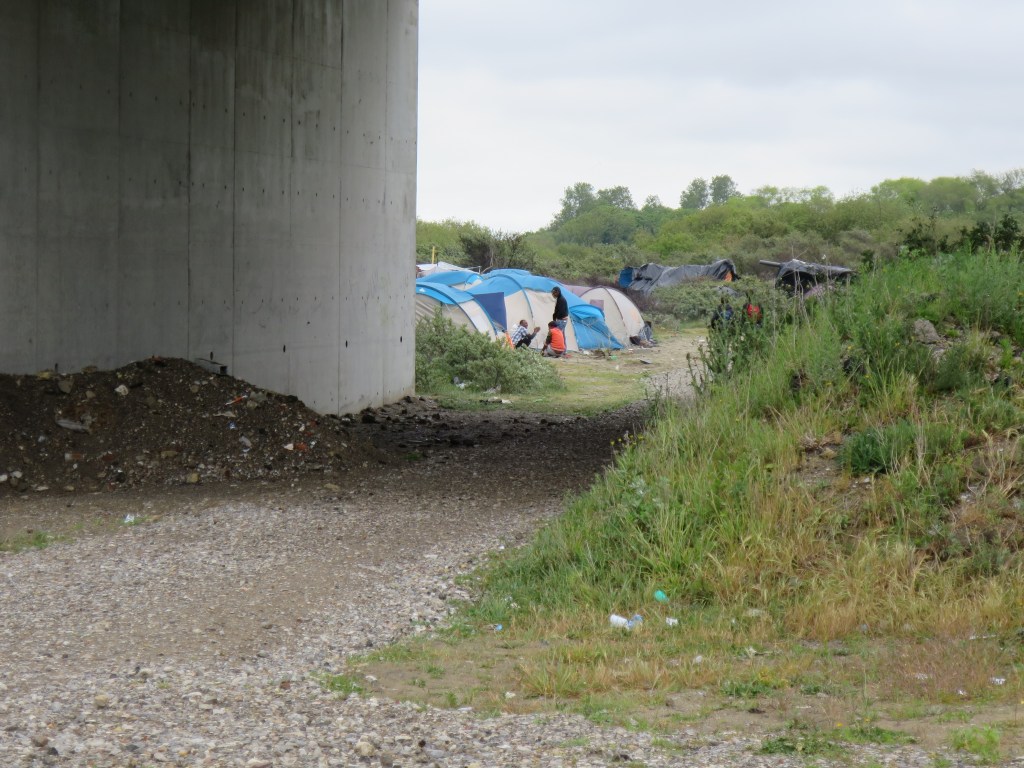
Seeing the collection of small tents, the shelters improvised with plastic sheeting, figures squatting down in mud in the rain, or walking patiently to and from the Tunnel entrance, having done or about to do their shift of waiting their chance, I see figures walking out of Africa, as they have for tens, hundreds of thousands of years, Africa the origin of sapiens, a forever bubbling spring. And I see a world of increasing inequality but reducing friction of distance, so that more poor people know about, and are desperate to reach, and can actually reach, the gates of what to them is the golden city. Making the gate stronger, building the walls higher, guarding more vigilantly won’t work for long. The solution has to be to reduce inequality. It’s physics.
I eventually find my way out, under grey skies, pushed along by the wind at my back, across land flat as Flanders, with canals, dykes, and pasture, through Gravelines to Loon-Plage.
It was once the island of Lugdunum, ‘which means “fortress of Lug”, the Celtic god of light’, and is, according to Graham Robb, the northernmost point of the Gaulish or Celtic Meridian of mid-longitude, their equivalent of the Paris Meridian, which lies 10km to the east. The Celtic Meridian will haunt, flicker in the background of my journey down the Paris Meridian, the echo, the trace, the mysterious, the barely-remembered predecessor to Rationalism’s boldly stepped and clearly recorded line.
On to St Pol-sur-Mer, a suburb of Dunkirk, which is both the northerly point of the Paris Meridian, la Méridienne verte, and the location of the Première-Classe hotel I’m booked into.
The hotel is a stack of containers, on two floors, set down in an industrial park, by a motorway access point, under an enormous yellow sign visible from the motorway. I go to reception and collect my key card. I climb the prison-like metal stairs. My container has a heavy security door, and a steel-shuttered window.
Inside, the room has a finish that resists imprint. It has no presence. It is not built to age, to absorb, nothing sticks, it will never develop character. Every morning it is swept, sluiced clean, all traces removed, its memory wiped. I can imagine a Tarantino massacre one day, and the next day: business as usual.
It is a pod of plastic.
I remember literary theorist Roland Barthes’ comments on plastics (and this in 1956, as they first entered consumer culture). It is, he notes, a material named after a quality. He goes on: ‘it is the first magical substance that consents to be prosaic; its one substantive quality is resistance, the absence of yielding; it abolishes the hierarchy of substances, replaces it with one substance, so that the whole world can be plasticised.’ The magical consenting to be prosaic. The whole world plasticised. And how, in the sixty years since, that has happened!
The steps are on the outside. Indeed there is no inside to this hotel. Apart from the reception desk and the small breakfast room on the ground floor. The room is a cell, slotted into a wall of identical units, like a safety-deposit box. The car park is full, so the cells must be occupied, but no one has raised their shutter, revealed their presence. This is not a place of shared space, but of privacy and guarded anonymity, in which freedom is found in isolation.
Most of the room is filled with a bed. In the corner, there is a plastic bathroom module. But, there’s a small desk, power points, and it works. I unload my bike (I’ve brought it into the room with me), shower and change. I make tea, heating the water in my tin mug with my in-the-cup boiler. It works well. I’ve arrived at my starting point.
After a snooze, I cycle out to the long, empty beach that was, for a few days in May-June 1940, full of Allied troops, the scene of ‘the Miracle of Dunkirk’, the evacuation of 350,000 Allied troops, when the expectation had been that 10,000 would escape.
For all the proud talk of disciplined crisis management, the romance of the small boats, it is hard for me not to see Hitler’s order to hold back, halt the advance, as giving the British a final chance to come to their senses and, if not join an ‘Anglo-Saxon Alliance’ (in 1914 there had been crowds in Berlin howling ‘Rassenverrat!’, ‘race treason!’ at the news that Britain had entered the war on the French side), at least to see the sense of coming to terms with Germany. Even today the Germans seem constantly surprised that we reject their overtures to join them in running the EU, over the heads of the French.
And yet, we never quite trust the Germans. We don’t go and live there, holiday there. German competence, relentlessness, their ability to carry things through, their adherence to (their own) rules, to win, if necessary without style, leaves us cold.
Our relationship with France, on the other hand, is somehow domestic, an incompatible couple who exasperate each other, and yet spark life into each other. We each have something the other wants. We are intrigued by French self-importance, grandeur, ‘exceptionalism’, which results in what Michel Winock has characterised as an open and a closed nationalism. ‘To put it simply, their [the French] desire to shine in the eyes of foreigners, no matter how childish it may seem, does tend to promote an attitude towards the rest of the world which is generous and cosmopolitan. On the other hand, the ‘closed’ version of nationalism tends to promote selfishness, exclusiveness, narrowness, defensiveness.’ How familiar, these two versions of the French, in my experiences in France!
And Winock’s assessment is an updating of Alexis de Tocqueville’s 1856 exasperated list of French contradictions:
‘Has there ever been any nation on earth which was so full of contrasts, and so extreme in all its acts, more dominated by emotions, and less by principles, always doing better or worse than we expect?
‘A people so unalterable in its basic instincts that we can recognise in it portraits drawn two or three thousand years ago, and at the same time so changeable in its daily thoughts and tastes that it ends up offering an unexpected spectacle to itself, and often remains as surprised as a foreigner at the sight of what it has just done.
‘Insubordinate by temperament, and always readier to accept the arbitrary and even violent empire of a prince than the free and orderly government of its leading citizens; today the sworn enemy of all obedience, tomorrow attached to servitude with a passion that the nations best endowed for servitude cannot match; led on a string so long as no one resists, ungovernable as soon as the example of resistance appears.
‘A lover of chance, of strength, of success, of fame, and reputation, more than true glory; more capable of heroism than virtue, of genius than common sense, ready to conceive vast plans rather than complete great tasks.’
Ending: ‘France alone could give birth to a revolution so sudden, so radical, so impetuous in its course, and yet so full of backtracking, of contradictory facts and contrary examples.’
And yet, another contradiction, de Tocqueville’s listing of these contradictions is full of pride, to the point of bombast. Because it demonstrates exactly that French exceptionalism.
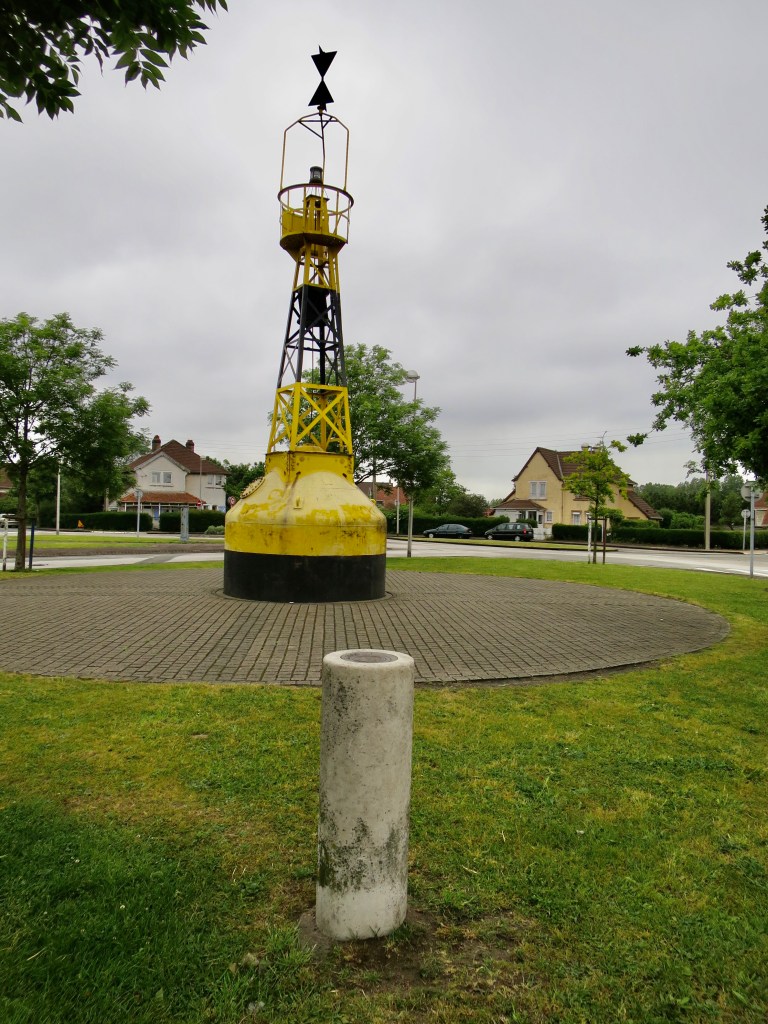
I return to the hotel. It is time to find the first Méridienne verte marker. It is here in St Pol-sur-Mer. But where, precisely? I have all the markers (hundreds of them) marked on 1:200,000 maps, and can see that it is close. But the map’s scale is too small to locate it exactly. Fortunately, geocaching has one of its Méridienne verte caches at this marker, so I can use their app. I walk across car parks, through housing estates, following the trail on my phone. It takes me to a small traffic island in a quiet suburban street. The first marker shares the island with a large, yellow buoy. Its coordinates are: 2º 20’ 11” E, 51º 01’ 44” N. The last marker is 8.5º of latitude due south.
There is a tree on the opposite side of the island. Is this the first of the millennium trees? I look south, hoping to see a thousand-kilometre line of them. Houses.
As I walk back a kestrel lands heavily in front of me in a fluster of wings, carried down by the weight of the mouse in its talons. It quickly heaves itself up and flaps away in a flurry, close to my face, its wing almost touching, leaving a space of charged energy. It brings to mind a story I have just written, in which such an encounter sets the hero on a quest. Story and life interweave. For am I not on a quest? And which is more real…?
Time to eat. I had passed a street of shops, and return there, hoping for a small, family-run restaurant. But of course, as in England, such places are long gone, and only the immigrant entrepreneurs are open in a quiet suburb on Sunday evening. There are two Libanais takeaways. One is the hang-out of youths in vests with tattooed arms and flexing muscles. The other, ‘Snack City’, is busy, the place that feeds the community. An old white couple are eating in the dining section. A group of Africans enter and shake hands shyly all round. People of all ages wait to be served.
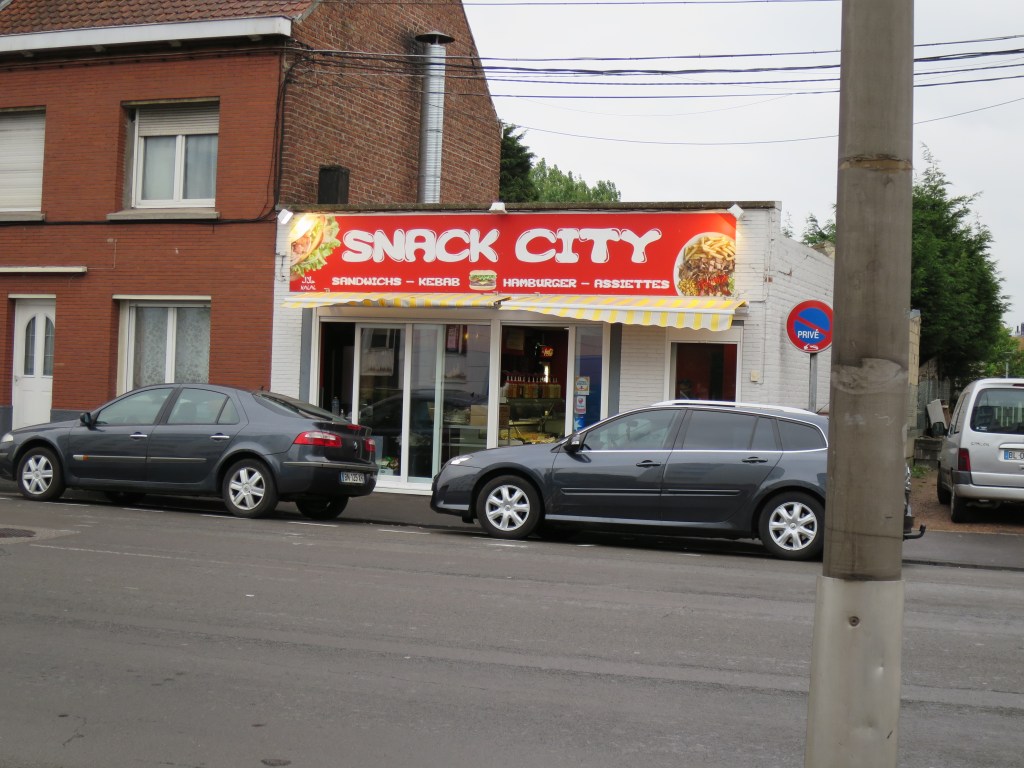
It is run with remarkable speed and efficiency by two men, the proprietor, and his small, busy, almost manic assistant. With remarkable energy and speed the assistant bales out chips, shaves kebabs, splits pitta breads, drops in meat and any or all of the several salads, and various of sixteen sauces of worryingly vivid colour, wraps them in foil, slaps them on the counter, starts again. I order frikandelle and chips. Frikandelle is a ch’ti speciality, a deep-fried sausage.
As I wait, the little man fits a new raw kebab. It is huge and pale, almost as big as him, and looks like a giant meat-filled condom. He strips off the condom, heaves it into place – the gas jets blazing, inches from his hands – clicks, and the kebab begins slowly to turn and brown and drip in the fierce heat. All this in less than a minute.
All the food, from bags of chips and containers of salad to bottles of sauce, has been bought in, ready prepared. The takeaway trade is industrialised into factories, where most of the profit is made. The margin for the retailer depends on speed of service.
I look at the man in charge. It is his place. He is North African, mid-thirties. He has the vision of the good entrepreneur, aware of the room, checking who’s waiting, and for what, ever sociable, ever ready with a kind word and handshake, but always with an eye on the supply chain.
And too, as he prepares a complicated order immaculately, he has that ability to change scale instantly – from strategic planning, to hands-on preparation – and keep many moving situations in view and under review, always on top of things. These are the skills that could run a major company. And he works longer hours. When my food is ready, foil-wrapped and handed over, and he sees me heading for a table, to unwrap and eat with plastic fork, as I would in England, he adroitly takes my package from me, points me to a table, unwraps it, arranges it carefully on a warmed china plate, brings it to me with metal knife and fork, my coke now in a glass, with a napkin, and sets it down, asking which sauces I want. There is a grace to it, and I am touched. I imagine him training as a waiter, this is his chance to run his own business, accumulate capital, his ambition is to open a ‘proper’ restaurant. Until then, any place he runs will be run with quality.
The frikandelle tastes of nothing; it is all filler; it has no recognisable meat taste. But my stomach is filled. As I leave he makes a point of catching my eye and saying ‘bonsoir’. I have been served with grace.
I return to my room, check tomorrow’s route, and sleep well. Whatever these units are made of, they are self-contained and well insulated: the ideal of the modern, solipsistic world.
Day 2: Dunkirk to St-Omer, 44 miles.
Breakfast radio. ‘Bienvenue Chez les Ch’tis’. Paperclips and trombones. ‘The other Bruges in Flanders’. The Quest. Mercurius and the Virgin Mary. The Grand Old Duke of York. The Western Front. An engineering marvel. Two famous books. The disgraced hero.
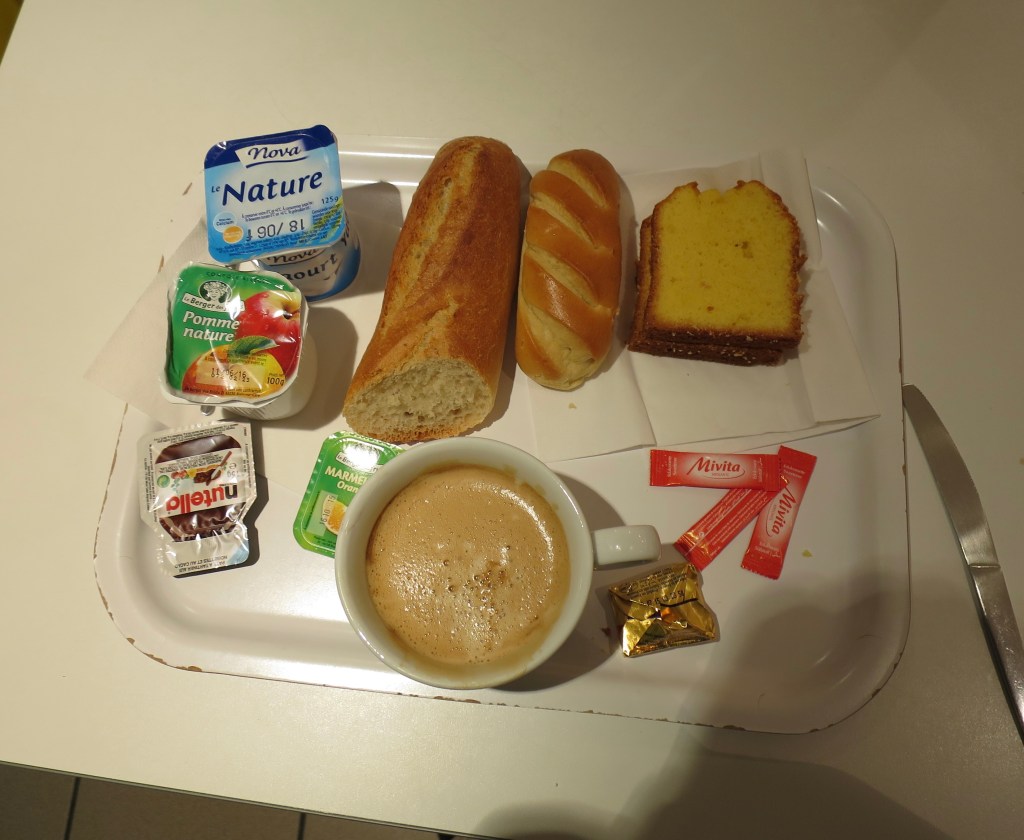
Breakfast is a self-service buffet, and I return often, piling on the cheap pastries, front-loading calories for the day.
The radio is loud, the breakfasters’ voices are quiet. Conversations are whispered. Less from fear of being overheard than a reluctance to break into the silence. There is none of that French acknowledgement as someone enters, no ‘bon appétits’. Everyone is in their bubble, and the surrounding silence is what keeps the bubbles intact. There is no society, each is here not as a person but as a set of functions. Privacy, anonymity is all.
The radio programme has two presenters, a man and a woman. The man talks non-stop, that upbeat logorrhoea of the morning drive-time presenter. The woman laughs. She has a bright, tinkling laugh, delightful, the oral equivalent of the bright-eyed, adoring look. Her job is to laugh, her laughter carefully placed to indicate the brilliance and wit of what he says. Which, given the number and quality of her laughs must be brilliant and witty indeed. I see him preening at each laugh, puffing himself up, complacently self-satisfied. She has her job because of her laugh. She is ear-candy. Her laugh stays with me all day. I smile as I hear, beneath the tinkling prettiness, the hard edge of irony, mockery, even savagery, of one whose time, one hopes, will come.
And he does say ‘sh’ for ‘s’. Time to talk about language.
Dunkirk, ‘the most northerly francophone city in the world’, is in fact buried in the Nord département where in 1874 most people spoke no French, and still in 1972 the majority were bilingual. This was part of the Netherlands until 1659, and the native language is French Flemish, a Dutch language still spoken by 40,000 here.
But 8km away is Bergues, the setting for Bienvenue Chez les Ch’tis, the most popular French film ever, which satirises the local ch’ti or Picard language. In the film, a post office manager is exiled, for a misdemeanour, from the South to Bergues, where he finds the local language all but incomprehensible. When he asks one of the postmen if they all speak like this, the postman replies (in the English version) ‘Yesh, the Ch’ti all shpeak ch’ti – although shome shpeak Flemishka.’ ‘It doesn’t even sound like French,’ the manager complains. It is an amiable comedy, built on the humanistic premise that we’re all French in spite of our language differences, with a happy ending, a feel-good film to draw all together. Although, with not a single non-white face, it is, like many popular comedies, conservative and nostalgic, dealing with the last problem, not the current one.
And ch’ti, Picard, is French, spoken by 700,000 people, one of the languages of ‘Old French’ or langue d’oïl, of the northern half of France.
Within five miles I will have encountered three languages. And this in a country that has only one language.
Finding my way out of Dunkirk, with the usual inadequate signage, has me cycling through most of the town.
I want to buy paperclips (the tag has broken off a zip, and they are handy replacements), and I must rummage in my memory for the French name. Of course, it’s trombone, an unexpected word for this emblem of bureaucracy. The English name it for its function; the French for its form, metaphoric and subversive.

Outside a car showroom I come upon – what a curious echo! – a beautifully-restored Simca Aronde (Old French for ‘swallow’), the first French car I ever saw. It was in a car showroom window in my home town in the 1950s, imported by an adventurous distributor. I never saw one on the road. There was something noticeably different about the design, an elegance, what we would learn to call chic.
Much of the town has a run-down feel, a general down-at-heel apathy. Interrupted by the brave attempts of individuals who’ve put their lives into shops, usually selling services, often in wild colours (shades of puce and lilac are popular), and in styles that are just off, and which may or may not succeed. And with some cosmetic municipal interventions – planters, benches, flowerbeds – that try cheaply to cover over the lack of the real, the costly investment in housing, infrastructure and jobs that would be needed to give the area a chance.
At last I find the road to Bergues, by a wide canal with tall, slender poplars on either side; their leaves shimmer and scintillate in the clear air, and dapple the water on this sunny, breezy day. It is one of the oldest canals in France, constructed in the sixteenth century, connecting Bergues to the sea.

I arrive to a watery world. There are bastions sloping down into a stagnant green moat.
Bergues calls itself ‘the other Bruges in Flanders’, and it is yet another reminder that this area, as far south as St-Omer, is Flanders, a region that grew prosperous on the wool and textile trade from the thirteenth century. Entering, I could be in Bruges, with tall buildings reflected in a narrow canal.
I cycle into the centre, into the square, and enter – a film set! It’s ‘Bienvenue Chez les Ch’tis‘! The sun is shining, the square is full of colourful stalls and entertainments, the carillon that Antoine played so deliriously rings out from the familiar tower. There, see, is the yellow lunch-wagon, where the friends ate, and over there the actual post office, and behind it the sorting office (for fifteen years I was a postman) … Are they filming Bienvenue 2?
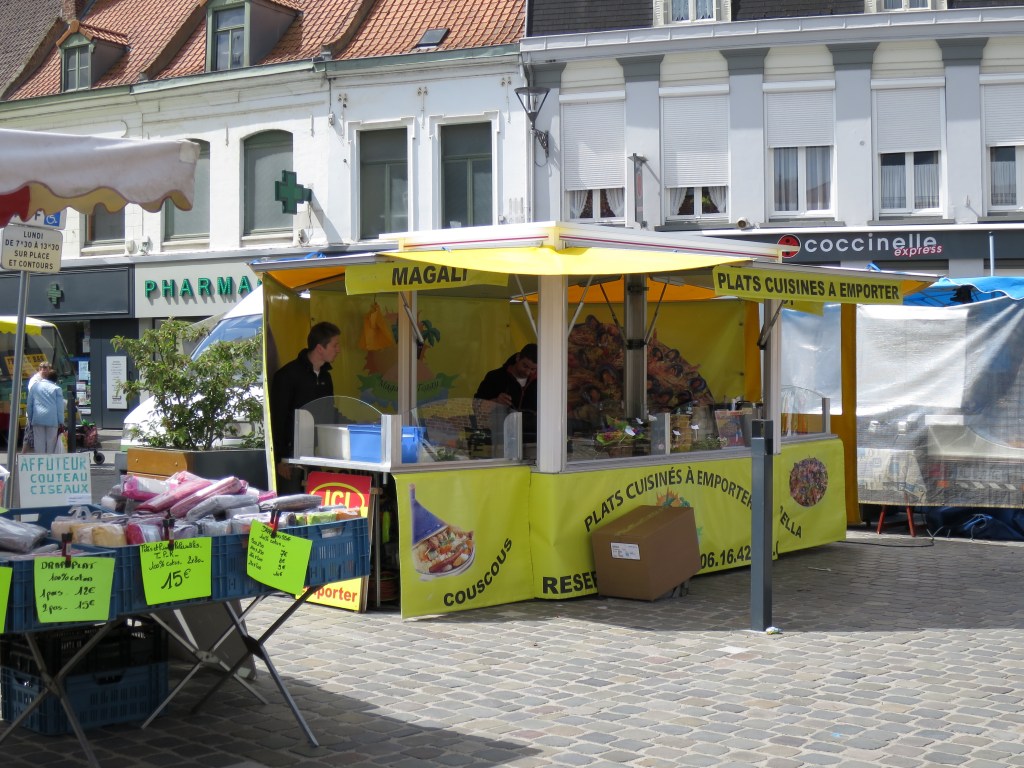
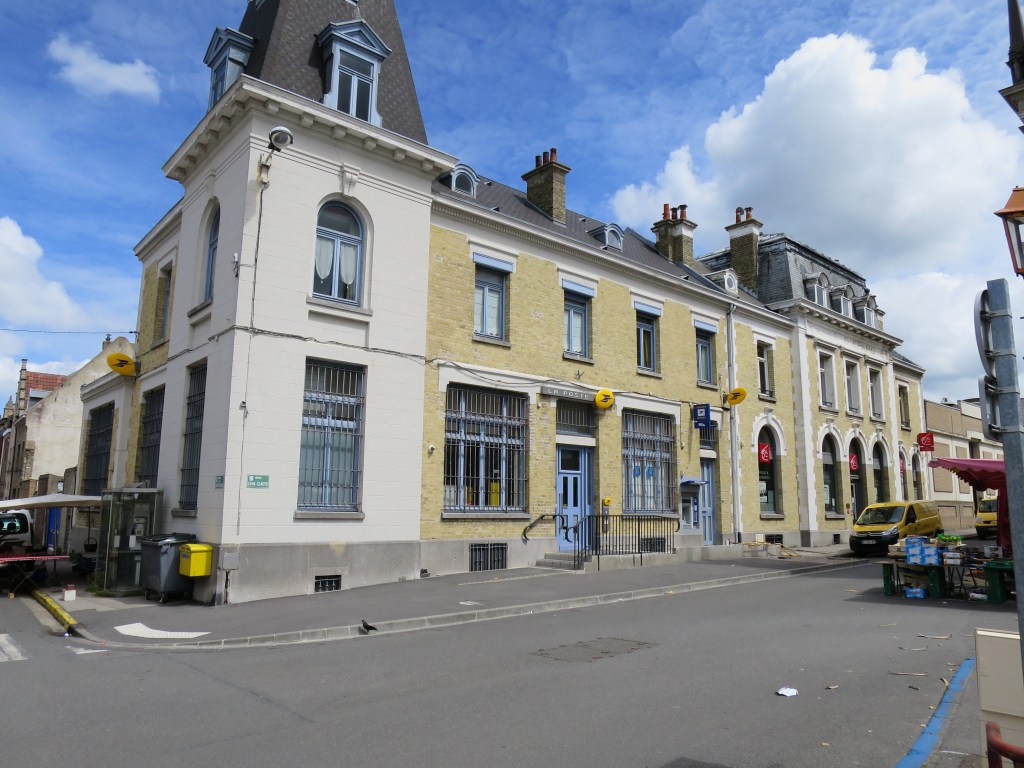
No, it’s just market day, a delicious French market day, with stalls spilling over with fine foods, and stalls selling cheap necessities. The town feels as warm and engaging as in the film. There are a few references to the film in shop windows, but in passing; this fame is just the latest ripple in the many tides of its history.
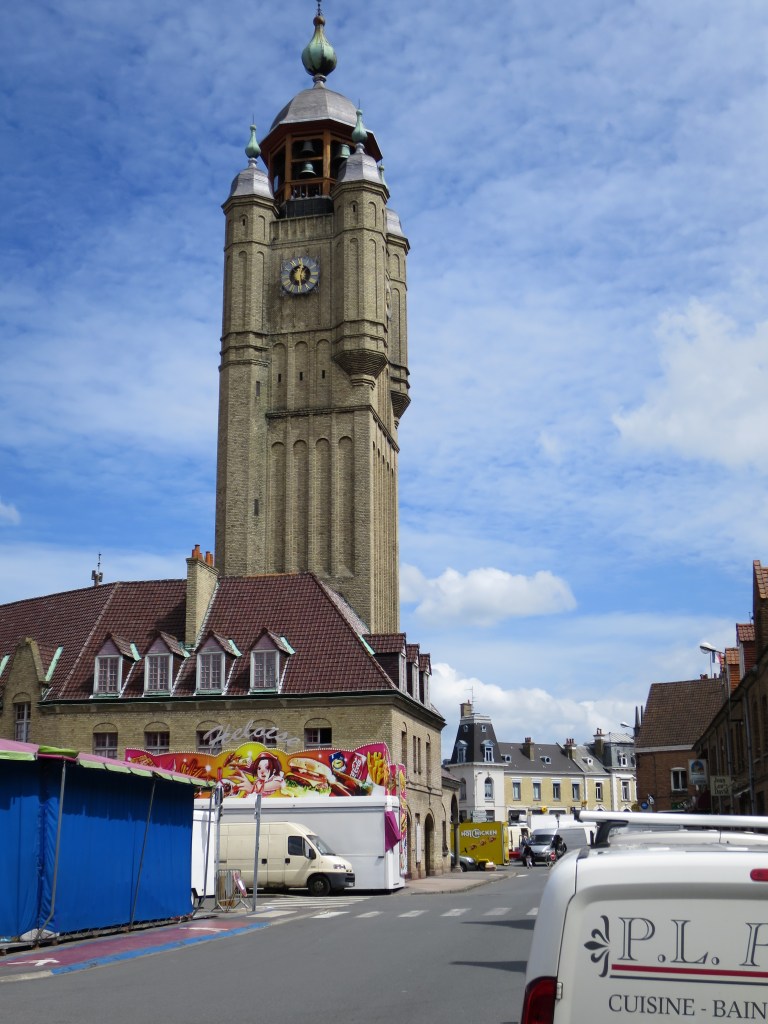
Its pride and its resilience is exemplified in its thirteenth-century belfry; entirely independent of the church, it was and is the mark of the town’s status. Each time it has been demolished it has been rebuilt: in the fourteenth, sixteenth and nineteenth centuries, and then after it was dynamited in 1944. On it is a plaque: ‘symbole des libertés communales’. Communale is one of those proud French words – in this case incorporating ‘common, commune and communal’ – for which English, and the English, have no exact equivalent. To our loss.
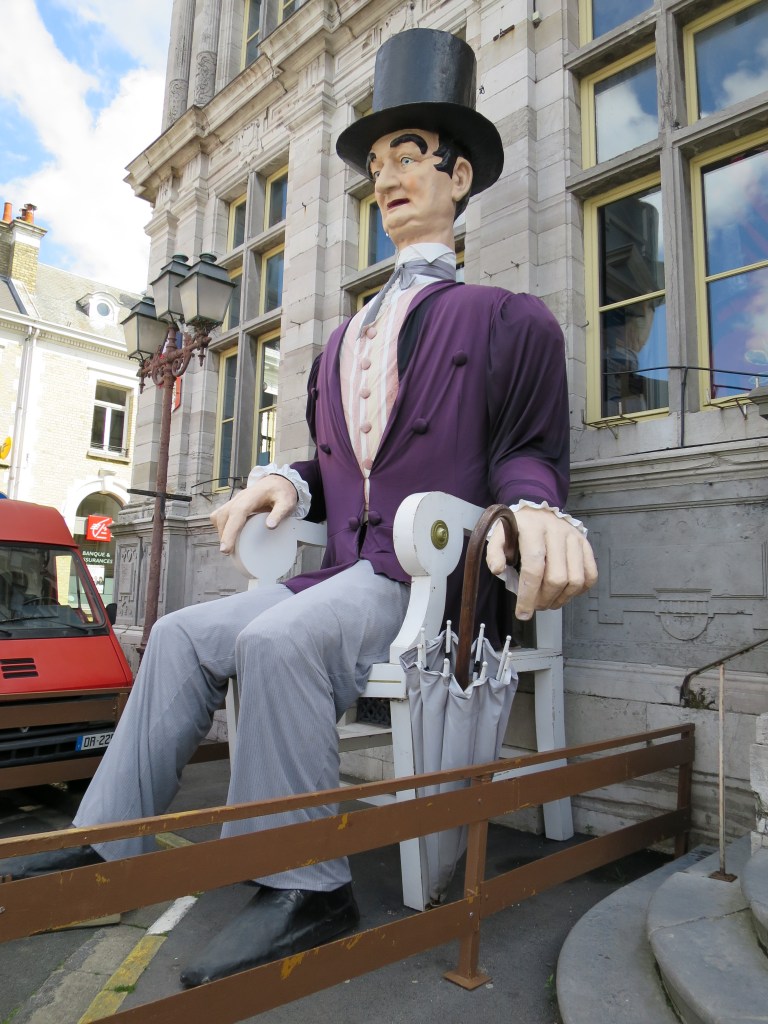
Outside the town hall sits one of the giants beloved of Flemish towns. This a splendid gent, a dozen feet tall, in stovepipe hat, with mauve jacket, cream trousers, an umbrella and the mildly-amused, stoical look of one who knows the world never really makes sense, but that’s life. They are still walked with pride through the streets in annual carnival. (The last of England’s perambulating giants, in Salisbury, ceased walking over a century ago.)
Panels show the destruction of the town in both wars. This area was invaded three times in seventy years, as well as countless times through history, demonstrating that it is a fluid world in more ways than one. It is still surrounded by the elaborate defensive wall, built in the thirteenth century to resist the French, and then upgraded by Vauban against the Spanish, with its characteristic star pattern ‘crown’ around the abbey.
I perambulate the wall as the market winds down, and a lunchtime torpor begins to settle.
The defences were part of the pré carré, Vauban’s line of fortifications from Dunkirk to the Ardennes, built in the 1680s to defend the new border of France. This line, if maintained, would have better served the French in both world wars in resisting the German invasions through Belgium, in this area long called ‘the cockpit of Europe’.
I resist the temptation of the ch’ti menu, with carbonnade flamande – beef and onion stew, made with beer – and ch’ti cheese (which is washed every day for a month in beer), tear off a piece of bread, cut some cheese, and eat as I walk the ramparts, then leave this delightful and friendly-feeling town as it nods off after lunch, and head south-west, back towards the Méridienne verte.
I can’t follow the line exactly, as Nicholas Crane walked England’s Central Meridian in Two Degrees West, for I’m travelling on roads. These spiral around the Meridian, and I pick my way along them, following my ‘path of desire’.
The Meridian is, for me today, the axis mundi, that links earth and heaven. It is the caduceus, the herald’s wand of Hermes, god of travellers, who both guides and leads astray.
Of him John Michell writes, ‘He is a god of both life and death, of initiation, inspiration, prophecy and delusion, the traveller’s friend. Yet to his earnest, uncritically devoted followers he is a wilful deceiver and “fool’s lantern”. His company is kept by the high-spirited of all temperaments, and the course of his study is a popular way to madness.’ I have been warned. And the roads I follow are the serpents that writhe and spiral around the caduceus. And, writes Yeats, ‘roads are the serpents of eternity … the only things that are infinite. They are all endless.’
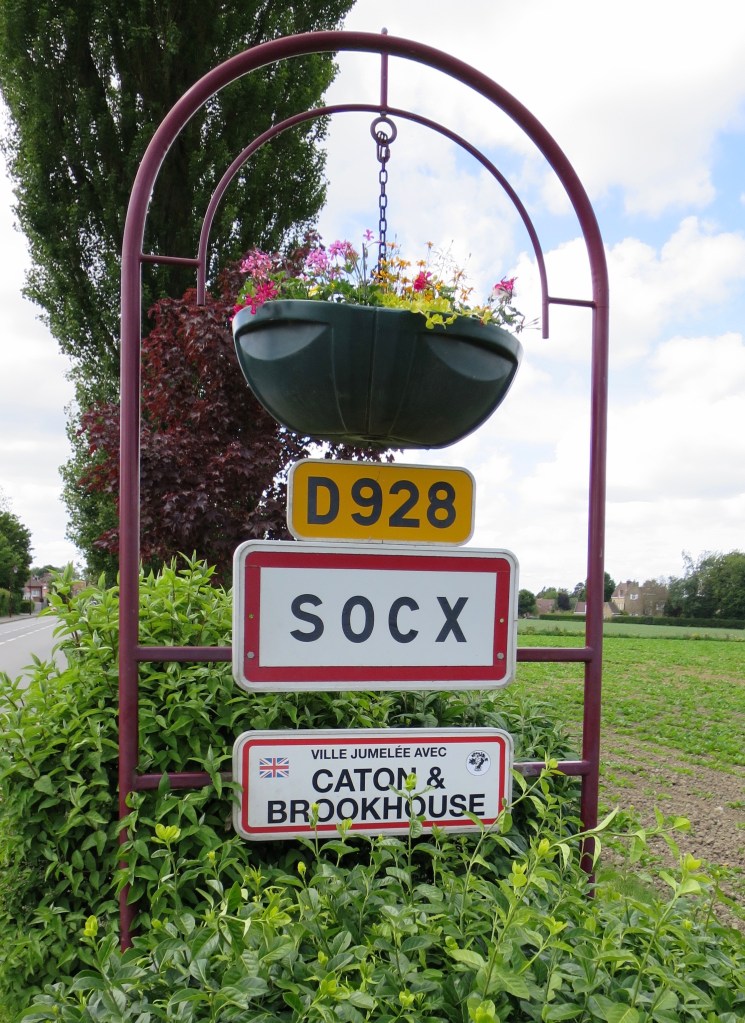
Cycling south-west, in sunshine, into the wind, across rich wide agricultural land reclaimed from the sea, towards a Meridian marker at Bollezeele, I pass through the village of Socx. It is twinned, a flower-garlanded sign announces, with two small villages three miles from my home town. When did that happen? After I left. But another unexpected echo.
Bollezeele lies at the centre of a five-pointed star of roads.
I enter a village in thrall to that midday spell that seems cast more deeply in France. A thick almost tangible stillness. Every shop is closed, with shutters down, never, it seems, to wind up. In the bar, the squeak, squeak of a cloth inside a glass slowly turned. The wide square has been emptied of vehicles. I expect, looking up, to see birds fixed in the air. There is the sense that behind every closed window there is a beating heart pressed against the stillness, waiting. Where ‘boredom waits for death.’
Is it because of the excessive self-consciousness, the excessive self-centredness of the French, that ennui, that ‘dull glib sadness’, is such a returning theme in their literature, their ideas? To the solipsist – if nothing is happening to me, how can anything be happening anywhere? Waiting.

But, no. Beyond waiting: the consciousness behind each heart, the face above each breast has surrendered to time. So that time is simply passing through.
As I am passing through.
Of course. Here, in this empty square, with my heavily-laden bike, in the shadow of a clock that surely will never manage to push that oh so heavy minute-hand up, up, up to the zenith so that the hour may strike, I have for the first time a sense of what I am doing.
For I am on a journey.
But more than that, a quest.
I write of ‘following’ the Méridienne verte. In fact, I am searching for it, seeking it out, locating it, even creating it, with my attention to, interest in what is along the Meridian
More than that, I am journeying through France. Where I first tasted what Lawrence Durrell calls ‘the bitter-sweet herb of self-discovery’. And so much since.
And journeying through my life. For, at my age, three-score years and ten, the allotted span, twice Dante’s ‘midway along the journey of our life’, all beyond is uncharted.
But the dark edge, the line beyond which there is nothing, is visibly approaching. Since I planned this trip, four friends have been diagnosed, out of the blue, with illnesses that will soon kill them.
I feel Crane’s unease with the do-as-you-please approach to journeying of those who follow ‘desire paths’, and to a degree I share it. But, the many places I plan to visit off the line will be on my desire paths, places I desire to visit.
And yet, like a washing line on which a dog’s lead is looped, to allow it not just the radius of the lead but the length of the line, the Meridian will tether me. And the accumulation of experiences will register each time I return to the line.
A wheezing above me, as the minute hand at last heaves up to the vertical. A rattling and meshing of cogs, stasis, and then, ‘bong … bong’. A shutter cranks slowly up. ‘La Vie en Rose’ plays in the café. And I have a brief, intense sense of pattern, and aliveness.
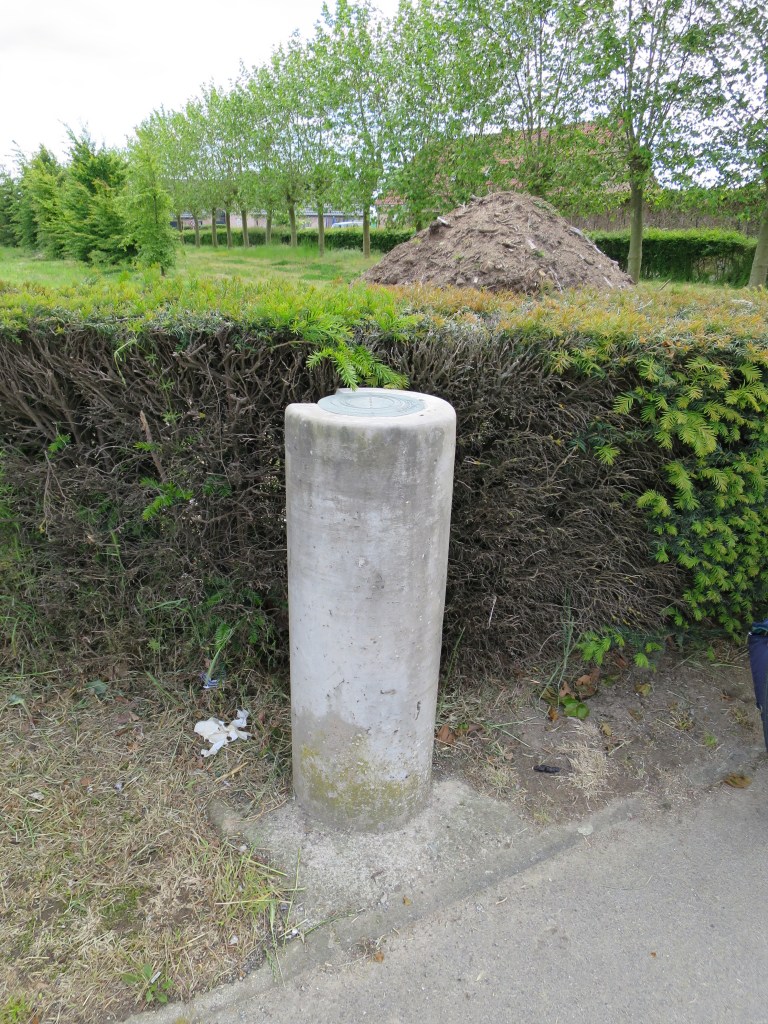
I find the Meridian marker on the edge of the village. It is in the standard form of a metre-high concrete cylinder, with the bronze medallion on top. The bronze has gone green, the marker has stood, untouched and unnoticed, since it was put here fifteen years ago. North, there are empty fields out of sight, with not a tree. To the south is a copse of trees. It could be fifteen years old. But there is an empty field beyond. Where is the long march of trees, where are the signs of annual renewal that keep symbols, emblems, the chosen, potent?
Beside the marker is the Le Chemin de la Procession, running due south, close to the Meridian, with a sign towards La Source Notre Dame. “The pious duty of settled people is hospitality to travellers, for they are acolytes of Hermes, the errant spirit of the earth, who, as Mercurius, is also the Virgin Mary,” writes Michell. Such springs are celebrated and processed to and reinvigorated on the Feast of the Assumption of the Virgin.
I cycle south along Le Chemin. It runs for a couple of hundred metres then veers suddenly west. Over the hedge, on the line, in the middle of a field of ripening wheat, is a vivid green patch, la Source Notre Dame. It is so close, the spring, to the Meridian. It could so easily have been incorporated into the celebration of the Meridian. It has, like the Meridian, been forgotten.
I head south-east, towards Cassel. It is set on a conical hill that rises oddly and uniquely 570 feet from the flat polder, not unlike Glastonbury Tor. But this, a defensible hill in the cockpit of Flanders, is inhabited to the top, and has traditionally had a military rather than a mystical role. Its commanding height has been repeatedly fought over. It is said to be the hill up and down which the Grand Old Duke of York ineffectually marched his British forces, before he was defeated by the French in 1793 and fled back to England. Although it was incorporated into France in 1678, it was still, in 1845, according to Disraeli, “quite French Flanders, where few of the inhabitants, and none of the humbler classes, talk French.”
It is tree-covered, and an even, steady ride up.
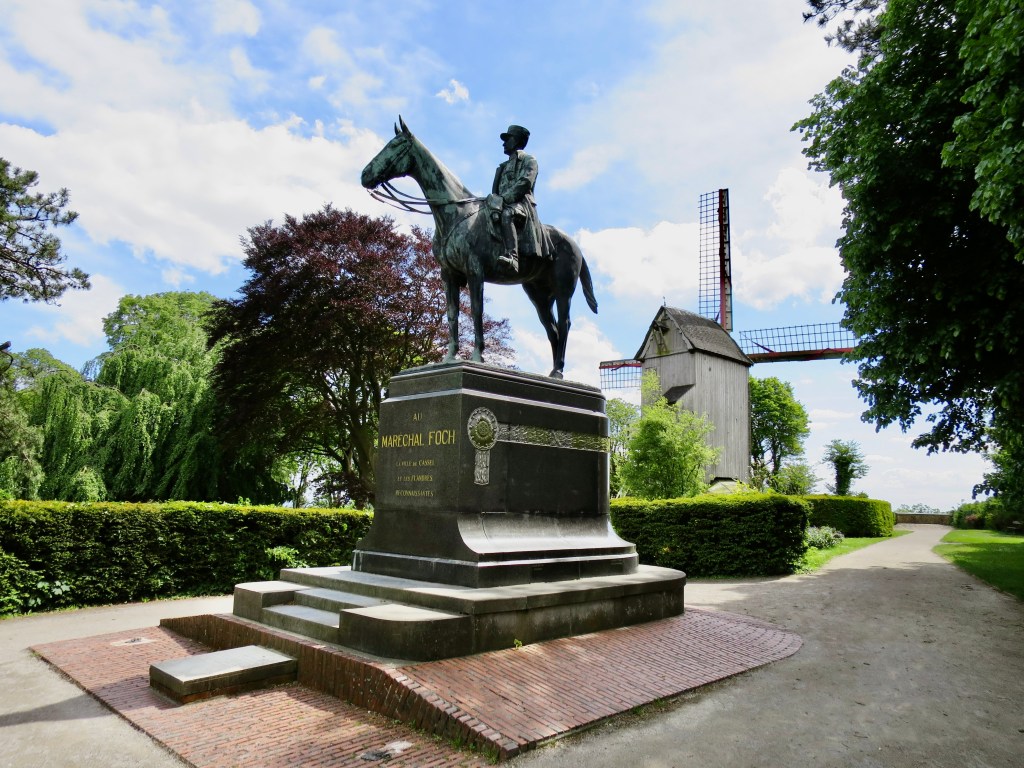
At the top is a wooden windmill, the last of twenty-nine that once ground noisily up here, and a statue of Marshal Foch, on horseback, facing east. Here he spent ‘some of the most distressing hours of my life’ staring out over the mechanised slaughter of the Western Front less than thirty kilometres away. The horse gives a clue to the reason for his hapless dismay.
The Front ran south from the North Sea, through Ypres, Armentières, Vimy, Arras, Somme (such evocative names!), then swerved south-east, away from Paris (which was saved by the troops ferried to the front-line in a thousand red Paris taxis – each charging, it is said, the full fare). On through Verdun, to the Swiss border. It was the line at which the German advance was held. It quickly congealed into a barely-moving killing zone in which half a million British, a million French, and a million Germans died. My map marks cemetery after cemetery along it, ‘Brit’, ‘All’, unmarked. There are 350 in Flanders, 280 in Somme. And many ‘ossuaires’.
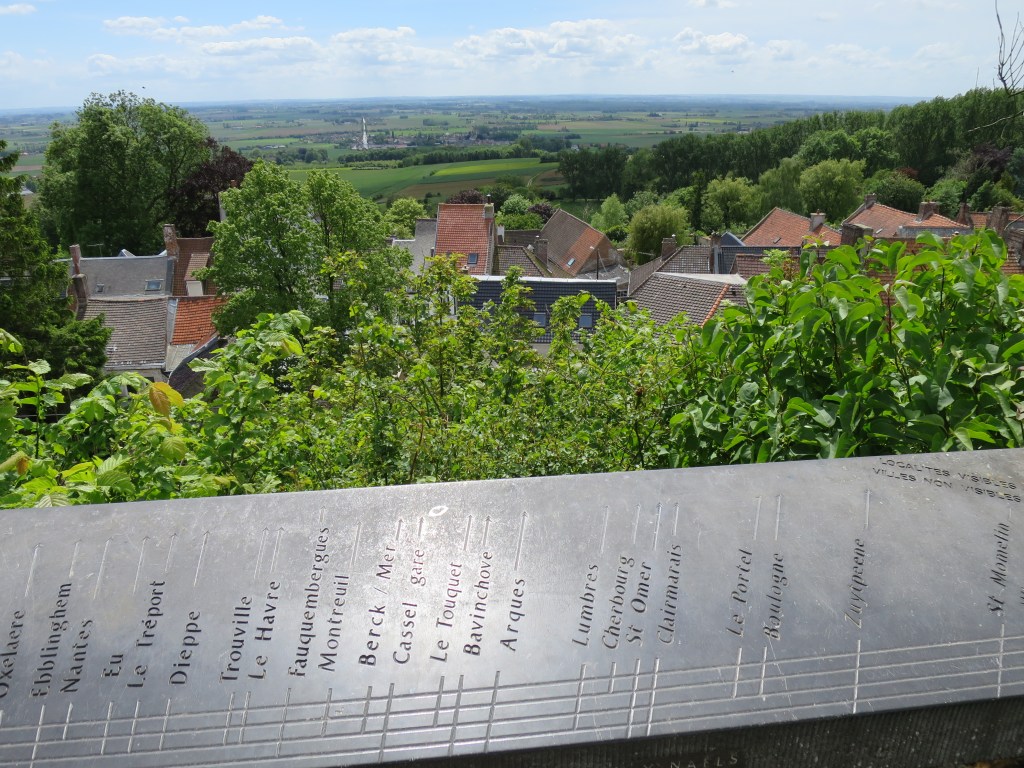
It is, from the top of the hill, a remarkable, light-filled view looking east, mile after mile of flat, open land. What is now productive agricultural land was then an industrial landscape of supply depots, narrow-gauge railways, muddy roads, hospitals, camps of reserve troops, the daily exchange of casualties and fresh troops, the madness of it all laid out. It convinced Foch that the only way to prevent it happening again was to dismember Germany. He said, of the Versailles treaty, ‘this is not a peace. It is an armistice for twenty years.’ As it proved to be.
General Pétain, too, commanded from here. I will meet him in St-Omer.
The descent into the village, on foot from this belvedere, is enchanting. It is one of those nineteenth-century curiosities, ‘pseudo-rustiques en mortier’,concrete shaped to imitate the wood of handrails and the rough stone slabs of steps, between artificial cliffs. So that instead of a simple set of even, granite steps, the way down is a romantic path through a rocky defile, between towering white cliffs, where plants nestle and cling, on ghostly white, uneven steps, with railings and seats of wood uncannily turned to white stone.
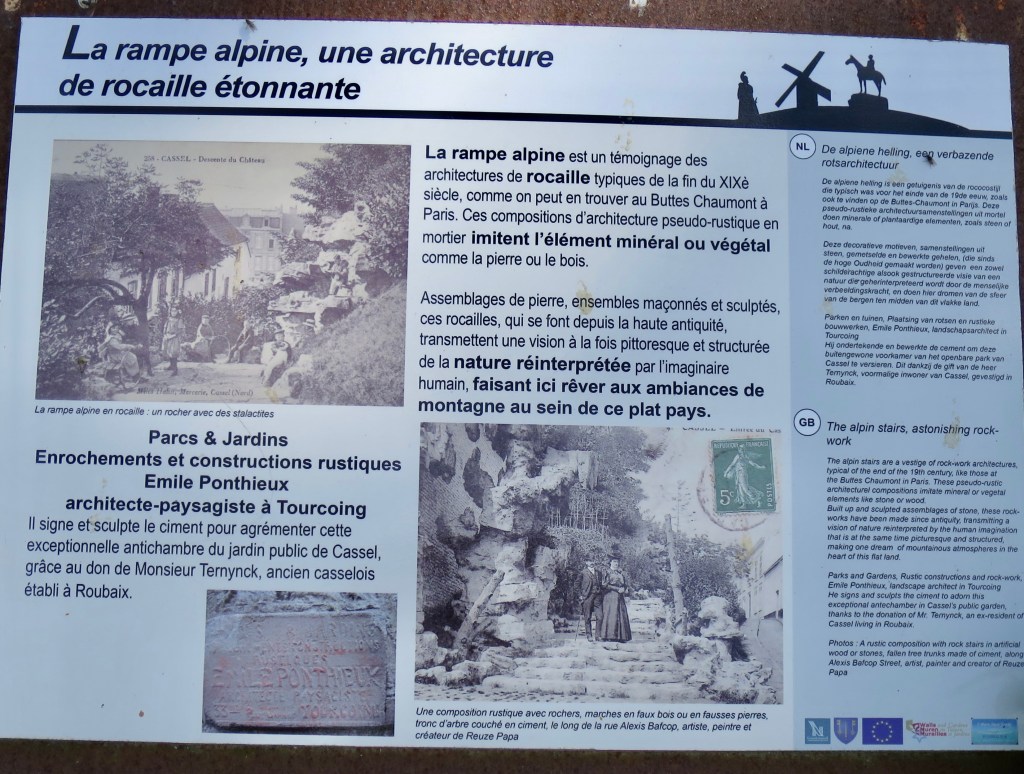
The information board reminds us that the same feature is used in the Parc Buttes-Chaumont, one of my favourite places in Paris. Aragon writes of the Parc’s Bridge of Suicides “which claimed victims from among passers-by who had no intention whatsoever of killing themselves, but found themselves suddenly tempted by the abyss,” in “the park in which nestles the city’s collective unconscious”, where we are “caught in the trap of the stars”.
Having descended the grotto-like pseudo-rustique staircase, I emerge into a Flemish Grand-Place, with cobbles and fine houses and substantial restaurants, colourful and comfortable.
Here, I imagine an awakening small-town adolescent who has read Aragon seeing himself in Paris as he climbs at night those uncanny, blanched steps. Alone, out of the noisy solidity of the given world, up to the belvedere of his dreams he climbs to stand, to lie, caught in the trap of the stars.
And I imagine myself walking at night, after a convivial meal of carbonnade and ch’ti beer in one of the Grand-Place’s restaurants, away from the chatter and colour and warmth, up this ghostly, bone stairway, to a canopy of stars, and experiencing in my mind’s eye and ear the flashes and arcs and thunder of war laid out for mile after mile below me.
Instead I am soon freewheeling down the helter-skelter of Cassel hill, and out onto the road to St-Omer, cycling into the early-evening sun.
I approach the fringes of St-Omer with the rush-hour traffic, and come upon another peculiarity of French roads – a major road, signposted with my destination, that, without warning, turns into a motorway, with no bikes allowed, and with no alternative signed. How to get into St-Omer now? I have to pick my way through villages and suburbs, using a map of too small a scale, and hard-to-read maps on my phone.
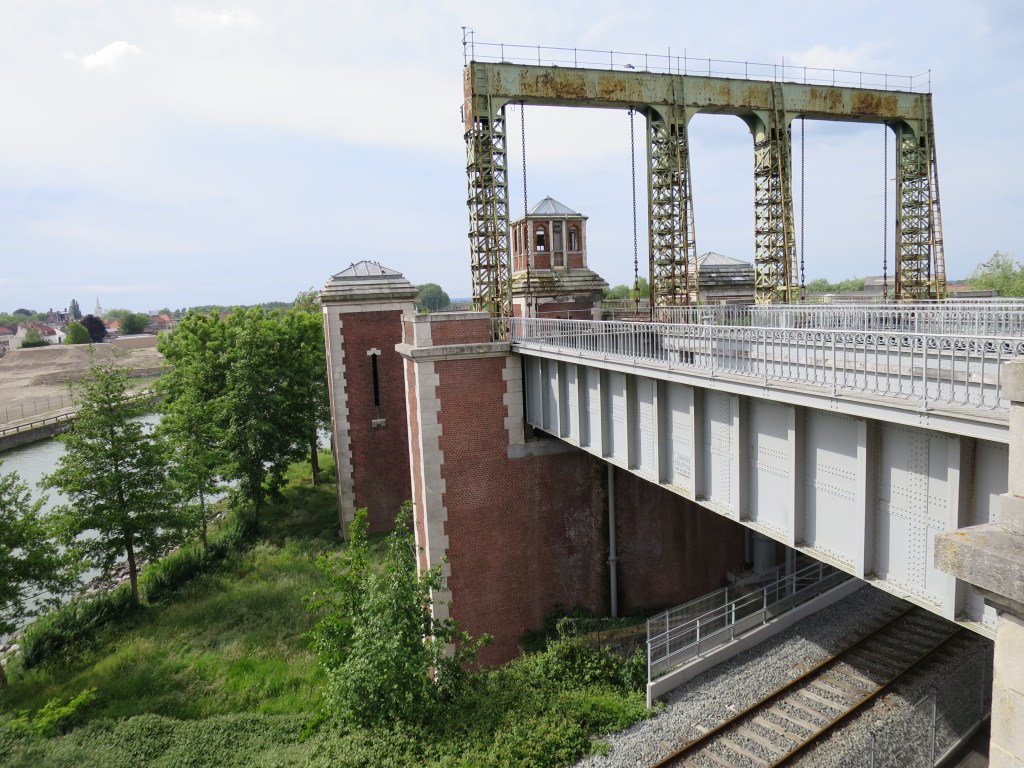
But, as I grumble my way along, I find that I have inadvertently diverted along the river Aa to the Fontinettes boat lift, an impressive piece of nineteenth-century engineering. It was a hydraulically-powered replacement for a flight of five locks that lifted boats the 43 feet from the Aa, on the Flanders plain, to the Neufosse canal, on the plateau of Artois. I climb up to the now-dry canal (the new junction is further along), and find myself in an edgy, liminal place, with too many figures apparently aimlessly hanging around, with no eye contact. I have walked into something illicit – drugs? sex? – I’ve no idea what. But it’s no place to stay. I back out, as I would withdraw from a tough bar, carefully, leaving them their private world.

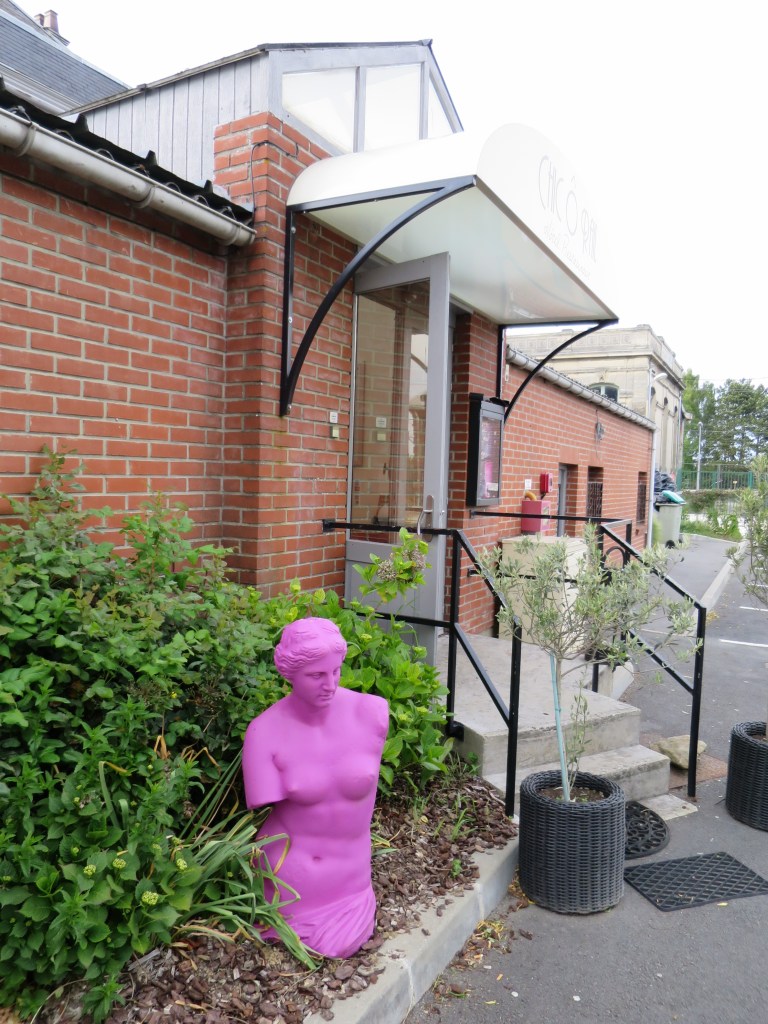
My hotel is by the elaborate Second-Empire railway station.
At the door is a nail-varnish-pink torso of Venus de Milo, rather attractive.
It is a cheap hotel trying to remake itself, as all must do, against the onslaught of the low-cost chains. At the weekend it is a ‘venue’, with music to keep people drinking. Once it would have been busy during the week with commercial travellers and rail passengers. Now it relies on the occasional trade of those, like me, passing through.
It is at the bottom of town, by the canalised Aa, so I decide to follow up Robb’s intriguing descriptions of the marais, the low-lying land reclaimed for market gardens between the canals that are the only means of access, “The “floating islands” to the east of town farmed by a community which had its own laws, customs and language. They lived in the low canal houses in the suburbs of Hautpont and Lysel, which still look like a Flemish enclave in a French town.”

As I cycle through, instead of a drowned, raffish, other world, I find a neat estate of bungalows, of conventional gardens, with some fields of grazing cattle, on narrow winding lanes and canals, a thoroughly suburban and domesticated landscape.
Here and there are the beginnings of tourism – kayaking and boat trips.
And of revivalism – a basket-maker. We domesticate the different, turn it into tourism. We destroy practical working-class trades with factory goods, and then reinvent them as middle-class luxury trades. The basket-maker runs basket-making courses. It is very pleasant.
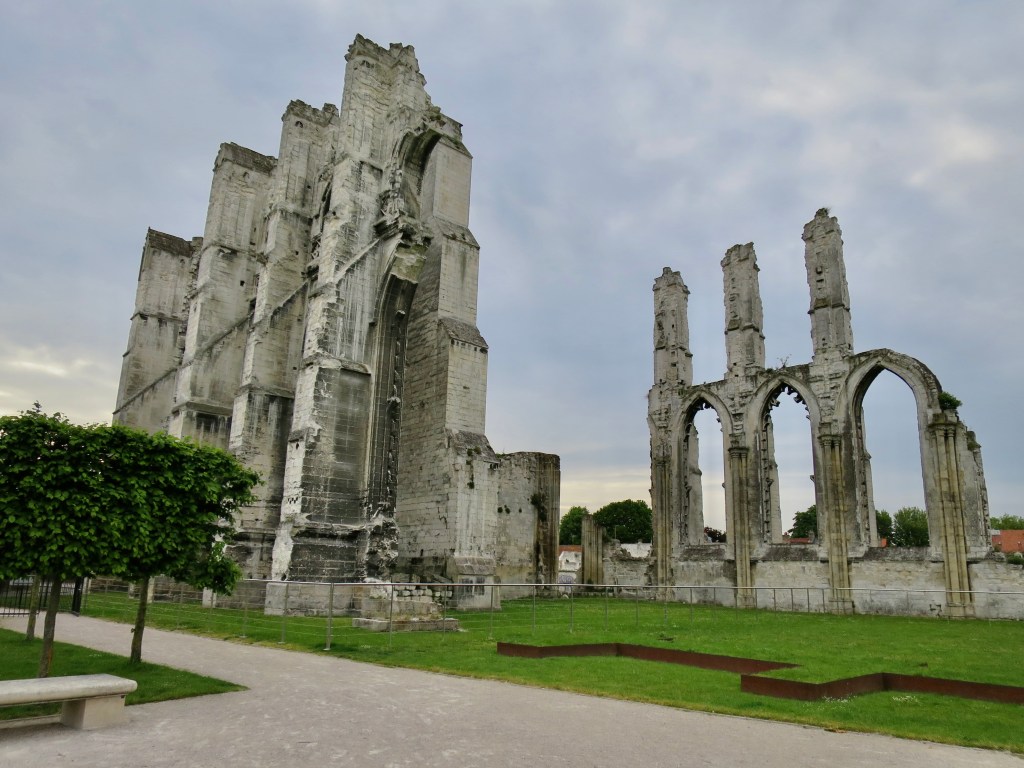
St-Omer, at the edge of the limestone Artois plateau, overlooking the plain, has a long history. Walking up into town, I pass the ruined abbey church of St-Bertin. Notre Dame in Paris was founded as a daughter house.
It is a reminder that Christianity came to Gaul not from the south, from Rome, but from the north, with the Franks.
The rivalry between the abbeys lasted for centuries. St-Bertin had a copy of the 42-line Gutenberg Bible, one of four in France, the only one outside Paris, which came to the city from the abbey after the Revolution.
A knight of St-Omer, Geoffrey, was one of the founders of the Knights of the Temple, the Templars, in 1118.
For centuries the city, on the border of France and Flanders, and close to the English possessions, was on the front line of battle and siege. Crecy and Agincourt are close. It was to a St-Omer knight, fighting on the English side, that the French king John II surrendered at the Battle of Poitiers in 1356. Henry VIII conducted his only field campaign here, and must have witnessed the stylish panache of the St-Omer swordsman-executioner, as he employed him to behead Anne Boleyn, so vividly dramatised in the television version of Wolf Hall.
The Jesuit college, set up here to train English Catholics as priests to infiltrate Protestant England, contributed to the town library one of only two copies in France of Shakespeare’s first folio. It was the property of Edward Scarisbrick. He came from a family of English Catholics, several of whom died for the faith. One ancestor served Henry in France as his standard-bearer before being executed for ‘conspiracy’. Edward, the faithful Catholic, reading Shakespeare, the perhaps-Catholic? He became James II’s chaplain. Titus Oates studied here, briefly, on his eccentric journey to inventing ‘the Popish Plot’.
For all its colourful history, it is a solid, undistinguished town, connecting the plain and the plateau. A good place for a career-soldier, after an uneventful thirty-seven-year peacetime career, to retire to.
As Colonel Pétain intended in 1913.
He was 58, and had bought a house in St-Omer, selected one of his many mistresses (he was a notorious womaniser) to marry, when the Great War broke out. He proved to be an excellent wartime soldier, considerate of his men, and sensibly defensive-minded, against the prevailing French command philosophy of furious attack (De Tocqueville, on the French: “more capable of heroism than virtue”).
After the war, as ‘the lion of Verdun’, and having been appointed Marshal of France, he was flattered into politics, and began to see himself as indispensable to the good governance of France.
When the Germans invaded in 1940, sidestepping the Maginot Line by invading through Belgium, and advanced rapidly towards Paris, they cut off the British army and many of the French at Dunkirk. Pétain was appointed to head the government, and immediately agreed to the armistice with Germany.
Was there any alternative? Churchill, of course, would happily have fought to the last Frenchman. He even offered to unite France and England into one state to keep them fighting. But Pétain had spent much of his time since 1918 warning of the inadequacy of the French army, and knew its lack of capabilities. And having seen the slaughter on the Western Front, and imagining that slaughter spread across the whole of France, saw that resistance was useless.
And the armistice was widely welcomed in France.
The country was divided, the north and west under German occupation, the south and east under French control, governed by Pétain from Vichy.
But Pétain, already 84, became ever more authoritarian and collaborationist. He declared himself Chef de l’État Français, the dictator of Free France. He replaced ‘Republic’ with ‘State’, Liberté, Égalité, Fraternité with Travail, Famille, Patrie. He proposed a “social hierarchy rejecting the false idea of the natural equality of man”.
And yet there was little resistance, until the occupation of the whole of France in 1943, and the Allied landings in 1944. As de Tocqueville wrote of the French: “led on a string so long as no one resists, ungovernable as soon as the example of resistance appears.”
If he had retired in 1914, Pétain would be an unremembered colonel who lived out his retirement quietly in this dull town, dreaming of what might have been.
If he had retired in 1918, he would be the celebrated marshal who’d had ‘a good war’.
If he’d gone in 1940, he would have been the wise statesman who saved France from destruction.
In 1945 he was a traitor, sentenced to death for treason. This was commuted, against much opposition, by de Gaulle, his former lieutenant, and he died in prison, quite mad.
Note: Thanks to Dave Castell for introducing me to Bienvenue Chez les Ch’tis, and ch’ti beer.
Day 3: St-Omer to Amiens, 54 miles.
Artois. Wind and rain. ‘The Battle of the Spurs’. Mechanical trouble. On the train. The Somme valley. Entering Amiens. Jules Verne. Cathedrals and cars. The elephant and the blind men. The enchanted couple.
In the night I hear rain like pebbles on the skylight. And I wake to a grey and windy morning.
As I eat my breakfast – alone in the large, pink-paint and black-leatherette dining room, from a small round tray on a small round table, portion control – I check the weather forecast. No rain, but a steady 25mph south-south-west wind. This is bad news: it will be in my face all day, on the longest leg of my journey. And I will be climbing, onto the plateau of Artois, from sea level up to 600m.
“That chalk rise,” as Ruskin puts it, “is the front of France; the last bit of level north of it the last of Flanders; south of it stretches now a district of chalk and fine building limestone. This high but never mountainous calcareous tract, sweeping round the chalk basin of Paris, away to Caen on one side, and Nancy on the other, and south as far as Bourges, and the Limousin. This limestone tract, with its keen fresh air, everywhere arable surface, and quarriable banks above well-watered meadow, is the real country of the French. Here only have you real France.”
For Ruskin, this was the home of the Franks, whose straightforwardness was in their name.
This was the founding tribe of France. Clovis’ conversion to Christianity in 496 is the generally-acknowledged ‘beginning of France’. And in the Franks lies the root of the Gothic, for Ruskin France’s greatest gift to culture.
I will be climbing up onto the chalk plateau, out of the water-world of reclaimed polders, to a land where the problem is lack of water. Artois, Artesie in Dutch, the land of the artesian well.
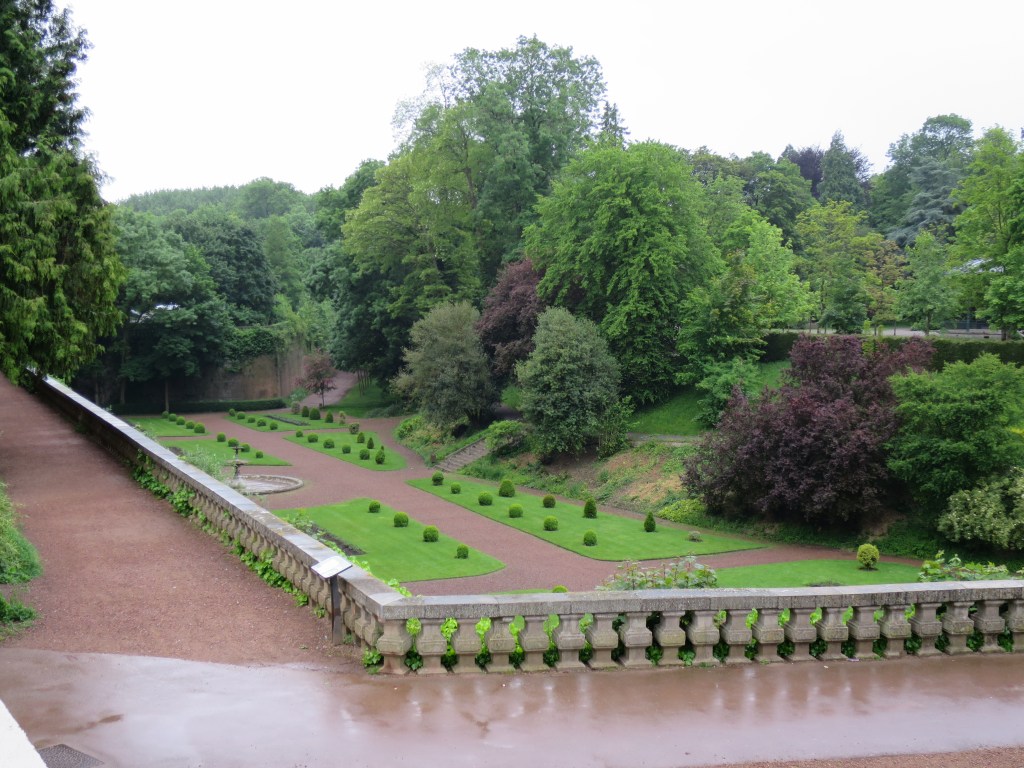
I ride up through the mist, out of St-Omer, past one of those parks peculiar to France, a wide expanse of flat lawn dotted symmetrically with geometrically-trimmed trees, like chess pieces. It’s like a Resnais film, and I expect flitting figures, held poses, and a voice-over of existential angst. It begins to rain, and it doesn’t stop for three hours. In spite of jacket and cape I am soon wet and cold. There are shreds of mist, cloud, in the air.

Just outside St-Omer I pass La Coupole. It is a concrete bunker-complex, built in 1943 to prepare, store and launch V-2 rockets.
Abandoned for 50 years, it has been opened as a museum of the rocket programme, the Occupation, and the use of slave labour. It is a grim, chilling place, with the mist swirling round, and another reminder of how much France has been occupied, fought over, ruled by, trampled on, by foreigners. This area occupied three times in 70 years by Germans, fought through twice by British and Americans. There’s all the difference between a bomb blowing your door off, and a boot kicking it in. Apart from 1066, and 1688, England has been little stepped on by foreign boots.
Perhaps it’s an element in the apparent contradiction between France’s prickly nationalism, and yet its willingness to negotiate. (For years the language of diplomacy was French.) Whereas England, Britain, has always had its moated redoubt to retreat to, and has cultivated an adversarial politics.
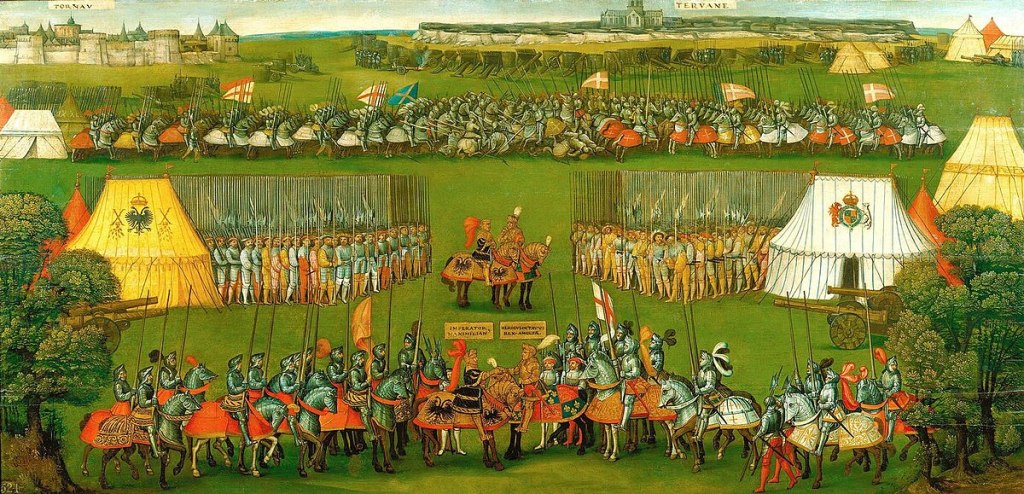
More foreign interventions happened at Thérouanne, ten miles south of St-Omer. It is the site of the ‘Battle of the Spurs’ in 1513, where Henry VIII and Maximilian the Holy Roman Emperor, fighting on behalf of the pope, routed the French cavalry and captured the town. It was a minor battle, of little significance. But a great propaganda opportunity at a time when the visual had primacy over the verbal, when style, as pageantry, was all-important. So, Henry and Maximilian met, in full armour, in a gallery of cloth of gold. And the occasion was recorded in paintings (showing Henry of course at the centre of the battle, when in fact he was kept well away from the fighting), a Dürer woodcut, and a joint celebratory account.
While Henry was engaged in the vanity project of leading his army on the field, Queen Catherine was organising the defence of England against the invading Scots, culminating in her victory at Flodden. She sent James IV’s bloodstained shirt to Henry in France.
Having made no gains, and run out of money, Henry withdrew, and made peace with France.

The weather at the Battle of the Spurs was described as ‘the foulest ever’, and today is trying to compete. Is it really the second day of June? The land is rising, with great sweeps of open field, and occasional ridges in the lee of which villages shelter. But I am riding into a wind blowing unhindered across open fields.
And now I’m having mechanical problems, with my gears slipping. Eventually I have to lock the derailleur. Instead of ten gears, I have two, one too high, one too low. I smile grimly as, rain-battered, and jury-rigging the gears in the shelter of a hedge, next to a vast wheat prairie, I remember Hilton’s description of the old-timer’s bicycle: ‘the transmission – chainset, chain and back sprocket, the heart of the bicycle – is expertly and beautifully maintained.’
This is not good. I had set out, having ridden a few dozen miles each week for the last 4 months, after a two-year lay-off. I am not very fit. It is fifteen years since I have done a cycle tour. The bike, fully loaded, is very heavy. And now I have mechanical trouble, and no idea of how to solve it. I am beginning to wonder if I have taken on more than I can handle. But, remember the old-timer’s salutation – ‘it’s a grand life’.
At Cauchy, Pétain’s birthplace, I turn south-west, into the wind.
By the time I reach St-Pol, less than half way to Amiens, I am struggling.
I stop there, and fuel up on pizza and chips from a van in the square. Then I go to a café. As I’m drinking hot chocolate in the dark café, run by a middle-aged woman of the old school, who sniffs as she serves, I begin to shiver. My energy drains away.
As I sit, a needy-looking young woman comes in and asks if she may use the toilet. The patronne, drawing herself up, purses her rouged lips, says, no, it is out of order, the plumber is working on it right now, désolé. The young woman droops, goes out. The patronne sniffs, and smiles that tight, petit-bourgeois smile of victory. She has given nothing. When I ask to use the toilet, she smiles the saccharin smile, ‘bien sûr’, tries for complicity, then sniffs at my lack of response. I had forgotten it, that clenched lack of generosity, the French jobsworth, the petty bourgeois.
St-Pol has a railway station. This is the last place I can decide to ‘be sensible’ and take the train. I have stopped shivering, and am feeling better, but I have little energy. I head for the station.
Could I have cycled it? Perhaps. But riding into a strong wind is like cycling with a giant hand on your forehead. It’s frustrating as well as hard, and across an undulating plateau, it would be relentlessly wearying. It is the third day of a twenty-six-day ride. What if cycling on makes me ill? What if I so drain myself that I’m knocked back for the next days? My hotels and youth hostels are booked. I am on a schedule. It’s not worth it. But a problem like this, so early, is disconcerting.
The rain stops as soon as I’ve bought my ticket. But the wind still blows.
There is no longer a direct line to Amiens, and the train goes out to the coast, where I change trains. It proceeds to Amiens along the Somme valley.
The gift of this is that I enter Picardy the way Ruskin always arrived at one of his favourite places.
His Bible of Amiens is written in the convoluted, clotted style of his late writing. Yet I find its innocence and passion moving. Especially as he is writing in the 1880s, when the Somme was just the name of an attractive chalk river in France.
He writes this, about arriving from Calais at the Somme: “You stopped at the brow of the hill to put the drag on, and looked up to see where you were: – and there lay beneath you, far as the eye could reach on either side, this wonderful valley of the Somme, – with line on line of tufted aspen and tall poplar, making the blue distances more exquisite in bloom by the gleam of their leaves.”
The train from the coast pootles along the valley, picking up and setting down, students, commuters, travellers, a modern train behaving like a train of times past. The fields along the wandering river are little cultivated, mostly rough-grazing among copses of aspen, and stream-following lines of willow. There are small groups of white, very white cattle. Not segregated, as is usual, with milking cows here, bullocks of a specific age there, but mixed up, like a natural herd, unusual, old-fashioned and heartening. I begin to revive.
At Noyelles we pass a narrow-gauge steam train, with small, wooden carriages. It is packed with waving schoolchildren, and alert men with long-lens cameras. I guess it is from the Great War, when hundreds of miles of narrow-gauge line were laid to supply the Front, the carriages packed with troops and supplies going up, casualties coming back.
I leave the train at St-Sauveur. I want to cycle into Amiens. Close by is the important Celtic tribal capital of Samarobriva. It is where Caesar spent the winter after his second invasion of England. It is now the site of a reconstructed Iron Age settlement.
And it is on Robb’s Celtic Meridian, the key to his ‘lost map of Celtic Europe.’ He notes the importance to the Celts of ‘The Cult of the Severed Head’. And the Celts, or Gauls as the original French.
I cycle among the commuter traffic, through industrial terraces that lead down to the canalised river, reminding me that Amiens was in Ruskin’s day an industrial town. He first sees the flêche, the spire of the cathedral, not as a church spire, but as one black chimney among fifty “or fifty-one, I am not sure of my count to the unit.”
About a mile out, the traffic locks up, and I get off and walk. I note again the change in French driving in the years I’ve been coming here. Not only the consideration for cyclists, but the absence of horn-sounding, extravagant, theatrical gestures, expressions of fury. The drivers sit placidly as I push my bike past.

My first distant sight of the cathedral produces a sudden and unexpected emotion. I realise how much I have looked forward to this moment.I remember Ruskin’s first view of the flêche, his language stuttering to reflect his passion: “a minaret, vanishing into air you know not where, by mere fineness of it. Flameless – motionless – hurtless – the fine arrow; unplumed, unpoisoned, and unbarbed; aimless – shall we say? It, and the walls it rises from – what have they once meant? What meaning have they left in them yet? …”
To find the youth hostel, I ask at an estate agent – they’re the best places to ask for directions, as they have knowledge, maps, and their job is being nice to people. I’m soon there.
It is a big hostel, very friendly. They give me a two-person room on my own. There are many immigrant families staying, and I wonder how that works. It is well handled. As the young receptionist takes me to the bike park, she asks me how far I am travelling. I tell her that I’m following la Méridienne verte. She has never heard of it.
The cathedral is closed now, but I can’t stay away from it. Reading Ruskin, studying the Gothic, has made me eager to come close to this ‘Parthenon of Gothic architecture’.
I cycle in, along narrow streets lined with brick terraces, not unlike English industrial towns. Although I notice, as so often in France, that some of the houses are decorated, with distinctive courses and colours and reliefs in brick, or glazed tile courses and panels. Perhaps to distinguish the houses of overseers, or even managers? It is called, in France, variously art nouveau or art deco. But has more the feel (and is of the period) of the English arts and crafts. You find it in many French towns, and with its understated decoration of the utilitarian (and demonstrating how little is needed), it adds a spark to what is so often grim regularity. I wonder if some genius – perhaps a jobbing builder? – could invent the equivalent for our flatly-functional housing developments? As a change from the usual dull mock-Georgian embellishments.
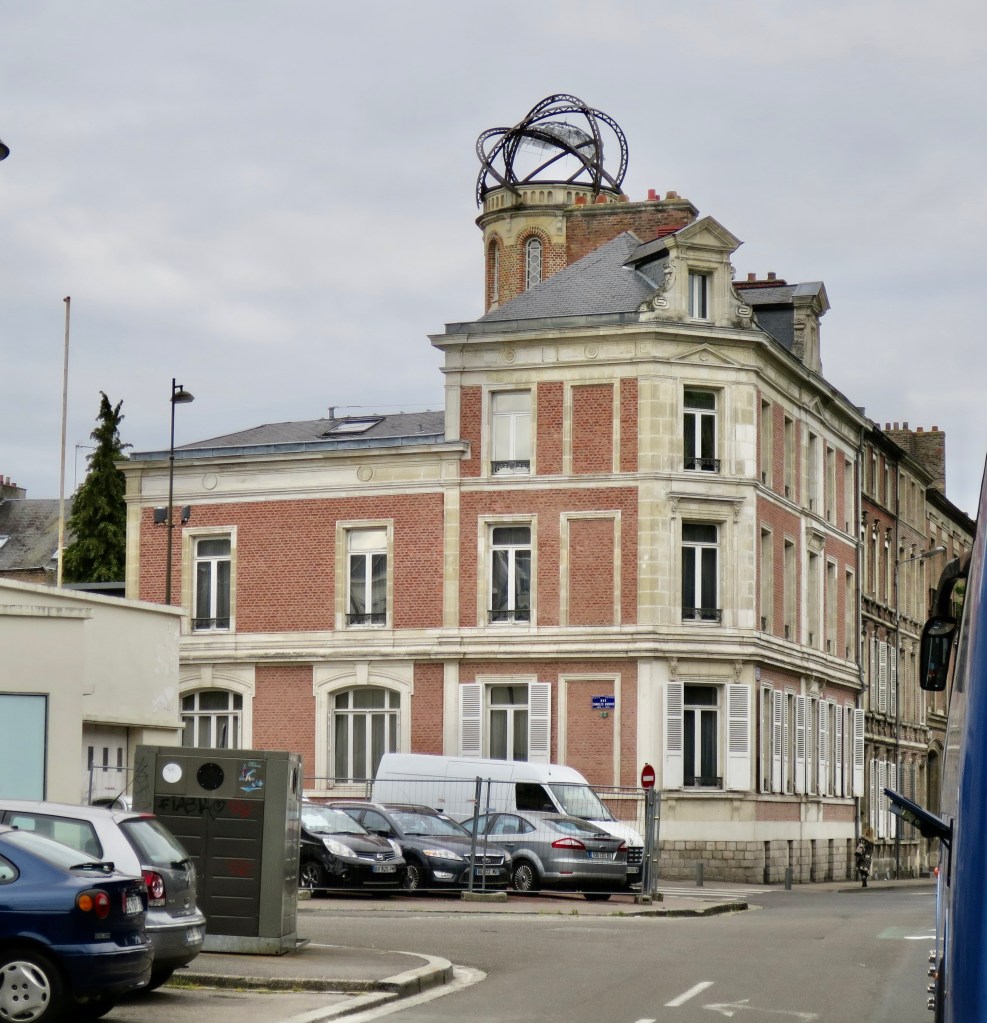
I pass Jules Verne’s house, which is now a museum. Jules Verne lived here from 1871, and he wrote most of his vast output here. An attempt, according to his publisher “to outline all the geographical, geological, physical, and astronomical knowledge amassed by modern science, and to recount, in an entertaining and picturesque format the history of the universe.” (What my education was aimed at. Without the entertainment.) For long he was seen by the literary establishment as a writer of pot-boiling romances. Now he is included in the literary canon.
To the extent that, for example, his influence has been traced in Rimbaud’s Drunken Boat.
Reminding me that, as the sixteen-year-old was writing that most incendiary of poems, the great poet of rebellion and altered states was also a romantic adolescent, reading adventure stories, dreaming of expeditions. (Expeditions he undertook in Africa in the second half of his life, after he’d given up poetry.)
Although it took Roland Barthes to point out the essential difference between their boats: Verne’s Nautilus is an enclosed world of objective observation. Whereas Rimbaud’s Bateau ivre is “the boat which says “I” and, freed from its concavity, can make man proceed from a psychoanalysis of the cave to a genuine poetics of exploration.” From the world of objective observation, to a genuine poetics of exploration. A journey I have tried to take …
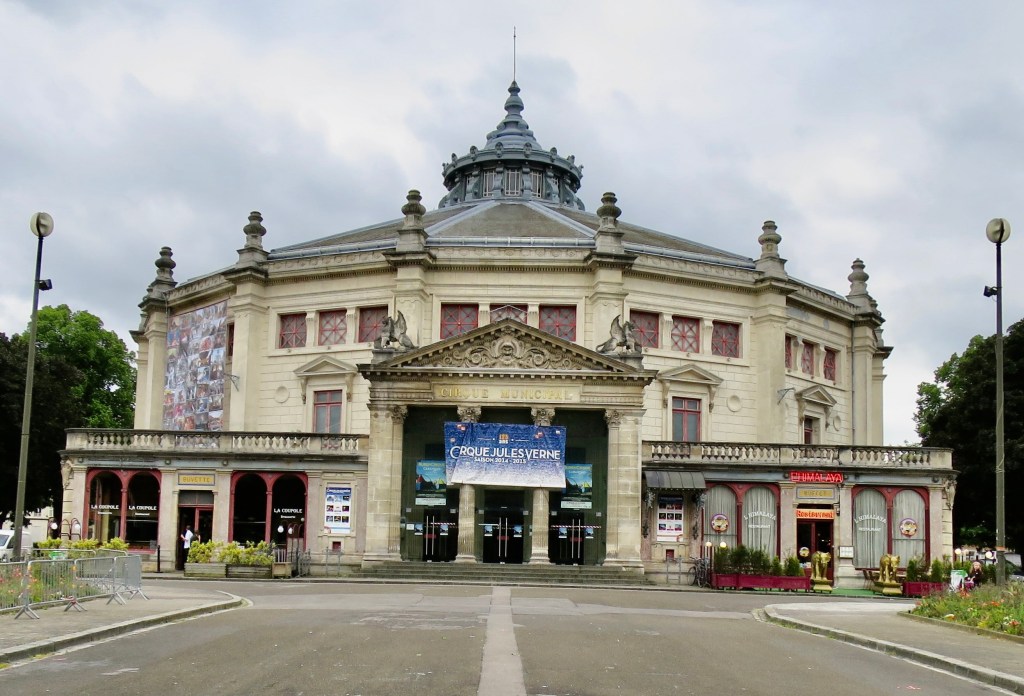
Close by is the circular Cirque Jules Verne. It is one of only two permanent circus buildings in France. It has nothing to do with the Verne; the intention is to add the aura of his name to what is one of those specialist-shaped, nineteenth-century buildings that no longer has a function.
There is a sign to the Unicorn stadium. And there are two unicorns on the town’s crest. I can’t stop myself looking for the mystical and esoteric on this most prosaic of journeys.
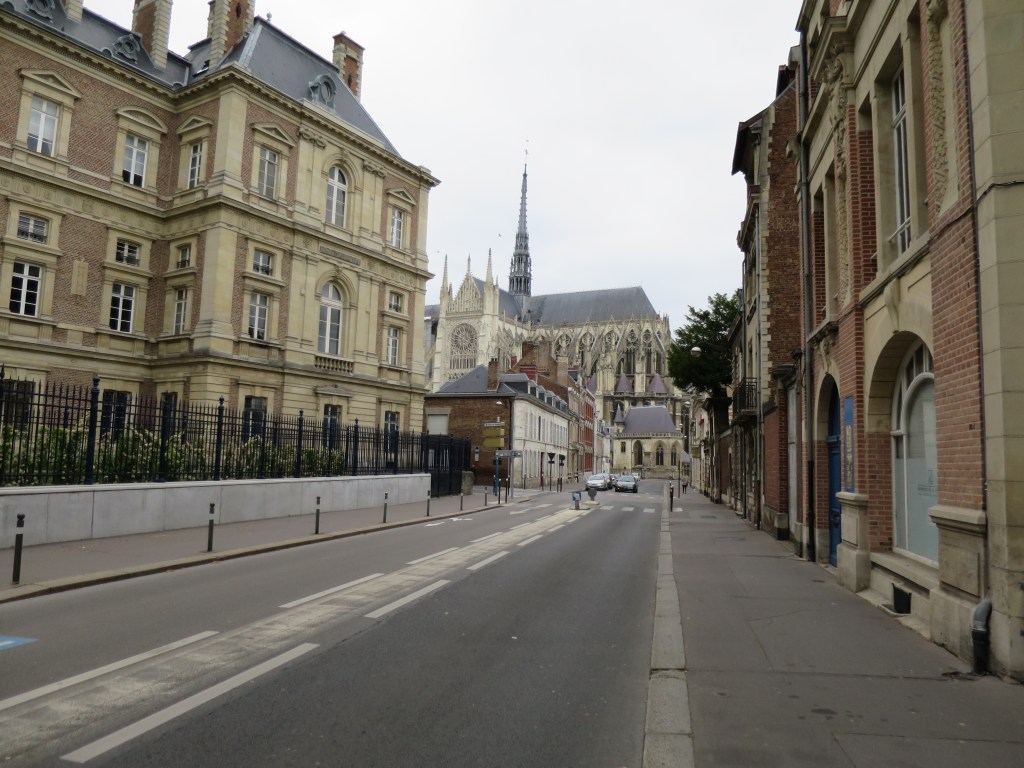
From a distance the cathedral looks like an enormous grey aircraft carrier docked in the middle of the city, its flêche a communications antenna. Closer, I expect to find it crowded in and trapped by small, mean buildings (as Rilke’s “ancient houses sit like fairground booths” around Chartres). A Gulliver in Lilliput. What I find are decent buildings set back at a respectful distance. (The old buildings were bombed away in the war.) And a building that in spite of being almost absurdly out of scale, fits.
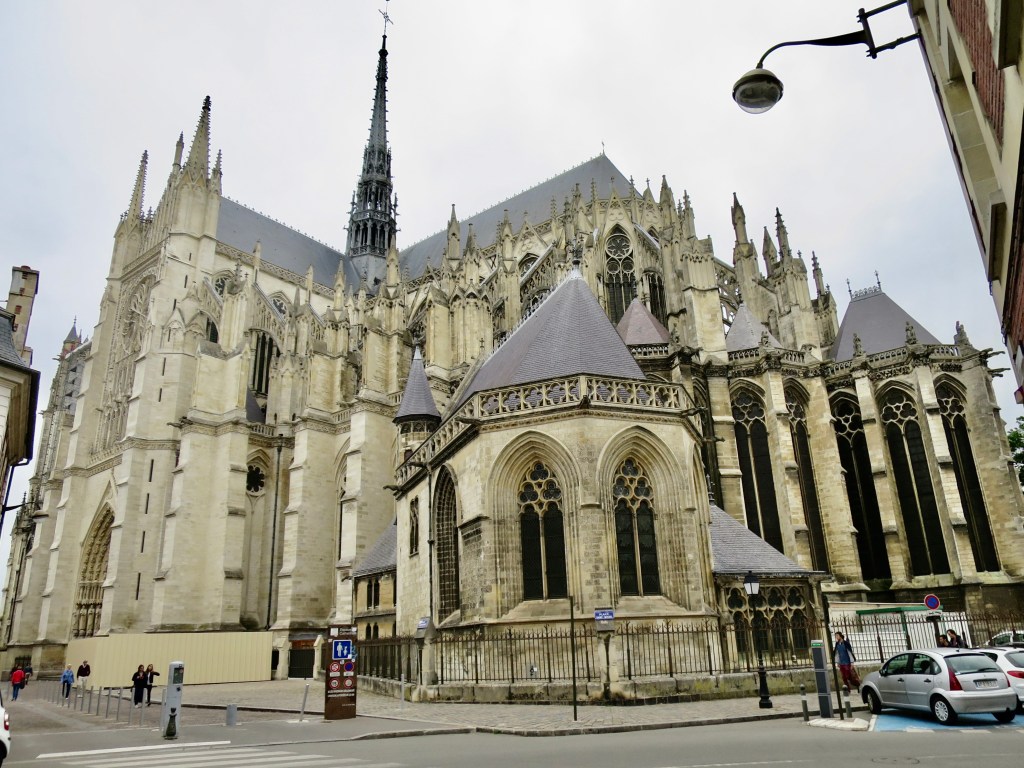
It belongs. It is like a giant and friendly elephant. Barthes called the great Gothic cathedrals, “the supreme creation of an era, conceived with passion by unknown artists, and consumed in image if not in usage by a whole population which appropriates them as a purely magical object” (in a passage likening them to the 1950s automobile). I find myself circling around it, this giant building, trying to get to know it.
Which of course reminds me of the blind men and the elephant, each touching a different part.
But ‘know’ is the wrong word. I am trying to experience something that is, at first overwhelming. Both in whole, and in part. There is the size, yes. But also, the complexity. And the detail.
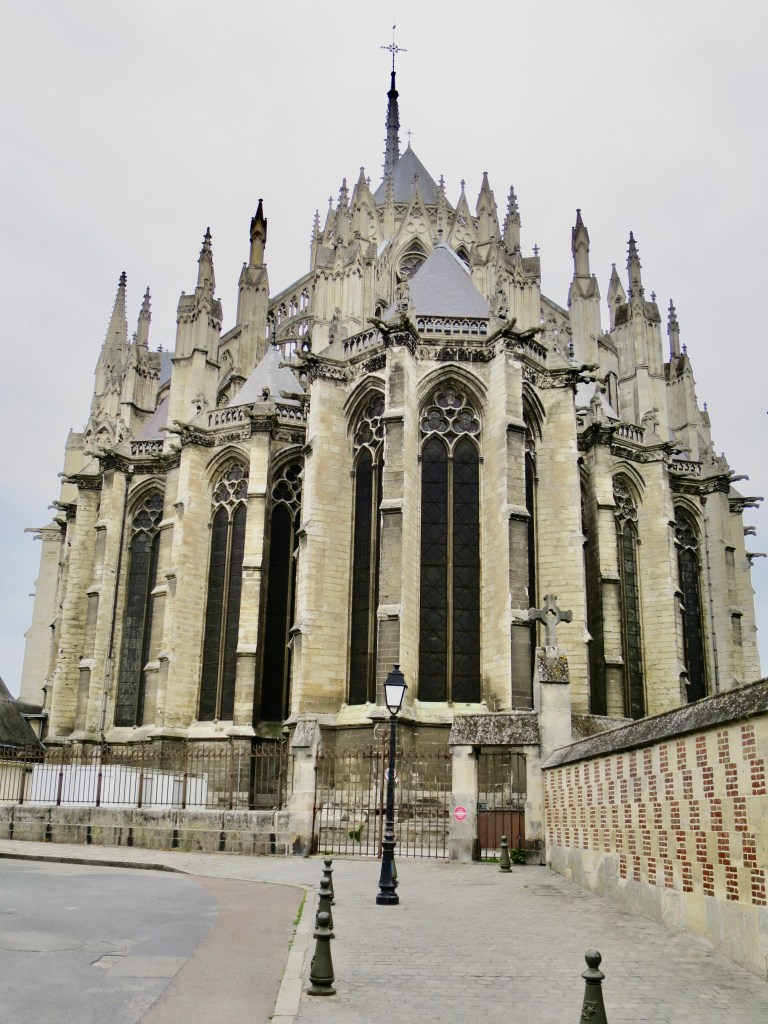
I am especially excited by the East end, the chancel and the chapels and the flying buttresses and the tall expanses of glass, all innovations of the Gothic. Radiant chapels, flying buttress upon flying buttress, water-spout gargoyles stretching far out like dragons about to fly. And all soaringly high, an ever-changing interlaced intricacy as I move around, that is stimulating, arousing.
And not just visually. I’m aroused too by the technical bravura, sharing the thrill of those builders-for-God trying something, new thing after new thing, that had never been tried before, the triumph of the new, when it came off. And more thrilling because sometimes it didn’t come off. And each new thing having a meaning, a purpose, a place in the belief of the faith. I love this radiation of chapels and buttresses and water-spouts – for do they not represent in experience both the radiance of the word from the head of Christ, the nimbus, and, through the great, new expanses of glass (“not windows, openings pierced in the dark shell, but large spaces of empty air,” writes Barthes), the entry of light, of the worldly as well as the heavenly light, entering the sacred space, and the hearts of those within?
I find myself writing, now, as if I believe. It has that power, if not to feel what they felt, but to imagine feeling what they felt. I can, here, believe; this formidable and yet light presence, its aliveness and vividness and energetic beauty, enable me to experience as if.
I roam restlessly around the outside, along the long nave walls, past the stretched arms of the transept, around the radiant nimbus of chancel and chapels.
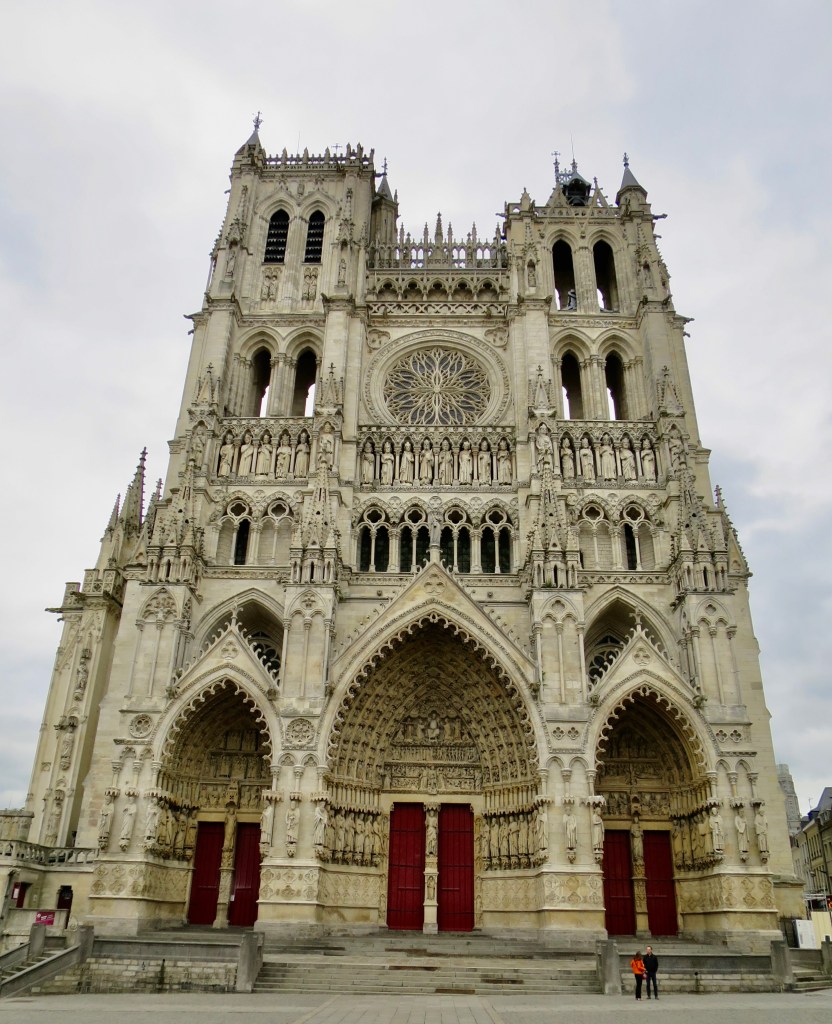
At last, after all the movement, I arrive at the great, static set-piece of the two-towered, three-doored West front. Static, until, as I look, it begins to move, unfold, and my eye follows the narrative of its story. It was once vividly painted, and the colours are projected on, in summer nights. But I am two weeks too early.
I leave, without looking back, letting it soak into my memory.
Back at the hostel, I realise I haven’t thought about food. I can find nowhere open near the hostel. Then I remember the enormous cheese burger, of astonishing construction, and the heap of chips, that I ate only half of last night in the square at St-Omer (drinking ch’ti beer, as I promised Dave I would. I sent him a photograph). I brought them with me, ‘just in case’.
I go to the kitchen, put them in the microwave, peer at instructions, push buttons. Nothing happens. What to do? The girl who is sitting silently in the dining room watching a TV sketch show enters silently, presses buttons, the machine hums, the plate turns, I thank her, she smiles and silently returns to her TV programme. Sitting close to her, tethered close to her by the short cable from his computer to the power point, is a thin young man with a wispy beard. They are entangled. But they don’t acknowledge each other. They are held together, waiting, in thrall.
I eat well. And I am suddenly very tired.
Day 4: Amiens to Amiens, 29 miles.
‘Roses of Picardy’. A Great War cemetery. Amiens cathedral with Ruskin. The head of John the Baptist. ‘The Venice of France’. Hortillonnages. Passerelles. Robinsonner and psychogeography. La Méridienne verte crosses the Somme. The enchanted couple, continued.
Breakfast, from a well-stocked and limitless buffet, is excellent. This is a really well-run hostel.
As I sit with my maps, working out my day, a group of English schoolboys, tumbling over each other like puppies, fill their trays with bizarre miscellanies, go through that chaos of finding their places that so quickly resolves into coteries and solitudes, consume various items from their miscellanies including swaps, clear their trays, and are gone, all this in fifteen minutes, leaving in a flurry of adolescent energy. It is the energy that, grown up a few years, was burned up, consumed on the battlefields of the Western Front, and drained from their countries.
In my thoughts, because today I am to visit those battlefields.
In the optimism of planning on small-scale maps, I had imagined myself cycling out to the Menin Gate, maybe the Canadian trenches at Ypres, and being back by lunchtime to ‘do’ Amiens cathedral and town in the afternoon. Impossibly ambitious. I decide to cycle out to the last front line of the war, and the nearest ‘Brit’ cemetery marked on the map.
As I cycle east, carried on a stiff breeze on this clear and sunny day across rolling country and through lark-filled air, I ponder Picardy. Why such romance in a word?
Is it simply from the memory of a song, ‘Roses of Picardy’? It is one of those sentimental parlour ballads, favoured by high tenors in starched dickeys, that encompass in two verses a life story. The verses unfold to a tricky tune: “She is standing by the poplars, Colinette with the sea-blue eyes. She is watching and longing and waiting, where the white roadway lies. And the song stirs in the silence, as the wind in the boughs above. She listens, and starts, and trembles – ’tis the first little song of love.” The second verse continues, “And the years fly on forever, till the shadows veil the skies. But he loves to hold her little hands, and look in her sea-blue eyes. And she sees the road by the poplars, where they met in the bygone years. For the first little song of roses, is the last little song she hears.”
The chorus could easily be, “Just a song at twilight …”, written thirty years earlier. But we surge into, “Roses are shining in Picardy, in the hush of the silver dew. Roses are flowering in Picardy, …” This is the Picardy of sentimental Victorian genre paintings, cheap emotion.
But now, as I head across country that was still described by Ormsby in 1931 as “slowly recovering from the terrible ploughing and harrowing worked by the shells in 1916-18. Its mangled villages and sub-soil will, in some places, never be brought back to use and habitation,” different voices take up the chorus. We cut from the tenor in a parlour or on a music-hall stage to men marching, the relentless 4:4 tramp of soldiers, men in greatcoats, singing in raucous, variously-accented voices, “but there’s never a rose like you!” They continue, with the bravado of men together, “And the roses will die in the summertime, and our roads may be far apart. But there’s one rose that dies not in Picardy! It’s the rose that I keep in my heart.” The bravado of men together. But what thoughts each has, alone, terrified, scratching reassuring pencil messages home, each to his Colinette, the poplars and white roads changed in his head to familiar gas lights and cobbles, and the girl or wife, who he’s never had to imagine before, never having left the street, is now transformed, has become a precious memory of every tenderness that has gone from his world.
The words were written in 1916, by a sixty-eight-year-old. It became a sheet-music best-seller, earning half a million pounds at today’s prices. Men sang it marching to the killing grounds of the Somme. As Amanda says in Private Lives, “extraordinary how potent cheap music is.”
I’m soon at Villers-Bretonneux. This was the furthest point west reached by the final German attack in 1918. It was here they were held by British, American and Australian troops, and from here, three months later, in the Battle of Amiens, they were pushed relentlessly back, along the dead-straight Roman road along the ridge, until the Armistice.
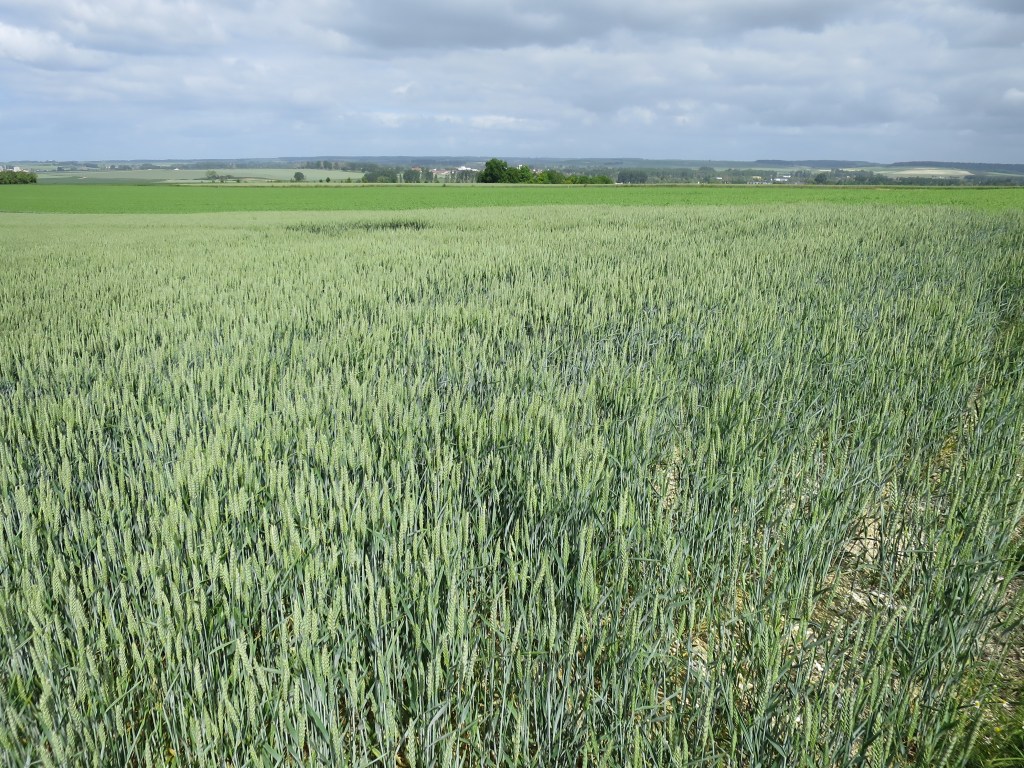
I stop at the cemetery. The sun is bright, dazzling. A strong wind blows across the open, rolling fields, making flowing patterns on the huge panels of different greens, of barley, of wheat, blowing the air clean, intensifying the clamour of the larks all around. A kestrel hangs, slips away, hangs, swoops down.
This is the official Australian war memorial. I hadn’t known. It’s a curious coincidence, that this is the one cemetery I am visiting. In Sydney last year I found the war memorial deeply affecting. Partly because it is such a fine building, that touchingly brings to the fore the lives and loss. Mainly because my father served with the Australians in World War II, got on well with them, and planned for us to emigrate there after the war. His diagnosis of TB put an end to that. And now my son is living in Australia. And, 12,000 miles away, they are expecting their first child.
I walk through the lines of white gravestones. This man was 46 years old. This man (boy?) was nineteen. Here is an engineer. There a member of the Australian Cycle Corps. I guess it’s inevitable that one begins to imagine lives, their lived pasts, their unlived futures, their families. 416,809 Australians enlisted, which is 39% of 18 to 44-year-olds. 61,514 died, 155,133 were wounded. A fifty percent casualty rate. 20% of Australia’s adult male population were casualties in the Great War, 12,000 miles from home.
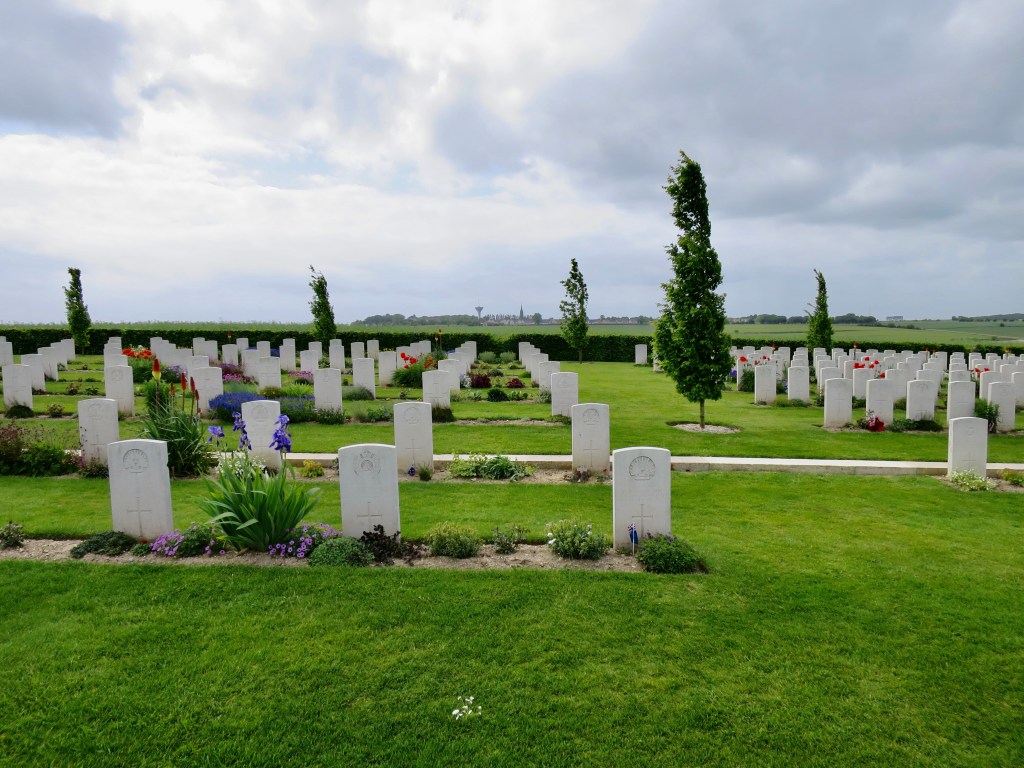
Looking up, I see the parallel lines of the 2,000 graves stretching away. I imagine this cemetery a thousand times bigger, to represent the Allied dead. I double that, to include the German dead. White gravestones as far as the eye can see over the rolling countryside.
It is a place, this open, wind-filled hilltop, for expanding speculations. And for the handwritten commonplaces (what else could one write?) of the memorial register: ‘Never Forgotten.’ ‘Rest in Peace. Thank you.’ ‘Our grandfather is here.’
I cycle back through Villers-Bretonneux (twinned with Robinvale in Victoria, Australia), on the Roman road (almost certainly the appropriation of a Celtic highway) along the chalk ridge that stretches east behind me, arrow straight, forty miles to St Quentin, where the front was from 1915 to 1918. I pick up food, return the hostel, lunch, snooze, and head into Amiens.
Ever since I read The Bible of Amiens, Ruskin has been my guide, especially to the cathedral.
What to make of John Ruskin? Remembered more these days for his sexual problems and his late madness, but in his day the leading art critic, social commentator, and passionate advocate for the working man’s right to beauty and a civilised life, his books on the meagre shelves of the humblest homes.
Charged with realism, for his belief in exact description; with intellectualism, for his high ideas; with aestheticism, for his passion for beauty. But his was a belief in looking, seeing, experiencing, thinking about. For “the configuration of an object is not merely the image of its nature, it is the expression of its destiny, and the outline of its history.” It is worthwhile bringing this to the consideration of any object.
And this summing up, by Marcel Proust: “Ruskin is one of those men who, like Carlyle, are warned by their genius of the vanity of pleasure and, at the same time, of the presence near them of an eternal reality, intuitively perceived by inspiration. Talent is given to them as a power to relate this reality to the all-powerful and eternal to which, with enthusiasm and as if obeying a command to conscience, they dedicate their ephemeral life in order to give it some value.” And, “as a sort of scribe writing, at nature’s dictation, a more or less important part of its secret, the artist’s first duty is to add nothing of his own to this divine message.” After pausing to consider this, I am ready to enter Amiens cathedral, with Ruskin as my guide.
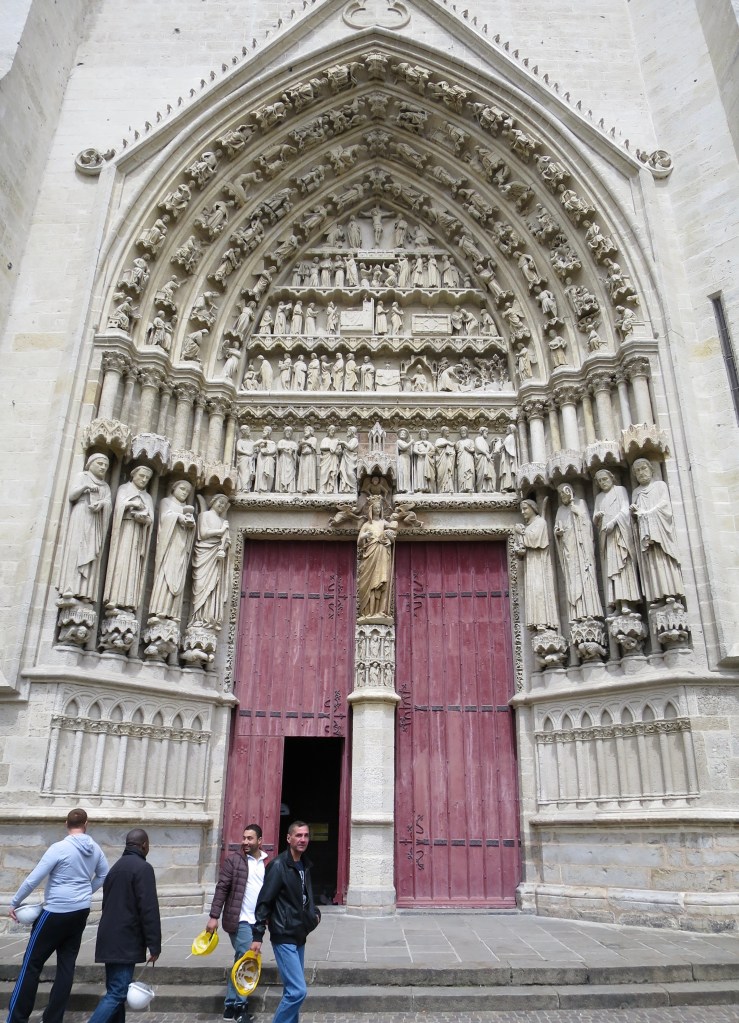
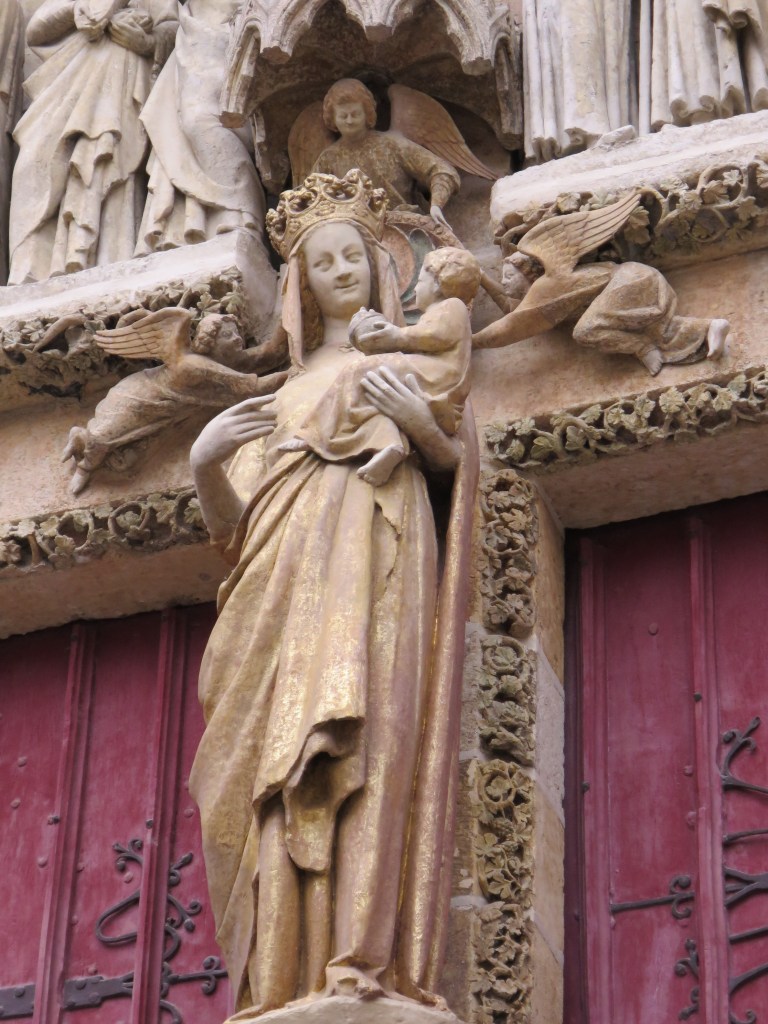
Enter, says Ruskin, not by the West door, for the effect of all great cathedrals is similar from this dramatic entrance. Enter Amiens, rather, from the Street of Three Pebbles, through the South porch, beneath “the pretty French Madonna, with her head a little aside, and her nimbus switched a little aside, too, like a becoming bonnet.” (A copy, now. Her original is inside. And she wears a crown rather than a nimbus.) “And put a sou into every beggar’s box who asks it there – it is none of your business whether they should be there or not, nor whether they deserve to have the sou – be sure only that you yourself deserve to have it to give; and give it prettily, and not as if it burnt your fingers.” I do this, and enter.
Enter at the cross-centre, the apse, “for it is not possible for imagination and mathematics together, to do anything nobler or stronger than that procession of window, with material of glass and stone – nor anything which shall look loftier, with so temperate and prudent measure of actual loftiness.”
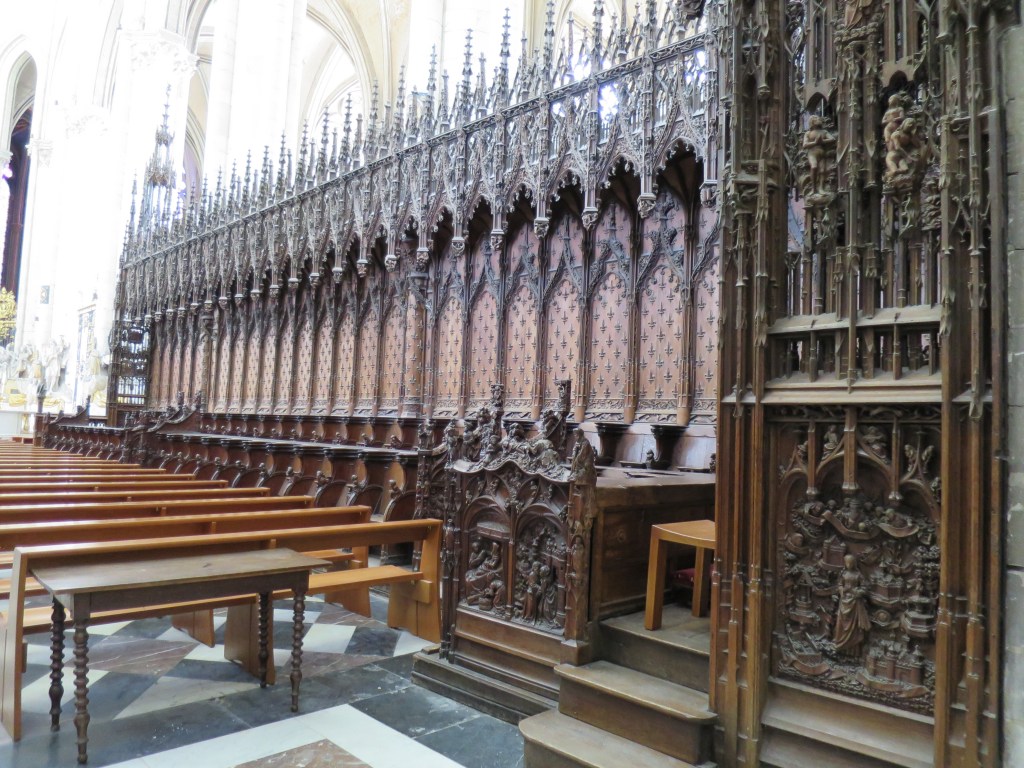
Attend especially to the fifteenth-century wood carvings of the choir, “Flemish stolidity mixed with the playing French fire of it … under the carver’s hand it seems to cut like clay, to fold like silk, to grow like living branches, to leap like living flame. Canopy crowning canopy, pinnacle piercing pinnacle – it shoots and wreathes itself into an enchanted glade, inextricable, imperishable, fuller of leafage than any forest, and fuller of story than any book.” Full of images and symbols, working at different scales. Except that, as Ruskin says, “in old Christian architecture, every part is literal: the cathedral is for its builders the House of God.” I’ll come back to this when Proust rejoins the conversation.
Beginning – never clearer than here – with the plan of the cathedral, that represents the form of Christ. The nave is the body, with feet at the West end. The transepts are arms. At the crossing is the heart. The chancel, the most sacred space, with the divine presence in the enclosed choir, is the head. And around that head, separated from it but related to it, radiate the chapels to the saints, the most easterly the Lady chapel dedicated to the Virgin, forming the nimbus or halo.
I follow Ruskin around the outside of the chancel curtain, along the ambulatory, past the radiant chapels, each with its slender walls and vast expanses of coloured glass, made possible by the pointed arches, the ribbed vaults, the flying buttress upon flying buttress that I had so admired outside.
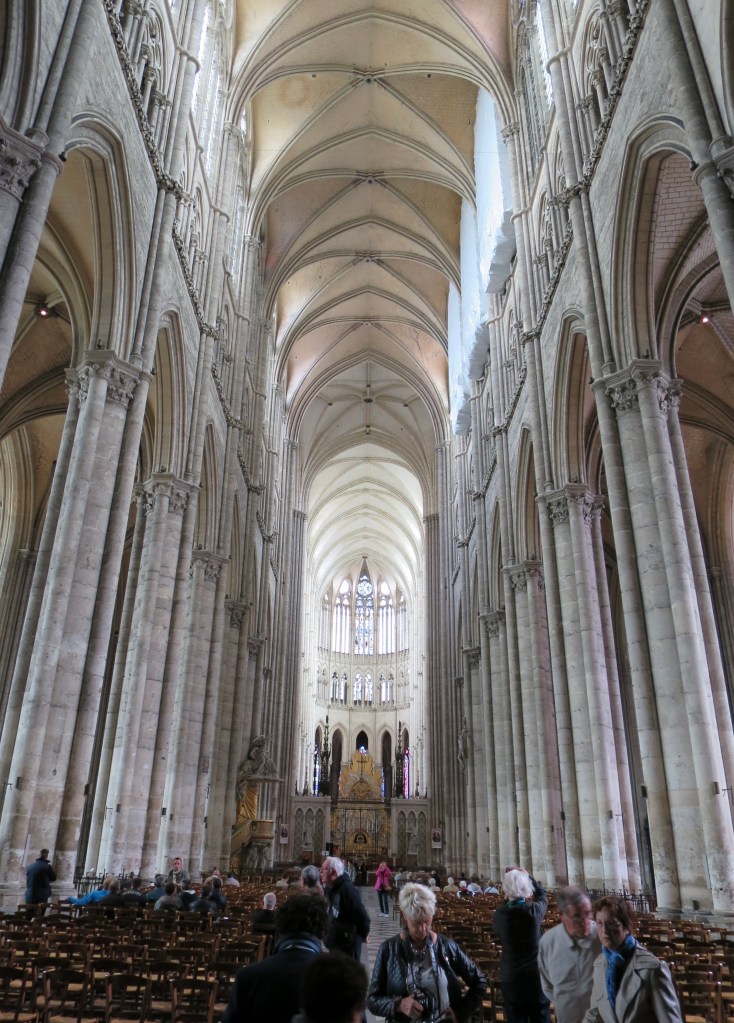
And then, to the nave. I walk the length of it, without looking up, to the West door, before I turn. It is high. 132 French feet high specifies Ruskin, 42.3m the modern measure. Which is 144 cubits, the height of the walls of the New Jerusalem in the Book of Revelation. It looks higher, is made higher-seeming, to an eye used to English cathedrals, by its narrowness, a mere third of the height. It is breathtaking. And, after the vitality and exuberance and illumination of choir and chapels, curiously austere, a simplicity of line that carries the eye up, emphasising one’s smallness. Then leads the eye forward, along the nave that is now the stem of a flower, to the apse that is a bloom of light.
This is the largest French Gothic building by volume, and exceeded in height only by ill-fated Beauvais.
It was built between 1220 and 1266, under Louis IX, to house the head of John the Baptist. This had been looted from Constantinople in 1204 in the Fourth Crusade. (Constantinople of course was a Christian city.) I think of the Celtic ‘Cult of the Severed Head’.
For Ruskin, Amiens was “not only the best, but the very first thing done perfectly in its manner by northern Christendom.” For Viollet-le-Duc simply “The Parthenon of Gothic architecture.”
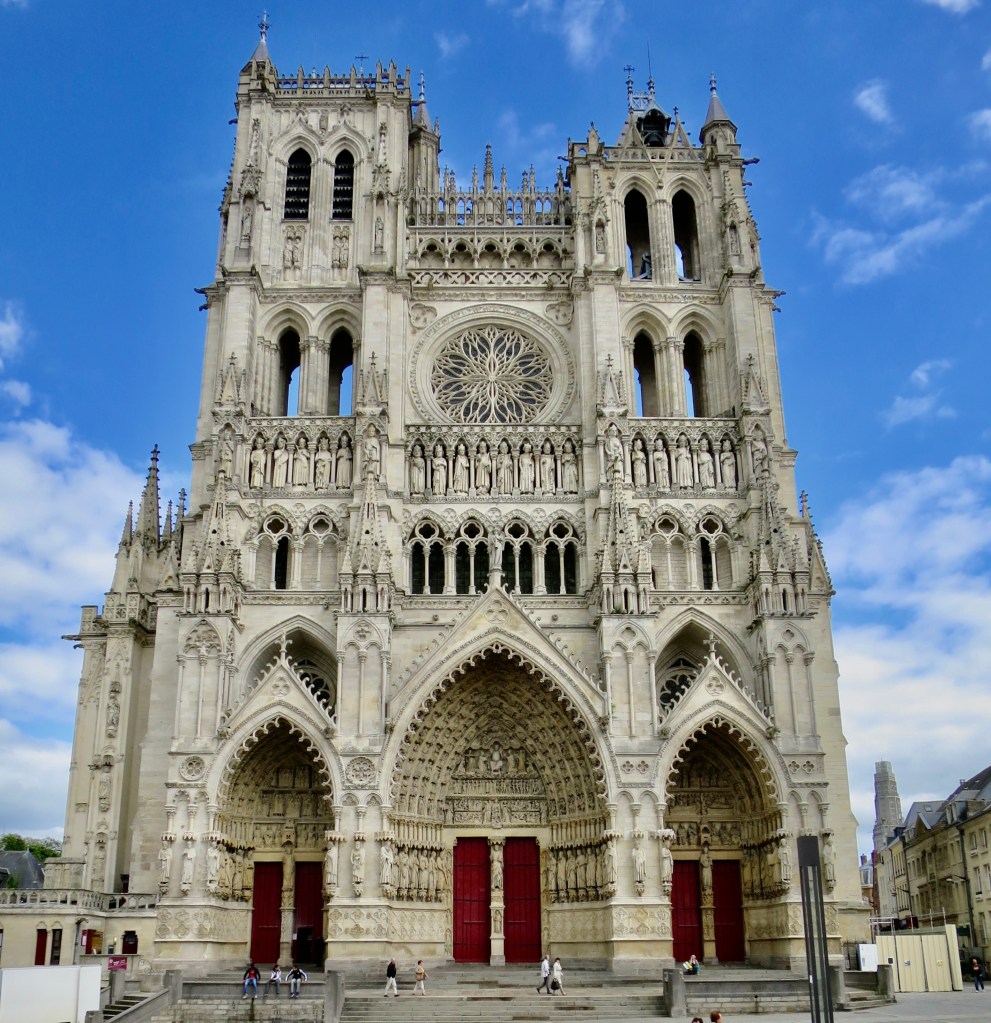
But what is it for me? I realise that I have been experiencing it through Ruskin’s text. And Ruskin was a devout, if idiosyncratic Christian. Out through the West door, I walk away, then turn to see the great West front. Three-doored and twin-towered, with detail upon detail piled up, like a giant organ; or, rather, the music of a great organ. Architecture as frozen music. This is Ruskin’s Bible of Amiens, and he devotes many pages to describing and explaining the meaning and the message, of each detail, at every scale, calling it “the simplest, completest and most authoritative lesson in Christianity.”
There are three figures of Christ. But none is of Christ crucified. For “The voice of the entire building is that which came from heaven at the moment of the Transfiguration: This is my beloved son, listen to him.”
Ruskin was one who could still believe in this message of Christianity. Which Proust, writing a few years later, resists. He describes the cathedral as “a book written in a solemn language in which each character is a work of art that nobody can understand anymore.” For him, and I guess for me, “There is no Logos; there are only hieroglyphs.”
Hieroglyphs. I re-enter. Stephen Murray writes this: “The power of the cathedral to liquefy the most hardened visitor is palpable on the astonished faces of those who enter the light-filled nave with its soaring spaces and repetitive forms,” its aim: to soften the surface of the soul – what an expression! – a means to an end. “That end nothing less than the stamping or imprinting upon the softened surface of the soul a series of powerfully interacting images that pertain to the idea of redemption through the Church. And the central image is that of Christ himself, stamped upon the soul at the point of entrance through the Beau Dieu.” Outside, it soars with the rich story-telling and evocation of the West front, and the virtuosic variety of the structural elements of the East end. Inside, its power comes from the grandeur of height, the simplicity of scale – or rather of size, the simple reaching up.

I marvel at the quality of the woodwork in the chancel, at the same time as, peering at it through a metal grill, I’m irritated at my exclusion from it.
I admire the tombs of the bishops, bronze, “cast at one flow – and with insuperable, in some respects inimitable, skill in the caster’s art,” still, centuries later, liquid looking.
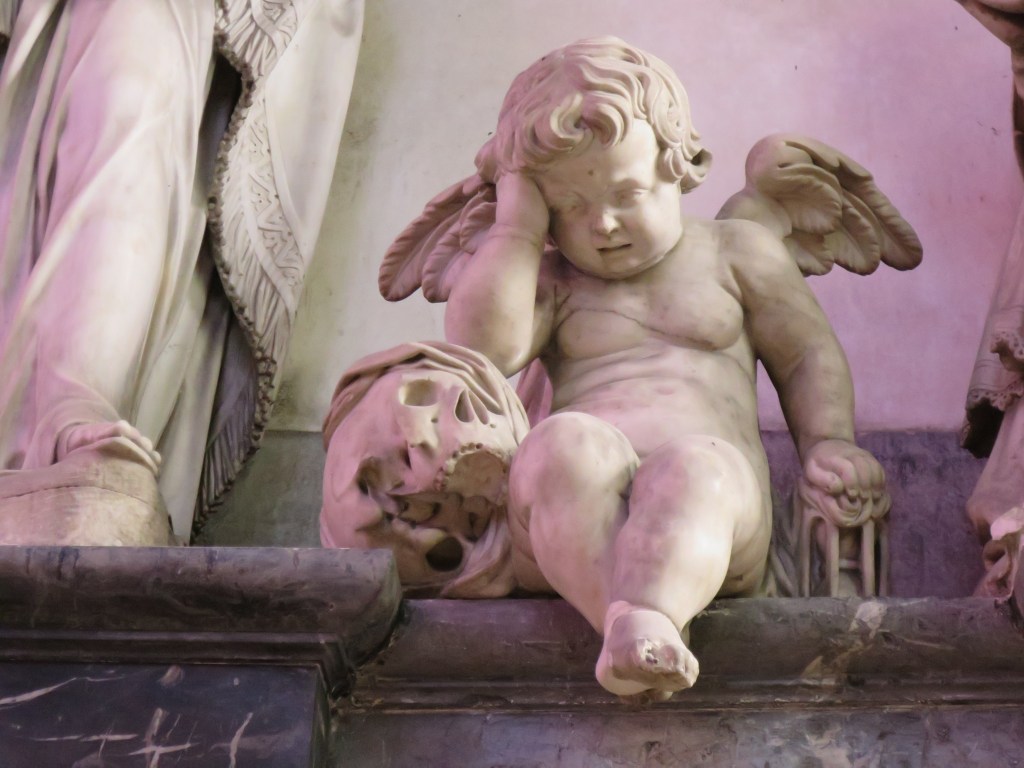
I find ‘the weeping angel’. Amiens was occupied by the Germans for a month in 1914, but thereafter it was in Allied hands, an important logistical hub. Many soldiers passed through, many sought solace in here. The ‘weeping angel’ is an emblem of that time, a sentimental seventeenth-century carving on a tomb behind the high altar that featured on thousands of postcards sent home. It returns me, with its sentimentality, to ‘Roses of Picardy’, reminds me that at times of emotional woundedness it is the sentimental, even the kitsch, that speaks directly to us; all we can bear, with its softness, when there is no skin over the wound.
Where the head of John the Baptist should be, in the North aisle there is an icon, and this note: “the reliquary cannot be exposed in the winter months [it’s June! Where is it?] because of humidity. You are invited to collect your thoughts and venerate this icon, gift of our brother Russian Orthodox Christians.” The first cause of the cathedral is now hidden away.
And by a chapel is this notice: ‘Confessions, Saturday 15:00 to 17:00 hours’. The whole population of Amiens, confessed in two hours? What a change, this downplaying of two elements so fundamental to the power of the medieval church: the relic, to be visited, and venerated, to touch and to be cured by – and of course to donate to, an important source of revenue; and confession, the church’s spy in people’s hearts, one of its primary instruments of control.
The cathedral has been, since the Revolution, owned by the state; the church is its tenant.
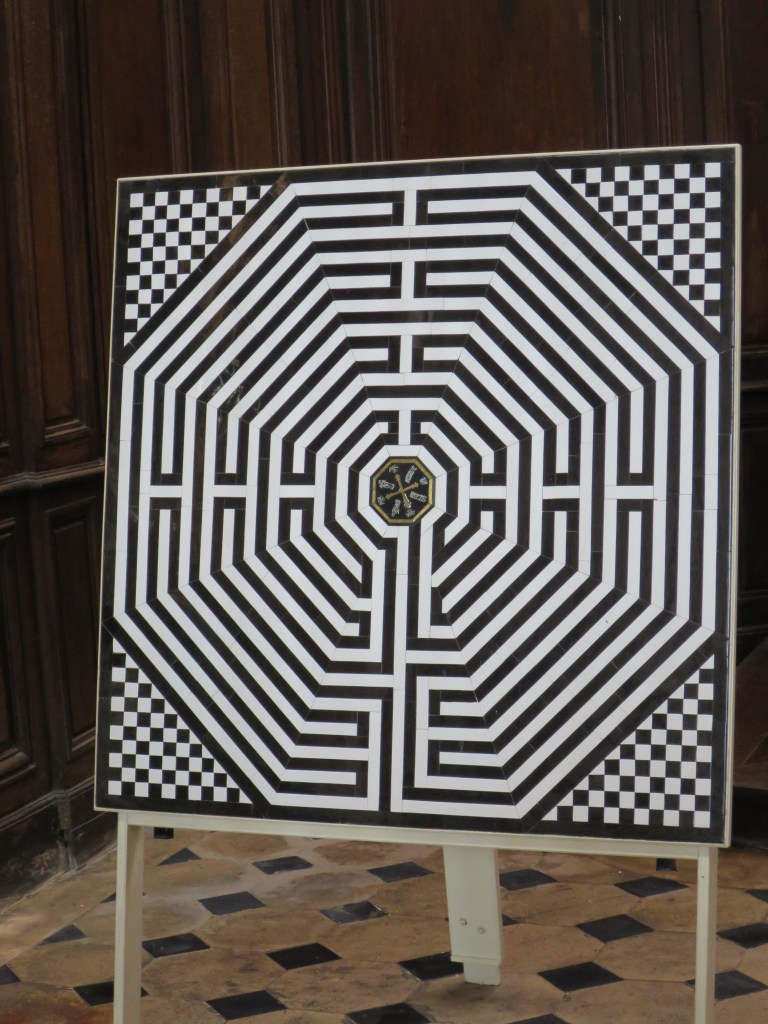
I arrive at the Cretan labyrinth, laid out on the nave floor.
I note that little boys rush round it, or cheat by stepping off the path, or become suddenly self-conscious and break off. While little girls proceed through it with knitted determination, walking quickly but accurately, their set expressions opening like brilliant flowers when they reach the centre.
The labyrinth. At the centre of my novel set in Greece is the labyrinth as the path to self-discovery.
And after the legendary and mysterious unicorn of last night, perhaps it is today’s metaphor for my journey along the Meridian, my forever-meandering journey along a non-existent line. And today’s question about my journey across France is this: is it a unicursal labyrinth, which, however complex has but one path, that leads inevitably to the goal; or is it a multicursal maze, designed to confuse and puzzle, but having many paths through to the goal, and which makes possible choice, serendipity, surprise? Which brings me back to Hermes, who both guides and leads astray.
As I leave, I look back, and remember Dostoevsky’s Grand Inquisitor: “So we have before us a mystery which we cannot comprehend. And precisely because it is a mystery we have had the right to preach it, to teach the people that what matters is neither freedom nor love, but the riddle, the secret, the mystery to which we have to bow – without reflection and even against our conscience.”
Amiens cathedral, “The very first thing done perfectly in its manner.”
But not, alas built perfectly. How often the Gothic builders overreached themselves, with buildings that fell down, or were too big ever to finish! At Amiens the flying buttresses were placed too high, and supplementary buttresses had to be added, twice. And the lower wall had to be stabilised by an iron chain, wrapped round the body of the cathedral red hot so it contracted as it cooled. An unsettling image.
And a hundred or so years after Ruskin was writing his ‘Bible’, and unimagined by him, during the cleaning of the West front, its original rich painting was rediscovered. Research has enabled the colours to be established, and to be projected accurately onto the façade in a son et lumière. Is this an enriching of the experience, being able to time-travel back to the façade as it was meant to be seen? Or is it a spectacle packaged for consumer consumption? I’m two weeks too early to find out.
The town of Amiens was important to Ruskin because of its place in French history.
Around 300, Firmin made the first Christian converts here. He was martyred here, and the first Christian church was built here, “the first germ of cathedral for the French nation”.
In 445, at the limit of their first advance south into Gaul, the Franks made Amiens their capital.
In 481 Clovis became king of the Franks, the first Merovingian.
Five years later he defeated the Gallo-Roman forces at Soissons, east of Compiègne, and extended his realm to the Loire.
In 491 he was baptised a Christian, adopted the Nicene creed, and establishing a unified Christianity across his realm. Later he conquered the rest of what is modern France.
And most agree with de Gaulle and “reckon the beginning of France from the accession of a Christian king who bore the name of the Franks”. The name Clovis became Louis.
Ruskin likes the Franks. He admires their Frankness, a word, he says, we should learn from them. They are for him the heart of France, and the heart of the Gothic.
And, returning to language, the distinctive elements in the Picard language are exactly the Frankish elements
But thinking back to the Frankish origin of the French state, I think back further, to the Celtic capital of Samarobriva, and the Celtic Meridian, the sophisticated culture of Gaul that Robb explores in The Ancient Paths, that was overwhelmed first by the Romans, and then the Franks. And I ponder the pagan culture that underlies ‘the state’, in its various forms through the centuries.
‘Pagan’ is from ‘pagus’, which becomes pays, a place inhabited by paysans, people of the land. And it is the paysans who, through two millennia of Christianity, and two centuries of Rationalism, have maintained a connection with a way of being that is both otherworldly, and deeply rooted in the earth. It was why we came to France to live on the land forty years ago: to live like peasants, to make that connection. Whereas in Britain the Celts were forced out to the fringes, in France, they were overlaid by incomers.
Overlaid, but never rooted out. Recalled of course in Asterix, and the French celebration of Vercingetorix. And in our use of ‘Gallic’ to describe something ungraspably but quintessentially ‘French’, a moustachioed brio. And perhaps it helps to explain both the contradictions that de Tocqueville points up, and the endless fascination of France.
I look across from the cathedral to the citadel. The river flows between. For Amiens is a city “divided”, as Ruskin tells us, “by eleven beautiful trout streams which, branching out of one strong current above the city, and uniting again after they have eddied through its streets are bordered as they flow down to the sands of St Valery by groves of aspen, and glades of poplar, whose grace and gladness seem to spring in every stately avenue instinct with the image of the just man’s life.” A city that, he delights in recording was, in the sixteenth century, called the Venice of France.
Not only because of its wateriness, but because of its manufacturing and trade, when “on fabriquait à cette époque des velours de toutes couleurs pour meubles, des colombettes à grands et petits carreaux, des burailles crois, qu’on expédait en Allemagne – en Espagne, en Turquie, et en Barbary.” Which he delightedly glosses as making, “all-coloured velvets, pearl-iridescent colombettes! (I wonder what they might be?) and sent to vie with the variegated carpets of the Turk, and glow among the arabesque towers of Barbary!”
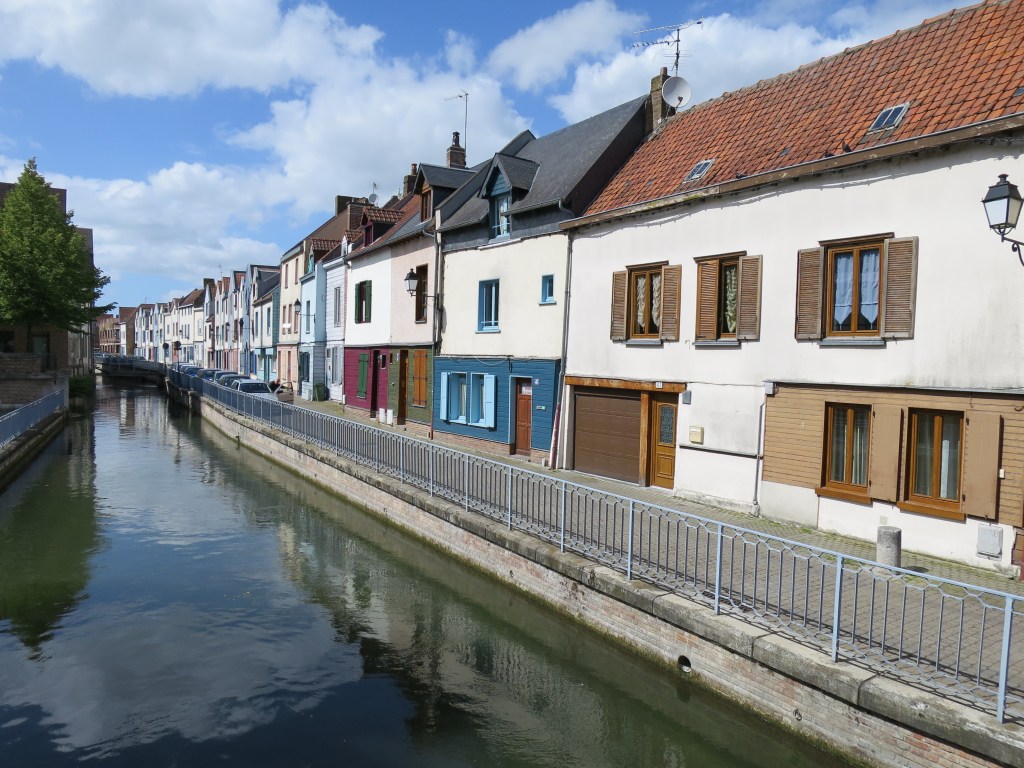
Made, these fabrics, in the workshops of St-Leu, the watery district of the eleven branching streams that provided water and water power (one wonders how many trout there still were in Ruskin’s day) low down between the high seats of authority. As the velvet-making moved out to factories the area declined into slummery, with its trapped population.
Then, as so often happens, at first artists came in, drawn by low rents and their art of enjoying what is, and sensing what might be, then bohemians, and at last the more adventurous of middle-classes. At which point the government mysteriously takes note of the ‘unsanitary’ conditions in which the poor have lived, condemns their buildings and moves them out to housing estates. And then, equally mysteriously, decides that these buildings are worth ‘conserving’, and provides money to improve services, to the point where estate agents and developers can move in and create what is now here, at St-Leu, a neat and smiling simulacrum of what had been, small houses along cobblestone quays by canals, now with added bars, restaurants, and all-important ‘ambiance’. But attractive, nevertheless.
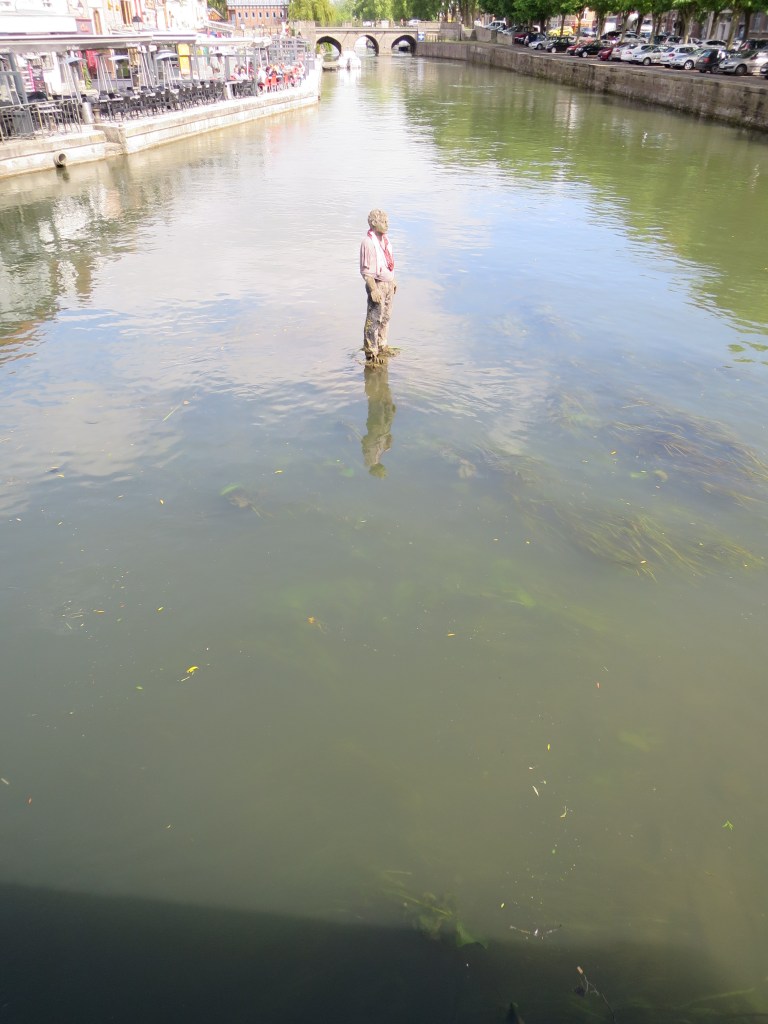
I walk quickly upstream. Past a life-size, life-like statue of a man standing in the middle of the river. He’s staring down. What does he see? What is he about to do? I walk upstream, past the branching streams, to the unitary river.
It is the area of the hortillonnages, low-lying market gardens reclaimed among a network of canals and accessed by punt. ‘Hortillonnage’ is a Picard word, half Latin, half Frank, that came into French in 1870. Although I am interested to see them, my quest is for the Meridian. It crosses the river a mile east of the cathedral.
A century ago this path alongside the river would have been the track of horses and men towing barges.
Now it is a recreation route, and the favoured track of runners and cyclists, lycra-clad, each in their bubble, isolated by earphones and reflecting dark-glasses, tearing through the delicate fabric of the gently flowing river.
But, too, there are couples strolling, and playful families, knitting it up. There is a little girl with a goldfish eyepatch. She is the magical girl who has a fish swimming around in the goldfish-bowl of her eye socket, look, see, isn’t it wonderful?
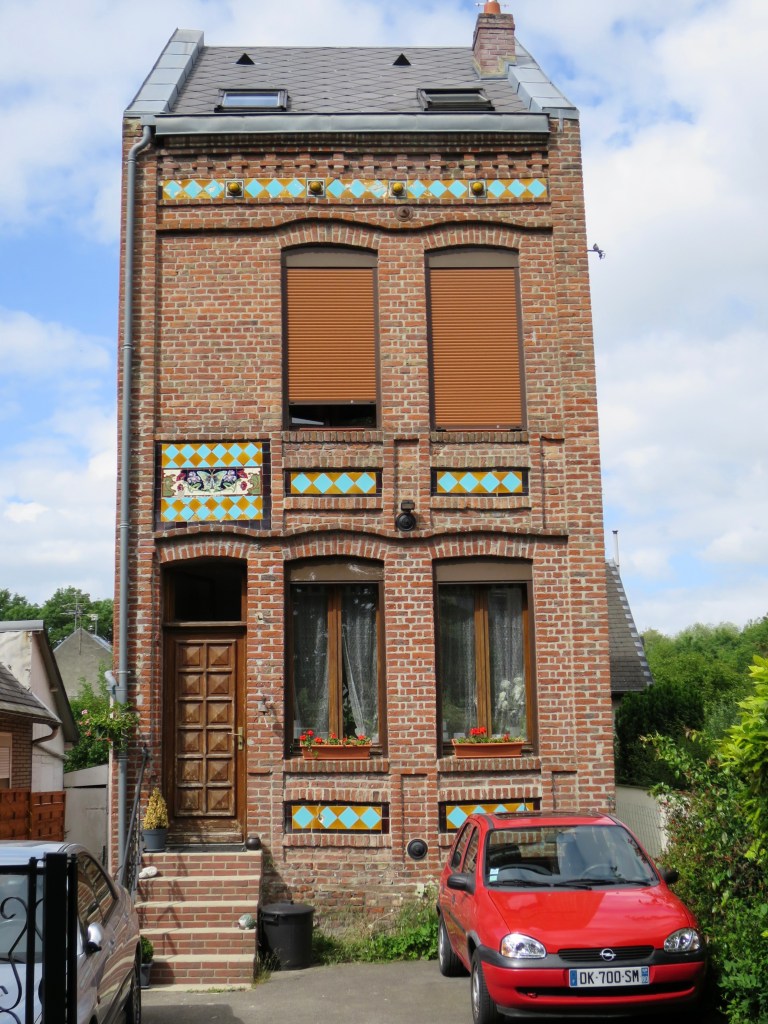
To the right of the towpath is the wide, sun-glittering, slow-flowing river. To the left, a narrow green canal, very still. And over this canal arc, like rainbows, a series of curved pedestrian bridges, les passerelles Each has a gate exactly at its high point. Each gives access to a small plot of land. On each plot is a small house. And every house is different. They are small dream houses, expressions of what is called eccentricity, but is simply individuality. This one is a perfect art and crafts villa, but tiny and stretched upwards. This one is pink clapboard, like a beach hut.
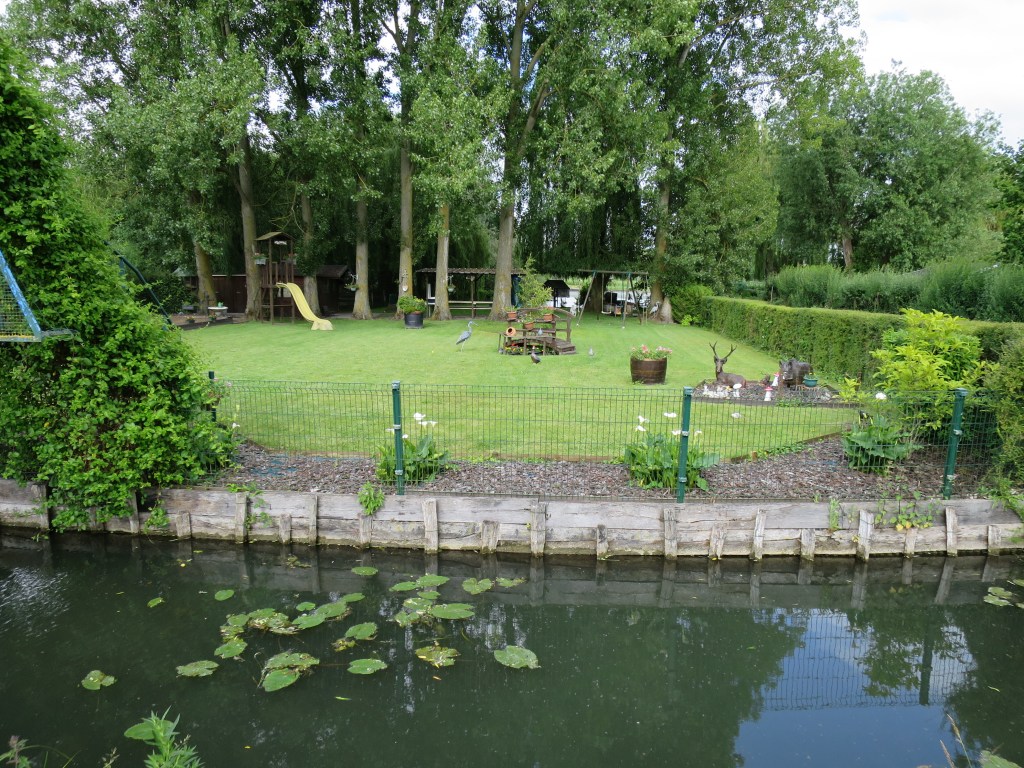
Next to it is a concrete bunker, built to survive the Bomb. Here is one dressed all over with seashells patterned into swags of curtains and baskets of flowers. This one has been built over a canal so one enters, like a princess, by barge.
On this plot the cottage is set back and the lawn is populated with every sort of animal, each one realistic and highly coloured, living amiably together, like a Disney film, or a medieval tapestry. This one has a working drawbridge! One of the cottages is falling down, with holes in the roof, and the garden overgrown – what story would be told if time rewound? What dream failed here?
Each has been allowed, on their tiny plot, to make their house uniquely their own. Architecturally they may be banal. But as self-expressions, houses of dreams, dreams of lives, places in which to make and live dreamed lives, they are touching. And that elevates them. For it is rare for individuals to be allowed to express themselves cheek by jowl with their neighbours, and so in the public eye. Of course, aesthetically it is chaotic, even, heaven forfend anarchic. But that is something too little allowed, and therefore to be celebrated.
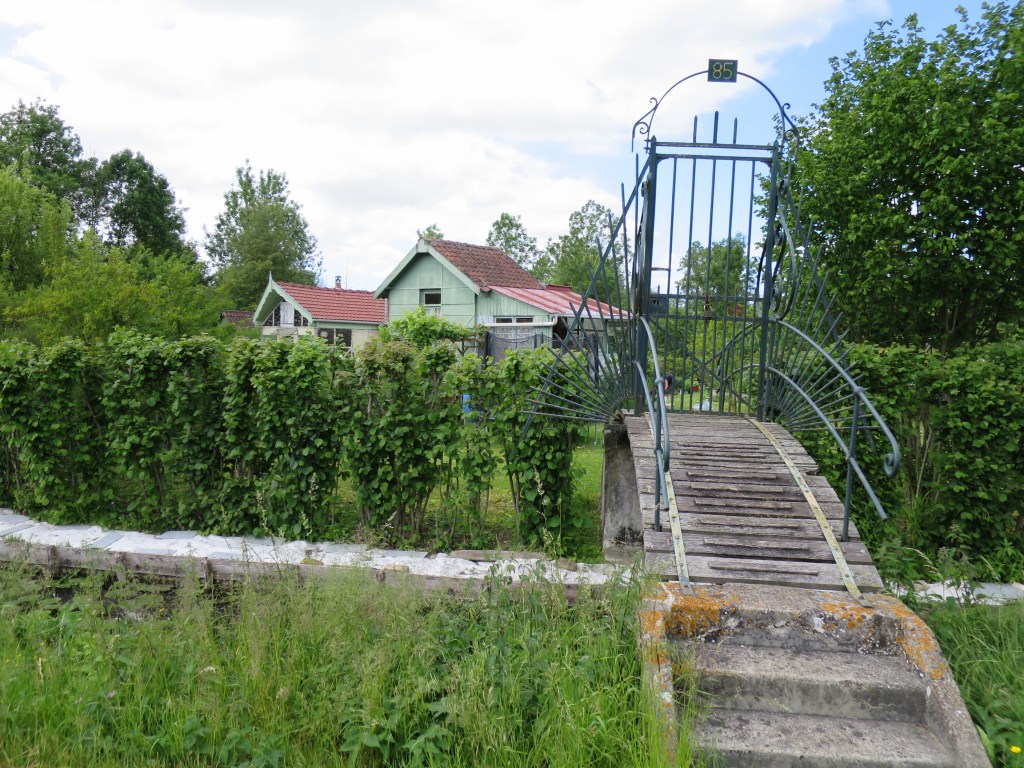
And each humpback bridge, passerelle, is an arc-en-ciel over the water, to a personal paradise to an individual’s hortus conclusus. A panel about les passerelles says, with French hauteur, “some of them do not lack elegance”.
And on each, the gate of paradise is midway: the in side is mine; the out side is the world’s: the gate is where the self meets the world. Most gates are of metal, with enough radiating spikes to deter the most adventurous trespasser. One is in the faux bois I encountered at Cassel.

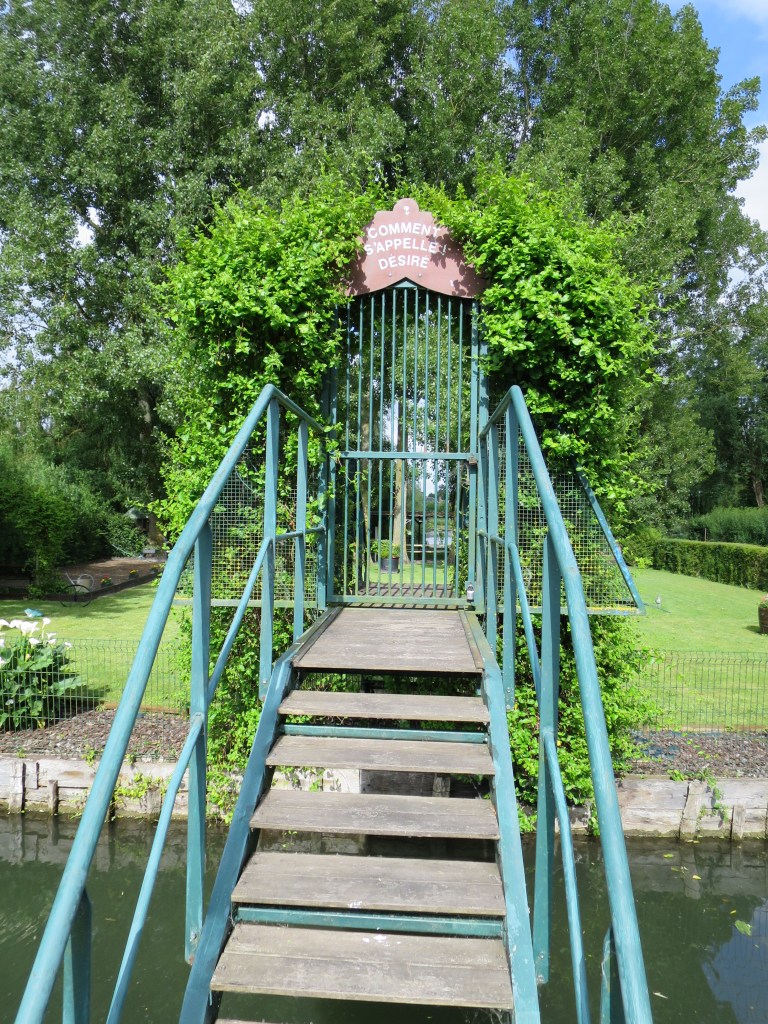
Here is one in concrete, formidable as an Egyptian pharaonic gateway. This gate, of green-painted wood, has, on a cloud-shaped board buried in greenery, ‘Comment s’appelle! Désiré’.
These castles of the embattled, these arcs over water, these gates, are bastions against the passing stream of entitled runners and cyclists that is the coming wave. They are defiant standards, flags of self-definition. Whitman called grass “the flag of my disposition, out of hopeful green stuff woven”. This is a place of hopeful weaving. I am cheered by this colony of embedded idiosyncratics.
The river here is wide, and flows gently. Once busy, it is now empty, abandoned rather, except for the occasional sculler. I watch a bottle float slowly past, pursued and pecked by an inquisitive duck. Is there a message in it? Not for me.
But, a little later, there is a message for me.
A board describes the guinguettes (dance-bars) that thrived in the late nineteenth century, on the opposite bank, and gives their names: Pré Porus, l’Agrappin, and – Robinson.
‘Robinson’ is a name beloved of psychogeographers. My ride along the Meridian is psychogeographical. Robinsonner is defined as, “to live alone, aside from, at an angle to, the world.” It was invented in Rimbaud’s poem Roman, where the young man’s “crazy heart robinsons through novels” in which he both loses and reimagines himself.
Robinson in Céline’s Journey to the End of Night is an amoral chancer with a clear-eyed view of the realities of the world, who yet dies for a principle, that of refusing to marry.
In Kafka’s Amerika he is also a drifter, slipping through the interstices of society, refusing to belong, and yet a repeated reference point for the hero.
In Weldon Kees’ poems, he is a conventional figure whose presence is a
sort of absence, his adherence to convention such that he has not developed a self.
In Chris Petit’s novel Robinson, he is an extravagant figure whose ever more extreme attempts to feel and be, end in frustration and death.
In Patrick Keiller’s films, he is an anonymous failure who yet doggedly persists in experiencing and trying to make sense of the world. I am something of each of these Robinsons, and meeting one, in a dance hall on the other side of the river, refocuses me on my journey.
Such that, when I arrive, a little further on, at the point where the Meridian, la Méridienne verte crosses the Somme, I expect an avenue of trees, flags flying, beacons, at least a rainbow arc-en-ciel of celebration over the river, echoing the passerelles. Nothing.
What has happened, or rather, not happened, to this grand Millennial idea? Why is there no line of willows through the hortillonnages? Why don’t people mark it where it passes through their gardens? An idea like this only works if it is adopted.
I had expected, on my ride, to be following an idea that, beginning with the bronze markers, and the first trees (one every hundred metres), has been maturing, in the fifteen years since its inauguration, into an experience. Which each individual, each community has been celebrating and developing, year by year, in their own way. That in the differences between how it is marked in each place, in each part of France, would lie the confirmation of diversity-within-unity, pays and patrie. I had seen it, la Méridienne verte, as the knitting together of a green backbone, a new unifying spine for France. What I am finding is a concept handed down from on high that has not resonated and therefore has been, in the head-down localism of the French, ignored. So, instead of a line of celebration, I am following the ruins of a forgotten idea.
There is an annual hortillonnage fair, when the market-gardeners dress up and bring their produce into town by punt. The rest of the year they wear jeans and use trucks, as this man is, loading boxes of lettuce.
I buy food to cook in the microwave in the hostel kitchen. Again I put in the food. Again I press buttons. Again nothing happens. Again the girl who is sitting silently in the dining room watching a TV sketch show enters silently, this time with the faintest smile of acknowledgement, presses buttons, the machine hums, the plate turns, I thank her, she smiles knowingly and silently returns to watching the same sketch show as last night, what looks like the same episode, occasionally looking down at her smartphone. A serene waiting. Again, sitting close to her, tethered close to her by the short cable from his computer to the power point, is the thin young man with the wispy beard. They are entangled, but they do not acknowledge each other. They are held together in this loop of repetition, in thrall.
As, I realise, I am beginning to be in thrall to Amiens. I like it here. The town, the river, the cathedral, the hostel, the girl at reception, the refugees, the two young people waiting in suspended time for something to happen. It is time for me to leave.
Day 5: Amiens to Villers-St-Sépulcre, 52 miles.
Picardy. The poetry of wind turbines. The omphalos. Beauvais and ‘The Truman Show’. Gothic’s new heights: ‘ridiculous, touching, splendid’. The Middle-Ages’ moon-shot. Progress and hubris. The Eagle Line. La Pierre au Fées.
A strange night. I have a long, continuous dream about breaking into a mysterious building to get something for nothing. But what? I’ve no idea. And there are noises from the room next door, of furniture moving, water running, a mercifully short bout of headboard banging followed by brief giggles and then a door opening and closing. This is a youth hostel!
Walking across to the dining room, in sunshine, I feel it so much warmer. The forecast for Saturday is 33ºC
I find my way out of Amiens okay, along a road busy with trucks heading for the motorway. I soon turn off at Dury, where there is a sign for the Battle of Dury, 1870. It was a minor skirmish in the Franco-Prussian war. There was also a battle of Amiens in 1870, as the Prussians advanced from the south. The main encounter was at Villers-Bretonneux. The defeated French fled north across the Somme. It reminds me again of the layer upon layer of flux and warfare in this area, recorded from the Romans onwards. And how strong was the shame of 1870, a shame reflected in the vengeful Treaty of Versailles.
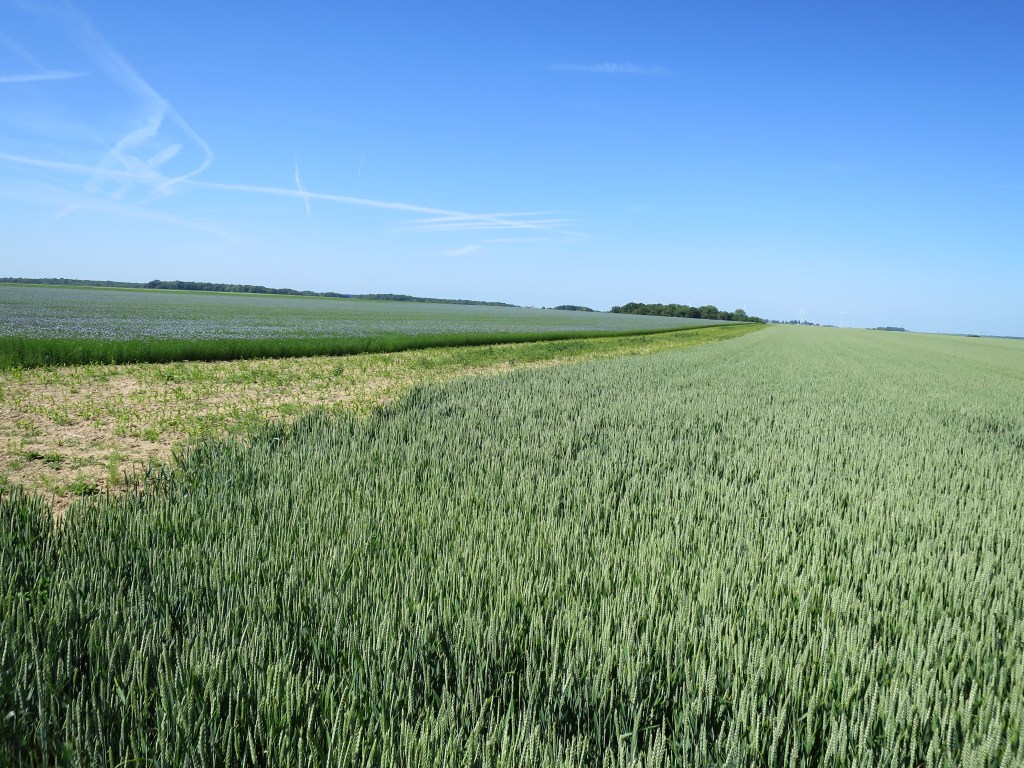
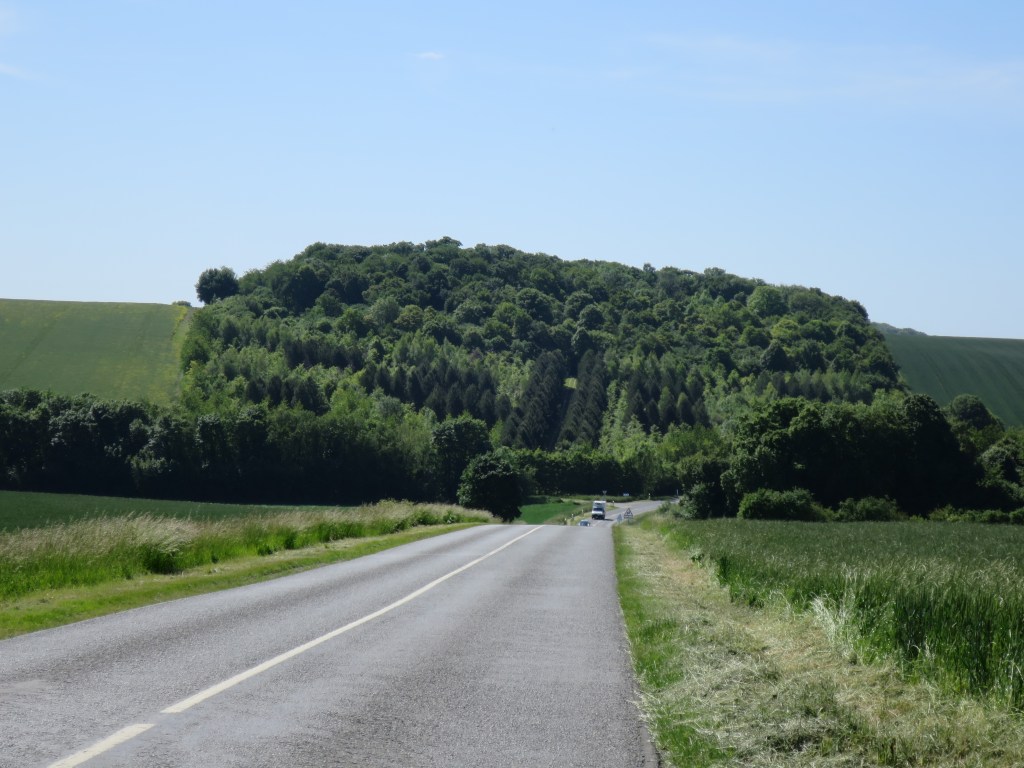
It is a day of enjoyable cycling, in warm sun along minor roads across the rolling plateau of Picardy, great unhedged rectangles of fields stretching away: dark green wheat, blue haze of flax, blue-green peas, yellow-green maize, brown earth spotted with the dark leaves of potatoes, green winter barley already edging gold.
And among these prairies, in valleys and under protecting slopes, are tightly-knit, English-looking villages, with trees, small meadows, cows, farmsteads.
There are several wind-farms, turbines in lines, turning slowly. What to think? Should I be against them, as subsidised blots on the landscape? Or for them, as the cheapest form of renewable energy? Are they ugly, metal intrusions in an organic world, their turning a dissonant, mechanical regularity? Or are they beautiful, sleekly-dynamic aerofoils that respond to and register wind direction and speed, visible tracings of the invisible, that may stir the soul? Why are we nostalgic for old, noisy wooden mills, while these subtle masterpieces of design and technology are howled against?
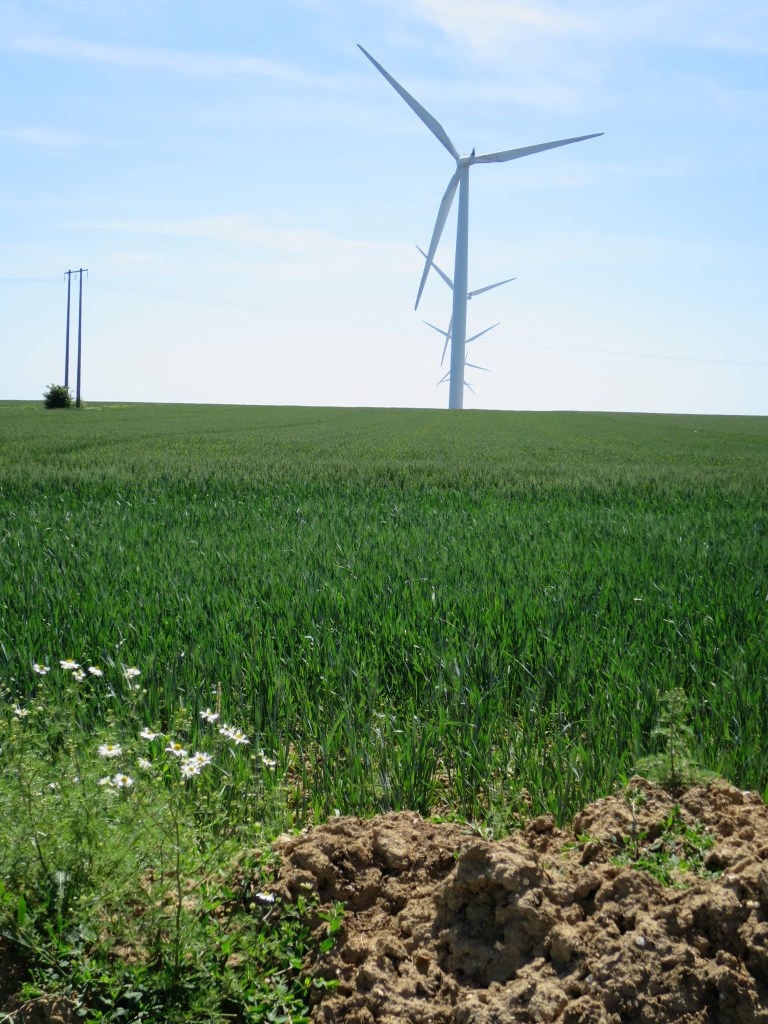
They turn slowly, together, but never quite at the same speed. And yet in sleepy synchronicity, as if they are linked to the same dream deep underground, while each dreams its own dreaming. Deep underground the cables connecting them are prickling with the turbine-wound electricity that is flowing through them, bringing to life distant machinery, illuminating faraway rooms. I stop where they are in a line, so I can see only the front turbine, while all the turning arms are visible. Is there pattern? Will it ever happen that these five turbines are a perfect fifteen-point star? What would that moment be like? Or all exactly together, in three points, a giant Mercedes badge …?
At this moment, now, I feel it important not to have an opinion. Opinions are table-tennis balls lofted up on water-jets, up in the head, that chattering realm of contrary voices, and needing effort to keep aloft on jets of will. Rather, now – look, experience, feel. Have perceptions that slip slowly down, like eggs through isinglass, until they reach their equilibrium point, by displacement, deep inside me, and are still.
Every innovation, new technology, social situation, needs a new poetics, with new metaphors, new techniques, and technics to incorporate (as the Impressionists incorporated boulevards and leisure, the Futurists, modern warfare); only then, once incorporated, judge.
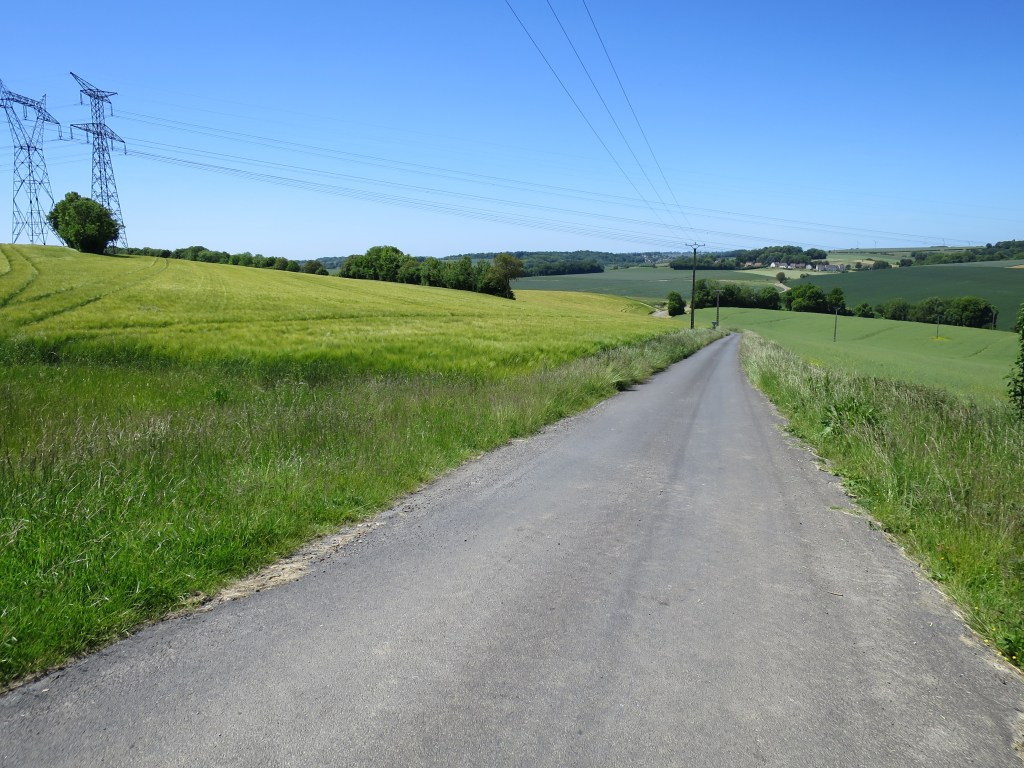
Heading south-east I cross the Meridian at Ailly-sur-Noye, and look along a tree-lined lane; and again, tacking south-west, near Paillart. Neither has a sign.
The road climbs slowly, I reach the top, and there below is Beauvais. Illuminated by the sun, the town is a purple shield, with the cathedral the pale boss (in Greek, omphalos) at its centre. Downhill, with the wind behind, I’m soon there.
I arrive in Beauvais at three in the afternoon. It is a tightly-knit town, crammed inside a wall. Its narrow streets, busy with pedestrians, are all traffic-calmed or pedestrianised. It was destroyed in the German advance of June 1940, and rebuilt in blandly functional form, within the wall and on the old street pattern. Absent is the solid stonework of the bank, the decorative tiling of the fishmonger, the grocer’s shop with inlaid ‘épicerie’, the bar with Suze painted on the end wall. The blank buildings are anonymous containers, of functions that are interchangeable.
Usually in a town you can see the past by looking up, above the new shop fronts. But none of the past is here.
Which makes it feel oddly like a film set, where the shop windows are filled with standardised goods, and the busy, intent – perhaps too intent? – shoppers are well-trained extras, concentrating on acting normally and not looking at the cameras, while the director’s instructions are fed to them through earpieces. The Truman Show effect.
More and more I feel people are acting the role of shoppers, rather than – shopping. Perhaps it is the accumulation of conditioning by advertising and media. Perhaps it is the ever-increasing reflexivity of our lives. What would happen if I stopped someone? Do they even see me?

These thoughts vanish as I pass a cross street and glimpse, so briefly I’m not sure what I saw, an enormous, white, pinnacled, heaped-up edifice. So out of scale, so apparently overbearing, and yet so ignored by everyone that I think I must have dreamt it. But I see it again and again, at each cross-street. Each time it is bigger in actuality than it is in my memory.
I imagine myself in a science-fiction story in which the oppressed people have ceased to see that which oppresses them, the castle, the tower, the presence. But to them, living here, it is just – the cathedral.
And now, there it is, in front of me.

Beauvais Cathedral really is bonkers. At first, white in the sunlight, it is an enormous Disney creation in a Sleeping Beauty world, reaching up into the clouds, step by step, so huge and out-of-scale is it.
And yet, on its own, with its pyramidal form, its boat-stern rounded apse, its spray of flying buttresses, its ever upward reaching, it is – magnificent.
When 4.9 metres were added to the height of the choir in the 1260s, in order to overtop local rival Amiens, it took the Gothic, literally and metaphorically, to new heights. It has never been surpassed. And it created something qualitatively different: a new and mighty grandeur. The combination of pointed arch and flying buttress had enabled a reaching up that is almost, in itself, overreaching. Like the new music, spinning out from grounded plain chant to spiralling polyphony..
That those tremendous, soaring buttresses are held together, and apart, by metal rods gives a clue to what happened next.
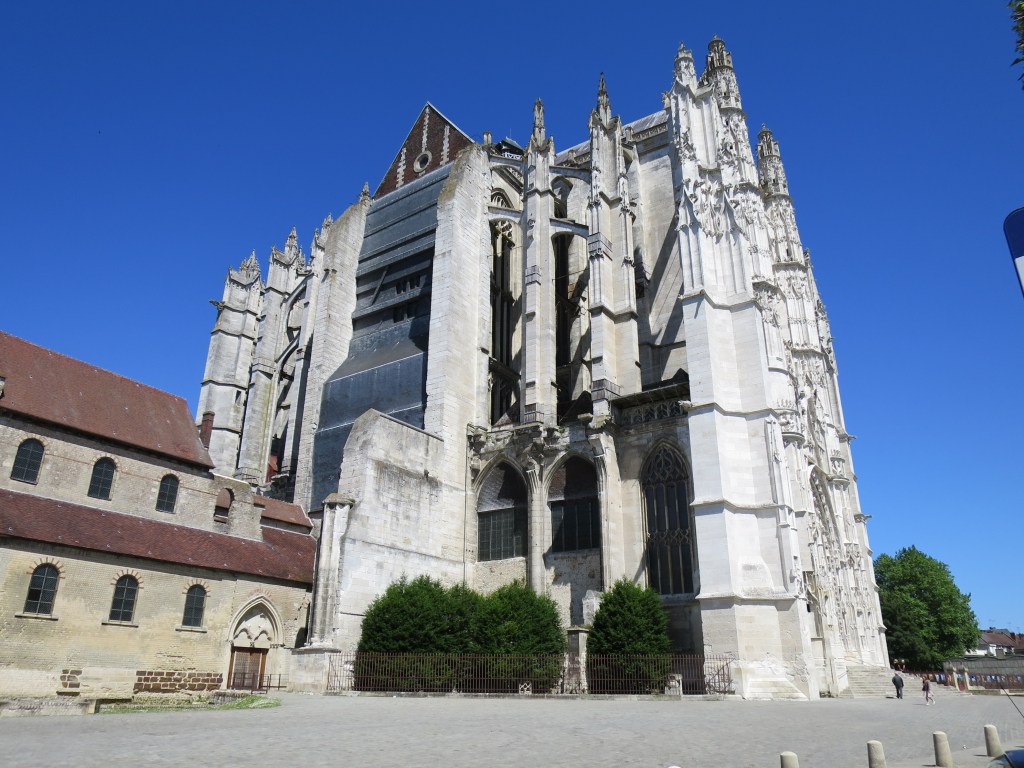
The choir was built in two phases, from 1225 to 1272. In 1284 part of it collapsed. It was then rebuilt, with modifications, possibly including these very iron bracing-rods. Two centuries later the transept was built. And a tower. Which then collapsed. At this point they gave up any idea of building the nave, and connected the giant choir and transept to the nave of the original tiny Romanesque church, “like an elephant confronting a mouse.” (Grant.)
It has been taken ever since as a prime example of hubris, of what happens when materialist ambition replaces spiritual transcendence, of the Gothic’s reaching exceeding its grasp, its aim beyond its technical ability; as the moment when the Gothic faltered, having either reached the limit of its technology (Viollet-le-Duc’s view), or lost its nerve.
I enter, through the great, magnificently-carved south transept doors, look up, and – it takes my breath away.
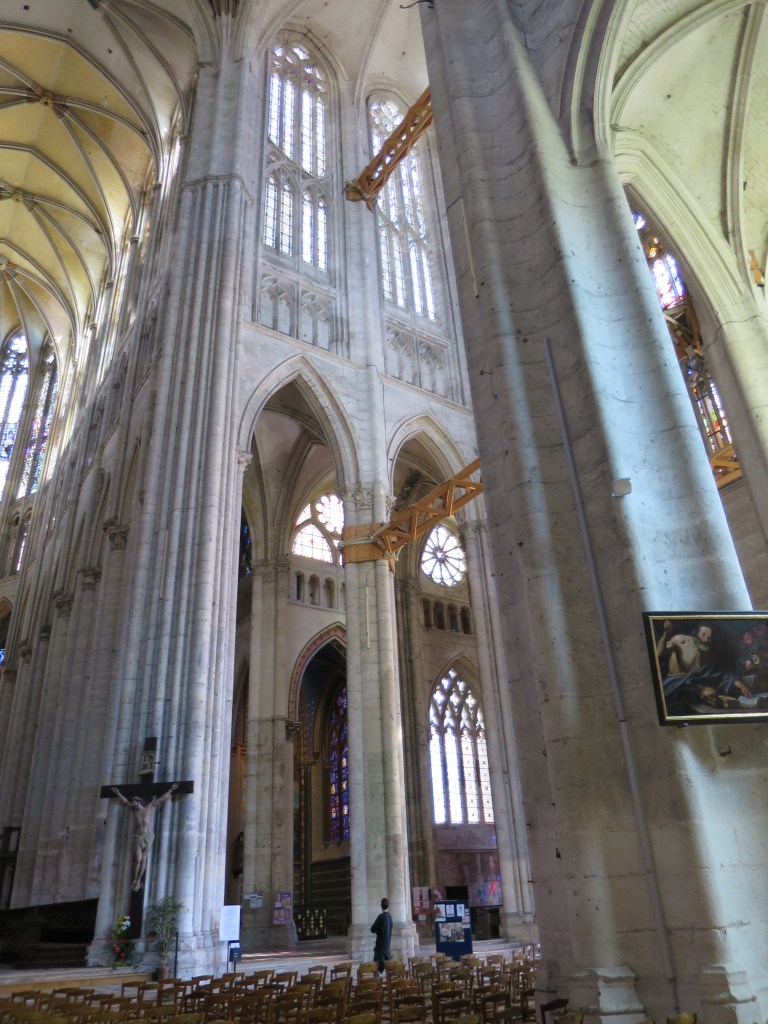
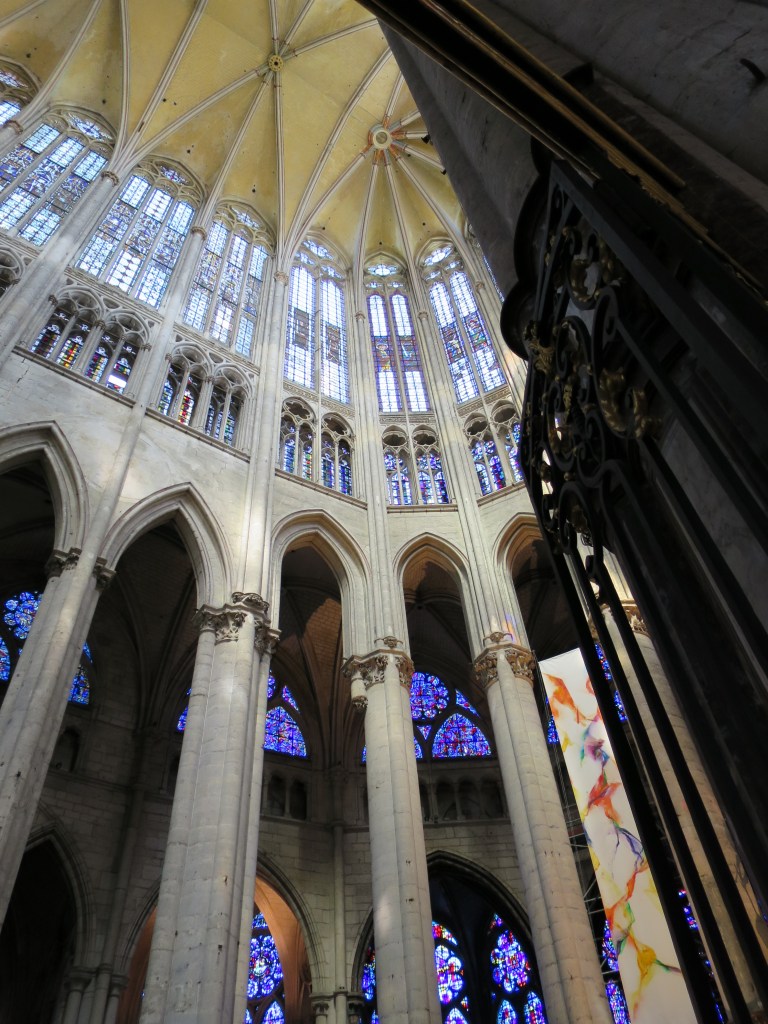
The choir soars and soars. Window above coloured window (so high it cricks my neck to look up) fill the chancel and apse with light. It reminds me of the exaggerated drawings of Beckford’s Fonthill Abbey; in fact, all such Romantic ‘Gothic’ exaggerated drawings. But this is no exaggeration. It is so. There is no nave, it doesn’t exist, it never happened. All there is, is the mouse of the Romanesque church. But the choir and transept rise and rise in a defiant upreaching. Even as it is, supported and wedged up with great baulks of timber, it is touchingly magnificent, “untidy, unfinished and unstable, bold, brilliant and beautiful, it soars triumphantly above its almost fatal flaws.” (Grant) It is stunning, incomparable.
I turn and turn, move through its vastness with head up, trying to absorb its size. But it is one of those places (Delphi is another) that is always greater to the eye than in the memory, bigger in reality than the imagination can imagine it. Close your eyes and it shrinks. Open them and there it is, its vast self. Murray calls it “the architecture of transcendence”. Grant adds, “Few sights in France are more ridiculous, more touching, or more splendid. Its parts are very interesting, but the whole is overwhelming, and for that you will need a plane ticket.” You have to see it, experience it.
Picardy by the twelfth century was very rich, more populous than today, its wealth based on the revolutions that, with heavy plough and horse power, increased agricultural production, especially of wheat; and with wind and water power added new sources of energy for processing. Wheat and textiles were hugely profitable. The cathedrals “represent the financial investment and the aspirations of the ecclesiastical aristocracy, and the local magnate families from which they were drawn.” (Murray.) The clever trick on the church’s part was to get the wealthy families to spend that money, in the thirteenth century, on Gothic cathedrals. (As the clever trick of the ‘military-industrial complex’ of the 1950s was to get the US government to spend tax ‘surpluses’ on rocket ships and travel to the moon.)
Beauvais has been called “the swan-song of the ecclesiastical aristocracy”. Not because the Gothic had reached its technological limits, nor from a loss of nerve, a fear of having gone, in God’s eyes, ‘too far’. But because of the costs and effects of the Hundred Years’ War and the Black Death in the fourteenth century. It represents not a limit of an idea, or of a technology, but a high point of wealth.
And yet. As I escape from the rush-hour traffic, and cycle, in the bright, long-shadowed light of a June evening, towards my bed for the night, along the quiet road beside the Thérain flowing its soft, chalk-stream way between willows and grazing cattle, I ponder again the Gothic.
I understand why Edward Thomas writes that, when in a cathedral, “I feel I know why a dog bays at the moon”.
And lines from two songs come into my head as I cycle: “They’ll never reach the moon, at least not the one we’re after,” and “Man has invented his doom, first step was touching the moon”.
Wasn’t the Gothic as spiritually egotistical as the moon landings were intellectually egotistical? Isn’t there something both overweening and illusory in the pointed arch’s reaching up, in not accepting the round arch of the firmament, the circle of the heavens, the stars as scintillations of the beyond, in equating physical light with spiritual light? Dante could not have written his Commedia in the Gothic North.
It is, of course, the argument between those who see man’s restless questing as his great gift, that he should exercise to the full. That if he thinks it, he must do it, the earth (and the heavens, and even heaven itself) his laboratory and estate, to do with as he sees fit; a process in which mistakes will be made, yes, but can be rectified by the same process that made them.
And those for whom his questing is, if not his curse, at least a very mixed blessing. That the problem is not man’s power but his judgement, his discernment, his inability to stop, to say ‘no’. That he (we) should be, both mentally and physically, working to find his (our) ‘place in this world’, rather than forever inventing new worlds. Raised with one view, temperamentally inclined to the other, it is something I have yet to resolve.
I am cycling, in this evening light, along the valley of Thérain, just after its junction with the Avelon, south-east on the Eagle Line. Robert Coon developed the image of the flight of an eagle from Glastonbury Tor to Spread Eagle Hill at Shaftesbury to express a geomythical landscape connection between the two towns. My researches showed that the line, continued on the same bearing, arrives at Delphi, the spiritual centre of ancient Greece, the omphalos, the navel of the world. Delphi was where two eagles released by Zeus from the ends of the earth, met. Close to my night’s stop the line crosses Robb’s Celtic Meridian at Mont César, “a major oppidum of the Bellovaci tribe, and almost certainly the tribal capital.” (Beauvais is named after them.)
Entering the village where I’ll stay tonight I pass the ancient dolmen of la Pierre aux Fées, the stone of the fairies.
Day 6: Villers-St-Sépulchre to St-Ouen, 46 miles.
On the Move. The Jacquerie. The Republic and laïcité. Nerval. Chantilly. Questing Quixotes. Heat exhaustion. Madame le Maire. My guardian angel of St-Denis. Abbot Suger and the birth of Gothic. Class and race. Ricqlès in St-Ouen.
I set off early, glad to be on the road. I slept well in the shelter of la Pierre aux Fées, but I found the b&b’s friendly domesticity – so much personal stuff, so much chatter! – stifling. I’m already into the groove of simplicity and anonymity, of leanness. Get up, fuel up, pack up, go, a need to go relentlessly on.
In this mood, as I cycle along the winding river-valley road, I find myself recalling a poem from long ago: “the gust of birds that spurts across the field, the wheeling swallows … seeking their instinct, or their poise, or both … men use what they imperfectly control to dare a future from the taken routes … afloat on movement that divides and breaks … at worst, one is in motion; and at best, reaching no absolute in which to rest, one is always nearer by not keeping still.” I may be cycling quietly, well-knit and self-contained, but it is a movement that divides and breaks, with a sense of the texture of reality, the warp and weft, loosening. As if the bonds between elements are letting go, and I am beginning to see, experience between. Through to another reality? Or is it this reality reconfigured; less tightly knit, less unified, less insistent? So that what were once incompatible may now coexist. For if the fabric of reality no longer holds together, new experiences are possible. The first village I pass through is named Hermes.
And then I settle into the day’s journey, into simply cycling. It is an apricot summer morning, I cycle through fresh air that is untouched, unbreathed, with birds, sun, open fields and woodland, the breeze stroking the fields of ripening barley like a soft hand on cat’s fur. It is deliciously warm. But it will be very hot. I had seen myself moving slowly south through June, acclimatising, my skin gradually darkening. Instead, April has turned into August in three days, and I will have to buy sunblock.
I pass through a small, empty village. It has five sets of traffic lights, at two insignificant junctions and three pedestrian crossings. There’s not a car or pedestrian in sight. French drivers wait patiently at these red lights, waiting as nothing happens. They have gone, in a generation, from selfish and anarchic, all aggression and blaring horns, to a placid, unthinking obedience. I check for evidence of irony in their waiting, but no, they sit, stolid, waiting for the green light that will activate action. Then there is a gap of two seconds between the green light and moving off. Come on! The law has been internalised. They have become domesticated. And the car, once a symbol of manliness, battle-scarred but vital, is now an extension of the home, unmarked, a travelling sitting room, complete with air-conditioning and sound system, to which they devote their newly discovered house-proudness.
At the end of the village is a quarry. This is an area of quarries, Ruskin’s ‘fine building limestone’, used to build the great cathedrals. I note the distinct bedding of the stone, and remember that in French Gothic building the stone is never cut, just shaped. Unlike the English, they used no saws, and stone was used to the thickness of the bed. Viollet-le-Duc’s maxim was: ‘never divide a stone.’
I’m soon at Mello, the site of the battle at which the Jacquerie were defeated. And then at Saint-Leu, where the revolt began, where I stop to buy sunblock.
It is a placid small town, with a big, grassy square, shops around, and old men on benches, not moving, their gaze far off and deep within. Not old, in fact, just men not working, with nothing to do, who time is passing through, winnowing out volition, leaving them with pattern and memory. In 1830 the last Prince de Condé, driven mad by the infidelities of his mistress, rode over from his sumptuous château at Chantilly to this nondescript place, and hanged himself.
I search for some commemoration of the Jacquerie on the board of local highlights. A one-word mention. There’s a lot about the local building stone, and the underground quarries so big that they were used to assemble and store V-1 rockets. I have just passed where the Eagle Line intersects the Meridian. There was no sign. But under their crossing point is a vast, underground emptiness. Emptiness?
The Jacquerie was a peasants’ revolt of 1358. Its outbreak was the other side of the equation of the great wealth and the ‘surplus’ that had built the cathedrals. For the ‘surplus’ came from taxing the peasantry. But by 1358 that wealth had been much reduced, by twenty years of war with the English, and the Black Death. The revolt began here at Saint-Leu, with a gathering in the churchyard of peasants bitter, less at the nobles’ wealth, than their failure to do their duty: to protect the king (they had allowed John II to be captured at Poitiers in 1356); to protect the peasants (many nobles had become bandits); to tax fairly (taxes had gone up sharply, and disproportionately for the poor). The protest turned into a savage release of pent-up fury, in which dozens of nobles were killed and their houses sacked. More risings happened across northern France. Most seem to have been spontaneous responses to perceived wrongs. But a peasant army came into being, and faced the nobles at Mello.
Their leader, Guillaume Cale, went to the nobles’ camp, under an amnesty, to parlay. He was seized, tortured and killed. (The rules of chivalry did not, could not, of course be applied to a peasant.) The defeat of the leaderless peasant band at the battle was followed by a reprisal rampage in which perhaps 20,000 peasants were slaughtered. “Like every insurrection of the century, it was smashed as soon as the rich recovered their nerve, by weight of steel, and the advantages of the man on horseback, and the psychological inferiority of the insurgents.” (Tuchman.)
Written up by Froissart and other aristocratic chroniclers in lurid style, their reports of the actions of these ‘evil’ and ‘wicked’ men so terrified the nobles that it came to be a word applied to any insurrection, indeed resistance by the lower orders, with the implication of the dire consequences of not dealing firmly with them. Nostradamus in 1552 used it as a term for any revolt that overturns the status quo. In 1872, a year after the bloody suppression of the Paris Commune,Louis Raymond de Vericour said this, to the Royal Historical Society: “To this day ‘Jacquerie’ does not give rise to any other idea than that of bloodthirsty, iniquitous, groundless revolt of a mass of savages. Wherever, on the continent, any agitation takes place, however slight and legitimate it may be, among the humbler classes, innumerable voices, in higher, privileged, wealthy classes, proclaim that society is threatened with a Jacquerie.”
This combination of fear and contempt reappeared in 2005, during the troubles in the Muslim communities in the banlieues, when Interior Minister Sarkozy (himself the son of an immigrant) promised to ‘pressure-hose’ off the streets these ‘racailles’ – a deeply offensive term meaning dangerous, contemptible rabble, scum.
Which brings us to Creil, five miles from Saint-Leu.
It was the scene in 1989 of the ‘affaire du foulard’, when three Muslim girls were excluded from college for wearing headscarves. They wore them for reasons of hijab, religious modesty. Their exclusion was on the grounds that the headscarf was incompatible with laïcité, secularity, the separation of church and state. France, as a lay, non-religious state, bans from state schools the wearing of religious insignia that are so ‘ostentatious’ or conspicuous as to be regarded as proselytising. The courts decided that the headscarf was not ostentatious, and therefore legal.
But in 2004 a law was passed that defined ostentation as any religious symbol ‘easily visible’, so banning the wearing of headscarves in public schools, and also turbans and large crosses.
And in 2011 a law banned face covering in public, outlawing the burka and niqab. In neither law was religion mentioned, but the head scarf and veil were clearly the target. Why? Laïcité.
The Revolution was a product of the Enlightenment, the age of reason, when religion was seen as a receding tide of superstition, something that would inevitably fade away. Many churches were turned into ‘Temples of Reason’. It was to be a state in which all were ‘citizens’, and the watchwords were ‘Liberty, Equality, Fraternity’. France saw itself as welcoming peasants into society, and foreigners into the country: but this was on condition that they assimilated linguistically and culturally, and didn’t differentiate themselves visibly. Hence the France’s refusal to accept multiculturalism, or acknowledge regional languages.
It had taken France eighty years after the Revolution finally to put behind it dynastic government, and, after the traumas of the Franco-Prussian war and the Paris Commune, to begin to develop a modern state, in which la Marseillaise, the tricolore, Bastille Day, laïcité, and secular education were central. Religion was to be a private matter, multiculturalism anathema. French presidents, like Mitterrand, have repeatedly asserted, ‘la République est laïque’.
The problem is that, in Islam, France faces a religion that for many believers cannot be separated from, is embedded in, their daily lives. Indeed, who would see their lives, rather, as embedded in religion. And there are an estimated five million Muslims in France. (Because religion is a private matter, no statistics are collected.) France faces a rising tide of religious observance and belief, and increasing militant radicalism. As indicated by the number of Muslim children who refused to observe the minute silence in schools, after the Charlie Hebdo assassinations in January 2015.
I cross the Oise, and am in a different world, cycling through the Forest of Chantilly. With its woods and clearings and small plots of land, called mas, it reminds me of Gerard de Nerval’s enchanted childhood in nearby Ermenonville, with his mother’s family. This is the Valois, “where the heart of France has beat for a thousand years.”(Nerval.) As a child he often saw the Prince de Condé’s unfaithful mistress, the Baronne de Feuchères (born Sophie Dawes, daughter of an English fisherman), “an Amazon on horseback”, riding through that countryside. He saw, in the weatherworn statues outside the church, not saints, but the Celtic deities of ancient Gaul.
Nerval was a brilliant writer, but a troubling visionary who slipped in and out of madness. Troubling because however attractive the visions, if they come from fantasy indulged, rather than being experiences of other realities, they are not realisation, but escapism.
But how is one to know?
He wrote, “I believe that the human imagination has invented nothing that does not exist, in this world as well as in others.” And recently I read this, from Jean-Luc Godard, “those lacking in imagination take refuge in reality.”
Is one’s existence, one’s livingness, less matter than vibration? Vibrations with just enough consistency to be sensed as the appearance of, or to be experienced as, matter. A sensing of vibration. And a sensing of the existence of the gaps between vibrations. As between the lines on the cathode ray tubes of old TV sets.
And this devastating question from Nerval: “Is my soul an indestructible molecule, a sphere inflated with a bit of air, which recognises its place in nature? Or is it the void itself, that vision of nothingness which disappears into eternity?”
Like Condé (for very different ostensible reasons, but the same central reason, being inconsolable) he hanged himself.
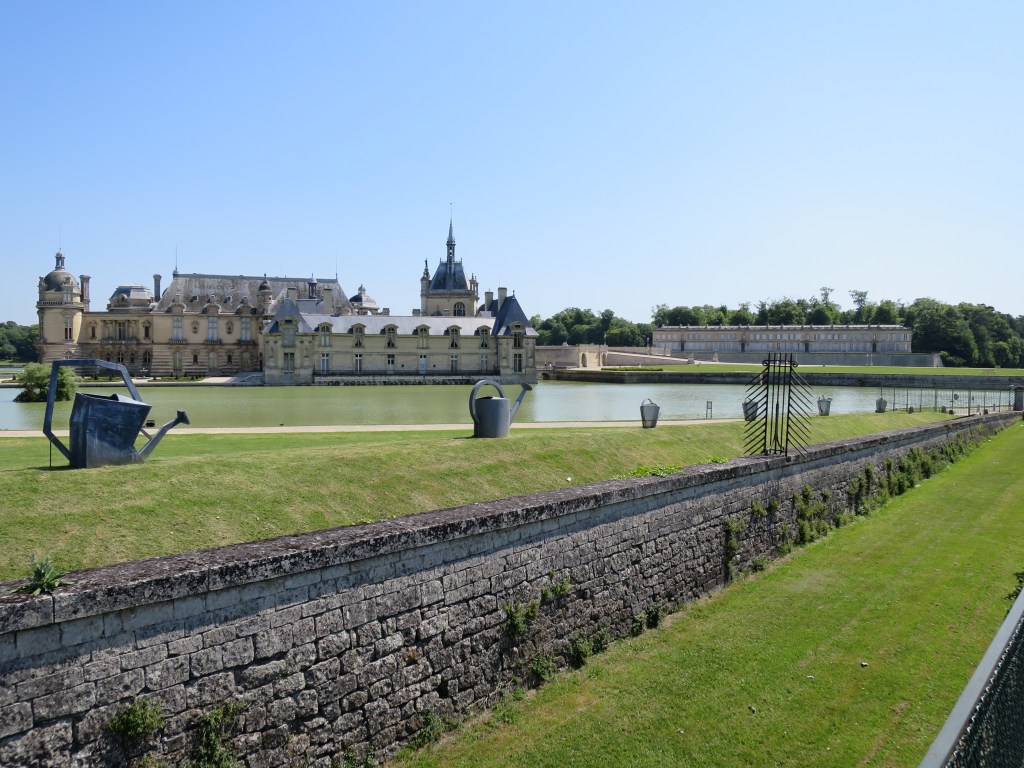
I cycle through the gateway, on the bumpy cobbled road towards the château of Chantilly and the Condé museum.
But I soon lose heart. It is something about the scale of the place. It is wearyingly huge. Vast open spaces as wide as English commons, the stables are as big as a palace (one of the Condés believed he would be reincarnated as a horse). There is a grand small palace and a grander big palace. It has a race course! There are formal gardens and romantic gardens. It even has the aristocratic play-village that inspired Marie-Antoinette’s at Versailles. And all perfectly made, neatly preserved.
The museum houses Les Très Riches Heures du duc de Berry but it is never on show, only a facsimile. And all this feels unreal.
There is something about a place where every whim of the owner can be realised, because he has limitless money, that offends me. Perhaps it is my English puritan soul. For all its style, this is capricious excess. And all on show – look at me, look at what I can do, and you can do nothing about it! Except, if you have any taste, admire. My heart sinks, and I turn around and pedal out.
Cycling out of Chantilly, I remember Nerval in the 1850s comparing the town to one of “those old aristocratic gentlemen with impeccable white shirt and faultless manners, whose proud demeanour covers a worn hat, or well-darned clothes … Everything is proper, well-ordered, circumspect; and voices fill the high, sonorous rooms with harmonious echoes.” It livened up in the revitalising late-nineteenth-century belle époque.
In the 1970s Richard Holmes described it as a town where “ancient gentlemen in mohair suits and with gold-topped canes still help beautiful young ladies in Liberty-print dresses out of Paris-registered Mercedes and Rolls-Royces. ‘Voilà, Angélique … nous-voici Hélène,’ they sigh, with tight moneyed smiles.”
That too has changed with the expansion, in the last thirty years, of the moneyed class, so many more than a generation ago, in this century’s belle époque of new wealth. Accepted, now, so there is no need to be discreet – how has it happened, this general acceptance of obscene wealth inequality? – with a new relaxed sense of entitlement, in an ecosystem, almost a democracy (although of a new aristocracy) of wealth. So, the men drink in local hotels, and the women shop in local shops, and they both eat in restaurants along the main street. Whatever hard work or ruthlessness or exploitation was needed to gain their wealth, they are now safe. For the system that they once had to work, or to work within, is now working for them. Therefore, at leisure, they are at ease, they look out almost benignly, unbothered by how we regard them, immune.
I enter a calm, relaxed shading forest. But on leaving it, the road switchbacks over exposed open fields. It is very hot, an oven heat. I’m getting hotter, stifled by the heat.
Heading up one long hill, I see a cyclist ahead, his bike as heavily laden as mine, cycling more slowly than I. But by the time I reach the top of the hill, he has turned aside, gone into a café. Why don’t I? I press on.
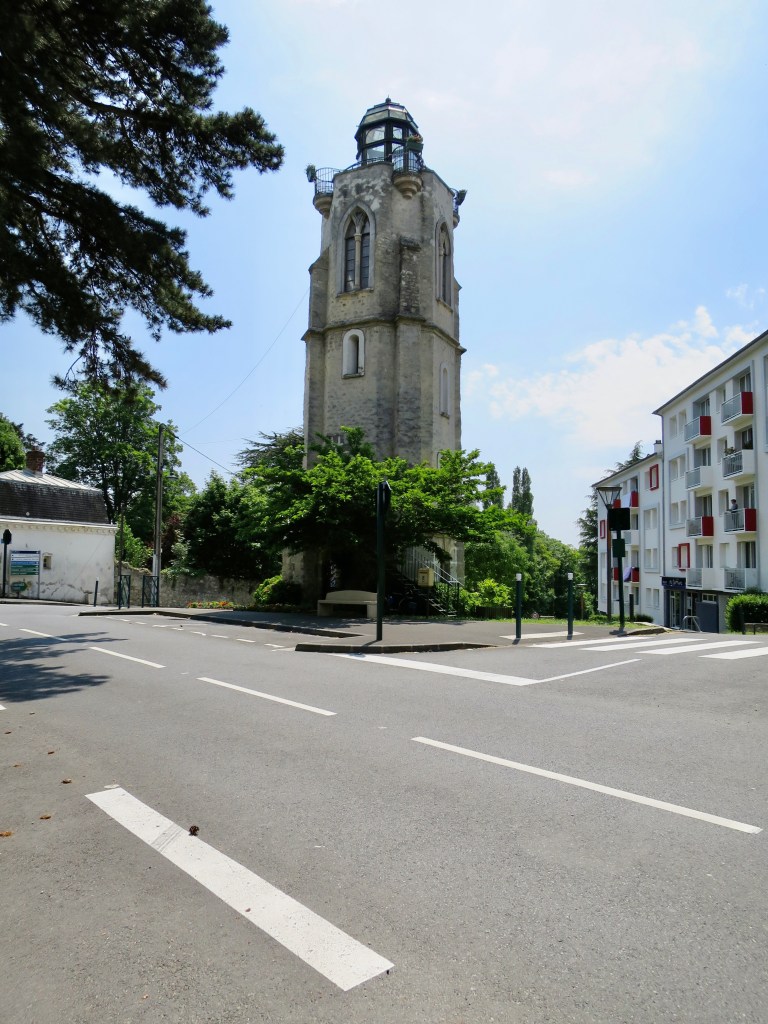
In Saint-Martin-du-Tertre I find the obelisk commemorating the Meridian survey of 1740. I cycle up a long hill to find a tower which ‘offre un point de vue incontournable sur la région. Le syndicat d’initiative y est install.’ It was built by a stockbroker in memory of his daughter. It is the highest point in the département, and was used by all the surveys, and also the télégraphe Trappe, a semaphore messaging system developed during the Revolution. But it is surrounded by trees, rendering the view invisible. And the tower, and the tourist office, are only open for two hours, on Sundays. So I cannot experience this ‘incontournable’ (from which one cannot turn away) view.
But something serious is happening. I am out of breath after the climb, very hot, but not sweating. I’m overheating. My pulse is racing. I drink, sit, rest in the shade, wait. But my pulse doesn’t slow. I’m radiating heat, but the surrounding air, 37ºC, blood heat, takes none of it, reflects it back. I am not cooling. The humidity – storms are beginning to build – makes it worse. I am close to fainting. I can’t see. My vision isn’t just blurred, it’s obscured by a white mist. I know the world is there, but beyond a white veil, and I am dizzy, about to fall into a black nothingness. My pulse, usually 60 bpm, after ten minutes’ rest, is 92 bpm. What should I do? Is it a passing condition brought on by the weather? Or is something serious happening to me?
I’m a dozen miles from Saint-Ouen, my night’s stopover. Have I got this all wrong? Have I miscalculated this whole trip? Every day is fixed, with no margin. Am I simply not up to it? Here I am, in the middle of nowhere, with no shop or bar open. I’m on my own. All I can do is keep going.
As I freewheel back down the hill, I pass the man I had seen earlier, pedalling slowly up, doggedly climbing. He’s as old as me. Is he too following the Meridian? Is Europe crisscrossed by old men, the foolish retired, living out their dreams, like so many Quixotes, on their ancient Rocinantes, each following the thread of a narrative that they believe will lead them to – What? Where? The centre of the labyrinth? The way out?
The mist clears a little, but I don’t feel great. As if the spring inside me, having been wound too tight, has broken, or at least lost its elasticity. It is downhill from here to Saint-Denis. But downhill is never downhill all the way. And it is getting hotter and more humid as clouds build, and I’m riding along in a hot, wet, suffocating blanket. What to do?
I pass a sign to a railway station, but cycle past. Why? Not wanting to ‘give in’ again, for a second day in three? That dogged sense that if I keep at it, I’ll, somehow get there?
I cycle into Villaines, in search of drink. But there is no shop. I go to the mairie.
It is a curious aspect of France that, in a village without a shop, without a school, there will be a mairie, with a smartly-dressed mayor, often a woman, sitting at a smart desk, in a modern office. Heaven knows what she thinks as I walk, stagger in, wild-haired, red-faced, shirt clinging with sweat, and ask the mayor, cool in her immaculate white blouse, if there is a railway station, with trains to Saint-Denis. She looks intrigued rather than alarmed, says calmly, yes there is, explains how to get to it. But there is no ticket office, she says, so I will have to get off at the next station to buy a ticket. As I am about to leave, she asks if I would like a drink of water. Please. I empty the first glass, the second, and the third and, panting, ask her to fill my bottle. Which her male assistant does. I thank her, she smiles, inclining her perfectly-coiffured head, I step back out into the midday heat. Chiens fous et hommes anglais …
The station is empty, but there is a reassuring electronic sign giving train times. And a machine where I can buy a ticket with a bank card. She must have thought that this would be beyond me. Or perhaps that such wild men don’t have bank accounts. Not racaille, but beneath comprehension. I buy my ticket. There is a train in half an hour, and it’s only 20 minutes to Saint-Denis.
I’m glad I didn’t try to cycle it. Something has broken, gone, won’t come back today. But when? Tomorrow is another day.
I stand and wait, the sun beating down on me, boiling my brain in its pan. There is the scent of cut hay. And the stink of manure. After fifteen minutes of standing in the sun, enduring, I realise that along the platform there is a shelter, shade. Of course there would be a shelter. I am in that state, beyond thinking, where all one can do is endure. I go and stand in the shade.
The train is on time. I heave my bike aboard. There are places in each carriage for bikes. At each station towards Saint-Denis more black people get on. Travelling in towards the banlieues is the same as travelling out from central Paris.
Banlieue just means ‘suburb’. But “since the 1970s it increasingly means low-income, high-rise housing projects, in which mainly foreign immigrants and French of foreign descent reside, often in perceived poverty traps”. There is a ring of these around Paris, beyond the Périphérique ring road, and before the ring of outer suburbs, the white couronne periurbaine (from which these service workers are returning), a zone where religion comes up against laïcité, and liberty, equality and fraternity are being tested. Saint-Denis is in the middle of it.
Saint-Denis is a small, poor town, 6 miles north of the centre of Paris. It is exactly on the Meridian, and a place where so much French myth and history has swirled, and still swirls, to the present day.
Here Denis, saint of Paris and of France, is buried, his story full of mythologising. Martyred at Montmartre, he carried his decapitated head (another severed head!) north along the Meridian, before collapsing. The town grew up around his grave, which quickly became a shrine.
Geneviève, the other saint of Paris, carried stones along the Meridian from the centre of Paris to build his sepulchre, initiating his cult.
Here the Gothic was born, in a complication of origins and influences.
Here Crown and Church became indissolubly linked, so that the fall of one led to the side-lining of the other.
Here, from the 1880s was a ville rouge, staunchly Republican, Communist, and anti-clerical, the type of the French Left.
Here the decline of traditional industries depressed the economy.
Here African immigrants settled, or were settled in State housing.
Here, in 1998, was built the national sports stadium, named, significantly, Stade de France, (every village has its ‘stade’, a football field often with just a tin shed, but its stade). It is where the French ‘Rainbow Team’, of mixed race and colour won the soccer World Cup that year, two days before Bastille Day.
And here, today, are exemplified the cultural and racial problems that France faces.
At Saint-Denis station I have to carry my bike down many steps. The station is busy. I wheel it to one of the exit barriers, put in my ticket, the barrier opens, I go through, pulling my bike – and it shuts, trapping my bike like a cow in a crush.The busy crowd pushes through, both ways, muttering at the blocked access point but ignoring my plight. What to do? A thin young woman with a pram stops. Okay, she says, a problem, she tugs but nothing moves. She looks round for an official. No one. But she’s not going to say, sorry, I tried, and abandon me. She asks each person who passes, do you have a season pass? At last a young Chinese man stops, taps his ticket on the reader, the bike is released. Thank you, thank you, from me to her; from her the Gallic shrug, de rien.
As we walk out together, she says, we could have called an official, but they take ages to come. She knows about officials. Where are you going, she asks? To the cathedral, I say. Oh, you mean the basilica, she says. She takes me outside, explains quickly but carefully, twice, how to get to it, then walks with me until we can see it at the top of the hill. She asks if I’m English, wishes me well, and pushes the pram quickly back the way we’ve come. I watch her go. She is one of those energetic women who have little (her clothes are cheap) and yet are always helpful. A heart of gold, we’d have said once. I’m moved. Because I know she has little, works hard all the time, will never have much, and yet she acts with generosity of spirit, selflessly, automatically. As if she lacks for nothing. So maybe she does. I have nothing to give her, my angel of Saint-Denis. I am touched.
The basilica is there, up the hill, the place I’ve been heading for. I’ve made it. Although I’m still not feeling great.
I push my bike up the hill and through the centre. So many black people, North African, sub-Saharan. It looks like France, formal and finished, but it feels like Africa, an energy, vitality, and incipient chaos (different order?) that is somehow negotiated through. It’s a French city centre, with municipal street-furniture, pedestrianised streets, well-finished pavements, familiar shops; but the streets are full of street traders, the informal personal business of men standing close, an African physical intimacy and restlessness, women in headscarves pushing European strollers. How should I feel? Under threat? Will I be mugged, my pocket picked? Or will there be an exaggerated respect, knowing how the law treats black-on-white crime? Of course they ignore me. They have no business with me.
I arrive at the Basilica. Now – where to leave my bike? I’ve been thinking about this since reading that this is the most dangerous part of the most dangerous département in Paris, in France, 93 Seine–Saint-Denis. Where photographers and reporters came in 2005 for the best shots of burning cars, the best stories of rampage, however concocted, by drawing the kids into the film of the story. And my bike is, on this journey, my world. If I lock it, it may be carried off. If I chain it to a fence, maybe I’ll return to find it picked clean of my possessions, like a tethered donkey by piranhas. My images are of the jungle! I find a secure-looking place behind a hedge, and am shooed away by sharp tapping on an office window. With deep misgivings, I lock it to railings by a public garden next to the basilica.
I walk back across the wide-open space to look at the front of the basilica. It is a sorry sight: one of the twin towers was taken down in the 1840s; the rest of the facade is covered in scaffolding and hoardings.
But this is where the Gothic began, the work of one man, Abbot Suger.
One of the most remarkable figures of the twelfth century. An adequate biography would combine Hilary Mantel’s treatment of Thomas Cromwell with William Golding’s character study of Father Jocelyn in The Spire.
Given to Saint-Denis monastery as a ten-year-old in 1091, he was educated with the future king Louis VI, and became his principle advisor, spending 29 years in his service, as diplomat and administrator. He forged the link between crown and St Denis by having the king carry St Denis’ standard, the oriflamme, into battle: ‘Mont-joie, St Denis!’ became the French battle cry. Louis VII appointed him regent when he went on the second Crusade, returning to “a country peaceful and unified as it had seldom been before; and, still more miraculously, a well-filled treasury.” Louis then rejected him as advisor: Suger’s last advice was not to divorce Eleanor; Louis did. She married Henry II of England, and through her was created an English dynasty that lasted for over 300 years, most of them spent in conflict with France.
Suger was also a force in pan-European Church politics, working with Bernard of Clairvaux for the strong papacy that ensured the political power of the Church for centuries to come.
In 1137, having restored the finances of Saint-Denis, he began its rebuilding. As a monk, Suger had renounced his individual identity; he identified himself with the church. His goal was to honour God and St Denis through the beautification of the church: “For the glory of the church that raised him, Suger strove for the glory of the church,” he wrote.
In this he was in conflict with the austere Bernard, who “deemed as dung whatever shines with beauty,” diverting believers because they found it “more pleasant to spend the day marvelling over these things rather than meditating on the law of God”. Whereas for Suger, “the dull mind rises to truth through that which is material. And although he was cast down before, he arises new when he has seen the light.”
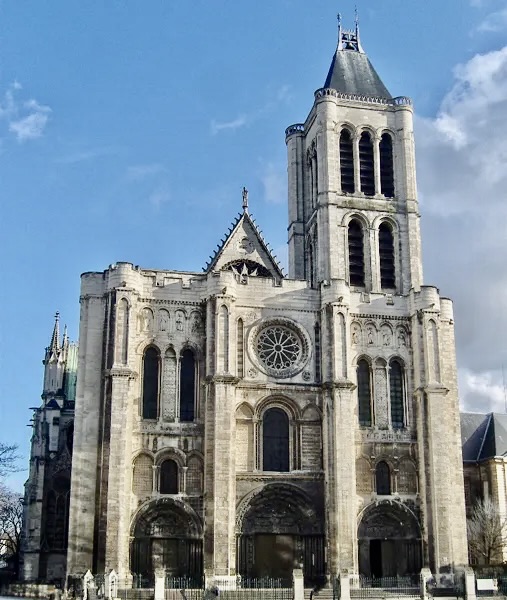
First, he rebuilt the West front, with three doors to improve circulation (“the narrowness of the place forced women to run to the altar on the heads of men as on a pavement with great anguish and confusion”, he wrote), and twin towers. (One tower was taken down in 1840s.) It was modelled on Roman town gates: the West front was to symbolise the entrance into the city of God, and to be a threshold on the way to Heaven, towards the light of God. “Noble is the work, but the work which shines here so nobly should lighten the hearts so that, through true light they can reach the one true light, where Christ is the one true door.” It incorporates the first rose window.
Leaving the nave intact, he remodelled the east end of the cathedral, the choir and ambulatory.
It is here that the Gothic was born, the first church to be transformed from stone cave of mystery to glass box of illumination. The ‘French Work’ that would dominate architecture until the Renaissance, and that represented a newly self-confident and upreaching Christianity.
Panofsky sees Gothic architecture as a working-out in building of the Scholastic philosophy that was thriving in Paris at the time.
But more interesting is what Suger took from the writings of St Denis. Or what he thought were his writings. In 835 it had been ruled by the church that St Denis was Dionysius the Areopagite, converted by Paul in Athens, and also the author of Neoplatonist texts that circulated in his name. Neither was true, as Abelard proved. What a chapter in the novel it would be, where Suger wrestles with his conscience! To accept the literal truth, as demonstrated by Abelard? Or to adhere to the 835 ruling, which connected Paul, Denis, and the texts in a higher, symbolic (and more convenient) truth that would justify the Gothic in the name of the saint of his church, of France itself? For surely Suger was intelligent and knowledgeable enough to know what was the literal truth. He chose to abandon the troublesome philosopher Abelard to the self-righteous Bernard, the papal court, and a trial for heresy.
It was one of the many occasions on which the church of the period abandoned the literal truth for some notion of a ‘higher’ truth.
And in so doing, opened cracks through which would filter and then flood the Renaissance, then Scientific Rationalism and the Enlightenment, that would challenge, compete with and eventually defeat religion as the ‘imagined reality’, as Harari calls it, that underlies a society.
From the writings of Pseudo-Dionysius (in fact a fifth-century Syrian), Suger took firstly his vivid sense of the aesthetic and imaginative beauty of the sensible universe, pervaded, from the perspective of divine beauty, by interrelatedness and harmony.
Then, the importance of light as an attribute of God, a sign of his working. Because light, like God, can penetrate substances without breaking them.
From this came the lux continua of Gothic architecture, a conscious control of the condition, quality and distribution of light within the building.

Inside at last. What I notice first is the scale. After the grandeur of Amiens, the vastness of Beauvais, this is not a place to awe, but a space in which to worship; this is a church.
Second, compared with them, is the simplicity. Or, rather, the straightforwardness. The pointed arch, the ribbed vault, the flying buttress, the rose window, the tripartite West front, each has a religious purpose, each is economically used. Here architecture is a means to an end, without exaggeration or elaboration.
And third, when I reach the East end, Suger’s masterpiece, I feel the exuberance, the thrill, of the uprising and then the splaying out, spraying out of the vault ribs. The upward motion and energy of a fountain, and then fountain upon fountain as I walk around the apse, the niches of saints’ chapels, individual, while sharing the general energy, the one and yet myriad-coloured light. He tore down the individual cave-like chapels and created a space of radiating chapels, around a soaring, light-filled choir. With twelve pillars to represent the apostles and prophets, using pointed arches, ribbed vaults, clustered columns supporting ribs springing in different directions, and flying buttresses that enabled glass, multi-coloured glass, to replace masonry. No wonder Stephen Murray speaks of Suger’s “ecstatic hovering in a remote in-between realm.”
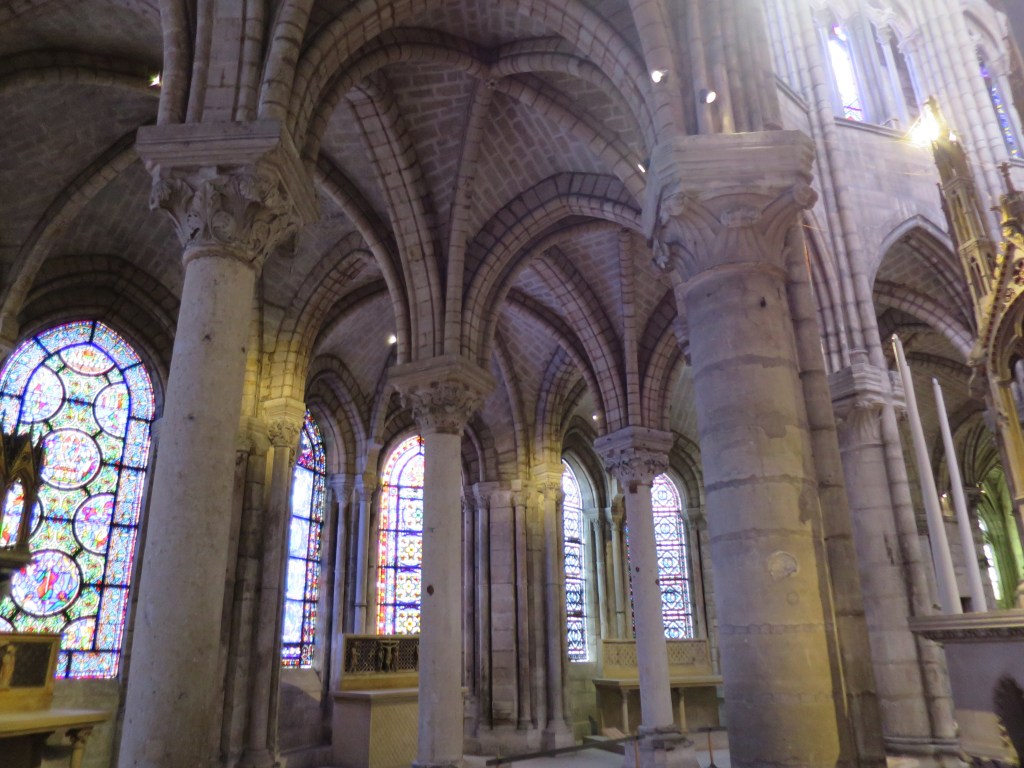
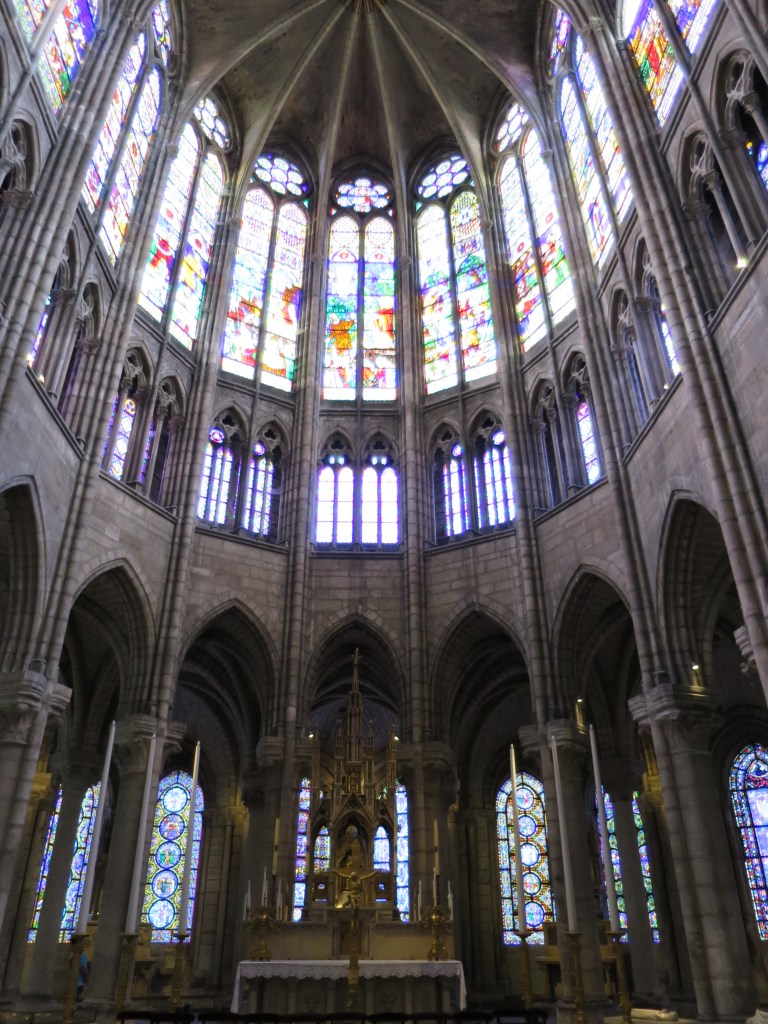
Turning on the spot, I’m surrounded by upgushing fountains of stone, and I feel the thrill (that word again) that must have filled them, commissioner and builder, abbot and clerk of works, when they saw what they had created, made happen, a multiplicity of reachings-up that, because they are reaching up towards the same end (or beginning?), they connect, unite, into a whole. That holds aloft, makes, a whole church.
And the sense they must have had, the commissioner and the builder, of having achieved it. Of having stepped into the unknown; and found through there, beyond, something new, that they had discovered by bringing into being. That within the theory (not, of course a theory to him, but the writings of revelation) was a new reality. And in that new reality, a new closeness to God. I imagine Suger coming here at midsummer dawn, as this space filled with light, surrounded by light, and more light, and himself filling with light, and – knowing God.
Being in this space, and moving around in it, and remembering how these new surfaces and spaces enabled new possibilities and developments in music, and seeing the light, and hearing the music, I remember further, in Pseudo-Dionysius, this: Ascending up from the particular to the universal, stripping off all qualities in order to attain a naked knowledge of the Unknown, we may begin to see the super-essential Darkness that is hidden by the light of existent things, “when our soul, becoming God-like, meets, in the blind embraces of an incomprehensible union, the rays of the unapproachable light.” Blinded, we see. For God would exist not in the light, but in the darkness beyond light. If He would be.
Amiens is grand, aesthetic perfection (truly “The Parthenon of the Gothic”).
Beauvais is Gothic Romanticism.
Saint-Denis is architecture that articulates faith, both reflecting and strengthening it. An architecture that could lead one to faith. And the more touching because of that.
Outside, the beggar woman continues her complicated acts of self-abasement. Even beggars have to perform these days, it seems. (“Be sure only that you deserve to have it to give.”) My coins had gone into her rough, brown hand as I went in, with the brief, reassuring grip I can never resist giving, meaningless to her but not to me.
Clouds have built up, in a sky livid and bruised, and there are flurries of wind, miniature dust devils swirling up papers and leaves in the wide space in front of the basilica, an overheated atmospheric energy that produces a brief shower. And then – all this day-long build up for that? – it dissipates.
I stand, looking across the open space in front of the West front, to the complication of a multi-ethnic, multi-cultural society that is struggling to work out and come to terms with its complementarities and contradictions. Exemplified here, in Saint-Denis.
For Saint-Denis is where the centuries-long compact between Crown and Church was established and maintained. The apse is less apse than mausoleum of the French kings; crowned in Reims, buried in Saint-Denis for over a thousand years.
But throughout the twentieth century Saint-Denis was vehemently anti-clerical, left-wing, Red, and seemed the precursor, the exemplar of the final success of the Revolution, the victory of the proletariat – The People, les citoyens – after the century of bourgeois appropriation.
Now there is confusion. There is the clear failure of the Communist ‘solution’. And there is a destabilising level of immigration, of people who on one hand are proletarian brothers, on the other are both competing for the resources that have always been limited (jobs, housing, services), and disrupting once-stable communities. As well as a sense that the national government is concerned less to solve than to contain, “the problem of the banlieues“, with the ethnic French trapped along with them in these containers, these kettlings.
So, there is the rise of the National Front, and of fringe groups nostalgic for the days of King and Catholicism, and a great deal of confusion. I have already found one Saint-Denis website on which a Christian white woman says, with assurance and certainty, that the aim of the Muslim community is to take over the basilica and force all Christians to convert to Islam.
My bike is fine, of course, untouched. I set off south, the few miles along the Meridian to Saint-Ouen. Past the Stade de France. It was intended to be the centre-piece of the 2012 Olympics. I wonder what changes might have been wrought in this troubled area by the Olympics? But, as in London, probably grand gestures, destruction of local communities, and yet more gentrification.
The road is solid with rush-hour traffic and I walk along the pavement. I cross a motorway, into Saint-Ouen. I’m soon at my hotel.
The hotel is run briskly by a Tunisian, white shirt, bow tie, but waistcoat hanging open, quick, friendly, watchful. He has worked hard, long hours, as a barman and in catering, he has learned, saved, and now he’s bought this place from the Aveyron family who opened it three generations ago. (6,000 Aveyronnais opened Paris bars and restaurants in the nineteenth century, including La Coupole and Deux Magots; they still have a weekly trade paper, L’Auvergnat de Paris.) These sons of immigrants have retired to one of militantly-white outer suburbs, in the ‘couronne périurbaine’. (Couronne means both crown and wreath.) And spend summers in their house in the village their forebears came from.
The bar is open from very early to very late, catering for the early-morning North African street sweepers, the coffee-and-croissant breakfast trade, the little old man from around the corner who nurses his verre rouge, slim, hunched men and women who lunch with laptops, oblivious of their surroundings, women with excited laughs taking a break from shopping, groups and couples eating together; and then the long, sociable café evenings, and the last man, staring into his glass, steered gently to the door after midnight. The rooms are priced for passing trade. Paris life (for this is Paris, now that so much of the area inside the Périphérique has been gentrified out of the reach of Parisians) passes before those watchful brown eyes, as he briskly shows me my room, gives me codes for door, room, Wi-Fi, and then, seeing I’m not happy with his reassurance that my bike will be fine locked to the railing outside, the code to the ground-floor disabled-access room for me to park my bike in.
I climb, heavy-legged, the narrow stairs.
The place has been refurbished to within an inch of its life. The already-narrow corridors have been made narrower with grey plastic wall panelling, black detailing, black plastic doors, generic prints, all glossy and wipe-clean. The ceilings are black, with recessed lights. There is no daylight, just the brief duration of the pressure-switches. No keys, it’s all coded. A modern hotel has been squeezed into a traditional hotel, as shiny plastic water pipes are fed down decaying metal ones. Old Paris hotel rooms used to have memories; now they have finish. But I have a window, with a Juliet balcony, overlooking a Paris street.
I had expected to collapse after my tough day in the heat. But after a shower, a cup of tea and a snooze, I’m ready to plan.
Tomorrow, I have to: go to the Saint-Ouen flea market; cross Paris; visit two cemeteries and two blocks of flats; buy a tent; and get to a hotel at the southern end of Île-de-France over 50 miles away: on a Saturday with all the weekend traffic. I’m unnerved by two failures in three days.
I check and find that I can take the bike on the RER, the new metro service. I could take the RER to Vitry-sur-Seine, cycle across to Arcueil (for Satie), on to Vigneux-sur-Seine (for Gabrielle), then to the Decathlon superstore at Saint-Genevieve-des-Bois to buy a tent, and back to the hotel at Fleury-Mérogis … Relieved, I go out, to wander round and find food.

Much of Saint-Ouen is run-down, awaiting the leap of the middle class across the Périphérique. There is still the huge Citroën factory, so long a hotbed of left-wing activism.
But, too, there are the first signs of Saint-Ouen’s transformation from industry to services. This is on a tourist-information board outside a fine art deco/modernist brick building:
‘In 1838, Henri Ricqlès, a chemist in Lyon, created a mint alcohol which he marketed as a tonic.
‘In 1898 the Ricqlès company established a distillery near Saint-Ouen docks to produce this mint alcohol. It later diversified into mint sweets.
‘Most of the workforce were women, 50 in 1902, 200 by 1929.
‘The present buildings date from 1936 to 1938.
‘In 1970 Ricqlès took over the Zan Liquorice company and became Ricqlès-Zan. At the end of the 1970s the company stopped production and switched to storing, packing and selling. In 1980 it had 67 employees. The company left Saint-Ouen in 1987.
‘In 1954 a soft-drink version was introduced. It is now owned by Dr Pepper, and distributed by Coca-Cola.’ The industrial century in a nutshell.
It is now the offices of an international business consultancy, drawn by the retro-chic of the building, and the proximity to the RER station, to bring its employees in from less dubious suburbs, into this quartier of ‘the dangerous classes’, an early-adopter, in place as gentrification gathers pace around it. The post-industrial century in a nutshell.
But again, after my socio-political grumblings, as I wander the streets I experience the effortless way Paris turns itself into art. A building covered in netting that combines a Christo wrapping with an Oldenburg out-of-scale object that’s been fished out of the river in a giant’s net. And a huge fir tree between two buildings, much taller than they, as if a discarded Christmas tree has in the night grown enormous, and must be decorated with giant baubles, huge lights, and will sprout vast parcels, as surrealist celebration, and – why not? – fetish of a new cult. One can see all art movements, including ones not yet invented, and whole anthropologies in Paris, just by wandering its streets.
I eat at a Chinese café-takeaway, where you select dishes from the display, pay by weight, and then they’re microwaved. I drink Chinese beer with it.
I am feeling better, and in the night decide that I won’t take the train. I will cycle across Paris.
Day 7: St-Ouen to Fleury-Mérogis, 53 miles.
The flea market. Reuniting two lovers. Suzanne’s grave. A hectic ride across Paris. Satie’s flat. The undertaker. Erik’s grave. Cultural tourism. Gabrielle. The bell not pressed. Depression in a metal cell.
I eat breakfast in the bar. Bright sun outside, washed streets, deep shadows, few people. A bar waking up, stretching, preparing for the long day. It is run this morning by a red-haired girl, competently in charge. This man is tolerated, served quickly with his too-early glass of wine. This man, a valued customer, is greeted with extravagant air kisses. An old man shuffles heavily in, disappears at the back. She rushes after him with coffee, more coffee, and then a plate of food. He is to be kept sweet, he’s the chef, and it will be a busy Saturday. I could sit here all day, watching from my invisibility a day in the life of a Paris bar, making notes that by closing time would be a book, as Georges Perec did near Saint-Sulpice. But I have to get on.
I had suddenly realised in the night, recovering from the physical strain of the day, and my loss of nerve, that the best way to cross Paris early on a Saturday morning is by bike. It is, after all, hardly 6 miles from Périphèrique to Périphèrique. Without the weekday deliveries and commuter traffic, and knowing the streets along the Meridian well, having walked them several times, it should be straightforward. There are even cycle paths in places! So now I can do what I intended to do: connect two lovers, once joined in Paris, long separated.
I cycle to Saint-Ouen cemetery. It is vast, ordered, municipal, the graves are in tight, symmetrical rows, with gravestones like stone coffins. How Suzanne Valadon, ‘the mistress of Montmartre’, would have hated it! Here is her grave. Her funeral in 1938 was attended by Picasso, Braque, Derain, and her troubled son, Maurice Utrillo.
She was born illegitimate in 1865, and from nothing she worked her way, from laundress, to trapeze artist, to the model and mistress of artists, to acceptance by them as an artist. A woman who lived in her own uncompromising way in a man’s world, and in her female nudes showed a new way not just of representing, but of seeing the naked woman.
One of her many lovers, and for a very short time, was Erik Satie, the composer and musician, a gentle, otherworldly soul who was drawn like a moth to the flame (how appropriate the cliché!): illuminated by the light, and heated, just once in his life, by the fire of this life-filled woman. He embraced it, pressed it to his neglected heart. But when he was left holding emptiness (how quickly she moved on!), and he had “nothing but an icy loneliness that fills my head with emptiness and my heart with sadness”, his angel’s gossamer wings vaporised, and he fell. Hard. Now wingless, he crawled away from the exuberance, vitality and vivacity of Montmartre, to the grey anonymity of the suburb of Arcueil, south of Paris, to remake his life.
And of course, for me Suzanne was Melanie, the romanticised femme fatale of my youth, and Satie a tragic hero I could identify with. And wouldn’t I, like Satie, with “nothing but icy loneliness …” etc., limp away, live secretly, change unseen, become who she had seen I could be (how clearly she had seen! How we need that!), and would say, ‘is this you? You did it!’ Of course I never saw her again. But she changed me, and I changed my life.
The flea market at Saint-Ouen, the biggest in the world, was once a place of quirky characters, both sellers and buyers, who had the knack of making the discarded the desired, of creating a theatre of imagination. It was a favourite place of the Surrealists. I came here with Gabrielle. We bought a birdcage and a well-thumbed copy of Jacques Prévert’s Paroles, carried the cage, with the book inside, back to the top-floor flat she’d borrowed in Rue Quincampoix, made aeroplanes of each of the poems and flew them across to the wide space in front of the Pompidou Centre, watched people pick them up and read them. Each of the poems except ‘Pour faire le portrait d’un oiseau’ (‘To Paint the Portrait of a Bird’), which we folded up and slipped into a gap in a door frame.
Now the flea market is an enormous commercial enterprise.
Except at the edges where, a sign of the times, it has reverted to what it was when it began, the market of the chiffoniers, the rag-pickers, who on the glacis (the open area in front of Paris’ defensive wall), La Zone, built squatters’ shacks and gathered and sorted and sold Paris’ waste. This was before M Poubelle, with his dustbins and municipal dumps, put them out of business from the 1880s. The city wall, having proved useless against the Prussians in 1870, was demolished in the 1920s, and the Périphérique ring road built on the line of it in the 1960s.
Now, gathered in the dank gloom under the Périphérique is a sorry collection of desperate-looking people, with pathetic objects, worn cases, broken toys, old clothes, rags, anything to sell. The rag-pickers are back, the squatters’ shacks – visible from the Périphérique – are back, the brief era of reducing inequality is past, and the poor are once more powerless.
I cycle under the Périphérique. In wealthy areas, the ring road has been put underground. In poor zones it passes on stilts at bedroom height. It is 35km long. The record time for completing the circuit is 9 minutes 57 seconds, on a motorbike.

And I am in Paris.
Bronze medallions were set into the pavement along the 9.2km length of the Meridian through Paris in 1994. I have walked it several times, recording buildings, places, people, associations along the way. The first time I tried to cycle in Paris, I hardly survived the crazed 1960s traffic. Now there are vélibs, bike lanes, and a new regard for the cyclist. And it is a sunny Saturday morning, early, there are few cars, the bright sun is flickering through the plane trees as I rush along, and water is gushing from the gutters across the fan-shaped patterns of pavés.
Across the boulevard and into where stood the mean tenements Céline wrote about so vividly in Journey to the End of Night, now replaced with council flats. Then the familiar world of Paris quartiers, seven-storey walk-up Haussmann apartment blocks, in the streets are bars, local shops, and life revolving around small, oddly-shaped squares, with trees, benches, a play area, green iron newspaper kiosk, and maybe a metro station, and here, a street market setting up.
Climbing up to Montmartre, with its windmills and vineyards that thrived because it was outside Paris, subversive and cheap, where the Commune began, the heart of art for a generation, the dream of art ever since. Suzanne and Erik lived on this street, Toulouse-Lautrec’s studio is … too late, past. An obelisk marks the Meridian, invisible in a private garden.
I drop down, past where Vincent van Gogh lived with Theo, on the hill up which M Citroën tested his cars, past le Chat Noir where Satie played, ‘Passant, soi-moderne’ over the door, across the crossroads where Nerval saw the star that lead him to the river. An extra horse was hitched here, to get the omnibuses up to Montmartre.
Across the Haussmann boulevards, past Proust’s cork-lined apartment, through the Passage des Panoramas, one of the iron-and-glass arcades that so fascinated Aragon, and later Walter Benjamin, starting him on his ‘Arcades Project’ – I shouldn’t cycle, but can’t resist a Bande à Part moment as the astonished shopkeepers preparing their displays shout after me as I skid across the washed tiles.
Into the heart of the State, past the Stock Exchange and National Library. But, too, where Isidore Ducasse, having written his incendiary Maldoror – unread before being rediscovered by Aragon (a battered copy of the Belgian edition, found in Saint-Ouen flea market? Why not?) – died in a cheap hotel, starved to death in the 1870 siege.
Past the Palais Royal, where Nerval in his youth walked his pet lobster.
Through the Louvre – more shouts as I scatter earnest Americans following Dan Brown’s Rose Line – and out to where, staring up at his star, Nerval hanged himself. And I’m at the Seine.
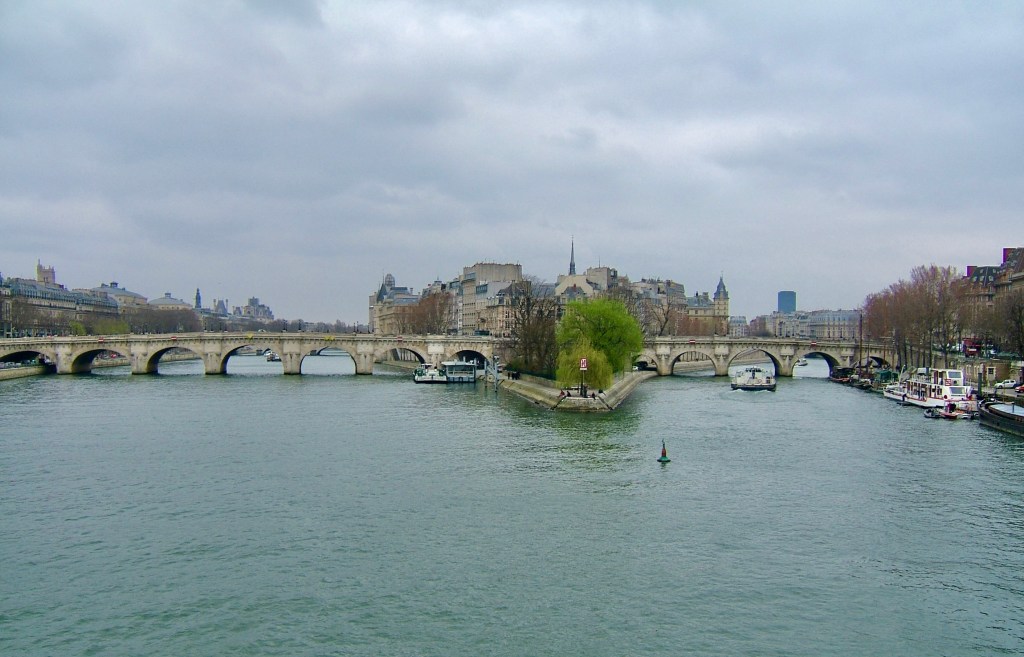
After the hectic rush and the closed-in buildings it all opens out, and I can relax and allow the vast expanse of sky to materialise in front of me, the broad, bright, softly-flowing river, the dreamy world of the quais at the water’s edge to appear, and I can take it into myself.
I stop, to allow myself to catch up. I’ve been like Limpy in Songlines, trying to sing the song of walking the landscape while travelling in a jeep. I’ve passed so many people, places, memories. In thirty-six minutes.
Upstream, the river glitters around the Île, Notre Dame, the Pont Neuf. It is the view that haunted Lantier in Zola’s The Masterpiece, the view so many, hand in hand, have fallen in love to, perfect Paris. Christo once wrapped the Pont Neuf in gold. Imagine.
I push my bike across the Pont des Arts. It is eerily empty. It is a pedestrian bridge, wooden-decked, and until recently had wire mesh at the sides, the river glittering through the mesh, the mesh heavy and shining with lovers’ locks. Now they’re gone, replaced by solid panels painted with a wire mesh pattern, and ‘love is the key!’ I have never understood the association of love and locks, but, with their spontaneous felt-tipped initials and hearts, their memories of moments, they humanised, democratised and brightened up the bridge. So, they’ve been removed, and the view of the softly moving water has been sealed off.
Over the river, and on. North of the river, the streets zigzag across the Meridian. South, the Left Bank, they follow the line directly. Past the street of Christo’s first ‘intervention’ (he blocked it with barrels), and the site of Debord’s famous graffito (how they must wish they had not cleaned it off, preserved it under Perspex, a tourist site!), through the once-Bohemian Left Bank, now smart galleries rather than radical bookshops. Into St-Germain, past Café Flore and Deux Magots. The cobbles, used in 1968 to build barricades, beneath which is the dreamed-of beach, are now sealed under two inches of tarmac. Past the bar where the seventeen-year-old Rimbaud electrified literary Paris with his reading of Le Bateau ivre, and past the wall on which the text of the poem, vastly enlarged, has now mysteriously appeared, “Comme je descendais des Fleuves impassables, Je ne me sentis plus guidé par les haleurs …” no longer guided …
Past the church of Saint-Sulpice, key to The Da Vinci Code, and the café where Perec wrote his ‘attempt at exhausting a place in Paris.’ Through the Luxembourg Gardens – ‘no cycling!’ – past a circle of three empty chairs, the air still vibrating from the just-ended conversation, and on past the Observatory, the point of origin of the Meridian. Here is the brass strip embedded in the pavement, north-south, and there the plinth on which stood a statue of Arago, surveyor of the Meridian, and director of the Observatory, until melted down by the Germans in 1940. Past the last vespasienne (pissoir) in Paris, very smelly. Over the Catacombs, the underground quarries from which the stone that built Paris was dug, now full of bones. Through the Montparnasse of Picasso and Modigliani, another heart of art, long lost in modern developments. Past Beckett’s flat –
To the Villa Seurat. Where Henry Miller wrote Tropic of Cancer – I pause, touch the door. A well-dressed young man comes out, I say ‘do you not realise …?’, but of course he does not. On.
Now I’m exactly on the Meridian, on one side was Soutine’s studio, the neighbours complaining of the smell from the rotting carcasses he painted. On the other the vast mental hospital of Sainte Anne, where Breton’s tragic Nadja was detained. Up to the Parc Montsouris where the Dreyfus conspirators met, to the 1806 obelisk that marks the Meridian. Look down into the tunnel of the ceinture railway that circled Paris inside the old wall. A last look back across the panorama of Paris, down to the Seine, up to Montmartre, wide, bright and open. I have crossed Paris in an hour. And each place I passed I might have marked with another name, a different event. I cross the Périphérique, and I’m in the ‘red ring’ of old Communist suburbs.
Arcueil was one of the red suburbs, left-wing strongholds. Familiar from the immensely tall aqueduct, with its slender pillars and round arches (reminds me of de Chirico), bringing water to Paris. I’m looking for Erik Satie’s apartment. I pass a block that looks familiar from photographs, but there’s no plaque, so I press on. Eventually, after less-than clear instructions from a librarian, in a ‘mediathèque’, (no sign of books), I arrive back at it: it is the block, recently done up, with new windows and security doors, and repainted. The simple plaque has been replaced with a stainless-steel cut-out of Satie as a Chaplinesque tramp, and this, by his friend Cocteau, ‘Satie est un ange (bien déguisé), un ange d’Arcueil se cachant’. (‘Satie is an angel, well-disguised, an angel of Arcueil in hiding.’ Or, ‘hiding in Arcueil’.) His apartment was a squalid chaos. As he lay dying in 1925, lacing his medicine with opium and champagne, he reproached his opinionated friends, ‘why attack God? He may be as unhappy as we are.’ The apartment will now be tastefully chic, perhaps with artful references to the two grand pianos, one on top of the other, the seven identical grey suits, the collection of umbrellas.
In fact, Satie moved here not because of a broken heart, but because it was cheaper, and away from the temptations of Montmartre. How easily I used to fall for romanticised bourgeois tales of poets and artists ‘maudits’! In Arcueil Satie was a respected citizen, who walked each day to Montmartre to play the piano in night clubs, and meet his avant-garde friends, stopping on the way (at rather too many bars) to telephone them to make appointments. He was championed successively by Debussy, Ravel and Cocteau, worked with Picasso, was one of the original ‘Les Six’ …
I cycle around, up and down, looking for the cemetery where he is buried. At last I see a funeral parlour. They’ll know. Hot and sweaty, I burst in.
One of those moments. Inside, a hushed solemnity. The dark scents of funeral flowers and coffin wood, gentle music. A woman behind the desk, professionally compassionate. A small man, with a sad face and drooping moustache, cap literally in hand, sits in front of her, making himself small. Bewildered, his wife of fifty years gone, poor, and faced with pressure to make this a good funeral – does he not owe it to her? It will be the only time he travels in so big a car. But, the prices … I burst in. He looks shocked. She looks pained. ‘Pardon,’ I stutter, ‘Desolé,’ I stammer ‘… la cimetière?’ Coolly she looks at me. Coolly she looks past me, with the faintest of head movements. Across the road, twenty yards away, where his wife of fifty years will be buried in two days’ time – he looks and droops a little more – is the cemetery. I back out, apologising, cursing myself.
It is a simple grave, very similar to Suzanne’s. But his is in a small cemetery, and set against a wall, warmed by the sun. On the plaque, ‘Ici repose un musicien immense, un homme de coeur, un citoyen d’exception’. There was to be a monument, but they couldn’t raise the money. I place the flower I brought from Suzanne’s grave. The least she owes him. Then I water the other flowers.
What is it, this searching out of dead heroes? Why fifty years ago did I so want to look up at the window of the apartment in Montmartre where Vincent van Gogh lived with his brother? Why have I followed him from Zundert to The Hague, London, Ramsgate, the Borinage, Drenthe, Brussels, Arles, Auvers …?
So, cultural tourism. When I first went to Saint-Rémy, fifty years ago, there was no sign of Van Gogh. He was simply a former patient of the nuns who still ran the hospital there. Did one of the older nuns, in her eighties, maybe even remember him? Nobody asked, in those days. Now his room has been recreated as it was then, there is a gallery and shop. Around Saint-Rémy, reproductions of his paintings have been set up at the places he painted. In Arles, the hospital has been repainted in the colours his picture portrayed it, not as it actually was when he painted it. The bridge he painted, long knocked down, has been replaced with a similar one brought from elsewhere. It won’t be long before the Yellow House – destroyed in the War – is recreated, again as he painted it, not as it was. This is cultural tourism as theme park.
But there is, I believe, a deeper level of cultural tourism. Which has the elements of pilgrimage. There is the journey, which costs, in money and time, and often discomfort. There is the object, whether cathedral or house or painting. There is the preparation of the self, with knowledge, anticipation, and focussing. And there is the sense, presumption even, that the self will be changed by experiencing, in a heightened state, the revered object, the special place. I participate fully in this sort of cultural tourism. Crudely, art as religion, art objects as relics, art galleries as churches, art the locale of whatever spirituality we’ve left ourselves with.
But why our interest in where heroes were? H V Morton, the interwar travel writer, titled his books In Search of. Richard Holmes writes of travelling “in the footsteps of” his biographical subjects. This in order to make a connection with the subject, so one can exist in parallel to him (her), with the subject as imagined presence, as the biographer unfolds their life. For me, it’s about being in the presence of the hero. Across this threshold Satie stepped each morning, turned – left? right? – and walked along the Meridian, through a gate in the city wall, Montparnasse, across the Place d’Enfer, over the Seine, up to Montmartre, composing to the rhythm of his footsteps, the tapping of his umbrella.
And what may become clearer to me, on this journey that is fixed in its central, linear purpose, but where the choices of what to be interested in around that line are so great, is noting who and what registers, interests, engages me, and how much. I imagine finding the ‘me of me’ in a three-dimensional Venn diagram, with ‘location of interest’ on the plane, and ‘degree of interest’ in the height.
Edward Thomas wrote: “Stay, traveller, says the dark tower on the hill, and tread softly because your way is over men’s dreams; but not too long; and now descend to the west as fast as feet can carry you, and follow your own dream, and that also shall in course of time lie under men’s feet; for there is no going so sweet as upon the old dreams of men.” I descend to the south as fast as pedalling feet can carry me.
Towards Vigneux-sur-Seine, and Gabrielle’s flat. The traffic is heavy, cross-currents of shopping, visiting and heading for motorways to escape the city.
I get to the Seine, wide and green, and make my way upstream, to Vigneux.
At the end of my novel Diggers and Dreamers, set in 1976, Kris is leaving La Balme, the smallholding in the Aveyron where he has been working for two years towards self-sufficient sustainability. He faces a choice. He can go back to England, to his wife who left La Balme and will never return, and resume there the life that living in France had interrupted. Or he can go to Paris, to the French schoolteacher who believes in La Balme and has renewed his vision of the possible life there. Where he can teach in winter, and work for the rest of the year at La Balme. She will come for the holidays. Together they will make it work.
A choice I made. Gabrielle’s flat is still here. All the blocks around have been demolished and rebuilt. Only hers is still here. The same door. The same bell-push. Is she still here? Of course not. And even if …? My finger hovers. There is an electric charge between finger and bell-push. Of course not. My hand drops. The bell not rung, the door not passed through, the road not taken. For I had returned to England.
Why am I here? A few months ago, I thought I was about to begin a new phase of my life. But it hadn’t happened. My life settled back. Now I accept that, rather than discovering what might be, my life is making sense of what has been. I have taken my place.
And having decided to follow the Meridian down France, and having found that both Vigneux and La Balme are close to the Meridian, I realised that they are chakras of the spine of France, and that one of the ‘desire paths’ along the Meridian, the ‘serpents of eternity’ around the axis mundi, passes through them. I will follow my own dream, and make of it and them what I can. My finger hovers. There is an electric charge between my finger and bell-push. Of course not. My hand drops. I turn away and cycle on.
It is a complicated journey through the outer suburbs, including a cycle path alongside the N7, called ‘the Holiday Road’, ‘the Road of Death’, before the motorways were built, when I first cycled in France, cycled it down the Rhone valley.
To Decathlon, a sporting goods retail shed, where I buy a tent and a sleeping mat. I will be camping for most of the next fortnight.
In Fleury-Mérogis I pass a wedding party outside a church, all black, men in black suits, women and children in brilliant colours, an easy, festive air, and arrive at my second Première Classe hotel. The same stacked containers, this one has three storeys, the same heavy security doors, metal window shutters and prison-like skeleton of stairs and walkways. The biggest prison in Europe is in Fleury. Many visitors must stay here. And inside the room, the finish that resists imprint.
One has to bring a lot of resource into a room like this, this room, because there is nothing here. I hadn’t notice in the Première Classe at Dunkirk, because I was full of myself and the coming trip and I’d arrived on a following wind. Now, after a tough week, of too much wind, too much heat, bike problems, the first week of four, on a journey I’ve hardly begun, and with little sign of the Meridian, I’m not sure I have that resource.
First, where to eat? The hotel is on a wide access road to the motorway, lined with council blocks. The small shopping centre is closed. There is a fast-food takeaway, Quick. But every time I go there, even at 10pm, it is too busy for me to cope with. Cars are coming off the motorway, fuelling-up with fast food, rushing back on.
Is there more to Fleury than this cut-price version of architectural Modernism, Corbusier parodied (or his ideal achieved?) – the wide boulevard, the tall, slab blocks set in green, the specialised zones? I haven’t the energy to look.
I spend a long evening in my sensory-deprivation cell, with no food. Low blood sugar brings a mild depression.
It is the end of the first week. It is unnerving to look at the map of France and see how far north I still am. Am I waiting for something to happen? I had expected la Méridienne verte to happen, that it would have substance, a suggestive dynamic that I could relate to, gain energy from, by interacting with. But it’s not there. I’m following something that doesn’t exist. It existed once, as an idea, an event. And it might have come into being by now. It was intended to have come into being by now. As a line of trees, a spine, a hiking route, a stitching-together of the length of the midline of France. That it isn’t there is as significant. I had expected this journey to be an experiencing and recounting of the various ways the Meridian is being celebrated, with each place expressing both its own individuality, and its place in the larger frame of la belle France. As each pays has its food, its language, its culture, so it would have its own way of celebrating. As a metaphor for France.
But maybe I’ve got this wrong. The original surveying of the Meridian was a grand endeavour, a dangerous exploration in which men lost their lives, by which France was revealed to be a terra incognita, new places were discovered, science at last got the measure of France. (Louis XV complained, when the first survey revealed that France was smaller than thought, that Cassini had lost him more territory than any king had lost in war.)
It was the beginning of the modern state.
The scale of the endeavour was so great that it was celebrated with obelisks along the line. It was heroic, a source of national pride.
Perhaps, in contrast, la Méridienne verte is just an idea, something dreamed up by an architect, a PR stunt seized upon by a government desperate to find a way of celebrating and commemorating the Millennium; but that, because it is an artistic and bureaucratic invention, without substance, it has no resonance for the French, for la vraie France?
Or, more worrying, that in the contemporary atomised world, in which businesses are more powerful than states, and Facebook ‘friends’ more real than neighbours, in which Guy Debord’s Spectacle, the commodification of culture and the recuperation of dissent, is ever more apparent, there is no place for nationality, locality, anything beyond the isolated consumer? Maybe the Green Meridian is a metaphor for France today … My journey has become the story.
A worried face appears at my window. Mine is the only window with the shutter raised, where the resident is visible. He has locked himself out of his room, his key card is inside. Can I help? I try my card, which of course doesn’t work. We go down to reception, which closed an hour ago, and find an emergency number to call. He calls the number, and they tell him that help will arrive within five minutes. How can that be? I imagine someone driving from a central depot covering all the hotels in a region. But in a couple of minutes a faded woman emerges from the back of the hotel, climbs the stairs with him, opens his door, walks heavily down and disappears into the back. It’s not the receptionist, and I never see her again.
I drink tea, dream of food, and go to bed.
Notes:
In 1954 Guy Debord wrote on a wall in the rue du Seine, ‘Ne travaillez jamais!’. ‘Never work’. This was photographed and sold as a postcard by a commercial printer. In 1963 Debord reprinted the postcard in his magazine. The seller of the postcard demanded a reproduction fee from Debord, for reprinting the image of his own graffito. Who owns what? Copyright such a slippery slope into individualism.
‘Sous les pavés, la plage’ was a 1968 graffito. Another was ‘Soyez réalistes, demandez l’impossible’.
Day 8: Fleury-Mérogis to Pithiviers, 62 miles.
Sunday driving. The Paris Meridian base-line. La France profonde. Bagpiper at the gates of noon. Where Norbert Dentressangle’s lorries sleep. France’s straight roads. Mutton cous cous. My first camping.
I wake to the sounds of the jungle. From early morning, chests are beaten, challenging roars are thrown forth and responded to in kind, there are excited monkey noises and the squawks of gaudy-plumed birds. What is happening? It is Sunday.
During the week, the French driver is an amiable herbivore, gentle, thoughtful, obedient, considerate to cyclists, waiting patiently at stop signs when there’s no one in sight, waiting for you, your bike. On Sunday, especially when aroused by the scent of a motorway, he becomes a snarling carnivore, get out of my way, this is my road. Sunday is Jungle Day. De Tocqueville on the French: ‘today the sworn enemy of all obedience, tomorrow attached to servitude with a passion that nations best endowed for servitude cannot match.’ Roll on tomorrow!
I hurry to breakfast and eat all I can, filling up for last night, and for the day. I feel stuffed rather than fed, but full.
A couple come in with their tiny, slender daughter, maybe three, with braids pinned across her head, pink ribbons, half asleep, trailing a pink cardigan and wearing an elaborate, pink, many-petticoated party dress, her dress for the wedding that she’s refused to change from, wanting always to be the princess, even in her sleep, to wake as every day.
I am beginning today by backtracking north, along the Meridian, to Juvisy-sur-Orge, where there is an obelisk commemorating the survey of the Meridian. It balances the one north of Paris, at Saint-Martin-du-Tertre. As the one in the Parc Montsouris balanced the one on Montmartre. French symmetry.
I repack my bags to accommodate the tent – so much stuff! – and set out. Heading north, I pass through the ‘real’ Fleury-Mérogis, with a busy market in the car park, shops and restaurants where I could have got food last night.
Working my way carefully north, at Epignay-sur-Orgue (where Nadja was in the asylum for eighteen months, visited by his friends but ignored by Breton), I come upon a concrete Meridian marker, an 2000, the first I’ve seen since Bollezeele.
Beside it a queue of traffic waits impatiently to get onto a motorway. As I pedal slowly past on the inside there are shouts from open windows and horn toots. Once it would have been ‘Allez Pou Pou!’, at an earlier time ‘Allez Louison!’ But it has been so long since there has been a French cyclist of note that all I get is the French equivalent of ‘get off and milk it!’ At least no cans are thrown.
Once past the junction, over the motorway that is a writhing, knotted snake of interweaving traffic below me, I am into quieter air, the somnolence of a suburban Sunday for those who are staying home.
In Epignay I stop to consult the map on my phone, and a woman asks if she can help. I ask, where is Juvisy? She says she can’t explain, but this young man will. A pony-tailed, round-faced, fringe-bearded young man of around seventeen steps forward and begins to speak. It is curiously theatrical. It is as if his whole life has been a waiting for this moment, as if he has spent years at this intersection, waiting for someone to ask – where is Juvisy? He explains fully and succinctly how to get to Juvisy, and then how to get to each part of Juvisy. He is word perfect. At the end of his long peroration, he beams. He has nailed it. If he were German, he would click his heels and bow. Being French, he stands smiling, round-faced and pleased with himself, absorbing the adulation. These theatrical moments happen more often in France than elsewhere: here the world really is a stage, and each stands in the spotlight of his own story.
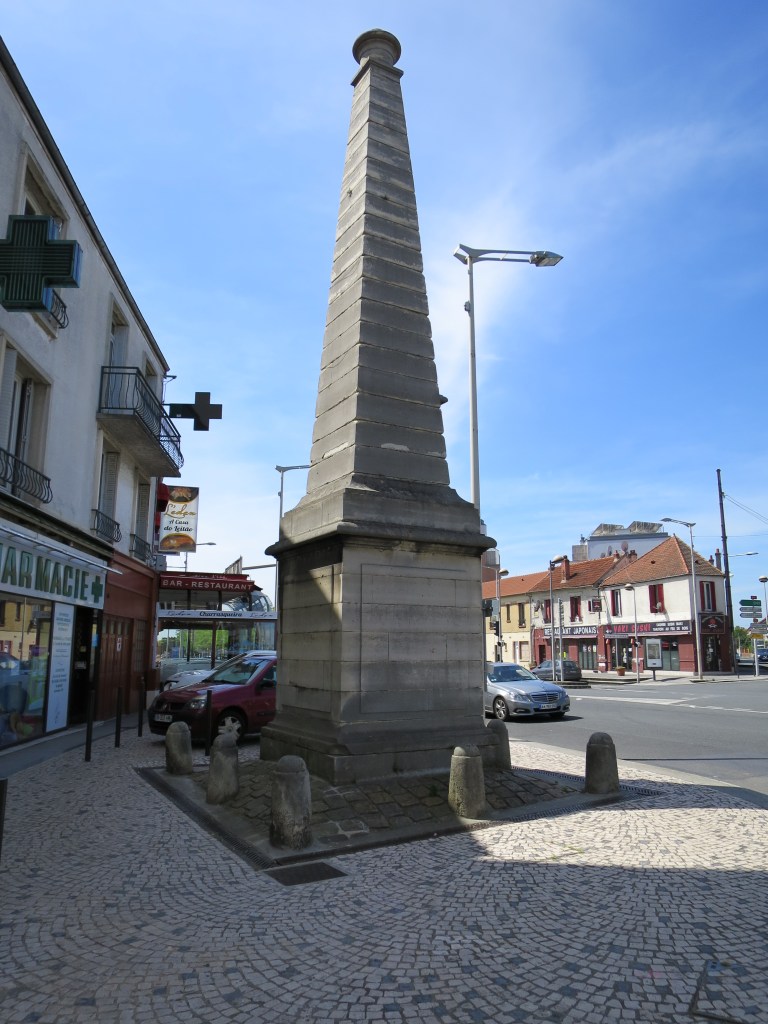
I continue up the road, and arrive not just at Juvisy-sur-Orge, but at the obelisk I’m looking for, la pyramide. On the pyramid, this: ‘The southern end of the geodesic base from Villejuif to Juvisy, 1670 Picard, 1740 J Cassini and Lacaille.’
In order to survey using angles and trigonometry, there needs to be one baseline, measured with great accuracy, from which all other distances are derived. This 11km line was measured using toise (just under 2m) length rods. This is the point from which the survey was begun, north and south. On the base of the pyramid is a modern surveying marker, from later surveys. It is redundant now that surveying is done from satellites. The original 11km line is under Orly airport. It was the first dedicated aerodrome in the world, opened in 1907 and blessed by the Archbishop of Paris.
I am glad I came here, to the starting point of the first survey of the Meridian. I turn around, speed back down the Meridian to Fleury-Mérogis, where I eat at Quick the meal I’d promised myself the previous evening, dreamed about, salivated over. Eighteen hours late, I tuck in. It is very disappointing.
But soon I have crossed the N104, which marks the southern edge of the Paris conurbation, and I am out, into – France.
It is a sunny June day. It is warm, but not the fierce, oppressive heat of Saint-Martin-du-Tertre. And I’m getting used to it, my skin is turning brown.
I’m cycling through rural France, between great open fields of wheat and barley and flax, past private walled domains, through mysterious woods. For a while I am accompanied by a gentle, green river. It is shallow, tree-shaded, with weed waving, fish holding themselves still against the flow, and patient fishermen. Through neat villages.
In one village the communal wash-house, the lavoir, has been renovated. Roofed but open-sided, with a large rectangular stone basin in the middle and rubbing stones around, it was where the women would gather each week. It is the first of several I come upon that have been renovated. I realise it is one of the French nostalgia points; it was the women’s equivalent of the bar, the place where they could come together, let go, be themselves, say what they wanted about their menfolk, their neighbours, the world. When we lived in France, we incomers were the only ones who used them; the locals were proud of their washing machines, or washed by hand at home so as not to be shamed by their poverty, or their lack of mains water. The tradition of the lavoir seems to be continued by the ladies’ hairdressers; even the smallest village has one, often just a front room. I wonder where the men go, with no bars left in many villages.
In 1940 Irène Némirovsky wrote, in her novel Suite Française, ‘Life in the provinces of central France is affluent and primitive; everyone keeps to himself, rules over his own domain, reaps his own wheat and counts his own money. Leisure time is filled with great feasts and hunting parties.’ I can imagine it little changed, except that the ‘primitive’ will have the veneer, as everywhere, of contemporary consumer goods.
After a good run on the bike, breathing the clean air of woodland and stream and prairie, and stretching my muscles, I’m just at that pleasant level of fatigue where a break is called for. I stop at a crossroads, in the middle of nowhere.
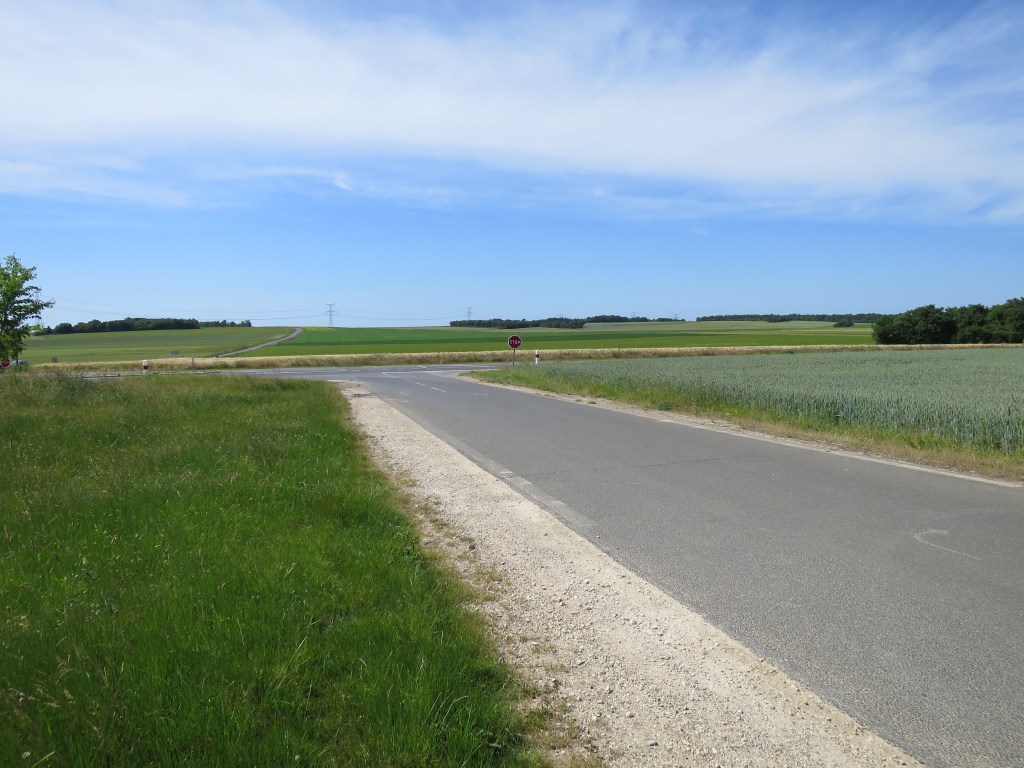
This is big country, the rich agriculture of la Beauce, large unfenced fields panels of different greens, rippling gold, hazy blue that stretch away in every direction, to woods, more fields, with a village steeple a distant punctuation mark. Wide blue sky with puffy clouds. Soft wind.
Big country so rare in England, so often come upon in France.
I break off a piece of baguette and eat it, with discs of saucisson I’ve cut against my thumb with my Opinel knife (I’ve kept it sharpened all these years, a knife that every Aveyron countryman has in his pocket. Forbidden on planes, but okay on the ferry). And another piece of bread, with a finger of dark Poulain chocolate pushed down the middle (I got this from the Autodidact in Sartre’s La Nausée, before I ever came to France). I drink Orangina, and eat a peach. This is it, this is la France profonde, I’m here.
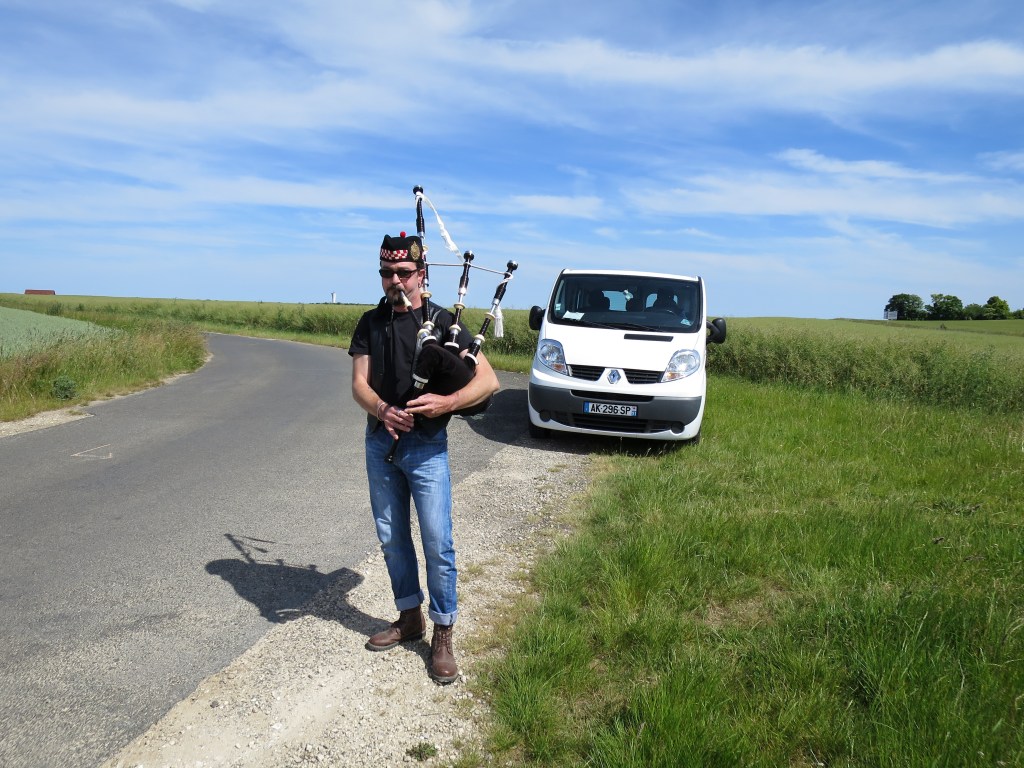
And then bagpipes begin to play. Fifty yards away, in the middle of nowhere, a young man in a kilt and a soldier’s bonnet is playing the bagpipes. For me? I rush over. Are you Scottish, what’s your name, where do you live, why are you here? I ask, in a rush. He is thirtyish, bearded, self-contained. He is French but of Scots descent. I hear his name as Michael Aye. He drives out from Étampes to be alone and play his bagpipes. I take his photo, shake his hand, and pedal on, accompanied by ‘Flower of Scotland’. I wave in that slow-motion way, like in Betty Blue. I’m in the world of all the films I’ve seen set in a perfectly-realised France. Now I’m in la France profonde.
A few miles on, at the edge of Malesherbes, in this rural middle of an immense nowhere, is a vast park of sleeping red behemoths. The giant lorries that criss-cross the continent. Red. ‘Norbert Dentressangle’. So this is where his beasts snooze, when they are not thundering along the motorways of Europe, and duelling with Eddie Stobart’s! There are new motorways everywhere in France, often N and D roads reclassified to exclude cycles and tractors, making route-finding difficult. They are full of these container-sized lorries that drive so close they become road-trains.
At Malesherbes I turn south west, towards Pithiviers, ten miles along one of the arrow-straight roads that lowland France is noted for.
Ascribed variously to the Romans, Louis XIV or Napoleon, most of them date from the 1740s, under engineer Trudaine’s direction when new, long-distance ‘Royal’ roads were built, straight ‘from steeple to steeple’, and lined with trees. The familiar ten-metre-wide avenues of plane trees, often painted white, slipping past the tarmac at night like metronomic ghosts, around which French writers and starlets regularly wrapped themselves in the 1950s, were their nineteenth-century successors. I’m never comfortable on these roads, they are too narrow for cars to pass if there’s traffic coming the other way.
But at least there’s a run-off at the side, as they are rarely kerbed. A Frenchwoman told me how unnerved she is by the hard edges of English roads, with kerbstones on even rural roads, the sense of confinement. French roads just peter out at the sides. Just as their arable fields are rarely fenced along the roads.
When I first encountered this, it felt like an invitation to enter. I couldn’t understand why the grapes weren’t stripped from the vines by passers-by, the cabbages not taken.
Now I think it may be a result of the Revolution, when so many rural domains were liberated from aristocrats and the church, and the ‘land of France’ became ‘ours’. Whereas in England that was the time of enclosure, the planting of the hedges that are so ‘typically English’, land as ‘property’, ‘keep out’, ‘trespassers will be prosecuted’.
And there is the French city-dwellers’ ongoing connection to the land, to their pays, a connection lost very early in England, in the Industrial Revolution that came so much earlier to Britain than to France. At heart many French feel themselves country folk. The word paysan is a title of sturdy independence, with none of the negative connotations of our word, ‘peasant’.

I cross the Meridian, marked with a splendid twenty-foot high stone obelisk, cube upon cube, a tapering needle, topped by a stone ball and a lightning conductor. Inscribed ‘Meridian of the Paris Observatory, established by Cassini in 1748’.
There are open fields all around, but no modern marker, no avenue of trees … As I park my bike to photograph it, a concourse of French classic cars, including a couple of Simca Arondes, motors slowly past, all pampered and polished and proudly driven. All these ‘classics’, I realise, were built in my lifetime, are the everyday cars of my youth.
A very tall, oddly-shaped church spire announces Pithiviers.
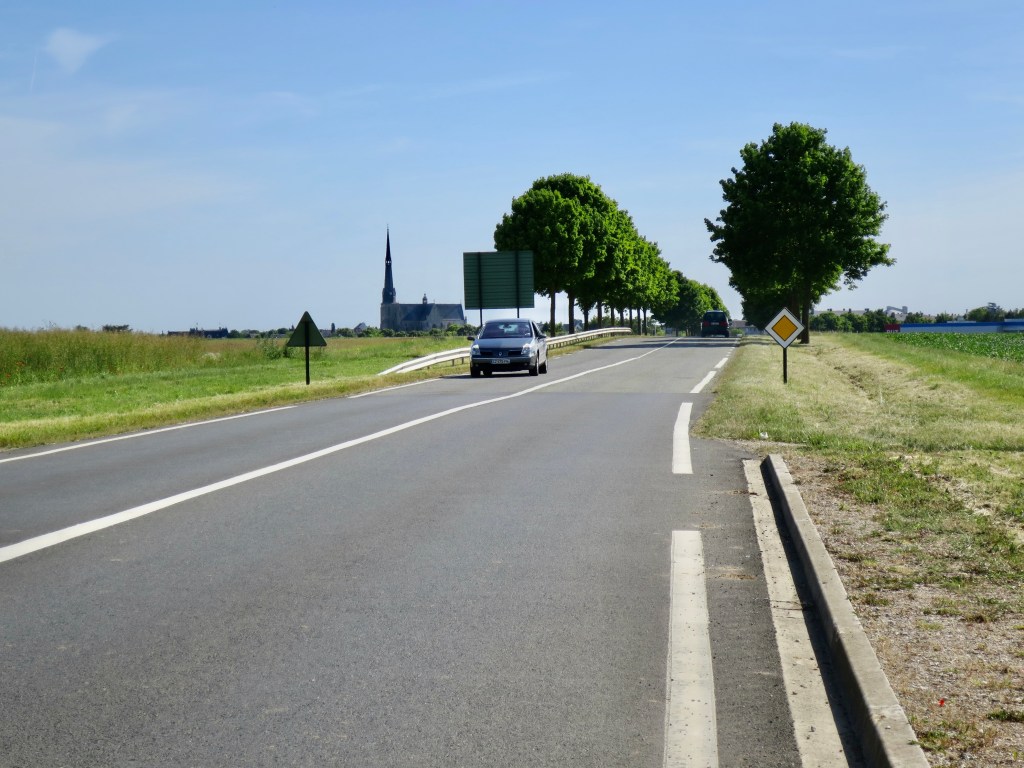
I have no reason to come to Pithiviers, but it is a convenient place to stop, and it has a camp site.
I know two things about Pithiviers, one of mild interest, the other disturbing. The first is that it is the name of a sweet, puff-pastry pie with almond-paste filling. The second, that it was the location of an internment camp, second in importance only to Drancy, where Jews were gathered, separated from their children, and transported to concentration camps. Irène Némirovsky was arrested in Vichy France by the French police in 1942, even though she was a Catholic convert, and deported from here to Auschwitz. She died two months later.
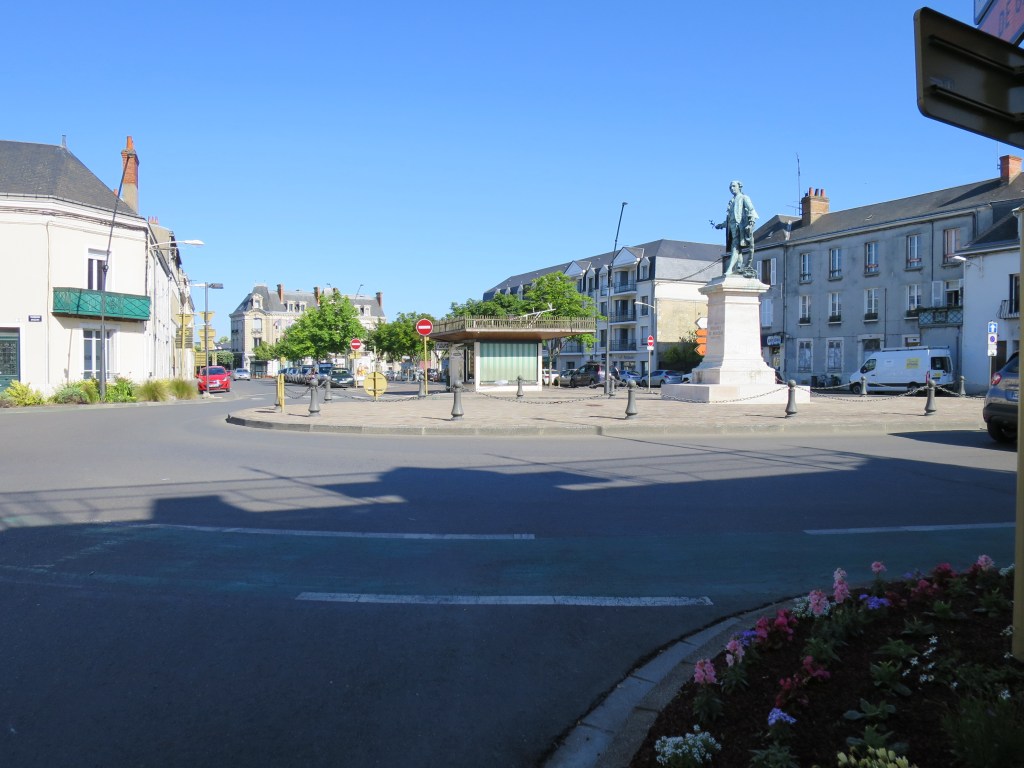
I cycle up to the main square. It is a wide, empty, windswept space. I imagine it in winter, the bare plain, the icy winds sweeping in from the east. It feels as remote as a mid-western US state. Even in June I’m finding it a wintry place.
A man approaches, speaks. I have by now realised that, with my reflecting bands, baggy shorts, white hair, and overloaded bike, I am, in rural areas at least, a phenomenon, to be spoken to and bon-courage-ed, even bon-chance-ed. He asks where I’m going. I say I’m looking for Camping Lilas. Non, non, he corrects me, shaking his head emphatically, you’re looking for Camping Laas, and it is four scenic kilometres (four scenic kilometres! I’m tired, and any number of kilometres isn’t ‘scenic’) along the turn-off at the bottom of town. I’m surprised, as my information has it close to town. I freewheel down through town, find the turn off, signed Camping Lilas, and come to it 200 metres down the lane.
What did he mean? An impish figure who appears, gives me false instructions, and then disappears? But what if I had carried on those four kilometres? Was I being guided to a magical, life-changing place? Would the ‘scenic journey’ itself have been transformative? Was he the spirit of Hermes, who both guides and leads astray …? And how to know which?
I check in at the campsite. The owner sits in his little hut, signs me in, takes my €7. How far have I come? I tell him. His eyebrows quiver, ‘vous êtes très fort’, he says. ‘Ou très fou’, I counter, with a self-deprecating grin. He acknowledges my false-modesty with a tilt of the head, ah, the English. And for him the edge of Paris is another world. Although quite young, he is an old-fashioned Frenchman you can banter with. Or maybe I’m just getting into the French mode. I ask where I might eat in town. After a considered pause, he says, definitely, le Relais de la Poste. Pitch anywhere, he says. The site is empty.
It is basic, to say the least, this my first campsite, with ancient showers, and no paper in the toilets. But, there are plenty of trees, it is close to a burbling river, the pitches are grassy, and they have electric points. One of my worries about camping was access to electricity, to charge phone and tablet, and for my drinks-making water heater.
Now to put up the tent. There are no instructions. But it proves, with its bendy fibre-glass poles, surprisingly easy. Tents have changed in the fifty-five years since I last camped. All my kit fits down each side, leaving a coffin-shaped space in between, for sleeping mat and cross-armed me. Missing only a dog at my feet and a shield at my head to resemble a knight’s tomb.
I make tea, put my phone on charge, and sit at the mouth of my tent, quietly. Tea finished, I lie on my back on the grass, looking up at the sky. Clear blue. But already fading into the sequence of colours that will arrive, at last, at the deep blue-black of night. Illuminating the trees is a light that can’t decide if it is lemon or peach, having the tang of one and the sweetness of the other. How can colours have taste? But they do. A French river ripples and birds sing. A sixty-mile ride, tiring but not exhausting, the energised tiredness of a good day’s exercise, through the countryside of central France. Paris, the Paris area, that I crossed yesterday, left only this morning, is not so much far away, as in another dimension. It happened, the change, when I met the bagpiper. Then I entered France. I’ve had a nice, relaxed chat in French, my first. And I am approaching the perfect culmination of a day cycling in France.
I will go to le Relais (I’ve already shortened it to denote my familiarity with it), introduce myself on his recommendation, ‘Ah, Gaston,’ she will say fondly, and I will relish, enjoy, be enraptured by an evening of Madame’s home-cooking bliss, slow-braised meat in a rich sauce, fluffy creamed potato, fresh vegetables, with just enough wine to soften the edges and enrich the experience. Followed by home-made tart. Another piece? I couldn’t. Sad face. Oh, if you insist. I wash, change, cycle up to town.
But le Relais de la Poste is the standard country-town hotel, €70 for a room, €20 for a menu that is too long for the dishes to be freshly cooked. I would eat alone in overstuffed and echoing silence. To avoid these hotels is exactly why I’m camping through the middle of France, where there are no cheap chains, few youth hostels.
As I’m looking at the menu, four young men come swaggering across the empty square, loud boom box on a shoulder, oddly threatening in this little French country town. Time for Plan B.
In France my favourite eating places, after the increasingly-rare family restaurants, are North African. I return to the one I’d passed on the way up. Check the menu. Yes, among the list of fast foods, there is cous cous. And mutton cous cous. Slow food.

It arrives, an enormous mutton shank – that muttony tang, so different from lamb! – a large plate of cous cous, a huge bowl of vegetables floating in stock. I fill my plate once, eat, then fill it again. The first plate satisfies my hunger. The second fills me up, as you need when cycling. I eat myself to a standstill, and feel gloriously full. It may not have been perfect – the mutton, while well-flavoured, was not quite falling off the bone – but it is good, straightforward food.
The place was empty when I came in. When I leave it is packed, with a couple of large ladies overflowing small stools, wondering what to have from the baffling menu, and a milling crowd at the takeaway counter which the proprietor and his assistant are dealing with at high speed. As I eat, drink my beer, people-watch, I am at the still centre of a whirling world.
I freewheel down the hill, and prepare for my first night camping.
I fall asleep to the dream that I am in my own sweet corner of la France profonde, having slipped warmly into my sheet sleeping-bag (no down sleeping-bag – who needs a down bag in June?) in a pair of shorts as the last light fades from the sky, and roosting birds serenade me from the softly whispering trees.
 my writing