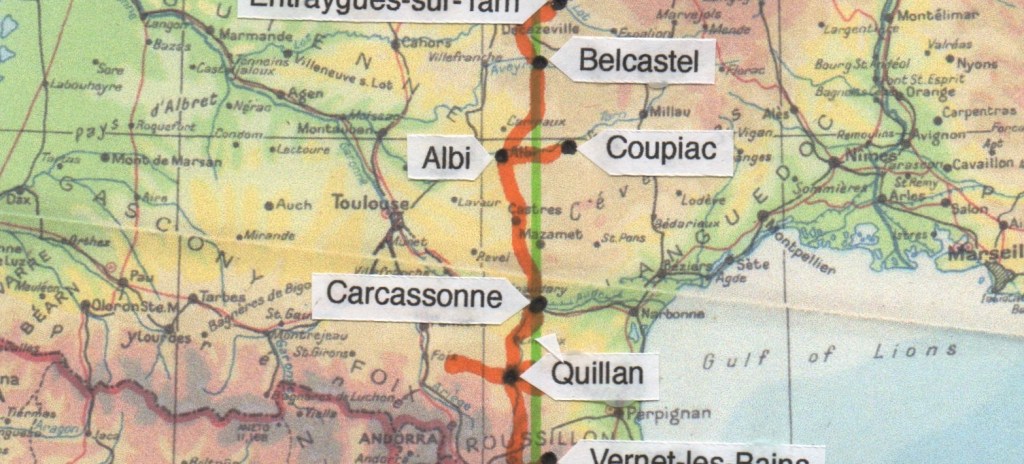
Day 19: Belcastel to Albi, 51miles.
The first smile of the South. Dante and tripe. ‘Benveguda en Tarn’. Pink city. Crusade against Christians. A congregation facing hell. The great explorer lost. Diagonals of the Hexagon. The garden restaurant. Burger à point.
It is another cold night and I hardly sleep. I’m up, packed and ready to leave long before anyone is about. I decide that Belcastel can live without my camping fee, whatever it would have been, and push my bike up out of the village.
It is an expansive June morning, the sun up long before people, the blue sky vast, the untenanted, uninfringed air rich with oxygen as I breathe deeply in and of the silence. Detail. The last wisps of mist are dissolving from the tops, going, gone. Now just green and blue. The quiet munching of a horse by a gate, the shiver along its back and the shake of its head as its big eyes follow me before it returns to its munching. There are simple roses in the hedge, small, delicate, pink. Again, I’m full of memories from living here. Of cutting a branch of ash for a hay-rake handle, stripping the bark off the damp, bone-white wood, splitting and fitting the handle in the chestnut head, the work unfolding perfectly, all this to a chorus of bantam cocks one early midsummer morning before the neighbours’ alarm clock had shaken them awake. Standing on the top, and seeing my shape cast on the snow-like mist below me, surrounded by a rainbow nimbus, a glory – what was it, what did it mean? Years later I discovered it’s called a Bröcken spectre.
But now, as my thoughts have been meandering, my footsteps, pushing the bike, have wandered. I’ve no idea where I am. I am in a maze. Every tiny lane looks equally important, there are no signs, the lane that begins upward, around the next corner curves back down. I return to the crossroads several times, once even back down to the village itself. Should I have left a camp-site fee? Is this Hermes’ early-morning trick, a little pipe-opener for a day of mischief? What to do? Keep trying.
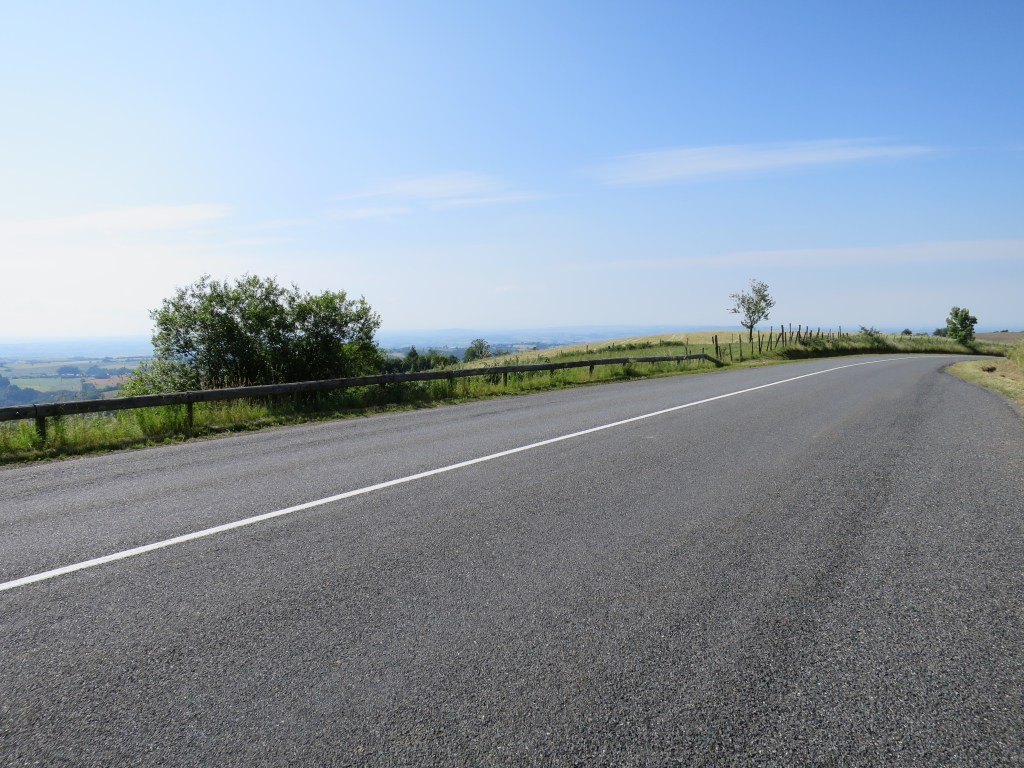
After two hours, I emerge unexpectedly from the maze, onto the D997, at Colombiès. I am back on the map. I head south, to the junction with the D911. I am at 750m, today’s high point. The land falls away, spreads before me. This is my ‘first smile of the South’.
I pass a roughly-painted sign by the road, “NON AUX EOLIENNES. IMPOSTURE ECOLOGIQUE.” ‘No to wind turbines. Ecological imposture.’ How French, on a protest sign, ‘Imposture’!
And a small, new factory unit, ‘Tripous. Fabrication. Vente directe’. In English ‘tripe’ means rubbish; in French, trickery. Hermes must be the patron-saint of French tripe-dressers. The best tripe I ever tasted was in a sandwich, peppery and hot, on a thundery summer day in Florence, between heavy showers, outside the church where Beatrice is buried (so many notes left to her, in a bowl in the church; as I considered leaving a note, wanting an answer that tumultuous week), close to Dante’s house. We had a tripe shop when I was young, the last tripe shop in town, bleached seams slithering around on the marble slab in the sun-filled window, and billowing like formless albino marine creatures in the vats of water in the yard. The young woman at this establishment has returned to the family farm to ‘devote myself to tripe’. As well as selling it fresh, they can it. Tinned tripe? Do the trotters they sell here come from the pig factory, the abattoir I worked in? not far away, now.
Heading south and down, a wind at my shoulder, pushing me on, the whole of the South is spread before me, light-filled air, ochre and green fields softening in the distance to a misty blue. There is one last sharp reminder of the west-draining streams I have been crossing for days, as I descend to and climb up from the Viaur.
Then I cross into Tarn. Which markets itself as ‘Coeur d’Occitanie’, and welcomes me ‘Benveguda!’
The buildings change, it seems at the département boundary, from grey stone with steep roofs of scalloped grey slate, to ochre render and shallow red-tile roofs. And the road margins, I’m sure, lose definition, from road to verge, from verge to field. There is something altogether looser about the South. For as well as crossing a département boundary, I have crossed a pre-1790 Province boundary, out of Guyenne-Gascogne. I am now in Languedoc.
I pass through the village where a friend and her new husband came to live, make a new life together. He liked it, she didn’t. She went back, he stayed. They divorced.
Through Carmaux, but no time to visit its museum of mining. And there, at last, is Albi.

For miles, on the long straight run into Albi, the cathedral is visible. Side on, high up, it is a huge presence, dominating the town, a red brick oblong with what looks like a fat chimney at one end, industrial-looking. An appropriate look for a church that imposed its rule with such factory efficiency. And for a building built to be a constant reminder to the people below of the ever-ready ideological machinery within, and its power to torture and burn to death at will.
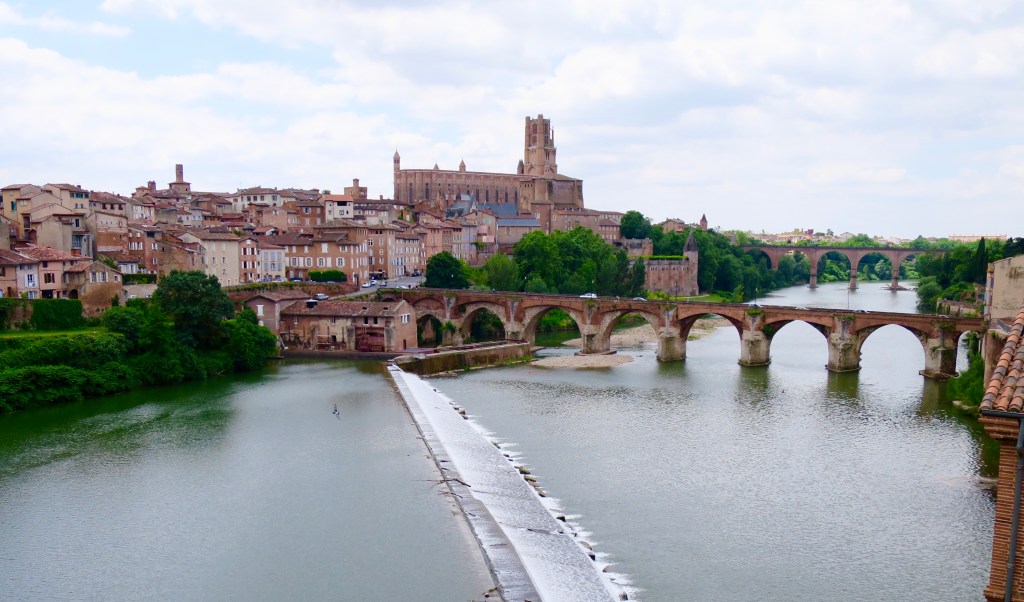
I stop at the bridge over the Tarn. It is a lovely view: the wide river, crossed by the two rhythmic-arched bridges and the diagonal weir, fringed by dark trees, the town heaped up in attractive cubist geometries, the cathedral sailing high. I had forgotten how pink Albi is! The raw red of the ubiquitous brick mellows with age, and the pale mortar further softens the effect. It has a dusty, rosy, salmony pinkness, set off by the green tinge to the river, the white water off the weir, the Midi blue of the sky.
Before I enter the town proper, I pause to ponder which Albi I am entering.
There is our market town forty years ago, where we would drive once a month in our ancient, canvas-seated 2CV to stock up in the whole-food coop and Mammouth hypermarket, have long, hot showers, and visit like-minded friends in the old quarter.
There is the town I recorded and reinvented in a novel.
There is the fourth major town on the Meridian, the fourth medieval cathedral, another chakra on the spine of my journey, and my entry point to the South.
And there is the town that gave its name to a heresy and a crusade, that colours so much of my relationship with the South.
All are interfolded, with abrupt shifts between. I cycle across the bridge, and up to the cathedral.
The Albigensian Crusade, the first crusade against heretics rather than infidels, was proclaimed in 1208 by Pope Innocent III. (I note the names popes give themselves, that allow them to distance themselves from their actions.)
It happened because of a coming together of interests. The result was a war of atrocities and destruction that ravaged the South for thirty years, followed by eighty years of the Inquisition, in whic
tens of thousands were slaughtered and thousands burned to death. A Christianity closer to the original Fathers, and a culture of subtle traditional relationships and high artistic achievement (celebrated by Dante) were destroyed.
The French crown, the French state, colonised the South.
Its name was less because Albi was the centre, than because the Cistercian fanatic, later Saint, Bernard had received a notably hostile reception when he preached here in 1145.
Albi fell in 1209 without a fight, after the massacre at Béziers.
But in 1234 the Albigeois, outraged at the torturings and burnings by the Inquisition, forced the bishop to hide in his own cathedral.
His successor, Bernard de Castanet, was made of sterner stuff. He had both religious and secular power, and this was useful because, although the church pronounced on heresy, the state carried out the sentence. Bernard was judge, jury, and executioner. He was the Inquisitor for Languedoc, and a close ally of the Dominican Inquisitors.
His first act was to build in Albi a fortress-like bishop’s palace, la Berbie. This was his base, and also a detention facility for the Inquisition.
By 1287 he felt powerful enough to pick a fight with the town, increase church dues ten-fold, and begin to build, using these dues, a new cathedral, modelled on his brick palace-fortress.
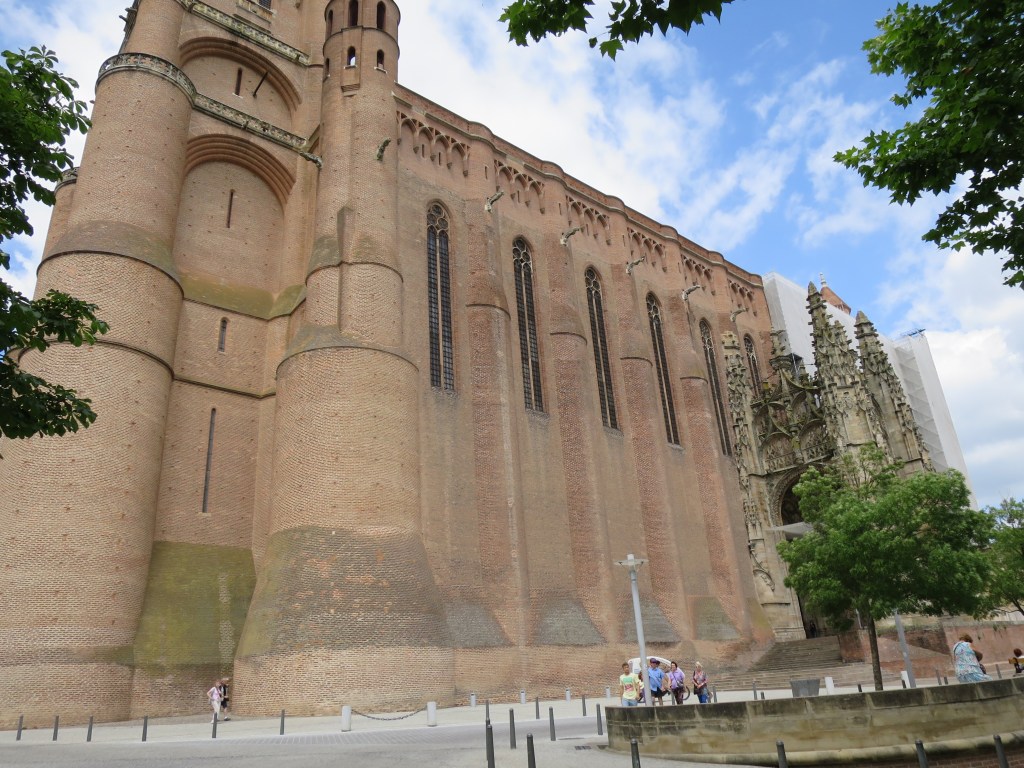
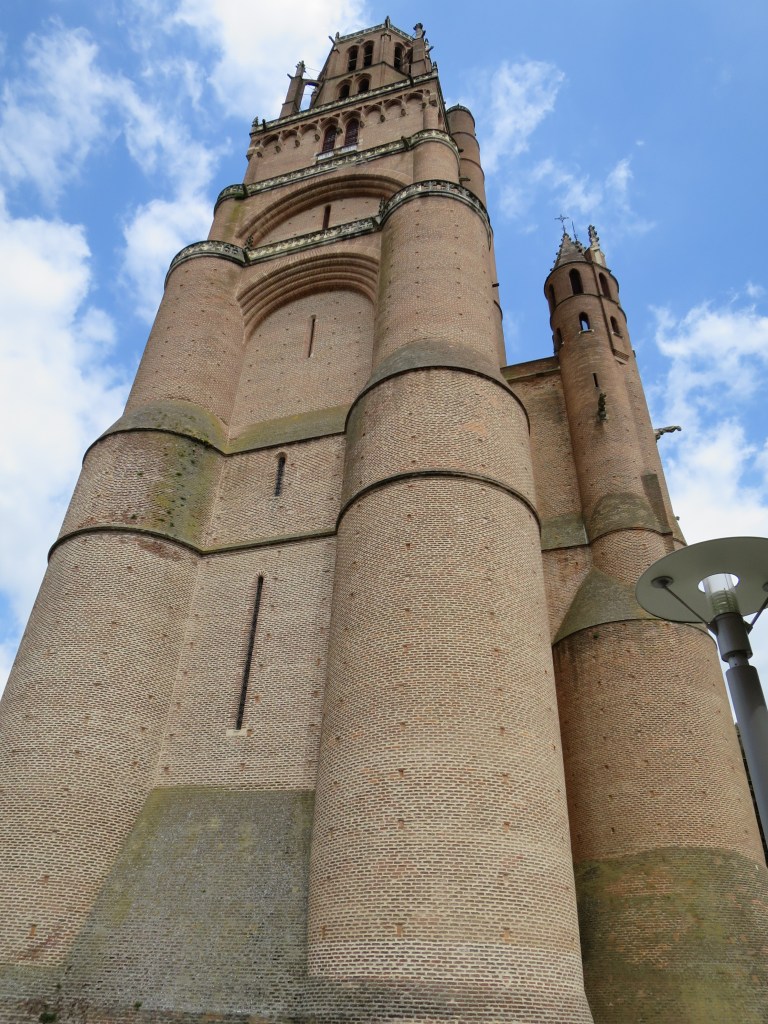
What to make of it, this church-fortress? It is huge, towering, impregnable. But impregnable against what? It comprises twenty-nine round buttress-towers, connected by curtain-walls that rise sheer and blank to lancet windows fifty feet up. The walls are topped with battlements. It is unlike any other cathedral. It is the largest brick building in France, possibly Europe. (Who has counted the bricks?) Although each canny Albigeois could count the bricks his taxes had paid for. While he remembered the Hebrews in Egypt, making bricks for their masters.
At the same time as the followers of Suger were building Notre Dame in Paris, with pointed arches and flying buttresses and expanses of glass, flooding the apse with light and expressing spiritual aspiration, even yearning, this fortress was being built as a manifestation of the church’s oppressive power over the community.
I am reminded of another church that was built at the charge of a community and as an ever-present reminder of their defeat at the hands of authority, the Sacré-Coeur in Montmartre. That sugar-loaf confection was built in the years after the Commune. It was, perhaps still is, a tradition for the locals to spit and utter a curse as they pass.
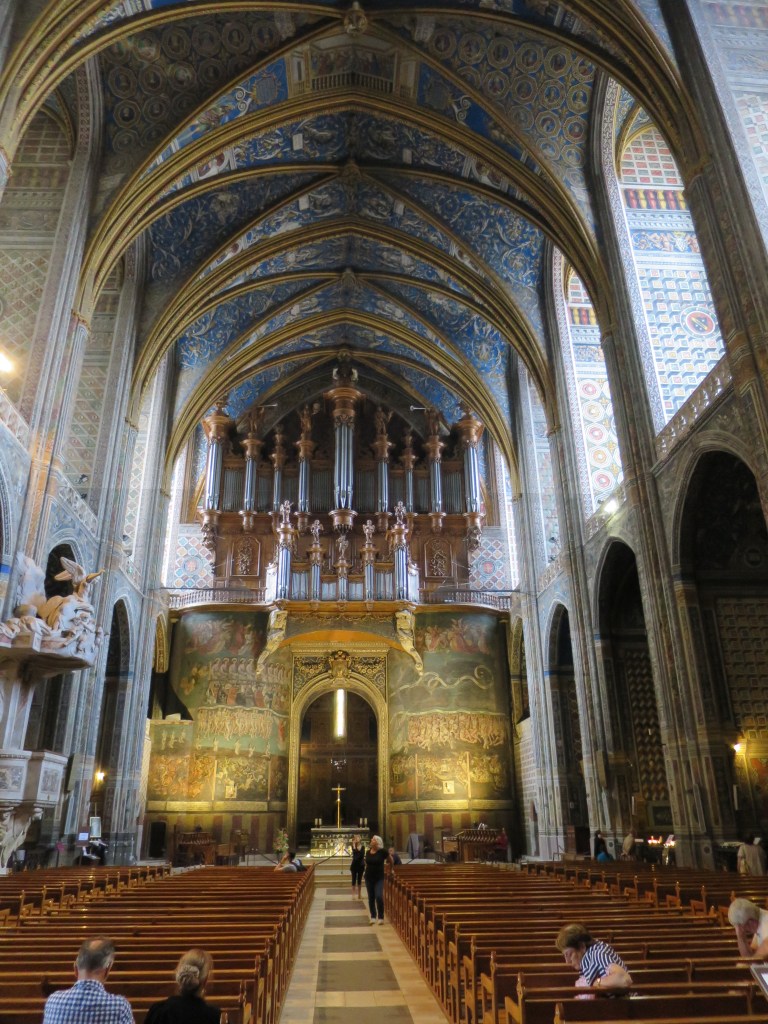
Inside, it gets weirder.
It is a vast space. There are no aisles and it is the widest transept in France. In contrast to the blankness of the outside, the walls and ceiling inside are covered in trompe-l’oeil patterns, as if to confuse the eye and draw it to the mural on the west wall.
For in here the congregation, by some vindictive reversal, faces west, with their backs to the high altar. Like naughty children facing the wall. Except this wall they are forced to face has upon it a vast and ghastly picture of the Last Judgement. And at its centre is a great doorway, that could be the mouth of Hell itself.
Behind them, in the area from which they are excluded, which they never see, in the richly-decorated choir, the Holy of Holies, in the company of a host of beautifully-crafted Bible figures, in the presence of the Virgin and child, and in the orient light from the apse, the canons sing the holy offices. I can’t wait to get out.
The cathedral took 200 years to build, and in that time Albi grew wealthy, growing and trading in saffron and pastel, woad. Woad was the only blue dye of the Middle Ages, before indigo arrived from the East. Weld provided yellow, and madder provided red, and the wools of the great tapestries were dyed with these three.
Referring to the Toulouse-Albi-Carcassonne triangle, a contemporary wrote, “Woad hath made that country the happiest and richest in Europe.” So the cost was easily borne.
But imagine that money available to the old South, to Languedoc, to the patrons of the troubadours …
In 1794 the cathedral became a Temple of Reason.
In 2010 it was designated a World Heritage site. It is a great draw for tourists. Its image is on a million postcards and souvenirs. Like the people of Montmartre, the Albigeois have learned how to turn a profit from the instrument of their oppression.
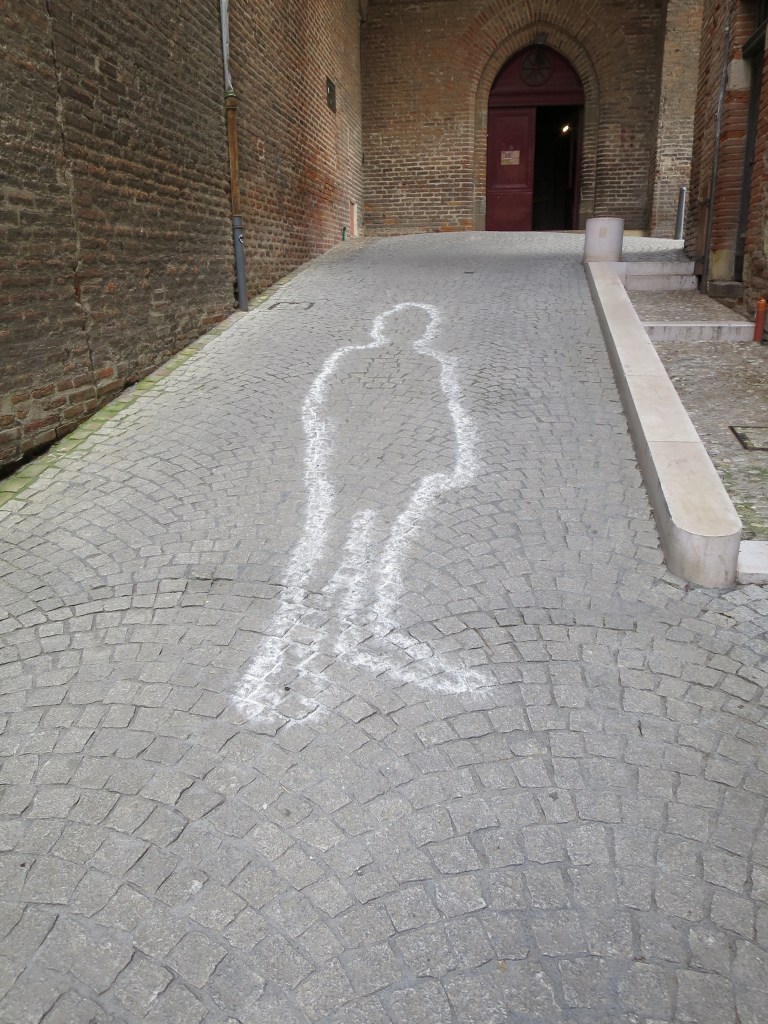
I need a break! I walk past the white outline of a man on the pavement – art intervention? crime scene? – to a place I never visited when I lived here. (Too busy. Too serious. Foolish!)
The Toulouse-Lautrec museum. In 1970s the town was decidedly ambivalent about its most famous, or notorious son, an aristocrat, but also a stunted drunk who lived in brothels, and painted prostitutes and vaudeville acts. Now he is celebrated everywhere in the town, with quotations plastered across dress-shop windows. And the museum is now in Bernard de Castanet’s Berbie. That I like!
It is an excellent museum, and I can’t stay long enough; I will have to get back to Albi: but for a while I escape to Paris, to Montmartre, to the few streets where he lived and painted. I had sped past his studio on my hectic ride across Paris, tipping my hat as I passed.
I am struck by how modern he is; less in his style than in his understanding of the market-driven metropolitan world. In his paintings of prostitutes I see his awareness of the market. Not the market for his paintings, but the market in which the girls were renting out their bodies. He depicts with shocking matter-of-factness how they are, all the time, even when they are off-duty, marketing themselves. Wearing clothes, adopting poses, taking on characters, acting in ways that will interest (‘arouse’ is too strong a word) the imagination of the client. Waiting in positions that they hope will draw his jaded attention. Each is trying to create a personal market, and thereby a buyer. There is something irremediably bleak about these pictures of girls selling access to and misuse of their bodies, in a buyers’ market.
And his awareness of the market is clear in the lithographic posters he created for artists and venues. New laws allowed bars and cabarets to open. Which meant that competition was intense, and every act, every venue, if it was to succeed, had to develop an image. The new lithographic process and cheap printing allowed these images to be fly-posted everywhere. Henri was a genius at developing images.

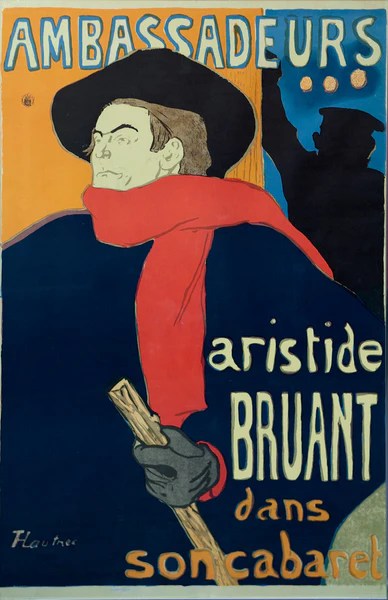
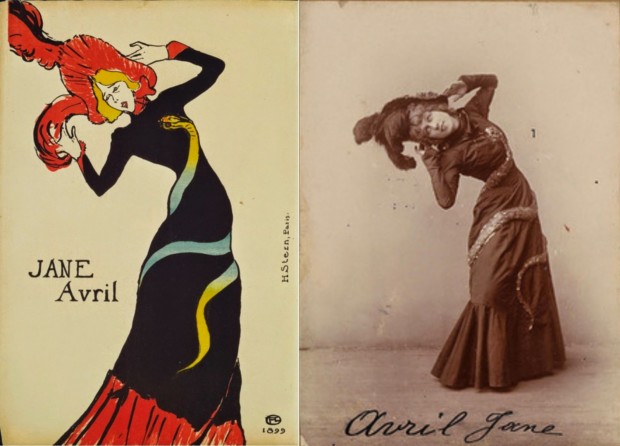
Looking at his posters for Aristide Bruant, Jane Avril, and comparing them with photographs of the artists, and the many sketches he made along the way, one sees how carefully, and brilliantly, he both captured and created, in an iconic pose, the essence of their act.
For the venues, like the Moulin Rouge, his depictions stop the action just at the moment you want it to go on – so you have to visit the venue to experience it going on. He is a great artist.
And what adds a dimension to his greatness is that, while he is depicting the artists at their most attractive, and ‘authentic’, he is showing both the frailty of the individual, and the artifice of the situation. He is depicting not the substance, but the market. And while he was selling the acts, he was selling his artist-self – he had his own initial colophon. (Like that other great artist-salesman, Dürer.) He is the Warhol of his day. Dead at 36, younger than Van Gogh. And, to add an irony, he is remembered today much less for his paintings than for the posters that were for him the hack work that paid the bills that enabled him to paint. I return to Albi, refreshed.
To the Albi of a novel.
It had taken me a long time to dare to imagine, invent, make up, to be able to ‘tell stories’ (which as a child was a phrase used for ‘lying’), to act upon Picasso’s ‘art is the lie that leads to truth.’ It was a while before Barthes’ deconstructions in Mythologies showed me that the self-evident is simply the unquestioning acceptance of the prevailing ideology. Before I learned from Levi-Strauss in La Pensée Sauvage that different cultures don’t just express reality differently, they experience it differently. Before Harari in Sapiens showed me that myth-making, the ability to imagine, and “to transmit information about things that do not exist at all” is the defining feature of Homo sapiens.
Now to revisit the places and objects at the beginning of the novel (Diggers and Dreamers, p.9-11. See in the drop-down menu MY BOOKS.), unvisited in forty years.
The public bathhouse is still here, and a shower is still cheap, only 80c.
The war memorial is close by, and the white gravel.
The crane is long gone. It had been there for the rebuilding of the old quarter. The old quarter was rundown, overcrowded, unsanitary, poor, lacking facilities, and occupying a site with development potential. It was lively, cheap, a community with washing-lines across the lanes, plenty of eyes on kids playing in the streets, useful local shops and services. It was demolished, and rebuilt on the same street plan, not in rough stone and render, but in ‘trademark’ Albi Roman brick, with shops along the lanes, and flats above. But the flats were too expensive for the locals, so they were moved out. And the shops and cafés were upmarket, for visitors and incomers, not for a local community: boulangerie replaced by patisserie, épicerie by chocolatier, mercerie by a fashion chain, no places for tradesmen’s workshops and yards. Visitors, safe in familiarity, flock in. It has become a place that time passes through, as styles and fashions change, but that doesn’t age: take a photo, and you could fix it, years later, to a specific year’s fashion campaign.
But where is the giant anchor? Surely I didn’t dream it, invent it, the anchor, “set on a plinth, eighty miles from the sea. I sniff it to see if I can smell the sea. It smells of iron and heat.” …?
It must, I realise (how little I knew, then, about this area!) have been a memorial to le comte de Lapérouse, naval officer and explorer, native of this town, whose amazing scientific expedition to the Pacific in the wake of Cook explored and mapped the coasts of Alaska, California, Hawaii, Australia, Japan, Korea and Russia. He sent back his invaluable records with the English from Australia, then disappeared. His last message said he expected to be back in France by June 1789. Just in time for the Revolution. (Apparently a benevolent and just captain, what role might the returning hero have played in making the Revolution work …?) After many searches, remnants of his ship were finally found in the Solomon Islands in 2005. But I don’t find the anchor.
I have remapped the Albi of memory and invention onto its present actuality. It is a town busy with commerce, busy with tourism. And, at this point in the late afternoon, busy with children. Because the streets have been roped off and waiting zones established for an evening of children’s cycle races. Disorientated, I stare at my tourist-office map, trying to work out where my night’s lodgings are.
As I peer hopefully around, I become aware of a young man sitting, staring at me. I say, hi, and he clicks into life, as if he’s been waiting for me. He scoffs at my tourist office map and pulls out his own map of the town. He asks where I’m heading, indicating my bike. I say proudly, to Perpignan. From Dunkirk. ‘Ah’, he says, unimpressed, ‘une Deeagonaale’. What? Others have done this? He recites the six Diagonals, bike rides across the Hexagon, between Brest, Dunkirk, Strasbourg, Menton, Perpignan, and Hendaye. They are organised, I learn later, by Amicale des Diagonalistes de France. Each has a time budget. Dunkirk to Perpignan is 100 hours.
He tells me how to get to my destination, and sits back down, inert once more. As if he is an automaton waiting to be switched on. Or an actor awaiting his cue.
He is another of those characters, like the woman at Saint-Denis station, the young man in Epignay, the man in the square in Pithiviers, who seem to have been placed, either to guide me, or to lead me astray. Spirits of Hermes, of the hermetic path. Was this character’s role to deflate me? To show that what for me is something special, is in fact something ordinary? And by extension to make me ordinary? Or was it to stimulate me to say, defiantly, this is my particular journey, my own diagonale, that I fully acknowledge and own …?
I find my lodgings. An odd word to use, but it is neither hotel nor hostel, an informal conversion of a two-floor flat, with individual bedrooms and a big shared kitchen.
It is good to be back among people, even if it is with that awkwardness of difference of language and type, and the simple desire in each of us for privacy. An old French couple, who seem to have taken up residence, the wife having that way of turning every place into a version of her home. A woman on her own who seems to want to talk, but at the same time has a way of deterring conversation. But it is good to be inside, a solid building not a flapping tent. And my room is comfortable, and it has a decent bathroom, I can shower, do laundry and sort out my things.
I bring my bike into the lobby, and put it in the cellar. The building is the classic nineteenth-century block of apartments, the provincial version of the block in Perec’s Life A User’s Manual, which opens, “Yes, it could begin this way, right here, just like that, in a rather slow and ponderous way, in this neutral place that belongs to all and to none, where people pass by almost without seeing each other, where the life of the building regularly and distantly resounds.” The heavy outer door that slams shut no matter how carefully you try to close it; the bare, dark, neglected lobby undecorated for half a century; the stone staircase of uneven, worn steps spiralling past door after door; the sounds and cooking smells of different lives seeping out from behind each; big locks and big iron keys; the curved wooden handrail loose on the iron holders; ancient light switches. The general neglect that enables cheap living now, on the capital (including labour, of course) expended when it was built.
Having showered and changed, I go out. The heavy door slams. I stand on the street, by the big elaborate coach doors that lead into the block’s courtyard, watched by the glittering eye of the amateur concierge behind the lace curtain.
Which way to go, in search of a meal? It is a long residential street, tree-lined, the evening sun dazzles along its length, the evening is pink and warm. There are a few shops but most of them are closed down. Do I want to go back into the centre? Too fashionable, too far. I want a quick meal. There is a burger place across the street.
Not a plate-glass window Formica place, with grudging sitting space, but a small restaurant that has adapted to the modern eating habit that demands burgers.
The small, energetic woman ushers me through the dark empty restaurant, with its candles in wine bottles and gingham tablecloths, into a garden, shaded by the buildings around, with a couple of trees, mild and comfortable. Oh, this is surprisingly nice.
I order cheval burger and beer. How do I want it cooked? she asks. I say ‘moyen’. ‘On dit, à point’, she says, less correcting than informing, nicely done. Of course! I’m mentally kicking myself for having forgotten. Then I remember Barthes’ essay on steak-frites, how bloodiness is the steak’s essence, and “even a moderate degree of cooking cannot be explicitly expressed; such an unnatural state requires a euphemism: a medium-cooked steak is said to be à point, more as a limit than a degree of perfection.”
I sit back, sipping my beer. There is a family, with a noisy child demanding attention, a listless mother, and a man who spends the whole meal on his phone, chewing as he listens, swallowing before he speaks. An old couple shuffle in, regulars on their night out. They order quickly, automatically, and then settle down to the puzzles that are printed on the place mats. Instead of tablecloths, cheap restaurants have individual paper place mats, advertising the town, or shops, or products, with, in this case, puzzles, and horoscopes. My horoscope reads, “Do not throw yourself lightly into a hazardous project. Be more prudent, your finances will be less impoverished.” This is the usual advice for the impulsive Aries. But having ignored the first piece of advice in making this journey, I decide now to follow the second: I will not have a pudding.
As I wait, I ponder something that had occurred to me while writing Diggers and Dreamers, years after our time here. What if we, having got off the train here, with our trunks, instead of taking the bus up into the hills, as we did, to stay with English friends who had persuaded us to come and do the ‘self-sufficiency thing’, preliminary to buying our own place, what if we had stopped in Albi? What if she, who wanted to be French in France, had got a job here, teaching, or in an office. While I, who wanted to be a stranger in France, stimulated by both the difference and the freshness of a new country, had written …?
As I look around the little garden, observing, noting – the accent, panse for pense, merci bieng, the people around, local colour, the vividness of the unfamiliar – what if, instead of a year working in an abattoir (120 pigs a day, killed and processed), and a year working on a house and the land, gardening, pruning vines, scything hay, making wine, bottling vegetables, making baskets, mending tools, fixing a cuisinière with an iron plate from the blacksmith and fire clay dug from a place in the woods he told us about, struggling with an old car, roofing a house, what if I had just written?
Except that it was exactly those two years of hard manual labour, of being practical, of débrouillage (getting by) and bricolage (improvising) that had been a crash course in separating me sufficiently from my privileged bookish upbringing to enable me to reconnect to a self I had been losing touch with since I was eleven. And that in the years after, back in England, had informed my writing.
Dinner arrives. The difference between burger places in France is less the burgers than the chips. These are chunky, not greasy, excellent. I had been trying to believe that cheval burger is made of horse meat (having conceded that canard burger isn’t made of duck), but this, the second I’ve had, like the first has a fried egg on top. How did it get the name? Horse and rider? I eat well, and saunter back. The glittering eye through the lace curtain does not blink as I heave open the heavy street door.
I close the shutters, those ingeniously-designed but fiendishly complicated wood and iron French shutters, definitively old France, and am in bed before ten.
Here in Albi I have a sense of arrival. But also the sense that this is the beginning, that one focus of my journey is just ahead. Tomorrow I will head east, across the Meridian, into the hills, and revisit our house of forty years ago.
Day 20: Albi to Coupiac, 56 miles.
Return to the hills. Our village revealed. The carved stone buried. Encounter in the café. The wild boy reconsidered. Our house. The one-armed man. The Virgin’s veil. The threshing-machine. Camping by the lake. Pot au feu with the young couple.
I wake early. Today I will be at La Balme, our old house. And I still haven’t worked out what to do.
What was once a hamlet of half a dozen peasant families, by 1975 comprised a farm of a hundred hectares, and our property of two hectares. We had bought it from a family who had left after their barn was struck by lightning and burned down, burning to death the animals inside, selling most of their land to the Bonafets, the neighbours. At first, they had come out from Albi a couple of times a year to prune and pick the grapes and make wine. But at some time they gave up even that, and when we went into the cobwebbed cave we found only rancid vinegar and spoiled barrels. They had waited, through the flight from the French cities of the disillusioned young after May 1968, the continuing interest of city-dwellers in second homes, until the arrival of the ecologically-inspired idealists from Northern Europe after the oil crisis of 1973, and a naive English couple, to try to sell their house. Of course we paid over the odds, bargaining being to them a skill bred in peasant blood, to us a form of rudeness.
We got on well with our neighbours, especially with Gaston, madame’s bachelor brother, who lived with the family as unpaid hand, and who enjoyed teaching us the old ways that his brother-in-law the farmer, and Didier, the farmer’s son, weren’t interested in. I had imagined when we moved in that our arrival would be a breath of fresh air, especially for madame, who hardly ever left the farm, but also for Didier and Yvonne, the children. But over time I have felt ever more guilty, that we had disturbed their self-contained world by moving into the long-empty house next to them, and then introduced the disturbance of the ‘outside world’ by selling it on to second-homers from Montpellier.
A friend had said – go in, introduce yourself, they will be glad to see you. My ex-wife had said – you’re not daring to go there, and actually speak to them, are you? I had to go there.
But who would be there? Forty years on, the older generation would be long dead. Didier, the son, had been around twenty. He spent his time driving around the farm too fast in the tractor, and driving along the lanes too fast in his car. He returned from his first holiday, on the Med, eyes big with disbelief, saying ‘we live on gold, and eat shit.’ Would he have sold up, to a progressive neighbour. Or a farmer from England attracted by cheap land and EU subsidies? Would he have married, continued the family tradition, the farm now run by his son?
Perhaps I will ask at the mairie if the Bonafets are still at La Balme? Perhaps I will cycle up to the farm and say that I lived here forty years ago, do you remember? Perhaps I will pretend to be lost on my way to Coupiac, and check the place out? Perhaps I will simply not go there, leaving a hole, occupied, as it has been for forty years, with memories and regrets, invention and guilt …
I breakfast well, in the spaciousness of the big kitchen, with fresh bread and fresh coffee laid on. I’ll be back here tomorrow night. Tonight will be my last night camping, somewhere near the Tarn.
I cycle across the Place Jean Jaurès. Every town in France seems to have one. Who was he? Born in Castres in 1859, he was a teacher in Albi. One of those young men, like Alain-Fournier’s father, who, following Ferry’s reforms, were tasked with introducing the values of the Revolution – democracy, secularism, laïcité, Enlightenment thinking, national identity, into education. He was elected deputy for Carmaux, and in 1895 helped the striking glass-workers of Albi to found their own bottle-making cooperative. It is still in business. A socialist, he was assassinated in 1914 for being against what he called the capitalist war.
I am soon on the familiar D999. Past where the vast Mammouth hypermarket had stood. It’s now a small ‘Carrefour Contact’, ‘le concept de commerce de proximité’. Our hypermarket has become a corner-shop. Is this a sign of what’s to come? Will this be like visiting childhood places? Will everything have shrunk? I cross the railway line embedded in the road. Already disused in 1976, it has still not been tarmacked over, as if they are still hoping for a train to cross.
There are many large lorries on the road, and I worry that with the opening of the Millau viaduct this has become a new main road. But they are serving the new industrial estates on the edge of Albi. The road soon quietens as I climb steadily up from the plain.
The road rises, and the rain starts. At least the wind is behind me. But it is hard to keep dry. An old woman, walking slowly, hunched under a sack, says as I pass, ‘vous allez mouillé’, with the grim satisfaction of one used to hardship; nothing bad can happen if you expect the worst. But, oh dear, to arrive at our old place in the rain, with a night of wet camping to follow …
I cross the Meridian. There is a sign saying the Tour de France will pass here on 17 July, and the road will be closed from 12:30 to 15:45. I saw the Tour for the first time in Yorkshire last year. I had seen many fast bike races, but the way the leader, away on his own, punched through the air, like a fist, took my breath away; it was an experience of raw power that still makes me shiver.
Past a sign for the restaurant in Coupiac, advertising ‘workers’ menu’. The workers at the abattoir, where I worked, ate there, a single meat ‘dish of the day’, potatoes, vegetables served as separate courses.
A sign, ‘Millau – Open’.
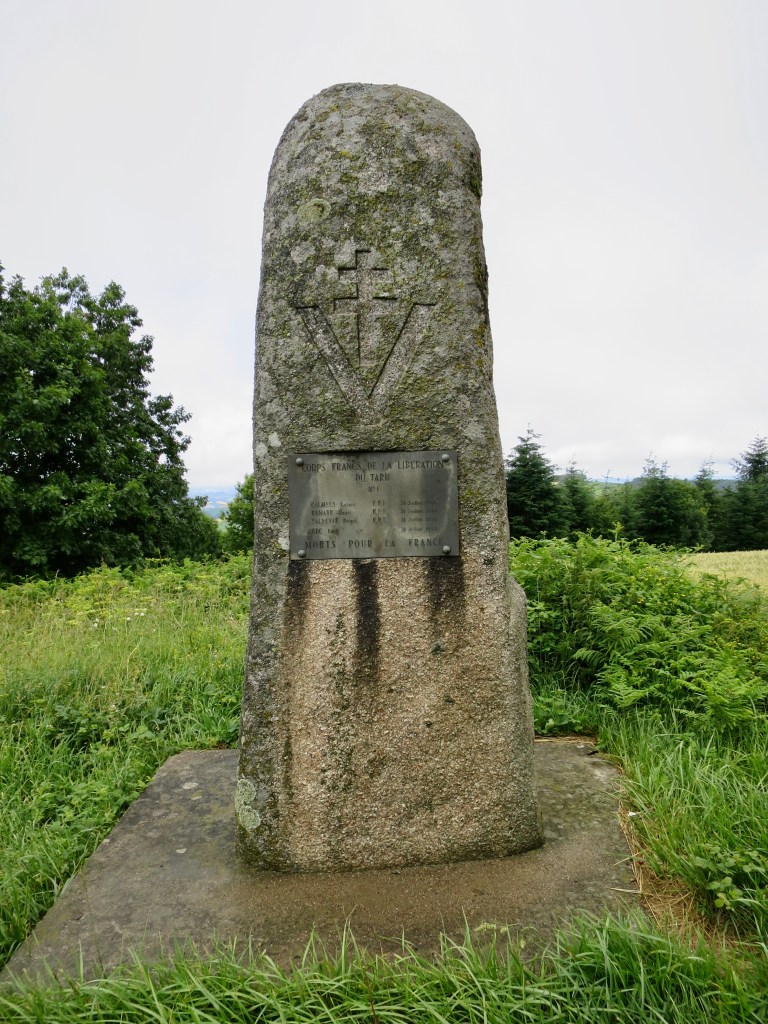
Past the memorial to four Resistance fighters, killed on 31 July 1944, a month after D-Day, a fortnight before the landings in the south of France. Three were members of the Free French Army, an attempt to unify the 200,000 Resistance fighters. It is a dark, gloomy menhir, by dark fir trees, and it has always made me shiver. I asked Gaston if he was involved in the Resistance. Yes. Did he fight? He gave his self-deprecating smile, who, me? I carried messages he said, and cooked. But he would still have been deported, shot or strung up if caught. A woman in a village close by was still known as the woman who collaborated by sleeping with the German Commandant. The husband took back this village Helen, and they were still together in 1976.
Wheat, barley, hay, pasture, vines, maize. A patchwork of small hedged fields. Areas of deciduous and coniferous woodland. A small-scale, various, undulating landscape. A raggedness, as if too much neatness would be irritating, with margins (here’s a wheat field stopping at a house lawn, with no fence between), an area not too much under pressure, where you can live and let live. And, as I approach the highest point, 750m, the cloud clears, and the sun comes out, illuminating the variegated fields and the dark green woods that to the left drop down into the Tarn valley, ahead rise to the Massif, revealing the sunlit blue distance. Struck, awed by its beauty, I have to stop. And look.
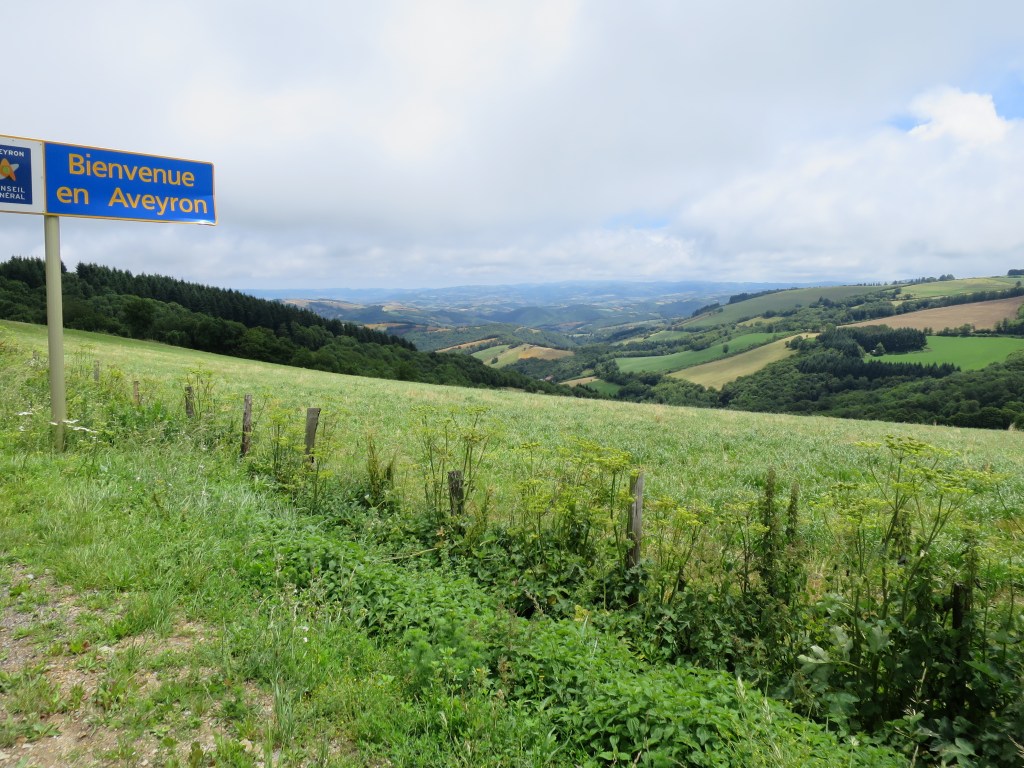
It looks like the promised land. I lived here. Why hadn’t I seen its beauty? Why had I clouded it with her, my, our unhappiness, an unhappiness that she, I, we had brought with us from our pasts? We had a house and land, bought and paid for, in cash, with the money I’d saved from a year of working ridiculous hours (often 100 a week) as a hospital porter. We had ideas, energy, abilities, skills. We might at La Balme have established a new way of working, with the locals who were still connected to the old ways, with the incomers and the new ways we brought, a new cooperation …
But perhaps the problem was in the word ‘self-sufficiency’, a buzzword of the time.
She, I, we were still raw from the wound left when we tore ourselves away from the life we had been trained for, that we’d embraced, as new entrants into the middling classes who run the system. We were monks who had been too obedient, but who had then lost their faith, and left the monastery. Outside, we needed time to heal, to find another way of being, beyond the off-the-shelf simplicities I’d learned from books at the Ecology Bookshop. We’d lost one faith, but immediately converted, simplistically, to a new one. We had been in too much of a hurry. Unnerved, I guess, by the uncertainties of the times, the ‘success’ of our contemporaries, the fear of being left behind. In too much of a hurry. So we couldn’t, didn’t dare to give this place, this way of life, time to soak into us, change us. Instead of giving ourselves that time here, she, I, we hurried back, there. Left all this, and what might have been, left it here, the unlived life.
1000 miles clicks past on my milometer.
The road falls, into the valley of the Rance, down 400m in one snaking, swooping, exhilarating run. The sun is hot, and my wet shirt soon dries. I’m breathless when I get down.
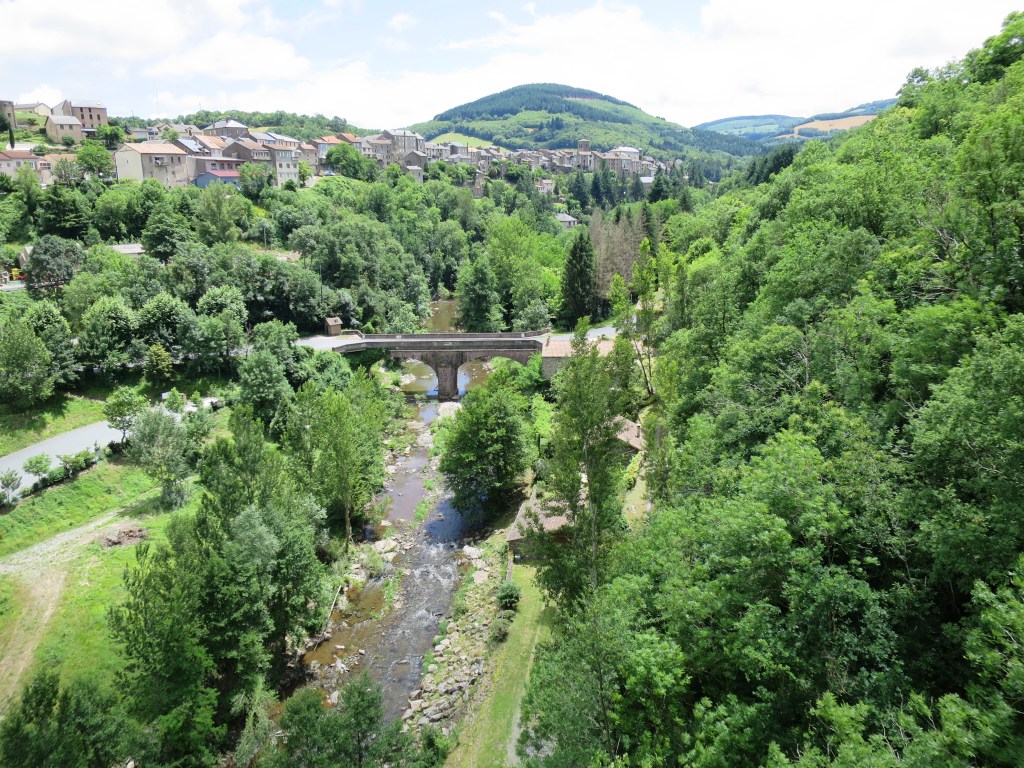
Approaching Saint-Sernin, our village, it is as I remember. The village rises sheer from the river, like a miniature Potala Palace. I ride across the bridge that marks the entrance to the village.
But, wait, something is wrong. The bridge is in the wrong place. Have I so misremembered? What has happened?
I return to the beginning of the bridge. There is a turning down, along a road lost among trees, down to a stone bridge, the old road bridge. When I get down to the old bridge, I look up. The new high-level bridge is a mini-Millau viaduct. It cuts out the steep drop and rise up, the sharp bends. I push my bike over the old bridge, and try to scramble up, on the line of the old road, wanting to enter the village the old way. But it is fenced off. I have to return and enter the village across the new bridge, on the level. Everything has significance. I take a deep breath as I cycle slowly up to the square. I have these few moments to remember with my old eye, see with my new, to register what has changed.
The feed-merchant is now a modern garage. There is a statue of the enfant sauvage. The village hall is still there, under the car park, where we went to a dance that was one of the most dispiriting evenings of my life. The creaking old hotel has been refurbished to something more boutique (I’ve checked the prices). The Grand Café, on the square, has become the centre of village life, with live bands and events advertised, decent music playing now, a place that is trying, and hopefully succeeding. The alimentation générale has closed down. The basket-maker is long gone. I park my bike, and saunter down the narrow village street that runs away from the main road.
We rarely came here, beyond the alimentation. I came here more with Gabrielle. I know nothing of Saint-Sernin, the internet has almost nothing.
The village is on a bend in the river, where a tributary joins. It is a fortified medieval village. But I have no idea who built it or why. Gabrielle was curious, would have asked, found out, connected it to history, to France.
One day a touring theatre group, Les Baladins du Havre, performed for one night in the square. She would have spoken to them, invited them back, at least found out where they were staying and joined them for the evening. Arranged for other groups, for singers to come.
The houses had interconnected lofts, to facilitate defence, a placard says. There were gates and towers. Was this for the petty conflicts of local lords? Was it involved in the Albigensian crusade, the Hundred Years War, the Wars of Religion, the camisard revolt? The little bridge is called le pont des morts; it was where bodies were carried on the mourners’ backs, across the river to the cemetery. Was there significance, symbolism in that? There is a stylish Renaissance house – whose? Why?
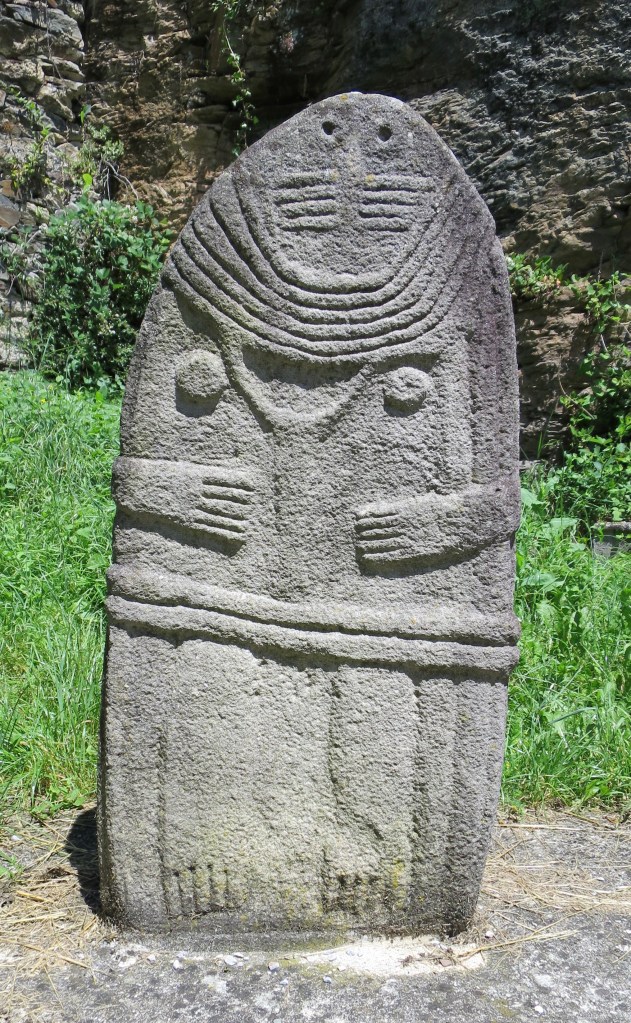
By the tributary stream, Le Merdanson, there is a copy of a small, carved stone menhir, set up where the original (now in the museum in Rodez) was found. Dated to 3500-2500 BC, it is a stylised female figure, remarked on for its ‘sculpture soignée’, carved with a complex iconography that would repay long study.
It is reputed to have been thrown down and buried in 658, when St Martin was preaching against such pagan images.
Perhaps, rather, it had been hidden here, among the gardens that lined the stream, the peasants’ secret continuation of the old ways, the Celtic ways, venerated, buried to fructify and ensure the productivity of the gardens?
In a ten-minute walk I have learned more about, and stimulated more of my interest in Saint-Sernin than in two years living here. All these stories, that I might have explored, expanded upon, written about …! Past the mairie. I won’t ask about the Bonafets (she might phone them!). I decide that I will turn up and pretend to be lost. Who will be there?
I go to the Grand Café for coffee. I want to sit outside, collect my thoughts, make notes, prepare to leave the village and take the road to La Balme.
A woman is sitting on her own, in the sun. She beckons me over, insists on buying me a drink. Beer? No, coffee, thank you. She is drinking beer. As we talk, in French, I realise that she is rather drunk. She has that serious drinker’s way of trying to camouflage her drunkenness, of both acknowledging and doing nothing about her drinking. ‘I like beer,’ she says slowly. Then, after a long pause, ‘sometimes I drink too much,’ she says. Each sentence is carefully enunciated, separate, as if searched for and then hauled up out of a bag of sentences. And sometimes the sentence is not quite the right one. It is an odd conversation, especially as she doesn’t speak very clearly and I’m reluctant to ask to her repeat in case she thinks it’s a comment her state. Where had I come from? I tell her. ‘I was in Albi this morning,’ she pronounces. How did she get here, I ask? She sits, silent, looking at me, as if trying to put something together, gives up, says, ‘it’s complicated’. Is she staying at the hotel, I ask? Sort of, she says. She gets up abruptly to speak effusively to a young woman with a child. The child shrinks from her. Returning, she asks my age. I tell her. She says I look younger than that. And that she is younger. How to ask questions that don’t sound like leading questions, especially of a woman who is raw with her vulnerability? She is divorced, she says, gets on well with her ex-husband, she has a daughter in Marseille. Is she on her own? Should I offer to stay, to sleep with her? What am I thinking? Such bizarre thoughts! I’m feeling quite unhinged, trying to think of ways I might comfort her, make her feel better. Why do I want to help her, save her? What from? What for? She greets and waves extravagantly to some boys going into the bar, they are embarrassed, joke among themselves. ‘They like me here,’ she announces loftily. What to do? I need to get on. How to leave her without ‘leaving’ her. I look at my watch, well, I’ve enjoyed – she stands abruptly, cutting me off, gives me the briefest handshakes and is gone, as if to an urgent, just-remembered engagement, she’s left me, better to leave than be left, the English have no manners anyway. A strange encounter, signifying … what? Hermes again.
Unsettled, not having had the time I wanted to ponder, I walk over to my bike, wheel it past the hideous statue of Victor of Aveyron, the enfant sauvage, and set off, pushing, up the so-familiar hill, the Route de Guergues; the road of the mountain pass/narrow valley.
Victor was one of the most famous cases of ‘feral children’, children who lived in the wild, supposedly in the company of animals, and who never, crucially, learned to speak. He was captured here on 6 January, 1800, and became ‘The Wild Boy of Aveyron’. He was sent to Paris to be examined, and was looked after there by a Paris physician who wrote a book about him. He died without learning to speak. François Truffaut made ‘L’Enfant Sauvage’ in 1970. In the eighteenth century, under the influence of Rousseau and later the Romantics, the enfant sauvage easily becomes child to the ‘noble savage’, man in a state of nature, ‘gentle, innocent, a lover of solitude, ignorant of evil and incapable of causing intentional harm.’ (Benzaquen.) Whereas Enlightenment thinking was that being truly human meant to be rational, to be socialised, and, above all, to develop language.
I ponder this as I push my bike slowly up the long hill. I see now that we – my ex-wife and I, others of our generation – hadn’t realise how confused we were. We had been educated out of our class, working-class kids who’d ‘passed’, gone to grammar school and university, Hoggart’s “uprooted and anxious”, and didn’t know where our loyalties, interests, even desires lay. I had been over-told. I did not know if the system was well-meaning, opening new horizons for me, and enabling me to bring benefits to those I would serve; or exploitative, taking my intelligence and aptitude and twisting it to the purposes of the established culture, for whom I would be the equivalent of a native colonial administrator, imposing alien values on ‘the people’ from my new position of privilege. By 1970 I just wanted to be left alone.
We wanted to be left alone. To ‘find’ ourselves, to explore alternatives, to live without societal pressure, to be ourselves. Whatever that was. Implicit was the presumption that by moving back down a couple of rungs on the ladder of social evolution, through urbanism and commercial farming, back to peasant farming, we would be two rungs closer to the essence of ourselves.
We saw Truffaut’s film, and to us Victor was our original self, an innocent, in a state of nature. Who was progressively insulated from the ground and air with shoes and clothes, blinded to the subtle light and shade of the natural world by artificial light, living in a world increasingly filtered by words, his natural individuality suppressed by social conformity. As we felt had happened to us. We saw ourselves as reluctant children of the Enlightenment, who were rebelling against that blinding light, becoming more feral. It’s not a coincidence that long hair and bare feet were big things at that time. But we’d hardly registered that our village was where he had been captured. Strange.
In fact most feral children have been shown to have been abandoned by adults because of their physical or mental deficiency. Recent research on Victor points to his having few survival skills, living not in the wild, but close to houses, surviving on scraps, more street-child than wild-child; that the scars on his body, far from being the result of battles with wild animals, were the result of physical abuse, and that his behaviour was consistent with autism or trauma. Each generation – ours obsessed with lost innocence, this one with child abuse – rewrites its stories to suit its mythology.
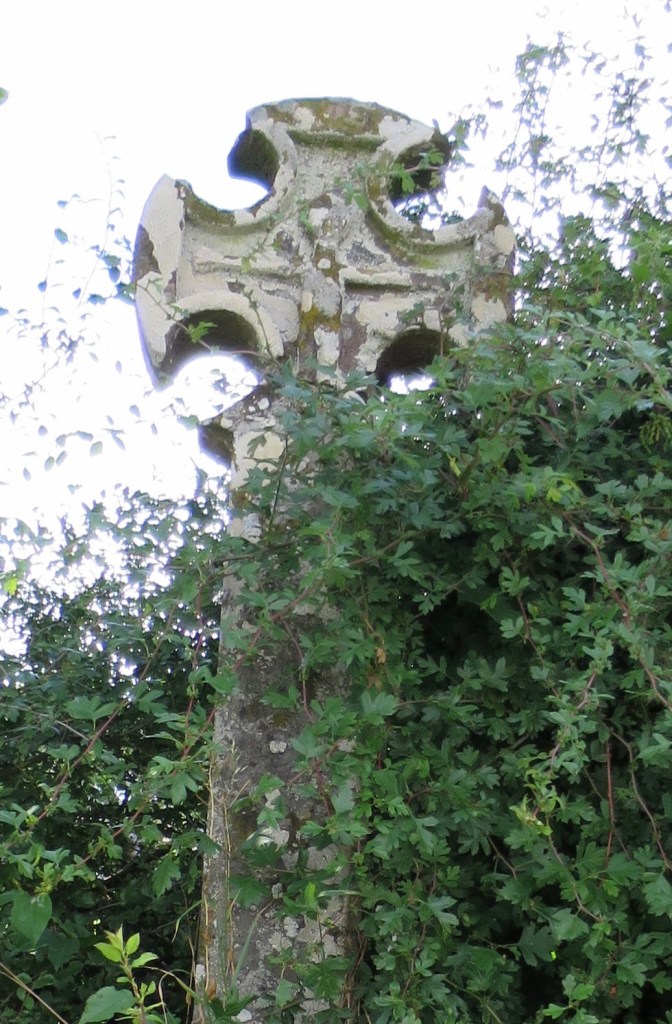
At the top of the long hill is the small stone wayside crucifix, now almost buried in the hedge, going the way of the Neolithic menhir in being lost and forgotten. The head of the cross is wonderfully simple: a disc, with four discs cut out of the stone to create the shape of the cross. There is a primitive Christ upon it. It is a Fanjeaux cross.
Fanjeaux was a Cathar stronghold, and I have seen this pattern of cross described as a Cathar cross. But the Cathars did not recognise the cross – what true believer, they said, would venerate the instrument of their Lord’s torture? And Fanjeaux was where Dominic Guzman, who founded the Dominican order, based himself in his campaign against the Cathars. The Dominicans ran the Inquisition. Cathar? Catholic? It is no clearer. Is it very old? It could be any age.
As I freewheel slowly down to la Balme, I am alert to note changes.

How clearly I remember it as it was, this lane! On which, one night after rain, walking with a torch, I found several fat lizards, black with yellow patches, crossing slowly. Fire salamanders! Anything seemed possible in that world.
There is a large, new industrially-built sheep house, of steel, corrugated roof sheets and slatted wood.
The vines are gone. Ours were next to the neighbours’, and each produced a year’s wine. We shared the vendange with them, and the feast that followed.
The vegetable gardens are gone, the hedges around them ploughed out and the gardens lost in a field of wheat. Again, they had been next to each other, and by a source that never ran dry. Gaston would leave his tools with their heads in the water, so the wood swelled and the heads fit tightly. Patiently he guided us in our planting.
There are no animals out, as there were then, the cattle grazing quietly, the sheep being chivvied with whistles and trills to remind them to eat.
The potato patch is gone; Gaston would plough it and then earth-up the growing potatoes using the oxen.
Now it is a farm of open, empty fields, of haylage, wheat and pasture.
As I approach the hamlet, no dogs run out barking, the excitable, ill-trained dogs that would run along biting at the tyres. Gone too is the graveyard of road vehicles and farm implements, a history of the mechanising century laid out as in a farm museum, with nettles poking through.
I stop in the farmyard, park my bike. The duck pond has gone, and the waddling ducks, and the scratching, crooning hens, and the midden-topping cock-adoodling bantam roosters. Gone too is the byre where were tethered the huge, slow oxen, and the cow from which Madame returned each morning to her kitchen with a jug of warm, foaming milk.
It is now a modern farm, with housed sheep, machine-milked I’m sure, some pasture, the rest for haylage and wheat, no other animals, no other life.

‘Our’ house is little changed. It has been tidied up, with new windows, and a flagstone terrace laid in front. As I would have done if I had stayed. After reroofing the house with tiles, I had carefully stacked the stone-flag lausses I had stripped off, ready. Good to see them used. The house is shuttered, shut up. It must be a holiday home.
There is a tractor at the bottom of the yard, bucking backward and forward as the driver uses the digger at the front to root out a tree. It stops its bucking, and the driver climbs slowly out.
He is a round-faced, comfortably-built, slow-moving, amiable-looking man. This should be Didier. But forty years ago he was slim, moustached, impatient, and always rushing. Perhaps the Bonafets did sell up, and this is a new, progressive man?
And then as he climbs down, I see something that shocks me to the core. The man’s left forearm is missing. Cut off six inches below the elbow, ending in a tuck of skin. Who is he?
He speaks, in that casual, inquiring way that paysans do, even on their own property, so little of the brusque, proprietorial English farmer. The words tumble through a mouthful of marbles. I’m taken back forty years, instantly. The figure is not, but the voice is, Didier. What happened? A car crash? An accident on the farm? When?
He has grown up (grown up? He must be sixty) to be, not like his father, thin and bent and foxy, but like his uncle Gaston, easy-going and amiable. I stick to my story, tell him I got lost going to Coupiac. He lifts his cap (Didier never wore a cap), scratches his head, trying to figure out how I could end up here, explains in great detail a route along minor lanes I have never travelled adding, I’d drive you there, if you didn’t have the bike.
As we chat, he asks where I’m from. I say England. His face lights up. A young English couple used to have the house, there, he says, pointing to ours. I’m expecting him to say, five, ten years ago, thinking that it must have passed through many hands in forty years. He says our names, first and second names, remembered, without hesitation, after forty years, brought instantly to mind.
And isn’t this my moment to announce, ‘mais Didier –c’est moi, je suis Keith!’?
I don’t. And is it really because I fear he is about to continue, … ‘ – and those bastards ruined our lives!’?
I say nothing.
How his face had lit up when he recalled! Now he carries on matter-of-factly, the light gone. They, les jeunes anglais, sold it to some people from Montpellier. He bought the house back from them and ran it successfully as a gîte for several years, but … the rushing account is lost among the marbles. But the sense is that it wasn’t worth the bother. Perhaps after his accident. Perhaps when his income grew so he didn’t need it. Perhaps when he acknowledged that he would only need the farm to support a bachelor.
All my years of guilt. When, for all his shy distance and youthful swagger, he had actually enjoyed having us, the hopeless but enthusiastic young foreigners with the strange friends, next door, around the place. As Gaston had enjoyed teaching us the old ways, because no one else was interested. The moment has passed.
I say, absurdly, that I like the farm, ask if I can take photographs. Of course. Am I cycling alone? he asks. When I say ‘yes’ he pulls a ‘rather you than me’ face, but slightly wondering, too. Where am I heading? How do I come to be in this area?
And, as we talk, I see that behind the curiosity, he has more than a suspicion who I am. I can see him at the Saint-Sernin monthly market, lunching with the other bachelors – as his uncle used to do – casually introducing and framing his story: strangest thing, this chap came on a bike, said he was lost, I’m sure it was the young Englishman who bought the Gascets’ place next door. He was about the right age, an old man now, no idea why he didn’t say. He must have had his reasons, it makes you strange, living in a city. The piece of news to share, his moment to hold the conversational stage, the take-off point for that market-day’s conversation.
Now I must get a pioche to get this tree out, he says. Pioche, the peasant omnitool. And how I want to get my pioche from our cave and help him with the task! I go to look around.
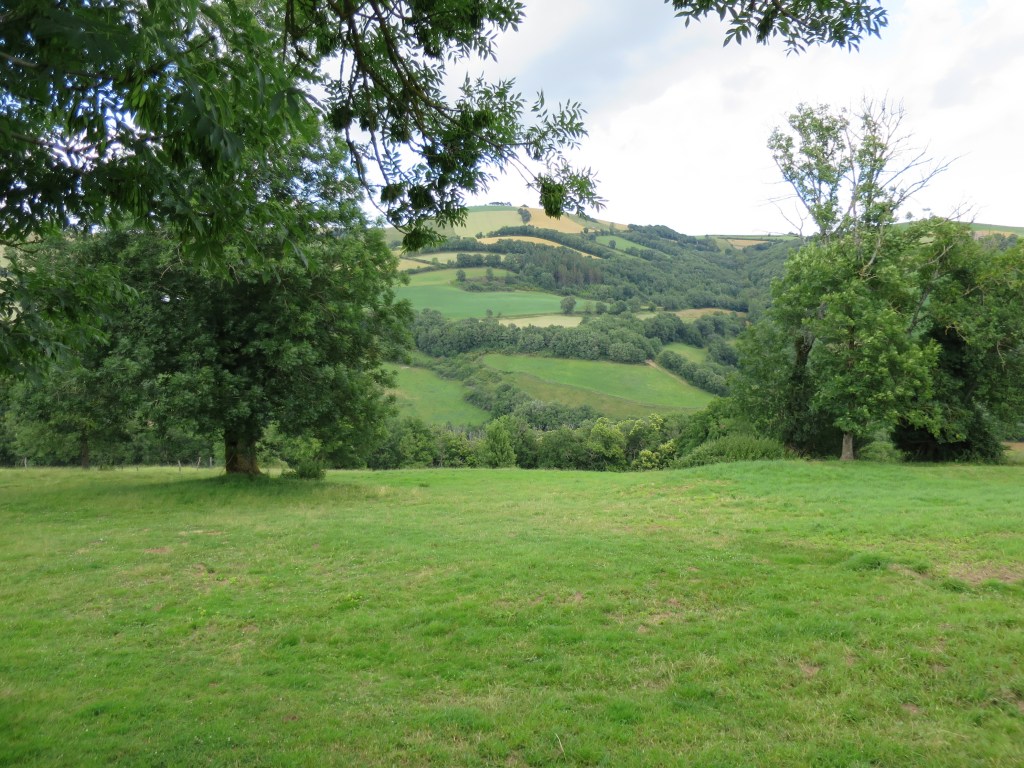
This was where our barn was, already burnt-out and collapsed when we bought the place, but with enough good stone to build a house. A gîte, maybe. Or a new house for us. Overlooking the valley, facing the rising sun.
Below it, our meadow, that I scythed for hay, guided by Gaston’s amused instruction. In the middle was the willow I cut for the wands to weave a basket, rustic but serviceable, also taught by Gaston, two hours’ work to make a basket that would last for years. It would have made a lovely garden, surrounded as it is by feathery ash trees. From one of which I cut the handle for my hay rake. And there is a wonderful view. Down across the abandoned terraces, now lost in woodland. Chestnuts, where one could gather limitless nuts, the old staple, ground for flour, before potatoes and wheat were introduced. We boiled a few, for marrons glacés, for friends in England. Down and then up, on the other side of the valley, to a patchwork of fields, where there is a perfectly-placed church, and the road along which the headlights of silent cars passed at night. And the rolling blue Aveyron uplands beyond.
But the stone has been bulldozed into the foundations, covered in earth, the barn quite gone. As they had thrown the lausses off their roof when they reroofed their house, dumped them somewhere; while I brought mine carefully down, for the future terrace. Which they had used when they made the terrace in front of ‘our’ house. The willow is gone.
I turn back to the farm.
At the end of their farmhouse is a small, modern extension, where Didier lives his bachelor life. The main house is closed up. I wonder at what point he became a bachelor. Was the farm not big enough for a family? Was it after his accident? Another story I will never know.
Gone are the cages of rabbits and pigeons. They used to bait a cage and then, when a pigeon went in, drop the door shut with a string from the first floor, a peasant smile at their cunning.
The fine stone sheep house, where monsieur hand-milked the sheep twice a day, cursing in the stifling heat, the milk going to Roquefort, has had its lausse roof stripped, been reroofed with corrugated sheets.
The pig, that lived for a year in his little sty, fed on waste food and milk, has gone. Relatives and neighbours joined in with the killing and processing, the intestines cleaned by the women for sausages, the hams smoked slowly over the winter wood-burning fire in the wide, deep chimney.
We were here at the end of an era. I am glad I recorded it in Diggers and Dreamers. After the 1976 drought, when their well ran dry and they had to bring water in by tanker (our source never failed), mains water was piped in. That would have enabled them to machine-milk. What was then a mixed farm supporting and run by a family, is now a mechanised sheep-rearing operation, run by a one-armed man.
I say goodbye. He smiles his uncle’s gentle smile. A knowing smile? Or the peasant smile of one who is forever amazed but never surprised at the weird things people do – across the country? On a bike? On your own? Who knows. I want to shake his hand, feel his hand. But I have no reason to
I wheel my bike out. Past another stone cross, the same pierced circle. Was this a Cathar village? Were those interlinked lofts in Saint-Sernin, rather than for defence, in fact the secret hiding places and escape-routes of the parfaits (Cathar religious leaders)? How delighted Gabrielle would have been; for Fanjeaux was the home of Esclarmonde de Foix, the greatest of the parfaites; she had debated with Dominic himself. And the Cathar ‘cross’ perhaps represents, rather than the crucifixion, the radiance of the True Word from Christ …? (Already I am imagining the essays, the stories, the novel I might have written here …) There is writing on the cross, there are dates, under the moss. Did I really never remark it, clean it off, this mysterious cross, a few feet from our house, read what it said, find a message there? I sigh at how little we did, all the things we, I, didn’t do, how much I missed.
Cycling slowly back up the hill (and missing the dogs, who had pursued any vehicle out of the yard, biting at the tyres) I remember that the idea to move to the country came from working in the Ecology books section of Watkin’s esoteric bookshop, and reading the books that predicted that by 2000 we would run out of oil, and there would be an ecological crisis (another ‘take’ on the Millennium). And the magazines that showed you how to live self-sufficiently with very little effort. Moving to France, coming here, was because friends came before us. It was another version of ‘dropping out’. But we had no skills, not even the ability to work hard physically. All that came after I returned to England, trained as a carpenter, worked manually. I spent the rest of my working life learning the skills needed to succeed in the life I’d failed to live here.
If I had stayed, I would have been able to preserve the old ways, continue to learn the skills, maybe even encourage the neighbours to keep them going, making it worthwhile for them by attracting visitors. Visitors would be fascinated by hand-milking, Gaston’s demonstrations of old skills!
But that would turn them from farmers into performers. Isn’t this modern commercial farming more authentic?
Even so, I could have learned the forgotten history, found out – if they didn’t remember, there would have been stories from fathers, grandfathers – when they stopped growing rye on the terraces, when liming the acid soil of the rough, open land allowed them to plough and grow cereals, when chestnuts ceased to be the staple, what those first schools were like when they were beaten for speaking patois, how they lived under the Occupation …
And as I pass over the brow of the hill, and la Balme disappears behind me, I realise why I didn’t tell Didier who I am. He would have invited me for coffee, we would have ‘caught up’. But this journey is not about reconnecting. It is about registering. There is the world of then, as remembered in my head, and recorded, and invented in Diggers and Dreamers, the life I chose not to live. And there is the world of now, as I experience it. Any mixing of the two would blur this life, for which I need all the clarity I can get. I descend slowly, slowly, to Saint-Sernin.
And as I cross the new bridge, leaving Saint-Sernin, the words of a song, “a lot of water under the bridge, a lot of other stuff too. Don’t get up gentlemen, I’m only passing through …”
I take the turning to Coupiac, to the nearest camp site. And where I worked for a year in the abattoir.
I am cycling alongside the Rance, a gentle valley road, the small pale leaves of the poplars by the water glittering and shimmering in the evening sun like myriad butterflies dancing around the slender trunks. At Balaguier there is another small statue-menhir; this one’s sex has been changed, the female features replaced by male. With Gabrielle, I would have said this marks the victory of patriarchy over matriarchy, Zeus over the Mother Goddess, the arrival of the sky gods and their dominance, ever since, over the earth deities. She would have enthusiastically agreed.
At Plaisance there is a small pig-processing factory. A notice emphasises trust and tradition, the butcher travelling around the farms to collect the beasts individually. Perhaps it is to contrast their methods with Serre at Coupiac, where I worked, who shipped them in in big lorries, and was forever commercialising and industrialising. I leave the Rance at Plaisance, and head up to Coupiac.
Coupiac is built in the narrow valley of a tributary of the Rance. A good site for mills. There is an Occitan song, ‘la Copiaguesa’, ‘the Coupiac girl’, about the lovely girl at the pretty mill. The Occitan songs, often composed to old tunes, were written, a notice tells me, by ‘erudite locals’ in the late-nineteenth and early-twentieth centuries, under the influence of the Félibrige, the Occitan revival movement founded by Frédéric Mistral. At the time when Occitan was being suppressed in the schools. The summer I met her, Gabrielle had visited the leaders of the Occitan movement in Toulouse, talked to the young singers and musicians who were doing for Languedoc what Alain Stivell had done for Bretagne.
There is a castle here, at Coupiac. More fortified house than castle, privately owned. I can imagine Gabrielle, with friends from Paris, with la Balme as their base, developing it as a new troubadour centre – not revivalist ‘folk group’ troubadours, but electric, electronic bands – Occitan rappers! I’m still dreaming of the life that didn’t happen.
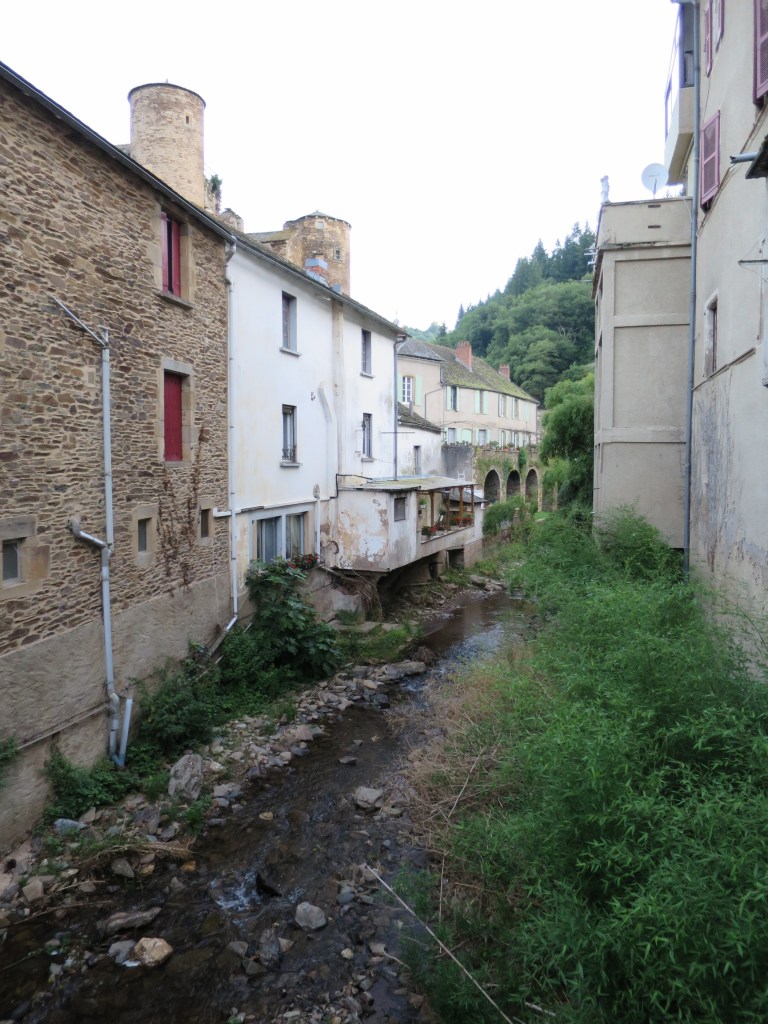
The church was rebuilt in 1762, “to welcome the influx of pilgrims coming to venerate the relic of the Holy Veil.”
The fragment from the Virgin Mary’s veil had been hidden from the Protestants in the Wars of Religion, and the hiding place lost. It was rediscovered when the villagers dug at a place where a bull repeatedly pawed the earth, making ‘extraordinary moans’. It cured eye problems. I remember “Hermes, who as Mercurius, is also the Virgin Mary.” (John Michell, The Earth Spirit.) Stories!
Nearby is the square where in the nineteenth-century the locals brought their wheat to be threshed, using a communal horse-powered threshing-machine. The threshing-machines introduced in England in the 1830s resulted in riots and machine-breaking because they put men out of work. The same threshing-machine introduced here was welcomed, because it eased the labour of peasant farmers, and added an enjoyably communal occasion to their isolated lives. Same technology, different application, different effect.
I remember the mobile distillery, all gleaming tubes and spouting steam, coming after the vendange, parking here, and the locals bringing their grape-must to be distilled into their legal allowance of eau de vie.
But the narrow valley makes it susceptible to flooding. On the épicerie wall are two flood-level marks, one a foot from the ground, 1968, the other above the top of the door, in 1993. There is a note on the window saying that because of 28 November 2014 floods, the shop has moved to the village hall. Seven months later, it is still closed.
The village looks run-down, there are many places for sale, including the restaurant that advertised its ‘workers’ menu’ on the road from Albi, filled in those days with twenty or thirty abattoir workers every lunchtime. What has happened to the abattoir? I hope to find out tomorrow.
As I cycle through, following the signs to le camping, I see that the furniture factory is doing well.
It’s an unexpectedly attractive camp site, with chalets and a café, among trees and by a lake. After I’ve put up my tent and showered, I go to its café/bar/restaurant, La Popotte.
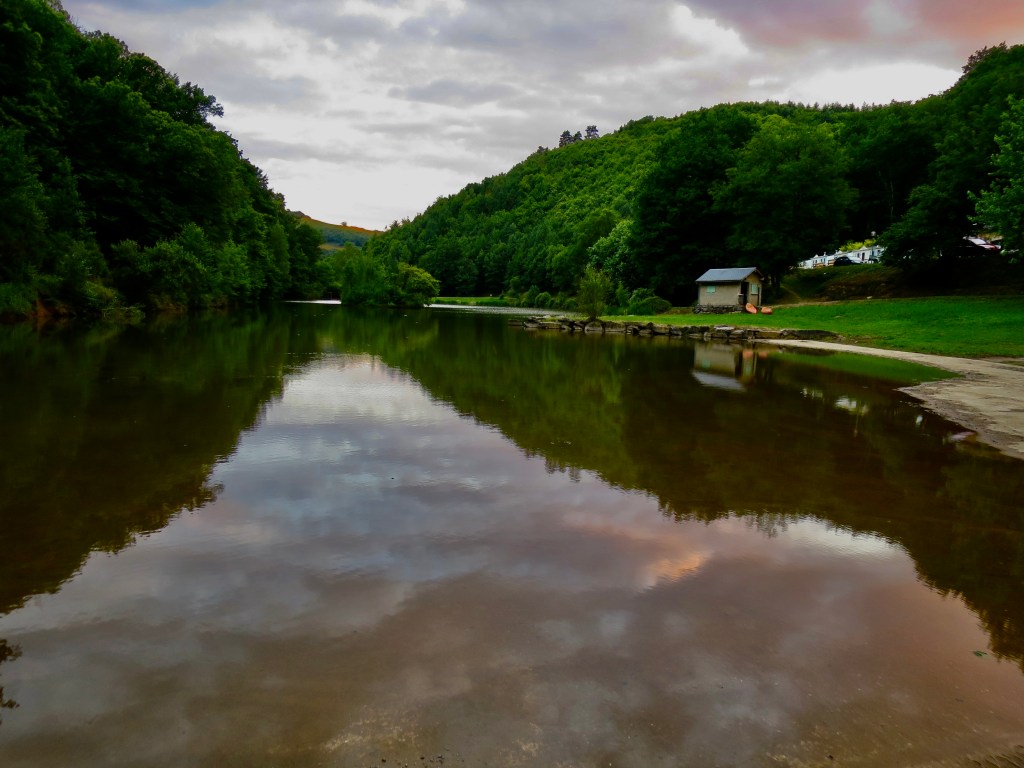
Brightly-painted trestle tables are laid out under an awning, overlooking the still lake, which is a coin of reflected sky amid dark trees, disturbed by the occasional water fowl then returning to its silvered stillness, and colouring and darkening slowly, as the light fades, to starlit black velvet.
The bar, on an empty campsite, outside a small village, in the remote uplands, has style, ambiance. It’s run by a young rasta-haired cook and a long-haired, friendly girl, and the decor, the music, the exotic burgers, give it the feel of a café hangout. How great, to have such a place, so close to la Balme! Again I’m imagining it here, back then, our friends, from all countries, meeting here for the shared celebrations, St John’s Eve coming up … But they aren’t us, they’re our children.
I ask who the band playing on the sound system is. Moriarty. A musical collective, born in France to American parents, named after Kerouac’s Dean Moriarty. It figures. Kavin says he’ll copy it if I have a memory stick with me. I drink wine, and Céline tells me how they come to be here. He is Belgian, she is from near Paris, they met in Switzerland. They got together. They took over this place in March. Are there enough people who share this style? Enough campers to make the site pay? Like the bistro-owner from Calais, at Vallon-en-Sully, they will only begin to know at the end of the season. Will they stay here, stay together, have a family? Who knows. I will never know. Just passing through.
But in the passing through, a delicious, expansive evening. As I ponder the list of exotic burgers, they say there is a dish of the day, a pot of dinde, slow-cooked with prunes and lemons. I think dinde is guinea fowl; I wouldn’t have had it if I’d remembered it’s turkey. But, no factory-farmed turkey this, a fine farmyard bird. The dish is fabulous. Tender, flavoursome meat, fragrant lemon sharpness, sweet, juicy prunes. A triumph. The wine flows, the music plays, and the evening slowly wraps itself around us. The dish is a rehearsal for St John’s Eve, in two day’s time, when he is cooking for forty. Oh, how I’d love to stay for that! I’m in a dream: well-fed, nicely wined, a warm evening, having been to la Balme, remembering the feu I attended in 1976, and back further, to my first time in France, fifty years ago …
They receive a phone call, and a couple turn up. She is beautiful. She enters, sits, ignores everyone, looks straight ahead. He is soft-faced, ordinary-looking. She is brittle, aloof, does not speak. He fusses around, asks her what she wants, relays it to Céline. His job is to arrange things perfectly for her, which he does nervously, willingly. It is time for me to leave. I pay, and, a little drunk, I stroll round the lake.
Shaded by the surrounding trees, open to the night sky, unmarked, a lake of mystery. To row out slowly on, to the centre. And then …?
Heading for my tent, I remember that Céline didn’t include the wine on my bill. I hurry across, she smiles her enormous smile, says, ‘you’re great!’, I hand her a note and, warmed by this gentle evening, I stumble through the dark to my tent.
Day 21: Coupiac to Albi, 48 miles.
The abattoir. The fallen maquisard. Along the Tarn. Ferraris and motor bikes. The tunnel. A chapel of healing. The Sage of Puech Cani. A view. Gilgamesh. Return along the Tarn
It is another very cold night, and I’m up early, walking into the village to warm up. But also to visit the abattoir, the pig factory, where I worked for a year.
We had left London and moved to rural France to live in peasant self-sufficiency. And yet I worked for a year on the production line of an industrial process in which squealing pigs were herded, stunned, bled, scalded, butchered and processed into products shrink-wrapped in plastic film printed with country scenes and a smiling girl in idealised peasant costume, ‘La Rouerguaise’, a celebration of locality, pays, a taste of the country brought to supermarkets by enormous lorries that battered their way between trees and over old stone bridges from this factory.
‘What goes into them?’ I asked Serge, who stood all day feeding an endless tube of plastic onto the machine that shot a stream of bright pink-dyed meat into it, which he twisted every few inches to form the sausages that mounted by him like coils of rope on a sailing ship. ‘Une pharmacie!’ he wailed. He had been a village butcher, killing and butchering the beasts as they came, sheep, cow, pig, whatever, one by one. He had been forced out of business and into the factory by EU and government regulations, and mechanised competition. The beasts that had come to his shop in a small trailer, or in the back of a 2CV, now arrived at the factory in a huge lorry. It had driven around all day, from farm to farm, and the pigs arrived parched, groggy, and sometimes dead.
My friends, who wrote for Undercurrents, who were anti-capitalist protesters, animal-rights activists, who squatted street farms, would have seen me as a mole, on the inside, able to gather information to attack the system, or at least stir up unrest, unionise and even recruit for the Revolution. It was here that I realised how little ideology, perhaps even principle, I have. We had no money. We needed money. I was here to work.
And it was here, that I learned how to work. How to put in a shift, learn a trade (boning hams!), employ manual skills, get on with blokes, endure and then make use of boredom. I learned to work a twelve-hour shift, humping carcasses, emptying frozen moulds in the freezer room at 7am, boning hams all day at a conveyor belt, heaving pig after bleeding pig into boiling water for two hours, cleaning up to be ready to do it all the again the next day, just the same. And then drive home, gathering bracken for compost on the way, work in the garden, and make, mend, fix an abandoned house, day after day.
Perhaps more important, it was here that I wrote two stories. One about employing zen, Tao, meditation methods, not in the formality of tea ceremonies or the stillness of meditation, but in the mundane, repetitive work of a production line. The other was about a simpleton who worked in the factory. That story was possible because I had learned how to be a quiet, almost invisible presence (having spent my life till then being schooled to be noisy, assertive, to stand out), to observe respectfully. And when to observe, and when to invent.
I learned, too, talking to Gilles, Suzanne, that for the factory workers, mostly young sons and daughters from paysan farms too small to support them, that this was a place to earn money while staying in their locality, to assert their independence, to joke and play tricks and work with their peer group, girls and boys, a liberation from the endless isolation of the farm. And jobs for the poor Portuguese immigrants.
I walk up the hill out of the village. The factory is still here. Silent on a Saturday. No name board, no collecting trucks, no delivery lorries. His name, the patron’s, is nowhere. It was, then, everywhere. Serre. It means talon, grip. The place was about him, it was the expression of his determination, hard work, his will. There wasn’t a job he couldn’t do, and better than anyone else. He would be on the production line, chivvying us, as the shepherds chivvied their sheep. They say most companies rise and fall in three generations. His, it seems, has come and gone in one. He must be long dead. No one took over. There is a Serre who runs a mobile butcher’s shop. His son? What was it for, all that hard, obsessive work? The factory is now owned by a Marseille company. It employs thirty. They still process pig products. But it is no longer an abattoir.
I walk back, make coffee, pack up, and am on the road by eight. I cycle through the silent village. Once the bar was the first place to open. Now only the boulangeries open early. This one is full of the warmth and sweet smell of fresh-baked pastries, and has delicious croissants and pains au chocolate, which I eat with relish.
Fortified, I head out on the empty road, alone in the morning freshness. I am cycling away from that time in my life, away from the world of Diggers and Dreamers. And away from the Meridian, further east.
But back on the Meridian trail, in search of one of the important figures in an early survey, who became ‘The Sage of Puech Cani’.
Over the empty top, I come upon a field of sheep! The first I have seen, in this land of sheep. Their shadows long on the sloping field, their presence highlights the emptiness. There are fields laid out neatly, rectangles of green and gold, all tidy and farmed, but with no animals. And no signs of life in the farms I pass, or the hamlets I cycle through. As if all living beings have been spirited away, a land emptied. Or perhaps it is a land made ready for the first man.
I pass a small memorial stone, ‘Here fell Raymond Crayssac, mortally wounded, for the liberation of France, 7 July 1944, aged 24 years.’ I wonder if Gaston knew him.
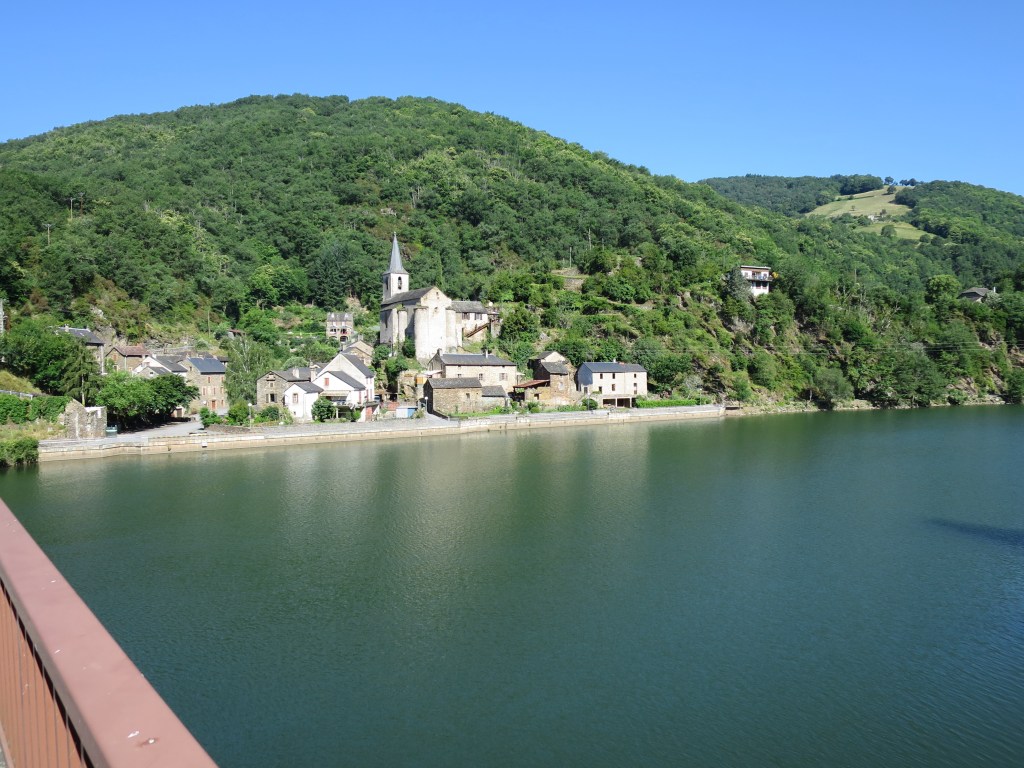
I descend to the Tarn. It’s a great river, wide, placid and green, somehow reassuring. Its forested slopes rise evenly on either side, its valley is varied, sinuous and very beautiful. I cycle along its bank, upstream, into the sun.
I know that the sage lies buried, the man I am looking for, at Saint-Cirice. And I know Saint-Cirice is on the other side of the river. But it isn’t on my map, and I can’t work out which bridge to cross to reach it.
There is a bridge across at Brousse-le-Château, one of the ‘Beautiful Villages of France’. Should I cross here? A dozen Ferraris, eleven red, one yellow, drive past me, in a concourse of drivers’ self-delight and passengers’ perfectly wind-blown hair. They cross the bridge and draw up in a line beneath the ramparts of the village, gun their engines throatily, and fall silent. It is their coffee time. Or an early stop for a leisurely lunch. And then a run of motor bikes passes me, twenty, thirty, men who wave briefly, along this side of the river. This is my sign. Four wheels bad, two wheels good. I follow the bikers.
I pass lengths of empty brick tunnel, horseshoe-shaped, overgrown. This is the railway that was never built. In 1880, with growing wealth from the industries of Roquefort, it was planned to extend the railway that ran from Roquefort to St Affrique, on to Albi, along the Dourdou and Tarn valleys. La Compagnie du Midi constructed the tunnels and bridges, many of each, zigzagging across the river. Expensive work. But the rails were never laid. It exists as a line on the map, with ghost tunnels and bridges. There are even signal boxes and station platforms. In places the road uses the bridges and tunnels. The next road bridge was built for the railway.
I cross the bridge. Immediately on the other side is a tunnel entrance, with traffic lights so the traffic alternates in each direction. It is a horseshoe-shaped blackness that is both a solid and a void, a wall I will hit and an emptiness that I will disappear into. It is the tunnel in The Vanishing. It is terrifying.
The lights change to green. But how long is the tunnel? How long before the lights change back and traffic starts thundering towards me, not expecting me, not noticing my puny light, blinding me, mowing me down? I must hurry. But within yards the tunnel has curved and the light is gone from behind me, and there is no light ahead. I am in the midst of a blackness that both buries me in suffocation, and retreats from me in a limitless invisible emptiness. The temperature drops. My light beam is a tiny dot on the road. But where are the sides? I will crash into the side, or cycle ever further out and be lost in an ever-expanding nothingness. My light illuminates a point on the road, but I can’t stand not knowing where the side is. I unclip it and shine it on the wall and wobble slowly along, the pale light-beam acting as my fingertips as I feel my way.
Cycling so slowly, so uncertainly, the tunnel curving, curving – how long is the tunnel, how long before the lights change? In these few seconds (minutes? hours?) I’ve lost all sense of time, of space. It is cold and I shiver. There is only a cold, clammy unknown. If I’m long in here, I’ll go mad, my thoughts flying out to be lost in emptiness, my being shrunk to a pinhead. I limp on for hours, beginning to wish for the approaching roar and blinding light to restore me to myself for one brief moment before annihilation. Then in the middle of this blackness that is both crushing and a void, an anger builds, a red fury erupts, I shout, ‘Bastard! Bastard!! Bastard!!!’
It means nothing. It means everything. I cycle on through black emptiness.
At last a paleness on the distant wall. It curves into the solid horseshoe of dazzling light, nothing to see. And then the road reappears. And the tunnel sides reappear. And I reappear, in all my simple form. I exit the tunnel, pass the traffic light. It is green.
Where am I? It is a favoured place, warm, full of sunlight, with birds singing. There is a terraced hillside of emerald grass, the ribbon of river is vivid blue, there are vines, a mosaic of hedged fields, and shaggy slopes of sweet chestnut trees. A buzzard soars high above in the blue. Where am I? Where is Saint-Cirice? I look back at the black mouth of the tunnel (how will I return through it?) – the tunnel it is called ‘Saint-Cirice’.
There is no village ahead, but there is a narrow lane up to the left, back over the top of the tunnel. I push my bike up, come to a cluster of houses, knock on a door, a woman comes to the door, half opens it. I ask, is there a village of Saint-Cirice? No, she says, there is no village, but there is a church; continue up the hill, follow the road round to the left, it’s there. Up and up I go, and at last, high above me, there is a simple chapel, silhouetted against the sky, reaching up.
The chapel was built by the Knights Hospitaller, a companion military order to the Templars, as a place of pilgrimage and refuge for those with mental illness. In the churchyard is the grave of a surveyor of the Meridian. Chapels are intensifiers of the upward connection to the divine; surveyors flatten the curved earth onto a rational plane. How did they come together?
‘The Sage of Puech Cani’, Jean-François Loiseleur-Deslongchamps was, in 1769, twenty-two years old, one of the idealistic, Enlightenment young men recruited as a surveyor on the triangulation from which the Cassini map of France would be drawn. It was the first modern, science-based map. Surveying was not, as Robb entertainingly describes, an easy job. Surveyors were attacked, their survey platforms destroyed by suspicious locals who spoke no French and saw the fancily-dressed young men squinting one-eyed through glass and metal mechanisms as sorcerers or, even worse, tax collectors. When looking for lodgings, everyone turned him away, even the local squire. At last a farmer allowed him to stay while he surveyed the area. One of the farmer’s six children, Marie-Jeanne, a thirteen-year-old shepherdess, was fascinated by him, and his work, helped him with it, learned from him. The survey moved on, but whenever he could, Jean-François returned. In 1774 they were married.
When the survey finished, they travelled around for work. But as she was always homesick, they returned to the Rouergue, and never left. He did various jobs, even working for a time as one of Trésaguet’s new road menders. At times they took church charity.
He was active in support of the Revolution, and in 1789 he became administrator of the new département of Aveyron, working in Rodez to unify the administration, money, weights and measures. He helped Méchain with the Meridian measurements that established the metre. He managed to survive the political changes emanating from Paris as the Revolution passed through its various phases – he was sacked and reinstated twice – before finally returning to his work as a surveyor in 1799.
In 1808 the couple retired here, to Puech Cani, a couple of hundred yards from this chapel, above this bend in the Tarn, in a place of “calmness and beauty”, with glorious views over the land he had surveyed. There they created a vineyard, and a jewel of a garden of delight “exhaling happiness and the sweetness of life”, with plants of every kind, watered by a spring, and where, after a day’s work the ‘Sage of Puech Cani’ would meditate under a cypress tree.
He corresponded with his famous botanist nephew, and other scientific men of the day, and continued to survey, measuring the heights of all the hills around.
When he was 90 he presented, at the Society of Arts and Sciences he had helped set up, his invention, a portable barometer, that enabled heights to be determined. This added the third dimension to maps. He died aged 96. Marie-Jeanne died six weeks later. Their story is a film script waiting to be filmed.
There is a man tending the gardens by the chapel. There is something about the way he gardens. He gardens as one who loves. He is a care taker. I can’t open the gate into the graveyard; very gently, he shows me how to open it. He says that the chapel is closed, but if I follow the path behind the chapel, there is a viewpoint – he forms a crest with his fingers, and circles his hand, and smiles.
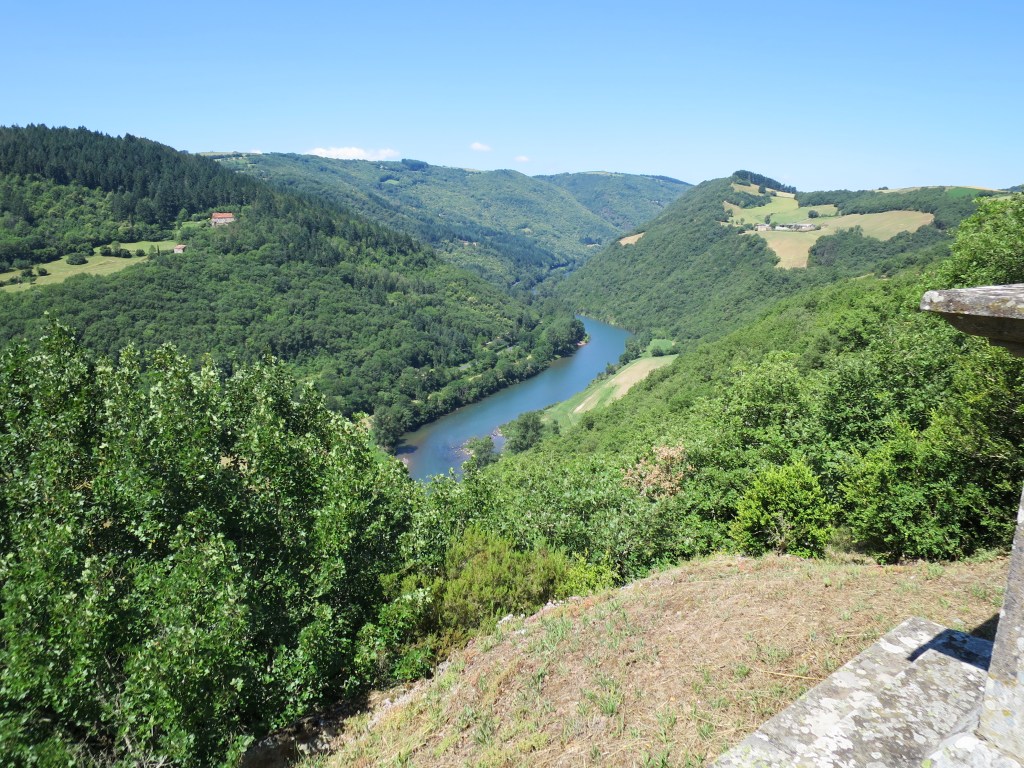
The graves of Jean-François and Marie-Jeanne are on the edge of a precipitous drop to the river. They share the same gravestone. They lie head to head. The view is terrific. I sit on the wall, legs dangling, my hand on their shared gravestone, content.
But there is more. I follow the path the gardener pointed me to, up through the trees and scrubby vegetation behind the chapel, and emerge at the sharp crest of pink rock. From here there is the panoramic view the gardener promised.
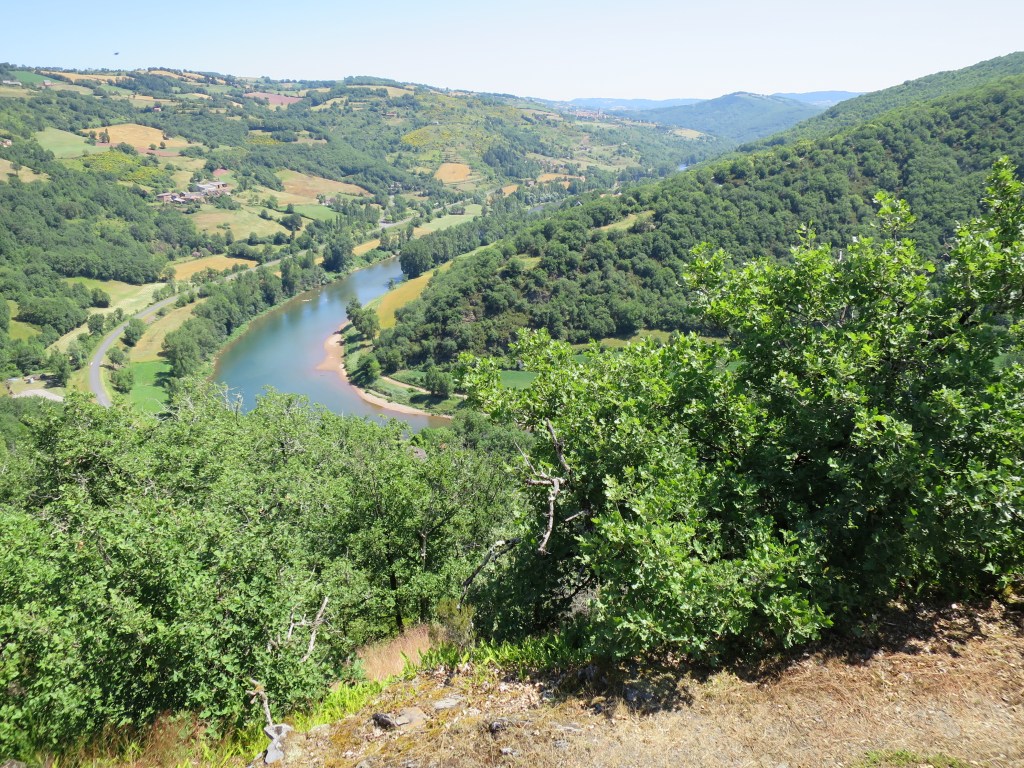
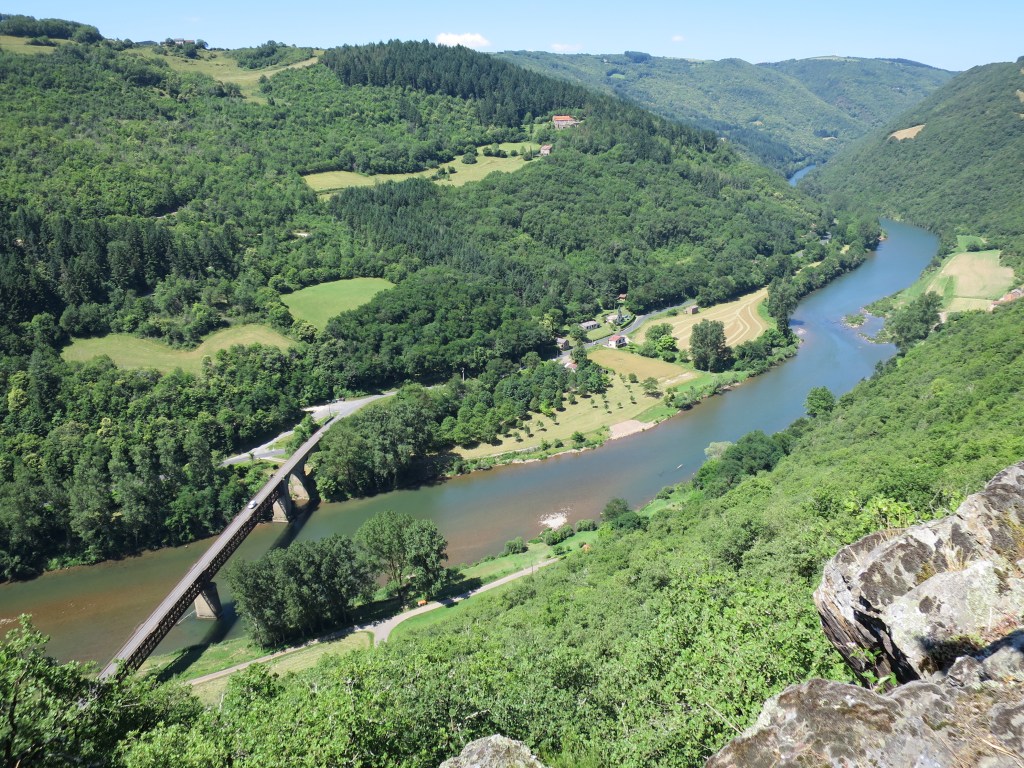
Looking down, I follow the bend in the river as it flows from the left, disappears under my feet and emerges and disappears windingly on the right, westward. It is a series of curves that I follow with my hand, lean through as if I’m on the water. The valley sides are mixed woodland and open fields, pasture and crops. The view around is clear in every direction, an undulating landscape mosaic of dark woods and lighter and variously-coloured fields, fading into the blue of far distance on every side. How wonderful, for a surveyor to make a place to live, in this inspiring place. And that the mechanics of his trade hadn’t blunted his love for and wonder at the beauty of the land.
And for the mentally-ill pilgrims, however valuable their communion with God in this place, I cannot but believe that it was this landscape that helped calm them, and bring lucidity to their minds. I imagine Artaud being brought the few miles from the asylum at Rodez, from the cold baths and electric shocks, and his mind clearing in this wonderful place. But that never happened.
I have come out of my way, away from the Meridian, and I am glad I have come to the resting place of a remarkable man; and woman. I want to thank the gardener. But when I get back down to the graveyard, he is nowhere to be found.
As I freewheel down on my bike, I realise that, in my journey from bridge to chapel – through the tunnel, my cry at the mid-point, emerging into Deslongchamp’s paradise – I have enacted, in miniature, Gilgamesh’s journey through the mountain of Mashu.
At the traffic-lights I wave down a car going my way, and ask if he will drive slowly ahead of me, to light my way. He readily agrees, and in his slipstream I pedal fast the 600 illuminated curving metres, and as we emerge a minute later I wave my thanks. He beeps his horn and accelerates across the bridge.
I cycle back to Albi along the banks of the Tarn. The road switches from bank to bank, passing through railway tunnels, past ghost railway platforms. I lunch at Trébas, by a camp site where a petanque competition is under way. Each team wears club colours with a sponsor’s logo. A team saunters over to drink between rounds, looking like English dart players, ‘Castelvision Garages Albi’ across their ample fronts.
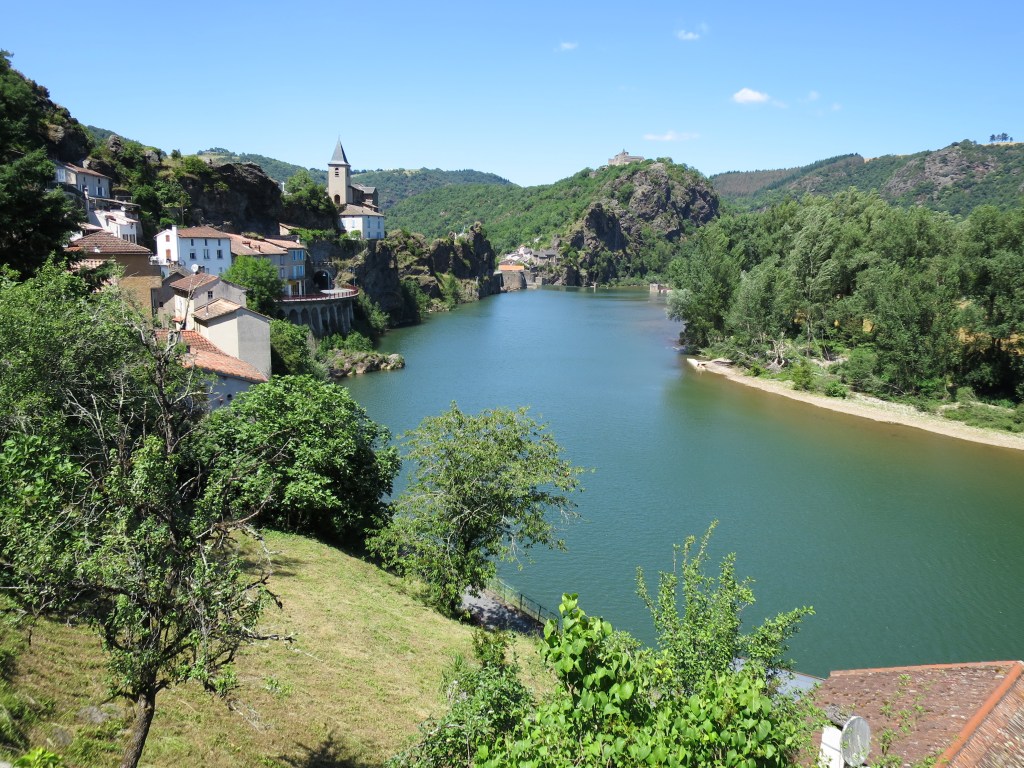
I pass the several hydro-electric barrages that now divide the length of the Tarn into a series of lakes. Across the Meridian and through Ambialet, one of the prettiest river views, the village heaped up around its steepled church, and an ideal combination of grass, trees, craggy rocks, water and beach.
I enter Albi through St Juery, the working-class suburb where Jaurès founded the bottle-making cooperative.
After the detour into my past, tomorrow I will be back in the present, resuming my journey along the Meridian.
Day 22: Albi to Carcassonne, 71 miles.
Dreams. Cathars, Camisards and Maquisards. Out of the silent forest into The South. Viollet-le-Duc and Northern appropriation. A view from ramparts remembered. An evening of music in the ville basse. Crêpes.
My bike is against the wall, by the window with the glinting eye, there are long tree shadows, it is early. As I’m fixing a pannier, the front of the bike slews round. A perky young woman passing, small and quick, grabs the handlebars, helps me steady the bike. She asks where I’m heading, tells me that last summer she cycled to Riga, the people were ‘génial’, the trip was ‘extra’, she wishes me ‘bonne route!’ goes jauntily on her way.
Along empty Sunday streets I weave my way out of Albi, through the French maze that is forever leading me either onto motorways or into village cul-de-sacs. Eventually I make it onto the main road south, enjoying the quiet, sunny, early morning. All day I will be parallel and close to the Meridian.
I pass a sign to Musée le Rêve du Passé. More dreams of the past (and the passed), with an echo of Proust, this for a museum of tough rural ways and practical farm tools. The noun rêve was unknown in France until 1694. (What would Shakespeare have done without it?) It was rare before the nineteenth century, and only in 1794 was it used in the sense of ‘imagined thoughts’. Perhaps under the ancien régime,before the Revolution, such dreaming was not allowed. Or even possible? By Nerval’s time, the mid-nineteenth-century, ‘the dream is a second life’.
For me it has always been the line from Georges Moustaki’s 1969 song ‘Temps de Vivre’:‘nous pourrons rêver notre vie’. Not just because I believe one has to dream one’s life into being, but also because of its echoes of réveiller (to awaken), and révéler (to reveal). And yet one of my phrases is ‘a goal without a timetable is a dream’. And what to make of Springsteen’s chilling ‘is a dream a lie if it don’t come true, or is it something worse?’ Now I’ll be singing ‘The River’ all day! I’m daydreaming! I’m cycling through France on a quiet, sunny Sunday morning, weaving dreams!
I stop at the first bakery-café, to reinforce this dream of France on Sunday. I sit with a grand crême and two pains au raisin, in the midst of the smell of Sunday baking, the vivid glow of Sunday tarts, the ‘bonjours’ and ‘bonne journées’, watching the careful boxing and wrapping – don’t forget to curl the ribbons! – of pastry gifts for Sunday lunch. I ride on, humming ‘Lost in France’.
I pass Lombers. In 1165 an important council of the notables of the region, religious and secular, was held here. On the lines of a jirga in tribal Afghanistan, it met to discuss and reach decisions by consensus. The outcome was that several ‘boni homines’, good men, parfaits, who would now be labelled ‘Cathars’, were judged to be heretics. There were several such procedures in Languedoc in the twelfth century, initiated by the local powers. Usually under pressure from hard-line Cistercian ‘missionaries’ from the north, like Bernard of Clairvaux, who sniffed heresy everywhere. Their decisions usually had few consequences, and never resulted in death sentences.
There has been a range of opinions of the ‘Cathar heresy’, from judging it an alternative religion, an extreme, gnostic-inspired dualist faith (that there are two gods, the good god of the spirit, the bad god of the material) imported from the Balkans, with an organised system of doctrine, dogma, bishops and priests, to seeing it as an undogmatic Christianity, similar to the ‘back-to-basics’ Christianity of many ‘approved’ Christian preachers of the time, based on paysan common sense, and reflecting a society that had an instinctive antipathy to Paris-trained priests, distant authority, and zealous tithe-collecting.
For Languedoc was a different world, a more tribal, consensual society, with less distance between nobles and people, in which difference was smoothed over, one could be ‘both-and’; in contrast to the Northern scholastic emphasis on ‘either/or’, adversarial argument, in which something was either right, or wrong, simple. Each conflict, Albigensian, Wars of Religion, Camisard revolt, vine-grower protests, contemporary Occitan nationalism, has been a restatement and expression of that difference.
It was Languedoc’s (and Europe’s) misfortune that in 1208 a perfect storm of religion, politics and greed unleashed a whirlwind that destroyed a culture.
Through Castres, where Jean Jaurès was born.
Just south, at Valdurenque, there is a Meridian marker.
It is close to where yet another Camino route crosses, this one from Arles.
It stimulates another thought about la Méridienne verte: I have passed, in several villages, iron crosses set up to commemorate Catholic missions in the nineteenth century, neglected, ignored since. I wonder if the Meridian markers are like them, signs of a brief fire of interest that soon faded; they record a moment of excitement that flared but didn’t take hold. Whereas the pilgrim ways to Compostela, never forgotten, touching something deep, have revived in recent years.
I pass a sign to a Museum of Protestantism. And a few miles east is Lacaune, a centre of camisard resistance.
The Camisards (it is an Occitan word) were Protestants who fought back against Louis XIV’s ruthless regime of suppression, which involved vicious dragonnade (deliberately destructive) billeting, forced conversion, imprisonment and torture. It was imposed around the Revocation of the Edict of Nantes in 1685. This was ‘the result of Louis “thinking seriously about the conversion of heretics,” wrote Mme de Maintenon complacently in 1679. The Protestant response was a guerrilla resistance that took a dozen years to put down. The oral accounts were still told when Stevenson walked his donkey through the Cevennes 200 years later; I can feel the atmosphere of their stories in Kidnapped, transplanted to the Scottish Highland resistance. The Camisard war echoes the Albigensian Crusade, and is echoed in the wartime résistance of the Maquisards, themselves named after the scrubby vegetation of the upland South.
The effect of the destruction and flight of the entrepreneurial and hardworking protestants, the Huguenots, on the economy and society of France was immense, delaying industrialisation, and being an element in the stagnation that brought on the Revolution.
Rising in front of me is a green wall, rising very high above Mazamet: the tree-covered Montagne Noire. It is a tough climb, rising 600m in a few miles. On top there is dense forest, of ash, oak, sweet chestnut. It is quiet, the quiet grandeur of undisturbed broad-leaf forests, with deep shade and little traffic as I cycle through, and enticing by-ways that I imagine following to the isolated houses of the minor nobility who (like the Catholic families in Protestant England who sheltered and passed on Catholic priests) welcomed and hid the secretly-travelling Cathar ‘good men’. Its dense forest was also a centre of Resistance in 1944, with over a thousand men in five camps. There are lakes here, dug to supply water to the Canal du Midi. And it is where you must gather gorse if you want to cook authentic Castelnaudary cassoulet.
The forest is cool. It could be England on a summer day.
But when I emerge from the trees to a stupendous view and into a tremendous heat, it’s as if a door has been thrown open, and I enter another world.
It is hotter and brighter than anything I’ve experienced this trip. And at first it is alien, frightening even, too much. The heat is terrific, and I begin instantly to sweat. The light is blinding, so that all I see at first is a vista of bleached ochres.
Only as I make the long, easy descent towards Carcassonne, as my eyes adjust, do I see subtleties and shades. But in new colours. At the far horizon is a pale blue wall, far higher than I expect: the Pyrenees. And embedded in the soft blue is the Pic de Canigou, the revered mountain of the Catalans, where in two days the Catalan Flame will be lit, and carried around the region. I have entered the South.
Close to, there are small-leaved, scrubby shrubs and spiky conifers, open stony ground, bleached-out colours, the trees are a wash of faded cyan, broken by the sudden sharp green of new conifer needles. Pale fields, and then the vivid emerald of vines. There are yellow flowers, purple flowers, scents of herbs, and the turpentine smell drawn from the pines by the sun. This is a different palette of colours! Intensely visual. But a fractured vision, for which first Cézanne and Van Gogh and after, Picasso, Braque, Matisse, Dufy invented new colour chords, harmonies and dissonances, new patterns of shape, both to represent, and to defy representation.
Pine cones litter the bare ground. The vegetation is thorny, spiky, protecting itself. There is a racket of cicadas. There are violent gusts of hot winds, as around an open oven, the air is overheated, there is a dangerous turbulence, of disturbing power, and a blanket of heat everywhere, the heat coming from every side, up from the road as well as from above and sides. The bike thermometer ticks up to 37ºC. The sun is a force, vast and frightening. A Van Gogh sun! The super-dry air is sucking moisture out of me, desiccating me as I ride. I drink and drink. By the end of the day I’ve drunk 3 litres.
And yet, by the time the citadel of Carcassonne is clear before me, I have adjusted, become part of this new reality. I have thinner skin, a clearer eye, I am sensitised. To the South.
The cité of Carcassonne, on its hill above the town, with its 3km of double walls and 52 towers, is not a castle but a fortified town.
Taken by the invaders in the Albigensian crusade in 1209, Simon de Montfort, a minor northern noble with close links to the Cistercians, threw all the people out, and made it his base during his ten-year rampage.
After 1247, when the town submitted to the French crown, it was refortified to become a key part of the defence against Spain. Below it, the area by the river became le ville basse.
The citadel lost its military significance in 1659 when Roussillon became part of France. Its fortifications decayed, and were about to be pulled down when Prosper Mérimée intervened and had Viollet-le-Duc renovate them. He did this in an inappropriately northern style (the conical tower roofs are too high and steep, and in places with grey slate, not red tile roofs), the last chapter in the French appropriation of a key Occitan centre. Although perhaps the last (or latest) appropriation is in turning Occitania and the Cathars into tourist attractions.
However inaccurate the renovation, it is a hugely popular, and I can hardly push my bike through the crowded streets. Although packed with shops and restaurants, few people now live up here, and at night it empties of all but the residents of the few expensive hotels. And, amazingly, the youth hostel, which is here, inside the citadel.
There is a friendly Irish girl on reception. My room-mate is a young Canadian. He is friendly, in a well-trained way, fastidious and rather prim. He has an electric fan, hired from reception, going full blast. He has just arrived in Europe, and he is not used to ambient temperatures and no air-conditioning. He has a day here, a day in Avignon, two days in Florence, etc. The European experience. He is excited because tonight is the night of the annual Fête de la Musique Carcassonne. It takes place in the ville basse, and there is a classical concert in the église des Carmes he is keen to hear.
I shower, change, and go out into the citadel. It is all narrow, winding alleys, stone buildings, hemmed in. Claustrophobic when full of people, but now, with the crowds gone, it echoes with emptiness, and has an air of sombre melancholy. Which takes me back. I climb up onto the deserted ramparts, walk slowly along.
It is a Southern evening. The warm air is soft around me, the stone warm to my touch, my footsteps light on the polished stone. I take off my sandals. A peach light. A lemon tang. Before I look out, I look in, remember.
I remember the adolescent I was, walking the ramparts of the castle at home. For years I was a solitary evening walker, a celebrant of sunset, twilight, the crepuscular, watching defiantly as the wide light drained away and the darkness flooded up, standing alone, a Friedrich figure. While wishing, yearning, for the one soft hand, the one silent listener, the one perfect companion. Through everything, a long life of having, and of relinquishing, always that wishing was there. No longer. For while I still believe it is nostalgia for a moment in childhood, I see it now as a desire, a need, not for a moment of completeness with another; but for a moment of clarity within oneself, a clarity one must continually renew, alone. Now, look out: –
The town laid out below, with the hills and horizon beyond. There are dusky blue-greys, layers and washes of colour, the sharp outlines of hills like smoky charcoal cut-outs, dark wedges of trees with emerald slashes. Birds are urgently feeding, noisily roosting. There are ochres and reds of earth and buildings, contrasting with the green of vegetation, and the blue sky overall. Complementaries of red and green, blue and orange, yellow and violet, harmonised and intensified with broken colours. Van Gogh didn’t find his colour theory, his gestural technique, in the South; he found in the South the place where he could apply the theory and technique he had developed in the North, that he brought with him. Complementarity of artist and place. Hence the astonishing Arles paintings. It is time to descend to the town.
There is a straight road down, to the old bridge crossing the Aude to Le Ville Basse on the other side. After Carcassonne surrendered in August 1209 the population was spared, but exiled from their city, straggling down the hill to a shanty town by the river. When the city was ceded to the French crown in 1247 and became a frontier fortress, Le Ville Basse was founded.
What would have been for centuries a narrow, traffic-filled causeway and bridge, is now a handsome stone pedestrian entry into the lower town, its own ceremonial gateway, a citizen appropriation.
From here, looking back up, the citadel is the perfect children’s castle, crenellated and towered. Not the girl’s fairy-tale castle of princesses and unicorns, but the boy’s castle of toy-soldier combat. As I watch, it turns pink, then red. Then fades to grey.

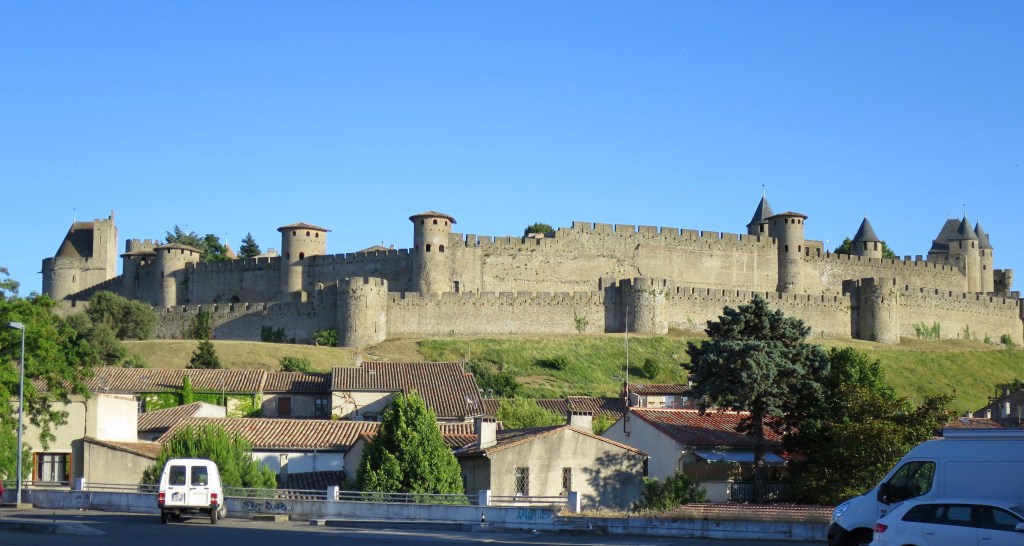
It reminds me, this pedestrian way up to the citadel, of Athens.
But there the citadel, the Acropolis, was the shared religious and ceremonial high-point; here it represents, then and now, exclusion, authority, and privilege.
A boy revs noisily past on the pedestrian-only bridge, bouncing on his mobylette on the polished stone, horn beeping, hair flying, set face, a dare on this night of fête to cross the pedestrian bridge, his friends laughing at the far side, high-fiving when he breathlessly arrives. ‘It’s not right!’ frets an old squat woman. ‘It’s youth,’ sighs her husband. They walk slowly on, arm in arm. The scent of figs rises up from the river bank below. A dark head emerges from the water, moves slowly towards a stranded tree, climbs on. An otter? An old man reflectively smoking, says it’s a ‘rat godin’. They don’t trouble the ducks, he says.
At the end of the bridge there is a circle around a white-haired woman, my age, attractive, who is singing ‘La Vie en Rose’, with passion. Our eyes catch, we smile. It is the night of ‘la Fête de la musique Carcassonne’, and music is everywhere.
A poster reads: ‘Capoeira, slam, blues funk, folk, heavy rock, rock français, soul, hip-hop, electro-rock, metal hardcore, percussion, jazz, fanfare, classique.’ Here a couple of earnest guys are setting up their turntables with snakes and coils of cable. There a girl band dances like Pussy Riot. A young rock band is anxiously tuning up. A middle-aged man is crooning sentimental ballads. As I get nearer the centre, the streets fill. The place is packed. A New Orleans jazz group is playing jauntily outside Subway. From the packed, open church next door come the high arcs of Vivaldi. There is the thump of techno, the swirl of accordion tunes. It’s a night of music and street food, of noise and light, of carnival, the terraces overflow with eaters, the streets are packed with strollers, and everywhere the mood is expanding into the soft evening air.
I eat a crêpe, expertly made and amazingly packed with ham, mushroom and cheese, and drink a can of beer as I stroll around, look at the lights reflected in the Canal du Midi. The beer reminds me how tired I am. Today was my second-longest ride. I head back.
On a stage in the square a middle-aged man, hunched over his microphone, is singing ‘si tu n’existais pas …’, if you hadn’t existed, I’d have had to invent you, the way you once loved me, the way that you left … Amateurs raising money for charity make crêpes, not expertly but their smiles make up for it, and I walk back the bridge eating a second crêpe, this one bien sucré.
I climb out of the noise, out of the light and music, the activity and life, up the empty stone streets to the citadel. Around me is the powdered light of a southern twilight, above me a greenish-blue sky, with swifts black meteors streaking across. The horizon is dusty pink, against it are silhouettes of buildings and trees, sharp and solid black. The far hills are smoky blue. Below me is the ochre and pale-red town, above me the grey ramparts, with their towered gateway. I walk in through the gate, onto the cobbles. I walk into the silence. Or rather the quiet. Of politeness. Restaurants with white napery, subdued conversation, the low tap and scrape of cutlery, the discrete world of privilege, high above the light and noise of a town that is coming to Brueghel carnival life.
The Canadian, setting out his clothes neatly for tomorrow, then writing his neat diary, is disappointed because the concert was sold out. I suppose he never thought of standing at the door of the church. Or of wandering through the crowds. The fan whirrs. As soon as he is asleep, I turn it off. It’s time he began to adapt.
Day 23: Carcassonne to Quillan, 47 miles.
Spanish children and teachers. Remembering a friend. The crusade that destroyed the South. Following the river upstream. Into the Pyrenees. 35ºC. The rond-point. By the river, in green hills. Steak-frites.
At breakfast the dining room is full of Spanish schoolchildren, so lively and yet so ordered and polite that I have to go over and compliment the teachers. One teacher has “That fireball whiskey whispered temptation in my ear” across her tee shirt. One has flowers in her hair.
And then comes the interesting child. There is, you hope, always one. She is small and composed, pale. She comes in alone, after the others. Usually the child coming in late looks desperately around for a group to invite her to join. Not this girl. She looks at no one, acknowledges no one. She queues silently, takes a single piece of dry bread, walks to the one empty table, eats alone, looking ahead at no one, leaves. Yes, Miss, I ate breakfast.
I eat in the garden. A middle-aged woman, checking her phone, seeing my tablet, asks if I have a wifi connection this morning. I say no, I don’t. She lives in Paris, was born here, in the Ville Basse, her parents are buried here. I say, so it’s a place of memories for you. Yes, she says, not all happy. The sense of a deep hurt. I wonder why she is here, don’t inquire.
I ask at reception about last night’s ‘rat godin’. It’s a ragodin, the man tells me, a coypu. Introduced for their fur, escaped, they thrive in the river, on the ducklings. Then about the Canal du Midi. He says it is most neglected in this département, Aude, that many trees have had to be cut down because of disease. But many are being planted, he adds. I say, in that case I’ll have to come again in twenty years, when they have grown, and ride the length of it, and smile.
Already the coaches are arriving at the cité, and I have to push my bike out through the incoming tide. A woman walks in, runs out wide-eyed to her slower, chattering friends, shouts ‘this is great!’, and rushes back in. An American boy passing, ‘in my early years of nine, I went downstairs …’ Mostly it is glazed-eyed tourism, of people shepherded around, onto and off coaches, told what to look for, their attention awakened only at the appointed places, switched on, a shutter clicked. And to record not the place but the memory of the place. Their thoughts are less about where they are than what they will tell people about it. They are script-writing. As am I.
I freewheel down the hill. The restaurants are all closed in the shadowed street, the light above is still dawn-pinkish, the air is cool, but seems to carry within it the heat of the coming day. I cross the polished stones of the empty causeway, and over the bridge. There are no signs of last night’s carnival, it has all been cleared away, it is a business-as-usual Monday morning. I pass the St Jacques hospital; it was built in 1317 for pilgrims to Compostela from Narbonne, along the Piemont Pyrenéen, the French foothill route. Now it is the GR78 long-distance footpath.
Through the city the Canal du Midi is a featureless, treeless green ditch. But westward, out of the city, there is a cycle path, and tall plane trees close-planted on either side, giving continuous shade.
A breeze shimmers the leaves, and with the moving water, there is a pleasing green and blue, grey and brown dappledness.
Most of today I will be following the river Aude south; but first I have backtracked, to cycle a short length of the Canal, because of a friend. Six months ago she was diagnosed with inoperable cancer. Her first comment was, ‘but I always meant to cycle the Canal du Midi.’ I wanted to say, then, ‘you still can!’ But it was January. Now it is June. She is still able. But rather than being asked how she wants to live out her life, she has been absorbed into a programme of increasingly extreme medical interventions, focussed on extending life, not on quality of life. She has disappeared into the medical system, far from a cycle ride along the Canal du Midi.
As I cycle along, a bumpy path that risks my tyres, passing mainly white-haired and blond-dyed English couples on rented bikes, I want to text her – ‘Do it! Now!’ And if she is not well enough to cycle, why not take one of these boats that cruise placidly along?
Cycling west, towards Montréal, Fanjeaux, Laurac, I am in the heart of the ‘Cathar’ area hit by the crusading army in 1209. Fanatical papal legates had long been preaching against the ‘Heresy of the South’, and their wish for action was granted when the Crusade was proclaimed in 1208.
‘Heresy’ was everywhere in Europe at this time. Partly because a new orthodoxy used the fear of heresy (whether real or imagined) to suppress debate. Partly because popular dissatisfaction with an increasingly corrupt, centralising and demanding church (demanding of money and obedience – it was at this time that confession to a priest became obligatory) encouraged support for preachers who proclaimed a return to the basic simplicities of Christianity; and rather than embracing these simplicities, the church labelled them ‘heretical’ and suppressed them. Partly because it was a useful – and often fatal – label to attach to an enemy.
And as the church structure in the South was looser and less controlling, with more divisions, “it was in that [looser structure], and in the venom with which accusations of heresy were exchanged among its bitterly competing factions and levelled against it by the predatory neighbours who meant to profit by those divisions, rather than the “heresy” itself that the south differed from the more developed and more closely governed territories around them.” For “there is no real reason to think that the region was especially given to heresy, but it had been repeatedly portrayed as such by those who hoped to dominate it.” (Moore, The War on Heresy).
And there were too many powerful factions who would gain from the proclaiming of a Crusade against Heresy in the South, for the South – in spite of some desperate diplomacy by Raymond of Toulouse (son of the patron of the troubadour Bernat de Ventadorn) – to survive. For pope Innocent III wanted to extend his increasingly centralising (and financially demanding) control over the Languedoc church. Philip Augustus of France, having lost Aquitaine to the English, wanted to extend his realm in the south. And there were poor lords and barons in the North who were happy to invade the South, in return for booty, land, and indulgences.
But there clearly was a coherent Christian heresy in the South, an underground faith that the ‘both-and’ Southerners could believe in, while accommodating themselves to the established church.
In June 1209, ‘the greatest Christian army ever’ (Arnold Amalric) assembled at Lyon. On 21 July, the army hit Béziers, which quickly fell. Asked what to do with the 20,000 men, women, children and priests in the town, Arnold, Cistercian successor to Saint Bernard, and the papal legate, replied, “kill them all. The Lord will know his own.” “After the great slaughter,” he reported to the pope, “the whole city was despoiled and burned, as divine vengeance raged marvellously.”
Albi soon surrendered, and Raymond-Roger, count of Béziers, Albi and Carcassonne, was besieged in Carcassonne. He surrendered after three weeks, to prevent mass slaughter, and although promised safe conduct, was imprisoned in his own dungeon, where he soon died, in unexplained circumstances. He was 24, “handsome, gallant and foolish – or betrayed.” (Moore.)
Simon de Montfort, a minor northern noble with close links to the Cistercians, made Carcassonne his base, and continued ten years of destruction, looting, slaughter and cruelty, a reign of terror until he was killed at Toulouse. At Bran he allowed the garrison to withdraw, after cutting off their noses and putting out their eyes, leaving one man with one eye to lead them home. At Lavaur he had the lady of the house dropped in a well and crushed under stones. After which, Arnold reports, “our crusaders burned them [400 people] alive, with great joy.” 140 were burned at Minerve.
The destruction and slaughter continued until Montségur fell in 1244. By then Languedoc was part of France. The Inquisition had been founded in 1229, as a specialised department of the church to root out heresy. It was authorised to use torture, and was run by the Dominicans, ‘the hounds of the Lord’, whose Spanish founder evangelised from Fanjeaux for ten years. After the shock and awe of the crusade, its work was bureaucratic, methodical, and over the next century it squeezed the last of ‘heresy’ out of Languedoc.
In the process, the crusade, that was proclaimed to be “a door open to Christian princes to avenge the wounds of Christ, and bring to the desert the garden of the Lord, and to the wilderness the sweetness of Paradise,” had laid waste a prosperous area and destroying a rich culture.
One of the last troubadours composed The Song of the Cathar War in Occitan, the only work written from the point of view of the South. Otherwise, as ever, history belonged to the victors. The familiar quote was memorably extended by Peter Esterhazy in Celestial Harmonies: “history belongs to the victors, legends to the people, fantasy to literature. Only death is certain.” For the Cathar story is full of history, legend, and fantasy. And death. One early history (legend? fantasy? work of literature?) has Raymond-Roger of Carcassonne as the model for Perceval/Parzifal, the knight of the Grail.
After a few miles, my homage done, I leave the canal and head south. Climbing from the canal, the country is pleasantly undulating, much of it under bright green vines, with long views to mauve hills. In the fields are small circular stone structures with conical roofs. It is very hot.
I suddenly remember that it is Monday, when many shops are closed, especially the local ones. And I am short of drink. I should have found a supermarket in Carcassonne. But I was eager to be on the canal, in the dappling shade, by the glittering water.
At the edge of a village, the vines in the fields glow vividly, while the tall, dark cypresses around the cemetery absorb the light. In the village there is no shop, not even the expected ladies’ hairdresser, with its reassuring hum and secluded laughter from within.
I knock at a door to ask for water, but no one comes, and I don’t knock again; it is that time, in the breathless heat, when life feels, less suspended than having absented itself. To call someone to the door would be to draw them up from the deep well of absence, of forgetting and of being forgotten. It would be as unthinkable as waking a sleepwalker, or pulling a hibernating animal out of its deep nest blinking and shocked into the now, an affront.
I cycle through the quiet lanes, and reach the D118, the main road south, and close to the Meridian. I am on a racetrack. An old-fashioned, unimproved road, with vehicles travelling too fast. I wait to be knocked off, especially along the sections that still have rows of plane trees close up to the tarmac so there is no run off, no escape route, and I’m sure that I am invisible in the camouflaging dappled light. Fearfully I cycle on.
I pass a campsite. There will be water there. Surprisingly I find that the reception is open, and they have milk and orange squash. Both are cold from the fridge, too cold to drink, and I ride for a while until the milk has warmed up. Then I drink the whole litre in a single draught. I feel it slowly hydrating me.
The road follows close to the Aude, so that although the land on either side undulates, rising in waves up to 800m, I am climbing regularly, easily, only a few feet each mile.
By the road, in a tree-lined gorge with the river dashing below, is a memorial to Paul Swank, an American lieutenant who ‘fell gloriously’ for the liberation of France here on 17 August, 1944, and is buried here, ‘according to his wish.’
I emerge from the gorge, and suddenly, from being a blue wall in the distance, the Pyrenees are close, there are hills, mountains all around me, I am now in the Pyrenees. This is the area of the last strongholds of the resistance to the crusade, the great Cathar castles, the last Cathar villages. The defile I have passed through, that has closed behind me, has taken me into a different world.
At Couiza, the temperature on the pharmacie sign is 35º. My bike thermometer reads 38º. It is hot. A battered van passes. A man walking, thin, wispy beard, long hair, in vest, ragged shorts and flip-flops, suddenly sees the van and breaks into an ungainly flapping trot, shouting ‘Gilles!’. The van drives on, the man runs on, waving his arms, the van disappears, he stops, says ‘dingue!’ and flaps disconsolately on. I imagine him a soixante-huitard, arriving here on the tide of the exodus after the 1968 Events to the fringes of France, to make the dream real, and left here, flotsam, when the tide receded. But he’s too young, a generation too young. Child of soixante-huitards? Or drawn by the mystical connections? This is very close to Pic de Bugarach, the one place that would survive the end of the world when it came in 21 December 2012. There is a sign to Rennes-le-Château, the village of The Holy Blood and the Holy Grail. I ask him at the junction which way is it to Quillan. He says, turn left, his hand points right.

I come into Quillan along the river bank. The river isn’t wide, and it’s shallow, dashing over rocks and flowing fast. I can imagine the rafts of timber bucking their way through the town. The backs of buildings rise straight up from the river.
On one side of the bridge is the castle, on the other the town. The castle was built by the church, fought over in the crusade, taken by the crown in 1229, and was a frontier fortress against Spain until the 1659 Treaty established the crest of the Pyrenees as the frontier, having changed hands several times in the Wars of Religion. The villagers used stone from the castle to replace the wooden bridge. I cross the bridge to a small, placid, tree-shaded square.
There are old men on benches, shops and cafés all around, a painted advertisement for ‘Suze’ fading on a wall. A tabac, ‘l’Alhumetur’. Bushy-topped plane trees give shade.
The shops are closed, but I find an insurance agent office open. I ask the brisk, bespectacled woman for directions to the youth hostel. She says, go back to the main road, and turn left. I say, what, back to the rond point? What roundabout? she says, indignantly, there is no roundabout! I thank her, return to it. It is a junction, with a traffic island. Technically she is correct. And I am in the French world of correctness, and needing to correct, in which something is right, or wrong. I realise why there are so many road signs, traffic lights, why the ‘zones of uncertainty’ that have been introduced in Dutch and English towns, where road users have to negotiate, would not work here: there is only rule (for example the priorité à droit rule, which established responsibility absolutely, and which the French found so hard to let go of), or anarchy. We’re back to de Tocqueville.
But also, I realise, and it’s pertinent in talking about heresy, we’re back to the university of Paris of the twelfth century. The Scholastic method, of dialectical reasoning used to resolve contradictions, involving the careful drawing of distinctions, was fundamental to it. A thing might be x, or not x; it cannot be both. A road junction resembling, and having the same function as, a roundabout, cannot, in any circumstances, be called a roundabout.
I head up the Perpignan road. The youth hostel is part of an outdoor-activities centre, The Forge, offering kayaking and rock climbing. It is by the fast-running river Aude, and surrounded by high, steep slopes, with dense, fur-like tree cover. There is a nice woman in a big office. There is an excellent kitchen, there are tables outside, lots of space, and it is set well back from the road. The only drawback is the low-level hum from the hydro-electric generator on the river. But even that is a reminder of the power of these mountains. And I have a room of my own. For three nights.
I head into town to eat, remembering that is Monday. There are only a couple of places open. One has a group of pallid English-looking diners.
The other says ‘bikers welcome’, and is empty except for one man sat outside. The woman says désolé, the kitchen is closed, almost apologetically adds that she can do steak and chips. That’s fine by me. I remember to request ‘à point’, and sit down outside. First two French men, then two Irish couples, then four elderly English arrive. She tells the same worried tale to each, there is the same response – fine. Within 15 minutes every table is filled. By this time the first man has finished, and he leaves with a smile, he has filled the restaurant. One Englishman is disabled, perhaps by a stroke, and he struggles to cut up his steak. No one helps him. His wife talks of the house they are here to buy.
As I’m leaving, the old lady sitting by road nursing her demi of beer says hello. We chat about the heat, I tell her of my travels, I say I haven’t far to go now. Misunderstanding, she says, oh you’re staying at the Forge, are you? She says she understands more than she can speak, having spent some time in Dunstable, and wishes me bon courage.
Back at the Forge there is a noisy party of French outside, spreading over several tables, doing the French thing of preparing a beautiful layout, on white tablecloths, even while hostelling. The wine flows as they prepare great platters of beautiful salad, carefully arranged meats. I can never decide if this is sophistication, bringing style to the outdoors, or the laying of domesticity over nature. I go to my room, to decide what I’ll do for the next two days, and go to bed.
Day 24: Quillan to Quillan, 64 miles.
The trapped light. Heresy. A Northern arriviste. Charlot Chassepot and ‘Happy Days.’ The last Cathar village. The last Cathar stronghold. The Field of the Burned Ones. Napoléon Peyrat. Gabrielle. The Inquisition and language
I wake early and listen to the silence in the Centre. No one is about. The only sound is the hydro-electric humming, its spin matching the spinning of my thoughts.
I am one day’s ride from the last Meridian marker. I have come a direct if serpentine route, snaking around but holding to the axis of the Meridian. So why have I booked three nights here? To allow myself, I realise, time to ponder. My headlong journey has tumbled me down the neck of a chemistry (or alchemy) flask; this bowl, cupped in the steep green velvet mountains, is the bulb. Which may become an alembic. To distil my experiences. Remembering Melville’s injunction, ‘why try to “enlarge” the mind? Subtilise it.’
I am in ‘The Land of the Cathars’ Around me are ‘The Cathar Castles’. But that is just tourist talk. What can I learn from ‘heresy’, and ‘crusade’, from beliefs held here, and from beliefs about beliefs, Esterhazy’s history, legend, and fantasy, his victors, people, and literature?
Long ago, I came upon (I don’t remember how) ‘Gnostic’. A word that drew me, a brilliant light. Not to lose myself in, but to be illuminated by. I was touched by the Gnostic idea that in each of us is a spark of the original light, a fragment of the pure essence, that is trapped, and obscured from oneself, by matter. Not just the matter of the material, but the matter of ideas and conditioning.
It was particularly resonant for me. For at the end of my long and seemingly comprehensive education, I felt that while gaining much, I had lost something important, that more and more seemed vital. I knew many things and understood many things, so I could control many things, productively and profitably in society. But when I read, “I begin to see objects only when I leave off understanding them – and remember afterwards that I did not appreciate them before”, it made sense. As did “education, I fear, is learning to see one thing by going blind to another.” My knowledge and understanding, I realised, were not an illumination of, but a veil, a net, in front of. I had lost touch with a vital spark necessary to animate my life, a touchstone of my life in its essence.
So I went into the desert (actually a seaside resort in winter) to find myself (this was the 1960s). Or rather, to allow myself to reveal myself to myself. I thought that by relinquishing control, the real me would emerge. Instead, I fell apart. Just in time (or a moment too soon? One never knows) I fled back to the city, and a job in a bookshop.
There I learned, from Plato, Lao Tzu, the Neoplatonists, a subtler story of the trapped light. Beyond being is the One, simple, ineffable, unknowable, unnameable. “The One that can be told is not the absolute One. The name that can be named is not the eternal name.” The One emanates nous, consciousness. Out of formless, chaotic matter, nous crafts, through the demiurge – ‘the maker’ – the phenomenal world, the world we can experience. “The One remains, the many change and pass; Heaven’s light forever shines, Earth’s shadows fly; Life like a dome of many-coloured glass stains the white radiance of Eternity.”
Stains, but also expresses. We may aspire to purify ourselves of the material in order to rise up towards nous. But we can only express ourselves through the material world, as makers, by descending into matter. As we descend, the light is progressively obscured, and we incrementally lose ourselves, forget ourselves, in storms of passions, and the lifeless material. To live well, this story goes, one has to negotiate between, “stripping oneself of passion in order to know the secret of life”, and “experiencing life with passion in order to know its manifest forms.”
Is this true? There is no way of knowing. But, “even supposing the pure principles to be illusions, it is something gained to have thought them.” It is a matter not of believing, but of entertaining the belief, that helps one live more fully. While one still tries, on occasion, to recover the experience of the first man, ‘face to face with the earth, the sun, the night; face to face with oneself, with nothing between; no wall of tradition; no built-up system of culture – the naked mind confronted by naked earth.’
I began to try to live, sometimes stripped of passion and rising towards the mystery, sometimes experiencing with passion and descending into its manifest forms.
But I soon discovered, in a brief return to the profession I was educated for, that the learning of my education, and the work it fitted me for, took me too deeply into the material; especially the material of given ideas and patterns of thought. I needed to be simpler, less complicated (although hopefully no less complex). I had to leave it behind and begin again, a beginner in my mid-twenties, at first in unskilled manual work (a good place for forgetting and remembering, in, for example, the abattoir), and then in learning and practising a manual trade. I recovered the direct connection between mind and hand (body). I found there less achievement, but more light.
To return to the One. The Gothic, with its soaring vaults, vast coloured windows, apsidal orient illumination, is one of the great expressions of the One in the material, of descending into manifest forms in order to rise toward the mystery. As I had experienced at Amiens, Beauvais, Saint-Denis.
Abbot Suger wrote of his beloved basilica of Saint-Denis, “the work which shines here so nobly should enlighten the hearts so that through true light they can reach the One true light”. His building was much influenced by the Neoplatonist Pseudo-Dionysius. He was so attached to him that he had Abelard charged with heresy for arguing (correctly, in fact) that Pseudo-Dionysius and Saint Denis were not the same person.
But why, as Suger was initiating the Gothic in the North in 1140s, was Bernard, his ally against Abelard, preaching through the South against ideas that shared much with Neoplatonism? And why, half a century later, as the Gothic was approaching its perfection at Amiens, were Northern armies waging a Crusade through the Christian South?
The traditional answer, from the eleventh century to recent times, would be, because the Cathars were dualists, believing that the material world was the creation of a fallen angel, an evil god, ultimately, the devil. This would question God as three in one, the incarnation, transubstantiation, the resurrection of the body, and other essential tenets of the Catholic church, arrived at through centuries of discussion, schism, establishment of dogma and organisation. A rival church, with its own parallel dogma and organisation, was too much of a threat to a church already buffeted by rapid economic and political change across Europe. But was there such a church?
‘Heresy’ was little heard of in the West until the 950s, when apocalyptic writings began to circulate about the approaching Millennium, dated to 1000 or 1033. As I discovered at St-Benoit-sur-Loire. Very quickly a template of ‘heresy’ was established, of an organised rival church, threatening the Catholic church. Did it exist? Or was the South, rather, a victim of the politics of the time?
Perhaps I will have a better idea tonight. Today I am going to Montségur, the famous ‘last stand’ of the Cathars, where 220 were burned alive in 1244. And Montaillou, where the Cathars was finally wiped out in the 1320s.
An excellent buffet from which to select breakfast. Being an outdoor centre, there is that attractive coming together of all sorts of active, focussed people – walkers, cyclists, kayakers, rock-climbers – alert and eager, fuelling up before dispersing to their activities. I eat outside in the warm morning air, to the sound of the rushing Aude, with the sun striking the tops of the surrounding green slopes.
I descend into the town and take the road towards Montségur. I’m soon up to 500m. I’m cycling west along a broad, shallow valley of good agricultural land, enclosed to the south by impressive mountains rising, wave upon wave, to the crest of the Pyrenees. I will have to cross one formidable ridge the day after tomorrow. I haven’t worked out how. The fields are a patchwork of cut hay and pasture. It is a warm, sunny day, and even into a wind, it is pleasant cycling. There is a squirrel flattened on the road. But it is a red squirrel. I cross from Aude to Ariège, the last département before Spain.
Into Bélesta to buy food. The street market is just winding down. A stall sells cous cous and paella as ready meals. On one wall is a fading ‘Byrrh vin tonique’ mural. The hotel is ‘Palais Cathare’. Scrawled across the enamel village plan in felt-tip is ‘la ville de la gandga’, with a red heart.
The château of the Lévis is here. It is a family whose history claims it as second only to Clovis in pedigree. In fact they were Île-de-France arrivistes whose son, Guy, joined his liege-lord, Simon de Montfort on the crusade in 1209, promised, no doubt, the spoils of conquest. He was rewarded with the lordship of Mirepoix. It is an example of the go-ahead but poor Northern minor aristocrats who as a result of the crusade replaced easy-going Southern lords, who had been too lax in raising taxes for the crown, tithes for the church, and suppressing beliefs that strayed from the papal party-line.
In the South were small-scale societies, of face-to-face contact, in which all classes mingled, where cortezia, a courtesy extending to love, was central. “The almost racial antagonism between noble and non-noble seen around Paris during the Jacquerie of 1358 scarcely applied in upper Ariège.” (Ladurie.) One Catholic lord, asked by the bishop why he didn’t expel the ‘good men’, the parfaits, replied, “How can we? We have been brought up side by side with them. Our closest kinsmen are numbered among them. Every day we see them living worthy and honourable lives in our midst.” (Quoted in Moore.)
It became the Lévis’ base for centuries of carefully-cultivated closeness to power. There were several archbishops, and a mignon (literally ‘darling’, a favourite) of King Henry III during the Wars of Religion. He took part in the ‘Duel of The Darlings’ in 1578, and was one of the four mignons who died in the masquerade that got out of hand. They also married into the Ventadour family of Ussel, and with them were noted suppressors of Protestants in this area after the Revocation of the Edict of Nantes. It is another reminder of the politics that lay behind the crusade, and the change in the balance of power it produced.
Several villagers of Bélesta were reported as having visited Montségur in the months before it fell. I take the Montségur turning. The ‘safe mountain’ is soon visible, an impossibly steep and high nob of rock, a pog, with a fringe of stone wall around its summit.
Just outside Bélesta I notice that the stream beside the road is unusually deep, green and fast-flowing. I soon come to La Fontaine de Fontestorbes, an ‘intermittent exurgence of the Vauclusian type’ (named after Fontaine-de-Vaucluse).

In a gloomy cave, green water surges up with unimagined force from unmeasured depths. Rain and snow fall high above, and slowly percolate and dissolve through the limestone before emerging. It can take hundreds, even thousands of years. I drink the water. Perhaps it is the rain that fell on the Cathars at Montségur as they burned. Or perhaps it was dripping through the cave as the Palaeolithic artists were expressing the spirit of life at the Grotte de Niaux, (just too far for me to reach today). There is a sudden release and rush of water every 60 to 90 minutes. But not while I’m there. There is a legend of a princess, returning from Spain with the head of her murdered husband, hiding here from the besieging forces before finding her way to the citadel of Montségur. Another severed head!
Through the small village of Fougax-et-Barrineuf. It is a key place in Samuel Beckett’s Oh Les Beaux Jours, his French version of Happy Days. Winnie, buried to her waist, says (I translate), ‘I close my eyes, and I’m once more sat on Charlot Chassepot’s knee, in the yard at Fougax-et-Barrineuf, behind the house, under the robinia. Oh the beautiful happy days!’ (‘Oh les beaux jours de bonheur!’) Later Winnie, now buried up to her neck, says, ‘what a curse – mobility!’ In Waiting for Godot, Vladimir and Estragon’s one plan to escape from endless waiting by the tree for Godot, is to go walking in the Ariège. Beckett, after evading capture when his Resistance cell in Paris was closed down, fled to Roussillon. I had passed his flat on boulevard St-Jacques on my headlong ride across Paris; had I then followed him in his flight down the Meridian? Had he retreated before the military juggernaut to these mountains, like the last Cathars? I could see him as one of the Cathar parfaits I’d read about in Montaillou, a pure soul within a sensualist. But, no, his wartime refuge was Roussillon in the Vaucluse.
The last words of the Waiting for Godot are:
Vladimir: ‘Well, shall we go?’
Estragon: ‘Yes, let’s go.’
Stage direction: They do not move.
This morning, I read, “The idea of the pilgrimage is to get away from the endless and nameless circumstances of everyday existence, which by degrees build a wall about the mind so that it travels in a constantly narrowing circle. This tether of the faculties tends to make them accept present knowledge, and present things, as all that can be attained to. This is all, there is nothing more, is the iterated preaching of house life.” (Richard Jeffries.)
There is a sign to Montaillou, “the last village which actively supported the Cathar heresy”.
Although armed resistance ended with the fall of Montségur in 1244, the good men and their followers continued quietly in the Pyrenean villages, fed by contacts across the border, as the Montaillou shepherds took their flocks into Catalonia in the annual transhumance. The Inquisition even arrested the whole village in 1308. But the end came with the appointment in 1317 of the Cistercian Jacques Fournier as Bishop of Pamiers. He was both ambitious and implacable in rooting out ‘heresy’. And in collecting tithes. His reward was to be made pope in 1334. By 1324, all those charged had been sentenced, to wearing the yellow cross, prison, or been burned. With them died the ‘heresy’. His meticulous records, written up in Ladurie’s absorbing Montaillou, and Weis’ engaging The Yellow Cross, give us a fascinating picture of a society of clever (not to say cunning), self-sufficient, easygoing peasants.

I cycle on, surrounded by sunlit mountains, towards the distinctive dome of Montségur, and am soon at the foot of the Col de Montségur. There is a sign for cyclists: it is 9km to the top, rises 494m, with an average gradient 5.5%, and 9.5% at its steepest.
I cycle most of it, up through woodland, with occasional views of the mountains all around, and then out onto the bare, sunlit shoulder of land on which the village sits, with the sugar-loaf pog, brilliant white and vivid green, rising a further 200m. A path winds up to the ruins of the castle. The road widens to create a parking area. There are several cars and motorhomes. Visitors come and go.
By 1240 the armed resistance to the crusade had all but ended. In fact the crusade officially ended in 1229. But the questionings of the Dominicans, and the pressing of the Northern knights, continued.
After 25 years, in which town after town had been sacked, villages and fields laid waste, hundreds had been burned, thousands had died, thousands more had their land confiscated, in which the kings of England, France and Barcelona had at times been involved, the Count of Toulouse, after all his manoeuvrings and changing sides, had at last had to swear fealty to the French king.
Many of the minor lords had been dispossessed by crusaders, the Dominicans had been given charge of the Inquisition, and the University of Toulouse founded to educate the clerks who would “cause the Catholic Faith to flourish in these parts”. The papal church, with its growing control over peoples’ lives, and demands on their purses, now held sway. The South was now part of France. It was the end of a society of informal relationships, little disparity of wealth, run on cortezia, in which troubadours could thrive, and men of religion were respected, not because they had authority and power but because they were ‘good men’.
But in 1242 the Count of Toulouse rebelled yet again against the French crown, one last desperate attempt to assert his autonomy. He agreed to the murder of seven Inquisitors, just beginning a new campaign at Avignonet. The killers came from Montségur. The Count’s revolt was short-lived, ended by a renewed treaty with the French crown. The treaty was signed at Lorris, the home village near the Loire of Guillaume, who a few years earlier had written the first, poetic, troubadour-influenced section of The Romance of the Rose. As if, having ridden up to the royal hunting lodge on the Loire to submit, the Count, whose father had been the patron of the great troubadour Bernat de Ventadour, had left there the precious art of the South, no longer sustainable in his ravaged wasteland, to be carried north and transformed into the new intellectual, scholastic style.
The Count was then obliged to fulfil his pledge to destroy Catharism by organising, with several archbishops, the siege of the last Cathar stronghold. Montségur had become, over the decades, a refuge for the faithful, and for faidits, the minor aristocrats dispossessed by the crusade. Or, as an official reporter had it, “a public refuge for all sorts of malefactors and heretics, a synagogue of Satan”. A chilling conflation of heretics, criminals, Jews and the devil. Its defences were organised by Raymond of Péreille, and the faidit Pierre-Roger of Mirepoix, the lord dispossessed by Guy de Lévis. It was remote, strongly defended and well-provisioned. The heart of any soldier marching towards it must have sunk, seeing from miles away the impregnable city in the sky. They arrived 13 May, 1343.
I walk past a garden with a life-size puppet with blond plaits on a swing, and one in dungarees bent over his spade. They do not move. I follow the sign up through the fields. I reach ‘The Field of the Burned Ones’, where the heretics died. Some reports have them fettered, dragged and thrown into an iron cage on the faggots. Others have them walking serenely into the fire. They included Raymond of Péreille’s mother, wife and daughter. There is a stone that reads, in Catalan, “The Cathars, martyrs of pure Christian love.”
What had they expected, taking refuge on a hilltop with no means of escape? That they would be beamed directly up to heaven? No.
First, that the besiegers would, as they had done twice before, give up. But they stayed, for 10 months, through a Pyrenean winter. There would be no escape. Eventually ‘the French bishop who was an expert in war machinery’ managed to build a trebuchet within striking distance of the castle. After a pounding, Raymond surrendered without a fight. In a curiously civilised outcome, given the history of the crusade and the length of the siege, a two-week amnesty was granted. After that, all who renounced the heresy were freed.
Second, that if they were taken, they would not renounce their faith, but would die in the body, at the hands of a church that had, they believed, departed from the original Christian message, and was itself heretical. And thereby save their souls. And doesn’t every Christian martyr believe this?
Even in the sun, it is a stark place, ‘The Field of the Burned Ones’. I try to imagine the Cathars approaching their death.
And by extension me approaching mine. What if – a vivid momentary thought – what if, what you are thinking, what you believe, what you have in your mind’s eye totally, at precisely the moment of death, becomes, through that intensity, a bubble in eternity? Containing the self as it is experiencing itself in that moment of death …? Life after death as the echo of belief. And if I cannot believe it for myself, I want to believe it of the Cathar martyrs who died here, full of belief.
I climb up through woods, buy my ticket at the ticket office, and follow the path that climbs the steep, bare hillside. It reminds me of the climb up Glastonbury Tor, with the same sense that even though the path is quite straight, I am spiralling up, journeying a winding path to the summit.
But unlike Glastonbury, where one arrives at a summit of chanting and music-making, meditation and conversation, a high, airy place of long views, where one feels closer to understanding, here I arrive at the tall, dark, empty keep of the castle built by Guy de Lévis after the siege. He would have been with the besieging army, waiting to take his final possession. He built it as a fortress to defend the new extent of France. (All of the so-called ‘Cathar castles’ were built as frontier fortresses in the years after the suppression of the Cathars.) With the Treaty of the Pyrenees in 1659 it became redundant. It decayed, a useful if remote quarry, the quarrymen at least having gravity on their side. Forgotten until Peyrat’s History of the Albigensians, published in 1870s.
Napoléon Peyrat both discovered and invented Montségur. He was born in Ariège in 1809, exiled at 14 to school and life in Paris as a Protestant pastor, historian, poet and passionate republican. He was both an Occitan romantic, and a French patriot. He wrote in French, and saw a direct line through Cathars, camisards, the Revolution, to the Republic (struggling into existence in 1870s, after the defeat by Prussia), opposing and resisting monarchy, aristocracy, and above all, the Catholic church. His history of the camisards (an important source for Stevenson’s Travels with a Donkey) had recovered the life of his oppressed religious forebears. His history of the Cathars reconnected him with his Ariège roots. Montségur was for him the supreme symbol of resistance, of the faith and sacrifice of the gentle Cathars, of the brutality of the Catholic church. He even saw a personal connection between the Peyrats and Raymond de Péreille – the old Ariège families were like the Scottish clans, he said, with aristocratic and peasant members. He also introduced esoteric elements: of a great treasure carried away secretly; of the holy grail; of Montségur as a solar temple; of a cave-tomb in which Esclarmonde de Foix, one of the most revered of the Cathar parfaites was said to lie.
But he was also the first historian to look in detail into the Inquisition archives, bring them into the historical discourse. On one side, he inspired the ‘revisionist’ historians of Toulouse, who have worked to correct the record by writing history from the point of view of the defeated; and Occitan revivalists, poets and marginaux seeing in the Cathars of the South a simpler life. On the other, the esotericist conspiracy-theorists, especially English and American, leading to The Holy Blood and the Holy Grail, and then The Da Vinci Code.
There are fine views all round, it is sun-filled, wind-blown, with high white clouds streaming across. It should be bracing. But somehow the gloom, the banal functionality of the Lévis’ keep sucks the life out of the place, and I don’t stay long.
I descend back down to ‘The Field of the Burned Ones’. Here there is stillness, and a white emptiness. The fire, the burning up and passing through of the faithful, the finality and yet timelessness of that end day, have made here an empty space, where I cannot think. In which I can only wait. For something, someone, to enter. It is Gabrielle who enters.
She was here two days before we met. A young schoolteacher, she was on a summer-long pilgrimage through the South, meeting Occitan liberationists and poets in Toulouse, supporting protesters at Larzac and strikers at LIP, spending time at l’Arche with Lanza del Vasto – ‘so austere, and yet full of joy’, visiting many installés, refugees of ’68, making a go of it – ‘there’s such a buzz in the countryside now!’ Here, at Montségur, she had at last come to the location of a film that had changed her life. ‘I saw the oppression of authority, and that another way was possible.’ A film about the Cathars, shown on TV in 1966. I see her, small, intense, sixteen, in love with the handsome poet proclaiming ‘libre l’Occitane!’, aroused by the peasant solidarity, by martyred parfaits and parfaites, certain in their belief. I see her in Paris in 1968, the black-clad CRS as the armoured soldiers of her day, instruments of oppressive authority; the university authorities as the latest incarnation of the Inquisition. I see her in the besieged Sorbonne, in the brief brave new world they made there, experiencing the shared love and ideals and belief that they will carry with them, out into the world.
How I have invested her with my hopes over the years! That she has taken one of many paths untaken, that I might have taken. I have this idea that in a ‘true’ relationship, however brief, each tells the other their deepest desires, divines in the other their hopes and possibilities, and however unspoken, blesses them. And that each thereafter lives ready to meet again, and at that meeting can say, ‘look at what I have done, who I have become; see, I have done what you knew I could do, who you helped me to see I could be, that you blessed.’
One woman with her name has come up in the whole of France in my internet searches. She lives not far from where we shared our time in Aveyron. She is a radical, a green activist. I hope she is Gabrielle.
I walk slowly, thoughtfully, back down to my bike. It is a touching place, a place of bravery and simplicity and belief.
I take a last look back, up at that high place, then freewheel down the other side of the col, and am soon back on the road to Quillan.
I’m tired, but there is a strong wind behind, and I get up the two rises okay before dropping down into Quillan. I even have time to ponder the village speed cameras. I’m always pleased when one registers my passing (some only register motor vehicles), a doughty 23kph, in green. I imagine a series of emoji, from a green smiley face (with a thumbs-up?), through amber straight face, to red sad face and a wagging finger, to fierce anger (maybe jumping up and down, even an explosion?) for the extreme speeder.
Back in Quillan, I buy a large tin of cassoulet, enough for two days, a bottle of wine, fruit, bread and cake, and creak slowly up to the Centre. I’ve done 64 hilly miles, including one col and a half hour climb up to the top of Montségur, and I’m blitzed.
After a shower, a snooze, and a very big meal, over a glass (or two) of wine, sitting outside in the soft evening air, in the shelter of the green slopes, acknowledging the adventurers as they return, I ponder, yet again, the Cathars.
“The long-cherished “dualist tradition” and the “Cathars of Languedoc” are largely mythical, and the war on heresy was proactive and creative, not reactive and defensive,” writes Moore in his comprehensive unpicking of the standard narrative that invented missionaries from the East, and an organised anti-church.
But the repetition of untruths finally became the truth. Especially when it justified military intervention. The ‘dodgy dossier’ as an excuse for war has a long history. And just as Internment in N Ireland, and war and detention in the Middle East largely generated the organisations they were ostensibly designed to suppress, so the ‘Cathars’, through the war, became more organised, and more militant. How easily we make our enemies like ourselves. Their acknowledged leader died at Montségur.
And yet, clearly the ‘Cathars’ were heretical. And their rejection of the church, as building and institution, of infant baptism, transubstantiation, bodily resurrection, confession to a priest, the value of prayers for the dead and of relics, the need for Catholic last rights by a priest, struck at the power and the finances of the church. One reason Fournier went after the peasants of Montaillou in 1320 was because the lord hadn’t been zealous enough in collecting tithes.
But rather than the carefully worked-out theology of an organised ‘anti-church’, brought from an ever-threatening Eastern Manichean source, it was the product of down-to-earth peasant experience.
For them, priests were venal outsiders, whereas the ‘good men’ were men like them, who lived and worked among them.
And how is it sensible to believe in the resurrection of the body when you’re surrounded by the evidence of bodily decay?
And so much easier to believe in the transmigration of souls, when you have often watched fleas jump from a cold dead body onto the warm living.
How could transubstantiation be true when even a Christ the size of Pic de Bugarach (as one parfait pointed out) would not be big enough to supply every Eucharist? Without thinking about what happens to Him in their gut.
And what crucified being would want the instrument of his torture and death to be venerated?
What peasant wouldn’t at some time think of the physical world, the resistant sod he’s trying to turn, the hail that destroys a crop, as malevolent? “The people of Sabarthès [Ariège] did not share the absolute dualistic belief that nature was the work of the bad god.” (Ladurie) Rather, what was benevolent came from the good god, what was harmful, from the bad god. Theirs was a weave of Catharism, Catholicism, and peasant common sense. Their belief in the transmigration of souls owed more to ancestral Celtic, Gaulish beliefs, than to Bulgarian missionaries. And the tangled and subtle theology of the church, especially that being presented by the schools-trained theologians, was simply too far from their reality to make any sense to practical peasants.
And the language of the Inquisition, with its scholastic, dialectical logic, was alien, incomprehensible to peasants brought up in a world of ‘both-and’, rather than ‘either/or’. The records of the questionings of peasants by university-trained inquisitors show clearly that they were interactions between people speaking different languages, even when they were conducted in patois.
And the language that prevailed was decided by the power relationship. Barthes puts it neatly, discussing the case of M Dominici in 1952, an old peasant found guilty of murder as a result of the ‘dazzling verve’ of the prosecutor’s oratory: “Old Dominici was judged by a power which will only hear the language it lends us … To rob a man of his language in the very name of language: every legal murder begins here.”
“The prisoners of Montaillou were the last of the last Cathars. But it was not an absolute end. For the brave fight put up by the peasants of the Ariège to preserve the remains of their heterodox beliefs after 1300 foreshadowed the great Protestant revolt two centuries later.” (Ladurie.)
Day 25: Quillan to Quillan, 41miles.
A cunning priest and The Da Vinci Code. The upside-down mountain and The End of the World. A journey through the chakras of the Meridian spine. The old man in the café. Felt hats and Formica. The first Criterium.
After another fine breakfast I cycle north to Couiza. I wonder if the ungainly man in the flip-flops ever caught up with Gilles. I turn off to Rennes-le-Château. Between tree-clad hills, past a high, ruined château.
And then I enter an enclosed plateau, a gentle vale of meadow and woodland, with Pic de Bugarach at its centre. The Meridian passes through Bugarach.
It is a sharp climb up to Rennes-le-Château, a village of fifty people perched on the side of the bowl of hills that enclose the plateau; it reminds me, the enclosed bowl, of Lasithi in Crete. I park my bike, and head for the church. I pass the inevitable war memorial. A population in 1914 of under 200, a military-age cohort of maybe forty: and twelve names. Made more poignant by their enamel photographs: one might be a debonair member of the Félibrige; one looks like a criminal. The others are made anonymous by their uniforms.
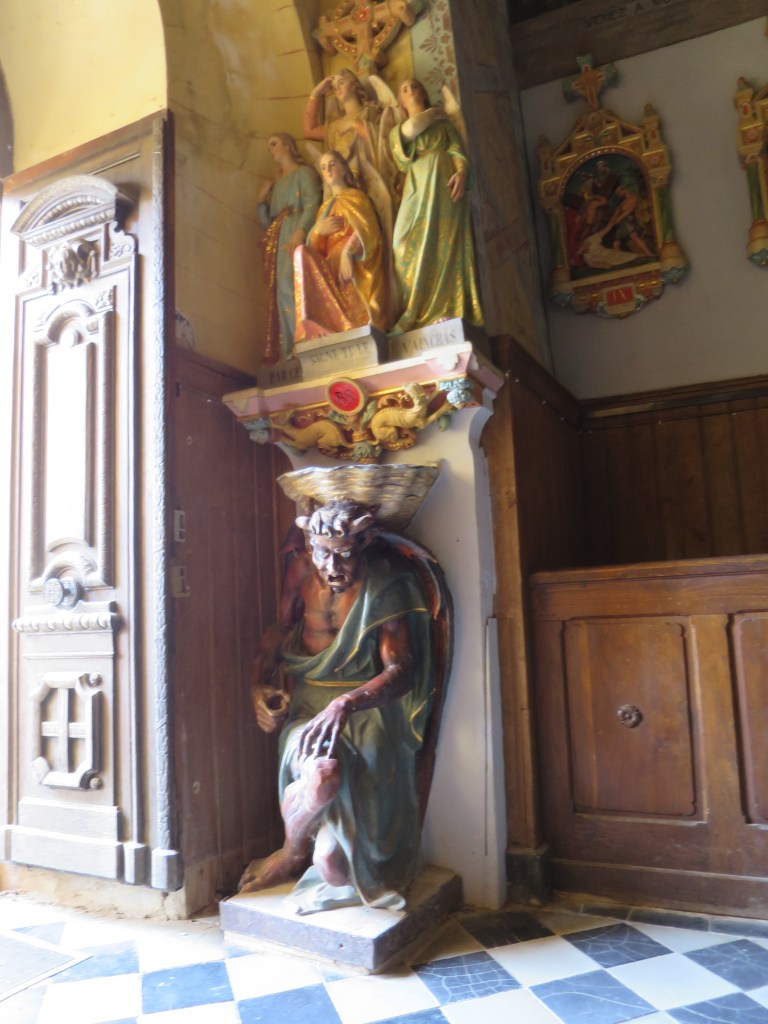
The church of Mary Magdalene is a small, simple Romanesque building with a tile roof. Dilapidated in the nineteenth century, it was restored by the curé, Bérenger Saunière. Between 1887 and 1897 he spent far more than his stipend repairing roof and walls, and decorating it throughout. By the door, the font is supported on the shoulders of a crushed, angry and very red devil.
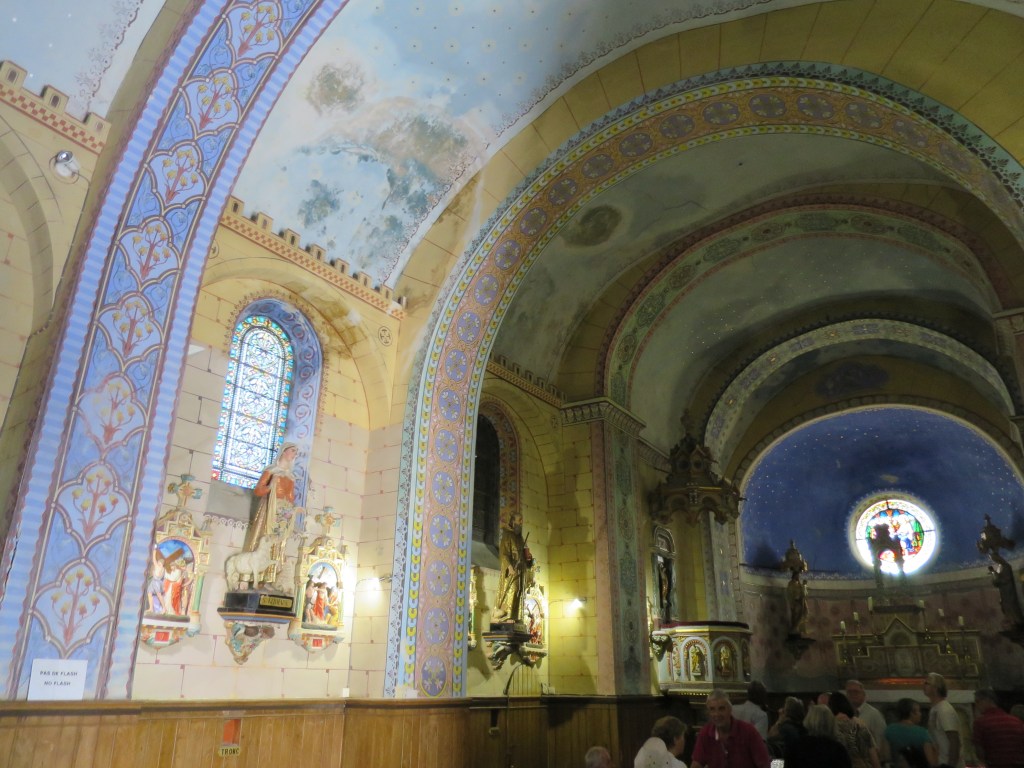
Inside, the arches and window-recesses have been decorated with pretty patterned tiles, with the floral and geometric patterns and pastel shades of the period. The walls have many garishly-painted statues of saints. The plain, rustic chapel has been made into a neat petit-bourgeois haven.

Then from 1897 to 1905 Saunière spent twice as much again on building the Villa Bethania (Bethania was Mary Magdalene’s home village) as the priest’s house, designed and built in art nouveau/arts and crafts style, with Mucha wallpaper, large gilt mirrors, and a piano.
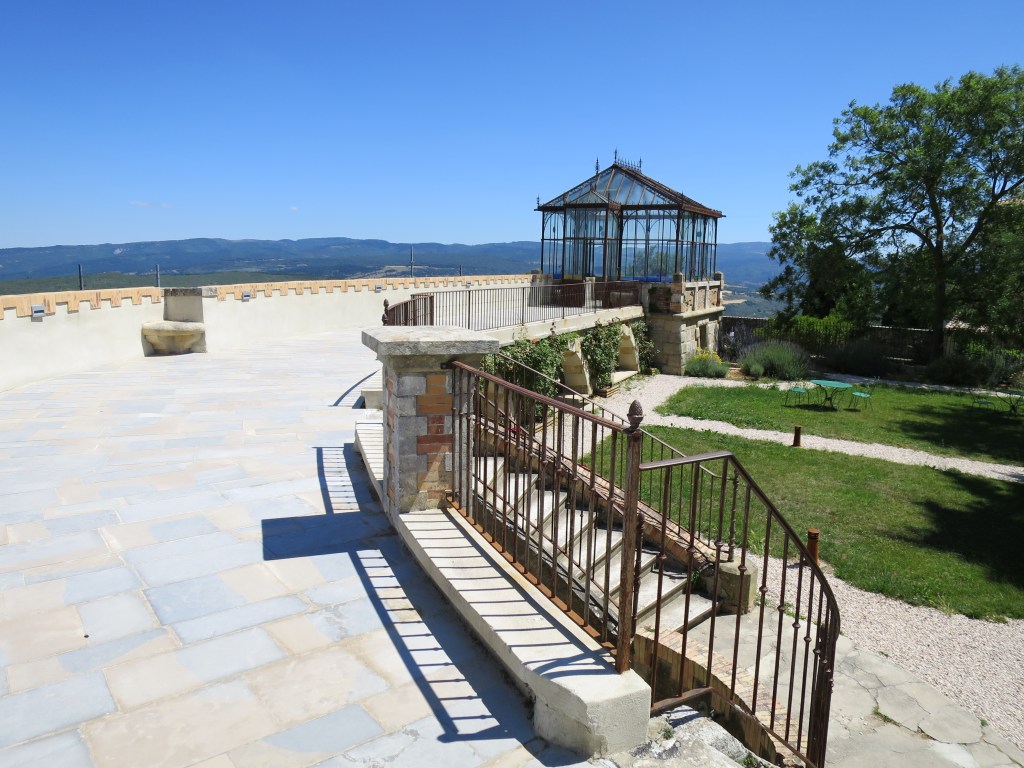
The story is that he set up home here with his housekeeper. He added an orangery, where he entertained lavishly. A promenade along a belvedere. And a tower in Troubadour style, the Tower Magdala, where he had his library.
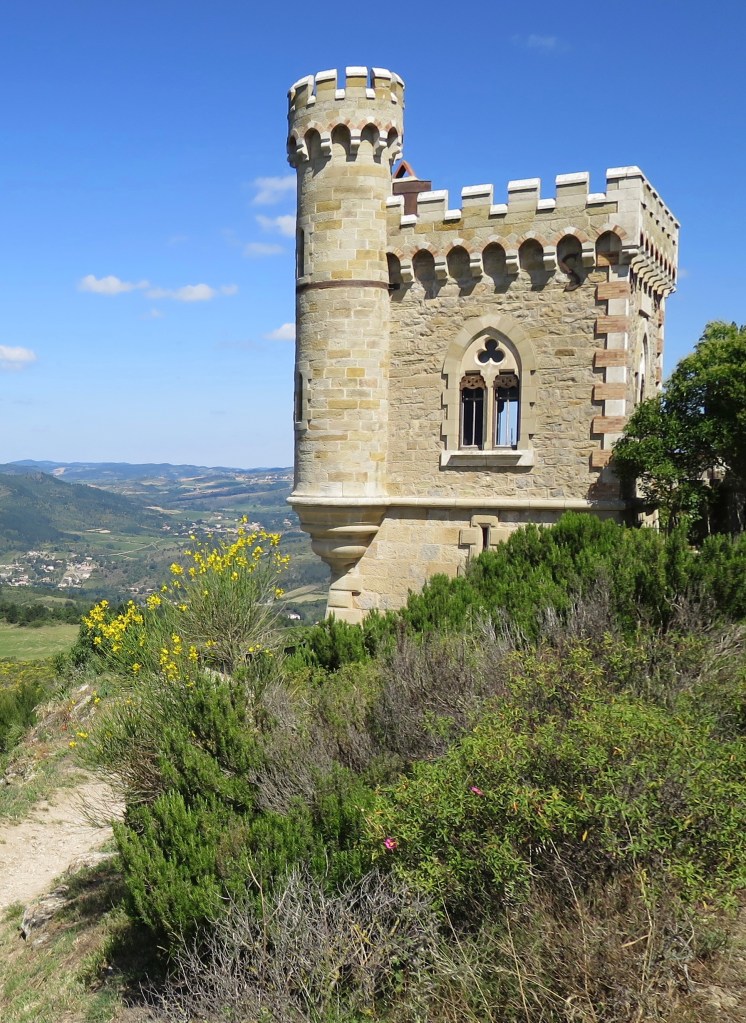
Whereas the chapel is prettily suburban, verging on kitsch, the house, orangery and tower make an attractive ensemble, a perfect estate-in-miniature, with on one side of the belvedere a sheltered garden, on the other a steep drop, and stunning panoramic views over the bowl of the plateau to the hills. I imagine, going from house to orangery and along the promenade to the tower-library, a middling-successful artist of the time, or a self-educated, self-made entrepreneur.
Summoned by the bishop to explain this expenditure, Saunière refused to say, and resigned. Although no longer in office, he built a chapel next to the house, and continued to say mass. He died in 1917, the mystery unsolved. His housekeeper fell into debt, a businessman settled her debts, and inherited all when she died. In 1950s he turned the villa into a hotel, and the tower into a dining room. He started the tale that Saunière had discovered parchments leading him to the lost treasure of Blanche of Castile, a tall tale to interest his guests.
From this grew the story that Saunière had taken the parchments to the church of Saint-Sulpice in Paris, where they were decoded, and revealed that Jesus and Mary Magdalene were married, had children, and founded the Merovingian line. To keep this quiet, the story went, the Church paid Saunière handsomely. While in Paris, he bought a copy of Poussin’s Et in Arcadia ego, and met and probably had an affair with Emma Calvé (of Decazeville, Day 18) opera singer and occult adept.
Eventually it emerged that the priest had in fact set up a business selling masses for the dead, far more than he could ever say, a scam. This explained why the postman had been delivering mail by the sack-load, containing the money sent to pay for the masses. The expense of the restoration had been greatly exaggerated – for example the many new statues, rather than being finely-wrought unique pieces, were literally plaster saints, bought from a maker of church requisites in Toulouse, and never fully paid for.
But by then the stories had taken on a life of their own. Within a generation it had developed into the full-blown conspiracy theory of The Holy Blood and the Holy Grail in which a (in fact non-existent) secret society, the Priory of Sion, has defended, for 2000 years, the blood-line (the sangreal, the sang real, the holy grail) of Jesus and his wife Mary Magdalene, against the Catholic church. Among those persecuted for that defence were the Cathars, and then the Templars. The story was entertainingly presented in The Da Vinci Code. The result was a boom in which 100,000 visitors were coming each year, dozens of groups and websites were established, and Rennes-le-Chateau became a New Age centre.
The oldish bourgeois French visitors wander around, interested, but uncomprehending of the wide-eyed belief of the Anglo-Saxons, of all the books and dvds in the museum shop. To them, the story of a cunning priest who makes money with a religious scam and sets up home with his housekeeper is a standard trope.
As I stroll along the village street, past the well-stocked New Age bookshop, I pass three examples of those drawn to such places. First a brisk, bearded man, walking with jerky, clockwork movements, waving his arms, talking to his newly-arrived friends with a clipped certainty, ‘the water had been this high,’ reaching up, ‘you could clearly see the mark,’ talking about evidence of Noah’s flood in the area. He has it all sorted, everything interlocks in a closed schema – a truth – in which all things have the meaning he ascribes to them. To entertain doubt would be to put at risk the structure of his system that makes the world make sense. Any doubt is trumped by reference to a yet higher level of conspiracy, ‘they don’t want you to know the truth!’.
Then I pass the studio of a woman ‘spiritual artist’, whose work is full of angels, swirling lines, and the colour mauve, and whose vision through her work is ‘to inspire, uplift and comfort’, a banal world of kitsch.
And at the edge of the village is a dilapidated house, its shutters hung with every sort of thing, bits of wood, a horseshoe, a wooden clog, flowers, stones, clay figures, feathers, that hang like fetishes. Through the window I see a chaos of stuff, a world in which everything might have meaning, so must be hoarded (for the one thing you throw away may be – will be – the key to it all, and be lost forever), who, because he dares not to discriminate, is gradually losing to chaos: because every thing might have meaning, nothing does.
I sit and drink coffee, staring at my blank notebook, my head a jumble of thoughts. Except, no.
I had expected, here, in this village, a resolution of the complication of ideas and information that have been sparked into vividness by my journey down the Meridian.
Instead as I sit, without thinking, all those ideas and that information, and the incontinent buzz of unconnected but forced-to-connect notions and facts in this place (like the chatter of impish whispers at Glastonbury) has disappeared. As if the winds released by this journey have returned to Aeolus’ bag. Leaving … This place.
The little church where, under a barrel-vaulted ceiling (I would paint it blue and spangle it with stars), among plaster saints (the Magdalene, two Antonys, Luc, Germaine, Roch. Follow their lives), with a red devil who may be the Dionysian, the demiurge, the maker, the seething source of creativity, one may engage with the everyday religious.
And the little villa, both aesthetic and charming, a place of beauty and domesticity.
The glass orangery is an observatory and accumulator.
The belvedere is a path along emptiness, and the edge of the breath-taking view over the wide expanse within the circle of hills, the shield of the plateau, at its centre the omphalos of Bugarach. (I remember Beauvais cathedral, seen from afar.) And further back, I remember on Corfu, Mount Pantocrator, seen from the boat, my first sight of Greece, and Pantocrator a word for God used nine times in the Book of Revelation.
The library tower (like Beckford’s above Bath), its spiral staircase winding up and down through levels of learning.
All this is the setting for a way of life, a way to live.
It is the dreamed place in which everything – every thing – may come into being. The emptiness waiting to be inhabited. The flask of expression. The alembic of transformation. Or, rather, of realisation.
And then, as if the muted sound has suddenly been turned up, as a gaggle of Da Vinci Code believers chatter into the café, Aeolus’ bag, containing every wild idea, is opened once more around me, and it is time to go. I seek out, as I walk to my bike, the reassuring sight of the Pic de Bugarach.

The ‘ach’ is soft, as in ‘vache’. A hard, plosive beginning, ‘Bug’; a soft sibilant end, ‘ach’ … As the hill, isolated and precisely-outlined, is a clear presence; trailing a mystery.
Rising 600m from the plateau, it is one of those hills I have experienced, Uluru, Parnassos, Glastonbury Tor, Mont Saint-Victoire, whose separateness and shape draw and hold the eye. It imposes its presence, it demands attention. And perhaps the need to find meaning.
And it is, for me now, on this first acquaintance, a peak not to be climbed, but to be circumnavigated. Not, this time, to set foot on, but to examine and ponder from without.
Of some places you say – what is this? Of others you say – what does this mean? It’s one of the latter.
I cycle towards it for an hour, along the Meridian. Past the Templar castle at Bézu. Beyond it is the Cathar citadel of Puilaurens. It is midday, I cycle under the high sun, in the still heat. I keep wetting the cloth under my hat to keep my head cool. The rest of me, adjusted now, looks after itself.
Across the hollow of the plateau, the other-worldliness of Lasithi, no traffic, silence. Through meadows and woodland, past a few fine houses, but also the modest, put-together properties of installés.
Still, forty years on, they come. I cycle slowly up a short hill, past two young men, long-haired and slim, stripped to the waist, brown, rebuilding a wall. It could be me and Richard in 1976. One calls out, ‘on descend, bientôt!’ ‘Merci’. One does. And then climbs again. So it goes.
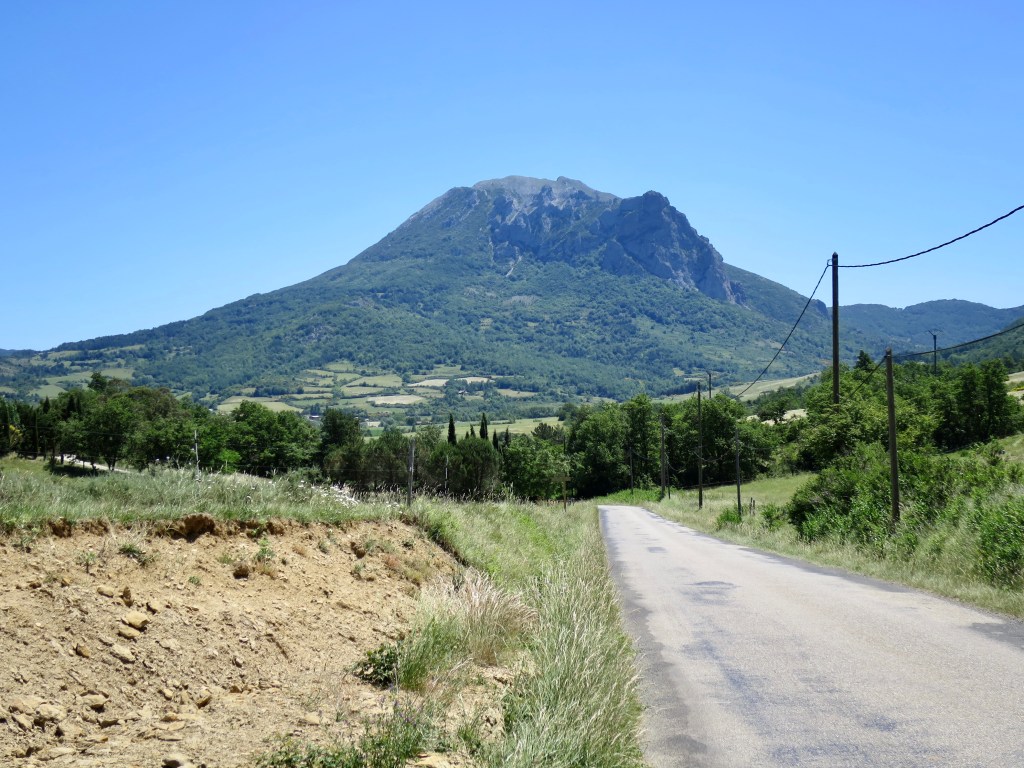
I cycle towards it. It just gets bigger.
It is called ‘the upside-down mountain’ because the rock strata were inverted in the uplift of the Pyrenees; the higher you climb, the older it gets.
A story developed that the Pic, being hollow and containing a spaceship, would be the one place to survive the Mayan apocalypse on 21 December, 2012, a New-Age Noah’s Ark. Thousands came. The police blocked access to the mountain, fearing mass suicides. (What would have happened to the human race if Noah had been prevented from boarding his Ark …? What did we miss, that 21 December …?)
The road curves round, so the shape of the Pic keeps changing, giving me more information. At the same time provoking more questions. It is mesmerising.
And then it turns away. Or rather the road bends away. Bugarach is behind me, I feel its gaze on my back as it recedes, its voice a question, ‘well …?’ I have no answer.
The road rises, I climb out of the enclosed stillness, and descend towards Quillan, towards the dashing river, into the world.
I return to the Centre, have lunch, and snooze.
Then I sit outside, in the shade. No one is around. All is still in the drowsy heat. Although the atmosphere is energised by the humming of the turbine, the rushing of the river.
My head is filled with the vision of Pic de Bugarach.
I imagine the Pic as the base chakra, the root from which the spine of the Meridian rises; the place from which the knotted rope is thrown up in the rope trick; the Meridian as the snake rising from the basket …
Through the empty afternoon, sitting first at the outdoor table, then lying cupped in the high green hills, and finally stepping from stone to stone across the leaping river, I play in my head frames from the film of my journey, vivid as the songs of skylarks ascending and descending.
In the concave plateau of Rennes-le-Chateau and Pic de Bugarach, writes David Wood, is “an immense geometrical figure indelibly marked on the ground”: a pentagram inside a circle. A pentacle.
Within it is a place where “the imperceptible gleam of the memory of our origin marks the portal through which, with courage, the mind can pass into the void of eternity and enlightenment.”
– For the five-pointed star is the Pythagorean sign of perfection, the quintessence.
– And it is the Gnostic passport to the kingdom of light.
– It is also the endless knot, an in-out journeying around an unreached centre.
– And the device of Gawain, the first grail knight; and “no character in the whole of Arthurian romance undergoes such metamorphosis as Gawain”.
– As an alternative in the Tarot to the suit of dishes, the pentacle is the grail vessel.
– Raymond-Roger Trencavel, who died at Carcassonne was said to be the model for Parzifal, the grail knight who failed to ask the question that would have saved the Fisher King.
– It is the sign of Venus; for the apparent motion of the planet in the sky inscribes a pentagram.
– It is the lover’s knot; its flower is the rose.
– In The Romance of the Rose the god of love pierces the hero with five arrows as he gazes at the rose.
– The first part was written by Guillaume de Lorris, close to the Meridian, around 1230 in courtly style, just before the final defeat of the Count of Toulouse, patron of troubadours, who signed his capitulation to the French king at Lorris in 1243.
– The second part was written by Jean de Meun, on the Meridian in Paris, around 1270 in a more clerkly, scholastic style. It illustrates the triumph of the clerks of the universities and the church, over the troubadours of the court.
– With the victory of the North, the troubadours fall silent.
– One tradition has the troubadour voice coming from the Arabic court of Al Andalus.
– Gerbert followed the Meridian south from Aurillac to Catalonia, where he acquired a learning that so astounded them in the north that some said he learned it from the devil.
– The devil holds up the holy font (fount) in the church of Mary Magdalene in Rennes-le-Chateau.
– The mosaic at Theodulph’s oratory, of ark and angels, became before my eyes a devil’s head.
– In their attacks on Neoplatonism, the church confused the demiurge – from the Greek meaning creator, maker – with the devil.
– Gerbert’s other source of power was said to be a magic head he had got in Spain.
– He studied at Vic, on the Meridian, the monastery of the monk who witnessed the first burnings of heretics at Orléans in 1022 that initiated centuries of heresy-hunting and Inquisition: Cathars in 1209, followed by Templars 1307, Protestants in 16th century, and ‘witches’ in the seventeenth.
– Cathars honoured their god on the day of the Virgin Mary, who is Mercurius, the errant spirit of the earth.
– The Templars were founded by Godfrey of St-Omer.
– It was a swordsman from St-Omer who struck off the head of Anne Boleyn.
The Templars were accused of worshipping a magic head; they had a saying, “he who controls the head of John the Baptist, rules the world.”
– Amiens cathedral was built to house the head of John the Baptist. It was brought back from the East by returning crusaders.
– The head is no longer on show at the cathedral, “the most perfect cathedral done in the Gothic manner”.
– The Gothic arch is believed to have come from the Arabic world.
– Reflected, it becomes the mandorla, entrance to the mysteries.
– The Rose Line (blood line) was first used for the Meridian by Dan Brown.
– St Roselin and Saint Sulpice share 17 January as their day.
– Saint Sulpice was buried at Bourges, and his tomb quickly became a place of pilgrimage.
– Jacques Coeur of Bourges, the richest man in France, whose wealth came from Arab lands, was said to be an alchemist.
– Alchemy is an Arabic word. But the alchemy of which Hermes Trismegistus is the master, and Mercury a key element, is aimed rather at refining and transforming the self; the gold is the realised being.
– Emma Calvé followed the Meridian north, from Decazeville to Paris.
– As did Saunière, who went from Rennes-le-Chåteau up the Meridian to Saint-Sulpice, the Louvre, and is said to have met Calvé, who studied the paranormal and was engaged to the author of Satanism and Magic.
– I first read of la Méridienne verte in Graham Robb’s The Discover of France, and about alchemists on the Meridian in his Parisians.
– In The Ancient Paths, Robb plots ‘The Lost Map of Celtic Europe’.
– The Celts had a cult of the severed head.
– Robb traces the Heraklian Way, Herakles’ path from the sacred promontory at Cape Saint-Vincent in Portugal, across Spain and France to the Montgenèvre Pass in the Alps.
– It crosses the Meridian at Pic de Bugarach.
– Robert Coon plotted an Eagle Line, from Glastonbury through Shaftesbury to Delphi, the Greeks’ most sacred place, omphalos, centre of the world, founded by Zeus where the two eagles he released at opposite ends of the earth met.
– It crosses the Meridian near Beauvais, through the tribal capital of the Bellovaci tribe.
– The intersection of the Heraklian Way and the Eagle Line in today’s Switzerland creates, with the Meridian, an equilateral triangle.
– Which is the tetractys, the Pythagorean symbol that encompasses musica universalis (the harmony of the spheres), number and form.
– Two equilateral triangles interlocked contain all elements and unite all opposites in the hexagram.
– The six cyclists’ diagonales are enclosed in l’Hexagone that is France …
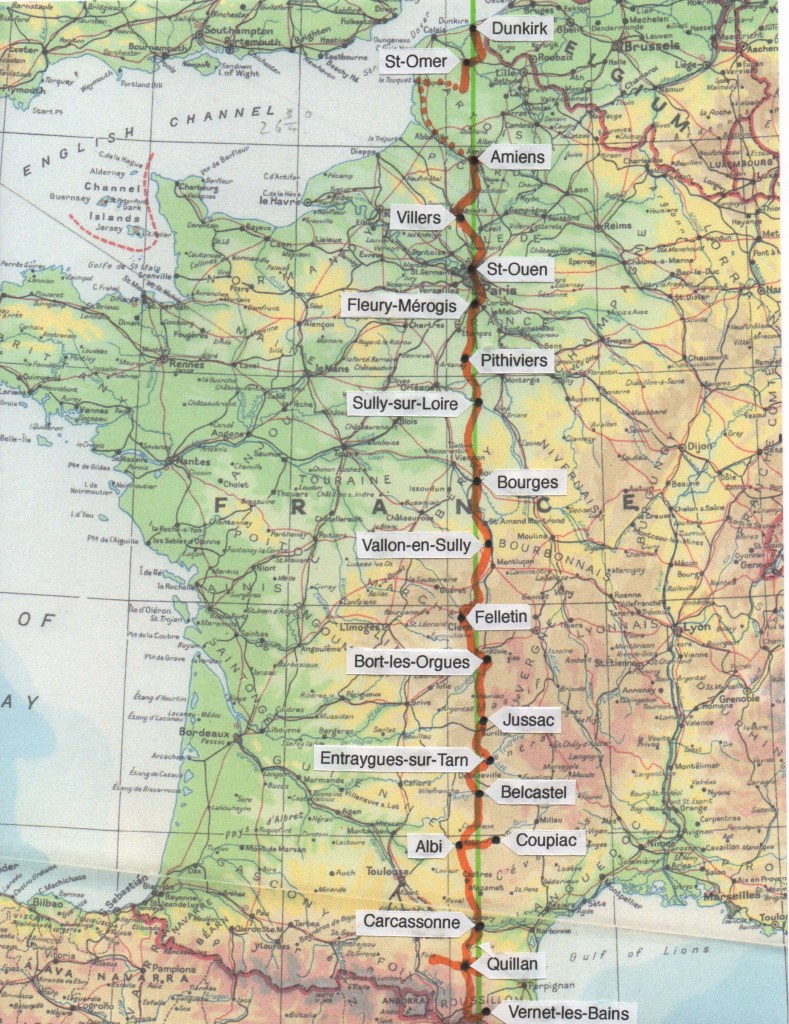
Up and down the Meridian, the axis mundi, through the chakras, and along the winding ways of the Hermetic serpents, “roads are the only things that are endless, they are the serpents of eternity, I wonder that they have not been worshipped.” …
“History belongs to the victors, legend to the people, fantasy to literature. Only death is certain,” writes Esterhazy. “When the legend becomes fact, print the legend,” says the reporter in The Man Who Shot Liberty Valance. And when the fantasy becomes legend, print the fantasy, as literature?
For the second time today I wrap my head in a wet cloth. This time to cool the heat generated inside.
After tea and biscuits, I freewheel down to Quillan. 18kph, green smiley face on the speed camera, a little wave.
The evening is gathering, the sky going pink, the birds are noisy in the trees in the square. I sit in the café, by the window, drink slowly, watch the comings and goings. Although it is the end of June, and a quarter of the homes here are second homes, there are few outsiders around.
A white-haired man sits in the corner of the café. He writes quickly in his notebook, looks up, eyes far away, deep inside; then suddenly they clear, he sees – I am here, I am here. Is it me? I could buy a nice place here for half the price of my flat in England. There are cheap flights from England to Carcassonne and Perpignan. The bus fare to each is one euro. I could work in peace on all my unfinished pieces. I could explore the Cathar places, work to figure out what it was really about, follow the shepherds’ paths over to Catalonia, explore the Palaeolithic caves, cycle up the Pyrenean passes …
I think of the radeliers, ‘strapping and well-muscled’, of ‘legendary suppleness’ who guided the trains of rafts down the rushing Aude river. Don’t we each need to be a radelier?
I see the mills along the banks, forging iron – I’m staying at the Forge –, sawing timber, fulling cloth.
I see the entrepreneur who brings hat-making from the village of Bugarach (brought there from Poland by French prisoners), and builds a factory in Quillan that by 1900 is making 135,000 hats a year. He pays for electric lighting in the town, the first in the region, powered by the river. And he finances the oldest Criterium in France. Criteriums are the street cycle races that take place after the Tour de France, in which the fans can see the stars of the Tour – from Coppi and Bobet, through Anquetil and Roche, to Alberto Contador – pass close eighty times as they do battle through their streets
I see fashion change, hat-wearing decline, the factory close.
I see it reopen in 1950 as the European manufacturing centre of that symbol of post-war consumerism, of Les Trentes Glorieuses, Formica. I see fashion change again. The factory closes in 2003. And now?
I pedal slowly back up to the Centre, in a rose sunset, to my dinner of cassoulet. I pass a van with a Guido Fawkes mask at head height in the driver’s seat. Yes, I could live here.
Day 26: Quillan to Vernet-les-Bains, 58 miles.
The bloke on the curly Hetchins. A long climb. Old men in lycra. The longview South. A swooping descent. Pressing on. The final Meridian marker. Life of Py. Entente Cordiale. Kitsch. A self. Le temp des cerises.
I don’t sleep well, worrying over which road to take. I have to cross a ridge of the Pyrenees, climbing to 1500m. The most direct route looks, on my small-scale map, to cross an inhospitable wilderness. The bike app on Googlemaps refuses even to suggest a cycle route over the mountain. But with my gear problem I’ll be doing a lot of walking. So, the shorter the better. I will climb for 21 miles, descend for 16.
At breakfast a cyclist in lycra asks, ‘are you the bloke on the curly Hetchins? We saw you in Carcassonne.’ A mixture of incredulity, amusement, and grudging respect. Although I might have imagined the last. I really have become ‘the old-timer’! There are four of them. They’re in lycra all the time, they never change as they clop around the hostel on cleated shoes. The bags on their bikes are tiny. Do they live in lycra, shower in it, sleep in it, a permanent artificial outer skin? How old-fashioned is my way of changing at the end of the cycling day into ‘civilian’ clothes! As old-fashioned to them as ‘dressing for dinner’ is to me. How we carry the ways of our twenties, the hairstyle, the clothes (hats, no hats), the manner of doing things (opening doors, stepping aside) into old age.
I pack slowly, reluctant to leave. When I check out the woman is so friendly. I don’t want to leave!

I set out at 08:15, heading south, into the wall of hills. Soon I’m threading through a narrow defile. The road clings to a vertical cliff, the river rushes below, the 1904 railway is on the other side, and jagged white cliffs, sharp as knives, bright in the sun, rise hundreds of metres. I cycle through a rock arch, and enter ‘le Trou de Curé’, the 2km cut hacked through the Gorges de Pierre-Lys, driven by curé Felix Armand. He struck the first blow in 1776. The breakthrough came in 1781, but work was stopped by the Revolution. By 1821 the road had opened up an area “rich in forests, animals and fodder, in thermal springs and minerals.” Now it is a playground of rock climbing, and white-water rafting on the wild river. Only at Quillan, says the guide, does the Aude ‘s’assagit’, settle down, become wiser.
I turn off the main road at Axat. It is on the Heraklian Way, on its way towards Bugarach. This road is heading for Font-Romeu. It passes through a narrow gorge, beneath white cliffs rising 500m, as sheer and angular as if cut with a giant (a Herculean?) axe. It is dramatic and clean; it is the clear line and scale that cuts through relative thinking: these are mountains, the realm of older, simpler, harsher gods. I breathe more deeply the sharp air. I clarify, become serious.
Many cyclists are following the Aude towards Font-Romeu, but none turns off where I do, taking the direct route, across the wilderness, over the 1500m Col de Jau.
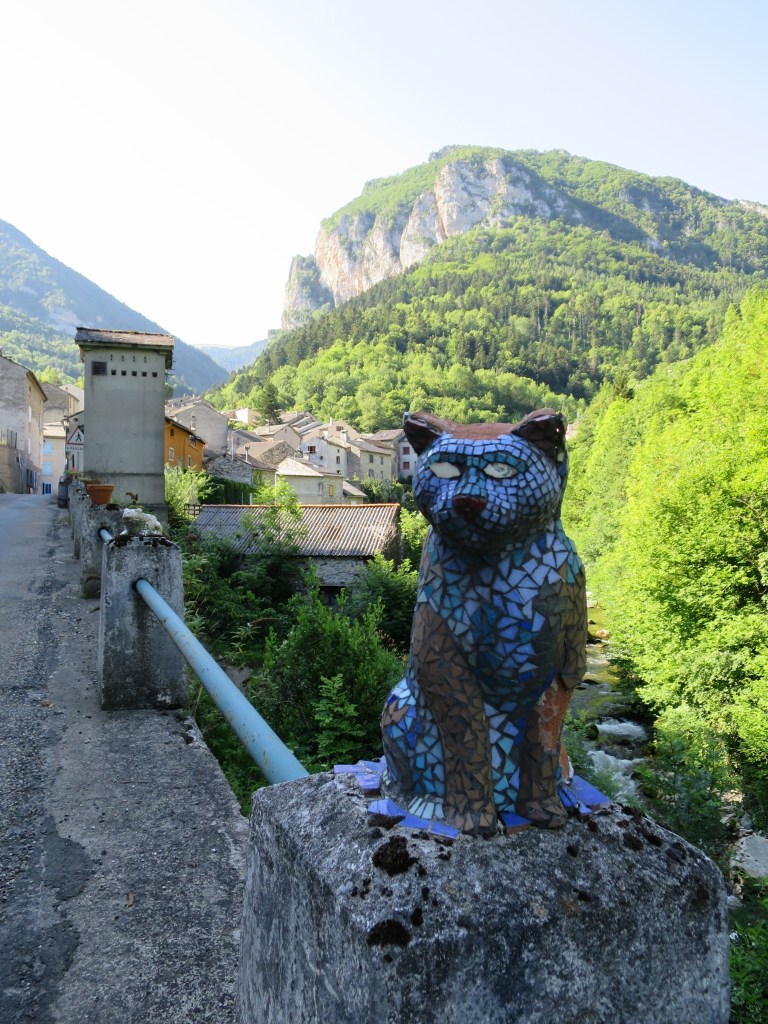
I’m soon up in coniferous forest. A giant grey pipeline snakes down the opposite hill. I climb through a village. It looks strange. Then I realise it is built for snow, for snow-drifts, for avalanches. It is guarded by a blue mosaic cat.
Further on there are purple and yellow alpine flowers by the road. Tall red poles mark the road line for when it’s buried in snow.
When I walk, individual cyclists pass me. They are in lycra, on modern bikes, but they are old and overweight. Omils. They look like the kebab in the Dunkirk takeaway, as if they’ve been poured into lycra and set. Their gears are so low they have difficulty passing me as I walk. Each passes in silence, in his own world, concentrating. They’re like the cyclists in Belleville Rendez-vous. A transit van passes, parks, passes, parks. What’s going on?
As I approach the top, it opens out, more plateau than pass, a wide green space, spreading to the trees that cover the slopes to the tops of the mountains on either side. There are higher mountains, flat and blue, in the distance, south. Before me is a wide vista, with tremendous views, an airy place. The van is parked, and tables and chairs are set out. The old men are sitting around the white table cloth, reaching for plates of food and bottles of wine, tucking into lunch. This is France. And they, the old men in lycra, have ‘done’ the Col de Jau, 1506m. I have done the Col de Jau. As I pass, no one waves, acknowledges. This is France. I pass a sign, ‘Bienvingut al Pais Català’. I begin to descend.
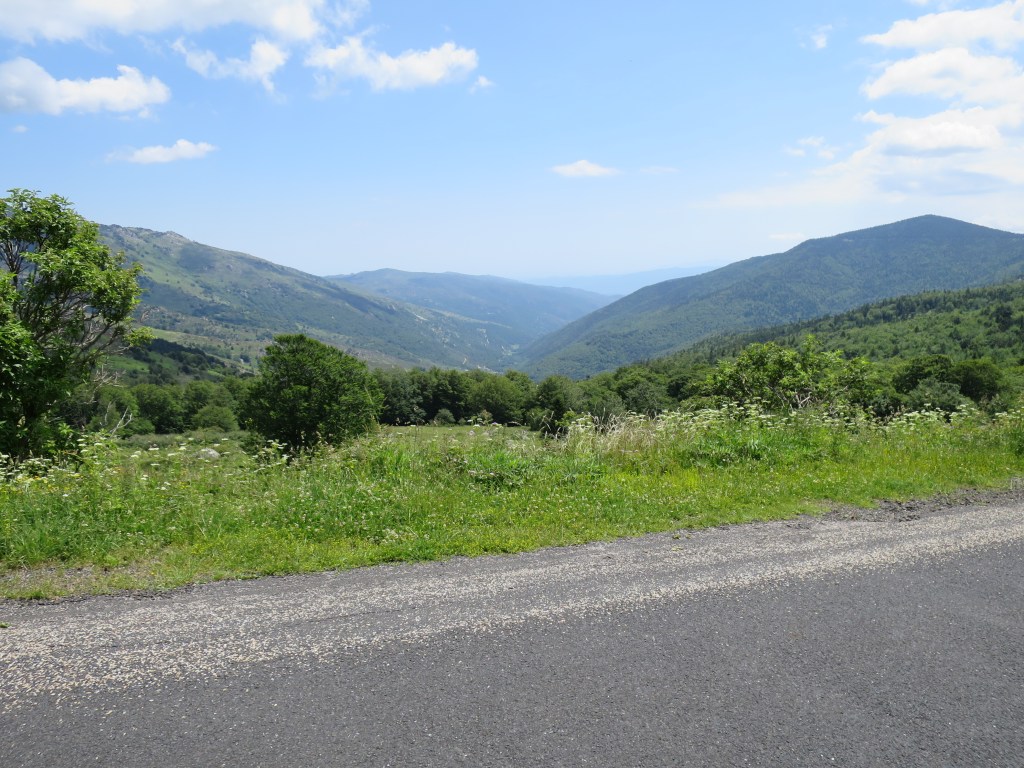
It has gone surprisingly well. I’m fitter than I thought. Ahead of me is the wide blue yonder, and now I have a straightforward road down to Pradès, an exhilarating descent of 16 miles at 5% (1 in 20), sweeping through bends, hardly braking, never pedalling. Past a Meridian marker without stopping. Past Mosset, a village on the other side of the valley, industrial until the mid-19th century, making iron with local charcoal, and ore from Canigou. Now it is a ‘Beautiful Village of France’, with promenades clinging to the cliff above the river.
It is only 2pm when I reach Pradès. I have crossed a high ridge of the Pyrenees and descended to the Têt valley, a wedge of lowland from the coast at Perpignan narrowing to a gorge at Villefranche. It is very hot.
I had intended to stop at Pradès, eat, look around, then make my way the 8 miles to my night’s stop at Vernet, and head up to the last marker tomorrow. But for some reason I take against Pradès – it seems a fussy place. Or maybe it’s the time of day, the oven heat, the dust and airlessness, the harsh light. And already the sense that the wild, capricious Catalan spirit – so not-France, already I miss France! – is scratching at me. I decide to go to the last marker on the Meridian, my goal, today, now. I should eat but I’m not hungry, and I want to get on.
I head up the Têt to Villefranche-de-Conflet. It is squeezed in where the valley narrows, and was a strategic site much fought over before the 1659 Treaty. The confined town has been confined even more by Vauban’s elaborate defences. From Vauban at Bergues, to Vauban at Villefranche. From phlegmatic Flemishka to crazy Catalonia …
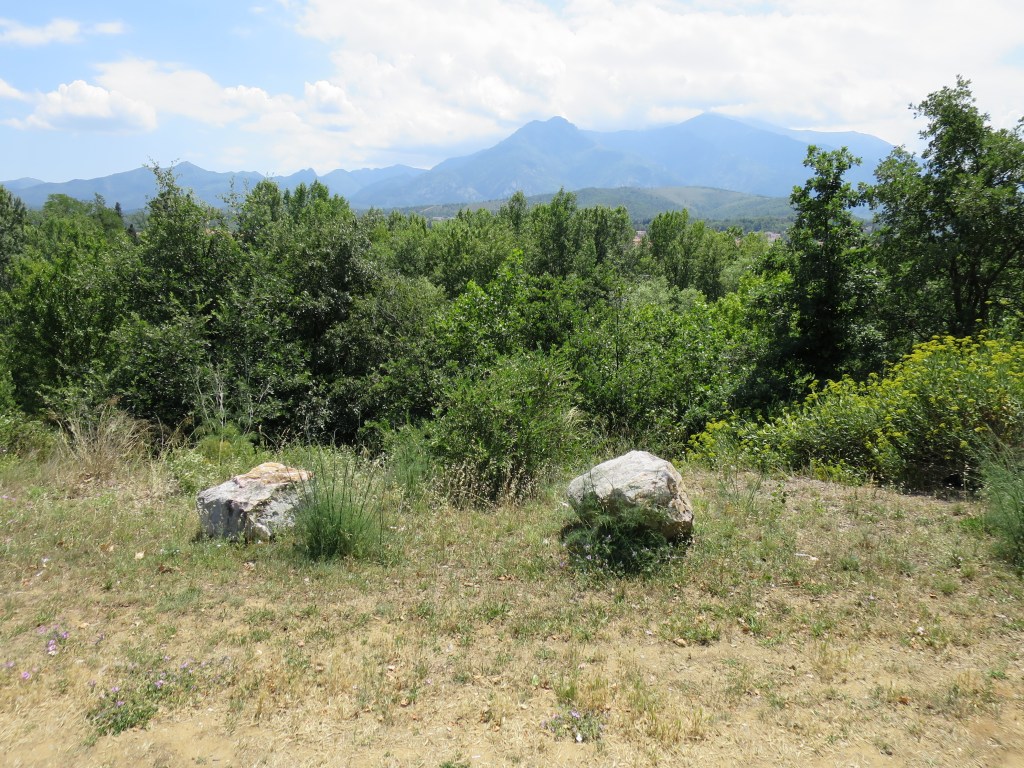
I turn south, up the narrow, twisting valley of the Rotja, heading for the wall of mountains, towards the last marker.
I keep changing plans: come up here tomorrow; drop off my bags in Vernet before I come up here today; hide my bags now, pick them up on my way down. All the time cycling on. I don’t stop. I don’t want to stop. An ambitious madness has seized me, an ongoing momentum, I’m singing, ‘I’m pressing on, pressing, pressing, pressing on’, Dylan at his most fervent, I push on and I am thrust forward. Go on! Go on! My stay at Quillan, in the alembic of thoughts, circling the circle, has energised me, speeded me up. I’m like a spaceship that’s been accelerated to a new velocity by sling-shooting around a planet – around Pic de Bugarach! The spaceship at its heart! On and up, towards my goal. I’m tired, cycling is hard, walking is hard, the rocky walls get higher, the forest denser, the road narrower, I haven’t eaten, I’m running out of fuel, I’m running on fumes, the fumes have made me a bit crazy, but good crazy, the road climbs implacably, I push madly on. Battered old vans pass, with trailers with a bale of hay or a single calf. The rocky wall, white, pink, yellow, opens, receives, and wraps around behind me. There are abandoned cars and trucks beside poor homesteads. I press on, ever upward.
Just before Py, the last village before the last marker, I burst into tears. I weep like a child. I am almost there, I am about to make it, I can do it, I will do it. What began as an idea, an aim, that I’d forgotten in all the doings of the journey, I’m about to realise, I’m about to reach my goal. Through disappointment that the green Meridian has not become a new spine of France, through mechanical problems, rough weather, on a journey that at times has felt endless, I’m about to reach my destination. Through waves of emotion I prepare my speech.
Through Py. The last Meridian marker should be soon. What if there isn’t one? Exhausted, I give myself two miles on my milometer to reach it. I couldn’t go further. Up again. Here? Lost in the undergrowth? I might miss it. I might have missed it. Here, 1.8 miles past Py, here it is. The last Meridian marker in France. Its bronze plate still in place. 2º 20’11” E, 42º 29’ 25” N. I have travelled through 8.5 degrees of latitude, 957 km, 595 miles. My milometer reads 1351 miles.
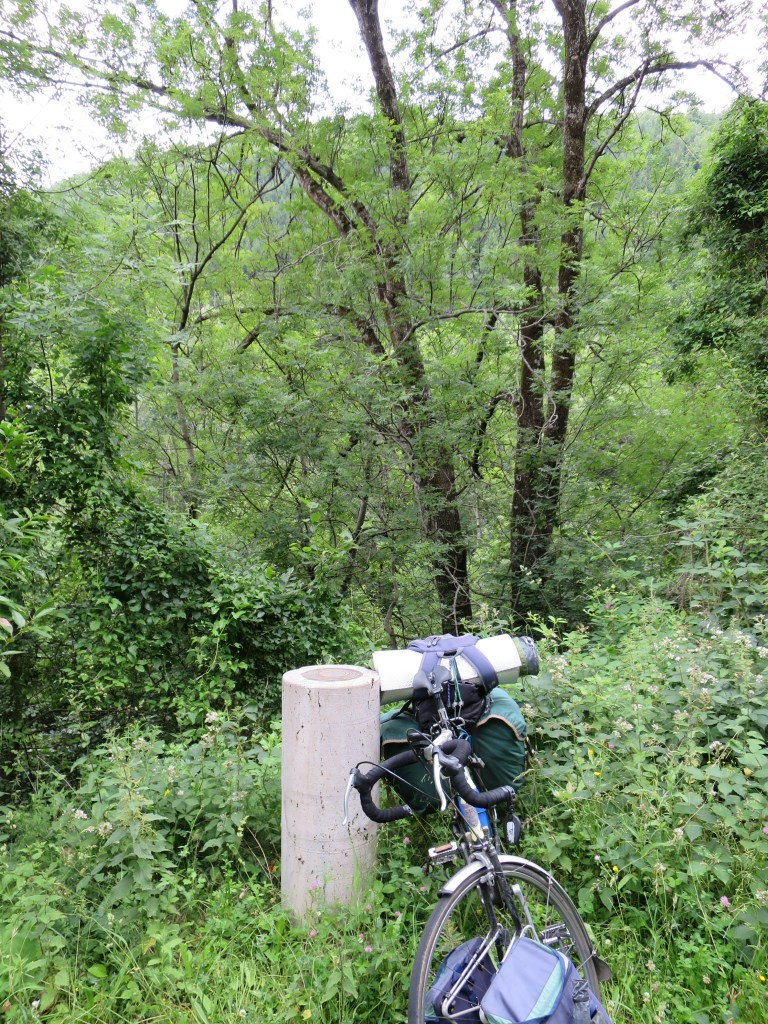
I arrive, simply. The emotion has gone. I am calm and clear. No speech. I have done it. I photograph my bike leaning against the marker and email, ‘Made it! So proud of myself! Thanks to all!!’ It is the first time I have ever said I am proud of myself.
There is mixed woodland all around, ash, oak, plantations of conifers, mountains. And silence. I would dearly love to cycle the couple of miles to Le Mantet, the last village, the literal end of the road a couple of miles short of Spain. But I am empty. I have done all I can. From the stormy North Sea and Flemish North, through Frankish Picardy, immigrant Saint-Denis, between the Observatory and lunatic asylum of Paris, to Gabrielle’s flat, across the wide fat lands of Beauce and the seductively sinuous Loire, through the Centres of France, Alan-Fournier’s world, across the hardness of the Massif, its suspiciousness and hospitality, my return home to Aveyron, and from Albi, the South, the allures and mysteries of Languedoc, into Catalonia and up into the Pyrenees, five miles from the crest, and Spain.
I turn around. In front of me is a descent into a rocky defile, white and green, past the red roofs of Py, opening out, back into France, a country changed, a country I so want to return to. I freewheel down.
Through Py. (‘The inhabitants are called Pinencs.’ Of course they are.) It was an important centre of ‘The Revolt of les Angelets de la terre’ (‘angelets’ means little angels), the war of resistance against the salt tax. Yet another battle of the South against the North. When this part of Catalonia passed to France in 1659, the king promised he wouldn’t impose the gabelle, salt so vital for preserving meat in these isolated places. Two years later, he went back on his word. The revolt lasted 13 years. In 1674 Py, ‘the last bastion of the resistance’ was taken, razed, and, in a final, message-filled act, salt was ploughed into the land, so nothing would grow. The revolt had caused so much trouble that Louis tried to swap Catalonia for Flanders; the Spanish king refused. Another of history’s might-have-beens.
The population was 551 in 1851, is 91 now. And yet it is a neatly-kept, spruce village, with signs for goat cheese and honey, and even a bar and restaurant. Is it a village of second homes? There are road signs: ‘snow tyres allowed’, ‘frequent ice on the road’. There is an information board (in bad French, as if poorly translated, as if to make the point that this is Catalonia) about transhumance. It shows the Pyrenees as an ecological whole, allowing shepherds to manage resources on either side to best feed their flocks. And, as I saw at Montaillou, transhumance made a ready network for the spread of dissident ideas.
As I descend, I can’t believe how long and steep the road is! I climbed this …? I turn off to Vernet, and I’m soon at my hotel.
Vernet-les-Bains was a popular spa in the Belle Époque. The French and Spanish came in summer, the English in winter, it was run by Germans. Entering I see a sign to ‘Casino’ – how odd, a sign to a budget supermarket. And then realise it’s to an actual casino.
It has the only monument anywhere to the Entente Cordiale. It was planned in 1912 by Lord Roberts and General Joffre, both visitors to the spa. It says, ‘To the Franco-British Entente Cordiale. To the glory of the Allied nations.’ In 1920 a line was added, ‘To the memory of the soldiers of Vernet who died for their country.’ Joffre served through the war. Roberts, an old India hand, died of fever at St-Omer while visiting Indian troops. He was 82.
Rudyard Kipling stayed in Vernet in 1912. Through Roberts’ influence he got a commission for his short-sighted, overweight, eighteen-year-old son. The boy blundered blindly to his death on his second day at the Front. Kipling never forgave himself.

The spa was destroyed in ‘l’aiguat [a Catalan word meaning deluge] de 1940’, flooding down from Pic de Canigou.
2785m high, often cloud-wreathed, Canigou is enormous, and dominates the town. It is the sacred mountain of Catalans: a Catalan flag flies at the top. On St John’s Eve (two days ago – so significant when I lived in Aveyron, it has passed without me noticing) the ‘Catalan Flame’ is lit at the summit, and torches carried to all parts of Catalonia. As candles are lit from the one candle in church at Easter. The inconstant river is now confined in a charmless concrete channel.
The hotel is from the spa days, old fashioned, bypassed. Built in baronial style, with massive dark beams, heavy wooden balusters, and every shelf and space, like a Victorian drawing room, filled with objects.
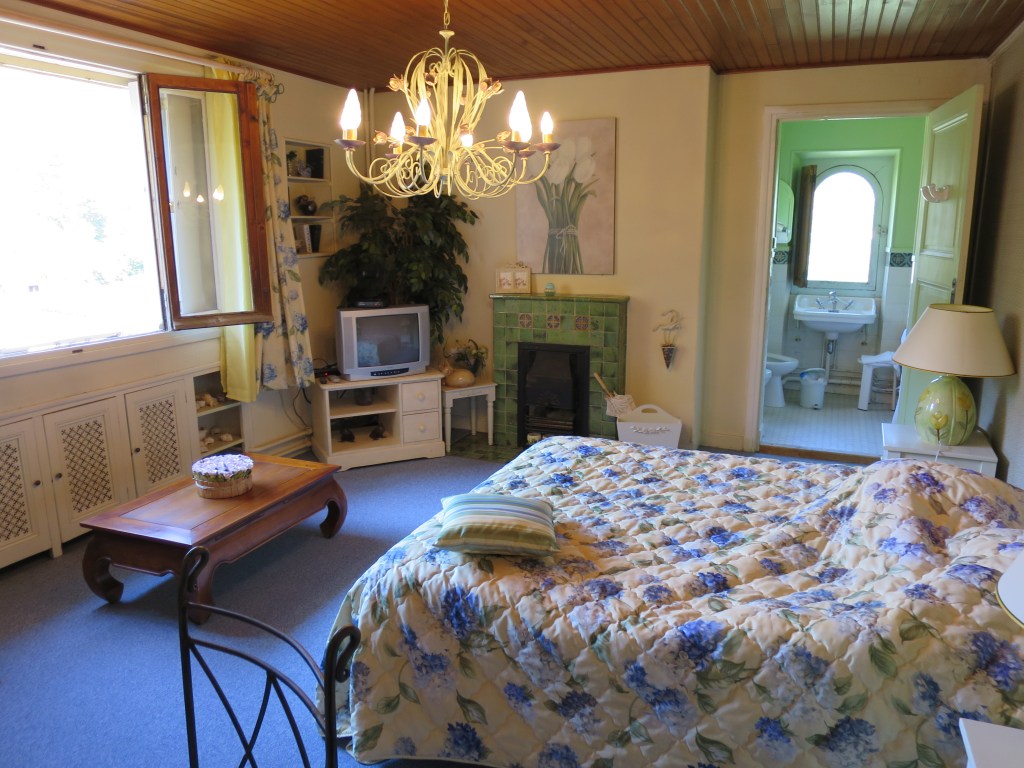
My room, furnished indiscriminately, is the exemplum of kitsch, “a style of decorative art and design in which ordinary objects with visual appeal, “old-fashioned” characteristics or banal usefulness feature prominently.” Kitsch occupies space, rather than either making use of it, or articulating it. The bathroom has bidet, bath and shower. Perhaps inevitably, the hot water comes out of the cold tap. But the room is big, with a double window opening on a large garden and on Canigou, high, massive and sunlit. And this indiscriminate plenitude is a comfort in my attenuated, refined state.
As I lie on the big bed, I remember that the idea of kitsch was crucial in Walter Benjamin’s encounter with Aragon’s ‘Le Passage de l’Opéra’, stimulating him to begin ‘The Arcades Project’, my reading of which led me to follow the Arago medallions along the Meridian in Paris, and then the Millennium markers across France.
And that in two days I will follow Benjamin’s last journey, on foot across the Pyrenees to Spain in 1940.
His escape across the southern border mirrors the ‘Jungle’ refugees’ attempts to escape across the northern. His memorial is a tunnel of steel steps down to a glass wall at the edge of a drop to the ocean, the invisible barrier to both escape and suicide.
The stowaway, blinded when the lorry door is thrown open in England, steps into the dazzle, where is he seized and sent back; or he escapes, disappears, becomes non-existent.
At Cerbère station there is a sign by the railway tunnel to Spain saying that in 10 days in 1939 more than 100,000 people appeared from this tunnel, having walked from Spain, fleeing the civil war, and were received into France as refugees.
Benjamin, unable to face being sent back to internment, killed himself. He carried a bag across the Pyrenees, said to contain the completed ‘Arcades Project’ manuscript. It was never found.
Lying here, staring up at the glittering chandelier, I see myself cycling on, around the world, around the world again, ever on, never arriving.
“As I can’t leap from cloud to cloud, I want to wander from road to road. I want to go up that path and along the high road, and so on and on and on, and to know all kinds of people. Did you ever think that roads are the only things that are endless? They are the serpents of eternity. I wonder they have never been worshipped. What are the stars beside them? They never meet one another. The roads are the only things that are infinite. They are all endless.” (W B Yeats.)
Life as a travelling self, a being in motion, has a beautiful simplicity. I would be both self-contained, having only what I carry; and entirely dependent on where I am for survival. I would be reduced/elevated to the primitive, travelling unencumbered, while in constant negotiation with the world around, alive in the moment.
While cycling, I am in a bubble of self-containment, the travelling world of my imagination. On the inside surface of the bubble, I project thoughts, images, desires. Desires that one by one have fallen away, leaving a life simplified to food, drink, shelter, locomotion. My life has become what the mind becomes in meditation.
And yet the outburst of emotion as I neared my goal reminds me how hard I have been working. Decision after decision, action after action, each followed by consequences to live with and then to negotiate, moment to moment. Nothing happens unless I make it happen. The motor never idles, is always in gear. Alive in the moment. Working every moment. The primitive self.
The self, inside a sphere of projections. Also, the self as the Gormley figure (he says, ‘the body is not an object but a place’), as the me-shape space created by rods of different lengths from every direction that stop at, in sum define, my surface, representing all the forces and influences creating the me of this moment. That are also the rays out, the radiations of my self, its nature, its actions, and effects.
A sense of arrival. At my self. A privileged place, where I am greeted, by my self. The locus of my self. A voice says, welcome, you have found your place, the moment of your balanced world, which is an element in all balanced worlds, where one’s self, moving, moves all others, so that all is an ever-moving equilibrium, and everything flows.
Attempts to describe, explain, failing. I am here. And now.
I find a good restaurant in the main square and sit outside. It’s quiet when I arrive. I order the menu complet, the works, salad, sea bream with rice, cherry tart, wine, coffee. Kids kick a ball around the big square in an endless, limitless football match. Swifts chase and whistle across the square like demented referees in a game they don’t understand. The restaurant fills up. Many order pizzas, and are taken aback when they arrive, huge, overlapping the plate like Texas steaks. There is talk all around. Good wine. As I start the pudding, a tart solid with cherries, a woman, stops as she’s leaving, having dined alone, says, ‘you’ve taken on something with that dessert.’ Australian. ‘I’m up for it,’ I say to her. ‘It’s cherry time, le temps des cerises, my homage to Catalonia, and to the Commune. But it’ll give me a thirst. I’ll need a long, cold beer, after.’ Why not?
25 June 2015
 my writing