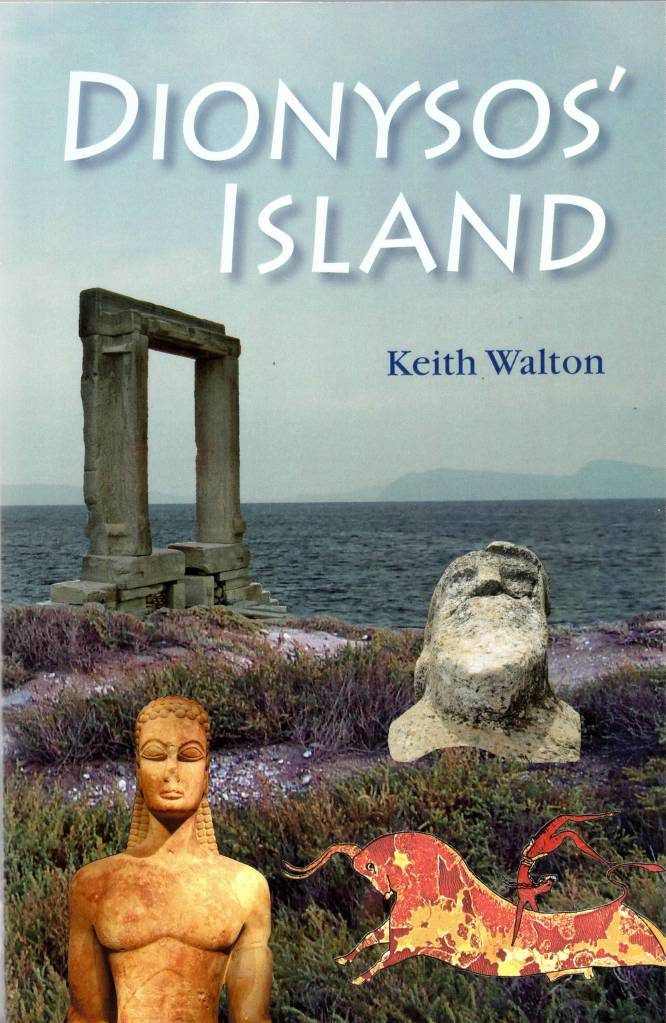
Set in 1971, two young men, dissatisfied with their lives, head for Greece on the long land and sea journey.
Richard, recovering after a traumatic affair with a student revolutionary, is hoping to recuperate in its classical calm and sun-filled clarity, while Simon seeks to empty himself in mountain walking.
For Richard, memories on the long journey by train and boat, and encounters with edgy, inspired artist Jacks, and knowledgable and mysterious Strawson, force him to continue questioning.
Simon travels to Crete, where he encounters a community reviving the Minoan ways and the spirit of Atlantis.
Richard’s time on an idyllic Cycladic island restores his equilibrium, but then chance – or is it fate? – takes him to Dionysos’ island, where a series of ever more extreme encounters with the art and deities of Greece’s past, surfacing in the present, bring him at last face to face with what he has been fleeing all along, and the question: are you ready to change your life?
This story of two young men’s first journeys into the Greek world, past and present, its landscape and literature, ideas and art, it affirms Lawrence Durrell’s: ‘Other countries may offer you discoveries in manners or lore or landscape; Greece offers you something harder – the discovery of yourself.’
401 pages £5 Available from brimstone-press.com
Contents
page numbers are of the print edition
Author’s Note
PART I : RICHARD’S JOURNEY TO ATHENS
1. Setting out 3
2. Leaving behind 5
3. Melanie at the fair 26
4. William Blake and the Arts Ball 40
5. The magic wave breaks 51
6. The Golden Arrow 55
7. With Nietzsche across France 60
8. Jacks, Bob Dylan and One Song Jukebox Number 1 78
9. Ionian voices 85
10. “City of the Violet Crown” 95
11. Full moon over the Acropolis 100
PART II : SIMON’S ADVENTURES ON CRETE
1. Stepping eastward 107
2. On the boat into mystery 111
3. Matala and Atlantis 118
4. Passage through the painted caves 133
5. The Minoan inheritance 137
6. Dancing with Mandy 152
7. The labyrinth 160
8. Robing the priestess 169
9. Party time 176
10. Freddie explains 183
11. With Sally to Lasithi 187
12. Alone in Zeus’ cave 197
13. Plunging out of this world 204
PART III : RICHARD’S VOYAGE THROUGH THE CYCLADES
1. The old man and Kea 207
2. Seriphos and The Perseus Project 212
3. Siphnos and Melos 230
PART IV : IOS
1. Looking back on Ios 239
2. Greek friends 251
3. Dr George and the Cycladic figures 267
4. Arriving on Naxos 279
PART V : CONFRONTATION AND RESOLUTION ON NAXOS
1. Jacks’s story 285
2. To Apollo’s island 303
3. Paul’s story 319
4. Theseus, Ariadne and Dionysos 325
5. The secrets of Dionysos’ island 336
6. More secrets 354
7. Rites of passage 364
8. The gateway 382
Notes 392
Author’s Note
The details of Richard’s disappearance filtered through to me slowly. Or perhaps I filtered them slowly. I had lost touch, ceased to keep in touch with him several years before, having run out of patience with his lack of focus, his failure to get on. When getting on, one needs the company of those who are getting on, one needs to leave people behind.
He was last seen on Millennium night, as midnight struck, AD 2000.01.01, 00:00:01, :02, :03, swimming out towards Durdle Door, an arch of rock fifty yards from the Dorset shore. He was seen by chance, by a bivouacking fisherman, who happened to peep out of his little tent, pitched on the shingle, as a few desultory fireworks crackled over Lulworth, illuminating briefly the swimming figure. The sea was busy but not stormy, the fisherman reported, and the man was still swimming strongly when he zipped up his tent and returned to his radio and beer.
And that brought him back to me so clearly. For it was somehow characteristic of Richard, this dramatic even melodramatic act, calculated, and yet observed only by accident, his head bobbing through the waves, disappearing into the dark. The secret exhibitionist. He’s not there, he’s gone. Disappearing. Into death? Into a carefully prepared new life? Taking an unconsidered step into the unknown? I had no idea.
That might have been how it rested. He would have come to mind sometimes in quiet, evening moments, alone or with old friends, but gradually he would have faded, yet another of the unresolveds of one’s life. Then the box marked “GREECE 1966 –1999” arrived.
It came from a solicitor in Shaftesbury, with a note from Richard asking me to do what I could or would with it. ‘I’m sure there’s a book in there. But as you know I’m not very good at finishing things, and anyway I’m too close, it needs distance.
And perhaps I’ve actually done with it? It’d be your book, your copyright, “I renounce all rights” etc. It would be unfair to say I’m counting on you. I’m counting on you.’
There was a lot of it, I was busy, I put it aside, “The Unexamined File.”
When at last I opened the box, I was plunged into several worlds simultaneously that threw my well-ordered life into disarray, and set me on a task that would take far longer than I’d expected.
There were photographs, the earliest clear black and white, and then fading colour. How young we looked, so full of sap, insouciant, ready for anything. Girls I’d never known, one especially, hauntingly beautiful. There were illustrations, sketches and maps. There were layouts and flow charts with circled words, connected by lines and arrows multiplied to illegibility. Pages of diary entries, beginning in his round, schoolboyish certain hand (in fountain pen, permanent blue-black ink, his favourite an Osmiroid 65 with interchangeable nibs, bought in Boots … enough), through looser, more agitated writing, to word-processing print-outs. There were travel journals, short stories, paragraphs of fic- tion, notes and meditations on history, mythology, philosophy, pages of quotations …
As I lifted out layer after layer, laid them out on the carpet around me, I was unpacking Richard’s relationship with Greece. Where had he gone?
At first I thought only an exhibition could do justice to the complexity and interconnectedness of the material. (Not unlike, I realized later with a smile, his “Perseus Project.”) But that would simply have displayed it. He had asked me to resolve it, to repack it not into a box, but into a book. For him? Or had he really ‘done with it’? Was there something in it for me? Might he reappear if the book came out?
As I looked at, read through the material, I saw that Greece, its history, art and ideas, its landscape and people, its existence, the very idea of it, was something against which he measured himself. A home, like the home key in music, he could return to and depart from; a source to drink at; an omphalos to reconnect with. As one of his characters says, ‘Greece isn’t so much a place I visit as a state of being I enter into. I go there to be there.’ He always went open-eyed, open-hearted, innocent. Although a student, he was more a fan. He never stayed long, never mastered the language, he was always the stranger in a strange land, but a land that was uncannily familiar. He was a very unGreek hero, more Parsifal than Perseus.
But what to do with all this material? How to combine the story of a life with descriptions of places and expositions of myths, marry speculations on the development of religion and consciousness to encounters with disparate characters and strange utopian communities? A publisher asked, what is your market? A friend asked, who is it for?
When I, and Richard, first went to Greece, it was exotic and distant, and yet welcoming and familiar. We felt we’d ‘arrived home,’ however strange that home was. Aby Warburg wrote of the “mnemonic wave” of the flow and ebb of the Greek presence in European life and thought. Richard’s work is preoccupied with that wave, its strangeness and familiarity, and how it clarifies and illuminates our world.
At one point Richard mocks himself for writing that, having given up his career, he had ‘rented an empty corner shop in a poor part of the city, and set about finding myself.’ ‘Had I mislaid myself?’ he asks. And yet his whole life was a search for himself. He kept coming back to a sentence of Pindar’s, “become who you are.” The full line is, “Having learnt who you are, become who you are.” The learning occupied his life. Most of us ask, ‘what shall I do?’ He asked, ‘who am I?’ He slipped through the life of society, avoiding money, status, affiliation, attachments. Heroic individualism, or narcissistic irresponsibility? He once said, ‘I want to arrive at my death knowing how to live my life.’ ‘But your life will be over!’ I cried. He shrugged and smiled.
The Delphic gnothi seauton, “know thyself,” had three connotations for the ancients: know you are mortal, not as the gods; pay no attention to the multitude; reevaluate not the truth but established custom. He applied all three. But “know thyself” was supposed to be the beginning of life, not its end. And yet he had such a rich inner life, in the hemisphere of the bicameral mind (I use Jaynes’s terms) once inhabited and now abandoned by the gods. I don’t know.
I have used the form of the novel, folding and embedding as much of the disparate material I felt could reasonably be fitted into a narrative of his first visit to Greece in 1971. I have added notes to expand upon, reference and, I hope, clarify. It may seem odd that Simon’s story is inserted in the middle of Richard’s: it is there because it offers insights that illuminate Richard’s sub- sequent adventures; also it establishes narrative strands that will be explored in a second volume, Odysseus’ Island, set in 1999.
Part I : Richard’s journey to Athens
Chapter 1: Setting out
Doors slam, shrill whistle and waving flag, a last running man wrenches open the door, clambers in, pulls it shut, stands breathless, would-be nonchalant, hot in his suit, ignored by the forest of silent newspapers, drops the window open on its leather strap, gulps in air. Slow heave turns into motion: wheels creak, iron stanchions and the big round clock move past, a woman slides backwards, waving discretely, eyes full of longing, tears, not for me; at last the smoke-darkened glass roof releases us into the bright day, the train on which I commute each day so different today.
Clattering across the writhing knot of silver rails, abrupt sideways jerk as points marshal the two-axle bogies onto the train’s assigned track, settling into the reassuring clickety-click as the viaduct curves us past the sunlit public buildings and, in the dark below, the crumpled back-to-backs, Rinso and Bile Beans fading on terrace ends, figures held in fold-armed conversation, clothes lines high over cobbles, fat shirts waving. Goodbye.
I settle back, look down at my light holiday clothes, up at my rucksack, around at the men in dark suits, swaying together, like plants under water. They are me yesterday and in three weeks, and I am a scuba diver breaking up through the surface of the sea, tearing off my mask, breathing pure air.
As we go faster the train becomes lighter, smooth and timeless on the new welded rails, the used-up landscape scrolling past. But focus on an object in the middle distance, that tree for instance: the landscape beyond goes forward with us, keeping pace; while everything this side of it rushes backwards. Trainsition IIII. I showed the effect to Melanie on the train back from the Tate and she turned those blue-grey eyes on me, a look of wonder bathing me in attention, in a golden light that I took for granted, that I thought was part of me not a gift from her, until she left, her love a lost illumination.
Pinks, whites, greens stretch like brushstrokes past the window, telephone wires rise and dip like birds, bridges slam past. The train is rising, the touch of satin wheel to polished rail is now a faint kiss, both still at the point of touching, and we are flying along, approaching the moment of separation … How often, on my journey to work, as the train went faster and the sun rose red through black colliery winding gear I’d have a moment of clarity that would have, if the train had plunged through to revelation or oblivion (it didn’t matter which), become a moment of consummation. Each day, as the brakes were applied harshly, I was jerked back into the carriage and had to pour myself back into the approximation of a person, put on a recognized face, step down at my station and walk to the office. Not today. Today my thoughts can stay free, floating, the London train is the train to London, the first stage on my journey to Greece. As my office in the Planning Department approaches, passes, familiar figures fixed, disappears behind, I float, smiling.
Chapter 2: Leaving behind
Settling into the journey across the stricken landscape, spoil heaps formed into giant black blancmanges, soon to be covered in white plastic, artificial ski slopes, as per our policy document “Recreation Facilities for the Age of Leisure”, merry miners skiing in bobble hats and scarves, cheery waves. Hello. Goodbye.I spread my papers on the table, prepare to look through my notes on Greece. But find myself instead, after buying tea from the trolley, going over the events of the morning.
I’m used to the janus of expectation and nostalgia when going away: my head full of the wonders and perfections of my destination, the new world that’s waiting to receive me and change my life; at the same time a sentimental bloom on everything I’m leaving as I walk to the bus stop, the trail of ivy and a single pink flower in the sunlit graveyard, “Maggie May” playing from the flat above the newsagent’s with a girl’s warbley voice singing along (who is she?), even the stale beer and cigarette smell from our pub where the old woman is stoning the step.
But at the bus stop I was aware of how different I was from those around me. But isn’t that me yesterday, and again in three weeks? And crossing the city centre to the station, head up, my rucksack hitched high, stepping out, seeing shuffling, preoccupied figures, eyes far away in ambition or deep in dream, alien to me this world, wanting to lay my hand on this man’s arm hold him, say, ‘see, that pretty girl, in a yellow skirt and a blue top, twirling her pink bag in the sunshine, carefree and gay having kissed her new boyfriend, the twirling bag sending (oh no!) the black bowler spinning from (I say!) the solicitor’s head, see it caught nonchalantly, without breaking step (owzat?) by the traffic warden, see them all stop, amazed, laugh, exchange, pass on, the moment swallowed up, unobserved, gone …’ Daily tide, flowing in to flow out, pebbles rattled in, rattled out, a little smoother each day, I wanted to cry, ‘you’re moving, but where are you going?’ But of course I was directing the cry at myself.
It disturbs me because in the six months I’ve been in my job I’ve convinced myself that I can be in it but not of it, that as I strip off my grey suit each day (in the toilet on the train home, put on paisley shirt and stonewashed jeans so I can step off the train as if I haven’t been to work) I am shedding my role, returning to being – me. While realizing that each day I am becoming more involved, being given and taking responsibility, flattered by authority, compromising my integrity in the interests of loyalty and career. “Lend yourself to me for one brief deceitful day, and then through all your days you will be called most upright of men,” old hand Odysseus to neophyte Neoptolemus. ‘You have to see the bigger picture, Richard, means and ends,’ my section leader to me. The mask I put on each day sticking more firmly so that one day, howl as I might (except, even worse, I won’t notice, I’ll be the frog in the heating water) it will not come off, I will be it. But the hypocrisy of expecting the comfort of belonging without the responsibility of participating.
And yet six months ago I’d thought that, in one weekend, I’d resolved my life.
After I’d given up The Project, when I had become like a statue of wetted sand that is drying and beginning to blow away, when the lives of my contemporaries, that I’d so mocked when I walked away, were suddenly, my nose pressed against the glass, looking in, infinitely desirable, I had, with considerable effort managed to package my dispersed self back into the role “Town Planner” sufficiently well to be offered a job. And wasn’t this what I’d wanted to do, been trained to do? Wasn’t I, after a skittish six months, returning to the fold?
I accepted the job, in the county town just a few miles away, on the main train line, and took the bus to my home town. Yet another of my journeys across the Pennines. Remembering arriving for the first time in the city from home, on my scooter, descending from the purple moors, the conurbation laid out before me, a dramatic vista of churning clouds and shafts of sunlight picking out the tall chimneys and big factories and long red brick terraces of the world I would remake, the black tower of the town hall and the white tower of the university that were the twin poles of my future, waiting for me, a new graduate heading for a postgraduate course, a cry of ‘yes!’ – I was a knight on a charger – as I accelerated down the long hill.
And the first weeks so comprehensively good that I took it all complacently for granted. Hubris (‘arrogance and presumption’), and all that followed. I returned home the first Christmas charred and in shock. I was Crow, flying the black flag of myself.
Whereas this return, two and a half years later, six months ago, was quiet and circumspect, and I had a job, which would reassure my mother, who asked only that I ‘be happy’ (as if this was a career option), and my father, who could now complacently resume living vicariously through me.
How pleasant, at first, the warmth of the familiar and given of the small terraced house, the smell of freshly washed clothes airing on the maiden by the fire, the roast chicken meal (on a Friday! Truly a fatted-calf moment), the apple pie and evaporated milk. And how quickly it turned to suffocation as, like programmed automata, when the clock struck they turned on the television, switched off the light, and settled in their chairs, the blue pictures flickering on childlike faces.
So I went to the pub in town where we used meet in the college vacations.
But it was term time, and anyway they were all, my contemporaries, now settled in new lives and distant places. Perhaps I just wanted a chance to sit among ghosts. Of friends I’d paid too little attention to. Of girls who had passed, a moment of recognition before passing on.
On the other side of the mahogany and frosted-glass partition that divided this lounge bar from that public bar, where drank my best friends at primary school, who had failed the eleven plus, who I’d never spoken to since. And where, when I was in here with college friends, I’d glimpse my brother in the fancy etched mirror behind the coloured bottles at the back of the bar, our eyes sometimes meeting. Like Joyce I had thrown in my lot, aligned myself with my education (called, in my case, liberal-humanist, but just as jesuitical). Like him I’d doubted. But while he had escaped from it “alone, unheeded, happy and near the wild heart of life,” I had walked out grandly, then fallen apart, panicked, and scrambled back inside the rule.
I waited, as I sank into the melancholy of the solitary drinker, for a sign. The door was hesitantly pushed open, and Ursula looked nervously in, saw me, her face flooding with relief, ‘Richard!’ she cried, and rushed over.
Ursula and I had gone out together at school, in that serious, married-couple way that some kids do, bypassing (or insulating within ourselves) the desires, extravagances and originalities of adolescence, conforming to a given notion of how to behave, who to be.
We would sit at opposite ends of the big table in her family’s kitchen doing homework, go for long walks hand in hand, unstoppable in our talkative self-absorption, setting the world to rights, each the other’s ideal audience. We chose with perfect seriousness the cottage we would renovate to our taste and live in, and decided which empty warehouse on the quay we would develop as an arts centre. We fumbled gravely in the dark of our front room, skin blue-lit by the street light, going only so far, saving ourselves for each other.
With rings of twisted grass and promises of fidelity we went off to our separate universities. It lasted a term, as she rebelled against everything, had a spectacular affair with the union president that ended badly, followed by two years of outrageous behaviour, a poor, scrambled degree, primary-school teaching. Whereas for me, university was the seminary of a new faith, of which my god was rationalism and my catechism the scientific method, the certainties of which covered over the inexplicables of my life. And yet something amiss, so that when I started my postgraduate Town Planning course, I pinned on my wall: “one knows, all the time, that one’s life is not right, at the source.” Which I guess is how the whole Melanie thing could happen.
But that was in the past. Sat opposite each other in the pub that night six months ago, Ursula and I were happy to occlude the last six years and connect directly those guileless, optimistic seventeen-year-olds to our bruised but still hopeful present selves. Her hair, once extravagantly long, then Jean Seberg short, was now a careful mid-length. Her sparky quickness had matured into a cool intelligence, her humour now tinged with a gentle irony. Her eyes were as bright and watchful as ever, and I’d quite forgotten how pretty she was, a girl I’d be happy to be seen with. We talked about films, books, music, smiled at how in step our tastes had developed. We enjoyed mocking our younger selves: ‘talk about old before our time!’ ‘“I was so much older then …”’ ‘Exactly! Such prigs!’ But touched too by the shared memory of them, us, two earnest, honest innocent kids who we missed. All this conveyed in words, silences, looks, touches. After one silence, looking down, she looked up, grinned, shook her head, said:
‘I can’t believe this is happening!’
‘Perhaps this is meant to be?’
‘Perhaps. Yes. Yes.’
I walked her home, arm in arm, that familiar walk along the canal, past the hospital, our shadows behind then stretching ahead as we passed each street light, inventing the lives that were going on behind each lighted window, as we’d always done, becoming increasingly baroque as we strove to outdo each other. We arranged to meet on Sunday – her brother was getting married on the Saturday – and she kissed my cheek softly and squeezed my arm.
I went to my special place, from where for years I’d observed the town unseen, where I could release my thoughts.
A train pulled slowly out of the station, its wheels spinning as it struggled for traction – how often I’d heard that from my bed. The white marble and green copper memorial to a dead wife, our Taj Mahal, was ghostly above the town. The town hall clocks struck the hour, one light and quick, from the town’s eighteenth-century merchant prosperity (Handel), one slow and portentous, built by a Victorian industrial magnate (Elgar). I imagined my parents in their long-shared bed, my newlywed brother and his wife in theirs. I remembered with a smile how once Ursula and I had crept into her parents’ bedroom, looked with awe at the big mahogany bed, the piles of books on bedside tables, the art nouveau reading lamps, and lain carefully on it, side by side, fingers touching, wondering if we’d ever grow up to fill such a bed.
Perhaps – what a thought! – we had? We could pick up where we’d left off, each containing and profiting from our experiences in the years between, all the time our relationship having stayed fresh. We get on well. We fit. I can imagine our children. We can be happy. After the stumbles and detours, we can pick ourselves up and walk along the road together, once more hand in hand.
So it was the new optimism about my future that allowed me a (last?) Saturday morning of unabashed nostalgia.
I walked through the miscellaneous smells of the covered market, past the sweets stall where my brother and I had bought liquorice root and coltsfoot candy, the fishmongers’ stalls with their uncanny fish and wriggling eels that always made me shiver, the butchers’ stalls smelling of sawdust and blood, the sausage stall with the man with fingers like sausages. On to Woolworth’s where we would wander round, just looking, buy cheap sweets, and steal things, partly for the daring, but also to have, to possess. Having little, objects became fetishes. I had a tin box I hid behind a stone in the yard wall. I’d get it out and look at the things I’d stolen, that had to be hidden otherwise my parents would ask where I’d got them, my secrets, and promises of other lives. Round the shops, seeing shop assistants I remembered, now shorter and wider, as if they’d settled over the years. And greyer. Shops closed down: “Smokers’ Requisites and Tobaccos – Try Our Dark Shag.” And new ones opened, “Whole Foods and Natural Products.” The new shopping centre built on top of where we’d lived, my tin box buried deep.
And then into the reference library where, at grammar school, a few of us serious working-class kids went to study (the middle-class kids had rooms of their own). Four walls of books. The whole of knowledge, classified by the Dewey Decimal system, so you could find out anything. Relieved that it was all there. Daunted by the scale of the task of knowing it all. The everyday goings-on in the market square outside were so ordinary compared to what was available and happening inside this cave of treasures, this tower of learning (“learning” a delicious word as both verb and noun). I would look through the big art books, “750: Painting & Paintings”. But sometimes in here felt like a prison, and that world outside, seen through bars, looked enticingly real, and getting ever less accessible.
At eleven o’clock we’d close our books in unison with a slam, ‘shsh!’ from the disapproving librarian, grin and walk round, as I did that Saturday, to Stan’s coffee bar. It was run by Jim. No one knew who Stan was. It was in a narrow street, up steep dark stairs. It had no juke box, but a record player and a pile of blues and jazz LPs, and maybe someone noodling on a guitar. Tepid coffee was served in shallow glass cups. The pre-dip art school crowd would sit on that side, the grammar school crowd on this. There’d be moans and catcalls back and forth at what the other side got played, but little connecting.
But Penny and I did connect, in our hesitant, demure way. Sometimes, when we were close, to provoke we’d sit on either side of the line and hold hands across it. Romeo and Juliet. That was before I was going out with Ursula, during my lower-sixth flirtation with art. The last time I’d seen Penny, in here, a couple of months before, when The Project was going well and I was high with it, she’d said, ‘next time, you’ll be sitting on this side.’ But the next time, this time – for, yes, there she was, smiling that ‘is this believable?’ smile – when she patted the seat on that side, I shook my head and sat down on this.
I’d known Penny since ‘O’ level. Art clashed with Latin, so I went to evening classes at the art school. I discovered charcoal and oil paint, the sensuous experience of handling them. And a different sort of education, encouraging creativity and developing self-expression. While I spent my days working my way through a curriculum. ‘Do you know what a “curriculum” is?’ she’d asked, eyes flashing, when I said she never seemed to settle to learning anything, was always darting from this to that. ‘It’s a racing chariot. And what you do is go round in circles, winning prizes and getting nowhere.’ It was a punning response, but in her eyes there was sadness that I was missing something important.
So, we inhabited different worlds, liked each other, would come upon each other when home from university and art college, sometimes almost get together (a New Year’s Eve party, an Easter walk along the river), always just miss.
In the nine years my appearance had changed minimally – school blazer to tweed jacket to suede casual, grey flannels to rust cords to faded jeans, polished shoes to desert boots to coloured plimsolls, my hair half an inch longer each year – while she had gone through transformations. And changing not just her appearance and behaviour, even her character, but her nature. So at sixteen she was an existential beat, dressed in black, singing Juliette Greco songs, into Artaud and Dubuffet, her paintings scumbled and dark, her boyfriend a depressive who’d failed as a poet in Paris and was now a journalist marooned on the local paper, writing his own never-ending Howl. Suddenly she was a dolly bird with a dandelion afro, in colourful and geometrical dresses and knee-length white boots, waving from a pop promoter’s E-type, taking objects and images from every source to put in large, bright, busy, fun collages. Then another change, her hair long and red, her clothes swirling, in rich, natural dyes, sandals, influences of folk art, especially Balkan in her clear, simple pictures, now with a bearded builder of gypsy caravans. When I charged her with a pick and mix approach to art, disrespect in wrenching objects and images out of their contexts and relationships, she let fly, saying, no, she was resisting and subverting the art historians who compartmentalize art and arrange it into a simplistic sequence of “great artists”:
‘Art is a spatial field, not a temporal sequence,’ she spat.
‘But where are you in all this?’ I demanded. She looked at me, as if trying to work out what I might understand, how to pitch her response, said patiently:
‘The self is a construct of the mind, a defence mechanism, a comforting sense of order and continuity. But to really learn, you have to enter, become, be. It isn’t about hooking ducks at the fair and putting them in a row, but about going into foreign places. Don’t stand on the shoulders of giants – follow the pearl fishers down. Dissolution precedes resolution. You have to stay out of your head. There’s only now. You’re a particle, and now is the wave you ride. Do what’s now, otherwise it’s not life, it’s recollection. We’re not Alice following the rabbit – we’re Alice and the rabbit, at the same time. It’s not easy.’
It wasn’t easy. The last time I’d seen her, in here, those few months before, when I was high on my Project, she’d been grey, blurred, wretched, ground down by a lousy teaching job and all her work coming to nothing.
And now? Well. I was sitting beside, looking into, the sun-filled, smiling face of a woman, beautiful, clear, resolved. Her clothes, her style carried elements of the styles she’d adopted so single-mindedly, now mutually echoing, dynamically harmonizing, into her own, individual look. And her face, that for all its prettiness had always seemed provisional, changing with circumstance, had settled into a fine beauty. She had found herself.
She of course would have none of this:
‘The self is a construct of thought. If you act wholly, selflessly, you experience purely. And now I have so many of those experiences to call on – and more all the time – that they arrive without getting tangled up in all that ‘self’ business. I am what I do. I have no inner life. The unexamined life is life itself,’ she laughed. Then, quietly: ‘And it isn’t easy.’ She looked at me keenly, as if trying to see what, if any, of this I understood, resumed:
‘I’m going to Cornwall. This is a last-day tour of my past. I know, revisiting isn’t me, is it? But this really is goodbye to all that. Someone’s backing me. I’ve no idea if what I do is “art” – not even sure if art exists anymore. There’s just events and stuff. I do stuff. I make Patrick Heron lampshades, Barbara Hepworth ashtrays – this is a Peter Lanyon!’ pointing at her multicoloured dress. ‘They’re all one-offs, handmade. Does that make them art? What if someone else made them and I signed them? Or I did multiples? No idea.
‘But you, how’s the Project going? It sounded so exciting – the Fisher King, and all that! – you really must keep at it. Come to St Ives! Do it there! There’s a place next to mine, you could rent it for nothing, work in the bars in summer. Are you still singing, playing guitar? Life is stuff and events – I do events, too. We could work together, you’d be the word guy, we’d be The Chums, end of the pier. Of course we’d have to build a pier first. We could do that.’ All in a hectic torrent.
To get a word in, I said:
‘Do you know what a pier is?’
‘A disappointed bridge,’ she replied. I was amazed, Mr Wilkins had told us that.
‘Who told you?’
‘No one,’ she said, adding pointedly, ‘I read the book.’ Then:
‘I’m leaving tonight on the eleven o’clock coach. Amazing to see you. See you?’ and was gone.
Timing. What would I have done if this had happened a month before, before I’d started cramming to get a planning job? I’ve no idea. Not even a sensible question. Whatever, I was at the bus station just before eleven, but watching from the shadows.
The last buses from the seaside town’s dances disgorged the celebrants, all drunk, variously sleepy, euphoric, angry, lost. A couple, wrapped around each other, keeping alight the flame of the evening between them. A brief, fierce scuffle, broken up by the bus conductor. A woman shouting after a man slouching quickly away, ‘yer ought ter be fuckin’ ashamed of yersel, what yer did, fuckin’ ashamed!’ pursuing him, throwing a pink stiletto shoe at him, it bounced off his dark back, he hurried on head down, she collapsed into her mates’ arms, they led her away. Soon all were gone, the buses parked up, close, dark, like slumbering beasts.
The long-distance coaches pulled in and pulled out, figures, alone, travelling into the dark, to new starts or disappearances without trace, she’s leaving home, bye bye, faces looking out, ghostly. I watched Penny’s bags being loaded. With one foot on the step she stopped, looked round, then climbed aboard. I couldn’t see where she sat. The coach pulled out. The station lights went off. I went home.
All of that had shrunk to a far corner of my mind by the time I was walking briskly through the warm sunshine to Ursula’s house on the Sunday.
I pressed the Edwardian bell-push by the heavy brown door under the coloured-glass transom window of the house I’d wished I’d been born in, with its reproductions of real works of art, its lived-in casualness, its shelves of old books. We had Tretchikoff, my mother polishing the emptiness, my father saying why have old books when you can get the latest at the library. I was let in through the dark anaglypta-papered hall into the sitting room where her father was torpidly digesting, the newspaper across his stomach, her mother crocheting. I found her teacher-father’s conversation, that I remembered as sharp and penetrating, now a thoughtless ragbag of clichés and received opinions, untouched by the contemporary. And her mother was no longer the interesting bohemian, but careless and unkempt. And why, I wondered, didn’t they risk their own judgements and buy contemporary art, rather than reproductions of “the masters”? All this I noted only in order to vow that we would not slump into such complacency. But I did notice that Ursula stiffened at even the slightest criticism of her parents.
We walked old walks, revisited old places, recalled our naivety and optimism nostalgically. One by one we placed the lost images back in the memory album, beginning the process of restoring a shared remembering. For weren’t we the same people, connecting back across an abyss, picking up dropped stitches, knitting our lives together once more, covering the abyss over?
It was spring and there were flowers and fat buds everywhere, and birds clamorous and quick, a buzz of new life in the air. We introduced topics and interests we’d added in the intervening years, carefully and sensitively, to draw the other in. We took each other to unexpected places. She led me through a dark wood to a sudden blaze of bluebells, the air full of their fugitive scent under our feet. She walked barefoot, I liked that. And I walked her along the old railway embankment by the estuary, where the bright light dazzled off the mudflats, the brown river flowed strongly, and sharp-edged birds, cutting through the clear air, swooped and flashed. She was entranced. We were a good fit.
We were sauntering along the canal towards her house, smiling at the ducks snappishly quarrelling, companionable, about to complete the parabola of reconnection. Physical too, for twice we had stood and embraced, remembering bodies, and kissed, remembering lips. When Ursula stopped suddenly. We were under one of the heavy stone bridges, the canal narrow, stone-edged, dark and deep, and she stood in front of me, hands on my arms, serious, her face suddenly uncanny in the uplight of rippling reflections that played too on the low curved arch. Water dripped. Her voice was echoey and strange, stopping and starting, urgent:
‘You are serious, aren’t you? You must be serious. It’s just that … There have been too many … I couldn’t take it if … I can trust you? Can’t I?’ almost pleading.
‘Of course. Honest. Little fingers,’ holding my hand out for our old gesture of fidelity, then wrapping her in my arms.
And so began a new era in my life, with a proper job and a steady, grown-up relationship, how life was supposed to be. I worked during the week at curbing my flights of fancy, being practical, and adapting to the frustrations and longueurs of the office. We spent weekends together, at her place or mine, constructing a shared life, integrating with other couples. She applied for and got a job in my city, and would begin term while I was away. On my return we would look for a flat together.
But too often, as the summer advanced, I found my nose pressed against the glass, looking out, at hitchhikers or cyclists, yearning for the freedom out there.
This trip to Greece, originally planned for the vacation between university and planning school, is supposed to be another reconnection, a knitting across the abyss, back to stability. Instead it’s stirring up all sorts of forgotten thoughts and feelings.
x x x
My notes on Greece are spread out on the table in front of me. I should be reading them. The train accelerates, almost free, then brakes hard for each dull town. I thought I would pass through this used-up landscape floating, emptied, filling up with Greece. Instead, all this remembering.
In the summer of my second year at university I went to France, Provence, my first time abroad. I went in search of Van Gogh, found Cézanne, a new world of dizzying clarity, and in the heat and dust and blueness, for some reason imagined myself in Greece. I mentioned this to a serious American, staying at the youth hostel in Arles, who showed me a letter of Hölderlin’s, written about France: “The violent element, the fire of the sky, stirred me continually . . . Apollo struck me . . . the south made me better acquainted with the true essence of the Greeks.” Hölderlin, passionate about Greece, never got there. I would. It was the next step.
After graduation I got a summer job labouring on the new bypass. The fresh-cut line was high above the town, with the purple moors sweeping emptily away to the east, and to the west, beyond the smoke-dark town, the pastel seaside resort and the sparkling sea. Each day I worked, stripped to the waist, hard work with pick and shovel, not up to the regular navvies but trying hard, tolerated, toughening up, a simplified world of repetitive labour, distant vistas, absence of conversation (talk like splitting stones) that allowed the formal structures of thought to dissolve, the silt of accumulated study to leach away, the chattering voices to fall silent, my mind to become gloriously empty and available. And the wages paid for my ticket to Greece.
Each evening, as my parents shut out the light and sat entranced by Emergency Ward 10 and Coronation Street, I was upstairs at my desk (now wonderfully empty of coursework), by the open window, bathed in the evening sun and evening sounds, reading the history, myths, and travellers’ tales of Greece.
Those first certainties are on the table before me, in my neat, round hand, as the train rushes south, the assertions and rhetorical flourishes that created my first picture of Greece, in my age of innocence: “The glory that was Greece.” “The Greeks looked life in the face.” “Of all peoples, the Greeks have dreamt the dream of life the best.” “The home of the gods, gods of human proportion, created out of the human spirit.” “If Greek civilization had not been invented, we would not have become fully conscious.” “The Greeks saw life steadily and saw it whole.” “Greece stands eternally at the threshold of the new life.” Stirring stuff. The world of Homer, Aeschylus, Phidias, Plato. The origin of our civilization, the source of our self-realization. Surely there, at the source, my doubts could be quieted; from there I could return, clarified and reassured, ready to move confidently forward.
It never happened. A confusion over dates meant I had to cancel my booking to begin my postgraduate course. And by the time the opportunity came again, three years later, now, so much had, has changed.
And so we gathered, smart graduates in geography, engineering, sociology, architecture, fine art; physical scientists and social scientists, certain of our intellectual objectivity, our ability to analyze and synthesize, armed with the latest theories and techniques, dedicated to applying science to society. We would create, with utility and beauty, practicality and idealism (even, whisper it, utopianism), a better environment, and therefore a better world.
On the first morning, gathered in the empty studio that we knew we would soon fill with our grand plans, we rubbished the syllabus, and determined that we would create an accurately descriptive and working simulation model of the conurbation. Using central place, gravity flow, diffusion surface, social structure, stochastic process and traffic potential theories, and the university computer, we would develop a simulation model of reality in which the effect of different policies could be tested. Planning would be based not on subjective opinions but on objective scientific principles.
I left the studio, my brain enlivened by our revolutionary discussions, my experience of the complicated conurbation clarified by the knowledge that its form and functioning would soon be made comprehensible through the simulation we would create.
I was renting a back-to-back in a solid area, close to but not in the student quarter, sharing with a friend who was doing research. The others were going for a celebration meal, but I wanted to ground myself in my new locality. So I spent the evening hearing companionably the families knocking about on three sides of the small living room, as I read The Uses of Literacy.
At ten o’clock I yawned and stretched. I could meet the others at the student pub. Or I could, full of Hoggart, why not, go to my local? My first local. Where was it?
I sauntered along the street in the mild September air, past lit windows, undrawn curtains, domestic lives, to the road at the end that swept down into the valley, and a shock. In front of me, beyond the road, was a vast emptiness. The cobbled streets and worn pavements were still there, but the houses had been removed, as if from a giant Monopoly board. A couple of distant fires, with sinister dark figures round them, added to the sense of desolation. Just one isolated building remained, a small pub, dimly lit, a gas light outside, The Omdurman. I crossed the road and entered.
I squeezed past a woman in pinafore and slippers collecting a jug of beer from the off-sales hatch, pushed open the door marked “Saloon”, and realized too late that I had walked into an alien world that I didn’t know how to function in. Where to look? who to speak to? as I waded endlessly through the sudden silence, the hostile looks, at last reached the mahogany bar, grabbed it, and ordered a pint of bitter.
I stood, hanging onto the bar, sipping the beer, a lost face in front of me in the mirror and eyes boring into my back. Should I stay standing? Find a seat? With others? On my own?
A big man next me laughed loudly and stepped back heavily onto my foot. ‘I say …!’ I yelped, and he spilled his drink. He turned slowly, flushed face, his fists balling, ready, ‘what say, luv?’ Not aggressively, but a question requiring an answer. Was this the gunfighter moment? Was I Shane?
A hand soft on my shoulder. ‘He says, Gerry, that he’s very sorry he carelessly put his foot under yours, and can he buy you a pint?’
‘Aye, aye, mild, ta,’ said Gerry, lifting his glass in acknowledgement, then, ‘yorright, Bruce?’
‘Tip top, Gerry. And we’re on for Saturday?’ Gerry nodded, at Bruce, at me, turned back round. I paid for the pint and followed my saviour to a table in the corner.
‘Sorry about that,’ Bruce said as we sat down. ‘But you seemed less than au fait with the Omdurman way. Gerry’s a good lad, but there’s not many back and forths before it’s fists. Great for getting building materials, though.’
He was confident, affable, hair in an Eric Clapton affro. He introduced the others. Spence, with his lank black hair, wispy moustache and beard, his glittering eyes, needed only a bomb with a fizzing fuse to be the archetypal anarchist. Steffie, her hair tied in an assortment of ribbons, wearing clashing charity shop clothes, was quick and aggressive. And, hidden behind a curtain of fair hair from which she would emerge, when she put her head up, with large, clear, Caroline Hester blue-grey eyes and an uncertain smile, a face across which moods passed like clouds in a blue sky, Melanie.
Asked about myself, I said I was renting locally. They exchanged meaningful looks, and Steffie snorted derisively. ‘You see,’ Bruce explained patiently, ‘the landlords put in a few sticks of furniture so the rent’s decontrolled, taking the houses out of the reach of the locals, then rent to people like you with no stake in the local community. What are you studying?’ My reply produced another silence, then Spence hissed, ‘so, your lot did this?’ arm encompassing the desolation around the pub. I explained that the houses were substandard – it was slum clearance, after all – and those moved out were given new, high-spec subsidized council flats. Anyway, our job as technocrats was to propose, for the democratic process to dispose. Steffie let rip: upgrading would be cheaper, could be done by jobbing builders, but the big firms liked new developments, and they had the councillors in their pockets; breaking up the neighbourhoods atomized and disempowered the working class; as the factories were removed from the valley bottom to the trading estates, the river and canal were being cleaned up, a linear park created, making this a desirable area where, surprise, surprise, middle-class housing would soon be built, while the working class were stuck out on the ring road, in tower blocks, with lousy public transport so they had to buy cars they couldn’t afford; it wasn’t a democracy but an elected oligarchy in which the oligarchs controlled education and the media and so the elections. She at last stopped, glowered. Bruce added, ‘as Tolstoy said, “the truth is that the state is a conspiracy designed not only to exploit, but above all to corrupt its citizens.”’
‘But you live here!’ I protested. Smiles all round. Spence said, ‘we squat. When families are moved out, we move in, reconnect the services. For every house we live in, we make two available for those in need. Real politics is guerilla warfare – don’t you see that the eleven plus is just a tool of the ruling classes, designed to cream off the clever to strengthen their stock and weaken the working class? Made bourgeois by the education system, bought off, you’re doing their work and betraying your class.’
‘Not so,’ I said, ‘we’re a working-class influence in the corridors of power. Anyway, class war’s old hat, the class system is withering away, it’s a meritocracy now. What we need now are technological solutions.’
The argument went back and forth. Bruce was smiling, enjoying the cut and thrust, while Spence and Steffie were taking it personally. Melanie was silently watching. At some point I asked what were they, were they anarchists? Bruce replied seriously:
‘We’re liberators. We’re at art school so I guess that makes us art students. But for us art and politics are aspects of the same process of liberation. We’re having an “Event” on Friday – why not come?’
I left long after closing time, let out of the back door of the blacked-out pub, feeling deliciously nefarious. The fires had died down, and most of the houses were dark. I should have gone home to bed, but I was so full of the events of the day, all mixed up, that I walked up the road to the moor, an open area laid out as a park, and sat on a bench overlooking the city and beyond it the conurbation.
There were clumps of lights and strings of lights for miles. So much light that the low, moving clouds were lit up by it. Illuminated caterpillars, buses, were still running, a police siren dopplered past, and there was a constant low-level hum of unseen traffic, a permanent carrier-wave of sound. My home town would have settled down to sleep by now, become silent, and in the morning would wake up. This place never tired, never slept. This was the nonstop future, the metropolis, spread everywhere so that now the rural was a subset of the urban.
And the characteristic of the metropolis is that different, incompatible ways of experiencing coexist, that may (may have to) conflict, and must all be incorporated into any synoptic simulation. So that Bruce’s position, while I might disagree with it, had to be taken into account in our modelling. It would be something I would bring up with the group. Jennie the sociologist would probably call it ‘radical deviancy from normative behaviour patterns, fascinating.’ It would be included in both our ‘culture’ and ‘politics’ subset metrics.
And I was feeling the frisson at being close to such a radical demi-monde, so much more interesting than the sad posing of my hometown’s arty beatnik hangovers.
But mainly I was thinking of Melanie, and how her eyes had held mine just that bit longer than necessary, that said, I’m interested.
Chapter3: Melanie at the fair
So that on Friday evening, after a busy, stimulating and productive week at the Planning School, as the others were piling into Peter’s van to go to York to see Jimi Hendrix, I was walking past emptied houses towards the squat that pulsed with music, flickered with light, and generally seemed about to explode.
Maximum decibels, a crush of sweaty, drunk, strangely-dressed people, I pushed my way through. Activity in every room and corridor. Pots of house paint and a mural being painted and repainted by anyone who wanted to join in, poetry extemporized over an electronic soundtrack, the cellar broken through under the other houses, in one cellar a girl dressed as Lolita with “Eat Me” printed across her tiny shorts reading from The Annotated Alice, in another an acoustic group playing rock classics, further on a rock band playing border ballads, a quiet, red-lit room where a joint was being passed sacramentally to the sound of an Indian raga, a harshly-lit operations room with charts on the walls, models on the long table, wary looks as I passed through. The familiar feeling of wanting both to leap in, and to examine from a distance, two sides of me in conflict, ending familiarly with me standing, Buridan’s ass, stuck.
‘How goes?’ asked a burly, bearded American.
‘I’m trying to make sense of it.’
‘But it doesn’t make sense.’
‘So then it’s chaos.’
‘Creative ferment. Don’t you feel the energy?’
‘It’s just flux,’ I said.
‘“Energy is Eternal Delight.”’
‘But energy without form is just sensation. What does it produce?’ pointing at the mural being painted over yet again.
‘We’re not trying to produce – there’s already too much production, too much consumption, too much stuff. We’re trying to change.’
‘Change what?’
‘Consciousness.’
‘And then what?’
‘Then we’ll do things differently. Welcome to the new world,’ walking away with a cheery wave.
‘Take me to the fair,’ Melanie, her arm in mine, quiet, intense.
‘Where have you been?’
‘Watching you. Trying to work out if you’re a wall or a tower. Or just a part of the scenery. Come on, take me to the fair.’
The fair, a big one, had arrived on the moor during the week, a transient outlaw-world with its own rules that appeared like a mushroom, lit up at night in fairy enchantment, and was as suddenly gone, leaving only scuffed grass and strange, fugitive memories, some good, some bad.
Now it was Friday-night busy, edgy, a little dangerous, generators throbbing by the caravans where guard dogs were chained in the dark, electric wires snaking across worn grass, smells of onions and candy floss, scratched, over-amplified pop records (someone would remember forever the record that was playing when something happened here, good or bad), the different shape of each attraction – the pendulum boats swinging out and up into the dark, back down into the light, the whirling, shunting dodgems, the graceful rise and fall of the carousel horses and their elegant circulation, the slow big wheel. All the attractions and booths brightly painted and lit by dozens of light bulbs, screaming girls opening like pastel flowers, dark, watchful men. A man’s voice: ‘Hi, Mel – you comin’ with us this time?’ She flinched, then collected herself, flared at the hard look from the swarthy man on the waltzer, who turned away abruptly and gave a vicious spin to a car of squealing girls, had laughing conversations with a couple of the women on the “prize every time” stalls.
‘I ran away with this fair when I was fifteen,’ she said conversationally. ‘I felt so boxed in at home, my sweet, muffled father, my snobbish mother, unable to pass any exams, so they sent me to a crappy school that turned idiot girls into docile wives. I worked on all the booths. I ended up in Ireland. There’s a racehorse named after me somewhere,’ she smiled, as if remembering a brief, happy time. ‘I loved her. Till they broke her. Then I had to leave. Eventually they brought me back, and prodded, poked, humiliated and drugged me. I seethed for a couple of years and walked out on my eighteenth birthday.
‘Heaven knows how I got into art college – I could hardly read or write. They like to let in the occasional unqualified oddball, makes them feel liberal. But I learnt everything with the fair. It was a world different enough for me to be able to start afresh, learn deliberately, experience consciously. There was so much I didn’t understand. And then suddenly I realized: I don’t want to understand; I want to get inside, so I’m experiencing the inexplicable, actuality; then I can draw, paint the effect actuality has on me. You see, I’m not concerned with actuality itself, that’s just stuff happening, but with making. But then again, at the end of his life, after all that making, Mondrian said, “I don’t want pictures. I want to find things out.” Then he messed up his final masterpiece. And they have to live with the masterpiece messed up. Maybe I’ll get there someday. Can I stay with you tonight?’
At the top of the two donkey-stoned steps, at the threshold, as I opened the door she peered in, wary as a cat, exclaimed, ‘it’s a house!’ sniffed, listened, ‘It’s wonderful,’ she whispered, ‘and terrifying.’ And stepped across.
That first night, her long, smooth nakedness, abandoned, remote, needy, giving, softly voluptuous, flexing like steel, slipping from nature to nature in the dark, antelope, snake, tiger. At last she lay asleep in my arms, while I, spent, my brain a boat plunging through rapids, guarded her.
When I got back from the shop with breakfast, she was sitting cross-legged on the carpet, naked in my big jumper, surrounded by books she’d pulled from the shelves, opened, tears in her eyes, ‘but is all this true? If only I knew – do you know?’ Well, it all depends on what you mean by …
After a breakfast she’d eaten ravenously, with relish, she belched, ‘pardon!’ lit a cigarette, drew hard on it, blew out a cloud of smoke, said, ‘you’ll have to phone the pub, say I’m not coming in to work.’ ‘What do I say?’ ‘Say – I’ve sprained my wrist, they’ll like that. And tell them you’re my brother,’ she added, then burrowed down and pulled pants and a toothbrush from her bear-like fur bag. ‘I made it out of her fur coat – she went ballistic when she found it gone,’ and smiled. At the door she turned, eyes fixing me, ‘don’t let them get their hands on me again.’ Not a plea, an instruction. Phoning from the box at the end of the street, I relieved the guilt I felt at lying by sounding unconvincing.
The second night, watching her sleep, the ridge of her hip and the breathtaking rush down to her waist and then up, as she twitched, her eyes flickering under her eyelids, lived lives, called out, was soothed by my touch, I suddenly realized – ‘I’m trying to work out if you’re a wall or a tower. Or just a part of the scenery.’ – that this was different. That for all my romanticizing, cycling past lit bedrooms, placing girls in dreams, my relationships had in fact been deals, transactions that resulted in exchanges of what each had for what the other wanted, the process energized by attention. That so far my “love” was what Byron said of Keats’s poems, a frigging of the imagination. That this was different, like encountering a strange creature in a dark cave. Later, too late, I realized that she had thrown herself out of a window at me and I’d had to decide whether to drop what I was holding and catch her. Or not.
x x x
On Monday morning we went into the city centre on the bus together and separated to our work places. With a kiss. As couples do. I passed the day (fortunately a lecture- not a studio-day) in smiling recollection, feeling her in my newly-alive body, smelling her on my skin, thinking through the weekend’s events, imagining the future. Hendrix had been very loud, Paul told me, pretty way out. I would introduce her to my friends, and I’d mix with hers; my world would give her security, hers would give me excitement. I was still thinking in terms of deals, transactions.
It was soon clear how incompatible were those worlds.
At first my group were intrigued, treating her as an exotic, with exaggerated care, as if she was African, or crippled. But they were soon uncomfortable, and then quickly antagonistic. She didn’t share their (our) cultural references – she could talk about putting up a big wheel in a storm, but had never heard of Antonioni. And while her knowledge was charming, local colour, theirs (ours) was the common ground, the bricks that made, the mortar that held together our shared world, that reassured us of its stability and strength. In the group each had quickly found their place; she didn’t, refused to, fit. When, around the table there erupted one of those ding-dong arguments about politics or the arts, in which voices were raised and insults traded, she was horrified to see that it was so much play-acting. ‘But how can they say what they don’t mean?’ But when she expressed her opinions (the sort Bruce had expressed, but less coherently), they at first patronized, and then, when they felt threatened, attacked her venomously, using every debating technique, fair and unfair they (we) had honed at school and university to destroy the opposition and keep us safe. I was beginning to see that the rational, enlightened, intellectual realm of knowledge and ideas, that I had been educated to believe was broad-minded and inclusive, was in fact intolerant and bigoted. And that the middle class I’d moved into, for all its liberal sentiments, was as narrow-minded and exclusive as the working class I’d moved out of. What I’d thought of, the realm of my education, as an open landscape illuminated by reason, about which our knowledge was becoming ever greater, ever clearer, I saw now as walled cities linked by lit roads through a dark jungle of the resisted and rejected. (I read this later, on the night of the Ball: “Improvement makes straight roads. But the crooked roads without improvement are the roads of genius.”) And I was becoming more intrigued by what might be in that ignored world. I noticed when it came even to attitudes to dress, how carefully the limits of individuality were policed, how strong the coercion to conform. I was beginning to doubt.
And how Melanie hated our endless talking, our second-hand knowledge, our simulation models, our game theory. ‘“Simulation?” “Model?” This isn’t a game – this is the real bloody world you’re messing with!’ Our ‘monstrous panopticons!’
I did no better in her world.
Although I did little drawing or painting after ‘O’ level at the art college, committing ever more of myself to the linear, the logical, the verbal, I continued to read art books and go to exhibitions, and I prided myself on being open-minded and knowledgable. But with Melanie and her fellow students, I realized that what I knew wasn’t art but art history. Faced with something described as a “work of art”, if I couldn’t place it in an established context, I didn’t know what to think or feel, and could only fall back on a low level aesthetic taste judgement. I was used to locating works of art in given pigeon-holes, within periods and styles, in a sequential flow in which each ‘-ism’ developed out of, or in reaction to, a previous ‘-ism’, artists were successive beads on temporal strings, art was a retrospective pattern, making reassuring sense. Whereas for them, art was what they did. Which was the bringing into being of what hadn’t existed, not as an element added to a tradition, but as something new. Existing art, the art of the past, wasn’t a tradition to be added to, but a resource to be pillaged. They were working forever on the edge of the unexisting, the abyss, stepping forward into it, in the expectation (or hope) that something solid would come into being as the foot landed. And with the knowledge that, however hard they tried, however much they believed in what they were doing, art is a long-odds gamble in which the vast majority are simply the manure that the few flowers will grow out of.
After a first interest in my knowledgable talk, they soon wearied of my analyzing, classifying, defining verbosity, my attempts to capture essences, existences in nets of words. So when I went to see Melanie in the studio they treated me with sarcastic politeness, agreed with everything I said, hummed “Ballad of A Thin Man”, asked how life was in the old folks home in the college, turned up Radio Caroline and sang along when particularly banal records were played, read Beano out loud, setting the Bash Street Kids on Lord Snooty.
Wherever had Melanie heard of the panopticon?
Despite the difficulties, I found myself ever keener to understand their world, less wedded to mine. Because of Melanie, of course. But also for myself.
At my grammar school, art was treated either as genius (something you were born with), or trade (a set of learnt skills, like carpentry). Neither of which were recognized as relevant to the school’s realm of accumulated knowledge and applied intelligence. Art was what those not up to Latin did. I was too clever for that.
And yet, in art classes, and with Penny, it hadn’t felt like that; I’d had a sense of a world (in the dark jungle?) that I would have liked to have entered. What if I had carried on drawing, painting? But I’d trusted their judgement, I was obedient. Too weak to defy them, too flattered to want to. And I took to applying myself, with the fanaticism of the doubter, through the sixth form and at university, to building edifices of knowledge and networks of theory, replacing art with art history. What might have been, the artist in me, shrivelled to a memory.
I turned to the bearded American who’d spoken to me at the party, Sam, a visiting professor at the art school. He was from a university in San Francisco, tenured there, but his involvement with Kesey, the Merry Pranksters, drugs, direct action, had made a couple of years away a sensible career move, especially after Reagan was elected governor.
Touched by my earnestness, and I’m sure thinking of Melanie, he would let me visit him in his tiny, book-filled cubicle.
‘If I want to understand what’s going on here,’ I said, my arm encompassing the art school, ‘what’s your first advice?’
‘Read Blake.’
‘And your second advice?’
‘Read Blake again.’
One evening in the pub, after the others had left on some escapade, he talked to me about Greece.
It was then that I began writing the second set of notes that are on the table in front of me, as the train slurs into yet another station, written quickly, much altered, questioning, at times desperate. It was a Greece I’d known nothing about. He said:
‘It would be easy for me to quote that irritating song that’s around, about knowing all the words, and singing the notes, but you never quite learnt the song …’
‘“she sang,”’ I finished.
‘That’s the one. I could say that you just don’t get it, as if it’s down to your obtuseness. But in fact you know such a lot of the wrong things, and so little of the right. There are whole realms of ideas and knowledge that are outside your curriculum. But you’ll need to explore them to get your head round this place. All I can do now is give you a Cook’s tour and hope you can begin to fill in the rest. Otherwise …
‘Begin with Nietzsche – he and Rimbaud are where the modern world begins, after all. The Birth of Tragedy, and his brilliant intuition of the very different tendencies represented by Dionysos and Apollo. Dionysos, the god of darkness – “for Dionysos is the same as Hades”, Heraclitus tells us. Remember that when you’re reading Blake. And god of drunkenness, dancing, ecstasy, abandon, self-forgetting. Apollo, the god of light, sculpture, dream, form, measured restraint, individuality. These gods typifying two conflicting tendencies in fifth century Athens, and in the Greek psyche. And, I’d contend, in all psyches. Resolved, at least for the duration of the theatre performance, in Tragedy – but that’s for another day.
‘The dionysian, Nietzsche tells us, breaks through, surfaces in the chaos and cruelty of war. And now, with the Vietnam war in all our living rooms, we have a new dionysian ascendancy of rhythmic and immersive music, of happenings, drugs that emancipate rather than enslave, an expanded and shared consciousness replacing the isolated ego. With Kesey, the Pranksters, the acid tests, we were so close to breaking through … It’s about being on the bus.’ An almost dreamy falling away of his voice as he remembered, then a renewed focus:
‘And of course a literal move from Apollo to Dionysos, with art students abandoning the making of static objects, instead creating environments, incorporating movement and time, forming bands, actually making music! Apollonian dream yields to dionysian ecstasy, form to flow. The artist is no longer a craftsman of objects, he’s an explorer of possibilities, an agent of change.
‘But – and this is crucial – it can’t be just a change in art; there must be a change in society. This rigid husk of a society is a prison, Hamlet’s Denmark; to work within it is to be decorators of the walls of the prison, entertainers of the prisoners, part of the prison system. Blake says, “If the doors of perception were cleansed everything would appear to man as it is, infinite. For man has closed himself up, till now he sees all things through chinks of his cavern.” We are cabined, cribbed, confined, bound in. We must break down the walls, be liberated.’
‘But surely,’ I protested, ‘to experience the infinite would be to lose oneself in the incomprehensible. We’d be destroyed like Semele. We need concepts to filter experience.’
‘Filter experience? That’s what they tell you. Does the child filter experience? Isn’t its life infinitely richer? Filter experience? Are you saying we need protecting from reality? That we’ve evolved to be unable to cope with reality? As Thoreau says, we don’t wear clothes because we’re cold; we’re cold because we wear clothes.
‘But note, Blake doesn’t say open the doors onto the infinite, which is what happened with Semele. Cleanse our perceptions and break down societal walls.’ He paused, took a drink, then resumed, getting going, on a roll:
‘You, you’re bright. But the only question in your sort of life is whether you’re an alpha or a beta. Or maybe,’ warming to his theme, ‘you rather fancy yourself as the Savage? But really, what you thought was an “education in thinking for yourself” was a conditioning just as powerful as in Brave New World. You’ve been trained to fill a particular role in a given society. Through school and university you were flattered and cajoled into being a concept-monger, by the concept-mongers, because this society needs and values concept-mongers. Beginning with Plato and his chained figures in the cave. Because the real world of democratic Athens frightened him, and because, too much the poet himself, he wanted to take the poetry out of experience, he came up with his weird idea of Forms, which has been developed and refined ever since. So that science, the intellect – especially since the seventeenth century – have placed a grid of concepts between us and reality, abstracted reality away from us, so we deal not with reality but with concepts of reality, we live at second hand.
‘And, having accepted that second-hand image of the world as the world, as reality, the lived world has become, and is becoming ever more, a representation, a simulation, what Debord calls le spectacle.
‘In the consumer society we’re cut off, alienated, from nature, from others, from ourselves. We’ve become “players” in a “game”, the game of society. And it’s a society that’s as artificial as that depicted by Watteau or Boucher. But because it now incorporates not just an elite, but the whole of society, it seems “normal”.
‘It’s too late for a Marxist revolution of production – although Marx’s precept that we must break up the old society before the new can emerge holds good – because we’re now in a society of consumption. And there’ll be no proletarian revolution, because all classes have now been incorporated into the culture of consumption, of the spectacle.
‘Politics is at best a process for choosing who defines and controls the small element of the spectacle that’s controllable, but mainly just an illusion of involvement.
‘Through personal derangement of the senses (back to Rimbaud), and direct, shocking, societal action, we can, for a moment, tear a gap in the fabric of the spectacle. It may reseal almost instantly, but in that moment there is the possibility, for ourselves, for others, of true insight, true seeing.’
He took a long drink of beer, wiped his moustache, looked round the bar at the fag-end of a dying world, the almost-empty pub in the middle of a waste land, hunched, diminished figures, as if pondering the contrast between what he was seeing and what he was saying, resolved, turned back to me:
‘D’you see how different your way is to theirs? And remember that they are as they are because of faulty conditioning – and thank heavens for that; but it’s tough for them. You piss them off because you’re an agent of what they’re fighting, you’re the enemy. On top of that, you act like a tourist. Are you a tourist? I don’t know. There must be something, or I wouldn’t be talking to you.
‘And Melanie – Melanie’s been outside before, on the run. Now she’s stepping out again. That’s tough. You’re her last link with the inside. But there’s no point in you trying to keep her inside; you need to help her be outside. I don’t know whether she needs it, if you’re up to it, or even how you do it. Without going outside yourself. We’ll see.
‘And there’s one, other, big difference between your position and ours. Back to Nietzsche: a culture, he says, can focus on the moral, or the aesthetic. The moral is the general well-being; the aesthetic is the good of the highest individuals. You and your gang of “social meliorists” focus on the moral. (Mainly because you’re not up to being the “highest individuals”; but you have been granted power and status within the social system, as part of the boss-class in the “general well-being”. It’s in your interest.) We’re for the aesthetic. Society, including most of us, is compost for beautiful flowers. Illumination comes from the brightest lights.’
He looked at me steadily, the unyielding look of a believer. He drained his glass, stood up,
:‘On the bus, with Kesey, our book was Journey to the East. There’s a line: “We had brought the magic wave with us; it cleansed everything.” We’re riding the magic wave. Either get on it, or get out of the way.’
As I walked home, with the rich welter of what Sam had said churning inside me, so much of it new, exciting, dangerous, there came, like a buoy bobbing on a turbulent sea, this thought: what if those feelings I’d had as a child, of not fitting in, of not belonging; what if that time aged twelve when I saw clearly – why didn’t others see it? – the disjunction between what life was and how people lived; what if, in Provence, when I suddenly saw, and afterwards the burrowing doubt that led me to write out, pin on my wall, “one knows all the time one’s life isn’t really right, at the source”; what if all these, rather than being the morbid symptoms of maladjustment (that I’d worked so hard to compensate for, cover up), were in fact signals from the dionysian within myself? What if I’d come upon one of those doors in the wall that if you don’t enter now, you never find again, and forever remember with poignant regret?
And yet, as I opened the door on my piles of books and careful notes and designs, I had a flood of warm feeling for what we were doing in our studio, a renewed optimism that we were applying intelligence to making a better world, within the rules, in this world, and that this was significant, and real …
Chapter 4: William Blake and the Arts Ball
On the day of the Arts Ball I read The Marriage of Heaven and Hell.
It is impossible to convey the effect of reading that firework-box of statement and contradiction, directness and ambiguity, celebration and subversion, all carried along on a juggernaut of certainty. Line after incandescent line of it could be the object of profitable thought, of meditation. The line I should have focussed on was, “If the fool would persist in his folly, he would become wise.” Instead, having read it, my old thoughts being, like Swedenborg’s writings, “the linen clothes folded up,” I declared: ‘Now – I understand!’
For was I not trying to ride, a foot on each, the tyger of wrath and the horse of instruction? And wasn’t Melanie, surely, “Energy” and I “Reason”; and as Reason is “the bound or outward circumference of Energy”, clearly I was there both to circumscribe and protect her, a tower and a wall!
It was all so clear in my head: we would come together at the Ball, and there would come that Perfect Moment; I would give her the expensive necklace I had bought for her, with the card on which I had written “You are Eternal Delight”, and she would understand, and we, the King and Queen of the Ball, would walk together into the future. The Start-rite kids.
As Melanie was one of the organizers, I was to meet her inside:
‘But where will I meet you?’
‘Find me. That’s what it’s about. Finding someone. Maybe even yourself.’
Crazily-dressed, excited figures were converging on the Art School. I had tipped my hat to craziness by painting my plimsolls as feet, hommage à Magritte.
The school had been transformed, with lights flashing in the windows and painted constructions altering its appearance, making it skewed, expressionistic, ambiguous.
I entered under the banner:
“Hellzapoppin! The World Turned Up Side Down.”
Through a painted arch:
“Prankster Theatre – Do You Believe In Magic?”
Into an unlit corridor, painted black:
“The Road of Excess – Pay Before You Start.”
I entered, quoting back: “once meek, and in a perilous path, the just man kept his course along the vale of death,” sure of myself. Briefly.
For the floor of the dark corridor was uneven, sprung, covered in foam rubber, and soon I was pitching about in the dark, with squealing figures around me, I was bruised against hard objects, absorbed into softness, disorientated by thudding music, aware of flitting figures: a sweet smell and soft flesh and a whispered, ‘“the nakedness of woman is the work of god,”’ aroused I reached, touched, she was gone with a derisive laugh; an insinuating voice by my ear, ‘“better murder an infant in the cradle than nurse unacted desires.”’ Then an imp in front of me yelled, ‘“purge your mind of all hope! Leap onto joy like a wild animal and throttle it!”’ and pushed me and sent me sprawling; I protested, ‘I say …!’ and my voice was echoed back amplified, ‘I say! I say! I say!’ a mocking policeman.
I staggered through at last, shaken, embarrassed, angry, ready to complain to somebody, and out into the main hall, under yet another banner:
“The Palace of Wisdom
Energy is Evil! Evil is Hell!
Welcome to Hell!”
Before I could catch my breath and look around, I was whirled onto the dance floor by Steffie, wearing green body paint, wisps of gauze, and little else, who squealed ‘Richard! Dance with me!’ and draped herself over me, softly sweating, desirable, does she really fancy me? I felt myself yielding, oh unfelt form, ‘But I have to find Melanie,’ I whispered in her delectable ear. She sprang away from me, hissing, ‘don’t find – be found,’ closed up and drooped like a flower at night. ‘I’m sorry, I didn’t …’ I began, and she ran away, laughing mockingly. I felt a flare of anger, then a hand on my shoulder. It was Bruce, in ringmaster’s outfit, complete with moustache, top hat and whip.
He led me to a small table, took out two small bottles labelled “Drink Me”, lit a fat joint labelled “Smoke Me”, pulled deeply on it, pronounced:
‘“I walked among the fires of hell, delighted with the enjoyments of genius, which to angels look like torment and insanity. Without Contraries is no progression. Attraction and Repulsion, Reason and Energy, Love and Hate, are necessary to Human existence. Good is the passive that obeys Reason. Evil is the active springing from Energy. Allow reversal, the contrary.” Enjoy,’ drank down his bottle, took another deep draw on the joint, gave it to me and was gone.
I was puffing quietly on the joint, pleased with the congruence of what I’d been reading with what was happening, wondering where Melanie was, drawing the smoke deep into my lungs, when a gorgon took it from me ‘ta, mate,’ and left with smoke billowing from among his snakes. I began a protesting, ‘I say …!’ suppressed it with a smile, and sipped from the bottle. Would I get bigger, or smaller? The alcohol fumes ballooned pleasantly in my head, the narcotic quicksilver smoke was cool in my veins, and before me the scene pleasantly out there, a Garden of Earthly Delights enacted by enthusiastic children. Should I watch, or join in?
A jab in the back and there was Spence, a devil with a pitchfork:
‘No rest for the wicked! Up, and at ’em! To the Abbey of Liberty with you, Thélème, fais ce que tu voudras, “the only rule: do what you would” – ah, but what would you? When is liberty, temptation?’ and pushed me into a room densely packed with jostling, dancing bodies, coloured lights flashing, strobing, liquid slide projections rippling over sweating flesh, the floor vibrating, the Velvet Underground, menace and lyricism, leather and silk, pleasure through pain, drugs and sex, run, run, run, shiny, shiny, boots of shiny leather, press of bodies, soft and hard, perfume and sweat, a breathing panting mass, expanding and contracting, engulfing, absorbing, inviting, a man’s soft honest eyes, two girls on either side, touching, pressing, what would you? Let go. Hold on. A mouth pressed against mine, tongue in mouth, I respond, is it Melanie? Do I care? soft, luscious body, dark, no one knows, she made to pull away, I held. Hold on. Let go. She was gone. All at sea, out of my depth, legs kicking, what am I supposed to do, save myself, desperate swim to the shore, heave myself out of the room panting, look back regretfully, self-righteous.
Spence, grinning malevolently, ‘ not sure what you would? Or not sure what you should? Or not sure what Melanie would you would? But where are you in all this? Need to get it together, find yourself? Here’s the room for you – find yourself, find all your selves, face to face.’
Above the door:
“On Reflection – Instant Portraits, by Salome.
Chin up, put your head on the block.”
This room quiet, unlit, black; just visible were head-high pillars with a small convex metal plate on each. I placed my chin on a plate and my illuminated face appeared brightly in front of me, hanging in the air, very close. I pulled back in shock, and my face disappeared. I tried again. There I was again: pressure on the plate switched on a light; I was seeing my reflection in a mirror.
This was a plane mirror, my face familiar, that I’d drawn obsessively at fifteen, who are you? trying to come to terms with me, there, a phantom in the mirror. But where’s me here?
The next fractured my face into a chaos of small fragments; all the parts were there but they made no sense. Was that me when my controlling will wasn’t organizing the parts, making a coherent whole? Or was it me without a spontaneous, unconscious sense of self?
In one I had no mouth – my eyes and nose joined directly to my chin: when I cried ‘but I am what I say!’ nothing moved; and I looked at this silenced face and wondered if there was a potential me, silent, who could function in a different way.
Another broke up my face, but this time artfully, as in a cubist painting, as if offering choices of how I might see myself, be myself, I might possibly make a different me from the parts of me, a glimmer of hope that I was not a given, that my endeavour, since adolescence, to perfect my self (but a self that had been given to me, off the shelf) was not the only way to resolve myself.
The last one, chin on: the light went on, and I was looking at the back of my head. How was that possible? La Reproduction interdit. Had I turned my back on myself? Was I walking away? Or was it an invitation to walk into the future, not looking back, an Orpheus leaving his Eurydice-self behind?
I lifted my head. All was darkness. I followed myself out of the room, to the bar, catching up with myself just in time for me to buy myself a drink, then bought myself one in return. Cheers.
Where was Melanie? Should I be looking for her? Or throwing myself into this dionysian realm, to emerge where I would? Were their words and events opportunities, even instructions, for liberation? Or temptations to be resisted? Was this a quest, on which I must keep myself untouched to attain my goal? Or an initiation, through which I must pass in order to be transformed? By my third pint, I realized I wasn’t having thoughts, just shuffling through metaphors.
After my fourth, I was a sentimental drunk, wandering around and observing with a feeling eye the Ensor faces, Le Chien Andalou projected on figures walking through a doorway, slides of Belsen on baroque putti cornices, seeking and not finding, standing and not being found, at last I arrived in a place of solitude, as “World of Pain” then “Little Wing” played, outside my window, is a tree, when I’m sad, she comes to me, familiarly, safely alone, knowing that now I was ready, and that if she appeared, now, walked towards me, with me opened up emotionally to her in a way I never had been, then it would all be all right.
And she did appear.
And it was all wrong.
As Hendrix faded, books, paintings, records were strewn across the floor and then, to a great fanfare, two strapping young men, in loincloths and with oiled bodies, appeared, dragging a chariot across them, crushing them, to great cheers, and cries of ‘“drive your cart and plough over the bones of the dead!”’ There was one person in the chariot. Melanie. In one hand she held a lance with a pennant, “Goddess of Unreason”; in the other a whip with which, Lou Salome, she lashed the men, who contorted in exaggerated B film agony, and pulled on, heads down. She was laughing, waving, blowing kisses like a Hollywood star, her revealed breasts thrust out like Liberty, throwing up her skirts a sans-culotte, the cheering rabble waving after her, gone.
And then, as the music restarted, “Light My Fire”, the crowd danced with renewed energy, frenzy even, on the broken art, throwing up shards of records and a confetti of pages torn from books, holding hands and circling and twisting in and out, whooping like savages.
I was stunned. In one action she had betrayed my anticipation, my respect for art objects, and the privileged access a lover has to his beloved’s body. Should I be broken, and creep away? Should I be stonily indifferent and dismiss her coldly from my life? No. Shamed (“shame is pride’s cloke”), furious, I went to confront her.
I found her at last on the balcony, with Sam and the others. They were drunk, stoned, joking and chatting and soaking in each other’s company.
‘Oh, oh, here comes Mr Jones,’ Spence said. ‘Pull up a spike and sit down, Richie boy,’ casually, mockingly, insulting.
Melanie was sprawled exhausted, a dreamy, pleased, almost post-coital smile on her face, drawing on a joint. At least she had covered up.
Lying back, trying to sit up, she held out her arms to me, welcoming me to her arms, ‘Richard! Where’ve you been? ’ve y’had a good time? Did you see it? Wasn’t it fucking brilliant? ’t’s a fucking riot down there. They’re going to tear the college apart!’ Her voice slurred, she was bright-eyed, high.
Shocked at a girl using the f word, aware of their lounging, watching insolence, unable to let go and descend into her arms, and drunker than I realized, I drew myself up, and turned into that pitiful creature (how well I knew him, how often I’d joined in baiting him), the ineffectual authority figure.
‘You,’ I said, encompassing them, ‘how dare you? You’re art students, for goodness sake, soon to be artists and teachers – how can you destroy art, our heritage, the very thing you live for?’
A cold and unyielding silence, and then individual voices: ‘we believe in art, not art objects;’ ‘galleries are built with the stones of commerce;’ ‘the past is compost for the present;’ ‘they are decorations of the prison, ours is a new beginning.’ I looked at Sam, but he shrugged helplessly at my incomprehension. Either get on the wave or get out of the way.
With nothing in my hand, I raised the stakes, looking directly at Melanie:
‘Melanie? I’m leaving. Are you coming? Please, come. You’ve clearly had more than enough for one evening. Time to get away from these – barbarians,’ and held out my hand, summoning her.
Oohs and mock fear. Then Bruce said, ‘the barbarians are coming! Prepare the scrolls, gather the costly gifts, assemble in the square, for the barbarians are coming!’ Steffie, delighted, picked it up, ‘but, I bring news – there are no barbarians.’ ‘No barbarians? But what will become of us? They were, after all, a kind of solution.’ Cheers and high fives.
Melanie meanwhile was looking at me with a mixture of puzzlement and disgust. She said, ‘for fuck’s sake, Richard, either come over here and join us, or fuck off,’ a last look of appeal as she blew a cloud of marijuana smoke in my face. Cheers all round. I turned on my heel, as they say, and walked out.
As soon as I was outside, in the cold night air, suddenly sober, all the light and noise from inside marking my exclusion, I knew I’d made a huge and horrible mistake. I wanted to rush back in, join in, be with them, begin to understand, couldn’t, dragged myself home.
I was amazed when, hours later, she slipped into bed beside me, murmured, ‘fucking prat,’ and fell noisily asleep. I lay awake with her in my arms, longing for this ever to be.
x x x
But of course it couldn’t. Something had broken.
I left the necklace out for her, with a note, as she slept on. When I got back she’d gone, and left a drawing of herself with the actual necklace round her neck, looped over a nail, hanging her, and a note: “A chain around my neck! Are you trying to enslave me? Garotte me? Rings, bangles, necklaces, enclosing, controlling, restraining … why can’t you givesomething real – some freedom? But you don’t know how.”
And yet I still imagined us, sometimes, as the yin yang figure, curled around each other, fitting together, each the life-giving contrary at the centre of the other.
And things continued to happen that I knew wouldn’t be happening without her.
At a party, left alone by her, in the electric air she created, I saw a couple who had argued noisily and flounced apart, now reconciled, stood silhouetted against the flickering light of a candle, leaning towards each other, “You Don’t Miss Your Water” playing, their lips meeting exactly at the flame, their kiss, their life together, igniting.
Seeing her from a distance, talking with friends, animated, vibrant, so full of life.
Finding her in the print room after she’d missed a rendezvous, preparing an etching plate, sweeping a feather (goose? swan? eagle?) delicately, daintily, intently across the plate, through the acid, brushing away the air bubbles, the fumes heady as the acid burned into the lines she had incised so precisely in the wax, fixing them, the soft, careful sweeps of the feather over wax that would be carefully removed, every trace, her smile as she looked up at me abstract, dreamy, uncertain, resolute, that image so precious.
But we now found each other’s worlds intolerable.
My group’s verbal slickness, reliance on received opinions, blinkered certainty, careerist ambition appalled her. For me their chaotic squats, the distortions, confrontations and horrors of their work, became too much to bear. ‘That’s because real life is too much for you to bear,’ she jeered, ‘you and your bloody filters.’ When they took to the streets, repainting advertising hoardings with slogans and obscenities, rampaging through a department store (owned by her uncle) destroying and “liberating”, I stayed away.
One evening, after yet another row, she stood at the door and said, ‘if I walk out now, I’ll never come back.’ I said nothing. At that precise moment I didn’t care. Or rather I felt nothing. The moment after, and every moment since, I have. She walked out, taking my life with her, I don’t know how. In my mind’s eye I see her at that moment, hand on the door handle, and then everything changes, life becomes different, a different thing.
I held out for a week, reassured by the clothes she’d left hanging in the wardrobe, a leap in my heart when I rounded the corner and saw a light on in the house, rushed in, calling out, but she wasn’t there: I’d left the light on in the morning.
A note, scribbled on a torn-open envelope addressed to someone I didn’t know, was pushed through the door:
Dear Richard
I won’t be round again. I’m sorry I couldn’t tell you to your face.
I’ll come round sometime to collect my things. Please don’t accuse me.
Mel
But no keys were with the note; there was still hope.
At last I inquired at college. The secretary, who knew me, gave me an uncertain look then told me that Melanie was in hospital, and referred me to Sam. ‘Didn’t you know?’ he said, ‘she tried to kill herself.’
Chapter 5: the magic wave breaks
I went to the hospital, fearful of what I would find, as one fears looking at a road accident. I was completely out of my depth. This was something more seriously real than anything I’d ever encountered; and yet I couldn’t fully acknowledge its reality. As if I was in a dream. Or a play. Or – I must try to get this right – while ‘I’ was inquiring at the desk (did the receptionist give me a funny look?) and then, heart thumping, walking with a bunch of flowers along the green corridors of a Victorian building devoted to people being ill (how different the healthy world looked outside through the long windows!), part of me, or even another ‘I’ was hovering a little above and behind me, observing, analyzing, making a story of it. So that the I with the flowers was nervously running through how she would be, what she would say, and preparing my responses: ‘Richard! You’ve come! How wonderful!’ ‘Get him away from me! Get him away!’ Or a bitter blaming silence, the unspoken words: ‘I asked you not to let them get hold of me again, I asked you.’ While the other I was thinking: perhaps a girl tried to kill herself – over me! But accepting no responsibility: ‘It was her decision, wasn’t it?’ An I in a tower.
She was alone in the small room, sat up in bed. The bed was metal, the bedside table was metal, the light and its long, adjustable arm, the tray across the bed, everything was metal; even the sheets were so smooth and white they looked as if they were made of enamelled steel. She had been sat up in the bed, in the middle of metal, dressed in a ridiculous flowery nightdress buttoned up to her chin, her long hair brushed schoolgirl straight, her face pale, her eyes large and inquiring, as if she was trying all the time to work out what was going on. She was like a lost child, not fearful but helpless, entirely in the hands of others.
She looked up startled as I entered, then smiled politely, as if this was what she’d been taught to do in this situation, followed by a puzzled look as she worked out who I was. When she did, the little look of hope, that this person might represent hope, faded, devastatingly, to indifference. She remembered me. And I was a memory from a past that had no significance.
After the ‘how are you?’ ‘how are you?’ ‘I brought you these,’ ‘that’s nice, the nurse will put them in water,’ I hesitated, about to speak, but was cut off by a large woman in a smart fur coat who swept in speaking as she came, ‘Melanie, dear, I’ve spoken to Mister Carter, and he says we needn’t go ahead with the electrotherapy, as long as you’re a good girl and take your medicine.’ ‘Good, that’s good,’ Melanie said softly. Her mother said, ‘time to rest,’ helped her slide down into the bed, tucked in the sheets firmly, tightly, turned to me a social smile, ‘thank you so much for coming, what lovely flowers, Melanie really must rest now.’ I opened my mouth to speak. Then closed it. What did I have to say? And left.
Of course I imagined rushing in and carrying her away. But where to, and to what? I imagined demanding to be accepted as her advocate. But what did I know about what was appropriate for her? Maybe she really did have psychiatric problems that needed treating. And they were her family, after all.
So I wrote letters. Those letters ostensibly about the person you’re writing to, that are actually about you. Those letters you write when your life is meaningless, and so painful it’s barely bearable, when each day … etc etc. But at the same time it’s the one thing, the one real thing you have, and you cling to it, like a red hot rock in a rushing stream, that you daren’t let go of.
A few weeks later she was back at college. She had shaved her head, and now wore warrior make-up, dressed in boots, khaki vest and fatigue trousers. She became lean and sinewy, and either ignored or failed to recognize me.
I went to Sam said, ‘I’m wretched because I love her.’ He smiled harshly, shaking his head:
‘No, Richard, you’re wretched because she loved you. She gave you so much, and now you miss her giving. Let me piss you off with two pieces of German wisdom:
‘“Despair is the result of each earnest attempt to understand and vindicate human life. Children live on one side of despair, the awakened on the other.” Melanie despaired. You, as yet, are a child.
‘And this:
“To be loved means to be consumed in flames. To love is to give light with inexhaustible oil. To be loved is to pass away; to love is to endure.” It’s up to you.’
As I burned inside the flame, like Odysseus, I struck out wildly, seduced indiscriminately. Maddened by my pain but unable to feel anyone else’s, I was for a while an insatiable predator, a vampire laughingly biting and passing on the infection. La ronde. My friends were shocked by my behaviour, didn’t know me, I didn’t know myself. Which was fine by me.
When I came to, I looked, appalled, at the blood on my hands. When the flame burned out, I could feel nothing, nothing was real, I was burnt paper, flying the black flag of myself, and a bell jar had descended over me.
Melanie had focussed on her pain, shot herself with a bullet that might have killed her, but that destroyed the cause of the pain, and left, where the past had been, a blank that quickly filled with the present. She had come to, on the far side of despair, awakened.
I had turned outwards, as if I could stab my anguish out there, in others. And for a while it made me feel better. But only temporarily. At the same time I was nursing my own special, personal pain inside, cherishing and crooning over it, until the flesh grew over the blade broken off in my heart, pearled the pain, so I could carry it within me, a ghastly trophy.
I carried on at college, but I was on automatic, no longer one of the activists, just going with the flow, keeping my head down, serving out my time to qualification. The day I got the certificate I dropped it on a bonfire on the clearance site, and began what would become “The Project”.
The train is slowing into King’s Cross station. I collect up my papers and pack them away.
Chapter 6: The Golden Arrow
We assemble at Victoria Station, a party of twenty-four, mostly young, mostly couples or small groups. The journey to Athens will take three and half days: train to Dover, ferry to Calais, then overnight train across France and Switzerland to Milan. A day there. Then a night and day on the train to Brindisi, overnight boat to Corfu, and a day cruising down the Adriatic to Patras, a coach to Athens, arriving at midnight. No couchettes or sleeping cars. One night’s hotel has been booked in Athens. After that I will be on my own, an independent traveller, an adventurer.
Nigel Braithwaite, of Nigel Braithwaite Travel, addresses us, reminding us of time zones, connections, passport controls, currencies, even a black-market place in Milan where we can change the odd pound into lire for the shower and hot meal ‘that you’ll certainly want by then.’
As he goes over this, briskly handing out schedules and tickets, I imagine him a serious, solitary child, solving puzzles. Now, still a young man, poring over international and national maps and timetables, five countries, four languages, three time zones, different rules on Summer Time, making connections, trying this piece with that until, late at night he sits back, it fits, it works. Solver of closed-ended problems. And then making a business of it. Was our Great Plan, our simulation model (which everyone quickly dropped when faced with the practicalities of the real job) open- or closed-ended? Which am I, a problem-solver or an explorer? I don’t know even that. Twenty years of education, and I don’t know that.
Breezily confident, he falters just twice. A tall, thin, elongated woman, like a Robb fashion drawing in my father’s Daily Express, middle-aged, in a fitted black suit, fully fashioned stockings, and a cartwheel yellow hat like an enormous halo, cuts through us in a cloud of heavy perfume, swaying and click-clacking on precipitous high-heeled court shoes. We scatter. She is followed by a hurrying, bowed little man in a chauffeur’s cap carrying too many crocodile-skin suitcases and hat boxes. She wails as she passes, ‘I must find Odysseou!’ Nigel stops, frowns, when she’s gone resumes, ‘as I was saying, before Kalypso …’ a self-conscious grin. Two minutes later she returns and, prepared, Nigel ushers her through with an exaggerated courtly gesture of his panama hat that she ignores, white face a glaze beginning to crack, thin crimson lips, ‘but where is the Golden Arrow?’ she moans theatrically. ‘Find Abaris,’ Nigel advises quietly, then resumes. Perhaps, rather than a Bradshaw nerd, he has a passion for Greece, a passion to get people there?
We pile aboard. I haven’t calculated who to sit with, then remember it’s only to Dover. As the train is about to leave, a flustered girl with hennaed hair and an ill-packed bag rushes up. Nigel reassures her, puts her aboard, waves us off.
Three Oxford types in safari suits and desert boots, self-consciously ignoring the two pretty girls, rehearse their learning:
‘No, Zeno was from Elea, Heraclitus was Ephesus.’
‘“You can’t step twice in the same river.”’
‘Define river.’
‘Exactly.’
‘Achilles will catch the tortoise.’
‘Infinite divisibility not infinite extension.’
‘Primitives. Aristotle saw them off.’ A lull, then:
‘A wager – how many stripes in the flag?’
‘That’s easy, nine.’
‘How did you know?’
‘The syllables of eleftheria i thanatos, of course.’
‘“Freedom or death,”’
‘A good book.’
‘Unreadable!’
‘And it’s and not or.’
‘Typical Kazantzakis, laying it on with a trowel.’
‘“The soul of a martyr in the mind of a modern.”’
They beam short-sightedly, then lapse into silence as if suddenly struck dumb by the presence of the girls. The girls are at teacher-training college. They whisper and giggle to each other and, entering the first tunnel, apply make-up, as if expecting to emerge on Corfu.
Leaving England. For the second time. Stepping off. Stepping across.
From solid land onto heaving boat. The gangplank is pulled back, the heavy ropes are unhooked and flop into marbled and flotsamed water, are hauled dripping aboard by casual, pomponed sailors. The engine noise rises, the screws churn up the water and struggle to push the land away; at last the boat swings round, pauses as if taking a breath, and then launches itself forward, heading steadily across the smooth water, aiming at the gap in the breakwater, towards the rougher sea beyond. I look back at the grey town, the white cliffs, Albion, the shingle beach. Dover beach:
The grating roar of pebbles
Which the waves draw back, and fling
At their return, up the high strand.
The turbid ebb and flow of human misery.
Oh love, let us be true to one another!
I think of Ursula. But I’m feeling, too, the bigger nostalgia, for what I’m leaving. Will it be the same when I return? Will I? And missing Top of the Pops.
Then I turn my back on the shore, on England, face into the sea wind as we pass between the breakwaters where unmoving black figures fish, how quickly they slip by, are gone and then there’s only the turbulent, many-coloured sea and the sky.
The others will be snug inside, making friends, trying strange French drinks, buying duty-free, being on holiday.
I walk round the spray-wet empty deck in the changing light, find a sheltered nook, read yet again Seferis’ “Argonauts”. I ponder yet again, now that I’m on my way, now that I’m on my way to Greece, the line:
“Soul to know itself must look into soul.”
Did it mean look into itself, or into another soul? Plato, the source of the line, likens it to a face seeing itself reflected, the truest reflection being in the pupil (the locus of sight) of another. And hadn’t I seen myself most clearly (for better and for worse) in Melanie’s eyes? (So close, so true.) And hadn’t I experienced goodness (no other word for it. Although I was almost vaporized by its nakedness, I also experienced there hope, and possibility) in her soul? Don’t we find ourselves in each other, through each other?
No, says Seferis. The soul of the argonaut (all searchers are argonauts), to know itself, must look into itself. He must ignore the enemy and stranger in the mirror and in the other’s eye. He must sit at his bench, head down, and row, bear the rain and sun, the laments of women and the passing of night-scented shores, the sudden memories of happiness, on the endless journey. His soul must become one with the oars and prow and the water that shatters his reflection, to die at last, unremembered. For isn’t that the only heroism, in this meaninglessness: to press on, to endure …?
I close the book, put it carefully in my bag, and go forward. The bow is cutting the water into high curves, the wind is cold and strong in my face, the boat is rising and falling ponderously, the waves peak and slide away, foam-flecked, blue, purple, brown, grey, the clouds are racing, ragged and torn. Diagonal sun rays illuminate patches of sea, like searchlights shining down. Seagulls keep pace with the ship in the shimmering air around the funnel without moving their wings – how do they do that? A splash of cold spray hits me in the face, shocks me; and at the same moment the clouds open and a beam shines down, straight down, onto me, silver, holds me in its spotlight, the salty drops on my lashes prism to rainbows, I raise my arms up and out, I turn and turn, looking up into the light, watch it as it moves on, the eye closes, I see a figure in my peripheral vision, I lurch back inside myself, feel caught-out and foolish, stop. The girl with the hennaed hair has been standing, watching, smiling. But when she sees the look on my face she puts her hand to her mouth, steps forward as if to touch my arm in reassurance, steps back out of my space, is at a loss, says, ‘No, I’m so sorry, I shouldn’t …’
‘No, I was miles away.’
‘No, you weren’t, that was what … Me and my … I …’ Then definitely, ‘Look, I’m going now. Okay?’ As she turns, says, ‘maybe see you …?’ leaves the scent of tobacco and patchouli in the salty air.
My attention follows her, a dog on a scent, as she battles through the heavy door and disappears, as has all my self-possession. Habit, the old Adam, opportunity, something there? Not particularly pretty, with a snub nose and uneven teeth. But something fresh and direct about her. And the pale blue eyes I’ve seen in the Irish, transparent and guileless. Should I follow? Idiot.
I settle back into my nook, out of the wind but with the sea and sky visible, adjust my watch to French time, pull out Report to Greco and open it at Chapter 14, “The Irish Lass.”
Chapter 7: With Nietzsche across France
Shuffling through grim, rundown French customs, alcohol-fuelled merriment in the group surrounding the girl, slovenly but officious customs men, leering rummaging, casual chalk marks, lazy insolent eyes until, seeing a black face, they light up as they pull him inside for the full treatment, smiling malice, because we can.
On the platform I try but can’t get close, and she’s quickly shepherded into a compartment, laughing. That’s probably it, a fun-loving girl, most likely heading for Corfu.
I climb into the train – high train, low platform, why don’t they build proper platforms, as in England? – settle into an empty compartment, let others choose around me, by the window so I can drop in and out of the world of the compartment.
Outside, a grey world, like Dover but scruffier, with disorderly wirescapes, unfinished road edges, streaked concrete constructions, noisy rear-engined cars, lots of honking as if they’re all impatient and bad-tempered. Where’s the romance of abroad? I remember it wasn’t France that touched me, but the South, Provence, the Mediterranean. A long way off. I doze.
‘I think you’ll like the Greeks,’ Strawson (‘call me Strawson’) is saying to the older couple, Max and Ethel, who are perhaps questioning their decision to be “adventurous”.
‘They’re open, curious, direct. In the country they’re generous to a fault – they have little, and they’ll share it. Athens – they’ve had it tough, a generation ago people were starving to death, and there’s been an influx from the rest of Greece. The neighbourhoods are strong, like villages, but you’ll be a stranger not a guest, and by instinct they’re market traders, finger on the scales with a smile. Not for nothing do they admire Hermes the trickster, name their sons after Odysseus, the craftiest hero. Be careful of anyone who offers himself as a guide, “How much? You fren, you my fren,” the hand on the arm. Unless you have Miller’s insouciance.’ Blank looks. ‘Henry Miller? The Colossus of Maroussi?’
‘Didn’t he write dirty books?’ says Ethel cautiously.
‘Nothing dirty in this one, Ethel,’ Strawson laughs. ‘You must read it. Hopelessly romantic, of course, but such brio, and he gets to the quick of the visitor’s response to Greece brilliantly, that sense of coming home.’ He pulls out an orange Penguin from his leather-strapped shoulder bag and hands it to Max. ‘I bring a couple of copies every time, and they never get to Athens with me. Enjoy.’
‘You must know it all,’ Ethel ventures. Strawson smiles.
‘Where will you go this time?’ Max asks. Strawson ponders, as if trying to work out at what level to pitch it, the experience of an old Greece hand, says:
‘Greece isn’t so much a place I visit, as a state of being I enter into. Clarity, energy, history, beauty – it’s a blood transfusion, a heart transplant. I go there to be there. But, yes, I always have my little list. This time, a tram ride down Syngrou Avenue with Theotakas,’ holding up a book in Greek, ‘for a swim in Phaleron Bay – with Phryne, perhaps,’ smiling roguishly. ‘Out to Amaroussion – Katsimbalis is still alive, you know,’ directed at me, the only one not to look blank. ‘To Piraeus – you can still hear the old rembetika, although the Colonels are busy closing the bars down. It’s like being in a Mississippi bar in the ’20s, listening to Charley Patten – and sometimes as dangerous,’ he grins. ‘And then out to an island, where a friend is the doctor.’
As evening advances and the train trundles on, we get out our food. Max and Ethel have a neat English picnic with a thermos flask. Strawson has energy biscuits, nuts and raisins, and jerky that he slices with a formidable pocket knife. I get out my crushed sandwiches and munch quietly.
From along the corridor comes the sound of a developing party. Simon, an athletic young man heading for a walking holiday on Crete, the sixth occupant of the compartment, fidgets, then gets up suddenly, pulls down a bottle of duty-free whisky, heads out with a bright ‘see you.’ Strawson, fortyish, lean, face sun-darkened, lined, but with a blond quiff still, watches him go, reluctantly accepting he’d be the embarrassingly with-it lecturer at the student party, looks inquiringly at me. I get out my Blue Guide and pencil, furrow my brow studiously. He smiles.
The mainland, I read, especially Athens, can be hot and oppressive, and it’s a good idea to acclimatize on an island first. But which one? So many magic names. The Cyclades. “In the heart of the Grecian Sea, where the gods have scattered them, these humble rocks shine like precious stones.” And I must go to Delphi.
Outside the window, beyond our reflections, all is now dark blue. The train rattles along, a bend sways us one way, then the other, in unison, companionable. The shaded lamps cast a soft, yellow light. Strawson is reading Theotakas, an expensive-looking black notebook on his knee in which he writes occasional quick notes. Max is writing carefully and methodically in a small pasteboard notebook with marbled edges. Ethel has closed her eyes, her lips moving silently. A sense of peace fills the compartment. I suddenly realize that Max and Ethel are doing what they do every night, separately, together, his diary, her prayers, concluding the day, wrapping it around the shared life that they have worked at, work at, accept. I feel irremediably callow. I see Ursula in my mind and think, we can be like this. I must write to her as soon as we arrive. By common consent, without words, we pull down the blinds, get out the blankets, arrange ourselves, switch off the lights, say, ‘goodnight, sleep well.’
I wake twice in the night.
The first time, the train is stopped, as if slumbering quietly. I peek past the blind, see a small town, like my home town, mostly dark but with a few lit windows, empty streets, traffic lights changing automatically. Perhaps this is my home town, and at any moment we’ll amble into view, heading home from a party, lit-up, setting the world to rights, telling our dreams. Evenings in Mark’s basement, swapping songs and guitar techniques (‘so that’s how you do a claw-hammer!’), rehearsing for the folk club, listening to Bob Dylan singing “Bob Dylan’s Dream” (he hadn’t called it “My Dream,” but “Bob Dylan’s Dream.” At a Halloween concert he announces, “I’ve got my Bob Dylan mask on – I’m mask-erading.”) We’re listening to a song about friends being together, told regretfully when they’re no longer together. But we are together, listening. And maybe wearing our Bob Dylan masks, or our Holden Caulfield masks – or our town planner masks. But what about the Mark Francis mask, the Geoff Bateman mask, The Richard Illingworth mask?
Maybe that’s it: for Mark, for Geoff, their personae weren’t masks that stifle, weren’t mask-erades, but personalities they were developing, through which they would increasingly express themselves? Where had I gone wrong?
I was a cutting taken at eleven, planted in different soil, richer, more refined, but separated from my rootstock. No choice (no other soil) but to root, accept, absorb the nourishment they gave me. (Of course there’s a choice, there’s always a choice! Others had carried on playing football, gone to art school, left to take jobs! But I was flattered, and I had wanted to please, to be plausible, to belong, to have my identity designated as well as recognized, not certain enough of my identity to assert it, fearing I’d be wrong. But lost, now, with an identity I didn’t believe in.)
But where is I in all this? Realizing that Geoff, Mark, didn’t differentiate inner from outer self. Geoff: ‘Hey, Rich, we’re not selling out, we’re getting in. This is what we’re meant to be doing. Money, influence, and the power to do good – what’s wrong with that?’ Seeing myself in Melanie’s eyes, not a person, not even a personality, but just a ragbag of received opinions, of quotations, as she’d once contemptuously said. That’s what’s wrong with that.
I had taken the apollonian and dionysian, when Sam spoke of them, as oppositional categories, contrasting ways of doing (or at least defining) art, comforting encapsulations, like “classical” and “romantic”. Then, in my further researches on Greece (that I continued, as they were a lifeline to the certainties of my pre-Melanie life) I read The Birth of Tragedy.
The conventional view of ancient Greece was, is, of sunlit, happy, confident, rational self-possession. In fact at its heart was a profound pessimism: “The best lot of man is not to be born; second best is to die young.” “Call no man happy until he dies; he is at best fortunate.” They saw the horror, felt the terror, of existence. (As I had after Melanie had torn aside the veil of appearance, the fabrications by which I lived, left me hanging by my fingertips over an abyss of meaningless is-ness.) In order to live with this knowledge, mankind establishes “the principle of individuation,” the isolated ego, which then creates a fantasy world of dream. In Greece this was expressed artistically in the mythic and heroic apollonian creations of Homer and Archaic art.
But this invented dream world of light and form, while comforting, ignores most of reality, the dark churning existence Nietzsche calls dionysian (what Jung calls the shadow). If the dionysian is denied, it erupts in cruelty and violence. The rural Greeks acknowledged and had access to the dionysian in the wine festivals of music, intoxication, dance and self-forgetting. The genius of the Athenians, tempted in their intensely urban world to undervalue the mainly rustic dionysian rites, was to absorb the dionysian into the city’s great collective rites and ceremonies, and then in theatre, combining the dionysian music and dance of the chorus, with the apollonian structure of form and exposition, into the supreme creation we know as Greek Tragedy.
Okay, the message – acknowledge the dionysian as part of life, don’t suppress or cover it over. But Nietzsche goes further, and it was this part that galvanized me, after I finished my postgrad course, into action, and formed the third layer of writing in my notes on Greece.
Through the fifth century BC a growing secularism and scepticism made the Athenians less accepting of myth, poetry and divine mystery as the locus of “truth”. This culminated in Socrates reversing the relationship of instinct and consciousness. Before him, creativity was driven by instinct and moderated by consciousness, as for example in Heraclitus and Aeschylus. Socrates put consciousness at the centre, and only occasionally acknowledged instinct (represented by his daimon). He put the mind in charge; the universal reality to him (and refined and extended by Plato) was not Is-ness, but Idea. He is the first “theoretical man”, claiming that there is an intelligible cause-and-effect relationship between universal reality and the experienced world, and dismissing as irrelevant anything that can’t be considered within this relationship. Everything is, therefore, potentially understandable. Instead of the pessimism of incomprehensible horrid existence, we have the optimism of (in potentia) understanding, as exemplified in the scientist.
But theoretical man denies both the dionysian inchoate and the apollonian dream-realm of hero, myth and poetry! He boards-over reality, and inhabits an invented world based on abstract Ideas. It is this world, covering over the dionysian and the apollonian, that is the basis of the Western intellectual tradition, in which I’d been trained as a “theoretical man”, and into which I had bought wholesale. Melanie had pulled aside that so richly decorated carpet, pulled up the floorboards, destroyed certainty, shown me how mean and limited was the world I’d lived in. I’d lost her, but I couldn’t ignore her. (So that one day I could say to her: ‘look, see, how I’ve learned, changed. Now I am worthy of you, now you can take me back’? We all need a ladder to the moon.)
I had been visited.
The sad irony being that I hadn’t realized I’d been visited until she had gone. By an angel, to point me to heaven, or a demon to lead me to hell? Blake’s inversions had taught me the foolishness of such labels. I had been visited; I had to accept the quality of the visitation, without questioning the provenance. I could not continue the old life. I had to examine my life. The unexamined life is not worth living for a human being.
With no idea what I would do, at the end of the town planning course I got a job working as a labourer on a building site.
The site was that around The Omdurman, “A prestigious urban village of architect-designed executive homes, close to the new river park.” The pub was the last thing to go, its demolition held up by a middle-class campaign to preserve it as “historic”. I’m rather glad it failed; it would have been painful to see it, cut off from its roots, a rescued “treasure”, its “fine features and authentic decor” being lauded and enjoyed by the very middle class who’d destroyed the neighbourhood it was built for. I watched it being demolished, all the moulded brickwork, decorated tiles, carved mahogany, etched glass, mirrors, bulldozed to rubble, used as hard core. It was replaced by a “contemporary urban square”, with a metal fountain designed by “an acknowledged modern master”. The water was soon scummy and rubbish-filled, the fountain stopped working and mouldered quietly.
I worked long hours, made good money, it was a hot, sunny summer and great to be working outside again. In the autumn, with enough money to live for six months, I rented an empty corner shop in a poor part of the city, and set about finding myself.
The train lurches into motion, the sleepers moan, the wheels groan, it picks up speed, leaves the town behind, is soon rattling through dark countryside, stars racing along with us, the moon almost full, the sudden sheen of a moonlit river, there, gone.
The second time I wake is when the door slides open, light pours in, the door is closed with a bang and a stage-whisper ‘sorry,’ there’s a muffled commotion as a dark figure stumbles past stirring forms and collapses beside me.
‘That’s Simon’s seat,’ I whisper. A slurred response:
‘’Know. W’swapped. S’okay?’
‘Fine.’
’S’good,’ she murmurs, dropping her head on my shoulder, smelling now of alcohol and sweat as well as patchouli and tobacco, and snores quietly. Her presence warms me. I tuck the blanket around us both and stroke her hair. ‘’S’nice,’ she says, ‘’s’lovely,’ and is gone.
x x x
We pass the night in snug and snuggled intimacy, the soft blurring of edges that comes with darkness and sleep.
Then, as the light gradually comes, we progressively separate, each from the centre checking and refining the edge of self. I press a fold of blanket between us, she moves her head away from my shoulder, onto the grey, plastic seat.
So that when the train stops at the Swiss border and we all blink ourselves stiffly awake, open blinds to the hostile light, greet the day with the shiver in the spine, the ice in the bones that follows an uncomfortable night of insufficient sleep, I no longer know what happened and what was sweet dream. She presses her temples, screws up her face with a ‘you’ve done it again, you fool’ grimace, and, with a quick tight smile, without looking at me, folds up the blanket and introduces herself to the others and finally to me as ‘Jacks.’
We are a sorry-looking bunch. Max is vacant with fatigue, Ethel brave but drained by the night, Jacks is hungover, Strawson, tall, thin and angular, unpacks himself like a boxed insect, shaking out each stiff limb, as we wait for the police and customs to reach us along the train. A bang and shudder, ‘they’re adding a second engine,’ Strawson says. ‘It’s quite a climb, even through the tunnel.’ Silence.
From outside a harsh, repetitive voice, like an old, cracked record approaches, ‘sanvish, limonad, cack; sanvish, limonad, cack,’ a doleful old man limping slowly along the platform, pushing a trolley of food and drink. As we wonder what we might have, what currency he might take, which country we’re actually in, Strawson springs to life as if switched on, bounds out, appears by the trolley.
Soon he’s passing through the window baguette sandwiches, croissants, brioches, plain biscuits, chocolate biscuits, apples, bananas, milk, soft drinks, then teas and coffees, asks for Ethel’s thermos charged with her English tea, disappears into the office, reappears with the flask filled, draining an espresso, the stationmaster saluting him, hands the cup to the old man who, after a whispered conversation produces a small bottle of brandy. Strawson opens his wallet, allows the old man to select his preferred currency, shakes his hand and waves him on his dazed way limping down the platform, ‘sanvish, limonad, cack.’ I expect him to vault in through the window, but he appears modestly at the door, to our applause, waving away all offers of payment with a nonchalant, ‘tuck in, folks.’
Revived and replete, we sit back as the train resumes its journey. Many cups of tea, fortified with brandy, have restored the colour to Ethel’s cheeks and the brightness to her eyes; Jacks’s hangover has been treated with my codeine, Ethel’s smelling salts, and Strawson’s manipulation of “pressure points” in her hands and wrists, something he’d learned in Japan.
Strawson and Max begin to swap stories. I’ve always been amazed at the way people tell stories, in the cycling club, at tea breaks on holiday jobs, an uncle visiting. I would be silent, absorbing, as they recounted events in their lives, with such detail and narrative force: an arresting opening, “I’ll never forget what’s-his-name …” an exciting climax, “we held our breath – then his head shot up through a hole in the ice, the rose in his teeth, for all the world like a dog with a stick”; a sage conclusion, “he was a daft bugger – but you had to admire him.” The stories were part of their lives, their lives were made up of the stories they took out, recounted, slotted back in, integral to the established entity that was “Joe Bloggs”. When I try to tell a story – how I want, now, to tell them of that moment in Provence, in the noon heat and stillness, when I saw Greece, knew I had to step across, into it …! – I set out grandly, put in too much or too little detail, lose my thread, tail off lamely. If I do get a story out complete, I immediately see that it’s only one of many ways to tell that story, I’ve left out so much, really important stuff, it needs to be more interesting, I want it to be less untrue. I look at myself and see a mass of provisional and changing quanta of information, thoughts and feelings that add up to no coherence at all.
Sam said to me once, ‘when I wake up, I say: what shall I do, today? When you wake up, you say: who will I be today? I don’t know if it’s excessive fastidiousness, excessive egotism, or the core of a way of life.’ Perhaps that’s why I adopted so completely the narrative fed me at school and university, without questioning whether I believed it or not; it gave me something (someone) to be.
So far Strawson has been quiet, watchful. Now, as if energized by his exploits on the platform (more mysteries: when he produces his dark blue passport for the police, I glimpse in his pocket what can only be another passport, green; when he opens his wallet to show what money he has, the wad of mixed currencies is gone), he becomes a story teller.
He tells how he followed, in the late forties, Patrick Leigh Fermor’s 1930s walk to Istanbul: ‘he’s holed up in the Mani now, writing it up – no one has any idea when, or if, he’ll ever finish it – I’ve heard him talk about it, it’s a terrific story.’ Strawson crossing war-wrecked Europe, paying his way with youthful charm, and stockings, chocolate and gum from US PX and BX stores, having found he could access them with a simply-forged letter, a confident ‘British liaison!’ and public school cool. Simon listens avidly from the door.
‘When I reached Turkey I had a crazy idea – one of those ideas you wish you hadn’t had because you know you can’t resist it. I’d been getting lifts from Americans, who’d been amazingly generous. Why not, I thought, go home the long way, carry on round the world, on US Forces planes? I tried it once, and it worked – I’d turn up at an American airfield, wave some papers, spin a yarn, ‘important dispatches,’ or ‘journalist on assignment,’ whatever seemed to fit. The size and wealth of their bases was amazing, American towns, cities even, main Street USA, set down in Europe, in Asia, their own worlds.
‘I got to Japan, a land of paper houses flattened by the American typhoon – maybe they had been suckered into the war, to pinch out a future threat? – now being remodelled as a client state to produce cheap consumer goods for the American market. I visited Hiroshima. I saw photographs of women’s burned bodies, their skin tattooed with the flower shapes that had been appliquéd onto their kimonos. I was shown human silhouettes on walls – bodies had protected the walls from the heat of the blast until they vaporized. I remembered Pliny’s story of the invention of drawing – a girl outlining round the shadow of her lover to keep him with her while he was away. I wondered if, after nuclear annihilation, with all the records destroyed, the only evidence of humans would be their shapes on walls, life drawings emptied of life.
‘On the flight to Guam, the officer checking my papers suddenly shouted, “Sergeant, we have an unauthorized alien aboard. Throw this limey bastard out – he can swim to Pitcairn!” They’d actually opened the door, the slipstream rushing in, were dragging me towards it when they burst out laughing, shared their rations. The officer said, “You Yerpeens’ll have bled us dry by the time we go home,” but he arranged papers that got me to Hawaii then back across the States. The wealth, the colour, the drive, the mobility, the optimism, was overwhelming.’
Max tells of going awol in the war when Ethel miscarried and the CO refused leave – “there’s nothing to see, Ewbank.” On jankers he was put to painting the coal heaps white.
‘They actually did that?’ I asked.
‘Oh yes. Not so daft as it sounds. To stop the thieving. You spray it on.’ Each night he helped a miner pal tunnel under, to get extra coal for their hut, and for trade with other huts. ‘In the end it was a hollow pyramid. When it collapsed, they made sure we had two days without fuel – “logistical difficulties” they called it – and they had us on wet, muddy exercises, with extra kit inspections in the meantime. You didn’t want Hitler to win, of course, but behind it all it was always “them” and “us”. That was what the 1945 election was about.’
As they tell their stories, I’m passing them through my brain, noting what lights switch on. Wondering again what my father did in the war, the times he would sit motionless, far away, his fingers tapping rhythmically, tiny muscle movements in his face, me wanting to touch him, bring him back, knowing I daren’t. Us as the second generation of post-war progress, supposedly the empowered working-class, in fact, as I see it now, the clever ones creamed off and reeducated in order to strengthen the middle class, depriving the working class (as our planning deprives them of their neighbourhoods, “For their own good”). Growing up on American films: the goodies and baddies of cowboy films; the Technicolor world (the spectacle) accentuating the drabness, the unattractiveness of the real world outside; the conventions of romance learned, kiss a girl roughly (even slap her first), she’ll resist then suddenly melt into your arms … Most of all, music, listening to my brother’s American rock’n’roll while my school friends played English trad jazz or folk music. But I did too, torn …
Jacks listens enthralled, what they’re saying registers as on a cinema screen, her responses of smiles, frowns, so expressive, so subtle, nuanced, exact. Attentive, taking on the colour and texture, sunlight and clouds passing across. When they stop, there is about her a clarity, her eyes shining, her expression, her nature has been cleansed and refreshed. Notions of pretty or not-pretty fall away. She looks at me, I look quickly away, a spy on naked Artemis spotted. I look out of the window, at Switzerland.
I’d expected a Ruskinian sublime, the awe-inspiring, the romantic agony of precipitous cliffs and plunging gorges. I see the neat landscape of an expensive model railway. Geoff’s father, a doctor, had a Märklin layout (classier than Hornby, with real windows) in the attic, just like this. The blue sky, puffy clouds, clear cut-out mountains, high pasture, dark trees, occasional picturesque cataract, are the painted backdrop to chalet houses raised off the ground, emerald fields, meadows of cut hay, brown and white cows, neat villages, all out of the Britains catalogue, a model world into which pieces can be plugged and unplugged, a plug-in world connected by pipes, pylons, electric cables over the highest passes, nature bound by unimaginative practicality, that binding spreading everywhere. I remember Harry Lime’s crack about the cuckoo clock. At last it disappears behind us as we enter a tunnel. Jacks snoozes. We emerge in Italy, the South.
x x x
As we pull into Milan station Jacks jumps up, shouts, ‘my bag!’ and is disappearing out of the compartment when I say, ‘I’m …?’ Over her shoulder she calls, ‘See you on the platform!’ then male voices, over-familiar, ‘Jacks! Where did you disappear to? Coming with us?’
When she catches up with me she’s flushed, flustered, takes my arm and, head down, hurries us out of the grandiose station. She is silent, thoughtful as we walk to the café Nigel had told us about, change two pound notes for colourful lire notes of unfeasibly high denominations, and disappear into separate doors of the ornate public bath house.
We enter bleary, dirty, our sweaty clothes clinging. We emerge, after a blissful age under the hypnotic beat of endless hot water, washed, coiffed, buffed, and wearing our washing-powder scented, if creased, change of clothes. I have been shaved, wrapped in hot towels, doused in cologne by a tiny man with garlic breath and a Chicago accent where, he tells me, he shaved Al Capone. Jacks’s hair has been carefully done, her face lovingly massaged by a mamma who’s all but adopted her, and is similarly, if more femininely perfumed. Her skin shines, her freckles show, her eyes are bright, her hair, no longer rat-tail henna, is curled Pre-Raphaelite, tumbling gracefully. I marvel at the change, from careless scruff to glowing ingénue. Her eyes light up when she sees me, then look down to deter the embrace I’m advancing to give her, says gruffly, ‘you smell like a pimp.’ ‘And you smell like you’re ready for me to put you to work.’ A hard kick on the shin.
We guzzle spaghetti out of white bowls, starchy and with just a spoonful of thin tomato sauce, comforting and filling. After all the fancy fork twiddling I’ve been shown (at university, my first spaghetti that wasn’t the short stuff out of a tin) I’m amused to see the Italians, mouths an inch from the plate, shovelling it in with fork and spoon.
We drink wine – we’ve ordered a carafe, una carafa.
We are abroad.
As we eat our veal, I say, ‘I think there’s something you ought to know.’ From looking casually around, she turns to me alarmed:
‘No, I don’t want to know anything, please, no!’
‘But …’
‘Please?’
I have been silenced, and liberated. Both make me uncomfortable, for now there is engagement but no complicity; all my actions will be my responsibility. I might claim I wanted honesty; in fact I sought absolution.
She eats, head down, embarrassed, at last looks up, around the café, at the fat couple feeding each other tit bits, reinforcing the fatness of their own reflections, the thin spinster drowning in loneliness, the smiling, sleek-haired salesman dining the shy, out-of-her-depth shop girl. Her expression changes as she looks at each, murmurs, ‘“what a piece of work is a man,” eh?’ Looks at me with a tight smile, ‘my father’s a lecturer. I don’t read, I pick things up.’ Her eyes are very clear, pale blue with flecks of gold.
‘Thing is,’ she continues, a frown as she chooses and orders her words, looks down then straight at me, ‘The thing is, I get myself into – situations,’ a backward movement of her head, as if toward the train, ‘that do not, shall we say, redound to my credit. Or benefit. I wondered how you felt about us – palling up?’ An anxious look, followed by a quick, ‘just for the journey, just to Athens?’
How do I feel about us ‘palling up’? Flattered to be asked. My vanity punctured that it’s all she wants of me. Safe now that a whole realm is off the agenda. Cornered by my loss of freedom. Pleased at the prospect of spending time with her.
‘Of course – to the journey,’ clinking glasses, in the easy open way of her brother’s best friend. Her face lights up, ‘Great!’ We clink again.
‘But now,’ I say, ‘the serious question – your name? I can’t quite see your parents looking down at day-old you and saying, let’s call her Jacks?’
‘Oh, that,’ nose wrinkled. ‘It’s Matilda. I tried the diminutives, all horribly mimsy. Dad puffs on his pipe, disappointed, “But Matilda is such a fine, queenly name.” “Sorry, dad, but to me it will always be a pantomime horse, white with big black spots, with two fat men huffing and puffing inside.” I did go on a bit. Thing is – if you’re unhappy with your name, does it mean you’re unhappy with yourself, your self?’
‘Your surname’s who your parents are, your first name’s who they want you to be. Maybe they got it wrong. Or maybe you haven’t found your Matilda. Mine never feels like “me”, but I bear it – maybe I haven’t yet confronted my parents’ wishes for me.’ Her face crinkles at my pedantry, then she laughs. I wait, at last ask, ‘And – Jacks?’ ‘Oh, Jackson, my surname, not “son of Jack,” Jack’s, just, “of Jack,” Jacks.’
‘Well, pal “of Jack,” Jacks, shall we sally forth and sample the delights of Milan?’
‘Do they have that Jesus sheet thingy here?’
‘No, otherwise it would be called the Milan Shroud.’
‘Smart arse. And it’s not where Nietzsche went mad?’
‘And wrote, “Ariadne, I love you, Dionysus” to Cosima Wagner? ’Fraid not.’ A pause, then she says in a voice of longing so carefully modulated that only at the end do I catch the humour (she’s subtler than I think):
‘So – we’re in the wrong city, aren’t we?’
‘For some things, yes. But for other things, in exactly the right city. “The Last Supper”, for example. Eat up.’
A large, bare room, a monastery refectory, dimly lit, high on the end wall, wide and narrow. ‘Cinemascope,’ I whisper, enjoying the fragrance of her hair and skin. She giggles: ‘Not Technicolor, though.’ Scaffolding, Leonardo’s flawed experiments with pigments fading, flaking off. The apostles are old men, except one who looks like a woman, and one young man – Leonardo’s catamite? Faces looking up at it. Some are eager to see, in this faded, oft-repainted thing, “One of the great masterpieces of art”, straining to be touched by its greatness. Some are ardent to catch Jesus’ eye, as at a pop concert, to be recognized, acknowledged, touched. Nuns, their white hands clasping beads, stand rapt, adoring, willing themselves into his, His presence, fast shallow breaths, almost panting, eyes shining. Jacks looks hard, neutral, frowns, softens at a new thought, whispers: ‘I prefer Buñuel’s version,’ throws up her skirt, cackles, a flash bulb explodes, we flee.
After the cathedral and too many madonnas: ‘Why is she always in blue?’
‘Lapis lazuli was the most expensive pigment; maybe it was intended to be understated compared to the extravagance of Byzantine gold, but still a wink at the cost.’
‘Very couture – blue the new gold. Cool.’
Chapter 8: Jacks, Bob Dylan and One Song Jukebox Number 1
On the overnight train down the length of Italy we take down the luggage and Simon and I use the netting racks as hammocks, leaving more sleeping space for the others. I look down at Jacks sleeping, sprawled and open-mouthed, then I’m rocked to sleep.
I wake to a red dawn, the air already hot, peep out at a bleached, parched worn-out landscape, dusty and blurred, with none of the measured order of Provence. I’m much further south, pushing deep into the Mediterranean world. I imagine Hannibal marching his army back and forth across this landscape, for fifteen years, not daring to attack Rome itself, unable to provoke them into attacking him, winning every battle but losing the war, because Rome simply refused to acknowledge defeat. A red dust, carried by a hot wind, coats us as we struggle into the second day.
There is little relief at Brindisi, an oven of a port town. There is a mosaic of the Cretan labyrinth, complete with Minotaur. A column marking the beginning of the Appian Way. And a monument to Virgil, who died here on his way back from Athens.
Brundisium was Rome’s main port on “The Superior Sea,” their gateway to the Greek world, their Staten Island, sucking in slaves and tribute, as well as ideas, art, thinkers, a whole culture; from here, having learned what they wanted, they sent their colonizing armies to possess.
It was connected to Rome by “the Queen of Long Roads,” the Appian Way, along the narrow, paved surface of which carts rumbled, soldiers marched, travellers rode. From 71BC they would have passed, for the 132 miles from Capua to Rome (six, seven days’ journey? On a road six feet wide), a crucified man every forty yards, the 6,000 survivors of Spartacus’ army, nailed up alive, dying, dead, left until they rotted off from around the nails, fell. Welcome to Rome.
The Superior Sea opens invitingly to the East, and to the South; but we must wait for the night ferry. We take the short boat ride to the scrap of beach by the industrial zone, where I swim for the first time in the Adriatic, another name, another step into the dreamed world.
The sea is dark blue, the water soft, the sun hot: bathe, bake, bathe, bake, oiling assiduously, darkening the northern skin, drying out the northern phlegm, the magic beginning to work.
Jacks relaxes in the sun, stretches, becomes nonchalant, talks.
She was at art school. But she’d left after a couple of years. Not because she was a failure but because she was a success. While there she was hardworking, contemptuous of the idleness and lack of seriousness of the ordinary students as they wallowed in pleasure or followed the trends. But also despising the careerism and opportunism of those who would be the successes. And she produced a work that caused a stir, and would have made her career.
Lying face down, bikini strap undone, her back glistening and fragrant from the suntan oil, relaxed after an energetic swim, dissolving into the fine sand, she tells me about it, her voice muffled, dreamy, as she recalls. I lie propped up on an elbow, my hand alive with the feel of her back, the movement of her flesh under her skin as I applied the oil, looking alternately down at her, trying to avoid the sideways bulge of her breast, and across at the scene before me. Young men with oiled hair pose nonchalantly in brief, pouched trunks, eyes roving, alert to the briefest eye contact with a girl that would have them descending like raptors. Lovers walk hand in hand along the water’s surf edge, floating in their own world. Speedboats cut the blue into arching bow waves of snow.
‘It was called One Song Jukebox Number 1: Absolutely, Sweet Marie, and it was all about the Dylan song. It was an animated juke box with just one record.
‘It was really complicated at the back, inside – it took a lot of making, woodwork, electrics, electronics, practical stuff. I enjoyed that. There was a record deck, on it the acetate I’d had made of the song, and loads of levers, cogs and cams that were needed to create all the movements from the spindle of the electric motor. I liked that, all those movements coming from one fixed, spinning point.
‘The “art stuff” was at the front. The lyrics scrolled past a speech-bubble shaped hole. A 16 mm film I’d made, riffing on the lyrics, scrolled past a light. I worked hard on the film, allusive, carrying other stories – a man masturbating for “beating on my trumpet,” a bit out of a Saturday-morning pictures B western for “six white horses,” that sort of thing. It was a film collage, clever stuff, worth seeing on its own.
‘The speech bubble came from the mouth of a life-size portrait I painted of Dylan that really caught him – Peter Blake would have been envious. He was holding an opened packet of Sweet Marie biscuits, natch, which I painted hyper-real, very Wesselman.
‘There was a neon sign “To Live Outside The Law, You Must Be Honest,” flashing on and off. A string puppet of BD in his sharp suit and shades period, the song and dance man, jigging around on a supine Pete Seeger who waved an axe ineffectually.
I covered the rest of the front with Rauschenberg lighter-fuel transfers from newspapers, magazines, lyric sheets. Close to, it was a collage of the man’s life and times. But when you stepped back, it gradually resolved into the ghostly image of a woman’s face, looking at you, under it: “where are you tonight, sweet Marie?”
‘The record, the lyrics, the film all synchronized: you put in a coin, the record played, the lights went on, it came to life, did its thing, stopped.’ She’s seeing it in her mind’s eye, her eyes flickering under eyelids, hands moving, remembering the making, remembering it coming into being, coming alive.
‘And, d’you know, I didn’t even know why I’d made it, until I heard “I’m Not There.” So ghostly. It sent shivers up my spine.’ She is silent. A water skier skims past behind a noisy speedboat, is soon gone. I say, unnecessarily:
‘It sounds great.’
Oh, it was, is. The first thing I made, as an artist, and the last.’
‘Why? Was it the thing done perfectly, the thing done once?’
‘How sweet,’ she smiles dreamily, ‘to give it an art-history reference – Duchamp, wasn’t it? No. It was me.’ She’s silent again. This time I keep quiet. When she resumes there’s an edge to her voice:
‘The course tutor’s first words, on our first day at college were: “If you want to be successful – make yourself visible.”
‘And at the end-of-year show, the agents and gallery owners came in, not looking at the work so such, but at the students – can we build his or her career? I could see the words in thought-bubbles above their heads: she’s a girl, she’s “with it” – I’d be the miniskirted redhead in the pop documentary – the work’s different, there’s a market in the “happening pop world,” she has her thing, she’s the one song juke box girl, imagine all the others she could do …
‘I’d loved doing it, but actually I’d made a piece of art that was about a piece of art, full of references to, stealings from, other pieces of art. And where’s the life in that? And the whole art business thing – I could either be a successful operator or, if I turn my back on the business, I’d be doing art just for me, which is just self-indulgence, and where’s the Life in that?’ She rears up as if stricken, her top falls off, I look away, she flops down heavily, defeated, says:
‘I’d gone to art school because I didn’t want my parents’ life of fitting themselves into a given bourgeois world. And that was what I was faced with doing. That or failure. I could locate myself in art, but I couldn’t locate art in myself.
‘So, I left, walked out, simple as that. I got a job in a canning factory, noisy, buzzy, hard work: you pull a lever, something happens, you’ve done something, that’s all there is; then you’re faced with real thought problems, how to survive eight hours of boredom, how to live when your life’s intrinsically meaningless. Hard, and yet a relief after all that self-regarding preciousness.
‘I drank in pubs, sang in pubs, hung out with the factory girls – they’ve got so much energy, and they’re so circumscribed, in a bubble, the world beyond the little world that they make for themselves alien and airless. They have a few years, between school and marriage, when they have money and freedom, to have fun, to be themselves, but no chance of getting anywhere, anywhere else. They’re matey, funny, ruthless, desperate, because they know at some point they’ll have to walk voluntarily – if they avoid being got pregnant by some persuasive or drunk twat – into the trap called marriage, where they finally give away their lives. Another option I refused.
‘While all this was going on, it was there in my little room, my one work of art, the neon sign “To Live Outside The Law, You Must Be Honest”, changing from an easy slogan to a Zen koan, with me looking at it, saying – but you forgot to leave me with the key.
‘Then one night, drunk, after a scary thing with a bloke, I found myself drawn to the tiny convex mirror I’d placed in the woman’s eye, me, looking at me, saying, where are you tonight, sweet Marie? And suddenly I knew what I had to do.
‘So, I sold it, for a good price, and I took off.
‘I’ll keep going,’ her voice low, determined, speaking to herself as much as to me, ‘to where I am when the money’s gone, the lights go out, the record stops. And I’ll be there.’
Chapter 9: Ionian voices
“Somewhere between Calabria and Corfu the blue really begins.” The first line of Prospero’s Cell. “For three years we waited for the angel messenger.” The first line of Seferis’ Complete Poems. Three years waiting. As I have waited, to get to Greece. But no longer waiting. Almost there.
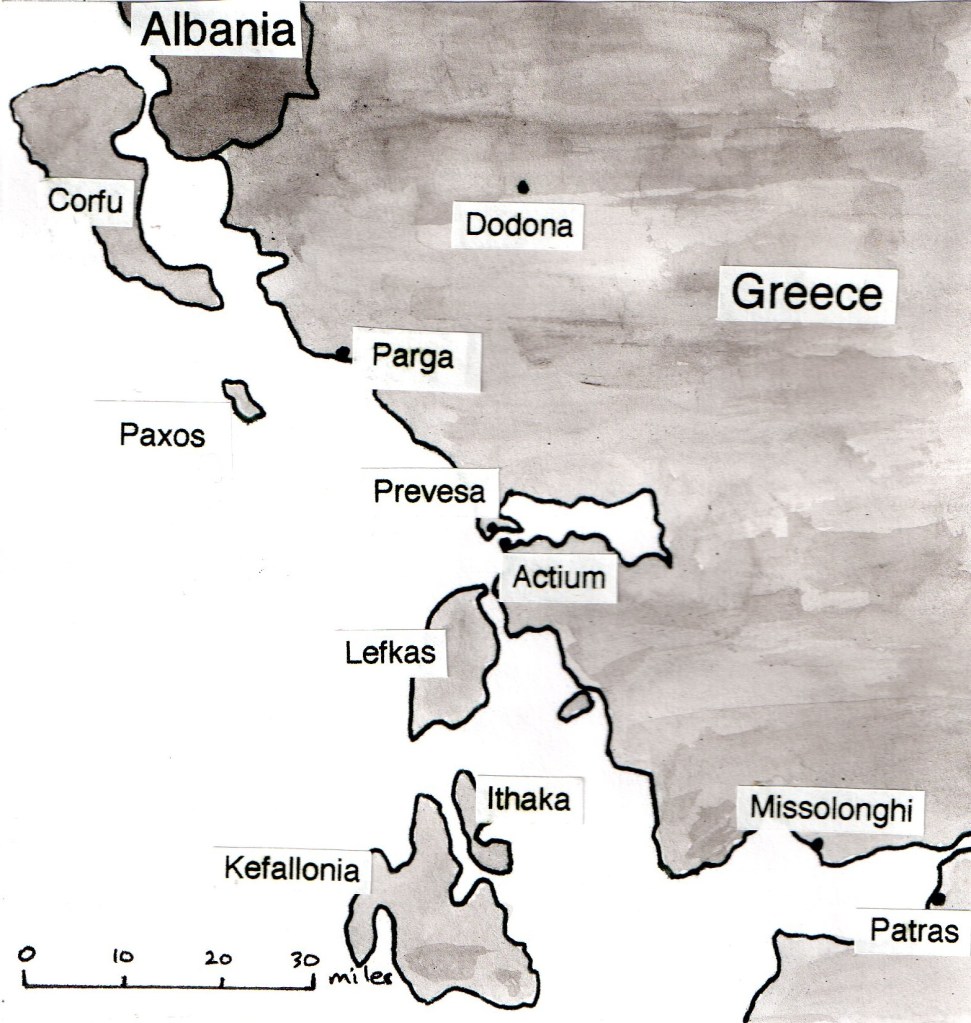
For now I’m standing at the bow of the white ship, at one with the keel that cuts a path into the trackless sea, heading into the realm of the first seed, so that the story of my life can begin, again. Ahead is untouched possibility. Behind is our churned wake, widening like a comet’s tail, turned to gold by the sun setting in Italy.
The next morning, after an uncomfortable night tipped back in an aircraft seat, I’m up on deck early as we approach Corfu. Jacks, after a noisy night at the bar, slumbers on below. The sailors, in Persil-white uniforms, down-to-earth, boyish, are sluicing down the deck, the water glitters in the early sun, shimmying as they work to a tinny transistor radio, “Volare, oh, oh, cantare, oh, oh, oh, oh,” splashing each other, grinning at me, sharing cigarettes, then they’re gone, leaving a washed emptiness.
Alone on deck, the sky monumental. Ahead is Albania, shockingly big and close, its mountains massive and purple against the dawn sky. I imagine Chinese soldiers with inscrutable faces watching me through military binoculars. I wave. And duck.
At the foot of the mountains, Corfu, for Odysseus “a shield laid on the misty sea,” its boss Mount Pantocrator: the Greek for the boss of a shield is omphalos. My first sight of Greece is an omphalos, a navel.
This is where Odysseus reentered time after his release from Kalypso’s realm. Having spurned immortality, he returned to the world of men, to resume his place there, to win his name. There are the rocks on which, raft wrecked, he clung, from which he was torn, the skin tearing from his hands. Down this, west coast is the bay where, saved by the veil of the sea nymph (the White Goddess in one translation), he was thrown ashore, with only the veil to cover his nakedness. His first action was to return the veil to the sea, his farewell to the faery realm, live then by his wits in the new world of the Phaeacians.
I too am entering a new world.
As I cross the sacred threshold, I remember, also from Prospero’s Cell: “other countries may offer discoveries in manners or love or landscape; Greece offers something harder – the discovery of the self”; “marvellous things happen to one in Greece, marvellous good things which happen nowhere else on earth.”
The ship heads straight for Albania, then, the purple mountains looming dark above us, casting us in shadow, turns sharp right and coasts south through the turbulent water of the narrow straight, hardly a mile wide, between dark mainland and the island that is now illuminated by the just-risen sun.
The rosy dawn vibrates as if with music almost heard. The air contains the promise of unprecedented heat. Everything is in perfect detail. I see and experience it in a light that is not just transparent, but a lens that intensifies the clarity. Durrell called it a dark crystal; for me it is a flawless diamond.
How to describe it, this light that makes every object immediate, individual, a light that I am inside and is inside me? I look as we pass clean ochre planes and curves, exclamation mark cypresses, gnarled lavender and silver olives, pink bays, headlands cut by white-frilled water, single white houses. Perched high up there is the cottage in which Durrell threw aside Huxley’s comedies of manners, embraced Tropic of Cancer, and wrote his way out of the English disease with The Black Book. On that beach Miller idled away the first weeks of the war, in Olympian detachment and Taoist revelation (the revelation: there is no revelation). Miller and Durrell, two lifebelts in the sea of chaos that engulfed me after Melanie. The bleating of a goat, water splashing, a man singing. I ache for someone to be beside me, now, to be telling this to, to be sharing it with. I give thanks that I am alone, experiencing this in my single self.
The ship enters the wide, curved bay, eases towards the quayside of Corfu town, an attractive place, Venetian, with French and English corrections, Greek dilapidations, pastel, glowing pink and clear in the early light, its washed streets, open cafés, mysterious alleys inviting, seductive.
As the fun-seekers prepare to disembark, I remember: this sickle-shaped island is the instrument with which Kronos cut off his father’s testicles; this is where Jason the argonaut and Medea the witch, niece of Circe, consummated their relationship (lying on the golden fleece), bringing the witch into the Greek world; here is where Odysseus resisted being tempted from his destiny by Nausicaa and the pleasure-loving Phaeacians; this is Prospero’s island, a place of magic and spell, that Shakespeare had him return to the witch Sycorax at the Baconian moment when the age of magic gave way to the age of science, and Prospero himself stepped through into the brave new world.
Several disembark, are met by nut-brown men with straw-hatted donkeys, enter the pastel dream. But this place is too complicated and voluptuous for me; I’m seeking something harder and simpler and more difficult.
As we leave the bay we pass Mouse Island, the Phaeacian ship that, as it returned from taking Odysseus to Ithaka, was turned to stone by ever-vengeful Poseidon. Remember the power of the gods.
Coasting south in the intensifying, brightening light, dazzling, I put on sunglasses. At last. Thirty miles over that hill is Dodona, the oldest oracle in Greece, where the gods were first named, and Zeus’ responses came in the sound made by the breeze in the “spelling leaves” hanging in the sacred oak, read by “interpreters with unwashed feet.” It sounds like an African village. I need to remember how primitive was ancient Greece.
Passing Paxos. Plutarch records a voice crying to a passing ship, “Thammuz, great Pan is dead!” (on board was an Egyptian named Thammuz), followed by cries of lamentation. Plutarch’s account was taken up by Christian exegetes in Rome as marking the moment paganism capitulated at Jesus’ birth. But a neat alternative translation by Graves, “All-great Thammuz is dead!” (pan = all) converts it to the ritual cry of lamentation at the annual death of a nature god, heard from the ship but not aimed at it at all. Pausanias a century later reports that the worship and celebration of Pan was alive and well throughout Greece. I’ll take it as yet another highly successful piece of Christian manipulation and propaganda. The pagan lives on.
A presence by my side, Strawson. He puffs on his pipe, carefully downwind. His face is shaded by his well-worn Tilly hat, there are lines crinkled round his eyes, his blue eyes look keenly, absorbing, the eyes of one returning, soaking up and soaking in the familiar, home, a smile, or maybe just the clench of his teeth on his pipe. He points with his pipe over his shoulder: ‘Your friend Jacks seems to be having fun.’ I look.
The ship has been transformed, from an overnight ferry with cocooned figures to a white Adriatic cruise ship with deck life, a pool, loungers, a bar. There is Jacks, again the party girl, splashing in the pool, stretching out in the sun, drinking and laughing at the bar. She absorbs the ambience of the situation she’s in, is absorbed by it, takes on its colour and mood, responds fully to those she’s with. Which flatters, and may mislead, them, me. Is easily carried away? But I notice that, even as she balances on the shoulders of a brawny youth, pitches shrieking into the water, she glances across, locates me. Strawson, looking ahead, puffing, says:
‘Cold blooded – in the biological sense. Not the other sense, I imagine?’
‘I really wouldn’t know.’
‘No, no.’ Silence. Puff, puff. Says:
‘Voices. So many voices. A confusion of voices, like the bat-twittering of the shades – which one to give the blood to? Crucial, to find your voice, in Greece.’ Another pause.
‘There’s an entrance to the other world, over there,’ pipe points across the blue sea to the ochre land, ‘just beyond Parga. You go down into the dark, the chthonic world, you confront death, you return to the light, this life, with a word, or at least, reconciled. The Palaeolithics did it, of course, and right through to the Eleusinian Mysteries. The Enlightenment – “more light!” – science, deprived us of it metaphysically, then physically. Maybe, as humans deprived of sleep lose their minds, we, without the dark, are in the process of losing our souls?’ Puff, puff, then turning to me:
‘ Don’t just enjoy the light in Greece. Seek the dark away from the light, and the dark within the light, that’s there, like that dark edge of the sun when you glance at it.’ He squints up then drops his face back into the green shade:
‘Entering Greece this way, it’s like a babble of radio stations. Only when I get to the Aegean can I tune into the one voice, and then, into the silence. Here, I spin the dial – and it is enlivening, but confusing.
‘What words of assurance and fidelity did Cleopatra whisper to Antony on Paxos the night before the battle at Actium? What voice did he listen to when he saw her squadron break away, and instead of continuing the battle, abandoned the battle, his empire, to follow her to Alexandria? And there, did he really, as Cavafy has it, hear Dionysos and his celebrants leave the city, abandoning him, and in the unbearable silence kill himself?
‘What silence engulfed Karyotakis on that day in 1928, in that bleak little town?’ pointing at Prevesa. ‘The finest poet of his generation, exiled from his beloved Athens to a stifling bureaucratic post. He lasted a month, one Sunday too many of listening to the garrison band play out of tune, and walking up and down the quay, asking “do I exist?” and hearing no answering voice, shot himself.
‘What voice sent Sappho, “violet-haired, pure, honey-smiling” Sappho, plunging from that headland?’ pointing to Lefkas. ‘Surely not love for some hunk of a ferryman. Perhaps, like Empedocles at Etna, the voice of immortality, the summoning realm beyond, the direct stepping across? Real or delusion? Only she knows.
‘And of course the noisiest voice on the coast, our own Lord George Byron.
‘He passed this way twice, the first time as a new graduate on his version of the grand tour, dressed in a red uniform and accompanied by a baggage train and armed guards, peeved that he could find no one to mend his umbrella, composing Childe Harold’s Pilgrimage as he went, admiring the brigandish locals, less sure of the Pasha’s lust for his plump white English body, and his penchant for nailing up the quartered remains of patriots he’d tortured to death.
‘But when he returned fourteen years later, sadder and wiser, “For we’ll go no more a roving …”, the voice he heard was no longer the Muse of Poetry, but the Call of Liberty. He was here to fight.
‘On Ithaka he expressed contempt for “antiquarian twaddle,” grown weary of his art and his fame. “Do people think I come to Greece to scribble more nonsense?” he says. “I will show I can do something better. I wish I had never written a line, for having it cast in my face at every turn.” He saw Ithaka, this last time, with a poignant tenderness. Not as place of past heroic deeds, but as a possible present place to live, should he survive. “If this isle was mine – I would break my staff and bury my book,” echoing Prospero. Dead within a year, in the “dismal swamp” of Missolonghi, not in battle but of fever and bloodletting, clutching his Mycenaean bronze helmet, crying “Forward! Forward! Follow my example! Don’t be afraid!” We could do worse.
‘This voice in Childe Harold:
Fair Greece! Sad relic of departed worth!
Immortal, though no more; though fallen, great!
Who now shall lead thy scatter’d children forth,
And long accustomed bondage uncreate?
‘And when you’re in Athens, looking at the cell in which Socrates died, tut tutting at their barbarism, remember that within a block is the secret police headquarters with its cells in which freedom fighters and political prisoners are at this moment, now, being tortured, their voices, unlike Socrates’, unheard by the world, unrecorded. Sometimes the voices of the present are the hardest to hear, the easiest to ignore.’
The cut of the bow wave, splashes from the pool.
I’ve listened spellbound, the privileged neophyte, to these stories from an old Greece hand, as islands and mainland places have appeared, approached, passed, been left behind. Now, in the silence, as evening begins to gather, I have a sudden sense that, not only has he been telling me something, I have been overhearing a man in dialogue with himself, approaching, as he enters Greece yet again, a decision point.
I turn to ask him. But he’s not there, he’s gone. Perhaps he is that sea-hawk, skimming the waves, there, there, gone.
Ithaka. Pray that the road is long. A day coasting between mainland and islands, Odysseus’ route home.
But he was asleep, wanting only to be there. I’ve been all attention. His island, dusky mauve against the descending sun, his return to his own world, where his strength and guile will be tested to the limit, where he will arrive home. Byron left here regretfully but defiantly, seeking a warrior’s end. Karyotakis completed the pact he made with autumn, “Let us die together.” Sappho plunged into oblivion, but left her poems, her name. Prospero drowned his book deeper than did any plummet sound, and returned to the everyday world after his foray into magedom. Dylan, weary of having his lines quoted at him, held up in his face at every turn, took off his Bob Dylan mask, sang “I’m not there, I’m gone,” broke his staff, and arrived home in Woodstock, in family life. And Jacks walked out of art, into life, leaping Splash! into the pool, a white plume, a bigger splash, now.
Brilliant blue gives way to dusty pink, the lights on the ship go on, the pool is covered, the land fades into night, marked only by pinpricks of light, the air stays warm.
As we enter Patras harbour and I am about to set foot for the first time on Greek soil (well, concrete), I wonder if my day has been wasted in antiquarian twaddle, if I would have been better occupied in having fun, working on my tan.
Jacks comes up, stands quietly beside me, slips her arm into mine, looking across at the catenaries of bare white bulbs, the lit cafés, Greek cafés, says, ‘you look as if you’ve had a good day.’
We stumble into the coach, pretty much done in, giving in to three days’ travelling now that we’re so close to our destination.
Jacks deflates beside me, her head on my shoulder, her hair smelling of chlorine, her arm through mine, mumbles, ‘I feel safe with you, and I don’t trust you,’ is asleep before, relieved, I say, ‘good.’
Along the edge of the Gulf of Corinth, fast, jolting, horn blaring, driving as if immune, as if protected by the worry beads and icons that swing and rattle above the driver’s head, we’re thrown around to the sounds of loud oriental music. Greek driving.
But I am floating, carried on a magic carpet. To the right, beyond those black mountains, is Arcadia, Olympia, Sparta. To the left, across that moonlit water, is Delphi, Parnassus. Ahead, is Athens. Places I will visit, experience, measure and test myself against, be changed by, I will never be the same, possibility flutters inside me.
The windows are wide open, hot air pours in, we slalom past unlit donkey carts jogging along, mules lost under swaying loads of firewood, enormous lorries lit up like Christmas trees, stop suddenly at a narrow-gauge railway and wait as a train like a fairground ride rattles slowly across, roar past village squares with tables under vine canopies, faces staring, children everywhere, cooking smells, music, Arp-bark plane trees, orange trees with fruit glowing like lanterns among dark leaves, mysterious scents on the hot night air.
And then, as fatigue sifts its greyness through, the melancholy of travel catches up with me. A face against the glass, my reflection, and beyond it worlds, out there, complete, inviting, lives I could slot into without effort or responsibility, just be. While in here is me, and I’m inside myself, lost, there’s a hole at my centre and a nagging voice, what to do, who to be, and Paul Simon’s “America” is the soundtrack. And there is the moon, most revered of the stars, the eye of the night, rising on cue over an open field, for I have arrived in Greece at the full moon, enormous, it races beside us through the trees, silvers the olive trees, lays a highway on the gulf’s dark waters, wakes me up, speaks to me. Around me there may be weary, dozing, curled-up passengers, but out there is a moonlit world, mysterious and clear.
At Corinth I look down into the canal. After Corinth we drive the precipitous corniche where Theseus kicked Sciron into the sea monster’s mouth, wrestled Cercyron to death, fitted Procrustes in his bed, and then, nonchalantly tossing a bull in the air, entered Athens as the future king.
Athens is busy, buzzing, hot – how strange is this dark, midnight heat! As we stagger off the coach, no match for insouciant Cliff in Summer Holiday, shaven-headed boys crowd around, shouting ‘Bobby Charton!’ ‘Quin Lisbet!’ ‘How are you?’ double up giggling when we say, ‘I’m fine, and how are you?’ We are ticked off to shared, single-sex bedrooms by an anxious young Greek with a clipboard and a frown that turns to a radiant smile when, incredibly, everyone has a bed.
I look out of the window of our room. Outside a bar the surface of the street glitters, set with jewels. In the square, on a pedestal, is the lower half of Miron’s discus thrower, the legs and buttocks and twist of the waist dazzling white, the upper half not there.
Chapter 10: “City of the Violet Crown”
Rain rattles from a broken gutter, there is singing in the rain, and I’m having a strange dream about the street at home when a gunshot wakes me with a start. The rain continues. But the air is hot and dry, and the snoring figures who’ve thrown off their covers lie covered in sweat. I go to the window.
Another car backfires. A woman on the balcony opposite, in housecoat and pink mules, smoking industrially and singing operatically, is watering her plants with a hosepipe, dense green foliage and big, brightly-coloured flowers, her garden in the sky, water cascading into the street below.
Jacks and I have breakfast on the pavement outside the bar. It’s oven-hot, and the air is dizzyingly polluted from exhaust-belching cars and violently revved motor bikes. The jewels in the street are bottle tops flipped off by the waiters and pressed by the traffic into the soft tarmac. The statue, made of plaster, has its upper body parts stacked at the base as it awaits completion.
‘What are yours like?’ Jacks asks, her eyes bright with purpose.
Oh, fine,’ I shrug.
‘I,’ she announces, the storyteller, centre-stage, breaking through the thick wrinkled skin of her yoghurt and dribbling dark honey in, ‘have got one who spent half the night sorting her cosmetics, saying she “must write to her boyfriend”, they’re “practically engaged” – having spent the whole boat trip with her tits hanging out ogling every boy and most of the crew. And one who went, “oh, my, god!” when she saw the toilet, the porcelain feet outlines, the black hole, gingerly placed herself squatting – you could hear her manouvring, going “ugh”, and “gross!”, imagining she was being filmed from below for a weird porno movie, or at least spied on from the bar and liking it –’
‘Jacks, I’m eating! You’re disgusting.’
‘Oh, I could tell she had that sort of dirty mind,’ she says airily, plunging her spoon in. ‘But the best bit, oh the really best bit, was when she put her hand in the basket next to the toilet, thinking it was full of clean paper …’
‘Oh dear.’
‘Her scream could have shattered glass. This yoghurt is scrumptious.’ Another spoonful, a bite of bread, then:
‘Richard?’
‘Yes?’
‘Can we get a room together, just sharing, just for tonight? Then we can go to the island tomorrow? Please? Pretty please?’
The plan has changed again.
‘Which island?’
An island, any island, you choose, away from all this, no buildings, no traffic, just a beach and a bar. You said you want to go to an island, before you travel, remember? We can split up there.’
‘Why not go today?’
‘Full moon. The Acropolis is open tonight, can’t miss that.’ Sorted.
We find a hotel, rejecting the cheapest option of sleeping on the roof, where the Europe-on-a-dollar-a-day backpackers, Commonwealth and American, lie torpid, wearied by too much aimless travelling, too many “sights”, refugees, huddling with their own, the guys hitting on the girls not for sex but to get them to do their laundry or repair their clothes, to be their moms. The girls sit patiently industrious, practising caring, and controlling. We take a twin-bedded room, leave our bags, and split up.
I cash my first traveller’s cheque – bank clerks in short-sleeve shirts and no ties – and receive a wad of colourful notes and a handful of exotic coins, some with petal edges, some of aluminium as if made from milk bottle tops, even one with a hole in it. I’m in China.
I catch a bus to the Archaeological Museum. Standing, I’m aware of the dark, alert faces looking at me. Everyone has dark hair, olive skin, dark eyes. I’m blue-eyed, fair. Is this what a black man feels like in England? But these looks are open, curious, interested. I notice the eyes especially. At first they look black as currants, but as I look I see they are dark brown, the colour and lustre of chestnuts, large, full of vivacity and light, especially the women, so that an ordinary-looking housewife has an exotic allure. Ox eyes. Then I notice some grey, Athenas among the Heras. And the skin: mine, beginning the colour of putty, will go pink, burn red, turn (if I’m lucky) reddish brown. Theirs will darken, as olive wood does with each application of oil.
And the gaze. Not the insolent, invasive look of the Italians, not the forensic look of the French (it’s my first day, I need these generalizations), but a look of open curiosity, as if each is itching to get to know me. Which alarms me. I was comfortable in France exactly because the examining look, the interest, stopped at my skin, allowed me my self-sufficiency, my self-definition, even demanded it, because each made it clear that I was other, contingent. For when, having satisfied their interest, they looked away, it was definitively, I no longer existed to them in their invincible self-regard. And that let me be. It encouraged and enabled me to experience myself as an individual with characteristics, rather than a location where things happened. Great awareness of self, with little self-consciousness. It gave me a model I was comfortable with, a centre from which I could organize my self and my relationship with the world, with a centre, and an edge.
But the edge, after my return from Provence, became a barrier. Become once more self-conscious, I armoured myself, cut myself off, isolated in an intellectual world, an ivory tower. (Deluding dreams come to us through the ivory gate; true visions through the gate of horn.) Breached, that tower, with such damage, to her and to me, by Melanie.
These looks are probing, questioning, out of interest. As if the edge of the person is the start not the end of the conversation. Perhaps the dialogue is their mode of discourse? Perhaps I am here to question, to be questioned, to be disconcerted, to be, somehow, infringed?
All this from looks on a bus! (How lone travel opens up the mind.) How much is this the insight of first acquaintance? How much is it invention, to make sense of a strange world
A woman in a headscarf with a child on her knee shifts uneasily. I have been smiling at the little boy. I suddenly remember the evil eye, the curse of the look of the blue-eyed, the amulets to ward off ill favour, I too am disconcerting. Should I mock-spit? I’d get it wrong, I carefully look away, smile in a saintly manner, probably look even more like a child molester, flee from the bus. Or maybe I remind her of the war.
I walk out of the cool, dark museum into the blinding light and the oven heat, look back at the solemn German facade, see behind the windows pinwheels and jumping jacks, thunder-flashes, fountains and rockets whizz-banging in every direction within, I turn away (already sweating in the heat), shake my head as the whizz-bangs go on inside, stop and look across the road.
At the park gates, like the desert mirages of oases, although tended not by alluring houris but by sun-baked little men, but just as heavenly, is a row of small carts that glitter and shimmer in the heat; within their glass displays of ice, nestling on snow, are red and green smiles of melon, cold pots of yoghurt, rice pudding, custard.
I sit in the park, eating ice-cold rice pudding. Cats prowl after birds in hard-leaved shrubberies, nannies walk stately prams, old men sit, patient and submissive, gnarled hands crossed on the tops of walking sticks, unshaven men stand by their long sticks of lottery tickets, while over the road pomponed and skirted evzones, strange as flamingos, step and turn like mechanical toys. A park in a foreign city. Again a remembrance of France, how in urban parks, those quiet, expansive places within the turmoil of cities, I could locate myself, in but not of, a stranger at home in my strangeness, more me than belonging, me and my solitude, together. And there, above, the sunlit Acropolis, “The city of light’s violet crown,” swarming with ant figures.
Sitting in the park, I am trying to absorb what I’ve seen in the museum, still whizzbanging in my head, to make sense. Cycladic, Minoan, Mycenaean, Archaic, the pure and the decorated, the martial and the tender, glittering gold and unadorned stone, energy, life, beauty, feeling, stillness – and all this before Greece, as I know it, began! Greece has suddenly become a whole lot bigger, and a whole lot older. I take a deep breath, and plunge back in.
Chapter 11: Full moon over the Acropolis
Jacks and I walk up through the Plaka, Turkish alleys, outdoor tables, the smells of cooking and the calls of waiters, please, you eat here, very good, the dark mass of rock above us and the walls above that, built two and a half thousand years ago on the ruins of the temples destroyed by the Persians, drums of columns visible under the walls, a perpetual reminder.
We enter after sunset, the sky a dome of purest light, of every colour from gold in the west through oranges, reds, greens, blues to darkest navy in the east where the moon, huge and full, has just risen. Jacks faces it, two moons in her eyes, whispers:
‘“The stars dim their brightness around the moon’s loveliness as she, full, floods the shadowed earth with her silver light. I desire. I yearn.” I am here.’
‘Sorry?’
‘Sappho.’
She puts a hand on my arm, then walks away from me, up towards the so-familiar silhouette of the Parthenon, above her the multicoloured dome of the sky across which black barbs of swallows dart. I stand, bathed in warm light. I watch her disappear into the dark, I desire, I yearn, and turn back to look down over the city.
It is a bowl of jewels that a giant hand has gently swirled, so that the jewels have spread halfway up the sides of the bowl, with, above, the charcoal darkness of mountains. Moving lights and seething motion, traffic noises rising up, ant-like busyness oblivious to what is up here, a different world. The air is soft on my skin, the moonlight wild in my head. I walk towards the Parthenon, following my faint moon shadow, knowing I won’t find her, not knowing if I want to. I am in two minds. Sappho.
How noisy the moon is! I’m hearing a sound that has always been there but that I’ve never heard before. It is companionable, and eery. And (stepping up the three steps of the stylobate, the stone warmly radiating the sun’s absorbed heat) I’m surprised how many pillars there are inside the Parthenon (I am inside the Parthenon!), it is full of pillars. I’d expected space, a cathedral. But this isn’t a space of collective experience, of worship, but of veneration. Here in its own small room stood the giant gold and ivory statue of Athena, the protective goddess of the city. Next to it, in its own room, the treasury, the city’s wealth. The goddess and money, looking after each other, looking after the city. Birds flutter and flash above, across the sky, the stars; the Parthenon is roofed with stars. Moon shadows flit. The stone is warm.
Outside this rectangular prism of columns and lintels, aeroplanes, electric light, the chattering world. In here bright light alternates with deep shadow. When I stand in the moonlight, I am scrutinized, x-rayed, examined. When I stand in the shadow, I wrap the darkness around me, look inwards, to the secret of my self.
I am, hours later, shooed out by the guardians, grumbling, wanting to lock up, go home.
Jacks is curled up asleep. In the night she slips into the narrow bed beside me, asks to be held, which I do, turning my embarrassing erection away from her, respectful in my caresses, until she sleeps, her head on my shoulder, her breast against my chest. I lie awake for a long time, looking up at the corniced ceiling, listening to the traffic, seeing her in my imagination, guarding her. But eventually I fall asleep. When I wake I’m alone. I see the note propped against the mirror.
x x x
I travel to Piraeus early, in the dark, on the unexpected modernity of the metro – I’d expected, wanted the friendly, rattling tram of Never on Sunday, hi, Melina – step off into a dark Hong Kong wharf world, of broken pavements, jury-rigged wirescapes, bodies slumped in doorways a begging hand held out, sprawled dogs growling in their sleep, a place of knife fights and robbery, I clutch my bumbag, pass a dim-lit café out of Zorba the Greek, raw figures stirring themselves into the day, imagine Strawson negotiating his way in this world.
Booths selling boat tickets, men answering “yes” and “good” to every question – I don’t anyway know where I want to go – I’m sold a ticket, I head for the row of ex-Clyde rust buckets tied up at the quay. It’s dark but warm, as if the night carries within it the heat of the coming day. An old man selling quoits of hard bread, his raven cry like the crippled newspaper seller at home, thinking of home, wanting to be at home, my childhood home, “Satdayeveninpo!”, buy one with aluminium coins, excited to be here.
Holding out my ticket I’m passed from boat to boat, see Simon on one, duck so he doesn’t see me, at last I’m accepted and I step aboard.
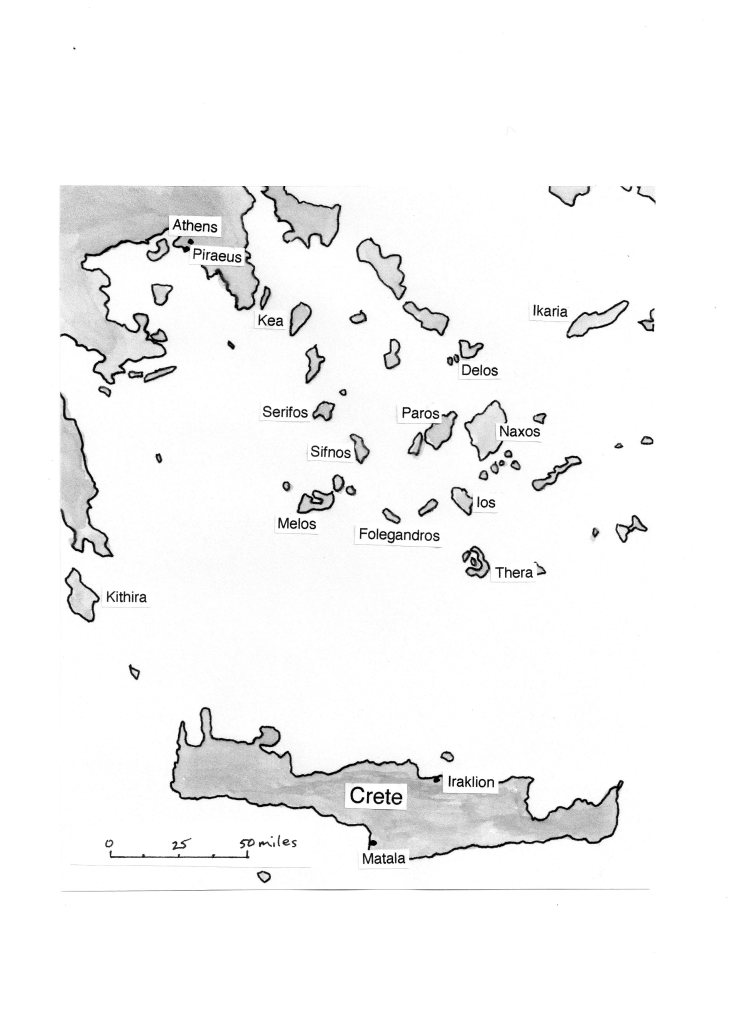

Part II : Simon’s adventures on Crete
Chapter 1: Stepping eastward
A strange meeting. He had come for hard walking, drawn by Kazantzakis’ accounts of the brigandish wild (and to share his view from the top of Mount Ida: “Crete, with her three high summits, was a triple-masted schooner sailing in the foam. She was a sea monster, a gorgon with myriad breasts, stretched supine on the waves and sunning herself”), and Boys Own Paper war stories, to walk teaching, cultivation, out of his system, stepping east, into the rising sun. He came, a self divided, the space between occupied by a paralysed nihilism. No idea what to do with his life. Intending at the end of Crete to dive into the new-risen sun. Whatever that meant.
The long journey across Europe, Strawson talking on the train about Leigh Fermor, the inaccuracy of Ill Met by Moonlight – they kidnapped the wrong man, and the Cretans had suffered badly in the reprisals. “Those stories don’t get told,” bitterly. Then the extraordinary incident on the Acropolis at the full moon with Jacks – “Tildy, I’m Tildy!”, she’d insisted – grabbing him, pulling him into her …. He’d been glad to get onto the slow boat to Crete.
Walking along the spine of Crete, its rocky vertebrae, high, the world of mountain people, poor, suspicious, guest-welcoming, for the stranger is the unknown god.
Hard walking on hard rock. And yet, waking at dawn, mist like gossamer in the valley below, clamour of bird song, as the sun in its grand solitude rose, and he greeted it with Zarathustra’s words: “Great star! What would your happiness be if you hadn’t those for whom you shine? I wait for you each morning, take from you your superfluity, and bless you for it,” as the eagle began his rising gyre in the warming air.
Walking day after day, alone: the hard labour of step after step on unyielding rock, nothing added to nothing – and then a sudden bubbling in the blood (joy? Joy) that had him laughing out loud and leaping careless and carefree from rock to rock like the ibex he saw, just once, poised heraldic, waiting for him, then with a shake of its bulky horns bounding away. Fancifully quoting Zarathustra again, “If I be a prophet and full of that prophetic spirit that wanders on high ridges between two seas, wanders between past and future, enemy to all that is weary and can neither die nor live …” Ah, if only. But odd, touching, when what one has read, remembered, fits.
A ragged wrinkled widow pressing with walnut paws a fig into his smooth hands, watching as he split it, bit into the soft flesh, touching his cheek with her work-hard hand, tenderest of touches, then shooing him on his way, on, go on.
And then, like a purged snail, leaving no trail, he was emptied.
Perhaps that had been the moment to carry on, empty, into emptiness?
But the sea, so long a sheet of hammered zinc far below, the sun reflecting off it as off a shield, was now mobile, liquid, inviting. And he was a dried sponge, hard, unfeeling; he imagined softening, absorbing, in the buoyancy of the dolphin’s realm. He turned south. He was above the Samaria Gorge. He would follow it to the African sea.
He descended, past rock cabins, with scratched gardens, a bony goat, black-clad figures still as beasts, as if to be invisible to this golden striding figure, down through thorny scrub and thin chestnut woods. Then olive trees with black nets under them, and the beginning of planted fruit trees, villages with a little white paint and a few tins of red flowers, to the head of the gorge.
A new world. A stylish Alpine lodge, a large area bulldozed to a coach park ending at a precipice. A footpath disappearing down through rocks and trees to a hazy luminous depth.
He was looking into a Chinese painting, an allegory, with mountains and mist, trees and cleft rocks, wooden rails and a steep winding path, a single small figure climbing patiently, resolutely, staff in hand. As Simon descended springily the cut steps, the graded slopes, the wooden stairs, following the passage of the river of tourists that had poured out of the coaches and down earlier in the day, he thought: instead of tumbling downhill like pebbles, thoughtlessly expending the potential energy built up by the coach’s climb, this should be, as in China, a pilgrimage up, from undifferentiated sea to specific mountain shrine, a slow gathering into oneself of the spirit of the place by purposeful, measured steps, expending effort to accumulate understanding. But that would not be tourism.
He admired the man, thin-legged, white-haired, as he passed, who had climbed up against the flow, waded through the flood of charmless, chattering tourists, imperturbable, who would arrive tired, cleansed, to quietness, peace, a mountain stillness, envied him. But this day Simon was just another tourist pebble tumbling to the sea. Another time.
And then he was in Japan, a Zen immediacy, set-pieces of twisted tree, broken rock, writhing root, nature that looked created to look natural, immanent with almost-readable meaning, at the edge of revelation, inscrutable but clarifying.
A thousand feet down he emerged into a sunlit Western, with a shallow river winding through stones, where a bear might scoop salmon, a family homestead (a tow-headed boy in dungarees), with dark forests rising up, timber and deer, to sunlit peaks, blue sky, the wilderness to be settled, the solitary rider entering a story.
All these images! He had so arduously emptied himself and now, turned away from the goal that had been the single exclusive point, all his knowledge was queuing up, pouring in, to chatter about the world he was passing through.
And the inaccuracy of the images was brought home to him when he reached the emptied village of Samaria (film-set for a gunfight!) where the Viglis family, aristocrats from Byzantium, had lived their self-contained exile for a thousand years, undisturbed until ecology and tourism (the government) had turned the gorge into a national park, and they had been exiled again.
Through scrubby woodland, then the walls closing in, squeezing the air, sand-coloured rock rising sheer a thousand feet, hot with oven heat, skittering pebble fall, gun barrel flash, dry gulching, the Iron Gate, just ten feet wide, with stepping stones across a trickle, imagine in winter, the river compressed to noisy boiling flood, this last intensification before, passing through, the gorge’s wonder dissolved in tawdriness. A miserable couple of miles of stony river bed, oppressive heat, stalls hawking overpriced drinks, the last ill-shod trippers limping their way to the sea.
The sea, that he had come for, to plunge into.
But between him and the deep indigo blue, a waste of black stones littered with pink bodies like pieces of salmon grilling, refugees washed down by a flood, waiting apathetically for rescue, among bars smearing the air with burger smells and the monotonous beat of Europop, he could not stay here, without stopping he strode across the beach, onto the wooden jetty, and stepped onto the first boat.
Chapter 2: On the boat into mystery
A strange meeting.
He unshipped his rucksack, stripped off his sodden shirt, his boots and socks, and, exhausted and energized, was staring down fascinated into the motion of water that was like liquid glass, looking at the light accumulated under the hull, rocks and weed and fish stretching and compressing in the liquid lens, when a voice next to him said, ‘damn, my ring,’ a young woman peering down, reaching with helpless hands.
Not thinking, no idea why, feeling a sudden and curious liberation, he leaped onto the rail and dropped into the water.
The shock to his overheated body was quickly replaced by delicious enclosure, the water caressing every surface of skin as he went down, past the ring idling glintingly down, through shafts of sunlight, fronds of weed, past fish darting away, to touch lightly with his toes the coloured rock and then, flexing gently, propel himself up towards her distorted, anxious face, collecting the ring as he passed, and broke the surface.
He was hauled aboard, with much shouting and ‘you crazy man!’ from the crew, and the boat cast off.
On the journey from Ayia Roumeli to Hora Sfakion, past brown cliffs and isolated coves with occasional rough stone shacks, the boat bouncing on white-capped waves, with low-skimming birds and a racing yacht heeled over, wind-filled sails of white steel, everything changed.
x x x
As he gave her the ring he watched unspoken words flicker across her startled face, you didn’t need to, why did you, why did I, what does this mean, settled at last on:
‘Thank you,’ a smile, inviting a response.
He had acted for no reason, his action a response to a stimulus, without motive, self-contained, completed. He would happily have walked away, got on with his life. And later he would have thought, if only.
But, for now, his silent walking, his inner conversations, had left him unable to converse. She was tapping at the shell. He tried:
‘Oh. Well. Not a,’ stopped.
‘It was sweet,’ she pursued, attentive.
‘Not for. Happened. Just did.’ A frown on her face, uncertainty, then a decision, her voice commanding:
‘“Tommy, can you here me?”’ At last a shared understanding, and his reply:
‘“See me, feel me, touch me, heal me.”’ Her face relaxed, her smile returned, she said:
Strange how potent cheap music is. Let me at least buy you coffee.’
‘Thanks. But less of the “cheap” – rock is art’s cutting edge,’ as he followed her inside.
They sat in the little cabin by the simple bar, manned clumsily in the gloom by a crew member whose big hands were more used to ropes than cups, cool in the shade that contrasted with the bright world outside leaping and bounding past.
‘Was that it?’ she asked.
‘I don’t know. But we’ll always have Ayia Roumeli.’ She smiled briefly, quickly became serious, wanting to get past the back and forth, asked:
‘Do you know about Talos?’ He shook his head.
‘Theseus?’
‘Of course.’
‘Theseus at the harbour?’
‘No, Theseus in the maze.’
‘Labyrinth,’ she corrected sharply, then, ‘Sorry – it’s all so strange at the moment, everything seems to have “significance”,’ she mimed quotation marks. ‘I was just checking. I …’ she looked down at the engagement ring she was twisting round her third finger, looked up, eyes flickering across his face, as if again trying to read his thoughts. He was a blank page. He had never been so thoughtless. She resumed, looking towards land, ‘a bronzed figure striding purposefully across the beach, along the jetty, towards … You looked, look, as if you’ve been, are, somewhere, interesting.’
‘I guess I have, maybe am. But everything gives way, nothing is stable, Heraclitus.’
‘Thanks, Prof. Freddie quotes this from him: “If you do not expect the unexpected, you will not find it, since it is trackless and unexplored.”’
‘Freddie?’
‘We’re not making a lot of sense, are we?’
‘Hopefully, to ourselves, but to each other, no. But, there’s time.’ He sipped the tepid neskafeh. They let time pass.
‘I was playing with the ring,’ she said, head down, voice muffled, ‘practising taking it off and putting it on. See, how pale it is underneath,’ showing him. ‘It falling, simplified things.’
‘Sorry.’
No! Simplifying isn’t good enough,’ plaintively.
‘Is he in England?’ She nodded, looked defiant, guilty, uncertain, then shivered. He said:
‘Come on, let’s sit on deck.’
They sat with their faces to the sun that was dropping in the west but still full of heat as they were carried east. He settled back against his rucksack, watched eyelid light shows, listened to snatches of conversations in several languages, to engine roar and sharp gull cries, smelled suntan lotion and diesel, felt engine vibration and the thump of waves, the sun unpicking his ribs, seeking his centre. Their conversation threaded through this, mostly her urgent monologue, her one chance to narrate and clarify.
Her name was Sally, and with her friend Amy had just finished at teacher training college. Each summer they would find an art connection to somewhere hot. Last summer El Greco in Toledo.
‘Toledo, in the middle of summer?’ he said, eyebrows raised.
‘I know,’ she said, ‘we’re good at art, not geography.
‘Then I read somewhere, “Toledo gave him his art, Crete his life”, so here we came.’
When he ventured that this sounded rather – sophisticated – for trainee teachers, she punched his shoulder, said ‘what a snob!’ laughed, said they’d both been a bit too “adventurous” at sixteen, screwed up their ‘A’ levels, would each have gone crazy if they hadn’t met on the first day of term and become the Glimmer Sisters. ‘You should see us do Mick’n’Keith! They’ll never forget us!’ she laughed.
They’d found nothing of El Greco on the island.
‘We’d forgotten the middle term – he learned to paint in Venice. There was a big Cretan community in Venice in the sixteenth century.’
‘Maybe that was where Icarus was heading,’ he said, mildly facetious.
‘Icarus flew up the Aegean. Daedalus flew to Sicily.’ Again he noted her humourless pedantry. Or serious accuracy? She went on:
‘We’d expected a blue and white Greek island. We got Iraklion. Dusty, dowdy, hot. We couldn’t make sense of it. The huge walls and bastions, geometries of baroque military engineering now buried in a ramshackle oriental town. A mosque turned into a cinema, with Hollywood posters written in Greek. The tree where patriots were strung up by the Turks covered in flowers. A blood-reeking shambles with butchers pulling the skins off hot, crazed-looking lambs, like removing a tight glove, next to a renaissance square with a nymph-dancing fountain and elegant cafés, a priest with his friends, burly, black-robed, his hat on the table, a line across his forehead like the mark of Cain, laughing red-mouthed, full-throated, tossing back his ouzo. A main street out of Touch of Evil, ‘Minos Rentacar’, ‘Daedalus Rentascooter’ – “where’s ‘Icarus Rentawing’ when you need him?” wailed Amy, our one joke.
‘A miserable day trip to Fodhele. Back in Iraklion, in a fleapit hotel, out of ideas, three Oxford types in safari suits conversing in ancient Greek, a couple of drug-wasted French guys, hanging on. Amy went out, I slept, she came back two hours later, she’d met a bloke, gorgeous, with a scooter, etc, etc, it usually happens, “but Sal, you’ll find serious things to do, you always do – I just want a good time,” and mostly it works, we go our own ways, I draw, she lives, but we always link back up, join up our experiences, the Glimmer Sisters.
‘Feeling flat, asking why, sometimes, I shouldn’t get the life, but still I went to the Archaeological Museum.
‘Expecting worthy statues of manly grace, I stepped instead through a magic door, into a vibrant, brilliantly-coloured world, intensely alive. How to describe it? Breathtaking bull-leapers, sensuous dancers, jolly fat pots held in the arms of octopuses, tall vases with palms and lilies bursting up, tiny sealstones carved with ecstatic worshippers, animal-headed priests, whole religious experiences in the size of a coin, frescos with dolphins at one with their element, and flying fish leaping out of theirs, daring to experience a higher realm. A world vital, fresh, depicted as it was being experienced for the first time, in which they were at home, at one, a world without mirrors, with shields to drum on and axes not to fight with but to cut through ignorance …’ She stopped, knowing that she could have gone on and on, looked across at him, his eyes were closed, resumed:
‘I was becoming a little delirious when, in answer to a prayer I hadn’t known I’d sent forth, I found myself in front of her. The goddess. Full-breasted, her eyes unblinking, her gaze steady, holding out her arms to me, snake-wreathed, encompassing, including, to hold and embrace me as the ground crumbled under me and, lost in space, aching with an absence I hadn’t understood, a separation I hadn’t realized, looking at the ghost of my reflection in the glass between us, had only these cherished, comfortless words to cling to:
‘“Each torpid turn of the world has such disinherited children
To whom no longer what’s been, nor yet what’s coming, belongs.”
‘My heart cracked open. The Minoan world flooded in.’
In the heat of the sun a shiver went up Simon’s spine, prickled across his scalp. Recalling that afternoon, alone in his bedsit, rain like pebbles against his window, nothing making sense, trying to make sense, opening Rilke for the first time, randomly, and reading; remembering, he continued the quotation:
‘“For even the nearest moment is far from mankind.”’
The boat hit a wave, leapt, landed, sped on.
‘Even the nearest moment,’ she whispered. Then, anguished, plaintive:
‘Are we children, demanding the impossible, playing in the garden, telling the grown-ups not to interfere but still expecting our tea to be on the table at five o’clock?’ He smiled at the image, said:
‘It may well be true. But remember, “Be Reasonable – Demand the Impossible”? I don’t think it’s yet decided. Meanwhile, we have to keep on. Don’t we?’
In separate silences they gradually returned to themselves, and she resumed:
‘A white handkerchief appeared in front of me – I hadn’t even realized I was crying – held in a wrinkled hand on a thin wrist projecting from a frayed, clean shirt cuff and the arm of a worn, neatly-pressed suit. He had a thin face, hollow cheeks, high cheek bones, sparse white hair, tears in his eyes. “Your tears bring tears to my eyes. All this,” he said, his arm encompassing the room, “makes my eyes to cry, my heart to sing. I am proud. This is Crete. We made this, we are of this, our bulls, our dancers, our Goddess, us.”
‘He told me of the mysterious people who had come from across the sea, out of the unknown, who had created a wondrous civilization, two thousand years before the Greeks, of cities without walls, a religion without temples, who glorified and celebrated, in and through the Great Goddess, the whole of life, the quick of it, in art, ceremony, dance, living. How, weakened by natural catastrophe, their civilization had been destroyed by the Mycenaean Greeks they’d given so much to. And then forgotten, the memory suppressed, except in distorting myth. But then recorded – unknowingly or knowingly? – by Plato.’
‘Sal, where are we going?’
‘To Atlantis.’
Chapter 3: Matala and Atlantis
It was a pink sunset, when the low red sun suddenly stains everything rose, so that the blues of sea and sky become tints of purple, brown hills turn indigo, white buildings and wave crests are washed pink; and only the yellow lights of Hora quayside resisted, clear as candle flames, as they entered the small harbour.
It would have been an auspicious arrival at his new destination, as the pink suddenly faded and the sky turned shades of darkening blue, the land charcoal, the village became a mysterious cave of lights. But there they met Sally’s friends, ate, a table of eight noisy North Europeans (or rather seven and silent Simon), too much to drink, and then onto a smaller boat for the longer journey to Matala.
He remembered the even roar and vibration of the engine, the pinprick stars in a black sky, being cold and a blanket being laid over him, and then nothing until he awoke to bird song, sunlight, heat, a cotton sheet cool across his naked body, and Sally up on one elbow, very brown in the white bed, looking down, surveying him.
He felt invaded by her appraising, forensic look, cool and objective; the way, he realized, he looked at women. Recalling the conversation at dinner, by turns ribald, mystical, surreal, waking like this, he knew he had to go with having gone through the looking-glass. On cue “White Rabbit” began to play in the distance, and a black kitten emerged from under the bed in a tangle of unravelling wool. He tried smart, a crooked smile and:
‘One question – did we?’
‘One answer – if you don’t remember, you’ll never know what you missed.’ Collapse of stout party. Going down in flames, her sudden, brilliant smile an angel’s parachute, ‘breakfast?’
She offered him a kaftan, a fashion item he’d avoided thus far. She slipped hers over her head with a touching combination of unconcern at her own nakedness and respect for his less advanced sensibilities. He struggled into his. It was comfortable, although he felt oddly naked.
They sat outside, at a small table in a hollow square of white-painted breeze-block buildings with many doors of different colours, girls here and there, a view over a bay between brown cliffs to a very blue ocean.
‘So, what happened with the Greek gent?’
‘Gent, yes, you’re right. Mr Thalassinos. A retired public servant, I’m sure poor as a church mouse on a tiny pension, but keeping up appearances. He never invited me into where he lived, a noisy tenement. I imagined him as a Cavafy figure, closing the door on the everyday world and conjuring up the golden realm of the Minoans in his imagination, with a few treasured objects to make it real.
‘During the war he’d met Pendlebury, the archaeologist who worked with Evans, who was fighting the Germans. Pendlebury told him about the Minoans, how the original Cretan language was still being spoken into Classical times, that their blood still flows in Cretan veins among “hillmen of the old stock”, in Homer’s words. After Pendlebury was killed, he pledged himself to learn all he could. ‘Now, “I am a bee that has gathered too much honey; I should like to give it away,”’ he smiled sadly.
‘His one possession was an American car, cream and chrome, brought back by an uncle from Detroit. He uncovered it, caressed a cloth over it, breathing on the chrome, and drove me in white-walled style, very slowly, the dancing, shouting children at last falling behind, to Knossos.
‘It was the middle of the day, the cruise-ship parties had gone to lunch, the place buzzed with cicadas but was empty and still.
‘He pointed out Mount Juktas, and the profile of the dead Zeus: “Because we say Zeus died, the Greeks call us liars. But the gods do die – only the Goddess lives forever. There is a road from here to her shrine on the mountain.” Nearby is the cave of Eileithya, who flew to Delos to enable the birth of Apollo, and so was midwife to a new age. “So much began here,” he said, “and has been forgotten. Or suppressed.”
‘Proudly he showed me “the first paved road in Europe” (he had already shown me “the world’s first printed text,” the Phaestos disc, in the museum), the advanced engineering – multi-storey buildings, sophisticated plumbing, large areas of food storage to care for the population, workshops for seal-making, gold and textiles, light-wells and movable screens that allowed air to circulate – “air conditioning!” – and light to enter a thousand rooms. He showed me the Theatral Area where crowds watched the bull-leaping, the Great Court for dancing ceremonies, the enclosed spaces for more intimate rituals, the throne on which the goddess would manifest through the person of a priestess. All this depicted on frescos and sealstones.
‘Walking round, I had a sense of lives lived as a community, in which the focus of life was the here-and-now, the Goddess everywhere, in every molecule of matter and every vibration of thought, not worshipped but celebrated, a life expressed in one of our oldest words, “joy”, which means “jewel”. I saw myself dancing, dancing …
‘Don’t you see?’ she said vehemently, turning to Simon, ‘the life has been lived, so it can be lived? It isn’t just a dream.’ He smiled neutrally. She continued:
‘Returning, we stopped by the Sufi monastery that Kazantzakis had visited. The monks there told him: “angels have no power of speech, so they speak to god through dance. If you cannot dance,” they said, “you cannot pray; for dancing dissolves the ego, and then there is no obstacle to joining with god. Laughter, dance and joy are the three archangels who take us by the hand.” He hopped from foot to foot in his polished, cracked leather shoes as he told me, eyes bright, laughter, dance and joy, then said, “For the Sufis, god. For us, for you, the Goddess. And you, you will dance with the angels, you will celebrate the Goddess, you will bring her back to us. How we miss her!” He spoke with such certainty.’
She stopped, as if in wonder at the responsibility put upon her by that certainty, and at the inevitable unfolding of what had followed. But then she turned back to Simon, and, seeing innate scepticism, and maybe to rehearse on an outsider her new-found conviction, she resumed, forcefully:
‘Goddess before god, you see? Forget the Bible, the Classical myths; the origin is female: woman, with two x chromosomes, unity, comes before man, with an x and y, differentiation. The bull, so often depicted as a symbol of male energy, is in fact the embodiment of the mother earth, a reservoir of earth energy. The horns aren’t phallic but channels for the outflowing of the earth energy; to touch, to grasp them is to connect to that energy. How much has been perverted by male phallocentric thinking, by screwed-up, screwed-down Freud! And the original power diminished thereby. No capes, no swords, but naked, leaping boys and girls. Not death, but exuberance.
‘The goddess is in every living thing, every realm, she’s in plants, fish, dolphins, birds, butterflies, the earth, the sea, the sky. A world of oneness, before division.
‘When that original connection, through the feet, was broken, and replaced by a connection through the head, it became a relationship not lived, but imagined, not felt, but thought. We must reestablish the connection to the primordial Goddess energy, through dance, must.’
She stopped, having said everything she wanted to say. He envied her vehemence and certainty, was touched by her passion.
What to say? He had nothing to say. He was a child listening to a fairy story, willing it to be true. He was a tutor listening to a student’s essay, weighing the evidence. He took refuge in ambivalence, certain that to have a decisive thought now – as he would habitually have done, and then expressed it forcefully – was exactly what he should not do. He did not know why. But he knew it was crucial. He was doing something he’d never done in his life: not having an opinion. He was the cartoon character who walks off the edge of the cliff but does not fall, until he looks down. He would not look down. He would keep walking.
As she let go the world she had conjured up in her head, she sighed then looked up, looked steadily at him, said:
‘I didn’t expect that.’
‘What?’
‘Silence.’ He kept walking, said:
‘“What we cannot speak about …”’ She laughed:
‘Thank goodness, I thought you’d gone soft on me.’
‘Where am I?’
‘Matala.’
‘Why am I here?’
‘Because you got on the boat.’
‘Where’s Atlantis?’
‘It’s a bit – further.’
Before she could continue, there was activity across the courtyard as a statuesque woman of middle years, with several girls around her, appeared, and looked across at them. Sally said, ‘look, I have to go, things to do, places to be, all that. Pete’ll show you round, explain a bit more.’ She looked at him, then across at the woman, ‘I really have to go,’ smiled quickly, got up, said, ‘I’m glad you’re here,’ and ran off. She spoke to the woman, disappeared into the communal rooms, while the woman looked at Simon. He smiled, waved, she did not respond. Sally reappeared and they all moved off, a queen with her retinue, a swan with her cygnets.
A couple of minutes later a gangling, loose-limbed young man ambled out and over to him, smiling and holding out his hand, introduced himself as Pete.
‘Shall we go?’ he asked.
‘I’ll just slip into something not like this,’ Simon smiled, and went in to change into the safety of shorts, shirt and sandals.
‘Bring a cossie and towel,’ Pete called.
x x x
Pete was an easygoing Aussie.
‘Shall we grab a coffee? I don’t know how Sal lives without caffeine. We bought a coffee-maker for Yanni – labelled it “Michael’s Percolator” after Blue came out. I can’t live on mud and instant.’
They sat outside the café overlooking the beach. A hot wind was blowing in from the sea, whipping up waves and flurrying the sand.
‘The wind really is in from Africa,’ Pete quoted. ‘You don’t realize how hot it is, you get lobstered in no time. Freddie calls it “Deianira’s love charm”.’
‘Why’s that?’
‘You’ll have to ask Freddie. He’s the Classics swot, and most of what he says goes over my head,’ he said, not a little, Simon thought, disingenuously. He continued:
‘We all quote Blue, bit of an in-joke – you know it, right?’
Simon said, a bit, not well.
‘It gave a cachet, a benediction, almost, to what we were, are, doing here, Joni being here, “Woodstock”, all that. Thing is, she calls it a tourist town. Turns out she was the tourist.’
He stopped, a sudden realization, said, ‘You haven’t a clue what I’m talking about, have you?’ Simon shook his head.
‘’Struth. Why are you here?’
‘I’ve no idea.’
‘Okay – how did you get here?’
‘I got on a boat.’
Pete leaned back in his chair, blew out his cheeks, shook his head, looked up to the sky, then leaned forward:
‘D’you know, I dropped acid in Sydney, had a vision at Uluru, I travelled through San Francisco, Mount Shasta, Findhorn and Glastonbury to get here – it was like a Campbell quest. And you – got on a boat. Who the hell are you, Parsifal?’
All of this said with such wonder and self-deprecation that Simon felt drawn in rather than discomforted. Even so, at one time he would have said – “I’ll have you know I went to a fine school and have a very good degree.” A year despairing of what to do with his “very good degree”, and two years teaching General Studies to art students had cured him of that. There, he’d found his knowledge of pop music (gathered largely from the record collections of a couple of rebels at his public school who’d gone on to make a fortune in the music business), was a more sterling currency with his students than the, to them, counterfeit of intellectualism. Part of him despairingly agreed. And now he’d landed in the counterculture. A word he only knew from his joke, when a student got a holiday job at Woolworth’s, “ah, I see you’ve joined the counter culture.” He was a card.
Pete collected his thoughts and settled, looking over the bay.
‘Okay. This, is Matala, right?’ They looked out to sea, into the sun: bodies at different stages of burning lay on the beach, silhouetted figures threw multicoloured beach balls and luminous frisbees, as on any beach; but the fierce, desiccating wind snatched at them, the sea, however blue, was churned and dangerous-looking, and there were slow-moving figures in the caves above the beach.
‘A bit of history, then. The caves are man-made – they’re easy to dig out – they’d been used for centuries, abandoned since the war.
‘As youngsters from Northern Europe spread through the Med, they began occupying them. In the early days, by all accounts, it was friendly and cooperative, they got on well with the locals, it was one of those happy utopias that sprang up in so many places, but so briefly. Then it became hip, a hippy St Tropez.
‘That was when Magda and Johann came here, running a stylish pension. The aristocrats of ’60s celebrity would visit. Everyone’s got a story, about Dylan, Cat Stevens, Joni Mitchell, whoever.
‘But, as so often, the generous and genuine were overwhelmed by the freeloaders, the incompetent, the criminal. The sixties’ story. It all got pretty unpleasant, the locals complained, the police started clearing the caves.
‘Meantime, Magda and Johann had graduated from being caterers to the beautiful people to believers in the Minoan as the great lost civilization of Europe. Discovering the Atlantis connection, just as The View Over Atlantis came out, clinched it.
‘They were here; this bay is where Zeus and Europa landed; the Argonauts had their confrontation with Talos along this coast; and one of Johann’s friends had just started the cave project. They convinced the locals that their Centre would bring business, so now the police protect the caves.’
‘Sally’s told me about the Minoans – but what about Atlantis?’
‘In Plato it’s an island of great wealth that was destroyed by the gods and sank beneath the sea.’
‘Again – what’s that to do with Crete?’
‘Crete was Atlantis.’
‘Except,’ boomed a voice, ‘that Atlantis was an island bigger than Africa and Asia, beyond the Pillars of Herakles, Plato is quite explicit,’ the loud, exasperated voice of one aggrieved that he had never been sufficiently listened to. A large, fleshy young man, overgrown in a puppyish way, but with a pleasant face, plastic-rimmed National Health spectacles.
‘Meet Freddie,’ Pete said, smiling, holding out a languid hand, ‘Jowett’s representative on earth. Our resident sceptic who wanders around, a latter-day Socrates, popping our soap bubbles.’
‘Not Socrates, that desiccated seducer of young minds, if you please,’ Freddie said, adding hopefully: ‘Heraclitus, perhaps?’
‘Enigmatic to the point of incomprehensibility? As you wish.’
‘Subtly wise, and yet unregarded in his time and inaccurately remembered after,’ he said with a theatrical sigh.
‘Pull up a coffee and join us.’ Introductions were made.
‘Atlantis,’ Freddie said, ‘is a name that quickens the pulse, but gives everyone licence to ascribe to it whatever characteristics they want. From More onwards, but especially after that huckster Donnelly, we’ve had nutcases, dreamers, and more dangerous characters, from Blavatsky through the Nazis, seeing it in their own image, as granting legitimacy to their specious claims. It’s been located everywhere on the globe, the Aquarians wait for it to appear from under the sea to mark the dawning of a new era, like Christians awaiting the Second Coming, or Glastonbury types waiting for Arthur. It’s a refuge for wishful thinking.
‘So many good things have happened in the last few years, so much fruitful flux. But now they’re either hardening into the commercial or being sidelined into fantasy. The Glastonbury monks invented Arthur, and Plato invented Atlantis. As Aristotle says, “the man who dreamed it up, made it vanish.”’
‘Okay,’ Pete said, ‘but, humour me – let’s go through the evidence for Crete being Atlantis. The story is told by an Egyptian, and the Egyptians weren’t seafarers – they didn’t even have a name for the Mediterranean, calling it “The Great Green.” To them Crete was a large island empire far to the west. Plato moves it beyond the Pillars because that was the limit of the known world, and to emphasize its otherness. Same with the dating – saying it was thousands of years ago is the equivalent of the medieval “time out of mind.” In fact, knock off a zero and the disappearance of Atlantis actually coincides with the fall of Crete.’
‘“Knock off a zero,” indeed,’ Freddie scoffed.
‘C’mon, you know the Greeks were lousy at dates. And there’s so much more. Given, that there was a thriving non-Greek civilization in Crete before the Mycenaeans took over. Given, that it was a large island, wealthy, a seafaring power, that built rich cities, for whom wild bulls was central to their ritual. Even the Greek story that the Cretan king conferred with Zeus in a cave every nine years echoes the gathering of the Atlantian kings to consult the pillar of the divine law. Now, add in the evidence for the sudden destruction of the Minoan palaces, and that it coincides with the eruption of the volcano on Minoan Thera, and you have the earthquakes and floods, and also you have, as happened to Thera, an island disappearing under the sea in a single day.’
‘Yep, and elephants roamed Crete, and, yep, Crete was Atlantis. So what?’
As you say, it quickens the pulse – because it’s in our memory, our collective unconscious. It’s cool that Crete was Atlantis.’
‘Cool!? This isn’t the King’s Road fashion parade!’
‘No, stay with me on this,’ Pete continued, persistent, serious. ‘It’s cool that we can locate Atlantis, the great mythical dream place, on which it is so easy to fix unreal fantasies, in a particular place, at a particular time. It takes it out of Donnelly’s realm, all things to all men, and makes of it a culture we can explore, learn from, work with, be real about.
‘It’s cool that Plato saw and admired it as a place of wealth, beauty and advancement, the product of human endeavour working on natural resources, of a people who were wise, gentle and virtuous, non-materialist, wealthy but unconcerned with luxury, sober, self-controlled, honouring of friendship and virtue. By connecting Atlantian values with what we can learn from the Minoans, we can create a Centre of Light. And we really need these centres of spirituality to carry the flame through this age of materialism, commercialism, spectacle.’
‘And you don’t think you’re part of the spectacle?’ Freddie said. Pete smiled and shook his head.
Simon realized that they argued not to convince each other, but to rehearse for themselves their arguments, to check that they still held them. And that for Freddie especially it was not a matter of what he wanted to believe, but what he had to believe, given the evidence. Further, that he was here less to convince the others of the rightness of his views, than in the hope that he might one day be convinced by theirs.
‘But this is just talk,’ Simon said, exasperated.
‘Have you shown Simon the caves?’ Freddie asked
‘We hadn’t got there.’
Been swimming?’ No.
‘Time, as our new friend says, to stop the talk and wash away the words. See you.’
He put his spectacles on the table and, flip flops flapping, headed across the sand, discarding shirt, shorts, footwear and towel as he went, and plunged in; when he reappeared, it was as a creature transformed, powerful, graceful, light. Pete watched him, smiling:
‘He’s a great guy. And we can but heed him – “Thalatta! Thalatta!”“The sea is there, and who can empty it? Nurturing the juices which yield the purple.” Let’s go get nurtured.’
x x x
Having fought his way out through the surging combers it was good to be beyond the churning sand, the hardness of headland and sunken harbour, in the deep of the great green, being pitched and tumbled, diving down and spuming up, happily topsy-turveyed, out in the permissive, rigorous ocean. Freddie had disappeared, a dogged long-distance swimmer, maybe half way to Africa by now. Simon was alone.
After his out-of-school frolicking, he swam. A stubborn wilfulness in him wanted to swim ever south, to the limit of his endurance, with nothing saved for the return, to see what would happen. His more reasoned self countermanded the self-indulgence of escapism from escapism. At last he turned and, treading water, balancing himself in the lift and drop of the swell, he looked at Crete, and his situation.
Dark blue, brown, light blue, horizontals, the three elements. The clear edge of the island’s spine. Who was it wrote music of skylines? He might still be walking that line. What had brought him down? Not fullness, but emptiness. But was it hunger, or appetite? The bay of Matala, cupped. What was here for him? Why should there be anything, beyond the charming – or was it charmed – meeting with Sally? Be on holiday. This is a break, not a quest. Stop hunting for significance. Take it as it comes.
Duly admonished, and sunk chokingly by a breaking wave, he swam easily to the shore and flopped on the sand next to Pete. ‘Twenty minutes max, each side,’ were his muffled words.
Walking with Pete from the beach, invigorated by the exercise, defined by the water, with his skin singing with the sun-glow that would ripen through the day, Simon asked:
‘Who was Talos?’
‘A bronze giant. Some see him as a solar figure, like Helios. He strode up and down Crete, protecting the island. He was invulnerable, except for one weakness, which Medea exploited. The witch put a spell on him, brought him crashing down.’
Bloody hell.
Over lunch Pete told him about the caves.
‘Magda is a dancer. Researching the Delos Crane Dance, Homer’s references to Ariadne’s dancing floor, the labyrinth, the ecstatic dancers on sealstones, and connecting this with Isadora Duncan, modern dance, Brazilian trance dancing, she trains female dancers to re-enact Minoan dancing, and through that to bring to life the long-suppressed celebration of the great goddess.
‘Johann is a sound engineer. When he showed the caves to Giancarlo, how readily they could be connected, extended, Giancarlo, in high excitement, told him about the frescos at Akrotiri on Thera. They’re excavating a Minoan town from under volcanic ash. Not a palace, but an ordinary town, remarkably well preserved. They’ve found rooms decorated with astonishing frescos, of ceremonial significance, not in temples or special places, but in houses. It’s clear that for them there was no separation of the religious and the secular, that they were aspects of one existence, coexistent.’
‘But surely,’ Simon said, ‘the one thing we have done, on the rocky road of human development, is root out the superstition that is religion, got rid of that invisible but all-powerful parent in the sky? We’ve had our Oz moment. We have to believe Nietzsche’s “God is dead”.’
‘But Nietzsche also writes, “Isn’t godliness exactly this – gods but no God?” We need to get godliness out of the sky, back down to earth. But that’s more Freddie’s thing than mine – I’m just a simple colonial boy,’ Pete said, smiling, continued, ‘it’s about not setting up religion as separate, the deity as something other, accessible only by submission. But let me stick with the caves.
‘Johann had done work, in the studio and in sacred spaces – churches, cathedrals, stone circles, tombs – and shown that certain sounds and placements of sounds in the space create resonances and vibrations in the participants’ bodies, that begin to move them towards that state in which intense awareness of the self, combined with a dissolution of the ego, enables what’s traditionally called the “religious experience.” It’s a matter not of belief but of physiology. A human right.
‘Together, Magda’s working-out of movement and sequence, Johann’s sounds and cave connections, and Giancarlo’s frescos, have produced an arena in which an experience suppressed, forgotten, then wiped from our memory, leaving only an intangible yearning, can once more be experienced.’
Was this adman selling? A believer’s self-delusion? The truth? Simon had no way of knowing. Which did he want it to be? He had no idea. Suspend disbelief. Suspend judgement, as Pete walked him to the caves.
Chapter 4: Passage through the painted caves
It was then, seeing the frescos, that Simon knew that they were serious.
The accuracy with which they had studied and transcribed the images that had been so miraculously preserved under pumice on Thera, the care with which they had created an evocation of a place and a time, three and half millennia past, of sophisticated innocence, mature freshness, wise thoughtlessness (only oxymoron serves). (“Instinct is the most intelligent of all the kinds of intelligence that have been discovered.”) Before civilization put religion in churches, put leather under feet, made dancing secular. Nietzsche dancing ecstatic, naked, Ariadne, I love you, Dionysus, certified mad, smiling knowingly out from inside his madness. Lawrence, having a hint of it in Etruria – perhaps Akrotiri would have saved his life?
They left their sandals at the door, washed their feet, and entered a vestibule. On its walls hieratic figures, slim and red, ritually engaged, “their nakedness its own clothing, more easy than drapery, the sun having painted them with the sacred minium,” walking, carrying dedications, leading them in, with a touching assurance that they knew where they were going.
A room of male dedication, with boys making offerings of their hair. Theseus had cut off his forelock so that wrestling opponents could not grasp it – was that much later myth this religious moment rationalized?
A room of female dedication, one girl with a bleeding foot, one offering a necklace, distress, solemnity, belief – the feel of the Persephone myth, but different – what lost story is enacted here, that might have saved us? He yearned to know.
A room, flooded with light from a window and ingenious light wells, that depicted the natural world with breathtaking vividness: the floor a brilliant blue ocean of nautiluses, dolphins, flying fish; to walk on it barefoot was to be amongst them: on this wall a spring scene, a rocky landscape, its geology in flux, still being formed, bright yellows, blues and reds, with flowering lilies like fountains, swallows touching (a kiss), the feel of a landscape lived in and observed intently and then painted quickly, definitively, onto wet plaster that drew the figures in.
And such figures! Beside a palm-fringed sinuous river a creeping jackal, vigilant deer, darting birds – and a griffin. The animals they knew observed minutely, painted exactly; but room in their vision for the absent, and the imagined: the threshold of reality differently placed; different layers of seeing, of existing, the movement between dimensions; even the absence of dimensions. All one. Curvaceous blue monkeys, flexed and athletic, alert antelope – does he see a muscle twitching under the skin? – running stags, a hunting lion, quivering … if he looks away, the lion will pounce; only in the moment is it, are they, still, at this instant, after the past and before the future, now. Now.
Papyrus plants – did they, a sudden yearning hope, have a written literature, stories carefully recorded? Destroyed by envious invaders? But, no, they didn’t need written stories, their lives were their narratives. (An irony that all that’s been preserved are temporary bureaucratic accounts on clay, made permanent by the fire that destroyed everything else. Maybe that’s what will survive a nuclear holocaust – our tax returns?) Around the narratives, rippling and rhythmic abstract patterns, wood- and marble-effects, tall vases of flowers, covering the walls; beauty a necessity, a given.
And finally the ceiling, blue, star-filled, with the Milky Way a river, a road across it. And this a room not in a temple but in a house. As he looked, this thought came to him: this is a world being rendered, registered, in the moment that comes after the awakening of self-awareness, before the development of self-consciousness; after connection, before separation; after reflection, before mirrors. Through the window, sunlight, beach noises, the rhythm of waves breaking, surging in, fading back … Go on, on.
A corridor with a long narrative of a sea voyage, a fleet of boats, from a wild place to an urban place: the largest boat has a giant butterfly settled on its prow; dolphins accompanying the fleet’s passage, figures cascade into the sea.
Opening into a room in which female figures gather crocuses in baskets and bring the stamens (saffron) to a blue monkey who, with great dignity, offers them to a female seated on a platform. She is richly dressed and jewelled, with necklaces of ducks and dragonflies, moon earrings, with a snake in her elaborate hair and down her back – the Kundalini serpent? – and a griffin alert beside her. The Goddess. Represented by those who know her, know Her. A pastoral scene, a harvest, a priestly monkey, a rampant griffin, and the Goddess. He had to draw breath, stare out of a window, before he could go on.
A change, now, with enlarged paintings of sealstones, epiphanies in which baetyl-hugging men and swaying women summon the goddess, who appears, here as a figure, there as a bird, there a butterfly (the Mycenaeans represented souls as butterflies). In one room he came upon Sally, studying a photograph, brush in hand, moving her body this way and that, as if feeling herself into the scene, alert for the moment to paint. ‘Hi, Sal,’ Simon said. She did not respond. That evening she had no recollection.
In a final room of its own, the Phaestos disc.
Out.
“Out of the vaulted cell into a shattering daylight of no thoughts.” The sun’s dazzle and sudden heat, “the brandished sword of God before him blazed, fierce as a comet,” the hot wind whipping grit into his face, barefoot he strode across the burning sand, he stood in the shallows of soft water, and watched technicolor fish dart between his rippling feet, among the images so real in his head. He had nowhere to go. He wanted to cry ‘I believe!’ and prostrate himself, but he didn’t.
He stumbled between holiday-makers to the room, poured a jug of water over his head, wrapped his head in a towel, and lay on the bed. The kitten stretched in the sun, mewed in a dream, a fly buzzed against glass, a shutter rattled in the wind. His head a tangle of thoughts that had neither beginning nor end, of images that never stopped moving. In the distance, “Happy Jack” played.
Chapter 5: The Minoan inheritance
Maybe he slept. A knock at the door:
‘Sporting the oak, old chap?’ tentatively. Simon was instantly awake, eager to talk, to share:
‘Freddie! Come in. I can’t get those frescos out of my head.’
‘Nor should you. The originals, and what they’re doing with them, is remarkable.’
‘And you so sceptical?’
‘Let’s say I’m the salt of the earth, bringing out the flavour, not the flavour itself. A little of me goes a long way – and though I may suspend disbelief, I can’t annihilate it. I hang around the fire, outside the circle, looking in, but I still sleep in the snow.’
Simon smiled at his orotundity and, in spite of his self-mockery, his serious self-importance, and wondered why it didn’t irritate him, and knew that it was because he was being honest.
‘Tea?’ he asked, then remembered there was none. Freddie produced, with an Aladdin flourish, a charged teapot:
‘I know what to expect, up here,’ he said, smiling self-consciously.
As he boiled the water Simon looked back, said:
‘Of course, salt makes water more buoyant – and less likely to freeze.’
‘Ah, I see we share a belief in the inherent absurdity of the metaphor.’
They sipped their tea, allowing their cleverness to dissipate. Freddie looked around humbly at this bare, whitewashed cube, made alluring by an artist’s hand and a girl’s touch. Simon was trying to gather his thoughts, as if it all depended on getting exactly to the point. He began:
‘There’s something I read of Nietzsche’s, that I didn’t understand when I first read it, wanted to understand, for a moment in the caves understood.’
‘So much begins and ends with Nietzsche.’
‘It goes something like this: “Once upon a time, in some remote corner of the universe, there was a star on which clever beasts invented knowledge. It was the …” I can’t remember the words exactly.’
Freddie drew, from the same magician’s poke as the teapot, a small, fat, loose-leaf notebook, clearly a commonplace-book, clearly formidably well organized, for he quickly found the quotation and read:
‘“invented knowing,”’ he corrected, ‘“Once upon a time, in some remote corner of the universe, there was a star on which clever beasts invented knowing. It was the most arrogant and untruthful minute of ‘world history’, but nevertheless only a minute. Nature breathed a few breaths, the star cooled and congealed, the clever beasts had to die.”’
‘“Nature breathed a few breaths,”’ Simon said, enlivened, ‘yes, I remember that. I know he’s talking about the limitations of the intellect, but suddenly, looking at the river scene fresco, I thought – what if “knowing” isn’t intellect, but consciousness? What if, in the process of the development of self-consciousness (which defines humanness, as both gift and curse), there was an historical – or, rather, a prehistorical – moment. Imagine,’ he was getting excited, ‘the “clever beasts” were waking into self-awareness, emerging from nature into the knowing of the self, self-reflexiveness, but being still a part of, embedded in, nature.
‘But that, rather than stopping there, the process had its own internal necessity, was unstoppable, and quickly, in “a minute”, self-awareness became self-consciousness, the separation that so haunts us. “Only a minute,” “Nature breathed a few breaths.” Maybe the Minoans lived in that minute, as nature, so rich in their lives, breathed those few breaths. They cooled and congealed. Those clever creatures, of the golden age, those Atlantians, those Minoans, had to die.’
He stopped, seeing again the frescos and the vibrant simultaneity of knowingness and innocence. He went on:
‘Maybe “knowing” wasn’t invented, but just happened, was registered by these “clever beasts”; maybe it wasn’t arrogance and mendacity, but brain evolution and innocence.’
Freddie’s face had lit up, his features refined – here was something to get his teeth into. He said:
‘But Nietzsche, so much the pastor’s son, couldn’t accept that, had to register it as his version of sinfulness. And …’ a new thought coming suddenly, ‘… the snake. The bible has it as the bringer of the knowledge that separates irrevocably man from god. Whereas in so-called primitive cultures, the snake is often revered because its whole body touches the earth, and so it’s always connecting and mingling with the Mother. Herodotus tells us: “the snake is child of the earth.” Contact with the snake is a way of being in touch with the Great Goddess. Surely that’s reflected in the Minoan snake cult!’ Simon remembered the snake up the Goddess’s back.
They sipped their tea, as in college rooms, connected by their conversation, separated by their thoughts. Simon was aware of the hot Cretan afternoon shimmering outside, the cool academy inside. Had they congealed the subject with their intellectualism? He so wanted Sally to walk in, and burst out laughing at their furrowed-brow seriousness, or drive them out into the sun in mock fury. Freddie said:
‘And the end of the Minoans? Was that, as we’ve said, simply the end of the minute? Curiously, the Atlantis hypothesis,’ he threw Simon a quick, guilty glance, ‘rather supports that. Plato is full of admiration for the Atlantians, not just for their enterprise and wealth but also for their character, even as he’s setting them up as the great rival Athens must confront and defeat. He calls it a sacred island, talks of the Atlantians despising everything but virtue, unspoiled by their great wealth, modest and moderate. But that they became debased and overweening as “the divine portion” in them was diluted by too much human admixture. And isn’t what we see in the frescos exactly a people with a greater “divine portion”? Destruction follows its dilution.
‘Johann has another view: that, using our terms, Minoan self-awareness was destroyed by Greek self-consciousness. The Mycenaeans, previously much influenced by Crete, conquered an island already weakened by earthquakes and the Thera eruption. And, further, that the memory of that conquest and destruction are encoded in Greek myths. It marks one of the great transitions: the emergence of the Greeks onto the world stage; and with it the suppression of the religion of the Great Goddess by the elevation of the Zeus-led pantheon. Zeus leaves Crete a fertility consort (dying each year, the symbol of renewal, serving the eternal goddess, who is the expression of continuity), and arrives in Greece the immortal, omnipotent, autocrat supreme.
‘The conflicts in the Greek memory are clear. The Theseus story has Minos as a bloody tyrant while earlier, Homer praises him as a caring ruler. The myth has the Athenian tribute of youths and maidens as fodder for the monstrous minotaur locked in an underground labyrinth, but Homer speaks of a dancing floor in wide Knossos on which the youths and maids danced. There are indeed raised paths in the palace courtyard, on which labyrinthine dances, perhaps related to the swaying figures on sealstones, took place in front of mass audiences. They’re shown on frescos. The minotaur is clearly a misrepresentation of bull-masked priests, common in Eastern Mediterranean rites. A ceremonial dance of initiation, held in the open, in public, has become, in the myth, a bloody, subterranean sacrifice.
‘As always, the victors write the history, to justify their actions and conceal their guilt. So, Minos refusing to sacrifice the bull from the sea to Poseidon, breaking his oath, allows them to question the legitimacy of his rule and his relationship to the gods. Pasiphaë’s passion for the bull, and the monstrous issue, show how ‘unnatural’ was that royal house – add in Minos as the first pederast, and Pasiphaë’s curse that turned his sperm to scorpions and serpents that devoured his sexual conquests, and we’re clearly in the realm of colourful calumniation. Daedalus, the supreme craftsman, references the acknowledged quality of Cretan work, but the myth makes him an Athenian. The flight of Icarus, with his father’s instruction that he “fly neither too high nor too low” is another example of the hubris-nemesis formulation the Greeks loved.
‘But Icarus is interesting: his wings are made of feathers and wax, the materials that were used to construct the second temple of Apollo at Delphi. And he fell into the sea near Delos, where Apollo was born and his first cult centre established – Icarus resurrected as Apollo?’
Freddie was now in full flow, marching up and down the small room, the enthusiastic lecturer, almost too knowledgable, details piling up, spilling out, and yet all of it fascinating to Simon, who sat, watched and listened, striving to fit it into his classical education. Suddenly a voice interrupted:
‘Freddie, always talking about the boys! – you’ve got to Delos and you still haven’t mentioned Ariadne?’
So absorbed that they hadn’t noticed Sally’s arrival, they now turned to her, shocked out of their privacy, guilty boys discovered. Standing at the door, silhouetted, golden-edged, in purple vest, long wraparound skirt, hair pinned up loosely. ‘What would your mums say about you being indoors on a day like this?’ she chided.
‘Don’t care!’ they chorused. She tutted, held out her hands, said:
‘Time to play out.’
They walked down to the beach, holding hands, one on either side of her, for all the world like children on an outing, dazzled by the light and air, relieved of responsibility, pleased to be seen thus, a pang in Simon’s heart that he had grown up – or was it grown old? – so young.
‘Dance,’ she said, ‘has become solipsistic, narcissistic,’ and mimed the arm flailing and head shaking with which Freddie and Simon had “expressed” themselves at many a hop. They looked suitably embarrassed.
‘Maybe we had to rebel against the clockwork coupledom of our parents, its authoritarian structure,’ she continued. ‘And it is possible for the individual, focussed, as the Sufi told Kazantzakis, to speak to the deity by dancing. It’s probable that the swaying figures on the sealstones are doing that.
‘But as well as the speaking to the goddess, there is also the summoning of the goddess.’
They had reached the beach, they dropped hands and looked at her. She continued:
‘I know, I know, you guys don’t want any of this god/goddess stuff. Call it group mind, mass hypnosis or collective consciousness if you want. Actually, it’s shared experience, the human as social being, generating in the group what is not possible for the individual alone. A group of people can experience, simultaneously, the same phenomenon, something that is not, in rational terms, ‘there’. Epiphany. A goddess not personal nor transcendent but immanent, whose presence is evoked, whose manifestation is precipitated by the group, our group, dancing. Let me show you. Shoes off.’
She stood them a few feet apart and walked around and between them in a figure of eight, her slim back hollow, her feet stepping out splayed on the soft sand, saying, as she moved:
‘I’m describing infinity. One motion. But if, as I pass I hook elbows and turn you, we have one motion and two movements,’ she walking, they rotating. ‘Now, if you walk as I do, hooking elbows and turning, we very soon,’ as Simon and Freddie bumbled into each other and stopped, ‘have a complex pattern that can be quickly learned. Again, if we hold hands – Homer talks of the Cretan dancers holding at the wrist – and loop under and over, we can do sinuous, snake-like dances.’ Again they shuddered to a halt. ‘Think of country dances, those weak memories, like faint, distorted radio messages, not from far away but from long ago.
‘Well, Magda has developed complex interweaving dances that set up such flows of energy, resonances of movement, a web of vibrations – or, as you’d say, so shakes up our brains – that the goddess manifests.’ Standing, she shining slightly, beginning to be enlivened by movement, Freddie and Simon become fat boy and rigid boy. She looked at them sadly, said, ‘the billiard ball boys – soften your edges!’ Then decided, said:
‘Or we could,’ taking their hands, ‘do ring,’ skipping sideways in a circle, forcing them to do the same, ‘a-ring,’ the circle getting faster, ‘a-roses, until,’ leaning back, throwing her head back, ‘we all,’ the world spinning past, dizzying, ‘fall … DOWN!’, letting go, they flew outwards, like petals falling open, lay panting, looking up at cliffs, the sky, the sun, spinning, slowing, stopping, stopped.
Lying on the soft sand. Simon made an angel with my arms and legs, the favourite game. The feel of the wind, the noise of waves, the sense of her lying so close, wanting to touch his foot to hers. She pointed at the sun, burning down at this hottest time:
‘Helios – Pasiphaë’s father. Pasiphaë means “wide shining.” Minos has no clear etymology – it may be a title. The tale of him battling his brothers is probably the memory of the competition to be the ruling queen’s consort. Descent was most likely matrilineal. Her children were Asterion – “starlike,” Ariadne – “pure, most holy,” and Phaedra – “bright shining one.” Hardly the names for a murderous cult – sounds like a hippy commune, doesn’t it?
‘Asterion was the minotaur, a bull-masked priest in the service of the house of the labyrinth. As Borges says in The House of Asterion: “the house is as big as the world – or rather it is the world.”
‘Ariadne is the priestess who also represents the Great Goddess in enacted epiphanies. There’s a linear B inscription of tribute: “to all the deities, honey; to the mistress of the labyrinth, honey.”’
Was it possible, Simon thought, as he’d watched the sky spin, that, in his divided self, the place occupied by paralyzed nihilism had been kept clear by that nihilism for the emergence of a truer self, that being here might enable to emerge? Was it too much to ask?
‘Has the world stopped spinning?’ Sally asked. ‘Draw the sun in through your solar plexus. Breathe in through your nose, out through your mouth, slowly. Accompany your attention down, from brain to throat, heart to solar plexus, connect through the navel, navel-string to Helios. Feel the heat pour in, like honey.’
The wind blowing sand over them. How long would it take to cover them, lying here? A desert meditation. A dune. A far-off voice, summoning:
‘Let me show you the labyrinth.’ They got to their feet, shook off the sand. She held out her elbows and they walked up to the Centre, barefoot, one on each arm, Jules et Jim, the music playing, smiled at, Simon feeling the sun in his solar plexus. She took them to a new place.
***
An enclosed space, secluded, with a pattern laid out on the ground, oddly reminiscent, Simon thought, of a brain.
‘A labyrinth is unicursal,’ she began, ‘which means that there is only one path through it. The Cretan labyrinth combines circle and spiral in a path that meanders, but is purposeful. The journey through the labyrinth is the journey to the centre of the self. And to the gateway to the beyond. The journey in cleanses; the journey out renews.
‘Everything that happens to us in a labyrinth comes from inside us – walking the labyrinth awakens in us the higher knowledge that is encoded in our DNA. Asterion would indeed be at the centre of the labyrinth, to mark the limit of this world, to guide the aspirant’s experiencing of the world beyond, and to aid his return to the outer world.
‘A maze is multicursal, with dead ends. It leads to confusion. You can get trapped, lost. Think Hampton Court. Interesting that the Greeks ascribed the characteristics of a maze to the labyrinth, even though it is the labyrinth that appears on Cretan coins even in the Classical period.
‘Our dance is complex, rehearsed, learned, it depends for its efficacy on the shared energy and focus of the company, and it’s a public, communal ceremony
‘Whereas walking the labyrinth is personal. There is nothing in this labyrinth, only what you take in. There are labyrinths in churches – the one at Chartres is called the Road to Paradise, and the Road to Jerusalem – walking it is a pilgrimage. The Minoan spirit lived on. It’s here if you want to make use of it. Shall we talk about Ariadne?’
She guided them back to her room, sat them outside, in the sun, brought out a jug of lemonade.
‘Freddie, you start, I’ll add in my twopenn’orth.’ Freddie beamed, blinked, dropped his head modestly, set himself up with the serious mien of an Oxford professor, frowning thoughtfully:
‘Theseus is the foundation hero of Athens. The heroes lived at the beginning of the Olympian age, after the Minoan, in a time of flux, when the rules and norms of the age of man were being established. Like Atlantis, his story is that of the victory of Greece over Crete. But, Sally, why does Ariadne go along with this?’
‘Well, obviously he’s so bloody gorgeous that any woman would wet her knickers, betray her family, and run off with him,’ she said, giving Simon a quick ‘I still haven’t got your number’ look, then continuing, ‘remember, by now Zeus is on Olympus, he’s top dog, and men are writing the story. But Theseus’ legitimacy has been established to the Minoans when Minos throws the ring into the harbour and challenges Theseus to prove he’s the son of Poseidon, which he does by leaping in and recovering the ring.’ Another quick look at Simon, who gave a start.
‘And the clue?’ Freddie asked.
‘Ah, the famous ball of twine. It’s a neat rationalization of Ariadne teaching him the labyrinth dance; he must follow it in and follow it out. But it’s an unfortunate simplification.
‘The ball represents the knot or key of life, found in so many traditions – for example the Egyptian ankh everyone’s wearing these days. And one of the images of the Minoan goddess has an elaborate knot at her midriff. Graves as ever gets close then misses the point in his discussion of the Gordian knot. He sees it as a message encoded along its length, to be read when it’s unravelled.
‘However we’ (the first time she had said ‘we’) ‘believe that the knot is not to be unravelled. It is a mystery whose involutions can be followed in the imagination or, as in the labyrinth, journeyed, but is not to be taken apart. The idea that every mystery can and should be unravelled, that we derive from Classical Greece, perhaps began with this myth. Wittgenstein rows us back from that positivism with his “what we cannot speak about we must pass over in silence.”’ Another quick look at Simon.
‘We say: what we cannot speak about we must contemplate and travel in silence. The inner journey through the knot takes us to the gateway to true vision, the gate of horn.’
Silence. Freddie said, very quietly, with trepidation, every word important at this time:
‘Mallarmé wrote: “for every soul is a rhythmical knot.”’
Sally laid a tender hand on his arm, said:
‘Perfect.’ He blinked, then hurried on:
‘But why did she leave Crete with Theseus?’
‘He’d proved his lineage, he’d learned the dance, he’d met Asterion, the knowing had been passed on – he was her new consort who would help her take the knowing to the Greeks.’
‘So, what happened on Naxos?’
‘The great betrayal,’ her voice cold and contemptuous. ‘Theseus has got what he wants from her, he dumps her, she kills herself. The old story.’
Simon said: ‘But he had more to do, a destiny to fulfil …’
‘… more women to shag,’ she interrupted.
‘Right person, wrong time,’ he continued. She snorted. Several looks had been exchanged at this sudden antagonism, as if each had withdrawn to a fixed position.
‘Now, you chaps, less of the romantic fiction,’ intervened Freddie, distressed by the personal. ‘There are conflicting versions of what happened on Naxos. I asked the wrong question. I should have asked: what happened between Naxos and Delos?’
‘That’s the crux.’ Sally said: ‘Diodorus tells us that the Eleusinian rites came from Crete, but that whereas at Eleusis they were secret, at Knossos they were open, in public, before all. What was open in Crete became secret in Greece. Secrecy entered the world. And with secrecy, privilege. Zeus disempowered the Great Goddess. Greek duality replaced Cretan wholeness.’ QED. And we’re here to bring it back. Chin out. She stood up, said:
‘I have to go,’ swept away, erect, head back, her sandalled feet stepping out.
‘She comes and goes, doesn’t she?’ Simon said, shocked, put on the defensive by her sudden eruption, the change from warm inclusiveness to cold distance.
‘They’re preparing for the robing of the goddess tomorrow – Magda takes them to the mountain shrine, they spend the night up there. Very much girls only.’
‘Sounds like Artemis and her nymphs. Or the bacchantes,’ Simon said vindictively.
‘They’re all related,’ Freddie said: ‘Magda’s of the opinion that the frenzy resulted from the suppression of the Great Goddess. Like female hysteria in the nineteenth century. There’s more bonding than rending, I believe. And Magda picks her new consort tomorrow.’
‘That happens?’ Simon said, shocked and a little disgusted by the thought of a woman of her age picking out a young man, and that Johann should stand for it. Freddie smiled indulgently at this sudden spark of sexual politics between Sally and Simon, said:
‘Scratch a liberal and you find an authoritarian. Men have done it enough. Ask any king’s wife. But then remember Catherine the Great. It’s the boss who makes the rules, in whatever culture. And it was the natural way to do it when descent was matrilineal – pick the breeding stallion, the good fighter. This place is a crash course in doing things differently. This may be the future.’
‘Or a past we’ve thankfully left behind,’ Simon said shortly. ‘Goddesses, crazy dancing, bare breasts. It’s – primitive. Maybe the horns of consecration are the cuckold’s horns,’ he added spitefully. Where was this coming from? He realized, as he felt his yearning follow Sally gone, that what he’d vowed, after Francesca, would never happen again, was happening; he was slipping down the slope … he said:
‘I’m going for a swim.’
As he strode down through the village, a girl in the square, rucksack at her feet, tight blouse knotted under big breasts, short flared red skirt, hair in schoolgirl bunches, an incongruous and alluring combination, pretty snub nose and smile, said, ‘hi, d’you speak English? – I need to find a place to stay.’ He said he didn’t know but that Yanni would, told her where to find him. She said:
‘Thanks. Maybe see you around?’ He nodded briefly, strode briskly on.
Chapter 6: Dancing with Mandy
Simon was floating, looking down through water at blood red sand. He had scrambled over to the Red Beach, past inhabited caves, sat for a long time, trying to put it together.
Two years of marking time, expecting the telephone to ring for him in every phone box he passed. His education a white-water ride, a trip he hadn’t chosen, that had ended on a lake with no clue which shore to head for, all the other possible destinations drawing him as soon as he started paddling in one direction, leaving him spinning on the spot, exhausted, nowhere. A relationship that had intensified then burned out his feelings. A home he’d left with relief, leaving him homeless. What had he dreamed of? A place, a purpose, a girl. And yet always other possible places, purposes, girls. Wanting to choose but also wanting to be chosen … A bump, a voice through the thickness of water, he reared up, the girl from the square, saying:
‘Hi, I thought I might bump into you,’ a cheeky grin that he couldn’t help smiling at, that made him feel oddly light. She pressed the water down through her long dark hair, it cascaded onto her brief bikini top. Her warm, open smile clouded. She said:
‘Look, I’m sorry, I’m finding this place a bit odd – is something going on? Do you fancy eating together tonight? I promise I won’t cramp your style.’
‘Would that I had a style to cramp,’ he sighed theatrically.
‘We’ll see. Are we on for this evening?’
‘Yes.’ Why not? Why?
‘Mandy,’ she said, holding out a hand and then throwing herself into the water and swimming easily away. A door opening. Or closing?
They ate at a beach taverna, open to the sea, with a bamboo and thatch roof, hurricane lamps swinging in the wind, chose their food from the kitchen, drank red retsina delivered in coloured aluminium jugs. She was at college, about to be a teacher, funnelled in by concerned parents after a colourful hippy year.
‘I should be looking for a husband,’ she said, spearing beans and looking around. ‘All the girls at college, desperately checking after each vacation who’s got the engagement ring, on the shelf at 22. But then I look at my parents. And my sister’s always saying how she wished the sixties had happened before she’d had kids. But – what to do?’
‘They’re doing some interesting stuff here. How do you come to be here?’
‘Crete, the four s’s – sea, sand, sun, and – I forget the fourth.’ A practised joke. ‘Matala because of Blue. I didn’t even know it was in Crete – you can imagine how I felt when I found it was here. Joni’s so honest – “it’s life’s illusions I recall” – facing all the contradictions, all the things you can’t have every time you do have something. I saw her at the Isle of Wight, on her own, long golden dress – or was it saffron? – just a guitar, raucous daytime crowd, such integrity. And Blue got me through this year – “love is touching souls”, facing life, but demanding quality, purity, her life, telling it as it is.’ Her eyes searching his face for agreement, or at least understanding of a self-revelation she hadn’t expected, intended, to make; then dropping down as she disembowelled a stuffed tomato. He said:
‘I find her a bit – shrill.’ As she half stood up, throwing down her napkin, mock leaving, he added: ‘But I guess Cohen does the same job for me.’ She sat back down and continued eviscerating then looked up, fixing him, and said:
‘That man is creepy. “And then I confess that I tortured the dress that you wore for the world to look through”? Come on.’
‘That’s us. Better than “moons and Junes and ferris wheels, the dizzy dancing way you feel” – sounds like a mimsy twelve-year-old.’
‘That’s us. And I’m here for the Matala moon.’
‘Well, there’s certainly one of those.’
‘Good – I’ll pass on the ferris wheel,’ she said, looked around, turned back, said:
‘This is fun.’ Then looked out over the sea. The sun had entered a bank of cloud at the horizon, gone from dazzling flare to orange disc, the sky cream and pink and purple, painted in pure colour. She said:
‘Look, it’s changed, in that moment, from tactile to visual, from a force to an object. And the air stays warm. Warm dark! So strange. I love warm nights. Listen.’
Behind the clashing pots, the harsh voices, the several strains of music, cutting through, a single bird song, clear and fluting, musical.
‘See how everything’s sort of coming back into being itself. All day it’s been light and shadow; now the cliffs are rock, and the trees are wood and leaves, and everything’s shaking itself free now that the sun’s weight’s off it. Breathing. Rising up. Oh, and the water!’ The sun had flared in the narrow gap between cloud and horizon and was shining through each wave that rose and thinned into a pane of aquamarine glass, stretched up, then crashed to destruction in shards of green water and bright foam, and was gone. The earth rising slowly, absorbing into a night becoming velvet.
‘God,’ she said. He looked, listened with her, touched.
They walked along the beach to a bar.
‘Adonis!’ she cried, dragged him to a table of self-conscious young Brits with a presiding Greek who she hugged extravagantly, a small, lean, nut-brown man, stripped to the waist, centred, radiating heat, with the well-knit strength of one who expresses himself physically. How Simon regretted his own giraffe neck, stretching always for the high leaves, yearned to be inside the brown skin, wanted to have him put his arm round his shoulders, call him brother.
Adonis was gathering up a party for Saturday night revels, all were welcome to go to a village festival on the flatbed of his two-stroke three-wheeler. He leaned in, said quietly, ‘the proprietor here does not like the music because a year his son die. He had boy and girl, now he has only girl.’ The woman dignified in black, the man with deep faraway eyes.
He told barely comprehensible jokes about women and donkeys, and laughed loudly and slapped a red-haired Scots lad on the back who winced at the pain of his sunburn but didn’t let on. When they rose to leave, Mandy said she’d rather stay in Matala, so they went and sat on a rock.
‘Do you ever think about falling in love in a place like this?’ she said, encompassing the starry sky, the velvet cliffs, the soft sand, the breaking waves lit by bar lights, the nests of light in the dark, the warm air.
‘I guess I think about falling in love in every place,’ he said, shocked at the truth of something he hadn’t even realized he thought.
‘That’s nice,’ she said abstractedly, then added, ‘I think.’ She leaned into the soft breeze like a dog scenting, as if trying to pick up a message for her on the air. He congratulated himself on not putting his arm around her, not telling her how much he liked her, not drawing her into an embrace, and felt inklings of growing up. She said:
‘Sometimes I think – what does it mean? And sometimes I think – what do I want? And then I think – those thoughts are incompatible, you have to choose which to think about. But I never can choose.
‘And meanwhile life goes on around me, and time carries on through me – so I screwed up my ‘A’ levels because it was more important to be in Glastonbury, but that meant I couldn’t get into uni and now I’m stuck with college then teaching and then I’ll be ready for a social life but there’ll be no social life because everyone will have paired off far too young because they’re terrified of being alone and I’ll be a lonely spinster and my life will be over before it’s begun.’
‘That does indeed sound like a tragic fate,’ he said, gravely. She punched him, said indignantly:
‘I mean it!’ then laughed. ‘Alright, tonight – I want. And I want – to dance!’
‘And I want,’ the alcohol blooming in his brain, ‘to get quietly drunk.’
‘Okay, this is the plan – I haff a plan – we’ll go to Stephan’s, there’ll be lots of blokes I can dance with, but they’ll start coming on to me, so we’ll go as a couple, dance a bit, and every so often I’ll come over and cuddle up and maybe snog, so they get the message, while you get drunk. Unless,’ an anxious thought, ‘you’re an angry drunk?’
‘No, I’m a sentimental drunk. Und zat, is ein gut plan – lead on, McDuff.’
‘How did you know that I’m Mandy McDuff? You must be psychic. What’ll win the three-thirty at Doncaster?’
Stephan’s was the nearest approximation to a discotheque in Matala. Swedish, he’d drifted in, stayed, worked at Vassiliou’s bar and Vassiliou, seeing his way with the punters, left it to him in the evenings, happy to keep the bar and count the cash.
Behind the decks, blond hair and blond moustache, thin and very suntanned, he was a mix of disc jockey and juke box. For a drachma you could take a record from the many boxes of 45s and put it in the play rack; but it was he who decided whether it was played. Part of the atmosphere of the place was his reaction as he picked up a disc, from “pah, you insult me with your bad taste,” to “aah, you are my soul buddy!” Pete had told Simon of legendary occasions when the random sequence of patrons’ choices had woven evenings of sublimity. There was always a gaggle of girls at the front, vying to be his chosen one, and a gang of young men, there to pick off the rest.
After their dance Simon sat in his corner, drinking steadily, keeping an eye out but, after a brief indulgence in stereotyping dancing styles – the self-regarding but elegant Frenchman, the German furrow-browed and on the beat dead centre, the Irish lad twinkling and light of foot – he settled into the comfortable cavern, excavated by alcohol, formed and decorated by music, the wind shaking the walls, and followed the meandering journey taken by his thoughts.
Watching Mandy dance he recalled the full moon on the Acropolis, the girl from the train, Jacks, “not Jacks, Tildy! Kiss Tildy, Tildy wants!” “What?” Kissing him passionately, pulling him so he pressed her hard against a column, arms above her head, “oh, yes, oh yes!” imagining for a moment it was him, saw, as she took him, her face looking up at the moon, moons shining in her eyes, it wasn’t, afterwards demanding money, “what?” “orphan’s dowry, gift of Cypris,” a handful of coins and she was gone. The moon laughed, but not maliciously. He’d shaken his head, smiled at his folly, and then, emptied, stood and faced the moon, unblinking, and felt her radiation.
He would walk along the spine of Crete, and then plunge into the newly-risen sun. Had he really believed that? The Empedocles, Sappho drama of translation or oblivion. Or the melodrama?
Then his going down, turning away from the journey towards the moment, the detour (a labyrinth?) to the possibility of a new world, a way forward. “Each man’s life is a road towards himself.” And another line from Demian: “each of us strives towards his own destiny.” But he’d never had a destiny, only a career path.
And that, suddenly, had felt wholly inadequate as the underpinning to a whole life. Too many unanswered questions. So, he’d opted out. But, after the failure of ’68, hadn’t too many opted out, gone to the country, indulged in utopian visions powered by primitive technologies, retreated into the solipsism of self-development, drugs, waited for the Age of Aquarius and the millennium to sort things out? And didn’t the pursuit of alternative realities leave the people he despised in charge of – reality? They’d twist it their way, his ideals sidelined. Opting out, which was what teaching General Studies in an art college was, was irresponsible. And short-sighted, because the ones he’d left in charge would create a world that was worse for everyone. Why shouldn’t Mandy be a good teacher, he be a good social worker, they have a fine family, do their bit, enjoy the given, change what they could, live a good life? Where was this coming from? These thoughts bubbling up as he drank and watched Mandy dance.
Stephan played “Me and Bobby McGee,” “Angel,” and “The End” – weren’t our heroes not to emulate, but to admire? We do the heavy lifting, they let the light in, even if the price is themselves? After “The End” (Morrison had died on the last day of term, cue weeping and wailing), he played “Light My Fire.” Yes.
Mandy enjoyed dancing, and then enjoyed periodically extricating herself and coming over to where Simon was sitting. She enjoyed experimenting with kisses and caresses, knowing he would play by their, her, rules. Just once she sat beside him, pulled his arm around her, nestled against him, watching the scene, as if testing how it felt.
They stepped out of the bar, he mellow with alcohol and pondering, she lit up with dancing, into moonlight. She looked up at it, said:
‘Cool.’
They walked back to her room hand in hand, chaste in the reality of a moonlit Cretan village.
‘That was good,’ she said. ‘Thank you.’
‘My pleasure.’
‘Trouble is, now I’m, you know – sorry, is it alright to say that?’
‘’Course it is. Truth be told, so am I.’
‘But I never do it on a first date,’ concern in her voice.
‘And neither do I. Was this a date?’
‘Not sure – you?’
‘Mm, not sure, but a definite maybe.’
‘See you tomorrow?’
‘Yes.’
Chapter 7: The labyrinth
A knock at the door, shards of light splintering in Simon’s eyes as he woke. It was Pete:
‘Congratulations – you’re invited to the robing.’
‘Is that a big deal?’
‘Think backstage pass to the Rolling Stones in the Park. See you later.’ Followed immediately by Freddie:
‘Coffee time?’
He needed it, after the alcohol and thoughts of last night. He should go and find Mandy. But as soon as they talked, he felt again the big interest of this place, piercing to a rare clarity, Sal’s singularity.
‘Where is the robing?’ He asked, as he downed the first coffee and ordered another.
‘In the caves. Magda has developed a site-specific ceremonial, based on Akrotiri and the “dancing floors” of Knossos. She’s still working on the outdoor labyrinth dance. Sally has added a lot to that,’ his face softening. To interrupt his revery, Simon said:
‘Doesn’t Graves deal with the Great Goddess?’
Freddie smiled tightly: ‘Ah, Graves. Rather a lot, much of it nonsense, but yes he acknowledges that the Great Goddess came first and was usurped by the male gods – in that he follows Frazer.
‘But, unforgivably, in order to make her fit his “White Goddess” agenda, he makes her a moon goddess. So what at first seems a brave attempt to establish the primacy of the female is yet another version of woman as creature of the night, reflector, sorceress, associated with the irrational, the menstrual, lunacy. The goddess becomes the muse, whose role is to inspire the muse-poet. He – always a he, and Graves himself being, of course, the exemplar – is a superior being “miraculously attuned and illuminated” by his absolute love for a woman who is the embodiment of the goddess-muse, enabling him to produce “true poetry”. Magda’s point, not unreasonably, is that women should be not muses but prime movers.
‘You see, the Minoan goddess wasn’t a goddess of one element, one environment; she was experienced in caves and at mountain shrines, in sanctuary rooms and on sunlit dancing floors, was manifest in earth and heaven, sun and moon, all that lives, all that is. As with Lao Tzu: the female is “the root of Heaven and Earth, source of the endless flow of inexhaustible energy.” Heraclitus recognized that the primary form of matter is fire, and that everything flows.
‘By the Classical Greek era, women were confined to the home, while the men concerned themselves with courtesans and boys. The female was constrained, and feared. You only have to read the great tragedies, performed to men-only audiences, to see that. We’re still living with their way of doing things – this place aims to change that, to release that female energy.’ He paused, then added:
‘Graves makes one valid point, though, for those who have experienced the extremities of passionate love, all those of us with a Beatrice in their lives: although a man may experience the goddess in a woman, he must not confuse the woman with the goddess. Because then it’s all too easy to expect the goddess to be present for us in every woman, and for us to impose on them our unrealistic expectations. Or, worse, to take it out on women when the goddess is absent, or after she absents herself.’
He went to Mandy’s room, but she wasn’t there, and he couldn’t find her anywhere in Matala. She had vanished. He didn’t anyway know what he’d have said if he’d found her. Maybe she had made good her escape.
And now Pete and Freddie had disappeared. The Centre was deserted.
He went to the labyrinth. It was midday. He noted again its resemblance to a brain. But wasn’t that his problem, that his life’s journey so far had been through the convolutions of thought, and that more maze than labyrinth? Perhaps he should move through it as a penitent? And he actually dropped to my knees at the entrance.
‘Hardly necessary,’ a voice behind me, gentle, clear. ‘Save that for Chartres.’ He turned round. An old woman, white-haired and slight, slender and erect, her face lined, each a lifeline of her character, skin transparent and child-soft, eyes clear blue, one moment liquid, the next sapphires, expressive of sadness and hope, the corners of her mouth turned up, a lightness about her and a strong presence. Her firm serenity made him feel absurd on his knees and, as he blundered up, she extended a hand, said:
‘I rather feel that self-mortification is a way of avoiding the real pain of life that carries with it the possibility of understanding and change. Our feet stand on the ground, our heads are bathed in the air, at blessed times the firmament. We are upright creatures.’ Her voice soft, clear.
‘Where is everybody?’ he asked.
‘It’s a busy day. Everyone is about their business. Is this your business, today? Are you here to walk the labyrinth? I can talk you through it, if you wish.’ He realized that he did not know how to take her; he had grown up with busy parents, without grandparents. At last he said:
‘I would like that.’ She continued to look steadily at him with clear blue eyes, smiled, nodded:
‘It is simplest, in the beginning, to relate the circuits to the chakras; that connects the journey to the body. The journey to the centre is a journey up through the chakras. Connecting the journey to our life’s journey comes later. The journey in, is a cleansing, the journey out, rebirth – but that too comes later; if you feel, after this first time, a little clearer, a little refreshed, that will be good.
‘I will say far too much: the watchwords are relax, and focus. Be aware of that part of the body as I speak of each chakra.’ Then, briskly: ‘Shoes off, feet on the ground, head in the air.’ He saw her teaching eurhythmy in a girls’ school in the ’30s. As he walked the labyrinth, this is what she said:
‘We enter at the third circuit, and at the solar plexus, where the astral energy enters your etheric field. It is the seat of our emotions, a good place to start. Feel each foot touching the ground, each bone articulating, your weight flowing into it. Then we circle, outwards in the circuit, downwards in the chakras, to the sexual chakra, such a difficult one in our culture but worth focussing on, especially how to use your sexuality positively rather than being driven by it. And then out and down again, to the root chakra, at the base of the spine, the realm, as you walk the longest circuit, of the earth, where you may ground yourself, reflect on your animal nature, those primary senses of touch, taste and smell. Now a long way in, and up from the earth to the heart chakra, golden spinning radiance, the place of love, compassion and higher consciousness, there, feel it beating in your chest. And in again, so near the centre, to the crown chakra, our spirituality and gateway to enlightenment – from animal to human to angelic in three steps; but although close, not there yet, more work to do, the necessary reconnection with our humanness, which is our vehicle. So, out and down to the brow chakra, the pineal, the third eye of imagination and clairvoyance – clear seeing; and out and down to the throat chakra, through which we experience our creativity – the work we do in this world – and express ourselves. At this point Gilgamesh gave a great cry as he journeyed through the mountain. To the centre. The empty place. The place of your soul star. The gateway to the realm beyond, that we cannot pass through in this life, Asterion the guardian and guide. Palaeolithic man pressing his hand against the cave wall. You may feel anguish that you cannot pass through, joy at its closeness. A place of contemplation.
‘And then the return, stepping carefully, head in the air, taking care to experience each chakra, cleansed and renewed, so that you arrive where you began, ready to be fully in this world.’
He had walked the involuted circuits, in to the centre, his attention moving through the spinning energy wheels of his body, out to stand where he had begun. He stood with his eyes closed, listening to sounds of beach, birds, music, waves, and the silence between them, aware of the scents in the air and the touch of the breeze on his skin. He opened his eyes and turned to thank her, to engage her in conversation. The courtyard was empty, she had gone.
He went over to the Red Beach. No Mandy. He swam and sunbathed, enjoying the thoughtless physicality, missing her. In his mind was his walk through the labyrinth, his journey through his body, and he did feel himself a little clearer, a little refreshed. But regarding Sally, Mandy, the Centre, more confused than ever. It was as if each occupied a different and incompatible centre of ‘I want,’ and he had no idea how to resolve that.
Evening was gathering as he scrambled back over to a Matala transformed.
Flames flickered in the mouths and eyes of caves, fires on the beach flared in the wind from the sea, figures were one with the dark then brightly lit, the beach a scene of preparation and urgency. Young acrobats stretched, walked easily on their hands, somersaulted over each other’s shoulders; individuals sat cross-legged, staring into fires or the setting sun; a breathing class, with the teacher urging them to raise the kundalini serpent through their chakras; young women swayed to the beat of a drum, hips gyrating, arms sinuous, skin glistening, eyes inward in concentration, the tempo rising progressively, a pipe added thrillingly, Sally among them, so close, so far away.
He headed up the beach, bewildered by all this focused activity, his exclusion from it. Freddie waved him over to his table at the café, said:
‘Quite a sight, isn’t it?’
In the darkening sky the first star appeared, as if arriving from far off, there. One by one others joined it, like an audience of spaceships. Venus/Aphrodite, Jupiter/Zeus, “Two, when three it’s night.” He looked over a scene that could have been any moment from the beginning of fire to the moment before the invention of electricity.
‘Oh to believe!’ Freddie said melodramatically, a little drunkenly, irony and yearning inextricable. ‘I used to say in church: “O my Lord, I believe – help thou my unbelief.” Which I never understood, so bizarrely ambiguous. Now I say – “Oh my gawd, I don’t believe – bugger.”’
He ordered an ouzo. There were several glasses on the table, a row of four, of three, of two. He placed the fresh glass at the top, completing the triangle.
‘The holy tetractys,’ he declared, his voice loud, beginning to slur. ‘One,’ pointing, ‘is position, two is extension, three is surface, four is three-dimensional space.
‘I,’ touching the centre glass, ‘am in the middle of six, the number of perfection, all around me, a hexagon. Like a bee,’ his fat fingers flapping.
‘Together, we make seven – the number of magic. Aha!
‘I connect with the four seasons;’ tracing each side of the triangle in turn, ‘the four elements; the four humours. Or,’ his voice suddenly desperately sad, ‘I,’ touching the central glass with great gentleness, ‘am trapped inside the three walls of rationalism, scepticism, and cynicism, with no way out. And misusing Pythagorean mysticism to justify drinking.’ He gripped the glass as if to crush it, then poured water in with delicacy.
‘Water makes the clear cloudy. No wonder Rimbaud loved absumph.’ He seemed about to drink it in one, instead sipped it genteelly, giving Simon a wry smile. He looked out over the beach.
‘They have such enthusiasm,’ he said quietly, then turned to Simon, eyes moist, asked, ‘do you know what enthousiasmos means? To have god inside. To be god-filled. Can you imagine what that must feel like? To enthusiasm!’ Another sip.
‘Socrates says that the greatest blessings come to us by way of madness: but only if the madness is divine. Maybe that was what Hölderlin and Nietzsche were looking for in madness – the divine that had abandoned them. Or perhaps,’ a sudden bright thought, ‘Hölderlin having met Apollo, and Nietzsche Dionysus, their so-called madness was in fact a way of containing the god within them. Perhaps, behind their smiling acquiescence, inside, they were dancing with a god? I do hope so.’ And then sadly, ‘but what if the madness isn’t divine, is just plain delusion?’
He stood, swaying, holding his glass out to the beach, said, ‘I bless ’em,’ sat down, turned to Simon:
‘You have a question, I can feel it.’
‘Do you think they can do it, recreate what we were talking about, the moment of knowing?’
Freddie scratched himself and sipped loudly, said:
‘The Nazis tried to recreate the aurochs, the ancestral cow. The creature, incidentally, that the Minoans would have leapt over. They crossed this beast with that, until they produced a creature that looked like an aurochs, but wasn’t genetically: it was a facsimile, a simulacrum.
‘Can one go back through Industrial, Iron, Bronze, Silver, to the Golden Age? No. Can one forget materialism, rationalism, Christianity, the Olympians and return to Minoan Crete? No. I have it here, in Nietzsche’s words,’ opening his fat ring binder with a flourish. ‘“Only after the death of religion will the imagination be able to luxuriate again in the divine spheres.”
‘But, with their bizarrely optimistic and subsidized idealism, maybe they can scratch the tiniest chink in the culture that we’ve walled ourselves inside, and let in a dazzling ray of true light, for those who have eyes to see.
‘“We are stardust, we are golden.” Why not? Why bloody not? And I love them for trying. On the mythos–logos scale, they’re way over in mythos, but by heaven we need it, and for that I bless them.’ He drained his glass and brought it down hard, and this time it did break, cutting his hand.
‘Ah,’ he said with relish, licking his wound, ‘I bless them avec ma blessure.’ Simon remembered the bleeding foot of the girl in the fresco. ‘No, I’m fine, the alcohol will disinfect. Enjoy the show. I’m going to bed,’ and lumbered off.
Simon drank no alcohol, ate sparingly, sensitized by his passage through the labyrinth, respecting the occasion.
As he sat, quite vacant, he became aware of a lightening of the sky over the eastern cliff, a white light that grew brighter as the sky darkened, a nimbus rising, a brilliant curve appearing – he expected a helicopter gunship, rotor thwacking, searchlight blazing. It was a gibbous moon that, fully risen, lit the scene with an appropriately strange and theatrical light. The actors on the beach had gone. Pete arrived, took him down to the cave entrance.
Chapter 8: Robing the priestess
A crowd had gathered on the beach, looking up, for the painted rooms and corridors were illuminated and there were enough openings for them to watch the ceremony. From inside came the rhythms of drums and the melodies of flutes.
Entering was stepping inside a drum, the drummers invisibly all around, the sound waves reverberating through the membranes of walls, ceilings, floors, vibrating the air around them, dust falling; while the flutes were like blades, cutting shapes through the drumming’s density. Simon felt the drums in his bones, the flutes in his flesh. On the walls sconced torches flickering and flaring, resin-scented, threw highlights and deep shadows, stretched and squeezed space, heated the air, sucked oxygen from it.
In the flickering light, as he walked up towards the throne room, head spinning, through the corridors and rooms, the votive figures walked with him, the sea undulated and rocked the boats, the river flowed, the lion leapt, the figures swayed; the poignancy of his first seeing was intensified by the hallucinating sense of movement, the polyrhythms of sound growing ever more complex and urgent, the shared experience of passing through the narrative, of approaching the sense of that far-off innocent time …
In the throne room, all was still. Magda stood in front of the throne that was flanked by painted griffins, her eyes far off or far in, deep in contemplation. The girls, the chorus, were gathered around her, moving individually to the music as each was moved. He began automatically to check them out, looking first at Sally to reassure himself that other men would fancy her, and then at the others, first at faces, who was pretty, who looked intelligent, quirky, passionate, what her vulnerability might be, then at their breasts, size, shape, imagined feel. It was a process so habitual that he could not imagine not doing it. He was aware of a distant questioning voice, but he could live with that. To get out of his head, he tuned back into the rhythm and music, feeling it in his body, moving to it, as others were moving around him, fronds in water, figures on sealstones.
Suddenly the dense polyrhythms and the intertwined tunes stopped. It left an emptiness marked by a heartbeat rhythm and a single keening tune, like an Irish lament, that wound through the vibrating air, pierced him.
The chorus stirred, creatures coming to life, coming into being, like trees, like waves, like streams, nymphs, embodiments of different places, moving around Magda, alarmed, confused, as if trying to make sense of this creature so still in their midst. Then one approached and plucked off her stole, another removed a bracelet, and then they began systematically to undress her.
Desire, alarm, guilt, shame, curiosity, expectation, prurience, all these, and the following, he had to encompass in the few minutes it took to remove Magda’s clothes: “to strip bare” had always induced in him an erotic charge (Duchamp’s title doubling it); watching an art student reenact Yoko Ono’s “Cut Piece” with members of the audience cutting off her clothes, piece by piece, had filled him with such conflicting thoughts and emotions (“Go on!” “Stop!”) that he had had to leave; one strand of his sexual experience had been the successive removal of girls’ garments, from the first unbuttoning of a blouse to, later, the removal of pants (knickers? panties?), towards one goal – her nakedness; this was the stripping of the new entrant to a seraglio, revealing her vulnerability, her availability.
All these. But what was the context for this laying bare? He had to go through all that male habit (cultural habit, he corrected), to get to this. But what was this? He was beginning to panic; because he did not know what he was supposed to feel, confused feelings were beginning to overwhelm him. In the nick of time, he realized: this is the journey to the centre of the labyrinth, the stripping away. He recalled his journey through the labyrinth; he let go of all the other thoughts: he stayed in the Minoan moment.
Magda stood, naked. She was no victim. To be naked is to be unencumbered, to have removed one layer of insulation from the world (the human mind has many more), to make oneself available to the world. In this moment the epiphany may take place, the spirit of the goddess enter human form, be embodied.
The chorus moved, swayed, danced, the drumbeat quickened, more flutes struck up in harmony and counterpoint, an interweaving that matched the chorus’ intertwining as they flowed, endeavouring to draw down the spirit, around Magda; whose eyes were closed, then open and sightless, and then, with a cry, bright, very clear, there.
Everything stopped. The only sounds the crackling of torches, the breathlessness of the chorus, the air singing with all that had gone before.
Several of the chorus gathered around Magda, circling her, holding her in their gaze. Simon remembered the seraphim, the fiery angels closest to the deity, circling endlessly, holding the deity in rapturous contemplation, maintaining divinity in perfect order.
The others, in a swirling, precise and elegant choreography, dressed and decorated her.
With each added garment of the goddess’s accoutrements – the long flounced skirt, the apron, the fitted bodice, Sally tying with great concentration the sacral knot at her waist, the careful arrangement of her hair, the plant and animal necklaces, the sun bangles and moon earrings, the painted decoration – she grew in confidence, strength, serenity, power. The final saffron stamens were painted on her cheeks. She became the goddess’s embodiment.
In a trance, and yet intensely present, she reached into a basket and drew out several snakes. Gasps, but she handled them as one might kittens, easily, intimately, gazing intently into the face of each then releasing it to move where it would over her body; lulled by her body’s heat, slow-moving, as if smiling, they soon settled.
A screen was removed from in front of the large window and the priestess was presented to the cheering crowd.
Then the screen was replaced. It was time, Pete whispered, to choose the priestess’s consort.
The priestess was escorted to the throne and seated there, the griffins watching her, the horns of consecration behind, the chorus arranging themselves at her feet. Her gaze passed along the audience in front of her.
Although there had been considerable competition, both formal and informal, among the young men vying for her favour, as her cool appraising eyes settled on him, Simon (confess!) quite expected a Hollywood moment – “bring him forth – for he is the chosen one!” “Who, me?” (vanity thy name is man) before they passed on. At last she nodded, and Johann led a young man to the front.
This time it was Johann who took off the clothes, stripped bare the bachelor, and now Simon’s attention was on the young man’s reactions.
He was dark, Latin-looking, and at first smiled, even smirked, with a swaggering braggadocio, posed, confident of his physique, as Johann took off his shirt, in preening machismo. Became progressively less confident as Johann removed his sandals, shorts and then – every man’s moment of truth – his underpants, so that he (and, yes, his manhood) were naked under the audience’s gaze. His insecurity increased as Johann turned him to face the priestess and her acolytes, girls he knew, and they simply looked, their eyes roaming over his body, with no flicker of reaction. So unfamiliar, his enforced passivity, their lack of response, the relentless looking, that Simon expected him to break down as Johann turned him to face the audience once more. As he shivered on the edge of panic, Johann snipped off a lock of his hair and tossed it into the flames of a torch; his strength drained from him like a Samson until Johann gripped his shoulder, began speaking to him in a low voice that he kept up as, with practised movements, he commenced to rub him all over with oil. What would, for most, be a test of endurance, a man running his hands over their naked body, to the most private places, in public, became instead a process of rebuilding the young man’s sense of himself, the formation, from deep inside his nature, of a strong consort.
As Johann placed the amber necklace round his neck and the Minoan kilt round his waist, there was on the young man’s face a combination of relief, self-realization, manliness and serenity that was a wonder to behold. He received at the window the crowd’s applause with raised hand.
The consort stood at the priestess’s left, Johann on her right, his hand resting lightly on her shoulder, the chorus around them. With this tableau, the torches were extinguished, one by one.
The audience stood in silence. Simon going over the events in his mind, the experience sinking into him like fresco into wet plaster, for minutes in the darkness.
When the torches were relit, the scene was empty. They shuffled out, through dark corridors, silent, each in their own, contemplative world, out onto the moonlit beach.
Simon, as he did on such occasions, found a rock and sat on it. Not that there had ever before been such an occasion. Pete had told him of the party after at Stephan’s, everyone always needing to ‘get loose’, but he wasn’t ready for that.
A moonlit beach, white breakers, fires flickering in the caves, the yellow headlight of a buzzing two-stroke threading up out of the village, maybe Adonis, past the illuminated 21 April sign, the moon above, looking down on him, an unblinking eye, implacable, one word – “well?”
He thought about the god thing. From all the gods and goddesses, we had precipitated out one god, God, and elevated and isolated him. But this action so separated him (Him) from our lives that when we developed our thinking so far in a certain direction we could say – actually, you’re so separate we can believe you don’t exist, we don’t need you.
But this Enlightenment thinking, instead of resulting in a new form of liberated society, had created one as barbarous as any past, “benightedly religious” society, in this most murderous century.
Was the answer, then, not as we had done, to kill God, proclaim Him dead, but rather to dissolve Him (him) back, as it were, into the spiritual substrate, into nature, into everything, a renewed paganism, a reenergized pantheism, expressed through the multi-aspected figure of the Great Goddess? He couldn’t believe he was having such heretical (for an Enlightenment man) thoughts.
And what about belief? Didn’t having gods require belief in them? Surely one of the arguments against the old deities was exactly that they were less concerned with belief than ritual – we ain’t bothered if you believe in us, as long as you give us the right number of sacrifices. But was that bad? Didn’t societies run on ritual, and didn’t ritual create belief?
But wasn’t he still being utopian, in wanting to believe in the efficacy of creating new societies, whatever they are based on? Aren’t they all much of a muchness, good and bad mixed? Why question their foundation, their structure? Why not just get on with living one’s life, doing one’s best, in the given? Don’t revolutions just make a mess? Why not adopt the Buddhist “do no evil, try to do good”?
For every soul is a rhythmical knot. He sat on his rock, recalled, from Freddie’s vade-mecum: “good knots have no rope, are not be untied,” and waited for someone to come.
‘’Allo, sailor – you looking for a gel to show you a good time?’
‘If you’ve got the time, I’ve got the inclination.’
‘As the Tower of Pisa said to Big Ben.’
‘Boom boom!’
Sally looking up, looking gorgeous, glowing, a brief dress, face made up, jewellery on arms and neck, smiling, holding out her hand. He slipped down off his rock, took it.
He had expected her to be thoughtful, even spiritual, after the ceremony; but Sal, her face wonderfully clear, just wanted to get to the party. While he was floating in abstract space, she was grounded. He looked around, at her, felt the sand under his feet, connecting, connecting.
As they walked barefoot down the beach, hand in hand, warm wind tugging at their clothes, she said:
‘It’s not about faith, or belief – it’s about what one experiences. Each time, I get closer to emptying, to the place, the state, where one pure thing, the pure, might enter. But afterwards I need to eat, drink, smoke, and have a bloody good time!’
Chapter 9: Party time
It was quite a night, his last night in Matala.
Stephan’s was full, many he recognized from the cave, from the Centre, who he would get to know, be one of the community with, if he stayed.
There was a bucket, everyone threw money in; when the bucket was empty, the party would finish: the bucket was never empty.
Vassiliou and his family brought in trays of food – salty lamb cutlets, grilled sardines, stuffed vine leaves and peppers, rice, green beans, moussaka, salad, the smell of searing meat accompanying them from the overworked kitchen. Endless jugs of retsina circulated.
It was an after-the-show party, focussed energy released. No Magda, but Johann was there, surrounded by girls, talking to one after another, as if interviewing, which he was.
Sally made the rounds, chatting energetically to lots of people, dancing with several, but always looking across to Simon, smiling, coming back to him. She flowered that night, came into herself, he never saw her lovelier. He was happy to drink, happier when a spliff passed his way and filled his head with pictures and put velvet between his vertebrae, happiest when they danced.
Unusually the wind hadn’t dropped at sunset, and it shook the bamboo roof and swung the oil lamps, adding to the wildness as the music played and everyone danced.
A group played through Blue, turning every song into rockabilly, everyone singing along, knowing the words. Odd lines stayed with him: you’re in my blood like holy wine; do you want to dance with me, baby (Sal’s big smile); songs are like tattoos; I met a redneck on a Grecian island (a big cheer, for absent Magda); the wind is in from Africa (more cheers); little green, be a gypsy dancer; all good dreams pass this way some day (cries of ‘yes!’); starlight, star bright, you’ve got the lovin’ I like alright (a huge cheer, shaking the roof).
As they finished there was an engine noise outside and everyone rushed outside as a dune buggy drove out of the waves, a man astride, a girl clinging onto him behind, they jumped down, he threw her over his shoulder and disappeared into the rocks. Another driver leaped onto the buggy and, as he careered round the beach, the acrobats somersaulted over it in perfect Minoan leaping, to great applause. Simon wanted to walk in the moonlight, but Sally said, ‘more partying!’
Simon knew that it was one of the great nights, when a threshold was crossed into a new level of seriousness and involvement. And although for him there was the ache that he could not step across, there was also benevolence towards their journey, and an opening of himself to the here and now.
He was dissolving nicely, ready to hold Sally close and whisper who knows what words in her ear, when Otis Blue came on.
He held her hips, she put her arms round his neck, for “A Change is Gonna Come”, her eyes looking into his as Otis Redding sang incomparably the incomparable Sam Cooke’s song; separated for the chugging beat of “Down in the Valley”; then he yelped and, with eyes closed, reached for her as he sang “I’ve – been – loving you – tooo long”, a track he’d had worn out after Francesca, ready to fall into Sally … Felt instead unfamiliar hips, opened his eyes to find standing in front of him, holding his arms, not Sally but Mandy. Sally’s arm was round Mandy’s shoulders and both of them were smiling, enjoying hugely his surprise and incomprehension. His face was a picture.
‘You know each other?’ he said, stupidly.
‘This is Amy, the friend from college I was telling you about, who I came with,’ Sally said, keeping a straight face with great difficulty. ‘I told you how we got separated in Iraklion? Her full name’s Amanda. I believe you two have met?’
He awoke to birdsong, sunlight, a cotton sheet cool across his naked body, and Sally up on her elbow, very brown in the white bed, surveying him.
‘I hope you remember last night rather better, this time,’ she said, with amused, mock severity. He did. He had let things happen to him, and it had been the right thing to do. He said:
‘I guess this is the parting of the ways.’
‘I guess.’
‘Snooker balls on the green baize of life.’
‘Hardly snooker balls.’
‘Snooker balls kiss.’
‘As I say, hardly snooker balls,’ with a big smile. Feed line, punchline, goal.
‘Sal, you’re quite a girl.’
‘Simon, I know.’
Leaving Matala on the bus, he passed out of one world, of surplus and privilege, into another, a hard, stony world of scratching a living, of scraping by, a world unsubsidized by North European money. Thin boys herding goats, black-clad women carrying huge bundles of firewood, overloaded donkeys, small, watchful men, the keen imperative at the end of the day to have put food on the table, to have fill stomachs. How could this land, this people, have produced the Minoan civilization? Was it, as Henry Miller said, “the Ark left high and dry by the receding waters of civilization”?
And, visiting Phaestos, that had been for Miller the culminating moment of bliss, located in a garden of Eden; for Simon, as he stood in its windswept emptiness, it was a desolation, bones picked clean, with no echo of that lost world and garden of Eden that for him lay hidden, as he looked back down from the ruins, in a small bay between cliffs filled with illuminated caves.
It was only when he visited Iraklion Museum, after much travelling, that he began to recover a sense of the Minoan world he had been given a glimpse of at Matala.
The exuberantly decorated and shapely pottery, the evident delight in representing the natural world, the leaping and dancing figures, the intricately designed and detailed sealstones, everywhere exhilaration, vivacity, joie de vivre, jouissance, joy, which means jewel – what Sally had said and the conversations with Freddie came clearly to mind, alive, what they had talked of became possibly possible.
But it was the Phaestos disc that he found himself returning to, seeking in that enigma for a message for him.

It is a clay disc, less than six inches across, covered on each side with a spiral of stamped symbols that had been impressed into the wet clay. It is, then, the oldest example of printing with movable type in the world. But it is unique – no type, no other print, exists. Was a technology invented, used once, then discarded? Imagine Gutenberg printing one bible then destroying his press, destroying printing. It has been claimed for any number of languages, from Hittite to Basque, on any number of subjects, from a call to arms to a religious invocation. It has been interpreted as, not writing but: a calendar, astronomical table, miniature board game, and (inevitably) a message from Atlantis. And that’s without straying far into pseudoarchaeology. It has been denounced as a modern fake. But it is simply unreadable. And yet each must read it. Which Simon does, at length.
He follows the spiral in, on one side to a boat and water, on the other to a flower. He imagines it as a hero quest, overcoming obstacles, crossing the water, arriving at last at the mystic rose (he is in Dante’s Paradise). He sees them as two discs, adjacent, overlapping, to create the figure of infinity, and also the shield on which the Minoans drummed. It is the path through the labyrinth, in to the centre of self and the Gate of Horn, out, on the other side of the disc, renewed, to the world. He waits for a bony hand projecting from a frayed cuff to touch him, for Mr Thalassinos to explain all. Then he realizes that there will be, for him, no hand, no explanation.
He had been confused that, at the end of his education, he had not suddenly become “grown up”, that instead of answers it had filled him with questions to which there were no answers. His response had been to wrap up incomprehension and name it nihilism. But that incomprehension was the knot (“good knots have no rope, are not be untied”), not to be unravelled but to be travelled, the journey into the soul. The unanswered question leads one on; the quest is a series of unanswered questions, that enigmas – like the clay disc in front of him, like the Minoans, like Atlantis – present one with, that one must consider, not analytically, but like zen koans; and the quest was just beginning. That even these thoughts were too clear, that he must learn to live with less clarity, to dwell in confusion.
Which did not, when that evening he met Freddie, quite by chance, stop him wanting to talk, to ask questions, to be answered.
Chapter 10: Freddie explains
Freddie was sitting at a café table in an Iraklion square, at ease, smiling upon the world, quietly benign, a finger tapping unrhythmically to the lilting music from a wind-up gramophone set up in the street outside a barber’s shop. But when Simon called to him, he came to with a start, looked guiltily around, as if someone might have seen his thoughts, relaxing when he saw who it was. Simon said:
‘This I did not expect. Do you come to Iraklion much?’
‘Oh, there’s a little place I – visit, when things get – tense. Relieves the pressure. But,’ eager to shift the focus, ‘you’re still here – when do you leave?’
‘Tomorrow night. I’m meeting Sally for a last trip tomorrow morning. But, after a very confusing several days, you’re the very man to make it all clear.’ Freddie smiled wryly, said:
‘Your facetiousness is endearing. I never thought you were the likeliest to be converted, but you’re certainly working at it. Perhaps you want to be a believer?’
‘I think it’s all in the “perhaps.”’
Over a drink, a meal, and as he walked Freddie to the bus station, they covered a lot of ground, aided by much reference to Freddie’s compendious commonplace-book.
‘It may well be,’ Freddie began, ‘that the Minoans were racially different – Toynbee has them as long-headed and African; Spengler’s translator says that head shape changed abruptly with the Mycenaean takeover. Perhaps there was wholesale population change. Maybe, pace Kazantzakis and Mister Thalassinos, there is no racial connection between Minoans and today’s Cretans, that the Minoans disappeared as completely as the Atlantians, and dreams of a revival are as unrealistic as expecting Atlantis to emerge from the sea. Maybe when Epimenides called Cretans liars, he wasn’t commenting on their claim to have buried Zeus, but it was his straightforward opinion of his fellow Cretans, “always liars, vicious brutes and lazy gluttons,” and that it still applied when St Paul quoted him six hundred years later.
‘As to culture, I think we make the Minoans we want. Frazer has them roasting alive hapless Athenian youth in a bronze Talos. Evans’ utopian vision of them as peaceful, sophisticated, slightly decadent, spoke to his late Victorian taste and his personal need to escape into another, more agreeable, world. The artists who “restored” the frescos both influenced and were influenced by art deco, hence their (for the time) “contemporary” feel. Romantics like Miller, drawn ever to the unattainable – an imagined Persia, a lost Minoa, golden times, golden places – idealized it in contrast to the modern world they hated. And of course it chimes – or should I say “vibes, man”? – with today’s colourful dreaminess and anti-rationalism.
‘Others, especially Grecophiles, are notably dismissive. They see the Minoans as an outlier of Egypt, intellectually childish and culturally decadent. Spengler contrasts Minoa, “gay and satisfied . . . elegant and light, with its problems far behind it,” its art a search for comfort not meaning, a matter of taste not style, with Mycenaean Greece, “darkly groping, big with hopes . . . ripening quietly towards its future,” the culture of the Heroic Age and the foundation for the flowering of Classical Greece. Conveniently echoing his privileging of the thrusting Germans over the decadent French. Collingwood dismisses its architecture as rambling, refined utilitarianism, lacking the Greek discipline of order, symmetry, and proportion.
‘Personally, I think each opinion is as unreal as any other – one man’s vivid exuberance is another’s lack of disciplined order.’
Freddie stopped, after this focussing of his mind, clearing of his throat. He drank some wine, looked round, at the square in the blue evening, the mix of Iraklians and tourists at the tables, a dirty thin Frenchman hawking a picture he’d drawn on cadged butcher’s paper, the disgust on the Cretans’ faces and the haste with which an embarrassed German bought it, the Frenchman leading his dirtier, thinner, barefoot, blank-faced friend away. Another gulp of wine, and he recommenced:
‘But there is one area that can be considered fruitfully, and that’s the religious realm. We’ve talked of open Minoan practices becoming closed Mysteries in Greece. The argument, roughly, is that Greek cultural development depended on (or resulted in – I don’t think cause and effect is important here) them replacing the indefinite pantheism of a protean goddess with a fixed pantheon of deities under a firm supreme god, “up there”, which enabled them to disentangle themselves from the gods “everywhere”. This was crucial in their developing of rational thought, based on the centrality of man, taking the human figure as focus. Hence their life-sized sculptures, a scale they imposed on their gods – instead of the superhuman giants of Egypt, the over-sized Archaic kouroi, and the small Cycladic and Minoan figures.
‘The pantheists see this as the moment of the fall. But the Greeks were very clever. There’s an inscription at Delphi: “Athens, by establishing the Mysteries, brought mankind from barbarism to civilization.” By enclosing the Minoan practice in the Mysteries, they protected it from the desiccation of rationalism. As Lawrence writes, “esoteric knowledge will always be esoteric since knowledge is an experience not a formula. But it is foolish to hand out the formulae.” In fact the Eleusinian Mysteries were open to all Greek speakers, including slaves and women; but in over a thousand years, the secrets were never revealed. And in the Mysteries they partook of an experience that the Olympian pantheon couldn’t give them.
‘So, although we may regret that instinctual bull-leaping degenerated into the narcissism and sexual marketplace of the gymnasium, and Minoan dancing split between the formality of the Crane Dance and the abandon of the bacchantes, we need to recognize that within the developing logos culture of rationalism and objectivity, the Greeks, or at least the Athenians, conserved the mythos culture of story and ritual in the two practices of Tragic Theatre and the Eleusinian Mysteries.
‘We have to live in the times we’re given. Regretfully, I’ve come to the conclusion that the Minoan moment has passed, beyond recall. Simone Weill writes that it is our duty to throw our weight into the side of the balance that is being outweighed. In these dark days of political repression, involvement in Theatre and the Mysteries is my way of doing that.
‘So, I’m going to Athens. The Colonels’ repressive regime has stimulated radical change – instead of putting their energy into talking politics, the Greek intellectuals are entering into cultural discourse. Reworking Theatre, reenergizing the Mysteries, these are the ways for me to help to bring the Minoan legacy into the contemporary world.’
Such sterling defiance, the fat boy and school swot who had escaped at school from the present into the Classics, one of nature’s conservatives, was now finding himself at the leading edge of radicalism, and was loving it.
Simon waved him off on the last bus to Matala, and was left at the bus station, then walked to the hotel where he would spend his last night on Crete.
Chapter 11: With Sally to Lasithi
The sky was flaring orange, the sun newly risen but still behind the purple mountains as Simon climbed up onto the ramparts by Kazantzakis’ tomb.
There was the faintest edge of coolness in the air, a whisper of what was to come. The last of the night world had withdrawn, was shrinking back with each pulse of light, leaving emptiness, and expectancy. The Venetian ramparts that had kept the Turks out for twenty-one years but were now so buried in haphazard Turkish and Greek development that you could step from them onto the flat roofs of houses.
The tomb of the Cretan patriot, his books banned, his burial boycotted by the church, and yet in pride of place; where families strolled, lovers met for the first time, futures were decided, questionable assignations made. Now, with the town stirring, cocks crowing, vehicles coughing into life, a stage set on which anything might happen. He waited for it to happen.
Sally appeared and walked towards him. Stepping out, long legged in her short skirt, her head high, she was centred, coordinated, controlled. Simon was suddenly all over the place, not even sure how to greet her, determined only to suppress his nervous facetiousness.
She was studying his face as she stopped, put a hand on his arm and offered her cheek. Obediently he kissed it. She smelled fresh, with a hint of perfume, her skin bronze and soft, the curl of her ear thrilling. He had a strong desire to fold her in his arms, forced himself to step back, said:
‘You look good.’ She replied:
‘And you look thoughtful.’
She paused, looked around, then said, ‘I like it here,’ indicating the emptiness, the tomb, the inscription: “I hope for nothing, I fear nothing, I am free.”
‘For all his self-conscious grandiosity, he was an honest seeker. Shall we have coffee?’
‘You, coffee!?’ he said. She smiled.
Over coffee he asked:
‘Can I have your address?’
‘No,’ she said. Then:
‘Do you have Amanda’s?’
‘Yes.’
She nodded, said:
‘I think she might stay.’
‘I know.’
‘I have to get back.’ Twirling the ring on her finger.
‘I know.’
‘Get on.’ Pulled it almost off, pushed it back on.
‘I know.’
‘And you?’
‘I don’t know.’
She smiled a secret smile, said:
‘You will.’ Then:
‘I thought we might go to Lasithi, before you, we, catch the boat tonight?’
‘I’d like that.’
Along the coast road, east from Iraklion, past the air base, half-built hotels, military vehicles, 21 April signs. The sun glinted on the sea, a boat moved parallel, a cloud low over the water, darkening and lightening in pulses mysteriously, resolved into a flock of migrating birds heading south. Beads and icons jangled over the driver’s head, talismans against bad driving, loud martial music played over the radio, by order of the Colonels.
The bus swung off onto the Lasithi road, heading inland, towards the mountains. Red earth and peasant holdings. Harvest time. Fast through a village. Simon pointed out a priest, red face, full black beard, tall hat jammed on tight, black robes billowing, wacking a tree with long sweeping energetic blows while small children scrambling to pick up the nuts. Sally smiled.
He looked down at her long slender legs, her feet with painted nails in dusty sandals, her blouse and pink skirt that did the minimum required for island modesty but looked absurdly overdressed, as did his shorts and shirt, so used were they, their skins now smooth and golden, to openness to sun and sea. No point in reminding the Cretans, who filled the bus, in their layers of clothes, headscarves and caps, of the bare-breasted priestesses, the naked bull-leapers, painted with the sacred minium, their antecedents. They had not been where Simon and Sally had been. Loose strands of hair, lightened by the sun, drifted across her face, her tilted nose, her set chin. In response to his look she gave a quick smile, then looked straight ahead. Tonight they would leave the island and resume their separate lives.
The Volvo bus was now well into the mountains. The road followed a river valley that gradually narrowed to a gorge cleft between towering crags; he breathed deeply and evenly as anticipation rose and the world fell away. He touched her hand without looking. She was still there. But their experiences were becoming separate. They were heading up to the plateau of Lasithi, with its six thousand windmills, to the cave where Zeus was born, the god who overthrew his father, changed the arrangement of heaven, inaugurated a new era.
Labouring noisily up the slow zig zags, through silver olives, bright vines, past sombre fingers of cypresses (“all the cypress trees point toward midnight.” By midnight they would be far away, separately), and roadside shrines, through silent villages carved from rock, between thin pines. Above them the mountains were lost in cloud, as was the valley below; they were journeying in their own space.
They were now above the level of cultivation and the land was precipitous, with scrubby vegetation on thin soil and no habitation. Above was a blank wall of rock, with sharp peaks on either side. Looking down, as the driver swung the bus round hairpin bends with sweeping turns of the wheel, the river gorge, dark with vegetation, was becoming hazy with distance. Looking up, there was sheer rock, and no way through – would a door slide suddenly open? Was Lasithi indeed a secret world?
Then a notch appeared in the rocky wall. The door had opened. The bus felt like a desperate climber clawing his way up a bare crag. Eagles drifted below them. Ahead the notch opened into a pass guarded by what looked like forts The valley below had disappeared in haze, but around them the mountains were sharp and sunlit. Hauling itself up, like a creature dragging itself out of the sea, it flopped through the notch, over the crest, and was suddenly level. A pause, silence, as if taking a deep breath – and then it was a Volvo bus again, the engine picking up, the driver busily going up through the gears, gathering speed on the slight downslope. They stared.
Before them was a circular plain, a fine-grained patchwork of minutely-cultivated fields, with green vegetables, gold cereals, rich brown freshly-turned earth, trees of red apples, and dozens, hundreds, thousands of slowly turning white-sailed windmills, all of this within a ring of blue mountains.
It was the moment in a utopian fable when the character crosses over. He was Ronald Colman staring dumfounded; one minute struggling up a bare wilderness mountain pass, the next making a wide-eyed progress through a smiling realm of fertility.
The notch had closed behind them; they were entirely within the ring of blue. A magic land. Shangri-la. And then absurdly circling in his head, as the bus circled slowly through the villages that edged the plain, the Kinks’ “Shangri-la”. Absurdly because the song was about lower-middle-class pretension and suburban convention, a song venomous with irony and sarcasm; and yet with a joyous rising chorus: “Shangri-la, Shangri-la, Shangri-la, la la la, la la la …” And it celebrated a man’s achievement, his arrival – even if his ambition was ducks up the wall and slippers by the fire. And Simon was supposed to have ambition, if at a supposedly higher level, but who was to say that wasn’t just as easy to mock? And did he want it anyway, this ambition? He didn’t know. And at this moment he didn’t care, it was a great song, and this was a wonderful place, the windmills were accompanying him – sing! they cried, cranking along in resolute accompaniment with every creaking rotation. And as he sang, at first quietly, then out loud, Sally at first looked at him as if he was crazy, was soon laughing and singing along. Shangri-la, la la la, la la la.
You’ve reached your top and you just can’t get any higher. Sitting on top of the world. Oh! that magic feeling, nowhere to go. Pop song heaven.
Past the village of Tzermiado: above it the last refuge of the Minoans, where they’d fled from Greek invaders, there remaking their world. Diminished, in isolation, their goddess figures made bigger, as if to reassure themselves of their continued presence and continuing power; arms raised, shielding themselves, the goddess figures; or about to surrender? Anxious-looking, each with her particular symbol – poppy heads, birds: as if the universal goddess had been divided up, had lost her universality.
Other Minoans fled to Sicily, where Minos was murdered; some fled to Palestine, and became the Philistines, such irony; Ariadne was exploited, carried away, abandoned. The island sank without a trace.
The bus circled through Tibetan-like villages pinned in a line above cultivation and the winter floods that each year deposit enriching alluvium then sink to the aquifer to be drawn up all dry summer long rhythmically by the windmills.
At each village, setting down passengers, greeted volubly and with much touching, and goods, a blue motorbike and a yellow cultivator manhandled from the roof rack, cardboard boxes, wooden crates, fabric bundles from the luggage bay.
Pomegranate, pear and apple trees, heavy with fruit, set in multi-coloured carpets of windfalls, breeze-patterns on the moving wheat, heaps of melons, tomatoes, cucumbers, coloured shapes everywhere in a hectic, orderly pattern of cultivation and harvest, scents wafting, flooding in through the wide-open windows, men and women unhurried and purposeful, as if to the rhythm of the slowly-turning sails. It was a scene from a utopian fable, a News From Nowhere, in which good nature, hard work and cooperation, free from exploitation, result in a fair and benign economy and society. Atlantis, Shangri-la, utopia. Couldn’t these face down his nihilism, give him an idea of what he might do?
Sally had got out her water-colours, untouched since they’d met, was sketching rapidly – he tried to imagine what they would turn into back in England, that he would never see, couldn’t. Wilde on utopia: the country humanity is always landing at, from which it looks out, sees a better place, sets sail for. The bus inscribed its slow circumference, returned almost to its beginning, the forts weren’t forts but yet more mills, stopped at the last village, Psihro, above which was the entrance to the cave of Zeus’ birth.
Six of them, tourists, climbed down from the bus onto the single tree-lined street, looked around bewildered, where was the cave? shook themselves, and went into the café.
The big glass-fronted “Minos” fridge, humming, beginning to rattle in the rising temperature. Sally and Simon, over cold custard and tepid tea, sat looking out.
Small people, round-faced and dark. The men unshaven and tough-looking, black cloths tied round their heads, heavy trousers tucked into knee boots, waistcoats and collarless shirts, heavy sticks. The women in black, submissive but rebellious, one laughing with another, a clear ringing laugh, revealing gold teeth among the yellow.
At that laugh, and at the look in the dark eye that caught his then passed casually on, Simon suddenly realized: they know the goddess, they invoke her in secret whispers, she is theirs, they hers; our (men’s) calling-up of the god, making two where there was one, creating opposition, this and that, mine and yours, was the fall; I (we, men) will never know her; our penetration is the impossible striving to touch the untouchable; from our frustration comes our creativity and our destructiveness (“Progress. The world marches on! Why shouldn’t it turn?”); but it’s all we have, that and the sparks that fall from woman’s fire; I am glad, Sally, that I have not tried to know you.
He wanted to blurt out, ‘I understand!’ instead sat, unable to speak. Sally looked at his stricken face, frowned, said, ‘shall we go to the cave?’ ‘No, no, you wait, guide,’ said the proprietor, in that peremptory Greek way. Surely we don’t need a guide? Simon wanting to be private. Her hand on his, ‘it’s okay, go with it, it’s their cave.’ Why not.
Their guide led them up through the village, rough stone, splashes of whitewash, the smell of animals. He was short, squat, with grey stubble, slant eyes, no English, sturdy as an olive bole. He moved ahead of them up the zig zag path on bow legs, arms hanging curved and ready, hands large and work-worn, sure and easy, at a slow-motion pace, each foot placed, that had them, young and fit, scrambling and panting to keep up. The two fashionably-dressed Italian girls giggled, squawked, and peeled off at the Xenia pavilion. The German, who had been lecturing his wife non-stop, gasped into silence, and all Simon heard was stertorous breathing. ‘Bon chance – c’est profond,’ smiled a French girl, striding down past them, a light in her eyes. Sally and Simon walked side by side, warm skin touching sometimes but each in their own space.
They climbed to a slash of solid black in sunlit rock, the cave entrance, its opacity breached, its depth accentuated by the slow-moving candles far below.
Aware of the light-filled, active world behind them, he didn’t look back as the guide lit their tapers and they began to descend, the path steep, zig zag and slippery, the warmth receding behind with the light, black cold rising to envelope them. Candle-lit figures climbed slowly up towards them, passed them, faces seeking the light.
Down and down, their guide helping, half carrying, the tapers throwing flickering lights onto walls, stalagmites and stalactites, shapes pushing into the light, sliding away, past the upper grotto where a thousand years of dedication left a great depth of ashes and bones, offering-tables and altars, but nothing after the Minoans.
At the bottom the guide lit a sudden flare of newspaper and dropped it onto a pool; it floated away, was quickly swallowed up. He pointed out breast shapes and mimed suckling, shield shapes and the clash of Corybantic arms. The German warned them and took his photos in explosions of light that penetrated Simon’s protecting fingers and, with Zeus’ birthplace safely boxed, was ready to go. Sally began to shiver. Simon persuaded the guide to leave him there. Thinking he might be more bothered about his fee than safety, he made a show of handing notes to Sally and pointing at him. ‘Are you sure?’ she asked.
Chapter12: Alone in Zeus’ cave
Alone in the dark. The upper chamber, deep in sacrifice, where horned animals and the fruits of the earth were offered, libations poured; the lower chamber, where axe blades were struck deep into stalactites. Religious ritual: two words that until a few days before had meant to him the benighted world of superstition that the Enlightenment had at a stroke illuminated out of existence.
Were the walls closer, pressing in? Was he alone in an infinity of emptiness? Did it matter? Was he afraid? As a child he had been “afraid of the dark” – had he been really, or had he just been fearful of what might be (monsters) or what might not be (the ground under his next footfall)? And how far had those fears been put into his head by people who themselves had been made fearful? Were such fears innate? If so, why did Palaeolithic painters crawl far into inaccessible blackness to paint their pictures, Cretan celebrants clamber down so deep into the earth? He pressed his hand against the wall. It was cold, and soon his hand began to lose feeling. In Palaeolithic caves there were hand prints on the wall; for them it was the interface between worlds, a quivering membrane. To him it was solid geology. Who was right? Perhaps the cave painters’ journey into the depths of the cave was a purification, their visions and imaginations so clarified that they could, in their innermost beings, connect more truly to the vibrant, light-bathed world outside, and to an inner light?
As for the ceremonial there: religious ritual creates situations of anxiety in order to overcome them, which both enables the participants to experience the sacred, and creates group solidarity. For the sacred he had substituted art, for the group, individualism. Combine art and individualism and you have the Romantic. A rationalist at work, a Romantic at home …?
“For goodness’ sake, Simon, that’s all words!” Francesca’s voice, and she was standing there, in his bedsit, as clear as if she was in front of him in the cave. “Of course you didn’t fit where you came from, that fixed, secure middle-class world,” her voice angry, plaintive, desperate to have him understand. “They have too much to lose to doubt, to change. So that, confronted by change, they don’t acknowledge it but add another layer of explanation to an ever-thickening formality. But you have doubted – I see it in you, you’ve glimpsed what’s beyond the curtain, the look in your eye when you suddenly see, the clarity of vision, the flame flickering in you … And you can change! But you need to step through, leave that muffling security behind, ignore their bullying, their flattery, their seductive charms. You need to divest yourself, become naked.” As she was speaking, her eyes blazing into his, she had been taking off her clothes, until she stood naked in front of him. Such nakedness. He did not know what to do. He could not live with such nakedness. He picked up a cover from the bed and walked towards her, with it in front of him, and wrapped it round her. He covered her nakedness. She sat down, head down. Then, without looking at him she dressed, gaining resolve with each garment, walked to the door, looked at him a last time, the look of someone who is seeing a stranger they vaguely remember, the goddess in her leaving him, and left.
He let her go. The life he had seemed more important. And yet strange how, in her absence, that life had crumbled to ashes, until the only reality was Francesca gone. He pined, yearned, followed her, built shrines, saw her in films, paintings, pornography, everywhere, began sentences with, “there was someone …” as his eyes filled up.
And now once more she was standing in front of him, expressionless. Her words came into his head: you have sentimentalized me, another curtain to hide behind. Be honest. Let go of me. Things have happened to you here, and you have let things happen to you. Now you must act. ‘But what must I do?’ he asked. Was that the faintest creasing of a smile at the corners of her mouth as she faded away?
Alone in the dark. Stalagmites rubbed smooth by devotion, baetyls hugged for connection. He had danced, he had taken part, in the upper world. Now he edged round the black pool into the inner sanctuary and, acknowledging the chthonic world and the limitations of enlightenment, he stroked and embraced as if he believed, clung to, and at last parted from, with a lingering touch. And began the long ascent.
He lit the taper briefly to get his bearings, then began climbing, up into total darkness, relying on touch and careful placement of his sandalled feet on the glazed rock.
In the beginning was Chaos. From it emerged Gaia and Eros. Gaia gave birth to Uranus, who fathered on her the Titans. But Uranus imprisoned their children, until Cronos dethroned him and ruled with his sibling Titans, a time that was for mortals the Golden Age. Thus Hesiod in Work and Days. But by the time of his Theogony, there is a different story: Cronos ruled tyrannically, swallowing each of Rhea’s children at birth, until she fled to this cave and gave birth to Zeus, who defeated his father and established the age of the Olympian gods. It is easy to see in Words and Days a memory of the Minoan age (substituting the Mother Goddess for Cronos), and Theogony (a hundred years later) as recording the victory of the patriarchal system.
For the Cretans, the Zeus they celebrated here was an annual fertility king who represented the vegetation cycle, serving the Goddess, dying each year to renew nature’s fecundity, and only the Goddess lived forever.
For the Greeks, this was the place where a new dynasty of deities was inaugurated, ruled over by an all-powerful (and of course immortal) extreme patriarch, Zeus.
He stopped, in total darkness, between two worlds. He might stay in Crete, at Matala, be part of a process of remembering, reviving, bringing to life a lost world that was in tune with the times. “Out of Chaos came Earth and Love” said it all. Everything else followed. When he crossed, going back, the line that separated Crete from Greece, he would pass from the realm of the Great Goddess, where people “dwelt in peace and ease . . . loved by the blessed deities,” into that of the remote and authoritarian Sky Father, his father, his headmaster, his bosses …
Except the divide was not spatial but temporal. It happened here; but it happened here three and a half thousand years ago. Zeus said: “let down a golden rope from the sky and, all you gods and goddesses, pull down on it as hard as you can; you will not be able to shift me. And any time I want to I can haul you up, and the land and the sea with you, then fetch the rope around the horn of Olympus, make it fast, and all shall dangle there.” Adding his weight to that rope would surely change nothing. In the world that is ruled by the Sky Father (call it patriarchy, established power, political empires, the monopoly capitalism or communism of the economic system), one surely has to work within the rules of the Sky Father. Like Mallarmé’s bell ringer, to unhitch the rope and hang onto it, as it is pulled up, is to hang yourself.
And yet the craftsman, the organic smallholder, the preserver of endangered species, the dancer, the spiritual aspirant, was keeping something alive that would otherwise be lost; it might only be a candle lit in an electric-lit world, but it was a different kind of light. He pressed his hands to the wall until they were as cold as the stone and were absorbed into the stone and the beyond; he clung onto a stalagmite to feel its connection to the earth in his heart; and then he resumed his climb.
As he climbed, faint patches of light appeared on slick rock then, rounding a boulder, he saw the mouth of the cave high above. A cloud of radiant light was blowing in, like breath, hovering at the cave mouth, illuminating the rock, the ferns, the bright green moss. As if heaven was waiting. A slender tree with silver bark and shimmering leaves, delicate, alive. Warmth spilling down. Below him a dark, cold, lumpish world that he was gladly climbing out of, was shaking off as he climbed, first into a hole of light and then out into a world.
So hot! He’d expected (why?) a spring day; he’d climbed into an oven. So much light, reality so sharp – the flash of mica in splintered boulders, the shaped facets of weathered rock, the rough bark of this tree, the smooth bark of that, the light wrapping around them half way, tiny holly-like leaves cupping blue light, a still lizard suddenly gone, the quick movements of small birds, their twittering, a harsh voice from the village below, the urgent bleating of sheep, two gliding eagles sweeping across a landscape of blue mountains, a patchwork of cultivation, slowly-turning windmills. The windmills don’t pump up water; they keep this place aloft, floating. Behind him the black chthonic world. Francesca. Sally was sitting on a rock, sketching. He stood, absorbing the world.
She closed the pad, looked over Lasithi for a while then stood up and turned to face him, looking at him intently. Then she walked towards him, unbuttoning her blouse. He unbuttoned his shirt. They pressed against each other, skin to skin, heart to heart, arms round each other, eyes looking into eyes.
As they let go, a party from the Xenia arrived, a young Greek employee with several young women, he was talking to them in that Mediterranean-waiter way – ‘it is ver difficult, I will halp you, your tresses will be dirty – are you not wear bikini under?’ They laughed, as women have got used to laughing at such talk, and at the inevitable groping that would take place as he halped them down, as he measured up which one to hit on that evening, and they fluttered coquettishly.
Simon and Sally walked down through the village hand in hand, nonchalant and resolved, for they each, both, knew where they were at, where they were going.
Chapter 13: Plunging out of this world
The bus trundled from Psihro back round the circumference of the plateau, stopping at each village, gathering in its passengers.
A travelling salesman, checking his order book, chewing his pencil. A girl in neat, poor clothes, her cardboard suitcase stowed, quiet, looking out at what she was leaving. A child in arms, head thrown back, mouth open, abandoned to sleep. Tourists, some animated, rehearsing their stories of the day, some quietly thoughtful, a woman with short grey hair drifting to sleep, her head against her husband’s shoulder, safe, their shared experiences, memories. Sally beside him, so beautiful in her completed separateness.
In the golden light, as they drove between fields Pre-Raphaelite in their colour and detail, he remembered that Zeus, as a gift to the goat that fed him as an baby, made of her horn the cornucopia, the inexhaustible horn of plenty. And that he had set her (as the first stars appeared) in the heavens as Capricorn.
In each village the peasants had made their slow way in from the fields, each bar and taverna was a pool of light, lights were going on in windows as evening meals were being prepared, gardens watered. As darkness gathered, the lights of each village brightened into a glittering necklace round the plateau.
It was the hour when, travelling, the land getting darker, the houses and bars brighter, Simon became intensely envious of the lives posed for a moment in squares of light and continuing after he’s passed, lives with form, substance. He was nostalgic even for his parents’ home, for the life they had shaped simply by having lived it. Adventuring had become wandering. He wanted to stay forever. Where? Somewhere. At the edge of the plateau, at the cleft between black cliffs, the engine dropped to nothing as the driver changed down through the gears, then they plunged out of this world.
PART III : RICHARD’S VOYAGE THROUGH THE CYCLADES
Chapter 1: The old man and Kea
I travel to Piraeus early, in the dark, on the unexpected modernity of the metro – I’d expected, wanted the friendly, rattling tram of Never on Sunday, hi, Melina – step off into a dark Hong Kong wharf world, of broken pavements, jury-rigged wirescapes, bodies slumped in doorways a begging hand held out, sprawled dogs growling in their sleep, a place of knife fights and robbery, I clutch my bumbag, pass a dim-lit café out of Zorba the Greek, raw figures stirring themselves into the day, imagine Strawson negotiating his way in this world.
Booths selling boat tickets, men answering “yes” and “good” to every question – I don’t anyway know where I want to go – I’m sold a ticket, I head for the row of ex-Clyde rust buckets tied up at the quay. It’s dark but warm, as if the night carries within it the heat of the coming day. An old man selling quoits of hard bread, his raven cry like the crippled newspaper seller at home, thinking of home, wanting to be at home, my childhood home, “Satdayeveninpo!” buy one with aluminium coins, excited to be here.
Holding out my ticket I’m passed from boat to boat, see Simon on one, duck past so he doesn’t see me, at last I’m accepted and I step aboard.
I find a place on the open deck. The Greeks have occupied the saloon, behind redoubts of furniture and luggage, doors and windows wedged shut, filling it with the fug of tobacco smoke, the clack of backgammon, the snap of cards, the swish of beads, the music of tinny cassette players, conversations harsh as arguments, to me the hysterical edge of social breakdown, to them security, home from home, heading home.
We tourists, travellers are on deck, guide books and cameras at the ready (I have no camera), not wanting to miss anything. I don’t know where I’m going (I have no map), just that it’s the last island. I’ve dealt with Jacks’s disappearance by letting chance decide. And hadn’t my original plan been to spend some time alone on an island before travelling on the mainland? I’m glad I sent Ursula a postcard from the museum. I wonder where Jacks is.
The boat casts off. It manoeuvres through the criss-cross of boats, hooting wildly.
As we head out, a breeze in my face, I at last can imagine myself on a trireme heading for the battle at Salamis, that needle’s eye of history, the moment Greece stepped into the light. It’s still dark, but as the moon descends in the west, the light intensifies in the east, behind the hills, bringing a ghostly dawn in which all forms – hills, buildings on the shore, boats around us, even the water itself – are provisional, vaporous, unresolved in the soft, spectral grey. But the moment the sun-rays stab over the mauve hills (Heat! Music!) everything fixes, as on film emulsion (cameras click), into unquestionable actuality. The Greek flag, eleutheria i thanatos, flutters at the stern, covering and uncovering the sun, the sun shining through it, shutters click.
Past Salamis as the transparent moon sets, the isle of doves, home of Telamon the argonaut, Ajax the hero, where enthroned Xerxes watched his fleet destroyed. Past US warships, the Colonels’ friends. Past Aegina, Pindar’s “divine pillar of strength” (he was well paid for such encomia), to the Athenians a foe so resolute that they agreed to Themistocles’ proposal to spend the Laurian silver not on handouts but on triremes. The same triremes that would later defeat the Persians and found the Athenian empire. At last, after the Adriatic’s confusion of Greek, Roman, Venetian, English voices, I am in the heart of the Greek world, hearing the Greek voice.
Our boat labours beneath the Cape of Sounion, with its white temple of Poseidon, perfectly placed, the beginning and the end of Attica, and into the Aegean.
The sea wide and blue, the islands soft grey shapes. The circling Cyclades. Appearing as pale smoke hovering above the water, each settles, resolves, as we approach and pass, into bleached greys and browns, dappled with dusty bushes, here crags of tilted and folded strata, there the ruins of windmills and grey lines of abandoned terraces.
Silent they pass, with scarcely a habitation, an occasional sea bird skimming the small white waves that break on desolate rocks. Against the sun they are insubstantial, ethereal, unresolved; on the other side of the boat, in full sun, they are shocking in their unmediated actuality. Is this duality, the mist of possibility and the unquestionable reality, the Greek light? Where is everyone? Where are the white villages, where are the Sirens, Circe, Kalypso, the temptings, the seductions?
Each passes silently, the silent record of past events, waiting to tell its story, for me to place it in the story of my life. Expectancy. Expectation.
That’s what I feel as I stand at the rail, move from side to side, look this way and that, in the sun’s heat, the soft breeze, the dazzling light. This is where it begins. Each island is an enigma, a question posed. And isn’t it for me to answer? That’s how I’ve been trained to proceed.
But perhaps each is the answer, and my task is to locate in myself the question? The islands move around me, inviting me to dance. A cry, ‘dolphins!’ in the distance a brief black convexity, gone.
Approaching Kea an old man joins me at the rail, bald, with a fringe of white hair, like my father, and the same Anthony Eden moustache, neat and spare. Without looking at me, eager eyes taking in the approaching island, says:
‘Down there,’ pointing down, ‘our shadow’s passing across HMHS Britannic.The Titanic’s sister ship. On end it would tower five hundred feet above us. Imagine that. Sunk in the First World War, a hospital ship, all the finery stripped out, no patients aboard, fortunately.
‘I was on it, sixteen, an orderly, heading for Gallipoli, as big a fiasco as the Crimean War, made the Trojan War look civilized. A hell of an explosion, went down in an hour. Our side said it was a German mine, but I was told it was carrying munitions, illegally of course. I saw stuff being loaded. Hushed up. Forgotten. No one’s been down there since. Weed wafting over it, fish and octopus among the bones, mates of mine.’ He shivers, goes on:
‘We made it to the island, were looked after by the islanders. I’d passed out, woke up in a strange bed, clean – I’d been covered in oil – in strange clothes, a girl by the bed with the most beautiful brown eyes in a lively face, headscarf, very young, but they grew up early here, concerned, arm so gentle round my shoulders, a cup to my lips. I was embarrassed when I realized she must have undressed, washed and dressed me, especially when her friend came in and they giggled. But so soft and kind. Of course we couldn’t understand each other, but we enjoyed just being together. Just being together, in that simple cottage, her family so poor, and yet warm in a way I’d never known.
‘The navy picked me up the next day, but before we left, she took me to the lion. It’s carved from the rock it lies on, no one knows when, long before history. I looked it in the eye and said, I’ll see you again. It said, are you sure? I said, yes.
‘At first I imagined going back after the war, marrying Yelena, living there – I was good with my hands, could surely do something. But by the end of the war, I’d got a lass pregnant. Then the twenties, the depression, another war, rationing, and suddenly it was the swinging sixties, at least for such as you. My wife died – she’d been a good’un to me, I wish I’d been better to her, especially when she’d catch that look in my eye, thinking of someone, somewhere else. And then I was an old man, thinking of Yelena.
‘Of course she’ll be old like me, might even be dead. But the lion will still be there. I’ll say, told you, and he’ll say, good for you. And I’ll think of all the might-have-beens of my life.’
He lights a cigarette, looking eagerly as we approach the harbour, coughs painfully, ‘cancer, see? Too many coffin nails,’ tapping his chest, continues:
‘My seventieth birthday in three days. In ancient times on Kea, on a man’s seventieth birthday, they gave a great feast, he’s guest of honour, they celebrate his life, he’s fed all good things, and all good things are said about him. And then at the end there’s a toast, and everyone toasts him in wine, and he toasts himself in hemlock.’ Pauses, then turns to face me, ‘not a bad way to go, eh, all them people round you, saying nice things and waving goodbye?’
As we dock he holds out his hand to shake. It’s thin, boney, the shake firm. He says, ‘enjoy …’ his other hand encompassing all around, the smallest tear at the corner of his eye, ‘just – enjoy,’ picks up his small, neat bag. No one meets him. He looks round, then sets of walking, knowing where he’s going. By the time we leave, he’s gone. I feel suddenly sad at my estrangement from my father. I think of all the things I might have said, had said nothing. I remember, feel, the handshake.
Chapter 2: Seriphos and “The Perseus Project”
Kythnos, source of copper for the Minoans, found there with arsenic so they could make bronze, the magic of melting and pouring stone, the first magic. It is empty, brown, barren. There’s just one structure visible as we steam past, which at first looks like a ruin. I begin to imagine its past. Then I see that it’s new, the framework for a new building, with its story in front of it, and imagine the film of its future as life comes to it, all those lives years ahead.
After two islands, the excitement of novelty is wearing off, followed by the awareness of repetition, the realization of the length of the journey, the sun’s growing strength.
The tourists have subsided from the rail and are now stretched out on deck, eyes closed, smiling that smile that smooths the skin, faces following the sun like flowers, touchingly delicate.
I drowse, remember Athens, wonder where I’m going, drift. Until a change in the engine note rouses me. Opening my eyes, I’m shocked to see land all around as the boat manoeuvres in the bay towards a small quay with a few buildings, a café and three customers.
I hurry to the rail. At the top of the island, in a saddle between two bare hills, a tumble of white cubes. A girl with a rucksack prepares to disembark. I imagine sitting in a café up there. A fussy Frenchman is swapping from binoculars to notebook to camera, his harassed wife like a theatre nurse anxious to hand him the right instrument. An impatient ‘Seriphos’ to my question as he winds up the movie camera and speaks portentously into a tape recorder as he films.
Seriphos means “stony”. The Perseus story is set here. Perseus was washed ashore here, where transparent waves lap against rock. “Having collected my qualification, I got a job working as a labourer on a building site for the summer, in autumn rented an empty corner shop in a poor part of town, and set about finding myself.”
Finding myself? Was I to search for someone lost, misplaced, whom I (who is I?) could shepherd to the right place? But where was the right place?
Was I to look inside myself, find a more appropriate me? But appropriate for, or to, what?
I felt I’d been distorted by a lifetime of pressures, and that without those pressures I would reshape naturally, into a natural me. The real me. But there’s no living without pressures.
Maybe I was wearied by an intense education too much against, not sufficiently with my grain (whatever that was)? I’d given in to, gone along with, too much, wanted now to do things my way. But what was “my way”?
Perhaps I was just avoiding growing up, crossing the shadow-line from adolescence into adulthood, as “the green sickness of late youth descended on me, carried me off.”
I was of course full of optimism at this fresh start, at this step into – freedom, sure something good would happen …
I rented the shop not as a shop but as a place, cheaper than a house, from a builder I met in The Omdurman. He was a local lad, young, energetic, ambitious, ruthless, buying rent-controlled properties, getting the tenants out – “they get nice council flats – what’s your problem?” consolidating ownership, doing deals with developers and councillors, seeing the bigger picture, ahead of the curve. My professed intention amused him. I was his indulgence. I’d do little jobs for him, for cash, things I’m not proud of, ethics a function of privilege, which I’d given up, or belief, which I’d never had, both trumped by necessity, that I neatly defined as having the cash that enabled me to carry on doing what I wanted.
A sticking door, a harsh bell echoing in the emptiness, clapper lolling like a dog’s tongue. Dust and desolation. A long wooden counter. Empty shelves. Bare of its contents it was forlorn and cheap. I’d loved the Aladdin’s caves of corner shops, each different, the brisk bell, the owner coming out from the back, maybe dabbing grease from his chin, or shaking crumbs from her pinafore, the dinner smells adding to those of sweets, tobacco, fruit, vegetables, bread, newspapers. The shelves of gaudy packets and tins, jars of brightly-coloured sweets, comics on the counter, a cornucopia on which, in which I could have lived forever, having exactly what I wanted, when I wanted it. The scales with brass weights, the weighing, the expert twirling between held corners of a bag with serrated edges torn from a hook, bulging, the handing over, the coins taken, the keys of the cash register pressed down in a chord, released – ker-ching! – the drawer springing open, so much money, the change.
All gone. Emptiness. That I would have to fill. Or at least inhabit. A fly against the glass, buzzing persistently, pressing against glass towards the red sun that had descended below the advertisement on the glass, “Oxydol”, dying.
A place. A space. My possessions, all my worldly goods, in boxes. What to do? What should I do? What do I want to do? There’s nothing I want to do; I want something to happen. To me? In me. Who’s me? What’s me? “Me is an existence which feels itself existing.” Start there. What to do.
I hung out, did what I wanted when I fancied, into town, wandering around, out on the bike, slept late, stayed up all night. Things I’d fancied doing but always too busy. It was fresh, and fun, at first.
But as time passed, three insights came: these actions had been desirable exactly because they’d had to be stolen, but freely available they were banal; I learned nothing about myself; I’d expected to be living in the present, in time, but, as others were “getting on with their lives,” time was passing through me, without changing me, just making me anxious.
I opened my box of books, read. Not systematically but beginning at random and letting interest take me from topic to topic, book to book, from insights that at first were like passing reflections on windows, soon turned into tangled, locked confusion. Anyway, these were the books of the given me – how would they help me to the real me?
I tried writing, drawing. But what was I trying to write, draw? Was I expressing myself? What did that mean? Was I trying to make art, be an artist? That was a whole other question that would require a decision, a programme, a continuity which I was exactly abstaining from. I didn’t want creativity. I wanted insight.
As time passed, the less I did the less I wanted to do, the less contact I had with the outside world the less coherent I became, as if the knot at the centre of myself was loosening, the edge of me was dissolving, I was running down like a clock. What to do. Let go? Give up? Give up what? Give up my self? No! A spark, a wheel against flint, no flame (no fuel), just a spark, bright, sharp, inside. Do not be acted upon. Act. An act of active non-acting. An act of stubbornness. I will stare at the blank wall until. I will stare at the blank wall. Not blank, of course, cracks across it, brush marks, flaking paint, beneath the paint, plaster, beneath the plaster, brick … return to the surface, the empty surface that only exists between, exists. As my attention drifted, I brought it back; as thoughts rose up, I let them be, and they drifted away; excruciating boredom, an itch that must not be scratched; drifting into sleep, bringing myself back, gently, firmly to that surface, having no existence of its own but there, I waited for a manifestation on that surface which would determine my next action. If an action there was to be: or I’d be found, cross-legged, staring, gone. How long? Long enough. (Was it?) A face, a name, a decision. Sam. I stood up, shook life back into my limbs, jumped on my bike and pedalled towards his flat.
Brought back to myself by movement, vibrations through my arms from the cobbles shaking me up, pedal-pressing feet and circling legs pumping the circulation of blood; the changing perspectives of rapid motion, the precision and care of perception and control as I rode the machine rapidly; feeling perfectly knit, I could be no other than this exact being in this precise form, my brain firing my body firing my brain, exhilarated.
It was a Sunday, evening beginning, the sky a brief hot red silhouetting, lives were tableaux framed in windows as I sped past, firefly red lights that hovered then settled orange on lamp posts, out of the cobbled bumpy terraces onto the smooth main road, surging up the hill, bizarrely powerful, energy being drawn from every reach, reserve of my body, to be combusted in this moment, a fire in me, past churchyards and pubs, parks and houses, hammering panting on his door.
Sam, the American professor Melanie’s group had formed around. As they’d got more political he’d stepped back, partly to protect his career, mostly because he was saddened that art, lampooning, living differently, being on the bus, hadn’t produced change, and touchingly faithful, for all he said about Nietzsche, to democracy. We’d kept in touch, he’d been sympathetic, while calling me a fool. A window eventually slid up, a shaggy head:
‘Go to hell, won’t you?’
‘I need a word.’
‘For crying out loud …’ He came to the door, dressing gown open, paunchy and hairy beneath, Phoebe leaning on the door jamb of the bedroom in his outsize tee shirt, “Furthur!” smiling dreamily.
‘A word? What about?’
‘No, a word, just a word, any word.’
‘Why not something easy, a thousand words, a dissertation?’
‘No, one word,’ holding out my cupped hands.
At first confused, gradually understanding, his eyes brightening with interest, reached behind to the hall bookshelf without looking, took a book, opened it without looking, placed his finger, looked:
‘Perseus.’
‘Thank you. Can I use your library?’
‘Not now! But, yes. Now – do me a favour and go to hell, won’t you?’ closing the door with a smile, noises of pursuit, squeals, Silenus and nymph.
Down the road, clean as a skier, burst into the shop, wrote in the middle of the wall.
‘PERSEUS’
Seriphos is the island on which Danäe and baby Perseus, cast adrift from Argos by her father King Acrisius, were washed ashore; where he grew up, protecting his mother from King Polydectes; where, having no horse to give, he promised the king Medusa’s head as a courting gift (don’t ask); from where he was taken, taught and equipped by Athena; to where he returned with Medusa’s head in a bag, and Andromeda on his arm; where he showed the head to Polydectes and his cronies, turning them to stone. Seriphos means “stony”. A stony island with a sprinkle of small white cubes.
A few goods have been unloaded, three people have got off, one the girl I’d automatically imagined an idyllic life with, looking lost then hitching up her rucksack, stepping out, soon gone. As the boat idles at the quayside, with no activity, I recollect.
It was not the word, the name that was significant, but my request for a word, and his gift of one. It was at the intersection of two people’s actions. It was a fixed point in an ever-changing universe, Archimedes’ fulcrum, the pin on which to tie the clew.
I researched the names in the myth, a rich and complicated story, arranged them in a circle (encyclopedia means circle of learning) around “Perseus”, and around each wrote a solar system of related names: Danäe made pregnant by Zeus in a shower of gold; the sickle, shield, helmet and wings with which Athena and Hermes equipped Perseus; the tricking of the Graeae; the reflection in the shield; Pegasus flying from Medusa’s neck; Andromeda rescued from a monster; Medusa’s head set in Athena’s shield; Perseus returning to his birthplace to be king.
The wall was soon filled, so I put new information (events, descriptions, attributes, definitions, poems, paintings, objects) on boards set up on the shop floor, with threads between boards and wall. I put subsets of information on shelves and in drawers. I was creating a multi-directional and multi-dimensional representation, beyond the literary linear, saw it in an ever-ramifying space connecting to other representations in a potentially infinite web of knowledge.
As the matrix grew, I found myself combining disparate elements into unities, cross-sections through that web of knowledge, using colour-coded threads.
Red for the Hero quest: the poor young man accepts the quest, enters the supernatural realm where he encounters beings, some of whom help, some he must defeat, risks all to gain the trophy of his quest and, armed with his new power, rescues the maiden who becomes his consort; he delivers the trophy back into ‘this’ world, serving his oppressors as they deserve, saves his mother, and returns in triumph to his original home where he assumes his birthright as king.
Blue for the triumph of the Olympian gods over the older gods (Graeae, Stygian Nymphs, Gorgons); in Graves’s terms the male solar gods (Athena, born from Zeus’ head fully armed, has little of the feminine about her) over the female, lunar gods (the Orphics called the moon “the gorgon’s head”).
Yellow for the victory of Athena over Poseidon as the tutelary deity of Athens: it was Athena who made the beautiful nymph Medusa monstrous after she had profaned her
by having sex (the pleasure she never allowed herself) with Poseidon there; the placing of the head in the shield, and using her skin as the aegis in Phidias’ great statue in the Parthenon was its public expression.
Green for a history lesson: Perseus’ journey, from Seriphos to Samos, through the Pillars of Heracles to the land of the Hyperboreans (Britain, source of tin, used to make bronze), and back via Libya, Egypt, the Phoenician coast, Seriphos, Argos was the record of a bronze-age trading voyage.
Mauve for the research I did into the use in literature of just one element, the petrifying effect of the Medusa gaze: for Dante it represented the hardening of the heart in unbelief that made one impervious to divine grace; for Christine de Pizan, it was Medusa’s beauty that ‘froze’ everyone who saw her; Milton has Athena’s look of “chaste austerity and noble grace” as the Medusa gaze that freezes off would-be seducers; Shelley has it both ways, “its horror and its beauty are divine . . . it is less the horror than the grace which turns the gazer’s spirit to stone.” Unbelief, beauty, chaste austerity, horror, grace …
There were many more threads.
One day at Sam’s he asked how things were going. I told him. He listened, frowning slightly, said:
‘Explain what you’re doing.’
‘I began with an empty space. I emptied myself and kept myself empty until an action appeared, which I acted upon. Everything has followed from that.’
‘But to what end? Is it art?’ I shook my head.
‘Does it have a social purpose? Is it a political act of defiance against the way we’re manipulated?’
‘No, no, it has no purpose. It is simply action. It may develop a purpose, or lead to purposeful action, but for now it is action out there that results from action in here,’ tapping my head, ‘that in turn affects what goes on in here, in a feedback loop.’ He raised his eyebrows, said:
‘Just hope that what goes into that ivory tower,’ tapping my head, ‘doesn’t enter through the ivory gate.’
‘Sorry?’
The gate of false dreams.’
‘And are these dreams?’ I asked. He smiled:
‘Chuang Tzu dreamed he was a butterfly; on waking was not sure if he was a Chuang Tzu having dreamed he was a butterfly, or a butterfly dreaming he was Chuang Tzu, never could decide, kinda hung him up.’
I had filled the shop, every surface, shelf, drawer, the counter, the panels, with words, images, objects, connected in a multi-coloured criss-cross of threads. What was it? Sometimes I had fleeting insights. Sometimes it almost made sense. But mostly it was “stuff” – without an organizing principle, how could it be other than stuff amassed? Wasn’t I just an amasser of facts, a curator of theories? Wouldn’t the logical end of this endeavour be a collection of facts exactly congruent with, identical to, all the facts in the universe? To what purpose? Separated from my learned methodology as an intellectual, I had no intention. At my centre, where my volition should be, was an empty space. Ariadne’s clue had become Arachne’s web. “If the fool would persist in his folly, he would become wise.” Yes – to his folly. I was tired, trapped. What to do? I walked.
Walking, through suburbs and parks, industrial areas and city centre, along the dead river and past the black abbey, in my own thoughts, but with a growing awareness of the same poster, in obscure places, almost lost amid graffiti, often half torn, but always there, as if for my eyes only:
‘Women in Greek Myth
&
Their Representation in Western Art
An Illustrated Lecture by E N Snocquers DD
Limited Entry – For Men Only – Not to be Repeated’
Strange that the venue was behind the cattle market. Stranger that the small, red-lit room in which twenty men sat on uncomfortable chairs had the tacky decor of a cheap strip club, with worn velvet curtains and the smell of tobacco and cheap perfume. A mix of tweedy academics, leather-jacketed culturati and social scientists, miscellaneous arty types, from the studiedly serious to the laid-back smiling. Strangest when onto the small stage stepped a blond woman in a dark business suit, a stir of recognition, ‘good evening, gentlemen, I’m E Norma Snocquers, double D – I know how much you like we lady lecturers to show our credentials,’ whisked off the suit and was standing in academic gown, mortar board, fishnet stockings and well-filled basque, holding a cane.
It was Laura Cage of the Sociology Department, and we were caught in one of her feminist events.
The tweedy types coughed nervously, the arty looked intent and confused, a couple of the culturati who tried ironic applause were silenced with, ‘boys, boys! I’m sure you have better things to do with your hands.’ We sat quietly, aware of the restless mooing and occasional bellow of beasts, stirred at being in one of her events, nervous of what we were in for, knowing that we were being filmed.
Her thesis was simple, incontrovertible: females do not fare well in ancient Greek literature. Aphrodite netted naked and held up to ridicule. Hera beaten and hung up by the wrists with anvils tied to her ankles by her husband, and suffering his repeated infidelities with – ‘rapes of’ she said sharply – nymphs and mortals. Herodotus opens with four rapes, about which he says: ‘the only sensible course is to pay no attention, because it is obvious that the women must be willing participants in their abduction, or else it would never have happened.
‘In other words, they were asking for it. As maybe you think I am, dressed like this – eh?’ She looked from face to face.
‘Feisty women, Medea, Clytemnestra, Antigone, were condemned as unnatural monsters. All this depicted in daylight on stage by an all-male cast in front of an all-male audience drunk on wine and bull flesh.
‘But, autre temps, autre mouers, non?
Then she cranked it up.
‘Let me turn to how they have been represented in the “highest” Western art, so admired today, how often they are naked, helpless, available – asking for it.
‘In magazines you call it pornography, in art you call it beauty. When Paul Raymond says he celebrates the female form, you smirk at his hypocrisy; when critics say it of Ingres, or Modigliani, you nod approvingly. These images were commissioned by men for men, as sexual stimulants, to express their power over women, dirty-mac minds protected in palaces, now pawed, sorry, pored over by you connoisseurs.
‘Let me show you some examples.’
A slide projector was switched on, shining a blank of light on a screen next to closed red curtains.
‘Andromeda is a favourite,’ she continued, ‘manacled to a rock, arms above her head, a monster about to ravish her. This is Titian’s version.’ She tapped with her cane and a slide of Titian’s painting was projected on the screen. We could cope with this. But then – the strip-joint red curtains opened and there, in the same pose, naked and chained, was an art student I knew by sight, a friend of Melanie’s, not looking helplessly to the side but gazing straight us. Muffled gasps, an aghast, ‘Suze, how could you …?’ Doctor Cage waited, and waited, as we looked, looked away, looked, drowning in desire and embarrassment, at last said:
‘Every time you strip a woman in your imagination, every time you’re titillated by pornography, by art – can any of you honestly say you haven’t enjoyed a little “self-gratification” over a work of art? – you’re objectifying women, you’re seeing them as things, possessions, to be possessed. If it’s your girlfriend up there, you want to protect her. Not as herself, and for herself, but as your property, for yourself, protect your privileged access to her nakedness. If it’s not your girlfriend? You want her. You want to have her.’ Her voice low and harsh. Silence. And then:
‘Here is our model – note the noun – in Rubens’s version.’ the slide, the opening curtains, the naked girl. And on, through Vasari, Delacroix, each girl known to someone there, the rest of us caught between his desire, and that desire bounced back at him from those unflinching gazes.
Dr Cage continued:
‘Danäe. She was a popular subject. And note the noun again. She was the daughter of the king Acrisius of Argos. He locked her up in a bronze tower to keep her virgin, because he’d been told that her son would kill him. But behind closed doors she was impregnated by Zeus in, not a golden shower you naughty boys, but a shower of gold.
Look at the Titian, her orgasmic ecstasy as the coins pour into her cunt. The same with Klimt, all gold and juicy. Men’s fantasies of their golden potency? Or illustrations of men’s power to buy women’s cunts. Paintings to bolster and glorify that power. See how often there are panders, picking up the coins that don’t enter between her legs.
‘I could show you a hundred illustrations. I will leave you with the story of Artemisia Gentileschi.’
The slide came up, the curtains opened. On Melanie. Looking directly at me. Could she see me? I wanted to curl up in embarrassment. I wanted to stand between her and these men’s gazes, rebuke her for displaying herself, carry her away, lock her up, until, surely, she would love me again …
She lay back, naked, one arm behind her head, stretching her so-familiar breast, one hand on her thigh, coins between her thighs, looking at us with an expression that changed as the story unfolded, through innocence, shock, hurt, betrayal, pain, resignation, determination, disdain.
‘She lived with her father, a painter, in Venice, and he brought a friend to live in his house to teach Artemisia to paint. The friend raped her. Gentileschi allowed the rapes to continue, until the friend refused to marry his daughter, whereupon he sued him. Not for rape. But for diminishing her value by deflowering – what a delicate word for so violent an act! – her. Artemisia was forced to give evidence in open court. Under torture. For in Venetian courts the evidence of a woman was only accepted if extracted under torture. Like slaves in ancient Athens. Think about that. The hand that painted this picture was locked in a thumbscrew that were progressively, agonizingly tightened.’ Melanie’s face became anguished, she looked at her father’s friend about to rape her yet again, at her father not stopping it, at me don’t let them get their hands on me again. And then her face emptied of all emotion, became a mask of contempt, and she was the urban warrior, and I was nothing. As Melanie lay there, Dr Cage continued:
‘Artemisia painted this picture in the year that she was raped repeatedly, the year her hand was mangled in open court, the year her rapist paid her father compensation for her reduced value. She was nineteen years old. The same age as our model. She went on to have a long, successful career, one of the few professional women painters of the seventeenth century.’
The curtains closed. I held onto the after-image, of her body, her face, even her contempt, not wanting them to fade. For nothing had changed. I was nothing without her.
The lights went off, we sat in silence then shuffled out to the mournful, or was it mocking, mooing of cattle.
Outside, some walked away, thoughtful, back into their lives. A small group gathered; they’d go to the pub, talk about it, maybe plan a response, part of the ongoing debate. And me? I’d been creating a world under a bell jar, like one of those gardens in a carboy. Seeing Melanie was a fist through glass. Her reality, and the reality of her absence, poured into my emptiness.
I walked back to the shop, no longer enriched by the inner Perseus world that now seemed so much self-indulgent escapism, seeing around me the poverty and meanness, the lives bent out of shape. The old man with his diseased dog on a string, shuffling along, alternately petting and kicking it, the beast, head down, responding to neither, as they disappeared into the black tunnel. Why was I living in it? Why wasn’t I changing it?
But not quite there.
My first step back in was the familiar safety of an art exhibition. Having checked that Melanie wasn’t exhibiting.
Ineluctable modality of fate.
I followed the arrows through the rooms of student work to “Screen Test”, a small, empty, unlit room. On one wall of which, huge, was Melanie’s face. For a shocked moment I thought it was her, in a live feed. Then I heard the projector, saw the flickering beam of light.
Face to face. I could look at her without being looked at. Her eyes (those eyes) large, alert, changing every fraction of a second, refreshing, seeing now, such honesty, looking straight at me (not me, of course, the camera lens), her mouth that so-familiar mix of certainty and irresolution, turning down at the corners, creasing, about to break into one of her self-conscious, self-deprecating smiles that would light up her face in an explosion of insouciant presence; but also steady, resolute, implacable: as if she lived in two time scales simultaneously, one as quick and responsive as a humming bird, the other as slow and unstoppable as a glacier. So beautiful. So vulnerable. So strong. So much more. Everything. I should have done anything to have her stay in my life, to stay in her life. “If I walk out now, I’ll never come back, you know.” I should have done anything … She was a million times, infinitely more important than me. I should have devoted my life to her. I let her go. The tears came first, pricking in my eyes, then the sobs, then the tearing in my chest as my heart was ripped apart. I had never cried. In the dark, alone, looking, I cried, muffling the sobs in a handkerchief when the occasional head popped round, ‘oh, isn’t that, what’s her name, from the third year? She wasn’t bad-looking before she shaved her head. Shame.’ Idiot. The rattle of film through the mechanism, the flickering light, the still, ever-changing face. Every emotion. Every memory. Her face, in space. What do you have to say to me? What is your message? Please, just a word. I remembered what she’d told me, impatient, frustrated, about the person she could see, I could be … She so real, me nonexistent. And yet I am here, a fleshly existence, and she’s not there, this is an image, flickering shadows, a projection, on a loop, she is gone, and I will have to live with that. I walked forward and stood close, in the projection beam, turned round so her face was projecting on my face, stared into the flickering lens until I saw nothing.
I had become scattered, dispersed, I’d fallen apart, and the only form I knew into which I could gather the pieces in a coherent being was town planner.
I abandoned the shop, left everything (taking just one photograph, of the first word, PERSEUS, on the wall, it’s in my rucksack). I heard later that some people from the art college had gone there, talking of Schwitters. Within a month my Merz Geschäft was demolished for a supermarket.
I rented a room in the student quarter, made contact with a sympathetic lecturer who eased me back in, gradually picked up with college friends, who were initially wary then, relieved that I hadn’t made it out, accepted me back patronizingly as the returning prodigal. I reentered their world, began to make it my world once more, read through notes and books, and gradually, layer by layer, accumulated the positivist thinking, the social science theories, information and mindset, the meliorist and progressive attitude, in a re-creation of the bourgeois bureaucrat my education had shaped me to be. A new suit, a convincing interview, meeting Ursula, starting work.
Chapter 3: Siphnos and Melos
The boat has left Seriphos, crossed a patch of sea, is nosing into a narrow bay, by the time I return to the present.
Fjord-like, just a couple of buildings at the water’s edge, the engine noise echoing off steep-sided emptiness, the eery desolation intensified by the fading light of the gathering evening. It quivers with story. Is something about to happen? Are the Laistrygonians about to stride over that crest, bloodthirsty? Or has something happened, is the story locked into the rocks, waiting to be released? Is this the island of massacre?
But no, this is Siphnos, no great tragedy happened here, just a simple moral tale of cupidity. In the sixth century BC it was the wealthiest of the islands, from its gold and silver mines. Its story is a playing out of Solon’s “profit is the gift of the gods; loss is in men’s hands.” Having built the finest marble treasury at Delphi, and given a tithe of their annual wealth, they asked the oracle if their good fortune would endure. The pythia replied:
“When Siphnos council chamber shines white
as do the brows of the market place,
then wise men must beware the danger
from a wooden host and a scarlet messenger.”
The Siphnians, sitting in front of their marble-adorned public buildings, watching a fleet of red-painted warships approach, scratched their heads as to the oracle’s meaning. This Samian fleet requested the loan of ten talents. The Siphnians, in best rich man fashion – I’m not made of money, you need to get a job, stand on your own feet, etc – refused, whereupon the Samians blockaded. The Siphnians had no fleet because they had spent their wealth on decoration and handouts. The Samians left when they’d been paid a hundred talents.
Miffed by the delphic nature of the oracle’s utterance, the Siphnians sniffily withheld their tithe. Whereupon the mines flooded and their source of wealth was lost. In 480 BC they could send just one humble pentecoster to Salamis. They’ve spent their time since living with “Siphnian” as a term of abuse, being poor, and making pots.
A simple tale; not exactly hubris-nemesis, but a satisfying parable of the dangers of taking gifts for granted, of not “thanking our lucky stars,” and of trying to punish the messenger for the god’s message. The facts are that Siphnos had mines, made gifts to Delphi, was blockaded by Samians, the mines flooded. The first part of the story is from Herodotus, keen to highlight the far-sightedness of the Athenians in voting to spend the Laurian silver not on handouts but ships. The second is in Pausanias, a tale he heard in Delphi. The oracle at Delphi was noted for circulating, ex post facto, prophecies that fitted the events.
But I’m interested in what it says about thinking. Anthropologists distinguish between the mythic or magical thinking of “primitives”, and our theoretic or scientific thinking. Levi-Strauss shows clearly that “primitive” thinking is not an immature version of modern thinking, but is as comprehensive and sophisticated, (clever enough to have produced the myriad developments that produced the neolithic revolution) but with a different strategy. Mythic thinking applies itself to all sensible phenomena and attempts to explain everything – every effect (the flooding of a mine), must have a direct, attributable cause (the withholding of a gift). Scientific thinking applies itself to phenomena at one remove from sensible intuition (it generalizes), and restricts itself to explaining what it can in its own terms, and ignoring the rest as inexplicable (unknown geological or hydrological events) (although allowing itself to hypothesize possible physical causes – earthquake? Excessive mining? Further investigation required. Set up an experiment? A simulation). Mythic thinking has a noisy universe of causative agents (gods, spirits, thoughts); scientific thinking progressively silences voices until there are only abstract physical causes. As the voices of the gods were progressively silenced.
It’s still hard for me to see the “logical” ancient Greeks as exemplars of magical thinking, but clearly they are. And the noisy, mythical, magical universe interests me. Especially as Levi-Strauss further shows that artistic thinking lies halfway between scientific and magical thinking. After my experiences with Melanie and her crowd, and with The Project, I am unwilling, I refuse, to return wholly to the silence of scientific thinking. It’s something I’ll explore more when I get back.
The next bead on the thread is Melos, where most of the remaining passengers disembark.
Night has fallen, the island is a dark mass, which makes the quayside, with its promenade, lights in the trees, lit tavernas, people sitting out, smells of cooking and pines and flowers wafting across to me, especially inviting, a haven in the dark. It is one of the Greeces I have come for. And I could get off here, be welcomed in. Men, women wave from the quayside. But I’ve decided to go to the last island, the end of the line. Holiday decisions, a series of binary choices (Pasolini’s Oedipus, spinning a coin at each junction) creating a lit, event-filled path through a dark landscape of ever-ramifying, possible but untaken journeys.
The Côte d’Azur-like cosmopolitan scene reminds me of this island’s place in cultural myth-making, told in a lecture I attended. The lecturer said:
“In 1820 the statue of a female figure was dug up on Melos. The French, desperate to compensate for the very fine Venus de Medici that Napoleon had looted, that had been returned to Italy after the defeat of 1815, immediately bought it from the Turks. They then claimed it was by Praxiteles, possibly even the renowned Aphrodite of Knidos. Praxiteles had famously modelled that Aphrodite on his mistress, Phryne, the most beautiful courtesan in Athens. She was notorious for ‘accidentally’ (in her distress) letting slip her top when losing a court case, revealing her breasts to the jury, who immediately found in her favour. The statue was refused by the citizens of Kos for being too racy – it was a goddess, after all. So the Knidians bought it and set it up its own temenos where it could be viewed in the round. It became a tourist sensation. One young man was so overcome with lust that he bribed the guardians to allow him to stay in overnight, attempted copulation, and left a stain on the thigh. Would this statue bear the stain? The French then invented tales of derring-do involving desperate battles with brigands – echoes of the Trojan war and the fight for Helen – in which the arms were lost. It was set up in the Louvre, the base, dating it as late Hellenistic, having been conveniently mislaid, and publicized as the epitome of Classical proportion and female beauty, her measurements quoted ever since. The absence of the arms no doubt added a frisson of helplessness and availability to overheated Parisian sensibilities. Thus the Venus de Milo, a piece of derivative, characterless kitsch. It reminds us that, so often, ‘good taste’ is clever public relations acting on herd instinct. I despair. Don’t get me started on the Mona Lisa.”
But, as the boat leaves the quayside, and the town shrinks into vast darkness, black the land, star-filled the sky, a cool wind, I recall the altogether grimmer events of 416 BC, as reported by Thucydides in a model discourse on power, right, morality and practical politics.
The island had been settled by Spartans, but the Athenians blockaded, demanding it join their side in the Peloponnesian war. The Melians said: as Spartans, we cannot join you, but we are prepared to stay neutral; Sparta may well come to our aid; the outcome is undecided. The Athenians replied: we cannot leave you neutral, because that would encourage others to defy us; you know the Spartans won’t come, for they believe, “ that what they like is honorable, what suits their interests is just”; it is wishful thinking to say the outcome is undecided, you don’t stand a chance; be sensible, yield and save yourselves. The Melians, having invoked justice and fair play, said: “we will not, in an instant, give up the liberty we have enjoyed for seven hundred years. We put our trust in god and our friends.” Freedom or death. The Athenians, having invoked self-interest and common sense, had the last word: “the strong do what they have the power to do, the weak must accept what they have to do.” Realpolitik. They then took the island, killed all the men, sold all the women and children into slavery, and emptied the place.
The lights of the island fade away. We sail, a speck of light in a dark universe. I find a place out of the wind on the empty deck, and snooze against my rucksack. While I’m asleep we pass Folégandros and Sikinos, for Solon by-words for insignificance. When I wake the boat is still. I have arrived.
PART IV : IOS
Chapter 1: Looking back on Ios
THE BOAT PASSES OUT OF THE BAY, the sunlit headlands close, like the Symplegades but without clashing, soft as curtains, on the bay and the scene on the quayside. Ahead the wide Aegean.
But first the quayside, the figures of my stay on the island: Dr George, standing by his car (the only car on the island other than the ancient taxi), foot on the running board, touching his straw hat briefly; Strawson and Chambers, Englishmen abroad, used to partings; Niko, Dimitriou and Alexi, my new Athenian friends, stripped to the waist, brown, larking about then framing Johanna in freeze-frame; Johanna very still, suddenly enigmatic, rich with depth and possibility, have I got it wrong, should I now be diving off, swimming back into that world …? The Symplegades close.
A middle-aged woman, headscarf tied Bardot-fashion, thin, upright, sits still, bony hands folded across her lap, eyes invisible behind large fly-eye sunglasses. A girl in tourist-shop Greek blouse and skirt has spread her shawl on the deck and is sitting in the middle of her island, staring at the island. I think of the Lady in the Unicorn tapestries in Paris, and the girls who come to look at them in Rilke’s novel, who’ve come to Paris to be free, who draw what they see. The girl closes her eyes then looks down and draws quickly without looking up, is still, then stares again at the island. Was Johanna very still, or was there a tiny wave, “shapes of women pale and far away, slight wave goodbye, no longer meant for me, a cuckoo flying from a damson tree”…?
The girl with her sketch book now full, my notebook still proudly empty, me having “lived life” on the island, the older woman sitting very still.
I stare down into the propeller foam, greens and blues churning up from pure depths, look along the curving wake to the island already growing pale, insubstantial, fading away, disappearing, existing now only in my memory.
On Ios, for that was the last island, that was where I landed, what had been an idea had become a romance, articulated with hard-edged clarity, with a spinning sun at my centre, music round my head, and fireworks everywhere; the island set in the blue sea, my feet on its hard rock, my hand on an ancient olive tree, the sea before me, a moment, yes, but containing everything, irradiating everything. My room on the beach, among the Greek holidaymakers, the path zigzagging and spiralling up from the quayside through the alabaster village, opening out into the square around which the foreign tourists, including Johanna, lodged, and up again to the pinnacle of the white chapel, and close by Dr George’s house, with its collection of figures and ferment of ideas, its view one way to the recollected memory of Minoan Thera, the other over Homer’s grave to Delos, Athens, Delphi, Greek consciousness, where I’m heading …
Now, look back, this journey back to Piraeus the time (my notebook empty, I have no camera) to absorb, be stained by, the experience.
The boat arrived at two in the morning. I expected emptiness and to sleep on the beach, rather fancied it, a night under the stars. But we few weary, disorientated tourists were mobbed by figures crying ‘cameras! zimmers! chambres! rums!’ Sleepy, inattentive, I found my rucksack expertly plucked from me by a thin woman who took my arm and pushed me through the hustling crowd of shouting faces and reaching hands. I might have resisted, suddenly awake, demanded my (habitual) right to solitary self-determination. But I didn’t. This was my Miller moment, the moment I went with it, entered the flow.
She led me off the quay and along the beach, resisting my attempts, as she sagged under my rucksack, to take the weight from her, fearing I’d bolt. ‘Inglis?’ she panted, I nodded. ‘Lavly rum,’ she said, through gritted teeth.
I was aware of the soft sand, the breeze through trees, the scents of herbs, the lap of small waves, the big darkness of the island, but above all the sky that was filled with more stars than I’d ever seen. I wanted to throw myself on my back, stare up and feel, listen to, absorb all this. But I was tugged along until we turned in between low buildings, she pushed open a rickety door, ‘lavly rum,’ bare with a bare light bulb, and left me. I lay down in a room flooded with moonlight, slept.
Rattle of tumbled stones, soft jingling, swish, swish. I woke, hot under a single sheet, got up to look out of the small window. A mule and a donkey, one loaded with firewood, the other with blue plastic drums strapped either side, picking their uneven, swaying, dainty, hard-footed way along a stony track, a shaven-headed boy swishing his stick at flower heads and stones, then landing on the donkey’s rump with a whack that raised a cloud of dust; the donkey stopped, threw back its huge head, pulled back lips from yellow teeth, twitched propeller ears and, looking at me with enormous brown eyes, pumped up its organ bellows and brayed, hee-haw, hee-haw, hee-haw, and ambled on. They passed in a cloud of flies, a smell of dung and dirty hide.
I looked out at the bleached, bare, scratched landscape, then into the room. A whitewashed cube with a bed, a table, chair and mirror. Songs From A Room, but without the smiling blond in a towel. The door a dark oblong haloed by light. On the table a block of dazzling white paper. Negotiate with the white, or plunge out to the light? Decision. I tossed a coin, pulled on shorts, opened the door. A house, two arms of breeze-block rooms, on the fourth side the beach, beyond it the sea.
I stepped onto the soft sand, curling and stretching my toes. In front of me a bay, pink headlands like crab’s claws enclosing blue water. The sunlit rock cut in planes as if by divine axe; the sky a pale backdrop arching over; the fretted water, lapping transparent on the sand, then further out turquoise, deepening to ultramarine and beyond the bay, in the open sea, purple-tinged and yes wine-dark, glittering: the three realms, of land and sky and sea, each with its deity. No tides, no twice-daily sweeping of the beach’s memory, the moon here a counter of days. I walked round the edge of the beach, past dusty tamarisks, looked inland at small fields that soon gave way upwards to abandoned terraces and ruined windmills, wan desolation, up to a bare summit purple against the sun. As I walked back along the sea’s edge, in the water, little waves lapping my feet, the sun burst over the island top, I turned on the spot, wrapping myself in its warmth.
I stepped up onto the quay, sat at a café, ordered breakfast. The Greeks don’t have breakfast, have invented it for tourists, proino. The breakfast words, psomi, meli, yiaorti, ghala, krema, khaf- feh, nero are soft, flowing, as I poured honey onto bread.
The goods delivered by the boat were on the quayside, boxes, bundles, machinery, each with a tied-on label, there until collected, safe. A few tourists with English newspapers. I’d avoid them. The slow pace of island life, with much conversation between shop- keepers, fishermen, farmers, work fitting in somewhere.
Breakfasted, I stood up to go, realized with a shock I had no money with me, stammered my story to the little girl who’d served me, who uncomprehending brought out her father, moustachioed and wiping his big hands on an apron. He listened to my story, nonplussed at my anxiety, frowned, ‘what problem? You bring whenever.’ The frown passed, his face lit up, ‘How you escape – swim to Folégandros?’ roared with laughter, shouted his joke across to a shopkeeper, making swimming motions, the shopkeeper smiled tightly then looked away. ‘Inglis? I sail Niarchos. Soutamton. Girls very nice. Enjoy day,’ shook my hand, gripped my shoulder and I left feeling like I’d been given a transfusion of earth-rich blood.
I lay on my towel, oiled and turning regularly, the sun hotter than I’d ever felt it, wanting it to bronze me, yes, but more than that to sink into me, warm me to the marrow of my bones, dry up my Northern phlegm, disperse misty uncertainty, bring me clarity. I lay, discontented, “when you are living, nothing happens,” a self aware of a self in labyrinthine, clammy involutions, as my skin browned like a basted turkey’s, bored.
Another splash of sand in my face from a fat, spoilt Greek child and I scrambled up, ran to the water, threw myself in, expecting a warm bath, shocked at its coldness on my hot skin, stood up, water cascading from me.
Far out, from a headland a brown figure dived, out into the blue and down, twisting like a spindle, plunging into black light, clean as a knife, a small white splash, and then nothing. Had it happened? It had happened, a fragment had entered me, send- ing ripples out, at the centre the kouros smile.
I looked at headlands, water, figures on the beach, in all their superb ordinariness, leaned into the water and struck out across the bay.
At lunchtime I walked toward the quay to find a sandwich. A dark blue yacht carved through the water, under perfect white sail, parallel as I walked, at the wheel a bronzed, confident man, by his side his alert, practical wife, at the rail his two smiling children. As they passed, a tee shirt blew off the rail, an orange torso, filling and thinning, twisting in the blue sky, landed near me. I picked it up, pointed to the quay.
When I got there they were at the centre of a vortex of activity they’d created to serve them. I handed over the tee shirt. ‘Come aboard!’ he said, smiling. Hadn’t I been invited to ‘come aboard!’ join that world of entitlement and privilege, at university? And it might happen in the future, me the planning consultant, working with my builder turned property-developer friend …? But now I had somewhere else to go.
For I’d seen people entering and leaving the little square at the back. I followed them.
I’d thought that this small settlement by the harbour was it, but now I was looking up at a picture-postcard Aegean village, piled cubes of white, hard planes of light and shade, a narrow, shadowed lane twisting up inside it. White paint everywhere, on the stone flag path, the steps, the houses, bright as if, like some fairy place, it was repainted each night.
The mule path weaving up, sometimes closing in, glowing in the trapped light like an alabaster tunnel, then opening suddenly to ever-higher views over harbour and the sea beyond, here a sunlit wall with purple bougainvillea, there a small yard with red geraniums, a walnut-faced woman in a black scarf shelling a mountain of beans with quick, expert movements, doors open on dark interiors, alert cats quick as thoughts, and then a clop- ping behind, a strong smell, and I was shouldered aside by a loaded, barrel-bodied donkey, as the mule track opened into a square.
All busyness, and suddenly it was a film set and someone had shouted ‘action!’ activities only familiar from films as I passed through it like the camera on a dolly, the establishing shot. In a hot dark cavern a hairy man in a vest drew loaves from an oven on a long paddle, closed the door to reveal the medusa head (close-up). Over a chopping block a red-handed man tugged the skin off a kid hanging from a hook (innocent pulls a face). Piles of purple aubergines, red green yellow peppers glossy as plastic, huge misshapen tomatoes, strange greens. Tanks of slow-moving lobsters, their claws tied in neat bows. A row of suckered octopuses hanging from nails, one lifted down, chopped up, thrown into a pan, jumping, smoking. Tables laid out, food being cooked, served. Men moving quickly with boxes on their heads. I was the innocent, walking wide-eyed, turning as he walked (I’m Russ Tamblyn) and, yes, backing into a table.
I apologized to the man reading, sat down, tried in vain to catch a waiter’s eye. Without looking up, the man called out ‘Kostas, ena potiri, parakhalo,’ and when the tumbler arrived poured wine from the aluminium jug and pushed it across to me, ‘is iyian,’ still reading. ‘Efharisto,’ I tried. I sipped, and shivered at the unexpected turpentine taste, he smiled without looking up.
He read on, then closed the book, and sat for a minute with closed eyes. A tanned, lined face, mid-thirties. When he opened them, they seemed still to carry flickering images from the book, then cleared quickly to presence, intense blue, a friendly smile, held out his hand: ‘Chambers,’ was silent then tapped the book, pointing to the spine, The Odyssey: A Modern Sequel by Kazantzakis, said:
‘This is what I was reading when you sat down
“My soul, your voyages have been your native land!
With tears and smiles you’ve climbed and followed faithfully the world’s most
fruitful virtue – holy false unfaithfulness!”
‘Quite a place to finish my day’s reading. “Your voyages have been your native land.” Faithful only to his journey. Odysseus’s only aim is to arrive at his death having used himself up so completely that there’s nothing left for death to take. The lived life.
‘And yet was his journey just selfish egotism? Where is service, companionship, compassion, love?’
‘Wasn’t he the faithful husband struggling to get home?’ I asked, and thought of my uncle blaguing his way onto troopships to get back to my aunt, of Max and Ethel. I drank again. This taste would be my memory of Greek abroadness. Chambers smiled:
‘Hardly faithful, given his adventures. Rather than seeking his home, he’s seeking his destiny; it’s a hero-quest. He begins his journey, disappears into the “other world”, learns many things, but he must emerge from that hidden world – Kalypso means “she who conceals” – to achieve himself in this world, in the real-life cut and thrust of this world. Destiny is one’s highest possible achievement. Few of us reach it – fear, love, responsibility, humility, respectability, comfort waylay us. Kazantzakis says, ignore all those, resist their seductions and pleadings, achieve your highest self. A hard message.’ He lapsed, as if facing the message directly, then focussed on me:
‘Are you new on the island?’ I nodded. ‘New to Greece?’ Another nod. A smile of memory, ‘I thought so – you have that look of astonishment we have, first time.’ I liked the ‘we’. He went on:
‘There’s a veneer of modernity, which they do enthusiastically but not very well. America is the Promised, or rather the Promise Land, image of the material prosperity they covet – which, given how poor they are, and for how many centuries, millennia they’ve been exploited, is not surprising.
‘But, slow down, stop, anywhere, and the modern disperses, like froth. As if it’s not really real even for them. Something happens. You may be standing on a battlefield that changed history. Or step- ping into a grove of ancient olive trees. An old fisherman named Oedipus, who holds a net in his toes as he mends it, while telling of his travels. A doctor who, having explored all of history and prehistory, wants to tell the Greek story in his home, surrounded by his possessions.
‘For all its visual beauty, so much of Greece is experienced through the ear – listen to the voices, listen to the silence. Listen.’
Adding, with a self-deprecating smile, ‘my “sage” advice,’ as I finished my wine, stood up, fumbled for coins, he tut tutted, smiled, held out his hand, ‘enjoy your astonishment.’
Back on the beach, lying in the sun, my body shaped by my oiling hands and then progressively dissolving into the heat as I joined this world, while at my centre a dark crystal (the dark crystal) was slowly activated into flickering life by the pinpoint sun. From time to time I climbed heavily to my feet, walked dazed and mazily to the water and dived in, fuzzy, was quickly shaped into myself by strict, silky water (like the bear that licks its cubs into shape). Scrambled up on rocks to weigh myself in gravity, as if standing in the pan of a scales. Swam again, further out, dived down, beginning to explore another dimension.
Lying on the sand, thinking, what should I do? The interesting tourist world was up around the village, I was down on the beach with the poor Athenians. But I’d chosen not to choose, didn’t want to take myself off the unreeling path, and choosing not to choose unburdened me of responsibility for all the unchosen choices. “We are troubled not by events, but by the meaning we give them.” Let things happen.
As the afternoon faded, I walked up through the village, my skin glowing under my shirt, across the busy square, under strings of lights lit against the darkening sky, and up again, a path of ascension, past a large Turkish house to the highest place, a chapel carved from sugar, or salt.
Below, the village tumbling down to the harbour and curved bay, beyond it the open sea with smoky islands fading in the dis- tance. I saw with a shock in another bay to the side a long beach with a resort. I wouldn’t be going there.
I sat on the low wall in the blithe air, legs swinging over a patch of cactus, small garden terraces giving off the smells of watered plants and flower scents. The rattle of small hooves as goats were brought in. The once all-powerful sun was now a red disc slipping towards the horizon, shadows were deepening, and pinprick lights, electric and star, were taking over.
At home, young, escaping the suffocation, I would hurry to the top of the hill to witness the melancholy sunset as the earth drew the sky down on it like a blanket of forgetting and I bitterly mocked its easy sleep. But here, as the evening gathered, the earth unbuttoned, opened itself, rose up to welcome nakedly night’s velvet embrace, interfolded with it in a new expression of itself in which life continued, more animated, more public, liberated into a theatre with a starry backdrop. I was alone but – no, not “but” – “and!” (as in Provence), okay.
In the square, busy now, I found a seat at the end of a long table, discretely alone among the hecticness. I drank ouzo and wine, ate a spare meal, smilingly resistant to the friendly attempts of Greeks to draw me in, not catching a second time the eye of the pretty blonde on a polyglot table of North Europeans, wanting to experience this alone.
Old men with gnarled hands folded over sticks, dashing children, shopping women, animated diners, busy kitchens, adroit waiters with huge trays, air full of so many scents, I got quietly drunk with all this whirling around me, in the silent, still eye. In the warm night, with stars above, I sat, an exile, a stranger in a strange land, understanding nothing in the confusion of tongues, inviolable and yet touched, feeling all this life around me, in me. I was both dissolved in it and intensely myself. I experimented, filtering out hearing so I was an all-seeing eye, sight so I became a promiscuous ear, then letting it all in, a babel of alcohol-blurred and alcohol-sharpened sensations, uncommitted, free. I hadn’t felt like this since Provence. I knew why I was here. A shiver passed through me.
As I walked away, the light and noise diminishing behind me, I felt the night wrapping around me, a cloak so protective that I suddenly took off, running crazily down the stepped mule track, past startled cats, off the quay into the dark, and threw myself panting on my back on the warm sand, as I’d wanted to do on my first night. The sky, even with the moon only a day past full (“I desire, I yearn”), was filled with stars, a depth of stars, the seven spheres of the planets and beyond them the sphere of the constellations, and across it our galaxy, the Milky Way, Aphrodite’s girdle, a river of stars across an ocean of stars, “the heaven-tree of stars hung with humid nightblue fruit,” hearing the lap of small waves, the distant music and chatter of cafés, deliciously alone.
I might have got up the next morning, wrapped in that solitude, sat at the table with its block of white paper, and begun to write. But I didn’t.
I had returned from Provence with a new, in fact my first, sense of myself as other than contingent, the sum of others’ views of me; at a precise moment the cord connecting me to home had snapped and I’d become separate. Glorious release.
But in the following year, my last at university, assailed by the world, I had developed that separateness into isolation, inside a protective carapace. It was that carapace that Melanie had cracked open, so shockingly, so necessarily. This time would be different.
I went out to the beach, walked into the water, struck out toward the sunlit outer half of the bay, into the light, my arms throwing up showers of sparks. I dived down, particles glinting in the water, looked up at the sun stretching and bending, imagined myself staying down there, why not, why, burst up through the surface and headed steadily out towards the gap between the headlands, the open sea, feeling its growing turbulence, its ominous depth down into darkness, shivered and headed back to the safe centre of the bay where I floated on my back, a star, bobbing in the slight swell, staring up into the blue dome, wondering how I might manifest my freedom, saw a yellow sun falling out of the sky towards me. I could avoid it or catch it.
Chapter 2: Greek friends
I caught it. And met Niko, Dimitriou and Alexi, the young Athenians with whom I would spend so much of my time on the island, through whom I became grounded to the island.
I swung upright and threw the ball back, to cries of ‘bravo!’ and ‘poli kala!’ and, after they’d cautiously established I was English not German, big smiles and a ‘Weenston Tsirtseel!’ and salute from Alexi.
We at last worked out, neither having the other’s language, that we were staying at the same place, and they invited me for coffee. My usual contrary pulls: to protect my separateness; to be part of. Go with it, let go.
A group of working-class Athenians – whether of friends, neighbours, extended family, or with shared links to the island, I never worked out – had taken over the house for the summer (the kyria had retreated to an outhouse), and, with kitchen, and long table on the verandah, reproduced the patterns of home, the women housekeeping, the men being waited on, the children parented by whoever was there. My three friends, although late teens and early twenties, accepted their place under authority, as adults in waiting, with none of the rebellion or striving for separateness of British teenagers. Nothing would change until they were courting.
So when we went out it was like early teens in England, hanging around, staving off boredom, testing ourselves. Maybe I liked it because that was what I’d missed out on at grammar school, with homework, out-of-school societies, serious reading, timetables, my time filled (deliberately, by my grammar school, to separate me from my roots – I was being reconditioned, relocated).
At first, when we went out, I’d want to know what we were going to do, but of course unable to communicate it. So we would saunter around, rough-house a bit, hang out, until something happened – piggyback races, a human pyramid, football – then one would point, and we’d scramble up abandoned tracks, climb up inside ruined windmills, pick wild fruit. Curious how intense and memorable the taste and texture of tiny berries picked laboriously from spiky bushes, the careful looking, the ever-seeking hands, the scratches, the scents of herbs, and then looking up, to the island summit or out across the bay and sea, a sudden lurch in my chest. Something happening from nothing, without intent. One hot, heavy midday, air vibrating like a tapped sheet of glass, we came upon a shepherd boy, oblivious, blowing ineptly on a mouth organ; Alexi signalled us to be quiet then leapt grotesquely out, screaming – with a look of terror and a cry of panic, the boy fled down the track, and we fell about laughing. Dimitriou climbing on the back of a docile-looking donkey and being immediately bucked off as the old man chased us with a stick.
I experienced how detailed is purposeless activity, for it can’t be generalized, categorized, it just is. I became newly acquainted with surface. For so long I’d focussed on intellectual substructure, the bones, monochrome and spare. Now I was discovering texture, colour, the flesh, the richness and pleasure of modulated surface, as my oiled hand had followed the surface of my skin, “superficial” as descriptive not judgemental. Without words, which I was used to using subtly (which means both “refined”, and “with devious cunning”), as tools of analysis and weapons of argument, our communication was in looks, actions, the concrete not the abstract, with eyes not mouths, body language, attunement. When I wrote, which I did occasionally, it was not systematically but in brief, rapid descriptions, impressions, my words tracing the contours of experience, my thoughts shaping themselves not in logical propositions but in images, nothing thought through.
Fishing with Niko. He was a goldsmith, slim, sensitive. I imagined him making Mycenaean jewellery, the gold butterflies that represented the soul. He was quiet, focussed, methodical. I looked down into the deep still water at the harbour’s edge, green, watched round dark fishes, line astern, like fat galleons; slender silver fish, slivers of glittering light moving together in waves; a lone large fish, searching: the world down there at different depths, like aircraft on flight paths. I sat watching him. He had the patience of an eskimo, as if letting down his exploring consciousness as he let down the baited hook. After two hours he had caught four sardine-sized fish. He shrugged lugubriously. Dimitriou and Alexi had made a fire on the beach and we roasted them on sticks. After we’d solemnly eaten one each, Dimitriou patted his belly in simulated repleteness, mimed alarm at it swelling in overfulness. We dived on him and filled his hair with sand.
One early morning I went for a walk and came upon the village drunk perched on his rock, staring out to sea. When he saw me, he pointed out, urgently – did I not see …? All the glints on the water were perfect six-pointed stars. Golden stars dancing on the sea. Was it always so? Had I just never looked? Was this a unique event? Was I seeing, at this moment, what he habitually saw? Was the drunk a visionary whose visions we all ignored? I retreated, chastened (and yet holding that vision to me, unexamined, letting it seep through me) to my safe world.
One afternoon we picked our way along one of the rocky, crab-claw headlands. Outside the turquoise lagoon of the bay, the water was dark, disappearing into oceanic depth (islands are submerged mountains, their foothills far below), its surface choppy and disturbed. Nervous, excited, they challenged each other, leaping outwards into the dark, open sea, beyond the wave-dashed sharp rocks, and scrambling back with cries of released tension. I remembered the bridge my brother had jumped from, a rite of passage that I, as a grammar school boy, and middle-class in the making, was both exempted and excluded from, to my relief, and regret. I joined them. We climbed higher, jumped further, sank deeper, struggled harder. At last we were at the top, the furthest possible leap, frightening.
They were careful not to challenge me, it was my choice, I took responsibility, to do it, and to survive it. Legs quivering, guts liquid, I leapt out, reaching up like a long jumper, bicycling myself towards the islet outside the bay, reaching up into the blue and then, as gravity took hold, straightening, relinquishing control, letting it take me.
Falling, I hit concrete water that shattered under my feet then melted, absorbed me, sucked me down, darkening, past rock where octopuses clung and goggle-eyed creatures lurked, past soft dark shapes slipping away, down into the realm of Proteus, drawn down interminably, at last slowing, stopping, stopped, waited, struggling not to struggle or cry out in the darkness, was at last released, rose, faster, drawn up to light and air that, when I popped through the surface like a cork was blinding, heating, thrilling, life-giving as I filled my lungs and yelled.
We lay on the rocks like basking seals, above the chopping water. I was ready to swim back, but Alexi had flame in his eye. He wanted to swim round the islet, across the bay mouth to the opposite headland. Dimitriou looked questioningly at me but, what the hell, I threw myself in and started swimming.
This was sea swimming, the salty swell slapping my face, lifting me high then dropping me deep between waves so I could see only sea, swimming out towards nothing, into emptiness. And then, as I passed close round the islet, buffeted towards it as waves broke and dissolved on the rock, the whole familiar world disappeared, all that existed was the sterile rock and the empty ocean, I was passing round the far side of the moon, alone in the universe, the only existence in non-existence. So, why not, tired and weary, dissolve into that comfortable, comforting non-existence, empty my emptiness into emptiness? A sudden anger at myself, a desire, a lust to embrace and possess life (I’d taken life for granted), unfamiliar, unexpected, shocking, exhilarating. I kicked on with a new strength from deep inside, round the islet, emerged into a bright, living world, swimming towards waving, encouraging, welcoming brown figures, real people who were sat on real rocks under a sunny sky, was dragged, leaving skin on the rocks, collapsed.
At last we swam wearily back across the bay, dragged ourselves onto the beach, collapsed onto the sand.
Something had changed, as we made our heavy way to the guest house, arms round shoulders, showered off the salt, drank coffee, a new warmth and inclusiveness, comradeship; the touching and close standing, which was so much part of their communication, was now more natural, the eye contact more intense.
That evening they were to eat at the restaurant, as some of their number were leaving, and I was invited.
I sat, in the strip-lit, cheap fishermen’s restaurant on the quay, quiet, in but not of, responding with smiles and nods to remarks addressed to me, hands on arms, understanding little, happy, glad to be among them, marvelling at their ease, vitality, warmth, warm-heartedness. I ate and drank whatever was placed in front of me, a happy babe, a guest.
As conversation was batted back and forth, jokes made and tricks played, as dishes were shared, I realized that what I’d intended to make happen had happened, incidentally. Without sunbathing, just by being in the sun, I was now deeply, overall tanned. With the restless getting about and playing, I was fit and sharp. The complexity of being and communicating with the lads had left no time or place for introspection, my thoughts had settled to concerns with the immediate.
I noticed Niko and Dimitriou, eyes bright, talking to those around them, pointing, applauding, toasting ‘Quin Lisbet!’ ‘filos kalos!’ evidently telling of our adventure, writing on and having others write on scraps of paper.
When the patron played a bouzouki record, the men got up, pulling me with them, to dance, solemnly, if rather drunkenly, the syrtaki, strong arms around me, my arms on broad shoulders, stepping and dipping with crane-like deliberation, wild whoops, waved handkerchiefs, and when finished much gripping and slapping of shoulders, and not a few boozy and stubbly kisses.
When “Agonia”, the song of that summer, was played, there was a collective swaying on the wave of the music, couples with heads on each other’s shoulders crooning along, a pondering within of the soaring voice in which sentimentality and tragedy, the banal (which means “common to all”) and the exquisite, were indissolubly entwined. When it ended, a silence, and then a coming-to, a shaking of each self back into the communal, looks at each other, touches. A moment of understanding that was a moment of sharing.
As we were gathering up to leave, to escort the departing ones to the boat, a hand touched my arm. I turned, to a pretty, open face, framed in long fair hair, a suntanned face with twinkly eyes and an impish grin. Her hand still on my arm, standing close:
‘I wonder, will you settle a bet?’ indicating two girls, one dark, one blond, across the room, hands fluttered in greeting. ‘Are you English, German or Swedish?’ She had been drinking but wasn’t drunk, was at that delightful, dangerous stage when inhibitions are shed, faculties are unimpaired, one glows. As I guess I was, too.
‘I’ll be whichever you bet on,’ I said, touching her arm, automatic. For a fraction of second she hesitated, then our eyes met in knowledge, and she said, with a new brightness in her eye, interest in her smile, ‘will you join us for a drink?’
‘I’d like that. I’ll just tell my friends.’
As the lads were leaving, I signalled I was staying. They looked puzzled then saw the girls and shrugged. I wanted to say, no, it’s not like that. But it was. As she took my arm and guided me across the room, I stepped from a new world, back. Why?
Flattery? In my mind’s eye I saw myself being observed, arousing interest, blond, bronzed, white-clad, the stranger who’s at home among the Greeks, and liked their seeing. Opportunity? That response when elements that are usually distributed around the body and mind rush suddenly together, drawn centripetally, to focus and supercharge, complexity simplifying to an essence: I. Want. You. When the bell rings, the dog salivates? But I’d often enough resisted all these. No, it was simply a feeling that, having all this, I could have more.
They had come over from the resort, weary of the one dimensional beach life, the monotonous chat-ups, glad to be staying up in the village – ‘it has so much character!’
Irene was dark and intense, forever quoting from the guide book. Wendy was blonde and frivolous, engaging. And Johanna, the girl who had come across, serious, focussed, intent, knowing. She said:
‘We saw you on the beach, crawling out of the water, collapsing on the beach, as if you’d been shipwrecked.’
‘Nausicca?’ I asked with a smile.
‘Oh, Johanna,’ Irene tutted.
I talked, I held forth. After the physical, tongue-tied days of body and feelings I was back in mind, weaving the familiar convolutions and mazes of words, golden in the vanity ignited by the light of their attention, but interesting, engaging, rather wishing it was being recorded, the girls attentive, puzzled, enthused, charmed, rewarded.
I escorted them up through the village, hanging back with Johanna as Irene and Wendy chattered ahead.
Johanna walked slowly, looking around, listening, touching, as if sensing and absorbing every element of the experience, said just one word, ‘marvellous,’ smiled, settled her hand on mine. And I experienced anew the shapes, cats, scents, sky, moon in the sky, moon on the sea as they bloomed in her experiencing and presence, and wondered if this magic was really happening. At their guest house, Irene and Wendy yawned, and Johanna declared herself not the least bit tired, and they went in and we went to the bar with the small dance floor.
Kostas, owner, barman, disc jockey chose infallibly a perfect sequence of records that had us dancing and whirling each other around in focussed, exhilarating competitiveness and release, eyes and teeth flashing; then holding each other in slow, surfing rhythm, her body soft and melting against mine, remembered and at the same time let go, in nestled oneness, my face in her soft, sea-scented hair, her head turning, just once, eyes softly opening, cat-like, offering her mouth in a full, passionate kiss and, satisfied, nestled again.
As we sat over a last drink, I at last said, ‘I think you should know, I have a girlfriend.’ She smilingly shook her head, I don’t know, said, ‘And I have a boyfriend, silly. Come on.’
In her room, with the breeze wafting the gossamer curtains in arabesques over the star-filled window, the light glazed and glossed our bodies into shadow and light, the shape-shifting creatures we became, her face angelic, devilish, this girl, that girl, inflaming me with desire to crush her, to release her, her face fearful, triumphant, urging me on with fierce words until I came inside her, about to pull out when she held me, murmured ‘me now,’ and pressed and gasped herself to orgasm on me.
But what had been a rising to consummation, a coming together, a gift to each other, was a sundering. Only at the moment of orgasm do you know if it’s right or wrong, and then it’s too late.
We lay side by side, the breeze drying the sweat off our overheated bodies, silent. I was thinking of Ursula, of the lads, of the special place I had walked out of. She was silent.
‘Mind if I smoke?’ casually, as she reached for her cigarettes. I dislike girls smoking, said, ‘of course not.’ She grew vague behind a curtain of smoke, crushed it out, said, ‘thanks, that was great,’ with a smoky kiss, said ‘night,’ and turned over.
I held her, we murmured formulaic endearments, slept. In the night, as we rose and sank in sleep, we progressively separated, pressing the sheet down between us, not touching. In the morning we averted our eyes until we had covered our nakedness. ‘Coffee?’ she asked. I nodded.
After her second silent coffee, looking out to sea, she finished her cigarette, ground it out, at last looked at me. She looked at me this way and that, squinted, then, holding her chin, as if examining a work of art, at last said, ‘that’s okay, you are fancyable, I didn’t think I’d got that wrong. And me?’ posing with exaggerated self-regard. I felt a leap of desire, and told her so. She smiled complacently, ‘I should jolly well think so,’ became serious:
‘But the question now, mon cher, is what thee and me do? We can “talk it all out,”’ pulling a face and miming putting her finger down her throat. ‘We can slope off and avoid each other. Or, we can start now, spend the day together, as friends?’
So we saw the girls off on a day trip to Thera, and the lads, larking around, off on a day’s sea-fishing, and headed up to the chapel. It was odd, but sensible, to be prosaic. She had become the responsible head girl, steadying us back onto the ground after our gossamer-winged flight, striding out, deep breaths.
I was uncertain about going in, having the irreligious’s exaggerated respect (and awe for?) the religious practice of others. And, too, fearing a row of head-bowed, black-clad devotees, turning and angrily denouncing our sacrilege. She just said, ‘scaredy-cat,’ and pushed open the chapel door.
It was dark, unprepossessing, with none of the echoing holiness I was familiar with, more like a decorated cave. There was the waxy smell of candle stubs, a faint incense smell, icons in silver frames, votive offerings for safety at sea and productivity on land, and a decorated screen at one end.
‘You see,’ she said, harshly, almost satirically, ‘behind that screen a black-clad, black-bearded priest intones, sings, his baritone voice vibrating the air, the words resounding in the air, the vibrations rising up with the fumes from the swinging censer. But on this side, it’s really just a shop – you walk in, put your money in the plate, light a candle, kiss a picture, make your request, say a prayer, leave. You’re not here to become a better person, but to make your life better. It’s a transaction – I’ll perform rituals, act as if you, yes, You,’ pointing upwards, ‘exist, and you respond to my apparent belief by apparently existing, and apparently helping me.’
‘Is that how it is?’
‘I don’t know. But look, it’s just a room, a cave, a shop. Outside they paint them white and blue and put them in prominent positions, like advertising hoardings aimed at heaven – “see, we’re here, we’re keeping our side of the deal.” And inside, none of the soaring gothic of aspiration that encourages you to ascend, transcend, be received into god’s presence and receive him into your heart.’ She paused.
And yet, those gothic arches, reaching up but curving in, closing off, the top of the arch leading you on then stopping you. Jeez, why do I feel so damn guilty?’
She plunged out into the bright sunlight, the tinkling soundscape, the hazy view, sat on the wall, smoked fiercely. I sat quietly beside her, and she spoke quietly, intensely:
‘My boyfriend, X, made love to, had sex with, Y. I found out by accident, it was no big deal, I’m sure it was just one of those things that won’t happen again. And yet I felt I needed to respond. To get back at him? To balance the account? What I decided was that it liberated me, just once, if the situation was right, and the bloke, to let myself go, to go for it, before we married, just once.
‘And last night it happened, and I enjoyed it. And now I feel guilty as hell because I enjoyed and wanted more of it. So does that make me a slag, a slut, a nymphomaniac? Sexual liberation? It just liberates us from getting pregnant, from having the baby. It doesn’t liberate us from shame and guilt. It just takes the lid off Pandora’s bloody box,’ bitterly puffing. Sat silent for a while. I said nothing, having had no reason, just opportunity.
‘There,’ she said, turning to me with a sad and “that’s life” smile, ‘I said I wouldn’t talk about it, and I have. Is it lunchtime yet?’
In the afternoon we scrambled over a headland into the adjacent bay. After her outburst Johanna had settled, her mood normalizing until by lunchtime she was behaving as if we were old friends. Whereas I, always slow to feel (or allow myself to feel), was withdrawing more as I went over in my mind what had happened.
The bay, open to the north, was barren and exposed, with a thin black dog on a chain collapsed under the weight of the sun beside a tumbledown cabin, the sun glinting harshly on fretful water, wave after wave smashing to sharp, flaring pieces on slick black rock. Johanna was aghast, said:
‘It looks like the west of Ireland, the end of the world. Who d’you reckon lives there, a witch?’
‘Probably a half-starved simpleton.’ I was horrified by the harshness. But also stirred by it.
I was already feeling bad about having gone to bed with Johanna. (But would I have felt bad if it had gone right? But it had gone right – it just hadn’t felt, been, right.) Now I was looking over my stay on the island. Hadn’t I been seduced by physical well-being and emotional ease? Hadn’t I left my mind to tick over, idle? Hadn’t I forgotten my intentions? Wasn’t I just washing along in emotional neutral?
I carefully but purposefully stepped out from rock to rock until I was far out, the waves roiling around me, splashing over my feet. Johanna had started to follow, stopped, ‘I can’t get out there,’ good, had gone back, was building a tower of stones.
I stared out, at empty ocean – not the end of the world, but all the world that was out there, out of sight, that I must reach, off my desert island. I found myself singing “Seems so long ago, Nancy”, a song of memory and moving on, off the Leonard Cohen album I’d worn out and bought again, comforting as it took me down to touch, to rest, at the bottom. I saw in my mind’s eye Böcklin’s “Odysseus and Kalypso”, he (me) dark and brooding, staring out into the world, wanting only to be out there, while she (Kalypso means concealer) stands behind him, lovely, seductive, disconsolate in the loss of her power over him.
I leaped back from rock to rock, swept past her, remote, decisive, saying, ‘they’ll be back by now,’ and strode quickly up over the headland. She caught up with me as we were walking along the beach past my guest house, was about to speak, question, when she turned suddenly green and was violently sick.
The women flew out and around us like mobbing birds, putting Johanna in a spare bed, fussing around, forcing potions down her throat, applying cold compresses, rubbing her with vinegar, hanging ikons over the bed, pointing down to ‘stomachi!’ up to ‘eelios!’ shoving Niko and me out with an urgent ‘taxi, yeeartro!’ Niko mimed ‘doctor’ as we hurried to the quay.
The taxi sat at the back of the quay on a new, unsurfaced road. It would not leave until it was full. After twenty minutes it set off.
I imagined we were heading across the island to the solitary eyrie of a Levantine eccentric with a passion for astrology, and was excited at the prospect. Instead the ancient vehicle coughed and wheezed its way up a raw, rough track cut into the hillside in a series of looping zig zags that fifteen minutes later brought us to the village square we could have walked up to in ten.
Up again, walking now, to the large Turkish house near the chapel.
The housekeeper told us the doctor was out, and she didn’t know when he would be back. We sat outside. A couple of times I tried a hopeful ‘avrio?’ shall we come back tomorrow? Niko shook his head vehemently, both chivalric towards Johanna, and terrified of the women. Eventually we gave up and set off down, Niko heaving great sighs.
It was now late, and lively in the village, with several noisy tables, young Athenians and foreigners singing loudly, exchanging pop songs, getting drunk. How I longed to be in their careless world. Two laughing girls caught up with us, put their arms through ours, asked if ‘you fine fellows’ would see them down, pretty, Irish, au pairing in Paris, interesting, I felt a real connection with the red-haired girl, when they stopped at the disco, said goodbye, she asked, ‘are you sure?’ I said we had to go, a smile and a shrug, a peck on the cheek, a squeeze and they were gone.
The doctor came the next morning, diagnosed a stomach upset, told me to come up later to collect some medicine. The women swooped again, this time with soggy rice and lemon juice, the sovereign remedy. When, after lots of miming sleep they left, Johanna said:
‘Don’t look so guilty, nothing’s broken. At least nothing that can’t be fixed. And you?’ I said I had things to figure out. She smiled, said:
‘I figured you’d be the figuring-out sort,’ shook her head, waved me out, closed her eyes. Outside Irene and Wendy were playing ball with the lads.
I walked up through the village, confused, and angry with myself for having caused the confusion, for having strayed by wilful action from the naturally unfolding, and all because I’d wanted more. And that had left me floundering, with decision after decision to make. Was this what happened when you ceased to go along with what was unfolding? But wasn’t our individuality exactly in stepping off the unfolding path? But, oh, it had been going so well!
The doctor’s door was opened by Chambers.
‘Well, well, our young English friend,’ he said, shaking hands. ‘You see,’ tapping his book, ‘I’m still following the crafty one. And you? You certainly have that well-tanned look.’
‘In both senses,’ ruefully.‘
‘Ah, life,’ he laughed. ‘Come in, come in. George is with a patient. Wait in here.’
A high, white room, with a marble floor, heavy, dark-wood furniture, windows covered by wooden shutters cut in Islamic geometries and arabesques that filtered the light.
‘This was the Turkish resident’s house, before 1821,’ he said.
As I sat down, Strawson walked in, stopped in surprise, ‘good Lord, this is a small world!’ holding out a hand. ‘I hear a friend is unwell. Jacks?’
‘No. We were just travelling together to Athens. Another friend.’
‘Gippy tummy, is it? Probably the water – there’s nothing wrong with it, just takes time for the plumbing to adjust. George’s nostrum should sort it out.’
I was trying to work out if his old-fashioned language was public-school speak or ex-pat speak when the doctor came in, a grey-haired man, slim and alert, in open-neck shirt. I still wasn’t used to this in middle-class professionals. He gave me the powders, explained their use, said yes, rice with lemon juice was fine and then, with a quick glance to the others said:
‘With your companion indisposed, I wonder if you’d join us for dinner? I like to hear from the young – these old fogies are so out of touch.’ Chambers laughed, said:
‘What he means is that we’ve heard all his stories and he wants someone new to bore with them.’ The doctor looked mock-hurt, smiled, said, ‘eight o’clock?’
Chapter 3: Doctor George and the Cycladic figures
After the meal Doctor George took us into a room lit by oil lamps, with wall-hangings, bookshelves, furniture, pictures, all indistinct, a faint smell of polished wood, french doors onto a narrow wrought-iron balcony, as in a Matisse Tunisian painting, adding to the non-European feel, opening on the bay, the sea, the sky, darkness, stars. Domestic sounds from houses below, and more urgent noises from tourist tavernas, the night life getting going, an occasional single bird note, the taxi’s bulb horn. As if the whole small world of the island was reporting in. Listen.
‘So,’ George began, ‘how are you finding our world?’
‘Overwhelming. And perfectly normal. As if this is the way the world is meant to be.’
‘Ah, do you hear, Alec? James? Another philhellene in the making!’ He said it with the pride and exasperation of one coming to terms with a phenomenon that both promised and threatened. He went on:
‘You know, it’s very odd, being Greek. In just one period of a hundred years, all those years ago, so much happened, so much was written down, so much is remembered, such a bright light shone on, in one country, one city, even. And yet at the end of that hundred years, Athens was defeated, occupied. And Greece has pretty much been governed by foreigners ever since, Macedonians, Romans, Franks, Byzantines, Venetians, Turks, over two thousand years. And in the hundred and forty years since independence it’s been a pawn in the Great Power game, occupied by the Axis powers, had a civil war the “allies” made sure the people couldn’t win, and been under US hegemony, with the Colonels their latest placemen. All of them disempowering us, and telling us how to live our lives, often quoting our own poets and philosophers back to us.
‘The Greek world was unified by a language that is now three languages. Its two greatest recent poets were born in Egypt and Turkey. A people who take the greatest pride in being Greek, and in avoiding paying the taxes that would enable Greece to thrive; who profess their love of Greece, and spend their time dreaming of Australia, and putting all their energy into getting there, and then dreaming of Greece when they are there. Who, in his home will treat you as family, in his taxi cheat you with a handshake. Who will argue passionately about politics, and yet refuse to get involved in the political process. And all the places, the Parthenon, the Pnyx, the Theatre of Dionysus, all there but empty, neglected, in silent reproach.
‘Impossible. Much easier to be a philhellene, whether Virgil, Byron, or Durrell. Or my good friends here,’ smiling.
‘The drawback being,’ said Chambers, ‘that the philhellene can never be Greek. We are at best metoikoi.’
‘True, true. But you can take what you want, mix and match, create your own Greece. We have to live with all of ours. But,’ changing tack, looking at me, ‘rather than one of my wearing – they would say “worn-out” – speeches, perhaps you have questions?’
‘I was wondering how you come to be living here?’
‘And does this perhaps speak to your situation?’
‘I’m still trying to find my direction. I would like to hear.’
‘Ah, youth,’ he smiled. ‘So many possibilities, so many doubts.’ Then composed himself.
‘You’ve read Miller’s book?’ I nodded. ‘With its ridiculous title that did George K no good at all. But that’s incidental.
‘In that pre-war society that Miller and Durrell passed through, in spite of the political chaos there was a real sense of a new culture coming into being. I know, we all think that in our student days. But writers like Seferis and Elytis, painters like Ghika, with Katsimbalis the publicist – Te Nea Grammatica so important – were taking on the language ‘purists’ by writing in demotic, absorbing modernism and surrealism into literature and art, facing up to our history and finding ways to incorporate it into their art. Even ancient Greece, which for us is the marble head that’s too heavy to hold but that we can’t put down, as Seferis so memorably puts it. Café society, gatherings in rooms, discussion and poetry, adventures down Syngrou Avenue, trips to the islands. And when the Italians attacked, we even had an invader we could beat!’ A lightness in his voice as he remembered those times. And then, heavily:
‘When the Germans came, it got very bad indeed. They really were extraordinarily cruel. I worked as a doctor, doing what little I could with what little I had. It’s difficult being a doctor, when your patients’ real illness is starvation.
‘And there was no relief after the liberation – the civil war was savage, the allies’ only interest was in Greece as a bulwark against communism, politics was corrupt. Seferis, a loyal public servant through the war, likened it to swimming in the sewers, and he left and stayed away for fifteen years.’ He stopped, as if reliving the hope, and the loss of hope. When he resumed, it was with a surprising question:
‘Do you know Homer’s association with Ios?’
‘Isn’t he supposed to be buried here?’ I said. He nodded, and continued, rather jauntily:
‘It’s all in a delightful work called The Contest of Homer and Hesiod. Alec and James enjoy replaying it their ultra-competitive way, having chosen different modes of philhellenism: Alec with his pursuit of Odysseus and the Odyssean spirit in European culture; James with his more – activist approach. Which with these sub-Metaxa colonels in charge, is perhaps not inappropriate now.’
I could see Strawson becoming agitated, clearly thinking that George was letting too much slip in front of a stranger. I was remembering the bulging wallet and the extra passport. He limited himself to, ‘hardly “activist”, George – all we do is publicize what happens to those who fall foul of the government, and help their families. Very Amnesty International,’ he added, directly to me.
‘Sorry, James, quite right, quite right. But, back to Homer.
‘In The Contest, we are told that when Homer asked at Delphi of his origins and fate, he was told that his mother came from Ios, and that he would die there. He avoided the island after that. He and Hesiod took part in The Contest, of wit and poetry, still worth reading, Zen-like in its gnomic wisdom. The crowd judged Homer the winner, but the king gave the prize to Hesiod, saying one must reward the poet of peace and industry, not of war and slaughter. I imagine the “peacenik” generation would approve?’ I smiled neutrally.
‘After a lifetime as a wandering bard, Homer’s final performance was on Delos, where he recited his Hymn to Apollo, was made a citizen of all the Ionian states, and retired, apparently forgetting the oracle, to Ios. One day, sitting by the sea, he asked two fisher-boys if they’d caught anything. One answered, “all that we caught, we left behind; what we didn’t catch we take with us.” They had caught no fish, and had been hunting lice on their bodies. Homer remembered the last part of the oracle – “beware the riddle of the young children,” realized his end was near, composed his epitaph, and died. He was buried here. His epitaph reads: “Here the earth covers the sacred head of the divine Homer, glorifier of hero-men.”’
George fell silent, as if to allow the spirit of Homer to permeate the atmosphere, as from outside the gentle domestic sounds continued to diminish, the raucous holiday noises to increase. Alec served more brandy. George resumed:
‘After the war, I too had to get away from “the damned swamp that Greece has become,” working as a doctor in London, waiting for things to change. At least there I had the opportunity to study Greek antiquities directly,’ he added tartly.
‘When it was clear that American hegemony and the bankrupt political system would continue, missing Greece desperately but knowing it was impossible to return to “the jungle of fraud and slander” – again I quote Seferis – I was at a loss.
And then, one rainy, early-dark, foggy London afternoon, in the Greek bookshop in Charing Cross Road, a hand (whose hand? I’ve no idea) put into my hand, Odysseus Elytis’ To Axion Esti.’ He paused, as if savouring, reliving the experience.
‘Reading it was a punch between the eyes. When I recounted the experience to Alec, his eyes lit up, he said, “like reading Song of Myself for the first time! Everything looks, is, different!”’
Alec smiled: ‘springs of pure water on the pilgrim way.’
‘To Axion Esti. “Worthy it is.”’ George continued. ‘The poet born, reborn, now grown up, having wrestled with the darkness within to come into the light, reborn as his true self, “the One I really was.” Realizing that to be nourished in thin soil one must strike down, deep. Reawakened to the old gods who created clay and heavenliness together; and newly aware of the particle of soul within the clay. Hearing these words: you will learn a great deal if you study the insignificant in depth.
‘The fresh growing-up of a poet who had lived and fought through the war, had absorbed the history and geography of Greece, coming into himself, enriched and unsullied. Aware of the fire within, and fertile in the midst of fire. Aware of the now of the physical and relative, and the forever of the spiritual and absolute, the two always coexistent in
‘This small world the great!’
This last he cried out, so it echoed round the room, his gaze far away, looking at each of us keenly, bright-eyed. Then, shaking his head:
‘Impossible to explain, my words poor and second-hand. Just that reading it, absorbing it, living it gave me enough clues to find where I should be: the trident and the dolphin; a far, unwrinkled country; a sea new born and little worlds sown in the midst of it; Ios, Sikinos, Serifos, Milos … All words from the poem.
‘So, I came here. Feeling guilty, yes that I could be doing “more” in an Athens hospital, that I was financed by the inappropriate but profitable development of a piece of Kineta Beach. But living with that guilt, because,’ he addressed this to me, willing me to hear, ‘when destiny calls, you have to ignore what you want to do, what you’d thought you should do, answer the call and live with whatever opprobrium comes your way, what guilt you feel. In Athens I would have had a rich social circle, I would have been respected, lauded even, for my role in society. But I would not have been me.
‘Here, I did my job, accepted my place as more than medical practitioner, travelled to where help was needed, made myself available to those who made landfall here. Often walking to Homer’s tomb, to be in the presence of the source of our literate culture, where he sleeps. Yes, sleeps, for more than once at his grave I have felt in myself the vibration of his dreams. Revisiting To Axion Esti when I became too complacent, for that revitalizing vision of Greece experienced, for that punch between the eyes, that revelation in the third eye.’
He sat back, the experienced storyteller, at once absorbed in his story, and gauging its effect. It was a good story, and yet again I wondered if my life would ever have such a satisfying form. But then, having apparently reached the end, he continued:
‘It might have carried on, that life of cultivated retirement, in which I questioned, from time to time in the loneliness of winters’ nights, the destiny that had brought me here, while accepting it. And, then something happened.
‘Having emptied myself of ambition, of purpose beyond the immediate, something came into my life to occupy that space; as if my life had been kept empty for that something, for which I was, if not the necessary, then a suitable, vessel. Archilochus wrote: “The fox knows many tricks; the hedgehog knows one really good trick.” I became a hedgehog, with a singular passion.’ After this build-up, he led us into another room.
A dark room, full of small figures, sharply brilliant, pale and warm, lit so they hovered, shining as if with their own inner light in the velvet darkness, and against the starlit sky in the open windows.
They were Cycladic figures, carved in stone, six to eighteen inches high, full face, arms crossed, heads oval and tilted back and set on long necks, faces featureless except for a stylized nose. The few in the Athens museum had bowled me over, but this throng, in this setting, with smells of cooking and jasmine floating in, the evening noises, the sense of the island, the islands, where they had been made, their home, was overwhelming. A passing resemblance to Easter Island figures, with their full-frontal directness and abstractness, to Modigliani portraits in their stylized simplification quickly dismissed. Let them be themselves.
I was amazed, touched by their self-possession. Each contained, in its simple, exquisite form, a tumultuous universe, a universe reduced (as is a sauce), concentrated, condensed (like a planet coming into being in interstellar space) to its essence. Made from a place of certainty that allows, embraces, even requires abstraction (for they are without eyes, mouth, ears, and their fingers, toes, breasts and pubic triangle are represented with simplified economy) because there is no need to stay within the security of familiarity, seek the safety of verisimilitude. Indeed needing to go beyond such representation; for the truth they deal in is beyond appearance. And therefore timeless. Again the sense that, having set the clock ticking, we have lost the now in time passing.
I moved slowly among them, wanting to embrace each, to enter and dwell in its certain world. George watched with quiet satisfaction, saying from time to time a few words.
‘When they were first dug up, they were called “grotesque,” “barbaric,” “repulsively ugly.” That was before modernism discovered the, so-called, “primitive”, learned how to call forth the essential from behind the incidental. But missing the point of them.
‘The peasants and fishermen from all the islands bring them to me, not just because they know I’ll pay well, but because with “the doctor” taking them seriously, keeping them in the islands, it validates their past, and therefore their present. They have anyway always kept them in their own homes when they’ve dug them up, as votives, even household gods, sometimes revered, always respected, as messengers from another, better time.
‘A thousand years before the Minoan civilization. Made from local stone, using the materials of the islands, obsidian, emery, pumice to make and shape them. They began various, and gradually refined to a form that remained unchanged for half a millennium, but with no falling off in quality, each one freshly new.
‘An art like meditation, in which the attention is repeated honed and focussed on the here-and-now, to attain glimpses into timelessness.
‘The left arm is always folded above the right, the toes point down, the neck is long, the oval face featureless except for the nose. They had large painted eyes but no mouth – all-seeing but silent. A timeless form that expressed perfectly, and connected them to, their spirituality.
‘With heads thrown back and toes pointing down, some believe they represent a state of ecstasy, of existence in a higher realm.’
I recalled Dante’s vision of angels in heaven circling and gazing upon god. As I looked round at the empty-faced forms, floating serene, I imagined people living in the eternal present, without aspiration, in a condition that perpetually purified and refreshed that present.
‘Some of the larger figures have ears – perhaps those are the goddesses, listening to us, hearing us?
‘Some are found in houses, household goddesses. Others are found in graves – perhaps those represent the anima of the deceased; or perhaps they are the vehicle by which the soul, on leaving the body, is carried to “heaven.” The Greeks saw the afterlife only in terms of a gloomy, unpleasant underworld – maybe this earlier, pre-Greek people believed in a journey into light, absorption into and existence in a spiritual realm? Perhaps for the islanders the membrane between physical and spiritual was permeable, as in Palaeolithic caves, not to be feared but to be embraced.
‘And, note this: in the human body, and in the Classical figure, the midpoint is at the genitals; with these figures, it is at the navel, the solar-plexus chakra, the tan t’ien. For them, the focus was not on reproduction, but on connection to the spiritual plane. The metaphorical trumped the literal. Such daring!
‘There is no evidence of interest in technology, no great buildings. And yet these remarkable figures. Perhaps they lived a simple, spiritual life …?’
Silence. As I looked at each one, the clean lines, the curves reverberating with a deep patterning, the assured incisions marking the divisions of the body, the empty attentive faces, I experienced in myself a yearning for their assured simplicity.
‘And now what dear Spyridon is excavating from under the volcanic ash at Akrotiri on Thera. The buildings, the frescos – I’ve seen them, they are, sublime – show that it was an important Minoan centre, destroyed when the island was blown apart in a volcanic eruption whose ash and tsunamis wrought havoc on Crete. And it is only a short step to reviving the idea of Crete as Atlantis, and Thera as the place of which Plato writes, “in a single day and night of misfortune, the island of Atlantis disappeared in the depths of the sea.” Do you know the Atlantis story?’ I shook my head. He smiled, ‘so many stories – for another day. I’m agnostic on Atlantis. But I don’t create histories, I engage with mysteries, draw up from the ancient wells images, ideas, possibilities.
‘Whatever, it is remarkable that, when I sit by Homer’s grave, I can look south to Thera and its gentle and sophisticated Minoan culture, and north to Archilochus’ Paros, Dionysos’ Naxos, Apollo’s Delos … That in this sea of bare rocks, which I came to for its absence, there is such a presence.
‘It might even be that from these ancient roots there can come new shoots, to revive a weary world? Perhaps that is a dream. And yet, living with these figures, dreaming and yet wide awake, allows me to dream while wide awake.’
I left the house with my head full of wonderful images, my senses sharp. How clear the shapes and planes of buildings, the charcoal-soft movement of a cat, the sea faintly star-lit and the lights of a far-off ship, the chattering star-filled sky, the breath of breeze on my skin!
As figures, images, words circulated restlessly in my head, I stood in unchanging actuality. I felt on the edge of understanding, with meaning inside me, and meaning around me. Meaning that was, surely, passing back and forth through my newly-porous skin, that would surely soak ever deeper in me until it touched and transformed that null, black, still point of unmeaning at my centre; except that null point was my self, that still I refused to yield.
Euphoria and pain coexisting, I tipped forward and ran, helter skelter down the narrow, twisting, slippery flagstone path, in a tunnel of my own crashing, echoing footsteps, striding, skidding, far beyond control and yet placing my feet exactly, crying as I went:
‘This small world the great!’
across the quay and pitched myself at the black rock of the sea, that split, received, buffeted and threw me up on the beach, where I lay, the stars stabbing my eager skin with the patterns of constellations.
I opened Johanna’s door quietly. She switched on the bedside light, looked surprised, then smiling said, ‘it’s time you left the island – you have somewhere to go.’
Chapter 4: Arriving on Naxos
Ios is a smoky smudge, fading. Islands pass, whispering ghosts. I am hurrying on, with somewhere to go, deaf to their voices, their importunities, heading to the mainland to resume my itinerary, Mycenae, Epidauros, Delphi …
I walk to the bow to watch the sun set. The heat has eased, the light softened, the sun’s dazzle calmed to a disc in a milky sky, falling visibly, as if subject now to the earth’s gravity, slipping down like a coin through water.
I’ve written my way through my notebook (untouched while on the island), and arrived at the sheaf of papers in Greek script. They are the names and addresses that Dimitriou had collected the evening I met Johanna. I might have returned to Athens with my new friends, travelled through Greece being passed from name to name, lived among Greeks, not a tourist. And yet, at that moment of acceptance, I had pulled away. As I had pulled away from my parents’ and my brother’s world. I might blame the latter on the flattery and seduction of teachers, the former on the flattery and seduction of Johanna. But hadn’t I also pulled away from the town planning world? Was this because I had such a strong sense of my self that I could not allow it to be encumbered by personal, social, intellectual attachments? Or so weak that I feared it would dissolve in involvement, that my fragile self would disappear?
And yet without Johanna I wouldn’t have met Doctor George. And they are all, now, there, together.
The last night, under the stars in the small disco, quietly drunk, Dimitriou, with his few English words, hand on my arm, face close: ‘Rich, I know you short time, but I feel you real friend. You not afraid of life. You know life. You smile not because here,’ touching his face, ‘but because here,’ touching his heart. He is eighteen. I have never listened so intently, so wanted words to be true. Niko, says, ‘Rich, you good boy.’ Alexi shouts ‘Weenston Tsirtseell!’ salutes, punches my arm then embraces me.
I can write to them, even if they won’t understand my words. I will stay in touch, I will learn Greek, I will return.
The sea is dark, as if darkness is welling up from the deep. All the drama is in the sky, now its separate lit-up self. A charged silence, infringed only by the boat’s engine. A wide sky. A single black bird crosses the prow, heading east towards an island that glows hot. The bow cuts bloody curves through the solid water, and we are on the rough and bloody highway to the sun. A soft flare of purple round the disc as it slips into haze above the horizon. Now it is large and barred, like Jupiter (Zeus); falling clear it becomes blood-red, Mars (Ares); it touches the horizon, slips into the sea, about to be swallowed, there is a last defiant curve of gold, a flicker, a green flash – le rayon vert! Gone. Did I see it? It means something, what does it mean? Did no one else see it? I look round, expecting rapt faces. There is noisy chatter from the lit saloon; tired couples sit on benches on deck crumpled into each other; the dark-haired girl looks intently down, the shawl drawn around her like an extra skin; the older woman sits unmoving, the glowing sky reflected in her sunglasses. Only I have seen.
And now the drama is over, the principal gone, there is the tidying up, the drained afterglow, the sky darkening, the land disappearing into night, and we are a small, isolated, lit, moving island, Asteria.
The boat labours north, between Paros and Naxos, large black opacities on either side shaped by the starlit sky.
It turns in towards Naxos town, the relentless engine noise at last dropping as it approaches the sparsely-lit quay, a cool night wind gusting across, I shiver, a few figures, some to unload and load, some to meet, some to board for Piraeus. A girl walking, illuminated by each light she passes under, stops, looks toward the boat, we recognize each other at the same moment.
Would I have done anything if she hadn’t seen me? No.
Jacks rushes to the water’s edge as the heavy ropes are pulled ashore and looped over the bollards, the boat is secured. She is on land, jumping up and down, animated, I am on the boat, rising and falling slowly on the swell as the gang plank is lowered and the little crane swings into action, still. We converse across three feet of choppy water as figures busy themselves around us. I have paid for my ticket to Piraeus, drawn the cocoon of self-sufficiency around me, prepared myself for the singularity of solitary travel, planned my itinerary. And here is the one who abandoned me, so real and full of life, drawing me back into her capricious world. Just as I’ve got back on track, she’s tempting me off it, with her, ‘oh, there’s great stuff happening here! You mustn’t miss it!’ and I know that it might simply mean that at this moment she’s feeling a bit lonely, which will soon pass and I may well be, once more, superfluous. I pick up my rucksack and step across.
PART IV : CONFRONTATION AND RESOLUTION ON NAXOS
Chapter 1: Jacks’s story
The solid ground at first uneasy under my feet as we set off along the quay, Jacks’s arm clutching mine familiarly, her breast pressing, adding to the disorientation as my directed thought becomes once more a swirling confusion, the reassuring smell of patchouli and tobacco now with a new lemon top note. On the right, small fishing boats bobbing in the dark, their halyards slapping in the cool wind, and beyond, black Paros; on the left, shops and tavernas, all closed, and the dark town heaped above. Two taxis pass. Already this is busier than Ios, in the world. But another island. The hooter blast as the boat departs, the day measured in arrivals and departures. What have I chosen to do? How thrilling to be chosen.
She steers me up narrow steps, past a blue-domed church, into the labyrinth of a Greek island village, white houses with blue shutters, shops, tavernas, even a public convenience, then through a heavy-lintelled, low, deep, military gateway, into a different world of alien formality.
‘We’ve come through the citadel wall – now we’re in the Venetian town – like all colonizers they brought their own architecture,’ she says, leading me on.
Blank façades of bare ashlar stone, dark shutters behind iron grills, neat stone porches, steps up to elaborate doors with stone crests above, no shops, a private, served world, with only a few shrubs and a little jasmine poking through railings atop high walls hinting at the life within, an inturned world with none of the Greek street life.
She stops in a steep, narrow lane, stoops under a massive lintel, pushes open a heavy door, fumbles and swears, then there’s the fizz and phosphorus smell of a match, a wick catches, and light blooms softly in a shapely lamp glass. A flag floor, roughly-trimmed joists supported on stone columns, a ladder up to a trapdoor in the floorboard ceiling, unplastered walls. It’s a cellar.
But, as she lights more lamps, that reveal wall hangings, rugs, drawings with strange designs, votive niches with figures and candles, the stone columns supporting the beams carved and clearly from a classical temple, it becomes a cave, a nymph’s grotto, a place of character, her character, not just lived in but made her own.
‘Tea?’ The pop of a gas ring, a pan of water on blue flame, more swearing as she rummages in the sink. ‘Take a seat – the seat,’ indicating an old leather armchair. Two beds.
As she bustles, I sit, look around, relax, the boat heading into the night, with my plans, now distant and fading.
She hands over a mug, lights a cigarette, inhales deeply, exhales and waves the smoke away. ‘I know, filthy habit, but it filters the world. So bright the world!’ She sits on the edge of the bed, hunched over her mug, and studies me with eyes now even more intensely blue in her sun-darkened skin.
‘The sun’s been good to you,’ she says. ‘And you like it. You have to like the sun, don’t you, to thrive in Greece – if you don’t like the sun, you don’t get the light. Helios, the god everywhere but never embodied. Are you past oil? Isn’t it great when nakedness is natural and one’s dyed with the sacred minium? D’you want to see my tan?’
She puts down her mug, stands up, and whisks off her top. Her breasts are as glossily brown as her shoulders. Taken aback, I say, ‘I see you’ve been going topless.’ She laughs harshly, ‘God, isn’t that a sleazy word? Not just topless – bottomless as well,’ unwrapping her skirt and twirling round. ‘Au naturel, mon brave, sky-clad.’ Her neat buttocks brown, her pubic hair sun-bleached, stands looking at me, defiantly naked.
‘Look, I’m not sure …’ I stutter, and suddenly she softens, folds herself into a gaudy wrap, sits down.
‘You’re right, a bit confrontational. It was the “topless” did it, sounds like a go-go dancer. I was just trying to crash through a few – preliminaries.’
‘“Preliminaries?”’ I say, recovering, in a Lesley Phillips drawl, with a Dirk Bogarde raise of an eyebrow.
‘Stop it!’ she laughs, ‘now you’re taking the piss.’ An uncertain silence, then she says, ‘I’m nervous.’
‘And I’m nervous, too. Half an hour ago I was … And in Athens you did …’
She grimaces, ‘That was not good. There were reasons. But now. Now.’ She looks down, hesitates, as if she wants to explain exactly, looks up, says:
‘We like each other, yes?’ I nod. ‘And we don’t fancy each other, beyond the opportunity boy-girl thing?’ I nod, sighing melodramatically. ‘Stop it!’ she laughs. ‘What say we cut to the chase, say we won’t do it, start from there?’ I nod, then smile at the wave of desire that passes through me, look round, at stone, wood, decorations, all flickering in the warm light, say, ‘I like it here.’
‘Good, isn’t it?’ she says, pleased.
‘How did you get here?’ I ask.
Two hours later, after a half-bottle of kitron, the syrupy island liqueur, a very nice joint, some sesame-coated nuts from Thera, and more tea, we’ve caught up with each other’s stories, decided yes, this is meant to be, and are lying in our respective beds, Jacks asleep, me wondering – what? Just wondering, going over those two hours.
‘Athens?’ I’d asked. She pulled a face, the headstrong girl not used to facing the consequences of her actions, reluctantly choosing to.
‘The moon, at the Parthenon,’ she said. ‘Inside, black pillars around me, I was protected but imprisoned; outside I was liberated but stripped bare. The moon an unblinking eye, the question mark to an unknown question. It silvered and skinned me, caressed and scarified me. So big, so clear. The perfect circle of the moon, and the perfect rectangular of the Parthenon, it sent me a bit, maybe a lot, crazy.
‘In bed the question came to me, the moon’s, which was “life’s” question: “I have shown myself to you – why have you not come to me?” I was called. I got into bed with you to steal a last bit of warmth before I left, selfish.’
‘Where were you “called to”?’
‘Crete. That afternoon, outside one of the street kiosks, among the priapic postcards, between the pornography and the leather belts, a postcard of a Minoan goddess, bare-breasted, wreathed in snakes, holding snakes, looking directly at me, summoning me. And on the Acropolis, the moon’s question – why haven’t you answered the call?’
She looked quickly at me, her eyes swimming back from past to present, still not sure I’m the right person to tell, went on:
‘I know, I know. But this is my one chance, I’ve told you that, the clock’s ticking, everything has significance, I have to work out its significance, I have to follow every clue, into the future, and in the moment, each moment, leave every past behind. I have to.’ voice low, knuckles white around the mug.
‘The boat was called Minos, its tug, Minotauros. And passing Kithira, where Aphrodite was born from the foam, a dolphin, leaping, spinning, then heading south, us following. And then an empty sea emptying me.
‘I found her in the museum, exactly as she was in the postcard, but so much more real. I could feel her, I just stared at her, I couldn’t move. How long? No idea.
‘At last a girl took me gently by the arm, took me to Matala, where they are dancing, connecting with, the goddess. Not the goddess as moon, creature of the night, of muse and madness, all that Romantic, Graves stuff. The original goddess, of energy and creation, usurped later by the gods, but still there in the Minoan. The goddess as sun, the moon her messenger.
‘You see, Rich,’ she said, speaking urgently to me, wanting so much for me to understand, ‘we’ve confused the messenger with the message: in alchemy, luna is fantasy, intuition, imagination, that had brought me there. Sol is wisdom, “the intelligence of the world,” the reason I had come there.
‘I felt so at home. I learned so much at Matala. I might have stayed.’ A soft look as she recalled what she had left.
‘But you didn’t.’
She smiled, suddenly seeing me, pleased to be telling me.
‘Again – this must sound so nutty – a voice in the night. It said: “this is where you belong, but not where you should be.” What sort of crazy message is that? Where should I be? I so wanted to ignore that voice.
‘But I have put my faith in silence, and the voice that comes in the silence.’
I remembered Alec Chamber’s words: listen to the silence.
‘And yet, on the boat in Iraklion harbour, about to leave for Piraeus, I was suddenly a badly-tuned radio receiving a confusion of messages. The families on the quayside, weeping, waving, crying out, “don’t leave us!” were crying out to me. As the ropes were released, the boat moved crabwise, churning up foam, uncertain like me, before finding its direction and heading reluctantly out. Zeus’ face on Mount Juktas, disapproving. Kazantzakis’ tomb on the ramparts, lit by the setting sun, “I hope for nothing, I fear nothing – I am free” – did that mean everything, or nothing? I didn’t know where I was going.
‘Maybe it was simply the conflict between the two things I did know: that I was leaving my home, where I belonged; that I was living out my necessary fate. Sorry, so corny and grandiose, but how I felt.
‘The boat settled into night, but I couldn’t settle, I was on edge, raw, lost. The boat was a moving island, a world, the world, all that existed, in a black sea with a gibbous moon, lop-sided, silent.
‘A band of gypsies, creating their own world on deck with islands of blankets, tied-up squawking chickens flung in a corner, one boy ineptly industrious with a worn-out shoe-cleaning kit, his tiny brother tumbling clumsily then begging insistently, the relentless way they make their life up wherever they are, nowhere’s home so everywhere is, and all disposable. A couple of French lads, emaciated, drugged, one with eyes so empty you could fall in and be lost forever, the other full of tender concern for him. Conscripts in new, ill-fitting uniforms, bashful, bunched together, smoking, sidling up to girls. A blonde girl, straight-backed, cross-legged in the middle of a Cretan shawl, dressed in newly-bought Cretan dress, untouchable, superbly alone; I expected at any moment the shawl to rise, like a magic carpet, and take her to her destination. Three American girls, with perfect tans and perfect teeth, talking incessantly, snappishly, criticizing loudly, unconscious within the unbreachable force-field of being American. A Greek couple, she enormous and immobile, like a huge pumpkin, he tiny and imp-like, supplying her every need with doting attention, sandwich after sandwich, then sitting close, his arm round her, hardly halfway, listening together to their cassette-player, singing along to songs of such passion, “Agonia” – have you heard that song? – his cheek against her arm, their self-created world of love, superbly oblivious to the Americans’ snarled, “do they have to play that thing?” A trio of Oxford types arguing over the date of the Final Palace Period, relieved to be out of the real world of Crete and the Minoans, back into their seminar-room heads. Is this the world? Should I be finding my place in this world? Where might I fit? Or is this the Ship of Fools, a compendium of temptations and lessons? Is that what the world is? Such a strong desire to be a part of something, and there being nothing to be part of, and anyway is there a me to be part of something …?
‘I walked round the deck, dizzy, the wind getting up, the boat heeling over, rising and falling, the misshapen moon racing slantwise between cables, the black sea tipping up, glazed with moonlight, then disappearing under, everything unstable, moving independently, without pattern, I had no place, began to fall … A hand under my arm, “whoah, there!” an arm around me, strong, a friendly face, a calm voice: “I think you need to sit down.”
‘He took me down to the saloon. It was packed, stifling, all drama and chaos, like the last refugee ship out of a war zone, thick with tobacco smoke and unwashed bodies, music blaring, everyone conversing in shouts, bodies sprawled where they’d dropped, families huddled in makeshift shelters, grannies crooning to fretful children, the men unshaven, oblivious, snapping cards, banging backgammon tiles, rattling beads.’ She stopped, seeing it all before her, around her.
‘And yet, after two brandies, sat next to this stranger, who felt not at all strange, it had become a warm and communal world that I knew would, if I simply signalled, absorb me into itself with open arms, without question. And I would have my place in it. I sighed, looked at him, he smiled and then, at exactly the right moment, said, “shall we go back on deck?”
‘We lay on the deck on a blanket. We held hands. Staring up into the blackness, stars visible even from the bowl of light in which we lay, rocking rhythmically, I talked. And talked. I told him everything I needed to say, kept to myself what I didn’t, I felt lighter, smoother, as if unnecessary scales had sloughed off. The chatter of voices had subsided. At last I fell silent, and slept.
‘A change in the engine note woke me. He’d gone. He was standing by the rail, said, “we’ve been diverted to Naxos, to pick up a medical case. Have you been there? You should go.” Then suddenly:
‘I know – we should jump ship, have a couple of days there! I know it well.” Why not? An adventure. He seemed okay, one of those thirty-something guys who’s good company but never settles.
‘We left the boat, me with my rucksack, he with a small bag – “I travel light,” he said, and smiled. I sat on the quay while he went to look up a friend, make sure he was there. It was very late. Fifteen minutes later the boat pulled out. I looked vaguely at it – and saw him, the guy, standing by the rail, smiling, but oddly, as if … I don’t know. As if he knew it was the right thing to do.’
‘He abandoned you?’
‘Yep.’
‘What did you do?’
‘I could have said, “weird guy,” and got the first boat out in the morning. And yet – being with him had done something, restored me to myself.
‘As I watched the boat disappear, I suddenly felt back on track, that this was where the story would unfold, I was here to play my part. All I had to do was find that part. Crazy, I know – but, hey, this is Greece, marvellous things happen in Greece, marvellous good things! I stayed.’
‘But what did you do? More, more!’
‘Look, I’m suddenly really tired,’ she said, the life draining from her face, then recovering to a last focussed intentness:
‘I just want to say – I pulled you off the boat not for me, but for you. You don’t have to believe me, but it’s true. And you, too, can get the first boat out in the morning, okay? Now, beddybyes for kiddywonks. À demain.’
‘Jacks!’
‘Tais-toi! À demain!’
I wake slowly, disorientated.
There are soft footfalls over my head – is someone on the roof of my room? And the darkness is the wrong way round. Then slowly I come to. I’m no longer on Ios. This is Naxos. And the rough breathing I can hear is Jacks’s.
My rucksack, neatly packed, is by the door. I can hear town and harbour sounds. And suddenly the ferry’s horn. Calling me? For now that the dreamlike possibilities of night have given way to the sensible realities of day shouldn’t I leave, before she wakes (as she left me), resume my itinerary? Wouldn’t staying be more postponement? And more infidelity?
On the boat from Ios I’d felt I was beginning the journey back to England, I’d begun to think of Ursula.
When I told Jacks I’d feel better once I’d told Ursula about Johanna, her eyes flashed, her voice was harsh:
‘Confession is a form of bragging, in which you have it both ways: by confessing you flaunt what you did; then, by asking for forgiveness you free yourself of guilt, and draw the other into complicity. You did the deed – now live with the guilt. As long as it is guilt, not shame – if it’s shame, the relationship’s doomed, because you’ll find ways to work out that shame on her.’ Warming up:
‘A relationship isn’t about “what’s mine is yours,” mingling, and that crap. It’s decided by working out and agreeing what’s mine, what’s yours, what’s ours – that’s the bit where you fight, the bit where you connect – and sticking to it.’ Continuing, piling it on, her blue eyes now icy:
‘There’s more than a little of Narcissus in you – what you look for in a woman’s face is your own face reflected back to you. And there’s a lot of self-congratulation in your “love”, as if it’s a gift you’re donating,’ her face scornful, but also registering the pain of remembered experiences.
When I looked down, hurt, offended, she continued, jeeringly: ‘“Neither a boy still, nor yet a man.” Look, I think your morality stinks – actually it’s not even a morality, it’s a system of self-justification, with you as victim or victor. But, it’s your system, and nothing to me.
‘But this is. For what it’s worth, I believe most people “settle down” too soon, out of fear not love, with off-the-peg identities and clinging relationships, instead of searching, and waiting until they’ve found, in themselves, something that at least approximates to their “true” self. But,’ and she took my hands in hers, looked seriously, almost desperately into my face:
‘ ‘I do believe that you do have a chance, if you’re prepared to remain unformed, neither a boy still nor yet a man, to “become who you are,” as the phrase is.
‘It’s why I hoicked you off the boat.
‘Even with your crap morality – which anyway is because you’re full of fear – I actually do believe in you. If you don’t believe in yourself, you’ll be gone when I wake up.
‘But remember this – if you know what the future is, it’s already the past. And who wants to live in the past? I know, most people. But you? Embrace the unknown future! Step into space!
‘Now, I’m knackered, go to bed! You are such bloody hard work! And maybe see you in the morning.’
What a drama queen! What certainties! But, like Melanie, her drama is real, as are her certainties, worked through, believed in, lived.
An edge of dazzling light around the door next to Jacks’s bed. I tiptoe across, pull the door open – a doorway onto blinding emptiness. And then, as my eyes adjust, I see the sunlit town, the harbour, the strait, Paros, all laid out below me. I gasp.
‘Amazing, isn’t it?’ a drowsy voice, a fit of coughing, a fumbling for cigarettes, ‘put the kettle on, Mack.’
With cigarette and coffee, she stands beside me at the doorway, on the edge of space, above a twenty foot drop, explains:
‘This house is built into the citadel wall. These were service quarters. Upstairs are the living rooms, accessed not by stairs but by ladders through trapdoors. So that when the trapdoors were closed they could imagine “downstairs”, which was Greece, didn’t exist. Cognitive dissonance. Supplies were hauled up to here from the Greek village below, appeared miraculously in their rooms above.’
She pauses as a girl in a long, old-fashioned dress steps onto the balcony above, her pale face anxious, her hands clutching the rail, staring out, sighing, ‘but why, but why?’ goes back in. Jacks signals me in and continues over breakfast:
‘After the Christian Crusaders sacked Christian Byzantium in 1204, Venice sent Marco Sanudo to claim the Cyclades for the city. Instead he set himself up as the independent “Duke of Archipelago”. He flattened the Classical and Byzantine hilltop, built a keep, a Catholic cathedral, two monasteries, and houses for his retainers inside the new citadel wall. Much of the old stone was used. Those columns,’ she points to ones in her room, ‘are from a Greek temple. They were Catholic feudal landlords ruling over Orthodox Greek peasants.
‘When the Turks took over in 1566, the Venetian elite stayed in power, administering the island for them – all the Turks wanted was peace and taxes. The Catholicism was strengthened with a French Jesuit school in 1627. They even sided with the Turks in the War of Independence. Since independence, they’ve lived as isolated Venetian-French Catholics.’
‘But Jacks!’ I cry, ‘they’re the colonialists! It’s Kenya’s Happy Valley! Why aren’t you down, there, with the Greeks, in Greece?’ She smiles:
‘Such indignation! You sound like Byron. Let me show you.’
She takes me to the doorway and points to the right, where a narrow causeway curves out to a rocky headland on which stands a large, white doorway, like a pi symbol, like a Stonehenge trilithon but slimmer, more elegant.
‘That’s the doorway to Ariadne’s Palace. I slept there that first night.’
‘What?’
She hesitates as we sit back at the table, as if this is a part of the story she hasn’t spoken to anyone, has sought to keep fluid, sighs, continues:
‘As I was telling you last night, when I was standing on the quay, watching the boat depart, seeing the look on his face, I was aware of being in a story – the weird feeling I’d had leaving Crete, the stranger saving me, him bringing me here and then abandoning me. I didn’t know where the story was going, but I wanted to enact it, make it happen.
‘I could see the doorway from the quay and, in the story, I was sure it framed the future. So I walked out to it.
‘It was the middle of the night. The causeway’s very narrow, the wind was blowing hard from the north and was crashing waves onto that side, wild, exciting, stimulating, piling water up several feet higher than the harbour side, which was calm and flat and safe. I was walking the line between.
‘I knew I had to walk through the doorway. But which way? Out towards the open sea, where the boat had disappeared, into the world? Or in, to the island, towards … what other world?
‘Everything had become symbolic, significant, every action part of the unfolding story, that I would be bringing into being. I’m sure I was in a highly nervous state – but I was also in a state of heightened, focussed awareness. I felt absolutely alive. I could trust myself, let myself go, and live with the consequences of my action.
‘I walked through the doorway, into the temple, into the island.’
‘Temple?’ I queried. She raised her hand to silence me:
‘Into the temple, into the other world that lay within the island.
‘I suddenly felt profoundly weary. I lay down in the cella of the temple, in Ariadne’s bed chamber, and slept, a night of strange, frightening, wonderful dreams.
‘Each time I woke the Great Bear – the only constellation I know: do you know it’s Callisto, one of Artemis’ nymphs, placed there by Zeus for her protection? – had moved. At last I realized that it, indeed the whole sky, the heavens, the firmament, was turning on an axis, from the pole star, the fixed point of the heavens, through me, to the centre of the earth. I knew this from books; but to experience it, when everything is symbolic, significant, alive …
‘I woke at dawn, with a man, silhouetted, looking down at me, scratching his head.’
She stops, looks at me, says, ‘I’m going too fast, aren’t I? Okay, some back story:
‘The doorway is all that’s left of a sixth century BC marble temple. In the Theseus story, Naxos is where Theseus abandoned Ariadne on his way back to Athens from Crete.’
As my eyebrows disappear into my hairline, she grins self-consciously, says, ‘I know, it’s crazy. Was he playing a game? Was he really …?
‘But it doesn’t matter. Because I’m aware of the story, but not trying to live it out. And anyway, there are so many conflicting versions of what happened to Ariadne on Naxos.
‘The headland was originally an island, and over time it became Palatia, and the temple “Ariadne’s Palace”. The causeway was built to shelter the harbour. Enough on that?’ I nod.
‘The man who found me, curled up in Ariadne’s bed, on Palatia, “his” place, was Paul. He lives in the house above, he’s one of the old Venetian aristocracy. Anyway, after confused introductions, Paul became my host, me his guest, and he escorted me along the causeway into town with the excitement, trepidation and honour of one escorting a nymph, or indeed a princess of Crete. I rather think he wished he had flowers to strew, timbrels to shake.
‘The first café was just opening and he sat me down and demanded whatever I asked for – I was ravenous – sending the sleepy waiter scurrying off to knock up a shopkeeper for anything they didn’t have with a sharp “filoxenoumenos!” He was served with sullen respect.’
She stops, says, ‘have you had enough breakfast?’ I nod impatiently say, ‘go on!’
‘Well I need another coffee – will you make it while I get dressed?’
‘Jacks!’ She smiles mischievously, sweeps out like a grand courtesan leaving me waiting.
‘As I said, Paul lives upstairs,’ she resumes, ‘with his sister, Élizabeth. That was her on the balcony. The poor girl’s hardly there, almost transparent, neurasthenic – she was probably watching the Venetian fleet being destroyed by the Turks in the strait in 1566. She spends most of her time with the nuns. Paul is different, a genetic sport, a flare of energy in a fading gene pool. Let me tell you about him, before you meet him.
‘They were brought up in a sheltered world of governesses, Catholicism and French literature. Not exactly “genteel poverty”, because there was always land and money, but of declining fortune, diminishing energy, deracinated. Elizabeth grew up a hothouse flower, a saprophyte.
‘But Paul was flintier, sparkier. He’d fill his pockets with bonbons and baubles from the house and sneak out to play with the town kids. He’d buy his way into their games, but at some point they’d turn on him and fight him for the rest, and, having battled hard, he’d come home empty-handed, bloody and torn. Partly it was to work out his guilt at what his forebears had stolen. But also he was learning to negotiate, to fight, the ways of the street. He was beginning to embark on similar but riskier dealings with sailors in bars when he discovered Kazantzakis.
‘It was instant hero-worship. You know how we discover heroes, someone whose life, work resonates with us, with whom we can – at last! – identify? And then there are those who take it further, dress like their hero, adopt his mannerisms, act as if the hero is living their life. I’d always thought of them as pale imitators, sad cases, with no character of their own. But I’m more and more wondering whether that identification, that loss of self isn’t a necessary step in the process of absorbing the qualities of the hero into one’s developing self …?’
‘Like Dylan and Woody Guthrie?’
‘Exactly. Maybe,’ she muses, ‘I’ve been too much myself …’ Silently thoughtful, briefly, snapping herself out of it with a sharp:
‘Enough! But certainly Paul did the identification thing, big time. And there was a lot to identify with: the sensitive yet stubborn son of buccaneering ancestors, at odds with his family; the ferocious determination to find his own salvation through effort and suffering; the tendency to self-dramatize … When he discovered that Kazantzakis, the archetypal Cretan, had in fact spent a year on Naxos, gone to the Jesuit school here, almost been seduced from his path by the subtle flattery of priests – all of which had happened to Paul – the identification was complete.
‘“I was rather a sad case,” he confessed to me, “growing a straggly moustache, starving myself to get those hollow cheeks, reading not only what he’d written but what he’d read.
‘“I’d always found myself drawn to the Palatia, my island world, where, book in hand, I could watch the sun set, and dream of Theseus, Ariadne, Dionysos, and remake their stories so they included me. So, you see, dear girl, why finding you there, and hearing your story, was so astonishing. And I do believe that there is a purpose to your coming here.
‘“But, back to Kazantzakis. When I read that he had studied in Paris, and that that had been a key experience in his life, I realized that when I was watching the summer sun set through the temple doorway, I was in fact gazing out to Europe. And that I must follow Kazantzakis, and pass through that doorway, to Paris.”
‘You see,’ Jacks continued, ‘while Élizabeth would stare out over the ocean and dream of Venetian princes or French knights coming to rescue her, Paul was more connected, he had to engage with the world, go out into it, Kazantzakis his sign in the sky.
‘ And so, mortgages were taken out, the money raised for him to spend a year studying in Paris.
‘The night before he left, his father, who had always been a vague and remote figure to him, suddenly said, “do you know what ships you are ramming?” Paul told me, “I was amazed – they were the words Kazantzakis’ father spoke to him before he left for Paris. How did my father know? What else did he know? He died while I was away.”’
She stops, allows the room to fill with silence, and then the distant sounds of the world outside, continues:
‘Paul will tell you the rest. First, we have a date with Apollo.’

The caique rises, hits the wave with a thump, spray flying up, heels, falls, lifts, slides sideways, following the curve of the sea’s surface, ultramarine, cobalt, turquoise, white, spindrift and foam patches on glassy convexities, flexes, digs in, then leaps and cuts through, making steady way through each successive wave towards the low islands. The sun is brilliant on the sea, the spray bright as diamonds, breaking into rainbows, the wind fresh in my face, sea air filling my lungs.
‘The Cyclades!’ Professor Stassios’ hand encompassing the soft grey islands in the blue all around. ‘“A circle like a choir,” a garland around “the most holy of islands,” Delos.
‘And yet, Delos was the last island in place, a spurned wanderer that at last found its place as the jewel at the centre of the waiting crown, fixed with golden roots at Apollo’s birth, and galvanically, or like a fuse completing a circuit, started, with its new patriarchal power source, a new age into life.’
The Professor, wedged in the bow of the bouncing caique, opens dramatically. The audience, a mix of the keenly attentive and the laid-back nonchalant, members of the professor’s archaeological tour and guests and drifters staying at Paul’s country house, hang on, gasping and ‘whoo!’-ing when we hit a wave and spray cascades. Alexis, our Tiphys, moustachioed and unshaven, in his blue vest and greasy sailor’s cap, steady as a tree, holding, minutely adjusting, the tiller, minding the engine, a half smile of focussed will, concentratedly in control, keeping the caique aimed exactly at the gap between the low islands ahead, Delos and Rhenia. Paul looks around, beaming at what he is making happen.
Jacks, as ever, is in among the hippyish group, sharing smokes. I, as ever, am off to the side, standing, holding onto painted wood. I’m having to reshuffle, again, the pack of “Greece” cards in my head, as I travel from Dionysos’ Naxos to Apollo’s Delos. Taking me back to that interminable winter, the disaster – or was it the triumph, or at least a window into triumph, or at least into possibility …? – of Melanie, The Birth of Tragedy in my heart.
‘Asteria,’ the Professor continues, ‘“the fallen from heaven,” Adelos, “the obscure,” was a forlorn, wandering island, “fitter for gulls than horses,” when desperate Leto approached, promising fame and wealth if the island would allow her to give birth there.
‘For Leto, pregnant by Zeus, was being pursued – as usually happened to Zeus’ paramours – by a furious and implacable Hera, who had terrified every other place into refusing her. When Asteria agreed – after some very Greek negotiating – Leto popped over to Ortygia, now called Rhenia,’ pointing to the island to the left of the strait we are now entering, calmer waters, motoring gently between low desolations, ‘gave birth to Artemis, and popped back.
‘But Hera wasn’t finished – she detained Eilythya, the Cretan goddess of childbirth, so that Leto was in the ninth painful day of labour before Eilythya could be bribed by Leto’s sisters to assist and, clutching a palm tree and kneeling on the ground, Leto gave birth to Apollo. “The earth laughed for joy, the child leapt forth to the light, and all the goddesses raised a cry that filled the air.”
‘At that instant, Adelos, “the obscure,” became Delos “the clearly seen,” and Asteria the wanderer was fixed with foundations of gold, gold filled the lake and ran in the river, gold foliage sprouted from the olive trees, and swans, “the minstrels of the gods,” flew seven times round the island singing Apollo’s praises.
‘No other birth, or place, is so celebrated.’
After this build up, it is a shock, as the boat idles towards a small quay, to see a scene of devastation. It is a litter of fallen, broken masonry. No building, no tree impedes the wind scouring the bare rock of the low island.
‘It looks like Hiroshima,’ I murmur.
‘In later times this was the largest slave market in the Mediterranean,’ Paul says. ‘Religion begins with revelation, which is liberation, ends in dogma, which is slavery.’
‘Many say that it begins in slavery, in its devotion to the invisible, what doesn’t exist,’ I say.
‘I think the physicists would dispute that what is invisible doesn’t exist. But let’s see if you find something, or nothing, on Apollo’s island?’
I curse my glibness. Having accepted willingly Jacks’s invitation to step off the boat, onto the island that is Dionysos’ island, and standing now on Apollo’s island, surely, so believing in Greece as place, it is incumbent on me to confront, open myself to the gods of Nietzsche’s book, directly?
This is Apollo’s island. I must seek his essential form and nature in this brokenness, listen for his original voice behind the chatter of two and half millennia.
The boat’s passengers disperse slowly, seeking what suits their predilections – hard-eyed revolutionaries looking for something to snarl at, hippy types drifting in the breeze, a couple of pondering academics, the earnestly blank members of the tour party. To those who haven’t moved away, the professor says:
‘Before we approach Apollo, I will speak briefly of Artemis. It is becoming clearer that the original sanctuary here, including the altar of horns, was dedicated not to Apollo but to Artemis, the wild and uncanny, the mistress of the animals. The tombs of the Hyperborean maidens, described so accurately in Herodotus that they have been located, are in fact Minoan, connecting this island to the island of the Great Goddess, home also of Eilythya. And anyone who has seen the Minoan sealstones on which a priestess holds a tree as she summons the deity cannot but see in them the image of Leto clutching the palm tree as she brings forth the god. We have here, yet again, the experience of the ancient goddess worship being replaced by a male deity.
‘However, not wishing to share the fate of Actaeon after observing Artemis revealed, or Pentheus when he joined in the women’s rites – and I speak metaphorically but in all seriousness – I leave this to the women, and move on.’
Names: Artemis, Artemisia bravest at Salamis, Artemisia Gentileschi, Laura Cage, Melanie … I leave this to the women, and move on.
‘Why is no one else here?’ I ask.
‘The island is closed to the public on Mondays. I have – connections,’ the professor smiles. ‘It allows us to excavate, mentally, to imagine without the chatter of tourism, to experiment with different mixes of visitors, to practise the Crane dance.
‘No one is allowed to stay on the island overnight. In the second “purification” the Athenians dug up all the graves, removed the remains from the island, and decreed that no one be born or die here. That was in 426 BC. It was supposed to signal the special purity of Delos. Rather, by isolating it from birth and death they were showing how they were losing touch.’
‘426, the time of Euripides and Socrates?’ I ask.
‘Exactly,’ he smiled. ‘I can see you’re about to pull out your well-thumbed copy of The Birth of Tragedy. I’ll come to that. But first some general points,’ raising his voice so that those who had stayed with him gathered round.
‘Let me open by saying that when I say “man”, I mean man and woman, “god” includes god and goddess.’ A minor hiss from Jacks that he smiles indulgently through, says:
‘I begin in the age of innocence, when man is part of and one with nature, and men and gods mix freely – in the Garden of Eden, the golden age and, to some degree, in the Cycladic and Minoan civilizations. Then comes the fall – precipitated it seems by a developing self-consciousness, self-awareness – mythologized in some act that separates men from gods and from nature, and for which man feels guilt: the eating of the forbidden fruit and the expulsion; the theft of fire by Prometheus and the anger of the gods. The tyrant god – Yahweh, Zeus – comes into being. And man, who no longer “lives like a god, without sorrow of heart,” in his self-consciousness experiences himself alone in an incomprehensible universe, aware of the meaninglessness of life, helplessly subject to the whims of the gods. As Silenus tells Midas: “the best lot of man is never to be born, not to be, to be nothing; the next best is to die soon.”
‘The Greek response is expressed in the contrasting but complementary figures of Dionysos and Apollo. As Dodds so neatly puts it, Apollo promises security, Dionysos offers freedom. We’ll deal with Dionysos on Naxos.
‘Apollo is the god of form, of beauty. But a formidable, even terrifying beauty; for he is the god whose instruments are both the bow and the lyre, who kills from afar and yet heals, he is the sender of disease and the leader of the chorus of muses. A beauty captured in these lines, written half a century after The Birth of Tragedy, the closest to encapsulating Apollonian beauty:
‘ For beauty is nothing but
the beginning of terror, that we are still just able to endure,
and we adore it because it serenely disdains
to annihilate us.’
A shiver passes through me on this hottest of sun-bright days, a hot wire drawn up through the centre of my spine, an epileptic flash in my brain as I remember the moment I read these lines, alone in my little house, as they took me into the presence of Melanie, her eyes destroying and creating me, her body a knife I must press myself onto, into me, through my flesh to the quick of my being … I have forgotten. I must remember. I will remember. The professor continues:
‘Art both takes us to the just-endurable edge of the horror, the chaos of life, and is our consolation. It both tells us the truth, and enables us to bear the barely endurable. The art for Nietzsche – and for me – of the Archaic kouroi and the lyric poets, above all the tragedies of Aeschylus and Sophocles. Lost by the time of Euripides and Socrates, of whom one might say what Heraclitus had said a century before: “they are ignorant of how what is at variance agrees with itself; an attunement of opposite tensions, as in a bow or lyre,” which is the essence of the Apollonian. As against their optimistic rationalism of “the systematic pursuit of knowledge.” Let us go and meet Apollo.
‘But first – I do not concern myself with belief in, or worship of, the gods, but with accessing myth and ritual in order to take us closer to the barely tolerable, the sublimely enriching: to take the self to the edge of dissolution, where it is then most itself.’
We walk through ruins of temples and treasuries, past lone columns forlorn in their solitude, with no companion to stand beside, no beam to share holding up, give it purpose, scatters of worked stone, to two pieces of marble that look, at first sight, like boulders. Gradually I see form in them, the torso and hips of a giant figure smoothed by the unconcerned entropy of time. Time has licked shape into shapelessness. The professor holds out his hand to the emptiness above the dedicated base, with its enormous empty footprints, says:
‘Thirty feet high, gift of Naxos. A kouros figure, naked, hands by his side, ready, stepping implacably into the present. There was another Apollo, gold, brother to the chryselephantine figures of Athena in Athens and Zeus at Olympia, in the temple.
‘There he held a bow in his left hand, the three Graces in his right, the lesser to deter the ignorant from violence, the greater a gift held out to the good. For Apollo appears only to the good – not “good” in some Christian moral sense, but “attuned”. As he appeared to the exhausted and elated Argonauts, a golden-locked giant, filling them with helpless awe. As he was experienced by Hölderlin as he tramped across France, “Apollo has touched me”; although by then, 1802, “difficult to grasp.”’
A chatter sets up in the small group that has stayed with the professor, as if out of nervousness at the presence and yet the absence of the figure:
‘Heart and hips are here, love and generation – I like that.’
‘He’s lost his head.’
‘Like Medusa.’
‘And Orpheus.’
‘Orpheus kept on singing. He played Apollo’s lyre, seven strings for the seven devotions of the swans.’
‘And Athena made pipes, “the melody of many heads,” to preserve and remind us of the lamentations of Medusa’s sisters.’
‘Perhaps he was dismembered by Dionysos’ followers?’
‘No, they were brothers, mutually interdependent.’
And I murmur the final words of Rilke’s “Archaic Torso of Apollo”:
You must change your life.
‘Too many voices,’ Élizabeth murmurs, looking distressed, moves slowly away from us. An embarrassed silence. The professor continues:
‘The great Apollo, dismembered by collectors, those curious people who destroy what they profess to love, and by possessing, disempower. There is a foot in London, a hand in the museum here. The head was sawn off as an especially valuable trophy, then lost at sea. The figure itself was toppled, by storm or earthquake in the fourth century BC, bringing down the absurd gold palm tree, as if the gods themselves could no longer bear what Delos had become.’
He heads off, followed by the others. Jacks touches my arm to let them go. We watch Élizabeth drift slowly between the stones, her pale face and long white dress blue in the shade of her parasol.
‘Where will she go?’ I ask.
‘There’s a shrine to Isis on Mount Kynthos,’ pointing to the conical hill at the centre of the island. ‘She’ll go there and dream of the full moon rising over the sea, and the word of the goddess changing all we asses into humans,’ she smiles grimly. ‘Let’s go to the Sacred Lake.’
Away from the suffocating rubble of destruction, we pass under the row of lions, cream Naxos marble, smoothed by time, glowing in the sun, set back on muscular haunches, ready to spring, heraldic, mouths open, tongues lolling in anticipation of blood. What would the pilgrims have felt, emotions heightened, passing beneath these strange, fierce beasts? For at that time, the boats landed at a different place, the pilgrims would first have passed the perfect circle of the Sacred Lake, the golden water on which the sacred swans swam, the palm tree, the very place where their god was born, then beneath the guardian lions, and into the presence of the god’s giant image.
The Lake is dry now, drained on health grounds, here at the healing god’s birthplace. And no longer a circle, for in the rapacious Hellenistic times, when Delos was a thriving centre of trade, the builders of mansions filled in part of it for a new road. And whatever I think of such rituals (and I don’t, at this moment, know what I think), I feel the same sense of outrage as I did when I found roads cut through and houses built in the middle of Avebury.
For I realize that I believe that the sense of the sacred, and the sense of the beautiful, are located in the same area of one’s being. (And isn’t that what the professor says is the essence of the Apollonian?) And that having developed a sense of beauty, but with no sense of the sacred (except in the dustbin marked “superstition”), and especially after what the professor was saying, I need to examine this.
The Sacred Lake is surrounded by a wall and is filled with tamarisks, the only green on the island, and Jacks has disappeared among them. There is a palm tree, incongruously, in the middle.
I walk to the original landing point, then walk back to the Lake, begin to circumambulate (I wonder if they did?), approach her touching the palm tree. She turns her wet, blotched face to me, says helplessly, ‘last year I had a, I had an …’ I withdraw, leaving her gripping, braced against the tree, her lips moving in rapid, silent speech.
Walking back, I pass two pillars with strange, broken-off shapes on top. The professor is innocently asking one of the more straight-laced ladies in his party what she thinks they might be. She studies them keenly, says, ‘I think they might be griffins,’ and indeed they might be the hairy haunches and slender bodies of some such creature. He whispers in her ear, she freezes, then suddenly sees, says ‘oh, my, god!’ her friend cracks up, leans on her arm, for the haunches are testicles and the body an erect penis, a giant phallus originally six feet long. Dionysos was here.
As I wander through the chaos of tumbled masonry, the remains of temples and slave quarters, mansions and markets, I wonder what to make of it.
The revolutionaries and hippies have dispersed like children let out of school. The theatre has been turned into a court where a naked Lyndon Johnston is on trial. There’s a slow race taking place in the stadium, each striving to keep moving but be last. A red kite tugs at its string, drops, loops, strains once more to be free. One Byronian has attempted to swim to Rhenia, Ortygia, and is at this moment being dragged from the water by the imperturbable Alexis.
I have learned these facts. The Delian League, that I had thought was a democratic alliance of plucky little cities and islands, brought together to defend liberty against the vast and autocratic Persian Empire, was in fact a front for an Athenian Empire, which was often more rapacious, and harsher (as the Melians discovered) than the Persian. The collective Treasury, located in this sacred place in trust, was soon removed to Athens for “safe-keeping”, and then spent on building the Parthenon, and fighting the increasingly futile wars with Sparta that the Athenian democracy engaged in. A “democracy” in which less than a fifth of the population could participate, and that depended for its functioning on slaves who were called “living tools”. And the island of Delos, where the young from across the Hellenic world had come to celebrate Apollo in song and dance, became a vast trading centre and slave market …
I walk rapidly up Mount Kynthos, as if action will clear my head, and elevation give me perspective. Halfway up the narrow path I pass the Temple of Isis, where Élizabeth is sweeping with an old besom, tut tutting round a headless statue of the goddess.
At the top, remnants of a building, piles of stones made by visitors competing to make theirs the highest point of the island. There is a stiff wind, whipping up the water in the strait. There are islands all around, seeming to face, crowd in – attentive and angel-like, or demanding attention? I smile at my imagination.
And then I’m suddenly, yet again, overwhelmed by the sheer effortless, unpretentious beauty of Greece; as if beauty is a given, the norm, non-beauty an aberration.
What is it about this place, Greece? as well-being wells up inside me, becomes helpless giggles and I turn on the spot, here, on this brown desert island of ruins that has now become golden, with its golden roots, its perfect circle of blue, its avenue of guardians leading to the sublime statue of the god, at the very centre of the Cyclades. It all makes sense, although I can’t make sense of it, which makes me laugh even more, laughter bubbling up in my chest, around my heart, like bubbles of champagne. At last I sit down.
The professor sits down quietly beside me, his hand briefly gripping my shoulder. Again that touch. He begins:
‘What a moment. Those gods and goddesses, each with their double aspect of help and harm, not to be messed with, coming from afar, congregating on these islands, in this Greek world, for that brief time: for by the late fifth century, Euripides could say: I pray to my own gods.
‘Zeus, the supreme, more powerful than all the others combined, from Crete. Hera, Athena, Artemis, Demeter, differentiated aspects of the Great Goddess, also from Crete. Aphrodite from Cyprus. Dionysos from India. Apollo from Thessaly, or even the land of the Hyperboreans, for his twin aspects of prophecy and healing associate him with northern shamanism.
‘A brief, glittering response to the fall, a way of living with the unlivable, until the unlivable was accepted into life, a part of life, as cruelty and insanity.
‘And Delos the key, the fuse, as I said, that completes the electric circuit, and sets it all in motion. The birth of a perfect idea. Remember the idea. For all that,’ his arm encompasses the great spread of ruins, ‘is merely what develops and decorates, encrusts and blurs the idea.
‘There were temples and shrines to Apollo all over the Greek world, but, as Callimachus says, Delos was always dearest to his heart, where the long-robed Ionians celebrated his rituals with the grace of the ageless and immortal, where girls, “whose fame will never die,” sang in tongues, everyone understanding it as their own, where the young men were initiated into manhood, where the sacred gifts from the Hyperboreans, passed carefully from city to city, precious as fire, were brought and tended here by their priestesses. Do you know Cycladic art?’ Surprised by this non sequitur, but then remembering with a pang the doctor’s collection on Ios, the lads, Johanna, I nod. He continues:
‘Simplicity, figures refined to the essence. A culture that had no yearning for accurate mimesis – why copy what you can see? – at ease with the abstract, accepting a given, established relationship with the “divine everywhere”.
‘Its apparent lack of content makes it attractive to this century’s taste for abstraction, which is an expression of our fear of content. But the Cycladic was not without content. Just a content that does not speak to us: we are comforted by the silence, but not informed by it. What they were to the Cycladic people we have, of course, no way of knowing. But one quality we can reasonably infer – timelessness. This separate world of islands, so close to Assyria, Phoenicia, Egypt, Crete, but untouched by them. The Cycladic people worked patiently towards and established a style, perfected it, and maintained it for five hundred years. In equilibrium with their environment, with the divine. That was the Cyclades, before Apollo, before Delos.’ The land of lost content.
‘So where did it come from, the Archaic Greek culture that burst forth so radiantly here?’ I ask.
‘Two are mentioned in mythology – which has proved time and again to point to the truth. The water in the Sacred Lake, and flowing in the river Inopus – long dried up – was said to come under the sea from the Nile. And from Egypt certainly came the art of free-standing monumental sculpture, first to Naxos, then to Delos.
‘They are so similar, the poses of the Greek kouroi and Egyptian figures, that clearly they derive from them: upright, looking straight ahead, one foot forward, arms at the sides, hands gripped. And yet their essence is quite different: the Egyptian are massive, static, the weight on the back foot, locked, their rigidity expressing the tradition that holds them, the timeless dark past they are happy to stay in, fearful of leaving. Whereas the Greek figure is lighter, stepping forward, in motion, at a point of transition, about to step through, out of tradition into liberation, out of the dark into light, out of timelessness into time. Significantly, while the Egyptian wears a kilt and a headdress, the Greek, although his hair mimics the headdress, is, like the Cycladic figures, naked.
‘The finest of the Archaic figures – and I’m sure the Naxiot genius would have made Apollo the finest – express that moment of self-realization we were talking about earlier, out of absorption in the deity-saturated realm, into separateness. Imagine a figure caught in the process of stepping out through a mirror, an irreversible moment that, once out, if he looks back, he will see, not where he came from, for he’s lost that forever, but, reflexively, his own reflection.’
I try to imagine that Apollonian moment, the exhilaration and terror, the independence and isolation.
And then I remember the moment, cycling along a road in Provence, when I felt the thread connecting me to home, like a kite thread, break. Then the moment, which would never have happened if that thread hadn’t broken, at Mont St Victoire, that sunset when in an instant, in that evening light, every leaf visibly itself, every bird note pure and precious, I saw the earth turn, and I vibrated with a new sense of aliveness, individually myself. And yet too naked, too exposed. I think of Hölderlin walking (in Provence! “where the ruins better acquainted me with the true essence of the Greeks”) when, out of the blue, “Apollo struck me” – and within three years was declared insane. Of Nietzsche, one day dancing naked to Dionysus, the next collapsing into a catatonia from which he never emerged. I think …
‘Do you know what Socrates, of all people, said about madness?’ the professor says abruptly. I shake my head.
‘“Our greatest blessings come to us by way of madness.” adding, “provided the madness is given to us by divine gift.” Plato, who records this, adds that there are four types of divine madness: prophetic, whose patron is Apollo; ritual or telestic, from Dionysos; poetic, inspired by the Muses; erotic, from Aphrodite and Eros. Perhaps he could record it only because it was past, the time of divine madness, touching, since, only those especially attuned individuals (often labelled “insane”). But I do believe that golden century, from 550 to 450 BC, was one of “inspiration”, the gods breathing into them, of entheos, enthousiasmos, “the god within.”’
He stops suddenly, as if aware of being carried away by his own words. In my head is a turmoil of exciting ideas that I can’t give a value to yet. Two small brown birds are flitting around among the stones, rising up into a wind that feels strong enough to blow them away like leaves but that, tiny autonomous whorls of energy, they resist seemingly effortlessly as they dash and flit. Two boats are moving up the strait, one heading into the bay where we landed, the other heading round to the ancient landing place.
‘That’s the boat with the Crane dancers,’ he says, pointing. ‘The other is a group from Crete, led by a rather formidable Amazon. They’ve been developing a dance in Matala that responds to the Minoan tradition. I haven’t seen them perform – women only. Their first time here.’ I think of Isadora Duncan, Gudrun Brangwen’s eurythmy.
‘Which rather too neatly brings me to the more important influence on Delos – Crete.
‘Diodorus Siculus tells us that the gods came to Greece from Crete. And the names of several Olympian gods have indeed been found on Linear B tablets. Also that the Mysteries came from Crete. But, he says, with this crucial difference: whereas in Greece the rites of the mysteries were handed down in secret, at Knossos they were in the open, available to all. And one immediately contrasts the windowless Hall of Initiation and the “unutterable words” at Eleusis, with the open dancing floors, and the frescos with their swaying figures and attentive, massed audiences, of Knossos.
‘And the change happened here.’ Another pause, as if allowing the images, and from them the words, to rise up in the here and now. Resumes:
‘Do you know who came from Crete to Delos, and then continued to Athens?’
‘Theseus?’
‘Exactly. The myth of Theseus’ journey to Crete and his encounters with Ariadne is both the hero-journey of initiation, and the record of an encounter with deity-saturated prehistoric worlds. He had learned everything from Ariadne the priestess, and brought her as far as Naxos, where he abandoned her in Dionysos’ realm. He crossed over here, to Delos, without her, to teach the rite of the mysteries, as a secret. What had been open to all was now hidden. But open to many, and thriving for over two millennia at Eleusis. And it was that secret that was suppressed in the Christian era, surviving only in the esoteric, that is not just secret, but private.
‘We are trying to reconnect with the tradition of the open mysteries – the altar of horns, the labyrinth dance, the singing in tongues of the maidens. It involves imagining away the accretions, to return to the first pure form. Is it possible to recover? Is it a utopian dream of the golden age? Maybe, maybe.’
He falls silent, gazing down on Delos, seeing, I’m sure, not the desolate tourist site, but the progressing along the ceremonial way, past the Sacred Lake and the palm tree, under the lions’ gaze, to the giant stone figure of Apollo, steadfast, into the temple and the presence of the golden Apollo, bow ready in the left hand, offering the graces with the right, the swaying, whirling figures, the universal language, the sound of the lyre and, for all I know, swans flying singing around our heads.
And then he comes to, says, ‘but that is our work. Here we wave goodbye to Theseus,’ as the Piraeus-bound ferry passes, heading north west. The fresh wind swirls around us, bringing scents of sage and thyme, the sun is hot. What to make of this? I have no idea, but feel deliciously giddy, as if I’ve taken a drug that widens the realm of the possible in a quite extraordinary way.
‘Now,’ he says, ‘we return to Naxos, Ariadne, and Dionysos.’
Chapter 3: Paul’s story
Jacks and I are to dine with Paul and Élizabeth.
Will we climb up the ladders and appear like jack-in-a-boxes? No, Jacks says patiently, and takes me by the arm a few yards up the steep alley to their front door.
Élizabeth speaks no English, silently holds out a slender hand, half covered in a crocheted fingerless glove, at an angle for kissing rather than shaking, examining me curiously with large dark eyes, as if to locate me in some complex social hierarchy. My firm handshake brings disdain, relief and dismissal to her face in little waves that clear to expressionless formality.
Each course arrives through the front door, carried on a tray by a Greek woman whose bustling energy and robust manner contrast with the genteel, nervy atmosphere in the house. When she’s placed the dishes and fussed with the serving, she stands behind Jacks or me, a hand familiarly on a shoulder, as she checks everything is okay, as if to reassure herself with a physical contact she’d never have with the brother and sister, then bustles out. The penny eventually drops that the courses are coming from a taverna down in the town. Long grown up, they are still being served like children in a nursery.
Paul and Élisabeth converse in a mixture of French and Greek, in a manner that seems to combine formality with baby talk, their own private language. The room itself, with the door onto the balcony closed, the outside world excluded, is part living room, part nursery, as if children are alone in an adult house: heavy, old furniture, a spotted rocking horse, old children’s books in French, musical instruments abandoned in mid-play and forgotten, old prints on the wall, one of a sea battle dated 1504. I wonder if they share a bedroom.
Élisabeth addresses just two sentences to the company. ‘J’attends mon Paladin – il se bat contre les Sarracins.’ And, after the meal, of which she eats hardly anything, as she’s wrapping a black mantilla-like lace shawl around her, ‘il me faut prier, pour les croyants – et les incrédules,’ looking sharply at Paul, her hand stroking across his shoulder as she goes out. Is she mad, affected, playing a game? I never work it out. Paul looks embarrassed, then, when the atmosphere has cleared, begins. His English is carefully correct, his manner intense, he is keen to be understood.
‘I followed Kazantzakis to Paris in September 1967. How I loved the soft, liquid colours, the palette of greys. Such sumptuous subtleties of grey! The gothic forms that speared and yearned heavenwards, and dripped and draped earthwards – how literal, in comparison, our geometry of straight lines and circles, our lintels and domes! The flow of vehicles, people, water, clouds, the flickering reflections of light and shapes in river and wet pavements … A world of the provisional, where one could suspend judgement, and live in that suspension and develop there, like a crystal.
‘I had read how destiny had “ambushed” Kazantzakis with Zarathustra. I yearned for destiny to ambush me – as I realized I’d so yearned on my encounters with street children, with sailors.
‘Coming from Greece, from Naxos, I had to grapple with Apollo and Dionysos. And yet, so absorbed in the atmosphere of Paris, I found myself creating, as I was reading Birth of Tragedy, scenarios, movies in my head, of what was happening in Paris as Nietzsche was writing it in Switzerland, the simultaneous lives of three great writers, who knew nothing of each other’s existence, and yet whose work so resonates off each other, Nietzsche, Ducasse and Rimbaud.
‘So that, in 1868, as Nietzsche was meeting Richard Wagner for the first time, Isidore Ducasse was writing Maldoror – and I would stand under Ducasse’s window, opposite the stock exchange, imagining him, in total isolation, writing that Dionysian masterpiece. In 1870, as Nietzsche was collecting corpses on the battlefield and formulating his book, I watched Ducasse, dead at twenty-four, starved in the Prussian siege, being carried out to an anonymous grave. As Nietzsche was writing it in 1871, I watched the seventeen year old Rimbaud being raped by soldiers in the Commune and writing his heart-breaking, misunderstood poem. And as Birth of Tragedy was being published in 1872, I saw Rimbaud in his brief Paris celebrity, living his “logical derangement of the senses,” at the very edge of meaning, lying naked on the roof tiles at night, staring into infinity, exploding reality into the shards of those barely comprehensible poems …’ He stops, smiles apologetically:
‘Paris is so full of resonances; it is so easy to experience it as a stage set, on which to imagine lives played out theatrically. As it is easy to experience Greece as a landscape in which to imagine mythic and heroic tales happening now.
‘But, with my reading, my peregrinations, my dérives, my imaginings, wasn’t I just a cultural tourist, a flâneur? What had this to do with reconnecting with lost gods, my home, with me, now?’ He stops on this question, pours more brandy for each of us, continues:
‘I had been aware of the disturbances at the Sorbonne, as an inconvenience, an intrusion into my imagined world of a century ago. I was on a higher plane,’ he smiled in self-mockery. ‘On the tenth of May the present burst into my life.
‘I was working in the evening, as usual, in my apartment high above the Rue Mouffetard, aware of noises, at first the buzzing of an angry wasps’ nest, then closer, more specific, voices shouting, glass breaking, low booms, running feet, unusual glows in the narrow streets.
‘And then clattering feet up many flights, pounding on doors, “Étudiants!” waiting, swearing, moving up, to my door, “Étudiants! Laissez entrer! Au secours!” My papers spread out, my thoughts in motion, a resolution so tantalizingly close – to allow in that outside world, ordinary, irrelevant? And yet something – but what? – had come knocking. I opened the door.
‘They tumbled in, a girl I knew by sight from the faculty, two unknown men, breathless, excited, angry, frightened, laughing at the edge of hysteria as they pushed the door shut and listened. No noise of pursuit. They relaxed, shouted in relief and triumph, embraced each other. One was still holding a pavé, his hand locked around it. He left it as a souvenir. It’s over there,’ pointing to the granite sett by the door.
‘They had been on the barricades, hot with excitement, retreating slowly before the CRS, imagining, maybe, themselves doing what their parents hadn’t dared do with the Germans. Then seeing the beatings being administered, the growing realization of the frightening reality, the obvious unfairness, these middle-class kids used to the much-derided working-class flics protecting them, now experiencing the relentless effectiveness of cops used to beating up Algerians and throwing them in the Seine, and in no mood to ease up on pampered students. This was no playground scrap, it wasn’t a film, a game. This was real, and real bones were being broken, and real lives might be lost, a terrifying physical reality.
‘They were shaking. But also they were shining, transfigured. They chattered across each other endlessly, partly to me, partly to each other, mostly to themselves as each rehearsed and constructed and began to fix their personal narrative of the Events. Flooded with adrenaline they roamed round the flat, glowing, eating and drinking everything in the place, looking at books, at what I was doing, commented, asked questions without waiting for answers. Eventually they slowed like clockwork mice and, like children, fell suddenly asleep in the studio.
‘But not for long. A night of whispering, giggling, grappling, coupling, who knows who with whom, perhaps even they didn’t know, shared absorption and clinging to a group-being, reassertions of ego, acts of possession and will, will-less in the maelstrom of a higher power …? Who knows. How I envied them in my narrow bed in my monkish cell.
‘They’d gone when I woke up. They’d painted a large “Merci!” on the wall, signed it “Jules, Jim et Catherine”, using a whole tube of expensive vermilion paint but cleaning the brush carefully – there’s a photo over there. And they’d taped an enormous paper phallus on my photograph of the Belvedere Apollo. My destiny had ambushed me. It was time to return to Naxos.’
As if on a theatrical cue, the silence that follows this dramatic sentence is broken by the door opening, and Élisabeth slipping in like a ghost, gliding around, a silent, disapproving presence. Paul looks extravagantly at the clock, says:
‘Is that really the time? I’d no idea – I’m keeping you from your beds. And don’t forget the professor’s talk tomorrow. So glad you could come,’ and shuffles us out.
Tantalized, I want to know more, but Jacks will only say, ‘all in good time,’ and when I swear she smiles angelically.

A few steps down the narrow lane from Paul’s house is a small, elaborate gateway in the high wall, into an enclosed courtyard at the side of the house, with a large fig tree and a sun-filled vista of the harbour, the Palatia, and, a distant wisp, Delos. We sit, thirty of us, the lounging and the studious, in the shade of the sweet-smelling fig tree. The professor begins.
‘Two ships are approaching Naxos,’ his hand swirling round and pulling down, here. ‘One, coming from the south, emerging from the mist of the Cretan sea, is the ship of Theseus. He, all lit up and hot from his triumphs, is heading home to Athens, a hero returning to a hero’s welcome, with a princess of Knossos at his side. For not only has he broken the power of the Minoan thalassocracy, he carries with him, as if nestled in tinder, the spark that will set the fire, the light of the Greek age.
‘But why, hurrying from Crete to Athens, does he take this detour, into the heart of the Cyclades?
‘He has a call to make, an appointment with a god, a gift for Apollo. Seven youths, seven maidens went to Knossos from Athens, and seven is Apollo’s number. On Apollo’s island, Delos, they will dance the gift that will change everything, “consisting in certain measured turnings and returnings imitative of the windings and twistings of the labyrinth,” Plutarch tells us.
‘Theseus carries within himself two secrets. One is the secret of life, learned in the labyrinth with the help of the clue, the knot, the key, vouchsafed to him by its keeper, the Minotaur’s sister, Ariadne the Priestess. The other secret is this: that, in the Crane Dance, he will reveal only part of the secret. What he will reveal on Delos will inaugurate the Apollonian principle. What he does not reveal will become the heart of the mysteries. Theseus brings the secret of life, but introduces into it division, privilege, the separation of the exoteric and the esoteric. The conflicts that division introduces are seen in the suicide of Theseus’ father, Aegeus, and the machinations of his stepmother, the witch Medea – but that’s a story for another place.
‘Apollo, so vividly described by Nietzsche as the deity of light, he who appears shining, the master of form, of beautiful appearance that transcends everyday reality and renders visible the higher truth of the imagination, the divine image of the principle of individuation. Apollo’s realm on Delos.
‘Meanwhile another, very different, ship is approaching Naxos from the east. A young man, “in the first flush of manhood,” had taken passage on Ikaria for Naxos. But the crew, noting his refinement and rare beauty, decide to kidnap and sell him in the slave markets of Egypt. As they change course, the youth sits unconcerned, “with a smile in his dark eyes.” This is going to be easy, they think.
‘But then uncanny things start to happen: sweet wine streams down all over the ship, drenching the sailors; leafy vines, both flower- and grape-filled, grow up the mast and around the oars; the youth suddenly is a lion who conjures up a bear, a lynx and a panther, and the terrified sailors, all except one, leap overboard and are transformed into leaping, squeaking dolphins. As this riotous ship arrives at Naxos, Dionysos, for it is he, resumes his youthful form, steps ashore, and rewards the faithful sailor by making him the priest of his celebration.
‘Let us add, in passing, a third traveller, this one flying – it’s a busy day on Naxos. High in the sky, a fabulous sight,’ he points up, to a high aeroplane, a less high bird, ‘a youth with wings of feathers and wax, dipping and soaring in his new, godlike freedom. But, as so often with those who partake too freely of the godly, he flies too near the sun, the wax melts, and he falls. Ikarus. The view, in Brueghel’s famous painting, could be from Naxos. (And might that golden ship be Dionysos’? Let’s not get carried away. But why not?) He falls into the sea close to Delos, is washed ashore on Ikaria, where he’s buried, and the island named after him. He had been escaping from Knossos where Minos had imprisoned him and his father Daedalus for giving the clue, via Ariadne, to Theseus. The second temple to Apollo at Delphi was made of feathers and wax, a strange enough coincidence – is there such a thing as coincidence? – to be worth a footnote.
‘Two ships. As Theseus is sailing away from Naxos, leaving abandoned Ariadne, Dionysos is landing here.
‘“There are many traditions concerning Ariadne,” Plutarch tells us, “all mutually inconsistent.” One has Theseus tiring of her and Ariadne hanging herself. Another that Dionysos desired her, warned Theseus off, and married her. The two traditions are represented here on Naxos by the two Ariadne festivals, one of lamentation and mourning, one of joyous revelry; and by the two masks of Dionysos, one of fig wood representing mildness and the underworld (and reminding us of Heraclitus’ “for Dionysos is the same as Hades”), one the vine-wood mask of Bacchic frenzy.
‘We might even allow – shocking thought,’ he smiles mischievously, ‘the lady, the priestess some say in the matter? That, foreseeing what would be lost in the splitting of the mystery, the one knowledge, the gnosis, and the inevitable supplanting of mythos by logos, she formed an alliance with Dionysos (who is both most ancient and youngest of the gods), to preserve on Naxos what would be lost in the Greek world? Making Naxos the outer limit of the old wisdom, the furthest outpost of the realm in which gods and men coexist. And raising the thought that the Cyclades, that “circle like a choir”, that garland and protective ring around Apollonian Delos, ignores, is amnesiac about, the fault line between Naxos and Delos, between the two worlds?
‘I’m speculating. What I do want is to focus on Naxos as the island of Ariadne and Dionysos.
‘Kazantzakis characterizes Dionysos as coming from India in multi-coloured silks, laden with bracelets and rings, face painted (all of which is not a bad description, incidentally, of the saffron goddess on a Theran fresco); and as he proceeds through Greece, the adornments falling away, until he stands naked at Eleusis where he is absorbed into the Mysteries.
‘I want to stay with the adorned god, before that absorption, the god of ecstatic and visionary intoxication.
‘And I want to begin with a visit to Dionysos. Or at least his figure.
‘It was intended, I believe, to be set up on Naxos as a twin to the Apollo on Delos, so they would generate between them, in their polarity, their difference and mutuality, a new creative energy, across the fault line.
‘ It lies, unfinished, unseparated from the rock from which it was carved, a reminder of a step not taken. And is, perhaps, a stimulus to take that step.’
We have been herded onto an old bus that’s rattled out of Naxos town, across a plain of mixed agriculture, more commercial than the peasant scratchings of Ios (Naxos is famous for its potatoes), past a shared Orthodox chapel and Catholic sanctuary (happy days), climbed the central mountain through waves of brilliant green vines, through a couple of surprisingly elegant villages with squares, fountains, plane trees, past tiny white blue-domed chapels on impossible peaks, a curious round tower. At the highest point, by a windmill, we reach a narrow crest. Scooped out from either side, the land falls steeply away, revealing open vistas in both directions, blue islands like dreams or memories, vivid yet ethereal, ghosts and visions …
What to think, on yet another journey through a landscape both sharply literal and quivering with larger, shifting meanings? I sit alone by the window. Jacks is at the back of the bus, where the troublesome, adventurous kids always sat, the rebellious, the disruptive, the inventive. I was never one of them, believing that meaning would come from quiet attention to the teacher in the front seat or, if one was very brave, through the big, empty windscreen.
After all that had been stirred up on the journey from England, and the strange events in Athens, my time on Ios had been a settling down, the resumption of a comprehensible narrative, a preparation for my sensible itinerary. But once again I’ve been sidetracked, led off the paved road, into the thickets I got so tangled in after leaving college. And yet that feeling, there from so far back, “one knows all the time, one’s life isn’t really right, at the source.”
At some point, I realize, I must step off the paved road in a way that risks, and perhaps requires, never getting back onto it. “If you know what the future is, it’s already the past. And who wants to live in the past? I know, most people. But you? Embrace the unknown future!”
I smile bitterly at all the effort, the life not lived, the successive disengagements, the jettisonings, that had enabled me, through school and university, through “education”, to attain the refinement (and desiccation) of the intellectual.
Logos works by discounting most of reality, and separating oneself from the rest, by abstracting – and what is an abstract (at the top of every “learnèd” (“learn’d”?) paper I’ve read) but a colourless summary?
By replacing Zeus, Poseidon and Hades with fire, water and earth, the Presocratics made reality easier to manipulate, but harder to know.
But what if one does place dream, imagination, sensory experience, in the centre? Have religion and art (mythos), not as adjuncts, add-ons, but central? Culture, not economy, as the focus? Being in it, and therefore at risk, with all the richness, proliferation, multiplicity of meaning. (Dionysos’ ship!) Fold Occam’s razor and put it away, forever. A terrifying, exhilarating thought as the bus tips over the crest, rushes down, under a cableway of moving buckets of emery, through more lush vines and a hair-raising zig zag descent into a village that sits quiet by a perfect bay with waves lapping and colourful fishing boats bobbing.
After lunch, in the heat of the sun, with the single shop shut, the lone waiter slumped in the shade, shutters closed, a heavy stillness overall, the only sounds the stridency of cicadas and the soft burr of wasps on fallen fruit, the professor leads us up a narrow track, stone-laid, old, past orange trees and pomegranate trees and fig trees all heavy with fruit, between rough stone houses, to an ancient quarry.
Oven hot in the enclosed quarry, imagine being here, working here, clang of hammer on chisel, bite of chisel into hard rock, marble, bits flying, sweat falling, orders shouted, my brother working on a building site, me on the motorway. But not digging down, or building up: setting free.
And then, entering the presence.
All words fade away, time slows, people move in slow motion, blurred, their voices deep and slurred, in the aura that radiates from the only clarity, the huge figure, supine, waiting. If it, he (what pronoun to use for a god?) were to utter a deep, slow sigh, I wouldn’t be surprised, but he doesn’t, he is silent, and still.
He lies on his back, as if cranked up slightly from the horizontal, but in fact on the gently-sloping bedding plane he has been carved from, is still part of, the living rock, a phrase that has meant nothing before, looking up into the sky. He has been here for over two and a half thousand years. He is immense. Jacks stands by his foot, and the foot is taller. He is thirty feet tall, the same as the Apollo on Delos; but this figure, bearded, is Dionysos. One side is clear, but on the other, where he’s been carved out of the rock, a space has been cut between figure and quarry wall, just wide enough to work in, ten feet deep, and the quarry wall is pocked with chisel marks, thousands upon thousands of them. The record of toil? The record of devotion? No way of knowing. The work of releasing the figure.
The face, beard, shoulders, arms, hands, legs, feet are roughed out, distinguishable. This figure struggling into form, into being recognizable, the better for his believers to connect with, learn from. Unless, rather, he is sinking back into the earth? Giving up on us, or given up on …
A face of infinite patience, of acceptance, endurance, perpetuity, the grandfather I never knew, the enduring earth, ageless in the time of the rock but ever ready to emerge when called upon, when received, to be in the moment, “Apollo touched me,” “Ariadne, I love you, Dionysus,” the abandoned, the abandoning gods …
Where are they coming from, these strange words? Surely this is just a statue, abandoned in the working when some flaw was discovered? But what if it was because men had lost faith, lost nerve, no longer felt up to releasing a god from the earth; or no longer felt it worth their while? Or because the men working here, coming into this quarry each day, no longer felt the presence of the god in the rock, their chisel blows sounded suddenly hollow, the god had gone.
On Delos, Apollo, the essence of form, lies dismembered and worn shapeless; on Naxos, Dionysos, the essence of being, lies undisclosed.
I walk round, touch, stand by the towering feet and hold the massive arm, experience its vast stillness. I take off my sandals and stand on his mighty chest and look down into a face that is time itself, that receives my look into the depths of itself, of the earth, I dance, raising and lowering each foot, each time a charge (the energy of dance in that alternate connecting, disconnecting), dance, and then dance too far, slip, I’m falling, down between figure and wall, a long way falling, land on my back, on rock, don’t move.
‘Oh my god!’ ‘are you okay?’ ‘what happened?’ Voices far away.
I lie looking up between marble wall and marble figure, at the blue sky which an eagle or a vulture is sweeping clean with tiny adjustments of its wide wings, not moving, have I broken my back, feel laughter bubbling up inside me. Stepping into nothing, falling, isn’t so bad, is good, good. I lie cradled, a baby in a marble cradle, in safe hands, each vertebra tingling with the connection. Worried faces appear above me, look down at me, prismed by my tears of laughter.
I walk around, away and back, smelling aromatic herbs in the hot air, watching lizards, listening to the silence behind the cicadas. I look down at the harbour, see the figure being let down the slope, loaded with difficulty onto a ship, being unloaded and set in place in the temple on the Palatia, facing, across the sea, his brother Apollo, and once in place the final dressing (interesting word) of the stone, the ceremonial activation. But, he’s here, he has to be made sense of here.
I find a slab of rock, sloping at the same angle, lie on my back, cross my arms in Cycladic manner, left arm above right, lean my head back, stare up into the blue with big eyes, no mouth, press my toes down, imagine ecstasy.
I sit at the front of the bus, looking through the big, empty windscreen. The driver steers with a huge roulette wheel, leaning over it, wrestling and spinning it extravagantly, accelerating towards emptiness then sweeping round, stones squirting over the edge, reacting with a start to any other vehicle – on my road? – stopping by an old man with a stick, calling him aboard, he stands by the door, still as carved wood, is set down when he grunts, the long return, having passed through the eye of a needle.
Paul sits down beside me, his duty done, pleased:
‘How’s your back?’
‘Bloody marvellous,’ I say, my spine tingling. ‘Is that really Dionysos?’
‘The village is called Apollon, but Apollo is never represented with a beard. Perhaps it was named to record the Apollo. Perhaps he was cut from the same quarry, from beside his brother.’
‘But I thought Dionysos was a “beardless youth”?’
‘Before about 430,’ I look at him sharply, he smiles, says, ‘yes, I know. Before about 430 he was always depicted as a mature man with a beard.
‘Dionysos is elusive and contradictory. Always thought of as a late, Asiatic god, his name has been found in the earliest written records, from fourteenth century BC Crete. He is associated with wine and drunkenness, but the divine ecstasy of his acolytes is unrelated to alcohol. Enormous phalluses were carried at his festivals, but he, unlike Pan and Hermes, is never portrayed with an erect penis. He was a bearded man who became an effeminate youth. For Euripides he was “the most terrible and most sweet to mortals.” The only god born of a human mother. “Twice-born” because, rescued from the immolated Semele, he was nurtured in and reborn from Zeus’ thigh. His is the realm of enchantment and the extraordinary, a potent world shared with plants and animals, a realm of mask, impersonation, theatre. As the god of transformation, it is in his communal rites that the individual loses the self in mania, “intensified mental power,” and ecstasis, “standing outside,” to find the self.
‘Ancient, elusive, transformative – no wonder Nietzsche saw him as the ground of being, “the ultimate and original power,” which one can endure only with “Dionysian wisdom.”
‘Odysseus is, for Nietzsche, its exemplar: he listens to the ecstatic, terrible, seductive song of the Sirens, but does it tied to the mast so he can’t leap into annihilation; the binding, the filters and forms of the Apollonian enable him not only to survive the experience, but to bring the Dionysian into the human realm. “The consciousness of the human individual may receive just as much of the Dionysian substrate of the world as can be surmounted by the Apollonian transfiguring power.”
‘I see our Dionysos set up in Ariadne’s temple, facing Apollo on Delos, each intensely himself, in contradiction, in conversation, and in the cauldron of their ferocious and magnificent interaction, bringing something new, absolutely new, into existence.’
He falls silent, seeing, continues:
‘But of course that possibility ended with Theseus’ action. The moment passed, the energy was gone, and our Dionysos was left unrevealed.
‘And now, too many of those who hear the Sirens leap, like Boutes, into annihilation, with no Aphrodite to save them; and those at the oars, their ears plugged with wax, are content with the dim, superficial, partial world of the spectacle, of scientism, and rationalism. And they run the world. 1968 was a protest, a wake-up call, but not a solution.
‘Here, on this side of the fault line, in the dark, with Ariadne, we attempt to connect to the Dionysian, in ritual, impersonation, theatre, dance. We are having an event at my country house. You must join us.’
Chapter 5: The secrets of Dionysos’ island
The bus stops in one of the neat villages we’d passed through on the way out.
I draw my vision back from the big, empty windscreen, and step down, into the comfortingly warm and vivid ordinary. The bus carries the professor and his group off to the boat for Thera. Paul leads his weekend guests through the village. He is acknowledged, but with respect rather than warmth.
His house is on the edge of the village, in a commanding location overlooking a wide vista of mixed agriculture that reminds me of a Van Gogh drawing of a Provence landscape. It is a fortified Venetian house, with miniature turrets and crenellations, four-square, military, alien. The Italianate Catholic chapel compounds the alienness, emphasizes difference. I think of Crusader castles in the Levant. It expresses colonial authority – but it was also a practical defence against other Venetian estate holders, for they brought with them their penchant for feuding. There is a carefully-tended Renaissance terrace, and a wide view over estate lands. I feel the same sullen resentment I do on entering an English country house but, aware of Paul’s dedication to being different, I park it at the door, as one leaves one’s boots by the boot scraper, and step into the cool, marble interior.
Jacks and I have been given a room together. Our bags are by our beds. Jacks must have packed mine and arranged the transfer. I look at her questioningly but she doesn’t engage. We are on different paths. There is a jug and bowl for washing, and a small reproduction of the saffron goddess from a Minoan fresco on the wall.
In the stillness of the heavy afternoon heat, the sun distilling the scents of grapes and fruit trees into the air, the light golden, flies buzzing softly, I feel suddenly tired. Jacks sits on the balcony, a gold-edged silhouette, smoking furiously, staring out, wrapped in her own brand of separateness. I wash my face and feet, lie on the bed, sleep, dream.
I’m on my bike, it’s evening, I’m young, I’m going home, heading west, there are clouds. Then the sun suddenly bursts through, ignites the air and sea in a dazzle of yellows and whites, the dark town is silhouetted with a golden edge like a magic place, everywhere is dyed shades of pink, there are apricot sheep, copper trees, rose grass, and a golden highway is laid out across the sea to the sun. I stop, to experience, to locate, to name this sensation, aware that in naming I will put something between me and it, but that I have to name it so that I can then pass through, into the enchanted world. I hear a word spoken behind me. A name? A name I don’t yet know? My name? I look behind. The sky is dark and filled with churning clouds, bruise purple, charcoal black, reaching down and dissolving the hills and drawing up the land into the seething, thrilling, chaotic ferment, I’m turning my bike round to ride into, to enter … ‘Something was supposed to happen!’ I’m shocked awake to see Jacks standing over me, staring down, fists clenched, eyes fierce, face tear-stained and distorted.
‘It’s okay,’ I soothe.
‘It’s not bloody okay! My life was supposed to happen! Something was supposed to happen to make my life happen! Nothing’s happened! What’s happened? Every time I set out I end up back where I started. This time, I’m not going back. I refuse to go back. It has to happen,’ and sobs.
By this time I’ve struggled out of sleep and up from the bed, am sitting beside her. I resist putting my arm round her. What to say? I say:
‘When the Argonauts sailed past the Sirens and were being drawn to them, Orpheus took up his lyre and sang, his song confounding and disempowering their song; although deeply grieving, they sailed on. One argonaut leapt off the ship and was swimming towards his destruction; Aphrodite saved him.’
‘Another silly bloody story,’ she spits and storms out. I try to remember my dream, but can’t. I get up and go downstairs.
Paul is waiting for me. He takes me to a door concealed in the wood panelling of the dining room, on which hangs a photograph of Colonel Papadopoulos. Opening the door into a dark corridor, he says, as he leads me along it:
‘The need of my forebears for security makes this a house of hidden places. Useful in this time when concealment has to be a way of life. The photograph confirms to our literal-minded police chief, when he comes to dinner, that I am an aristocratic eccentric with a fine wine cellar, rather than a dangerous subversive.’ And then, as he leads me on:
‘If you were wondering why I so lightly let you in, I took the precaution of telephoning George on Ios. And Dionysos, the master of concealment and false-seeing – as foolish Pentheus found to his cost – protects us. Come through.’
He opens a heavy door into an underground room lit by light wells, a combination of library and exhibition, with several men and women variously engaged. On one wall is a fine Cycladic figure, above it a map of the sea and islands, labelled
ARCHIPELAGO
‘It means “chief sea”. And, like Danuto, we centre it on Naxos – the green island in the middle of the “The Great Green.”’
He goes to speak to a man studying a document. Below the map, this familiar legend:
“So many of them could with justice be called sterile rocks, but in the heart of the Grecian Sea, where the gods have scattered them, these humble rocks shine like precious jewels.”
I see that a tape connects each island on the map to a location in the room, where books and objects and boards covered in writing and illustrations are grouped, and individuals stand. A shiver goes up my spine as I realize that it is a sophisticated version of what I was doing in my Perseus Project.
He walks back to me beaming, says, proudly:
‘It’s a Mnemosyne Gallery.’ I look blank.
‘Aby Warburg?’ he tries. I shake my head. He looks amazed, then exasperated:
‘He developed a rich and suggestive way of presenting information and opinion, synoptic, non-hierarchical, mixing media, tolerant of, indeed highlighting, ambiguity. It’s much closer to the way we actually deal with information. But of course anathema to the analytical thinking and turf-war specialisms of the academic orthodoxy. A system not adopted even at the Institute he founded.’ He stops sadly, then rallies:
‘He was the eldest son of a wealthy banking family, but willingly gave the family business to his brothers, in return for the financing of his researches.’ What, I realise, Paul has done. His hand flutteringly encompasses the room.
‘And he said this: “I see the person who visits my gallery as a patient, there to be cured of narrow-mindedness.” That’s what we hope to do here. Hence our provocative events.’ I think of Laura Cage. He goes on:
‘By this method we hope to bring to light and express all aspects of our islands, especially the aspects that have been ignored, forgotten, suppressed. We do it under the sheltering aegis of Dionysos. Let me show you round our “precious jewels.”’
He points on the map at the most southerly island, three thin curves around a lagoon, says:
‘Thera. You probably know it as Santorini, which sounds like a smart resort on the Italian Riviera. And that’s how they’re marketing it to the cruise ships: spectacular coloured cliffs rising from black water, the icing of white villages, the legend of vampires, the sunset views … But what’s there now is a remnant around an emptiness.
‘What’s significant is what’s gone, what was there three and half thousand years ago. A Minoan settlement is being excavated from under the volcanic ash whose remarkable frescos are giving us new detail about their rites. And of course reinvigorating the idea that it is Atlantis. So many of the Cretan rites – ecstatic dancing, divine epiphany, sacred ivy, celebrations in caves and wild places – are the same as the rites of Dionysos …’
‘And what, are rather who, is common to both?’ a forceful, husky voice breaks in, continues: ‘Paul! I do believe you have been avoiding me! And hiding this young man from me.’
A striking woman, black hair drawn back like a Spanish dancer’s from an expressive face, full red lips, large dark eyes, a dancer’s litheness thickening into middle-aged voluptuousness, deep-bosomed, in Homer’s words, she places an electric hand familiarly on my arm, appraises me nakedly. Her heavy perfume envelops me, and I tremble and blush. She smiles in satisfaction at this intended effect, turns back to Paul, her hand lingering on my arm before falling slowly away. I lean towards her, want to fall into her, I dig nails into palms to sway myself back.
‘Magda!’ Paul cries as they touch cheeks. ‘How was your dance on Delos?’
She simultaneously smiles and frowns, says, in her rich, melodious, accented voice:
‘Such a strange island. So bare and exposed. As if too much mechanical ritual, too much commerce has desiccated it. And yet, touching, with the islands circling as if waiting in hope. But I’m glad to be here – there’s real possibility on Naxos.
‘And, to return to my question – who is common to the Minoans and Dionysos?’ and not giving us time to answer:
‘Ariadne, the Minoan princess, priestess of the labyrinth, of which her brother Asterion, the bull-masked priest, was guardian and guide. Plato says that Atlantis fell because the “divine portion” declined as their nature was too much diluted by the human. Our work at Matala leads us to believe that the Minoans lived closer to the gods, in direct intimacy with them, with a richer “divine portion”. The Greeks developed the enhanced self-consciousness with which we’ve lived ever since, but which depended on and resulted in separating men from gods, a diminished divine proportion. But with it came nostalgia for the golden age, and an inherited guilt at that “sinful” act of the ancestors, expressed especially in Tragedy.’ Launched now, she continues theatrically, as if performing a dramatic aria:
‘Would things have been different if Ariadne had gone to Athens with Theseus?
‘Probably not, if we look at what happened to her shadow self, her sister Phaedra. Married to Theseus, she brings about her son-in-law’s death, and hangs herself. And note how Euripides focusses on the knot in the suicide rope, and the knot with which Hippolytus ties the reins to his body that drag him to his death.
‘In Crete, the knot was the symbol of the key of life, the labyrinth whose involutions each must follow to the goal of revelation at its centre. Ignorance of this brings their deaths. And the “bull from the sea” and the accompanying tsunami that kill Hippolytus are symbolic of the fate of Atlantis, and the punishment that follows from misusing Cretan wisdom.
‘So Theseus, the great hero of Athens, causes the deaths of his father, his son and his wife by not understanding Ariadne’s Cretan gift.
‘But Ariadne’s fate would have been the same as Phaedra’s. Only by staying in the Dionysian realm of Naxos could she preserve and develop that wisdom. As we hope to show this evening. I must go. See you later,’ directly to me, turns, and with dancer’s back and Monroe hips, sashays away. I wait for my heart’s pounding to subside, as Paul turns back to the map.
He points to the island next to Ios:
‘ Sikinos, by Solon’s day a byword for insignificance, in myth having its own rich tale. Originally called Oinöe, “Wine Island”, renamed after Dionysos’ grandson whose father, Thoas, was washed ashore here. King of Lemnos, he was the only survivor when the Lemnian women killed the men, his daughter casting him adrift in a wooden chest. Curious story. Dionysos is everywhere in these islands, even the most insignificant.
‘But not here,’ pointing to the next island:
‘This is Foléghandros, craggy and desolate, with no roads or electricity. It is one of the Colonels’ prison islands.’
I shiver as I remember the café owner that first morning on Ios, “how you escape – swim to Folégandros?” shouting his joke across to the shopkeeper, who smiled tightly then looked away.
‘Nikos was a prisoner there. He escaped, crazily, on a tractor inner tube. He was picked up by fishermen who, knowing of my ability to conceal, and my willingness to reward, brought him here. He’s my caretaker here, and works on the political side. You’ll meet him when we get to Seriphos.
‘He’s teamed up with Rainer and Hanse, who needed somewhere to “disappear” – after the Frankfurt fire bombings?’ Again I look blank.
‘They bring a fascinating European dimension. Here’s Rainer.’
Tall, smiling, a firm handshake, he has that German self-assurance that we British so easily experience as arrogance. Too many war films, too much industrial success? Do the Greeks sort between “good” and “bad”, or just move on? But then I remember that the war was my father’s, not mine, Rudy Dutschke is my brother. A tape connects Seriphos and a collection labelled Gesamtkunstwerk. Rainer stands by it, Rainer the demonstrator, ready with his pitch:
‘Nietzsche built The Birth of Tragedy around his belief that Wagnerian opera, for the first time since Athenian Tragedy, was an immersive art work in which everyone enters together into the Dionysian, where the self dissolves into a shared chaos, safely, and emerges through the Apollonian, renewed. He quickly saw that what had been conceived by Wagner on the barricades of 1848 as democratic immersion, had become in the 1870s privileged entertainment, a spectacle. But because of his fear of democracy and what he saw as the mob, Nietzsche failed to see the importance of the political.
‘ The Tübingen Three, all passionate about Greece, and writing eighty years before Nietzsche, were much closer to the essence of what we believe. Here are some quotations from their Programme,’ pointing to a board.
The first idea is naturally my self as an absolutely free being. With this free, self-conscious being, an entire world immediately emerges – out of nothingness.
There is no idea of the State because the State is something mechanical. Every State has to treat free human beings as mechanical cogs; and it should not do that; therefore the state should cease to be.
[We proclaim] the absolute freedom of all spirits, that carry the intellectual world within themselves, and cannot seek God or immortality outside themselves.
Never again the contemptuous glance, never the blind trembling of the people before its wise men and priests. Only then does equal development of all powers await us, of the individual and of all individuals.
The highest act of reason is an aesthetic act . . . people without aesthetic sense are intellectual pedants.
We must have a new mythology, but one in the service of ideas. . . . The idea that unites all is the idea of beauty. . . . Mythology must become philosophical, philosophy mythological. Then eternal unity will reign amongst us.
I want to linger, study these astonishing texts, I will find them, return to them, as Rainer hurries on:
‘So we reject entirely Nietzsche’s idea that culture should be the preserve of an elite, served by a slave-like proletariat. Culture must come from the people. But the people are kept quiet by conditioning, law, and just enough goods to keep them quiet. They are bees working for those at the top – in your case, literally, the queen – given just enough honey, and narcotized with smoke when they get too lively.
‘Political provocation is needed to wake them up – yes, bombs in their shops, more sacrilegious these days than bombs in churches! – awaken them to their situation, to themselves, make them self-aware. We’re the stick in the hive, stirring things up.
‘Culture exists among the people, it’s not something handed down from on high – as the Athenians realized, including so much of the popular dionysian in their ceremonies and drama. When it bursts out of the sub-culture, as it did with rock’n’roll, it’s first suppressed, then appropriated.
‘We want that primal dionysian energy to be expressed and shaped in the the people’s apollonian, rather than appropriated and fed back as “Entertainment,” “Representative Democracy,” “Culture,” “Consumerism.”
‘Local communistic and cooperative enterprise, communitarianism, grass-roots music and culture, and a resolute refusal to work for the self-appointed “authorities”, and especially to fight their wars of aggrandizement. Not nationalism – people power!
‘Warburg talks of the “mnemonic wave”, surges and ebbs of memory that a civilization experiences in relation to its past. We believe that the ancient Greek past, especially the time of the gods, before those parallel triumphs of rationalism and superstition, is a wave that can energize today’s culture, nourish a new mythology.’
And he’s gone. Phew. And his words are a stick in the somnolent hive of my mind, stirring up pictures of Bruce, Spence, Melanie, their activism; of reading News From Nowhere and realizing that my brother and his working-class friends have more than enough energy and ideas and cultural aliveness to run their own world, but that people (like me) take over their culture, appropriate the power structures, force them into schools that are designed to drain all their initiative and self-esteem (calling it “education”), so we can use their energy to feed our comfortable lives; of seeing street farms and other self-help projects begin and then be closed down by bureaucratic intervention (my bureaucratic intervention); a hot ferment of ideas; I am ready for action …!
A hand on my arm, cool as alcohol, white, red-nailed, stilling. I look at a face white, with black lips and purple-ringed eyes, deathly beautiful, and a mischievous sprite smile. She draws me to her, and then leads me across the expanse of blue sea to an island, all black, says:
‘Melos, whose dark secret is obsidian.’
‘Volcanic glass. Used to make cutting edges,’ I say automatically, I know many facts. I remember the fine carving on Cycladic figures. She smiles again:
‘But to cut through what? Flesh and bone? Or the fog of incomprehension, the cloud of unknowing, as the instrument of true seeing …?’ If the doors of perception were cleansed. Not opened, cleansed …’
She, cool and fragrant as an iris growing out of water at the margin of a magic pool, now has me at Melos, with its Venus and Dialogue and, in the centre, a black disc that she leads me to. To look at, and to touch.
It is so smooth that my eye flounders, unable to locate its surface; my finger, sliding over, loses touch with itself, is lost. I’m helpless. She smiles the secret smile of the woman who with one touch has beguiled and mesmerized, as she has done countless times before. She speaks so quietly, insistently, that I’m not sure if I’m hearing with an outer or inner ear:
‘Obsidian, used through the ages and across continents to make the dark glass, the black mirror of occult speculation. Euclid writes of images appearing in the space between the viewer and the depth into which he looks.
‘For whereas the ordinary mirror simply returns the image of the viewer in a closed loop that, as Narcissus discovered, may paralyze, the dark glass liberates the mind. To see oneself in the dark glass brings death; one must look, see, far beyond the self, far beyond the known.
‘Of course to the medieval church, with its single god and fixed theology, it was the “glass darkly”, its use punished with excommunication. But the open-minded Renaissance thinkers used it, including Queen Elizabeth’s mage, John Dee.
‘In the mid-eighteenth century his was in the possession of Horace Walpole, but by then it was simply a “curiosity”, deprived of its power by the narrow-minded scientism that had come to dominate the mental climate. It degenerated into the Claude glass, in which the artist, with his back to the view, could tame the sublime. From an instrument of speculation it had become a means to entrap nature. Ruskin called it “the most pestilent invention for falsifying nature and degrading art.” The wonder of progress. Such is the fate of the subtle when unprotected.’
She falls silent, as if waiting for the next words to swim into view, continues:
‘Melos was a prized possession of the Minoans, their source of obsidian. Of course it does make excellent cutting edges, and was used thus by the Cycladic sculptors. But see Ariadne as a mistress of scrying, seeing Theseus through the labyrinth in her dark glass. No wonder she refused to pass over to the blinding light and fixity of Apollo. No wonder such disasters followed Theseus. No wonder she stayed in the dark, fluid world of Dionysos.
‘See the Phaistos Disc as the record of the shamanic journey seen in the glass. See the ridiculously named “frying pans” of Cycladic art as backings for dark glasses. No wonder they lived in contented self-containment – who needs to journey out, when inner journeys are so much richer?
‘I have seen. Open your mind, don’t look at reflections in the mirror, look into the glass, and then perhaps you will see.’
My attention is distracted for a second by Nikos, and when I look round she is going, ‘what’s your name?’ ‘Lilith,’ so there, Lilith, now gone. I feel the yearning, the sense of loss one has on waking from a perfect dream.
But Nikos’ story, translated by Paul, soon grabs my attention. He is young, small, nervy, a ball of barely-contained energy, his eyes troubled, as if he’s still seeing, experiencing the horrors inflicted on him. Holding my arm, he hustles me over to Serifos, desperate to tell his story.
Serifos, Perseus’ island, yes, but also Nikos’ home, and the home of a modern hero. He points proudly to a faded sepia photograph: Constantinos Speras. He led the miners’ strike in 1916 and the workers’ commune that ran the island successfully before Greek troops, paid for by the German mine owners, suppressed it. Miners were killed, and Speras was jailed.
Released, he spent his life as an anarcho-syndicalist activist, mostly in Athens, always making his own humble living, often persecuted by employers, working for the people, arrested 109 times, ‘one hunderd nine,’ Nikos says proudly. He was murdered by the Communists in 1943 as they cleared the ground for their post-war takeover.
Nikos and his friends had raised the Anarchist flag on the island in a larky protest gesture when the Colonels took over, and were quickly “disappeared” to Folégandros, a regime of pointless brutality, where torture was used not to extract information – no one knew anything – but to instill fear, to express power, to dehumanize. One conscript was an especially feared torturer. He was from Serifos. Nikos knew him. An insignificant if overindulged boy who now relished whispering to the bound and beaten Nikos how he befriended his girlfriend by telling her of all the favours he gained for him, seduced then abandoned her. Nikos didn’t even know if any of it was true. He just couldn’t understand how, why an ordinary kid would act like that, just because he could. Within the weeping incomprehension there are glints of something hard, inhuman, as if he might do anything, as Paul leads him away, talking soothingly.
I stare at Seriphos, trying to make sense of Nikos’ story, remember what Strawson had said about the prison in Athens. Gradually I become aware of a girl standing patiently, waiting. I focus on her. She smiles and comes forward. She is pretty, neat, finished, as if her character was established early and she has no problem living with it. She reminds me of Ursula. She spreads her arms to reveal a picture of Medusa on her tee shirt. I mime being turned to stone and she smiles indulgently, holds out a warm hand, ‘Angela – welcome.’ I point to her chest, ‘Athena’s shield?’
‘Perhaps. Tell me what you know about Medusa.’
I sit down by the Seriphos collection as people move around us, relieved to be focussed on myself, and tell her about Melanie, the shop, Sam, the Project, the exhibition, Ursula. She sits beside me, listening with the neutral attentiveness of a therapist, allowing me to unfold a narrative I have followed through the convolutions of my brain a thousand times, but never uttered.
I talk until I have reached the end of the narrative, until it lies behind me, unwound, laid out, but now behind me, until I have nothing more to say, there is nothing ahead. I feel relieved at having recounted it, uncomfortable at having nothing to say, the lack of chattering voices, the silence. She allows the silence to stretch, then says:
‘And who are you in the narrative?’
‘Oh, I’m Bellerephon,’ I say with certainty. She frowns slightly, then smiles and shakes her head. He had, with Athena’s help, bridled Pegasus. Together they performed heroic deeds, but then he attempted to fly to Olympos. Zeus hurled him down into a thorn bush:
‘“he wandered about the earth, lame, blind, lonely and accursed, always avoiding the paths of men, until death overcame him,”’ I quote, with relish.
‘And Melanie?’
‘Oh she was the light, Beatrice, a sun I had tried to grasp as a moth does a light bulb, tried to trap in my “net of concepts”, my scientific rationalism.’ She frowns, says:
‘Poor girl, a lay figure festooned with imposed properties like a dressed-up idol. Turned into a fetish. She was a girl, an art student for goodness sake! Where is Melanie the person, the girl in all this?’
‘She was everything to me!’
‘Bollocks,’ she retorts angrily. ‘She was an excuse for self-indulgence. All this half-educated student romanticism, identifying yourself with “the great fallen,” is just escapism, an adolescent failure to grow up. Art and mythology as something to hide in, rather than learn from. A refusal to face life. Did you ever really care for her? I hope Ursula hasn’t fallen for all this.’ She stops, allowing her sudden anger to cool. I’m stung, stunned, unable to feel. I see Melanie in the hospital bed. Angela looks at me as if I am a problem to be solved, continues, more softly:
‘But let’s let poor Melanie be – the question is, what was her gift? In all true encounters we are given a gift.’ She pauses, pondering, continues:
‘I wonder, if her gift to you was to stop you in your tracks, in your journey along tracks not selected by you? To allow, even force you to question your life, so you can decide what you truly want to do, make a choice? And have you made that choice? Or have you fled back into the warmth of the familiar?’ She pauses, allowing this to sink in, continues:
‘And, as with the gods and the ancients, she will sometimes feel close, sometimes fade away. But she will always be there.
‘And if you are on the right path, you will want at every moment to meet her, so you can say – “look at me, look who I’ve become, how I’m becoming worthy of your gift.”
‘But if you are on the wrong track, you will dread meeting her, hide in the bushes, an ashamed Adam.’
In the silence that follows, I am aware: around me of the busy room, the map, the Cycladic figure, the detail all through the Mnemosyne gallery, the wonderfully dynamic complexity, the islands circling the still centre like seraphim; within me of a new emptiness in which Angela’s words sparkle and dance. I want to stop here, keep Melanie in my story, luxuriate in these heightened feelings, be at the centre. She will not let me, her story is Seriphos.
‘So, what do you make of the Perseus story?’ she asks.
I’m back on firm ground with this, having thought it all through, say confidently:
‘I concluded that Medusa represented the excessive rationalism of my education, resulting in a life lived on her stone island, turning all feeling to stone. She was the upstart, “theoretical man,” subverting Athena’s true wisdom with the mechanistic scientific method.’
‘So you think we should turn back from the method of science to the method of religion?’
‘The method of religion, but not exclusive to it. One can use the method – direct apprehension, revelation, intuition, epiphany – without belief in gods. By taking Thales’ “all things are filled with gods” to mean that everything is imbued with the qualities ascribed to the gods – spirit, vitality, a vivid quickness, apprehensible but unmeasurable – without the gods themselves. Gods are possible but not necessary.’
‘“Wise is he who knows much by nature, while those who have acquired their knowledge chatter in idle confusion?”’ she says with a smile. I nod.
‘Let me put to you,’ she says, in a measured way, ‘another interpretation.
‘Athena is, above all, the deity of intelligence and control. She was born, after all, not from a mother but from her father’s head. So, Poseidon is the god of horses and the sea, but it is Athena who shows men the use of the bridle and shipbuilding. Gorgons were deities of the first generation; it was Athena who was the upstart. Having sacrificed beauty for intelligence, and passion for control, it was exactly her jealousy of Medusa’s beauty and passion, and of her taking pleasure with Poseidon in Athena’s sterile temple, that led her to use Perseus to revenge herself on the gorgon.
‘The key is the mirror. Having Perseus look at Medusa only in reflection distances him from her, separates him from the direct apprehension you talk about. And then her use of Medusa’s head and her flayed skin as aegis is typical appropriation. As is her conversion of the laments of Medusa’s sisters into the music of pipes.
‘Perhaps, if Theseus had rejected Athena’s instruments, approached Medusa unarmed and without a mirror, with clear apprehension, he would have experienced a revelation.
‘Perhaps, if you had approached Melanie unarmed and direct, with clear apprehension, you would have received directly what now you will receive, if at all, only after a long detour through many convolutions and trials. Remember the beginning of Dante’s story.’
Melanie as the Medusa who is ancient wisdom, direct experience, beauty and passion, and me as rationalism’s hit-man …?
‘But, tell me …’ I begin urgently, when – KERRANG! the tremendous, reverberating sound of an amplified guitar chord. The party is beginning. I look round for Angela, but she is gone.
Chapter 6: More secrets
I wake, slowly, holding back, rising up, through liquid, solidifying, reluctantly. Heat on sweat-sticky skin; light on blind-drawn eyes, red, purple, shapes, shifting. A fly walking on the hairs of my arm, a walker on heather, springy, lifts buzzing, dithers, lands, tickling feet walk springily, sweat, salts, proboscis tongue licking, swat, no, live, and let live, let be, sink back into waking dream as dream dream fixes, falsifies, and a memory: our faces, close, singing our hearts out, meet on the ledge, eyes pouring into eyes, one touch of two lips on two lips, one kiss, soft, full, meant, first, last, hello, goodbye, a gentle finger drawn gently down my cheek, lingering, she says ‘“I crown and mitre you lord of yourself,”’ sadness, fear, resolve, fierce brilliant smile, turns, walks away, hand out to take her, Dionysos, doesn’t look back, I want to live in that moment, don’t end, night, don’t open, eyes, I open my eyes, see. Her bed, empty, neatly made, empty the space where her bag was, golden light through the window, the seat on the balcony where she’d sat.
I dress, pack. The picture of the saffron goddess has been replaced with a sentimental Virgin.
I present myself in the dark, empty dining room, the long table, one place set, yoghurt, honey, bread, fruit juice. As I sit down, on cue a black-dressed woman comes silently in with a coffee pot. When I ask about Paul, Jacks, she shrugs, in ignorance and incomprehension, real or feigned, points to a folded piece of paper by my plate. I don’t open it.
The orange juice glows in the jug, glitters when I pour it into the glass, tastes of the sun. Whatever I ingested last night is still residually with me. Which comforts me, here, alone, connects me to all that happened. My hearing is buzzing from the loud music, blurred by the presence of the words and sounds of the evening, still in my head. When I look around, playing like a film behind my eyes are the sights, events, experiences. Perhaps being alone is no bad thing, time and space for the experiences to sink into me, saturate me, change me, enable me to be a changed person, not knowing, yet, who that person is, will be.
I unfold the sheet of paper. Typed, it gives the time of the bus to Naxos Town, and encloses a ticket for the night boat to Piraeus. And I will still have a few days, in which to visit: some names on the slips of paper in my notebook; or the great ringing sites, Mycenae, Epidauros, Delphi …
I have a couple of hours before the bus leaves. I wander round the house. I can’t find the door in the wood panelling, although the picture of Papadopoulos is still there. Rooms that had been filled with activity are now empty, or locked.
But still there, over the doorway where Jacks and I had stood, me desperate not to be alone with that last thought before KERRANG! Jacks sparkily up for a good time, at the threshold, wanting so much to step across, into, where a band was playing hard-driving rock, where a glitter ball sparkled starlight, coloured lights pulsed to the beat, and coloured figures, ambiguous, protean, danced, where we could plunge in and forget ourselves, this:
Life, like a dome of many-coloured glass
Stains the white radiance of Eternity
Until Death tramples it to fragments.
‘For the radiance of eternity, Is-ness, can be known only in death; living, it would destroy us,’ Strawson said briskly, stepping between us and guiding us firmly away from our fantasied pleasure. I did a double-take, Jacks a treble- then went with it, so in time. As he walked us, past doors from which tantalizing sounds issued, past rooms of intriguing happenings, along twisting corridors, he talked:
‘Or so the later Greeks thought. After they’d invented, or rather imagined into being, the soul. What a relief, the soul, life after death, the bigger life available in the white radiance. Unavailable to the Cycladics, life life, death death.’
‘“One life is all. One body. Do. But do.”’ Jacks said quietly, with conviction. Strawson stopped in surprise, said:
‘The perfect segue, Jacks, for our explorations of the different facets of the many-coloured glass.
‘Here, in the obscurity of Dionysos’ island, beyond the fault-line, Paul, at no small risk to himself, has nourished ideas, colours of glass, that the state systems and social structures feel threatened by, strive to destroy, by suppression or ridicule.’
‘“Mock on, mock on, Voltaire, Rousseau,”’ Jacks quotes vehemently. I don’t read, I pick things up.
‘Exactly. And perhaps one of these colours will make sense of your life, your one life, this very special evening. You have come far, both of you, experienced much. Tonight you may go further, experience more. We begin here.’
He pushed open a heavy door and we stepped out from cool dark into the bright warmth of a bronze-lit sunset-glowing garden, drowse of bees, plash of water, a superabundant vegetable plot with beds of glossy, many-coloured peppers, bright tomatoes, dark aubergines, dug potatoes lying like golden eggs on dark earth, espaliers of peaches, the eddying air delicately richly fragrant, a fig tree at the centre. We stood, taking it in, letting ourselves into it.
As we walked between well-kept beds, past diligent gardeners who acknowledged us directly, Strawson continued:
‘How often there is the memory of a garden, a golden age, when men lived peaceful, harmonious lives. It ends when there’s a quarrel with the gods, leaving an unassuageable sense of loss. Paul imagined the Cycladic as prelapsarian. What if one could recreate those harmonious, prelapsarian conditions? And he had a model in Epicurus’ Garden in Athens, where Epicurus and his associates lived in a secluded, close-knit community.
‘First, what to do about the soul, and all the hopes and anxieties that engenders? Says Epicurus: metaphysics is idle speculation, taking us away from ataraxia, freedom from disturbance. Take as true what we know: the body dies; what happens before birth or after death is “nothing to us.” And the gods? There is no necessary evidence of the gods’ interfering, so one need take no account of the supernatural. A loss, of course, compared with the Cycladics, but there’s no point in trying to reinvent what has gone. And it gets rid of those uneasy, imagined relationships we have with the supposed gods, enables us to focus on the beginning and the end of living happily: pleasure.
‘Pain, Says Epicurus, is caused by unsatisfied desires, so take pleasure in natural and necessary pleasures that are easily satisfied – be, not a pleasure seeker, but a pleasure enjoyer. Happiness is not the process of satisfying desires, but the state of one’s desires being satisfied. And, as present pleasures are spoiled by the unsatisfied expectation of future pleasures, live in the present: without competition, so there is no pain of jealousy or failure; without intense emotional commitment, for that causes mental turmoil. A life both active and contemplative, in which each gravitates to the activity that suits his temperament. With no unsatisfied desires, one doesn’t “lose one’s temper” – interesting phrase; become “beside oneself” with passion. One lives one’s whole self.
‘That’s fine for prelapsarian man. But what of those evils that Zeus sent as punishment: need, and greed? Paul banishes one, and controls the other. And what of law, used by those with power to control the less powerful? And of morality, invented by the weak to limit and deter the strong? Paul oversees both. He is the philosopher-king. Artificial, of course, and potentially open to abuse, but here there is a space protected from the worst abuses of the wider society, a place rich with discussion and democracy – or should I say anarchy, remembering that anarchy isn’t the absence of order, but the absence of force – in which many thrive.
‘Live in the present: the past is gone and cannot be affected; the future is unknown and cannot be prescribed. Live in the now, in timeless time.
‘And in that continuous present, something interesting happens. Living in the illuminated, specific, existent detail of now; but aware that the detail of now contains the past that created it, and the future it is bringing into being. Watch Mikis building that wall.’
A young man, stripped to the waist, turning mortar with strong, quick wrist movements, trowelling it onto the wall, reaching for a stone without hesitation, placing, tapping it into place, turning the mortar, and on, in an easy, relentless rhythm that was almost a dance, almost a tune, was an action.
‘Each action is itself, but contains the result of all previous actions, the origin of all future actions. He works intently, mind-and-body focussed on the action, thought and act shaping and illuminating the moment. And the wall builds. And yet, time passes – for time is simultaneously a particle and a wave – each moment part of a flow, and he establishes a rhythm within that flow. It is the way of the craftsman.’
We watched the wall coming into being, not there yesterday, still there in a thousand years, imbued – is this fanciful? – with Mikis’s consciousness. I thought of my brother, coming home from a day on the building site, often frustrated at what had got in the way, but sometimes illuminated with the job he’d done, spent, full, glowing. Strawson watched with a look both admiring and yearning, as if seeing in action a body-wisdom that his mind had irremediably separated him from. Then recollecting himself, said:
‘Let us return to the Cycladic culture, these islands, surrounded by the swirl of ‘great’ civilizations but untouched by them. Living their quiet life, with their stone companions in life and death. For half a millennium, nothing changed. What we, in our obsession with “progress,” always heading for but never arriving, would call “stagnation.” But for that period they made figures at the highest level of quality, perfect, a steady-state of excellence in which each emeried surface, each obsidian-cut groove was both in the moment,’ a finger jabbing a point, ‘and in touch with all time,’ an encompassing wave. ‘Is that stagnation?
‘It was a sustainable culture in which the spiritual rang in the actual like the clapper in a bell’
Strawson had talked and walked us through the sunlit garden and back into the house, another dim corridor. The winter sparrow’s brief flight through the lit mead hall. The figures, building a wall, picking fruit, digging the earth, still in their attitudes in the sunny garden, fixed in my mind.
As I walk through the house, I cannot find the garden. I search and cannot find. The door in the wall has disappeared.
Do I want to find it, go there again? I think of my brother. The way of the craftsman. A given world. Do I want to find, myself, my place, in a community, settled, as my brother is, finding his, with work, with wife, with family? I don’t want to be settled. A line from a song – I still haven’t found what I’m looking for. Not knowing what I’m looking for, still looking.
Strawson led us out through French doors onto a warm terrace where tables were laid with food and drink and several people were eating
We filled plates and went to a small table. As we ate, he said, almost helplessly:
‘Another colour, the Minoan – I’m sorry, this is so broad-brush. I have so little time. Just one evening. Not to convince you, but to infect you!
‘Frazer, in The Golden Bough, and most anthropologists since, applying Darwinism, have said that thinking has evolved, from primitive magical, through the religious, to the maturity of the scientific. And our education, our culture presumes that the scientific, based on reason, is the highest, and therefore, once discovered, the only valid, way of thinking. But thinkers like Levi-Strauss have shown that magical and religious thinking aren’t less mature stages of thinking; they are different kinds of thinking. They’re a different ‘take’ on the world. Scientific thinking doesn’t supersede and render them redundant; but it has ‘de-existed’ them by ignoring and suppressing them. It’s very good at asking certain questions and solving certain problems. But the questions and problems addressed by magical and religious thinking still exist within us, as does the capacity to use those modes of thought. As Laing says, quoting Mallarmé: “to adapt to this world, the child abdicates its ecstasy.”’ Jacks jumped as if given an electric shock. Strawson continued:
‘And by applying reason across the board, we abdicate our ecstasy. For the working class, it bubbles up in rock music and sport, bursts out in violence. For the middle class it’s available, residually, in art. But art behind glass, in galleries and museums, received passively and in silence in theatres and concert halls, from screens and sound systems. And it is tasted in romantic love. Hence, perhaps, our strange obsession with that concept. But it lies, ecstasy, within each of us, a seed in the desert. And it requires, to water it, not belief, but participation. We’re not returning to old beliefs, but enacting old ways to water that seed.’
He stopped, as if emptied by his hectic exposition, said, ‘phew,’ smiled, took a drink and surveyed briefly the terrace and the figures on it, the cultivated land beyond and the hills turning apricot in the setting sun. He turned back to us:
‘The Minoan. Characterized, variously, as decadently effete, childishly unachieved, and an Atlantian might-have-been future, swept away by geological events and Mycenaean might. Centred on Crete, but active on Thera, Melos, Kea. And of course we are on Ariadne’s island.
‘Something considerable happened between the Cycladic and the Minoan. With the Cycladic there is a natural oneness with their world, an acceptance, a living in the now, that Epicurus tried to reinvent, and the Taoist and the Buddhist to achieve by active not-thinking.
‘But in the Minoan there is a new flowering and flourishing of the separate self – albeit a self still closely and intimately and vibrantly connected to the earth and the universe, the animals and the gods. But, for there to be an active connection, there has first to be a separation.
‘The self, growing in self-awareness and self-confidence, pulling away in self-consciousness, but magnetically, electrically drawn to and illuminated by what it is pulling away from. A world of vision and representation, of epiphany and ecstasy, in which the gods – or, rather, the goddesses – visit, as a matter of course, this world, and humans familiarly experience union with the other world. Because there is, for the first time, a division of this, human, world and the other, everything-that-is-not-human, world. As they separate more and more, the connection grows weaker, man takes more power, there comes a sense of something missing, a yearning for something indefinable that has been lost. But that is later. Let Magda say more about what we do here.’
Magda strode up, light on her feet, her dark skin glistening with sweat, her face radiant with expended energy, a stole around her shoulders. She held Strawson’s arm intimately as they cheek-kissed.
‘You’ve had a good rehearsal,’ he said.
‘The girls are in excellent form – it’s going to be great. And you,’ turning to Jacks and me, ‘will be joining us in the dance.’ Jacks cried, ‘Yes!’ and my mumbled demurral was waved aside. Magda said:
‘Goddesses, the Great Goddess, Gaia in her aspects as earth mother, goddess of vegetation, mistress of the animals. Priestesses and girl acolytes. Female epiphanies and ecstasies. The presence of the goddess evoked by the priestess sitting on the sacred seat. All these are represented on frescos and engraved rings and sealstones. Men, if present, are in subordinate, subsidiary roles.
‘At the heart of their celebration, the sacred, labyrinthine knot.
‘That the warrior – Alexander, for example – believes he can cut through; but his action leaves him enmeshed by the deities in “the knotted rope of strife, that cannot be slipped or broken, and that unstrings the knees of many,” as Homer puts it.
‘That the scientist thinks he can unravel and reach the end of; but for all his teasing and pulling, like a kitten with a ball of wool he is no nearer the end, working frantically to cover the mess in layers of increasing abstraction.
‘That the philosopher and yogi believe they can contemplate their way through; but they lose themselves in it, forgetting to take their bodies with them, or comfort themselves with an invented mental simulacrum.
‘Masculine ways. I’m not attacking them; it’s just that they see different problems, and so have different solutions. It worries me that the new feminist movement is seeking equality with men, in the male version of the world. They’ll be demanding to fight in the army, next! When we need to be exploring and developing the female vision of the world, as a viable alternative to the masculist. But that’s a discussion for another day.
‘The secret of the knot is to journey through its twists and turns and involutions, to the centre of the self, that is also the threshold to the other world, where the personal self meets the universal Self. It is the quivering membrane of the cave wall on which Palaeolithic man – woman? – placed their hand. It is the centre of the labyrinth where you meet the minotaur, who connects the realms of man and nature, is both guardian and guide. If, like Theseus, you kill the minotaur, you kill something in yourself, and seal shut the gateway. No wonder Dionysos refused to allow Theseus to take Ariadne to Athens. We will journey the knot in dance.’
‘A dance only for women?’ I asked.
‘Yes. But supported, enabled, by the men. You are the Curetes.’ I looked blank.
‘In the Zeus story they guarded the infant Zeus, making a noise to hide his crying from Cronos. In the Minoan tradition they beat their drum shields, whirl bull roarers, play flutes, stamp on the earth, to connect to the earth, raise the earth spirit, and help to precipitate the necessary derangement of the conscious self in the dancers. And they take part equally in the bull-leaping.
‘Now, before we begin, a strand of saffron, and a mild infusion of poppy, both sacred to the goddess, to start you on your journey.’
‘Bull-leaping?!’
Chapter 6: Rites of passage
How to describe it, the feeling in that moment, hands planted for a moment on rough, hot hide, arcing over the beast’s back, pivoting around that point, inscribing a long circle and landing, hard and stuttering, to be held in safe hands?
I look out over the parched meadow, where brown, soft-nosed, big-eyed heifers and bullocks lap softly at thin, hard grass, ears flicking, tails swishing, on ground marked by our leaping and dancing.
Boys and girls in separate teams, suddenly rivalrous, jeering and catcalling each other, men strutting, women undulating, all flooded with testosterone, oestrogen, adrenalin. Shouldn’t we all be together? Strawson: ‘we must pull the sexes apart, for them to define and shape in separation, so that when they snap together, each feels the other’s difference, and is marked by it.’
And I was back in the first-fifteen changing room (I was a fast and elusive wing three-quarter, I relished the slippery dash for the line, the moment of sudden, absolute freedom, less so the thumping physicality that increased through our teens), muscle-slapping, and face-to-face yelling, pumping up – “how shall we play?” “Hard!” “How hard?” “Bloody hard!!” But I was peripheral, not a team player, “I’m an individual!” “this is just a game!” waiting for real life to begin, for me alone, not realizing it was going on all the time. And now? Almost. But still less Leonidas than Archilochus, throwing down his shield and scarpering (none of the “with your shield, or on it,” Spartan nonsense), living to write another day “I’ll get another just as good.” And yet some of that involvement getting through to me now, as it had with the lads on Ios, softening my edges, sharpening my edge.
Bull-leaping, not bull-fighting, that phallic conquest. (Girls’ taunts, ‘who needs a cock when we get the pleasure? Ask Tiresias. Penis envy? In your dreams,’ I was shocked at Jacks’s ferocity.)
‘It’s a connecting with the animal realm,’ Strawson said, ‘that recognizes our separation, and our loss. Through the bulls we can touch the earth energies that are raised by their drumming hooves, connect to the primal power that flows out through their sparking horns. The touching and the leaping are both an earthing of our disconnected selves, and the jolt from a completed circuit.’ Adding, ‘electrical power is actually a metaphor, a utilitarian simulacrum of the cosmic process we’ve lost touch with. Like so much technology.’ Do I believe this?
I felt, amid the shared activity, the rapid, coordinated movement, the teamwork, the pounding hooves and animal vitality, the point of focus within me descend, from my head, through my chest, down to some inchoate dark gut place where sex (so often isolated) and feeling and creativity lived and churned, interpenetrated and interacted. Oh to express.
I watched Jacks, light footed, exactly focussed and coordinated, grasp magnificently the horns and flip perfectly over. (‘Gymnastics,’ she said simply.)
And then it was my turn.
A trotting, jaunty bullock that stopped and looked curiously around. I ran at it, imagining it the vaulting horse in the school gym I’d always avoided (too scared). My catchers on the other side stood ready to disentangle me from whatever mess I got myself into. I leaped at the bullock, placing my hands on its brown back, and realized that if I did nothing I would land on my teeth. I dared (how? I dared. Terrifying disorientation) to flip my legs up and over, upside down. I leapt out of and back into this world, and landed crumpling in strong arms.
I’d done it.
But no time for congratulation as, panting, tired, focussed, we boys, males, men lined up on either side, beating drums in heavy rhythm, stamping on the rumbling, reverberating earth, with screeching flutes tearing the air, on and on, arms aching, feet sore, legs heavy, every molecule of me shaken up.
And then passing through the pain into a strange state in which my body, acting, was out there, while in here, aware of all that, I was a sharp, bright point of awareness, like a nucleus spinning in the vast space of an atom, and able, like Ariel, to fly out, above the scene, look curiously down on people and patterns.
Slowly, two by two, in hesitant, mannered steps, extravagant hip-swaying, hands fluttering, faces abstracted, the girls, females, women entered, between our lines, entered the drumming, fluting, reverberating cauldron, led by Magda, imperious, ecstatic, their two lines separating, pushing us back, us feeling their pressure; and commenced to wind in and out, between each other, flowing slowly through complexities of endlessness, ouroboros, infinity, Möbius strip, the sacred knot, the labyrinth, Ariel watching fascinated the flowing, snake-like complexity. And then moving close, tightening, us closing around them, drums and flutes put aside, being pulled to a centre, pressing, compressing, little cries, flickers of hands as we pressed around them, panting breaths and involuntary sighs, until we were a tight, rhythmic knot, a pulsing, undulating creature, body pressed against body, soft, hard, female, male, a voluptuous intimacy, smells of sweat and perfume and leather and saffron, and, inside, each walking through their labyrinth to the minotaur-guarded gate.
And then a gradual coming to, individual reintegration, eyes looking into eyes, touches of familiarity, and we were easing outwards, a bud opening into a many-petalled flower, flowering, at last separate, until, the centre no longer holding, we fell onto our backs, into individuality, and I lay, my spine a kundalini serpent touching the ground along its length, my eyes clearing and looking up into clear blue, Ariel looking down, seeing the flower, the shape of it, heart and petals, a spark inside me pulsing gently.
We got slowly to our feet, shaking our heads as if waking, coming to life, new born, climbed out, back into the mundane.
Jacks came up and we embraced in a way we never had before and never would again, in that moment, fleetingly, female and male, yin and yang, meltingly, secure.
And after touchings and self-collectings, conversations stuttering into life, normality, a new normality, came into being.
I stand on the terrace and watch those figures, us, climbing to their, our feet, hesitantly, looking round, as if climbing out, new risen from the grave, new made from earth and a spark, newly alive, having shed something. Regarding ourselves, each other, moving around, chatting, embracing …
And watch them fade, into my memory.
How much of this, as much as I can, I must keep within me, uncommented upon, unanalyzed, to allow it time, a life time, a time in life, to seep into me, to colour me, to change me. ‘Not to convince you, but to infect you!’
Strawson came up and said that was the end of the collective events but lots was going on and we should explore because this would never happen again.
He pointed at the door of the house, where a bull-headed figure stood, allowing entry. Above the door:
I give you the end of the golden string,
Only wind it into a ball,
It will lead you in at Heaven’s gate
Built in Jerusalem’s wall.
Jacks entered quickly. I was about to when Angela laid a hand on my arm, loosed her sash and tied it round my waist.
The door is there, as it was. But standing by it now is no bullheaded figure, but a tall cypress in a tub.
Is that what I saw? Has it been placed there since, to make me doubt? Or simply returned to its usual place in the after-the-party clear up? What happened? I’m standing at the threshold. I stood at the threshold, touched the sash at my waist (the feel of Angela’s cool hands), and stepped across.
I saw Jacks disappear round a corner, hesitated, then turned and headed in the opposite direction, towards the music she and I had stood on the threshold of, the sumptuously mindless disco, and went in.
I danced alone, feeling the colour and comfort of popular music soak into me, the shared solitude of bobbing, dancing figures, the easy, familiar strains of pop records that the artful deejay put together in clever sequences, building moods, creating atmospheres, as I’d done for myself with my brother’s records in the dark front room, turned inward, a dreamed world, dancing alone as record clicks into record, creating a world inside, newly made each time, my own world expanding to fill the world, all mine, on and on, and wishing for only one thing, a girl, a woman, an other, to step across into my world, to be exactly who I wanted, to share my self-created Eden, as a hand touched my arm, I opened my eyes, Magda, smiling, here for me, now.
We danced wonderfully together, carried along on the wave of the music, she the dancer applying her expertise to commonplace dancing, at times arch and over-artful, but always full-bodied and sensual, me from the weariness after the bull-leaping and dancing accessing a second wind of sparking energy. We each went through our repertoire of moves, flinging apart and holding close, the alluring combination of perfume and sweat, showing off, the glowing centre of attention, smiling at the effect we were having, becoming more aroused with each dance.
And then that song, the slow song that builds ineluctably on a careful trajectory of harmonic instrument and urgent vocal, rising to that climax where, click, you know you’ll be leaving together, the evening is yours. Pressed close, her fragrant head on my shoulder, swaying, listening to the voice. And then another voice. Not from up in my head, the place of control, doubt, second thoughts; but from down here, far out and deep inside, in the darkness of an unexplored realm, echoing in cavernous spaces and threading through twisting passageways, over glimmering jewels and past half-seen images, insisting on my attention, “is this really how you want it, this evening of evenings, to end? This wonderful this, when … really?” As the voice rose towards that time-stopping moment, I found myself unpicking from connection, pulling apart from Magda’s magnetic attraction, stepping away, as her eyes sprang open, her smile vanished, ‘sorry, I have to, sorry,’ I mumbled, a hiss as I fled the room as the final, climactic chord played, died echoing away.
What had I done? What was I doing? What was it, whose, that voice, that other voice?
As I stood, nonplussed, my thoughts were interrupted by a sudden surge of people along the corridor, a young, interesting crowd, chattering excitedly, ‘I can’t wait to see!’ ‘This will be great!’ ‘Christophe! Keep up!’ Carrying me along, how good to be carried along, part of, in the flow, past a quiet room, dark, obscure, with a sense of mystery and quiet purpose.
I stopped, braced myself against the flow as a beautiful, laughing girl linked her arm in mine to whirl me back into the stream, I smiled, said ‘have fun!’ disengaged, watched her carried away smiling, waving, struggled through the throng to the doorway.
‘Welcome!’ It was Lilith, holding out two slender white hands, nails glossy black, the black slash of her lips smiling. I saw in the dimness of the room geometrical figures and obscure drawings and paintings on the wall – I recognized Dürer’s “Melencolia I”, with its magic square – and the dark glass on a small table.
The stream of chattering figures had passed, the corridor was quiet.
‘Lilith. Lilith?’ I said, asked. It was a name I knew, couldn’t place. She said:
‘Adam’s first wife, created with him, of the same clay, banished by the patriarchy that replaced her with the Eve who was begotten from him. Isis. And the black moon, invisible since the enlightenment, of the song: “they’ll never, ever reach the moon – at least, not the one we’re after …”’
‘Were you christened Lilith?’ Why this pedantry? Perhaps a residual academic resistance to her smiling knowingness. Or self-protection in this place that had a strange, still power I was unfamiliar with. Her smile broadened at my choice of verb, she said:
‘Through The Work, awakening, remembering, revelation, one breaks out of the imposed, contingent identity, discards its shell, is reborn, one’s self, my name, I.’
I remembered Jacks’s struggle with her name. I was irritated by the certainty of The Believer. I was impressed by her cool self-possession. She said, as if continuing a sentence she’d just broken off:
‘As self-consciousness developed in the Minoan era, as the gods were less accessible, in his new isolation and consciousness, man discovered the soul.’
‘Discovered? Or invented?’ I challenged. She was silent, thoughtful. She would not engage in sophistical debate and seemed to be pondering how to proceed. At last she said, slowly:
‘When one believes, and the belief comes not from learning or knowledge but from experience, an experience, it is impossible to unbelieve, or even imagine not believing. Is it possible for you to at least suspend unbelief? Otherwise …’ holding out her hands, palms upward, helpless. I felt crass. And envious. I nodded. She acknowledged, continued:
‘The soul is a fragment of the gods, a god, within us. For Dionysos was torn to pieces and eaten by the Titans, outraging Zeus, who destroyed them with a thunderbolt and then moulded man from the ashes. So, a morsel of the god, divine light, ultimate wisdom, Sophia, is in each of us. Imprisoned, as Plato puts it, in the sema of the soma, the tomb of the body.
‘The “real world” is not here, in the everyday, but in the white radiance of the absolute. The soul returns “home”, to its “real life”, when the prison of the body dissolves. Although trapped in the body, and without memory, the soul yearns for the white radiance, is-ness, pure being. And the individual can, by remembering, unforgetting, anamnesis (for incarnation involves forgetting, amnesis), attain knowledge of pure being.
‘Not easily, but a task one puts oneself, one’s whole self to, passionately, wholeheartedly, an act of love, approaching madness, divine madness, the soul sprouting wings, the beautiful signposting the way.’ She stopped, as if picturing it in her mind, then looked outward, at me:
‘And what has this to do with me, you ask? I believe that, accidentally, in the intensity of the love of and with Melanie, amour fou, you experienced, however fleetingly, that knowing. You glimpsed the light. Hence your sense of loss, and yearning.’
I felt the tears rise in my eyes as, yet again, the blade plunged into my heart, broke off, lodged. Her eyes hardened against such self-indulgent sentimentality (‘but it’s real!’ I want to cry), and she continued briskly:
‘Melanie was not the end (in both senses) of love, but a glimpse of the beginning.
‘But, to rise, the soul must have wings. And the individual must have the strength, the dedication, but above all the desire to fly ever higher. It is not for everyone.
‘Magda means well in trying to make the mysteries available to all. But we believe it is a misplaced democratizing. In Minoan times they were available to all precisely because they weren’t mysteries, for the Minoans were closer to the gods, self-knowing but not self-conscious. We can only approach through mystery.’ She pointed to two slogans on the wall:
The esoteric knowledge will always be esoteric, since the knowledge is an experience not a formula.
Everything that is sacred and that wishes to remain so must envelop itself in mystery.
‘We must proceed, as Plato acknowledged, through mysteries, to unforgetting.’
‘But what has this to do with me, now?’ I said, irritated by her lack of respect for the wound in my heart, her imperturbable certainty. From misty vagueness her eyes snapped into bright focus, she laughed delightedly:
‘Exactly! I have things to show you, in the glass,’ indicating the glass on the small table.
‘But first, very quickly, too quickly – but some of it will remain in your memory, sleeping, to be awakened when appropriate – I want to tell you a story.’
She stood close, looking into my eyes with eyes that were both hypnotically deep and faraway, and precisely glitteringly focussed on me, now. She began to speak.
Or, to be precise, I began to hear, words spoken in her voice but her lips not moving. And see, for some of the words appeared in my head written, and accompanied by striking images. Words and images, I realized, that were on the walls around me, that I’d been vaguely aware of, but were now, in my head, definite and clear. These were the words:
‘Pythagorean number, orphic melody, the seven-string lyre, dionysian ecstasy and self-forgetting, apollonian order and the muses, Icarus, Pegasus, Bellerephon, focussed through the platonic lens and mystery, Ptolemaic astronomy, Hermes Trismegistus and the emerald tablet, as above so below, gnostic oneness, Ficino’s neoplatonism, the seven-string viola da gamba, Agrippa and Dürer, Dr Dee and the monas hieroglyphica, the moment. When it ends. Where it must begin.’
As these words swirled and tumbled through my head, in a cosmic commotion, leaving me no time, no place to think, she led me to the table, passed her hand over the glass, said:
‘Don’t be drawn into reflection, which lies within the glass; allow your attention to rest lightly on the surface, let the images come to you and depart as they will: by being on the surface they are deep inside.’
At first I saw nothing, my eye searching – where was the surface? Then, relaxing, I began to see. The images rose, as through water, resolved on the surface, were then swept away, as if by a feather or a wing. Texts scrolled tranquilly across. Begin.
Figures, flickering, sparkling, golden-edged, circling intently ardently around a dazzling golden light, I lie looking up and laughter bubbles up in me, fills me with delight and the golden light, “Oh, you used to love lying in your pram, watching the leaves flicker in the sun, you’d reach for them, chuckling,” no, it was – more than that. Kneeling on the window seat, looking out at a black cat, cut from steel, flowing like treacle, licking its fur in long, complete strokes, stretching. It leaps lightly onto the wall, is stepping carefully between embedded shards of glass – that shiver at each descending paw – when, shockingly, a stone erupts into the picture, thrown by my uncle, hits the cat’s head, hard, “That’ll teach you to piss on my plants!” the violence, hating my uncle, the cat shakes off the blow, looks at me, eyes intense green, thin vertical pupils (vesica piscis), its voice in my head, “remember me,” leaps down on the other side of the wall, gone, never seen again. Drawing hour after hour on kitchen paper, my first small drawing a door into the world inside the paper, bringing figures, objects, shapes to the surface, tongue out, absorbed, interrupted by earnest, tobacco-smelling father, instructing me in scale, perspective, shading, flattening the world onto paper. How curious, people their words and actions, inaccurate and often untrue, complacently fitting experiences into given places, common sense. “You cannot learn, through common sense, how things are; you can only discover where they fit into the existing scheme of things.” But learning to fit in. Running, always running, wanting only to run onward, I am curved into running in circles, across finishing lines, I win, I am praised, I enjoy the applause, I begin to learn to judge myself not by what I know, but by their recognition, at the same time despising it. “To adapt to the world the child abdicates his ecstasy.” Walking home from school alone, no noisy kids, enjoying looking, thinking, a man and a dog in the snow, the dog runs away, the man slithers, at first curses and threatens, then wheedles it to him with soft words, a held-out biscuit, the dog, quivering between instinct and experience approaches, the man grabs it, swears angrily, beats it, the dog escapes, runs off, the man slithers, the farce repeated, the futility of it, so much of life, I walk on, shaking. Cycling for miles, away from home, towards, what? a kite tugging at the end of its string, I come to a dilapidated grand gateway, eagles on the gateposts, I follow a path twisting through neglected shrubbery to an open door, music from inside and soft voices, I enter past shelves of books and walls of paintings into a sunlit dining room of vivacious conversation and laughter, a serious, kindly lady indicates the place set for me, my place, as I approach it fades from around me, I get on my bike and cycle ‘home’, eating and swallowing the string as a spider does its thread. At grammar school, successful but never fitting in, art class the only refuge, once a week, the others mess around, I fit in there, I begin to work the moment I go in, I don’t stop until the bell rings, in the endless realm of imagination, “Imagination, the real & eternal world of which this vegetable universe is but a faint shadow,” painting strange things, “art does not represent the visible; rather it makes visible,” I’m dragged back; leaving the art room I’m walking out of a cathedral, a palace, a forest into the rest of the school which is a building site, where ideas are blueprints, words are bricks, arguments are structural members, and we are building, under instruction and supervision, a world for us to control. Alone, playing my brother’s pop 45s in carefully-arranged sequences that build different moods to fulfilling climaxes. After one such session, fulfilled, looking vacantly out of the unlit sitting room – we live above a shop in the centre of town – across the narrow street at the showroom on the first floor of the ladies’ outfitters opposite, Wednesday afternoon, half-day closing, the street’s emptiness sun-filled, the manageress, a big, fleshy woman, strict with the girls (my brother is in love with one of them), heavily made-up and perfumed, tight black suit, alone in the showroom, puts on a record I can’t hear, unbuttons her tight jacket, revealing her cleavage, and proceeds to strip, provocatively lascivious, between the full-length mirror (her passive, responsive audience), and peeping, voracious me, heart pounding, I reach for myself, the removal of each garment long imagined, her released body, marked by elastic and wire, softly flowing, revelation on revelation until she stands, fleshily, gorgeously, frighteningly naked, belly hanging over her dark triangle, triumphantly posed in the mirror, her reflection in the mirror smiling at invisible me, I come, never bettered, then slowly, voluptuously she pulls on a fur coat, strokes its rich collar, picks up her cigarette and leaves, with a last longing look over her shoulder – where to? What to do? Who to be with? Abandoned I can only hurry to my desk and bury myself in schoolwork. A figure stands by a bike on an empty road in France by a purple tree, the moment the kite string snaps and I am gloriously free, entering a new life. And then Mont St Victoire, vast after the paintings, about to swallow me in its vastness, peach sunset, stillness marked by a single bird call, I see the earth turn, it is all here, now, and I am filled, no room for anything else, with unalloyed joy at my existence. So brief. Back in the grey academy, under pressure to invent meanings to take out into the world (but I have experienced meaning), with which to change the world, while inside me the golden moment shrinks, becomes a memory inside a shrinking jewel, and I become the steppenwolf, ignoring Hesse’s warning, and wallow in “disease and crisis,” don’t realize until too late that Melanie is my Hermine, “I mean to make you fall in love with me, it is part of my calling,” the one who could have saved me. I’m crossing a bridge in the dark, it breaks ahead of me and behind, drops spinning into the icy river and is carried over the waterfall, falling. Ariadne, Phaedra, Antigone, the necessary hanged suicides; and now Melanie, a noose around her neck, outside the kitchen window, catches her mother’s eye, kicks away the box as she does, falls, her mother rushes out, holds her up, not letting her die (what is their conversation? How long? As long as necessary) until at last the gardener runs up, cuts the rope, they collapse on the ground together, mother clutching daughter, daughter stiff. She is docile under treatment, anything to avoid the electrical treatment, takes her pills, hidden under her tongue, got rid of, promises to be good, on her first day back at college sells her mother’s new fur coat and has a noose tattooed round her neck, “coup ici”, shows her mother, laughs, and walks away. Melanie in Laura Cage’s tableau, lying naked, her voice in my head, ‘I teach you the overman – and woman, of course! – of woman as something to be overcome, as mistress of herself. But you are, yet, the last man, ultimate man, worthy only of contempt. and we must remember, “for we are forgetting how to shoot the arrow of our longing over humankind; and soon the bowstring will have forgotten how to twang.” And you and your kind will have won. So we must fight you (her face twisting as the thumb-screw tightens), the artist reborn as revolutionary! Not that we can win – it’s important that we don’t win, because if we win we’ll have become like you. All that matters is how we lose. “We steer west, hoping to reach India, and will be wrecked against infinity.”’ And then her face in the film in the art exhibition, her lips moving and a voice, but not Melanie’s, it is Jacks’s voice: ‘you began, to step outside, even live outside; the Project was a step; so was Penny. You came close, so close. But you lost your nerve, and in terror crept back in. Was all your talk of “living in the thin air of loneliness” mere posturing? Do you think that, having once tasted that air, you can live in the bourgeois suffocation of the ultimate man, forever? That having once stepped, really stepped, off the broad highway, walked, however briefly, the narrow, twisting, rocky path through strange worlds, you can, without suiciding your soul, go back? You have to keep on. Find me, and I will show you how. Find me.’
I reached for her but the image faded into blackness, and when I came to, I was in a dark corridor. Ahead of me was noise and light. I hurried towards it.
I plunged inside the vibrating drum of music, the thudding rhythmic bass shaking the floor, screaming guitar notes bending the walls, the drum kit smashing the air into glittering fragments. Sensory overload in which my bones, emptied by leaping, now filled with pulsing, coloured mercury, my body, hollowed out by activity and strung with resonant strings now sang with each note, and my head, cleared of thought by dark-glass images, was full of flowering fireworks. I had become an instrument. At my centre the six-point sacral chakra whirled red, and through the spinning pineal gland I saw, was getting it, got it, yes. Immersed in the maelstrom of hot, packed, dancing bodies, in water waving, lava bubbling, bodies bobbing, shining with sweat and coloured and made protean by stroboscope and light show, were those I’d leaped with, this pretty dark girl, that handsome blond man, smiles and eyes touching and hands touching and bodies pressing, who are you, who am I, who are we, we are, we is, collectively this, no other, I melts into I, shared thoughts and haptic connection and synaptic detonation, togetherness and blessed letting go and dance and ride the wave, on the beat, beat, being. Written on the bass drum, “The Morbid Symptoms.” Above the stage: “This crisis is exactly that the old is dying and the new cannot be born. In this interlude a great variety of morbid symptoms appears.” The drummer pinned at his centre, flailing limbs and flying hair; bassist rooted as a tree, white hands like scurrying animals; guitarist, now wrapped round his guitar as if muffling an explosion, now throwing the red sunburst at us, showering us with red-hot notes; and the singer, thin and skinny-ribbed, stripped to the waist, dripping sweat, now holding his mic stand like Merlin’s staff, invoking, commanding, now Eros’ bow, shooting arrows of desire, cries as they hit. Around me men roared like lions, butted like buffalo, women howled like cats, wrapped snakelike around each other. Distorted figures scrambled onto the stage and threw themselves off, were tossed and bounced across the room. Circles of dancers formed and a champion leaped in and showing off danced to exhaustion, was pushed aside by a new champion, driven on by shouts. The music got louder, more intense, the mood rising towards hysteria as the singer, master of it all, now shaking as if possessed, now glancing with hooded eyes, smiling, driving the band harder, the mood higher. Now clothes were torn off and bodies rolled around the floor, alone or coupled, and couples stood glued together, eyes closed or locked into each other pouring back and forth, danced ever wilder, throwing each other around in marvellous synchrony and mortal combat. Others dance alone, experiencing their own smiling epiphanies, beatitudes, on the beat, beat. A girl in a scrap of silver dress threw her arms round my neck, pressed her slippery body against me, hot smell of sweat and sex, we danced, enjoyed every bit of each other in naked intimacy, took everything, moved on. A handsome, muscular man offered himself, intrigued, I declined. A slide projected: “Fais ce que tu voudras,” that rule, again, a shiver at the memory, do what you want – but want as desire, or want as lack? My life driven by lack, grabbing what’s available when I can in case it never comes again, acquisition rather than transformation – what, now, full of so much, what, now, do I want? I stopped, seized up, in the middle of all the motion, unable to answer, unable to act. Jacks appeared in front of me, smiling, said, ‘let’s dance.’
We danced, energetically and gently, violently and lovingly, expressing, experiencing all that had happened, processing it into our body memories, working through what was and was not between us, arriving at a resolution, so we knew what would happen, accepted its inevitability, at last. Eyes open, with her, and others, in the moment, now. Eyes closed, scrolling through my life. And then she was on stage and I was looking up at her in the spotlight as she sang “Lilac Wine”, lilac wine is sweet and heady, like my love, and realizing, as the blade twisted and hot tears flowed, that love is a gift, and that the pain of lost love is not to be got over or healed (become sentimentality), but to be felt and lived with, really real. And then I was on stage with her, blinded in the spotlight but her face illuminated, close, singing ‘we used to say, that come the day …’ “Meet On The Ledge”, a song I’d sung alone in my room, and at the folk club, thinking of Sandy Denny, another avatar of Melanie, and Jacks and I were singing it face to face, at one microphone, alternating lines then singing the chorus over and over as expression after expression passed across her face like the film of her life, going through it, approaching the present, a Denny cry as she arrived at now, and everyone singing, over and over, “if you really mean it, it all comes round again,” the band played quieter and quieter, stopped, the singing grew softer, we kissed, long, soft, full-lipped, our first kiss, the singing stopped, the spotlight went off, in the dark she whispered, ‘come with me.’
Chapter 7: The gateway
What did I expect? Not this: a small room with a few people, busy and occupied, office workers, and Strawson, sat behind a small desk, indicating chairs, like a university tutor.
And yet I was so full of the energy and activity and flow of the day, and so sure of Jacks’ instinct, that I was happy to go with yet another twist in this rabbit-hole world that yet made its own, oddly-acceptable sense. And too I acknowledged Strawson’s importance in all this, the quiet, methodical, passionate, perhaps fanatical man. Rainer was sat behind him, smiling and amenable. And by him Hanse, lounging in a chair, one leg over the arm, tight denim crotch, a harsh, disdainful sneer on his handsome face. Strawson’s smile was warm and encouraging, acknowledging we’d got this far. He said:
‘This, you’ll be glad to know, is the last discourse. After this, you will go your way, whatever that might be. Let me begin with a quote:
‘“In the seventeenth century the passionate search for absolute truth stopped so that mankind might transform the world. Something practical was done with thought. The mental became also the real. Relief from the pursuit of absolutes made life pleasant.”
‘A recapitulation. From the unconscious acceptance of the existence and presence of the gods in the Cycladic, to the slightly distanced and correspondingly enriched relationship of the Minoans. Through man’s awareness of the growing distance of the gods in the Heroic age – Odysseus complains to Athena when he finally arrives back on Ithaka, that at Troy she was always close but that since he has never known whether she was there or not. Onto the Presocratics’ treatment of the gods as personified abstractions. To the soul, that last point of direct connection to the gods and the white radiance of eternity. Through renaissance neoplatonism, to Dee’s final, desperate even crazed, attempt to make contact using the dark glass. The connection with the other, the eternal world, was lost. “The mental became also the real.”
‘In the time since, man has explored intellectually, materially, geographically, through two and half exhilarating centuries of scientific materialism and technological development. Religion remained, but having a social rather than spiritual role, and churches were now merely “the tombs and monuments of God.” The active discourse was now political, economic, social. Individuals like Blake might experience the heavenly realm in the imagination, Hölderlin feel a brief touch. Art could be taken up as a substitute religion, as an element in politics, but the revolutionary Wagner of the 1848 barricades becomes the establishment Wagner of Bayreuth.
‘Spiritual sects, from Rosicrucians through the Golden Dawn to today’s millenarian new agers could spring up; but gone was the visceral knowing of Socrates’ daemon, of Plato’s soul. It was, and remains, in Nietzsche’s phrase, the time of the last men, the ultimate men: “They are clever and know all that has ever happened: so there is no end to their mockery. They still quarrel, but they soon make up – otherwise indigestion would result. They have their little pleasures, but they have regard for their health. ‘We have discovered happiness,’ say the ultimate men, and blink.”
‘It is only with Nietzsche – yes, the beginning and the end of your journey – that the death, the loss, the absence of the gods is confronted. His “mad man” asks a series of questions that, one by one, pull up the planks that had been laid over the abyss of the absolute:
“We have killed God!” cries his mad man, “– you and I! But how have we done it? How were we able to drink up the sea? Who gave us the sponge to wipe away the whole horizon? What did we do when we loosened this earth from its sun? Do we not wander, as through infinite nothingness? The holiest and mightiest that the world possessed has bled to death under our knife – who will wipe the blood from us?” And the devastating conclusion: “shall we not ourselves have to become Gods, merely to seem worthy of what we have done?”’
He stopped, looking keenly at us, allowing silence to fill the space. Around us the figures worked on, unconcerned. From outside came the residual sounds of a great party breaking up. Do we not wander, as through infinite nothingness? Shall we not ourselves have to become gods, merely to seem worthy of what we have done? The words resonated, with what I had brought to the island, with what had happened on the island. Crossing a bridge in the dark, it broke ahead of me and behind, dropped spinning into the icy river and was carried over the waterfall, my wings had melted, the winged horse was gone, falling. But not, now, endlessly, in darkness: into a recognizable world, through blue sky and wispy clouds, towards a blue sea and jewel islands, and I landed in that chair, full, once more, of questions.
‘May I?’ I asked. Strawson nodded. I asked:
‘Do you believe that man invented the gods and then killed them off? Or that the gods are real and have, progressively, absented themselves from our lives?’
He smiled, recognizing a familiar, difficult question, fingers forming a steeple under his chin:
‘It has been a change in man, a progressive loss of the “divine portion,” a growing, separate, humanness. Whether gods are real or invented, we’ve no way of knowing, because we have no final way of knowing what’s real outside our heads. It becomes a matter of opinion. But I don’t believe it’s central. What is central is – how do we live without the gods?
‘Do we strive to imagine them into being, relocated deep inside ourselves? Or “out there,” in the stars? Do we seek for preserved memories, touches of the godlike, in ancient cultures, in ritual, in art? Do we say – thank goodness we’ve got rid of those pesky gods, let’s get on with living without all that supernatural stuff, as Epicurus did, as we have for the last two and half centuries? Living, if we are “ultimate men”, insulated, self-satisfied lives; if we have any sensitivity, with the numbing sense of loss, depending on a few suffering individuals to give us flashes, intimations of what we have lost …?
‘And if that’s right for you,’ he said, directly to me after moments of revery, ‘you can return to building your secular utopias, and being a spiritual tourist. It may be valid, but it’s not for here.
‘Or do we,’ once more addressing both of us, with a renewed fervour, ‘with Nietzsche, say that in order to fulfil himself, man must now employ the focus, ingenuity, the passion he used in inventing an entire heaven of gods (or the perceptiveness he needed to so fully experience them, if you prefer) to reclaim the godlike for himself?
‘Man as a bridge, not a goal.
‘Man as the lake that threw up a dam where it flowed out into the gods, retained what had flowed out, and now, elevated in the rising lake, finds the faith in himself to fully realize himself, without that detour via god.
‘The overman …’ He stopped, pulled a face, said, ‘we can no longer translate Übermensch as “superman”, a word soiled by both capitalist consumerist popular culture and fascist politics. And even “overman” sounds too much like “overseer.” Take it to mean “self-overcoming man.” To continue: the overman is the one who seeks to find his true self in self-configuration and self-enhancement, who becomes the master of himself and his virtues. “I love the one who has a free spirit and a free heart,” says Zarathustra. He is free of religion because he has reclaimed for himself, embodied in himself, the sanctification of this world. It doesn’t have to be a choice between a lost, god-filled world of child-like wonder, and an actual, but prosaic, secular world. This world is full of wonder!’ He stopped, looked at me, said:
‘Yes, “This world. This small world the great!” Remember? We are full of the wonderful! We do not have to live with loss and the sense of loss. The child abdicated its ecstasy, but we can reclaim it. For, by acknowledging and accepting the absence of god, man can begin to create, in this world, this life, a way of living that incorporates the vividness of a god-filled world that we see in, for example, the ancient art of these islands that you and I so admire. “No! Life has not deceived me! On the contrary, from year to year I find it richer, more desirable and more mysterious,” Nietzsche cries.’
His voice had risen as he tried to explain. He then fell silent, so sure of what he was saying, and so aware of the inadequacy of his words.
‘It sounds utopian,’ I try.
‘No, no, no! Utopia is an imagined state that begins from then. This is an actual process that begins in now.
‘And the process begins with the dismantling, in the self and the group, of the fixed, given apollonian dream-world – for art is a dream …’ ‘Yes!’ Jacks, all attention, yelped, then looked embarrassed. Strawson smiled, continued, ‘dismantling to reveal, then dwell in the dionysian, the chaotic, vital, energy-filled and energy-filling root of being, that in its extravagance and excess enables one to gain power over himself, and realize his – and her – human potential. To step off the fixed island, of being, into the turbulent sea of becoming. To make of life an experiment “in a world of dangers and victories, in which heroic sentiments also have their arena and dancing floor.”’
His words rang out, his eyes shone as if illuminated from within. Were these the ravings of a mad man (but if mad, maybe Nietzsche’s clear-sighted “mad man” …)? Or the insistent words of one who knows but has become used to having to shout to be heard, even to himself, against the chatter and noise of the twittering world, the bland, boarded-over, papered-over world that left me feeling so unfulfilled? Was he offering me a way? Maybe the way? On Ios and Delos, and here on Naxos, hadn’t I been shown another world? Here, in the arena and on the dancing floor, hadn’t I begun to experience it? I wanted him to go on. I wanted to ask him how I could dismantle to reveal. I was about to speak, when there came slow, ironic clapping, and a sarcastic ‘bravo!’ from Hanse.
From sprawling languidly, he had lifted his leg back over the arm of the chair and was leaning forward:
‘James, James! How you idealize, how you romanticize! You make it sound epic, heroic – rather public school, in fact. But you elide the destruction. It’s as if, for you, Dionysos’ followers didn’t really tear Pentheus to pieces, his mother didn’t actually hold up his bloody head in the triumph of the dionysian. You slide over Nietzsche’s crucial, unambiguous statements: “The remorseless destruction of all degenerate and parasitic elements will again make possible that excess of life on earth from which the dionysian condition must awaken.” “Far too many live, and for far too long they hang on the branches. If only a storm could come to shake off all this rot and worm-eaten decay from the tree!” “Where you cannot be rulers and possessors, you knowing ones – be robbers and spoilers!”
‘So, as with everything else, we must fight our fathers for Nietzsche. They hijacked him for their fascist nationalism; for us he is the voice of liberation. Their “degenerates and parasites” were Jews and homosexuals; ours are bankers and politicians. We’re the storm to clear the whole Nazi-generation ruling-class from the tree.
‘“It is a terrible thing, to kill,” says Brecht, but “this murdering world can only be changed by force alone, as every living person knows.”’ He looked at me:
‘You see, while you were reading Steppenwolf as the romantic outsider, roaming alone through the night streets, past lit windows, howling your solitude, then returning to your warm bourgeois room, we were in the Magic Theatre, shooting the bourgeois. You believe there is a way through bourgeois meliorism, through art. There isn’t, for one builds the prison, while the other decorates it. One only find oneself through destruction.’
His eyes looked to the side of me. He continued: ‘As Gudrun found when she fire-bombed the department store. It released her from constraint and fear. Even her pastor father saw it. He said that she had experienced “a condition of holy, euphoric self-realization,” “a kind of freedom.” He was in awe of it. Her mother envied it. If only that generation had dared, when they had been called to dare! As we dare.
‘And Ulrike experienced it when she followed the others out of the prison window, out of society, into the dionysian.
‘And when the guard was shot, it brought home to us that people who are not direct targets will be killed. “It is a terrible thing, to kill,” but …’
A silence. I could see Melanie, not now stealing from her uncle’s department store, but fire-bombing it. Maybe she was right. Maybe I should have … And then practical sense prevailed. I said:
‘But you can’t win!’
He looked astonished, then his face opened and he laughed a big, open-hearted laugh that rang round the room. He said:
‘What is “win”? Nobody wins. Nobody gets out of this world alive, as that great philosopher of the real, Hank Williams, tells us. Each of us dies. All you can do is live a good life, and die a good death. It’s Nietzsche’s whole thing.
‘Remember Silenus: the best is not to be born, the next best to meet an early death. That is the dionysian tragedy that underlies my life, your life. “The question is not how can man be preserved, but how can he be overcome.” “Be fearful, but master your fear.” “He who cannot obey himself will be commanded.”
‘We must above all avoid, as Mailer puts it, being “jailed in the prison air of other people’s habits, other people’s defeats and quiet desperation.” You must learn, my friend, to “leap over your own shadow, into your own sunlight.”’
Another silence, in which that exhortation echoed. I wanted to stay with it. But again anxiety pushed it aside and I found myself crying out, almost in desperation:
‘But they will kill you!’
‘No,’ he said, very quietly, ‘we will choose to die. “A voluntary death that comes to me because I wish it.” “The man consummating his life dies his death triumphantly!”’
Silence. For a moment he was looking inward, and maybe forward, his face serious. Then he was back, laughing full-throatedly:
‘“And now, you higher ones (unless you are the ultimate man?) the seminar is over – leave the market-place!” “Truly Zarathustra had a goal; he threw his ball. Now, inherit my goal – I throw the golden ball to you.” Will you catch it?’
And, a magician, like Pedro in the Magic Theatre, he magicked a golden ball into his hand and threw it, hard, at me.
Would I have caught it? What would I have done if I had? I’ve no idea.
For a hand appeared in front of me and caught the ball, and Jacks, holding it aloft, stepped across to Hanse.
Of course.
All along he had seen the possibility in her. All this time he had been speaking not to me, but to her.
He took her hand and they walked away together. She didn’t look back.
And yet, even if this had been intended for Jacks, I had experienced it all.
They quickly faded, as if they were being absorbed into a dark mist, and were soon gone. I heard music, and singing, and wild celebration, but that also faded. I was left in the silent dark.
And I was on the Palatia, facing the marble doorway of Apollo’s temple, of Ariadne’s palace.
It was night still, with just the faintest light over the dark mass of the island behind me, where the sun would rise. I shivered. It was fresh, but refreshing, an early morning awakening, small waves breaking intermittently on the rocky shore.
I looked up into the starry sky, at the Great Bear. I remembered Jacks following its rotation around the fixed point of the pole star on her first night on Naxos. From there I located, via Arcturus, Corona Borealis, the half-circle of stars that is the golden coronet that Dionysos gave to Ariadne at their wedding. (Or that he placed in the sky as a memorial after his sister Artemis killed her, on his orders. “There are many traditions concerning Ariadne, all mutually inconsistent.”)
And then the sun was rising, striking my back with its sudden heat, illuminating the island and the sea, throwing my shadow forward. I walked towards the doorway. And then suddenly remembered Angela’s sash at my waist. I untied it and let it fall, with a silent invocation; when I looked down it was gone. I stepped through the doorway.Notes
Author’s note
Aby Warburg’s mnemonic wave “alludes to the successive surges of the
memory that a civilization experiences in relation to its past, in this case
the part of the West’s past which is inhabited by the Greek gods.” Calasso,
Literature and the Gods, p27.
· “become who …” Pindar, Pythian Ode 2, line72.
· “three connotations …” in the Suda, a 10th century Byzantine encyclopedic lexicon.
· “Jaynes’s terms …” Julian Jaynes, in The Origin of Consciousness in the Breakdown of the Bicameral Mind proposes that the right hemisphere of the brain was the home of the gods, from which they were progressively evicted by developing consciousness in the Greek mind between the ninth
and seventh centuries BC.
Page
3 Trainsition IIII a painting by Richard Hamilton.
6 “Lend me …” Sophocles, Philoctetes, lines 180–185.
7 “flying the …” Ted Hughes, Crow, ‘Crow Blacker than Ever’.
8 “alone …” James Joyce, Portrait of the Artist as a Young Man, p175.
8 “one knows …” DH Lawrence, Women in Love, p139.
15 “a disappointed bridge …” James Joyce, Ulysses, p31.
19 “The violent …” Friedrich Hölderlin, letter to Casimir Ulrich Böhlendorff, Nov 1802, edited.
26 “Energy is …” William Blake, The Marriage of Heaven and Hell, plate 4.
32 “Improvement …” William Blake, The Marriage of Heaven and Hell, plate 10.
34 The exploits of Kesey and the magic bus (“Further” or “Furthur”) are in
Tom Wolfe’s The Electric Kool-Aid Acid Test. Also the film Magic Trip.
· “She said …” The Incredible String Band, “The Hedgehog Song”.
36 “If the doors …” William Blake, The Marriage of Heaven and Hell, plate14.
Semele, when pregnant with Dionysos by Zeus, was tricked by Hera into
asking Zeus to appear to her as he appeared to Hera; having promised her
anything, Zeus reluctantly did so, and she was consumed by fire. Zeus
saved Dionysos and sewed him into his thigh, from where he was born:
hence he is “the twice-born.”
37 Guy Debord, Society of the Spectacle.
38 “we had brought …” Herman Hesse, The Journey to the East, p26.
40 “If the fool …” William Blake The Marriage of Heaven and Hell, Plate 7.
40 “the linen …” William Blake, The Marriage of Heaven and Hell, plate 3. Most of the dialogue at the Ball is from this work.
43 Thelème, François Rabelais, Gargantua and Pantagruel Book 1, chapters 52 – 57.
44 “La Reproduction …” a painting by René Magritte.
47 “the barbarians …” C P Cavafy, “Waiting for the Barbarians.”
53 “Despair is …” Herman Hesse, The Journey to the East, p83.
· “To be loved is …” R M Rilke, The Notebooks of Malte Laurids Brigge, p250.
· Odysseus was placed by Dante in the eighth circle of hell, the circle of the
deceivers, the flame fuelled by his anger. Dante, Inferno, Canto 26.
56 Abaris, mentioned in Herodotus, Histories, Book 4, 36, is said to have ridden
from the land of the Hyperboreans (Britain?) to Greece on a golden arrow.
· Zeno and Heraclitus were fifth century BC Presocratic philosophers.
57 “The grating roar …” Matthew Arnold, “Dover Beach.”
58 George Seferis, Nobel Prize winner, widely regarded as the finest Greek
poet of the twentieth century. The poem is the fourth “Mythistorema”, a
word combining mythology and story.
· “soul to know …” Plato, Alcibiades, 133B.
59 Nikos Kazantzakis, Report to Greco.
61 Seferis wrote a poem called “Syngrou Avenue 1930”, dedicating it to George Theotakas, “who discovered it” in his novel Free Spirit. See Seferis Complete Poems, translated by Edmund Keeley and Philip Sherrard.
· It is the road the celebrants of the Eleusinian Mysteries followed to Phaleron Bay, where they ritually bathed. Phryne, a famously beautiful courtesan, model for Praxiteles’ Aphrodite, was memorably among them one year.
· George Katsimbalis, writer and editor, the Colossus of Miller’s book.
62 Attributed to Arthur de Gobineau. See note to p339, below.
64 Around as a bootleg, finally released as Bob Dylan: Live 1964 in 2004.
66 “The best lot …” Silenus, Dionysos’ teacher and companion, to King Midas, quoted in Friedrich Nietzsche, Birth of Tragedy, 3.
· “Call no man …” Solon, one of the Seven Sages, to King Croesus, quoted
in Herodotus, Histories, Book 1, 32.
77 Luis Buñuel, Viridiana.
81 “I’m not …” A recording made by Dylan and The Band at The Basement Tapes Sessions in 1967, and a celebrated bootleg track until released on the soundtrack of the film I’m Not There in 2007.
85 Prospero’s Cell is Lawrence Durrell’s poetic account of living on Corfu just
before the Second World War. Miller stayed with him, and through him
met Seferis and Katsimbalis in Athens.
· “a shield laid …” Homer Odyssey Book 5, line 281.
88 “spelling leaves …” Homer, Odyssey Book 14, line 327.
“interpreters with…” Homer, Iliad Book 16, line 235.
88 Plutarch was a priest at Delphi, first century AD.
· “All-great …” Robert Graves, The Greek Myths, 26.5.
90 C P Cavafy, “The God Abandons Antony.”
90 “violet-haired …” Alcaeus, her contemporary on Lesbos, fragment 384.
· Empedocles, fifth century Sicily, is included in the Presocratic philosophers, but seems to have been as much a magician and shaman as a philosopher.
92 “let us die …” Karyotakis, “Autumn, What Can I Say to You?” Quoted in Inventing Paradise, by Edmund Keeley, p73.
97 “deluding dreams …” Homer, Odyssey Book 19, lines 563–568.
99 “the City of …” Pindar, fragment 64.
100 “the stars dim …” Sappho, fragment 34.
· “I am …” Sappho, fragment 51.
107 “Crete, with …” Nikos Kazantzakis, Report to Greco, p122.
· “Great star …” Friedrich Nietzsche, Thus Spoke Zarathustra, “Zarathustra’s Prologue.”
108 “If I …” Friedrich Nietzsche, Thus Spoke Zarathustra, Part 3 “The Seven Seals” 1.
112 The Who’s rock opera, Tommy.
· “Strange how potent …” Noel Coward, Private Lives.
113 “If you do not …” Heraclitus fragment B18
115 Domenikos Theotocopoulos, called El Greco, was born at Fodhele.
116 “each torpid turn …” R M Rilke, The Seventh Duino Elegy, verse 6.
119 “hillmen of …” Homer, Odyssey Book 19, line 177.
· “I am a bee …” Friedrich Nietzsche, Thus Spoke Zarathustra, “Zarathustra’s
Prologue.”
120 “angels have …” Nikos Kazantzakis, Report to Greco, Chapter 16.
124 Joni Mitchell, Blue.
· Deianira, Heracles’ wife, gave him a cloak soaked in what the Centaur
Nessus claimed was a love potion but was in fact a poison that burned his
skin agonizingly. Sophocles, Trachiniae.
126 Zeus, in the form of a bull, kidnapped Europa from Phoenicia, and fathered
on her the Minoan dynasty.
· The Talos story is in Apollonius, Argonautica Book 4, lines 1640–1650.
· The Atlantis story is recorded in Plato, Timaeus 2, and in the tantalizingly unfinished Critias.
127 Ignatius Donnelly, Atlantis: The Antediluvian World, 1882.
128 A tooth found on Crete was identified, in 2012, as belonging to a mammoth!
129 “Thalatta! Thalatta!” “the sea! The sea!” was the exultant cry of the 10,000
Greeks as they escaped from Persia, quoted in Xenophon, Anabasis.
· “The sea is there …” Clytemnestra in Aeschylus, Agamemnon, lines 957–959;
the murex shellfish, found off Crete, was the source of the Imperial Tyrian purple dye.
131 “God is …” Friedrich Nietzsche, Gay Science III, 125.
· Isn’t godliness …” Nietzsche, Thus Spoke Zarathustra III “Of the Apostates” 2.
133 “Instinct …” Nietzsche, Beyond Good and Evil, 218.
133 “their nakedness …” DH Lawrence, Etruscan Places, p51. Minium is vermilion, a brilliant red mineral used for colouring. “In the early days, men smeared themselves with the scarlet when they took on their sacred selves.” Etruscan Places, p50.
· How inadequate these descriptions! Reproductions of the Thera frescos
can be seen at www.therafoundation.org.
135 baetyls are sacred stones.
· “out of …” James Joyce, Ulysses, p215.
· “The brandished sword …” John Milton, Paradise Lost, Book 12, lines 633–634.
138 Nietzsche, “On Truth and Lie in an Extra-Moral Sense.”
139 Herodotus, The Histories, Book I, 78.
140 Homer, Odyssey, Book 19, line 178.
· Homer, Iliad, Book 18, lines 590–608.
148 Robert Graves, The White Goddess, p461.
149 Ludwig Wittgenstein, Tractatus Logico-Philosophicus, 7.
· Stéphane Mallarmé, “La musique et les lettres.”
· Diodorus Siculus, Bibliotheca historica, V, 77, 3.
158 Hermann Hesse, Demian.
160 Robert Graves, The White Goddess, p490.
161 Lao Tzu, Tao te Ching, 6.
165 “Two …” James Joyce, Ulysses, p374.
167 Friedrich Nietzsche, Complete Works, XI, 79. Quoted in Eric Heller, The Disinherited Mind, p150.
175 “Good knots …” Lao Tzu, Tao Te Ching, 27.
179 “the Ark …” Henry Miller, The Colossus of Maroussi, p159.
184 Epimenides, Cretica.
· “gay and satisfied …” Oswald Spengler, The Decline of The West, Vol 2, p87.
185 “esoteric knowledge …” DH Lawrence, Etruscan Days, p159.
190 “all the cypress trees …” Odysseus Elytis, “Seven Nocturnals” III.
193 “A map of the world that does not include Utopia is not worth glancing at,
for it leaves out the one country on which Humanity is always landing.
And when Humanity lands here, it looks out, and seeing a better country,
sets sail. Progress is the realisation of Utopias.” Oscar Wilde, The Soul of Man
Under Socialism.
194 “Progress …” Arthur Rimbaud, A Season in Hell, “Bad Blood.”
200 “dwelt in …” Hesiod, Work and Days, lines 118–120.
201 “let down …” Homer, Iliad Book 8, lines 18-27.
· Stéphane Mallarmé, “The Bell-Ringer.”
208 “Divine pillar …” Pindar, Olympian Ode 8, line 28.
213 “the green sickness …” Joseph Conrad, The Shadow-Line p3.
214 “me is …” Jean-Paul Sartre, Nausea.
220 Dante, Inferno, Canto 9, lines 52–63.
· Christine de Pizan, The Book of the City of Ladies, II.61.5.
· Milton, Comus, lines 450–451.
· PB Shelley, “On The ‘Medusa’ of Leonardo da Vinci.”
223 Herodotus, The Histories, Book 1, 4.
230 Solon, fragment 13.
· Herodotus, The Histories, Book 3, 57.
231 Pausanias, Guide to Greece, Book 10, 11.
· Claude Levi-Strauss, The Savage Mind.
234 Thucydides, History of the Peloponnesian War, Book 5, lines 84-116.
235 Solon, “Salamis.”
239 Symplegades were the clashing rocks between which Jason had to sail to find the golden fleece. Apollonius, Argonautica, Book 2.
· R M Rilke, The Notebooks of Malte Laurids Brigge, pages 127–135.
The magnificent Dame à la Licorne tapestries are in the Musée de Cluny.
· R M Rilke, “Parting.”
243 “When you …” JP Sartre, Nausea.
245 Kazantzakis, The Odyssey: A Modern Sequel, Book 16, lines 959–961
247 “we are …” quotation unlocated.
249 “the heaventree …” James Joyce, Ulysses, p619.
257 Nausicca found, and fell in love with, Odysseus when he was washed ashore
on the land of the Phaeacians.
268 Metoikoi, metics, resident aliens in classical Athens, allowed to work but
not vote.
269 “marble head …” see Seferis’ third “Mythistorema.”
271 The Seferis prose extracts are from his Journal, quoted in Edmund Keeley, Inventing Paradise.
· Odysseus Elytis, The Axion Esti, translated by Edmund Keeley and George Savidis.
273 “The fox knows …” Archilochus, fragment 201. From Paros, he lived in the mid-seventh century BC, and was ranked in antiquity with Homer and Hesiod as one of the greatest poets. Only fragments survive.
276 Professor Spyridon Marinatos excavated Akrotiri from 1967 until his death
on Thera in 1974.
·“in a single day …” Plato, Timaeus, 25
301 “do you …” Nikos Kazantzakis Report to Greco, p303.
303 “most holy …” and other quotations come mainly from Callimachus’ Hymn
to Delos and Hymn to Apollo.
· Tiphys, the steersman of the Argo in the Argonautica.
305 Herodotus, The Histories, Book 4, 34.
306 Actaeon, turned into a stag by Artemis, was torn to pieces by his own hounds, Ovid, Metamorphoses, Book 3, lines 131–253.
· Pentheus’ head was torn off by his mother in a bacchic frenzy, Euripedes, The Bacchae.
307 “lives like …” Hesiod, Work and Days, line 114.
· E.R.Dodds, The Greeks and the Irrational, p76.
· “For beauty …” R M Rilke, The Duino Elegies I, lines 4–7.
308 Heraclitus, fragment 21.
309 Apollonius, Argonautica Book 2, lines 675-685.
· “the melody …” Pindar, Pythian Odes, 12, line 21.
315 “where the ruins …” letter to Böhlendorff, 1802.
316 Plato, Phaedrus, 244a.
· Diodorus Siculus, Bibliotheca historica, V, 77, 3.
320 Isidore Ducasse published Maldoror under the pseudonym le Comte de
Lautréamont.
325 “consisting in …” Plutarch, Theseus.
326 Aegeus threw himself from the Acropolis when he saw Theseus’ ship bearing the sails that signalled (erroneously) that he was dead.
· “in the first flush …” Homeric Hymn to Dionysos.
327 Heraclitus, fragment 63.
328 Kazantzakis, quoted page XV of the Introduction to Kimon Friar’s translation of The Odyssey: A Modern Sequel.
334 Euripedes, The Bacchae.
335 “The consciousness of the …” Nietzsche, The Birth of Tragedy, 25.
· Boutes, one of the argonauts. He leaps from the Argo at the Sirens’ call. Aphrodite saves him. Argonautica, Book 4, line 915.
339 “So many …” quoted in Lawrence Durrell, The Greek Islands, p216, attributed to Arthur de Gobineau. Made up by Durrell?
340 Mnemosyne gallery. Mnemosyne, “memory”, was the mother of the muses.
Warburg (1866 – 1929), art historian, gathered information and illustrations,
connected by affinity, on boards, which he hoped to publish as a Mnemosyne
Atlas, never achieved. Only photographs of the boards survive.
342 “her sister Phaedra …” Euripedes, Hyppolytus.
343 The fire bombings of two Frankfurt stores on 2 April 1968 by Andreas Baader
and Gudrun Ensslin were the first actions of the Red Army Faction,
known as the Baader-Meinhof gang.
· Gesamtkunstwerk, total art work.
344 “The Tübingen Three” were Hegel, Schelling and Hölderlin.
· “their programme …” “The Oldest Programme for a System of German
Idealism” is the second, surviving page of a manuscript in Hegel’s hand,
written some time between 1795 and 1797.
345 “Warburg talks …” see Author’s note, p392, above.
350 “he wandered …” Robert Graves, The Greek Myths, 75 f.
352 “wise is …” Pindar, Olympian Ode 2, lines 88–90.
353 “Dante’s story…” at the beginning of The Divine Comedy, Dante wakes in
a dark wood, sees a sun-bathed hill which he begins to climb, but is prevented
by a leopard, a lion and a she-wolf (lust, pride and avarice); Virgil appears
and tells him that he must take the long route to the hill (the way to
heaven), through hell and purgatory.
354 “I crown …” Dante, Purgatory canto 27, line 142. Virgil’s last words to Dante
as he ceases to be his guide.
355 “life, like a dome …” PB Shelley, “Adonaïs”, verse 52.
356 “One life …” James Joyce, Ulysses, page 279.
· “Mock on …” William Blake, “Poems from the notebook 1800-1803.”
360 “As Laing says …” RD Laing, The Politics of Experience, page 118. Mallarmé
“L’enfant abdique son extase,” in “Prose pour Des Esseintes,” line 49.
362 “the knotted …” Homer, Iliad, Book 13, lines 359–360.
364 “with your shield …” reported by Plutarch, Moralia,“Sayings of Spartan
Women,” a woman giving his father’s shield to her son, “return with this
shield, or on it,” that is, victorious or dead. Leonidas, leader of “The 300”, the Spartans who all died at Thermopylae.
· Archilochus fought to protect the Parian colony on the north Aegean island
of Thasos. From his poems, a man both wild – “I know how to start the round of singing Lord Dionysos’ dithyramb/ when the wine has blitzed my brains,” and combative – “I do have one great quality, I repay whoever does me ill with equal harm.” The quote (fragment 5) is “Some Saian carries my splendid shield/ I had to drop it in a wood/ to save my skin, but that’s okay/ I’ll get another just as good.”
365 “Ask Tiresias …” Tiresias lived as both man and woman, and was asked to
settle an argument between Zeus and Hera as to who got the most pleasure
from sex; he said women get nine-tenths of the pleasure, whereupon Hera
struck him blind for giving away the secret: as recompense, Zeus gave him
the power of prophecy. Ovid, Metamorphoses, Book 3, lines 322–350.
367 “I give you …” William Blake, Jerusalem, Plate 77.
372 “one’s whole self …” see Plato, Phaedrus, 249d.
373 “The esoteric …” DH Lawrence, Etruscan Places, p159.
· “Everything that is …” Stéphane Mallarmé, “Hérésies Artistiques: L’Art pour Tous.”
375 “You cannot learn …” Stuart Hall, Culture, The Media and ‘The Ideological Effect.’
376 “Imagination …” William Blake, Jerusalem plate 77.
· “art does not …” Paul Klee, “Creative Credo,” 1920.
377 “ignore Hesse’s …” in which he reminds the reader that Harry Haller’s path
leads out of crisis, to healing.
· “I mean to make you …” Herman Hesse, Steppenwolf, p131.
378 “for we are forgetting …” Friedrich Nietzsche, Thus Spoke Zarathustra,
“Zarathustra’s Prologue” 5.
· “we steer west …” Friedrich Nietzsche, Daybreak, 575.
379 “This crisis is …” Antonio Gramsci, “Prison Notebook 1930.”
382 “In the seventeenth …” Saul Bellow, Herzog page 330.
· “Odysseus complains …” Homer, Odyssey, Book 13, lines 312–320.
383 “the tombs …” Friedrich Nietzsche, Gay Science Book 3, 125.
· “They are clever …” Nietzsche Thus Spoke Zarathustra, Zarathustra’s Prologue 5.
· “We have killed God …” Nietzsche, Gay Science, Book 3, 125.
385 “I love the one …” Nietzsche, Thus Spoke Zarathustra, Zarathustra’s Prologue, 4.
386 “No! Life has not …” Nietzsche, Gay Science, Book 4, 324.
· “in a world …” ibid.
387 “the remorseless destruction …” Nietzsche, Ecce Homo, “The Birth of Tragedy” 4.
· “Far too many …” Zarathustra Zarathustra’s Discourses, “Of Free Death.”
· “Where you cannot …” Gay Science Part 4, 283.
388 “It is a terrible thing …” Bertolt Brecht, The Measures Taken, quoted in
The Baader-Meinhof Complex by Stefan Aust.
· “As Gudrun …” he is talking about Gudrun Ensslin and Ulrike Meinhof,
and the origins of the Baader-Meinhof Gang, details in Aust’s book.
389 “The question …” Thus Spoke Zarathustra, Book 4, “Of the Higher Man”, 3.
· “Be fearful …” Zarathustra, Book 4, “Of the Higher Man”, 4.
· “He who …” Zarathustra, Book 2, “Of Self-Overcoming.”
· “jailed in …” The White Negro, quoted Jeff Nuttall, Bomb Culture, p15.
· “leap over …” Zarathustra, Book 2, “Of the Sublime Men.”
· “A voluntary …” Zarathustra, Book 1, “Of Voluntary Death.”
· “The man …” ibid.
· “And now …” Zarathustra, Book 4, “Of the Higher Man”, 1.
· “Truly …” Zarathustra, Book 1 “Of Voluntary Death.”
Essential books
Taplin O, Greek Fire.
Calasso R, The Marriage of Cadmus and Harmony.
Calasso R, Literature and the Gods.
Levy G R, The Gate of Horn.
Dodds E R, The Greeks and the Irrational.
Keeley E, Inventing Paradise: the Greek Journey 1937 – 1947.
Seferis G, Complete Poems, translated by Edmund Keeley & Philip Sherrard.
Elytis O, The Axion Esti, translated by Edmund Keeley & George Savidis.
 my writing