Where I lived from 1948 to 1960.

This horse shoe, let into the crossroads at the top of St Nicholas Street on Horseshoe Corner, was – either: thrown by the horse of John of Gaunt, as he rode in triumph, having been made Duke of Lancaster in 1362; – or: the sign of a horse fair. Catching the dual nature of Lancaster before the maritime trade from 1700 [Letter 25]: county town, with a statement castle, seat of the Duchy of Lancaster (rarely sat on – John of Gaunt, Shakespeare’s “time-honour’d Lancaster”, never came), with its Assizes at which all crown court cases for the county were tried; a local agricultural and market town benefiting from its location on a cattle- and horse-trading route north and south.
The name St Nicholas Street was first recorded in 1360, but likely dates from Pope Nicholas’ 1292 Indulgence relating to the saint’s feast day. The saint was a noted gift-giver, especially to children. A child-pope was elected on 6 December, and children ruled for the day. In the Netherlands he was Sinterklaas. Lancaster’s veneration is illustrated by the candle that was still burning for him in the parish church in 1564, years after Elizabethan law forbade such idolatry.
An ancient street, leading down from the crossroads on the Roman road to an ancient well, with a pump, a pond, a stream down to the mill race, and a village-green-like area around it. (17 on Speed’s 1610 plan. Stone Well is 11.)

The majority of the town’s population – under 1500 – cultivated the open fields around, but barned their animals in the town: this would have been their watering place. And for the horses in the several stables in St Nicholas Street, marked on a 1684 map. Illustrated grimly in 1643 when the royalist Lord Derby, having failed to take the castle, laid waste much of the town: ‘all burned: dwelling houses, corne, hay, cattell [meaning all domestic animals] in their stalls’. Parliament awarded £8000 in compensation. It was never paid.
The street was on the route from the castle, which was both court house and prison, to Gallows Hill on the Moor above the town. The condemned passed on their way to execution, with the crowds, friendly or hostile, accompanying them. They included sixteen Catholic martyrs, several of whom were drawn and quartered. And two dozen ‘witches’, including the Pendle Ten, scapegoated victims of prejudice and revenge. As well as the numberless victims of the Bloody Code of exemplary punishment –“men are not hanged for stealing horses, but that horses may not be stolen”, said a jurist of the time – which by 1800 listed 220 capital offences. Lancaster was known as the Hanging Town, passing more death sentences than any other court outside London. The twice-yearly Assizes brought wealth to the town, as judges, lawyers and spectators turned them into events in the social season. The scaffold was moved to the castle in 1800, the executions still public: the master of the nearby Free School, later the Grammar School, witnessed 168 executions, and encouraged the boys to attend with a half-day holiday.
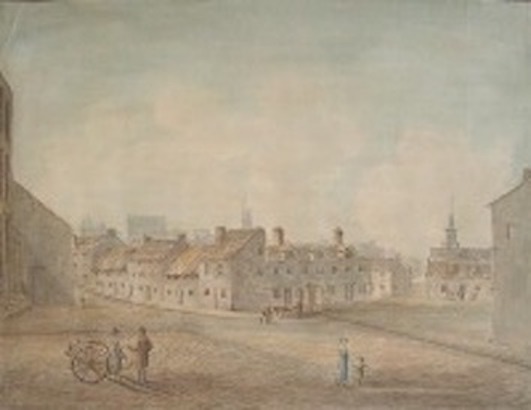
This 1810 painting shows Stonewell as still surprisingly rustic, unpaved, with thatched houses, decades after much of the town had been rebuilt in fine Georgian style on West Indies’ profits. [Letter 25]
By 1905 the pump and pond had gone, the area was paved – not with granite setts but with wooden blocks soaked in tar; when they were lifted in 1950s, many found their way into our cellar, where they made for a very cosy winter. The stream was a covered sewer, and pumpless Stonewell was the terminus of the horse-drawn tram service to Morecambe. St Nicholas Street had settled into a town centre street.
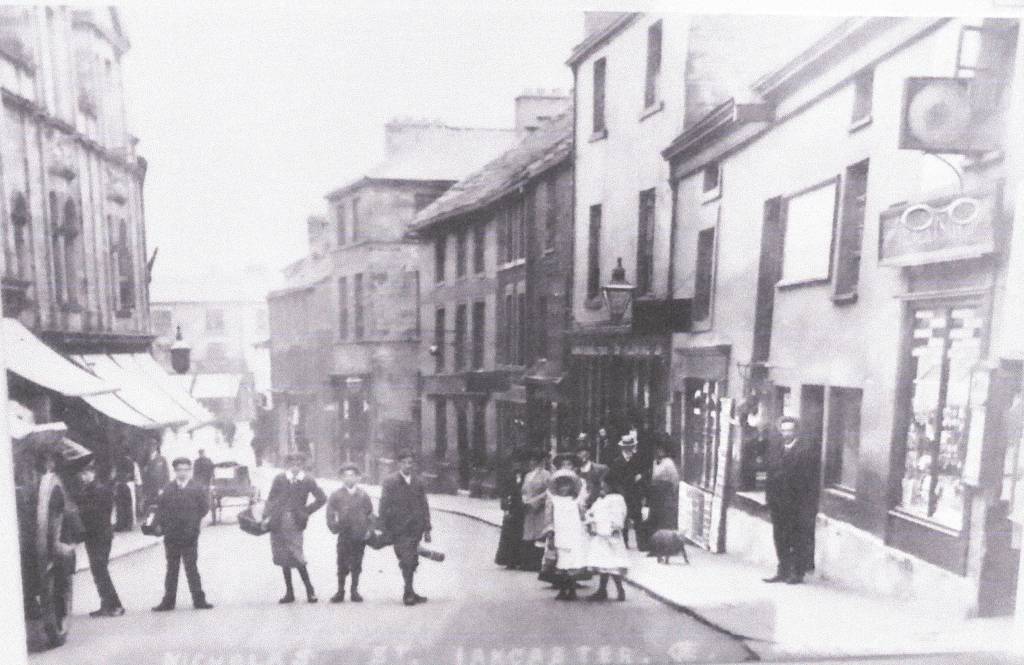

Little changed in the street from 1905 to 1960: The Golden Ball and Boar’s Head pubs remained, as did the Unitarian chapel, Galbraith’s ironmongers, the chemist, two hairdressers, two newsagents, Gorrill’s drapers, a clog maker, and a tripe shop – not ours. The corn merchant had become a pet shop, the hosier was now a haberdasher, the chippie was a fresh fish shop. And our tripe shop had arrived. Or had been left out of the Directory, number 25 one of only two shops absent from its listings. So little record of our house and shop!
From age 3 to 15, St Nicholas Street was my world.
Marbles (“alleys”) on grids between grumbling feet, eyes down for dropped coins and discarded Turf packets, paper boats in the gutter plunging to Australia, running out nimbly between heavy-shod hooves to collect soft droppings, the peaceful flutter and coo of racing pigeons in eight-high wicker panniers on their way to the station, next door for a haircut, Brilliantine smell, razor stropped for a single terrifying nick above each ear, men’s overheard conversations, ‘something for the weekend, sir?’, next door-but-one, tinkling bell, bacon smell, Mr Cornthwaite emerging dabbing his chin, George Gambol to his wife’s Gaye, cigarettes for our parents, my brother’s and my comics, Beano and Dandy, then Lion and Tiger, then, as we grew, Wizard and Rover. Then he onto Disc, me to Eagle, the parting of the ways. Floral and polish smells in the dark drapers’ opposite, wading in an agony of self-consciousness across the parquet floor under the shop girls’ X-ray gaze, a clutched button, ‘four of these, please’, running errands, always running, eager, past greengrocer boiling beetroot, grocer roasting coffee, to the warm bread smells, soft white loaf and the promise of thick slices. Helping in the shop after closing time at six, counting the coins into piles of fours, tens, twelves and twenties, an army arranged in battalions; standing on the marble slab, cleaning the window in the evening sun that poured in from the empty street filling me with light, my semaphore arm signalling the far off. Out, into the empty town, all life departed, the town mine to possess, still photographs outside the cinemas, every plate-glass shop window the entrance to an imagined world, a world of imagination. Each component in the bike shop window transferred onto my bike, and I am Fausto Coppi, Il Campionissimo. Mannequins to fall in love with and sweep away as in Hollywood movies. Cyril Washbrook bat, carried through the innings, the match saved. And then, a couple of years later, the linseed oil transferred magically to paint as I entered the Art School for the first time.

And yet by fifteen I was modern, imagination squashed under information, my wandering chained to a student desk. So that when the plan was announced to demolish our street for a shopping centre, my new self approved of the redevelopment, the necessary car park, the smart shops above in a pedestrian area, chains replacing local, progress, the modern way. From Ashfield Avenue, where we moved to, I didn’t notice the demolition, the digging down through hundreds, thousands of years of history, to the bed rock, the erasure, then the building in breeze-block, veneered with artificial stone, of ‘St Nicholas’ Arcade’, later, ‘St Nic’s’.
“Don’t it always seem to go that you don’t know what you’ve got till it’s gone …?”
Thanks to Darren Webster for information on the origin of St Nicholas Street.
 my writing