p 38
On the overnight train down the length of Italy we take down the luggage and Simon and I use the netting racks as hammocks, leaving more sleeping space for the others. I look down at Jacks sleeping, sprawled and open-mouthed, then I’m rocked to sleep.
I wake to a red dawn, the air already hot, peep out at a bleached, parched worn-out landscape, dusty and blurred, with none of the measured order of Provence. I’m much further south, pushing deep into the Mediterranean world. I imagine Hannibal marching his army back and forth across this landscape, for fifteen years, not daring to attack Rome itself, unable to provoke them into attacking him, winning every battle but losing the war, because Rome simply refused to acknowledge defeat. A red dust, carried by a hot wind, coats us as we struggle into the second day.
There is little relief at Brindisi, an oven of a port town. There is a mosaic of the Cretan labyrinth, complete with Minotaur. A column marking the beginning of the Appian Way. And a monument to Virgil, who died here on his way back from Athens.
Brundisium was Rome’s main port on “The Superior Sea,” their gateway to the Greek world, their Staten Island, sucking in slaves and tribute, as well as ideas, art, thinkers, a whole culture. From here, having learned what they wanted, they sent out their colonizing armies to possess.
It was connected to Rome by “the Queen of Long Roads,” the Appian Way, along the narrow, paved surface of which carts rumbled, soldiers marched, travellers rode. From 71BC they would have passed, for the 132 miles from Capua to Rome (six, seven days’ journey? On a road six feet wide), a crucified man every forty yards, the 6,000 survivors of Spartacus’ army, nailed up alive, dying, dead, left until they rotted off from around the nails, fell. Welcome to Rome.
p40
“Somewhere between Calabria and Corfu the blue really begins.” The first line of Prospero’s Cell.
“For three years we waited for the angel messenger.” The first line of Seferis’ Complete Poems.
Three years waiting. As I have waited three years to get to Greece. But no longer waiting. Almost there.
For now I’m standing at the bow of the white ship, at one with the keel that cuts a path into the trackless sea, heading into the realm of the first seed, so that the story of my life can begin, again. Ahead is untouched possibility. Behind is our churned wake, widening like a comet’s tail, turned to gold by the sun setting in Italy.
The next morning, after an uncomfortable night tipped back in an aircraft seat, I’m up on deck early as we approach Corfu. Jacks, after a noisy night at the bar, slumbers on below. The Italian sailors, in Persil-white uniforms, down-to-earth, boyish, are sluicing down the deck, the water glittering in the early sun, shimmying as they work to a tinny transistor radio, “Volare, oh, oh, Cantare, oh, oh, oh, oh,” splashing each other, grinning at me, sharing cigarettes, then they’re gone, leaving a washed emptiness.
Alone on deck, the sky monumental. Ahead is Albania, shockingly big and close, its mountains massive and purple against the dawn sky. I imagine Chinese soldiers with inscrutable faces watching me through military binoculars. I wave. And duck.
At the foot of the mountains, Corfu. For Odysseus, “a shield laid on the misty sea,” its boss Mount Pantocrator: the Greek for the boss of a shield is omphalos. My first sight of Greece is an omphalos, a navel.
This is where Odysseus reentered time after his release from Kalypso’s realm. Having spurned immortality, he returned to the world of men, to resume his place there, to win his name. There are the rocks on which, raft wrecked, he clung, from which he was torn, the skin tearing from his hands. Down this, west coast is the bay where, saved by the veil of the sea nymph (the White Goddess), he was thrown ashore, with only the veil to cover his nakedness. His first action was to return the veil to the sea, his farewell to the faery realm and, naked, live then by his wits in the new world of the Phaeacians.
I too am entering a new world.
As I cross the sacred threshold, I remember, also from Prospero’s Cell: “other countries may offer discoveries in manners or love or landscape; Greece offers something harder – the discovery of the self.”;
“Marvellous things happen to one in Greece, marvellous good things which happen nowhere else on earth.”
The ship heads straight for Albania, then, the purple mountains looming dark above us, casting us in shadow, turns sharp right and coasts south through the turbulent water of the narrow straight, hardly a mile wide, between dark mainland and the island that is now illuminated by the just-risen sun.
The rosy dawn vibrates as if with music almost heard. The air contains the promise of unprecedented heat. Everything is in perfect detail. I see and experience it in a light that is not just transparent, but a lens that intensifies the clarity. Durrell called it a dark crystal; for me it is a flawless diamond.
How to describe it, this light that makes every object immediate, individual, a light that I am inside and is inside me?
I look as we pass clean ochre planes and curves, exclamation mark cypresses, gnarled lavender-and-silver olives, pink bays, headlands cut by white-frilled water, single white houses. Perched high up there is the cottage in which Durrell threw aside Huxley’s comedies of manners, embraced Tropic of Cancer, and wrote his way out of the English disease with The Black Book. On that beach Miller idled away the first weeks of the war, in Olympian detachment and Taoist revelation (the revelation?: that there is no revelation). Miller and Durrell, two lifebelts in the sea of chaos that engulfed me after Melanie. The bleating of a goat, water splashing, a man singing. I ache for someone to be beside me, now, to be telling this to, to be sharing it with. I give thanks that I am alone, experiencing this in my single self.
The ship enters the wide, curved bay, eases towards the quayside of Corfu town. An attractive place, Venetian, with French and English corrections, Greek dilapidations, pastel, glowing pink and clear in the early light, its washed streets, open cafés, mysterious alleys inviting, seductive.
As the fun-seekers prepare to disembark, I remember:
This sickle-shaped island is the instrument with which Kronos cut off his father’s testicles;
This is where Jason the argonaut and Medea the witch, niece of Circe, consummated their relationship (lying on the golden fleece), an act that brought the witch into the Greek world;
Here is where Odysseus resisted being tempted from his destiny by Nausicaa and the pleasure-loving Phaeacians;
This is Prospero’s island, a place of magic and spell, that Shakespeare had him return to the witch Sycorax at the Baconian moment when the age of magic gave way to the age of science, and Prospero himself stepped through into the brave new world.
Several disembark, are met by nut-brown men with straw-hatted donkeys, enter the pastel dream.
But this place is too complicated and voluptuous for me; I’m seeking something harder and simpler and more difficult.
As we leave the bay we pass Mouse Island, the Phaeacian ship that, as it returned from taking Odysseus to Ithaka, was turned to stone by ever-vengeful Poseidon. Remember the power of the gods.
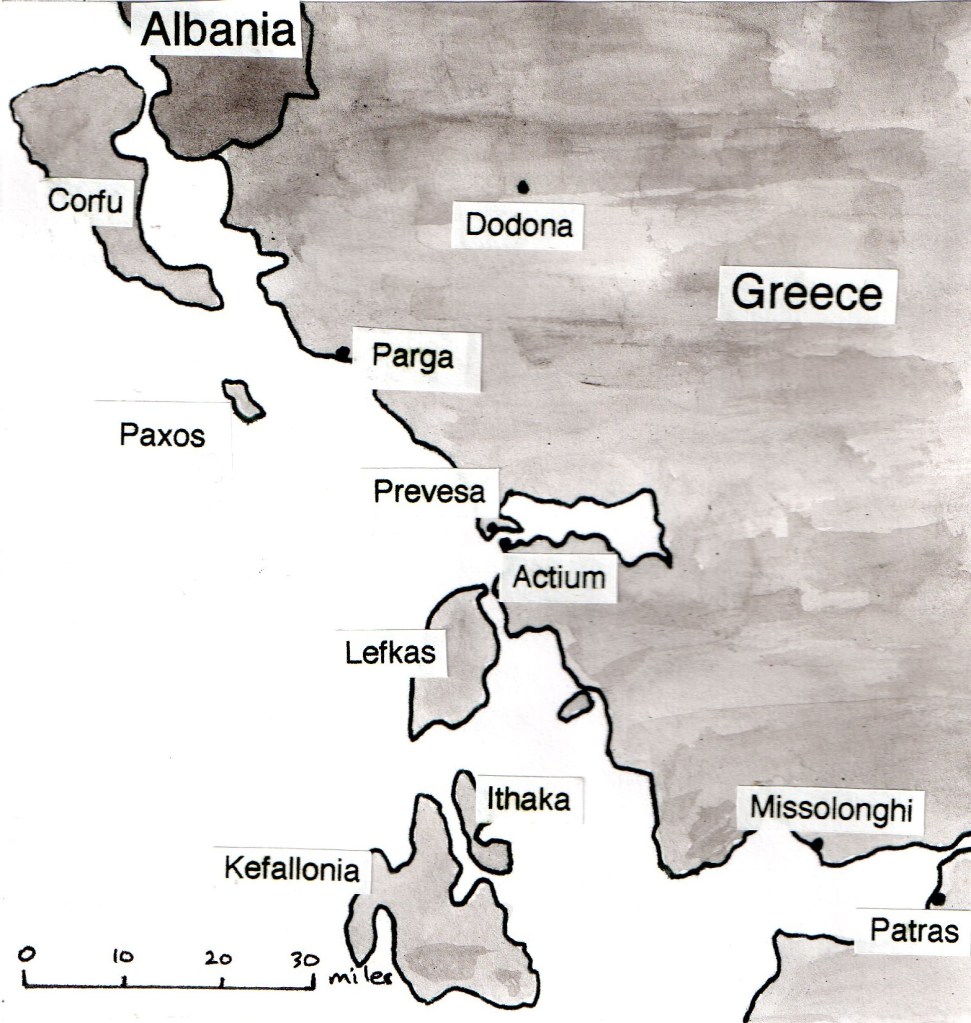
Coasting south in the intensifying, brightening light, dazzling, I put on sunglasses. At last. Thirty miles over that hill is Dodona, the oldest oracle in Greece, where the gods were first named, and Zeus’ responses came in the sounds made by the breeze in the “spelling leaves” hanging in the sacred oak, read by “interpreters with unwashed feet.” It sounds like an African village. I need to remember how primitive was ancient Greece.
Passing Paxos. Plutarch records a voice crying to a passing ship, “Thammuz, great Pan is dead!” (on board was an Egyptian named Thammuz), followed by cries of lamentation. Plutarch’s account was taken up by Christian exegetes in Rome as marking the moment paganism capitulated at Jesus’ birth. But a neat alternative translation by Graves, “All-great Thammuz is dead!” (pan = all) converts it to the ritual cry of lamentation at the annual death of a nature god, heard from the ship but not aimed at it at all. Pausanias a century later reports that the worship and celebration of Pan was alive and well throughout Greece. I’ll take it as yet another highly successful piece of Christian manipulation and propaganda. The pagan lives on.
A presence by my side, Strawson.
He puffs on his pipe, carefully downwind. His face is shaded by his well-worn Tilly hat, there are lines crinkled around his eyes, his blue eyes look keenly, absorbing, the eyes of one returning, soaking up and soaking in the familiar, home, a smile. Or maybe just the clench of his teeth on his pipe. He points with his pipe over his shoulder: ‘Your friend Jacks seems to be having fun.’ I look.
The ship has been transformed, from an overnight ferry with cocooned figures, to a white Adriatic cruise ship with deck life, a pool, loungers, a bar. There is Jacks, again the party girl, splashing in the pool, stretching out in the sun, drinking and laughing at the bar. She absorbs the ambience of the situation she’s in, is absorbed by it, takes on its colour and mood, responds fully to those she’s with. Which flatters, and may mislead, them, me. Is easily carried away? But I notice that, even as she balances on the shoulders of a brawny youth, pitches shrieking into the water, she glances across, locates me. Strawson, looking ahead, puffing, says:
‘Cold blooded – in the biological sense. Not the other sense, I imagine?’
‘I really wouldn’t know.’
No, no.’ Silence. Puff, puff. Says:
‘Voices. So many voices. A confusion of voices, like the bat-twittering of the shades – which one to give the blood to? Crucial, to find your voice, in Greece.’ Another pause.
‘There’s an entrance to the other world, over there,’ pipe points across the blue sea to the ochre land, ‘just beyond Parga. You go down into the dark, the chthonic world, you confront death, you return to the light, this life, with a word, or at least, reconciled. The Palaeolithics did it, of course, and right through to the Eleusinian Mysteries. The Enlightenment – “more light!” – science, deprived us of it metaphysically, then physically. Maybe, as humans deprived of sleep lose their minds, we, without the dark, are in the process of losing our souls?’ Puff, puff, then turning to me:
‘ Don’t just enjoy the light in Greece. Seek the dark away from the light, and the dark within the light, that’s there, like that dark edge of the sun when you glance at it.’ He squints up then drops his face back into the green shade.
‘Entering Greece this way, it’s like a babble of radio stations. Only when I get to the Aegean can I tune into the one voice, and then, into the silence. Here, I spin the dial – and it is enlivening, but confusing.
‘What words of assurance and fidelity did Cleopatra whisper to Antony on Paxos the night before the battle at Actium? What voice did he listen to when he saw her squadron break away, and instead of continuing to fight, abandoned the battle, his empire, to follow her to Alexandria? And there, did he really, as Cavafy has it, hear Dionysos and his celebrants leave the city, abandoning him. And in the unbearable silence, kill himself?
‘What silence engulfed Karyotakis on that day in 1928, in that bleak little town?’ pointing at Prevesa. ‘The finest poet of his generation, exiled from his beloved Athens to a stifling bureaucratic post. He lasted a month, one Sunday too many of listening to the garrison band play out of tune, and walking up and down the quay, asking “do I exist?” and hearing no answering voice, shot himself.
‘What voice sent Sappho, “violet-haired, pure, honey-smiling” Sappho, plunging from that headland?’ pointing to Lefkas. ‘Surely not love for some hunk of a ferryman. Perhaps, like Empedocles at Etna, the voice of immortality, the summoning realm beyond, the direct stepping across? Real or delusion? Only she knows.
‘And of course the noisiest voice on the coast, our own Lord George Byron.
‘He passed this way twice. The first time as a new graduate, on his version of the grand tour, dressed in a red uniform and accompanied by a baggage train and armed guards, peeved that he could find no one to mend his umbrella, composing Childe Harold’s Pilgrimage as he went. Admiring the brigandish locals. Less sure of the Pasha’s lust for his plump white English body, and his penchant for nailing up the quartered remains of patriots he’d tortured to death.
‘But when he returned fourteen years later, sadder and wiser, “For we’ll go no more a roving …”, the voice he heard was no longer the Muse of Poetry, but the Call of Liberty. He was here to fight.
‘On Ithaka he expressed contempt for “antiquarian twaddle,” grown weary of his art and his fame. “Do people think I come to Greece to scribble more nonsense?” he says. “I will show I can do something better. I wish I had never written a line, for having it cast in my face at every turn.” He saw Ithaka, this last time, with a poignant tenderness. Not as place of past heroic deeds, but as a possible present place to live, should he survive. “If this isle was mine – I would break my staff and bury my book,” echoing Prospero. Dead within a year, in the “dismal swamp” of Missolonghi, not in battle but of fever and bloodletting, clutching his Mycenaean bronze helmet, crying “Forward! Forward! Follow my example! Don’t be afraid!” We could do worse.
‘This voice in Childe Harold:
“Fair Greece! Sad relic of departed worth!
Immortal, though no more; though fallen, great!
Who now shall lead thy scatter’d children forth,
And long accustomed bondage uncreate?”
‘And when you’re in Athens, looking at the cell in which Socrates died, tut tutting at their barbarism, remember that within a block is the secret police headquarters with its cells in which freedom fighters and political prisoners are at this moment, now, being tortured, their voices, unlike Socrates’, unheard by the world, unrecorded. Sometimes the voices of the present are the hardest to hear, the easiest to ignore.’
The cut of the bow wave, splashes from the pool.
I’ve listened spellbound, the privileged neophyte, to these stories from an old Greece hand, as islands and mainland places have appeared, approached, passed, been left behind.
Now, in the silence, as evening begins to gather, I have a sudden sense that, not only has he been telling me something, I have been overhearing a man in dialogue with himself, approaching, as he enters Greece yet again, a decision point.
I turn to ask him. But he’s not there, he’s gone. Perhaps he is that sea-hawk, skimming the waves, there, there, gone.
Ithaka. Pray that the road is long. A day coasting between mainland and islands, Odysseus’ route home.
But Odysseus was asleep, wanting only to be there. I’ve been all attention.
His island, dusky mauve against the descending sun, his return to his own world, where his strength and guile will be tested to the limit, where he will arrive home. Byron left here regretfully but defiantly, seeking a warrior’s end. Karyotakis completed the pact he made with autumn, “Let us die together.” Sappho plunged into oblivion, but left her poems, her name. Prospero drowned his book deeper than did any plummet sound, and returned to the everyday world after his foray into mage-dom. Dylan, weary of having his lines quoted at him, held up in his face at every turn, took off his Bob Dylan mask, sang “I’m not there, I’m gone,” broke his staff, and arrived home in Woodstock, in family life. And Jacks walked out of art, into life, leaping Splash! into the pool, a white plume, a bigger splash, now.
Brilliant blue gives way to dusty pink, the lights on the ship go on, the pool is covered, the land fades into night, marked only by pinpricks of light, the air stays warm.
As we enter Patras harbour and I am about to set foot for the first time on Greek soil (well, concrete), I wonder if my day has been wasted in antiquarian twaddle, if I would have been better occupied in having fun, working on my tan.
Jacks comes up, stands quietly beside me, slips her arm into mine, looking across at the catenaries of bare white bulbs, the lit cafés, Greek cafés, says, ‘you look as if you’ve had a good day.’
Note : read the whole of Dionysos’ Island in the drop-down menu, MY BOOKS.
 my writing