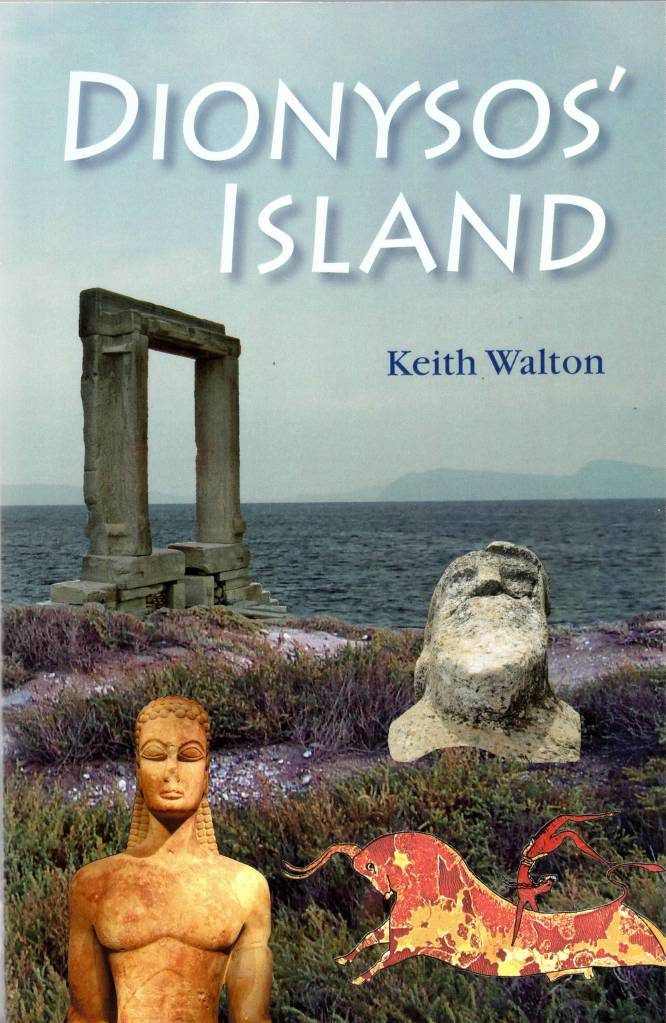
Set in 1971, two young men, dissatisfied with their lives, head for Greece on the long land and sea journey.
Richard, recovering after a traumatic affair with a student revolutionary, is hoping to recuperate in its classical calm and sun-filled clarity, while Simon seeks to empty himself in mountain walking.
For Richard, memories on the long journey by train and boat, and encounters with edgy, inspired artist Jacks, and knowledgable and mysterious Strawson, force him to continue questioning.
Simon travels to Crete, where he encounters a community reviving the Minoan ways and the spirit of Atlantis.
Richard’s time on an idyllic Cycladic island restores his equilibrium, but then chance – or is it fate? – takes him to Dionysos’ island, where a series of ever more extreme encounters with the art and deities of Greece’s past, surfacing in the present, bring him at last face to face with what he has been fleeing all along, and the question: are you ready to change your life?
This story of two young men’s first journeys into the Greek world, past and present, its landscape and literature, ideas and art, it affirms Lawrence Durrell’s: ‘Other countries may offer you discoveries in manners or lore or landscape; Greece offers you something harder – the discovery of yourself.’
AUTHOR’S INTRODUCTION
The details of Richard’s disappearance filtered through to me slowly. Or perhaps I filtered them slowly. I had lost touch, ceased to keep in touch with him several years before, having run out of patience with his lack of focus, his failure to get on. When getting on, one needs the company of those who are getting on. And one needs to leave people behind.
He was last seen on Millennium night, as midnight struck, AD2000:01:01, 00:00:01 second, 02 seconds, 03 seconds…, swimming out towards Durdle Door, an arch of rock fifty yards from the Dorset shore. He was seen by chance by a bivouacking fisherman, who happened to peep out of his little tent, pitched on the shingle, as a few desultory fireworks crackled over Lulworth, illuminating briefly the swimming figure. The sea was busy but not stormy, the fisherman reported, and the man was still swimming strongly when he zipped up his tent and returned to his radio and beer.
And that brought him back to me so clearly. For it was somehow characteristic of Richard, this dramatic even melodramatic act. Calculated, and yet observed only by accident. His head bobbing through the waves, disappearing into the dark. The secret exhibitionist. He’s not there, he’s gone. Disappearing. Into death? Into a carefully-prepared new life? Taking an unconsidered step into the unknown? I had no idea.
That might have been how it rested. He would have come to mind sometimes in quiet, evening moments, alone or with old friends. But gradually he would have faded. Yet another of the unresolveds of one’s life.
Then the box marked “GREECE 1966 – 1999” arrived.
It came from a solicitor in Shaftesbury, with a note from Richard asking me to do what I could or would with it. “I’m sure there’s a book in there. But as you know I’m not very good at finishing things. And anyway I’m too close, it needs distance. And perhaps I’ve actually done with it? It’d be your book, your copyright, ‘I renounce all rights’ etc. It would be unfair to say I’m counting on you. I’m counting on you.”
There was a lot of it, I was busy, I put it aside, “The Unexamined File”.
When at last I opened the box, I was plunged into several worlds simultaneously that threw my well-ordered life into disarray, and set me on a task that would take far longer than I’d expected.
There were photographs, the earliest clear black and white, and then fading colour. How young we looked, so full of sap, insouciant, ready for anything. Girls I’d never known, one especially, hauntingly beautiful.
There were illustrations, sketches and maps. Maps of real, and invented, worlds, (a Greek carte du tendre, a sudden memory of Moustaki, ‘avec sa guele de pâtre Grec’, le méteque, the metic, the accepted stranger … enough.)
There were layouts and flow charts with circled words, connected by lines and arrows multiplied to illegibility.
Pages of diary entries, beginning in his round, schoolboyish, certain hand (in fountain pen, permanent blue-black ink, his favourite an Osmiroid 65 with interchangeable nibs, bought in Boots … enough). Through looser, more agitated writing, to word-processing printouts.
There were travel journals, short stories, paragraphs of fiction, notes and meditations on history, mythology, philosophy, pages of quotations ….
As I lifted out layer after layer, laid them out on the carpet around me, I was unpacking Richard’s relationship with Greece. Where had he gone?
At first I thought only an exhibition could do justice to the complexity and interconnectedness of the material. (Not unlike, I realized later with a smile, his “Project”.) But that would simply have displayed it. He had asked me to resolve it. To repack it not into a box, but into a book. For him? Or had he really ‘done with it’? Was there something in it for me? Might he reappear if the book came out? Late night questions in a silent night, suddenly missing him.
As I looked at, read through the material, I saw that Greece, its history, art and ideas, its landscape and people, its existence, the very idea of it, was something against which he measured himself. A home – like the home key in music – he could return to, and depart from. A source to drink at. An omphalos to reconnect with. As one of his characters says, ‘Greece isn’t so much a place I visit as a state of being I enter into. I go there to be there.’
He always went open-eyed, open-hearted, innocent. Although a student, he was more a fan. He never stayed long, never mastered the language, he was always the stranger in a strange land. But a land that was uncannily familiar. He was a very unGreek hero, more Parsifal than Perseus ….
But what to do with all this material? How to combine the story of a life with descriptions of places and expositions of myths, marry speculations on the development of religion and consciousness to encounters with disparate characters and strange utopian communities? A publisher asked, what is your market? A friend asked, who is it for?
When I, and Richard, first went to Greece, it was exotic and distant. And yet welcoming and familiar. We felt we’d ‘found ourselves,’ ‘arrived home’. However strange that home was. Aby Warburg wrote of the ‘mnemonic wave’ of the flow and ebb of the Greek presence in European life and thought. Richards’s work is preoccupied with that wave, its strangeness and familiarity, and how it clarifies and illuminates our world.
At one point Richard mocks himself for writing that, having given up his career, he ‘rented an empty corner shop in a poor part of the city, and set about finding myself.’ ‘Had I misplaced myself?’ he asks.
In fact his whole life was a search for himself. He kept coming back to a phrase of Pindar’s, ‘become who you are.’ The full line is, ‘having learnt who you are, become who you are.’ The learning occupied his life. Most of us ask: ‘what shall I do?’ He asked: ‘who am I?’
He slipped through the life of society, avoiding money, status, affiliation, attachments. Heroic individualism, or narcissistic irresponsibility? He once said, ‘I want to arrive at my death knowing how to live my life.’ ‘But your life will be over!’ I cried. He shrugged and smiled.
The Delphic gnothi seauton, ‘know thyself’, had three connotations for the ancients: know you are mortal, not as the gods; pay no attention to the multitude; reevaluate not the truth but established custom. He applied all three.
But ‘know thyself’ was supposed to be the beginning of life, not its end.
And yet he had such a rich inner life, in the hemisphere of the bicameral brain (I use Jaynes’ terms) once inhabited and now abandoned by the gods.
I don’t know.
I have used the form of the novel, folding and embedding as much of the disparate material I felt could be fitted into a coherent narrative of his first visit to Greece in 1971. And added end notes to expand upon, reference and, I hope, clarify. I have written it in the first person, from Richard’s point of view, so much have I identified with him in writing it.
It may seem odd that Simon’s story is inserted into the middle of Richard’s. It is there because it offers insights that illuminate Richard’s subsequent adventures. Also it establishes narrative strands that will be explored in a second volume, Odysseos’ Island, set in 1999, just before he disappeared.
p14. UNEXPECTED MEETING WITH PENNY
At eleven o’clock we’d close our books in unison with a slam, ‘shsh!’ from the disapproving reference-room librarian, grin and walk round – as I did that Saturday, back in my home town for the day, revisiting – to Stan’s coffee bar.
It was run by Jim. No one knew who Stan was. It was in a narrow street, up steep dark stairs. It had no juke box, but a record player and a pile of blues and jazz LPs, and maybe someone noodling on a guitar. Tepid coffee was served in shallow glass cups.
The pre-dip art school crowd would sit on that side, the sixth-form grammar school crowd on this. There’d be moans and catcalls back and forth at what the other side got played, but little connecting.
But Penny and I did connect, in our hesitant, demure way. Sometimes, when we were close, to provoke we’d sit on either side of the line and hold hands across it. Romeo and Juliet. The last time I’d seen Penny, in here, a couple of months before, when my Project was going well and I was high with it, she’d said, ‘next time, you’ll be sitting on this side.’ But the next time, this time – for, yes, there she was, smiling that ‘is this believable?’ smile – when she patted the seat on that side, I shook my head and sat down on this.
I’d known Penny since ‘O’ level. Art was my favourite class, but at ‘O’ level it clashed with Latin (Art a frivolity at my academic grammar school, and I needed Latin for Oxbridge Entrance), so I went to evening classes at the art school. I discovered charcoal and oil paint, the sensuous experience of handling them, fell in love with the smell of linseed oil. And experienced a different sort of education, encouraging creativity and developing self-expression. Liberating evenings at the art school, while I spent my days working my way through a curriculum. ‘Do you know what a “curriculum” is?’ she’d asked, eyes flashing, when I said she never seemed to settle to learning anything, was always darting from this to that. ‘It’s a racing chariot. And what you do is go round in circles, winning prizes and getting nowhere.’ It was a punning response, but in her eyes there was sadness that I was missing something important.
So, we inhabited different worlds, liked each other, would come upon each other when home from university and art college, sometimes almost get together (a New Year’s Eve party, an Easter walk along the river …), always just miss.
In the nine years my appearance had changed minimally – school blazer to tweed jacket to suede casual; grey flannels to rust cords to faded jeans; polished shoes to desert boots to coloured plimsolls; my hair half an inch longer each year. While she had gone through transformations. And changing not just her appearance and behaviour, even her character, but her nature.
So at sixteen she was an existentialist beat, dressed in black, singing Juliette Greco songs, into Artaud and Dubuffet, her paintings scumbled and dark, her boyfriend a depressive who’d failed as a poet in Paris and was now a journalist marooned on the local paper writing his own never-ending Howl.
Suddenly she was a dolly bird with a dandelion blond afro, in colourful and geometrical dresses and knee-length white boots, waving from a pop promoter’s E-type, taking objects and images from every source to put in large, bright, busy, fun collages.
Then another change, her hair long and red, her clothes swirling, in rich,
natural dyes, sandals, influences of folk art, especially Balkan in her clear, simple pictures, now with a bearded builder of gypsy caravans.
When I charged her with a pick-and-mix approach to art, disrespect in wrenching objects and images out of their contexts and relationships, she let fly, saying, no, she was resisting and subverting the art historians who compartmentalize art and arrange it into a simplistic chronological sequence of “great artists”:
‘Art is a spatial field, not a temporal sequence,’ she spat.
‘But where are you in all this?’ I demanded. She looked at me, as if trying to work out what I might understand, how to pitch her response, said patiently:
‘The self is a construct of the mind, a defence mechanism, a comforting sense of order and continuity. But to really learn, you have to enter, become, be. It isn’t about hooking ducks at the fair and putting them in a row, but about going into foreign places. Don’t stand on the shoulders of giants, follow the pearl fishers down. Dissolution precedes resolution. You have to stay out of your head. There’s only now. You’re a particle, and now is the wave you ride. Do what’s now, otherwise it’s not life, it’s recollection. We’re not Alice following the rabbit – we’re Alice and the rabbit, at the same time. It’s not easy.’
And it wasn’t easy. The last time I’d seen her, in here, those few months before, when I was high on my Project, she’d been grey, blurred, wretched, ground down by a lousy teaching job and all her work coming to nothing.
And now? Well. I was sitting beside, looking into, the sun-filled, smiling face of a woman, beautiful, clear, resolved. Her clothes, her style carried elements of the styles she’d adopted so single-mindedly, now mutually echoing, dynamically harmonizing, into her own, individual look. And her face, that for all its prettiness had always seemed provisional, changing with circumstance, had settled into a fine beauty. She had found herself.
She of course would have none of this:
‘The self is a construct of thought. If you act wholly, selflessly, you experience purely. And now I have so many of those experiences to call upon – and more all the time – that they arrive without getting tangled up in all that ‘self’ business. I am what I do. I have no inner life. The unexamined life is life itself,’ she laughed. Then, quietly: ‘And it isn’t easy.’ She looked at me keenly, as if trying to see what, if any, of this I understood, resumed:
‘I’m going to Cornwall. This is a last-day tour of my past. I know, revisiting isn’t me, is it? But this really is, goodbye to all that. Someone’s backing me. I’ve no idea if what I do is “art” – not even sure if art exists anymore. There’s just stuff and events. I do stuff. I make Patrick Heron lampshades, Barbara Hepworth ashtrays – this is a Peter Lanyon!’ pointing at her multicoloured dress. ‘They’re all one-offs, handmade. Does that make them art? What if someone else made them and I signed them? Or I did multiples? No idea.
‘But you, how’s the Project going? It sounded so exciting – the Fisher King, and all that! – you really must keep at it. Come to St Ives! Do it there! There’s a place next to mine, you could rent it for nothing, work in the bars in summer. Are you still singing, playing guitar? Life is stuff and events – I do events, too. We could work together, you’d be the word guy, we’d be The Chums, end of the pier. Of course we’d have to build a pier first. We could do that.’ All in a hectic torrent. To get a word in, I said:
Do you know what a pier is?’
‘A disappointed bridge,’ she replied. I was amazed, Mr Wilkins had told us that.
Who told you?’
‘No one,’ she said, adding pointedly, ‘I read the book. Bt it needn’t be. It could be a reaching into the as yet unexperienced ….’ Then:
‘I’m leaving tonight on the eleven o’clock coach. Amazing to see you. See you?’ and was gone.
Timing. What would I have done if this had happened a month before, before I’d started cramming to get a planning job? I’ve no idea. Not even a sensible question. Whatever, I was at the bus station just before eleven, but watching from the shadows.
Read the whole of Dionysos‘ Island in the drop-down menu, MY BOOKS.
 my writing