3am thoughts. The savage river dreams. Norse pirates. Theodulph’s oratory. The saint at the abbey. The Apocalypse. The first heretics burned at Orléans. Joan of Arc and visions. Max Jacob. The failure of la Méridienne verte, the success of letterboxes.
3 a.m. Writing, in the cold, unfamiliar light of my new, illuminating pen. The third time, recently, love struck me with the freshness and force, the spark of the first time we had set eyes on each other so many years before. Having lived our lives separately, differently in the years between, we arrived, just once, at the same time, the same place, the moment. Just once. Love struck.
And yet. How easy, at 3 a.m., alone in the shroud of my tent, with the faint whispering of the ever-flowing river, the occasional woodwind note of a night bird, a motorcycle accelerating across the bridge, the thrum as it crosses the end of the bridge onto the dead-straight road, heading north, or south, how easy for me to believe that I have got my life all wrong, that she, with investment in capital and family, with continuity and acceptance, had got it right, had chosen the responsible way. That I would be wrong to try (as I always try) to lead her away from the hearth, into the twilight world between fire and stars, between camp circle and forest. Rather, that I should forget myself and, amenable, slip into a place in that circle, fit in, warmed by the fire in front, with the firelight sparkling and enlivening the faces in the circle, the light and noise blanking out the solitude and silence behind …
And yet. We met after long and different lives, while living those different lives, drawn to each other eventually by their difference. Why this choice – either to join her circle, or to entice her out of it? Why not let be, so each can be themselves in their lives? Have faith in the compatibility of our unlikeness.
And remember my duty to the path I have chosen. ‘Breaking my staff’, ‘burying my book’, ‘abjuring rough magic’ etc., would be a betrayal of my life.
Perhaps, rather, it is time exactly to move forward, to deny myself all notions of ‘retirement’; to work more. The faith, once chosen, is an obligation.
I wake to a morning when I have no camp to break, no packing up to do, no destination to plan for. I have a day by the Loire. There are cycle paths the length of the river, over a hundred kilometres. Which way to go? Upstream, to the nineteenth-century technological marvel of the Briare aqueduct? Downstream, along the Loire of long history?
The thin man is leaving. I watched him arrive last night, leaning forward, looking neither left nor right, no eye contact, no word. All his movements are quick, impatient. Quickly, impatiently (how ‘things’ annoy him!) he rolls up his low dark tent, packs his few things into the coffin-like box on his bike. Quickly, impatiently he pushes his bike to the camp-site road, acknowledging no one. As if nothing, anywhere, is good enough, so he must move on. Or is there, just beyond that Concorde nose, that beard like the ram of a Greek trireme, that butting forehead, a destination, ever out of reach? He pushes off, cutting through like the bow of a ship, and the sea closes behind him, and he leaves no wake. An icebreaker, breaking a cold path through ice that freezes behind him. He’s gone.
I have become a mesh, through which some things pass, to which some things stick. Unsure any longer which is me. And not sure it matters.
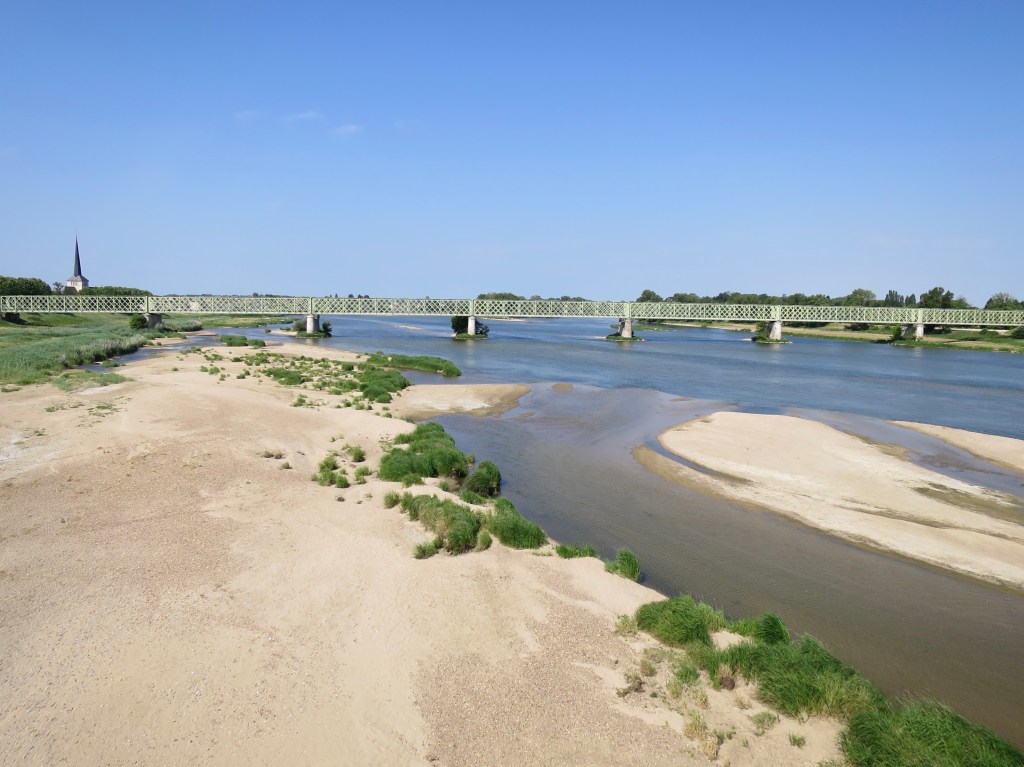
I find the cycle path and head west, downstream, the path weaving sometimes alongside and sometimes away from the river. It is a bright, hazy day, very calm. The river flows slowly, slowed by the friction of its alluvium bed. Or perhaps reluctantly, as if there is too much to explore among the sandbars and vegetation-covered islets, the coves and beaches, too much of interest to hurry. It is a curious river, a nosy river, nosing here, nosing there.
And a dreamy river, on this low-water June day, in the bright, hazy light of a big sky.
No wonder Guillaume de Lorris had his dream here, dwelt here in the garden of his imagination, wrote the four thousand lines of his dream “in which the whole art of love is contained”.
No wonder the French kings and nobles who built their châteaux along this river built them ever up and out, elaborating them, with complication and embellishment, endlessly, as if in a dream.
And yet so much French history happened here.
Châteauneuf-du-Loire has echoes, but only that, of the heyday of navigation, before the railways were built: a chain suspension bridge like the fallen one of Sully, high enough for the sails of boats, stone quaysides now tidy and deserted, fine traders’ riverfront houses, a museum of river navigation. I might cycle on to Orléans, where so much has happened. Instead I turn around and cycle back towards Sully: I have two destinations, which I want to visit, in order, travelling back upstream, first to Germigny-des-Prés.
The first fortifications on the river were built to resist the Norsemen, who rowed up in the ninth and tenth centuries, out of curiosity, and in a quest for booty. This was before they settled in Northern France and became the Normans. One of the places they destroyed, in 860, at Germigny-des-Prés was the grand palace of Theodulph, religious advisor to Charlemagne, and bishop of Orléans.
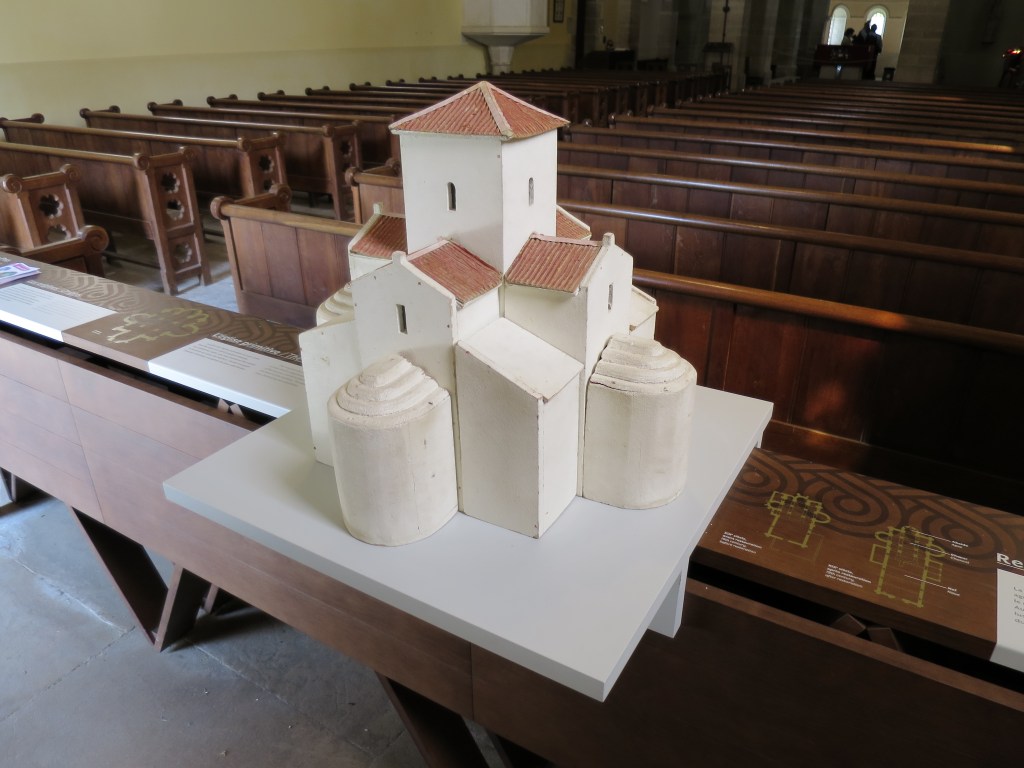
All that survives is Theodulph’s oratory, consecrated in 806. From the outside it is a modest building, square, with half-circle apses on each side, tiled pitched roofs, small windows, a central tower. It is domestic in scale. Or rather, private. It is unassuming, with no sense of making a statement.
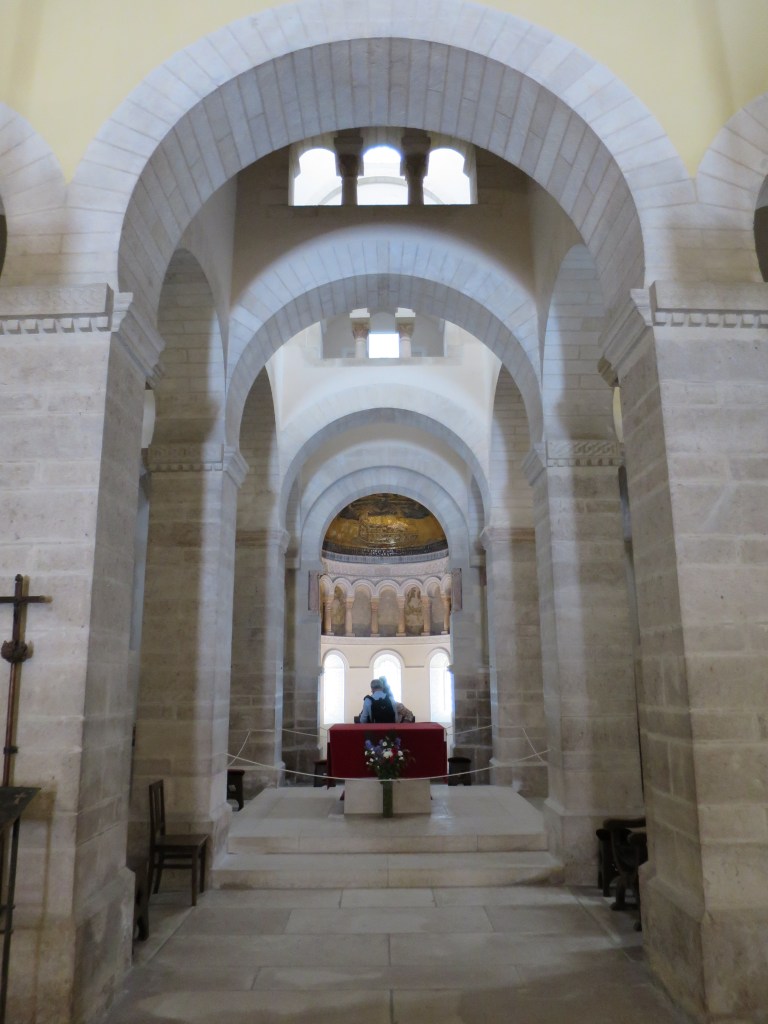
Inside it is made up of the simplest forms, of square and circle, pillar and round arch. And yet it has a great sense of unity, integrity, and intensity. Why is this?
The square is divided, by four pillars, into nine squares. And it rises up through three levels. It is, without being obviously so, a cube of nine. This evokes the celestial city as described in the Book of Revelation.
And the arches aren’t quite semicircles, but horseshoe-shaped, a form brought by Theodulph from his native Spain. As are the apses. And that slight pinching in, and the pattern of different-sized arches and slender pillars, ever changing as one moves, create tension, dynamism, even expectancy.
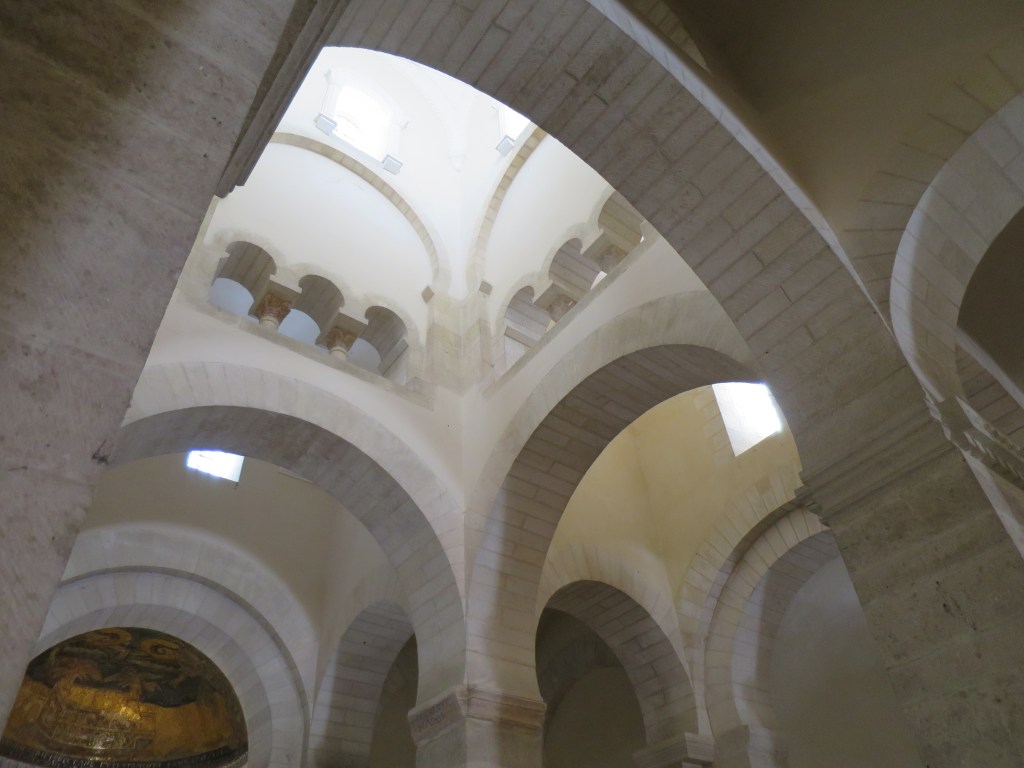
All the pattern and change swirls around an illuminated central stillness.
Under the tower is a simple, still, light-filled space, Turrell-like, where the white light is purified. This is the oratory, the private prayer space of the bishop.
His work, as spiritual head, depends on him intensifying the spirit within himself. This space is his spiritual accumulator. It is expressive of a vision of accumulation and intensification. Rather than, as I’ve met so often with the Gothic, of upreaching and aspiration. The light touches in benediction a bent head that is turned towards the inner light. Rather than shining in upraised eyes searching into the beyond.
From these forms, the Spanish and the Byzantine, influences from the south and east, developed what the French call Roman and we call Romanesque. It quickly became the standard church architecture, until the Gothic. And it expressed a different focus in Christianity.
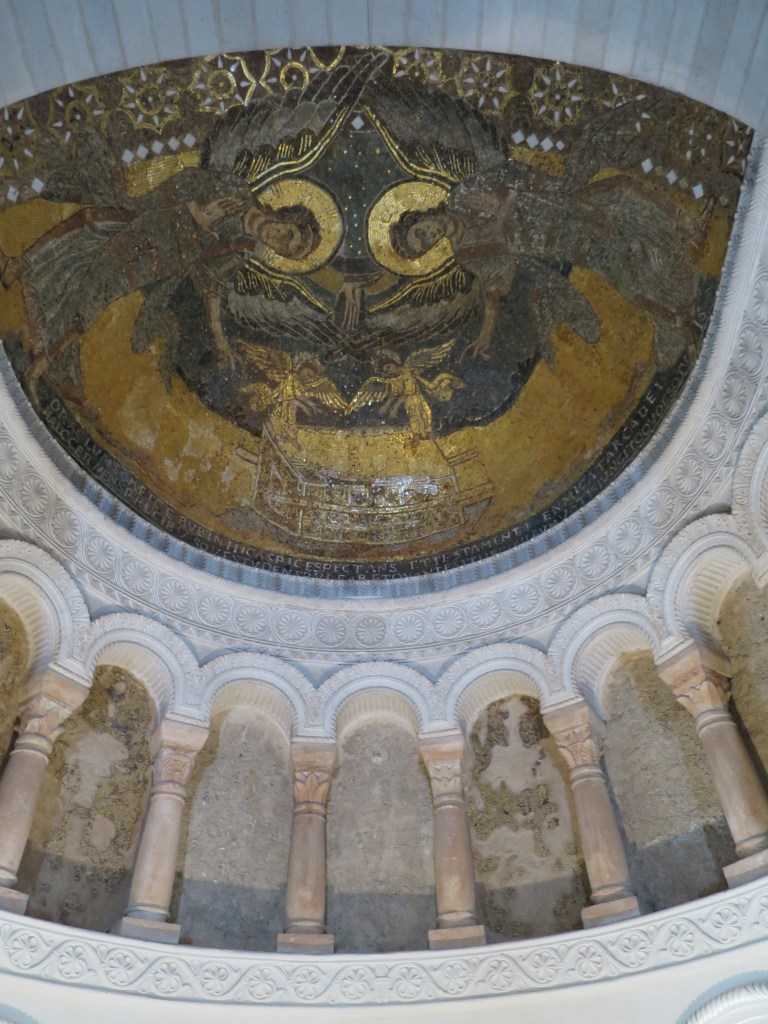
And so that he is not lost in abstraction, facing the bishop in his oratory, in the dome of the eastern apse, is a gold-rich mosaic. It is the only Byzantine mosaic in France.
Traditionally it would have been of the Virgin, with the Christ child on her knee. But the oratory was constructed during a period of Iconoclasm, when such images were prohibited. So it represents the Ark of the Covenant. The ark contains the manna, which was regarded as prefiguring the Virgin, flanked by two cherubim and two smaller angels. Not to be worshipped, as Theodulph makes clear in his writings, but as an aid to contemplation.
But, and this is weird, what I see, when I look at the mosaic from a distance, is first an ark and angels, but then the face of a horned and bearded devil, Satan. First one, haloed and winged cherubim and angels. Then the other, halos become horns, wings and angels a brutish snout. It is so clear, it must be obvious. Has no one else seen this? What is going on? I leave, scratching my head.
A little upstream, at St-Benoit-sur-Loire is the Abbey of Fleury. Theodulph was abbot here.
In 630, monks from Orléans founded at Fleury one of the first Benedictine abbeys in Gaul. Benedict’s abbey at Monte Cassino had been laid waste by Lombards in 580 and abandoned. In 672, intrepid monks from Fleury walked to Monte Cassino, found Benedict’s remains, and brought them to Fleury, which became the primary centre from which Benedictine principles spread. Both the Cistercians and Cluniacs adopted the Rule of St Benedict:
This abbey is the root from which the monasticism of the eleventh century grew and flowered.
Benedict’s bones were interred in the crypt, the foundation stone placed upon him, and with him at its centre the church was built up from him. All rests on him, all converges on him, all grows from him.
In 1020 Abbot Gauzlin built a monumental tower here, “to serve as an example to the whole of Gaul”: it was an evocation, in architecture, of the celestial city, the new Jerusalem, as described in Chapter 21 of the Book of Revelation.
It is time, at this church 2km from the Green Meridian that was intended to commemorate the second millennium, to go back to the first Millennium, the year 1000.
Michelet writes: “It was the universal belief in the Middle Ages that the world was to come to an end in the year One Thousand AD.” People waited for the end. And when it didn’t come, “by the coming of the third year after the year 1000, churches and buildings nearly everywhere were again being built, especially in Italy and Gaul … It was as if the very world was shaking itself free of its decrepitude and everywhere put on a white mantle of churches.”
This is an often-quoted passage from the eleventh-century Benedictine monk and scholar, Rudolfus Glaber. More careful research has shown both these statements to be exaggerated, and that those predicting, and believing in the imminent end of the world were a minority. Albeit a noisy one. Abbon, the abbot of Fleury before Gauzlin, tells of having heard a preacher in Paris talking thus in the 950s, and that such ideas were circulating in the 970s. They faded as 1000AD passed.
But it clearly bothered Gauzlin enough to build his tower in 1020 (another favoured date for the apocalypse was 1033) “as an example to the whole of Gaul” of what can come after. For what follows the Apocalypse, and the defeat of Satan is, as John writes, “a new heaven and a new earth … the holy city, new Jerusalem, coming down out of heaven from God.”
And what survived 1000AD was a newly-persistent idea: millenarianism. Cohn, in The Pursuit of the Millennium, describes it as “a group’s belief in a terrestrial, imminent, total and miraculous change that results in salvation for the members of the group.” It was a commonplace when I worked in Watkins esoteric bookshop in the 1970s, from the Age of Aquarius, to the Mayan ‘End of Time’ of 2013.
It vibrates north up the Meridian to Paris and beyond in Dan Brown’s The Da Vinci Code, south to the mystery of Rennes-le-Château and Pic de Bugarach.
It echoes in Utopianism, its post-religion, secular version.
It underlay my belief in ‘the new world’ that I would help to build as a socialistic town planner in the post-war welfare state consensus.
And when that fell apart, my embracing of a News from Nowhere ‘salvation’, that would come from a handwork-based life focussed on rural self-sufficiency.
Perhaps the Green Meridian was a last, faint echo.
Or maybe an example of revivalism that had no traction, that failed to ‘take’ …
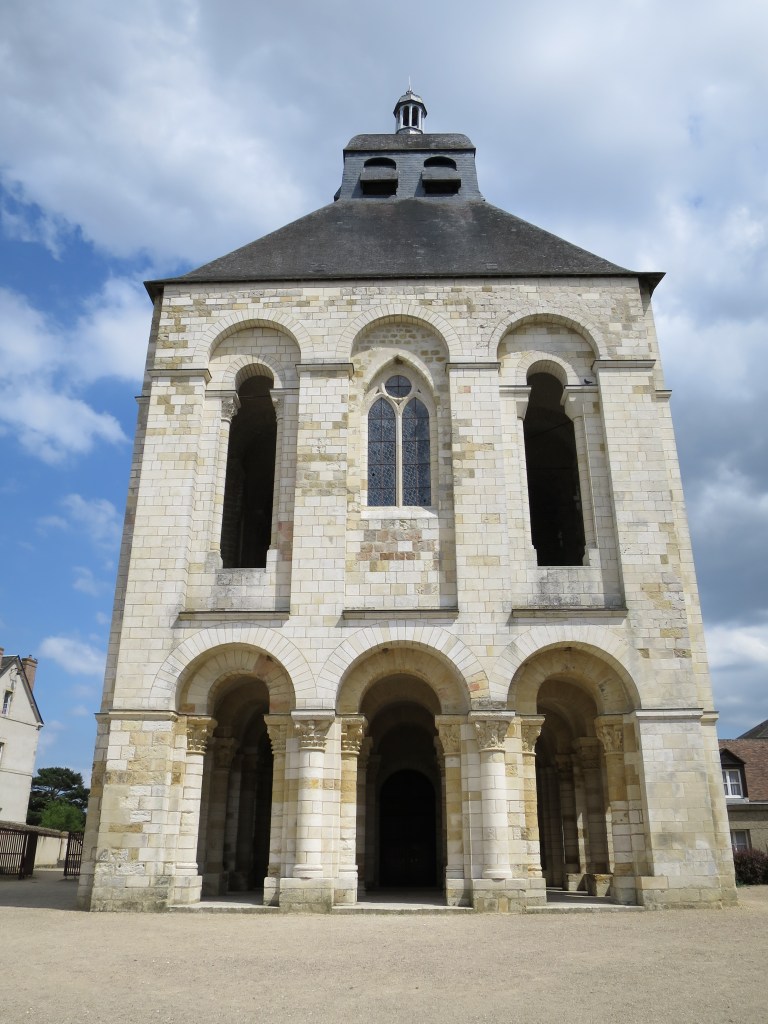
Abbot Gauzlin’s Porch-Tower is his contribution to the millennium, and is still standing in front of the abbey.
It is a remarkable and very attractive building. The four pillars at the centre divide the space into nine squares, referencing Theodulph’s Oratory, and evoking the celestial city, the new Jerusalem, which “forms a square, its length and breadth and height being equal. It has twelve doors, three to the east, three to the north, three to the south, and three to the west, and they are never closed since this place knows neither day nor night …”
The capitals illustrate the Book of Revelation, with Christ in glory, the book with seven seals, the four horsemen of the Apocalypse, and more.
Thus, at the turning of the millennium, he gave hope. It echoes Theodulph’s Oratory, also a cube of nine. And, too, I can’t shake from my mind the image, in the Oratory, of the mosaic in which I saw both angels with the Ark, and a horned Satan. Who, in Revelation 20, is “let loose from his dungeon … to seduce the nations in the four quarters of the earth” …
For what arose at the same time as millenarianism was heresy. Or rather the idea of heresy. Which was, of course, the work of Satan.
Books have been written about the extent, even the existence of heresy in the period from 1000. I will look at this when I reach the Cathar lands. Enough to say that in 1022, just two years after he began his tower of the New Jerusalem, Gauzlin convicted 14 canons of Orléans cathedral of heresy, and had them burned alive. They were the first executions of heretics since Roman times.
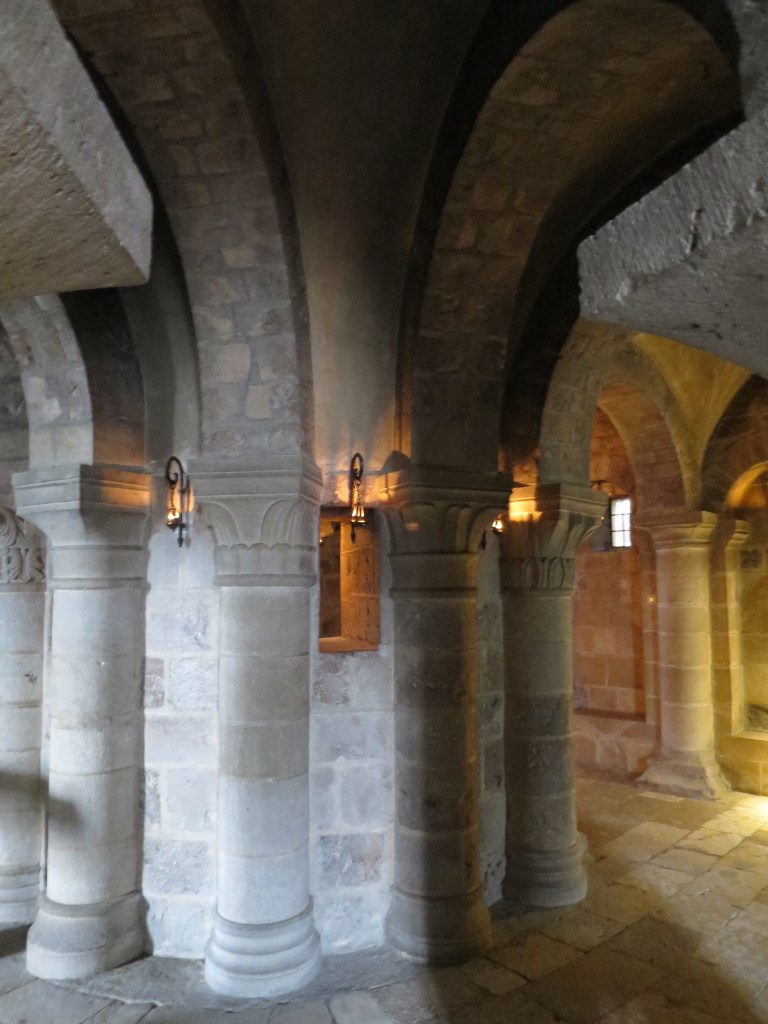
After which I enter the church. It is a fine church, and I can imagine the life spiritual growing up, like stems from a root, from Benedict. Pillars sprout and arch in sprays of masonry up from his bones in the crypt, the upgushing of a spiritual fountain. And the church (The Church) rests upon the foundation of his bones
It was much visited by churchmen, including the pope, the king, and Bernard of Clairvaux in 1130. After the abbey was closed down in 1790, the church was saved by becoming a parish church. The monastic tradition was maintained by having a priest who was secretly a Benedictine monk (shades of Dan Brown!). In 1865 a group of monks came to maintain the presence near the saint. Full monastic life was restored in 1944. The monks perform the offices six times a day.
In this quiet space, I notice two plaques on the wall.
One records a visit here by the dauphin with Joan of Arc in June 1429, when Charles, seeing how tired Joan was, suggested she rest. To which Joan, in tears, replied that she would not rest until Charles was anointed king at Reims.
The Loire was the front line in the Hundred Years’ War (1337–1453), with the English army pouring south. Following defeat after defeat, the last French bastion on the north bank was Orléans. Joan, an illiterate peasant girl of seventeen, after visions of saints told her to drive out the English, had made her way from her home in Burgundy (allies of the English) to the dauphin at Chinon, got into his presence, and persuaded him to let her take part in the relief of Orléans. The breaking of the siege coincided with Joan’s arrival in the field, and was hailed as her triumph. It was the turning point of the war. Within two months she was at the dauphin’s side at his coronation at Reims. Thereafter she helped at the siege of Paris, but was captured when attacking the Burgundians at Compiègne. They sold her to the English.
The English, in their stronghold of Rouen, arranged for compliant French clergy to try her for heresy, declaring the visions diabolical and condemning her. She saved herself by recanting. So, the church required a second conviction. It found her guilty of cross-dressing (when in fact she only wore men’s clothes in circumstances that the church allowed, for example to deter rape). The records of the trial show that she handled herself with remarkable self-possession and acuity. She was burnt at the stake by the English, aged nineteen, her bones reduced to ashes and dumped in the river – or rather, dissolved in the very water of France. It is one of those stories beyond the power of invention.
But, what are visions?
Rationalist science treats them – has to – as delusions created by neural misfirings within the individual’s brain, products of sickness or overwrought imagination.
Religions, believing in the supernatural, need ways of dealing with visions, especially of separating the true from the false, those that lead us towards God, and those that lead us away, usually towards Satan.
Julian Jaynes writes of a critical change in human history, recorded around the eighth century BC, from a time before, when the gods were ever present, humans conversed with them, and held them responsible for their actions, to a time after, when the gods had absented themselves, leaving humans to make their own decisions. He sees this as the moment of the development of self-consciousness.
But Jaynes, as a scientist, saw these gods not as existing, but as the internalising of the humans’ authority relationships. Whereas I, although a non-believer, want to see it as the moment when we gave up on the gods, on the idea of gods, eventually turning the remnants of the direct experiencing of them into a disease called schizophrenia. And as the moment the gods, if not exactly giving up on us, stepped back, as if unsure of, not safe with, what humans had become.
The problem is that, as Harari makes clear, the differentiating characteristic of Homo sapiens is “their ability to transmit information about things that do not exist at all. As far as we know, only Sapiens can talk about entire kinds of entities that they have never seen, touched or smelled.” That is, imagination. Once this has happened, a species – us – has no way of determining what is ‘real’.
From this follow most of our achievements. And most of our insecurities. The sense of living in a world that is fruitfully malleable, in which perhaps anything is possible; but that is never stable, always questionable.
And where are gods in this? I find myself telling a friend, ‘I don’t believe in gods. But I would not want to live in a world where no one believed in gods.’
And this, from Traherne, “God hath made you able to create worlds in your own mind which are more precious to him than those which he created.”
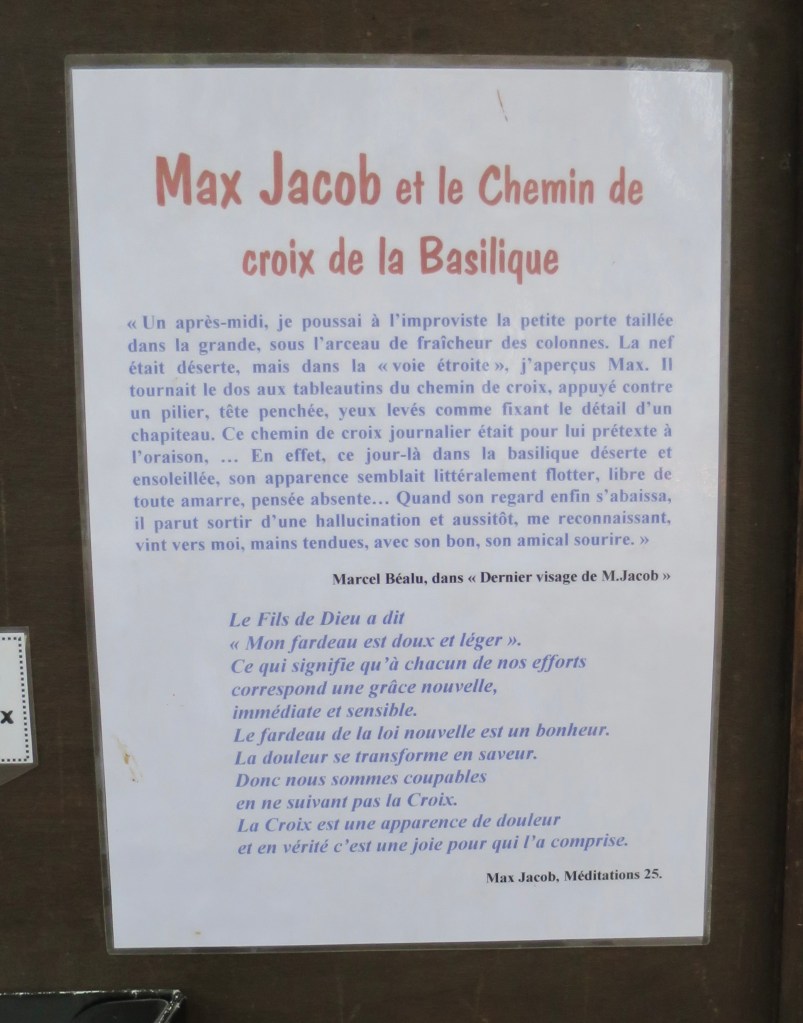
The other plaque is about Max Jacob. He was a writer who befriended Picasso when he first came to Paris, taught him French, introduced him to Apollinaire and Braque. A Jew, he had a vision of Christ in 1909, and converted to Catholicism. In Picasso’s ‘Three Musicians’ he is ‘the monk’. He spent much of the 1920s at St Benoit-sur-Loire, and lived here from 1936 until 1944. Marcel Béalu records entering the church and seeing Max, who was supposed to be studying the pictures of the Way of the Cross, “back turned to the pictures, leaning back against a pillar, head back, eyes looking up, as if fixed on the detail of a capital. His “study” was an excuse for prayer. He seemed literally to float, free of all moorings, without thought, absent … When at last he lowered his gaze, he seemed to come out of an hallucination, and immediately on seeing me, came towards me, hands held out, smiling his lovely, friendly smile.” In 1944 he was arrested here by the Germans, as a Jew, interned at Pithiviers. He died of pneumonia in Drancy before he could be transported to Auschwitz.

I come out of the monastery, out of history, into a light made luminous by the flowing waters of the river. The Loire is ‘Fleury’s golden valley’. Jacob wrote that here he was in the most beautiful countryside in the world, with the most perfect balance between three masses: of stone, of greenery, of water. For him, the Trinity. To which he added another mass – silence.

I meander east in the sunshine, between wide fields and shining river, past a meadow of brown goats, and find a marker for the Meridian, almost buried in midsummer vegetation. The banner talks of the trees planted along its length “establishing a strong relationship between new generations and the environment.” It leans, about to fall. And where are the trees? I’m by the river, at the point where the Meridian crosses the river. Invisibly.
How would different people mark the Meridian?
Grandville, who in 1844 represented the rings of Saturn as a “circular balcony on which the inhabitants of Saturn strolled in the evening to get a breath of fresh air” might have marked it with a carriage way of innumerable iron arches and cavalcades of coaches, north to south.
For 1960s architectural technical utopians, sons of Corbusier, it would be a linear city with a multi-lane motorway running along the top of the buildings.
Ecologists would have a green way, a protected corridor in which wildlife would live unhindered, and providing them with safe migration routes.
The technologically-inclined millennials would have fun with laser shows, waves of light and sound propelled along it.
Half a million people could link hands.
A shouted or a waved message would need just thirty people in each commune to take part, 10,000 in all.
Imagine a shouted or sung message sent along the Meridian.
Imagine a dance in each commune which at an agreed moment stops, and everyone joins hands and connects to the adjacent communes …
Or it could be an opportunity for each locality to find its own form of expression, to express its individuality, that it would share with other communities on Meridian Day, not exactly a competition, but an opportunity to show off …
And here, where the Meridian crosses the great central river of France, how I want an arc-en-ciel, a rainbow of connection across the water! But there’s nothing.
And yet, perhaps the days of such collective action are over. Even on demonstrations there is the sense of atomised individuals absorbed in recording and broadcasting their own experiencing. We are each, now, the star of our own show.
As if in illustration, 5km from here is the village of Saint-Martin-d’Abbat. In 1997 someone proposed that householders customise their letterboxes. (The French, like Americans, have letterboxes at the edge of their property.) Now there over 200 decorated boxes in the village. It was an idea that ‘took’. They variously depict a cow, a dancing couple, a tractor, a fire-hose reel, a guitar, a public telephone box, all sorts. Each is the expression of an individual nature and interest. Like the passerelles at Amiens. And like the passerelles, they are at the limes of the home, the place where the private pagus meets the public realm. Not nationality or locality, but individuality. Not la patrie or le pays, but la personne. “Since 1789, the entire nation, as a people, has unfolded in the purified individual.” (Hugo.) And, however much I may wish it different in others, it is how I have lived my life. Time for dinner.
I eat in my Chinese takeaway. As I begin to eat, prawns instead of chicken tonight, the young assistant approaches shyly and asks if I left a pen here last night, holding out to me my cheap bic. I am touched. I have two pens again. And each, now, resonant with generosity.
Notes:
Guillaume de Lorris wrote the first part of Le Roman de la Rose, which I write about on Day 9.
 my writing