Day 6: Villers-St-Sépulchre to St-Ouen, 46 miles.
On the Move. The Jacquerie. The Republic and laïcité. Nerval. Chantilly. Questing Quixotes. Heat exhaustion. Madame le Maire. My guardian angel of St-Denis. Abbot Suger and the birth of Gothic. Class and race. Ricqlès in St-Ouen.
I set off early, glad to be on the road. I slept well in the shelter of la Pierre aux Fées, but I found the b&b’s friendly domesticity – so much personal stuff, so much chatter! – stifling. I’m already into the groove of simplicity and anonymity, of leanness. Get up, fuel up, pack up, go, a need to go relentlessly on.
In this mood, as I cycle along the winding river-valley road, I find myself recalling a poem from long ago: “the gust of birds that spurts across the field, the wheeling swallows … seeking their instinct, or their poise, or both … men use what they imperfectly control to dare a future from the taken routes … afloat on movement that divides and breaks … at worst, one is in motion; and at best, reaching no absolute in which to rest, one is always nearer by not keeping still.” I may be cycling quietly, well-knit and self-contained, but it is a movement that divides and breaks, with a sense of the texture of reality, the warp and weft, loosening. As if the bonds between elements are letting go, and I am beginning to see, experience between. Through to another reality? Or is it this reality reconfigured; less tightly knit, less unified, less insistent? So that what were once incompatible may now coexist. For if the fabric of reality no longer holds together, new experiences are possible. The first village I pass through is named Hermes.
And then I settle into the day’s journey, into simply cycling. It is an apricot summer morning, I cycle through fresh air that is untouched, unbreathed, with birds, sun, open fields and woodland, the breeze stroking the fields of ripening barley like a soft hand on cat’s fur. It is deliciously warm. But it will be very hot. I had seen myself moving slowly south through June, acclimatising, my skin gradually darkening. Instead, April has turned into August in three days, and I will have to buy sunblock.
I pass through a small, empty village. It has five sets of traffic lights, at two insignificant junctions and three pedestrian crossings. There’s not a car or pedestrian in sight. French drivers wait patiently at these red lights, waiting as nothing happens. They have gone, in a generation, from selfish and anarchic, all aggression and blaring horns, to a placid, unthinking obedience. I check for evidence of irony in their waiting, but no, they sit, stolid, waiting for the green light that will activate action. Then there is a gap of two seconds between the green light and moving off. Come on! The law has been internalised. They have become domesticated. And the car, once a symbol of manliness, battle-scarred but vital, is now an extension of the home, unmarked, a travelling sitting room, complete with air-conditioning and sound system, to which they devote their newly discovered house-proudness.
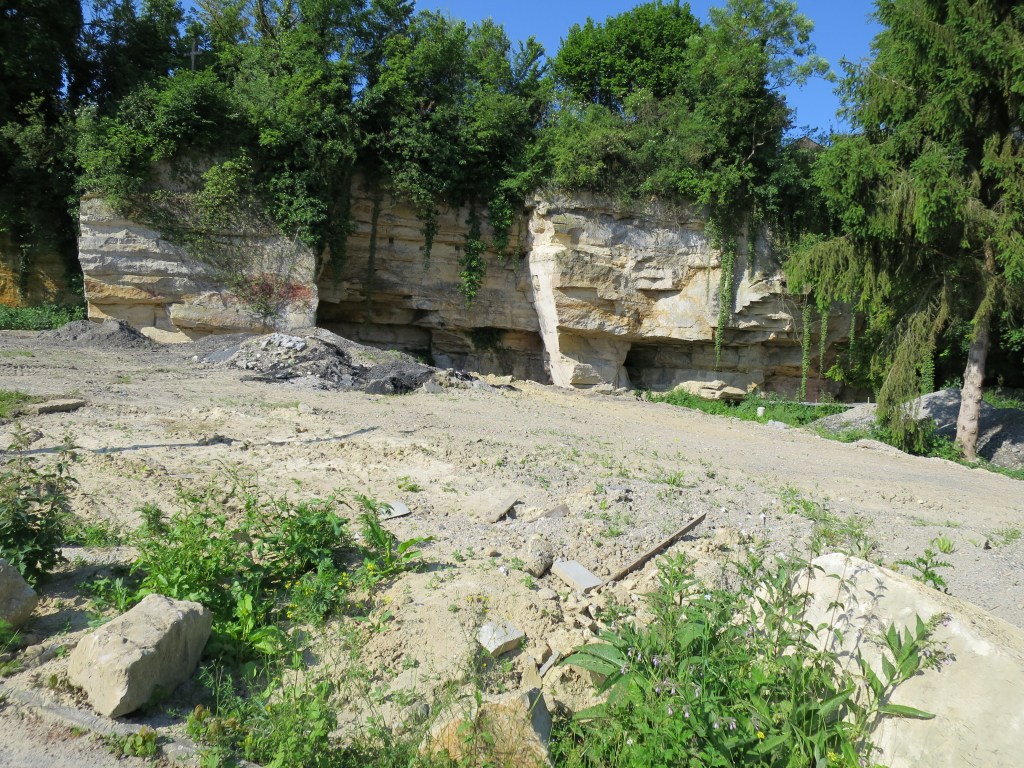
At the end of the village is a quarry. This is an area of quarries, Ruskin’s ‘fine building limestone’, used to build the great cathedrals. I note the distinct bedding of the stone, and remember that in French Gothic building the stone is never cut, just shaped. Unlike the English, they used no saws, and stone was used to the thickness of the bed. Viollet-le-Duc’s maxim was: ‘never divide a stone.’
I’m soon at Mello, the site of the battle at which the Jacquerie were defeated. And then at Saint-Leu, where the revolt began, where I stop to buy sunblock.
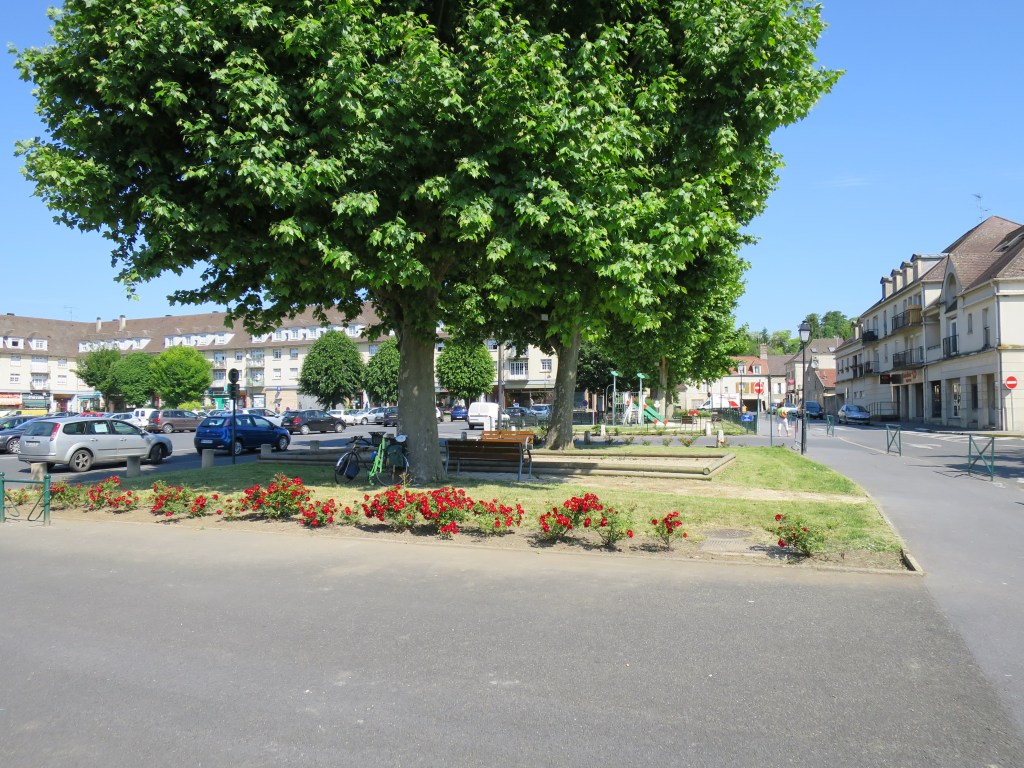
It is a placid small town, with a big, grassy square, shops around, and old men on benches, not moving, their gaze far off and deep within. Not old, in fact, just men not working, with nothing to do, who time is passing through, winnowing out volition, leaving them with pattern and memory. In 1830 the last Prince de Condé, driven mad by the infidelities of his mistress, rode over from his sumptuous château at Chantilly to this nondescript place, and hanged himself.
I search for some commemoration of the Jacquerie on the board of local highlights. A one-word mention. There’s a lot about the local building stone, and the underground quarries so big that they were used to assemble and store V-1 rockets. I have just passed where the Eagle Line intersects the Meridian. There was no sign. But under their crossing point is a vast, underground emptiness. Emptiness?
The Jacquerie was a peasants’ revolt of 1358. Its outbreak was the other side of the equation of the great wealth and the ‘surplus’ that had built the cathedrals. For the ‘surplus’ came from taxing the peasantry. But by 1358 that wealth had been much reduced, by twenty years of war with the English, and the Black Death. The revolt began here at Saint-Leu, with a gathering in the churchyard of peasants bitter, less at the nobles’ wealth, than their failure to do their duty: to protect the king (they had allowed John II to be captured at Poitiers in 1356); to protect the peasants (many nobles had become bandits); to tax fairly (taxes had gone up sharply, and disproportionately for the poor). The protest turned into a savage release of pent-up fury, in which dozens of nobles were killed and their houses sacked. More risings happened across northern France. Most seem to have been spontaneous responses to perceived wrongs. But a peasant army came into being, and faced the nobles at Mello.
Their leader, Guillaume Cale, went to the nobles’ camp, under an amnesty, to parlay. He was seized, tortured and killed. (The rules of chivalry did not, could not, of course be applied to a peasant.) The defeat of the leaderless peasant band at the battle was followed by a reprisal rampage in which perhaps 20,000 peasants were slaughtered. “Like every insurrection of the century, it was smashed as soon as the rich recovered their nerve, by weight of steel, and the advantages of the man on horseback, and the psychological inferiority of the insurgents.” (Tuchman.)
Written up by Froissart and other aristocratic chroniclers in lurid style, their reports of the actions of these ‘evil’ and ‘wicked’ men so terrified the nobles that it came to be a word applied to any insurrection, indeed resistance by the lower orders, with the implication of the dire consequences of not dealing firmly with them. Nostradamus in 1552 used it as a term for any revolt that overturns the status quo. In 1872, a year after the bloody suppression of the Paris Commune,Louis Raymond de Vericour said this, to the Royal Historical Society: “To this day ‘Jacquerie’ does not give rise to any other idea than that of bloodthirsty, iniquitous, groundless revolt of a mass of savages. Wherever, on the continent, any agitation takes place, however slight and legitimate it may be, among the humbler classes, innumerable voices, in higher, privileged, wealthy classes, proclaim that society is threatened with a Jacquerie.”
This combination of fear and contempt reappeared in 2005, during the troubles in the Muslim communities in the banlieues, when Interior Minister Sarkozy (himself the son of an immigrant) promised to ‘pressure-hose’ off the streets these ‘racailles’ – a deeply offensive term meaning dangerous, contemptible rabble, scum.
Which brings us to Creil, five miles from Saint-Leu.
It was the scene in 1989 of the ‘affaire du foulard’, when three Muslim girls were excluded from college for wearing headscarves. They wore them for reasons of hijab, religious modesty. Their exclusion was on the grounds that the headscarf was incompatible with laïcité, secularity, the separation of church and state. France, as a lay, non-religious state, bans from state schools the wearing of religious insignia that are so ‘ostentatious’ or conspicuous as to be regarded as proselytising. The courts decided that the headscarf was not ostentatious, and therefore legal.
But in 2004 a law was passed that defined ostentation as any religious symbol ‘easily visible’, so banning the wearing of headscarves in public schools, and also turbans and large crosses.
And in 2011 a law banned face covering in public, outlawing the burka and niqab. In neither law was religion mentioned, but the head scarf and veil were clearly the target. Why? Laïcité.
The Revolution was a product of the Enlightenment, the age of reason, when religion was seen as a receding tide of superstition, something that would inevitably fade away. Many churches were turned into ‘Temples of Reason’. It was to be a state in which all were ‘citizens’, and the watchwords were ‘Liberty, Equality, Fraternity’. France saw itself as welcoming peasants into society, and foreigners into the country: but this was on condition that they assimilated linguistically and culturally, and didn’t differentiate themselves visibly. Hence the France’s refusal to accept multiculturalism, or acknowledge regional languages.
It had taken France eighty years after the Revolution finally to put behind it dynastic government, and, after the traumas of the Franco-Prussian war and the Paris Commune, to begin to develop a modern state, in which la Marseillaise, the tricolore, Bastille Day, laïcité, and secular education were central. Religion was to be a private matter, multiculturalism anathema. French presidents, like Mitterrand, have repeatedly asserted, ‘la République est laïque’.
The problem is that, in Islam, France faces a religion that for many believers cannot be separated from, is embedded in, their daily lives. Indeed, who would see their lives, rather, as embedded in religion. And there are an estimated five million Muslims in France. (Because religion is a private matter, no statistics are collected.) France faces a rising tide of religious observance and belief, and increasing militant radicalism. As indicated by the number of Muslim children who refused to observe the minute silence in schools, after the Charlie Hebdo assassinations in January 2015.
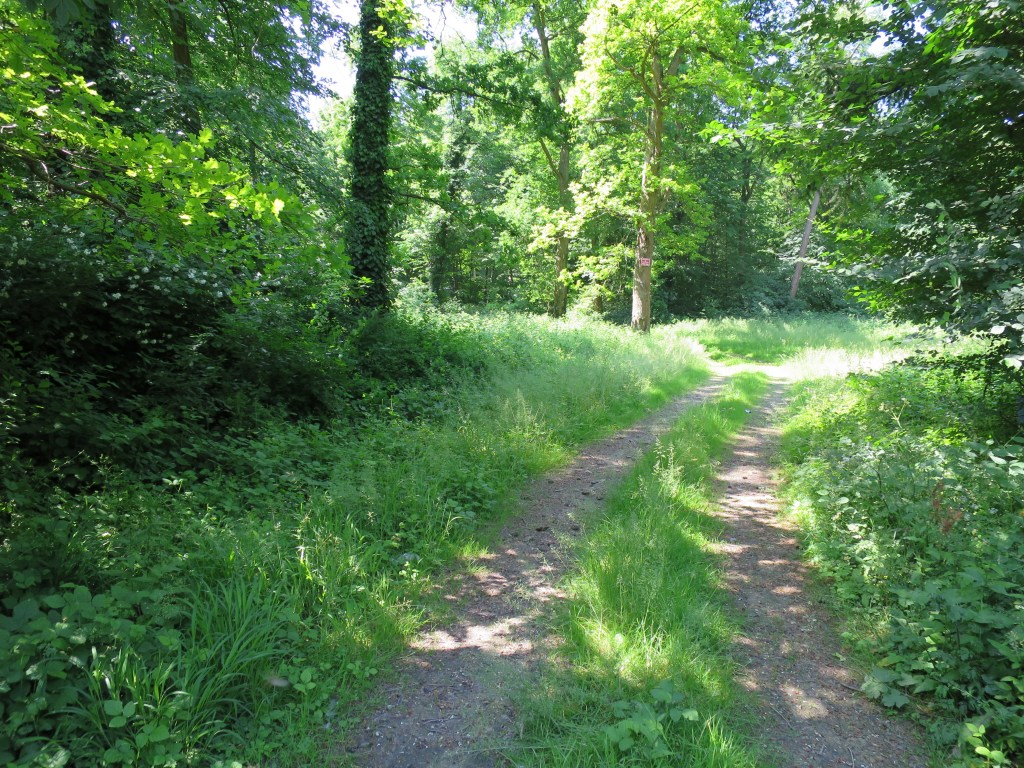
I cross the Oise, and am in a different world, cycling through the Forest of Chantilly. With its woods and clearings and small plots of land, called mas, it reminds me of Gerard de Nerval’s enchanted childhood in nearby Ermenonville, with his mother’s family. This is the Valois, “where the heart of France has beat for a thousand years.”(Nerval.) As a child he often saw the Prince de Condé’s unfaithful mistress, the Baronne de Feuchères (born Sophie Dawes, daughter of an English fisherman), “an Amazon on horseback”, riding through that countryside. He saw, in the weatherworn statues outside the church, not saints, but the Celtic deities of ancient Gaul.
Nerval was a brilliant writer, but a troubling visionary who slipped in and out of madness. Troubling because however attractive the visions, if they come from fantasy indulged, rather than being experiences of other realities, they are not realisation, but escapism. But how is one to know?
He wrote, “I believe that the human imagination has invented nothing that does not exist, in this world as well as in others.” And recently I read this, from Jean-Luc Godard, “those lacking in imagination take refuge in reality.”
Is one’s existence, one’s livingness, less matter than vibration? Vibrations with just enough consistency to be sensed as the appearance of, or to be experienced as, matter. A sensing of vibration. And a sensing of the existence of the gaps between vibrations. As between the lines on the cathode ray tubes of old TV sets.
And this devastating question from Nerval: “Is my soul an indestructible molecule, a sphere inflated with a bit of air, which recognises its place in nature? Or is it the void itself, that vision of nothingness which disappears into eternity?”
Like Condé (for very different ostensible reasons, but the same central reason, being inconsolable) he hanged himself.
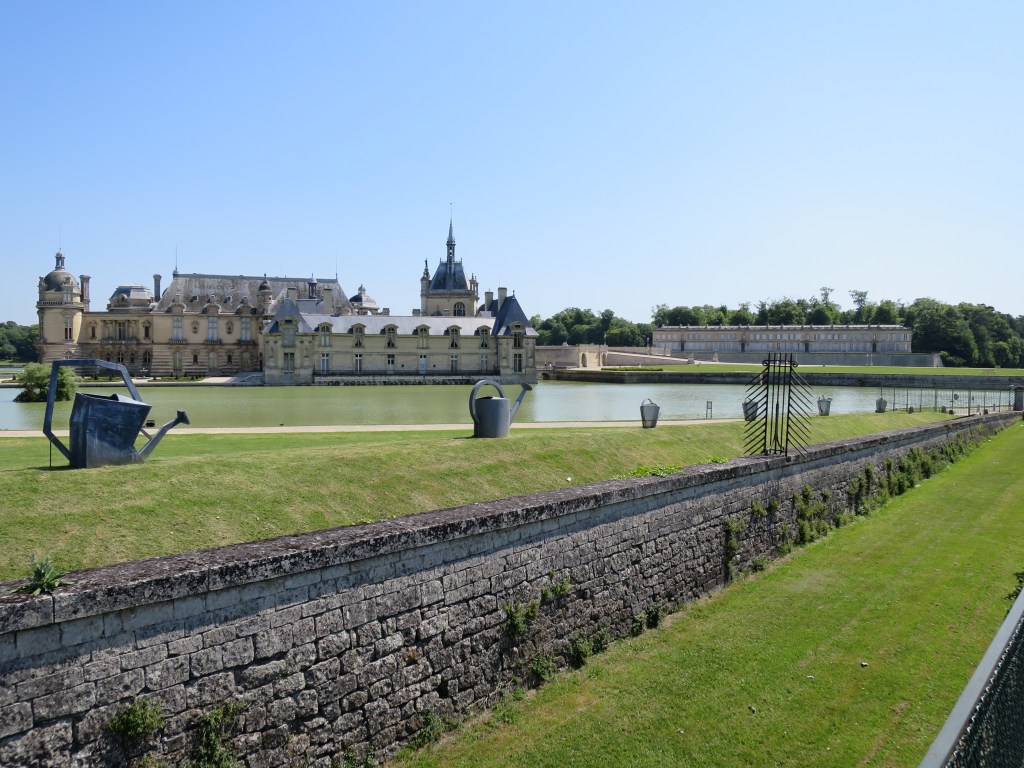
I cycle through the gateway, on the bumpy cobbled road towards the château of Chantilly and the Condé museum.
But I soon lose heart. It is something about the scale of the place. It is wearyingly huge. Vast open spaces as wide as English commons, the stables are as big as a palace (one of the Condés believed he would be reincarnated as a horse). There is a grand small palace and a grander big palace. It has a race course! There are formal gardens and romantic gardens. It even has the aristocratic play-village that inspired Marie-Antoinette’s at Versailles. And all perfectly made, neatly preserved.
The museum houses Les Très Riches Heures du duc de Berry but it is never on show, only a facsimile. And all this feels unreal.
There is something about a place where every whim of the owner can be realised, because he has limitless money, that offends me. Perhaps it is my English puritan soul. For all its style, this is capricious excess. And all on show – look at me, look at what I can do, and you can do nothing about it! Except, if you have any taste, admire. My heart sinks, and I turn around and pedal out.
Cycling out of Chantilly, I remember Nerval in the 1850s comparing the town to one of “those old aristocratic gentlemen with impeccable white shirt and faultless manners, whose proud demeanour covers a worn hat, or well-darned clothes … Everything is proper, well-ordered, circumspect; and voices fill the high, sonorous rooms with harmonious echoes.” It livened up in the revitalising late-nineteenth-century belle époque.
In the 1970s Richard Holmes described it as a town where “ancient gentlemen in mohair suits and with gold-topped canes still help beautiful young ladies in Liberty-print dresses out of Paris-registered Mercedes and Rolls-Royces. ‘Voilà, Angélique … nous-voici Hélène,’ they sigh, with tight moneyed smiles.”
That too has changed with the expansion, in the last thirty years, of the moneyed class, so many more than a generation ago, in this century’s belle époque of new wealth. Accepted, now, so there is no need to be discreet – how has it happened, this general acceptance of obscene wealth inequality? – with a new relaxed sense of entitlement, in an ecosystem, almost a democracy (although of a new aristocracy) of wealth. So, the men drink in local hotels, and the women shop in local shops, and they both eat in restaurants along the main street. Whatever hard work or ruthlessness or exploitation was needed to gain their wealth, they are now safe. For the system that they once had to work, or to work within, is now working for them. Therefore, at leisure, they are at ease, they look out almost benignly, unbothered by how we regard them, immune.
I enter a calm, relaxed shading forest. But on leaving it, the road switchbacks over exposed open fields. It is very hot, an oven heat. I’m getting hotter, stifled by the heat.
Heading up one long hill, I see a cyclist ahead, his bike as heavily laden as mine, cycling more slowly than I. But by the time I reach the top of the hill, he has turned aside, gone into a café. Why don’t I? I press on.
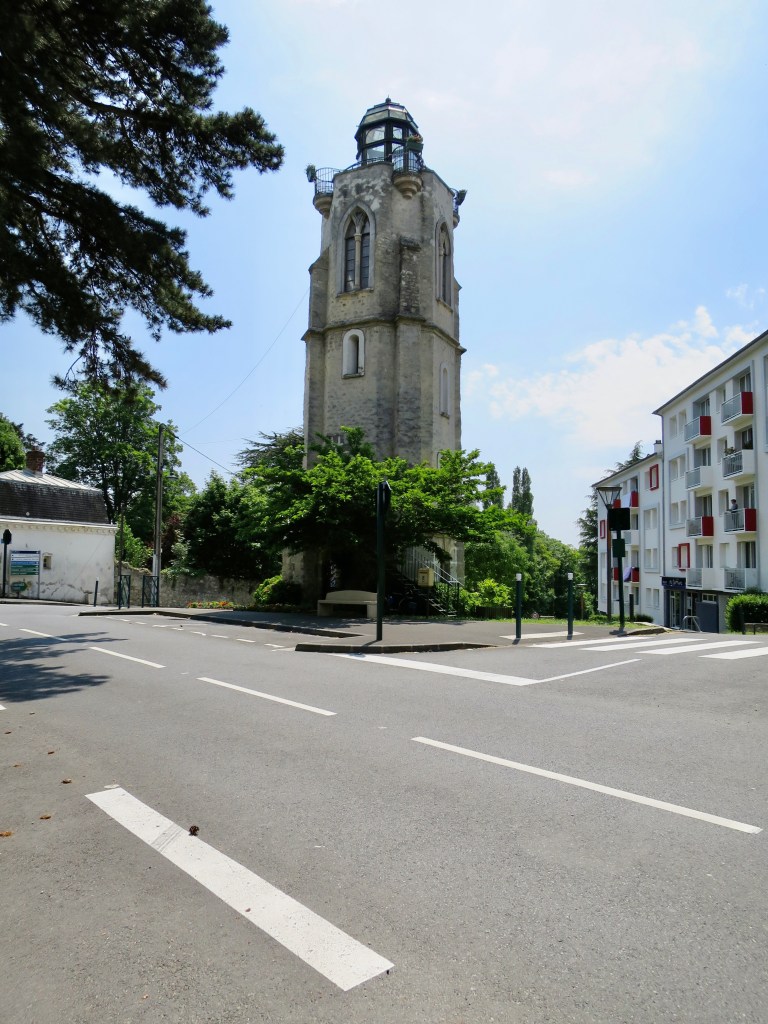
In Saint-Martin-du-Tertre I find the obelisk commemorating the Meridian survey of 1740. I cycle up a long hill to find a tower which ‘offre un point de vue incontournable sur la région. Le syndicat d’initiative y est install.’ It was built by a stockbroker in memory of his daughter. It is the highest point in the département, and was used by all the surveys, and also the télégraphe Trappe, a semaphore messaging system developed during the Revolution. But it is surrounded by trees, rendering the view invisible. And the tower, and the tourist office, are only open for two hours, on Sundays. So I cannot experience this ‘incontournable’ (from which one cannot turn away) view.
But something serious is happening. I am out of breath after the climb, very hot, but not sweating. I’m overheating. My pulse is racing. I drink, sit, rest in the shade, wait. But my pulse doesn’t slow. I’m radiating heat, but the surrounding air, 37ºC, blood heat, takes none of it, reflects it back. I am not cooling. The humidity – storms are beginning to build – makes it worse. I am close to fainting. I can’t see. My vision isn’t just blurred, it’s obscured by a white mist. I know the world is there, but beyond a white veil, and I am dizzy, about to fall into a black nothingness. My pulse, after ten minutes’ rest, is 92 bpm. What should I do? Is it a passing condition brought on by the weather? Or is something serious happening to me?
I’m a dozen miles from Saint-Ouen, my night’s stopover. Have I got this all wrong? Have I miscalculated this whole trip? Every day is fixed, with no margin. Am I simply not up to it? Here I am, in the middle of nowhere, with no shop or bar open. I’m on my own. All I can do is keep going.
As I freewheel back down the hill, I pass the man I had seen earlier, pedalling slowly up, doggedly climbing. He’s as old as me. Is he too following the Meridian? Is Europe crisscrossed by old men, the foolish retired, living out their dreams, like so many Quixotes, on their ancient Rocinantes, each following the thread of a narrative that they believe will lead them to – What? Where? The centre of the labyrinth? The way out?
The mist clears a little, but I don’t feel great. As if the spring inside me, having been wound too tight, has broken, or at least lost its elasticity. It is downhill from here to Saint-Denis. But downhill is never downhill all the way. And it is getting hotter and more humid as clouds build, and I’m riding along in a hot, wet, suffocating blanket. What to do?
I pass a sign to a railway station, but cycle past. Why? Not wanting to ‘give in’ again, for a second day in three? That dogged sense that if I keep at it, I’ll, somehow get there?
I cycle into Villaines, in search of drink. But there is no shop. I go to the mairie.
It is a curious aspect of France that, in a village without a shop, without a school, there will be a mairie, with a smartly-dressed mayor, often a woman, sitting at a smart desk, in a modern office. Heaven knows what she thinks as I walk, stagger in, wild-haired, red-faced, shirt clinging with sweat, and ask the mayor, cool in her immaculate white blouse, if there is a railway station, with trains to Saint-Denis. She looks intrigued rather than alarmed, says calmly, yes there is, explains how to get to it. But there is no ticket office, she says, so I will have to get off at the next station to buy a ticket. As I am about to leave, she asks if I would like a drink of water. Please. I empty the first glass, the second, and the third and, panting, ask her to fill my bottle. Which her male assistant does. I thank her, she smiles, inclining her perfectly-coiffured head, I step back out into the midday heat. Chiens fous et hommes anglais …
The station is empty, but there is a reassuring electronic sign giving train times. And a machine where I can buy a ticket with a bank card. She must have thought that this would be beyond me. Or perhaps that such wild men don’t have bank accounts. Not racaille, but beneath comprehension. I buy my ticket. There is a train in half an hour, and it’s only 20 minutes to Saint-Denis.
I’m glad I didn’t try to cycle it. Something has broken, gone, won’t come back today. But when? Tomorrow is another day.
I stand and wait, the sun beating down on me, boiling my brain in its pan. There is the scent of cut hay. And the stink of manure. After fifteen minutes of standing in the sun, enduring, I realise that along the platform there is a shelter, shade. Of course there would be a shelter. I am in that state, beyond thinking, where all one can do is endure. I go and stand in the shade.
The train is on time. I heave my bike aboard. There are places in each carriage for bikes. At each station towards Saint-Denis more black people get on. Travelling in towards the banlieues is the same as travelling out from central Paris. Banlieue just means ‘suburb’. But “since the 1970s it increasingly means low-income, high-rise housing projects, in which mainly foreign immigrants and French of foreign descent reside, often in perceived poverty traps”. There is a ring of these around Paris, beyond the Périphérique ring road, and before the ring of outer suburbs, the white couronne periurbaine (from which these service workers are returning), where religion comes up against laïcité, and liberty, equality and fraternity are being tested. Saint-Denis is in the middle of it.
Saint-Denis is a small, poor town, 6 miles north of the centre of Paris. It is exactly on the Meridian, and a place where so much French myth and history has swirled, and still swirls, to the present day.
Here Denis, saint of Paris and of France, is buried, his story full of mythologising. Martyred at Montmartre, he carried his decapitated head (another severed head!) north along the Meridian, before collapsing. The town grew up around his grave, which quickly became a shrine.
Geneviève, the other saint of Paris, carried stones along the Meridian from the centre of Paris to build his sepulchre, initiating his cult.
Here the Gothic was born, in a complication of origins and influences.
Here Crown and Church became indissolubly linked, so that the fall of one led to the side-lining of the other.
Here, from the 1880s was a ville rouge, staunchly Republican, Communist, and anti-clerical, the type of the French Left.
Here the decline of traditional industries depressed the economy.
Here African immigrants settled, or were settled in State housing.
Here, in 1998, was built the national sports stadium, named, significantly, Stade de France, (every village has its ‘stade’, a football field often with just a tin shed, but its stade). It is where the French ‘Rainbow Team’, of mixed race and colour won the soccer World Cup that year, two days before Bastille Day.
And here, today, are exemplified the cultural and racial problems that France faces.
At Saint-Denis station I have to carry my bike down many steps. The station is busy. I wheel it to one of the exit barriers, put in my ticket, the barrier opens, I go through, pulling my bike – and it shuts, trapping my bike like a cow in a crush.The busy crowd pushes through, both ways, muttering at the blocked access point but ignoring my plight. What to do? A thin young woman with a pram stops. Okay, she says, a problem, she tugs but nothing moves. She looks round for an official. No one. But she’s not going to say, sorry, I tried, and abandon me. She asks each person who passes, do you have a season pass? At last a young Chinese man stops, taps his ticket on the reader, the bike is released. Thank you, thank you, from me to her; from her the Gallic shrug, de rien.
As we walk out together, she says, we could have called an official, but they take ages to come. She knows about officials. Where are you going, she asks? To the cathedral, I say. Oh, you mean the basilica, she says. She takes me outside, explains quickly but carefully, twice, how to get to it, then walks with me until we can see it at the top of the hill. She asks if I’m English, wishes me well, and pushes the pram quickly back the way we’ve come. I watch her go. She is one of those energetic women who have little (her clothes are cheap) and yet are always helpful. A heart of gold, we’d have said once. I’m moved. Because I know she has little, works hard all the time, will never have much, and yet she acts with generosity of spirit, selflessly, automatically. As if she lacks for nothing. So maybe she does. I have nothing to give her, my angel of Saint-Denis. I am touched.
The basilica is there, up the hill, the place I’ve been heading for. I’ve made it. Although I’m still not feeling great.
I push my bike up the hill and through the centre. So many black people, North African, sub-Saharan. It looks like France, formal and finished, but it feels like Africa, an energy, vitality, and incipient chaos (different order?) that is somehow negotiated through. It’s a French city centre, with municipal street-furniture, pedestrianised streets, well-finished pavements, familiar shops; but the streets are full of street traders, the informal personal business of men standing close, an African physical intimacy and restlessness, women in headscarves pushing European strollers. How should I feel? Under threat? Will I be mugged, my pocket picked? Or will there be an exaggerated respect, knowing how the law treats black-on-white crime? Of course they ignore me. They have no business with me.
I arrive at the Basilica. Now – where to leave my bike? I’ve been thinking about this since reading that this is the most dangerous part of the most dangerous département in Paris, in France, 93 Seine–Saint-Denis. Where photographers and reporters came in 2005 for the best shots of burning cars, the best stories of rampage, however concocted, by drawing the kids into the film of the story. And my bike is, on this journey, my world. If I lock it, it may be carried off. If I chain it to a fence, maybe I’ll return to find it picked clean of my possessions, like a tethered donkey by piranhas. My images are of the jungle! I find a secure-looking place behind a hedge, and am shooed away by sharp tapping on an office window. With deep misgivings, I lock it to railings by a public garden next to the basilica.
I walk back across the wide-open space to look at the front of the basilica. It is a sorry sight: one of the twin towers was taken down in the 1840s; the rest of the facade is covered in scaffolding and hoardings.
But this is where the Gothic began, the work of one man, Abbot Suger.
One of the most remarkable figures of the twelfth century. An adequate biography would combine Hilary Mantel’s treatment of Thomas Cromwell with William Golding’s character study of Father Jocelyn in The Spire.
Given to Saint-Denis monastery as a ten-year-old in 1091, he was educated with the future king Louis VI, and became his principle advisor, spending 29 years in his service, as diplomat and administrator. He forged the link between crown and St Denis by having the king carry St Denis’ standard, the oriflamme, into battle: ‘Mont-joie, St Denis!’ became the French battle cry. Louis VII appointed him regent when he went on the second Crusade, returning to “a country peaceful and unified as it had seldom been before; and, still more miraculously, a well-filled treasury.” Louis then rejected him as advisor: Suger’s last advice was not to divorce Eleanor; Louis did. She married Henry II of England, and through her was created an English dynasty that lasted for over 300 years, most of them spent in conflict with France.
Suger was also a force in pan-European Church politics, working with Bernard of Clairvaux for the strong papacy that ensured the political power of the Church for centuries to come.
In 1137, having restored the finances of Saint-Denis, he began its rebuilding. As a monk, Suger had renounced his individual identity; he identified himself with the church. His goal was to honour God and St Denis through the beautification of the church: “For the glory of the church that raised him, Suger strove for the glory of the church,” he wrote.
In this he was in conflict with the austere Bernard, who “deemed as dung whatever shines with beauty,” diverting believers because they found it “more pleasant to spend the day marvelling over these things rather than meditating on the law of God”. Whereas for Suger, “the dull mind rises to truth through that which is material. And although he was cast down before, he arises new when he has seen the light.”
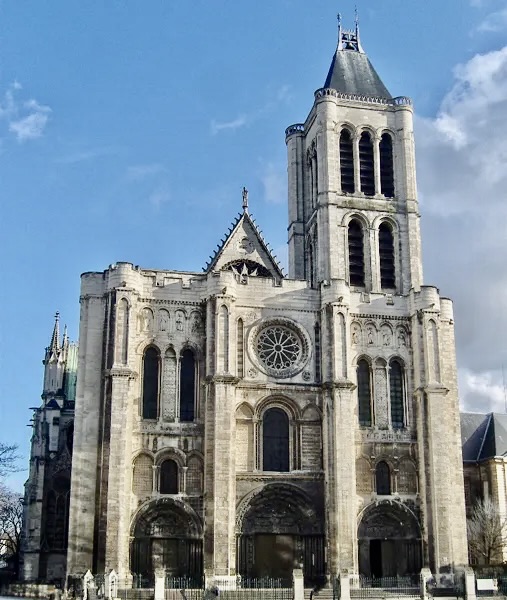
First, he rebuilt the West front, with three doors to improve circulation (“the narrowness of the place forced women to run to the altar on the heads of men as on a pavement with great anguish and confusion”, he wrote), and twin towers. (One tower was taken down in 1840s.) It was modelled on Roman town gates: the West front was to symbolise the entrance into the city of God, and to be a threshold on the way to Heaven, towards the light of God. “Noble is the work, but the work which shines here so nobly should lighten the hearts so that, through true light they can reach the one true light, where Christ is the one true door.” It incorporates the first rose window.
Leaving the nave intact, he remodelled the east end of the cathedral, the choir and ambulatory.
It is here that the Gothic was born, the first church to be transformed from stone cave of mystery to glass box of illumination, the ‘French Work’ that would dominate architecture until the Renaissance, and that represented a newly self-confident and upreaching Christianity.
Panofsky sees Gothic architecture as a working-out in building of the Scholastic philosophy that was thriving in Paris at the time.
But more interesting is what Suger took from the writings of St Denis. Or what he thought were his writings. In 835 it had been ruled by the church that St Denis was Dionysius the Areopagite, converted by Paul in Athens, and also the author of Neoplatonist texts that circulated in his name. Neither was true, as Abelard proved. What a chapter in the novel it would be, where Suger wrestles with his conscience! To accept the literal truth, as demonstrated by Abelard? Or to adhere to the 835 ruling, which connected Paul, Denis, and the texts in a higher, symbolic (and more convenient) truth that would justify the Gothic in the name of the saint of his church, of France itself? For surely Suger was intelligent and knowledgeable enough to know what was the literal truth. He chose to abandon the troublesome philosopher Abelard to the self-righteous Bernard, the papal court, and a trial for heresy.
It was one of the many occasions on which the church of the period abandoned the literal truth for some notion of a ‘higher’ truth. And in so doing, opened cracks through which would filter and then flood the Renaissance, then Scientific Rationalism and the Enlightenment, that would challenge, compete with and eventually defeat religion as the ‘imagined reality’, as Harari calls it, that underlies a society.
From the writings of Pseudo-Dionysius (in fact a fifth-century Syrian), Suger took firstly his vivid sense of the aesthetic and imaginative beauty of the sensible universe, pervaded, from the perspective of divine beauty, by interrelatedness and harmony.
Then, the importance of light as an attribute of God, a sign of his working. Because light, like God, can penetrate substances without breaking them.
From this came the lux continua of Gothic architecture, a conscious control of the condition, quality and distribution of light within the building.

Inside at last. What I notice first is the scale. After the grandeur of Amiens, the vastness of Beauvais, this is not a place to awe, but a space in which to worship; this is a church.
Second, compared with them, is the simplicity. Or, rather, the straightforwardness. The pointed arch, the ribbed vault, the flying buttress, the rose window, the tripartite West front, each has a religious purpose, each is economically used. Here architecture is a means to an end, without exaggeration or elaboration.
And third, when I reach the East end, Suger’s masterpiece, I feel the exuberance, the thrill, of the uprising and then the splaying out, spraying out of the vault ribs. The upward motion and energy of a fountain, and then fountain upon fountain as I walk around the apse, the niches of saints’ chapels, individual, while sharing the general energy, the one and yet myriad-coloured light. He tore down the individual cave-like chapels and created a space of radiating chapels, around a soaring, light-filled choir. With twelve pillars to represent the apostles and prophets, using pointed arches, ribbed vaults, clustered columns supporting ribs springing in different directions, and flying buttresses that enabled glass, multi-coloured glass, to replace masonry. No wonder Stephen Murray speaks of Suger’s “ecstatic hovering in a remote in-between realm.”
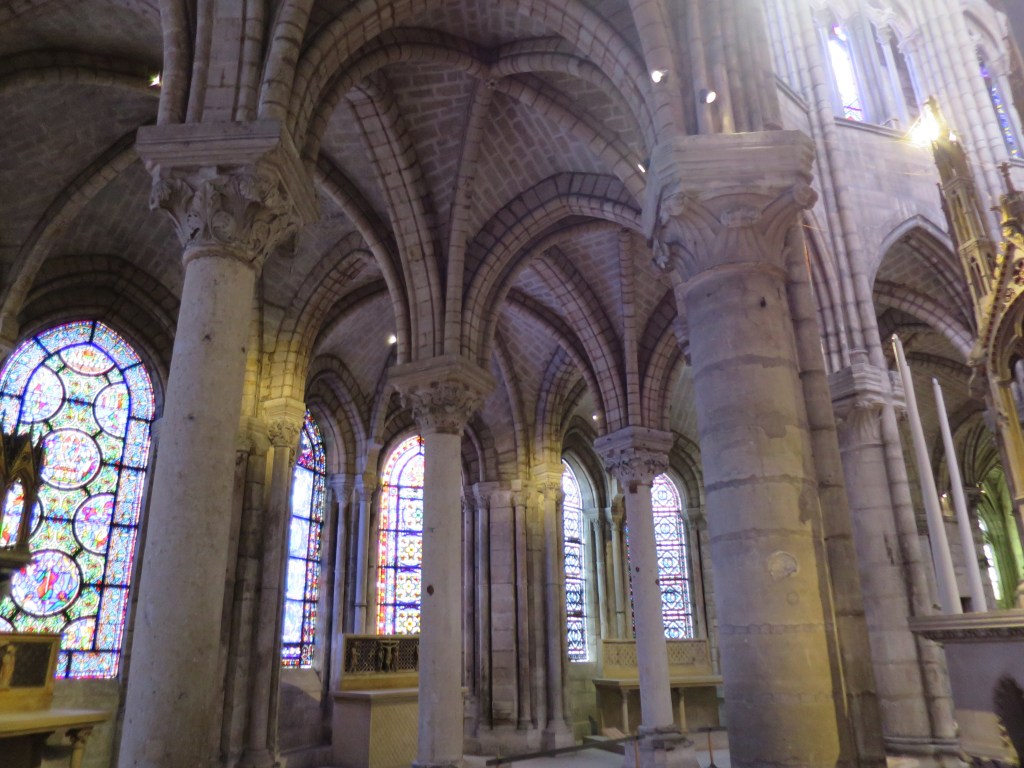
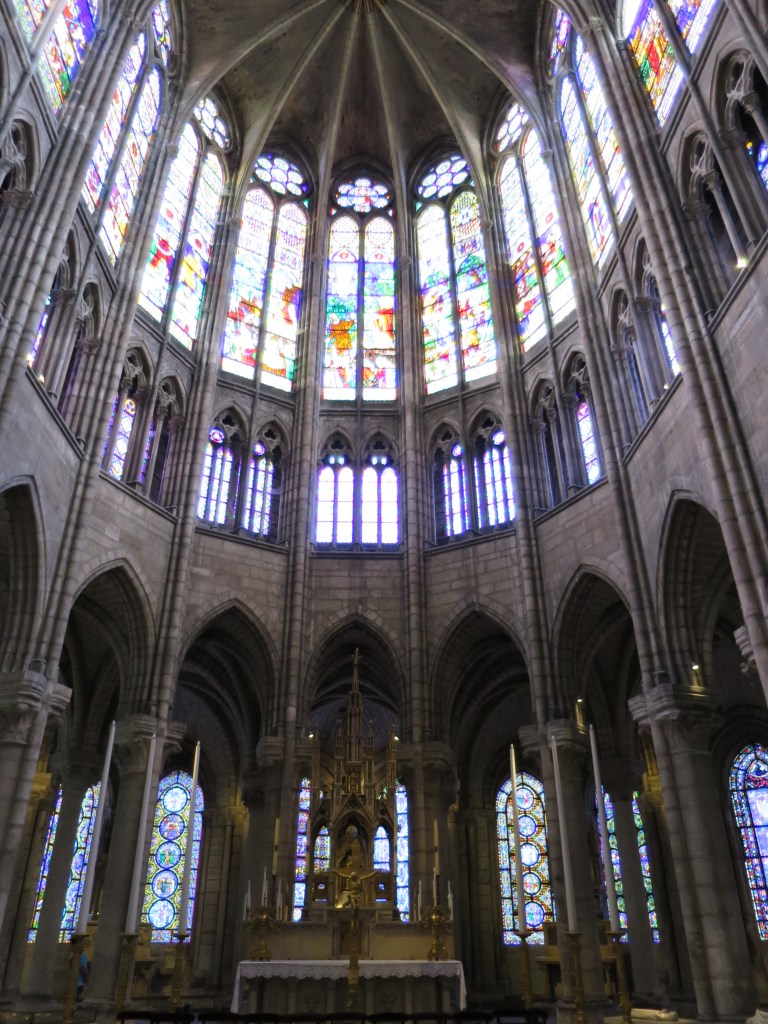
Turning on the spot, I’m surrounded by upgushing fountains of stone, and I feel the thrill (that word again) that must have filled them, commissioner and builder, abbot and clerk of works, when they saw what they had created, made happen, a multiplicity of reachings-up that, because they are reaching up towards the same end (or beginning?), they connect, unite, into a whole. That holds aloft, makes, a whole church. And the sense they must have had, the commissioner and the builder, of having achieved it. Of having stepped into the unknown; and found through there, beyond, something new, that they had discovered by bringing into being. That within the theory (not, of course a theory to him, but the writings of revelation) was a new reality. And in that new reality, a new closeness to God. I imagine Suger coming here at midsummer dawn, as this space filled with light, surrounded by light, and more light, and himself filling with light, and – knowing God.
Being in this space, and moving around in it, and remembering how these new surfaces and spaces enabled new possibilities and developments in music, and seeing the light, and hearing the music, I remember further, in Pseudo-Dionysius, this: Ascending up from the particular to the universal, stripping off all qualities in order to attain a naked knowledge of the Unknown, we may begin to see the super-essential Darkness that is hidden by the light of existent things, “when our soul, becoming God-like, meets, in the blind embraces of an incomprehensible union, the rays of the unapproachable light.” Blinded, we see. For God would exist not in the light, but in the darkness beyond light. If He would be.
Amiens is grand, aesthetic perfection (truly “The Parthenon of the Gothic”).
Beauvais is Gothic Romanticism.
Saint-Denis is architecture that articulates faith, both reflecting and strengthening it. An architecture that could lead one to faith. And the more touching because of that.
Outside, the beggar woman continues her complicated acts of self-abasement. Even beggars have to perform these days, it seems. My coins had gone into her rough, brown hand as I went in, with the brief, reassuring grip I can never resist giving, meaningless to her but not to me.
Clouds have built up, in a sky livid and bruised, and there are flurries of wind, miniature dust devils swirling up papers and leaves in the wide space in front of the basilica, an overheated atmospheric energy that produces a brief shower. And then – all this day-long build up for that? – it dissipates.
I stand, looking across the open space in front of the West front, to the complication of a multi-ethnic, multi-cultural society that is struggling to work out and come to terms with its complementarities and contradictions. Exemplified here, in Saint-Denis.
For Saint-Denis is where the centuries-long compact between Crown and Church was established and maintained. The apse is less apse than mausoleum of the French kings; crowned in Reims, buried in Saint-Denis for over a thousand years.
But throughout the twentieth century Saint-Denis was vehemently anti-clerical, left-wing, Red, and seemed the precursor, the exemplar of the final success of the Revolution, the victory of the proletariat – The People, les citoyens – after the century of bourgeois appropriation.
Now there is confusion. There is the clear failure of the Communist ‘solution’. And there is a destabilising level of immigration, of people who on one hand are proletarian brothers, on the other are both competing for the resources that have always been limited (jobs, housing, services), and disrupting once-stable communities. As well as a sense that the national government is concerned less to solve than to contain, “the problem of the banlieues“, with the ethnic French trapped along with them in these containers, these kettlings.
So, there is the rise of the National Front, and of fringe groups nostalgic for the days of King and Catholicism, and a great deal of confusion. I have already found one Saint-Denis website on which a Christian white woman says, with assurance and certainty, that the aim of the Muslim community is to take over the basilica and force all Christians to convert to Islam.
My bike is fine, of course, untouched. I set off south, the few miles along the Meridian to Saint-Ouen. Past the Stade de France. It was intended to be the centre-piece of the 2012 Olympics. I wonder what changes might have been wrought in this troubled area by the Olympics? But, as in London, probably grand gestures, destruction of local communities, and yet more gentrification.
The road is solid with rush-hour traffic and I walk along the pavement. I cross a motorway, into Saint-Ouen. I’m soon at my hotel.
The hotel is run briskly by a Tunisian, white shirt, bow tie, but waistcoat hanging open, quick, friendly, watchful. He has worked hard, long hours, as a barman and in catering, he has learned, saved, and now he’s bought this place from the Aveyron family who opened it three generations ago. (6,000 Aveyronnais opened Paris bars and restaurants in the nineteenth century, including La Coupole and Deux Magots, and they still have a weekly trade paper, L’Auvergnat de Paris.) These sons of immigrants have retired to one of militantly-white outer suburbs, in the ‘couronne périurbaine’. (Couronne means both crown and wreath.) And spend summers in their house in the village their forebears came from.
The bar is open from very early to very late, catering for the early-morning North African street sweepers, the coffee-and-croissant breakfast trade, the little old man from around the corner who nurses his verre rouge, hunched men and women who lunch with laptops, oblivious of their surroundings, women with excited laughs taking a break from shopping, groups and couples eating together; and then the long, sociable café evenings, and the last man, staring into his glass, steered gently to the door after midnight. The rooms are priced for passing trade. Paris life (for this is Paris, now that so much of the area inside the Périphérique has been gentrified out of the reach of Parisians) passes before those watchful brown eyes, as he briskly shows me my room, gives me codes for door, room, Wi-Fi, and then, seeing I’m not happy with his reassurance that my bike will be fine locked to the railing outside, the code to the ground-floor disabled-access room for me to park my bike in.
I climb, heavy-legged, the narrow stairs.
The place has been refurbished to within an inch of its life. The already-narrow corridors have been made narrower with grey plastic wall panelling, black detailing, black plastic doors, generic prints, all glossy and wipe-clean. The ceilings are black, with recessed lights. There is no daylight, just the brief duration of the pressure-switches. No keys, it’s all coded. A modern hotel has been squeezed into a traditional hotel, as shiny plastic water pipes are fed down decaying metal ones. Old Paris hotel rooms used to have memories; now they have finish. But I have a window, with a Juliet balcony, overlooking a Paris street.
I had expected to collapse after my tough day in the heat. But after a shower, a cup of tea and a snooze, I’m ready to plan.
Tomorrow, I have to: go to the Saint-Ouen flea market; cross Paris; visit two cemeteries and two blocks of flats; buy a tent; and get to a hotel at the southern end of Île-de-France over 50 miles away: on a Saturday with all the weekend traffic. I’m unnerved by two failures in three days.
I check and find that I can take the bike on the RER, the new metro service. I could take the RER to Vitry-sur-Seine, cycle across to Arcueil (for Satie), on to Vigneux-sur-Seine (for Gabrielle), then to the Decathlon superstore at Saint-Genevieve-des-Bois to buy a tent, and back to the hotel at Fleury-Mérogis … Relieved, I go out, to wander round and find food.
Much of Saint-Ouen is run-down, awaiting the leap of the middle class across the Périphérique. There is still the huge Citroën factory, so long a hotbed of left-wing activism.

But, too, there are the first signs of Saint-Ouen’s transformation from industry to services. This is on a tourist-information board outside a fine art deco/modernist brick building:
‘In 1838, Henri Ricqlès, a chemist in Lyon, created a mint alcohol which he marketed as a tonic.
‘In 1898 the Ricqlès company established a distillery near Saint-Ouen docks to produce this mint alcohol. It later diversified into mint sweets.
‘Most of the workforce were women, 50 in 1902, 200 by 1929.
‘The present buildings date from 1936 to 1938.
‘In 1970 Ricqlès took over the Zan Liquorice company and became Ricqlès-Zan. At the end of the 1970s the company stopped production and switched to storing, packing and selling. In 1980 it had 67 employees. The company left Saint-Ouen in 1987.
‘In 1954 a soft-drink version was introduced. It is now owned by Dr Pepper, and distributed by Coca-Cola.’ The industrial century in a nutshell.
It is now the offices of an international business consultancy, drawn by the retro-chic of the building, and the proximity to the RER station, to bring its employees in from less dubious suburbs, into this quartier of ‘the dangerous classes’, an early-adopter, in place as gentrification gathers pace around it. The post-industrial century in a nutshell.
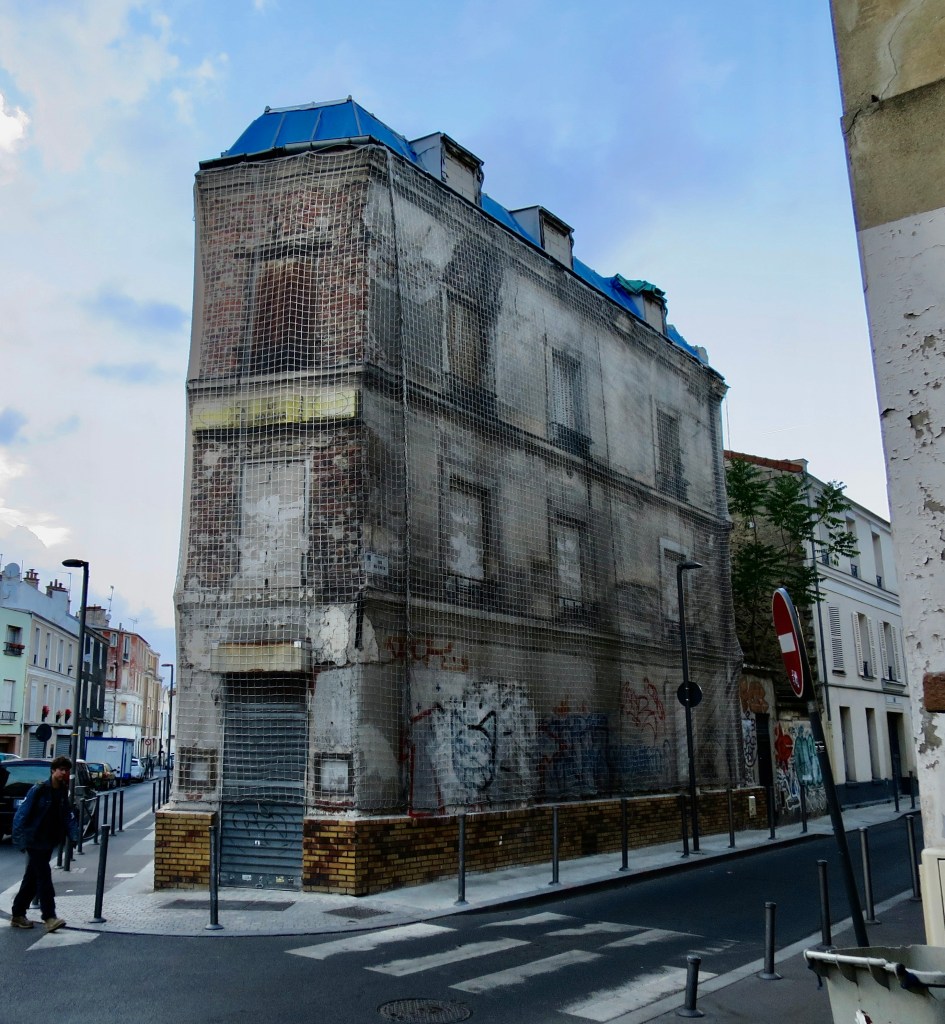
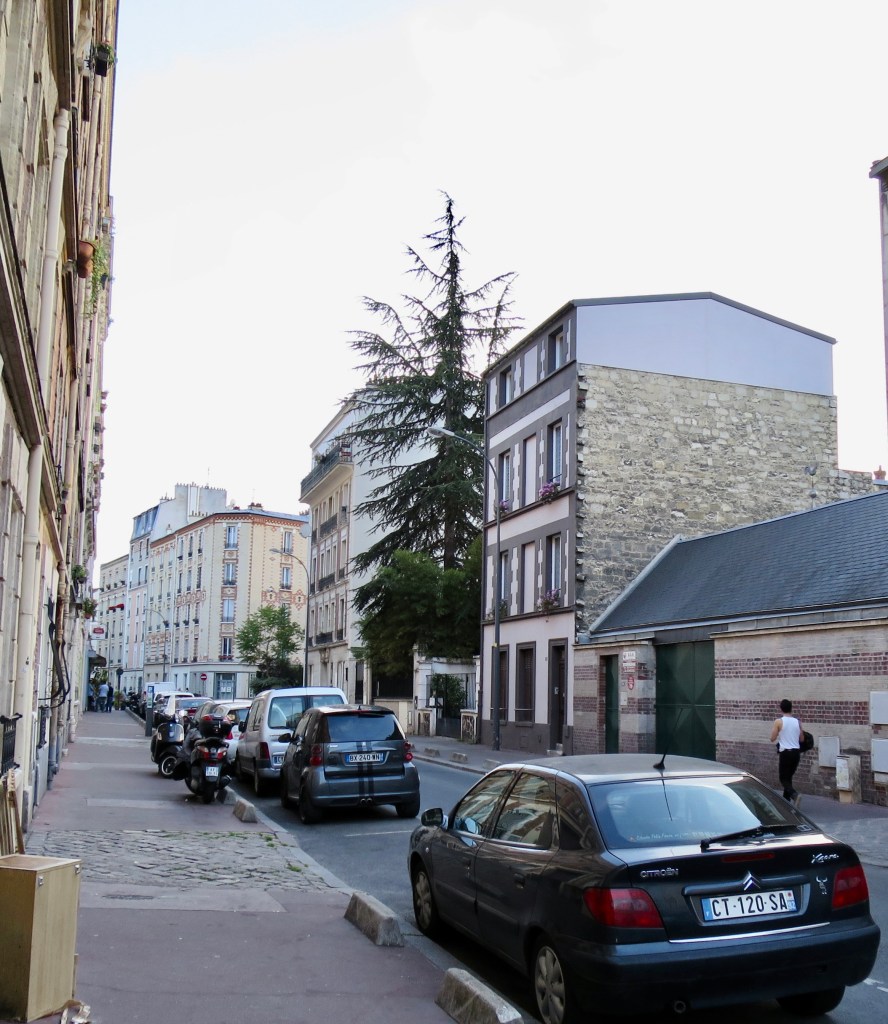
But again, after my socio-political grumblings, as I wander the streets I experience the effortless way Paris turns itself into art. A building covered in netting that combines a Christo wrapping with an Oldenburg out-of-scale object that’s been fished out of the river in a giant’s net. And a huge fir tree between two buildings, much taller than they, as if a discarded Christmas tree has in the night grown enormous, and must be decorated with giant baubles, huge lights, and will sprout vast parcels, as surrealist celebration, and – why not? – fetish of a new cult. One can see all art movements, including ones not yet invented, and whole anthropologies in Paris, just by wandering its streets.
I eat at a Chinese café-takeaway, where you select dishes from the display, pay by weight, and then they’re microwaved. I drink Chinese beer with it.
I am feeling better, and in the night decide that I won’t take the train. I will cycle across Paris.
 my writing