Day 20, 19 June, 2015 : Albi to Coupiac, 56 miles.
Return to the hills. Our village revealed. The carved stone buried. The wild boy reconsidered. Our house. The one-armed man. The Virgin’s veil. The threshing-machine. Camping by the lake. Pot au feu with the young couple.
I wake early. Today I will be at La Balme, our old house and smallholding. And I still haven’t worked out what to do.
What was once a hamlet of half a dozen peasant families, by 1975 comprised a farm of a hundred hectares, and our property of two hectares. We had bought it from a family who had left after their barn was struck by lightning and burned down, selling most of their land to the Bonafets, the neighbours. At first, they had come out from Albi a couple of times a year to prune and then pick the grapes and make wine. But at some time they gave up even that, and when we went into the cobwebbed cave we found only rancid vinegar and spoiled barrels. They had waited, through the flight from the French cities of the disillusioned young after May 1968, the continuing interest of city-dwellers in second homes, until the arrival of the ecologically-inspired idealists from Northern Europe after the oil crisis of 1973, and a naive English couple, to try to sell their house. Of course we paid over the odds, bargaining being to them a skill bred in peasant blood, to us a form of rudeness.
We got on well with our neighbours, especially with Gaston, madame’s bachelor brother, who lived with the family as unpaid hand, and who enjoyed teaching us the old ways that his brother-in-law the farmer, and Didier, the farmer’s son, weren’t interested in. I had imagined when we moved in that our arrival would be a breath of fresh air, especially for madame, who hardly ever left the farm, but also for Didier and Yvonne, the children. But over time I have felt ever more guilty, that we had disturbed their self-contained world by moving into the long-empty house next to them, and then introduced the disturbance of the ‘outside world’ by selling it on to second-homers from Montpellier.
A friend had said – ‘go in, introduce yourself, they will be glad to see you.’
My ex-wife had said – ‘you’re not daring to go there, and actually speak to them, are you?’
I had to go there.
But who would be there? The older generation would be long dead. Didier, the son, had been around twenty. He spent his time driving around the farm too fast in the tractor, and driving along the lanes too fast in his car. He returned from his first holiday, on the Med, eyes big with disbelief, saying ‘we live on gold, and eat shit.’ Would he have sold up, to a progressive neighbour, or a farmer from England attracted by cheap land? Would he have married, continued the family tradition, the farm now run by his son?
Perhaps I will ask at the mairie if the Bonafets are still at La Balme? Perhaps I will cycle up to the farm and say that I lived here forty years ago, do you remember? Perhaps I will pretend to be lost on my way to Coupiac, and check the place out? Perhaps I will simply not go there, leaving a hole, occupied, as it has been for forty years, with memories and regrets, invention and guilt …
I breakfast well, in the spaciousness of the big kitchen, with fresh bread and fresh coffee laid on. I’ll be back here tomorrow night. Tonight will be my last night camping, somewhere near the Tarn.
I cycle across the Place Jean Jaurès. Every town in France seems to have one. Who was he? Born in Castres in 1859, he was a teacher in Albi. One of those young men, like Alain-Fournier’s father, who, following Ferry’s reforms, were tasked with introducing the values of the Revolution – democracy, secularism, laïcité, Enlightenment thinking, national identity to school children. He was elected deputy for Carmaux, and in 1895 helped the striking glass-workers of Albi to found their own bottle-making cooperative. It is still in business. A socialist, he was assassinated in 1914 for being against what he called the capitalist war.
I am soon on the familiar D999 up into the hills. Past where the vast Mammouth hypermarket had stood. It’s now a small ‘Carrefour Contact’, ‘le concept de commerce de proximité’. Our hypermarket has become a corner-shop. Is this a sign of what’s to come? Will this be like visiting childhood places? Will everything have shrunk? I cross the railway line embedded in the road. Disused in 1976, it has still not been tarmaced over, as if they are still hoping for a train to cross.
There are many large lorries on the road, and I worry that with the opening of the Millau viaduct this has become a new main road. But they are serving the new industrial estates on the edge of Albi. The road soon quietens as I climb steadily up from the plain.
The road rises, and the rain starts. At least the wind is behind. But it is hard to keep dry. An old woman, walking slowly, hunched under a sack, says as I pass, ‘vous allez mouillé’, with the grim satisfaction of one used to hardship; nothing bad can happen if you expect the worst. But, oh dear, to arrive at our old place in the rain, with a night of wet camping to follow …
I cross the Meridian. There is a sign saying the Tour de France will pass here on 17 July, and the road will be closed from 12:30 to 15:45. I saw the Tour for the first time in Yorkshire last year. I had seen many fast bike races, but the way the leader, away on his own, punched through the air, like a huge fist, took my breath away; it was an experience of raw power that still makes me shiver.
Past a sign for the restaurant in Coupiac, advertising ‘workers’ menu’. The workers at the abattoir ate there, a single meat ‘dish of the day’, with potatoes and vegetables served as separate courses.
A sign, ‘Millau – Open’.
Past the memorial to four Resistance fighters, killed on 31 July 1944, a month after D-Day, a fortnight before the landings in the south of France. Three were members of the Free French Army, an attempt to unify the 200,000 Resistance fighters. It is a dark, gloomy menhir, by dark fir trees, and it has always made me shiver. I asked Gaston if he was involved in the Resistance. Yes. Did he fight? He gave his self-deprecating smile, who me? I carried messages he said, and cooked. But he would still have been deported, shot or strung up if caught. A woman in a village close by was still known as the woman who collaborated by sleeping with the German Commandant. The husband took back this village Helen, and they were still together in 1976.
Wheat, barley, hay, pasture, vines, maize. A patchwork of small hedged fields. Areas of deciduous and coniferous woodland. A small-scale, various, undulating landscape. A raggedness, as if too much neatness would be irritating, with margins (here’s a wheat field stopping at a house lawn, with no fence between), an area not too much under pressure, where you can live and let live. And, as I approach the highest point, 750m, the cloud clears, and the sun comes out, illuminating the variegated fields and the dark green woods that to the left drop down into the Tarn valley, ahead rise to the Massif, revealing the sunlit blue distance. Struck, awed by its beauty, I have to stop. And look.
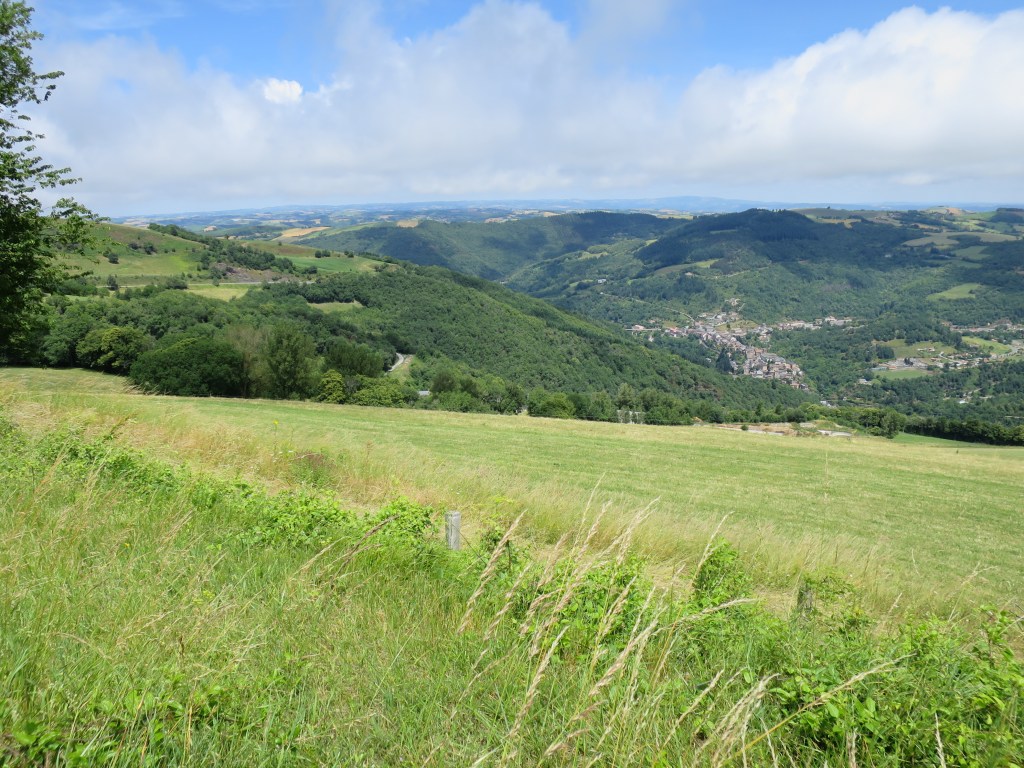
It looks like the promised land. I lived here. Why hadn’t I seen its beauty? Why had I clouded it with her/ my/ our unhappiness, an unhappiness that she/ I/ we had brought with us from our pasts? We had a house and land, bought and paid for, in cash, with the money I’d saved from a year of working ridiculous hours (often 100 a week) as a hospital porter. We had ideas, energy, abilities, skills. We might at La Balme have established a new way of working, with the locals who were still connected to the old ways, with the incomers and the new ways we brought, a new cooperation …
But perhaps the problem was in the word ‘self-sufficiency’, a buzzword of the time. She/ I/ we were still raw from the wound left when we tore ourselves away from the life we had been trained for, that we’d embraced, as new entrants into the middling classes who run the system.
We were monks who had been too obedient, but having lost their faith, had left the monastery.
Outside, we needed time to heal, to find another way of being, beyond the off-the-shelf simplicities I’d learned from books at the Ecology Bookshop.
We’d lost one faith, but immediately converted, simplistically, to a new one. We had been in too much of a hurry. Unnerved, I guess, by the uncertainties of the times, the ‘success’ of our contemporaries, the fear of being left behind. In too much of a hurry, so we couldn’t, didn’t dare to give this place, this way of life, time to soak into us, change us. Instead of giving ourselves that time here, she/ I/ we hurried back, there. Left all this, and what might have been, left it here, the unlived life.
1000 miles from Dunkirk clicks past on my milometer.
The road falls, into the valley of the Rance, down 400m in one snaking, swooping, exhilarating run. The sun is hot, and my wet shirt soon dries. I’m breathless when I get down.
Approaching Saint-Sernin, our village, it is as I remember. The village rises sheer from the river, like a miniature Potala Palace. I ride across the bridge that marks the entrance to the village.
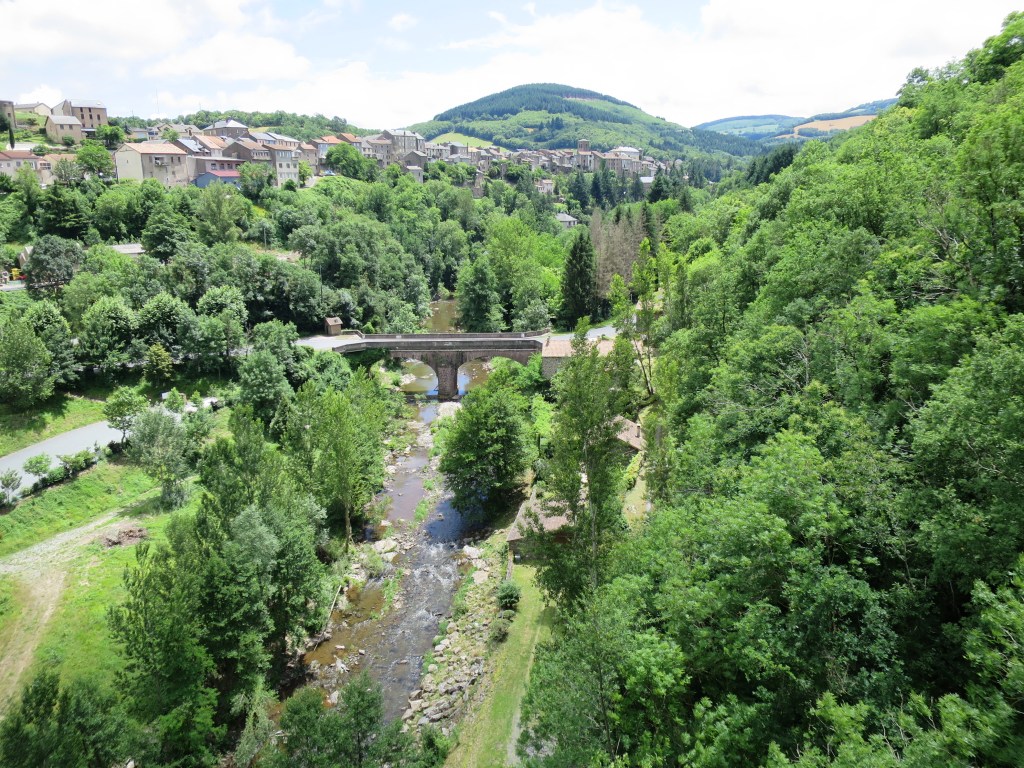
But, wait, something is wrong. The bridge is in the wrong place. Have I so misremembered? What has happened? I return to the beginning of the bridge. There is a turning down, along a road lost among trees, down to a stone bridge, the old road bridge. When I get down to the old bridge, I look up. The new high-level bridge is a mini-Millau viaduct. It cuts out the steep drop and rise up, the sharp bends. I push my bike over the old bridge, and try to scramble up, on the line of the old road, wanting to enter the village the old way. But it is fenced off. I have to return and enter the village across the new bridge, on the level. Everything has significance. I take a deep breath as I cycle slowly up to the square. I have these few moments to remember with my old eye, see with my new, to register what has changed.
The feed-merchant is now a modern garage. There is a statue of the enfant sauvage. The village hall is still there, under the car park, where we went to a dance that was one of the most dispiriting evenings of my life. The creaking old hotel has been refurbished to something more boutique (I’ve checked the prices). The Grand Café, on the square, has become the centre of village life, with live bands and events advertised, decent music playing now, a place that is trying, and hopefully succeeding. The alimentation générale has closed down. The basket-maker is long gone. I park my bike, and saunter down the narrow village street that runs away from the main road.
We rarely came here, beyond the alimentation. I came here more with Gabrielle. I know nothing of Saint-Sernin, the internet has almost nothing.
The village is on a bend in the river, where a tributary joins. It is a fortified medieval village. But I have no idea who built it or why. Gabrielle was curious, would have asked, found out, connected it to history, to France. One day a touring theatre group, Les Baladins du Havre, performed for one night in the square. She would have spoken to them, invited them back, at least found out where they were staying and joined them for the evening, arranged for other groups, for singers to come.
The houses had interconnected lofts – to facilitate defence, a placard says. There were gates and towers. Was this for the petty conflicts of local lords? Was it involved in the Albigensian crusade, the Hundred Years War, the Wars of Religion, the camisard revolt?
The little bridge is called le pont des morts; it was where bodies were carried on the mourners’ backs, across the river to the cemetery. Was there significance, symbolism in that? There is a stylish Renaissance house – whose? Why? I know so little. I imagine me/ we finding out over the years.
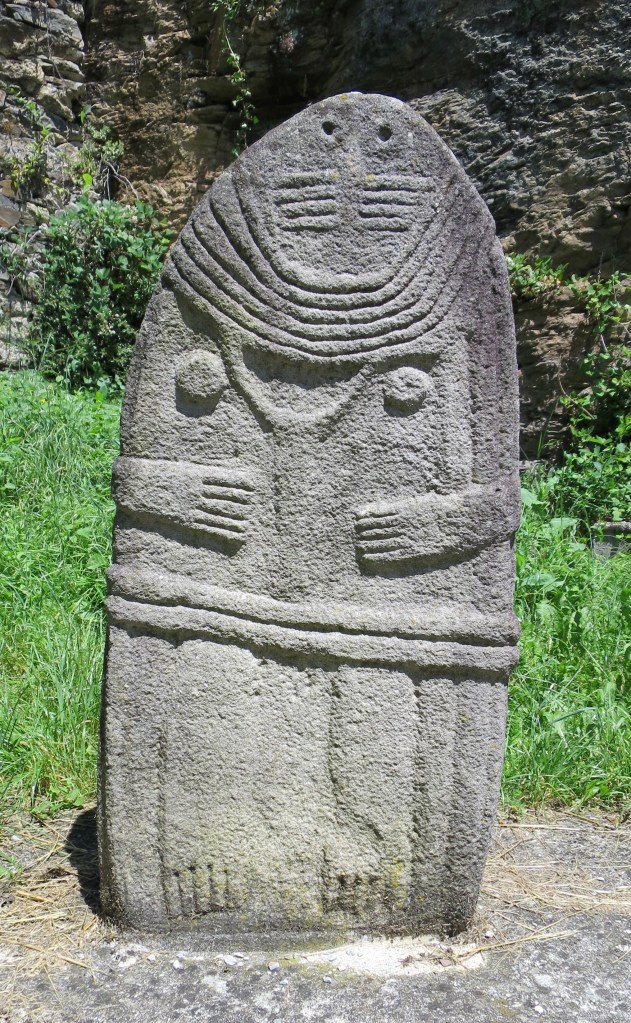
By the tributary stream, Le Merdanson, there is a copy of a small, carved stone menhir, set up where the original (now in the museum in Rodez) was found. Dated to 3500-2500 BC, it is a stylised female figure, remarked on for its ‘sculpture soignée’, carved with a complex iconography that would repay long study. It is reputed to have been thrown down and buried in 658, when St Martin was preaching against such pagan images.
Perhaps, rather, it had been hidden here, among the gardens that lined the stream, the peasants’ secret continuation of the old ways, the Celtic ways, venerated, buried to fructify and ensure the productivity of the gardens?
In a ten-minute walk I have learned more about, and stimulated more of my interest in Saint-Sernin than in two years living here. All these stories, in areas of knowledge that interest me, that I might have explored, expanded upon, written about …!
Past the mairie. I won’t ask about the Bonafets (she might phone them!). I decide that I will turn up and pretend to be lost. Who will be there?
I go to the Grand Café for coffee. I want to sit outside, collect my thoughts, make notes, prepare to leave the village and take the road to La Balme.
A woman is sitting on her own, in the sun. She beckons me over, insists on buying me a drink. Beer? No, coffee, thank you. She is drinking beer. As we talk, in French, I realise that she is rather drunk. She has that serious drinker’s way of trying to camouflage her drunkenness, of both acknowledging and doing nothing about her drinking. ‘I like beer,’ she says slowly. Then, after a long pause, ‘sometimes I drink too much,’ she says. Each sentence is carefully enunciated, separate, as if searched for and then hauled up out of a bag of sentences. And sometimes the sentence is not quite the right one.
It is an odd conversation, especially as she doesn’t speak very clearly and I’m reluctant to ask to her repeat in case she thinks it’s a comment on her state. Where had I come from? I tell her. ‘I was in Albi this morning,’ she pronounces. How did she get here, I ask? She sits, silent, looking at me, as if trying to put something together, gives up, says, ‘it’s complicated’. Is she staying at the hotel, I ask? Sort of, she says. She gets up abruptly to speak effusively to a young woman with a child. The child shrinks from her. Returning, she asks my age. I tell her. She says I look younger than that. And that she is younger. How to ask questions that don’t sound like leading questions, especially of a woman who is raw with her vulnerability? She is divorced, she says, gets on well with her ex-husband, she has a daughter in Marseille. Is she on her own? Should I offer to stay, to sleep with her? What am I thinking? Such bizarre thoughts! I’m feeling quite unhinged, trying to think of ways I might comfort her, make her feel better. Why do I want to help her, save her? What from? What for? She greets and waves extravagantly to some boys going into the bar, they are embarrassed, joke among themselves. ‘They like me here,’ she announces loftily. What to do? I need to get on. How to leave her without ‘leaving’ her. I look at my watch, well, I’ve enjoyed – she stands abruptly, cutting me off, gives me the briefest handshakes and is gone, as if to an urgent, just-remembered engagement. She’s left me. Better to leave than be left. The English have no manners anyway.
A strange encounter, signifying … what? Hermes again.
Unsettled, not having had the time I wanted to ponder, I walk over to my bike, wheel it past the hideous statue of Victor of Aveyron, the enfant sauvage, and set off, pushing, up the so-familiar hill.
Victor was one of the most famous cases of ‘feral children’, children who lived in the wild, supposedly in the company of animals, and who never, crucially, learned to speak. He was captured here on 6 January, 1800, and became ‘The Wild Boy of Aveyron’. He was sent to Paris to be examined, and was looked after there by a Paris physician who wrote a book about him. He died without learning to speak. François Truffaut made ‘L’Enfant Sauvage’ in 1970.
In the eighteenth century, under the influence of Rousseau and later the Romantics, the enfant sauvage easily becomes child to the ‘noble savage’, man in a state of nature, ‘gentle, innocent, a lover of solitude, ignorant of evil and incapable of causing intentional harm.’ (Benzaquen.) Whereas Enlightenment thinking was that being truly human meant to be rational, to be socialised, and, above all, to develop language.
I ponder this as I push my bike slowly up the long hill. I see now that we – my ex-wife and I, others of our generation – hadn’t realise how confused we were. We had been educated out of our class, working-class kids who’d ‘passed’ the 11+, gone to grammar school and university, Hoggart’s ‘uprooted and anxious’, and didn’t know where our loyalties, interests, even desires lay. I had been over-told. I did not know if the system was well-meaning, opening new horizons for me, and enabling me to bring benefits to those I would serve; or exploitative, taking my intelligence and aptitude and twisting it to the purposes of the established culture, for whom I would be the equivalent of a native colonial administrator, imposing alien values on ‘the people’ from my new position of privilege. By 1970 I just wanted to be left alone.
We wanted to be left alone. To ‘find’ ourselves, to explore alternatives, to live without societal pressure, to be ourselves. Whatever that was. Implicit was the presumption that by moving back down a couple of rungs on the ladder of social evolution, through urbanism and commercial farming, back to peasant farming, we would be two rungs closer to the essence of ourselves.
We saw the film, and to us Victor was our original self, an innocent, in a state of nature, who was progressively insulated from the ground and air with shoes and clothes, blinded to the subtle light and shade of the natural world by artificial light, living in a world increasingly filtered by words, his natural individuality suppressed by social conformity. As we felt had happened to us. We saw ourselves as reluctant children of the Enlightenment, who were rebelling against that blinding light, becoming more feral. It’s not a coincidence that long hair and bare feet were big things at that time. But we’d hardly registered that our village was where he had been captured. Strange.
In fact most feral children have been shown to have been abandoned by adults because of their physical or mental deficiency. Recent research on Victor points to his having few survival skills, living not in the wild, but close to houses, surviving on scraps, more street-child than wild-child; that the scars on his body, far from being the result of battles with wild animals, were the result of physical abuse, and that his behaviour was consistent with autism or trauma. Each generation – ours obsessed with lost innocence, this one with child abuse – rewrites its stories to suit its mythology.
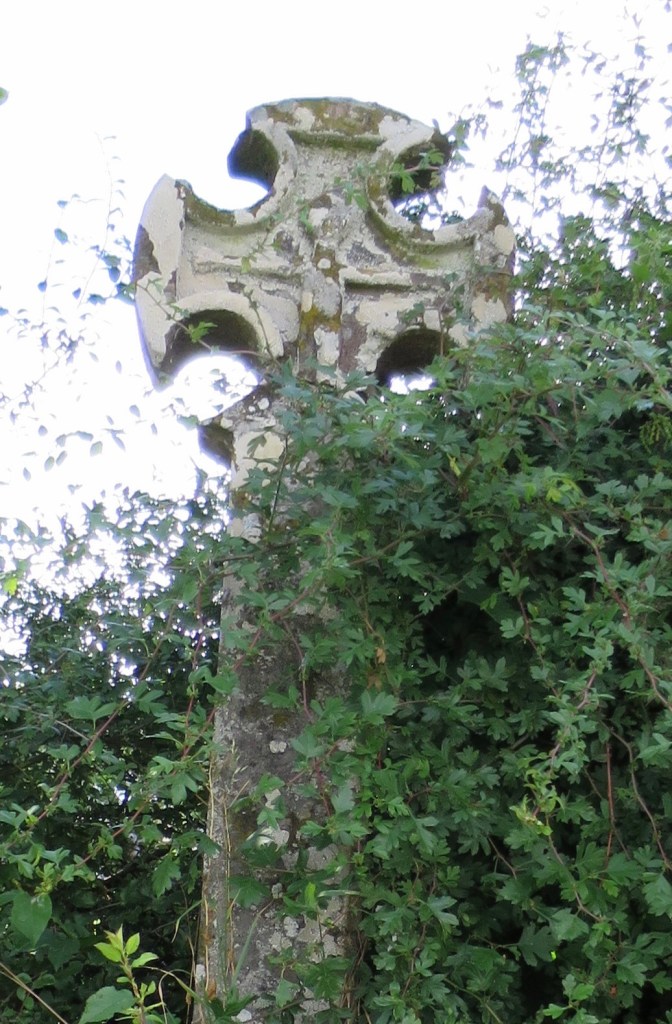
At the top of the long hill is the small stone wayside crucifix, now almost buried in the hedge, going the way of the Neolithic menhir in being lost and forgotten. The head of the cross is wonderfully simple: a disc, with four discs cut out of the stone to create the shape of the cross. There is a primitive Christ upon it. It is a Fanjeaux cross. Fanjeaux was a Cathar stronghold, and I have seen it described as a Cathar cross. But the Cathars did not recognise the cross – what true believer, they said, would venerate the instrument of their Lord’s torture? And Fanjeaux was where Dominic Guzman, who founded the Dominican order, based himself in his campaign against the Cathars. The Dominicans ran the Inquisition. Cathar? Catholic? It is no clearer. Is it very old? It could be any age.
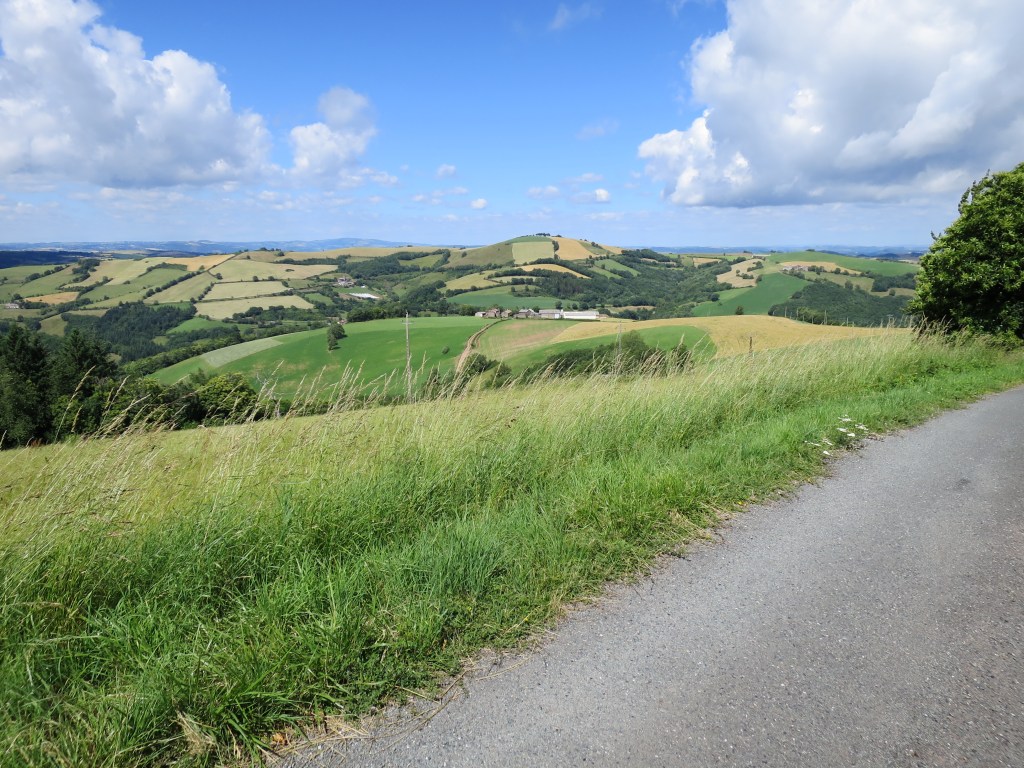
As I freewheel slowly down to la Balme, I am alert to note changes. How clearly I remember it as it was, this lane! On which, one night after rain, walking with a torch, I found several fat lizards, black with yellow patches, crossing slowly. Fire salamanders! Anything seemed possible in that world.
There is a large, new industrially-built sheep house, of steel, corrugated roof sheets and slatted wood.
All the vines are gone: ours were next to the neighbours’, and each produced a year’s wine. We shared the vendange with them, and the feast that followed.
The vegetable gardens are gone, the hedges around them ploughed out and the gardens lost in a field of wheat. Again, they had been next to each other, and by a source that never ran dry. Gaston would leave his tools with their heads in the water, so the wood swelled and the heads fit tightly. Patiently he guided us in our planting.
There are no animals out, as there were then, the cattle grazing quietly, the sheep being chivvied with whistles and trills to remind them to eat.
The potato patch is gone; Gaston would plough it and then earth-up the growing potatoes using the oxen.
Then, it was a mixed farm, wheat and sheep’s milk the cash earners, but two cows for milk, oxen to plough the awkward places, chickens, ducks, rabbits, pigeons, vines, vegetables, an annual pig, Gaston’s secret walnut trees.
Now it is a farm of open, empty fields, of sheep raised indoors, of haylage, wheat and pasture.
As I approach the hamlet, no dogs run out barking, the excitable, ill-trained dogs that would run along biting at the tyres. Gone too is the graveyard of road vehicles and farm implements, a history of the mechanising century laid out as in a farm museum, with nettles poking through.
I stop in the farmyard, park my bike. The duck pond has gone, and the waddling ducks, and the scratching, crooning hens, and the midden-topping cock-adoodling bantam roosters. Gone too is the byre where were tethered the huge, slow oxen, and the cow from which Madame returned each morning to her kitchen with a jug of warm, foaming milk. It is now a modern farm, with housed sheep, machine-milked I’m sure, some pasture, the rest for haylage and wheat, no other animals, no other life.
‘Our’ house is little changed. It has been tidied up, with new windows, and a flagstone terrace laid in front. As I would have done if I had stayed. After reroofing the house with tiles, I had carefully stacked the stone-flag lausses I had stripped off, ready. Good to see them used. The house is shuttered, shut up. It must be a holiday home.
There is a tractor at the bottom of the yard, bucking backward and forward as the driver uses the digger at the front to root out a tree. It stops its bucking, and the driver climbs slowly out.
He is a round-faced, comfortably-built, slow-moving, amiable-looking man. This should be Didier. But forty years ago he was slim, moustached, impatient, and always rushing. Perhaps the Bonafets did sell up, and this is a new, progressive man? And then as he climbs down, I see something that shocks me to the core. The man’s left forearm is missing. Cut off six inches below the elbow, ending in a tuck of skin. Who is he?
He speaks, in that casual, inquiring way that paysans do, even on their own property, so little of the brusque, proprietorial English farmer. The words tumble through a mouthful of marbles. I’m taken back forty years, instantly. The figure is not, but the voice is, Didier. What happened? A car crash? An accident on the farm? When?
He has grown up (grown up? He must be sixty) to be, not like his father, thin and bent and foxy, but like his uncle Gaston, easy-going and amiable. I stick to my story, tell him I got lost going to Coupiac. He lifts his cap (Didier never wore a cap), scratches his head, trying to figure out how I could end up here, explains in great detail a route along minor lanes I have never travelled adding, I’d drive you there, if you didn’t have the bike.
As we chat, he asks where I’m from. I say England. His face lights up. A young English couple used to have the house, there, he says, pointing to ours. I’m expecting him to say, five, ten years ago, thinking that it must have passed through many hands in forty years – ‘Keith et […] Walton’. He says our names, first and second names, remembered, without hesitation, after forty years, brought instantly to mind.
And isn’t this my moment to announce, ‘mais Didier – c’est moi, je suis Keith!’?
I don’t. And is it really because I fear he is about to continue, … ‘ – and those bastards ruined our lives!’?
I say nothing. How his face had lit up when he recalled! Now he carries on matter-of-factly, the light gone. They, les jeunes anglais, sold it to some people from Montpellier. He bought the house back from them and ran it successfully as a gîte for several years, but … the rushing account is lost among the marbles. But the sense is that it wasn’t worth the bother. Perhaps after his accident. Perhaps when his income grew so he didn’t need it. Perhaps when he acknowledged that he would only need the farm to support a bachelor.
All my years of guilt. When, for all his shy distance and youthful swagger, he had actually enjoyed having us, the hopeless but enthusiastic young foreigners with the strange friends, next door, around the place. As Gaston had enjoyed teaching us the old ways, because no one else was interested. The moment has passed.
I say, absurdly, that I like the farm, ask if I can take photographs. Of course. Am I cycling alone? he asks. When I say ‘yes’ he pulls a ‘rather you than me’ face, but slightly wondering, too. Where am I heading? How do I come to be in this area? And, as we talk, I see that behind the curiosity he has more than a suspicion who I am. I can see him at the Saint-Sernin monthly market, lunching with the other bachelors – as his uncle used to do – casually introducing and framing his story: strangest thing, this chap came on a bike, said he was lost, I’m sure it was the young Englishman who bought the Gascets’ place next door. He was about the right age, an old man now, no idea why he didn’t say. He must have had his reasons, it makes you strange, living in a city. The piece of news to share, his moment to hold the conversational stage, the take-off point for that market-day’s conversation.
Now I must get a pioche to get this tree out, he says. Pioche, the peasant omnitool. And how I want to get my pioche from our cave and help him with the task! I go to look around.
This was where our barn was, already burnt-out and collapsed when we bought the place, but with enough good stone to build a house. A gîte, maybe. Or a new house for us. Overlooking the valley, facing the rising sun. Below it was our meadow, where, taught by Gaston, I’d scythed the hay. In the middle was the willow I cut for the wands to weave a basket, under Gaston’s instruction. It would have made a lovely garden, surrounded as it is by feathery ash trees, from one of which I cut the handle for my hay rake. And there is a wonderful view. Down across the abandoned terraces, now lost in woodland. Chestnuts, where one could gather limitless nuts, the old staple. We boiled a few, for marrons glacés, for friends in England. Down and then up, on the other side of the valley, to a patchwork of fields, where there is a perfectly-placed church, and the road along which the headlights of silent cars passed at night. And the rolling blue Aveyron uplands beyond.
But the stone has been bulldozed into the foundations, covered in earth, the barn quite gone. As they had thrown the lausses off their roof when they reroofed their house, dumped them somewhere, while I brought mine carefully down, for the future terrace. The willow is gone.
I turn back to the farm. At the end of their farmhouse is a small, modern extension, where Didier lives his bachelor life. The main house is closed up. I wonder at what point he became a bachelor. Was the farm not big enough for a family? Was it after his accident? Another story I will never know.
Gone are the cages of rabbits and pigeons. They used to bait a cage and then, when a pigeon went in, drop the door shut with a string from the first floor, a peasant smile at their cunning.
The fine stone sheep house, where monsieur hand-milked the sheep twice a day, cursing in the stifling heat, the milk going to Roquefort, has had its lausse roof stripped, been reroofed with corrugated sheets.
The pig, that lived for a year in its little sty, fed on waste food and milk, has gone. Relatives and neighbours gathered for the killing and processing, the intestines cleaned by the women for sausages, the hams smoked slowly over the winter wood-burning fire in the wide, deep chimney.
We were here at the end of an era. I am glad I recorded it in Diggers and Dreamers. After the 1976 drought, when their well ran dry and they had to bring water in by tanker (our source never failed), mains water was piped in. That would have enabled them to machine-milk. What was then a mixed farm supporting a family, is now a mechanised sheep-rearing operation, run by a one-armed man.
I say goodbye. He smiles his uncle’s gentle smile. A knowing smile? Or the peasant smile of one who is forever amazed but never surprised at the weird things people do – Across the country? On a bike? On your own? Who knows. I want to shake his hand, feel his hand. But I have no reason to.
I wheel my bike out. Past another stone cross, the same pierced circle. Was this a Cathar village? Were those interlinked lofts in Saint-Sernin, rather than for defence, in fact the secret hiding places and escape-routes of the parfaits?
How delighted Gabrielle would have been, for Fanjeaux was the home of Esclarmonde de Foix, the greatest of the parfaites, who debated with Dominic himself.
And the Cathar ‘cross’ perhaps represents, rather than the crucifixion, the radiance of the True Word from Christ …? There is writing, there are dates on it, under the moss. Did I really never remark it, clean it off, this mysterious cross, a few feet from our house, read what it said, find a message there? I sigh at how little we did, all the things we/ I didn’t do, how much I missed.
Cycling slowly back up the hill, I remember that the idea to move to the country came from working in the Ecology books section of Watkin’s esoteric bookshop, and reading the books that predicted that by 2000 we would run out of oil, and there would be an ecological crisis (another ‘take’ on the Millennium), and the magazines that showed you how to live self-sufficiently with very little effort. Moving to France, coming here, was because friends came before us. It was another version of ‘dropping out’.
But we had no skills, not even the ability to work hard physically. All that came after I returned to England, trained as a carpenter, worked manually. I spent the rest of my working life learning the skills needed to succeed in the life I’d failed to live here.
If I had stayed, I would have been able to preserve the old ways, continue to learn the skills, maybe even encourage the neighbours to keep them going, making it worthwhile for them by attracting visitors. Visitors would be fascinated by hand-milking, Gaston’s demonstrations of old skills!
But that would turn them from farmers into performers. Isn’t this modern commercial farming more authentic?
Even so, I could have learned the forgotten history, found out – if they didn’t remember, there would have been stories from fathers, grandfathers – when they stopped growing rye on the terraces, when liming the acid soil of the rough, open land allowed them to plough, when chestnuts ceased to be the staple, what those first schools were like when they were beaten for speaking patois, how they lived under the Occupation …
And as I pass over the brow of the hill, and la Balme disappears behind me, I realise why I didn’t tell Didier who I am. He would have invited me for coffee, we would have ‘caught up’. But this journey is not about reconnecting. It is about registering. There is the world of then, as remembered in my head, and recorded, and invented in Diggers and Dreamers, the life I chose not to live. And there is the world of now, as I experience it. Any mixing of the two would blur this life, for which I need all the clarity I can get. I descend slowly, slowly, to Saint-Sernin.
As I cross the new bridge, leaving Saint-Sernin, the words of a song, ‘a lot of water under the bridge, a lot of other stuff too. Don’t get up gentlemen, I’m only passing through …’
I take the turning to Coupiac, to the nearest camp site. And where I worked for a year in the abattoir.
I am cycling alongside the Rance, a gentle valley road, the small pale leaves of the poplars by the water glittering and shimmering in the evening sun like myriad butterflies dancing around the slender trunks.
At Balaguier there is another small statue-menhir; this one’s sex has been changed, the female features replaced by male. With Gabrielle, I would have said this marks the victory of patriarchy over matriarchy, Zeus over the Mother Goddess, the arrival of the sky gods and their dominance, ever since, over the earth deities. She would have enthusiastically agreed.
At Plaisance there is a small pig-processing factory. A notice emphasises trust and tradition, the butcher travelling around the farms to collect the beasts individually. Perhaps it is to contrast their methods with Serre at Coupiac, where I worked, who shipped them in in big lorries, and was forever commercialising and industrialising.
I leave the Rance at Plaisance, and head up to Coupiac.
Coupiac is built in the narrow valley of a tributary of the Rance. A good site for mills. There is an Occitan song, ‘la Copiaguesa’, ‘the Coupiac girl’, about the lovely girl at the pretty mill. The Occitan songs, often composed to old tunes, were written, a notice tells me, by ‘erudite locals’ in the late-nineteenth and early-twentieth centuries, under the influence of the Félibrige, the Occitan revival movement founded by Frédéric Mistral. At the time when Occitan (the local patois) was being suppressed in the schools. The summer I met her, Gabrielle had visited the leaders of the Occitan movement in Toulouse, talked to the young singers and musicians who were doing for Languedoc what Alain Stivell had done for Bretagne.
There is a castle here, at Coupiac. More fortified house than castle, privately owned. I can imagine Gabrielle, with friends from Paris, having la Balme as their base, developing it as a new troubadour centre – not revivalist ‘folk group’ troubadours, but electric, electronic bands – Occitan rappers! I’m still dreaming of the life that didn’t happen.
The church was rebuilt in 1762, ‘to welcome the influx of pilgrims coming to venerate the relic of the Holy Veil’. I’d known nothing of this. The fragment from the Virgin Mary’s veil had been hidden from the Protestants in the Wars of Religion, and the hiding place lost. It was rediscovered when the villagers dug at a place where a bull repeatedly pawed the earth, making ‘extraordinary moans’. It cured eye problems. I remember ‘Hermes, who as Mercurius, is also the Virgin Mary.’ (Michell.)
Nearby is the square, where in the nineteenth-century the locals brought their wheat to be threshed, using a communal horse-powered threshing-machine. The threshing-machines introduced in England in the 1830s resulted in riots and machine-breaking because they put men out of work. The same threshing-machine introduced here was welcomed, because it eased the labour of peasant farmers, and added an enjoyably communal occasion to their isolated lives. Same technology, different application, different effect.
I remember the mobile distillery, all gleaming tubes and spouting steam, coming after the vendange, parking here, and the locals bringing their grape-must to be distilled into their legal allowance of eau de vie.
But the narrow valley makes it susceptible to flooding. On the épicerie wall are two flood-level marks, one a foot from the ground, 1968, the other above the top of the door, in 1993. There is a note on the window saying that because of 28 November 2014 floods, the shop has moved to the village hall. Seven months later, it is still closed.
The village looks run-down, there are many places for sale, including the restaurant that advertised its ‘workers’ menu’ on the road from Albi, filled in those days with twenty or thirty abattoir workers every lunchtime. What has happened to the abattoir? I will find out tomorrow.
As I cycle through, following the signs to le camping, I see that the furniture factory is doing well.
It’s an unexpectedly attractive camp site, with chalets and a café, among trees and by a lake. After I’ve put up my tent and showered, I go to its café/bar/restaurant, La Popotte.
Brightly-painted trestle tables are laid out under an awning, overlooking the still lake, which is a coin of reflected sky amid dark trees, disturbed by the occasional water fowl then returning to its silvered stillness, and colouring and darkening slowly, as the light fades, to starlit black velvet.
The bar, on an empty campsite, outside a small village, in the remote uplands, has style, ambiance. It’s run by a young rasta-haired cook and a long-haired, friendly girl, and the decor, the music, the exotic burgers, give it the feel of a café hangout. How great, to have such a place, so close to la Balme! Again I’m imagining it here, back then, our friends, from all countries, meeting here for the shared celebrations, St John’s Eve coming up … But they aren’t us, they’re our children.
I ask who the band playing on the sound system is. Moriarty. A musical collective, born in France to American parents, named after Kerouac’s Dean Moriarty. It figures. Kavin says he’ll copy it if I have a memory stick with me. It’s that sort of place.
I drink wine, and Céline tells me how they come to be here. He is Belgian, she is from near Paris, they met in Switzerland. They got together. They took over this place in March. Are there enough people who share this style? Enough campers to make the site pay? Like the bistro-owner from Calais, at Vallon-en-Sully, they will only begin to know at the end of the season. Will they stay here, stay together, have a family? Who knows. I will never know. Just passing through.
But in the passing through, a delicious, expansive evening. As I ponder the list of exotic burgers, they say there is a dish of the day, a pot of dinde, slow-cooked with prunes and lemons. I think dinde is guinea fowl; I wouldn’t have had it if I’d remembered it’s turkey. But, no factory-farmed turkey this, a fine farmyard bird. The dish is fabulous. Tender, flavoursome meat, fragrant lemon sharpness, sweet, juicy prunes. A triumph. The wine flows, the music plays, and the evening slowly wraps itself around us. The dish is a rehearsal for St John’s Eve, when he is cooking for forty. Oh, how I’d love to stay for that! I’m in a dream: well-fed, nicely wined, a warm evening, having been to la Balme, remembering the feu I attended in 1976, and back further, to my first time in France, fifty years ago …
They receive a phone call, and a couple turn up. She is beautiful, she enters, sits, ignores everyone, looks straight ahead. He is soft-faced, ordinary-looking. She is brittle, aloof, does not speak. He fusses around, asks her what she wants, relays it to Céline. His job is to arrange things perfectly for her, which he does nervously, willingly. It is time for me to leave. I pay, and, a little drunk, I stroll round the lake.
Shaded by the surrounding trees, open to the night sky, unmarked, a lake of mystery to row out slowly on, to the centre. And then …?
Heading for my tent, I remember that Céline didn’t include the wine on my bill. I hurry across, she smiles her enormous smile, says, ‘you’re great!’, I hand her a note and, warmed by this gentle evening, I stumble through the dark to my tent.
Note: this was Day 20 of my 2015 cycle ride across France, from Dunkirk to the Pyrenees, following the Paris Meridian, renamed in 2000 La Meridienne Verte, to commemorate the Millennium with a line of trees to be planted across France. I published it as In Search of France’s Green Meridian. It is on this site in full, in the drop-down menu MY BOOKS.
 my writing
5 responses to “Return to La Balme …”
I still remember when Kathy and I came and visited you at La Balme. Such days, when we were all tuned in, turned on, and dropped out in our own ways.
This is a great piece of writing Keith, thanks for sharing.
LikeLike
Thanks, Harry, it was a great visit. The girls loved the space and the animals. And the evening at Liz and Rory’s, when the electricity failed and you told stories pretty much through the night, was especially memorable. Great days. Thanks.
ps, enjoying your stories!
LikeLike
Thanks, Harry. The girls loved the space and animals. And I vividly remember our evening at Liz and Rory’s, when the electricity failed, and you told stories all through the night. Great days. Thanks.
LikeLike
Oh Keith this moves me so much, for all the reasons you know: I know your story, from both books, and there is SO much resonance with my own from that time just a little further south. So many of your references, cultural, historical, philosophical, are my own lodestars. I felt great nostalgia (and noticed how I was hoping that I’d misremembered, and that you DID tell Didier who you were – until you reminded us why you didn’t.
Your writing, as always, is exquisite: lyrical, descriptive, profound.
I hope that as a result of this you sell many copies of the Meridian, and also of D&D.
Thank you. Lovely to revisit.
Roselle
LikeLike
Thanks as ever, Roselle, for your interest and your sensitive reading. I realise from my account (most of it written up directly from my diary) how much processing I was doing, in real time, of thoughts, feelings, memories, many of which I’d locked away for forty years. Even to go there was such a big thing! Of course going there freed me to declare myself. But by then the moment had passed. However it had also freed me from dragging around with me those unprocessed memories, thoughts, feelings.
Thanks and best wishes
Keith
LikeLike