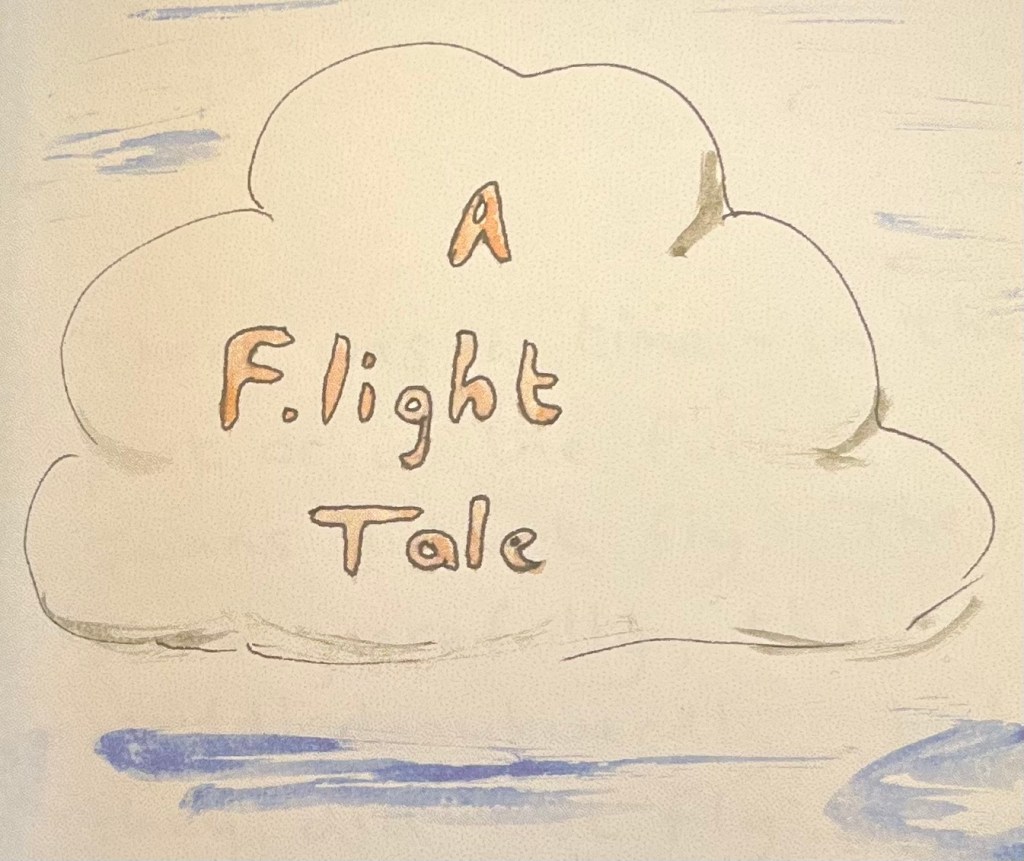
There was a time – in the past or in the future – when swans did not fly. They swam gracefully, they waddled awkwardly, but they did not fly.
She was a bright and pretty cygnet, the best of the brood. How proud her parents were to watch her sport with the others, to see how in her excellence she outshone them! She was a cygnet who was remarked upon – whether from jealousy or in admiration – never overlooked.
Of course there were difficulties in the change-time from cygnet to swan, when the young’s colour and manner co-exist uneasily with the adult’s form, when they are for so long dowdy, awkward and self-conscious. What swan and what swan parent has not suffered agonies at that time? But when she was through it – well, her beauty would take your breath away, and her intelligence would startle you with its freshness.
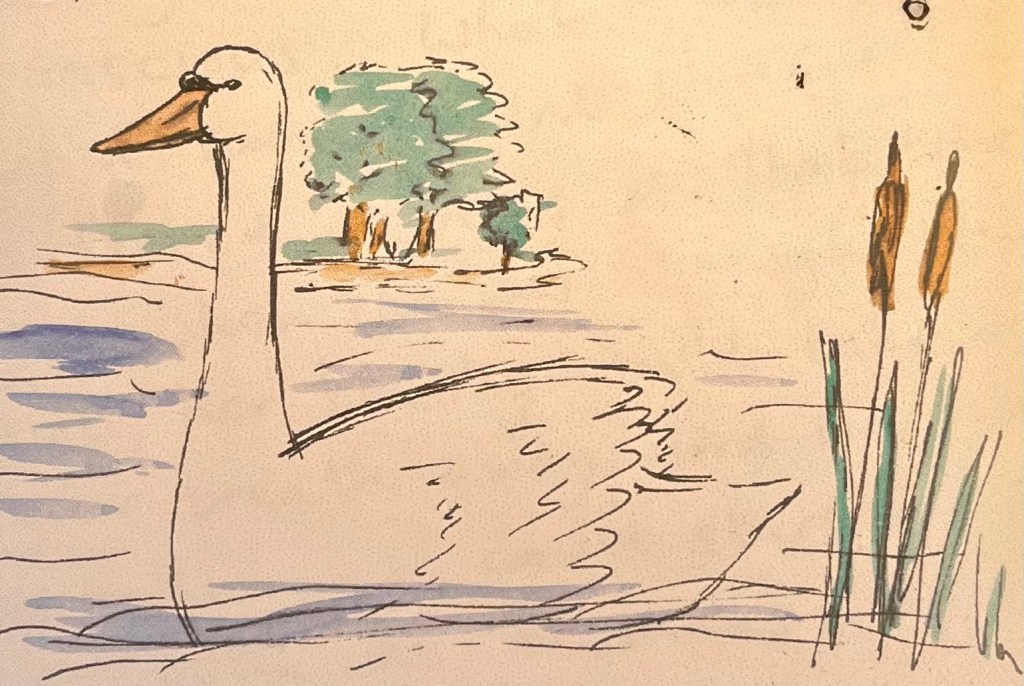
And yet she was not happy. There was a shadow over her, and within her a whispering voice of dissatisfaction. It was as if the sun no longer shone fully, ever. Other swans she managed, hesitatingly, to talk to about this said, ‘It always happens when you grow up – it’s a sign you’re no longer a cygnet. It’s inevitable.’
She could not accept this. There was something missing from her life, and she had to know what it was. She became moody and solitary – ‘strange’, said the other young swans.
Instead of spending her days frolicking with the other youngsters, or learning the duties and practises of swanhood, she would go for long solitary swims on the empty, shaded backwaters, searching. Although for what, she did not know.

One evening, as she paddled despondently on the weed-snagged water of a neglected reach, she heard something. It was a rhythmical, whirring sound that stirred her blood. She turned her head this way and that to discover its source. It got louder and louder, thrilling in its unidentifiable familiarity – and then, across the sky flew a ragged chevron of geese. Her heart leaped. The confusion of thoughts and feelings, the discontents and longings suddenly stilled. To fly.
As she watched the geese pass overhead and then diminish into the sunset sky, her yearning stretched her heart almost to breaking point.
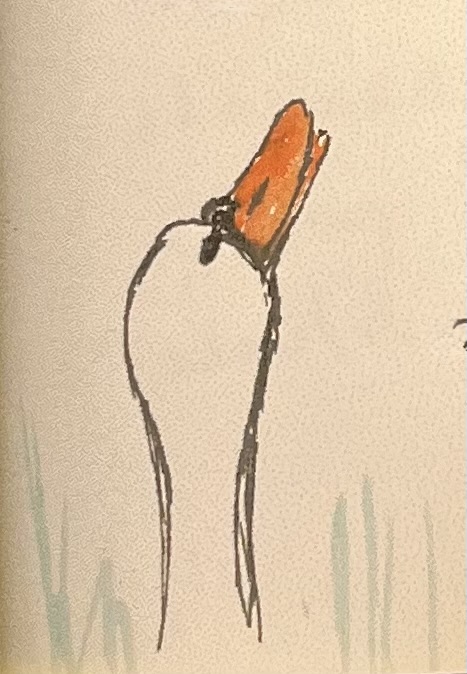
And then they were gone. There was silence. Then her excitement bubbled up and she raced this way and that, hissing wildly, flapping and splashing with her great white wings, overwhelmed with joy that now she knew what she must do. It was as if the voice of dissatisfaction had changed to one of affirmation, giving her life purpose. She would fly.
When she got home her mother remarked on her new-found happiness. She smiled mysteriously and said nothing. She curled up that night with the knowledge drawn tightly to her, and slept soundly.
x x x
Early the next morning she set off for the neglected reach. The flowers were glowing with colour, the birds were bursting with song, the sky was clean-swept and brilliant.
But now her problems began. How, actually, to fly? She flapped her wings as hard as she could, but that just threw up a choking spray. She stood on the sandy margin of the stream and ran and jumped and flapped, and landed with a thump.
The problem, she realised, was not flying, but taking off. She tried to force herself, to will herself into the air, without result. In a final act of desperation she climbed onto a high section of bank and hurled herself off, flapping her wings madly. She hit the water with such an impact that she was stunned, and only just avoided drowning.
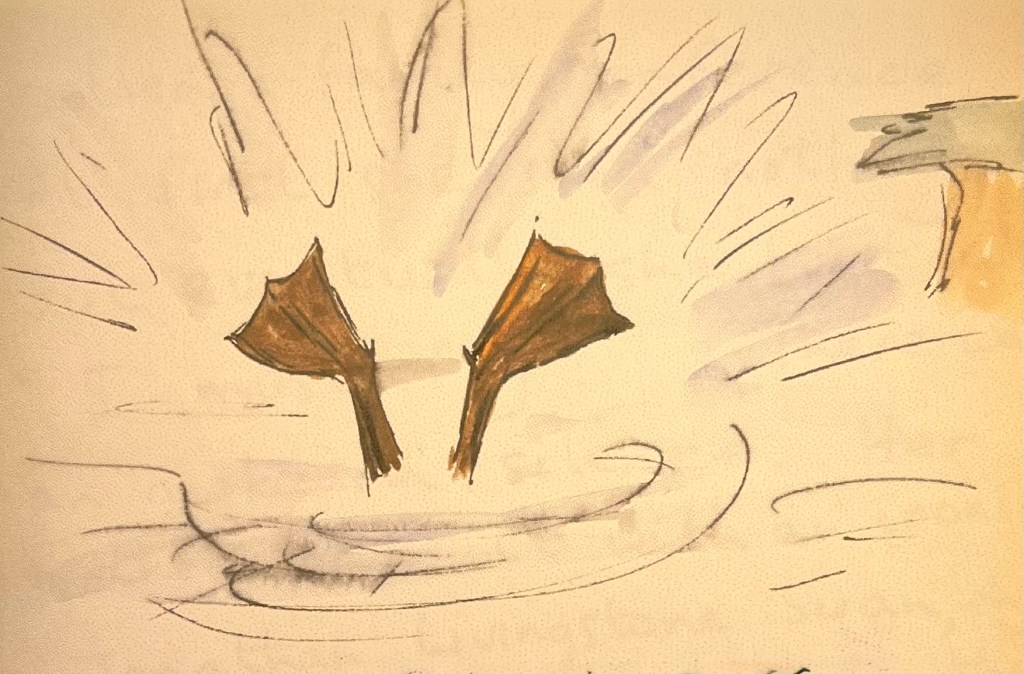
At the end of a long, long day, tired and sick at heart, she forced her weary body on the long swim to her home.
She looked so bad that her father called a family conference. At first she said nothing, but eventually she burst out, ‘I must fly!’ There was an awkward silence.
Her brother broke it with an ironic, ‘Jonathan Livingstone Swan, eh?’ Which didn’t help.
Her mother said, ‘but darling, swans don’t fly. Goodness knows we have enough problems walking and swimming without bothering ourselves with flying. Why not work at making things better here and now, instead of dreaming of something new?’ Then, ‘why do swans want to do things new, rather than better?’ She was close to tears.
Her sister said, ‘there’s so much to do, so much to be had. Your troubles is that you don’t get out enough, you don’t mix with the others. Come out with me, I’ll introduce you – they’re a great crowd, and they really like you.’
Her father said, ‘swans have always dreamed of flying, my dear. Philosophers have written about it, scientists have studied it. Even now our finest bio-engineers in the great universities are working on it. And there’s no reason why, one day, you shouldn’t work in that field. But first you must study, gain qualifications. You mustn’t be so disparaging of swans. You must become less of an outsider.’
Swan loved her family and they loved her and she knew it. So she tried to see things from their point of view, and follow their advice. She studied seriously, she mixed socially, and she did well.
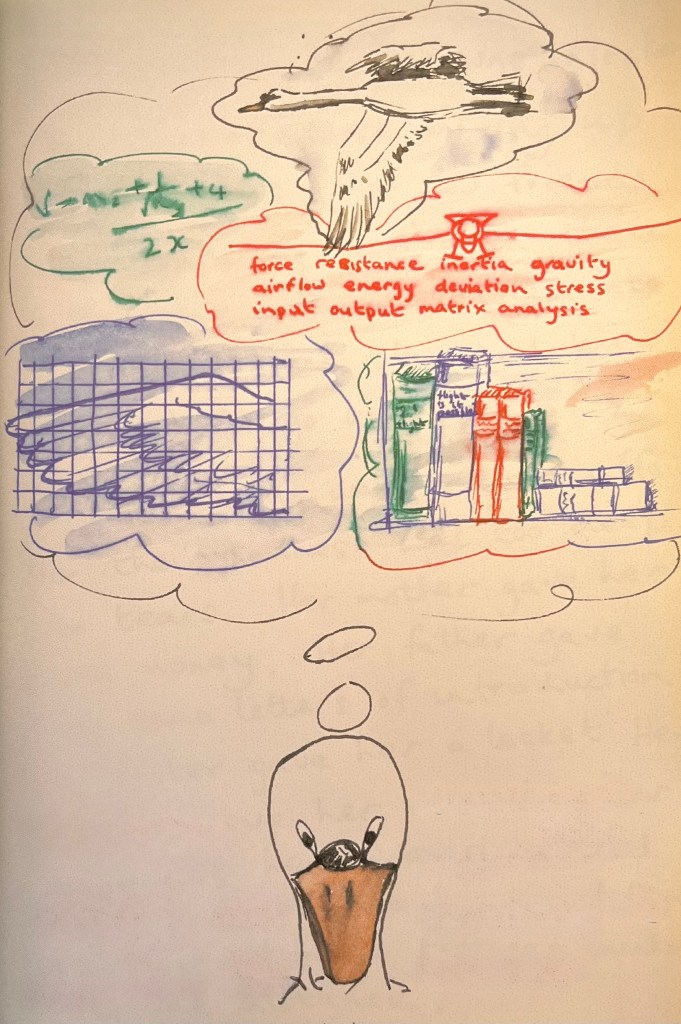
For a while she was contented.
But the further she went, she realised that she was losing something, and that something was the most important thing – the original spark of desire that had ignited at the centre of her being.
The more she read the philosophers, the more she studied the technologists and bio-engineers, the more remote she felt herself becoming from her original intention. She was losing herself.
‘This isn’t the way to do it!’ she burst out fiercely while reading a paper on ‘flight-feather modification by hormone injection’. Her studies were mixing up her thoughts. Her new friends were confusing her with their attentions. She looked up into the clear blue sky, and knew she had to go away.
Her leave-taking was a quiet affair, for their sadness was too deep for tears. Her mother gave her some money. Her father gave her some letters of introduction. He sister gave her a locket. Her brother gave her a book. Her heart was heavy as she looked round from time to time and and saw the four motionless figures shrinking into the distance.

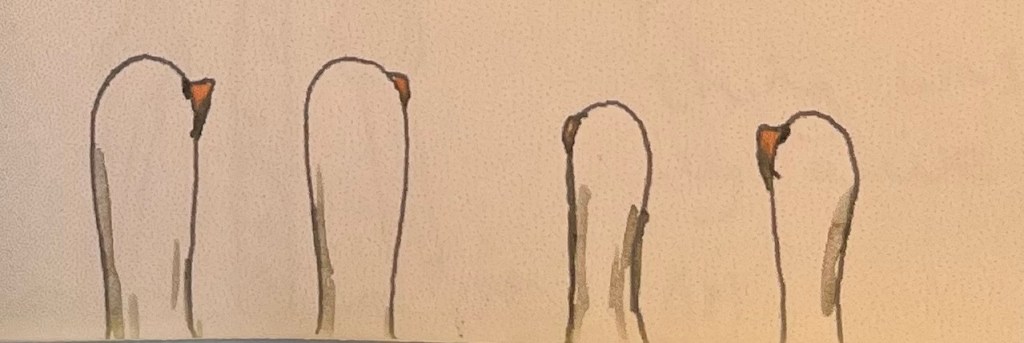
But once they were out of sight her sadness went and her heart lifted. She walked rather jauntily, looking around, seeing river and sky and trees as if for the first time. And yet she had no idea where to begin her search.
She was just pondering this when she saw a strange sight ahead. By the side of the road was a large feathery ball supported on three thin pillars. The thing was evidently alive because from time to time it shook and wobbled. She approached it timidly. Close to, she saw that two of the pillars were legs, the third was a neck. Then she recognised it from a picture in a book.
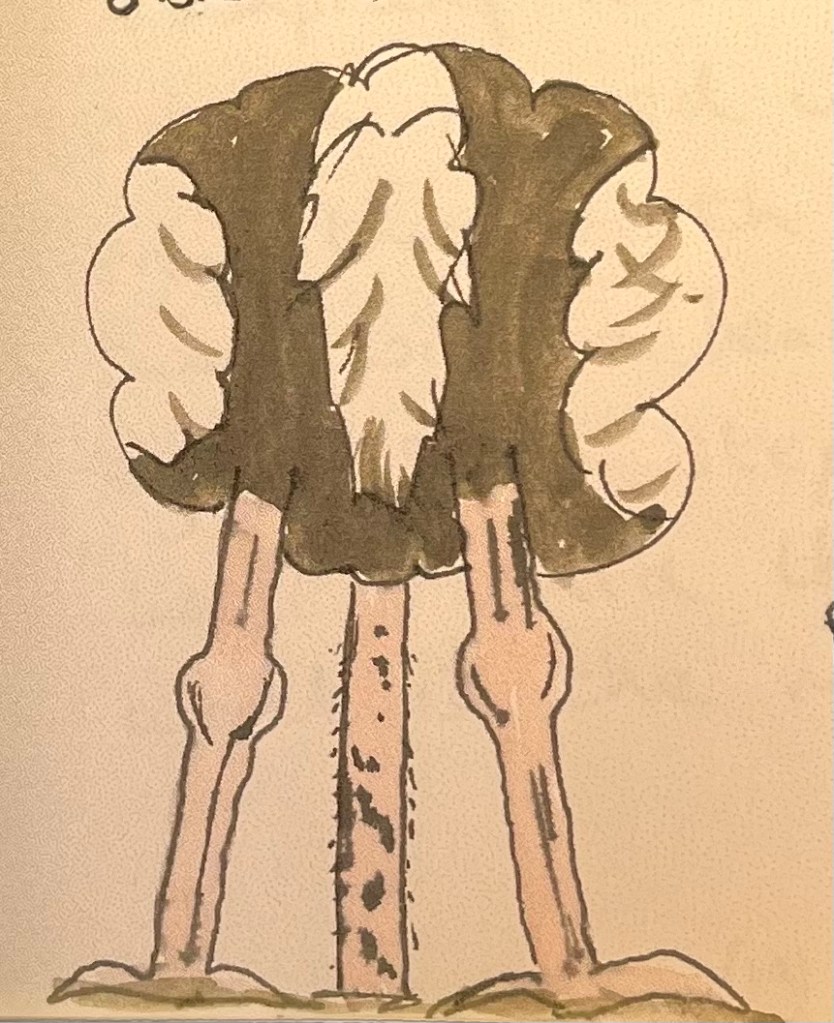
When a polite cough got no response, she prodded it gently on the rump.
With much humphing and coughing the ostrich reared up his head from the earth and fixed swan with a beady and myopic eye. Swan stepped back.
‘Well?’ said the ostrich severely, ‘what is the meaning of this? Why have you interrupted me in the middle of my studies, just as I was on the edge of a most important breakthrough?’ Swan stepped back again. ‘I’m sorry, ostrich,’ she said, ‘it’s just that you’re such a big bird, I thought perhaps you could help me? You see, I want to fly. I thought perhaps you might …?’
‘Weeell,’ said the ostrich, its stern expression softening to a superior smile, ‘you have come to the right bird, young swan, for I am writing a treatise on flying. A masterly work, though I say it myself.’ Swan stepped forward. In fact,’ added the ostrich confidingly, ‘if you were to become my assistant, I would reveal to you all the results of my researches,’ and began to scrabble in the sand, pulling out sheet after sheet of diagrams and writing. ‘Look, diagrams of the mechanics of flight – forces, resistances, and all that. And here’s a history of flight, from the gliding reptiles on. And here – oh this is very interesting, “Flight in Myth and Religion”. You see,’ he continued excitedly, ‘it’s all here. It just needs someone, someone interested, a bright young swan like you, to help me pull it all together. It’s here. It must be here!’
Swan was confused by all the paper flying around. She said,
‘but all I want to do is to fly. Perhaps you could just – show me?’ The ostrich went quiet. He looked very embarrassed. ‘D’you know, that’s the strangest thing. Since I started my research, I seem to have forgotten how actually to …’ He stopped. Then recovering his blustering manner, ‘but if silly creatures like you didn’t keep disturbing me, and breaking my concentration I would remember. Because it’s perfectly simple, if you’d just let me think about it!’
Swan suddenly felt very sorry for him. She said, ‘I apologise to have disturbed you. I’ll go now, and leave you to your thoughts,’ and set off along the road.
She saw the ostrich looking sad and lost. She watched as he put on his fiercest look, and plunged his head back into the earth.
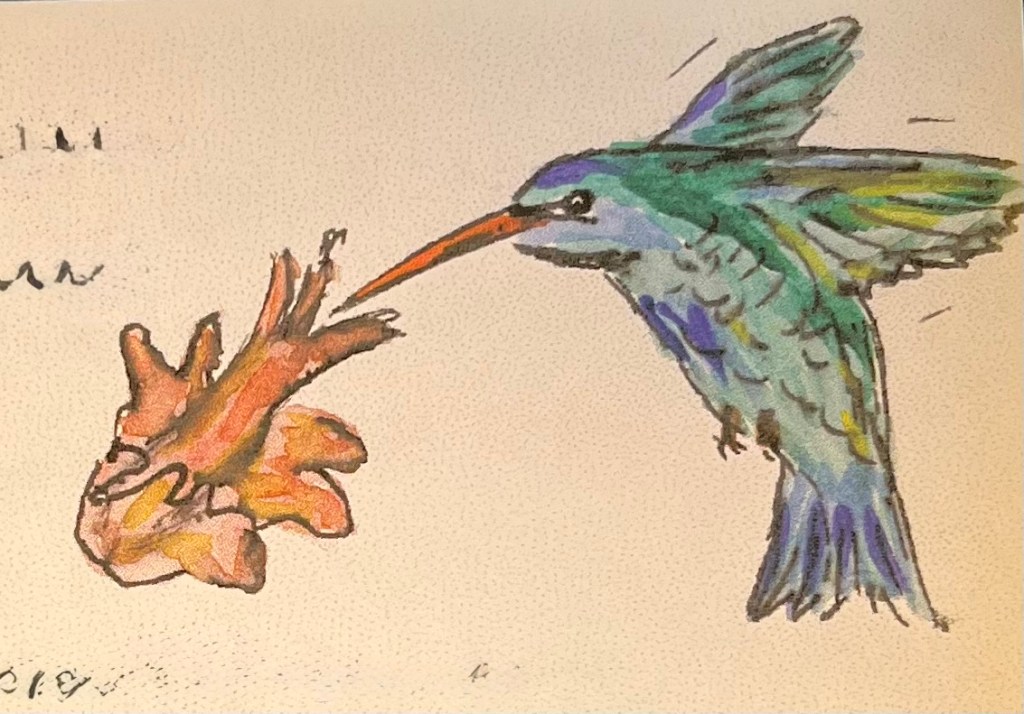
She plodded on until a rumbling in her tummy reminded her that it was a long time since she had eaten. She sat down in the shade of a tree and began to munch the food her mother had packed. Presently she heard above her head a soft whirring sound.
She looked up to see a brilliantly plumed bird hover at a flower blossom for some moments, move suddenly away to another blossom, then dip and dart this way and that. Its wings were a rainbow blur, and its movements were so controlled and exact that swan watched entranced. What a brilliant flyer! Surely this bird could help her? She called out,
‘Excuse me? I want to fly, and you’re so marvellous at it, I wonder if you would tell me how to do it?’
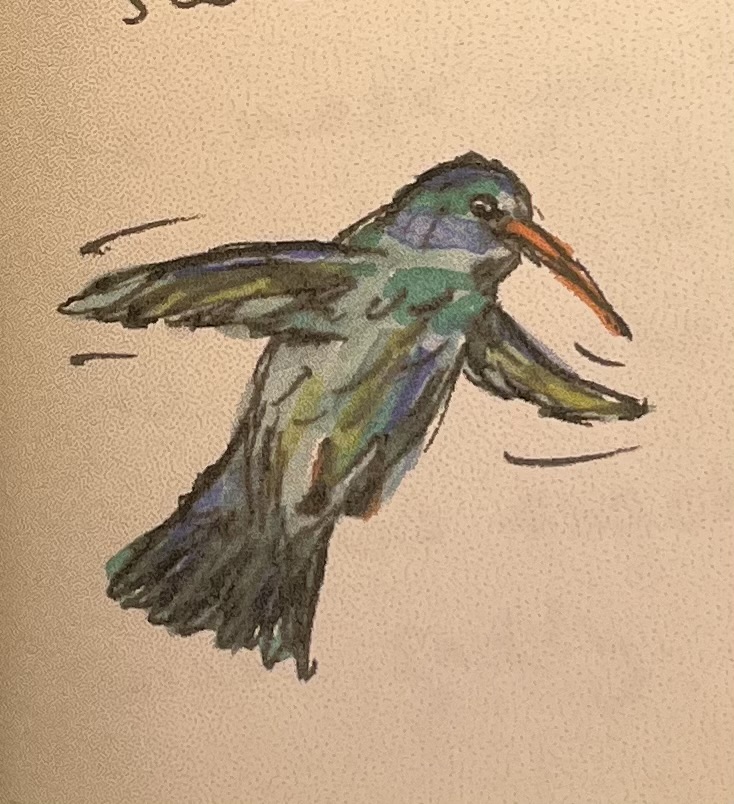
‘Who, me?’ Said the humming bird, reversing gently then swooping around in a nonchalant display of aerobatics, before landing at swan’s feet.
‘Yes,’ said swan, full of admiration.
‘I don’t really know,’ said the humming bird, frowning in unaccustomed effort at thought, ‘I just sort of do it. I mean, from being tiny, in the nest you know, it just came naturally. It’s just part of me – do you know what I mean?’
‘I know exactly what you mean,’ said swan sadly. ‘Perhaps it’s true what the others say, that it isn’t part of being a swan, that it’s unnatural that I want to do it.’
‘I don’t know about that,’ said the humming bird, taking off and casually hovering by swan’s head, ‘as I say, I just do it,’ and darted off in a blur of colour.
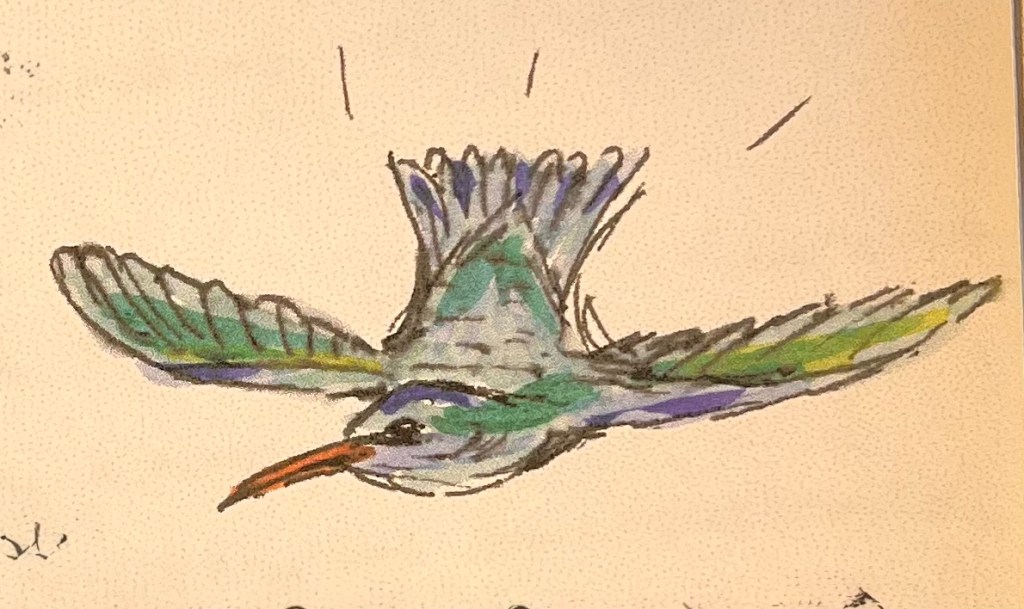
‘That’s what I want,’ said swan quietly, ‘to just do it.’ The idea seemed absurd when she looked from herself to the humming bird. Swans just weren’t made for it. The thought depressed her.
Then she slapped her thigh with her wing and said aloud, ‘this won’t do, swan. You either believe in yourself or you don’t. Just pull yourself together and carry on.’ She scrambled to her feet and set off along the road with a new determination.
But as she walked her sadness deepened. The incident had depressed her, and she found herself sinking down and down, walking slower and slower. She had walked for a long time in this state when something caught her eye.
It was a word. ‘FLY’. She stopped and looked hard at a poster pinned roughly onto a tree. She was suddenly wide awake: ‘SWANS, LEARN TO FLY.’ It said, in bold letters, and gave an address in the big city. Her heart lifted. At last! ‘The darkest hour,’ she murmured to herself with a satisfied smile, and set off with renewed vigour towards the big city.
x x x
But the big city confused and terrified her. Pushed and jostled by milling crowds of silent individuals, each pursuing some unknown and incomprehensible destiny, she felt alone and lost. Only the firmest application of will saved her from being overwhelmed and brought her at last to the address on the poster.
A smiling swan greeted her, said yes this is the place, took some money from her, and led her to a door. Swan took a deep breath and pushed it open.
Before her was the most bizarre spectacle she had ever witnessed.
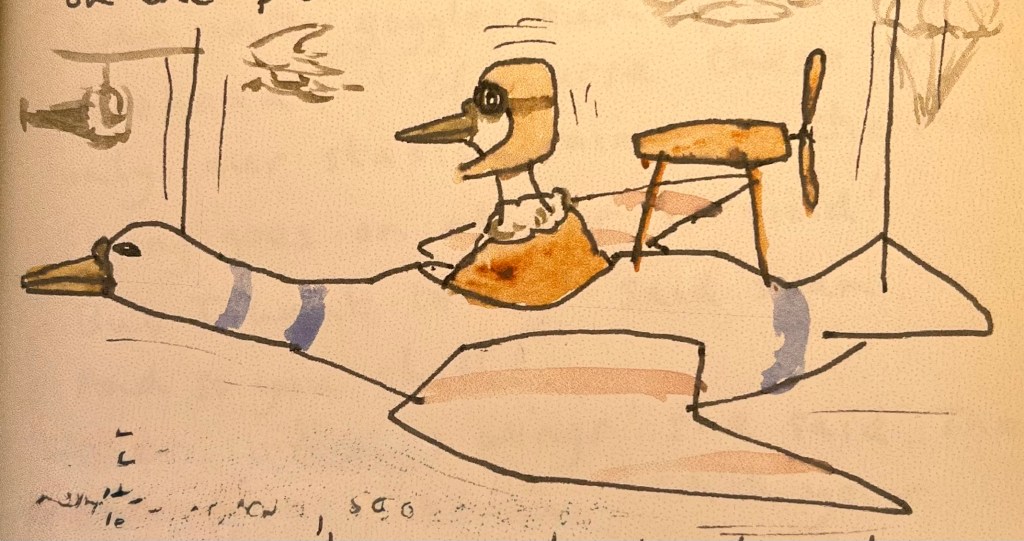
The large and echoey room was filled with strange apparatus, on the floor and hanging from the roof. There were aeroplanes, gliders, autogiros, balloons, helicopters, parascenders, microlights, hang-gliders – in fact every conceivable machine for flying. The craft bounced up and down, rocked forward and back, swans bustled this way and that, and the place vibrated with activity.
‘Impressive, what?’ Said a leather-clad swan with goggles pushed up onto his forehead. ‘Of course these are only our static trainers – the real flying goes on at our airfield.’
‘But I want to fly,’ said swan.
‘And so you shall.’
‘But – with my wings,’ she said.
The swan looked stunned. ‘With your wings? We’re not ducks, you know, we’re not parrots. We alone of the birds have evolved our intelligence to the point where we can construct flying machines. With these machines we can fly higher, faster and farther than any bird. In comfort, and without effort. And you want to fly with your wings?’ he scoffed, adding in a harder tone, ‘swans fly with their brains.’
‘But I want to fly with all of me,’ she said hotly, ‘not strapped into some absurd machine.’
‘Absurd? These, the finest products of our technology, absurd?’ He was becoming angry. ‘Oh, I see what you are – you’re one of those escapist dreamers who let others do the real work. Well, try next door – they’ll soon have you flying,’ he sneered and pushed her out into the street.
Bewildered, swan stood on the busy pavement. Then she saw the open door. It looked inviting. She entered.
Inside the atmosphere was calm and peaceful. It was such a contrast to the flying school that she breathed a sigh of relief, and the sigh seemed to vibrate for a long time before being absorbed into the stillness. A tall swan approached noiselessly. ‘Welcome,’ he said, his voice caressing, his eyes direct, his face radiant, ‘welcome.’
‘I want to fly,’ swan said firmly.
‘Good, good,’ he said.
‘Can you help me?’
‘All things are possible here.’
‘What do you mean?’ She asked, suspicious.
‘Come, let us sit down, and I will explain. But first – a small matter – we make no charges here, for the knowledge must be open to all. But perhaps you would feel more at one with us if you made – a donation?’ He handed her an envelope into which she put some money. She put the envelope onto the table. They sat down, and he began to speak:
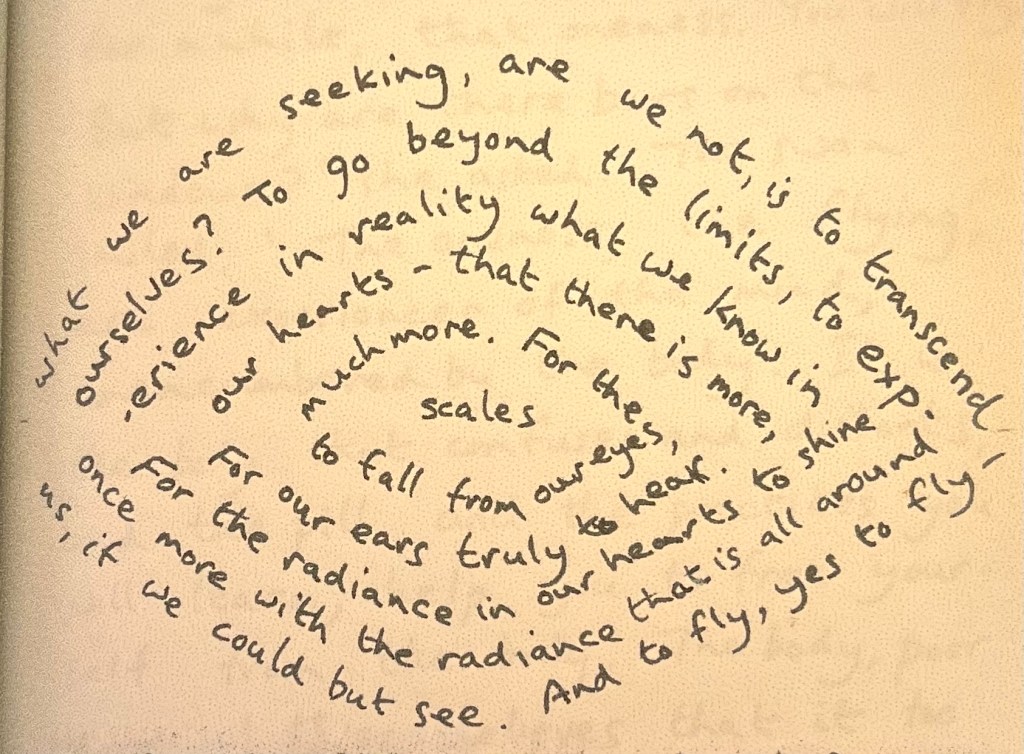
‘for in the world of true radiance, when we are one with the radiance – then, we fly.’
She said nothing.
‘The path to that experience is a long one. But to help, to give an insight, to encourage you to continue your journey along the path, we have a pill. If you take this pill here, where we provide to right atmosphere and guidance, then you will experience, for a while, that oneness. You will fly.’
‘But why are there bars on the windows?’ She asked. The swan smiled,
‘The oneness, the flying are experiences of the mind, unencumbered by the body. It is the body that confuses and distorts. The pill, and the practises you will learn help you to free yourself from the body. The body, poor deluded thing, believes that it too can experience the freedom, the oneness. It wants to hold onto the mind, to prevent it being free. It will destroy the mind rather than allow it to be free. We must curb the body …’
‘I don’t want to curb my body!’ Said swan heatedly, ‘I want to fly with all of me!’
‘You are young and proud, as this age is proud. But you must overcome your pride, your delusions. And we can help you overcome those illusions.’
I don’t want to overcome them. I want to achieve them. I want to make them come true.’ There was silence. Then he spoke again, slowly and quietly,
‘You are a child. You must, like all of us, learn for yourself. Go, go and find what the doctors and scientists say when you tell them what you want. Then I think you will see the truth of what I say. Then you will be ready to return. Begin across the street. Take care.’
Across the street was a brass plate on which was inscribed a name followed by many letters. Inside the receptionist made an appointment for later that day. The fee was large.
At the appointed time swan was shown into a small white room. On the wall was a screen, and facing it a large padded chair covered in black leather. A white-coated swan motioned her to the chair, and said, ‘how can I help you?’
‘I want to fly,’ said swan. The white coated swan thought for a moment, then said, ‘mm, I have just the thing for you.’ She checked along a shelf of cassettes, took one out and put it into the video player. Then she taped two wires to swan’s temples.
‘Now, you will experience a little, discomfort,’ she said. ‘But afterwards you will feel better, and no longer suffer from this tiresome desire. Desires are just habits, you see, and can be corrected straightforwardly.’
Swan began to protest, but at that moment the screen came to life. A group of swans was swimming slowly on a pond. It was very peaceful, and made her feel nostalgic for home, a feeling that was heightened by the pleasurable sensation that bubbled in her head.
Then the picture changed, to show geese flying across the sky. Swan’s heart jumped, filled with yearnings, as real as on the first day – except that his time it was accompanied by a wave of nausea pulsing through her. ‘Stop!’ She yelled.
‘Don’t worry,’ said the swan, ‘your unfortunate desire is the result of incorrect learning in cygnethood. We must help you to learn that swans are happy walking and swimming, and unhappy when they harbour desires that cannot be fulfilled. But you must help me. You must want to become well again.’ Before she could say anything the cycle of pleasure and nausea was repeated. She ripped off the wires and leaped from the chair. ‘It’s not an “unfortunate desire”, and I don’t want to be so-called cured. I want to fly!’
‘Oh dear,’ said the swan, shaking her head, ‘what a difficult case. It’s such a problem when the patient will not accept that she is ill. let me think. Well, I have doubts about his methods, but perhaps my – colleague,’ she said, with just a tremor of distaste, ‘can help you.’
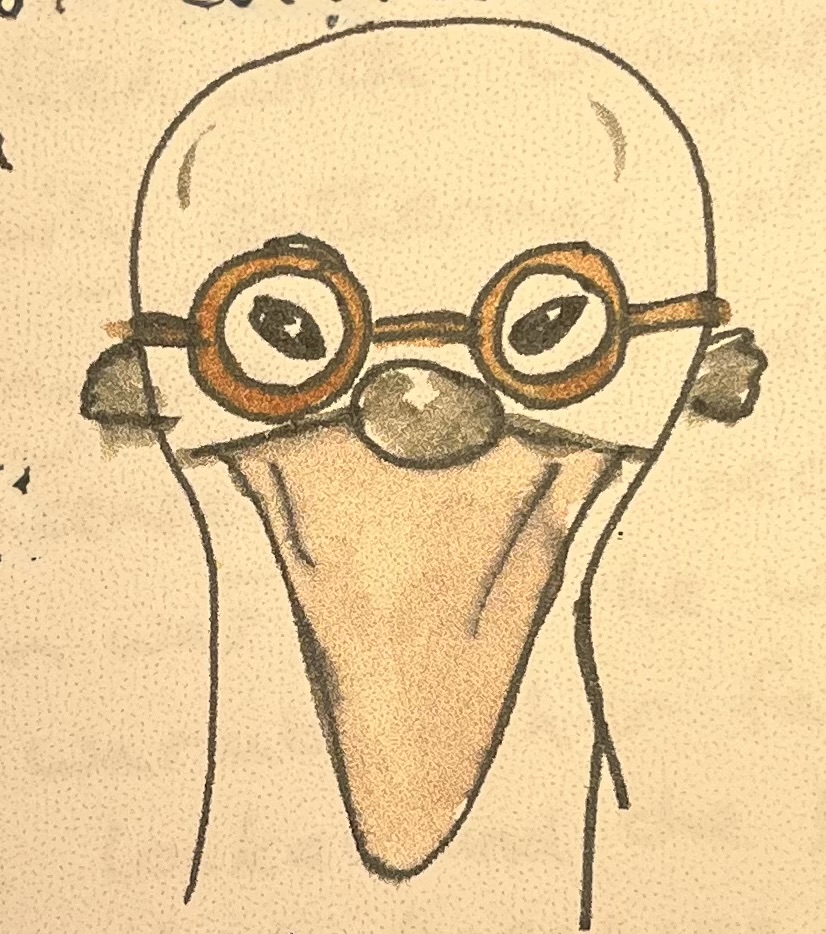
She pressed a button, and shortly after, into the room stepped a short swan with a massively domed forehead, and very thick spectacles, who began, ‘the association of the wish to fly with sexual …’ the door slammed and swan was gone, running as fast as she could from the city, and not stopping until she had left it far behind.
When at last swan stopped she sat down to take stock.
Her money was gone, and so was her confidence. Would it not be best to return home, tell them that she had been wrong, take her place once more in the society of the pond? Her mind filled with images of the pond – of family gatherings, of parties by the glittering waters, of solitary sunsets more intensely felt because when the sun was gone she could return to the warmth of her family.
She took out the locket and the book. The locket was her sister’s treasure. She remembered how her sister had saved for it, her pride in owning it. Was that what she would return to? She looked at the book. It was beautifully bound. She opened it and slowly turned the pages. Every one was blank. She smiled to herself. There was no going back. She had to go on. She had heard the voice and answered it, she had gone beyond the bounds of the pond world, and now she must search, to whatever the conclusion might be.
x x x
So began her wanderings. She worked here and there to keep herself, she followed up rumours and hints about flying, she read all the books she could find on the subject. There were a lot of them, many popular and sensational, a few arcane and difficult. Although wary, she would from time to time join up with a group or follow a leader, but they led nowhere. She came no nearer to flying.
At first the voice was always there, and that first feeling. But through repetition in thought, through reading, through the sheer pressure of living, gradually the voice faded, and the feeling, until they were only memories.
One day she passed a pond that reminded her of her home pond. It was a sunny day and the swans on the pond were going about their business relaxed and contented. Some cygnets were splashing about at the edge. She went nearer, wanting for some reason to be close to them as she watched. But as soon as they became aware of her presence they grew uneasy, moving away from her, until the smallest burst out crying, calling for its mother. The mother swan swam swiftly to them and ushered them away, looking darkly and suspiciously at swan as she did. Swan stood, helpless. When they were on the far side of the pond, swan looked at herself in the mirror water.

She had changed. Once she had disdained the life of the pond, rejected it as not enough. Now, when she saw the attraction of its small pleasures within the larger security, was drawn to it, she could not have that life even if she wanted it. Between the swan mother, who was about her age, and herself, there was a gulf. She was different. She was marked. She could not belong.
It was as if she had seen a treasured goal from the top of a hill, but to reach that goal she’d had to go down the hill and cross a plain dense with jungle, tangled, confused, trackless, without direction, without clue, with only the fading memory of the view from the hill top to sustain her. But had what she seen been real? Had it been a mirage, a figment of her imagination? Despair grew in her, and she walked blindly, not knowing where she was going, and not caring.
Suddenly she was aware that she was in a familiar place. A large tree here, a group of nests there, a pebbly beach by a swift-flowing river. But where? She had to descend deep into her memory of cygnethood before she could … of course!
The great-aunt she had visited once. She remembered her mother telling her how she had refused to leave and had to be dragged home crying. She had one letter of introduction left. It was addressed to her.
She greeted her warmly. Although she was sad to see that the bright-eyed perky cygnet who had such potential, had become dowdy, unkempt, dull-eyed and desperate. And yet she still asked the same question: ‘I want to fly – can you help me?’
She was silent for a long time. When she spoke it was quietly, unemphatically:
‘Some believe that swans could once fly, but that with the development of other faculties, we have lost that ability. Some believe that swans have the potential for flight, but that only through constant striving and conscious effort can that potential be realised. Some believe that flight is, has been, and always will be possible, but only for the few, who must guard the secrets lest they be misapplied.’
‘But what do you believe, auntie?’ Again she was silent for a long time:
‘My dear, each of us can only experience the truth for herself. Others can point the way, guide, but only you can know. I cannot show you how to fly. And for you to know what I believe really doesn’t help you.’
Then she felt quite helpless. Nothing mattered. She began to cry. She cried for a long time, until she hadn’t the strength to cry any more. When she stopped crying, she said, ‘I’m so tired, auntie. The voice has gone. When I stop moving, there’s nothing, just silence. And yet I remember it.’
‘Do you believe in that voice?’
‘I just don’t know. I used to know things, but I don’t anymore. I don’t know what I believe. For so long I’ve been searching for something, reaching for something, following trails, signs, always searching, reaching out. Now I’m tired. I don’t want to search any more.
‘I just want to live somewhere, do something.
‘I want to forget the great dreams and enjoy small realities. I want to take what I’m given, and make the best of it.’
She fell silent. She tasted gall and bitterness, for she knew, even as she spoke the words that she didn’t mean them, no matter how much she want to mean them.
Her aunt said, ‘would a job help?’
She laughed, ‘I’ve had dozens. They’re just ways of making money when I need it. But now – I need money.’
‘I’ve a friend who has a small business. I’ll write him a note.’ She thanked her. She was grateful. But also bitterly disappointed that she, of all swans, could not help her more.
x x x

“Swan’s Nest Builder” said the sign on the door. Swan went in, and found herself in a workshop.
It was lit by sunlight streaming in through high windows, so that parts were brightly lit, others lost in dusty shadows.
On the walls were hung tools that had the comforting look of instruments of exact purpose, long used and well cared for. It was quiet, none of the loud piped music of so many places she had worked.
The only sounds came from a swan of middling years who was adding sticks to a pile in front of him. She listened to his breathing, his occasional grunt, the low scrapes and taps as he worked the sticks into place with beak and foot.
Then it seemed that coming in with the sunlight were sounds from outside, the cries of playing cygnets, the wind soft in the trees, the lap of water.
The swan looked up briefly, nodded, and carried on. He worked quickly, but without haste, always using the stick that came to hand from the stacks beside him, never hesitating, his movements a continuous flow. Swan felt comforted, and a little mesmerised.
Then she was startled by a voice from the shadows: ‘and then he said, “it was a weir – I’d never seen a weir before.”’ The swan grunted. She looked towards the voice, and saw an ancient swan in the shadows, sat very still. ‘Like the estuary,’ she went on. ‘Oh yes – spice on the wind,’ said the working swan. Silence. ‘Floating – on the turn.’ Another grunt. They did not so much speak as put words into the air where they floated around, developing or fading, connecting up or dissolving. Swan felt excluded. But she stood there watching.
Then the swan stopped and looked at her. ‘Well,’ he said, ‘what do you reckon – easy?’ She admitted that it didn’t look too difficult.
But stood in front of the half-built nest she felt very different. Not knowing what to do, all she was aware of was questions – which stick should she choose? Why? Where should she put it? How? The questions, having no answers, paralysed her.
To break the paralysis she grabbed a stick and jabbed it into the nest. The nest shook and loosened. She tried pulling the nest around to tighten it up, but that only loosened it further. Soon it was a collapsing pile of sticks.
What had appeared random was in fact intricate, complex, exact. The ancient chuckled, and swan flushed. The working swan smiled, but sympathetically,
‘It’s always the same at first,’ he said.
‘It might be better if I started one from scratch,’ she ventured. Again he smiled. ‘I think you’ll find that starting is the most difficult part.’ She looked at him questioningly, and he continued,
‘I know, starting is easy. But starting something in the right way – in which the completion is in the commencing, although the path between that two is unknown, and each decision, each movement is a step into that unknown – that’s not easy.’ This was a bit complicated for swan.
‘We have no blueprints here – no blueprints on the wall, no blueprints in our heads. Every nest is different. Each is, as it were, the first. The sticks are always different, the customer’s requirements are always different. All I have is my skill, which is me. I work in this moment, which becomes the next moment – or is it that the next moment becomes this? I’m not sure. The nest comes into being. At some point the nest finishes with me. Then I’ve done my job.’
Swan was silent, confused by all these words, not sure that so basic and straightforward a task as making nests should require such complex thoughts and explanations.
He resumed his work. At first she watched dutifully. But then once more his skill worked its magic, and she watched enthralled, understanding a little, just a little of what he had said.
As he worked he talked – of the scientist who had come to discover their secret, because tests had shown that their nests were lighter and stronger and more comfortable than the finest factory-made ones. ‘“There is no secret,” we said. “Everything is hear to see.” He looked around, took measurements with his instruments, but he left baffled. Oh yes, they have blueprints in factories, and machines, so that anyswan can knock them out in no time. But they’re not the same at all.
‘They build factories because they’re more “efficient”, with their machinery and division of labour. But in a factory a swan is diminished. He’s a less whole worker, which means less resourceful, less skilful. So they invent new machines to make up for the diminishing skill, which diminishes him further. And so on. Until instead of having many skilled swans actually producing, you have a few very skilled swans designing machines, and a lot of automata operating them. Which produces lousy nests because they have no feeling put into them. And what happens when the automata go home and try to become whole swans again …?
‘And of course there were problems with the sticks, because the machines couldn’t cope with the natural variations. So they started growing them specially, in monocultures. And then it was only a short step to dispensing altogether with natural sticks, and making them of synthetics, totally uniform in shape and material. So there are factories to serve factories, which require vast quantities of raw materials and power.
‘Not that some of the workshops were any better. Some so fragmented and specialised the work that the makers became as diminished as in the factories. Others stuck rigidly to old ways, each nest made exactly the same. “Tradition” they call it. I call it laziness.’
And much more. At the end of the day, swan’s head was reeling. But as she walked to the home her aunt had found for her, her mind was filled with the image of the swan working – she would be proud to work like that.
x x x
But it was to be a long time before she had a chance to learn nest-building. Her first job was very different. It was to sort and prepare sticks. Each morning she faced a huge heap of sticks, which she had to separate into piles according to length and thickness. She shared this task with two swans who set a cracking pace that she was unable to match.
After the first hour of the first day she was exhausted, and only a great act of will got her through. At first each hour felt like a day, each day like a week.
At the end of the first week she went to the nest builder and told him that the job was too boring, that she was capable of better things, and that he must transfer her. He looked at her for a while and then said simply, ‘it is necessary’, and resumed his work. She didn’t understand what he meant. But she did understand that if she wanted to stay, she would have to do the work she was given.
Gradually she developed a facility, and found that after a while she could do the job without thinking. But this brought problems.
At first she let her mind wander, daydreaming happily. Except that after a while the thoughts began to repeat themselves, and a series of thoughts would lock themselves into a loop and repeat and repeat, each repetition seeming to scrape a layer off ‘knowledge’. And beneath ‘knowledge’ was – chaos. Knowledge, it seemed, was not a collection of things, but a membrane which separated that unique creature, swan, located in time and space, distinguished by her personality and experience, from that which is everything and nothing, which is everywhere and nowhere, which is ‘existence’. When the membrane was gone and she and existence seemed on the point of merging, then she was frightened.
She invented mental games to divert herself. As she worked she would recite the alphabet backwards, or count sticks as she placed them, squaring each number; or solve complicated problems of mental arithmetic. But sooner or later the circling thought would return, scraping, scraping. And the circling thoughts were a spiral which drew her down and down, towards a dead centre …
That was one mood. Another was a smiling happiness, an elation that would swell inside her like an iridescent bubble of feeling and warmth. Some small incident would trigger her awareness, and at that moment the past would extend like a thread behind her, a thread linking a series of consequent events that led up, naturally, to this moment. And the thread would extend into the future, drawing from the future a pattern that did not exist, but which, at the instant that each moment came into being, was exactly as expected. At such times the workshop, the world, her life, the work she was doing, were all wonderfully right. Each object was vivid, each thought luminous. Everything fitted. The mood never lasted long – in fact it hardly survived her awareness of it – but it was a good mood.
But they were just moods. And soon she began to see them as moods, perturbations on the surface of her being, products of the interaction of self and circumstance. They were moods, fickle, products of the moment, without substance. From there it was a short step to seeing all her actions, her ideas as products of the moment. Everything was relative. She questioned many thoughts and ideas she had taken for granted, and found them to have little substance. Her thoughts were unrelated to her actions. Her dreams were escapes. There was, suddenly, very little to hold onto.
Only her work, the fact that each day she had to begin work, to continue it for a certain time, kept her going. The givenness of her work helped her through her crisis of uselessness. The only way she could cope with her work was to concentrate on it, to concentrate on what she was actually doing, to the exclusion of everything else. Only by doing this could she avoid the equally unfulfilling moods of elation and depression, and the awful sense of her own insignificance.
At first it was hard work. Just to keep her mind on the job required great and unaccustomed concentration. For a long time, she realised, she had mistaken day-dreaming – the experiencing of thoughts that came into her mind – for thinking.
And she found that her concentration had to be of a certain kind. If it was too specific, she would go into a revery upon each stick, experiencing its individuality, its origins, its life, the structure of its cells, the micro-organisms that lived upon it … she would stand in wonder. Too general and she would see endless mountains of them, tomorrow’s the same as today’s, and become paralysed.
Gradually she developed a consciousness that was unconscious. She learned to sort sticks.
While on stick-sorting she envied the swans she worked with. They worked automatically, without thinking about it, chattering about their lives; and they worked better than she. But later, when she began nest building, she noticed they had stayed in sorting.
Nest building was another world. When she entered the workshop on the first morning, it was strangely familiar, as if she had come home. Her experiences in the sorting room had so prepared her, so swept her clean, that she was ready.
She worked with an experienced swan, who taught her the techniques of hand and mind that were involved in nest building. In her spare time she worked through problems that were puzzling her, asked questions, read books. Her life was nest building.
More and more she experienced her work as a microcosm of life. Her studies and observations radiated further and further from her work. But they always returned to it. Time passed. She became a good nest builder. She changed. She became physically stronger. Her life came to have substance.
x x x
It was evening. The big log fire crackled. Its glow played upon and warmed everything it touched. The swans were relaxing. They had been working very hard, and were enjoying the chance to chat aimlessly, to be in pleasant company. Outside the west wind blew. Swan loved such evenings – the tiredness after a hard day, and the companionship she shared was her present life; the blustering wind reminded her of her youth, her home, long ago.
Suddenly the door opened with a clatter. Swan looked up. It was the swan she had met that first day. He stood for a moment, shaking the rain off his feathers. With the drops of rain fell a leaf, a strange leaf swan had never seen before. She was about to comment when she looked at his face and checked herself. Their eyes met for a moment. Her heart lurched. A memory, long-forgotten, came to her perfectly clearly. And a voice. She felt suddenly joyful.
And yet she knew she must not speak.
For what seemed an age he talked to one of the other swans, then wished them all goodnight and left. Swan hurried after him.
With a gasp she stepped out into the windswept night. For a moment she hesitated as the wind buffeted and cut through her. Was she not, now, too old for this? Hadn’t that moment in her life passed? She dismissed the thought, opened herself to the cleansing freshness of the night, and set off after the swan who was disappearing into the wood that lay between the house and the big lake.
She was blown about by the wind, torn by branches and briars as she hurried to keep him in sight. Above her the moon raced wildly through the branches and torn clouds. The rain had stopped but the wind blew and moaned, alive and enlivening. At last she came to the lake, vast and dark, its surface choppy, cold spray slapping suddenly up into her face. Then the swan was behind her, saying, ‘watch.’
Three swans swam out from the edge of the lake. Then they were leaning forward, their necks stretched out, their wing beating onto the water with tremendous power, their great webbed feet stamping at first through then upon the water. Swan watched, holding her breath, overwhelmed by the power and the longing and the fierce beauty as after an age of fighting through the foaming water the three great birds became airborne, were flying with indescribable power and freedom. They had come into their own. Tears filled her eyes.
The swan led her to the water’s edge.
Carefully he instructed her. how to use her wings and feet, the correct position of head and neck, what to do with her tail.
But mostly he talked of things of the mind. Of the balance between desire and energy, of the placing of her attention precisely, of the relationship of mind and body.
This was the first of many nights of instruction and learning and exercises. For swan it was a coming together of the dreams and studies and searching of her early years, with the practical disciplines of her present life.
In the water, practising the physical and mental processes involved, several times she felt herself on the very edge between water and air, when it seemed that only the slightest extra effort would see her airborne – but always the older swan restrained her.
One evening, after a long and arduous training session, he said, ‘right, now’s the time.’ Swan was startled, almost protested that she was not ready, was too tired. But soon she was swimming out to the middle of the lake. The lake was so vast, she was so small and alone. She turned into the wind and set off slowly.
She stretched forward and began flapping her wings, slap, slap, slap onto the water, her feet stamping, her attention focussed on the surface that both separates and connects water and air.
On and on. Her body protested, her mind was tired, surely she was not ready, surely this not the time, surely she would never … as her feet were suddenly released from the gluey grip of the water and the wind swept under her wings and she was in the air.
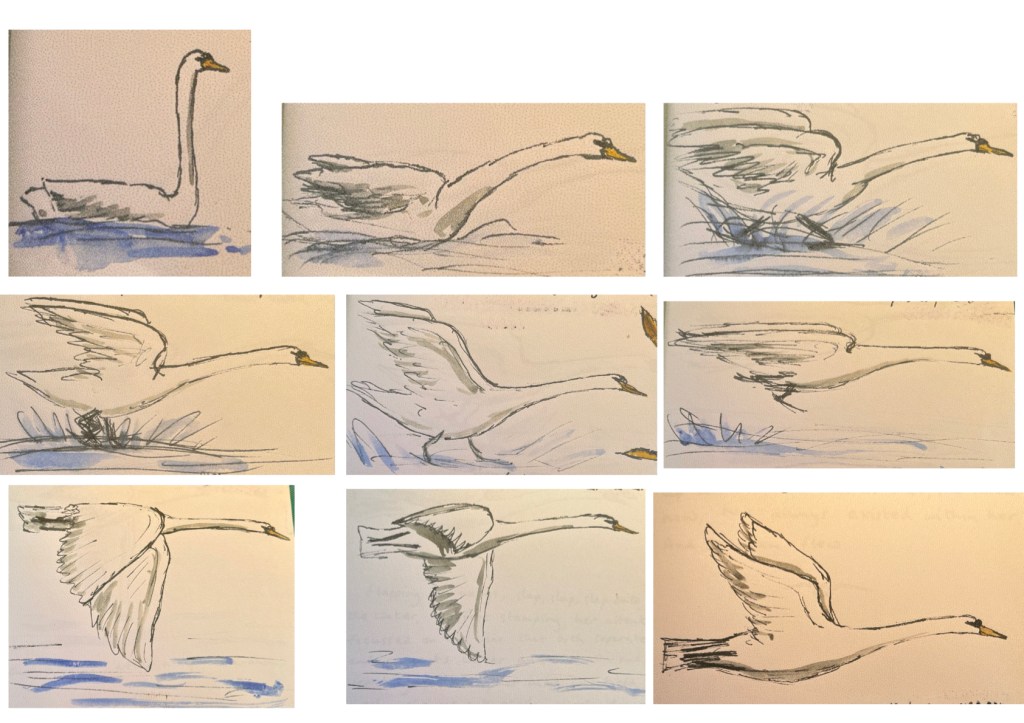
A door opened and she passed from a small dark room into a glorious golden world of limitless possibility …
before she hit the water with such a crash that the others had to drag her out.
When she had recovered, the swan smiled at her and said, ‘you started to dream, didn’t you? Don’t worry, we’ve all done it. Your attention must never waver.
‘Flying is not a pleasure to be enjoyed but a state that can, at first, only be maintained by absolute focussed concentration.
‘It is a freedom: not a freedom from, but a freedom to do. It happens when you are completely responsible for yourself.’
She hardy heard his words. She felt only joy.
She practiced and she flew, she became better at flying, and she flew far and wide.
Her experiences, flying, are another story.
Suffice it to say that the new world that was opened up to her was a world that, she knew now, had always existed inside her. And so, swan flew.

SWAN SONG
‘Have you seen a swan upon a lake?
As she moves, so fine and stately,
A fair and perfect lady,
A living curve of whiteness
And so effortlessly free
– But held down by the legs that you can’t see –
So she hisses out in anger
When she feels herself endangered,
When you come too close for comfort
And she feels herself less free.
‘Have you seen a swan about to fly?
As she leans into the water
And her wings are beating faster,
Her feet are pounding madly
As she’s straining to be free
– And awkwardness the only thing you see –
But the beauty of a creature that’s
Not swimming now nor flying yet,
But reaching for the vision she can be.
‘Have you seen a swan in the sky?
The air is all around her,
And the earth far beneath,
Her wings in perfect motion
And her head stretched to the sun
– You stand below and feel it quite alone –
As she shrinks into the distance,
And the sun Is slowly sinking,
And you’re thinking to yourself,
what has she done?
‘Standing very still upon the ledge
As the water flows beneath me
And the sky is wide above,
Trembling with uncertainty,
Shivering with love
– Remembering the time that was the best –
When we stood upon the bridge between
What might have been and what might be,
That moment we were standing on the edge.’
 my writing